







Abstract
With advances in science and technology, nanofluids are the ultrafast heat transfer fluids which effectively empowers the distillation process. In this research article, N-evacuated tube collector (N-ETC)-coupled single slope solar still-equipped built-in-passive condenser and roof-top semitransparent photovoltaic (PV) module have been analyzed incorporating carbon quantum dot nanoparticles (CQD-NPs). The effect of volume concentration of nanoparticles (NPs) and packing factor (βc) is tested to study the system performance (thermal and electrical). The use of CQD-NPs showed impressive enhancement in thermal conductivity (56.06%), Reynold's number (
Keywords
Introduction
Solar energy is an ample source of energy and its maximum utilization should be the first priority in order to preserve our non-conventional sources of energy. Nowadays, drinking water sacristy and clean electrical energy production is the global concern. We not able to balance the demand-supply equation of drinking water and clean electrical energy for human kind and this problem is getting more complex day by day. Human kind may survive without electricity or other essentials for some period but clean drinking water is the basic necessity of all living organism everyday on the planet Earth. With advances in material science, nanotechnology and thermal science, researchers and engineers continuously put efforts to find alternative technologies or methods (multiple effect desalination, microbial electrosynthesis, reverse osmosis, etc.) to produce clean drinking water from saline or filthy water. Solar distillation is one of the ancient, environment friendly technologies to produce drinking water utilizing an ample source of energy (sunlight). In last few decades, in literature, researchers have already reported experimental and theoretical work on passive and active solar distillation systems and put a lot of efforts to improve the solar still efficiency by changing design and non-conventional external integrations.1–7 The productivity is directly proportional to the heat transfer mechanism inside the solar distiller, its area and design. The productivity or efficiency is reported low and it becomes difficult to meet the drinking water requirements for a small family in arid-regions. Active solar distillation process is more effective than the passive distillation process as reported in literature. Efficiency of these systems can further be improved incorporating and testing different types of external thermal energy providers (photovoltaic thermal flat plate collector (PVT-FPC), evacuated tube collector (ETC), and photovoltaic thermal compound parabolic concentrator (PVT-CPC), etc.), basefluids (thermal oil, EG, etc.), different nanoparticles (NPs) (CuO, SiO2 Al2O3, etc.), PV technology (c-type, a-type, mono, SPV, etc.) and other minor/major modifications in the system designs.
Today, with advances in science and technology, nanofluids are available as the ultrafast embryonic fluids and behave as an excellent heat transfer carriers in solar thermal systems; and it is credited to their better thermo-physical properties (thermal conductivity, viscosity, density, and specific heat).8–12 At the lower nanoscale (diameter below 10 nm), materials characterization is difficult and raises their cost of processing/embodied energy (EE) but it make them highly efficient due to their extremely good thermophysical properties. Better heat transfer mechanism of nanofluids is credited to the better absorption characteristics of assisting carbon quantum dot nanoparticles (CQD-NPs), which is due to the maximum overlapping of the spectrum of optical absorption spectrum and solar radiation. Moreover, in fluid suspensions, Brownian motion plays a vital process which controls the thermal behavior of NPs; and the interfacial nanolayers change the viscous forces, which in turn improves the heat transfer rates.
Lui et al. 13 reported the study of evacuated tubes and ultrasonic foggers integrated developed passive solar distillation system using foggers and CO3O4 nanofluids. As the high productivity depends on the temeprature differnces between two surfaces; they operated the system via cooling down the external condensing cover and reported efficiencies of 83.87%, 18.29%, and 38.86%, potable water production, energy efficiency, and exergy efficiency, respectively. Also, the cost per liter of potable water is lowered by 11.61%. Abdelaziz et al. 14 performed a detailed analysis of the tubular solar still-incorporated five major additions, viz. (1) v-corrugated aluminum basin, (2) wick material, (3) carbon black nanofluid, (4) pure paraffin-wax phase change material, and (5) v-corrugated basin combined with wick. They reported efficiencies of 82.16% and 221.8%, respectively, enhancement in thermal energy and exergy efficiencies for the best case (v); and minimized around 22.47% cost in comparison to the conventional tubular solar still. Later, Chen at al. 15 performed the stability and performance analysis of solar still using of low-cost carbon quantum dots (CQDs) saline water-based nanofluids and they reported 57.9% rise in daily potable water production in compared to the conventional stills. Also, they found 34.23% and 21.52%, respectively, average energy efficiency with or without using CQD-water-based nanofluids; with 0.013–0.015 $/L cost of potable water production with CQD NPs.
Alsaiari et al.
16
experimentally analyzed the performance analysis of TiO2/Jackfruit peel nanocomposites (green synthesis) in solar distillation system. They reported 50.55% improvement in daily productivity (8.7919 L/m2) as comapred to conventional solar still. Arora et al.
17
analytically analyzed partially covered N-PVT-CPC integrated solar still equipped with helically coiled heat exchanger (HCHE) incorporating MWCNTs and SWCNTs. They studied the HTCs, Nusselt number, thermal energy/exergy, economic viability and daily productivity; and found significant improvement in natural convective HTCs (46.4%) of fluid collector, heat exchanger (HE) (46.7%) and double slope solar still (76.7%) sections for SWCNT-NPs. From their analysis of the proposed system operating with and without HCHE, they suggested the necessary use of HE as a medium in the solar distiller section for the proper flow of the nanofluid; and it resolve the major issues like sedimentation, clustering of NPs, re-collection of original nanofluid, separation of NPs from the host fluid, and the reuse of nanofluids, etc. The external thermal energy from its outlet (PVT-FPC, PVT-CPC, ETC, etc.) can be in plugged directly (high efficiency) or via HE (relatively bit low efficiency) to the solar distillation unit (in case of nanofluids) as suggested above. Deshmukh et al.
18
executed the experimental investigation of heat transfer characteristics, friction factor and solar thermal efficiency analysis of TiN-nanofluid filled U-pipe ETCs; and they reported the improvement in overall efficiency by 70.9%. Abdullah et al.
19
experimentally investigated the performance of rotating wick solar still using two different designs, viz. (1) a path of “L” character shape (
Based on the thermal energy and exergy, analysis of CO2 mitigation and life cycle analysis (energy matrices) is an integral part of the performance analysis of the solar thermal systems. Kumar et al. 23 experimentally performed the detailed performance, thermo-enviro-economic and thermos-economic analysis of SSSS and DSSS using silver nanofluids for better design optimization. They reported 41%, 5.63%, and 7.35 kg/m2 daily thermal energy, exergy and productivity output, respectively, for 0.8 cm water depth; also, they reported 7.97 tons of CO2 mitigation. Exergo-economic and enviro-economic analysis is an important method; and it help the designers/manufacturers to find complementary procedures for the system efficiency improvement. Dhivagar et al. 24 depicted the performance and enviro-economic analysis of modified solar still using black iron oxide magnetic powder as an energy storage material. They reported 39.8%, 14.5%, and 31.2% improvement in evaporative heat transfer rate, convective heat transfer rate and productivity in comparison to the conventional solar still. They also analyzed thermal energy and exergy efficiencies and found significant enhancement around 18.9% and 19.04%, respectively. In addition, from the exergo-economic analysis, 45.53% improvement in CO2 mitigation have been reported in comparison to conventional solar still. Modification in system design effectively improves the system performance; Shatar et al. 25 analyzed the energy/exergy, enviro-economic and exergy-economic analysis of partially thermoelectric cover cooling-based partially coated roof-top condensing cover solar still. Cooling to the roof-top condensing cover help to maintain the higher temperature difference between the two surfaces which intern raises the evaporation mechanism in the distiller chamber. They reported 128% enhancement in potable water output with 36 W thermo-electric cooling capacity; and 2.97 tons of CO2 mitigation with 0.036$/L final productivity cost.
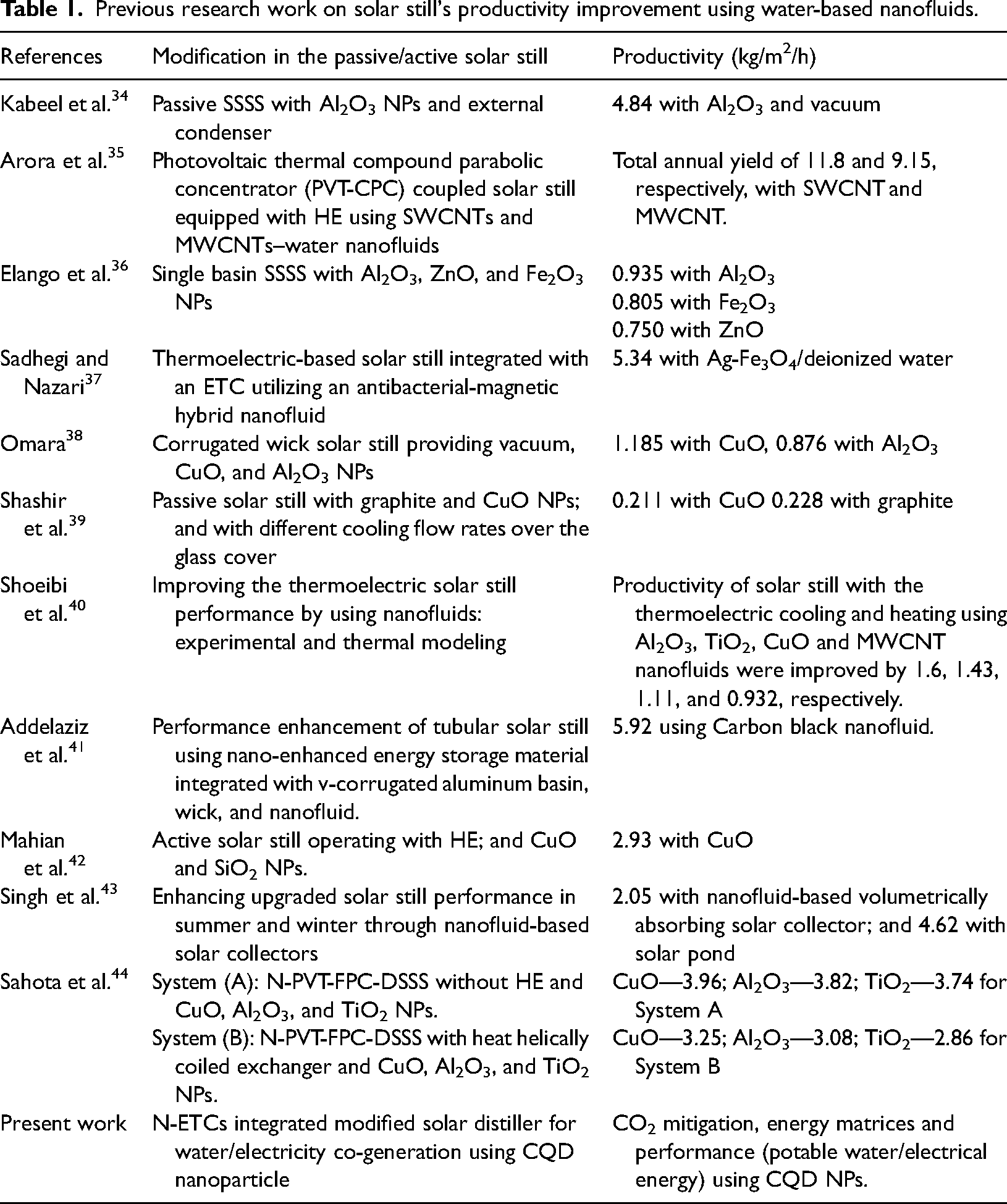
Nazari et al. 26 performed the energy, exergy and cost analysis of SSSS using the CuO nanofluid; and they reported 81%, 80.6%, 38.5% enhancement in thermal energy, thermal exergy efficiencies and productivity, respectively, with optimized 0.0218 ($/L/m2) cost and 13.8 months energy payback period. In detailed review, Iqbal et al. 27 put efforts to highlight the desalination process in solar stills incorporated with different nanofluids and their innovative progress in the last decade. With the advancement of nanotechnology, and photovoltaic technology, they favored the use of ultrafast heat transfer nanofluids to raise the thermal system performance (desalination process) with promising economic and environmental benefits. In recent times, many researchers reported work on solar distillation systems incorporating nanofluids and reported the performance of solar distillation systems coupled with different external thermal energy supplier systems (PVT-FPC, PVT-CPC, ETC, etc.) using water as a basefluid but very few researchers have reported with the use of different NPs (Al2O3, TiO2, CuO, MWCNT, SWCNT, ZnO, SiO, SiO2, SiC, etc.) assisted nanofluid in these hybrid systems with design modifications for the performance and thermo-exergo-enviro-economic analysis. Daily productivity of different designs of solar stills using nanofluids is presented in Table 1.
Previous research work on solar still's productivity improvement using water-based nanofluids.
In normal passive or active or hybrid solar distillation system, condensation process takes place on the inner surface of the roof-top glass cover but raises its temperature; and lower down the potable water production as mentioned earlier. In present system, modifications have been made by replacing the roof-top glazed cover of SSSS chamber with the semitransparent PV module; and a separate built-in-passive condenser have been fitted on the rear wall of the SSSS (non-exposed to solar light). Also, a D.C. fan is connected at the top corner of the SSSS to suck and transfer water vapor's from solar still chamber to the built-in-passive condenser section shown. In the proposed system, the efficient heat transfer unit, ETC is integrated to the solar still section via HE, which is used for proper circulation of CQD-water-based nanofluids. The effect and the use of βc on the system performance is discussed in detail in the next section. In general, the proposed system is N-evacuated tubular collector (N-ETC) integrated single slope solar distillation system having roof-top semitransparent PV module equipped with HCHE and built-in-passive copper condenser (circulation mode) using CQDs water-based nanofluids. Mathematical modeling has been developed to analyze the detailed performance and energy/exergy-based enviro-economic analysis; and the system is tested as a function of design, packing factor of PV module, nanofluid concentration, and climatic parameters valid under any circumstances. Numerical computation is executed for the climatic parameters of New Delhi, India, to evaluate daily productivity, thermal performance, heat transfer characteristics, the thermo-physical characteristics, overall electrical energy; and overall thermal energy and exergy outputs of the system. The analysis have been carried out for (1) CQD-NPs volume concentration (
System description and design modification
In the proposed system (Figure 1), series connected N-ETC-fluid collectors

(a) N-evacuated tubular collector (N-ETC)-integrated SSSS and in-built-passive condenser (N-ETC-SSSS-PC) via HCHE. (b) View of semitransparent PV module with different packing factor (βc). (c) Side view of the semitransparent PV module. (d) Labeling of different components of ETC. 45 (e) Schematic view of (a) HCHE (HCHE) and (b) passive copper condenser.
As we know, during the condensation process, vapors lose their latent heat of vaporization and gets condensed at the inner surface of the semitransparent PV module. It raises the inner surface temperature and ultimately reduces the final productivity (potable water) of the system which is due to the fact that productivity or yield directly depend on the temperature difference between the stored water surface (saline water) and the inner surface condensing cover, which affects the evaporation rate. Keeping in mind about this, present system is further modified and two condensing surfaces in the present system have been involved, viz. (i) roof-top semitransparent PV module of area
Opaque (solar cell) and transparent (double glazing) parts of roof-top semitransparent PV module partially reflects the incident solar radiation; and major portion of it reaches the solar still chamber and absorbed direct by the saline water in SSSS section. Also, it is absorbed by the nanofluid flowing (circulation mode) in the HCHE section; and blackened surface (thermal storage). The circulation nanofluid releases its heat to saline water available in SSSS section and raises its temperature significantly. Apart from the direct absorption of solar radiation in SSSS section, blackened surface also transfers its stored thermal energy and contribute to raise saline water temperature. Hence, the evaporation mechanism is progressed through this mechanism in the proposed system and significantly improves its heat transfer rate in solar still chamber. With modification in the proposed system, role of heat and mass transfer sink is played by additional built-in-passive condenser and D.C. fan continuously sucks water vapor from the solar still chamber and transfer to the condenser section for the condensation process. Major portion of the condensation takes place in the condenser chamber eventually collected in the measuring jar under gravity. Operation and maintenance of HCHE and built-in-passive condenser in the proposed system is easy and it do not any complexity. HE is found to be more effective than straight tube HE in the literature, resulting in a higher heat transfer rate of tubular surface. Necessity of the HE is for the use of nanofluid or other fluids except water only; because NPs can be extracted easily form the basefluid after its use and it can be effectively used without its loss during circulation. Heat from the circulated CQD-water-based nanofluid is transferred to the saline water via HE.
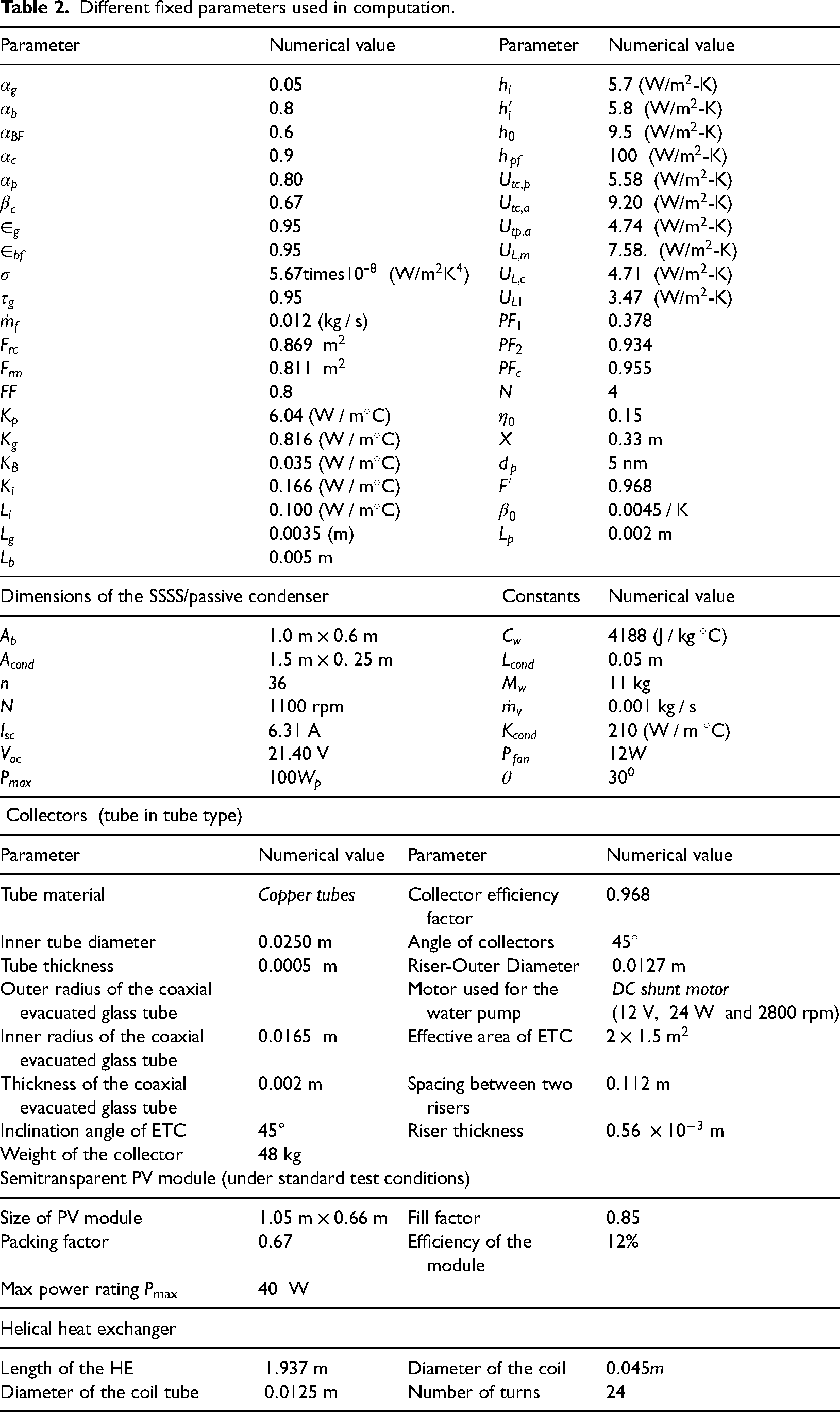
Although present system without operating HE has higher efficiency (direct thermal energy transfer to SSSS chamber) but it is not feasible for the case of using NPs because of NPs sedimentation, and cluster formation results their inappropriate circulation in solar still section which in turn creates their low chances of recovery from the basefluid. These issues can be resolved with the help of some separation nano sized particles-technologies which can be predicated on the NPs/size, base fluid's type, volume fraction, and thermal/optical properties, etc. Energy storage plate and saline water of solar still section directly absorbs the major portion of the incident solar radiation. Eventually, basin thermal plate, direct solar absorption, external thermal energy transfer (ETC), ultrafast thermophysical properties of CQDs, HE transfer rate all works together to raise the temperature of the saline water in the basin. After evaporation and condensation process, major portion of potable water is collected at the bottom of a built-in-passive condenser; also, some portion of it is collected at the lower end output of the SPV module through a channel/pipe as shown in Figure 1. Moreover, Table 2 lists the specifications for the proposed system's solar still and other sections.
Different fixed parameters used in computation.
Mathematical modeling
Following assumptions have been made to study the performance of the proposed:
Quasi-steady state is maintained on every hour of the day. All heat exchange points follow the Fourier's law of heat flux. The quoted values of thermos-physical characteristics through aid of numerical computation have been calculated averaging over every hour. No radiation exchange occurs in the second condenser. Proposed system is leakage free.
Roof-top semitransparent PV module of the SSSS section (first condensing cover)
Solving the above equation, Blackened surface of the SSSS section Solving above equation, the basin temperature Basin water of the SSSS section Here, the value of where Unknown terms are given in the Appendix.
Helical HE immersed in basin water of the SSSS section
Boundary conditions (BCs): Solving Eq. (4) using above BCs, Substituting Built-in-passive condenser (second condensing cover)
Energy balance equations of different components of the proposed system:











From the above equation, the condenser temperature

On solving Eq. (3) using Eqs. (2), (4), and (12), we get,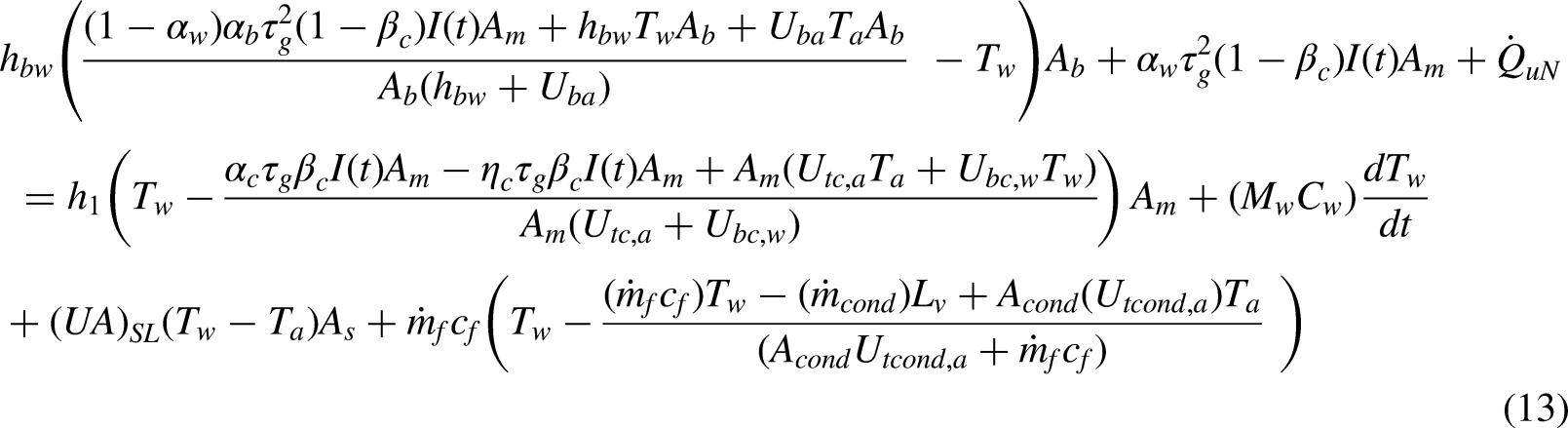
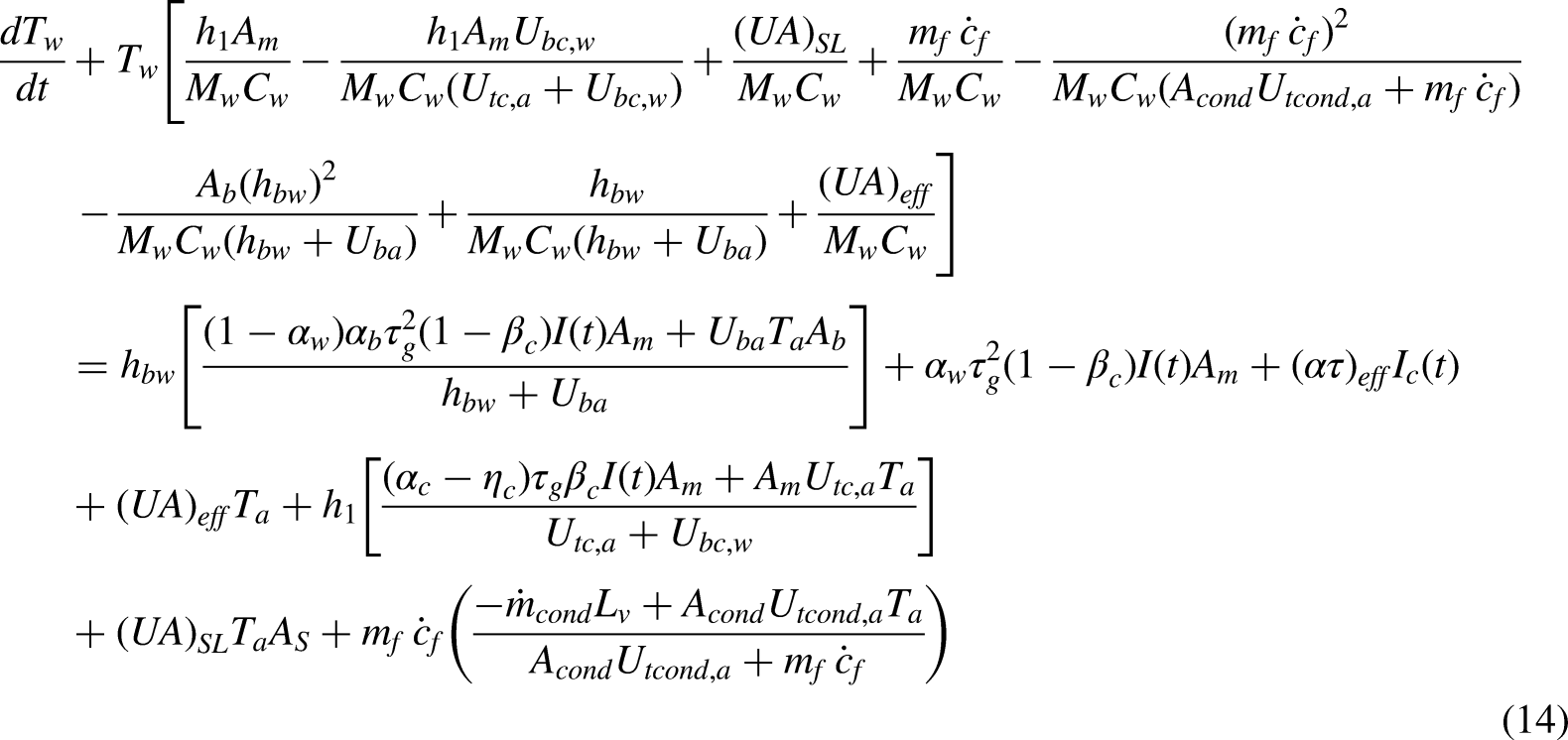


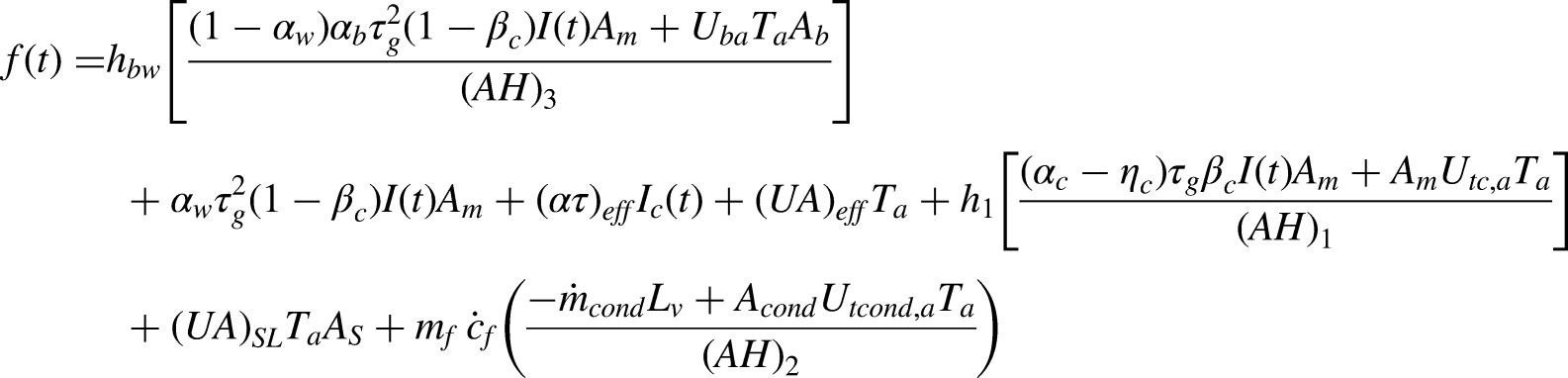

The rate of vapor condensation on the inner surface of semitransparent PV module cover (minor contribution) and in-built-passive condenser chamber (major contribution) can be estimated from the following expressions:

The hourly energy and exergy are
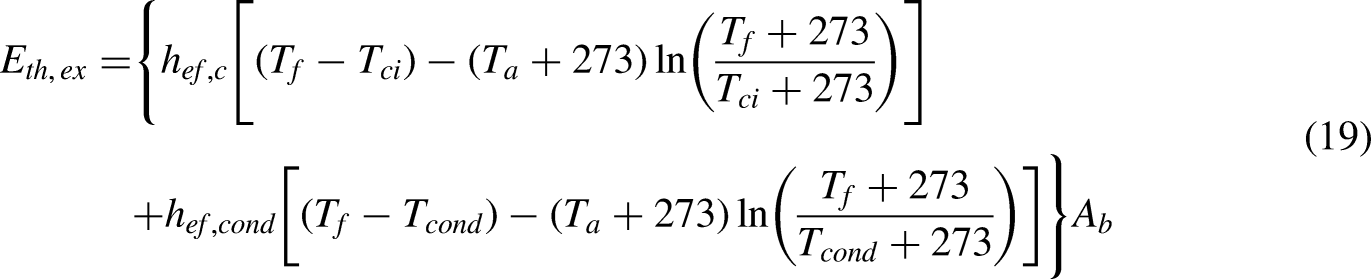







Furthermore, the rate of condensed water in kg/h is expressed as





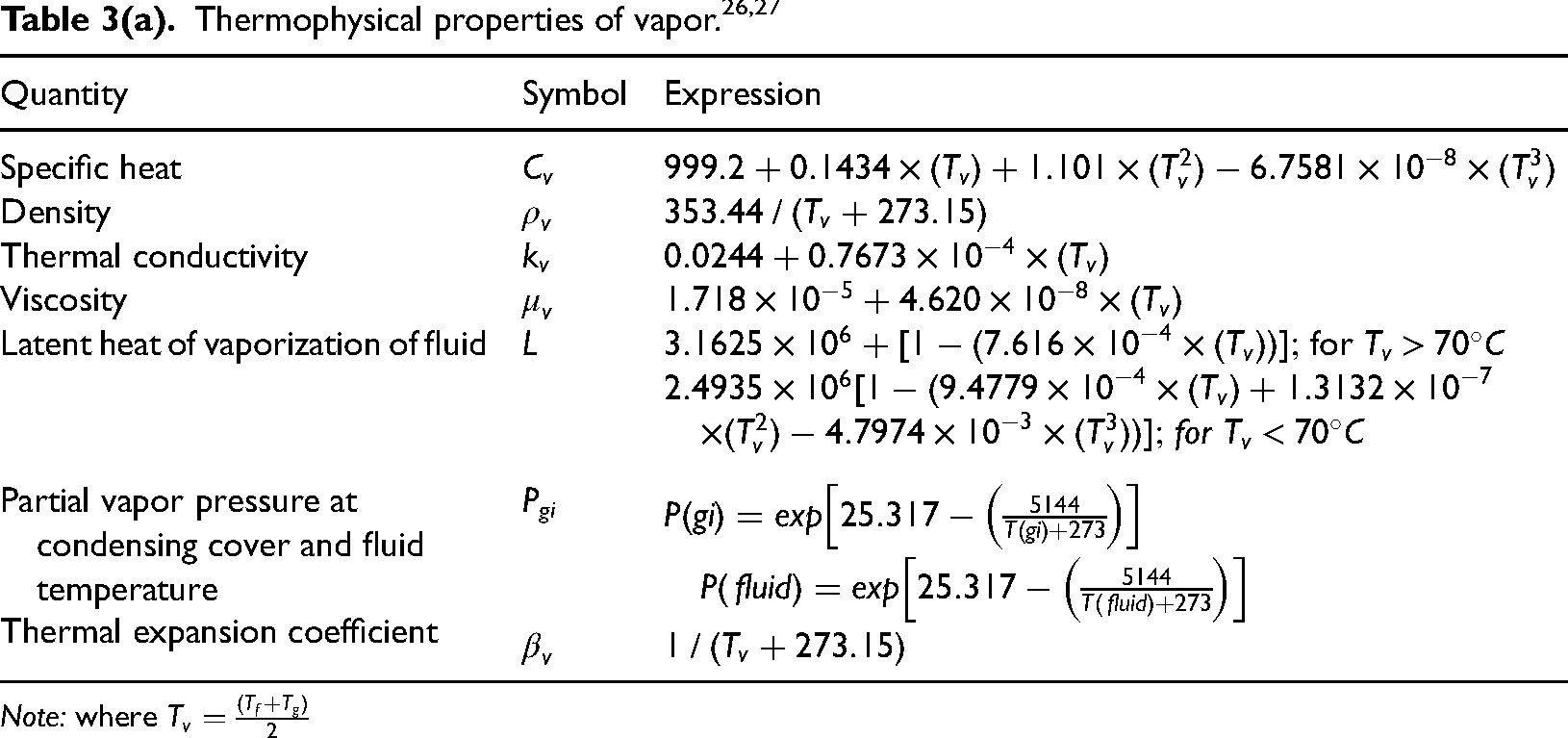
Note: where
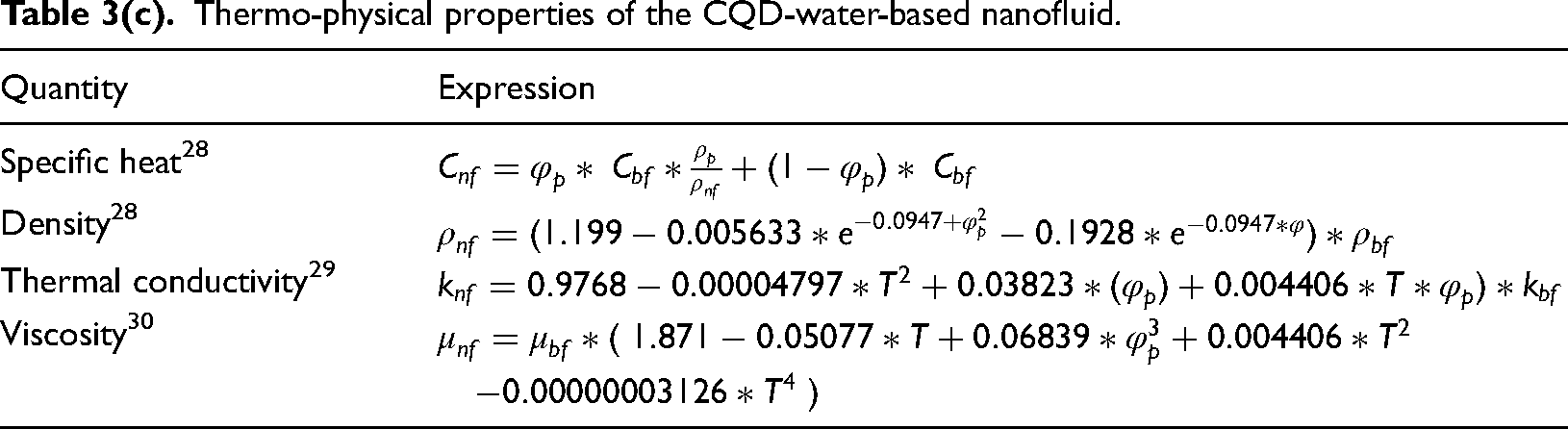
Thermo-physical properties of the CQD-water-based nanofluid.
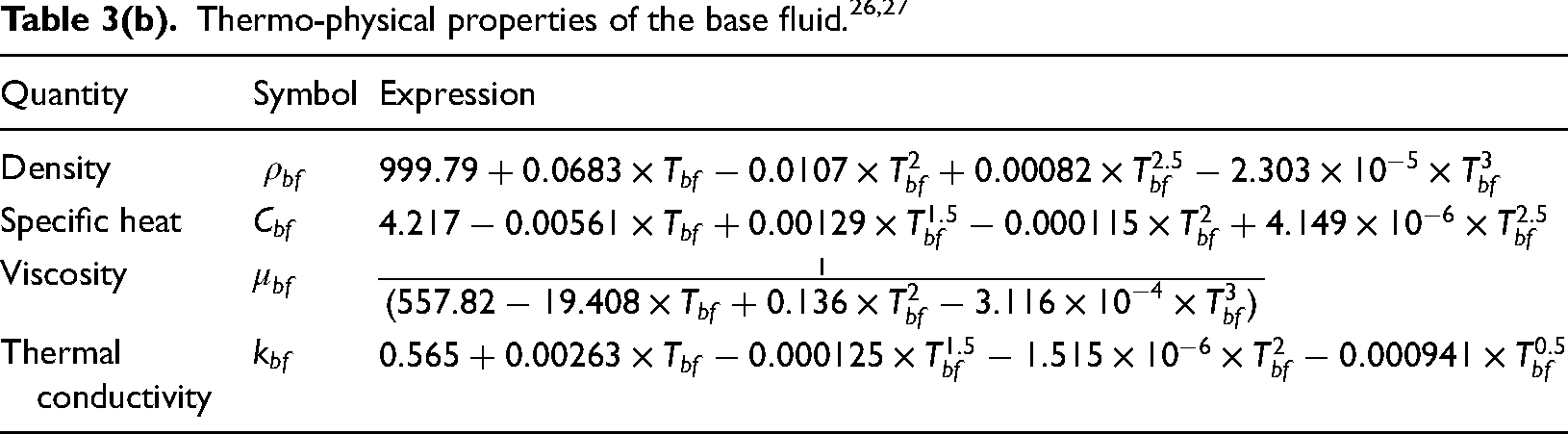
Thermo-physical properties of CQDs-NPs and the base fluid (water).

Energy matrices and CO2 mitigation (environmental cost)
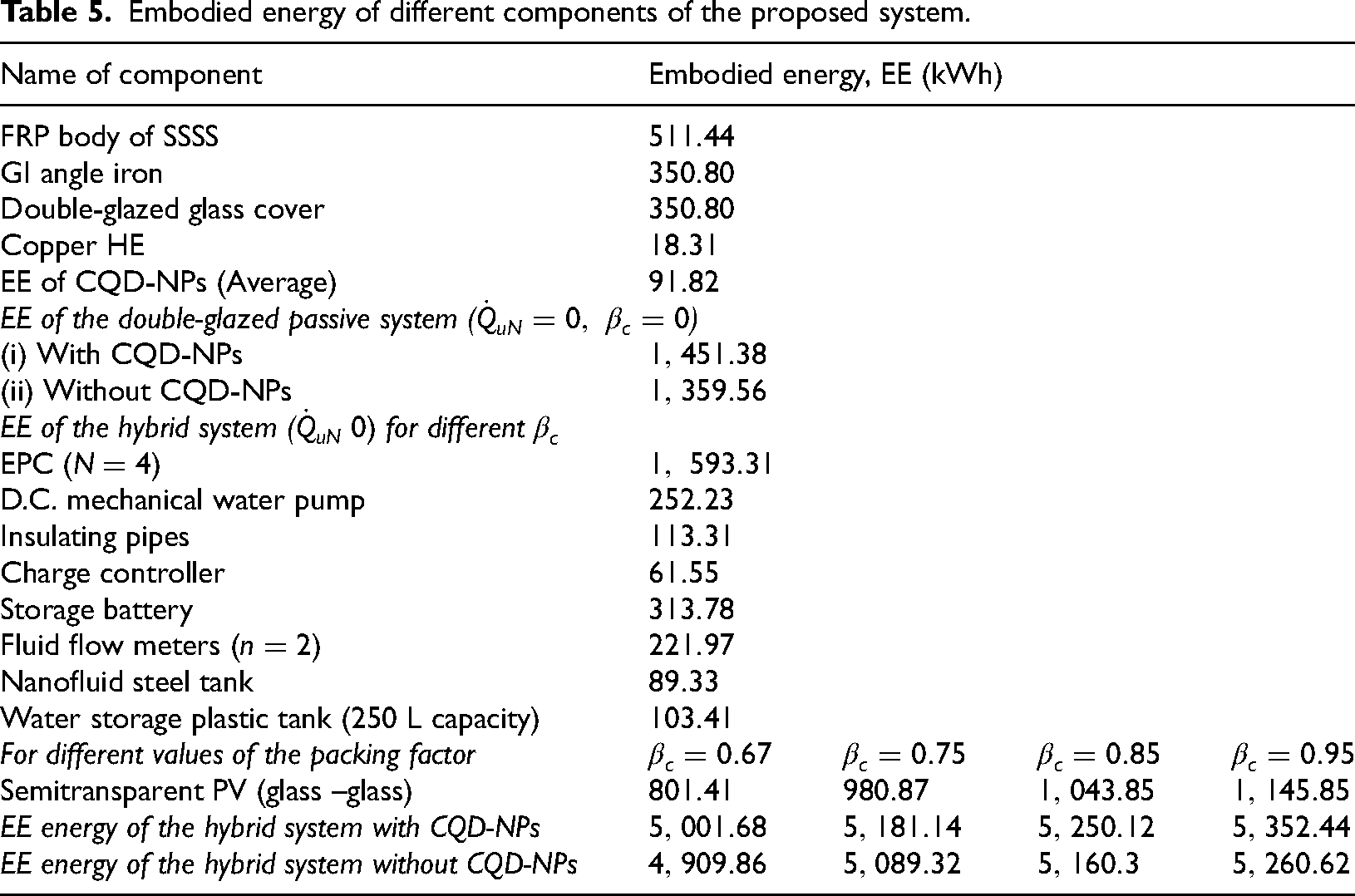
For any renewable energy-based system design, energy matrices, viz., EPBT, EPF, and LCCE; and CO2 mitigation analysis are important. Apart from the annual energy/exergy generated by the system, these parameters depend on the EE or energy densities of all the internal and external components used for the system design. It is the processing energy required to make the final component during manufacturing; and represent the equivalency of carbon emissions in kilograms per volume of material (kg-CO2/m3). The EE of all the components used for the design of the proposed system is listed in Table 5. It majorly controls the values of the energy matrices and CO2 mitigation. In general, EPBT is used as a basic criterion to check the viability of the system. Conclusively, low production cost of potable water and electrical energy generation; the use of low-cost materials with their longer durability; low EE values of used components; and low annual maintenance can effectively lower down the EPBT value.
Embodied energy of different components of the proposed system.
Mathematically,
Mathematically,
Mathematically,
Moreover, control of CO2 emission and conservation of our conventional sources of energy is the global concern for environmental sustainability. Many international bodies are working on the water–energy nexus for their cleaner production. Enviro-economic analysis is to compute the amount of CO2 mitigation of renewable energy-based systems to maximize their use and commercialization. Considering transmission 


Methodology
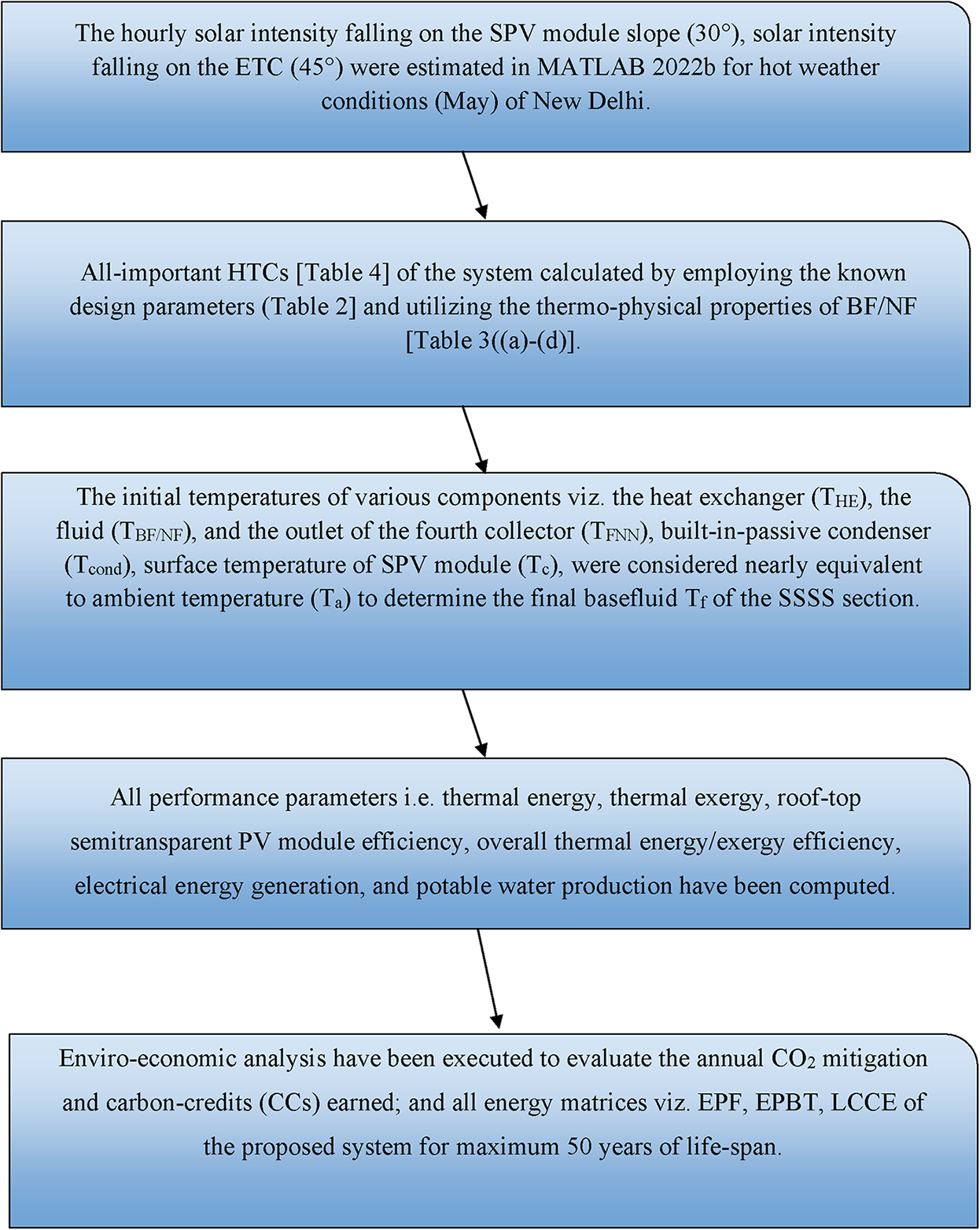
N-ETC integrated SSSS with two major modifications, viz. (i) built-in-passive condenser on the rear side of the still and (ii) roof-top-semitransparent PV module is analyzed using CQD-water-based nanofluid ( Step (i) Step (ii) Step (iii) Step (iv) Step (v)
Using raw data of global and diffused solar radiations available on India Metallurgical Department, Pune website, solar intensity falling at a particular angle for chosen geographical location (New Delhi) for a specific month (May) and day (c-type weather condition) is obtained from a separate MATLAB022b code.
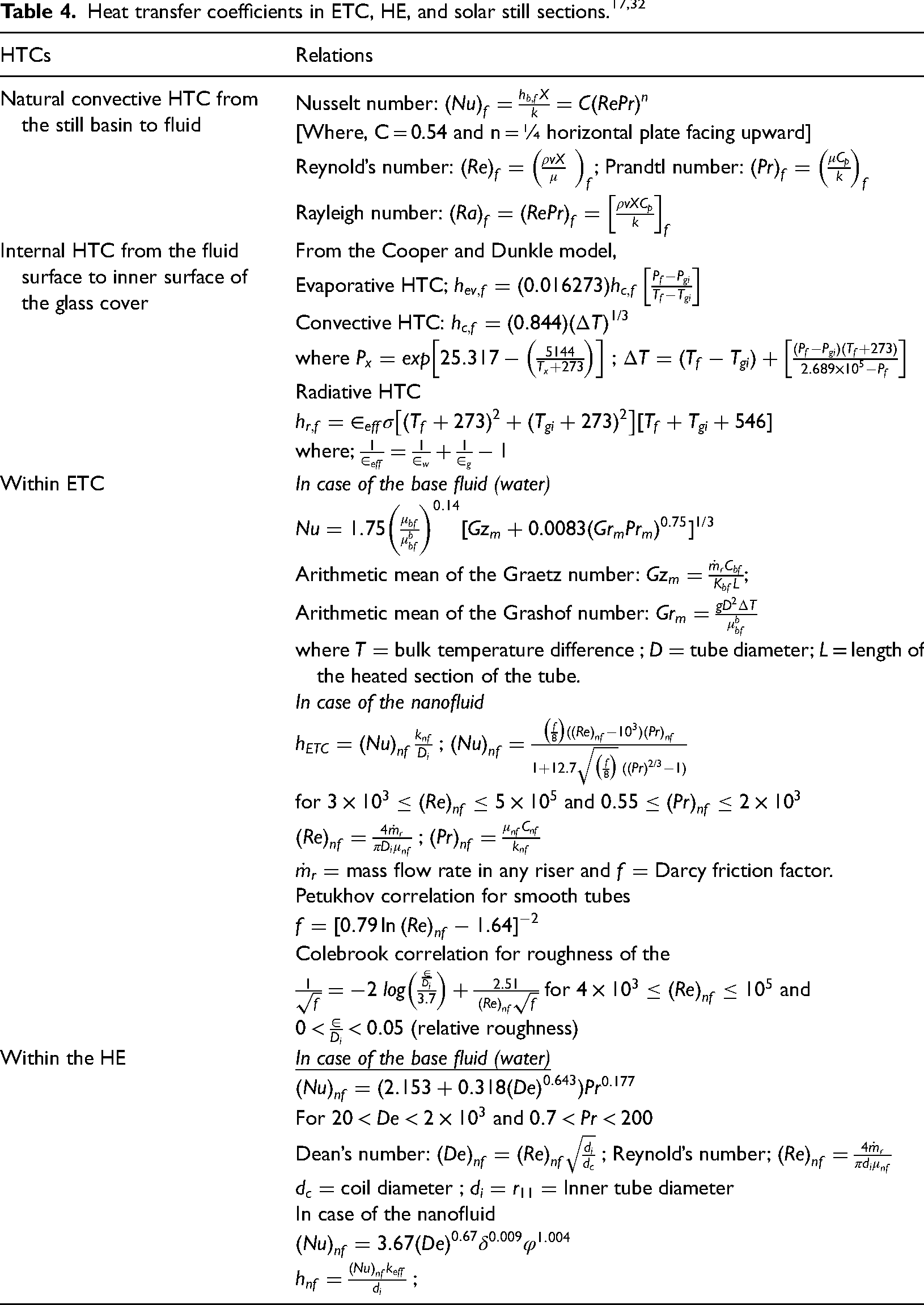
Initially, thermo-physical properties (thermal conductivity, specific heat, density, and viscosity) of the base fluid (Table (3a) and (3b)) and nanofluid (Table (3c) and (3d)); and all internal-external HTCs (Table 4), have been estimated every hour with iteration using known values of time dependent parameters.
Initial values of fluid (BF/NF) temperature of all different sections, viz. HE, SSSS section, N-ETC, built-in-passive condenser, semitransparent roof-top, and blackened surface have been taken nearly equal to the ambient temperature
The instantaneous values of temperature of the fluid (Eq. (15b)), roof-top semitransparent PV module (Eq. (2)), ETC's Nth outlet (Eq. (7)) and built-in-passive condenser (Eq. (12)) have been evaluated. All these time dependent parameters are used to estimate other useful performance parameters, i.e., thermal energy (Eq. (18)), exergy (Eq. (19)), roof-top semitransparent PV module efficiency (Eq. (20)), overall thermal energy efficiency (Eq. (25)), and overall thermal exergy efficiency (Eq. (26)), and daily yield (Eq. (29)).
Using above analysis (steps (i)–(iv)) Energy and exergy-based enviro-economic analysis have been carried to estimate the annual CO2 mitigation (Eq. (35a) and (35b)), and carbon-credits (CCs) (Eq. (34)) earned from the proposed system. Moreover, Energy matrices, viz. EPF (Eq. (31)), EPBT (Eq. (32)), and LCCE (Eq. (33)) are estimated for every 5 years of lifespan of the proposed system up to 50 years.
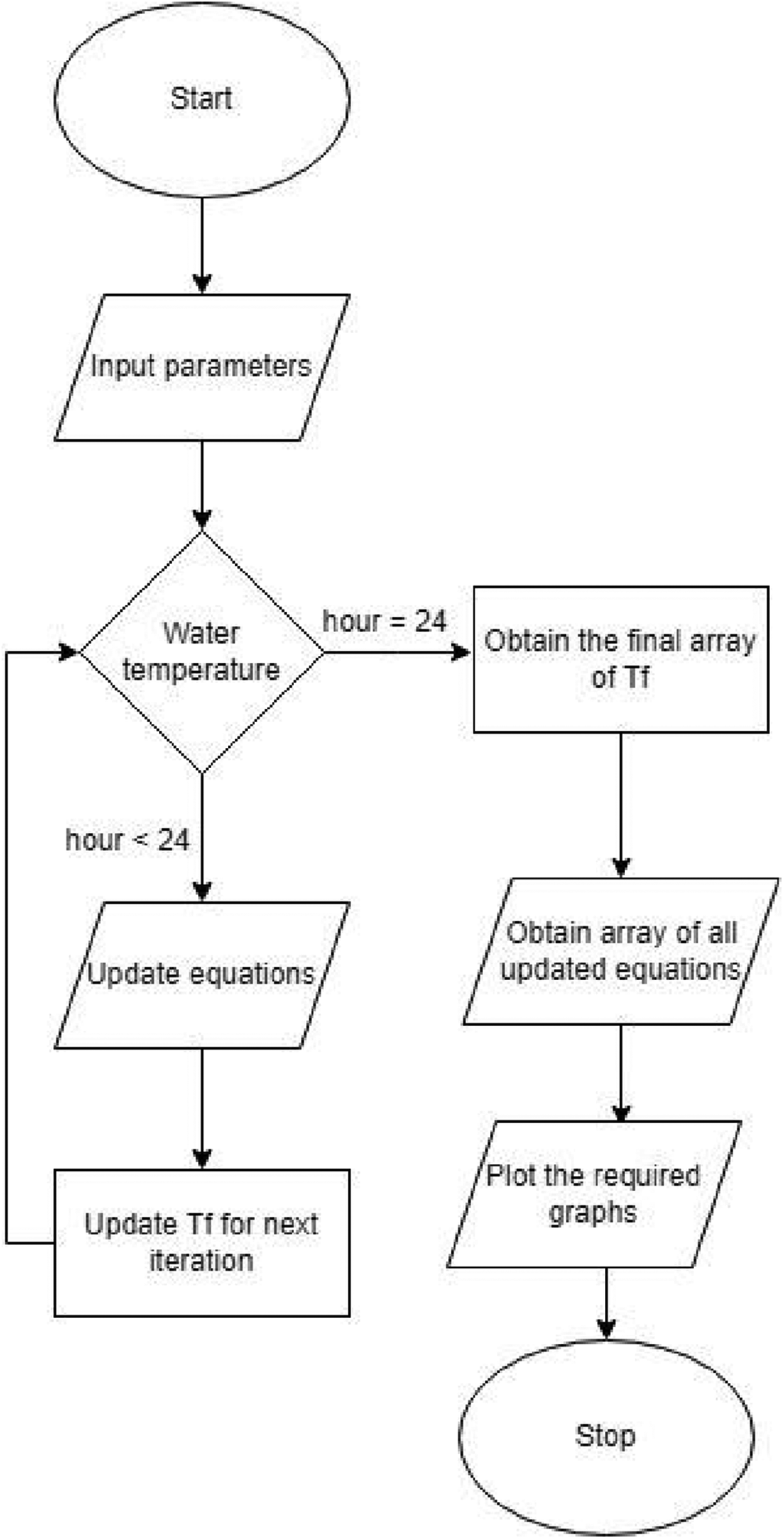
Flow chart and logic diagram for the MATLAB code execution is described below:
Results
Based on the analytical analysis, CO2 mitigation, thermal characteristics, and performance of N-ETC integrated single slope solar distillations system is analyzed for the New Delhi weather conditions of the month May. As discussed in the system description section, single layer 3 mm roof-top toughen glass is replaced by semitransparent photovoltaic module (SPV) and passive copper condenser is fitted on the side rear wall of the system. One DC fan (6–12 V) is also fitted at the junction of SPV module and copper condenser. Internally the system is operated in circulation mode to get high evaporation rate in the condensing chamber. Figure 2 presents the hourly variation of solar radiation, and ambient temperature of the month May. Particularly, c-type weather condition includes twelve number of clear sunshine days, and this data is used to execute the analysis. Before analyzing the system efficiency and performance, thermo-physical characteristics (thermal conductivity, viscosity, density, and specific heat) of the system with and without using CQD-water-based nanofluid is tested. Figure 3 presents the hourly variation of all four mentioned thermo-physical characteristics and expected trends have been observed but with significant improvements using CQDs at their fixed volume concentration (φ= 2.5%). Thermal conductivity and specific heat are enhanced by 56.06% and 1.02%, respectively, during sunshine hours. On the other hand, significant plunge around 1.22% and 85.03% in density and viscosity, respectively, have been observed using CQDs. Both the density and viscosity trends show maintained difference with and without using CQD-water-based nanofluid after off-sunshine hours and sunset, which intern helps the saline water to continuously sustain the internal convective (basin liner to fluid) evaporation rate for longer period. Moreover, thermal conductivity plays the key role among all thermo-physical properties; and it shows huge jump using ultrafast CQDs in water-based nanofluid. Eventually, external integration of N-ETCs, basin liner, and better heat transfer thermal properties of CQDs (via HE) significantly raises the saline water temperature. Moreover, significant enhancement in thermo-physical characteristics is credited to the better absorption mechanism of assisting CQD-NPs due to maximum overlapping of its optical spectrum with the solar radiation spectrum. Figure 4 shows the variation of maximum values of thermo-physical characteristics of the nanofluid with CQD-NPs volume concentration up to 5%. It has been noted that density, thermal conductivity, and viscosity increases; and specific heat decreases sharply with increase in concentration of CQD-NPs; and fixed water mass and mass flow rate in the circulation pipes connected with external integration and HE restricts the improvement in thermophysical characteristics beyond fixed volume concentration of CQD NP-water-based nanofluids.
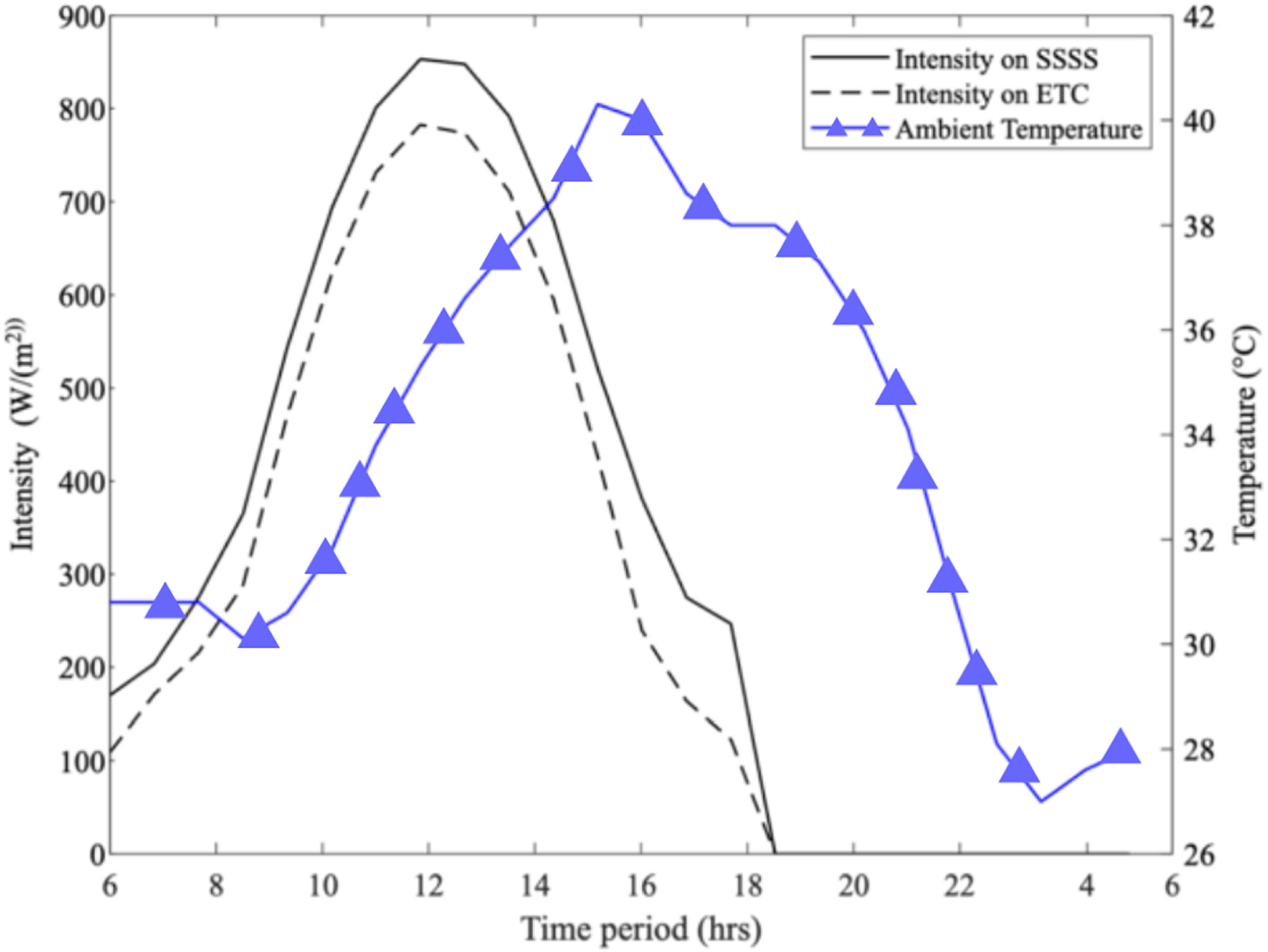
Hourly variation of the total radiation and ambient temperature of the New Delhi weather conditions of the month of May (Official data, IMD, Pune, India).
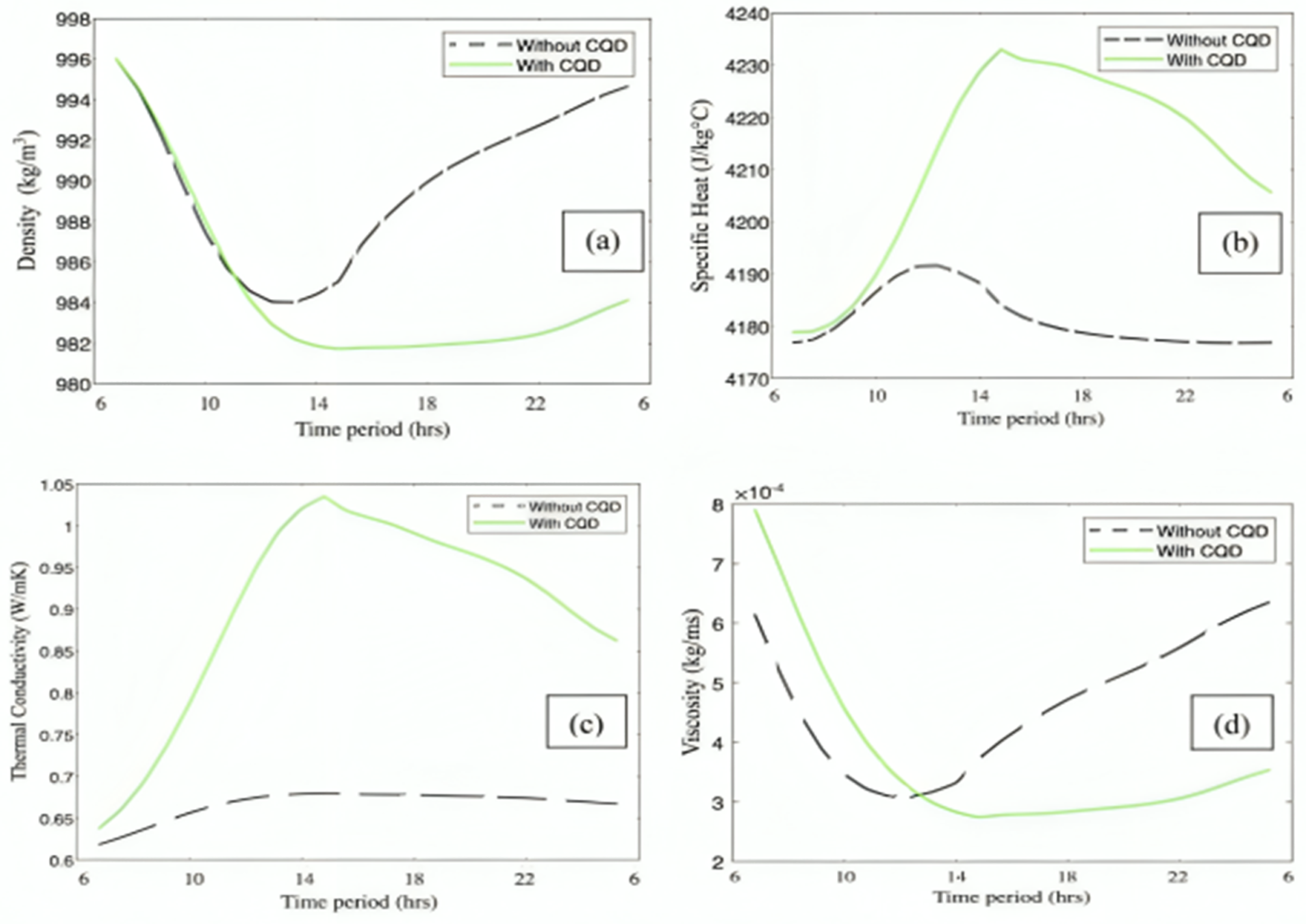
Hourly variation of TPPs of the basefluid and CQDs-water-based nanofluid (φ =2.5%).
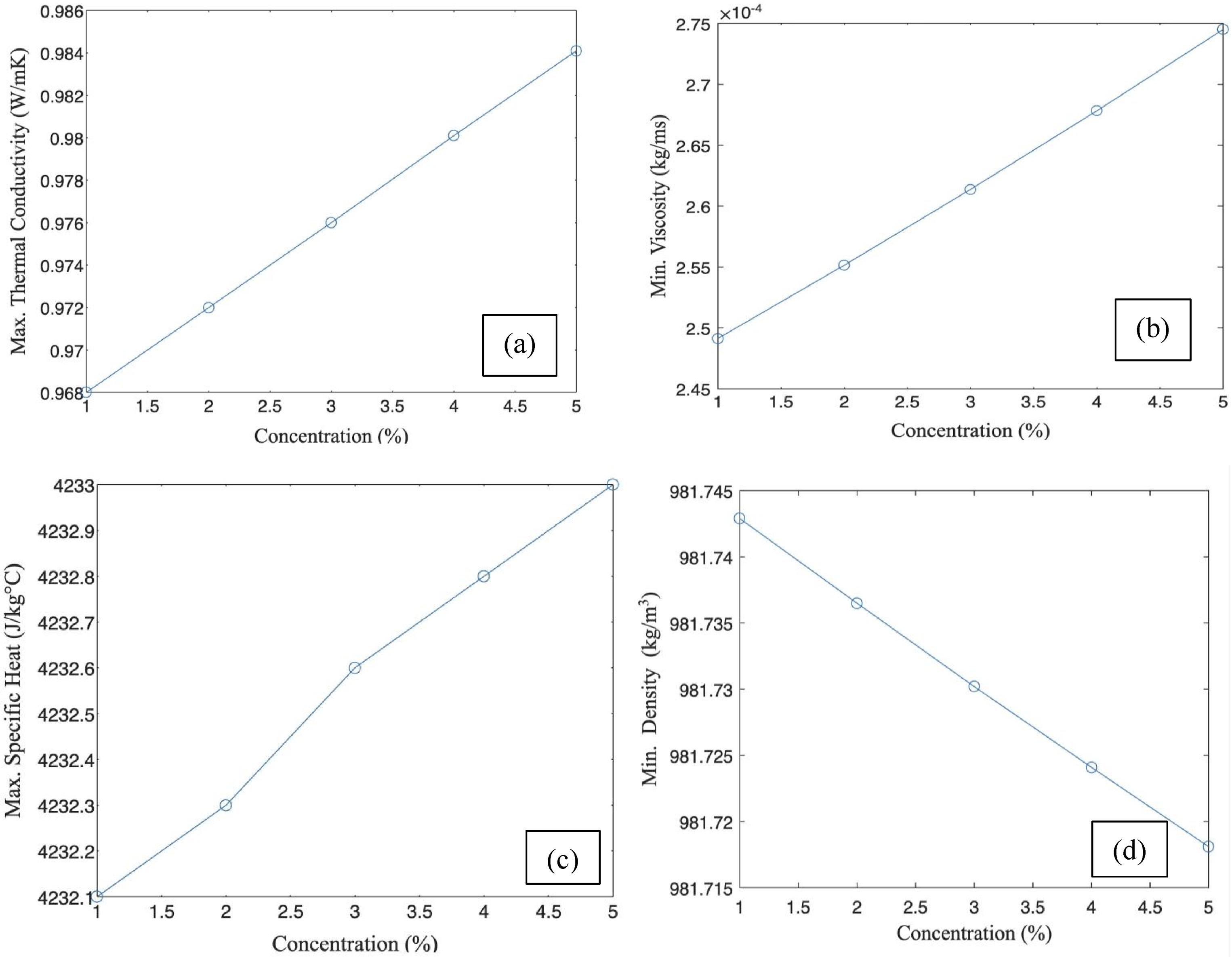
Effect of volume-fraction of CQD NPs on TPPs of the respective nanofluid.
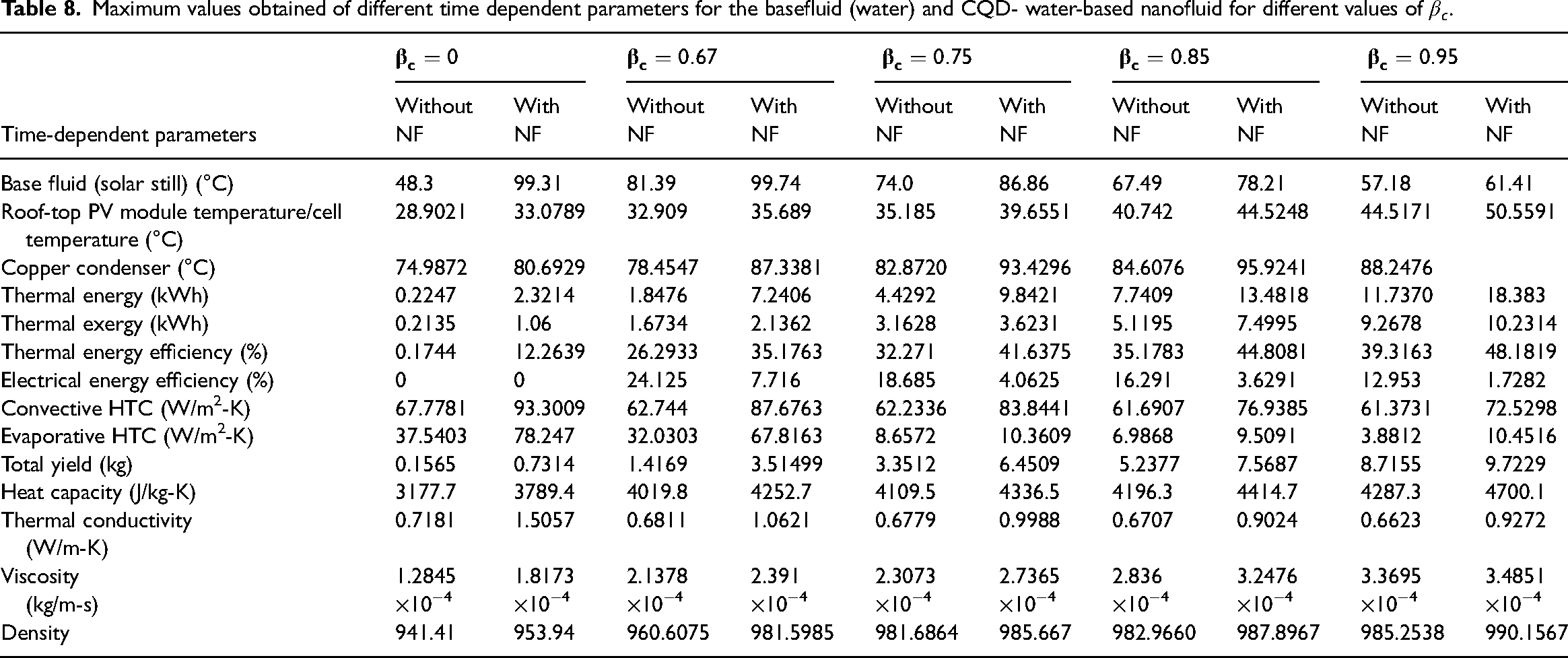
As discussed above, ultrafast heat transfer properties of CQD-water-based nanofluid directly accelerate the convective and evaporative heat transfer rates; and it is clearly depicted in Figure 5. Hourly variation of internal convective heat transfer coefficient (HTC) taken place between the horizontal blackened plate and saline water; and evaporative HTC is shown in Figure 5(a) and (b), respectively. Sharp improvement around 39.2% and 112.04% in convective and evaporative HTCs, respectively, have been observed, thanks to thermo-physical properties of CQDs-water-based nanofluids. Surface plasmon resonance (SPR) is the manifestation of resonance effect which is due to the oscillation of free electrons in the conduction band and interaction with photons (light). The interaction relies on the size/shape of the metal NPs as well as on the nature/composition of the dispersion medium. The SPR effectively alters the thermo-physical characteristics of the water-based nanofluid properties. As the size of CQD-NPs is extremely lower, they do not settle down (non-sedimentation) due to its Brownian motion in the fluid. The energy of vibrations of these CQD-NPs gets dissipated in the form of heat to its surroundings and effectively modify the heat transfer rates. Moreover, change in packing factor (βc) of the roof-top semitransparent PV module effectively alters the heat convection and evaporation rates as shown in Figures 6 and 7 with and without using CQD-NPs, respectively. Lower βc allows high solar radiation to enter in the solar still cavity and raises the convective and evaporative heat transfer rates but it lowers the electrical energy generation output. Therefore, it is necessary to select an optimum value of the βc in order to maintain the required minimum value of electrical energy to run the mechanical water pump and D.C.-fan. Range of maximum values of convective HTC around 86.3–71.3 W/m2-K and 62.58–61.2 W/m2-K is observed with and without using CQD-NPs, respectively, for βc variation (0.67, 0.69, 0.75, 0.85, and 0.95). On the other hand, for evaporative HTC, it is around 58.1–9.12 W/m2-K and 32.91–6.11 W/m2-K with and without using CQD-NPs, respectively, for the variation of βc of 0.67–0.95. The use of CQD-NPs showed impressive enhancement in evaporative (37.9%) and convective (76.94%) HTCs even at moderate value of βc (0.67) and sharply decreases with increase in βc which is due to maximum blockage of incident solar radiation by the semitransparent solar cell. ETCs are the best to use for solar water heaters, found in literature. Entropy generation mechanism is lower down inside the external integration (ETC) at high volume concentration of NPs as well as high mass flow rate; and help to raise the convective HTCs (Reynold's number). Collectively, it improves the fluid temperature and other thermal parameters, i.e., thermal energy/exergy and efficiency of the system. 31 Apart from the entropy generation, due to better thermal conductivity and other optical properties, change-in-flow, and change-in-thermal field behavior of CQD-NPs in the water-based fluid also significantly improves the heat transfer rates in the ETC and HE sections which directly improves the evaporation and convective heat transfer rates of saline water in the solar still section. Figure 8 depicts the variation of fluid temperature of saline water stored in SSSS section. It is raised with accumulative effect of heat transfer by blackened surface (convective HTC), circulation of external hot fluid (BF/NF) transfer from the outlet of ETC via HE, direct absorption of incident solar radiation and mainly CQDs. It is found to be around 97.18°C using CQDs-water-based nanofluid as compared to water as a basefluid (21.5% rise) at 69% value of βc. Also, it increases with increase in concentration of NPs as shown in Figure 9. As discussed above, βc effectively controls the heat transfer rate and hence fluid temperature (Tf) of the SSSS section; its effect is shown in Figure 10 which shows the variation of Tf for different values of βc. It is found to be higher for lower values of βc and found to be higher during sunshine hours. The βc value of 0.67 is found to be optimum, which gives a very high value of Tf such that it just about to touch the boiling point of the fluid. At commercial level, user can utilize the flexible range of βc of 0.67–0.95, which give sharp change in the value of Tf around 97.18°C–60.01°C in this range. This can be elected on the basis of requirement of electrical generation and drinking water output. Moreover, the variation of maximum value of Tf which occurs around sunshine hours; and the concentration of CQD-NPs is presented in Figure 11. It increases with increase in concentration of NPs. From the analysis, it has been observed that there is just 0.51°C variation in Tf for the wide range of CQD-NPs concentration (1%–5%), which is credited to their ultrafast heat transfer characteristics even at low concentration of CQD-NPs and showed saturation beyond 1% volume concentration because of fixed quantity of basefluid (water) flowing in the insulating pipes and HE in circulation. It is very significant outcome which clearly suggest to use CQD-NPs in place of other NPs such as TiO2, CuO, Al2O3, SiO2, etc. These mentioned NPs in literature shows significant results but at the use of higher concentration which ultimately increase the effective cost of the system. Moreover, apart from the sunshine hours value of solar intensties and ambient temperatures, the maximum values to all thermal variations including all HTCs are restricted by the viscous forces; and these thermal values increases continuously with increase in volume fraction of CQD-NPs due to thermal conductance forces which define the optimal point by balance of these forces. Motion of the flowing fluid inside the hellicaly coiled HE is also responsible for the significant enhancement of HTCs. The rate of heat transfer per unit length of the HE’s tube is effectively dominated by the the swirl flow of the fluid (centrifugal forces formation) and it causes secondary convective transport inside the HE, which in turn developes diffusion and convection vertices of flow; and it restrics the rise of HTCs or temperature beyond fixed concentration of CQD-NPs. Figure 12 shows the hourly variation of in-built-passive condenser temperature (a) with and (b) wthout using CQD-NPs. It has been observed that condeser temprature range is almost same as saline water temperature in solar still section after sunshine hours but it is partially lower before noons hours. It is due to the fact that water vapors releases its latent heat ofvaporization and raises the condenser temperature after sometime. Ambient temperature also plays effective role in condensation proces in this case; beacause passive condenser is attached on th rear wall of the solar still section and it is not exposed to the solar radiation directly. Therefore, natural outer colling of the condenser continously maintain the condensation rate and hence the final productivity of the modified system. Around 10°C−12°C differences in temperature of passive condenser have been repoted with and without using CQD-NPs for βc value of 0.67.
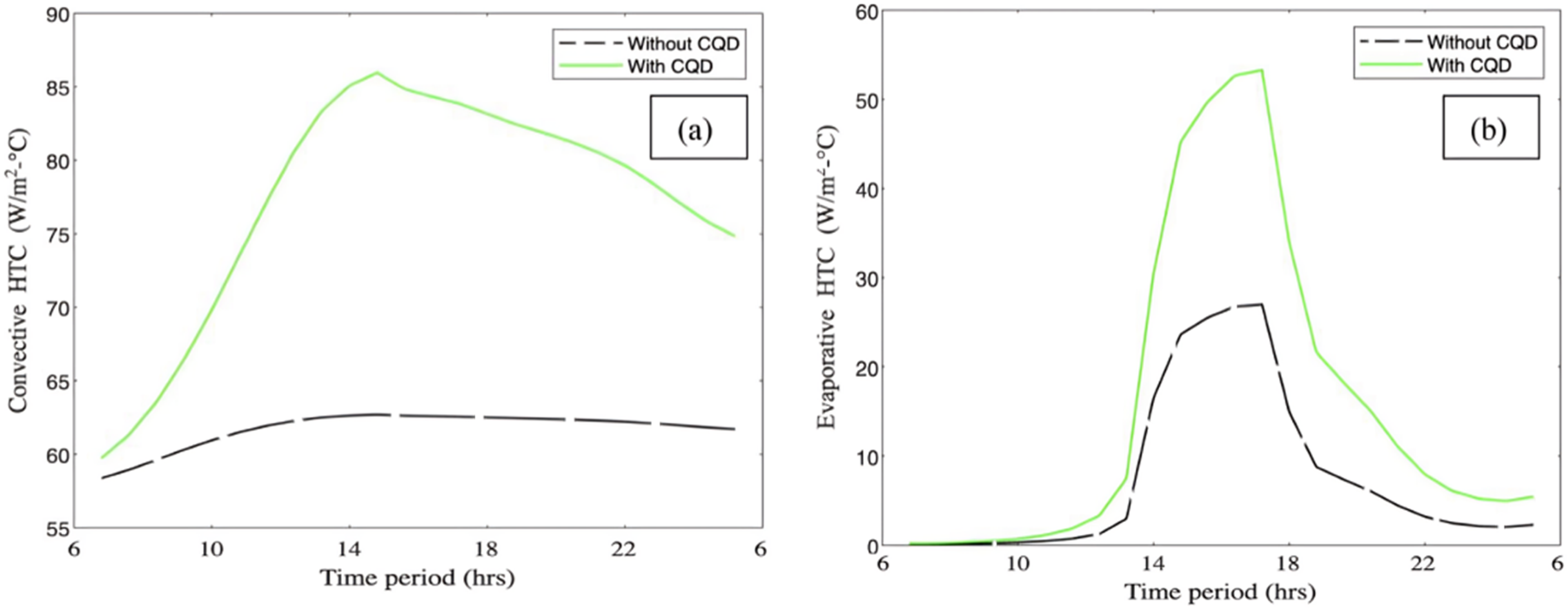
Hourly variation of (a) convective and (b) evaporative HTC with basefluid and CQD-water-based nanofluid.
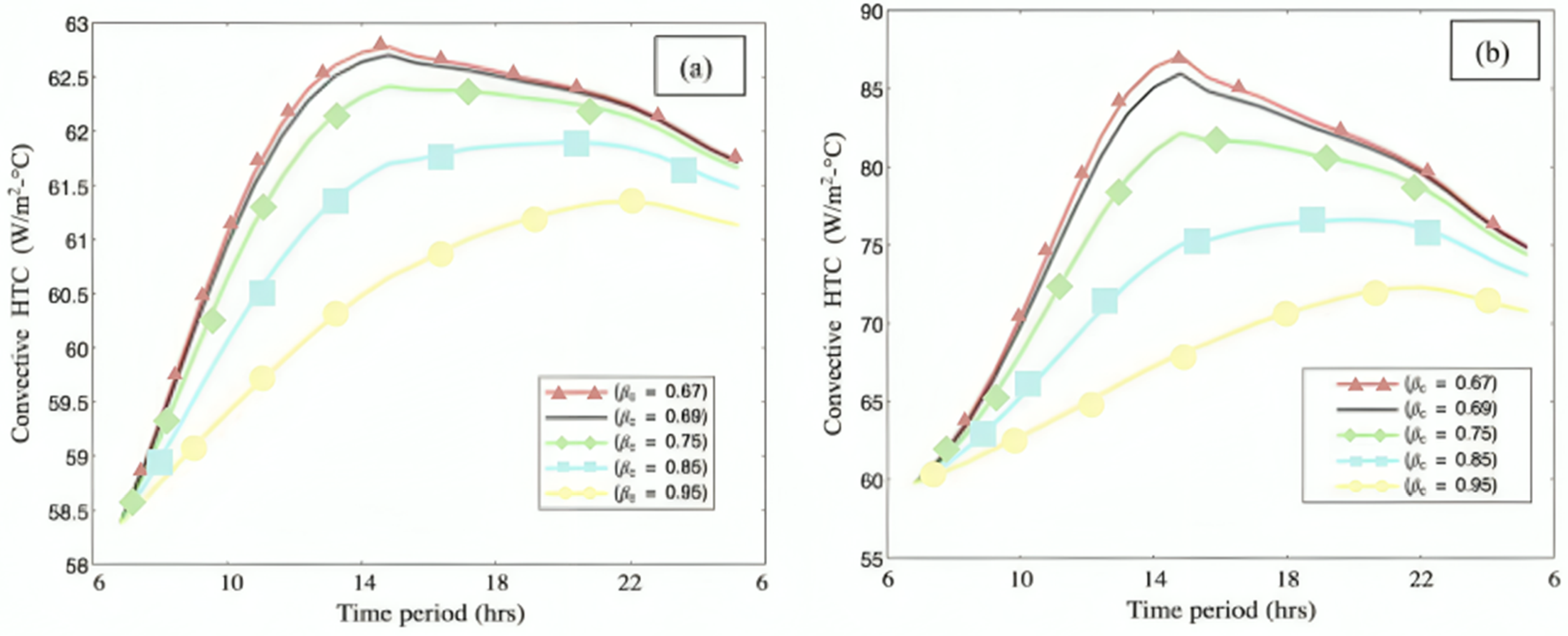
Hourly variation of convective HTC with (a) basefluid and (b) CQD-water-based nanofluid for different packing factors of the roof-top semitransparent PV module.
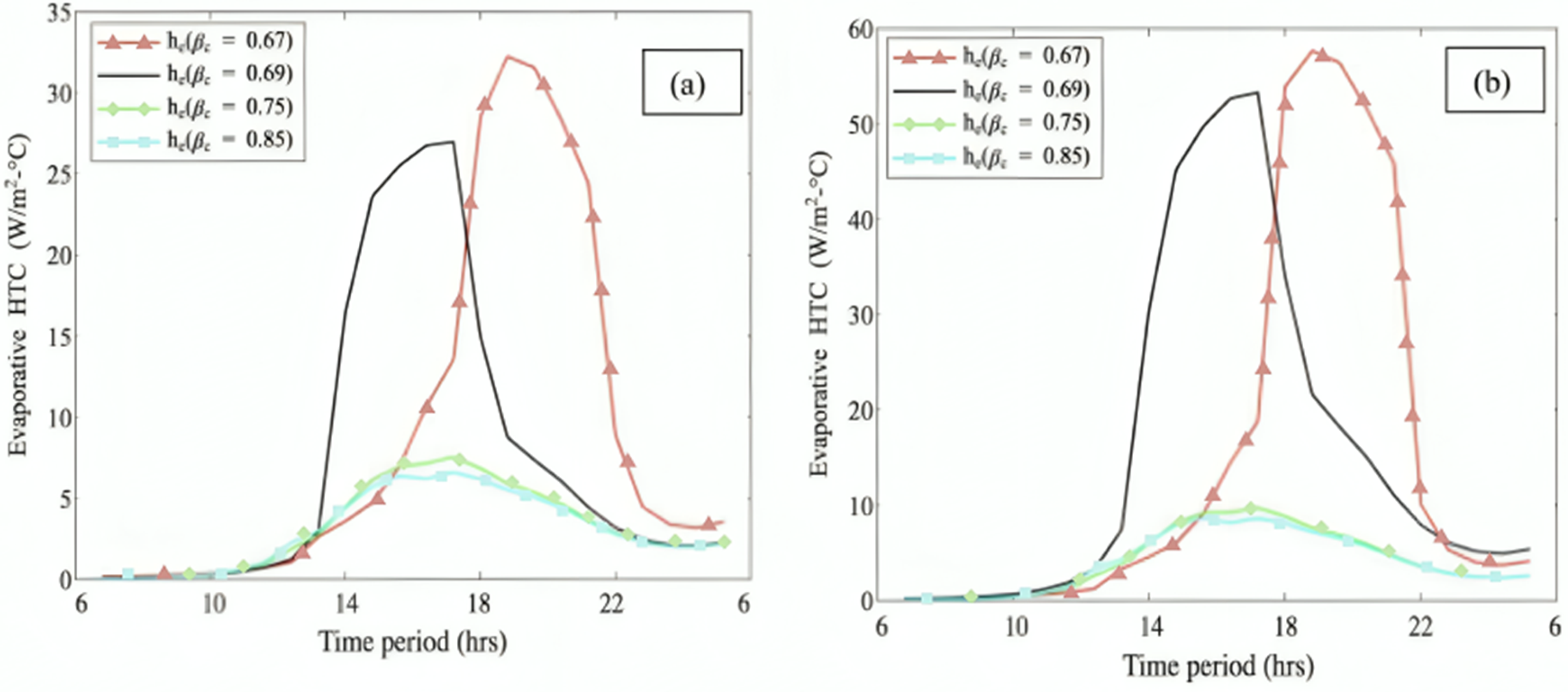
Hourly variation of evaporative HTC with (a) basefluid and (b) CQD-water-based nanofluid for different packing factors (βc) of the roof-top semitransparent PV module.
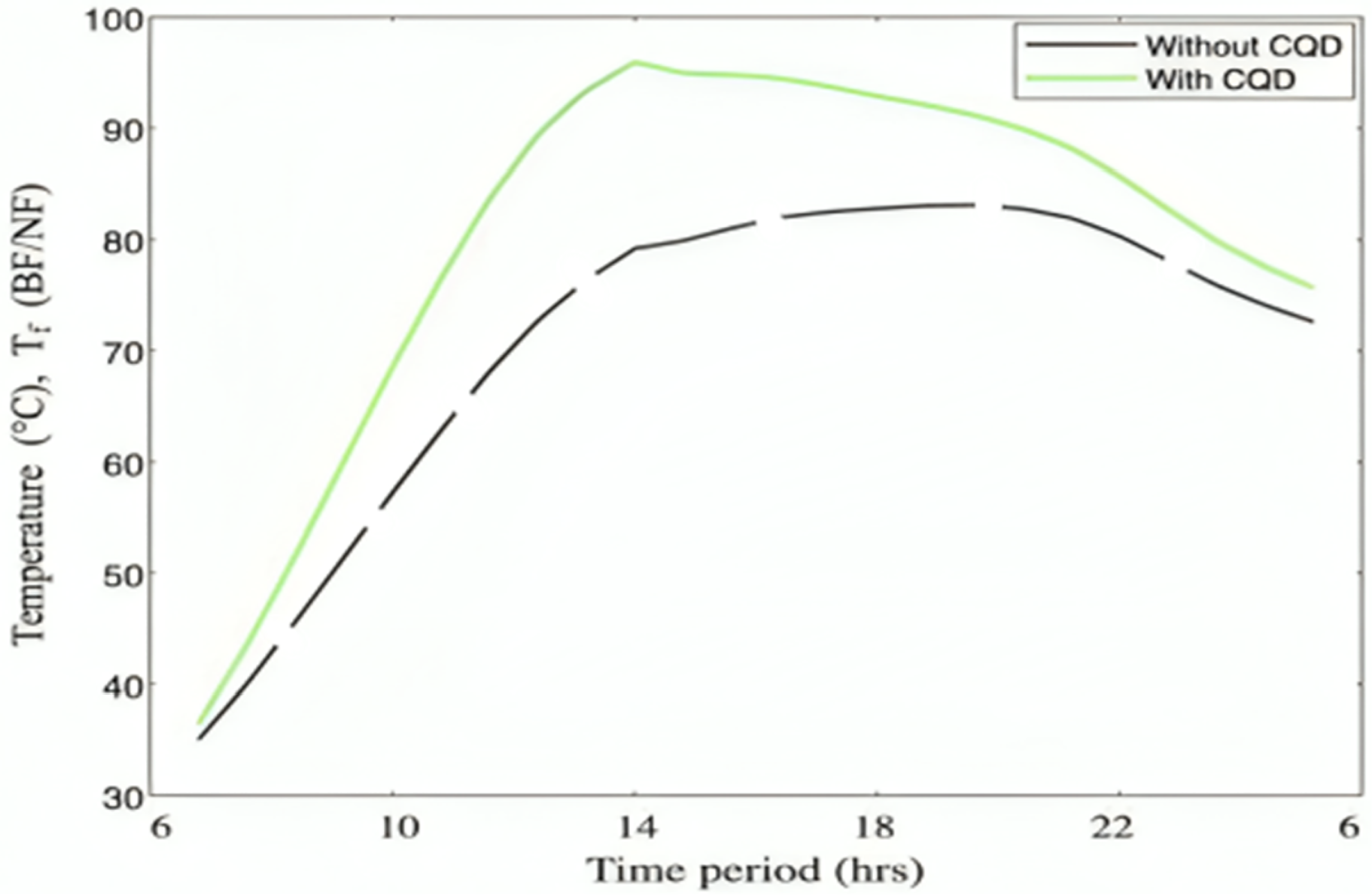
Hourly variation saline water temperature (solar still section) with and without using CQD-NPs.
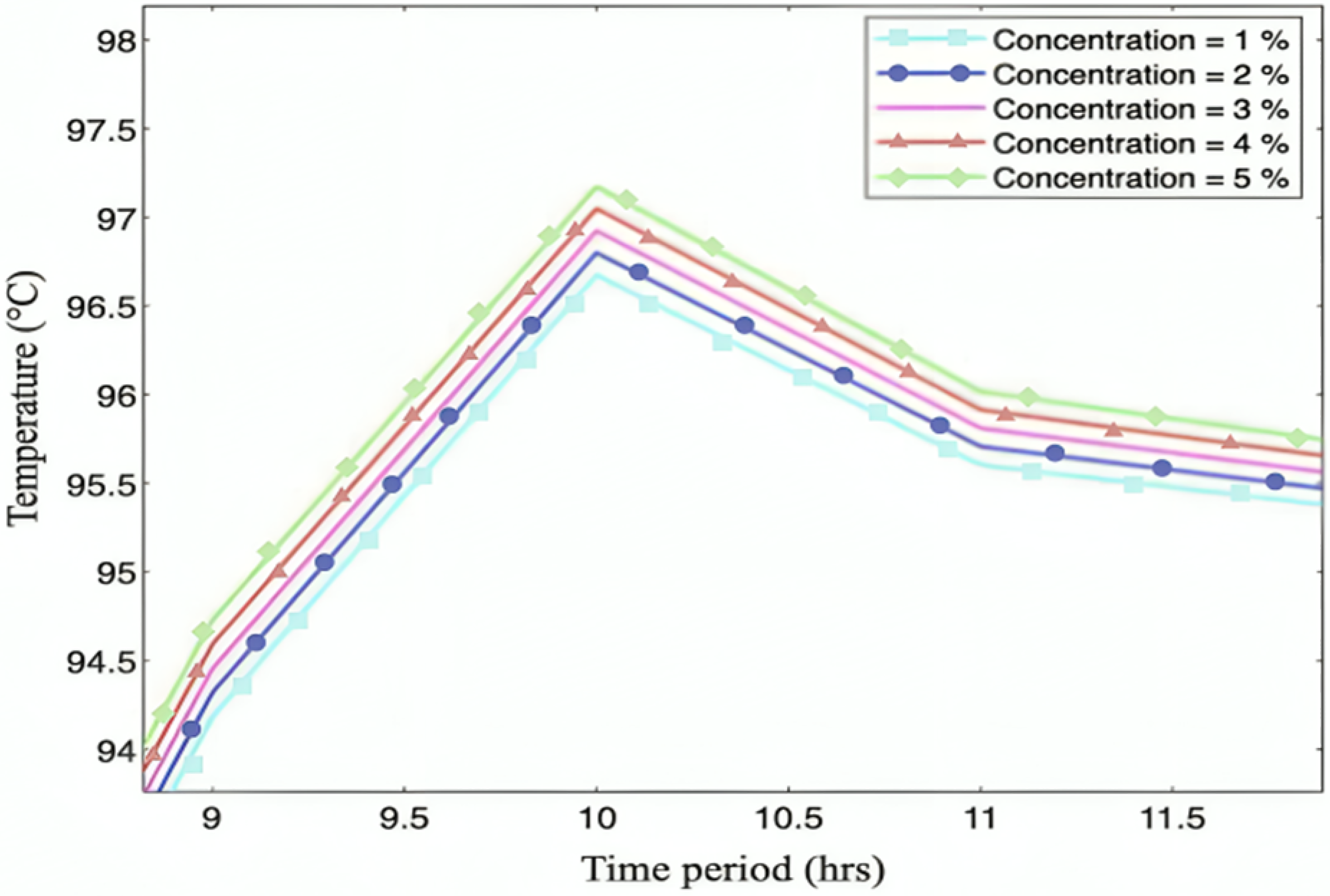
Variation of saline water temperature (solar still section) with volume concentration CQD-NPs for fix packing factors (βc = 0.67).
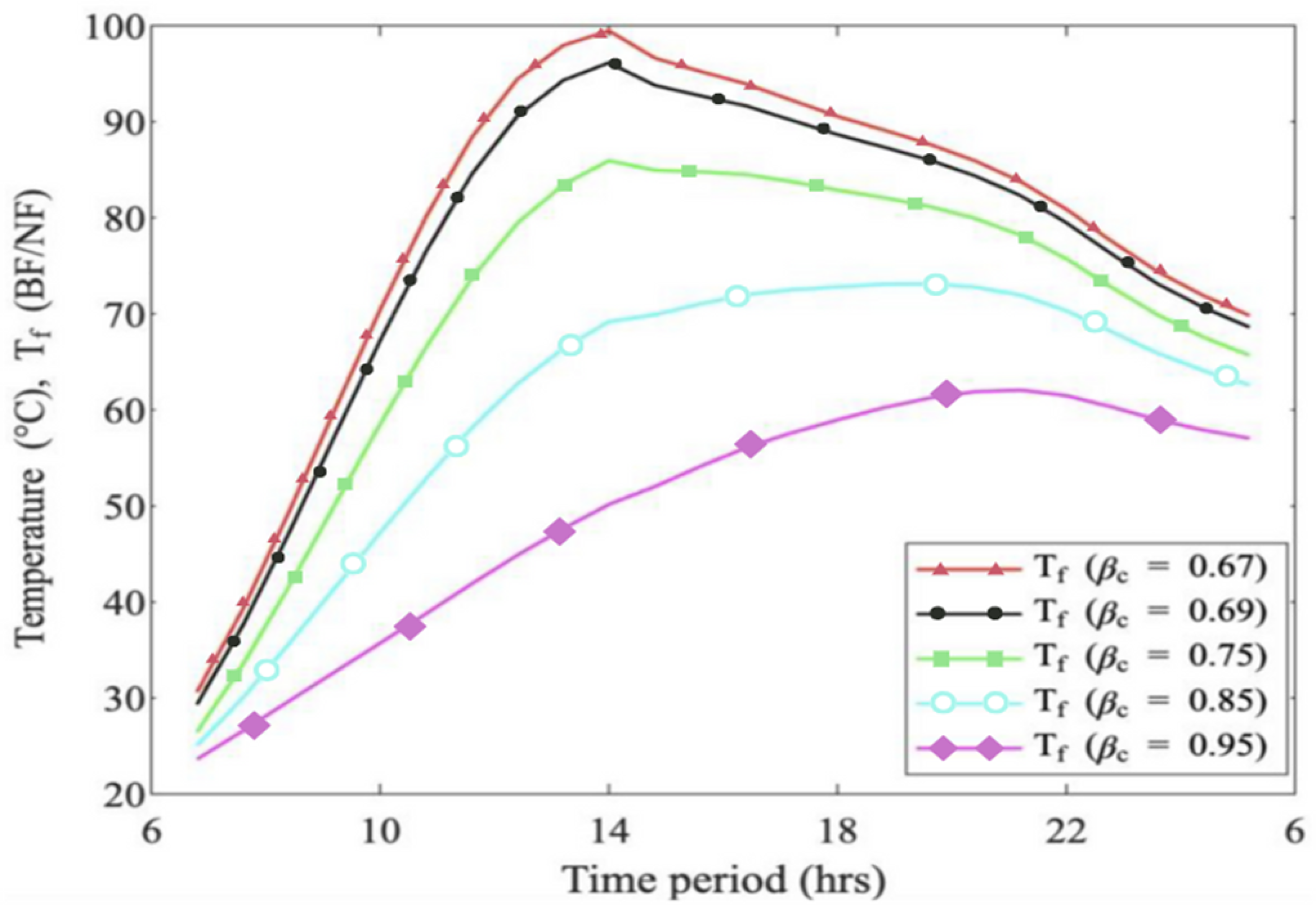
Hourly variation of saline water temperature (solar still section) for different packing factors (βc).
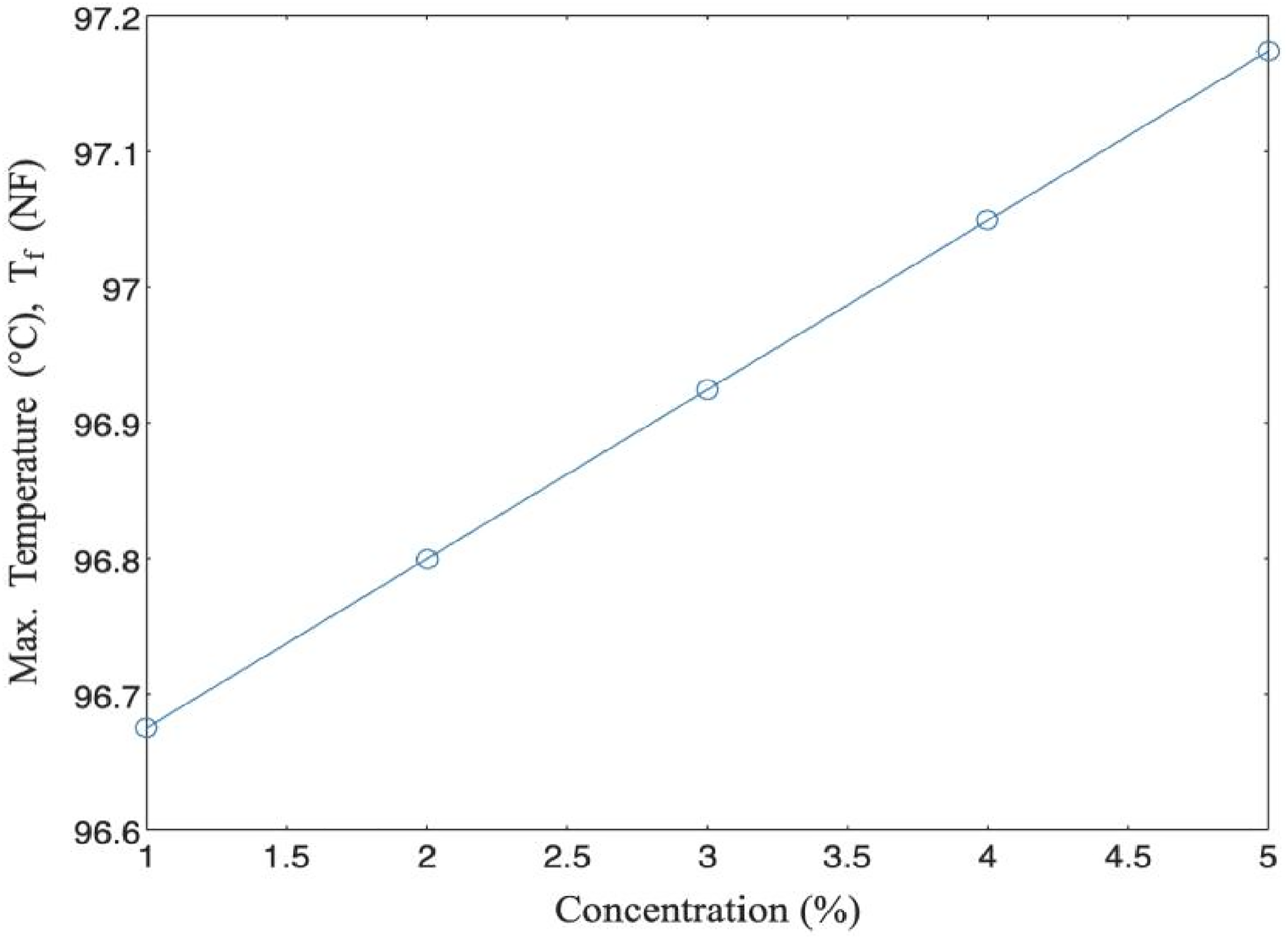
Variation of maximum value of saline water temperature (solar still section) with volume concentration of CQD-NPs for fixed packing factors (βc).
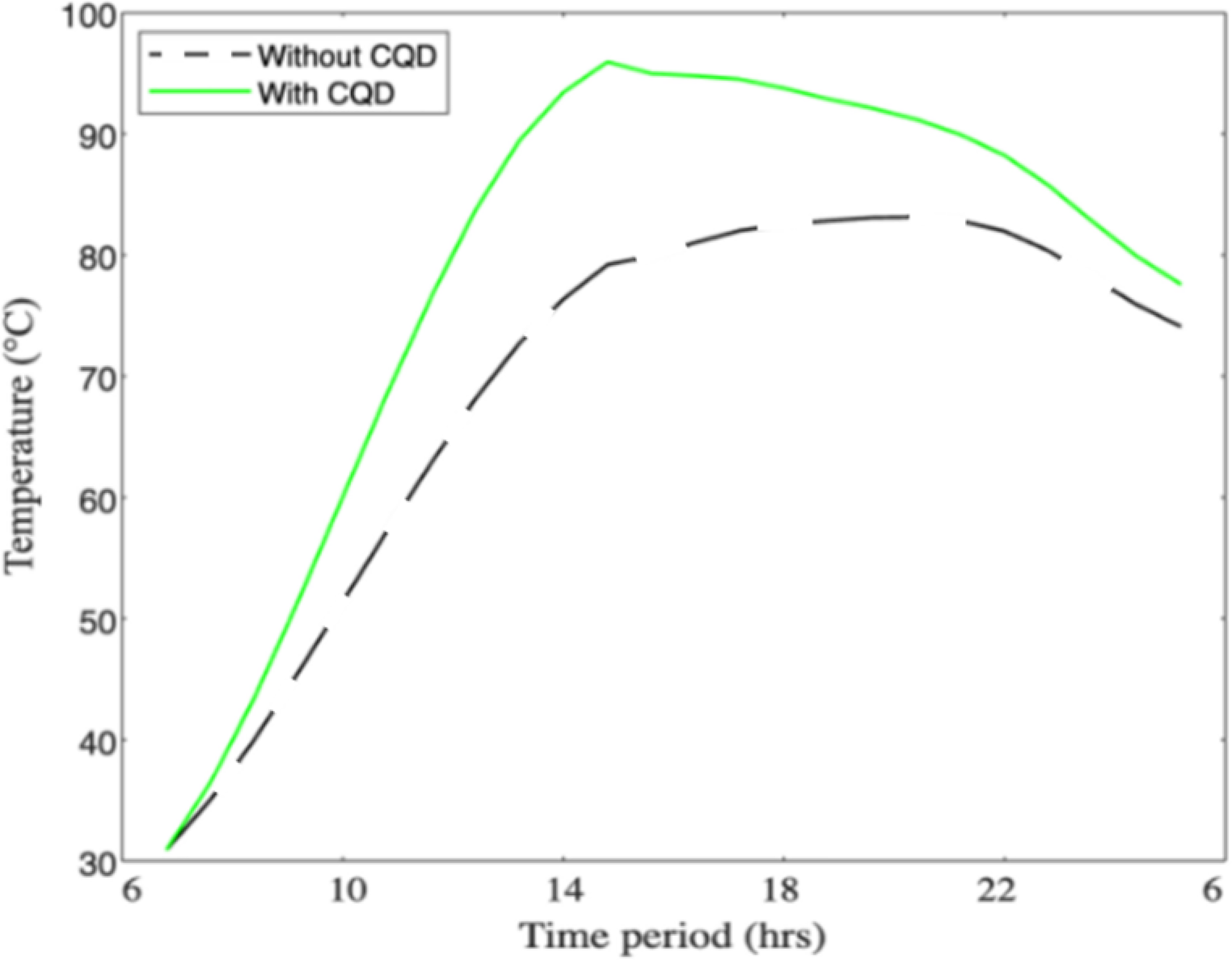
Hourly variation of in-built-passive condenser temperature with and wthout using CQD-NPs for fixed packing factors (βc = 0.67).
In circulation mode or hybrid solar distillation process, Reynold's number analysis is really important as shown in Figure 13. From its hourly variation, it is found to be higher during sunshine hours; and higher
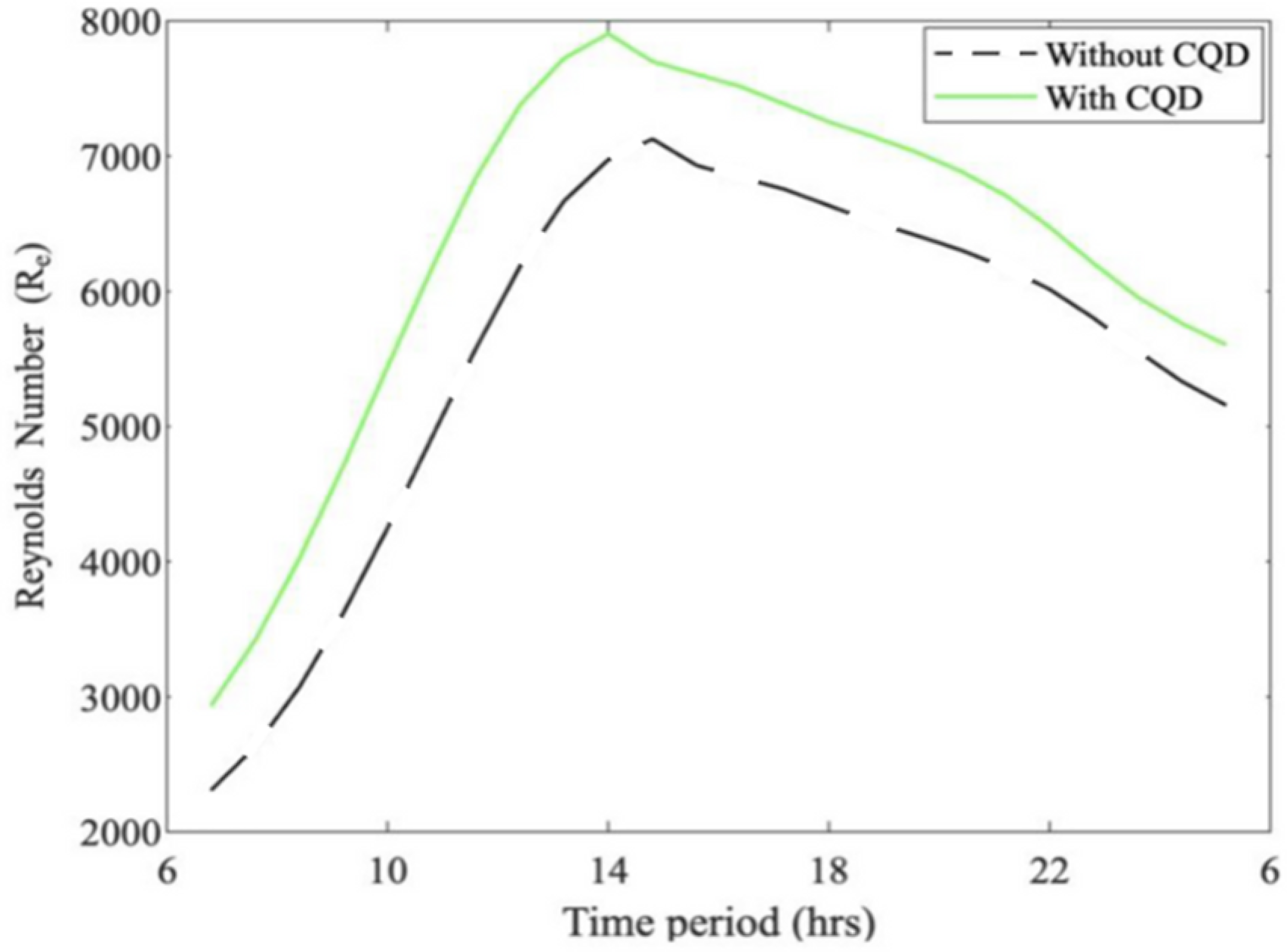
Hourly variation of Reynold's number with and wthout using CQD-NPs for fixed packing factors (βc = 0.67).
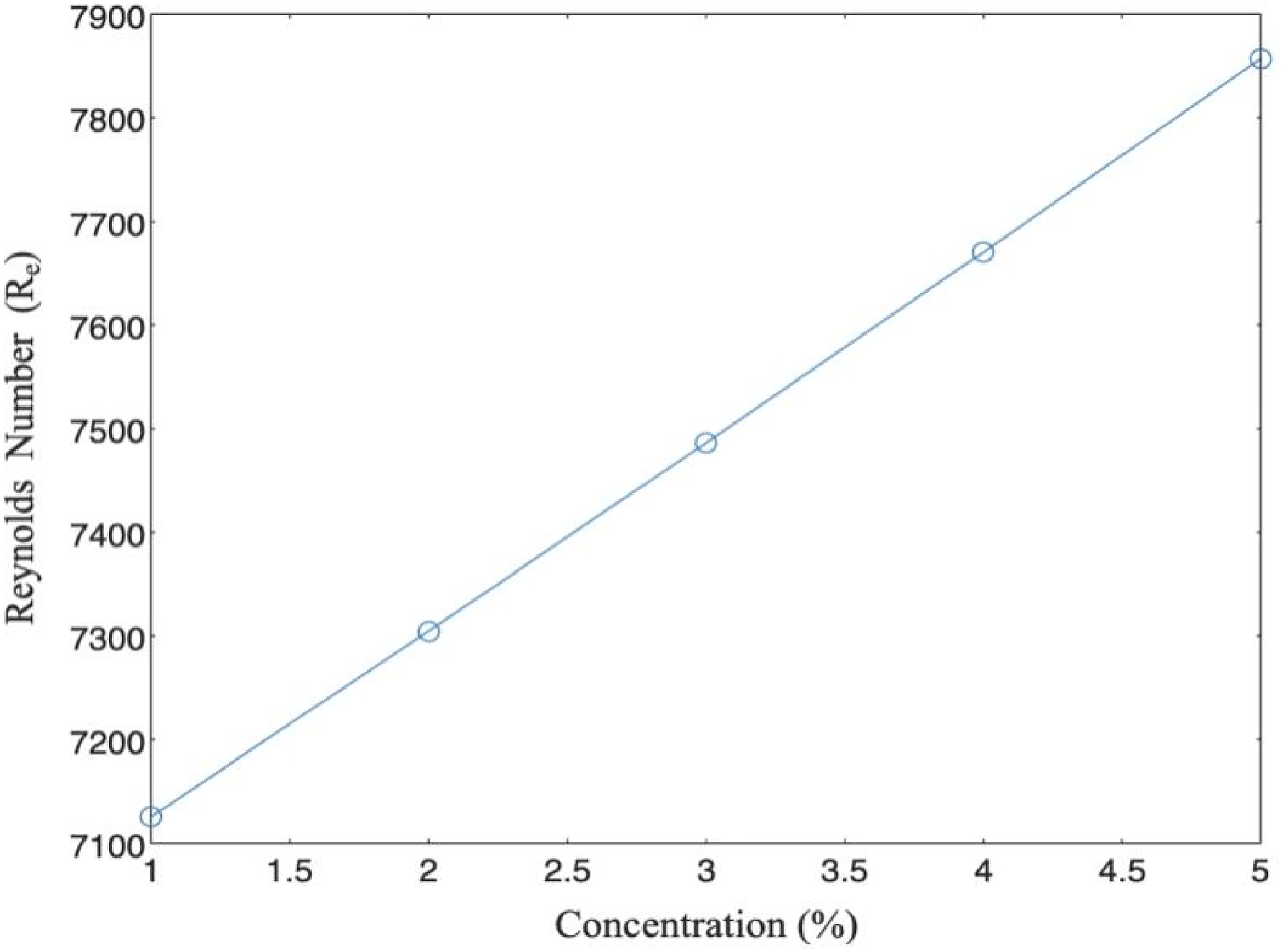
Variation of Reynold's number (maximum values) with volume concentration of CQD-NPs for fixed packing factors (βc = 0.67).
Figure 15 (a) and (b) depicts the variation of thermal energy and exergy, respectively, for fixed packing factors (βc = 0.69) of roof-top semitransparent PV module using basefluid and nanofluid in the system. Both time-dependent parameters are found to be significantly higher using CQD-NPs. Figure 15(a) shows huge rise in thermal exergy (247.4%) during sunshine hours and maintains effect till evening hours. On the other hand, thermal exergy (Figure 15(b)) enhancement around 27.31% have been observed using CQD-NPs during sunshine hours. The significant rise in thermal energy and exergy parameters is attributed to the mutual effect of external integration, CQD-NPs, direct solar energy absorption, and basin liner-thermal plate. Figure 16 (a) and (b) presents the hourly variation of thermal energy efficiency and electrical energy efficiency, respectively, attained by the system. Thermal energy efficiency is found to be around 37.67% and 26.81%, respectively, for CQD-water-based nanofluid and basefluid (water). On the other hand, expected difference in electrical efficiency with and without using CQD-NPs have been observed. It is due to the fact that major condensation takes place in the in-built-passive condenser section and vapors releases latent heat there only; which means that inner surface temeprature of the roof-top-SPV module remains high due to trap of more heat (humid effect) in solar ditillation unit using CQD-NPs in the system. A maximum electrical efficiency around 3.48% has been obseved for the βc value of 0.67 and it will further increase with an increase in the value of βc. It is important to select roof-top semitransparent PV module having sufficient number of solar cells on it to run mechanical water pump as well as a DC fan. Otherwise, a separate module would be required to integrate with ETC but it will cover more area and increase the unit cost; and this case would be considered for the requirement of more drinking water for bigger communities in society. Moreover, it has been observed that solar cell temperature
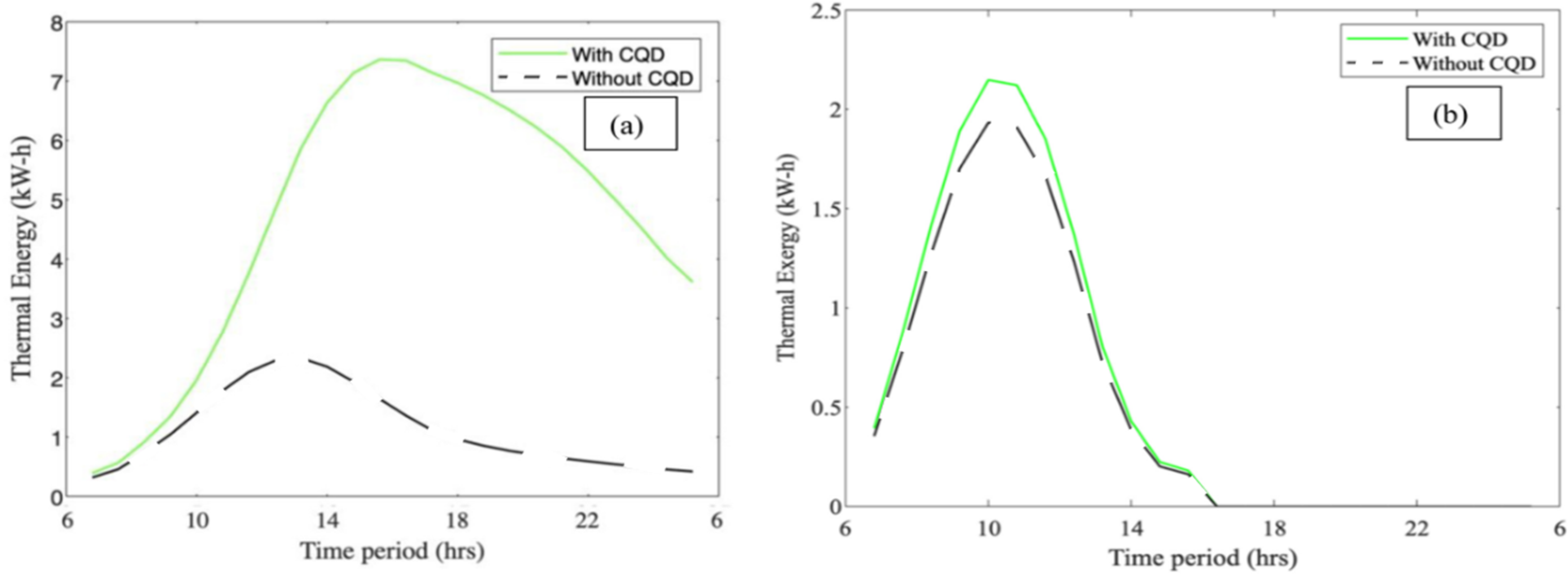
Hourly variation of (a) thermal energy and thermal exergy with and without CQD-water-based nanofluid for fixed packing factors (βc = 0.69) of the roof-top semitransparent PV module.
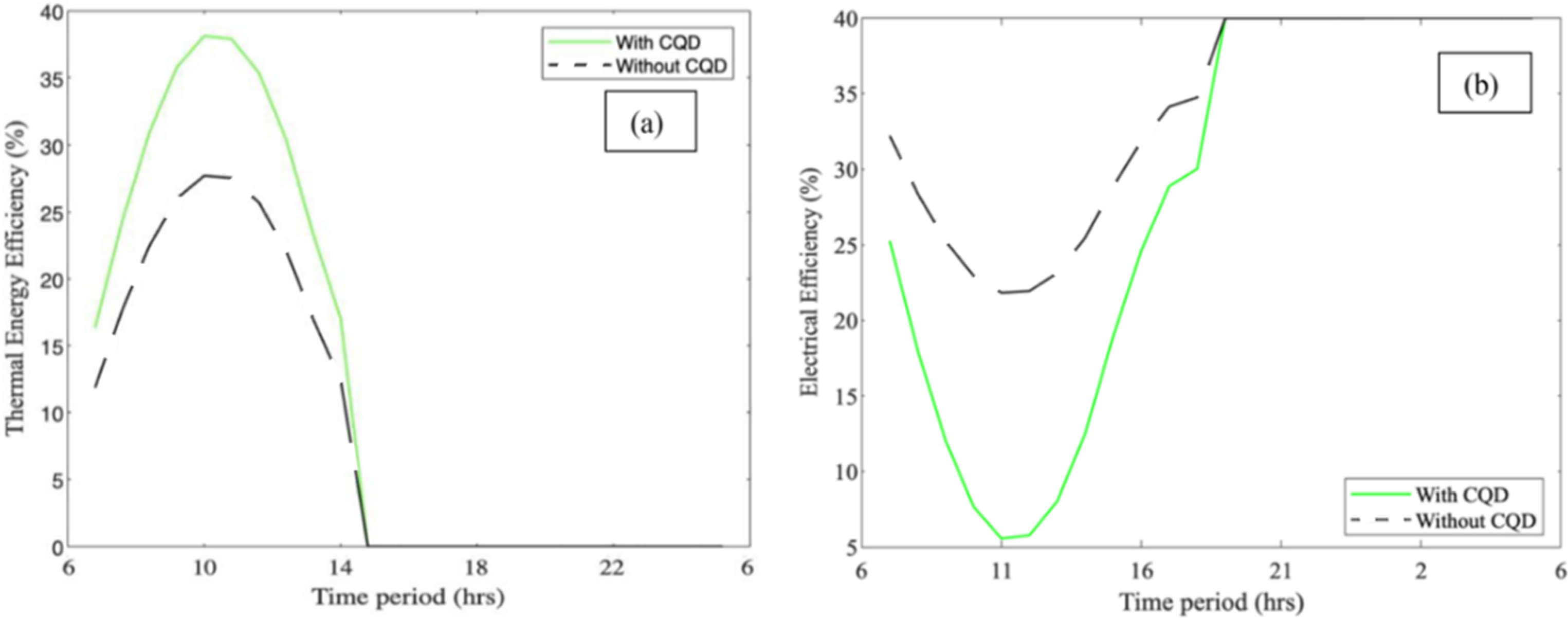
Hourly variation of (a) thermal energy efficiency (maxima should come around noon hours) and electrical efficiency with and without CQD-water-based nanofluid for fixed packing factors (βc = 0.67) of the roof-top semitransparent PV module.
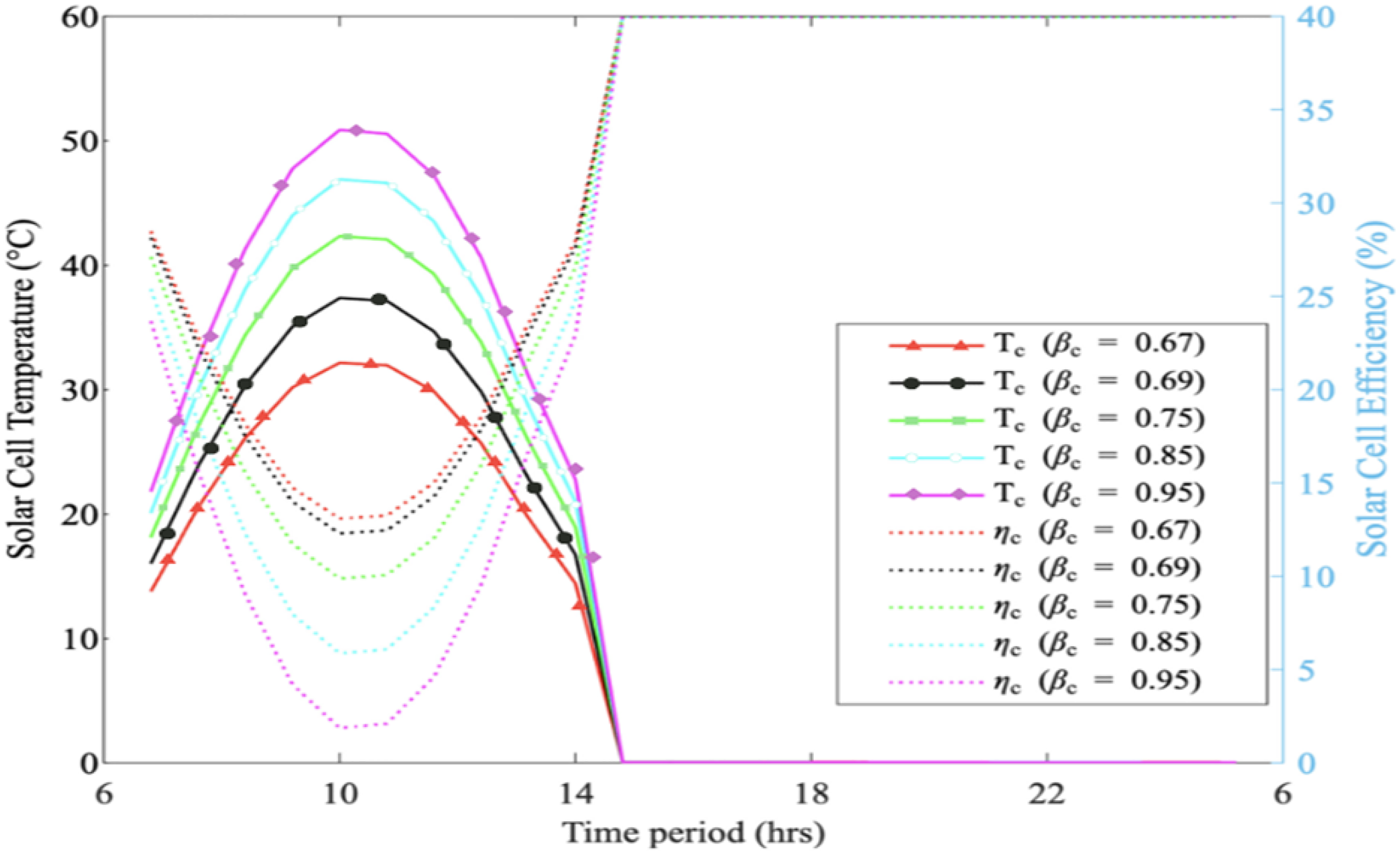
Hourly variation of solar cell temperature and efficiency (SPV-roof top) using CQD-NPs for different packing factors.
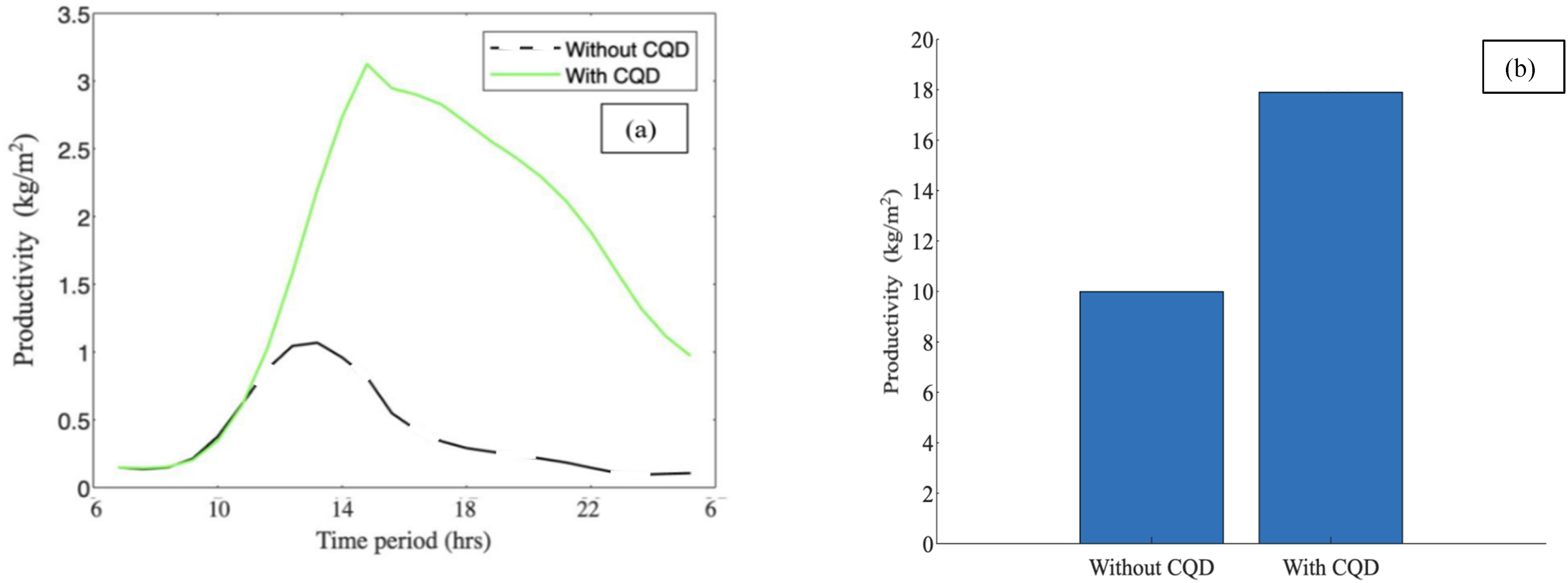
(a) Hourly variation of potable water production and (b) overall daily potable water production with and without using CQD-water-based nanofluid for fixed packing factors (βc = 0.67) of the roof-top semitransparent PV module.
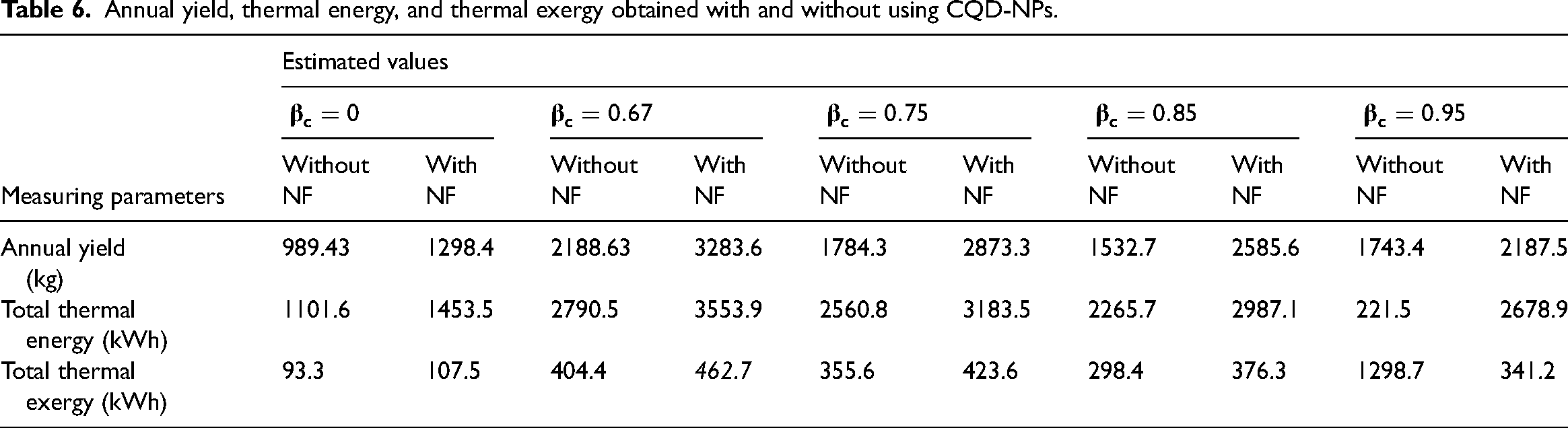
Annual yield, thermal energy, and thermal exergy obtained with and without using CQD-NPs.
Energy/exergy-based CO2 mitigation and CCs earned (enviro-economic parameters) obtained with and without using CQD-NPs.
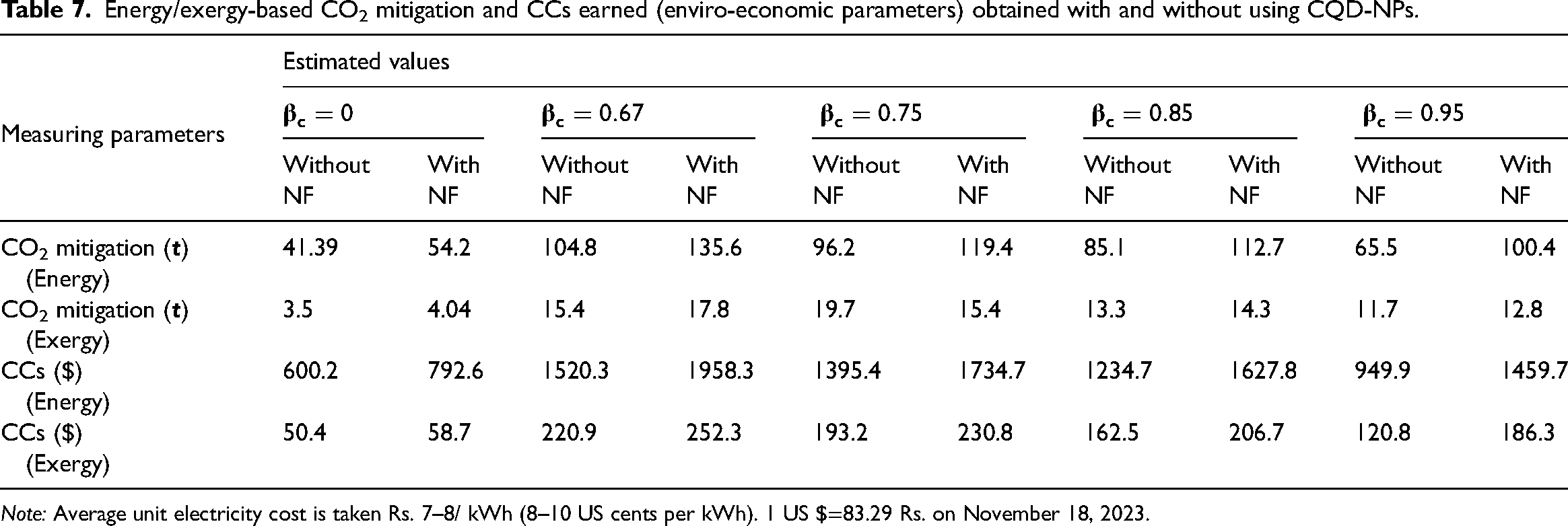
Note: Average unit electricity cost is taken Rs. 7–8/ kWh (8–10 US cents per kWh). 1 US $=83.29 Rs. on November 18, 2023.
Maximum values obtained of different time dependent parameters for the basefluid (water) and CQD- water-based nanofluid for different values of
Moreover, to improve the system performance, it is vital to filter the inefficiencies generated within the system. As discussed above, entropy generation mechanism is useful in order to characterize the estimation of thermal processes. In conjunction with heat transfer based on the second law of thermodynamics, it allows the evaluation of irreversibilities related to heat transport in the system. Due to irreversibilities, the entropy of the system increases continuously and attains maximum value at the state of equilibrium; and all the irreversibilities mechanism ceases out at this stage. From the off state of equilibrium, system begins entropy exchange (matter/heat) with the exterior and irreversible process begins to operate. The entropy of the system decreases the process due to heat loss. Moreover, in association with this heat transfer, exergy transfer depends on the temperature level at which it occurs in relation to the ambient temperature; and exergy of the system has important property, i.e., it is conserved only when all processes of the system and the ambient are reversible which implies exergy destruction occurs on triggering of irreversible process. It means that system carries more thermal exergy gain as it deviates more from the ambient. In general, reducing the inefficiencies in the existing systems, exergy gain, or exergy efficiencies help us to develop a more efficient energy system. Therefore, energy/exergy-based matrices, viz. EPBT, EPF, LCCE, have been evaluated for different lifespans of the system (n = 1:5:50 years) for different values of βc (0, 0.67, 0.75, 0.85, and 0.95) of semitransparent PV module. For the evaluation of these energy matrices and enviro-economic analysis (CO2 mitigation), EE value of each component of the system plays a crucial role. EE and carbon footprint are indicators for selecting materials with lower environmental burden at the product life cycle; and it provides fast and reliable information to design new products. Figure 19 shows the energy-based variation of EPF and EPBT for different lifespans of the system with basefluid (Figure 19 (a)) and CQD-water-based nanofluid (Figure 19 (b)) for different values of βc. EPF increases with increase in lifespan of the system (n = 50 years maximum) and it decreases on increasing the packing factor of the semitransparent PV module [40.51 (βc = 0), 27.92 (βc = 0.67), 25.11 (βc = 0.75), 21.92 (βc = 0.85), 16.60 (βc = 0.95)]. It is the highest for the case of βc = 0 (double-glazed roof-top). It is due to that fact that addition of EE of the solar cells of semitransparent PV module. Moreover, generation of more annual energy with passage of time raise the EPF. On the other hand, EPBT show the reverse effect of the EPF [0.0247 (βc = 0), 0.0358 (βc = 0.67), 0.0398 (βc = 0.75), 0.0456 (βc = 0.85), 0.0603 (βc = 0.95)]. Figure 20 shows the exergy-based variation of EPF and EPBT for different lifespans of the system with basefluid (Figure 20 (a)) and CQD-water-based nanofluid (Figure 20 (b)) for different values of βc; and same trend have been observed as shown in Figure 19. The energy-based variation of LCCE for different lifespans of the system with basefluid (Figure 21 (a)) and CQD-water-based nanofluid (Figure 21 (b)) for different values of βc is depicted in Figure 21. It decreases on increasing the packing factor of the semitransparent PV module, whereas it increases with passage of lifespan of the system [0.326 (βc = 0), 0.377 (βc = 0.67), 0.346 (βc = 0.75), 0.306 (βc = 0.85), 0.236 (βc = 0.95)]. Moreover, LCCE improves significantly for the system using CQD-water-based nanofluids. Similar trends have been observed on carrying the analysis on an exergy basis [0.0196(βc = 0), 0.0414 (βc = 0.67), 0.0343 (βc = 0.75), 0.0264 (βc = 0.85), 0.0158 (βc = 0.95)] as shown in Figure 22. Higher values have been observed using CQD-NPs in the proposed system which is credited to the fact of high generation of annual thermal energy and rise of net EE. As the CQD-NPs shows impressive TPPs due to their lower size (3–5 nm); and processing of this much of size raises the EE values of CQD NPs which significantly alters the values of energy matrices (EPF, EPBT, and LCCE). Picking the highest limit of the lifespan of the system (n = 50 years), significant enhancement in EPF [23.35% (βc = 0), 28.65% (βc = 0.67), 22.34% (βc = 0.75), 29.74% (βc = 0.85), 50.75% (βc = 0.95)]; EPBT [23.51% (βc = 0), 28.77% (βc = 0.67), 22.4% (βc = 0.75), 29.91% (βc = 0.85), 50.81% (βc = 0.95)]; and LCCE [31.90% (βc = 0), 28.91% (βc = 0.67), 24.56% (βc = 0.75), 32.02% (βc = 0.85), 53.38% (βc = 0.95)] has been observed using CQD-NPs on the bases of energy.
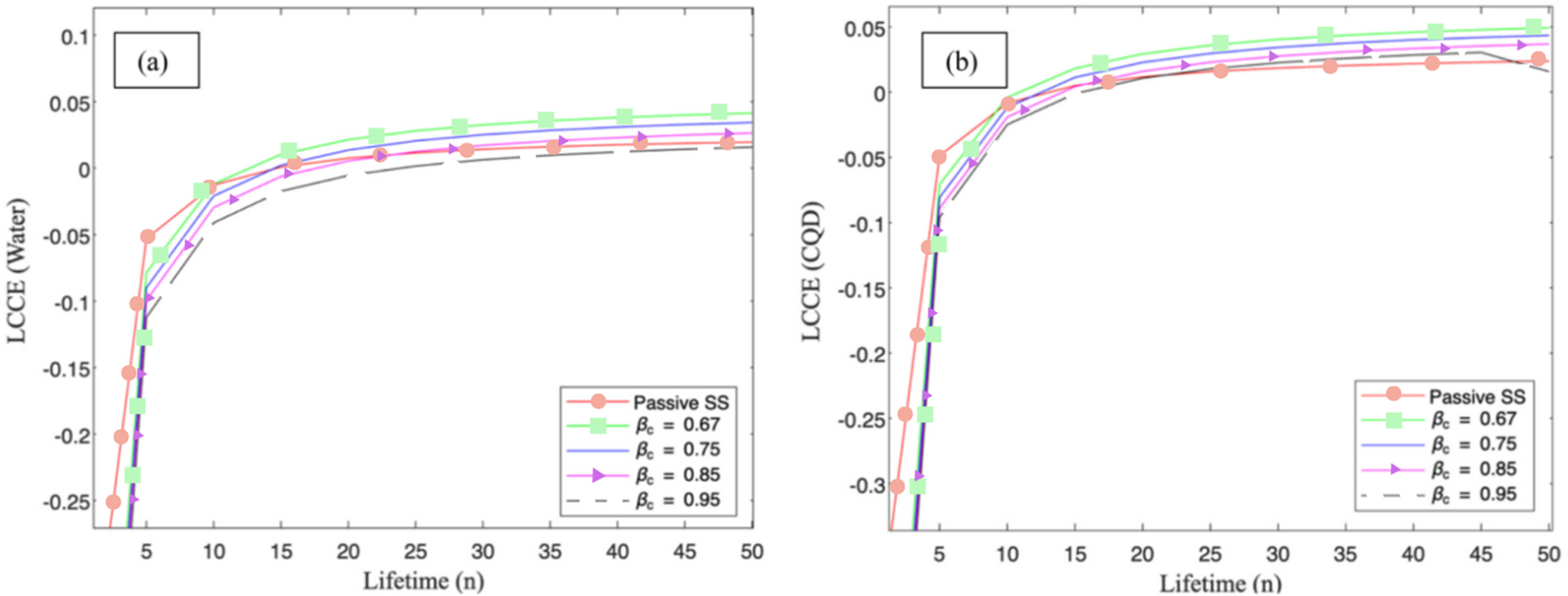
Energy based, the variation of EPF (year−1) and EPBT (year) with different life-spans (years) of the system using (a) basefluid and (b) CQD-water-based nanofluid for different values of βc.
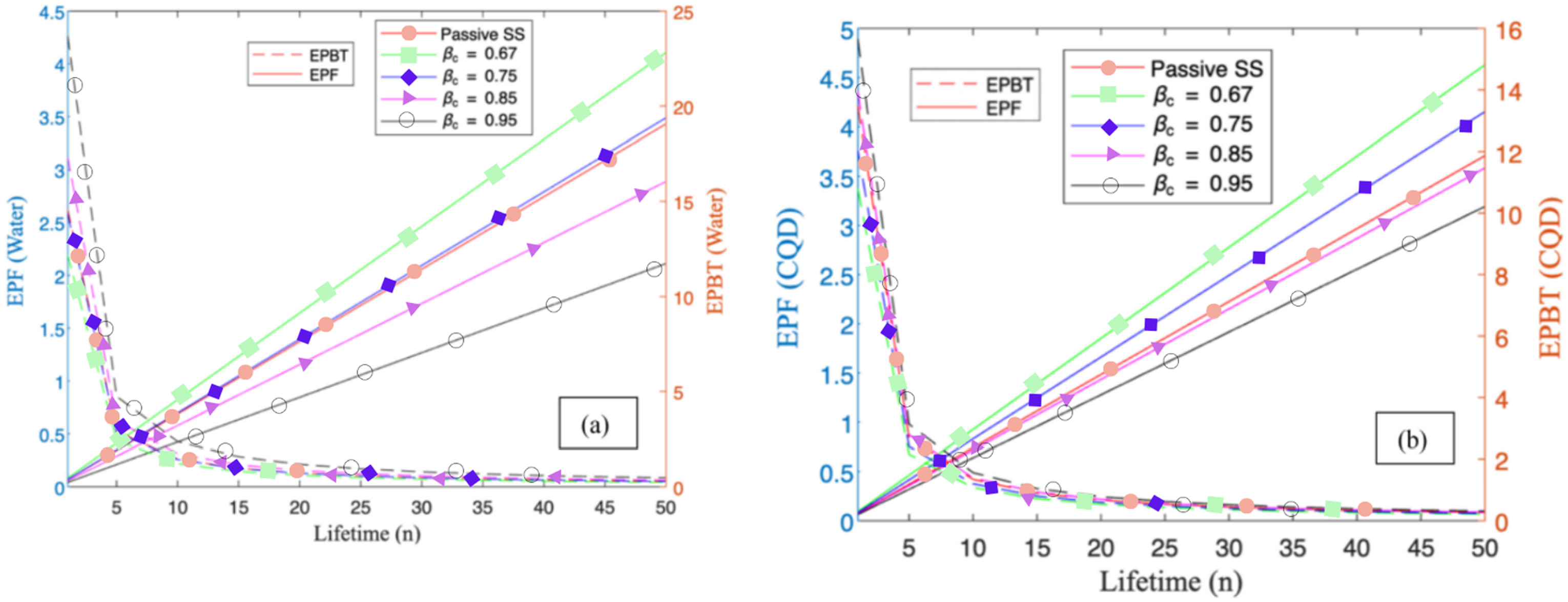
Exergy based, variation of EPF (year−1) and EPBT (year) using (a) basefluid and (b) CQD-water-based nanofluid with lifespan (years) of the system for different values of βc.
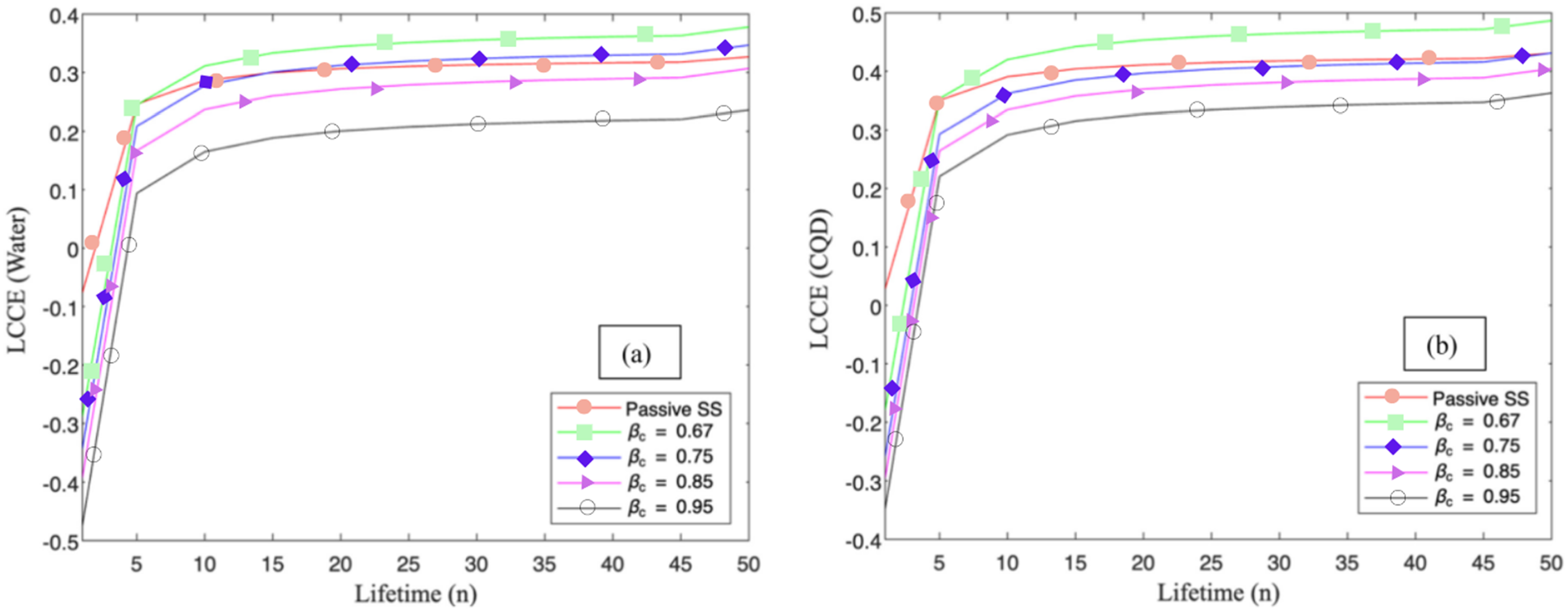
Energy based, LCCE variation with lifespan of the system using (a) with basefluid and (b) CQD-water-based nanofluid for different values of βc.
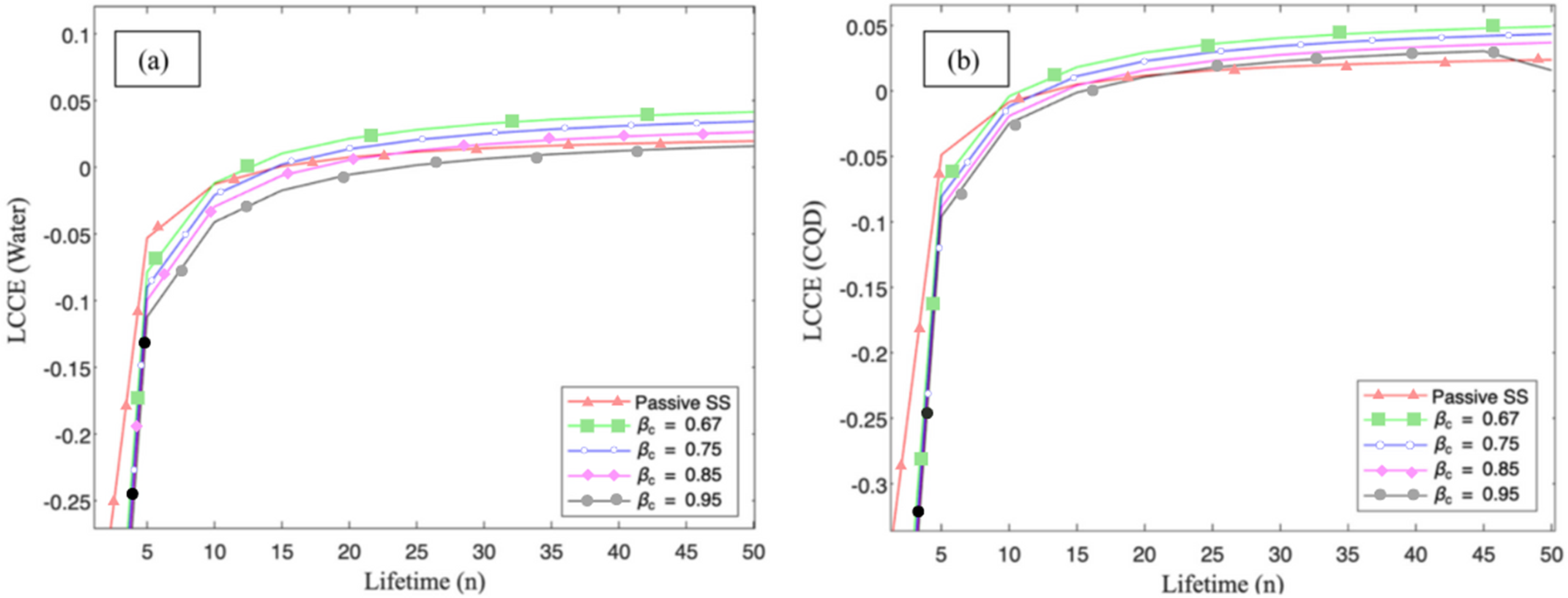
Exergy based, LCCE (%) variation with lifespan (years) of the system using (a) basefluid and (b) CQD-water-based nanofluid for different values of βc.
On performing the enviro-economic analysis, CO2 mitigation and CCs earned have been estimated with and without using nanofluids on energy and exergy basis for different values of semitransparent PV module (βc). Table 5 presents the annual values of thermal energy, thermal exergy, and productivity of the system for different values of βc; and these are used to estimate the annual CO2 mitigating and CCs earned. CO2 mitigation (tons) decreases on increasing βc [41.39 (βc = 0), 104.85 (βc = 0.67), 96.23 (βc = 0.75), 85.14 (βc = 0.85), 65.51 (βc = 0.95)] as shown in Figure 23 (a); because solar cell restricts the solar radiation to reach the solar distiller unit and hence reduces the potable water production/annual energy output. It increases significantly using CQD-water-based nanofluid [31.94% (βc = 0), 28.8% (βc = 0.67), 24.31% (βc = 0.75), 31.82% (βc = 0.85), 53.32% (βc = 0.95)], which is due to the better performance of the system due to ultrafast TPPs of CQD-NPs as discussed above. Similar trends have been observed on carrying the analysis on exergy basis with and without using CQD-NPs (Figure 23 (b)). Moreover, Figure 24 depicts the CCs earned per annum for different values of βc on the basis of energy (Figure 24 (a)) and exergy (Figure 24 (b)). CCs earned decreases on increasing the βc [600.27$ (βc = 0), 1520.35$ (βc = 0.67), 1395.4$ (βc = 0.75), 1234.51$ (βc = 0.85), 949.98$ (βc = 0.95)]; and it increases significantly using CQD-NPs. Similar trends have been observed on carrying the analysis on the exergy basis with and without using CQD-NPs (Table 7). Practically, this system provide both drinking water and electrical energy output. One can withdraw these outputs according to their daily needs as it critically depends on the packing factor of the roof-top semitransparent PV module. With advances in science and technology, small size efficient model of this system can be developed to replace it with modern RO units. This stand-alone two-in-one output system require low-maintenance, easy operation; and it effectively meet the daily needs of drinking water and electrical energy of societies, and families living in scarcity areas (arid/semiarid regions).
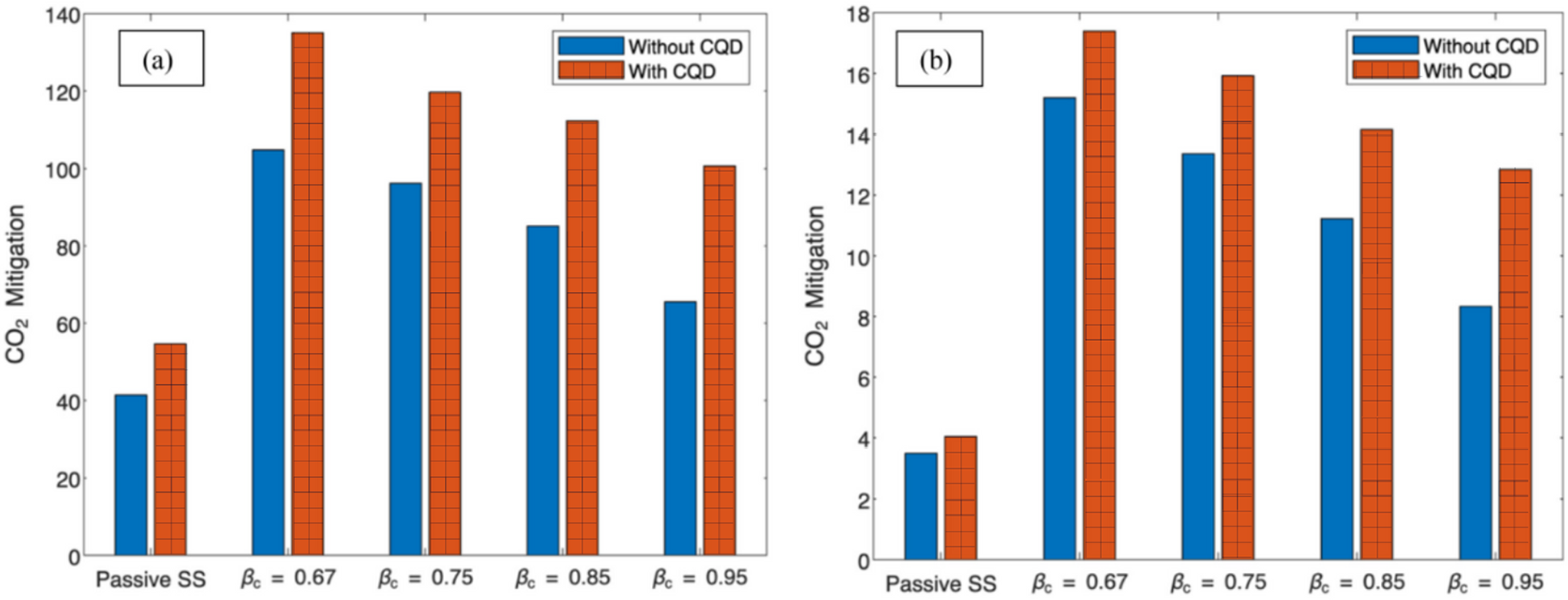
Annual CO2 mitigation (tons) obtained with basefluid and CQD-water-based nanofluid for different values of βc on the basis of (a) energy and (b) exergy.
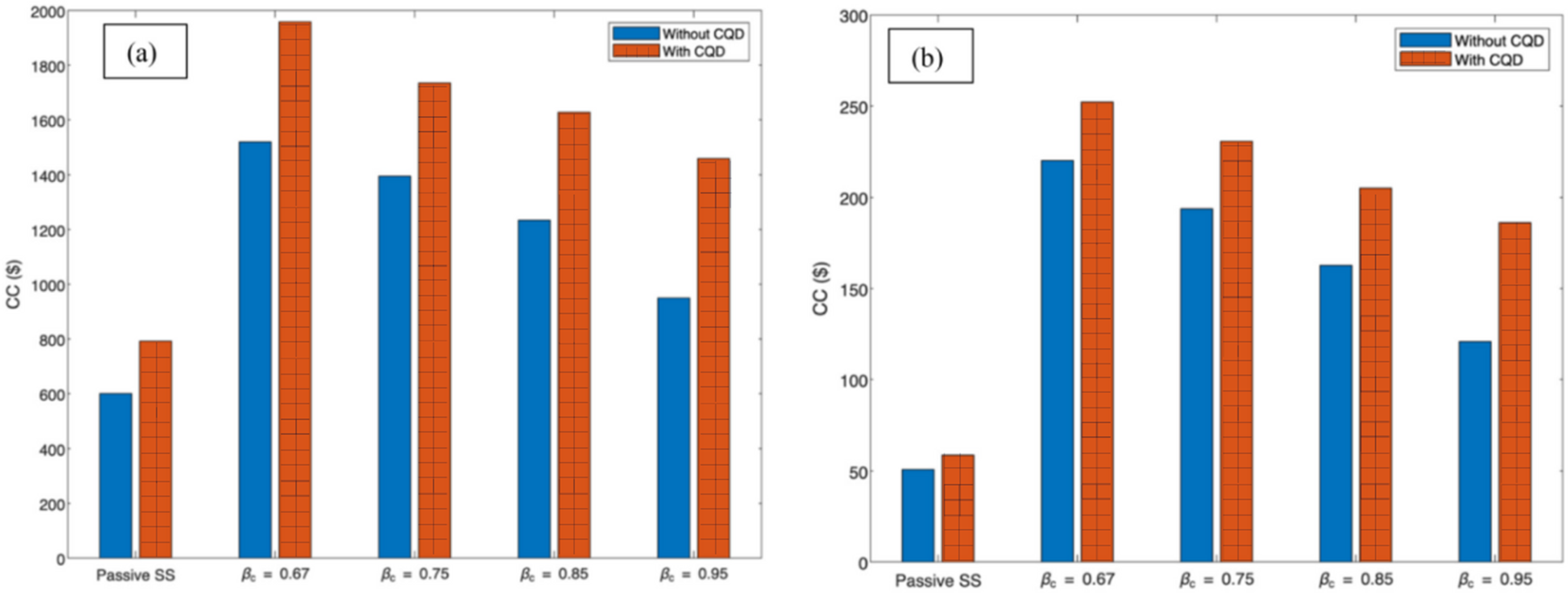
Annual CCs earned with basefluid and CQD-water-based nanofluid for different values of βc on the basis of (a) energy and (b) exergy.
Conclusion
Analytical analysis of the proposed system N-ETC equipped with HCHE, built-in-passive condenser, and roof-top semitransparent PV module with/without using CQD-water-based nanofluid provide the promising solution of potable water production and electrical energy generation. Among all the thermo-physical properties, thermal conductivity shows the dominating effect to improve the thermal characteristics (temperature, energy/exergy, all internal/external HTCs, Reynold's number, etc.) of the proposed system. A rise of 56.06% is observed in thermal conductivity during sunshine hours using CQD-NPs for packing factor 0.67 (βc). Maximum values of evaporative HTCs are observed in the range 9.12–58.1 W/m2-K; and 6.11–32.91 W/m2-K, respectively, with and without using CQD-NPs for the variation of βc of 0.95–0.67. These thermal characteristics deliver around 187.7% enhancement in productivity during noon-hours; and 44.15% improvement in the overall daily productivity for a fixed value of βc (0.67) and volume concentration of CQD-NPs. In the proposed system, CQD-NPs act as a vital system performance parameter and form the thermal efficiency point of view, but βc is the system's output controlling parameter. It decides the quantity of electrical energy generation and potable production output to meet the demands of arid/semiarid regions according to their needs. Low value of βc produces high potable production but low electrical energy output and vice versa. Therefore, it is necessary to keep in mind to consider an optimum value of the βc to run the internally connected D.C. fan and external mechanical water pump for the circulation of nanofluid, viz. integration (ETC). Moreover, for balanced output of potable water and electrical energy, a separate PV module can be coupled with the ETCs; and, in this case, βc can be taken zero (double-glazed roof-top case). Cost analysis shows, generation of more annual energy with passage of time raise the EPF. It increases with increase in lifespan of the system (n = 50 years maximum) and it decreases on increasing the packing factor of the semitransparent PV module [40.51 (βc = 0), 27.92 (βc = 0.67), 25.11 (βc = 0.75), 21.92 (βc = 0.85), 16.60 (βc = 0.95)] credits to the addition of EE values of the solar cells. On the other hand, EPBT shows the reverse effect of the EPF. LCCE shows similar trends. From enviro-economic analysis, implies annual CO2 mitigation (tons) decreases on increasing βc [41.39 (βc = 0), 104.85 (βc = 0.67), 96.23 (βc = 0.75), 85.14 (βc = 0.85), 65.51 (βc = 0.95)] and increases significantly using CQD-water-based nanofluid. CCs earned decreases on increasing the βc [600.27$ (βc = 0), 1520.35$ (βc = 0.67), 1395.4$ (βc = 0.75), 1234.51$ (βc = 0.85), 949.98$ (βc = 0.95)]; and it increases significantly using CQD-NPs. In general, reducing the inefficiencies in the existing system, i.e., exergy gain, or exergy efficiencies improves the energy metrics (EPBT, EPF, and LCCE), which help designers to develop more efficient energy systems.
Scope of future work
Characteristic curve analysis of this system can be carried out to study the thermal energy/exergy gain and loss efficiencies with different integrations. Also, other solo/hybrid NPs with different basefluids can be tested to improve the potable water output and environmental impact (CO2 mitigation and CCs earned). Kitchen wall (outer side-Sun facing) mounted thermosyphon incorporated prototype model of this system can be tested to make it commercial (RO replacement).
Footnotes
Highlights
Acknowledgments
I, corresponding author, Dr Lovedeep Sahota would like to thank Late Prof. Manoj Kumar Arora for his work dedication and knowledge delivered in research and academics. Throughout his wonderful teaching/research career, Prof. Arora guided many students/colleagues to achieve their goals.
Declaration of conflicting interests
The authors declared no potential conflicts of interest with respect to the research, authorship, and/or publication of this article.
Funding
The authors received no financial support for the research, authorship, and/or publication of this article.
