







Abstract
This article concerns the effectiveness of the European Employment Strategy (EES) as a governance tool. It analyses the policy measures of the Member States with regard to the commonly agreed guidelines and the country-specific recommendations of the Council. To analyse the policy measures the paper introduces a new quantitative method, which is applied to ten EU Member States during 2005–2009. After presenting the results, the paper subsequently analyses the level of follow-up with regard to future intended reforms within the Member States and their level of responses to the country-specific recommendations. Although it is difficult to attribute the reforms within the Member States to the EES, the analysis reveals that it is hard to get Member States to move beyond their national priorities, resulting in the EES being a weak governance tool.
Keywords
Introduction
Since its launch in 1997, the European Employment Strategy (EES) has been the cornerstone of the EU’s employment policy. The launch of the strategy was unique in that it applied a soft law mode of governance to the policy area within the EU, which subsequently became known as the Open Method of Coordination (OMC) under the Lisbon Strategy (see Ashiagbor, 2004: 109–90; Council of the European Union, 2000: 2) and became the archetypical mode of what is now referred to as ‘new governance’ (Borrás and Radaelli, 2011; De Búrca and Scott, 2006; Heidenreich and Bischoff, 2008; López-Santana, 2006; Tholoniat, 2010: 102). The new governance mechanism of the OMC was initially greeted with optimism (Radaelli, 2003; Rhodes, 2000; Trubek et al., 2006); however, the non-legal binding nature of the OMC and the absence of judicial review have created scepticism regarding its effectiveness and ability to influence and converge the policies of the Member States (Borrás and Greve, 2004; Hatzopoulos, 2007; Idema and Keleman, 2006; Smismans, 2011; Trubek and Mosher, 2003). Smismans (2011: 518) argues the European Court of Justice considers the Member States to be ‘Masters of the Treaty’ in the OMC and that non-compliance cannot be sanctioned in court.
Current approaches to the topic include qualitative analysis of the possible influence of the EES on the policy reforms of the Member States and are largely exploratory (for example, Ashiagbor, 2004: 35–62; Jacobsson, 2004: 335–70). Empirical research is primarily dominated by national case studies providing an insight into country-specific developments (Graziano, 2011; Gwiazda, 2011; López-Santana, 2006; Mailand, 2008; Zeitlin, 2009; Zeitlin et al., 2005). Such studies have proved both valuable and insightful, but produce conflicting accounts of its overall effectiveness. Furthermore, a second strand of literature focuses on the capacity of the OMC to create cognitive shifts within the Member States and argues that not all policy measures related to the EES can be observed directly (Gerven and Beckers, 2009: 79–81; Hemerijck and Visser, 2003: 21–9; Zeitlin, 2009: 228–31). Overall, this research provides little insight into the effectiveness of the EES as a governance tool – that is, its integration capacity to create policy measures at the Member State level, rather than merely paying lip service. Understanding the effectiveness of the EES as a governance tool is, however, of central importance to the broader debate concerning European integration and EU public policy. As the ‘model’ OMC the EES has become a central governance mechanism in Europe 2020, the successor of the EU’s Lisbon Strategy (Commission of the European Communities, 2010: 27–30). The effectiveness of the EES therefore has much broader consequences than the EU’s employment policy per se.
In response this paper analyses the effectiveness of the OMC as a governance tool via a case study analysis of the EES. We focus on two aspects of the EES, the guidelines and the country-specific recommendations, and analyse Member State policy measures surrounding these two elements. Although we are unable to establish a strong causal relationship between the policy measures of the Member States and the EES, the fact that the Member States report them in their national reform programmes indicates that they themselves frame them within the context of the EES. As Zeitlin (2007: 5) argues, the contribution of the OMC to changes in national policy thinking (cognitive shifts) and to changes in specific national policies (policy shifts) remains controversial and open to multiple interpretations, yet it includes evidence to support the view that the OMC can be considered as influential. However, Zeitlin (2007: 5) also acknowledges that ‘given the active role of Member States in shaping the development of OMC processes, their relationship to national policy making should be understood as a two-way interaction rather than a one-way causal impact’. Therefore, when drawing conclusions on the relationship between the policy measures of the Member States and the EES, we have to be cautious over the exact claims made by particular findings.
In the first section of the paper we introduce a new quantitative method to analyse Member State policy measures surrounding the Employment Guidelines. To do this we develop a coding framework and construct a dataset based on the policy measures of the Member States, as reported in their national reform programmes (NRPs). In the second section we present the results of this coding process, as applied to ten EU Member States during 2005–2009 that represent the different welfare state traditions within the EU Member States, as well as both old and new Member States (the Czech Republic, France, Germany, Italy, Latvia, the Netherlands, Poland, Slovenia, Sweden and the UK). This provides an insight into the ongoing policy measures within the Member States.
As planned projects and strategies at the domestic level are considered to be particularly susceptible to EES influence (see Zeitlin and Heidenreich, 2009; Zeitlin and Pochet, 2005), in the third section we use the dataset to analyse the intended future reforms of the Member States, as reported in their NRP, against the adoption of subsequent legal instruments. To aid interpretation of the results we draw on the existing secondary sources on the topic. In the fourth section, we focus on Member State responses to the country-specific recommendations. The recommendations are used by the Commission to identify areas of weakness within the Member States and to redirect national priorities. To gain a greater insight into their significance we unpack the formation of the recommendations and the roles of the Commission and the Member States. Finally, we conclude with an assessment of the integration capacity and significance of the EES and the OMC as a governance tool.
Methodology to assess policy measures within the Member States
To assess the policy measures at the Member State level surrounding the EES, three issues need to be addressed: first, how and where to identify Member State policy activity; second, how to identify and categorize the type of policy activity; and third, how to assess its magnitude. An obvious way to identify Member State policy measures is in the NRPs. In agreement with the Member States, the Commission produces the Employment Guidelines annually (which remained unchanged during our period of analysis; see Council of the European Union, 2005, 2006, 2007a, 2008a, 2009a). Member States are encouraged to transpose specific policy objectives of the Employment Guidelines to national level programmes in ways that accord with their particular socioeconomic circumstances (De La Porte and Pochet, 2003: 17). To illustrate their efforts, the Member States submit NRPs annually, and the Commission and the Employment, Social Policy, Health and Consumer Affairs Council (EPSCO) in turn make an annual assessment of the progress of the individual Member States (Adnett, 2001: 253–64; De La Porte et al., 2001: 291–307). During the period of analysis of the present paper, country-specific recommendations were issued from 2007 onwards by the Council and the Member States are to report their progress in the NRPs.
A close inspection of the NRPs reveals them to contain two types of policy measures, although it should be noted that the causal link between the policies reported in the NRPs by the Member States and the EES is difficult to establish. First, the NRPs contain strategies or intentions relating to future policy directions and activity. These intentions include either: the acknowledgement of the importance of a guideline usually accompanied with a description on ongoing policies and intentions for future reform; or, a description of preparatory measures (for example, preparation of a Bill for Parliament) that will form the basis of a future policy instrument. Second, the NRPs include the reporting of adopted policy measures, that is, the full range of legal instruments the Member States use to execute their policies (such as programmes, codes of conduct, collective agreements, law). As such, the NRPs are not just reports of retrospective activity; they also include strategy for future policy.
Policy measures within the Member States therefore refer to both their future intentions and adopted policy instruments at the national level only. Such measures can be conceived in terms of both informal and formal output within the Member States (see Bulmer and Burch, 1998). Informal output concerns intentions and preparatory activity, while formal output concerns legal instruments such as hard law, soft law and collective agreements. The concern of this paper is therefore with output within the Member States, as opposed to the analysis of political agency, that is, the shifting nature of national cognitive frameworks and the ability of national actors to frame policy problems and their solutions in accordance with the EES.
To identify the policy measures of the Member States and its magnitude we construct a coding framework to analyse the content of the NRPs against the Employment Guidelines. Constructing such a coding framework enables us to condense the extensive qualitative data found within the NRPs into smaller analysable units through the creation of categories and concepts derived from the data (Lockyer, 2004). To assess the employment guidelines against policy measures within the Member States, codes are assigned to the guidelines with each of the guidelines sub-dividing into specific guidelines. 1
The constructed framework consists of three variables: first, Member State identification of a policy of the EES; second, the type of instrument used to operationalize the aforementioned national policies; and third, the magnitude of such activity. The first variable simply captures whether Member States actually acknowledge the guidelines, whether it be explicitly via the mentioning of a guideline or implicitly via a discussion of a policy that relates to a guideline. As there are no previous coding frameworks for the OMC/EES, it was necessary to generate the second (type of instrument) and third variables (magnitude) by initially analysing a cross-section of the NRPs of our country case studies (see below). After constructing the framework it was applied to a pilot test and subsequently amended where necessary (see Gibbs, 2007: 44–6).
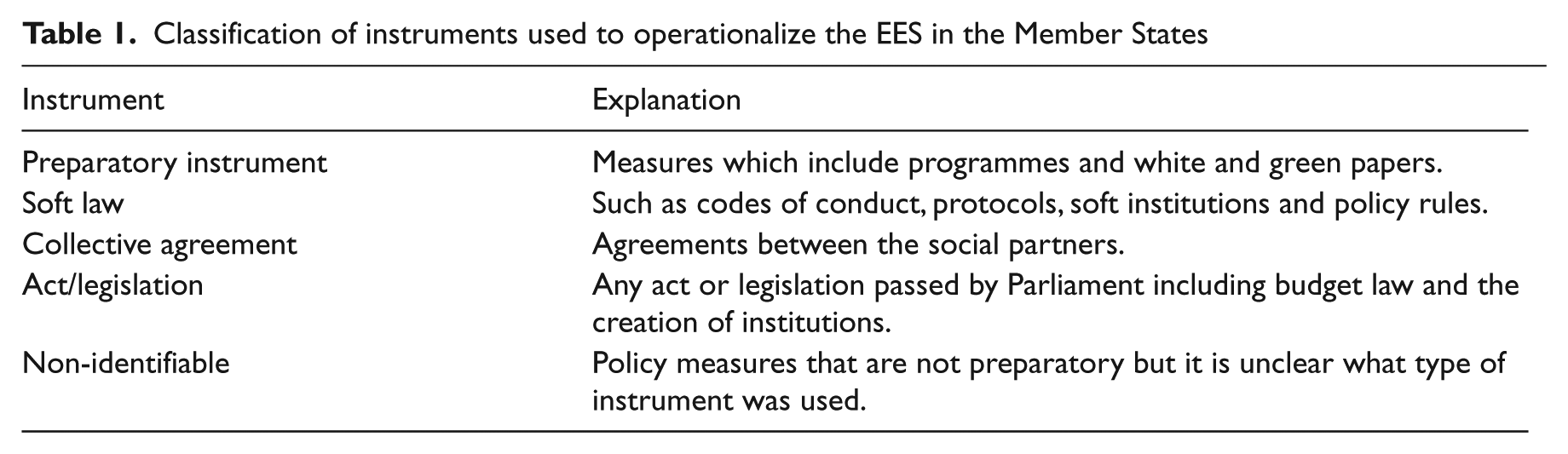
For the instrument variable five categories capture the type of policy measure: non-identification; preparatory instruments; soft law; collective agreements; and act/legislation. As this paper is concerned with the effectiveness of the EES, defined as policy measures moving beyond pure lip service, these include legally binding measures (act, budget law and collective agreements given effect erga omnes), legally non-binding measures that nonetheless have normative effect (soft law, codes of conduct, protocols and frameworks) and preparatory documents (policy documents, reports, discussion/ working papers, green and white papers which represent a first step towards the aforementioned instruments). Where there was evidence of Member State activity, but it was not clear what type of instrument was used, the policy measure was categorized as ‘non-identification’. For example, the Dutch NRP of 2006 (p. 44) provides detail of a life-course savings scheme, but no further information is given on the instrument used. 2 Although it is clear that the scheme is not a preparatory instrument, it is unclear as to what else it could be, that is, act or programme. Therefore this has been categorized as a ‘non-identifiable instrument’.
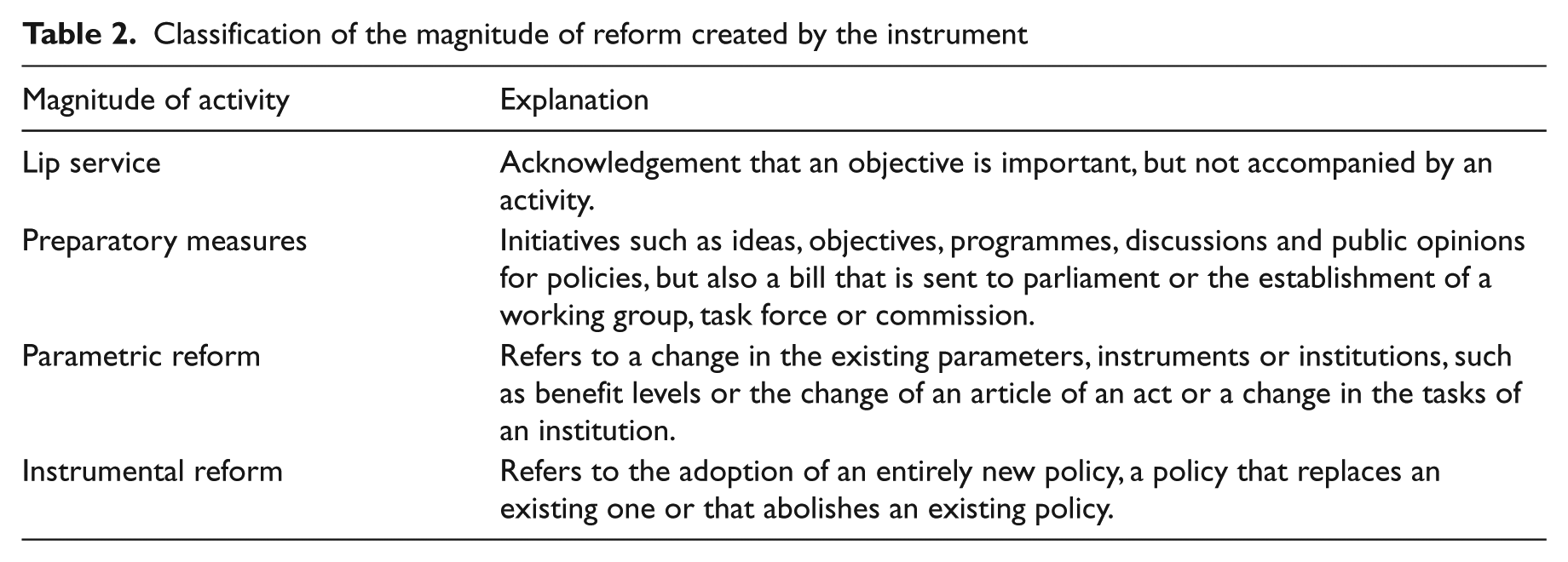
We developed a separate typology to assess the magnitude of the instrument used. An assumption underlying this typology is a belief that it is important not to conflate the type of instrument with its overall impact on the national legal order: while some relationship between the two variables is expected, Member States may introduce an instrument, such as an act, which can either change the parameters of an existing policy or create brand new policy – either way, the scale of such a change is significant. The scale of the magnitude is categorized as follows. First, none for where there has been no acknowledgement of an employment guideline. Second, ‘lip service’ for the acknowledgement of a guideline, but which is not accompanied by policy measures – therefore suggesting only minor shifts in cognitive processes. Third, ‘preparatory measures’, such as initiatives, ideas, objectives, programmes, discussions public opinions, working groups, task forces and bills sent to parliament that represent more substantive shifts within cognitive behaviour. Fourth, parametric reform, which refers to a change in an existing policy parameter, instruments or institutions, such as benefit levels, the change of an article of an act, a change in a level of funding, or the change in task on an institution. Fifth, ‘instrumental reform’ refers to the adoption of a brand new policy, a policy that replaces an existing one, or a new institution.
NRPs for each year during 2005–2009 for ten Member States were manually coded in accordance with the constructed framework. The result is a dataset that captures the policy measures of the Member States, varying from pure lip service to actual policy changes. Analysing the NRPs of the Member States against the Employment guidelines provides a key method for discovering the effectiveness of the EES. Inevitably, one drawback of this approach is that it cannot take into account behaviour and measures that are not recorded in the NRPs. A second problem is that the NRPs do not just represent explanations of specific policy measures within the specified year. As De la Porte and Pochet (2003: 14) note, Member States tend to recycle their national programmes in view of European policies; emphasize what is in concordance with European priorities; and minimize or camouflage the differences. 3 Extracting the exact policy developments of a particular year can therefore be tricky. Furthermore, Member States potentially have an incentive to overplay developments within a particular policy area, so as to appear as ‘good students’ and thereby avoid criticism by the Commission and the Council (De la Porte and Pochet, 2003: 14).
To minimize these issues we adopted a number of strategies. First, the analytical framework was designed to differentiate between where Member States were simply referring to a guideline without giving any substantive policy content, versus actual substantive policy developments. Second, within the analysis we were cautious when assigning policy measures to a particular category within the variables and assumed that Member States overemphasized their developments. Providing a conservative analysis of the NRPs reduces, as far as possible, the inbuilt bias within the documents. Third, to avoid a double-counting of policy and thereby construct an accurate dataset of developments, only polices that were agreed, passed in parliament or initiated in that particular year in question were analysed. For example, all of the 2006 NRPs contain some discussion of policy developments in 2005, but these should have been analysed in 2005. Including them again in the dataset of 2006 would in effect ‘double-count’ them and creates a false impression of the actual developments within the Member States. There are some exceptions to this rule, as NRPs are required to be written and submitted in September/October Member States can report policy measures of a previous year, particularly for the final quarter. Thus, although the NRPs appear to concern calendar years, they do not, as they actually run from September/October to the following September/October. The analysis of the NRPs was therefore respectful of this issue. If specific policy was found in a NRP relating to a previous year that had not been mentioned in the NRP of that year, it was added to the dataset of the previous year.
Finally, to reduce the level of subjectivity in the dataset and increase the consistency of the results, both authors were involved in classifying the NRPs. We classified one country case study together to ensure that as far as possible we were using the typologies in the same way. Thereafter we each took the lead on specific cases, consulted each other on policy measures that were difficult to classify and cross-checked the completed datasets.
The second stage of the analysis focuses on the country-specific recommendations made by the Council, on proposal of the Commission, to the Member States. During the period of analysis of the present paper, such recommendations began from 2007 (Council of the European Union, 2007b, 2008b, 2009b) and are targeted at areas of weakness or challenges within a Member State owing to a lack of policy measures. Alongside such recommendations, focus areas are identified which serve as amber lights to the Member States since they may become problem areas in the nearby future. Therefore, both the recommendations and focus areas are included in the analysis since they both aim to steer national priorities and as such, require the Member States to develop policy measures in these areas. The recommendations and focus areas are subsequently coded in accordance with the guidelines.
Selection of case studies
The framework is applied to the NRPs of ten Member States over a 5-year period (during 2005–2009). This period was chosen for three reasons: first, unlike previous years the employment guidelines remained unchanged for this period enabling the analysis to capture the dynamics of the EES more consistently over time; second, the specified time period is more representative of the current EU in that it enables the analysis to include the new Member States; and third, this particular period from 2007 includes the setting of national priorities by the Commission and is able to capture the recommendation process.
The selected Member States are: the Czech Republic, France, Germany, Italy, Latvia, the Netherlands, Poland, Slovenia, Sweden and the UK. There are two underlying reasons for the selection of these Member States. First, they represent a mixture of old and new Member States. This distinction is significant because new Member States are often considered to be laggards within the OMC (De la Rosa, 2005; Potůček, 2007; Wógcicka and Grabowski, 2007). Second, they represent a broad range of the varieties of welfare state found within the EU. The varieties of capitalism/welfare state literature has made numerous attempts to categorize the EU’s divergent welfare states, but little consensus has emerged over how many typologies of welfare state exist, as well as exactly where Member States should be situated within the various clusters (see Arts and Gelissen, 2002). Germany, Sweden and the UK are three Member States that consistently fall into the conservative-corporatist, social-democratic and liberal clusters, but other ‘hybrid’ countries, such as the Netherlands, are more problematic. Esping-Andersen (1990) categorizes the Netherlands as being in the social-democratic cluster with Sweden, but Bonoli (1997) and Ferrera (1996) align it more closely to Germany and the conservative-corporatist/Bismarckian cluster. Disagreement also exists regarding the EU’s newest members. Vaughan-Whitehead (2003) argues that the 2004 new Member States are a neoliberal bloc of countries, but others such as Keune (2006) provide a more nuanced analysis, arguing that the Baltic States are neoliberal, the Czech Republic and Poland are a mixture of neoliberal and conservative-corporatist underpinnings and Slovenia is social-democratic.
A further problem with such a rigid classification is that welfare states are not temporally fixed in their policy structure and content. At the domestic level countries will be undertaking on-going reforms and while they often maintain their core features, new elements can also be introduced in the short term that can have long-term structural consequences. Therefore, the case studies of the paper have been chosen because they represent a good mixture of the different varieties found within the various welfare state categorizations.
Member State policy measures surrounding the guidelines
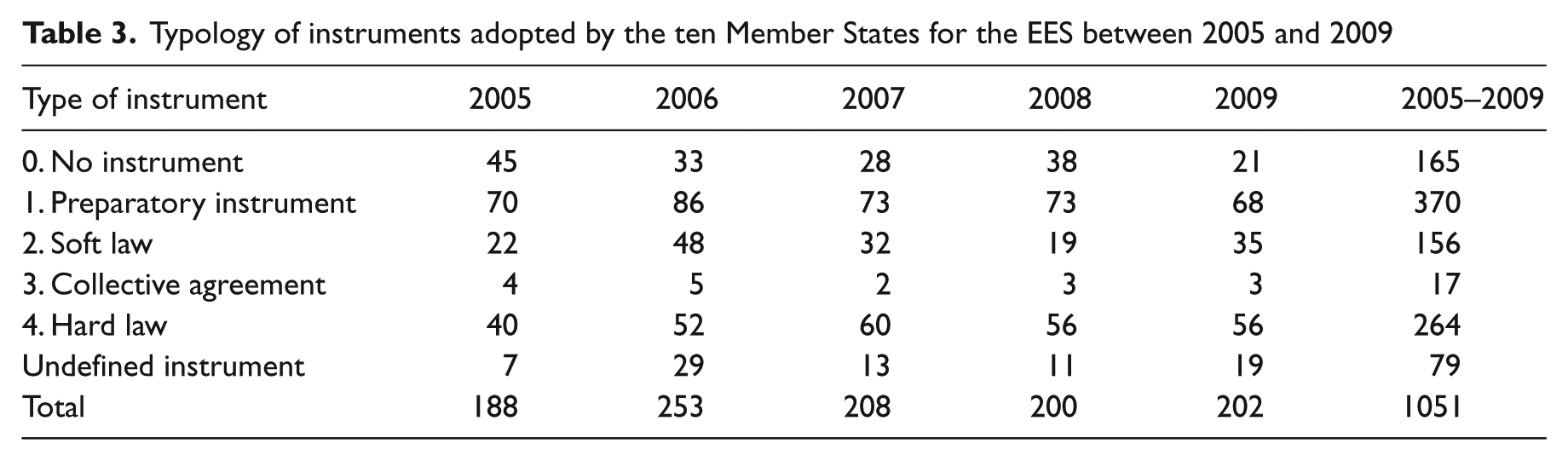
Tables 3 and 4 illustrate that there are considerable policy measures within the Member States surrounding the EES, with 1051 policy measures coded during 2005–2009: 165 policy measures are pure lip-service, that is, where Member States simply make reference to a policy guideline that is not accompanied by an activity; 886 policy measures are concerned with in the initiation or adoption of a legal instrument. More precisely, of the 886 policy measures, 370 were preparatory instruments, and 516 were legal in nature including 156 soft law instruments, 17 collective agreements, 264 hard law instruments and 79 undefined instruments. In terms of the magnitude of the 516 legal instruments, 207 have created parametric reform in the Member States and 309 have created instrumental change.
Classification of instruments used to operationalize the EES in the Member States
Classification of the magnitude of reform created by the instrument
Typology of instruments adopted by the ten Member States for the EES between 2005 and 2009
The magnitude of the instruments adopted by the ten Member States for the EES during 2005–2009
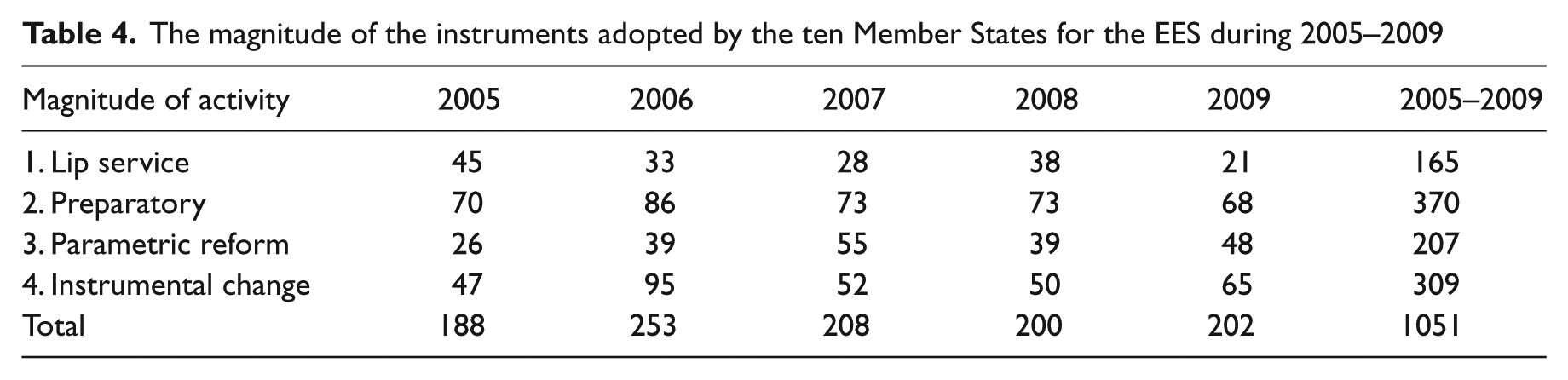
From Tables 3 and 4 it is clear that there are a considerable number of policy measures at the Member State level. A further segregation of the data is required to analyse the policy measures across the different Member States (see Table 5). This is done in two stages. As NRPs are a mixture of future intended reforms by the Member States in response to the EES and retrospective measures (some of which are related to the EES or purely influenced by the domestic political agenda), our analysis is concerned with these two aspects of the data and we segregate the data accordingly.
Number of policy measures of the ten Member States per coded guideline in the period 2005–2009 8
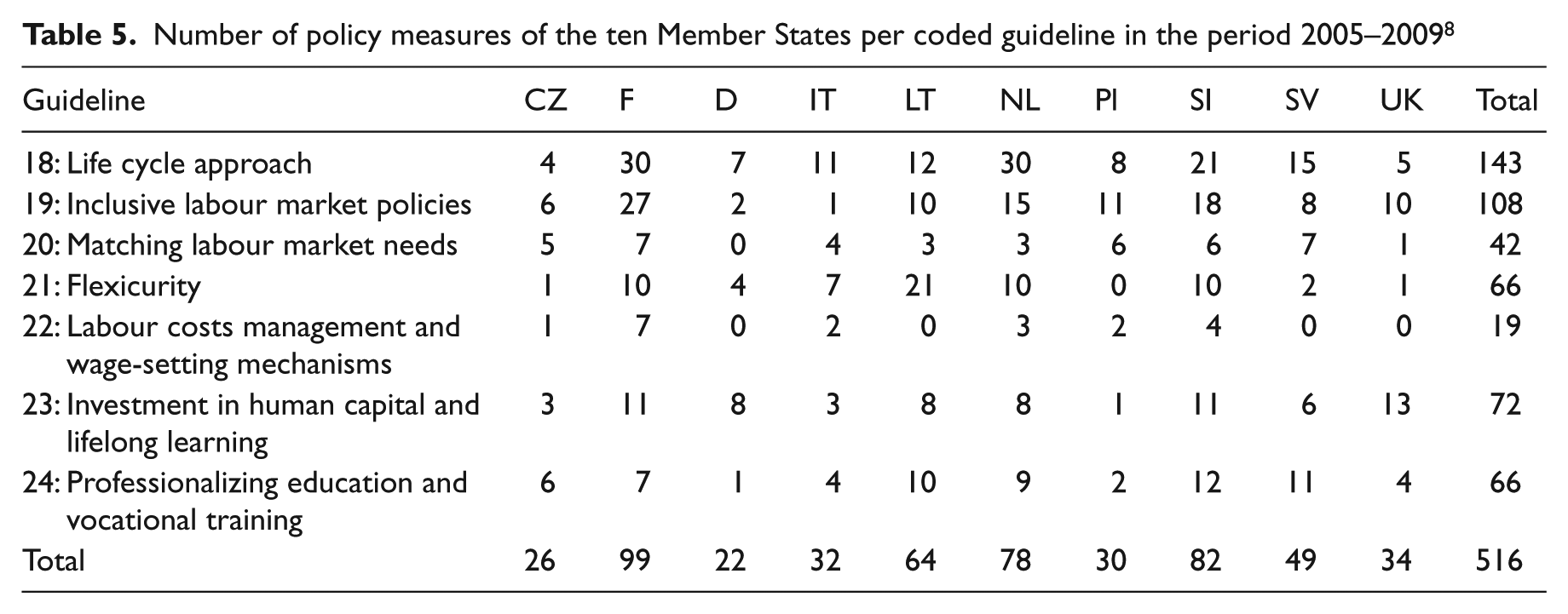
First, regarding the reported retrospective policy measures of the Member States, we are concerned with policy measures that go beyond pure lip service and thereby those instruments that create actual policy changes at the Member State level. This is generated via instruments that create policy reform within the national policy frameworks and includes: soft law, collective agreements, hard law and non-definable instruments.
Table 5 demonstrates that with 99 legislative instruments most of the 516 policy measures are in France, followed by Slovenia (82), the Netherlands (78), Latvia (64), Sweden (49), the UK (34), Italy (32), Poland (30), the Czech Republic (26) and Germany (22); with few exceptions, there have been policy changes for all of the guidelines in all of the Member States. However, Poland has no policy measures in guideline 21, which is mainly concerned with the issue of flexicurity. During the period of analysis there was little impetus for such measures in Poland as reforms were introduced in 2002–2004, which the NRP states: ‘have enabled a more flexible approach to work time and diversified forms of employment’ and that the subject is ‘less popular in Poland than elsewhere in the world’. 4 A similar situation can also be found in Germany with regard to guideline 20: since it reformed and modernized its public employment services prior to 2005 with the Hartz II and III reforms, our dataset does not capture such activity. 5
The most striking observation from Table 5 is the wide variety of policy measures between the Member States, both with regard to old and new members and within the different welfare traditions. First, there is no difference in policy measures between the old and the new Member States, as both groups are at the top (France and Slovenia) and bottom (Germany and Czech Republic) of the total number of policy measures. Second, there are no significant trends with regard to welfare states. For example, France and Germany, which both Esping-Andersen (1990) and Goodwin et al. (1999) categorize as being part of the conservative-corporatist welfare cluster, represent the two extremes of the overall findings. A further example is found within Latvia and Slovenia – two polar opposite welfare states that can be found in Central and Eastern Europe (neoliberal versus neo-corporatist) – which are the second and fourth most active Member States within the EES. To further illustrate the above, the majority of Member State policy measures are within guidelines 18 (concerning the promotion of a life-cycle approach to work) and 19 (which promote labour market policies) with 143 and 108 policy measures – indicating that these policy areas take priority in the domestic political agenda. Among the most active Member States are both old and new members, as well as those from the different welfare traditions: France (30 and 27), the Netherlands (30 and 15) and Slovenia (21 and 18). The same is also true for those who are the least active: the Czech Republic (4 and 6), Germany (7 and 2) and Italy (11 and 1). Within guideline 23 (investment in human capital and lifelong learning) the most active Member States are the UK (13), France (11) and Slovenia (11), while among the least active Member States we find Poland (1), the Czech Republic and Italy (both 3).
Member State policy measures in response to future intended reforms
We can analyse the data with regard to the future intended reforms of the Member States, as reported in the NRP. Here the analysis focuses on where an intended reform was followed-up by the adoption of a legal instrument. According to Zeitlin and Heidenreich (2009) and Zeitlin and Pochet (2005), such policy measures represent EES potential influence. This can be conceived as a result of the ‘downloading’ of the EES into the domestic agenda that can influence the content of policy reform, regardless of where the initial reform momentum came from (that is, EU or Member State levels). Here we focus on policy measures that relate to 0 (lip service) or 1 (preparatory instrument) – a total of 535 policy measures. Our starting point is policy measures that relate to lip service (code 0) or preparatory activity (code 1) during 2005–2008 (a total of 450). We subsequently compared Member State intended policy measures (categories 0 and 1) between 2005 and 2088 with the adoption of legal instruments (categories 2, 3, 4) between 2006 and 2009, and recorded where there was a direct relationship between the two. Of the 450 intentions, 119 (or 26 percent) are followed-up by the adoption of a legal instrument representing parametric or instrumental changes in national policies. The results for each Member State are given in Table 6.
Number of intentions and their follow-ups
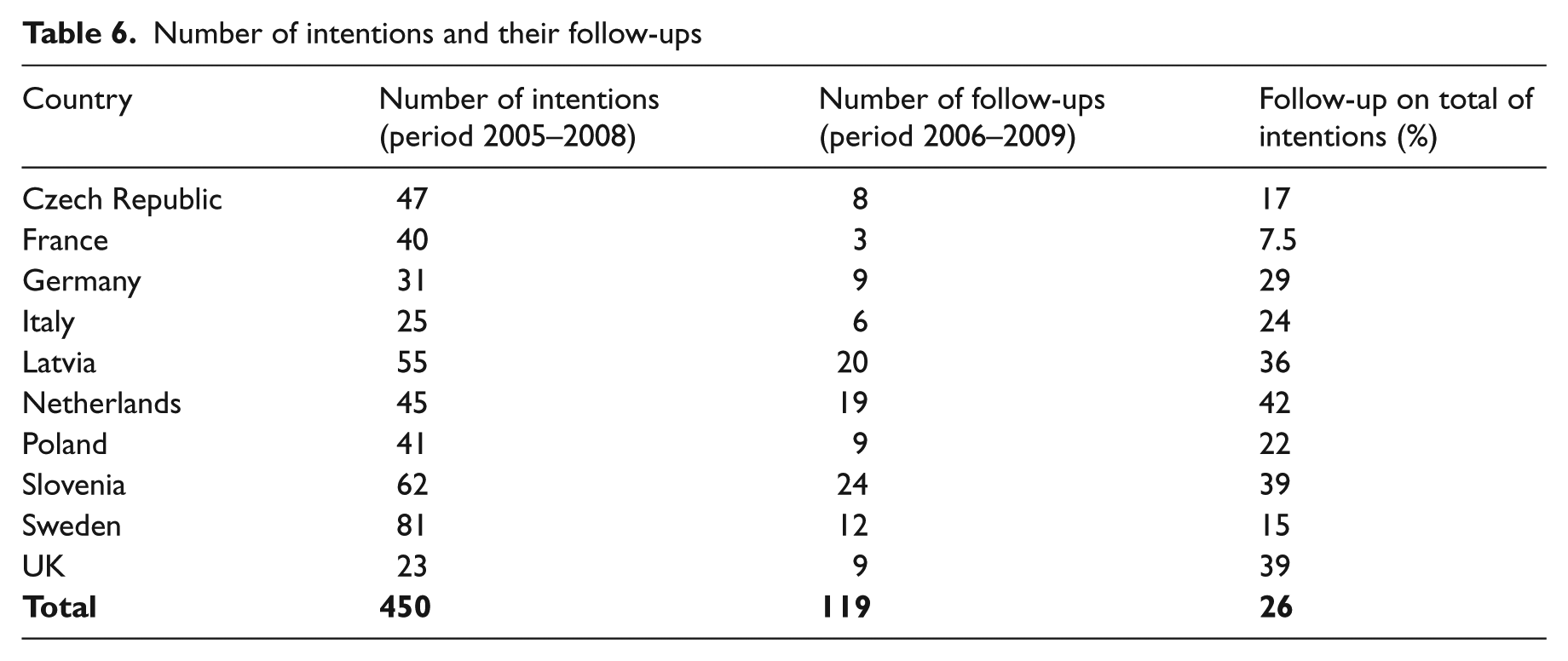
Two points are worth noting from the data. First, the two most active Member States with regard to legal instruments (France and Sweden) are the two Member States with the least amount of intention follow-up. Second, nevertheless, generally Member States who were the least active with regard to legal instruments cluster together with regard to low levels of intention follow-up (Italy, Germany, Poland, the Czech Republic). While the group of Member States that were some of the most active with regard to legal instruments (Netherlands, Slovenia and Latvia) cluster together with regard to higher levels of intention follow-up. In short, intentions and their follow-up activity, usually considered to be where the EES can exert the most influence at the domestic level, demonstrate a relatively low level of follow-up, although some Member States are clearly more studious than others.
How can the low level of informal policy measure follow-up (that is, intentions subsequently followed-up by legal instruments) be explained? Current qualitative studies concerning the effectiveness of the EES point to the importance of domestic political priorities (for example, Büchs, 2007; Graziano, 2011; Gwiazda, 2011; Mailand, 2008; Velluti, 2010). For example, in her analysis of the OMC, Büchs (2007: 35) argues that Member State engagement with a non-binding OMC is determined by a variety of domestic factors including: a goodness-of-fit between the EES and domestic policy; the political system and actor constellation; the position and involvement of social partners and non-governmental organizations (NGOs); and a country’s relationship with the EU. The interplay between such factors will differ within each Member State. Therefore, the level of engagement across the EU is likely to vary significantly, as governments often ‘cherry pick’ aspects of the EES (and OMC more generally) according to their political interests and current policy plans (see Büchs, 2007: 103–6; Visser, 2005: 199–201).
Within such ‘cherry picking’ not only will governments effectively ‘download’ aspects of the EES that suit their own agendas, but they will also interpret the EES differently. There is an added layer of complexity here, as the aims and objectives of the EES are open to interpretation and are thereby fluid. Our dataset corresponds to a period in which centre-right governments have dominated the Council of the European Union, and it is therefore of little surprise that the guidelines in which the Member States are the most active are those concerning labour market flexibility, increasing individual responsibility of the unemployed to get a job and for workers to remain employable (for example, guidelines 19, 18, 23). This corresponds with the existing findings of Büchs (2010: 104–5), who argues that such issues have tended to dominate policy measures in the Member States while those surrounding flexicurity (notably the ‘security’ aspect) and the quality of work have not received as much attention. For example, in the UK the EES has not been used to strengthen the rights of the unemployed and workers, or to enhance ‘social partnership’ at the national level (Büchs, 2010: 104). 6
Member State policy measures in response to the recommendations
Since the EES not only directs Member State policy via the employment guidelines, but also via country-specific recommendations, the second part of our analysis uses the dataset to analyse Member State responses to the recommendations. Furthermore, since the recommendations are one of the least understood aspects of the OMC, we unpack this and analyse the involvement of the Member States in their formation.
Methodologically the recommendation process is simple: Member States submit their NRPs to the Commission who assesses the overall progress of each individual Member State and identify areas of weakness; Member States are then issued with country-specific recommendations to target such weaknesses under Article 148(4) of the Treaty. In this regard, the recommendation process appears as a powerful tool to initiate EES inspired reform within the Member States where they would otherwise fail to act. The Commission takes the role of an assessor of the Member States against the overall objectives of the EES and provides feedback (recommendations) outlining the individual areas of weakness. Such areas of weakness are monitored in subsequent years. Our second hypothesis is that if the Member States respond to the recommendations with policy measures that move beyond lip service and their involvement with their formulation is small, then the EES can be regarded as an effective governance tool. This line of enquiry is underpinned by the belief that the greater the involvement of the Member States, the more likely recommendations are to fit with national priorities (and hence the less successful recommendations are a governance instrument).
Table 7 demonstrates the Member State policy measures, that is, measures that move beyond pure lip service and represent either soft law, collective agreements or hard law, with regard to the country-specific recommendations. The second column of Table 7 represents the total number of recommendations for the Member States, while the third column represents the number of guidelines for which there are recommendations. For example, Italy is recommended to improve the operation of its employment services on three occasions (in 2007, 2008 and 2009), a subject that is promoted by coded guideline 20. The number of recommendations is therefore higher than the number of guidelines the Member State should prioritize. As such, the table captures both the number of recommendations over time and the number of policy areas the Member States need to focus on.
Policy measures with regard to the recommendations
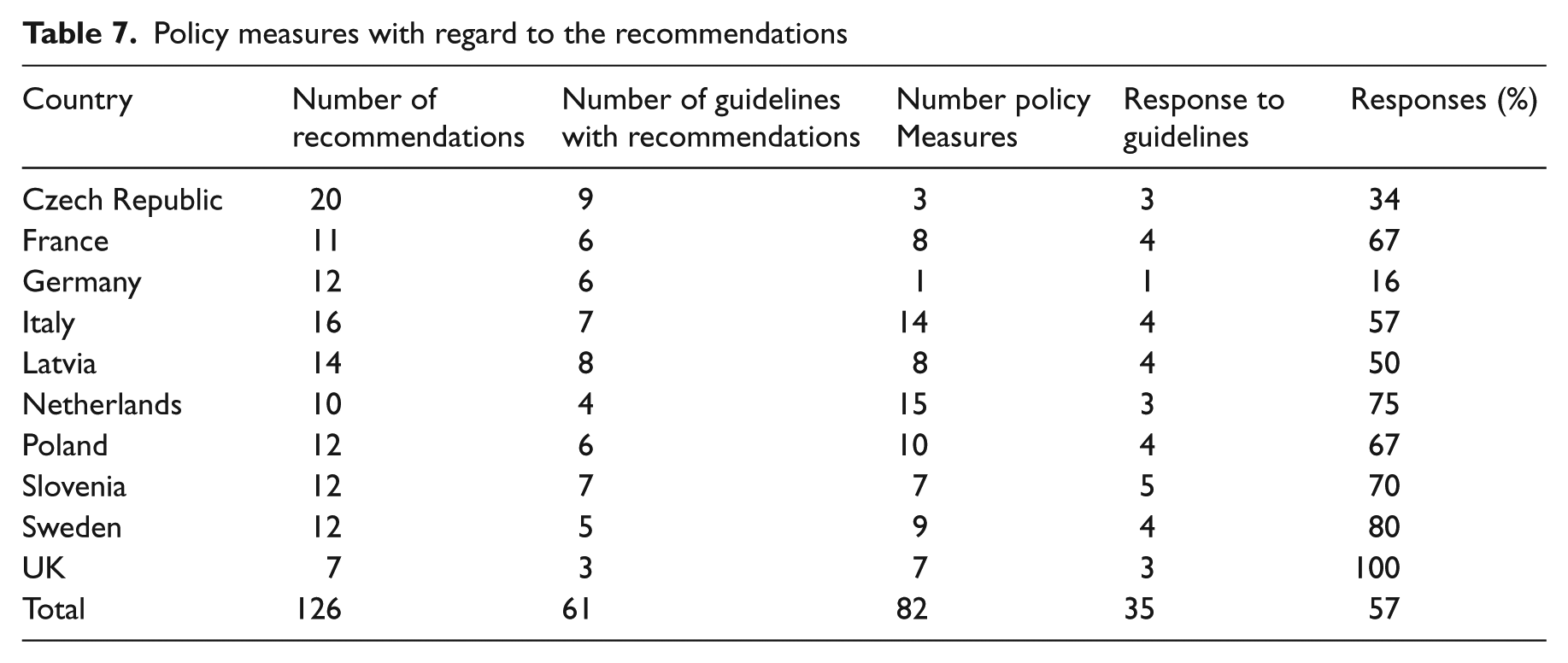
Column four represents the total number of policy measures per Member State with regard to the recommendations. This can be higher than the number of recommendations in column three because Member States may introduce more than one policy reform to address a specific recommendation. For example, to meet the recommendation on improving the operation of the employment services, Italy has adopted a total of four policy measures. The fifth column therefore provides the total number of coded guidelines for which there has been at least one policy measure at domestic level. The final column expresses, as a percentage, the number of guidelines in which there has been at least one policy measure over the number of guidelines with at least one recommendation (columns five and three).
The result of this analysis illustrates that all Member States have undertaken some policy measures with regard to the recommendations but the level of such measures varies considerably. With the exception of the UK, not all Member States act upon the recommendations. For instance, in 2007, 2008 and 2009, the Czech Republic is recommended to prioritize incentives to invest in training for older and low skilled workers, but repeatedly fails to act on this recommendation. With six recommendations but only one policy activity, Germany (16 percent) is the least responsive Member State, followed by the Czech Republic (34 percent) and Latvia (50 percent). The most responsive Member State is the UK (100 percent), followed by Sweden (80 percent), the Netherlands (75 percent), Slovenia (70 percent), France (67 percent), Poland (67 percent) and Italy (57 percent). Combined, the Member States are responsive in 57 percent of the recommendations. One general observation is that the two least active Member States in the EES, the Czech Republic and Germany, are also the two Member States that have responded the least to the recommendations. In this regard, the EES is limited, as it is unable to stimulate policy measures in Member States that are unwilling to respond. Finally, it is worth noting that we find no difference in the policy measures between old and new Member States. Since the reasons behind Member State responses to the recommendations are multifaceted and not only dependent on their welfare states (see Falkner, 2006; Falkner et al., 2004, 2005; Falkner and Treib, 2008), we do not analyse them with regard to the welfare clusters.
Measured by the response of the Member States to the country-specific recommendations, the recommendations appear to be capable of redirecting some national priorities. However, to further understand the integration capacity of the recommendations, it is necessary to unpack the involvement of the Member States in the formation of such recommendations. De la Porte (2011: 496–7) provides one of the few insights into the formation of recommendations for the EES. They were initiated in 1999 by the Commission without the authority of the Member States, but governments were able to claw back control over the process by negotiating with the Commission to soften the recommendations. The use of recommendations was then institutionalized as a regular feature of the EES and the Commission was forced to accept oversight from the then Employment and Social Affairs Council.
This suggests that the formation of country-specific recommendations is a politically negotiated process both within the Commission, and between the Commission and the Member States. 7 The first stage of the recommendation procedure involves the evaluation of the NRPs by country desk officers in DG EMPL, who initially draft the recommendations (DG EMPL 1, 2010), but follow the instruction that they should not contradict what the member states identify as key problems (de la Porte, 2011). Subsequently, the recommendations are internally screened to ensure a harmonization between the Member States, both in terms of the actual wording (in which standardized words are used and care is taken not to describe the seriousness of a problem) and the number of recommendations given to each Member State. Therefore, despite differences in performance of the Member States, the Commission ensures that the number of recommendations between them is relatively similar (Council 1, 2010). From our data, while the Czech Republic may be an outlier to this, during 2007–2009 the two most active Member States, France and the Netherlands, received 11 and 10 recommendations, while the second and third least active, Germany and Poland, each received 12 recommendations. This minimizes political fallout between the Commission and the Member States that could delay or block the adoption of the recommendations in the Council (Council 1, 2010). As one representative noted: ‘we are restricted in what we can do and say and the amount and wording of the recommendations is clearly disproportionate with the worst performing Member States receiving only one or two more recommendations per year than the best performers’ (DG EMPL 2, 2010).
The recommendations are subsequently communicated to the Secretariat-General in the Commission, which after its own screening process communicates them to the Employment Committee in the Council (EMCO). The Secretariat-General then opens up informal bilateral negotiations where each Member State is provided with the opportunity to discuss any problems they have with their country-specific recommendations. This involves the Member States negotiating with the Commission on the number of recommendations and/or their exact wording. Member States can request as many bilateral negotiations as they deem necessary (DG EMPL 2, 2010). Outside of the informal bilaterals, Member States, via their permanent representations in Brussels, are involved in intense lobbying of the Secretariat-General to further influence the recommendations (Council 2, 2010).
During the whole process, Member States aim for recommendations that are few in number, simple to understand and suit their domestic priorities. There are occasions when Member States will use the recommendations to support a domestic reform agenda, but only if it corresponds with national priorities (DG EMPL 2, 2010). Once the Member States are satisfied with their particular set of recommendations, EMCO forms a common position. In reality, every Member State has to be satisfied with their recommendations; they form a single policy document in which all of the recommendations for all Member States are compiled and agreed under a single vote. The Treaty makes no reference to the voting procedure of the recommendations, but in general the issue of employment is subject to qualified majority voting (QMV) under Article 148(4). In practice, formal QMV is rarely used and informally the Council will agree on the final document by consensus (DG EMPL 1, 2010). This further strengthens the influence of the Member States over their own recommendations, as they each hold an informal veto over the approval of all country-specific recommendations. Following the common position, the recommendations are approved by Committee of Permanent Representatives (COREPER) II and the Council of Ministers as a matter of formality.
Therefore policy measures in response to the recommendations should not be overstated, as the Member States play a central role in their formulation. As one representative noted: ‘the final agreed set of country-specific recommendations was always very different compared to their initial drafting by DG EMPL’ (DG EMPL 2, 2010). Recommendations are therefore quasi-extensions of the Member States acting in areas they themselves identify as a priority. As such, the recommendation process is relatively weak.
Conclusion
The aim of this paper has been to analyse the effectiveness of the OMC as a governance tool via a case study analysis of the EES. We introduced a new quantitative method identifying different categories of policy measures including formal output (legal instruments) and informal output (intentions), as well as the magnitude of such activity. First, we analysed the formal output of the policy measures at the Member State level. There are no differences in the policy measures between old and new Member States (for example, France and Slovenia are the most active and Germany and the Czech Republic are the least active), no significant trends between the policy measures of the Member States and no evidence to suggest welfare groupings to be important. Furthermore, there is a wide range of policy measures between the 10 Member State case studies. Second, we analysed the informal output (intentions) of the Member States and whether such intentions are followed up with formal policy measures (legal instruments). On average 26 percent of intentions are followed up, although there are significant variations between the Member states. This level of follow-up could be conceived as indication of the good performance of a legally non-binding governance mechanism. However, it should be remembered that establishing causality between Member State policy measures and the EES is problematic. It could be that the intention follow-ups happened as a result of the EES or would have happened regardless. The analysis of the existing secondary sources on the topic points to intention follow-up being more of a result of the latter. Analysed from this particular perspective, intention follow-up within the EES appears to be low.
The third section analysed Member State responses to the country-specific recommendations, which appear to be relatively high (57 percent). To further understand the significance of the recommendations we analysed their formation and the roles of the Member States/Commission. The analysis revealed that the formation of the recommendations is a politically negotiated process with the Member States ultimately being in the driving seat. Although the Commission initially drafts the recommendations, bilateral negotiations between the Commission and the Member States give the Member States a considerable influence over the number of recommendations issued and their exact wording. Furthermore, the compilation of all country-specific recommendations into a single document further strengthens the influence of the individual Member States, as they each hold an informal, yet powerful veto over the whole process. The result is that country-specific recommendations are little more than an extension of national priorities.
As demonstrated, data-coding analysis often requires the complementary support of qualitative interviews: data coding enables the analysis of large volumes of data over long periods of time and reveals particular trends/performance; while qualitative research provides a detailed explanation as to why such trends occur. The application of both approaches enables the findings of the research to be more substantial, as they benefit from both breadth and depth of empirical research.
What do the findings of this paper conclude with regard to the integration capacity of new modes of governance such as the OMC/EES? First, the low level of follow-up by the Member States with regard to their future intentions demonstrates that it is difficult to get Member States to move beyond policy measures that they themselves identify as a priority. This finding should be considered along with evidence from the existing qualitative research in this area that highlights the potential for the long-term ideational impact of the EES, for example, increasing female employment rates. Second, the formation of country-specific recommendations is dominated by the Member States and as such, recommendations rarely move beyond national priorities. This demonstrates that the guidelines and recommendations of the EES/OMC have little significant impact upon the employment policies of the Member States. In order to have a much stronger integration capacity, the EES requires a more concerted, possibly idealized, form of political commitment to strengthen its governance tool.
Looking forward to Europe 2020, the Commission has argued that the EU’s new economic reform plan requires a stronger governance mechanism with a greater use of country-specific recommendations (Commission of the European Communities, 2010: 28). As illustrated in this paper, the increased use of recommendations will have little impact on the overall success of Europe 2020, vis-a-vis the Lisbon Strategy, unless the involvement of the Member States on their formation can be reduced. At present, there are no indications that this will happen, leaving the OMC a rather toothless governance tool in this regard.
Footnotes
Acknowledgements
We would like to thank the participants of both the joint Harvard Law School and Stanford Law third annual International Junior Faculty Forum 2010, and the European Union Studies Association Twelfth Biennial International Conference 2011. Thanks are also given to Susana Borrás, Gráinne de Búrca, Stewart Macaulay, Helen Stacy, Oliver Treib and the anonymous reviewers of this journal for their constructive comments on an earlier draft of this article. We also thank Olaf van Vliet who joined us in developing the coding system applied in this paper and the financial support given from both the Stichting Institutt GAK and Hallsworth Research Fellowship Scheme.