







Abstract
Korea and Spain share crucial labour market and welfare state characteristics that converge to produce similar outcomes: strongly dualized labour markets, weak social protection, and features that are archetypical of familialist states. Labour market flexibility in both countries has recently increased through unusually high levels of temporary employment. Yet, when we analyse female labour force participation, we observe a significant divergence: Korean women interrupt their participation in the labour market when they are of childbearing age, while Spanish women do not. Furthermore, the level of education of women in Spain matters for their career prospects, but in Korea, it does not. In this article, we explore the causes of this divergence by analysing (1) structural characteristics of the labour market, (2) policies that facilitate the reconciliation of work and family and (3) gender equality politics. We argue that the combination of these three factors have different impacts on the career choices of women in Spain and Korea. Some aspects of working culture – long working hours in particular – the unavailability to women of good quality jobs and a high gender pay gap contribute towards labour market interruption of highly educated women in Korea when they have children. Policy developments have been important in the two countries, but high levels of childcare investment in Korea have not improved female employment prospects. Furthermore, we observe greater political commitment to gender equality in Spain than in Korea. Fundamental changes in the Spanish political culture, which were the result of a combination of domestic and supranational dynamics, played a major role in the political endorsement of gender equality and a rejection of familialistic policies and practices.
Introduction: the puzzle
This article focuses on Spain and South Korea (hereafter Korea), two states that are late democratizers in the quartet of countries under study in this Special Issue. As stated in the introduction to this Special Issue, despite their geographical distance, Korea and Spain are very similarly familialist states. Both countries developed similar labour markets and welfare states which were characterized by a dual structure of employment protection and a heavy reliance on the male breadwinner model. More specifically, safety nets for the unemployed and the working poor, and policy support for women’s employment, long remained underdeveloped in the two countries.
We would argue that the similarities between these two countries run even deeper than the introductory article suggests because they share another important feature. The governments of Korea and Spain have both engaged in the expansion of the welfare state since their transitions to democracy. At the same time, important reforms were implemented in 1984 in Spain and in 1998 in Korea which profoundly deregulated their labour markets. These reforms led to a proliferation of temporary employment in the two countries. As Figure 1 shows, both Spain and Korea are clear outliers with regard to the very high levels of temporary employment, which is in contrast to the low levels of part-time work.
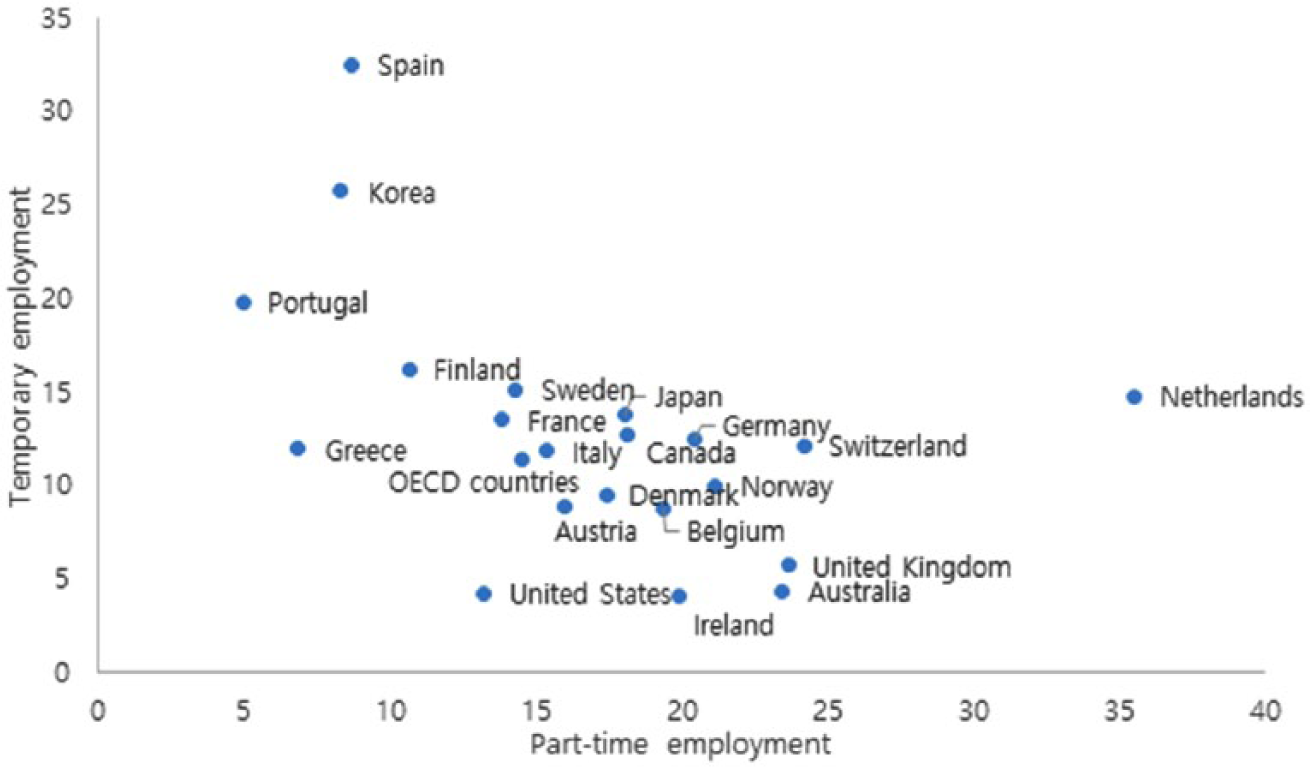
Share of temporary and part-time employment in Organisation for Economic Co-operation and Development (OECD, 2004) countries (%).
Notwithstanding these key similarities, a close examination of the patterns of female labour force participation in Korea and Spain reveals striking differences. In Spain, after successive labour market deregulations, and up until the outbreak of the financial crisis in 2007, women’s employment significantly increased, whereas the effect of labour flexibility on women’s employment in Korea has been minimal. The female employment rate (of women aged 15–64 years) in Spain was below 30 percent until the early 1990s. It then increased to 42 percent by 2000 and to 56 percent by 2007. In Korea, however, the participation of women in the labour market has remained at a similar level for over a decade (51% in 1997 and 53% in 2007).
Perhaps the most puzzling difference between the labour market participation of women in Korea and Spain is represented in Figure 2; women seem to behave differently when we examine employment trajectories across their lifecycle. While the curve for Korean women presents an M shape, in the case of Spanish women, we see more of a reverse U curve, with a sharp decrease towards the end of active working ages. In Spain, the largest increase in women’s employment has occurred among the young and middle cohorts (25–54). Once women enter the labour market, they tend to stay, although permanent exit occurs relatively soon. However, in the case of Korea, the curve shows a decline for women in their late 20s and 30s, only to pick up again in their late 30s. For both countries, the respective shape is similar for the three periods analysed (1997, 2007 and 2012).
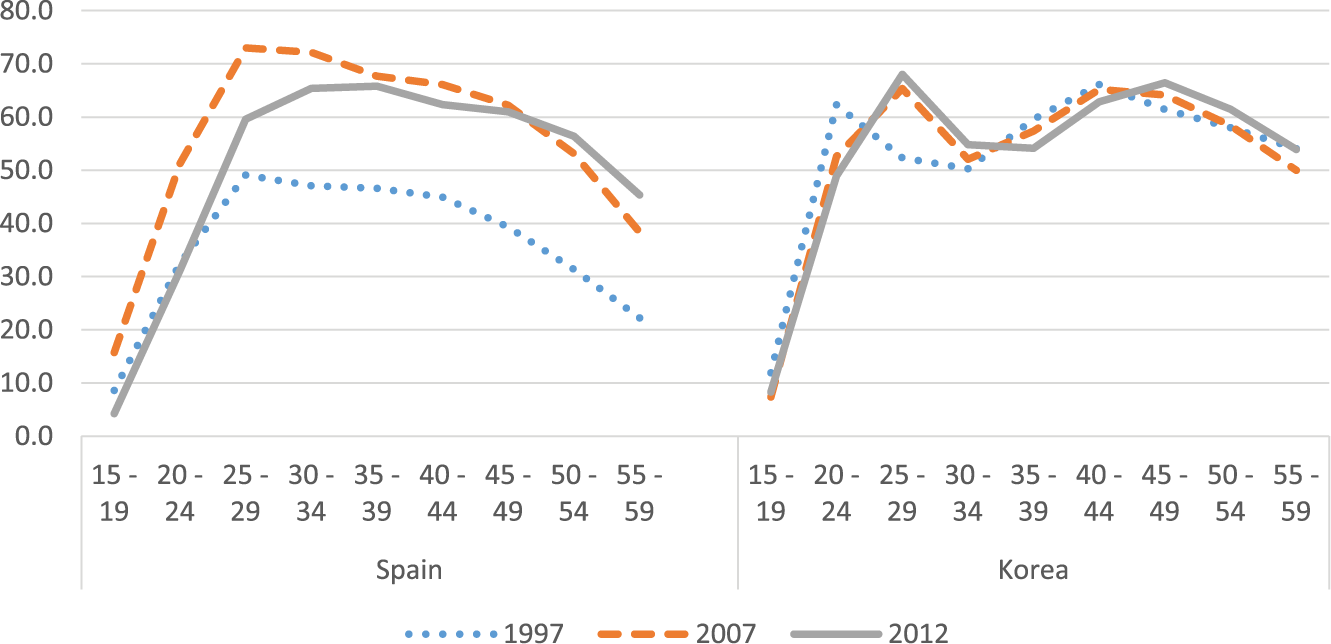
Employment rates by age cohorts in Spain and Korea in selected years.
Furthermore, the patterns of labour market participation among women of different educational levels are also very different between the two countries. In Spain, as in most other Organisation for Economic Co-operation and Development (OECD) countries, women with the lowest level of qualifications have a much higher likelihood of unemployment and inactivity. In 2014, in Spain, employment for women who had completed less than upper secondary education was 39 percent, whereas employment for those who had completed tertiary education was 77 percent (Eurostat, 2015). The employment gap between highly educated (International Standard Classification of Education (ISCED) 5–8) and medium–low educated (ISCED 3–4 and 0–2) women is larger than in the case of men, and this gap has been widening since the mid-1990s (Eurostat, 2015). In Korea, by contrast, there is very little difference between women with a high level of education and women with a low level of education (OECD, 2015a). In 2005, the employment rate for women who had completed less than upper secondary education was 58 percent, whereas employment for those with a tertiary education was 59 percent (OECD, 2015a).
Education reduces the likelihood of labour inactivity for women with children in Spain but not in Korea. As Table 1 indicates, in 2006, the employment rate of childless women aged 25–49 years with lower than secondary education was 60 percent in Spain, but it was only 36 percent for women with three children. By contrast, the employment rate for women with a tertiary education is similar regardless of whether they have no child or three or more children (73.9% and 74.6%, respectively). This is clearly not the case in Korea. According to the analysis reported in the Korean Labor & Income Panel Study Dataset, the employment rate of women aged 25–49 years in 2006 increased with the number of children women had when those women’s educational attainments were low. For example, the employment rate was 48 percent for women with one child and with an upper secondary education while the rate was much higher – 67 percent – for women with the same level of education but three or more children. In the same year, the employment rate of women with one child and with a tertiary education was 39 percent while the rate for women with three children or more was, by contrast, only 15 percent. Women with an upper secondary education are more likely to work in order to ease financial pressure, it seems, whereas highly educated women – likely to be more affluent – tend to stay at home and take care of their children. In sum, in the case of Spain, women who graduate from college do not opt out of the labour market even when they have children. On the contrary, the rate of employment of highly educated women in Korea decreases as the number of children goes up.
Maternal employment rates by education level and number of children (%).
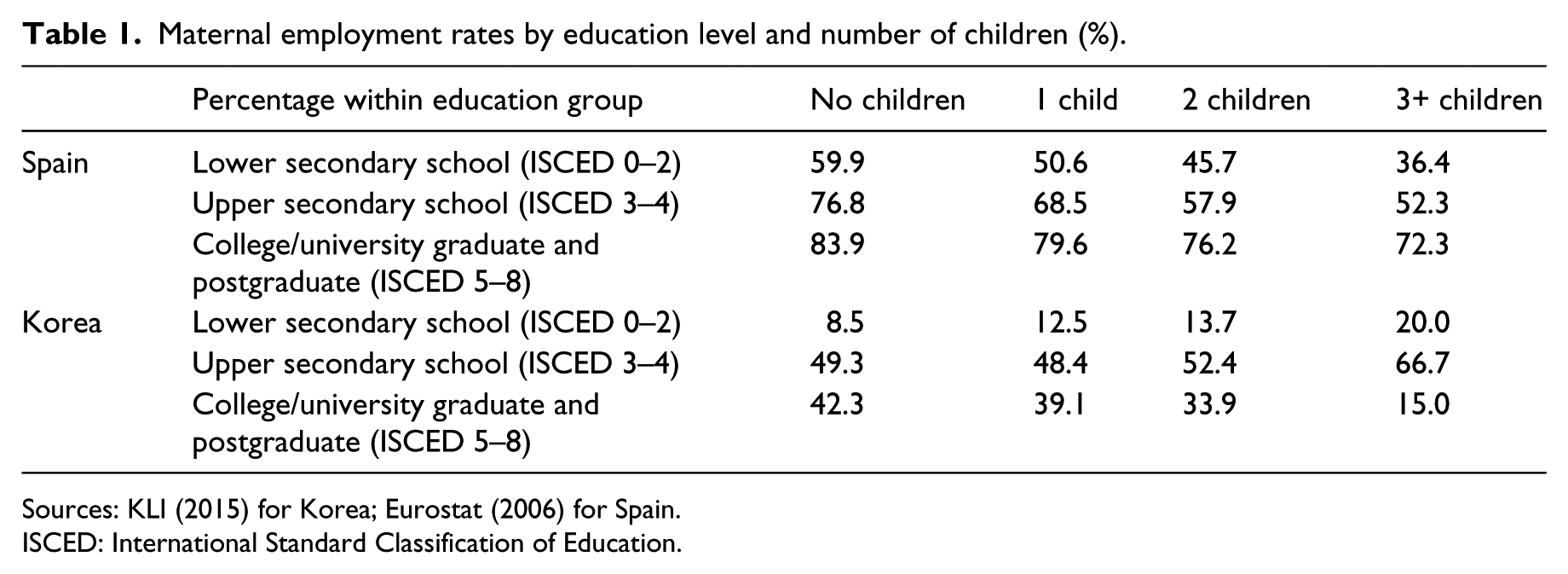
Sources: KLI (2015) for Korea; Eurostat (2006) for Spain.
ISCED: International Standard Classification of Education.
Why are female employment patterns so different in two familialist countries? In the remainder of this article, we attempt to explain this puzzle. First, we review existing theories explaining cross-national variations in mothers’ employment. Second, we explore the causes of such differences by considering labour market features, work and family reconciliation policies and gender equality politics. Although we carefully examine an array of alternative explanations, we focus on these as the causes producing divergence in the two countries. To conclude, we summarize our main findings and arguments, and consider their implications for further academic research.
Existing theories of cross-national variation in women’s employment
The significance of institutional features at the macro level in understanding patterns of female labour force participation has been systematically analysed by the comparative welfare state literature. Particularly prominent in such analyses is the concept of familialism, a term which describes a welfare state that either implicitly or explicitly supports the care and welfare function of the family. Although this notion refers to a function of a given welfare state, the concept is deeply entrenched in the idea of ‘care cultures’ (Pfau-Effinger, 2005). The concept of ‘care cultures’ draws attention to the role that specific cultural contexts, produced by distinct historical experiences, play in shaping the institutional configuration of welfare policies and in influencing individuals’ work patterns (Reskin and Padavic, 2002: 64–78; Treas and Widmer, 2000: 1410). Familialism leads to insufficient institutional support for work/family balance, including childcare provision, and a perseverance of strong inter-generational reciprocity ties. In the absence of adequate social policies supporting the employment of mothers, countries with familialist welfare states tend to exhibit low birth rates (Ejrnæs, 2011; Hobson and Ólah, 2006). Our two case studies, Korea and Spain, fit into this category of ‘familialist states’ (see the articles by Saraceno and Estevez-Abe and Naldini in this Special Issue).
Yet, empirical evidence shows that countries with higher rates of women’s employment do not necessarily have generous family policies. Labour market structures interact with welfare state institutions to influence women’s labour market opportunities. Increasing internal flexibility, such as quality part-time work, certainly eases the tensions between family responsibilities and work while maintaining – or even reinforcing – gender segregation in the labour market (Crompton, 2002). Nevertheless, as Treas and Widmer (2000: 1429) argue, in countries where part-time work is not readily available, a substantial number of women choose either to work full-time or to stay at home. External flexibility at the contract level, however, fosters the use of fixed-term contracts and agency employment, which increases levels of female employment but reinforces tensions between family life and employment (Muffels and Wilthagen, 2011).
Work organization and practices at the level of the employer further determine the ways in which women can participate in paid employment. As has been widely explored in the literature, some workplace practices – such as unsocial working hours or overtime shift work – create severe friction with family life (Drobnič and Guillén, 2011). An abundant body of research also shows that a culture of long hours at work hinders the employability of women (Haas et al., 2002).
Governments play an active role in regulating working time and other workplace organizational practices, and different governments differ in their capacity to do so. In this respect, gender equality politics, defined as ‘a politics or endeavour to introduce measures that could diminish structurally conditioned discrimination’ against women (Jalusic and Antic, 2001: 16), could be an important factor. Existing research points to a number of ways in which power resources matter in gender equality politics. First, social democratic governments are known to promote gender equality and family-friendly labour conditions to a greater extent than conservative governments (Huber and Stephens, 2000; Sainsbury, 1999). Second, a greater presence of women in governments and parliaments is likely to result in more resources being allocated to gender-related issues (Paxton et al., 2010). Third, the power resources of social agents, especially women’s advocacy groups and trade unions, have also been identified as playing a significant role (Kabeer, 2010; O’Connor, 1999; Stetson and Mazur, 1995). Fourth, supranational institutions can legitimise discourses and actions at national level. Such dynamics can be seen, for example, in the case of the support given by the European Union (EU) for the introduction of gender quotas in EU countries (Siim, 2014).
As Childs and Krook (2006) note, however, a greater presence of women in parliament does not necessarily have an effect on gender equality and women’s employment. Existing literature points to the importance of political culture in facilitating, or hindering, the establishment of gender equality politics. Morgan (2003, 2005), for example, argues that in the case of France, political secularization in the late 1960s and early 1970s enabled the development of public policies supporting women’s employment (see also Jalusic and Antic, 2001: 11–12 for a similar argument regarding Central and Eastern Europe).
In the following sections, we attempt to explain our two central puzzles: first, why Korean women are more likely to interrupt their careers than Spanish women; and second, why in Korea – unlike in Spain – there is little correlation between educational attainment and mothers’ employment rate. In addressing these issues, drawing on existing theories, we pay attention to three factors and their interrelations: (1) structural characteristics of the labour market, including employment composition, occupational structures and work practices; (b) work–family reconciliation policies, including parenting leave policies and childcare policies; and (3) gender equality politics.
Explaining the puzzle
The importance of employment composition, occupational structures and work practices
As demonstrated above, Korea and Spain have a high proportion of temporary employment in their labour markets. A close examination of the employment composition in Korea and Spain by occupation and gender reveals, however, some significant differences between the two countries.
Table 2 shows that more Spanish women (close to 40%) work in relatively high-quality jobs – such as legislators, senior officials, professionals and technicians – than Korean women (around 20%). The majority of Korean women work as clerks, service workers and other unskilled professions. This difference could explain why women tend to stop working after marriage or childbirth in Korea, given the presence of an opportunity cost (Joshi, 1992). It should be noted that female entry rates into tertiary education in 2010 were 70 percent in Korea and 48 percent in Spain (OECD, 2010). This means that many highly educated Korean women – roughly 70 percent of the women who have advanced to tertiary education since the 2000s – remain frustrated in the labour market, holding relatively low-skilled and low-paid jobs (Korean National Statistics Office (KNSO), 2014).
Employment composition in Korea (2008) and Spain (2010) by occupation a and gender (%).

Source: Authors’ own extraction from LABORSTA, International Labour Office (ILO) (2015).
Refer to International Standard Classification of Occupations (ISCO-88).
According to our comparative analysis of the Korean Labor & Income Panel Study Dataset, Korean women had relatively good jobs in their 20s. More than 62 percent of young women worked as (associate) professionals or clerks, whereas the rate dropped sharply to less than 20 percent for women in their 40s and to about 5 percent for women 50 years old and over. In 2012, the proportion of women with good jobs increased but a large cohort gap remained. The situation was very different in Spain. In 2014, the percentage of women aged 25–49 years with relatively good jobs – including managers, professionals, technicians and clerks – was around 51 percent, while the percentage of women aged 50–64 years with those jobs was 44 percent (Eurostat, 2015). Hence, the percentage of older women with good jobs was lower than that of younger women, but the difference was much smaller than in Korea.
The differences we have identified above are not simply the result of women in Spain and Korea as a whole working in different kinds of jobs. Table 2 also shows that the percentage of women in Spain employed in elementary occupations is very high (close to 20% of jobs occupied by women) – higher than in Korea – and a further 25 percent fall into the category of ‘service workers, shop and market and sales workers’. In sum, the significant differences that we observe between the countries in terms of career interruptions and downward occupational mobility are the result neither of different levels of educational attainment nor of Korean women generally working in low-skilled jobs and Spanish women generally working in high-skilled jobs.
Figure 3 illustrates the different employment patterns for women in Spain and Korea. In general, women in both countries tend to work much more in the service sector. A greater proportion of Korean women work in the agricultural/fishery sectors than do women in Spain, although primary sector employment has shrunk rapidly in both countries. In Korea, such jobs are held mostly by elderly women in rural areas (Kim et al., 2010). A greater proportion of Korean women also work in the manufacturing sector and the accommodation and food service sectors – areas where the incidence of career interruption is particularly acute. In manufacturing, in 2009, the number of employed women was notably higher in the 25–29 age range (120,000) than in the 30–34 age range (75,000). In the accommodation and food service sectors, the number of women employed was 14,800 in the age range 25–29, but only 8000 in the age range 30–34 (Ministry of Employment and Labour (MOEL), 2015). With respect to the service sector, a higher proportion of women in Spain work in public/private administrative, professional/technician and health and social services work than in Korea. To the extent that jobs in the public administration and the welfare sectors are tenured jobs with good working arrangements, the balance between childrearing and a professional career is more easily achieved. The size of the public sector also matters: according to the OECD, in 2013, 13 percent of the labour force was public sector employment in Spain. This percentage, which is low for EU standards, is much higher than in Korea (6.5%). The recent expansion of health and social services in Korea has resulted in more women being employed in that sector; according to the MOEL (2015), the number of women employed in health and social services increased by around 50 percent between 2009 and 2013. However, the number of young women aged 20–34 years employed in this sector increased only slightly (from around 250,000 in 2009 to 280,000 in 2013), whereas the number of older women aged 45–59 years working in such services doubled from around 120,000 to 250,000. Such jobs are low paid with long working hours (190 hours per month in 2009) and, hence, make it difficult for women to reconcile work and family.
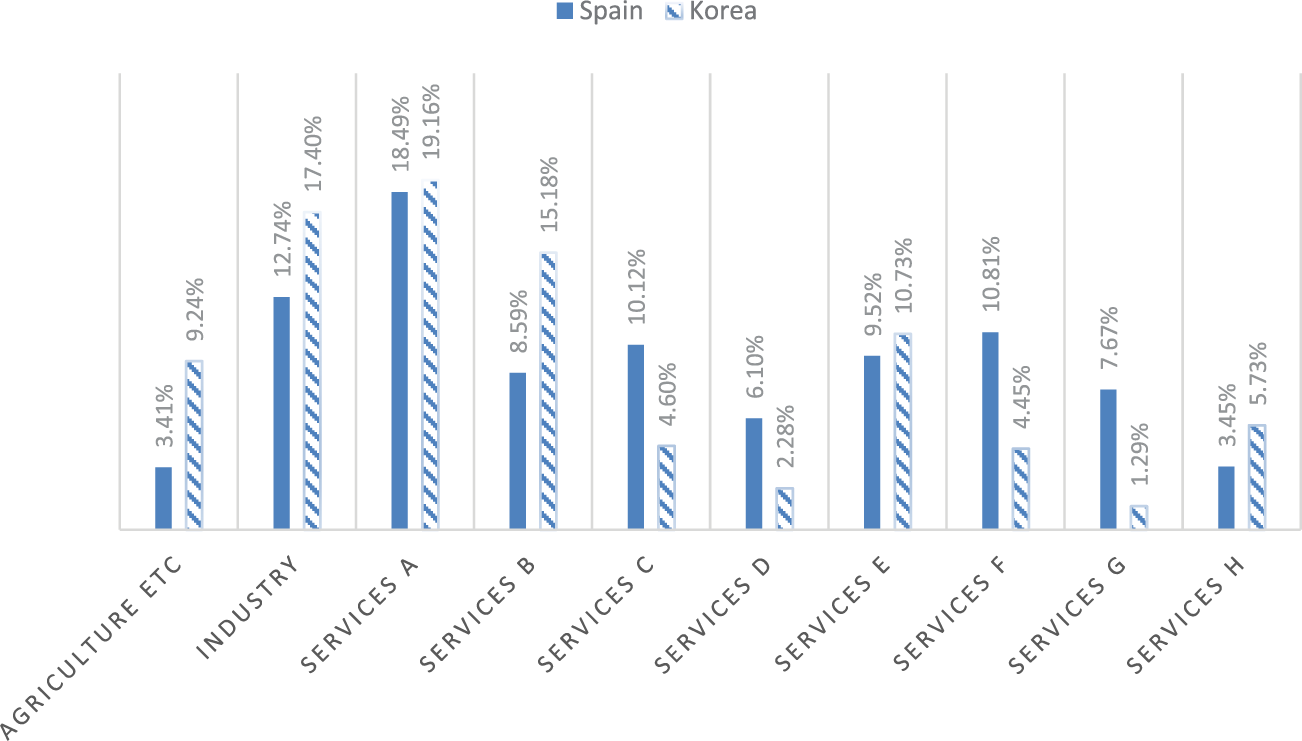
Women’s employment by sector in Korea and Spain 2007.
The percentage of women in Spain who work in low-paid jobs with precarious working conditions is also very high. Together with the wholesale and retail trade sectors, a larger percentage of women in Spain than in Korea were working in household activities as employers. Employment in the household sector remained above half a million employees in 2013, the vast majority of whom were women, more than half of foreign origin. The household sector is a clear entry route into the informal labour market for female foreign workers. Domestic workers are, in fact, by far the largest occupational group among migrant women, constituting close to 20 percent of all of those who are economically active. Given the fact that many low-income households have been severely affected by the economic crisis in recent years, a significant number of families are able to survive economically only thanks to the domestic and caring work performed by women. At the other end of the socio-economic spectrum, the supply of domestic and care work in private homes allows professional women with small children to work full time (Ibáñez and León, 2014: 111). Although beyond the scope of this article, the prevalence of middle- and low-income families with significant private debt as a result of home-buying during the years of economic expansion that preceded the crisis surely plays a part in explaining why Spanish women in low-income jobs do not exit the labour market when they have children (González and Jurado-Guerrero, 2006). Likewise, the extraordinary high levels of unemployment in Spain (above 20% for both men and women) will also be a strong deterrent to exiting the labour market.
Working hours seem to be another key factor. In 2005, women’s weekly working hours were 46.4 in Korea compared to 35.5 in Spain (OECD, 2015b). The average time spent travelling to and from work in Korea was also the highest among the OECD countries, 40 minutes per day, whereas in Spain, the time spent was less than 25 minutes (OECD, 2015b). A number of studies also point out that expectations that people will work beyond their normal working hours and a strongly male-oriented working culture in Korea are obstacles to women maintaining their careers (Chong and Choi, 2014). Despite the long working hours, the gender pay gap is very high in Korea, close to 40 percent in 2005, compared to 13 percent in Spain (OECD, 2015b). Related to this, another noticeable aspect of the Korean labour market is the high proportion of self-employed women. According to the OECD, 27 percent of Korean female workers were self-employed in 2010, while in the case of Spain, the proportion was 12 percent – close to the OECD average of 12.4 percent (Ministry of Strategy and Finance (MOSF), 2011). In Korea, the more marginalized groups of women with caring responsibilities seem to choose self-employment as an alternative to low-paid wage employment (Carrasco and Ejrnæs, 2012).
Working cultures and practices that are inattentive to the potential conflict between work and family are strong deterrents to equal participation of women in paid labour. The following section will show, however, that social policy also plays an important role in women’s presence in the workforce.
Improved but flawed ‘work and family reconciliation’ policy
It was not until the 1990s in Spain and the 2000s in Korea that social policy mechanisms oriented towards work/family balance broke through into the political agenda. It would even be difficult to describe Korea as a welfare state until the late 1990s, when the government introduced, and then expanded, social insurance and health policy (Choi, 2012). Instead, businesses provided a range of welfare services, such as retirement benefits, housing allowances and scholarships for children. In fact, the total public social expenditure in Korea in 1995 was only 3.2 percent of gross domestic product (GDP) (OECD, 2015a). Spain, by comparison, devoted a greater percentage of GDP to social spending by 1980, when it was above 15 percent. This was still well below European averages, but the spending was accompanied by notable efforts to improve the quality of, and access to, social security. Spain witnessed large investment in universal health care and education during the 1980s, although social services, family policy and support for social care remained minimal (Rodríguez, 2011). Social policy in Korea has developed since the 2000s, but institutional changes to promote gender equality in the workplace have gone much further in Spain than in Korea.
In order to comply with the EU directive on pregnant workers, successive reforms in Spain have lengthened paid maternity leave to the point where it has now reached 16 weeks at 100 percent of one’s salary and with an eligibility period of 180 days. Since 1994, the state has been responsible for the social security contributions of the employee during maternity leave. In 2002, the Korean government increased the period of maternity leave from 8.6 weeks to 12.9 weeks, but not at 100 percent of salary. Both countries have also introduced paternity leave and parental leave schemes. While parental leave in Korea provides 40 percent of the basic wage up to a limit of €810 per month over a 1-year period, Spain offers only 4 weeks of unpaid leave. Yet workers who look after their children or dependant relatives can be granted a maximum of 3 years of unpaid leave. Both countries offer minimal paid leave for fathers – 13 days fully paid in Spain and 3 days paid leave with two additional days unpaid in Korea. In Spain, while parental and paternity leave have low rates of up-take, the 16 weeks of maternity protection is utilized by the majority of female workers (León, 2016). To increase access to paid leave, the 2007 Equality Law granted unemployed women and women who do not qualify for the contributory scheme the right to a non-contributory paid maternity leave. Although there is an absence of official figures in Korea, a recent survey claimed that only 35 percent women under the age of 50 who had interrupted their careers used maternity leave and only 1 percent used parental leaves (Etoday, 2014). Around 50 percent of respondents reported that they quit their job because of work overload during their pregnancy. Around 25 percent also said that silent pressure in the workplace prevented them from taking advantage of the leave policies. This suggests that despite the increasing number of women using maternity and parental leave, the gendered nature of the labour market and the working practices hinder the effectiveness of social policies for working women.
Efforts by the most recent governments in both countries to improve and expand childcare and pre-school education have been remarkable from a social investment perspective. Pre-school education for children aged 3–6 years in Spain is universal and publicly provided – coverage rates reach 100 percent – and quality standards (in terms of professionals’ qualifications and working conditions, non-contact hours and child–staff ratio) are similar to those of elementary education. Improvements have been less noticeable in the case of childcare for children under 3 years of age. Prior to the 2007 crisis, Spain’s socialist government introduced a national plan (the Educa3 programme) to increase the provision of and quality of nurseries. However, that programme was discontinued in 2008 as part of a wider package of social spending cuts. Today, childcare for children under the age of 3 remains highly fragmented, privatized and clearly biased towards working parents (Ibáñez and León, 2014).
Korea’s progressive government believed that increasing women’s employment and social investment could ameliorate both labour market dualization and low fertility rates (Kim, 2007). The government began to expand childcare provision as a response to declining birth rates, an ageing population and the low participation of women in the labour market. State support for childcare and pre-school education gradually increased throughout the 2000s and, finally, became universal in 2014. Now every child under the age of 6 is eligible for free childcare, and if families opt to take care of their child themselves, they are eligible for a childrearing allowance (see Table 3). In 2014, about 56 percent of children under the age of 3 received some form of formal childcare (KNSO, 2014). As a result of this investment in early-years programmes, Korea has dramatically increased spending on childcare to a level above both the OECD average and that of Spain (0.83, 0.70 and 0.56 of GDP, respectively) (OECD, 2011). However, governmental reforms have not been enough to offset the negative aspects of the labour market (such as long working hours), and there has been no corresponding boost in the levels of employment of mothers.
Principal work–family balance policies in Spain and Korea.
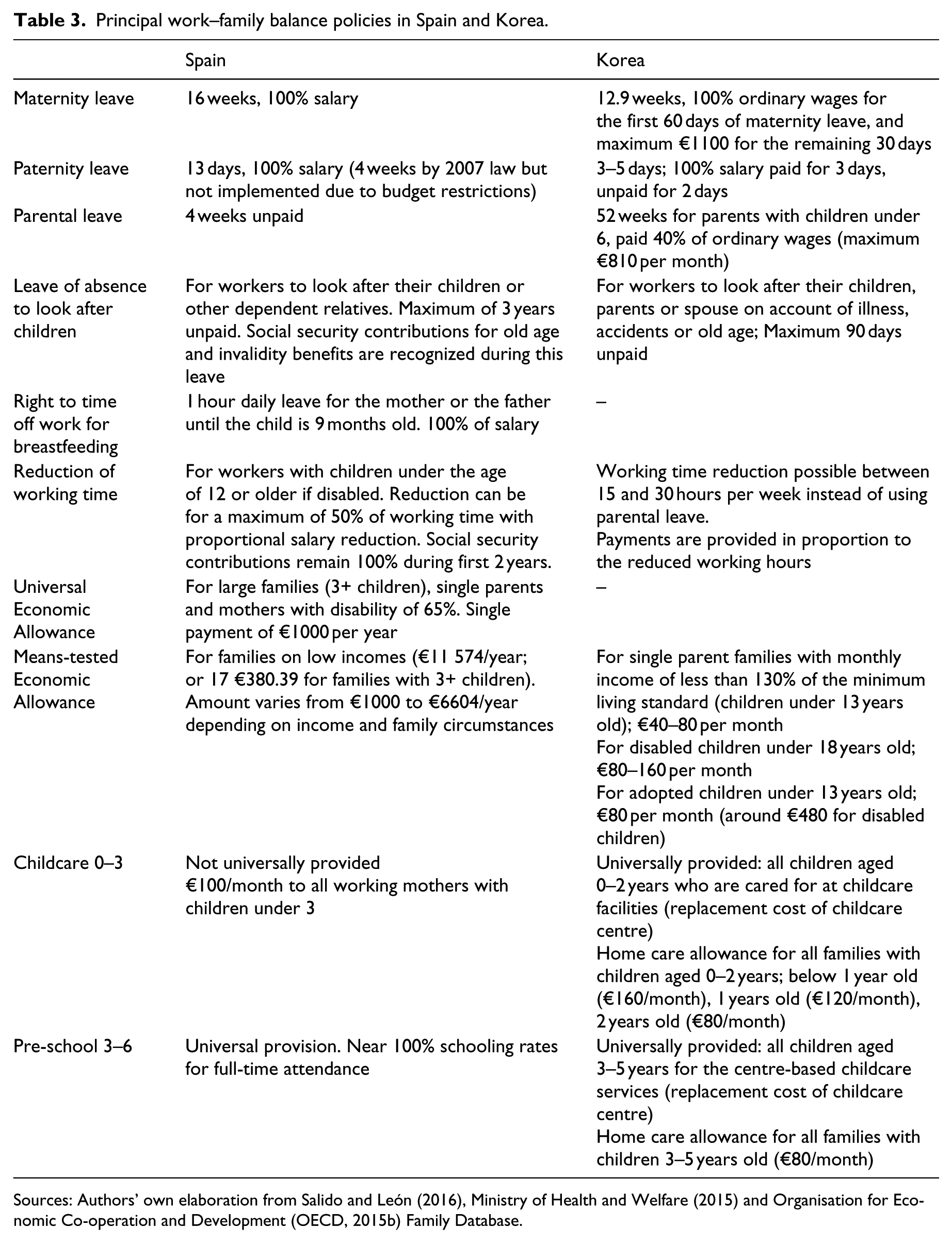
Sources: Authors’ own elaboration from Salido and León (2016), Ministry of Health and Welfare (2015) and Organisation for Economic Co-operation and Development (OECD, 2015b) Family Database.
Does gender equality politics make a difference?
Spain and Korea share important political traits. First, both have developed an institutional context of party competition whereby majoritarian political dynamics make policy shifts more likely (see Estevez-Abe and Naldini in this Special Issue). Second, their political trajectories have been similar – a similarity that is reflected in the gender equality politics of the two countries. Following the end of authoritarian and conservative regimes, pro-welfare, progressive, centre-left political forces gained power in both states – in Spain, from 1982 to 1996, and in Korea, from 1998 to 2008. These progressive governments established close rapports with the feminist movements in the respective countries, resulting in the creation of government bodies to promote the rights of women. The Women’s Institute was created in 1983 in Spain, and the Women’s Special Committee was formed in 1998 in Korea. Some years later, these public bodies were upgraded and converted into national ministries.
As Kim (2012) argues, however, in the Korean case, gender equality politics has been largely symbolic, with the Ministry of Women playing a very marginal role in the government. After the institutionalization of women’s movements in Korea, the de-radicalization and demobilization of gender politics has been evident, with the movements shifting to ‘a more moderate position towards the government, losing passion for women’s liberation and being satisfied with their accomplishment’ (Kim, 2012: 564–565). Gender politics has also been weak in labour unions in Korea. Although organized labour was militant, the unionization rate remained low and female workers were far less represented than male workers, even after democratization (Goulding, 2013; Yang, 2014). In short, gender equality politics has not been strong enough to transform the existing gendered and patriarchal political culture. As a result, neither unions nor women’s movements have actively worked against gender inequality and discrimination within the labour market.
As noted above, the expansion of social care was marked in Korea and it is undeniable that the institutionalization of women’s movements was influential in that process. However, many question whether the policy expansion was the result of gender equality politics. As Peng (2014) argues, the key feature was ‘its explicit link to human capital mobilization and the creation of new economic growth engine’ (p. 11). In other words, gender and childcare issues became more instrumentally important in a low-fertility society. As a result, although care policies were expanded, no attempt was made to address the traditional structure of the labour market or the strongly patriarchal political culture. It is unsurprising, therefore, that policy changes did not produce desirable outcomes regarding women’s employment in Korea.
In Spain, successive socialist governments have mobilized resources to give impulse to gender equality politics. Unlike Korea, a closer inspection reveals deep changes in the overall political culture away from traditional beliefs and practices and towards more egalitarian attitudes. This has paved the way for the consolidation of gender politics in the agenda of all political parties and the presence of women throughout political institutions. The dissolution of the Christian-Democracy Party in 1982 (after ruling the country in the transition to democracy over the years 1977–1982) and the modernization of the centre-right People’s Party (PP) meant that there has been no significant political force in Spain willing to endorse the patriarchal and catholic image of traditional family policies which, for many decades, discouraged the employment of women (León, 2011; Valiente, 1996).
While it is certainly true that the conservative party has been openly against the gender quota systems that the socialist party has endorsed, its pro-equal opportunities discourse has led it to actively support women’s access to education and employment. A good example of this is the 1999 law on the reconciliation of work and family life, which was introduced by the first centre-right government of José María Aznar. The law made changes to the Workers’ Bill of Rights (Estatuto de los Trabajadores) to improve maternity and parental protection. A second example is the National Plan to Support Families approved in the year 2000 by the second Aznar government. This bill introduced a €100 per month payment to all working mothers with children under the age of 3 (Law 46/2002) and provided for the subsidizing of the social security contributions of companies who employ women (RD3/2003) (Salido and León, 2016). Although the main opposition party, Partido Socialista Obrero Español (PSOE), criticized these two initiatives as pandering to the electorate, the fact that they maintained them when they gained power a few years later is clear evidence of the political success of these new family programmes. Similar to Morgan’s (2003) argument with respect to France, these shifts in Spanish labour laws suggest that the secularization of politics, rather than just the hegemony of social democracy, can explain departures from traditional family policy.
Another significant aspect distinguishing the Spanish case from the Korean is the accession of Spain to the EU in 1986. The subsequent supranational legislation and benchmarking with regards to gender equality has enabled a significant policy learning process from the European to the national and regional levels. Article 121.4 of the Amsterdam Treaty (1997), for example, sets the legal framework for the implementation of positive action in member states. As Siim (2014) argues, this has helped a widespread political consensus to be reached on gender quotas at the member state level.
If we take percentages of female representation in national parliaments as outcomes of these processes, we observe that while in Korea women’s representation in the parliament is one of the lowest in OECD countries (16% in 2015), in Spain, it has now reached 40 percent, following more than two decades of continued ascent (Inter-Parliamentary Union (IPU), 2016). In 2012, the Women’s Political Power Index, which includes women’s representation in ministries, parliaments and regional assemblies, situated Spain well above the EU average (European Institute for Gender Equality (EIGE), 2012). In sum, while gender equality has permeated Spanish politics since the country’s democratic transition, in Korea, the discourse of the equality of women and men has barely been visible in the policy process.
Conclusion
This article has identified a puzzling difference that exists between two familialist states: patterns of maternal employment in Korea and Spain. Both countries have similarly flexible labour markets. However, Spanish women tend not to leave paid employment when they become mothers, while Korean women do exit the labour market around childbearing ages before returning some years later. Thus, in Korea, the trajectory of female labour force participation throughout the lifecycle is characterized by an M shape. Significant differences are also observed in the relationship between women’s educational attainment and employment. In Spain, employment for women with a tertiary education is considerably higher than for those who have lower qualifications, and higher education attainment is also a protection against employment inactivity for women with children. By contrast, there is very little difference in employment levels in Korea between highly educated women and those with low levels of education.
How can we explain this divergence? In this article, we have examined the existing theories of cross-national variation in female labour force participation. We show that the causal mechanisms put forward by the literature are useful for understanding some aspects of the Korean and/or Spanish cases, but are less able to explain internal variations within these similar cases. We have argued that accounts that focus solely on either the micro or the macro level cannot capture the varying dynamics of women’s employment in these two countries with equivalent institutional contexts.
In this article, we have argued that the combination of certain characteristics of Korean and Spanish labour markets, work and care reconciliation policies and gender equality politics explain the observed divergence. Male-oriented work practices – particularly long working hours – together with the lack of availability of good quality jobs and a large gender pay gap seem to play a critical role in reducing incentives for educated women to stay in the Korean labour market. Policies for the reconciliation of work and family life are underdeveloped in both countries, compared to other OECD countries. However, while Spanish reforms addressing gender equality in employment have been explicit, comparable policy developments in Korea – including the expansion of childcare policies – have not been effective enough to counteract the negative effects of the labour market. In the background, gender equality politics plays a significant role. Similar macro-political institutional frameworks in these two post-authoritarian states represented favourable contexts for the development of gender equality politics. Yet, we clearly observe greater political commitment to gender equality in Spain than in Korea. As a result of both domestic and supranational dynamics, fundamental changes in the Spanish political culture resulted in the political endorsement of gender equality. As a result, Korean women seem to suffer the consequences of the country remaining in a transitional phase, where the traditional prescriptions of the male breadwinner model are yet to be overcome.
As with the rest of the articles in this Special Issue, our cross-regional comparison has posed important challenges that the comparative welfare state literature has only partially addressed. It is academically important to identify similar regime traits such as familialist legacies and their consequences. However, such comparisons do entail the risk of overemphasizing similarities and, as a result, overlooking crucial variations between regimes. As Rose (2004) has argued, ‘learning from strangers is most useful when similarity in conditions is combined with striking differences in outcome’ (p. 48). In this respect, it is equally important to investigate key variations within most similar cases in order to better design social and employment policies. For this reason, in future research, tighter causal analysis with respect to internal variations within similar cases will be required.
Footnotes
Acknowledgements
The authors are very grateful to two anonymous reviewers and to the editors for their extremely helpful comments and suggestions. The authors made equal contribution to the work.
Funding
The author(s) disclosed receipt of the following financial support for the research, authorship, and/or publication of this article: This work was supported by the National Research Foundation of Korea Grant funded by the Korean Government (NRF-2013S1A3A2052898).