







Abstract
The issue of welfare targeting is back on the political agenda in European welfare states. Benefit recipients are subject to different rules, depending on age, family status and work. For instance, strict conditions and harsh sanctions apply, in particular, to young unemployed people. This article investigates public opinion towards welfare targeting in three policy areas – unemployment benefits, conditionality of benefits and sanctions – and utilizes a factorial vignette experiment presented within a representative German survey. The results suggest strong support for welfare targeting. Respondents are more likely to offer generous benefits and fewer obligations and sanctions to unemployed people who are elderly, have caring responsibilities, are of German ethnicity and have high job-seeking ambitions. The negative effect of foreign ethnicity is moderated by the ideological standpoint of the respondent, highlighting the mechanisms underlying welfare chauvinism. Accordingly, policy support strongly depends on the individual circumstances of the affected target group.
Introduction
In recent years, policy makers introduced a new balance between the rights and responsibilities of the unemployed to improve their motivation to engage in job-seeking activities (Handler, 2003; Weishaupt, 2011). The payment of benefits is increasingly conditional on the behaviour of the welfare recipient, and failure to comply with these conditions is sanctioned with benefit cuts. However, the rules and regulations concerning the level of benefits, conditions to receive them and the harshness of sanctions differ widely between different target groups. For instance, young unemployed people identified as responsible for losing jobs and who show little effort to find new employment face stricter conditions and harsher sanctions than other benefit claimants (Larsen, 2008). Accordingly, current reforms of the labour market need to address the fundamental moral question of the welfare state, concerning ‘who should get what under which conditions’ (Jeene, 2015). The need for reforms highlight the importance of the social legitimacy of targeted welfare schemes (van Oorschot et al., 2017).
This article investigates whether targeting of social rights and obligations is rooted in the public’s considerations of fairness and solidarity. It enquires how the public evaluates the rights and responsibilities of benefit recipients with different personal characteristics. Three policy dimensions related to unemployment benefits are examined – the generosity of benefits, conditions to receive them and sanctions in case these obligations are not met. The article investigates the effects of five personal characteristics on support for these policies – the recipient’s age, child-caring responsibilities, the reason for unemployment, job search efforts and ethnicity. Based on deservingness theory, I argue that policy support depends on respondents’ images of benefit recipients. For example, respondents might view a single mother, who is highly motivated to find employment, as more entitled to receive benefits than a childless single person who refuses to apply for work. Furthermore, I test the assumption that the personal characteristics affect attitudes towards various aspects of labour market policies in different ways. The public may expect parents of young children to look for a job, but grant them the right to decline employment if the working conditions are incompatible with their parenting responsibilities.
This study contributes to the current state of literature in three ways. First, it focuses on different recipient groups. The majority of studies in this field treat the unemployed as a collective, homogeneous group and focus on the distribution of public resources between different social programmes (Svallfors, 2010; van Oorschot, 2000; Wendt et al., 2011). Recent studies indicate that certain characteristics such as age (Larsen, 2008), disabilities (Jeene and Roosma, 2017) and the number of children (Hörstermann and Andreß, 2015) influence the public’s support. A systematic review of the relevant characteristic, however, is so far missing. Second, I take into account the multidimensionality of welfare state attitudes by analysing three relevant aspects of unemployment benefits – generosity of benefits, conditionality and sanctions. Previous studies focus almost exclusively on attitudes towards social rights, while ignoring other facets of the labour market such as obligations of benefit claimants (Fossati, 2017; Gallego and Marx, 2017). Third, an innovative experimental vignette design is applied. The characteristics of a fictitious benefits recipient are randomly modified. Each respondent evaluates the rights and responsibilities of one unemployed person in relation to the three policies. The vignette design allows for the assessment of the relevance of several characteristics simultaneously, as well as their interdependent effects. Furthermore, the method reduces the effect of socially desirable responses to sensitive topics such as the rights of foreign benefit claimants because respondents are asked about their preferences in an indirect way (Auspurg and Hintz, 2015).
In a first step, I provide a review of the rights and responsibilities of different target groups in the German labour market. Next, I describe how certain characteristics of the recipient group influence their perceived deservingness. Thereafter, the data, operationalization of terms and methods are described. In the Results section, I discuss the effect of both the recipient’s and the respondent’s characteristics on preferences for labour market policies in the experimental vignette study. This article concludes with a discussion of the results and future directions for research.
Theory
Targeting of benefits, conditions and sanctions
This section elaborates on the prevalence of welfare targeting concerning three facets of the labour market in Germany – unemployment benefits, conditionality of benefits and sanctions. Like most other European countries, German rules and regulations related to the labour market account for the individual’s socio-economic characteristics and behaviour such as age, work history, family situation and job-seeking activities.
The unemployment compensation system consists of two pillars – an insurance benefit based on the previous income and a flat-rate benefit which is payed after the first year of unemployment (Arbeitslosengeld II). Because of the constitutional requirement to ensure a ‘life in human dignity’, the benefit level is adjusted to the needs of the recipient, depending on his age and the number of children in the household (Fleckenstein, 2012). Young, childless adults receive €324 and €400 after they turn 25 years old. Parents responsible for a young child receive €634, and €779 when they are single parents (Code of Social Law II, § 20). The second policy under consideration concerns the conditionality of unemployment benefits. In order to motivate benefit recipients and increase their job-seeking activities, the Hartz reforms introduced strict conditions to receive benefits in the mid-2000s. The unemployed have to fulfil certain requirements in order to be eligible for the full amount. These requirements include the obligation to apply for suitable jobs, participate in training measures and attend meetings with an employment agency case manager. As a third policy, non-compliance with an obligation results in a cut of unemployment benefits. For example, case managers can suspend benefit payments for up to 3 months for those who quit their job without ‘a good reason’ or failed to provide proof of job-seeking activities (Dlugosz et al., 2014). A general guideline suggests to cut benefits by 10 percent after the first infringement and by 30 percent after the second infringement, but case managers have some flexibility to decide how to account for infringements (Kumpmann, 2009). The rules and regulations concerning obligations and sanctions differ between target groups and are considerably stricter for the young unemployed. They lose benefits entirely after missing a second appointment with the agency or refusing a job offer (Clasen and Clegg, 2007). Furthermore, case managers are requested to take the circumstances of the beneficiary into account. Accordingly, job offers that require a long commute may be compulsory for unemployed people without family but not for single mothers.
The perceived deservingness of welfare recipients
The rules and regulations of the German welfare system distinguish between specific target groups. However, does the general population perceive it is justified to treat benefit claimants differently based on their individual circumstances? One line of argument explains attitudes towards social policy with the respondent’s political values and the perception of the recipient’s deservingness (de Swaan, 1988; van Oorschot, 2000). According to this line of reasoning, the level of public support for particular groups depends on how deserving they are perceived based on five criteria – (1) the group’s control over its situation, (2) its display of gratefulness, (3) the level of reciprocity in regard to past or future contributions to society, (4) shared identity and (5) the level of need (Cook, 1979; van Oorschot, 2000). Research in this tradition focuses on the popularity of welfare programmes that favour different recipient groups. Unemployment benefits are consistently found to be less popular than pensions and healthcare, because of the ‘rather widespread doubt about unemployed people’s willingness to work and about proper use of benefits’ (van Oorschot, 2006: 25) and the predominantly negative image of the jobless in the media (Golding and Middleton, 1982).
I suggest a more fine-grained perspective on deservingness of benefit recipients. The general term of ‘the unemployed’ does not capture a diverse group of individuals who score very differently on the deservingness criteria. One can imagine two individuals who have recently lost their job: a father of three who worked continuously in his life and has lost his job due to bankruptcy of his employer, and a young man in his 20s who rarely was in employment and quit his job because he did not like it. Most citizens will not grant the same social rights to both individuals and not demand the same responsibilities.
I pay particular attention to five characteristics of individuals that potentially influence their perceived deservingness – their age, display of good work ethic, responsibility for children and ethnicity. With the exception of the latter, these characteristics define the rights and responsibilities of unemployed individuals in the German welfare system. Furthermore, studies indicate their high relevance for deservingness perceptions. Hörstermann and Andreß (2015) find German respondents to provide more generous benefits to individuals who have children, show active efforts to find work and who are not responsible for their job loss. Support for work obligations is weaker for disabled individuals than it is for social assistance recipients and long-term unemployed, in particular, if the unemployed are young and childless (Jeene, 2015; Jeene and Roosma, 2017). Larsen (2008), using conventional survey data from Australia, finds that respondents attach stricter obligations to young unemployed people compared to the old. While these studies support the assumption that individuals take into account the circumstances of the benefit recipient when evaluating rights and responsibilities, this study compares systematically the effect of the recipient’s characteristics across different policy measures. I argue that the recipient’s personal characteristics and behaviour have distinct effects on respondents’ attitudes towards rights and responsibilities of the unemployed.
First, I expect respondents to grant more rights and fewer obligations to the unemployed nearing retirement age compared to individuals at the beginning of their working career. One reason is the limited chance of reemployment for workers at the end of their working life. Employment rates are considerably lower in older age groups, partly because employers may assume that older workers have an out-of-date skillset (Büsch et al., 2009). Thus, the old appear less in control of their situation. A similar argument could be made about young people in most European countries, but youth unemployment is comparatively low in Germany. In line with the deservingness criteria of reciprocity, older unemployed people presumably receive more support because they contributed to the social system in their working life and, thus, earned their right to support. Furthermore, respondents might perceive certain obligations, for example, participation in training programmes and regional mobility, to be more suitable for young unemployed people because of the working career ahead of them.
H1. Unemployed individuals close to retirement age receive more generous benefits, are subject to fewer conditions and receive less extensive sanctions in comparison to young unemployed. In particular, they are less often obligated to participate in training and move to another city.
Second, I assume a positive effect of child-caring responsibilities on the perceived deservingness of welfare recipients. In light of the discussion on an ageing society, the public might see parenting as a contribution to society, thereby satisfying the deservingness criteria of reciprocity. From a social investment perspective, respondents might want to ensure that parents are able to provide a decent environment for the development of their children. Furthermore, child poverty is a reoccurring theme in the public debate as a high share of children live in households that depend on social assistance (Corak et al., 2008). Therefore, the perception of children’s neediness presumably increases respondents’ willingness to support families with greater benefits. The perception of need could be stronger for single parents because they cannot rely on additional income from a partner. Additionally, parents must coordinate their working life with their family responsibilities and are less flexible in their temporal availability. Therefore, respondents might grant parents the right to decline jobs that conflict with family obligations.
H2. In comparison to childless single people, parents receive more generous benefits, are subject to fewer conditions (in particular, to take any available job and to move to another city) and receive less extensive sanctions. Respondents should grant even more rights and less responsibilities to single parents.
Third, according to deservingness theory, those who are not responsible for their job loss and make efforts to find a new job should receive more support. Unemployed people who quit their job exhibit more control over their situation than those who involuntarily lose their job. Sending applications and participating in training measures indicates the recipient’s willingness to contribute to the social system.
H3. Unemployed individuals who are not responsible for their job loss and show a high motivation to find a new job receive more generous benefits, are subject to fewer conditions and receive less extensive sanctions.
Fourth, respondents should grant more extensive support to those with whom they share a similar (ethnic) identity. Ethnic discrimination is based on racial sentiments and the belief that the social system should primarily benefit one’s ‘own’ ethnic group (van der Waal et al., 2010). Studies on welfare chauvinism support this argument, indicating that the population judges migrants more harshly than native unemployed people (Kootstra, 2016; Reeskens and van der Meer, 2017). Natives allocate fewer benefits to migrants, in particular, if they come from culturally distant societies (Czymara and Schmidt-Catran, 2016). However, the effect of the recipient’s ethnicity might be moderated by the cultural and political values of the respondent. A right-wing orientation is generally associated with ‘stereotyping, prejudice, intolerance, and hostility toward a wide variety of outgroups’ (Jost et al., 2009: 325). Therefore, the discriminatory effect is likely to be stronger among individuals on the right end of the political spectrum.
H4. In comparison to the native unemployed, those with a name indicating a foreign background receive less benefits, more conditions and more sanctions. This effect is stronger for respondents who are located on the right end of the political spectrum.
The effect of self-interests on attitudes
A second line of arguments suggests that individual self-interest, based on the respondent’s socio-economic characteristics, defines his or her attitudes towards social policy (Iversen and Soskice, 2001). Individuals who (expect to) depend on unemployment benefits are more in favour of generous policies (Blekesaune and Quadagno, 2003; Fraile and Ferrer, 2005). Experiences of unemployment (Margalit, 2013; Naumann et al., 2016) and low job security (Marx, 2014) are important determinants of preferences for generous social policies. Furthermore, individuals with low human capital prefer generous social policies and a redistributive welfare state, whereas highly skilled individuals can rely on the expectation that their education pays off in the market, protecting them from long-term unemployment (Schwander et al., 2015).
The question emerges to what extent the employment status, unemployment risk and educational attainment have a comparable influence on attitudes towards conditionality and sanctions. Individuals distinguish between different aspects of the welfare state (Roosma et al., 2013), but only few studies investigate the individual determinants of attitudes towards conditionality and sanctions (Fossati, 2017). Job seekers and the low educated are more likely than others to be subject to certain obligations (job search requirements, training, etc.) and have a higher risk of receiving sanctions and benefit cuts. Thus, a narrow self-interest perspective suggests a similar effect of labour market position and educational attainment on attitudes towards conditions and sanctions as on preferences for unemployment benefits.
H5. Unemployment, high job insecurity and low educational attainment are positively related to support for unemployment benefits and negatively related to support for conditions and sanctions.
Data and method
Data
The data for the empirical analysis were provided by the German Internet Panel (GIP), a probability-based longitudinal online survey, which focuses on political and economic attitudes and reform preferences through bimonthly online interviews. The respondents were recruited in person and are representative of both the online and the offline population aged 16–75 years in Germany (Blom et al., 2015). Data collection took place in January 2016. Each of the 3015 respondents evaluated one vignette.
The vignette design
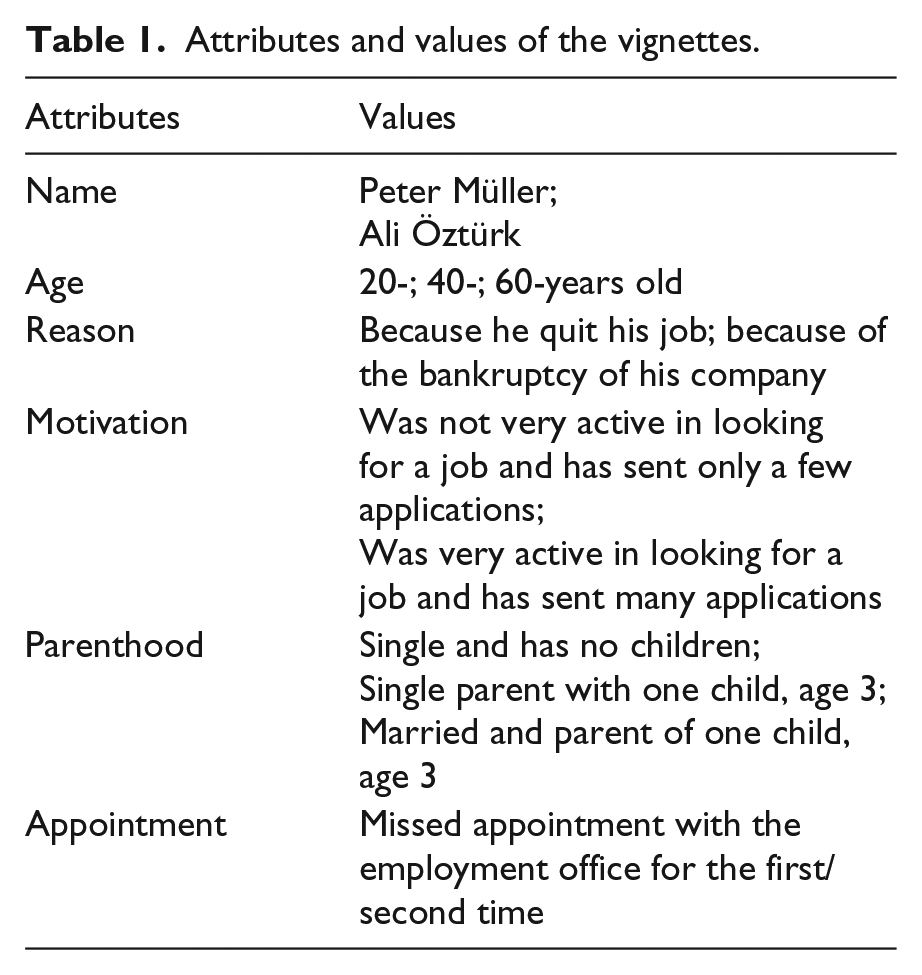
In the factorial survey experiment, each respondent received one text describing a fictitious unemployed person (the vignette) and evaluated the rights and responsibilities of this person. The personal characteristics of the fictitious unemployed person were randomly assigned. In comparison to traditional surveys, the randomized ‘treatment’ allowed for estimating the causal effect of the recipient’s characteristics. Respondents were forced to weigh different attributes and integrate these aspects into an overall judgement. Furthermore, the use of vignettes reduced the problem of social desirability because respondents were not directly asked about socially sensitive topics such as the discrimination of migrants vis-à-vis the native population (Auspurg and Hintz, 2015). The combinations of the five attributes resulted in a universe of 40 vignettes (Table 1). The vignette read as follows (the randomly assigned characteristics appear in squared brackets):
Ali Öztürk/ Peter Müller] is [20/ 40/ 60] years old. For the previous two years, he was employed in a company and is now unemployed because [he quit his job/of the bankruptcy of his company]. He was [not] very active in looking for a job and has sent [only a few/many] applications. [Ali Öztürk/Peter Müller] is [single and has no children/ single parent with one child of age three/ married and parent of one child of age three].
Attributes and values of the vignettes.
Variables
After reading the vignette, respondents evaluated the rights and responsibilities of the unemployed individual. The first question concerned the appropriate level of unemployment benefits after 1 year of unemployment. The respondent indicated the level of benefits the unemployed person should receive per month on a scale from €0 to €1000, in addition to rent and energy costs. Each respondent received information regarding benefits a single adult receives under the current legislation. In this way, the results did not depend on respondents’ previous knowledge. The second question concerned the conditions the unemployed person must fulfil in order to receive the full amount. The respondent could choose to select multiple of the three obligations – move to another city for work, take any job available and participate in training measures. The third question dealt with a 3-month benefit cut after the recipient failed to attend a meeting with the employment agency. A randomized attribute indicated whether the benefits recipient missed one or two appointments with the agency. The scale for this question ranged from a 0 to 100 percent cut of previous benefits.
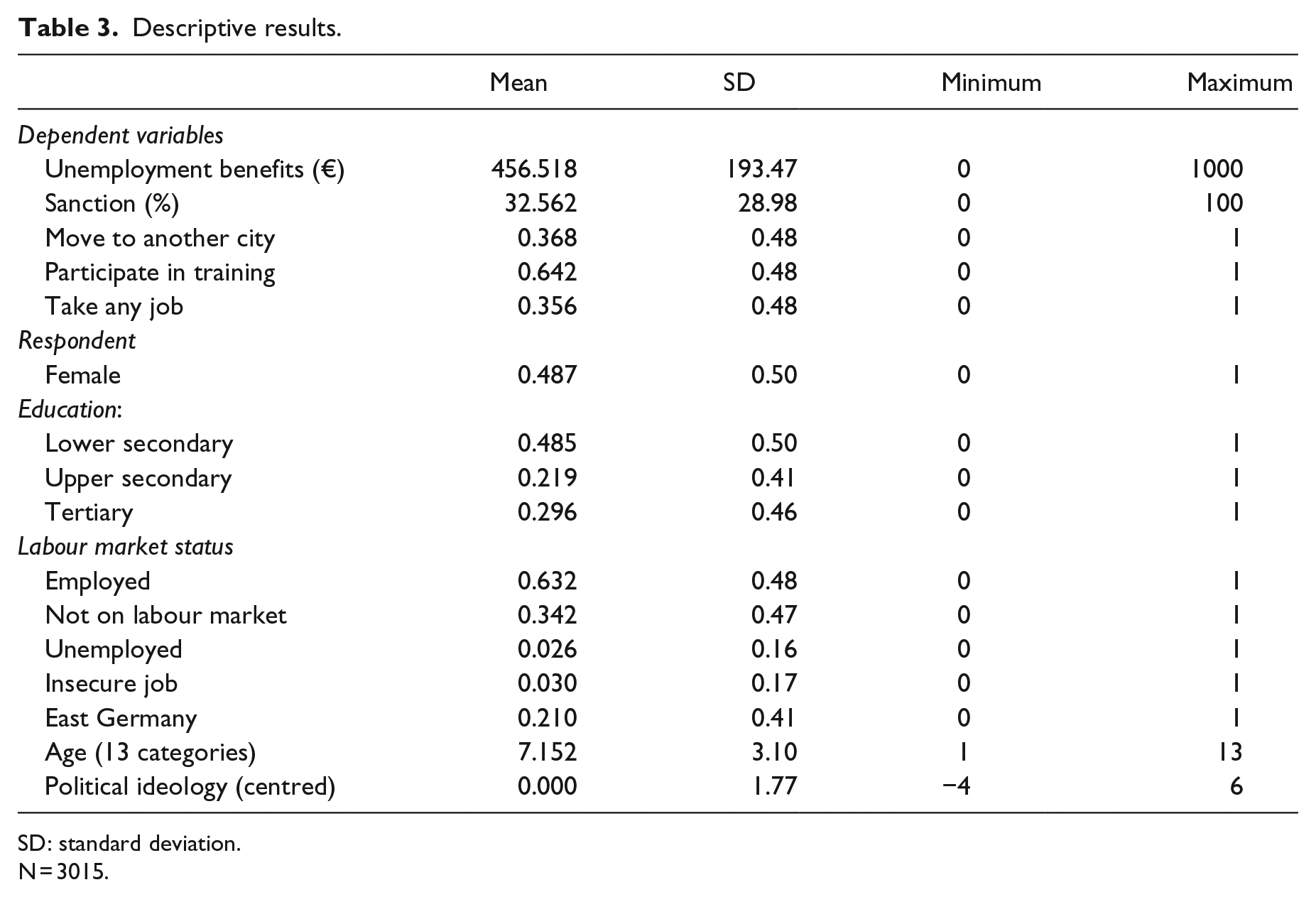
The effects of the recipient’s characteristics on the generosity of unemployment benefits and harshness of sanctions were analysed using linear regressions. Logistic regressions were used for the three conditions to receive benefits. Because of the experimental design, it was unnecessary to include control variables. However, as I was also interested in the effect of the respondent’s characteristics and their interaction with the vignettes, several background variables were added to the regression models that showed a significant effect on attitudes towards welfare state attitudes in previous studies (Fraile and Ferrer, 2005). Employment status was measured in three categories, namely employed, unemployed and not on labour market. The variable for job security was based on the self-assessment of the respondent that job loss was very or rather likely. The highest educational attainment was measured in three categories: lower secondary education, upper secondary education and a university degree. Political ideology was based on a self-assessment on a left–right scale that ranged from 1 to 11. Age was included in 13 categories, spanning a range of 5 years. Both variables, age and political ideology, were centred on the mean in order to facilitate interpretation. A dummy variable for East and West is included because of the persisting differences in attitudes between the regions. Table 3 in the Appendix provides a description of the sample.
Results
The level of unemployment benefits for different target groups
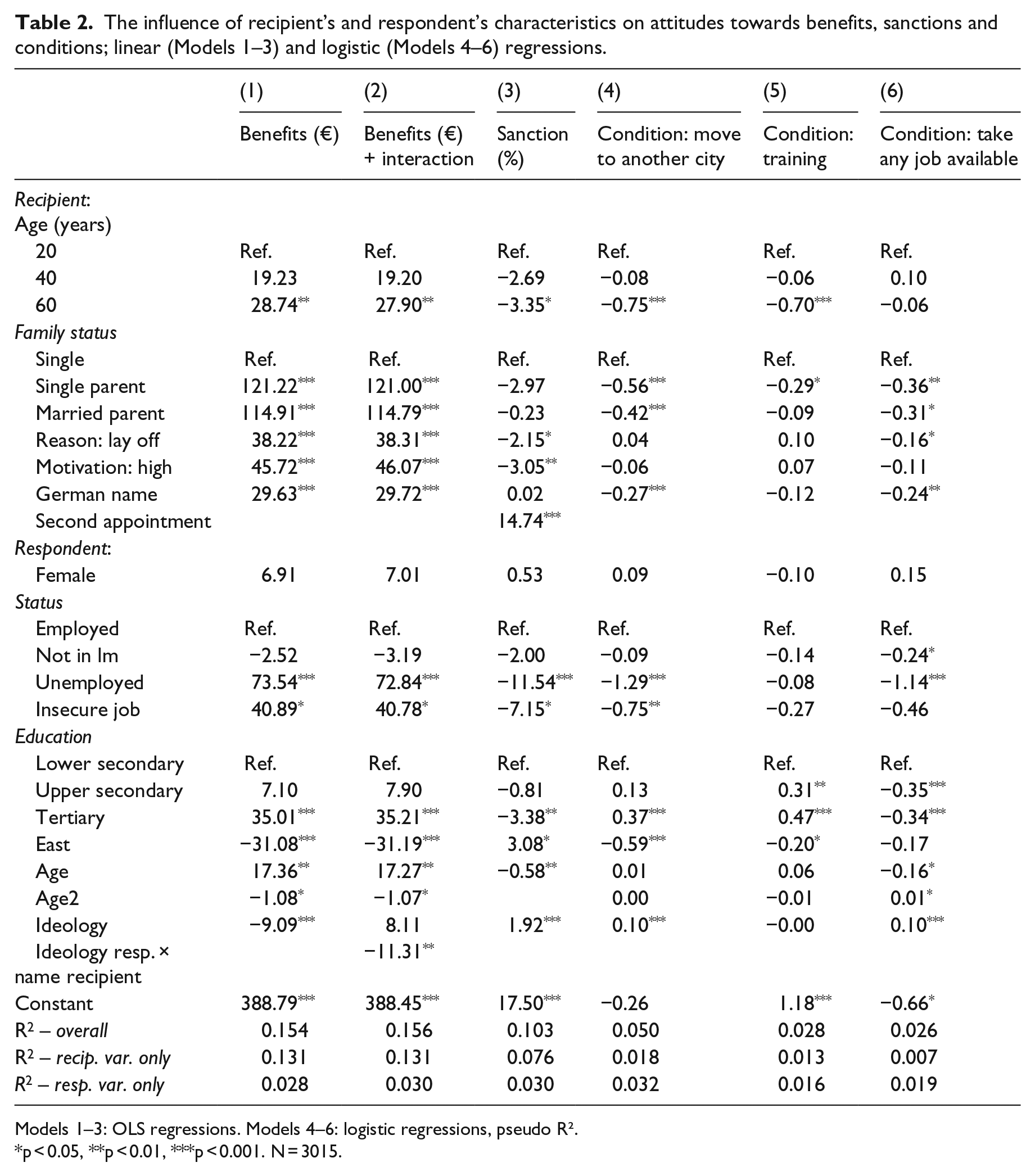
Table 2 presents the results for the dependent variables – unemployment benefits, sanctions and three conditions for benefits – regressed on the five randomly assigned characteristics of the unemployed person and the background variables of the respondent. In the first step, the empirical analysis focuses on the first dependent variable, the generosity of unemployment benefits (Model 1). Figure 1 illustrates the predicted average benefits based on the recipient’s characteristics. On average, respondents allocate about €456 to the recipients. The allocated amount of benefits, however, differs widely between target groups.
The influence of recipient’s and respondent’s characteristics on attitudes towards benefits, sanctions and conditions; linear (Models 1–3) and logistic (Models 4–6) regressions.
Models 1–3: OLS regressions. Models 4–6: logistic regressions, pseudo R².
p < 0.05, **p < 0.01, ***p < 0.001. N = 3015.
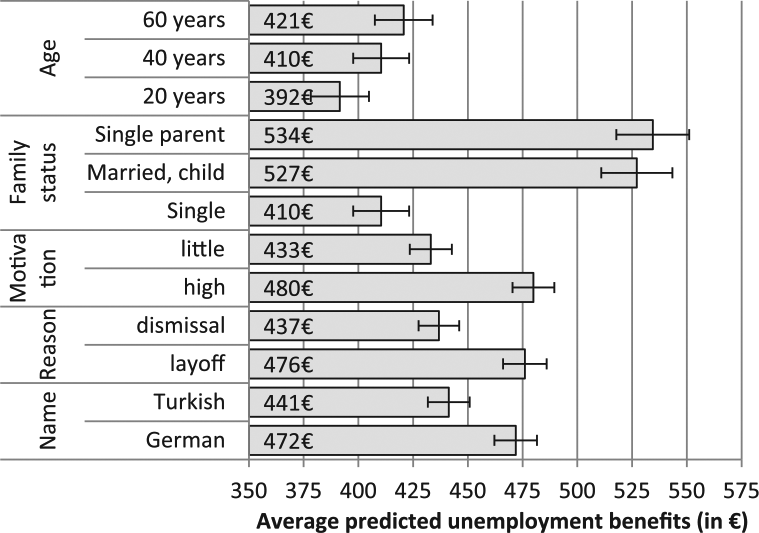
Average unemployment benefits distributed to different target groups in €.
Concerning the age of the benefit recipient, respondents allocate €29 more benefits to a 60-year old than a 20-year old. There is a premium of €19 for those who are 40 years old, although this difference is not significant. In line with the current legislation, the perceived deservingness increases with age, motivating the public to grant more extensive social rights to those who have contributed to the social system in the past.
An analysis of independent variables reveals that children have the biggest effect on attitudes towards unemployment benefits. A single parent (€534) and a married parent (€527) receive significantly more benefits than a single person without children (€410). However, this benefit premium for parents is far below the additional €237 that unemployed parents with young children receive based on current legislation. Respondents might underestimate the financial costs of a young child. Furthermore, the difference between single parents and married parents is small and not significant. In this regard, the respondents’ opinions depart from the current social security law which grants additional benefits to single parents to account for their increased financial burden. Negative stereotypes of single parents, in particular concerning those without work, could be responsible for the relatively small benefit premium for single parents in the experiment.
The motivation of the unemployed and the reason for unemployment play an important role for the amount of benefits respondents granted to the recipient. Individuals who are not responsible for their job loss and those who show strong effort to regain employment receive significantly more unemployment benefits than those who quit their job and appear to be unmotivated to find a job (additional €38 and €46, respectively). This finding highlights the importance of the deservingness criteria reciprocity for the perceived deservingness of the unemployed. Efforts to keep a job or find a new one are rewarded by the respondents.
The last characteristic concerns the ethnicity of the unemployed indicated by his name. Individuals with a Turkish name receive €30 less benefits than those with a German name. This difference is highly significant and comparable to the gap between the young and the old. This result confirms previous findings by Kootstra (2016) who found similar effects for the perceived deservingness of migrant groups in the Netherlands and the United Kingdom. The question emerges, however, to what extent this effect is mediated by the political ideology of the respondent. To test this, Model 2 in Table 2 introduces an interaction term between the recipient’s name and the respondent’s political ideology. This term is negative and highly significant, indicating a much stronger positive effect of the German name on attitudes for individuals on the political right. Figure 2 displays the predicted unemployment benefit based on the political ideology of the respondent and the name of the benefit recipient. While respondents on the political left do not significantly distinguish between a German and a Turkish recipient, this difference is increasingly pronounced for individuals on the right, up to €75.
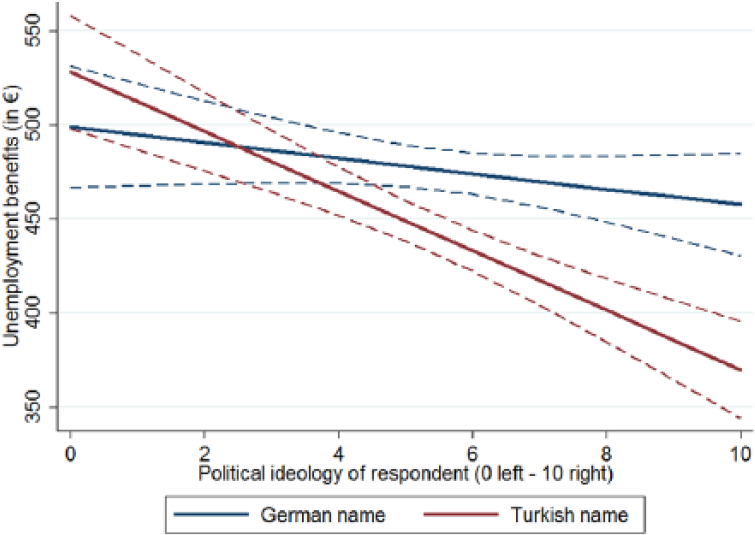
The generosity of unemployment benefits for native and Turkish benefit claimants, depending on the political ideology of the respondent.
Conditions and sanctions for the unemployed
In this section, the analysis turns to two related aspects of labour market policies, namely conditions for benefits and sanctions in case of a breach of the employment agency’s rules (Models 3–6, Table 2). Across all vignettes, about 64 percent of the respondents agree that the unemployed should take any job available in order to receive unemployment benefits without cuts; 37 percent of the respondents support forcing the unemployed to move to another city for a job. Approximately, the same share of respondents agree that participating in training courses should be mandatory for the unemployed in order to keep their benefits. Support for these conditions depends on the individual circumstances of the unemployed, but not as much as respondents’ preferences for generous benefits. Moving to another city or taking up work that conflicts with caring responsibilities is a higher burden for parents and accordingly less popular for parents than single people receiving benefits. Furthermore, those close to retirement age are less often required to move to another city or participate in training activities. Many respondents might see less value in these measures for the old, considering the limited time left in their working life. Interestingly, there are no significant differences concerning obligations for the two younger age groups. This suggests that respondents do not place an additional penalty on the young unemployed. Turkish unemployed people are more often required to move to another city or take any job available than native unemployed workers.
In the next step of the survey process, the respondent was informed that the unemployed person failed to attend an appointment with the case manager at the employment agency. An additional experimental condition determines whether the unemployed person missed the appointment for the first or second time. The average cut-off benefits across all respondents is about 25 percent for the first infringement and 40 percent for the second infringement. It is clear from this finding that repeated misbehaviour is punished by the respondents. Interestingly, preferences for unemployment benefits and sanctions are only mildly correlated (Pearson’s R² −0.247). A substantial proportion of the population is quite generous when it comes to unemployment benefits but give harsh sanctions if the unemployed do not comply with rules.
Attitudes towards sanctions are to a lesser extent influenced by characteristics of the unemployed than preferences for benefits and conditions. Only age, the cause for unemployment and the motivation of the recipient exhibit weak effects on attitudes. It seems that respondents base their assessment of possible sanctions primarily on the behaviour of the unemployed. Those who did not display ‘grateful’ behaviour from the beginning are punished more severely than those who demonstrated a commitment to benefits procedures. The name of the welfare recipient does not have a significant effect on the extent of benefit cuts. Turkish and German unemployed people are granted different levels of benefits, but receive the same punishment when they breach the rules of the employment agency by not attending an appointment. The reason might be that ethnic stereotypes lead to higher expectations towards native unemployed people, resulting in a stronger punishment if they exhibit socially undesirable behaviour. In other words, the positive reputation of a native unemployed person diminishes as soon as his behaviour contradicts stereotypes.
Table 2 provides the explained variance of models that include the characteristics of either the respondent or the recipient. The latter models provide larger predictive power which indicates the importance of the target groups’ characteristics on individual attitudes towards labour market policies. In addition, the total explained variance is lower for conditions than it is for benefit generosity and sanctions. Attitudes towards conditions are less dependent on who is affected by these policy measures than those towards the other two policies. Furthermore, the continuous measurement for benefits and sanctions leave more leverage for respondents to differentiate between recipient groups.
The influence of the respondent’s personal background on attitudes
Table 2 provides information on the impact of several of the respondent’s background characteristics on attitudes towards unemployment benefits, conditions and sanctions. In line with previous research on this topic, being unemployed and at risk of job loss substantially increase support for generous social policy. The unemployed grant, on average, about €73 more benefits than the employed. In line with H5, the unemployed are significantly less likely to support conditions and benefit cuts.
Individuals with higher levels of education grant more generous benefits and are more reluctant to sanction the unemployed than their less educated counterparts. This is a surprising finding because higher education is usually associated with a more sceptical view of the welfare state. Most likely, the answering scale with actual benefit levels instead of abstract values explains this deviation from previous studies’ findings. Respondents must decide on the amount of money they deem sufficient for a decent standard of living. The highly educated, often equipped with good employment and income, might have a different view on this than those who struggle to meet costs of living and are used to living with few financial resources. At the same time, university graduates are more likely to support the conditions ‘moving’ and ‘training’ but less in favour of ‘taking any job available’, thereby lending only partial support to H5. Again, this finding is rooted in the living standards related to education and social class. The highly educated have higher regional mobility and participate more often in further education. Therefore, the well-educated expect the unemployed to make similar investments in their working careers. In contrast, the obligation to ‘take any job available’ is seen as more problematic by highly educated individuals who generally select specific jobs best fit to their skillset (Hensen et al., 2009).
Consistent with previous studies, right political ideology is linked with a strong negative effect on attitudes towards benefits. However, this effect becomes positive and loses significance once an interaction with the name of the recipient is introduced in Model 2. Accordingly, the political view of the respondent does not have any effect on preferences for benefits when native German recipients are considered (see Figure 2). This finding confirms H4 and indicates that the political right is not per se the strongest opponent of the welfare state. A substantive part of the negative attitudes towards the welfare state can be attributed to welfare chauvinism.
Discussion
The trend towards increasingly targeted policies in European labour markets served as the starting point for this research endeavour. Although targeted policies are increasingly common across many European countries, few extant studies investigate the legitimacy of targeted benefits and activation policies. This study found solid support for welfare targeting, showing that attitudes towards different facets of unemployment benefits are heavily influenced by certain characteristics of the affected unemployed. Individuals who are close to retirement, care for a young child, have no foreign background and make strong efforts to find a new job are, on average, granted more generous benefits. Similar effects were found in regard to attitudes towards conditionality of benefits and sanctions. For example, unemployed people with children are less often required to move to another city or take inappropriate job offers, but they are expected to participate in training courses and are sanctioned as often as other individuals.
The findings have important implications for our understanding of popular reform support and for future research. First, instead of focusing on the distribution of resources between different social programmes, research should pay more attention to the rights of specific target groups of social policy. While unemployment benefits are rather unpopular for some groups, others such as parents and highly motivated job seekers receive significantly more support. Second, the effects of the recipient’s characteristics differ between policy dimensions. Apparently, respondents take into account the consequences of sanctions and benefit cuts for different benefit claimants. If children are affected by these measures, respondents are more reluctant to restrict the rights of the unemployed individual. Given that conditions and sanctions are an essential part of recent labour market reforms, this finding highlights the need to broaden the scope of attitude research beyond the redistributive elements of the welfare state. Third, from a methodological perspective, the usefulness of an experimental vignette approach for the study of political attitudes was demonstrated.
The results of this study are subject to some limitations. First, this study does not provide a strict test for the different deservingness criteria. For example, the public might grant older unemployed people more rights either because they have (presumably) contributed more to the social system or because their chances for reemployment are lower. Further studies should use more elaborate descriptions of the benefit recipient to assess the importance the public attaches to additional characteristics of the recipient. In addition, the analysis considered only male recipients. Respondents might draw a distinction regarding the responsibilities of unemployed women and men and gender norms might result in fewer obligations for women with childcare responsibilities. Second, this study was limited to attitudes towards labour market policies in Germany. Future research should explore whether targeted welfare policies are seen as legitimate in other policy areas such as healthcare and pensions. Furthermore, the question arises to what extent the results can be generalized to other countries. For example, attitudes might be more independent of the benefit recipient’s characteristics in Nordic universal welfare states where benefits more often have the character of unconditional social rights. Third, the high degree of conformity between public opinion and the social rights of different target groups lead to questions regarding the direction of the causal relationship. Did policy makers react to public opinion when they introduced major changes or did benefit system reform lead to a differentiated view on the rights of the unemployed among the public? Regardless of the answer, research on targeting of the welfare state will remain an important topic in the years to come.
Footnotes
Appendix
Descriptive results.
| Mean | SD | Minimum | Maximum | |
|---|---|---|---|---|
| Dependent variables | ||||
| Unemployment benefits (€) | 456.518 | 193.47 | 0 | 1000 |
| Sanction (%) | 32.562 | 28.98 | 0 | 100 |
| Move to another city | 0.368 | 0.48 | 0 | 1 |
| Participate in training | 0.642 | 0.48 | 0 | 1 |
| Take any job | 0.356 | 0.48 | 0 | 1 |
| Respondent | ||||
| Female | 0.487 | 0.50 | 0 | 1 |
| Education: | ||||
| Lower secondary | 0.485 | 0.50 | 0 | 1 |
| Upper secondary | 0.219 | 0.41 | 0 | 1 |
| Tertiary | 0.296 | 0.46 | 0 | 1 |
| Labour market status | ||||
| Employed | 0.632 | 0.48 | 0 | 1 |
| Not on labour market | 0.342 | 0.47 | 0 | 1 |
| Unemployed | 0.026 | 0.16 | 0 | 1 |
| Insecure job | 0.030 | 0.17 | 0 | 1 |
| East Germany | 0.210 | 0.41 | 0 | 1 |
| Age (13 categories) | 7.152 | 3.10 | 1 | 13 |
| Political ideology (centred) | 0.000 | 1.77 | −4 | 6 |
SD: standard deviation.
N = 3015.
Funding
The author(s) disclosed receipt of the following financial support for the research, authorship, and/or publication of this article: I gratefully acknowledge financial support from the collaborative research center SFB 884 “Political Economy of Reforms” (project A6) at the University of Mannheim, funded by the German Research Foundation (DFG).