







Abstract
In the wake of the recent increase in the inflows of refugees to Europe, governments have made considerable investments in public policies aimed at facilitating the labour market integration of refugees. Despite these efforts, the labour market participation of refugees remains low. This situation raises the question of whether employers actually appreciate these public policies and whether refugees’ participation in specific active labour market policies (ALMPs), such as work practice or wage subsidies, increases their likelihood of being hired. In this article, we take a novel approach and combine employers’ evaluations of specific ALMPs with their attitudes towards refugees. We argue that these labour market policies can only be successful when employers hold positive attitudes towards refugees in the first place. We investigate this question by means of a factorial survey experiment with employers in Austria, Germany and Sweden. Our results show that, indeed, employers’ evaluations of fictional refugee candidates who participated in ALMPs are influenced by their attitudes towards this group. Participation in these policy measures is regarded positively only by those employers who already hold positive attitudes towards refugees.
Keywords
Introduction
Employers have always played a key role in the integration of immigrants into a host country’s labour market (LM), whether by trying to influence legislation (Donnelly et al.; Afonso et al., both 2020) and the implementation of specific policies (Burroni and Scalise; Morgan, 2020) or by exerting their influence as gatekeepers to employment (Auer et al., 2019). This is why, in light of the refugee inflow of 2015, we focus on employers’ hiring preferences regarding this particularly disadvantaged group of jobseekers (Bevelander, 2011; Konle-Seidl and Bolits, 2016) and examine which factors affect employers’ evaluation of the employability of these candidates.
In the past, the introduction of active labour market policies (ALMPs) has been the strategy of choice of many governments seeking to foster the labour market integration (LMI) of vulnerable jobseekers (Bonoli, 2013). ALMPs reconcile investment in LMI without expanding passive transfers to groups that are generally perceived as less deserving, including immigrants and refugees (van Oorschot, 2006). To integrate refugees, countries with strong ALMP systems have granted them access to the existing schemes and developed new types of measures to render refugees more employable. This approach has been heavily used in Germany, Sweden and Austria, which received the largest number of refugees among the EU-28 countries during the 2015 influx (Martin et al., 2016). All three countries have invested considerable resources in the LMI of refugees, ranging from mandatory integration courses to providing skills certification through vocational training (Konle-Seidl and Bolits, 2016). These efforts suggest that governments consider refugees a valuable source of labour, similar to other types of immigrants.
This study analyses the factors that influence employers’ evaluations of fictitious job applicants with a refugee background. 1 The main goal is to determine whether ALMPs actually help refugees to increase their LM chances and whether employers’ attitudes moderate the effect of ALMP participation. Thus, we complement the other contributions on this issue that investigate how social partners influence the formulation and implementation of immigration and welfare policies. We focus on the evaluation stage, that is, the last step in the policy cycle (Knotz et al., 2020).
The research question is investigated by means of a factorial survey experiment (FSE) conducted among a sample of 350 employers, recruiters and HR assistants each in Austria, Germany and Sweden in 2019. In the experiment, these respondents were asked to evaluate fictitious refugee applicants for low-skilled positions. Several characteristics of the candidates’ profiles were varied, including their language skills, their occupation in the country of origin and their ALMP participation.
The findings show that refugees’ participation in ALMPs is generally considered an asset on their CV. However, the results also reveal that ALMP participation leads to a positive effect only when employers hold positive attitudes regarding refugees’ expected contribution to the LM in general. We conclude that positive attitudes of employers are an important pre-condition for the successful policy outcomes of ALMP schemes for refugees. This is important because different factors, including polarised public debates, may negatively affect these attitudes and thus lower the chances of success of such measures (Bali et al., 2019; Greussing and Boomgaarden, 2017).
Case selection
Employers’ preferences regarding refugee jobseekers are studied in Austria, Germany and Sweden. We chose these countries, first, because compared to the EU-28 average, they received the highest number of refugees in terms of per capita intake in 2014–2017, rendering their LMI a particularly salient problem (Figure A1, Appendix). In all these countries, the recently arrived refugee population is similar: in 2018, most refugees were Syrian, followed by Iraqi and Afghan nationals. Most refugees were young (40%–50% were 18–34 years old), and roughly two-thirds were male (Martin et al., 2016; Konle-Seidl, 2018). Their formal educational background is often unclear and varies by nationality. However, selective data show that almost 80% have less than vocational training and thus are difficult to integrate into western LMs (Brücker et al., 2014). Consequently, their unemployment rate is high (Bevelander, 2011; Verwiebe et al., 2018).
Second, we focus on countries that have a comprehensive ALMP system (Bonoli, 2013). This is a necessary condition for testing how participation in such measures influences employers’ hiring preferences. We avoid countries with marginal ALMP schemes and/or countries that implemented ad hoc measures for refugees as ALMPs might be perceived differently in such contexts. Governments in all three countries have made an active effort to integrate refugees into existing schemes (Konle-Seidl and Bolits, 2016) as refugees’ low levels of formal education make an investment in their human capital a long-term priority. All three countries spent substantial resources (between €56 million in Sweden and €250 million in Germany and Austria each) to provide measures to facilitate the LMI of refugees. Moreover, recognised refugees are granted access to the same ALMPs as nationals (Konle-Seidl, 2018). Additional efforts include mandatory LMI measures (a combination of language and civic orientation courses), investments in certificate recognition (Konle-Seidl, 2018) and some specialised LM training.
Third, this study tests the influence of three main types of measures that primarily target jobseekers who are distant from the LM. These measures exist in all three countries and were expanded to address the needs of the increasing numbers of refugees. Moreover, at the time of the refugee influx, the economic conditions in the countries were positive, which facilitated refugees’ LMI. In fact, unemployment was moderate, amounting to 4.6% in Germany, 5.7% in Austria and 7.4% in Sweden, and all countries had positive GDP developments (Eurostat, 2019).
There are, however, some national differences that allow the variance to be maximised within our most-similar system design to ensure that our findings are generalisable beyond idiosyncratic context conditions. These countries belong to different welfare state systems, namely, conservative (Germany and Austria) and Nordic (Esping-Andersen, 1990), and they differ with regard to the type of ALMP interventions. Germany has made available additional resources, such as special placement assistance, practical job training and skill assessments. Furthermore, German employment agencies’ staff received training in how to deal with refugees (Martin et al., 2016). Austria bundled existing LMI into a package that includes, in addition to language courses, work preparation measures, diploma/certificate recognition and non-profit community work. In fact, in Germany and Austria, skill certification is essential for successful LMI. Sweden has introduced skill assessments and early interventions, such as ‘fast tracks’ to accelerate refugees’ LMI (Konle-Seidl, 2018). Finally, the countries differ with regard to their migration histories. Humanitarian migration has always accounted for the largest refugee inflow in Sweden, whereas Austria and Germany are traditionally dominated by labour migration (Bevelander, 2011).
In sum, the main aim of this case selection is not to develop country-specific hypotheses, which is particularly difficult given the scarce research in this domain (Konle-Seidl, 2018: 44). Rather, we want to ensure that the mechanisms that drive employers’ hiring preferences regarding refugees who did (not) participate in ALMPs are generalisable beyond a single case (Bearce and Roosevelt, 2019: 907). Future research should examine whether different mechanisms apply in settings with underdeveloped ALMPs or where ad hoc measures for refugees were implemented because such measures may be perceived differently by employers.
Theory
Most research to date has focused on individual characteristics of refugees or on institutional mechanisms for explaining their LM success (Bakker et al., 2017; Bansak et al., 2018; Bevelander, 2011; Delaporte and Piracha, 2018; Hainmueller et al., 2015; Verwiebe et al., 2018). However, we know little about the efficacy of ALMP for refugees’ LMI (for laudable exceptions, see Lundborg and Skedinger, 2016) and even less about employers’ preferences and whether employers consider ALMP participation an asset on a CV. This is surprising because employers’ perceptions affect jobseekers’ LMI chances (Fossati et al., 2020a) and, in turn, the policies’ efficacy (Liechti et al., 2017).
We examine whether and under what conditions ALMPs affect employers’ assessment of refugees and how employers’ attitudes towards refugees moderate this effect. The finding that employers’ attitudes towards a particular group influence their hiring preferences (and behaviour) has been shown in studies of black people in the US (Pager and Karafin, 2009), ethnic minorities in OECD countries (see Zschirnt and Ruedin, 2015), the long-term unemployed in Europe (Bonoli, 2014) and low-skilled jobseekers in Sweden and Switzerland (Fossati et al., 2020b). The literature on discrimination shows that, in particular, low-skilled members of minorities are disadvantaged in the LM (Helbling and Kriesi, 2014; Waldinger and Lichter, 2003). Consequently, refugees, who on average are the most disadvantaged in terms of human and social capital and face additional problems, such as health issues and certificate recognition, can be expected to be at the end of the hiring queue (Bansak et al., 2018; Bevelander, 2011; Konle-Seidl and Bolits, 2016). Accordingly, it is important to understand whether refugees who participated in ALMPs have better LMI prospects than those who did not participate and whether these policies have heterogeneous effects for this target group (Butschek and Walter, 2014; Liechti et al., 2017).
Moreover, we expect that whether ALMPs increase refugees’ employability does not only depend on employers’ evaluation of whether these measures can address possible lacunas; rather, the evaluation of ALMPs is moderated by employers’ attitudes towards refugees in general. As Schwartz (1992: 4) argues, values are abstract beliefs that ‘pertain to desirable end states and behaviours’ and influence attitudes. Plausibly, citizens – or, in our case, employers – have positive attitudes towards policies that are in line with their values. If this is true, employers should favour ALMP measures only if they believe in the necessity or usefulness of integrating refugees in the host country’s LM in the first place as these ALMPs are then in line with their values.
As welfare support entitlement for refugees is controversially debated and anti-immigration parties have gained popularity (Inglehart and Norris, 2019; Konle-Seidl, 2018), employers might be exposed to an increased number of negative frames (Greussing and Boomgaarden, 2017). These could influence their evaluation of refugee jobseekers and, in turn, the effect of ALMP measures, potentially undermining their efficacy. In fact, there is ample evidence that policies work only if they are supported by the relevant actors (Bali et al., 2019). Therefore, we believe that it is important to investigate not only the effect of refugees’ ALMPs participation on employers’ hiring preferences but also the extent to which these evaluations depend on employers’ attitudes towards refugees in general. Further studies should clarify whether the extent of frame exposition influences the level of discrimination refugees face in a most-different system design.
Active labour market policies and labour market integration of refugees
We investigate ALMPs that target low-skilled occupations because refugees are often low qualified (Brücker et al., 2014), and even those who acquired higher formal qualifications in their countries of origin are willing to accept low-skilled employment (Colic-Peisker and Tilbury, 2006) – if not permanently, then at least as a stepping-stone, similar to other vulnerable populations (for example, Mosthaf et al., 2014). As recognised refugees in all three countries have access to the same programmes as native jobseekers, we focus on ALMPs that are available to all jobseekers because these policies address LM needs more directly (Konle-Seidl, 2018).
ALMPs can take three main forms: training, acquiring work experience and allocating monetary incentives to employers (Eichhorst et al., 2008). Employers should appreciate measures that target skill development because they provide refugees with working experience in the relevant firm, thus increasing their human capital (substantive effect). However, participating in such programmes can also act as a positive signal of certain skills, qualities and trainability (signalling effect) (Liechti et al., 2017; van Belle et al., 2019). Research shows that participation in ALMP programmes is considered a positive signal, particularly for jobseekers who are most distant from the LM and thus are least employable (Fossati et al., 2020b; Liechti et al., 2017).
We test the effect of work experience measures, which can be organised either by the public employment office or by private employers. Both measures should be evaluated positively by employers, but internships in the private sector might be appreciated slightly more because they signal that the candidate has already successfully passed another employer’s screening procedure.
Wage subsidies are often assigned to, and are effective for, hard-to-place jobseekers, including immigrants (Butschek and Walter, 2014). This ALMP should have straightforward positive effects because it reduces wage costs for an employer (substantive effect). The results from qualitative interviews in Sweden and Switzerland show that employers who are offered such incentives are more willing to give a chance to a candidate they would otherwise consider too risky to hire (Fossati et al., 2020b).
Furthermore, studies have shown that social capital is pivotal for employment outcomes (Fernandez et al., 2000; Granovetter, 1995). However, refugees often lack such beneficial social contacts. To counteract this deficit, refugees may try to proactively engage in voluntary work. Employers should particularly appreciate this activity as a signal of attempting to assimilate into society, of being motivated to work and as a way of acquiring skills (signalling effect). In a similar vein, Verwiebe et al. (2018) show that personal agency and a proactive approach to seeking employment are the most promising way for refugees to obtain employment. Thus, we expect that volunteering can be a strategy to signal proactive behaviour to prospective employers. 2 Even if this is not directly a policy measure, it could be advice a caseworker might give to refugees at the public employment office and thus seems a relevant strategy to study in this context.
Finally, it may also be that participating in an ALMP has a more ‘general’ signalling effect, namely, that a caseworker or an integration specialist deemed this applicant as qualified enough to work, engendering a positive signalling effect (Liechti et al., 2017 call this the ‘caseworker effect’).
Employers’ attitudes and their effect on policy efficacy
At least since Putnam (1993), we have known that culture and value systems play an important role in determining policy preferences, outcomes and, in particular, the effectiveness of different policies (Alesina and Giuliano, 2015; Bednar and Page, 2018; Lau and Heldman, 2009; Rauwald and Moore, 2002). Broad public support and the support of relevant actors regarding the problem definition and the correct identification of solutions ensures a commitment to the policy and facilitates its implementation (Bali et al., 2019).
Values and attitudes matter especially in the context of polarised and very salient public debates such as the issue of refugees’ integration. The suspicion is that exposure to negative frames may affect employers’ readiness to integrate refugees and, in turn, affects the efficacy of measures that attempt to do so. In these debates, the concern is often raised that refugees are unable or unwilling to integrate in the host country and prefer to take advantage of the welfare system (Konle-Seidl and Bolits, 2016; see Inglehart and Norris, 2019). As research shows, such negative coverage can negatively impact attitudes towards refugees (Boomgaarden and Vliegenthart, 2009; Greussing and Boomgaarden, 2017). Accordingly, it is plausible that employers’ attitudes influence the efficacy of ALMP interventions.
The public acceptance of refugees also depends on whether their motives are in line with specific values and thus on whether they are perceived as deserving of support. High deservingness is attributed to refugees who are perceived as being at risk of persecution (humanitarian values), but deservingness is lowest when refugees are perceived to only seek more advantageous economic opportunities (Bansak et al., 2016). Moreover, refugees are evaluated more positively when their perceived cultural distance, especially regarding religious affiliation, to the host society is low (Adida et al., 2010; Bansak et al., 2016; Heath and Martin, 2013). Citizens’ attitudes are also more favourable towards individuals who can be expected to easily integrate and/or do not compete for (welfare) resources. Unsurprisingly, popular support is highest for refugees with high educational attainments, who are young enough to work and who speak the language of the host country (Helbling and Kriesi, 2014).
Employers’ attitudes towards refugees might focus on different aspects than the general population. We expect that employers primarily consider the advantages that refugees can bring to the LM or their firm, such as being a source of (cheap) labour, addressing labour shortages, or accepting jobs that are avoided by natives, rather than seeing them as unwelcome competition for jobs and other resources (Naumann et al., 2018). Therefore, what should matter for employers’ hiring preferences is their attitude towards refugees’ employability and suitability for the host country’s LM and possibly their anticipation of customers’ and/or employees’ reactions (Baert and de Pauw, 2014).
In general, refugees’ ALMP participation should positively influence employers’ evaluation as their employability is low, and thus it is unlikely that negative signalling may be attached to ALMP participation (Liechti et al., 2017). However, we expect employers’ attitudes to moderate this effect. In fact, if employers hold positive attitudes towards refugees, they might be more willing to hire from this group. Furthermore, such underlying attitudes may affect employers’ perception of ALMPs that support LMI. More precisely, employers will evaluate ALMPs positively and thus value them as an asset on a CV only if they hold positive attitudes towards refugees in the first place.
Surprisingly, little research has investigated the extent to which the success of ALMPs is influenced by the attitudes of those who are mainly confronted with these policies – employers. For instance, Fossati et al. (2020b) show that employers tend to consider ALMP participation a positive signal only when they attribute the agency for programme participation to the unemployed person. In a similar vein, we argue that for ALMPs to be successful, employers must perceive refugees as a valuable and suitable labour force.
Methods
Research design
Generally, it is difficult to observe the hiring behaviour of employers. To overcome this problem, we rely on a factorial survey experiment (FSE) (Di Stasio and Gërxhani, 2015). In an FSE, respondents are asked to evaluate descriptions of hypothetical situations (vignettes) that consist of different dimensions that can take on different values, and these values are varied randomly (Auspurg and Hinz, 2015). The advantage of an FSE is that it reduces the risk of endogeneity, allows for testing of the influence of several dimensions, delivers a more valid measurement of attitudes and is less biased by social desirability than item-based techniques (Auspurg et al., 2014). FSEs are increasingly popular for examining employers’ hiring preferences because they are more cost effective and ethically less problematic than correspondence testing (Di Stasio and Gërxhani, 2015; Liechti et al., 2017). Although these designs do not capture real behaviour but rather capture hiring intent, studies have shown a high correlation between stated and real behaviour (Hainmueller et al., 2015). Moreover, the fact that vignette studies reach similar conclusions as correspondence studies (that is, studies in which fake CVs are sent to real job openings) (Zschirnt and Ruedin, 2015) shows the high validity of the design. In contrast to correspondence studies, FSEs can capture informal recruitment practices, which are common in low-skilled occupations. Moreover, unlike correspondence studies, FSEs enable the collection of respondent-level information, which is essential when testing the influence of employers’ attitudes on their evaluation of ALMPs.
The experiment
The experiment consisted of the administration of schematic CVs of fictional job applicants to respondents. These vignettes were submitted to a sample of employers via an online survey. Two different low-skilled 3 jobs, one in administration and one as a janitor/caretaker with basic duties, were included. We focus on these jobs because refugees, even highly qualified ones, are mostly forced into this low-skilled segment of the LM (Bloch, 2008). Specifically, respondents were asked to imagine that their company wanted to recruit a refugee for an open position and asked them to evaluate a set of four vignettes for each job (eight vignettes in total). Employers had to indicate from 1 to 10 (not at all likely – very likely) how likely they were to invite the candidate for a job interview. We included only profiles of refugees because they represent a very specific population that is difficult to compare directly to other jobseekers, particularly because of the substantive human capital endowment differences, including the different educational signalling effect that is triggered by having a foreign diploma or speaking a non-national language.
The candidates’ descriptions varied randomly on eight different dimensions, namely, gender, age, nationality, marital status, year of arrival (2015/2018), language proficiency, profession in the country of origin and ALMP participation (Table A1, Appendix). We focus on refugees stemming from Syria and Afghanistan as they represent the largest refugee groups in 2015 in all three countries. Moreover, we include Turkish asylum seekers to test whether employers differentiate among individuals according to perceived cultural distance; Turkish nationals could be perceived as closer, particularly due to their presence in Europe already during the guest worker period. 4 In fact, previous research suggests that in the western LM, employers hire new staff according to an ethnic ranking whereby applicants who are perceived as closer to the in-group in terms of language, culture or religion are preferred over candidates with a background that is perceived to be more ‘distant’ (Auer et al., 2019). The main variable of interest, however, is ALMP participation, 5 which was manipulated in the following way (Table A2, Appendix):
participation in an integration course (reference category in the analysis);
work practice as an intern for a private employer in the domain of the job description;
work practice by attending a practical workshop organised by the job centre;
wage subsidy of 40% of the salary for six months paid by the job centre;
volunteer work for the Red Cross.
We chose a basic integration course as the reference category, because in all countries refugees are required to complete a course in which they learn the language and are familiarised with the customs of the country (Konle-Seidl, 2018). Moreover, we chose volunteering work for the Red Cross as this organisation is active in all countries, is well known on an international scale and supports the LMI of immigrants through volunteering actives. Finally, we chose practical training in a related occupation and the payment of wage subsidies because intensive investment in human capital is not necessary for low-skilled occupations. To avoid the assumption that refugees participating in practical training have been in the country for a longer period, we specified their year of arrival (either 2015 or 2018).
Before introducing the vignettes, employers were provided with a description of the two jobs and some background information about the hiring situation; in particular, we mentioned that all candidates were admitted refugees with permission to work. For the position of administrative assistant, the tasks included distributing internal mail, sorting office material, and copying documents, and for the caretaker or janitor position, the activities included cleaning offices and taking care of the outside area. Within each job, the order of the vignettes was randomised. Finally, the survey included questions about the characteristics of the firm, the socioeconomic characteristics of the respondents and their attitudes towards refugees.
Analysis of employers’ attitudes
To analyse employers’ attitudes towards refugees, we used the items in our questionnaire that asked about refugees’ potential contributions or aptitude to work in the host country’s LM. We expected that employers’ attitudes regarding characteristics that are especially relevant for assessing employability and productivity should matter. Thus, we included attitudes concerning the ‘added value’ of such employees for their firm and the economy overall. This is why we asked respondents to indicate how much they agreed (not at all; do not agree; fully agree) with the following statements: (i) refugees are willing to accept work that natives refuse, (ii) refugees will resolve the lack of qualified workers in [country] and (iii) refugees are underqualified to work in [country].
We were interested in general LM-related attitudes towards refugees; therefore, we combined these three survey questions for further analysis. The combination of these three indicators was performed by means of principal component factor analysis (PCA) (see Jolliffe, 2002; Moore et al., 2002). 6 In the regression models, we used the predicted factor scores (continuous variable) as the operationalisation for employers’ attitudes and interacted them with their evaluation of different ALMPs.
Data
The data were collected with an incentivised online panel run by an international market research firm (Qualtrics©) in February 2019. Weinberg et al. (2014) show that the results of FSE with crowd-sourced and population-based samples are comparable. However, to ensure that information was obtained from qualified employers, we specified a selection criterion, namely, that the respondent was involved in hiring processes during the 12 months before the survey. We also introduced quotas to ensure a diverse sample. Respondents were recruited according to age (50% had to be older than 35), gender (50% female), and firm size (60% from firms up to 250 employees). We obtained 368 respondents for Germany, 228 for Austria and 363 for Sweden. These respondents rated a total of ~3,800 vignettes per job, which amounted to a total of ~7,600 vignettes. When compared to the German establishment panel (IAB, 2019), our sample (Table A12, Supplementary Material) of employers was representative with regard to sector and location (urban vs rural). Larger firms were overrepresented; however, as these firms also employ more people, their hiring procedures are relevant to a large share of jobseekers.
Analysis
Due to the nested data structure (vignettes are embedded in respondents), we estimated multilevel models and controlled for country and jobs (Auspurg and Hinz, 2015). To test the hypothesis 7 about how attitudes shape employers’ evaluation of ALMPs, we estimated a cross-level interaction effect between respondents’ attitudes and the vignette variables concerning ALMPs. Moreover, as a robustness test, we estimated fixed effects models for the models without cross-level interaction effects, and the results remained the same.
Results
When regressing only the vignette characteristics on employers’ evaluation of the refugees’ profiles (Figure 1), we observe that among the socio-economic variables, the rating of the candidates was primarily influenced by gender. Male candidates received significantly lower ratings than female applicants did. This might be explained by the negative stereotypes that are associated with male refugees and their portrayal in European newspapers (Georgiou and Zaborowsk, 2017). Age did not significantly influence the ratings. Having to provide for a child significantly decreased the rating of an applicant. Employers may fear decreased flexibility or distractions related to parallel care duties (Oesch et al., 2017).
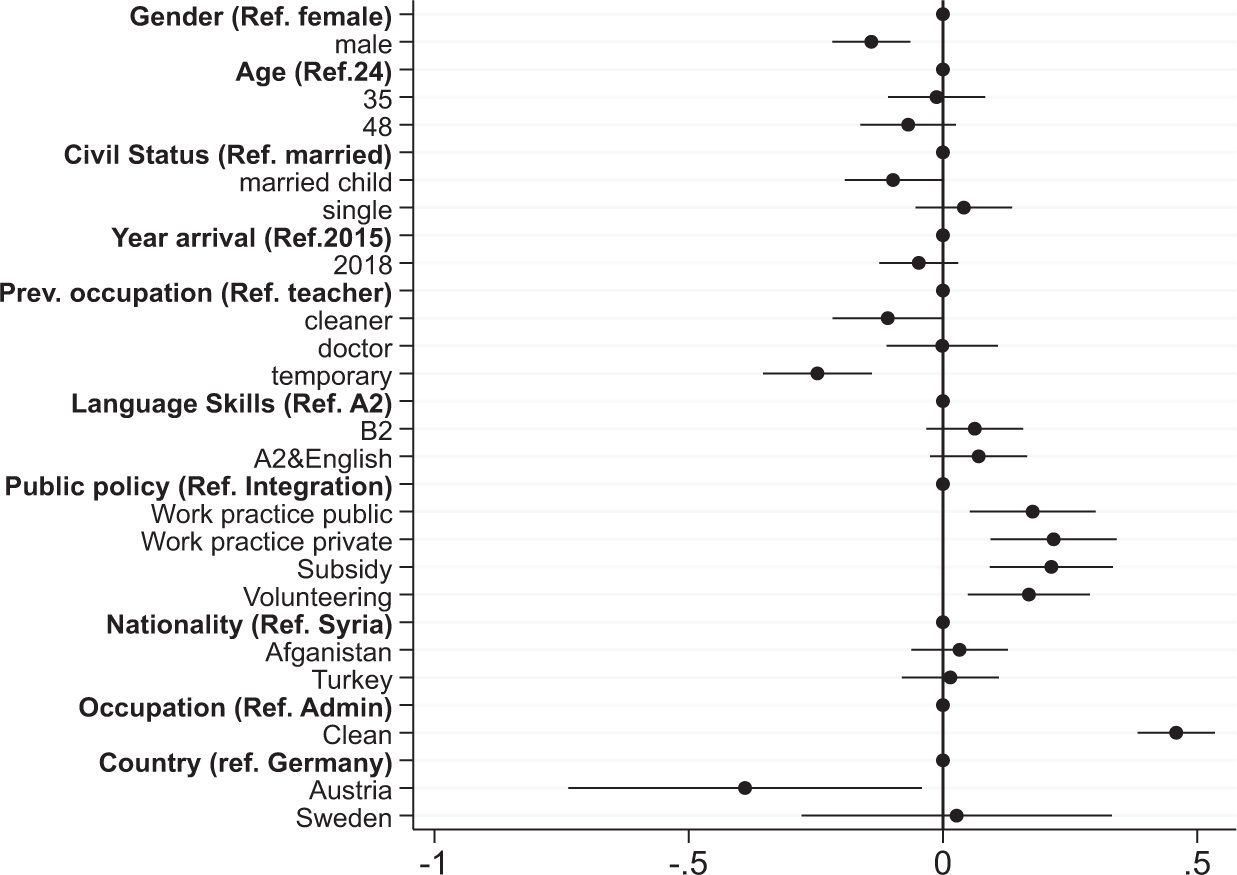
The influence of vignette variables on the rating of the candidate.
The country of origin did not play a significant role in employers’ evaluation of the candidates, suggesting that they perceived them as similarly distant. In fact, the majority of the population in all three countries is of Muslim faith, which is a particularly salient dimension in the current public debates (Adida et al., 2010; Heath and Martin, 2013). The analyses reveal that Turkish immigrants, although they have been present in Europe since the guest worker times, were not evaluated more positively by employers. It may be that the reason for migration is more important than their precise origin in the eyes of employers. In fact, all candidates were described as humanitarian refugees who had fled their countries due to the political situation (Bansak et al., 2016). Finally, it is important to note that all candidates were explicitly mentioned as having a working permit; accordingly, there were no differences regarding bureaucratic hurdles.
In terms of immigration history, employers did not differentiate between refugees who entered the country in 2018 or 2015. Having good proficiency in the host country’s language (level B2) or compensating for a low level of proficiency with a good level of English had no significant effects. 8 Unsurprisingly, previous professional experience was relevant. Overall, individuals who worked as cleaners and, in particular, individuals who held temporary jobs in their native country were rated lower than doctors or teachers. 9 Finally, employers gave higher ratings to the vignettes for caretaker job applicants, which presumably is related to the higher perceived skill level required for a job as an administrative assistant. Regarding country differences, Austrian employers were most sceptical and rated applicants more negatively than employers in Sweden and Switzerland.
Finally, ALMP participation had a positive influence on employers’ evaluation of candidates. Overall, all measures – having practical training, being eligible for a wage subsidy and doing volunteer work – were valued significantly positively by employers when compared to candidates who had followed only a basic integration course. This finding mirrors evidence from Germany, where Kosyakova and Sirries (2017) found that refugees who participated in LMI measures were more likely to obtain a job. Country-specific analyses (Table A4, Model 2–4, Appendix) show that employers appreciated at least one ALMP measure when evaluating the profiles of refugee applicants. Employers in Sweden were very positive towards different ALMP measures; employers in Germany were more favourable to private work practice schemes and volunteer work; and Austrian employers valued wage subsidies the most. However, because we included only three countries and the number of respondents in each country was low, we were unable to further investigate these country differences, which could arise due to differences in the LM structure or the appreciation of ALMP participation.
In the next step, we included respondent-level variables and tested whether and how employers’ attitudes towards refugees shape their evaluation of the ALMP participation treatment (Figure 2, Table A4). Additional analyses (not shown) revealed that, in general, attitudes towards refugees did not differ among the three countries and were not influenced by hiring-related variables, such as hiring experience, the respondents’ occupation, or whether the company had ever hired refugees. The main model (Table A5, Figure 2) for all countries shows that the interaction between the continuous attitude variable (factor score) and ALMPs was positive and significant.
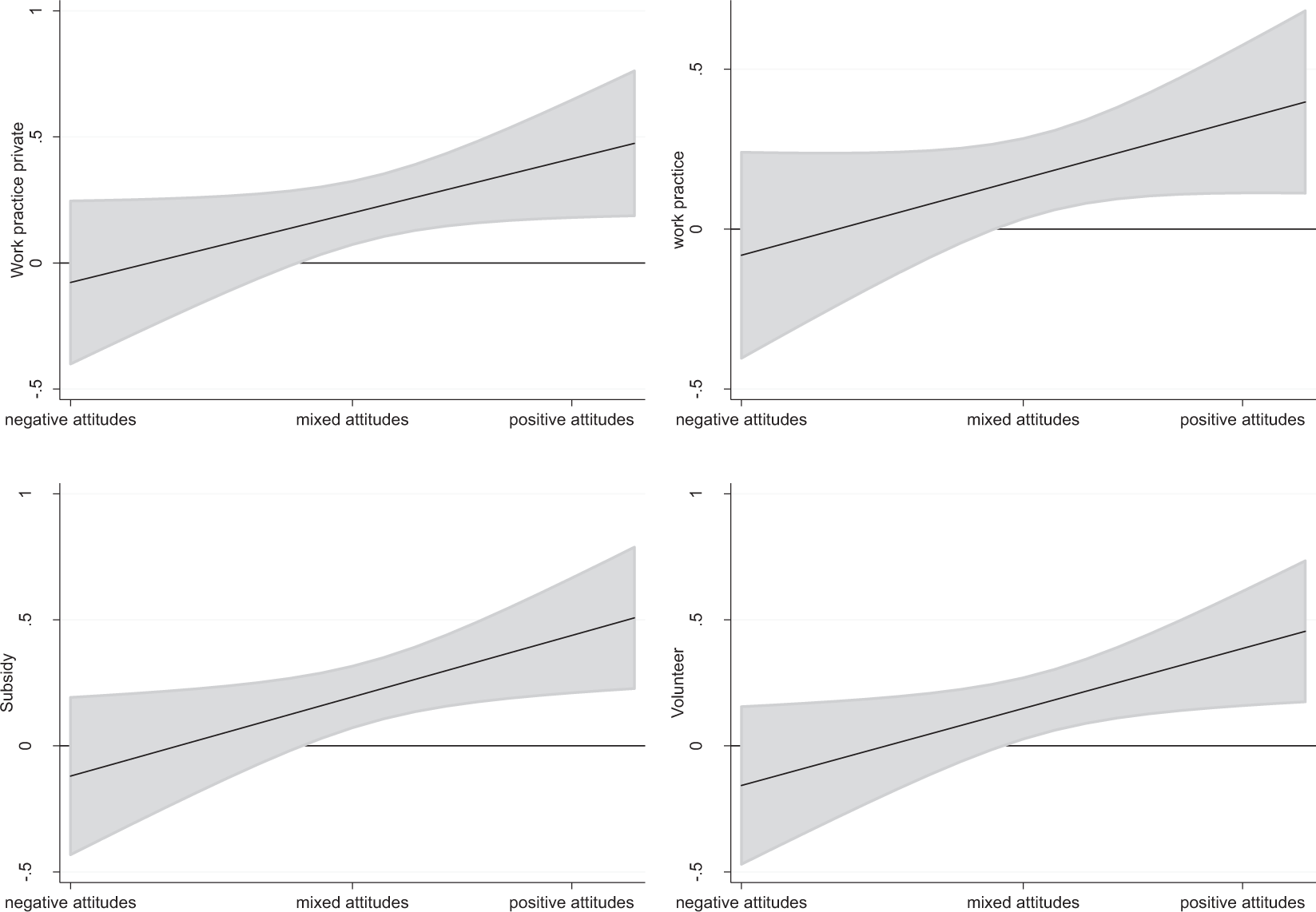
Interaction effect between employers’ attitudes towards refugees and ALMPs.
The results (Figure 2) corroborate the expectations and show that employers’ evaluation of refugees’ participation in ALMPs depends on their attitudes towards refugees’ potential contribution to the host countries’ LM. The more that employers hold negative attitudes towards refugees and thus believe that refugees are unqualified or unwilling to work, the less they consider ALMP participation an asset on a CV. In other words, there is no difference between candidates with a basic integration course or with ALMP participation, which suggests that these measures may be less effective in such a situation. Conversely, the more that employers hold positive attitudes towards refugees and thus the more they believe that refugees are qualified and able to contribute to the host country’s LM, the more they consider participation in ALMPs to be an asset. In fact, in these instances, participation in ALMPs significantly improves the ratings of applicants.
The effect of ALMPs on employers’ attitudes towards refugees is present across contexts but to different degrees. The effect of attitudes is strongest in Sweden and weakest in Germany, where the interaction effects do not reach statistical significance. 10 As robustness checks, we tested other interaction effects of employers’ characteristics and their evaluations of policy measures, such as whether the firm is a private firm, whether it is located in an urban or rural area, and its size; however, none of these interactions are significant or influence the main interaction between attitudes and ALMP evaluation (results available on request).
Conclusion
Although the LMI of refugees is a pivotal issue in many European countries, we know little about employers’ preferences towards this group of jobseekers, whether ALMP interventions positively affect their employment prospects, and whether positive attitudes are a prerequisite for ALMPs to actually increase their employability. Accordingly, in this study, we ask whether employers perceive typical ALMPs as an asset on a refugee’s CV in Sweden, Germany and Austria in 2019. Moreover, we investigate how employers’ general attitudes towards refugees influence their perception and thus the effectiveness of ALMPs for this group.
This research is relevant because we know from previous literature that ALMPs may have heterogeneous effects (Butschek and Walter, 2014; Liechti et al., 2017). Accordingly, it is useful to determine when and how ALMPs are effective for refugees’ LMI. Issues linked to context dependence and heterogeneity are discussed surprisingly little in the specialised literature, although they are important to ensure better targeting and increased effectiveness of public policies.
First, we find that employers do not distinguish between different ALMPs; what matters is whether refugees participated in a measure or only in a basic and mandatory integration course. Second, our main result is that ALMPs depend on employers’ attitudes. Employers who hold positive attitudes towards refugees, that is, who consider them to be adequately qualified and thus able to make a substantial contribution to the host country’s LM, also appreciate ALMP interventions’ support for their LMI and thus evaluate these applicants more favourably. Conversely, employers who by principle hold negative attitudes towards refugees do not appreciate ALMPs as useful interventions to support their LMI process.
These results clearly show that it is not solely the setup of a specific policy that determines its efficacy; rather, other factors may influence its effectiveness. In our case, factors that influence employers’ attitudes had an important effect on refugees’ LMI chances. Previous research convincingly argues that attitudes are difficult to change (Billig, 1985) and that change is dependent on people’s willingness to counteract their negative stereotypes (Fiske et al., 2018). Even though it may prove difficult for governments to change negative attitudes of employers, it is still important that such attempts are undertaken, for instance, by means of de-biasing campaigns, anti-discrimination legislation, and possibly even introducing quotas for large firms. In terms of policy efficacy, it is also worth considering that previous research has found wage subsidies to be particularly effective measures for immigrants. It is possible that this strategy is promising with regard to refugees. However, in light of our results and of contact theory (Pettigrew and Tropp, 2006), measures that increase contact between (reluctant) employers and refugees might also be important.
Beyond policy interventions, there are other mechanisms that may affect employers’ attitudes and thus co-determine the effectiveness of ALMPs, such as the elites’ framing of public debates and the tone of news coverage (Bali et al., 2019; Boomgaarden and Vliegenthart, 2009; Greussing and Boomgaarden, 2017). Particularly in times of polarised immigration debates, it is important for governments to (re)balance the public discourse and thus the news coverage regarding refugees as these have an impact on the readiness to categorise and eventually discriminate against individuals according to their background (Boomgaarden and Vliegenthart, 2009). Another possibility to reduce negative attitudes towards refugees might be to address the perceptions that immigrants compete for jobs, welfare benefits and other scarce resources (Naumann et al., 2018; see Knotz et al. 2020; Zschirnt and Ruedin, 2015). By ensuring sufficient job opportunities and/or welfare support, governments may prevent employers from prioritising native workers, fearing negative customer reactions if they do not (Baert and de Pauw, 2014). In other words, addressing the various potential sources that may trigger employers’ reticence to integrate refugees is important for ALMP effectiveness.
This study is not without weaknesses. In particular, the population of employers is difficult to reach and therefore not entirely representative of its universe. This is also the case because we were unable to target only the person who is the main person responsible for a hiring decision in a company. Rather we inserted a screening criterion, which defined that a respondent needed to have been involved in at least one hiring process during the previous year. This may lead to an overrepresentation of HR managers and to a potentially more heterogenous population that what we commonly understand as employers. Nevertheless, all our respondents were involved in the hiring process and had a say at some stage of the recruitment process, even if not always in the final decision.
Moreover, our study covers only a limited number of countries. Thus, it is important to study strategies used to integrate refugees into the LM in countries where ALMPs are less established and where the economic and LM conditions are more difficult. It would also be interesting to analyse how refugees are evaluated compared to natives and long-term resident immigrants when they compete for similar jobs.
Another issue which we are not able to fully answer in this study is the causal explanation for why employers take ALMPs into account. There are two main mechanisms that can lead to a positive assessment, namely a positive signalling and a positive substantive effect. In other words, if employers believe that ALMPs increase the skills or reduce the hiring costs (substantive effects) they may be more likely to employ refugees. Alternatively, employers may rely on ALMPs as a positive signal for the employability of a candidate. Thereby, ALMPs may convey trainability, motivation or suggest that a caseworker assessed the applicant positively (see Liechti et al., 2017). To design more effective interventions in the future it would be useful to design follow-up studies that can disentangle the precise mechanisms that are at play.
Finally, regarding the role of employers in the welfare–migration nexus, it is important to analyse what measures employers’ organisations can take regarding the LMI of refugees and whether and how they react to their members’ discriminatory behaviour. What is certain is that integration questions will remain highly salient on the welfare state reform agendas of multi-ethnic modern economies in the coming decades.
Supplemental Material
sj-pdf-1-esp-10.1177_0958928720951112 – Supplemental material for Integrating refugees through active labour market policy: A comparative survey experiment
Supplemental material, sj-pdf-1-esp-10.1177_0958928720951112 for Integrating refugees through active labour market policy: A comparative survey experiment by Flavia Fossati and Fabienne Liechti in Journal of European Social Policy
Footnotes
Acknowledgements
We are grateful to Anna Wilson for the translation of the questionnaires into Swedish and to Giuliano Bonoli, Maïlys Korber, Daniel Oesch, Nicolas Pekari, Sieglinde Rosenberger, Jeremias Stadlmair and the INEX Group at the University of Vienna for feedback on the questionnaires and Barbara Prainsack, Lukas Schlögl, Mirjam Pot, Christoph Novak and the CeSCoS Group, for their feedback on earlier versions of this article. We extend our thanks also to Eva van Belle and the participants of the Special Issue Workshop that took place in May 2019 in Lausanne for their constructive comments. Last but not least, we would like to thank Carlo Knotz, Gemma Scalise and Gerda Hooijer for an excellent collaboration on this Special Issue, as well as, their feedback on this article.
Funding
The author(s) disclosed receipt of the following financial support for the research, authorship, and/or publication of this article: This research was financed by the NCCR-on the move Phase I, Project IP 7, which is financed by the Swiss National Science Foundation and by the Graduate School for Public Administration at the University of Lausanne, Switzerland.
Supplemental material
Supplemental material for this article is available online.
Notes
References
Supplementary Material
Please find the following supplemental material available below.
For Open Access articles published under a Creative Commons License, all supplemental material carries the same license as the article it is associated with.
For non-Open Access articles published, all supplemental material carries a non-exclusive license, and permission requests for re-use of supplemental material or any part of supplemental material shall be sent directly to the copyright owner as specified in the copyright notice associated with the article.
