







Abstract
This paper addresses patterns, trends, and “pockets” of old-age poverty in Western Europe and North America since 2000, with a focus on five of the more financially resilient countries: Sweden, Germany, the Netherlands, Canada and the United States. Despite major public pension retrenchment initiatives in several of these countries, increases in both the breadth and depth of old-age poverty have been limited in most of these countries. Increases in old-age poverty that did occur were largely “collateral damage” from across-the board cutbacks in pension replacement rates and eligibility that were not adequately compensated for by increases in means-tested or minimum pensions. Poor retirees have only rarely been targeted directly for retrenchment in these countries. The most consistent pattern in the case studies is the role of policy drift--the production of different old-age poverty outcomes as the social and fiscal context within which government programs operate change, but policies do not. It is the limited positive power of poor retirees (their inability to get policy changes enacted that favor them) rather than their negative power (inability to block changes that hurt them) that has been more important as a driver of increased old-age poverty where it has occurred.
The reduction of old-age poverty is a central achievement of democratic welfare states. This decline can largely be attributed to the expansion of public pension programs, many of which included minimum benefits for most retirees. These programs established two broad paths for using public provision to eradicate old-age poverty. One cluster followed Beveridge, adopting tax-financed basic public provision supplemented by voluntary or mandatory occupational coverage. Another cluster chose Bismarck; mandatory, contributory earnings-related pensions with benefits high enough to prevent poverty and allow retirees to maintain their standard of living, and some countries blended the two approaches.
Demographic trends, notably population aging and immigration, have posed major challenges to these programs (e.g., Bloom and Luca, 2016). Growing numbers of “older old”, predominantly women, have created population subgroups particularly vulnerable to poverty. Additionally, immigration has in many countries generated additional pockets of elderly with incomplete earnings and residency histories that “earn” adequate pension benefits. Population aging has also led many governments to consider reducing minimum pension commitments as part of broader efforts to improve public pension sustainability.
We investigate the politics of old-age poverty in an era of austerity. Established research shows that considerable cross-national variation in aggregate poverty in Western Europe and North America remain, while new pockets of deep poverty have emerged in some countries since 2000. We examine policy responses to these trends by analyzing the underlying political factors driving policy stasis and change. Do elected governments respond to demographic changes and labor market trends, as well as growing numbers of immigrants with insufficient basic pension rights? If so, how? Or does legislative inaction lead to “policy drift”--- the failure to update existing policies to changes in the economic and demographic context (Béland et al., 2016)?
We analyze policy responses to shifts in old-age poverty risk since 1990 in five affluent democracies: Germany, Sweden, the Netherlands, the United States, and Canada. This case selection allows us, first, to address an important gap in the welfare state literature: the politics of old-age poverty policies in financially resilient welfare states. Recent research shows that pension retrenchment mechanisms have been widespread among affluent democracies, especially since the post-Global Financial Crisis (GFC) (Fernández, 2012; Tepe and van Huysse, 2009). But whether these measures addressed old-age poverty in this period is less thoroughly explored (an exception is Ebbinghaus et al., 2019). Moreover, while much attention has been devoted to the more financially vulnerable OECD member states (e.g., Spain, Greece, Ireland, Italy) in the post-2000 periods, we know less about the more financially resilient countries in the OECD. Analyzing country cases also permits exploration of the effects of two institutional variables--policy feedbacks and the structure of political institutions--on old-age poverty policymaking
We draw on institutionalist theorizing to explore variable policy responses to old-age poverty. Institutionalism suggests that current social policy configurations are the product of previous political struggles; country-specific patterns of old-age poverty reflect the effectiveness of pension policies adopted in the past, as well as their capacity to respond to new or altered risks generated by changes in economic and demographic context and by feedbacks generated by those policies (Hacker, 2004; Streeck and Thelen, 2005; Weaver, 2010). We focus on public pensions rather than non-state occupational pensions, personal pensions, or employment earnings because the structure of public provision has been the dominant determinant of old-age poverty in western democracies. Moreover, public pensions, especially basic pensions and minimum earnings-related pensions, provide the largest share of income for pensioners below the poverty line (Kuitto et al., 2023).
Our core argument is that politics and institutions interact to shape patterns of policy continuity and change in response to shifts in old-age poverty risks. Effective policy responses require continuous updating of existing policy parameters as old-age poverty risks change. Research on policy drift (policy design remaining stable despite changes in the external environment) demonstrates that this is often difficult. In affluent welfare states with mature pension systems, old-age poverty is typically low salience, but elected politicians must nevertheless navigate competing political and fiscal pressures to update policies that are out of sync with poverty risk shifts.
We make four contributions to scholarship on old-age poverty policymaking. First, we examine how governments respond—or fail to respond--to the unintended and/or unwanted effects on old-age poverty generated by pension reform processes aimed at stabilizing pension expenditures as populations age. Second, we show how policy drift is frequently contested, specifying the conditions under which policy revision, policy drift, and policy updating/learning may be part of larger processes of institutional change. Third, we integrate different approaches to social science research on old-age poverty, including the life course perspective, which emphasizes how labor market participation in adulthood affects pension income in old age. For example, gendered labor markets and social services, especially childcare, result in systematically lower pension incomes for women because of periods spent outside the labor market (or working part time) because of caring roles, especially those in lower social strata (see Gabriel et al., 2015; Vandecasteele, 2011). For all its merits, the life course approach pays limited attention to how political and institutional factors affect governmental responses to changing determinants of poverty over the life course. Our analysis complements life course research by demonstrating how the structure of political decision-making mediates national responses to changes in economic and demographic context. Finally, our inclusion of both North American and Western European cases contributes to overcoming the “transatlantic divide” in social policy research identified by Béland and Seeleib-Kaiser (2024). By comparing policy responses to shifts in old-age poverty risks in five countries on two continents, we demonstrate how middle-range theories of welfare state development explain central aspects of old-age poverty policymaking in cases that are often considered too different to include in comparative analysis.
The first section discusses challenges concerning cross-national poverty measurement. We then review the rates, depth and trends in relative old-age poverty in Western Europe and North America. The third section outlines alternative explanations for policymakers’ efforts and success in enacting measures to respond to shifts in old-age poverty risks. Fourth, we review the politics of old-age poverty alleviation in the five countries listed above. Finally, we discuss lessons on the political limits of reducing old-age poverty in Western democracies.
Measuring old-age poverty within and across countries
Developing cross-national old-age poverty measures is methodologically difficult (see Ilmakunnas, 2022; Marchand and Smeeding 2016). Should poverty be measured in absolute terms relative to some “poverty standard” that captures whether individuals can satisfy basic needs, or in relative terms (i.e., households'/individuals' living conditions compared to others in society)? Researchers in the affluent democracies tend to measure relative poverty because it reflects differing social policy ambitions and the extent that employment and social policy raise relative living standards. There are, however, disadvantages to the relative poverty measure. First, there is disagreement about where the relative poverty threshold should lie. EU sources use the ambitious 60% of median equivalized household income threshold, while the OECD uses the 50% threshold. Second, the relative poverty threshold, however it is defined, conceals large cross-national differences in the effective purchasing power and level of living of poor households, even within Europe (Saraceno et al. 2020). Third, relative poverty thresholds are sensitive to changes in population-wide disposable household income: if working households’ incomes rise more than those of pensioners, then old-age poverty increases (Ilmakunnas, 2022). Fourth, counts of persons below the poverty standard reveal little about the depth of poverty, because this measure captures all persons below the poverty line without describing how far below the poverty line they are. Many elderly poor subsist at incomes significantly below the poverty income standard. Finally, internationally comparable poverty measures are often not used in domestic policy and political debates about old-age poverty in most countries; rather, domestic poverty measures are generally far more salient. We use the 50% relative poverty threshold because the most comparable data including both European and North American cases is available for this measure, facilitating an analysis of both similarities and cross-national differences in the politics of old-age poverty policymaking.
Patterns of old-age poverty in Western Europe & North America
Patterns of old-age poverty in OECD countries (OECD definition of 50% of median equivalized household income).
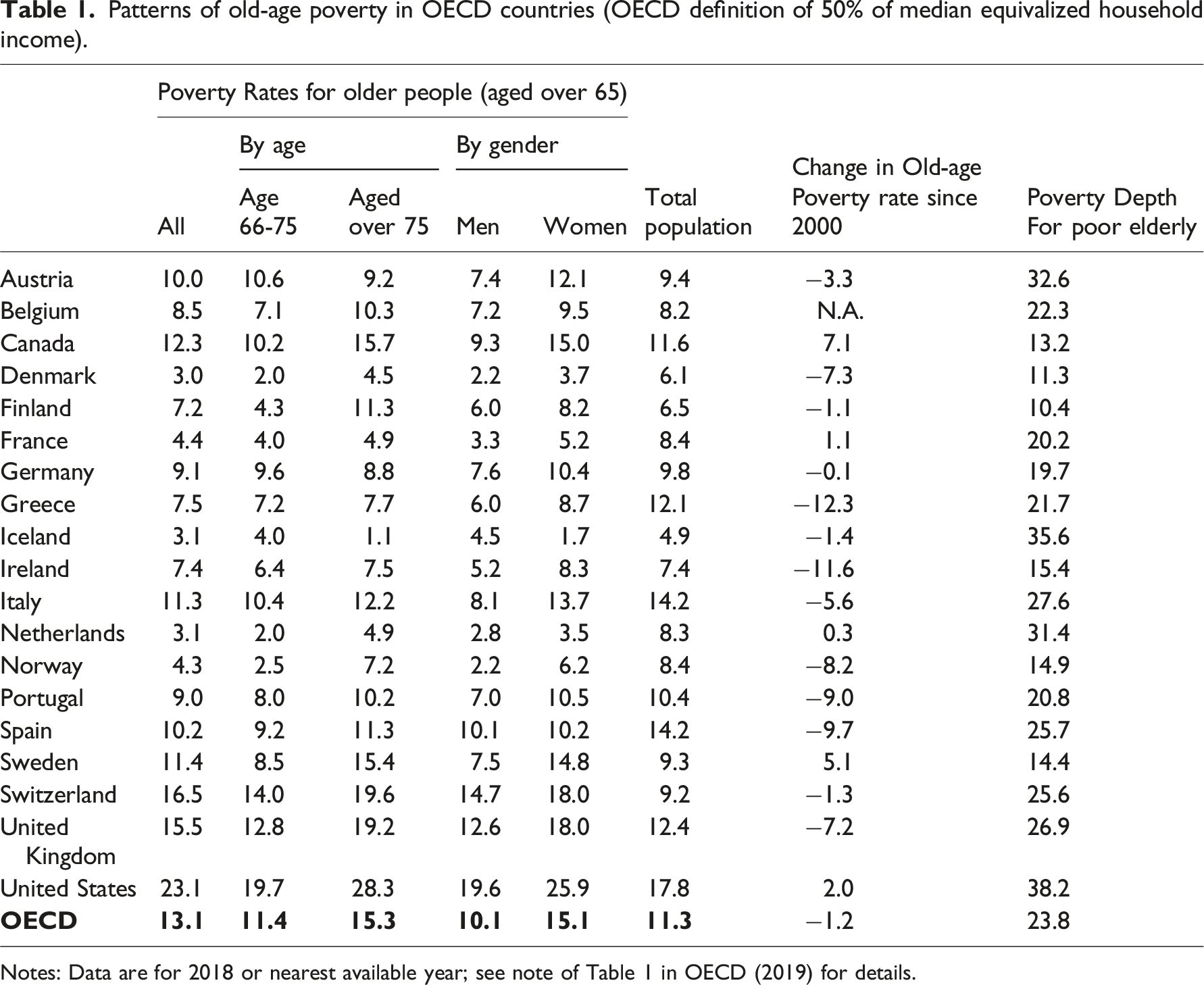
Notes: Data are for 2018 or nearest available year; see note of Table 1 in OECD (2019) for details.
Despite adoption of retrenchment-oriented pension reforms in several countries between 2000 and 2018, old-age poverty generally declined in most countries in the sample over this period; in Denmark, Norway and several later-developing European countries (Ireland, Spain, Portugal and Greece), changes were substantial. A few countries experienced increases in old-age poverty rates over this period, however, notably Canada (+7.1%) and Sweden (+5.1%).
The indicator for old-age poverty depth (the mean income gap of poor population to income at poverty line, in percent) adds further nuance. In some countries, poor retirees are only slightly below the poverty line (Canada, Denmark and Finland), while in other countries (the United States, Iceland, the Netherlands and Austria) many poor retirees fall very short of the poverty line. The United States has the highest poverty rates and poverty gap; Denmark, Norway and Finland are low in poverty rates and poverty gap; and some countries with relatively high old-age poverty rates, like Sweden and Canada, have relatively shallow poverty gaps. Despite severe fiscal stress in some countries and general trends toward pension retrenchment in this period, only three of the countries in Table 1 experienced increases in old-age poverty rates over this period: Canada, Sweden, and the United States. These relatively stable patterns of old-age poverty—including some reductions —are puzzling, given that substantial pension reform initiatives occurred in most OECD countries.
Pension retrenchment risks increasing old-age poverty, especially among those with low lifetime earnings and interrupted work histories. This risk is greater in Bismarckian earnings-related pension regimes that lack or have very weak basic provision through minimum or means-tested pensions (Ebbinghaus, 2021). However, pension reforms in recent years have by no means been unidirectional, especially as countries recovered from the GFC and reversed some austerity-induced reform measures (see OECD, 2019: chapter 1; Bridgen, 2019).
The politics of old-age poverty alleviation: Priority or afterthought?
Existing research offers three related explanations for continuity and change in old-age poverty policy. First, the life course/demography approach analyzes the effectiveness of old-age poverty policy in the context of long-term changes in the life course. A second perspective emphasizes the capacity of political actors with differential resources to enact their preferred policies. Third, institutionalism highlights how policy feedbacks and the structure of political decision-making institutions mediate demographic pressures for policy change. (Béland et al., 2022). Our analysis of old-age poverty policymaking draws on all three perspectives, but emphasizes the last two.
Life course research highlights how demographic and economic shifts shape the life chances of different birth cohorts. In affluent democracies, understanding old-age poverty requires investigating how pension policy interacts with changing labor market conditions during adults’ working lives (deindustrialization, unemployment, increase in women’s labor market participation). Pensioners with incomplete employment profiles are most likely to experience old-age poverty, unless minimum pension provision is robust. Poverty risks are typically higher for women who leave the labor force partially or entirely for long periods to care for children and other family members (Daly, 2000).
Life course research suggests several questions. Are governments aware of shifts in poverty risks? Can existing policies respond effectively? How do governments decide what to do about them/generate support for policy change? We also ask how pension regimes shape the types of old-age poverty risks likely to emerge in specific countries. All else equal, Beveridgean regimes with robust basic pension schemes are less likely to experience high levels of old-age poverty unless eligibility rests on long periods of residence or basic benefits fall below poverty levels. Bismarckian regimes face different pressures related to the life course because of the emphasis on “equivalence” (pension benefits linked to employment earnings). Without highly developed parental insurance and social services (child care, eldercare), women’s lifetime employment earnings are generally lower than men’s, leading to lower pensions. Without adequate minimum benefits, women will be more likely to experience old-age poverty (e.g., Madero-Cabib et al., 2023).
We integrate insights from life course analyses with research emphasizing the role of politics and institutions in pension policymaking. Our starting point is that collective actors (parties and organized interests) mobilize politically to pursue their preferred social policies. Established research demonstrates that left-right political ideology influences social policy making: left parties tend to pursue pension policies that prevent/reduce old-age poverty and ensure adequate earnings-related pension benefits. Conservative parties are less likely to enact egalitarian policies because of their preference for less state and more market, as well as their skepticism of redistribution (Brady, 2009; Esping-Andersen, 1990; Huber and Stephens, 2001).
The “new politics” perspective on policy feedbacks (Pierson, 1994) emphasizes the political difficulty of scaling back popular, institutionalized social policies. Once in place, social policies generate their own sources of political support: government action in the social sphere shapes citizen’s attitudes about the visibility and desirability of state social policies; beneficiary groups mobilize politically to defend their social rights; and other relevant actors adapt their behavior and expectations to the maintenance of popular social policies that cover large groups. More recent contributions have emphasized general barriers to policy change posed by the structure of political decision-making institutions; the effects of self-undermining aspects of public policies that undermine political support (Jacobs and Weaver, 2015); and the potential for policy effectiveness to decrease if the policy is not continuously adapted to changes in the external environment (policy drift). Understanding the role of policy drift in pension policy is particularly important: if eligibility requirements and benefit levels fail to adjust to shifts in economic and social context such as family structure and labor force participation, poverty reduction effectiveness may decrease.
The next section examines how changing socio-economic conditions have influenced old-age poverty risks in specific pension regimes since 1990. We then analyze whether and how policy drift has occurred. Finally, we investigate how policymakers have responded to policy drift.
Broad drivers in the life course approach
There are three broad sets of macro-societal pressures on pension policy. First, population aging creates fiscal pressure on pension policy. The expected number of years in retirement in the OECD has increased from 12 for men and 16 for women in 1970 to 19.5 for men and 23.8 for women in 2020, while old-age dependency ratios have increased (https://stats.oecd.org/index.aspx?queryid=54758).
Second, increasing precarious employment and breaks in full-time employment in the context of rising longevity strains the effectiveness of existing old-age poverty policies. Women, especially those without access to survivors pensions or pension rights for periods of childcare, are disproportionately affected because of the interaction of gendered labor markets and caring regimes. In Bismarckian regimes with weak policies supporting women’s and especially mothers’ employment, women tend to have fewer years in full-time employment, and hence lower earnings-related pensions, unless survivors' pensions address these gaps. As noted, the capacity of Beveridgean regimes to respond to changing old-age poverty risks turns on the generosity of basic pension provision. Several European pension regimes provide strong minimum provision, but require 40 or 50 years of residence for full benefits (SE, DK, NL, CH). Adult migrants often fail to qualify for full benefits because of residence requirements.
Third, adult migrants, especially from outside the OECD, are vulnerable to old-age poverty because they do not qualify for residence-based basic protection in Beveridgean regimes, and they have low/interrupted employment records and thus low occupational pension entitlement. Bismarckian regimes do not perform much better because of the centrality of employment earnings for pension entitlement.
Politics
Existing research argues that left-wing parties are more likely to adopt government-financed social policies aimed at poverty reduction, whereas right-wing parties are more concerned with fiscal restraint and promoting work incentives. In general, we would expect that policy changes leading to increased old-age poverty are more likely to be enacted by ideologically conservative governments than those where left or social democratic parties dominate.
Another perspective focuses on power resources and constituency pressures, especially those of the elderly as a constituency. While older people are usually a powerful constituency (Pierson, 1994), lower income citizens (Schakel et al., 2020), including the elderly poor are not. Thus, the more old-age poverty is concentrated among socially marginalized groups such as immigrants, the more likely they are to lose when fiscal/demographic pressures hit, unless they develop alliances with more powerful groups. These increases in old-age poverty may also occur as “collateral damage” from retrenchment-oriented policy that affects these groups differentially, rather than those pensioner groups being explicitly targeted.
Institutions
Political institutions mediate the impact of these broad drivers on pension policymaking, and hence on old-age poverty. They also interact with the pension regimes in place (discussed further below) to influence policy responses to changes in old-age poverty rates. An important thesis emphasizes institutional opportunities for political actors to block policy change. The “veto points” perspective (Immergut, 1992) suggests that strong, persistent and multiple veto points lead to policy stalemate and policy drift, which amplify existing patterns in level and changes in old-age poverty rate. On the other hand, informal cooperative institutions and cross-block coalitions can help to overcome both polarization and status quo bias and lead to policies that simultaneously adapt pensions to changing demographic trends and protect vulnerable elderly people from increases in poverty.
Policy feedback and poverty reduction
A simple classification of pension regimes distinguishes between “Beveridgean” systems that emphasize poverty alleviation through flat-rate benefits versus “Bismarckian” systems that prioritize earnings replacement; a four-fold categorization adds a second dimension focused on the generosity of Beveridgean or Bismarckian benefits. More complex categorizations include “mixed” systems with mandatory privatized pension tiers, and notional defined contribution schemes that emulate capital-funded defined contribution plans where pensions depend on investment returns (Weaver, 2010).
The countries analyzed in this article have multi-tier pension systems, but the tiers differ in weight and micro-rules, generating different balances of pension adequacy, income replacement, and financial sustainability objectives. They also differ in how they transfer fiscal, demographic and financial risks to pensioners—and thus in their impact on old-age poverty. National pension regimes also vary in their incorporation of at-risk groups, including women, the very old, those in fragile or interrupted employment, and immigrants. The structure and “micro-rules” of these individual tiers largely determine how well national pension regimes protect against old-age poverty. Based on these considerations, the policy feedbacks perspective suggests, first, that countries with large, deeply imbedded and universal/quasi-universal flat-rate pensions will be protected from increases in old-age poverty by broad constituency support. Second, countries with dominant earnings-related (social insurance or NDC) pension tiers will experience increases in depth and breadth in old-age poverty after 2000. Finally, national trends in old-age poverty will be driven largely by exogenous shifts and shocks in composition of the elder population and income distribution that are not compensated for by adjustments in pension and other social policies—that is, by “policy drift” (Galvin and Hacker, 2020; Hacker, 2004). These effects are likely to be interactive rather than mutually exclusive: systems with weaker and fewer institutional veto points may be less subject to policy drift than those with strong and multiple veto points.
Old-age poverty politics in the Sweden, Germany, the Netherlands, Canada and the US
The five countries examined here represent a broad sample of well-established public systems in affluent democracies. All have multi-tier pension systems, but the composition and relative size of the various pension tiers varies dramatically; they also offer a variety of political institutions and partisan/ideological mixes. This sample permits an exploration of the arguments outlined above. This section presents brief summaries of patterns, trends and explanations in old-age poverty in the five countries. Table 1 in the online appendix summarizes our findings concerning the arguments outlined in Section 3.
Swedish old-age poverty: Patterns and trends
Old-age poverty rates in Sweden are moderate but increased during the 2010s. In 2019, 11.4% of those 65 and over fell below 50% of median equivalized household income, compared to 9.3% for the total population. Old-age poverty increased by five percentage points between 2000 and 2019, but old-age poverty depth was fairly shallow, at 14.4%. The overall trend in Sweden is one of moderately increasing relative poverty at both the 50% threshold and the 60% threshold used by national policymakers.
Single women, older pensioners, and adult immigrants are most likely to experience relative poverty (Granbom et al., 2022). As Table 1 shows, poverty increases with age. Differential poverty rates across gender and age reflect lower average earnings for women, leading to greater reliance on income-tested basic pension provision. Women are also more likely to live alone because they tend to outlive their male partners. Non-European migrants also experience higher than average relative poverty, largely because they have lived in Sweden for fewer years and have inadequate pension rights. The share of foreign-born pensioners has increased from 9% to 14% since 2000. According to government calculations, improvements in basic provision since 2022 have started to counteract these trends (Proposition, 2023/24: 1, Utgiftsområde 11, pp. 9–12).
Swedish old-age poverty: Explanations
Prior to a major pension reform in 1998, flat-rate and earnings-related public pensions covered all residents. The flat-rate pension and income-tested benefits, especially for housing, kept poverty rates very low until the early 1990s. The PAYGO earnings-related scheme provided generous defined benefit pensions to those with at least 30 years of labor market participation. Demographic shifts and the decline of full employment increased fiscal pressure on existing pension provision, prompting the emergence of a broad, cross-party reform coalition behind legislation in 1994 and 1998 (Anderson and Immergut, 2007) that replaced the basic pension with a pension-tested, inflation-protected guarantee pension requiring at least 3 years residence (a full guarantee pension requires 40 years residence). A notional defined contribution (NDC) income pension based on lifetime earnings and an individual capital-funded defined contribution (DC) scheme replaced the previous PAYGO scheme.
The 1994/1998 pension reform directly responded to population aging and fiscal pressures, supporting our argument about the role of fiscal pressures. It generated moderate but unintended increases in old-age poverty because the lifetime income principle disadvantaged mothers, immigrants, and those with incomplete employment records. These reforms predate the GFC, so there is little evidence that the GFC facilitated reforms that increased old-age poverty.
As the Social Democratic Party’s electoral dominance declined, non-socialist influence on pension policy since 1991 took two forms: participation in a five (later six) party policymaking cartel, the Pensions Group, formed in 1991 to negotiate pension reform and subsequent amendments. There has been sustained cross-party consensus that NDC pensions based on lifetime earnings should determine pension levels, but recently there has been increased attention to rising old-age poverty. A Social Democratic-Green government adopted increases in the guarantee pension outside of the Pensions Group in 2022. Our institutional argument suggesting that strong multiple veto points would lead to policy stalemate is not applicable to Sweden in terms of formal institutions, but the consensus norm in the Pension Group does provide an informal veto point that constrains policy change. This consensus norm has prevented majoritarian policymaking, and the frequency of minority government, especially during periods of left government, has required cross-block cooperation. Thus the institutional argument suggesting that informal and cross-block cooperation protects vulnerable pensioners, is partially supported for the period since 2000. Center-right governments have adopted changes to the tax system outside the Pensions Group that effectively increase old-age poverty by increasing net income of workers, but not pensioners, partially supporting the argument concerning the influence of ideologically conservative parties on old-age poverty.
Guarantee pension improvements since 2022 suggest a subtle feedback effect: a strong normative commitment to adequate minimum provision can survive even when a universal basic tier has been phased out. There is partial evidence that the increased dominance of the earnings-related tier since 1998 moderately increased old-age poverty because of the lifetime earnings principle, affecting mainly women and late-life immigrants. There is also evidence that automatic adjustment of pensions to longevity and the failure of many workers to extend their retirement age, caused substantial unintended downward pressure on pension replacement rates (von Nordheim and Kvist, 2023). Finally, legislative developments since the 1990s show that policy drift led to moderate increases in old-age poverty: increasing unemployment since the 1990s and increases in immigration from outside the EU led to higher numbers of pensioners relying on basic provision because of insufficient pensionable income. The 1994/98 reform was not designed to address this, resulting in policy drift.
German old-age poverty: Patterns and trends
The depth of old-age poverty in Germany in 2018 was moderate, at 9.1%, somewhat lower than in Sweden. Unlike Sweden, however, the poverty rate in Germany has remained fairly stable since 2000 (Table 1). As in Sweden and the Netherlands, single women, older pensioners, and adult immigrants from outside of Europe are more likely to experience poverty than the native-born (Bundesministerium für Arbeit und Soziales, 2020). German policymaking relies on national definitions and metrics of poverty derived from income thresholds for all forms of social assistance, including social assistance for pensioners and basic provision for pensioners. At the end of 2019, 3.2% of those who had reached the retirement age required basic provision to cover some of their basic living costs.
Old-age poverty is relatively deep, at 19.7% in 2018 (Table 1). The gender pension gap is fairly large, at 29.9% in 2021 (Statistisches Bundesamt, 2023). In 2019, 33% of pensioners with migration background were at risk of poverty at the 60% poverty level used in Germany. As in Sweden and the Netherlands, these higher poverty rates reflect lower lifetime labor income because of part-time work, low-wage jobs, or late-life immigration.
German old-age poverty: Explanations
The Bismarckian structure of the pension system assumes that all employees, including breadwinners, will have sufficient lifetime earnings to ensure a good pension; the few older people with low pensionable income would receive means-tested supplements from the national system of minimum provision. Unlike Sweden and the Netherlands, a citizenship or residence-based flat-rate basic pension never had much political traction until after 2000. Until then, strong union and Social Democratic support for earnings-related provision crowded out support for a basic pension tier.
The Bismarckian approach worked well until the 1990s when high unemployment, increased atypical employment, and immigration from outside Europe generated increasing numbers of pensioners with insufficient pensionable income. Fiscal and demographic pressures and the costs of unification exacerbated this trend, ushering in 15 years of retrenchment starting in the late 1990s (Jochem and Schulze, 2007; Hinrichs, 2010). Incremental cuts made it more difficult for many to accumulate sufficient pensionable income, an important impact of the life-course and old-age poverty policy. There is little evidence that the GFC exacerbated this trend, however. The 2004 Rürup reform linked indexation of pension rights and pay-outs to the ratio of pensioners to contributors via a “sustainability factor”; this was suspended several times, however. Similarly, an explicit goal of reforms since 2001 has been the voluntary expansion of private and occupational pensions to compensate for cuts in the statutory pension. Take-up has been uneven, especially for individual private pensions, increasing poverty risks for low-income households.
There is little evidence that ideologically conservative parties in government disproportionately enacted policy changes that increased old-age poverty. Pension retrenchment since 2001 reduced earnings-related generosity, but these reforms were usually adopted by left governments or by grand coalitions (2005–2009; 2013–2021; see Jochem and Schulze, 2007). Earnings-related benefit cuts have increased the number of retirees below the nationally-defined poverty thresholds, exacerbating poverty rates for women, adult migrants, and those with many years of precarious or low-income employment; this was a consequence of general policy shifts such as adoption of the sustainability factor rather than targeting of these groups.
The Social Democratic/Green government (1999–2002) adopted a means-tested minimum income for pensioners in 2001 as part of the existing system of minimum social provision (Jochem and Schulze, 2007). Policy drift began to erode earnings-related benefits. Means-tested benefits were not adequate to support the growing number of pensioners with insufficient earnings-related benefits. Recent reforms try to counteract policy drift by establishing means-tested provision for pensioners (Anderson, 2011; Geyer et al., 2019; Hinrichs, 2012). In 2020, the CDU/CSU-Social Democratic grand coalition enacted a basic pension supplement to earnings-related pensions for those with many years of low-income employment. The supplement is part of the statutory pension scheme rather than the national system of minimum income support. These recent reforms demonstrate that cross-block cooperation can mitigate policy drift, resulting in reforms that mitigate poverty risks for vulnerable pensioners, as suggested by our institutional argument about informal cooperation.
Netherlands old-age poverty: Patterns and trends
Poverty rates (breadth) are very low in the Netherlands because politically popular, generous flat-rate pensions have been in place for six decades. However, poverty depth is considerable, at 31.4% (Table 1). Unlike Sweden, poverty rates at the 50% threshold have remained fairly stable between 2000 and 2018. Pockets of poverty are similar to those in Sweden: pensioners older than 80 years, women, especially those living alone, and late-life migrants from outside the OECD are more likely to fall below the poverty threshold than the native born (Nibud, 2022).
Netherlands old-age poverty: Explanations
The Netherlands has two fairly equally-sized pension tiers: the PAYGO basic pension and capital-funded earnings-related occupational pensions negotiated by employers and unions. The basic pension, the AOW, provides a generous, flat-rate pension to all residents, regardless of employment history, that lifts nearly all pensioners out of poverty. A full AOW requires 50 years of residence prior to the statutory retirement age, but is reduced proportionately for each year of non-residence, and the pensionable age is linked to remaining life expectancy for 65 year olds. In 2022, 9.8% of AOW pensioners had no occupational pension income to supplement their AOW pension. The AOW is highly institutionalized and has wide electoral appeal, but faces significant demographic, economic, and political pressures. Higher rates of poverty among immigrants from outside Europe result from incomplete AOW rights, lower lifetime employment income than the native born (resulting in lower occupational pensions), and lower rates of home ownership (Lössbroek and Fokkema, 2022).
The politics of old-age poverty centers on the AOW. Despite population aging and fiscal stress, the AOW has largely remained stable over the past few decades. The center-right Christian Democratic Party lost heavily in the 1994 national election after proposing a 4-year freeze on AOW benefits to improve financial sustainability (Anderson, 2011). Since then, direct AOW benefit retrenchment is firmly off the political agenda. Policymakers turned instead in 2012 to increasing the AOW retirement age and automatic adjustment to changes in longevity. This change was initiated by a center-right minority government, during a post-GFC period when the Netherlands was under severe fiscal pressure, although with major input from the social partners (Kickert, 2012). These patterns are consistent with the arguments in Section 3 about the role of life-course changes, GFC pressures, and partisanship. The measure was later modified by a cross-block coalition as the least undesirable alternative. These changes were not targeted at poor retirees, but have the potential to affect them disproportionately as retirement ages increase.
There is mixed support for arguments about political institutions. Dutch political institutions have relatively few veto points, but pure proportional representation (there is no minimum electoral threshold) encourages the formation of new parties, making cross-bloc coalitions with divergent viewpoints and many potential veto players common. Parties representing retirees entered Parliament for the first time in 1994 and have gained seats in several elections since then. Retiree mobilization increases the political sensitivity of AOW benefits, and coalitional veto players protect universal pension benefit levels but not retirement age.
Canadian old-age poverty: Patterns and Trends
Canada’s pension system is often seen as a social policy success, producing very low old-age poverty rates at relatively modest cost. Recent assessments have been more mixed, however; Canada now has relatively high overall rates of old-age poverty, although its depth is relatively shallow (Table 1). Poverty rates are particularly high among older women living alone and immigrants. More than thirty percent of retirees identified as immigrants by 2016 (Sibal and Raphael, 2022) There were significant increases between 2000 and 2018 in old-age poverty rates, but not in poverty depth.
Canadian old-age poverty: Explanations
Canada’s multi-tier public pension system shapes patterns of old-age poverty. Canada’s semi-universal (it phases out at very high income levels) Old Age Security (OAS) and income-tested Guaranteed Income Supplement (GIS) and associated benefits are administered by federal government. Both are non-contributory and closely integrated; almost one-third of OAS recipients receive GIS. OAS and GIS together provide a strong income floor, both are indexed to inflation rather than incomes, causing that floor to fall slightly below OECD poverty thresholds. Both programs have a graduated years-of-residence test that makes immigrants, especially late-life immigrants, vulnerable to old-age poverty, although several ad hoc increases in GIS levels have mitigated this effect (Curtis and Lightman, 2017).
The modest (maximum benefit of 25% of average earnings) contributory earnings-related Canada/Quebec Pension Plan (Quebec’s Plan operates separately but has similar benefits) provides a pension top-up that carries most pensioners over the poverty level, but provides weaker benefits to those with interrupted earnings histories.
The arguments posited in Section 3 have mixed success in explaining the patterns observed in Canada. Fiscal and demographic pressures led to significant reforms of the Canada/Quebec Pension Plan in 1997, and further changes to the QPP in 2011; however, these were felt primarily in increased payroll taxes rather than benefit cuts, partly because payroll taxes are low by international standards, reducing financial stress.
Efforts to cut and restructure OAS and GIS by a Progressive Conservative government in the 1980s and Liberal government in the 1990s provoked strong opposition and were cancelled. Retrenchment in the OAS and GIS were enacted in the immediate aftermath of the GFC, but only after the Conservatives won a majority in 2010: the conservative Harper government enacted a phased-in 2-year increase in eligibility age for OAS and GIS. This change was reversed by the Liberal Trudeau majority government in 2015, suggesting a strong partisan effect. Trudeau’s government also enacted a phased-in increase in CPP benefits, which was later matched by the QPP, both prompted in part by a secular decline in coverage of defined benefit occupational pensions. This benefit expansion should eventually increase pension replacement rates, but it will not reduce old-age poverty substantially in the short term. Thus the hypothesized effect of the role of conservative parties finds support more in partisan intent rather than outcomes, since the Harper government’s proposed eligibility cuts failed.
The concentration of poverty increases among immigrants is consistent with the argument about the vulnerability of marginalized groups. However, old-age immigrant poverty is the result of lack of action to address poverty in these groups—policy drift--rather than targeted benefit cuts. Canada has had an unusually high prevalence of minority governments (2004-2010 and 2019-present) recently, strengthening veto points that make pension reforms less feasible; thus the importance of veto points finds support in the lack of retrenchment initiatives during the period of minority governments. Policy flip-flops can be found in OAS/GIS eligibility age debates in the 2010s with the return of Liberal majority government; cross-bloc cooperation is present only in the CPP/QPP pension reform process. Finally, Canada’s quasi-universal and income-tested pension tiers did not prevent increases in old-age poverty rates, but they did prevent increases in deep poverty—an outcome that reflects policy drift resulting from program benefits that are indexed to inflation rather than wages (Béland and Marier, 2022: 221).
U.S. old-age poverty: Patterns and Trends
Poverty rates and old-age poverty depth stand out in the United States compared to the western democracies shown in Table 1. Poverty rates (breadth) are the highest among the countries shown, and poverty depth also tops the league tables. There are several concentrations of old-age poverty, particularly among minorities, the unmarried, older unmarried women living alone, and immigrants (Li and Dalaker, 2021). US poverty measures are based on an absolute poverty standard, and these show old-age poverty dropping dramatically from the 1960s through 1975, with much slower but fairly consistent downward trends until around 2000, when rates stabilized.
U.S. old-age poverty: Explanations
The United States has seen a 40 year period in which policymaking for the main US public pension program, Old Age Survivors Insurance (known as Social Security), has been essentially untouched by policymakers—an extreme case of policy drift. The reasons for this stalemate are several. One factor preventing public pension reform is that old-age poverty rates in the US have by (ungenerous) official US standards been consistently at or lower than the poverty rate for 18–64 year olds, and substantially lower than the poverty rate for children, lowering attention to the problem of old-age poverty. The 40-year stalemate in Social Security politics has been exacerbated by high levels of partisan polarization combined with multiple veto points that make passing legislation difficult, leading to the absence of a comprehensive public pension reform package including improved protections for poor retirees’ incomes. While many Republican policymakers advocated Social Security retrenchment and restructuring, these proposals have not been enacted during brief periods when Republicans controlled both the presidency and Congress, contrary to the expectations about the impact of conservative governments.
These effects are deeply intertwined with the structure of public pension policies. The US lacks a universal or quasi-universal flat-rate pension with broad constituency support that could act as a bulwark against old-age poverty. Instead, Social Security dominates public pension politics, and it is quasi-universal in coverage but contributory and earnings-related, albeit providing a more generous replacement rate to workers with low lifetime earnings. Additionally, Supplemental Income (SSI), a means-tested program for the elderly and disabled poor, is ineffective as a minimum income vehicle: it has extremely low benefits and onerous income, asset, residency and citizenship eligibility requirements that discourage participation (Herd et al., 2018). However, the prolonged Social Security stalemate has also meant that neither adjustments to longevity nor partial substitution or addition of mandatory privatized tiers in the Social Security system have been enacted, although the latter did make it onto the policy agenda during the Bush Presidency (2001–2009) (Béland and Waddan, 2012: chapter 3).
Conclusions and lessons on the political limits of elder poverty reduction
Our analysis reveals complex patterns of policy responses that have affected old-age poverty rates, depth, pockets and trends. We conclude, first, that analysis of old-age poverty should address depth, pockets and trends as well as “breadth” (i.e., poverty rates). Some “pockets”, notably older women living alone, are large and drive overall poverty rates. Examining poverty depth and concentration among groups is important for understanding the gaps in welfare state programs that lead to severe material deprivation.
Second, the factors affecting old-age poverty in affluent democracies are complex and interactive. A life-course perspective provides an important starting point for analyses of patterns in old-age poverty, but it should be supplemented by other explanatory factors, particularly demographic pressures that shape policymaking, notably increases in numbers of the very old, increasing numbers of older immigrants, and increased earnings inequality among those of working age. Fiscal pressures also drive policymaking and poverty outcomes, but there has also been great variation in the number and types of reforms enacted, and limited changes in old-age poverty in most of the countries studied.
Third, the GFC had limited impact on policy changes that contributed to increased old-age poverty; it is evident only in the Netherlands. As discussed, the most dramatic post-GFC retrenchment cuts occurred in fiscally weaker countries. Moreover, with recovery from the GFC, some countries (e.g. Canada, Germany, Sweden) enacted measures that directly address old-age poverty reduction.
Fourth, there is limited evidence that conservative parties in power enact policies that increase old-age poverty. The reasons vary, however, from a policy process that increases cross-block cooperation and consensus in Sweden to veto points that limit conservative initiatives or heighten the costs of even introducing them in the United States, to the reversal of conservative enactments following a change in government in Canada.
Fifth, there is little evidence that the weak power resources of poor retirees shaped policymaking. Increases in old-age poverty were largely “collateral damage” from benefit cuts that were not offset by increases in means-tested or minimum pensions. Poor retirees have only rarely been targeted for retrenchment. Indeed, a common pattern has been policy drift—failure to enact policy changes to address pockets of old-age poverty in response to increased inequality and immigration, weakening occupational pension systems and growing numbers of very old retirees. In short, it is the limited positive power of poor retirees (their inability to achieve positive policy changes) rather than their negative power (inability to block harmful changes) that has been more consequential for increased old-age poverty where it has occurred.
Sixth, political institutions have played a mediating role in affecting old-age poverty, but their role has varied cross-nationally, reflecting institutional differences. The role of institutions is most evident in the United States, with strong veto points exacerbating political stalemate and policy drift and preventing enactment of a comprehensive reform package to address high old-age poverty breadth and depth. In Canada, weak veto points led to policy reversals on OAS/GIS retrenchment reforms following ideological lines, but only when single party majority governments prevailed. Institutional effects in the other cases studied were more muted because collusive cross-bloc policymaking in the continental welfare states facilitated both pension reform and direct efforts to address old-age poverty.
Finally, policy regimes and micro-rules mediated reform pressures. Deeply imbedded universal pension tiers have been effective bulwarks against old-age poverty in the Netherlands; even where they have been abolished (Sweden) the norm of protecting low-income pensioners has remained strong. The Canadian quasi-universal OAS continues to provide significant protection against poverty depth and breadth in combination with other tiers. The two countries that rely most on social insurance (Bismarckian) pensions, Germany and the United States, followed different trajectories, suggesting complex interactive effects related to politics and institutions, with Germany enacting policies to strengthen pension protections for low income citizens while the U.S. has not. These patterns support the “paradox of redistribution” thesis proposed by Korpi and Palme (1998): targeted income support policies are less effective at reducing poverty and inequality than universal ones.
The most consistent pattern in the case studies concerns policy drift--government failure to adapt policy to changes in the external environment. Absent political will and capacity to enact policy change, all government programs are subject to policy drift. Failure to react to socio-economic changes increasing income inequality, and thus relative old-age poverty rates, and rising numbers of elderly immigrants and the very elderly have been important drivers of old-age poverty patterns and trends. What the cases examined here highlight is that policy drift can take different forms, and that cross-national differences in the structure of government policies have an enormous impact on how policy drift affects old-age poverty. In the Canadian context of a moderately generous quasi-universal pension and a closely linked income-tested program, both indexed to inflation, policy drift has led to significant increases in poverty breadth in recent years but small increases in poverty depth. Swedish policymakers have recently responded to previous benefit reductions by prioritizing old-age poverty reduction. In the US, an extraordinarily weak safety net pension program and increased earnings inequality coupled with high partisan polarization and institutional paralysis has meant that policy drift has been extreme, resulting in significant increases in both poverty depth and breadth.
We suggest two directions for further research. First, improved micro-data that allows directly comparable cross-national investigation of poverty rate trends among especially vulnerable populations such as older women living alone and immigrants would be useful. Second, more detailed examination of how old-age poverty is defined in national pension debates and how that affects pension policy reforms could also enrich the discussion presented here.
Footnotes
Declaration of conflicting interests
The author(s) declared no potential conflicts of interest with respect to the research, authorship, and/or publication of this article.
Funding
The author(s) received no financial support for the research, authorship, and/or publication of this article.

Supplemental Material
Supplemental material for this article is available online.
References
Supplementary Material
Please find the following supplemental material available below.
For Open Access articles published under a Creative Commons License, all supplemental material carries the same license as the article it is associated with.
For non-Open Access articles published, all supplemental material carries a non-exclusive license, and permission requests for re-use of supplemental material or any part of supplemental material shall be sent directly to the copyright owner as specified in the copyright notice associated with the article.
