





Abstract
Purpose
Subjects (n = 45) did two high-intensity interval training (HIIT) workouts on a cycle ergometer to assess intermittent palm cooling's influence on this exercise mode. Workouts included three 20-s sprints separated by two minutes of active recovery and were done either with, or without, palm cooling (PC, no PC) in a randomized order. Dependent variable data were assessed with 2-factor ANOVAs, with repeated measures per independent variable. A Bonferroni correction (α = 0.05/6 = 0.0083) mitigated the Type I error risk based on the number of dependent variables analyzed. Significant dependent variables were assessed with pairwise comparisons to identify the source of the differences.
Results
Palm temperature (PT) and thermal flux (FLX) each had significant two-way interactions; the latter dependent variable saw PC > no PC at multiple times during and after workouts. Peak power, as an absolute (PP), and relative to body mass (PP/KG), value had significant two-way interactions, with PC > no PC for the second and third sprints as identified with pairwise comparisons. Inter-treatment PP and PP/KG differences likely benefitted from PC's significantly higher FLX values.
Conclusions
Exercise with repetitive bursts of supramaximal activity may benefit from intermittent PC to abate body heat accrual.
Introduction
Characterized by brief repetitive bouts of supramaximal effort interspersed by active recovery, high-intensity interval training (HIIT) is a popular exercise modality due to its many benefits. For instance, for those with limited time to engage in physical activity, HIIT attempts to increase the volume of exercise done within an abbreviated time frame. In addition, since repetitive bursts of supramaximal effort are needed in many sports, HIIT is a popular way to prepare athletes for competition. Yet an aspect of HIIT that limits exercise performance is body heat accrual, which results from differences between internal rates of heat production and removal. While exercise and warm environments individually cause heat accrual, when combined they exacerbate the problem. 1 Heat production may rise 100-fold as persons go from rest to supramaximal exercise. 2 At such times heat removal does not keep up with production, and higher core temperatures result. Heat removal during exercise sees evaporation responsible for up to 85% of heat losses. 3 Despite evaporation's best efforts, heat accrual persists and the resultant dehydration contributes to losses in exercise performance.2,4 For instance, a 1–2% body mass loss from dehydration undermines the body's thermal balance and performance, while a 3% loss or more causes heat-related ailments regardless of fitness status. 1 While a normal resting core temperature is 37°C hyperthermia, perhaps the most well-known heat-related ailment, occurs if it exceeds 39°C.1,5 Ergogenic aids that abate heat accrual should enhance HIIT performance. Yet sport governing bodies must demand only their safe use, as even small benefits can have a major impact on athletic competition. Pre-cooling, to abate heat accrual during exercise, received the most inquiry. 5 Pre-cooling strategies included water-immersion, dermal ice pack application, and cold air exposure. 5 They also included clothing that used conduction to augment evaporation's heat transfer. Yet cooling garments during exercise (termed mid-cooling) were unpopular. Complaints included carrying a garment's excess weight during training or competition, and skin irritation, that limit their usage. 5 In addition, the garments had little success at core temperature mitigation since they often contacted nonglabrous skin with limited ability to transfer heat.6,7 This is problematic, as during mid-cooling heat production rises that leads to higher body temperatures.
In contrast, the hand's palm has high thermal conductivity and low skin thickness to aid heat transfer.8–10 The palm has a large surface/volume ratio, and exercise delivers high blood volumes to glabrous palm and finger surfaces.9,11–13 The palm's surface covers arteriovenous anastomoses that connect arterial and venous circulation.8,9,13 With local blood flow regulated by smooth muscle, palm cooling can see arterial circulation bypass systemic capillaries and instead divert it to anastomoses to dissipate heat.12,13 Palm cooling is applied during exercise and may aid HIIT outcomes, but its influence on HIIT has yet to be determined. 14 Palm cooling's merits were previously assessed by within-subject designs and large samples to identify inter-treatment and -time differences.2–4,11,15–20 At a 27° C air temperature the palm dissipates 150–220 W · m−2 of heat. 21 Yet during exercise, palm cooling transferred more than 500 W · m−2 of heat in persons especially prone to heat accrual. 3 Application of water-based substances make palm cooling more effective, as water's heat transfer coefficient is 25 times higher than that of air. 22
Aside from its unique anatomy,8,9,11,12 heat loss from the palm was attributed to cold-induced vasodilation (CIVD), which creates an oscillating pattern of heat transfer.15,21,23,24 Cold application initially evokes cutaneous vasoconstriction; for instance, hypothermic core body temperatures reduce palmar heat dissipation to as little as < 0.1 W. 21 Yet within 5–10 min of vasoconstriction, CIVD temporarily returns heat-ladened blood to the hand's palm as a protective mechanism against permanent tissue damage. 24 Passive heating and cooling, to elicit a CIVD response is quite variable. 23 Yet CIVD responses produced through exercise may be more consistent. Since CIVD also occurs at warmer body temperatures, HIIT participants may wish to use it to their advantage during exercise since it hastens rates of heat transfer from their bodies. 3 CIVD occurs during exercise when 1): core body temperatures are high, and 2): enough norepinephrine binds to a palm's adrenergic receptors that regulate its blood flow.2,7,15,21,25 The following were cited as possible reasons for CIVD's occurrence during exercise: 1) axonal reflexes from thermal receptors block local afferent signals; 2) cooler blood via conductive heat transfer; 3) local analgesic or vasodilator release; 4) pain modulation by sensory neurons; 5) afferent shifts as the brain senses cold, and 6) action potential blockades between anastomoses and sympathetic neurons.4,18,25
Due to the limited success of cooling garments worn on nonglabrous torso and neck surfaces, a different approach needs to be adopted.6,7,24 Given the large heat transfer changes possible at the palm,3,21 athletes and HIIT enthusiasts may wish to consider palm cooling as a safe and legal ergogenic aid against exercise-induced body heat accrual. A glove was fabricated to extract heat from the palm with intermittent cooling, which maintains larger temperature gradients for more rapid heat transfer and greater overall heat loss over the course of an exercise bout.3,18,20 A 7.6 cm gel pack may be inserted into the glove's pouch located within its movable flap and applied against the palm to induce conductive heat transfer.3,20 For intermittent cooling, the glove has insulated material and Velcro on its back to temporarily store a still-cold gel pack, so it may again transfer heat when reapplied to the palm. Figure 1 glove images show the pouch moved from its front (for palm cooling) to its back (for temporary storage). Intermittent palm cooling with the gloves had significant benefits when compared to workouts without the treatment.15,19,20 Though the studies did not entail HIIT, it builds on evidence palm cooling should be assessed for this exercise modality.15,19,20 HIIT should evoke more heat production and accrual than other exercise modes, and offer palm cooling its biggest challenge as an ergogenic aid.15,17,19 The current study's purpose examines palm cooling's influence on HIIT workouts. For practical importance, that data will be compared to an identical workout done without palm cooling to address the study's objective. It is hypothesized palm cooling will yield superior performance values, yet lower indices of thermal and physiological strain, than a non-cooling workout.

Glove front (Panels A-B) and back (Panels C-E) images. They have a movable flap to hold a 7.6 cm gel pack. The back's insulated compartment may temporarily store a gel pack for later use. The flap adheres to the front (for PC) or back (for temporary storage) with Velcro.
Subjects
Prior to data collection, this study was approved for the use of human subjects by The University of Louisville's Institutional Review Board (IRB# 23.0068). All procedures complied with Declaration of Helsinki guidelines. The principal investigator's (JF Caruso) development of a commercial palm cooling glove was disclosed to subjects prior to their participation. Healthy subjects (mean ± sd 21.5 ± 2.7 years; 25 men, 21 women) gave informed written consent and filled out a health history questionnaire. Those items were reviewed by the study physician who was responsible for their admittance.
Some subjects (four men, five women) were varsity athletes, but none were familiar with palm cooling, or used sprint cycling, as part of HIIT workouts. The athletes had 7.1 ± 2.4 years experience in their sport prior to their study participation. Eligibility required all subjects be in good health, free of lower body injuries, and able to perform HIIT workouts. It also required they were free of the following: diabetes, exercise-induced asthma, hypertension, tachycardia, heart disease, arrythmias, hyperthyroidism, musculoskeletal ailments to either leg, and convulsive disorders. Subjects refrained from caffeine at least three hours before visits. Their height and mass were recorded on a stadiometer (Detecto; Webb City MO) and were as follows: men 180.2 ± 11.5 cm, women 171.8 ± 9.5 cm; men: 82.4 ± 13.5 kg, women: 71.7 ± 11.2 kg.
Study design
To test the hypothesis, a randomized within-subjects design had participants make three visits, spaced seven days apart, to a thermoneutral laboratory (24.2 ± 0.9 °C, 40% humidity). First visits entailed familiarization to the HIIT protocol on a stationary cycle ergometer (LODE Sport Excalibur; Groningen, Netherlands). The protocol entailed three maximal-effort 20-s cycling sprints (s1, s2, s3) that were each immediately followed by two minutes of active recovery on the ergometer. First visits used the same HIIT protocol as the two subsequent workouts, each of which followed identical data collection methods. Subjects were told to maintain the same hydration, food, and sleep practices 24 h before each visit. For the last two visits, they were assigned either a palm cooling (PC) or no palm cooling (no PC) treatment to assess PC's influence on HIIT outcomes and allow the hypothesis to be tested.
First visits: practicing the HIIT protocol
Prior to practicing the HIIT protocol, each subject's cycle ergometer settings were determined. Pedal position was assessed by adjusting saddle height and setback, as were the total and vertical distances between saddle and handlebar heights. Per subject, the settings were held constant across each visit. The protocol began with a three-minute warmup as they pedaled at 50 rpm against 0 kg of added resistance. Upon the warmup's completion, they immediately pedaled as fast as possible to begin their first sprint. Done in the ergometer's isokinetic mode, sprint pedal rates could not exceed 110 rpm for men, and 100 rpm for women and were chosen to optimize power output. 26 The ergometer measured and displayed power in real time. After each sprint, subjects immediately did two minutes of active recovery as they pedaled at 50 rpm against 0 kg of added resistance. HIIT protocols concluded once the three sprints and active recovery periods were completed. Figure 2 shows the ergometer.

Current study cycle ergometer (LODE Sport Excalibur; Groningen, Netherlands).
Data from second and third visits were used for analysis. To limit training effects, subject's second and third visits were spaced seven days apart. They did not ingest fluids once visits began and initially sat for ten minutes so accurate pre-exercise values were obtained. While seated, they donned a telemetry-based watch (Apple; Cupertino, CA) to measure heart rate (HR). On the palm of their left hand, a thermal sensor (FluxTeq; Blacksburg, VA) was secured with athletic tape. It had a 6.5 cm2 area, a 380 µm thickness, a thermal range of ± 150 kW

Thermal flux sensor (FluxTeq; Blacksburg, VA).
As the pre-exercise period concluded, the following were collected: HR, FLX, tympanic and palm temperatures (TT, PT). TT was measured with the handheld Figure 4 device (Braun; Winamac, IN). It also estimates core body temperatures and offers insights on hypothalamic activity.16,27 Once those variables were obtained, subjects sat on the ergometer and began their warmup. Like their first visit, they pedaled at 50 rpm for three minutes against 0 kg of added resistance, followed immediately by their first sprint. For PC workouts, 10.6°C gel packs were inserted into the gloves 90 s into the warmup as they pedaled. The gel pack's main ingredient (∼89%) is a H2O-based gel with a latent heat fusion of ∼335 kJ . kg−1.16,22 Both gloves, with gel packs inserted, weigh 0.4 kg.

Handheld device (Braun; Winamac, IN) used to measure tympanic temperature (TT).
For each sprint, subjects were instructed not to pace themselves, remain seated on the ergometer, and received verbal encouragement. Per gender, sprints began once subjects reached their peak pedal rate. One minute after each sprint and as they continued to pedal, HR, PT, FLX, and TT were obtained. Collectively, these measurements are termed post sprint 1–3 (post s1-s3) values. Peak power expressed as absolute, and relative to body mass (PP, PP/KG), were obtained per sprint. Once subjects completed the HIIT protocol, they sat in a chair for 30 min. At five, ten, 20-, and 30-min post-exercise HR, PT, FLX, and TT were again collected. At the start of the recovery period for PC workouts, gel packs were removed from the gloves but were reinserted 20 min post-exercise. The intent was to utilize intermittent PC, restore higher temperature gradients, and more heat transfer, between gel pack and palm. 18 In contrast, for no PC workouts, subjects wore the gloves, but at no time were gel packs inserted. After 30 min of recovery, second and third visits concluded.
Data were analyzed with SPSS 30 by a statistician. With an effect size (f) of 0.2, a 0.05 α, and statistical power (1–ß) of 0.8, at least 28 subjects were required to detect significant inter-treatment and -time differences. Thus, the current sample allows 1): assessment of PC's influence on HIIT outcomes, and 2): the hypothesis to be tested. For current analyses, Z-scores identified outliers among the data. Z-scores > ± 1.96 were deemed outliers and excluded from further analyses. Data were then assessed for compliance to ANOVA assumptions (normality, independence, equal variances). For the overall analysis, and to limit the likelihood of type I errors from multiple dependent variable analyses, a Bonferroni correction was used, whereby the current study's predetermined and anticipated α level (0.05) was divided by the number (6) of dependent variables, which produced an adjusted α = 0.0083 to determine statistical significance. To test the hypothesis, dependent variables were analyzed with two-factor (time, treatment) within-subjects ANOVAs, with repeated measures per independent variable. Pairwise comparisons served as the post hoc. Effect size magnitude was reported as partial eta squared (η2) values when statistical significance was achieved.
Results
All but one subject completed their three visits when a male participant voluntarily withdrew.
Thus 24 men and 21 women completed all their visits; per subject they occurred within a 21-day period. No subjects were injured from their participation. Z-scores showed no outliers, and each ANOVA assumption was met. For the overall analysis with the Bonferroni correction, statistical significance was achieved (p < 0.0083). With the final two visits assigned workout treatments (no PC, PC) in a randomized order, results appear below.
Thermal- and Physiology-based dependent variables (Table 1)
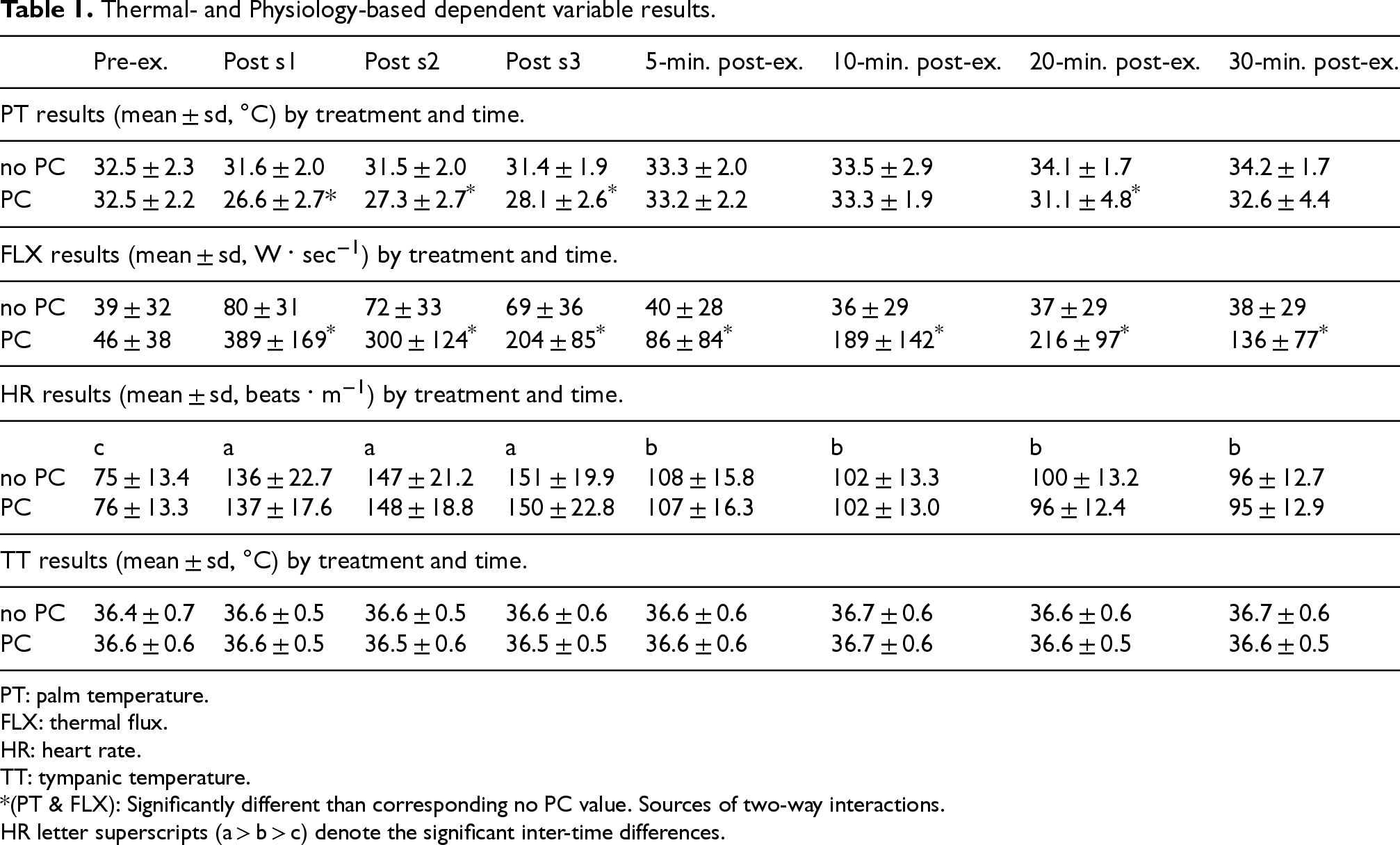
Thermal- and Physiology-based dependent variable results.
Thermal- and Physiology-based dependent variable results.
PT: palm temperature.
FLX: thermal flux.
HR: heart rate.
TT: tympanic temperature.
(PT & FLX): Significantly different than corresponding no PC value. Sources of two-way interactions.
HR letter superscripts (a > b > c) denote the significant inter-time differences.
The primary PT outcome was a significant two-way interaction (partial η2 = 0.32). Pairwise comparisons revealed no PC > PC at post s1-s3 and 20-min post-exercise. PT results also included significant time (pre-exercise, five-, ten-, 20- and 30-min post-exercise > post s1-s3; partial η2 = 0.62) and treatment (no PC > PC; partial η2 = 0.55) main effects. At the four inter-treatment PT times responsible for its significant two-way interaction, no PC values were 15.8% (post s1), 13.3% (post s2), 10.5% (post s3), and 8.8% (20 min post-ex.) warmer than its corresponding PC value. This is not surprising since only the PC treatment entailed 10.6 °C gel pack application.
The primary FLX outcome was a significant two-way interaction (partial η2 = 0.50). Pairwise FLX data comparisons saw PC > no PC at post s1-s3, as well as at five-, ten-, 20-, and 30-min post-exercise. FLX data also had significant time (post s1 > post s2-s3, ten- and 20-min post-exercise > five- and 30-min post-exercise, pre-exercise; partial η2 = 0.63) and treatment (PC > no PC; partial η2 = 0.86) main effects. The seven inter-treatment FLX times responsible for its significant two-way interaction saw PC values removed 386% (post s1), 317% (post s2), 196% (post s3), 115% (5 min post-ex.), 425% (10 min post-ex.), 484% (20 min post-ex.), and 258% (30 min post-ex.) more body heat than its corresponding no PC value. Table 1 illustrates slightly cooler volar hand surfaces create larger temperature gradients between the palm and gel pack allows a far greater magnitude of body heat removal.
HR results include a significant time effect (partial η2 = 0.91). Pairwise comparisons showed the following HR relationships: post s1-s3 > five-, ten-, 20-, 30-min post-exercise > pre-exercise. HR also had a two-way interaction trend, with lower PC values than those for the no PC condition at 20-min post-exercise. TT results included non-significant changes.
Performance-based dependent variables (Table 2)
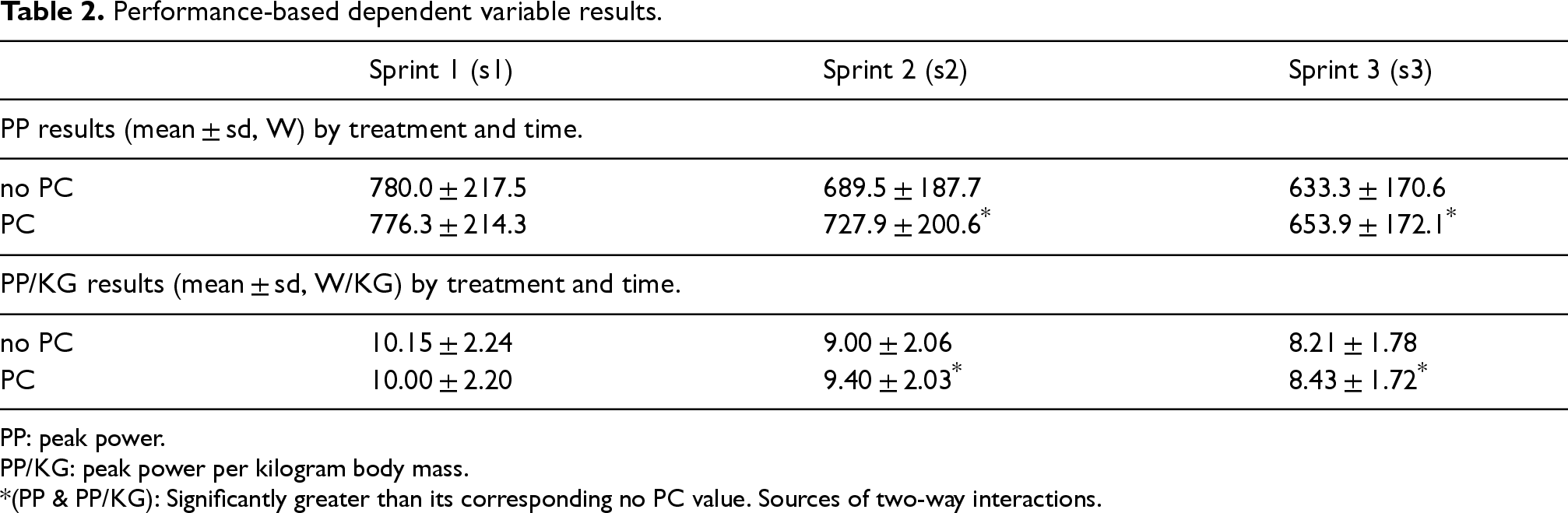
Performance-based dependent variable results.
PP: peak power.
PP/KG: peak power per kilogram body mass.
(PP & PP/KG): Significantly greater than its corresponding no PC value. Sources of two-way interactions.
The primary PP outcome was a significant two-way interaction (partial η2 = 0.081). Pairwise comparisons showed PC > no PC for s2 and s3. Inter-treatment PP differences were 5.6% higher for s2, and 3.3% higher for s3, from the PC workout. PP results also included a significant time (s1 > s3; partial η2 = 0.61) main effect. The primary PP/KG outcome was a significant two-way interaction (partial η2 = 0.07). Like PP, pairwise comparisons of PP/KG data showed PC > no PC for s2 and s3. Inter-treatment PP/KG differences saw 4.4% higher s2 values, and 2.7% greater s3 values from the PC workout. PP/KG analyses also had a significant time (s1 > s2 > s3; partial η2 = 0.60) main effect.
Body heat is among the metabolites that sees its production rise most when going from rest to supramaximal exercise.2,4 Repetitive bursts of supramaximal exercise, which characterize HIIT, require supreme effort and motivation. After an initial burst of activity, subsequent repetitive efforts are compromised by heat-induced fatigue. Early PC research assessed aerobic exercise. 17 Yet more benefits occur at higher intensities that see greater body heat production.2,4,15,18,19 Recent work on exercise-induced heat accrual did not see benefits from PC, perhaps due to their small (n = 10–17) samples.28–31 In fact, any study that demonstrated PC's benefits had a larger sample than the prior studies28–31 or examined subjects particularly susceptible to body heat accrual. 3 The current study's design addressed its purpose, and its results affirm the hypothesis.
Current results imply PC is an impactful ergogenic aid for repetitive bouts of supramaximal activity, as HIIT performance benefits from limited losses in power. Pairwise comparisons showed PP and PP/KG both had ∼3–5% higher s2 and s3 values from PC, implying it becomes a more ergogenic treatment as body heat accrues. This magnitude of power retention is rare across successive 20-s sprints. Greater preservation may only be possible over shorter time frames, as supramaximal activity accrues body heat and fatigue rapidly and makes maintaining power progressively more difficult. PC also had an ergogenic effect with exercise done at high ambient temperatures, as it produced significantly lower TT and faster performance times than workouts without the treatment. 17 With a current two-way FLX interaction that saw greater heat loss from PC, and a trend for lower post-exercise HRs for that same treatment, present results imply PC's ergogenic effects were aided by body heat removal that likely had subjects begin s2 and s3 with less internal body heat than when those same sprints were done for no PC workouts.
Prior high intensity exercise studies also noted PC's ergogenic effects coincided with that treatment's greater heat removal. 15 A repeated measures design assessed PC's (15 °C) impact on three different four-set leg press workouts. 15 Subjects were randomized to a single treatment per workout. Two treatments saw PC applied between sets, while the third was a no PC workout that served as a control condition. The fourth set's average power, and body heat losses, were significantly higher for both PC workouts as compared to the control condition. 15 Like current PP and PP/KG results, more body heat accrued by the fourth set that in turn saw PC have a significant ergogenic effect. Greater heat loss was attributed to exercise-induced CIVD, which occurs when body core temperatures are high and enough norepinephrine binds to the palm's vascular receptors that regulate the volume of blood it receives.2,7,15,25
Rowing is a total-body exercise that places high physiological demands on the body that inevitably elevates heat production. Multi-stage rowing ergometry was used to assess an optimal gel pack temperature for PC workouts. 20 Subjects (n = 20) did three multi-stage rowing workouts, in which gel packs at one of three temperatures (10.6, 12.6, or 14.9° C) were applied intermittently during and after workouts. Despite small variations for distance rowed, many dependent variables had significant inter-temperature differences, whereby 10.6°C had the best thermal and physiological responses. It was concluded 10.6° C 1): removed the most body heat, perhaps by CIVD and, 2): was optimal, as it provided the best physiological responses among the temperatures examined. 20 Skin cooling other body parts, to improve physiological, thermal, and ergogenic outcomes included a cooling headband with data collected before, during, and after rowing workouts. 16 Over three workouts, subjects (n = 28) received one treatment; two of which entailed the headband, while the third was a no cooling control condition. An ANCOVA showed significantly longer distances rowed for headband workouts. The ergogenic effect was attributed to greater heat losses, yet data showed losses did not occur through the head but rather through the palm. 16 Thus, the hand's anatomy and headband study results reinforce that conduction across the palm may be ideal for heat removal.4,8,9,16,18
A two-way FLX interaction, with significantly higher values at several times during the PC workout, likely contributed to that treatment's lower HR trend. Though only a trend, others saw lower HRs from intermittent PC. 19 Rowing ergometry assessed intermittent PC in 34 healthy subjects. 19 Each completed three workouts in which a single treatment (intermittent PC, no PC, intermittent PC during and after exercise) was administered as they did as many rowing stages as possible. Results included significant treatment effects for distance rowed (partial η2 = 0.30) and HR (partial η2 = 0.04). 19 Post hoc analysis showed the intermittent PC workouts led to longer distances rowed. Yet the no PC condition led to significantly higher HRs, with larger inter-treatment differences over the latter stages, as compared to the workout in which intermittent PC was administered. 19 Lower HRs from PC were attributed to vagotonia, higher venous return, and/or central fatigue inhibition.9,32,33 CIVD and higher body temperatures may each contribute to the likelihood of inter-treatment HR differences. 19 Those considering intermittent PC should note the relevance of significantly higher (∼3–5%) s2 and s3 PP and PP/KG values, as compared to the no PC treatment. Coaches and athletes should know, if repetitive bursts of supramaximal effort are required in training or competition, intermittent PC warrants consideration as a legal, cost-effective, and safe ergogenic aid to combat exercise-induced heat accrual. 14
Study limitations include inter-treatment comparisons with data collected from single workouts. Future research should compare PC's chronic effects across diverse populations and multiple workouts to affirm current results. The current study's female subjects did not have their data controlled for menstrual variability, which could possibly impact body temperatures. Finally, though the current study collected quantitative temperature and heat transfer data, perceptions of subject's thermal discomfort were not assessed and warrant inquiry. Yet current results suggest repetitive bursts of supramaximal activity may benefit from intermittent PC.
Footnotes
Acknowledgements
We thank the subjects for their participation. Current study results do not constitute an endorsement of the product by the authors or the journal.
Author contributions
M. Wydotis: Data collection, subject recruitment, manuscript preparation
K. Maguire, S. Stocke, C. McKinney, K. Berns, S. Cavan: Data collection, subject recruitment
P. Quesada: Equipment instrumentation, manuscript preparation
J. Jaggers: Project conceptualization, manuscript preparation
A. Cocco: Statistical Analyses, manuscript preparation
J. Daily: Study Physician
J. Caruso: Project conceptualization, data collection, subject recruitment, manuscript preparation
Ethical considerations & participant consent information
Prior to data collection, this study was approved for human subjects by The University of Louisville's Institutional Review Board (IRB# 23.0068). All subjects gave informed written consent to participate.
Funding
The authors received no financial support for the research, authorship, and/or publication of this article.
Declaration of conflicting interests
The authors declared the following potential conflicts of interest with respect to the research, authorship, and/or publication of this article: In conjunction with The University of Louisville's Office of Technology Transfer, John Caruso holds intellectual property related to the glove used in this study. All other authors report no conflicts of interest with respect to the research, authorship, and/or publication of this article.