Abstract
Dear readers, contributors, editorial board members and the support staff in IOS Press (now part of Sage Publications),
This is a farewell letter which I’d like to open with a short historical background.
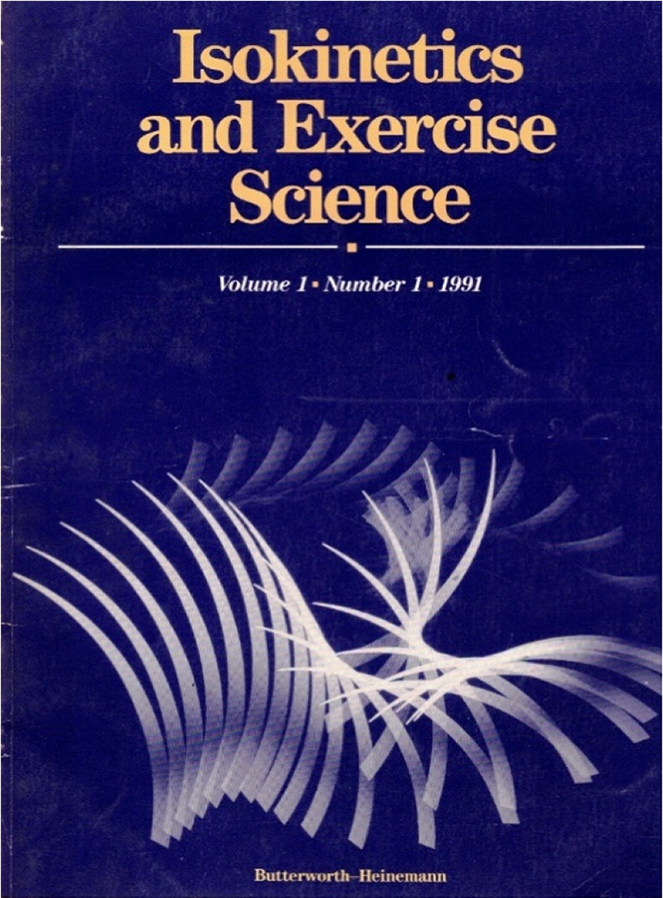
The idea of launching a journal that would focus on the assessment of muscle performance in health and disease using isokinetic dynamometry started to float around 1990. This development was supported by researchers and practitioners in the field, residing predominantly in the US, and in parallel, by a UK initiative to establish the International Society of Clinical Isokinetics, one of whose main objectives was to have such an affiliated journal. This led to the publication of the first issue of Isokinetics and Exercise Science in 1991 (now at its 34th year) by the Publisher Butterworth Heinemann. Admittedly, the reason why was the title expanded to include ‘Exercise Science’ remains elusive but I guess it was due to some misgivings regarding the future and viability of a journal exclusively limited to isokinetics and its applications/aspects.
When the first issue came out, the 3 editors (-in-chief), Davies, Malone and Timm, as well as virtually all editorial board members, were American. This situation was quite understandable at the time. It should be remembered that although the isokinetic principle was first described in the 1950's by a German physiologist, Theodor Hettinger, the beginning of isokinetic dynamometry is attributed to James Perrine, an American engineer, who had patented the controller of the device in 1967. This device enabled an accurate selection of the angular speed at which the test was performed. The first isokinetic device –concentric + isometric only – was called the Cybex 1 and shortly after, the patent was commercialized by the US company Lumex. A few years followed and more developments took place: the addition of the computer as an inetgral part of the device and most importantly, the shift from hydraulic- to electrically-based operation which opened, for the first time, a window to the testing of eccentric contractions. With the highly consistent and phenomenal commercial success of isokinetic dynamometry, apparent already in the 80s’, other companies like Chattecx, Biodex, Lido and BTE joined the exclusive club of manufacturers. Yet, at that decade, all were still American. Add to this situation the fact that along gait analysis systems, the isokinetic dynamometer was arguably the most expensive single device in the rehabilitation arsenal and in sports science, the inevitable result was that research using isokinetics remained a predominantly US discipline.
However, this technology gradually gained a solid foothold in other countries and reflecting this development, once the pioneering editors announced they were stepping down (1995), the publisher offered this post jointly to Mr Angus Strover MBChB, a renowned UK knee surgeon and arguably the first specialist in the UK to integrate an isokinetic dynamometer in the testing and rehabilitation of patients following various knee operations, and myself. When we were appointed, Mr Strover was responsible for submissions arriving largely from Europe while I took care of N. and L. American papers. This arrangement lasted a few years when Mr Strover decided to retire from this position due to extreme workload, leaving me as the sole E-i-C, until 31.12.2025. Of note, the journal ownership changed hands; B-H became an imprint of Elsevier whose name appeared on the front cover of the journal for a very short period but since Vol 6(3) it was IOS Press from Amsterdam that took over its publishing until 2024. Beginning this last year, the journal is published by Sage, a leading US publisher.
In many respects, editing the journal became an integral part of my life. It did not allow for time off as papers kept arriving at a rate of 2–3/week for the duration of my tenure. And given the number of submissions/year that meant browsing through all papers, which gave me a first hand impression of why the authors thought IES was the proper address and in particular, what was in the paper that deserved publication. Typically, the ratio of accepted papers/submitted papers stood at 1/3.5 which, for a very niche type journal and specific audience, was reasonable.
As the years went by, one could see the shift in the geographical distribution of the ‘contributing countries’, in particular a relative decline in papers coming from the USA and Canada, against a significant surge in those originating from the far east: Korea, Japan and China. Sadly, save Poland, little came from eastern European countries or from Scandinavia. On the other hand, Brazil and Turkie maintained their presence, reflecting in particular the great interest in fitness science in these countries. Equally, the balance in papers between ‘Isokinetics” and “Exercise Science” shifted gradually and consistently towards the latter; that said, in ‘ES’, the isokinetic component played a significant role. Today, isokineic dynamometery is regarded unanimously as the gold standard in muscle stregth testing paving the way to its wide spread use in the clinical domains as well as in sports science.
Successful running of a journal is absolutely dependent on the editorial board. In that respect I was very lucky in being part of an exclusive team of experts. Reviewers work on a voluntary basis. Else than the credit they receive for being recognized in their respective fields, there is basically no finacial or other compensation for the many hours they regularly invest in keeping the jounal alive and of a significant impact. Moreover, from a predominantly male board, the ratio of women scientists in the board has systematically increased to include quite a variety of professions and nationalities. Hopefully this trend will persevere. I take this opportunity to thank, from the bottom of my heart, all members of the editorial board, past and present, for their unflinching loyalty and support alongside exemplary contributions to the journal.
In the same vein, the managing editors of the journals with whom I worked for 30 years, Mrs. Marion Lilley for the most part and Mrs. Gabriela Ricci in recent years, did a fantastic job in steering the boat together with me. For their outstanding effort and the way they conducted the business of the journal, I am extraordinarily obliged.
Finally, it is my pleasure and privilege to welcome the new Editor-in-Chief, Prof. Andrea Manca, and greet him with the best of wishes. I have known Andrea for more than a decade, as an independent researcher and an editorial board member. His contribution to the isokinetic literature, expressed by excellent papers in IES as well as in other journals, and his help in reviewing scores of papers, sometimes at a moment notice, played a decisive role in Sage's decision to offer him this post. I am totally confident regarding Prof. Manca's full success in this new endeavor while hoping he will receive the same standard of support and good will I did, from all members of the editorial board, present and future.
In my private library I keep all issues of the journal including the very first. It is 35y old, a bit yellowing and just a bit crumpled, adorned with a printing format that was typical in those years. But it is very dear to me and I thought it would be so nice to seal this farewell letter with its front cover.
Zeevi Dvir, zdvir@tauex.tau.ac.il
Tel Aviv
January 2026