






Abstract
This study examines the influence of patriarchal ideology on women's beliefs about wife beating. A convenience sample of 701 married Palestinian women from Israel was obtained, and a self-report questionnaire was administered. The findings revealed that large percentages of Palestinian women expressed some tendency to justify wife beating in certain instances. In addition, some of the participants expressed some tendency to blame battered women for violence against them, and to believe that they benefit from beating. As hypothesized, endorsing patriarchal ideology was found to influence all three beliefs about wife beating held by Palestinian women in Israel, over and above the amount of variance in the women’s socio-demographic characteristics (e.g. age, education, employment, place of residence, and religion). The limitations of the study as well as the implications of the results for future research are discussed.
Keywords
Introduction
Wife beating and violence against women is a social phenomenon that can be found in various societies and cultures throughout the world (Rose, 2013). Public attitudes toward wife beating, however, vary considerably across different cultures and nations (Li, Wu, & Sun, 2013; Nayak, Byrne, Martin, & Abraham, 2003). The existing empirical literature on attitudes about wife beating in both Arab (e.g. Jordan, Palestine) and non-Arab patriarchal societies (e.g. Nepal, India, Bangladesh, Turkey, Zambia, Uganda) indicates that there is generally a higher level of justification for violence against women than in Western societies, and a stronger tendency to blame women for violence against them rather than blame the violent men (see Boy & Kulczycki, 2008; Rani & Bonu, 2009; Waltermaurer, 2012). For example, in a study that sought to assess women’s perceptions of wife beating in Bangladesh (a patriarchal non-Arab country), 62% and 41% of the respondents justified violence against women in cases where the woman fails to meet her husband’s expectations or obey him, and when the woman refuses to have sex with her husband, respectively (Sayem, Begum, & Moneesha, 2012). In contrast, in a large-scale study conducted among adults in the United States, Simon et al. (2001) found that only 5.8% of the women agreed that “it’s OK for a man to hit his wife or girlfriend if she hits him first,” and only 0.8% agreed that “it’s OK to beat a woman, to discipline her, or to keep her in line.”
Scholars who study violence against women in Arab societies maintain that endorsement of patriarchal beliefs is particularly conducive to permissive attitudes toward wife beating (e.g. Dhaher, Mikolajczyk, Maxwell, & Krämer, 2010; Haj-Yahia, 1998a, 1998b, 2002a, 2005). Moreover, studies on beliefs about wife beating among members of patriarchal communities living in Western societies have also shown that they are more likely to hold patriarchal and negative views toward women (see Flood & Pease, 2009), and similarly tend to justify wife beating (e.g. Abu-Ras, 2007; Ahmad, Riza, Barata, & Stewart, 2004; Kulwicki & Miller, 1999).
The Palestinian society in Israel is no exception. In a study conducted in Israeli society, it was found that both men and women accepted the use of violence against women under certain circumstances, such as adultery and other situations where a wife was believed to have disrespected her husband (Eisikovits, Winstok, & Fishman, 2004). However, a higher level of legitimacy and tolerance for such violence was found among Palestinians in Israel (Haj-Yahia, 2000, 2003) compared with their Jewish counterparts (Eisikovits et al., 2004; Herzog, 2004). In fact, studies that examined attitudes of married Palestinian men from Israel (Haj-Yahia, 2003) and the Palestinian territories (Haj-Yahia, 1998a) revealed that these men had a strong tendency to justify wife beating and to blame women for their husbands' violence. The findings also revealed that married men’s justifications for violence and their victim-blaming attitudes correlated positively with men’s patriarchal orientation toward gender roles and nonegalitarian expectations of marriage and family. Interestingly, studies conducted among women in Arab countries (e.g. Jordan and the Palestinian Territories) have yielded similar results as those using male samples (see Haj-Yahia, 1998a, 1998b, 2002a, 2005).
Examining women’s beliefs about wife beating is imperative to understanding the nature and scope of such social phenomena in any given society. In particular, growing empirical evidence highlights the significant correlation between women's beliefs about wife beating and their attitudes toward coping with violence against them (e.g. Abu-Ras, 2007; Haj-Yahia, 2002b), as well as other help-seeking behaviors and strategies they use to cope with such violence (e.g. Haj-Yahia, 2000). Hence, research on this topic may provide mental health practitioners in patriarchal societies with appropriate knowledge that can be utilized for developing suitable interventions in cases of wife beating.
Literature review
Theoretical and conceptual framework: Patriarchy and the male dominance perspective
The concept of patriarchy is deeply rooted in feminist writing, and is widely used by scholars to elucidate gender inequality, oppression, and hierarchal social arrangements. In hierarchal social systems, men are routinely placed in higher, more privileged positions than women in social institutions and in society as a whole. Accordingly, men become dominant in both the private and public spheres (i.e. family and society) whereas women play a secondary role. From a feminist perspective, violence against women within the family is a product of gendered social arrangements and unequal power structures (Dobash & Dobash, 1979; Yllö, 1993).
Two main elements can be identified in the feminist literature when considering the concept of patriarchy: structure and ideology (Dobash & Dobash, 1979; Hunnicutt, 2009; Millett, 1970; Smith, 1990; Sultana, 2012). Patriarchal structure refers to a gendered and hierarchal social system in which adult men hold authority and power over both women and children (Yllö, 1993). As a result, different levels of power and prestige are attributed to both genders: men are idealized as being highly privileged and enjoy a dominant status within society, whereas women are less privileged and subordinated to male authority and control (Sultana, 2012; Yllö, 1993). In contrast, patriarchal ideology refers to the norms, values, attitudes, and beliefs that justify the existence of the patriarchal social structure. These cultural values and norms, which portray women as passive, weak, and submissive, are ultimately held as social facts which constrain members of society to these social norms (Yllö, 1993).
In Palestinian communities, a patriarchal power structure is acutely reflected in spousal relationships, where women have historically been considered inferior to men (Haj-Yahia, 2000, 2003; Hassan, 2005). In marriage, for example, women are expected to be obedient, well-behaved, and financially dependent on their husbands. Moreover, women are expected to prioritize, first and foremost, the fulfillment of their obligations as mothers and wives (Sultana, 2012). Failure to comply with these traditional gender and spousal roles is perceived as a reflection of a woman’s inability to manage the well-being of her own family, and is thus regarded as socially unacceptable and deserving of punishment by the husband. Within this context, studies have shown that the belief that men have the right to use violence against their wives is deeply rooted in patriarchal norms that hold men responsible for controlling women’s behavior and misconduct (Haj-Yahia, 2003; Shalhoub-Kevorkian, 1997). For example, Haj-Yahia (1998a, 1998b, 2003) found that negative attitudes toward women, rigid sex-roles stereotypes, sexual conservatism (SEC), and traditional familial patriarchal beliefs (FPB) and expectations correlated significantly with justifying wife beating and with blaming battered women for violence used against them.
Women’s attitudes toward wife beating in patriarchal societies
Focusing specifically on patriarchal Arab societies, a small but growing number of studies examining beliefs about wife beating have revealed a high rate of justification for violence against wives, especially among Arab women (see Dhaher et al., 2010; Haj-Yahia, 2002a; Linos, Khawaja, & Kaplan, 2012). For example, in a study that examined the effect of patriarchal ideology on Palestinian women’s beliefs about wife beating, Haj-Yahia (1998b) found that women from Gaza and the West Bank had a strong tendency to justify wife beating under certain circumstances such as when women were perceived as being unfaithful to their husband (69%), challenging their husband’s manhood (42%), or insulting their husband in front of his friends (40%). In a subsequent study, Haj-Yahia (2002a) found similar justifications for wife beating among Jordanian women. In both contexts, beliefs about wife beating correlated significantly with women’s patriarchal ideology – specifically with their rigid gender role stereotypes, negative attitudes toward women, and nonegalitarian expectations of marriage and family (Haj-Yahia, 1998b, 2002a).
Existing studies on attitudes toward violence against women have also reported that higher levels of public acceptance of such violence are associated with victim blaming attitudes (see Gracia & Tomás, 2014). Further, the connection between violence against women and victim blaming enjoys particularly strong empirical support in patriarchal settings such as Arab countries, where there is generally a strong tendency to blame battered women for marital violence. For example, Haj-Yahia (2002a) found that roughly half of the Jordanian women in his sample did not perceive violent husbands as being responsible for their behavior, and instead they blamed women for the violence that was used against them.
In addition to the role of gender ideology, many scholars point to the importance of considering sociodemographic factors (e.g. age, education, employment, religion, place of residence) when examining attitudes toward violence against women (see Flood & Pease, 2009; Waltermaurer, 2012). Studies in Arab societies, for instance, have revealed that those who reported lower levels of educational attainment were found to be more likely to justify wife beating than their more educated counterparts (Dhaher et al., 2010; Haj-Yahia, 2002a). In a related vein, place of residence appears to be another factor shaping individuals’ attitudes toward violence against women in Arab societies (Dhaher et al., 2010; Haj-Yahia, 2002a; Linos et al., 2012). For instance, Haj-Yahia (2002a) found that women who live in rural areas were more likely to believe that women benefit from the violence against them when compared with those living in urban areas. Given these findings, the framework of intersectionality may be useful for considering how women’s unique social positions (e.g. education, employment, place of residence) might intersect with gender and race (or in this case, ethnicity) to shape women’s attitudes about wife abuse (Crenshaw, 1991). Thus, based on the available literature it appears that not only do broader, societal level contexts affect attitudes toward wife beating, but more individualized factors are also implicated, underscoring the importance of integrating both dimensions in subsequent work surrounding attitudes toward wife beating.
The present study
Despite the growing scholarly attention and advocacy efforts surrounding the problem of wife abuse in patriarchal Arab and non-Arab societies in recent years, there is still a dearth of research dealing with women’s attitudes toward the problem, especially among the Palestinian minority in Israel. Moreover, the vast majority of studies on beliefs about wife beating among the Palestinian minority in Israel have focused almost exclusively on men’s attitudes and perceptions (e.g. Haj-Yahia, 1997, 2003). To date, almost no comprehensive studies have been conducted among Palestinian women in Israel to assess their beliefs about wife beating. The present study is an attempt to fill this critical gap in the extant literature.
Against this background, we aim to address the following research question: Will the endorsement of patriarchal ideology predict beliefs about wife beating held by Palestinian women from Israel above and beyond their sociodemographic characteristics (e.g. age, education, employment, place of residence, religion)? On a theoretical level, the current study aims to examine the contribution of a specific theoretical approach (i.e. patriarchal perspective) to explaining beliefs about wife beating among Palestinian women in Israel. Based on the theoretical and conceptual framework of the patriarchal perspective, and in accordance with our earlier definition of patriarchal ideology (e.g. Dobash & Dobash, 1979; Yllö, 1993), the following six variables were derived, and constituted the predictor variables in this study: attitudes toward women, SEC, religiosity, marriage role expectations, gender-role stereotypes, and FPB. The following three beliefs about wife beating constituted the outcome variables in this study: justifying wife beating, blaming wives for their beating, and wives benefit from beating. We hypothesize that women’s patriarchal ideology will significantly influence the endorsement of all three beliefs about wife beating over and above the influence of the women’s sociodemographic characteristics on these beliefs.
Method
Sample and procedure
The study was conducted among a convenience sample of 701 (N = 701) married and literate Palestinian women from Israel, using a self-administered questionnaire. The initial sample (N = 606) was obtained in 2000, from different parts of Israel (mainly the central and southern regions). Specifically, this sample included mostly Muslim and Christian women from Arab cities and villages in Israel. This sample did not include Christian and Druze women from northern Israel. Therefore, to overcome this limitation of the initial sample and in an attempt to obtain a more representative sample that reflected the geographic characteristics of the Palestinian population in Israel, a second sample (N = 95) of Druze and Christian women was obtained in 2008. The geography of the whole sample included women from two Arab cities, two Arab villages, and one mixed city (Arab and Jewish) from northern Israel. Consequently, both samples were combined in the same database and included a total of 701 participants.
The women who participated in this study were identified and approached (when their husbands were not present) in various locations, including: public organizations and institutions such as community centers, schools, universities, and various social and family events. First, they were asked if they were married and literate. Women whose responses on both dimensions were positive were asked if they would like to participate in the study. Overall, the response rate for both data collection periods was high (89% in the first period, and 87% in the second period). None of the women withdrew from the study after they began participating. Because of the sensitive nature of the phenomenon investigated among this population, surveys were administered at times and places where potential participants would not be disrupted or fearful that their husbands would be cognizant of their activities.
Participants were informed about the objective of the study, and were told that it focused on family life and marital relationships, and that they could withdraw from participating in the study at any time if they felt uncomfortable about answering the questions. They were also reassured about confidentiality, and verbal consent was given. The questionnaires were administered in Arabic, no incentives were offered, and there was no compensation for participating in the study. The average time for completing the questionnaire was 20 minutes. The study was approved by the Ethics Committee at the Hebrew University of Jerusalem.
Participants
All participants were married, and their ages ranged from 17 to 62 years (M = 35.23, SD = 8.48). Two-thirds of the sample (68%) lived in Arab villages in Israel, and the rest lived in Arab and mixed cities (26% and 6%, respectively). With respect to religion, 35% of the participants were Muslim, 33% were Christian, and 32% were Druze. With regard to education, 7.1% of the participants had graduated from elementary school; 14.2% had graduated from middle school; 38.1% had graduated from or partially completed high school; 15.6% had some post-secondary education but did not hold a degree; and 25% held an academic degree. In terms of employment, 39.5% of the participants had a full time job; 16% had a part time job; 3.8% were unemployed; 35.7% were housewives; and 5% had a temporary job. Finally, the average length of marriage was 13.4 years (SD = 8.76, range = 1–43), and the average number of children was 3.31 (SD = 2.04, range = 0–12 children).
Measures
Descriptive statistics, number of items, range of responses, and values of Cronbach’s alpha for the measures, as utilized in the study (N = 701).
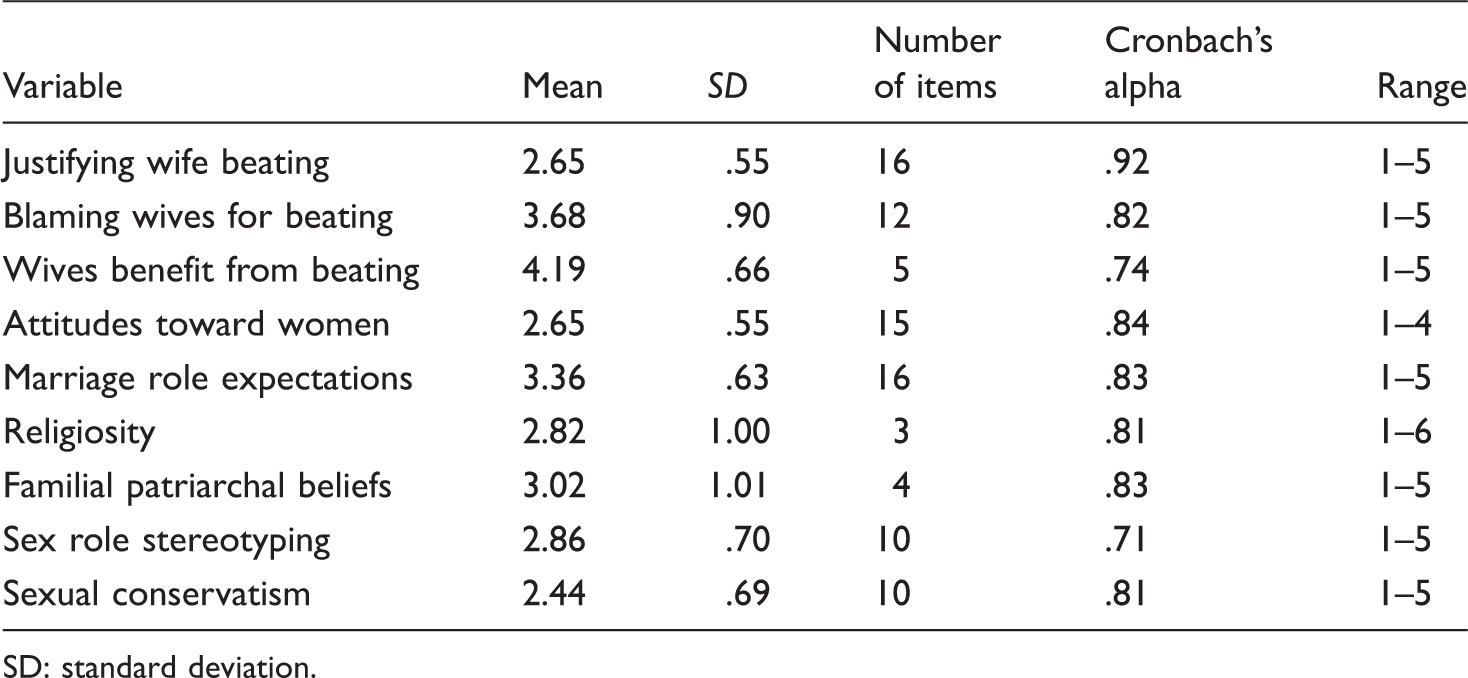
SD: standard deviation.
Beliefs about wife beating
Two beliefs from Inventory of Beliefs about Wife Beating (IBWB, Saunders, Lynch, Grayson, & Linz's, 1987) were examined (Justifying Wife Beating (JWB) and Wives Benefit from Beating (WBB)), in conjunction with Haj-Yahia’s (1998a, 1998b, 2003) Blaming Wives for their Beating (BWB) scale. These three beliefs about wife beating served as the main outcome variables for this study. They were measured on a 5-point Likert-type scale, ranging from 1 (strongly agree) to 5 (strongly disagree).
Attitudes Toward Women Scale (ATWS)
A short and revised version of Spence and Helmreich’s (1978) ATWS (Cronbach’s alpha was .89) was used to measure traditional and negative attitudes toward women (e.g. “women should not have the same freedom as men to go to the same places or participate in unlimited activities”), based on a 4-point Likert-type scale ranging from 1 (strongly agree) to 4 (strongly disagree).
Marriage Role Expectation Inventory (MREI)
A short and revised version of Dunn and DeBonis’ (1979) MREI was utilized to measure marital role expectations among participants (e.g. “The husband’s duty is to help his wife with housework”). Responses to these items were based on a 5-point Likert scale ranging from 1 (strongly agree) to 5 (strongly disagree). Dunn and Debonis (1979) reported a Spearman–Brown reliability coefficient of .97 for the measure after conducting a split-half correlation analysis.
Religiosity
A three-item scale constructed by Haj-Yahia (1998a) was used to measure the level of religiosity among Palestinian women in Israel (e.g. “to what extent do you practice and adhere to the laws and customs of your religion?”). A 6-point Likert-type scale ranging from 1 (not at all) to 6 (to a great extent) was used (for more information about validating this measure, see Haj-Yahia, 1998a).
FPB
Smith’s (1990) FPB instrument (Cronbach’s alpha was .79) was used to measure FPB among Palestinian women from Israel (e.g. “husbands have the right to decide whether or not their wives will work outside the home”). A 5-point Likert scale was used ranging from 1 (strongly agree) to 5 (strongly disagree).
Sex-role stereotyping (SRS)
Burt’s (1980) SRS scale (Cronbach’s alpha was .80) was used to measure the extent to which participants stereotype others based on their ingrained beliefs about gender roles (e.g. “it is acceptable for a woman to have a career, but marriage and family should come first”). A 5-point Likert scale ranging from 1 (strongly agree) to 5 (strongly disagree) was used.
SEC
Burt’s (1980) SEC scale (Cronbach’s alpha of .81) was used to measure participants' beliefs related to SEC (e.g. “I have no respect for a woman who engages in sexual relations before marriage”). A 5-point Likert scale ranging from 1 (strongly agree) to 5 (strongly disagree) was used.
Sociodemographic variables
Participants were asked about their age, religion, level of education, place of residence, employment status, years of marriage, and number of children.
Statistical analysis
Zero-order correlations among predictor and outcome variables (N = 701).
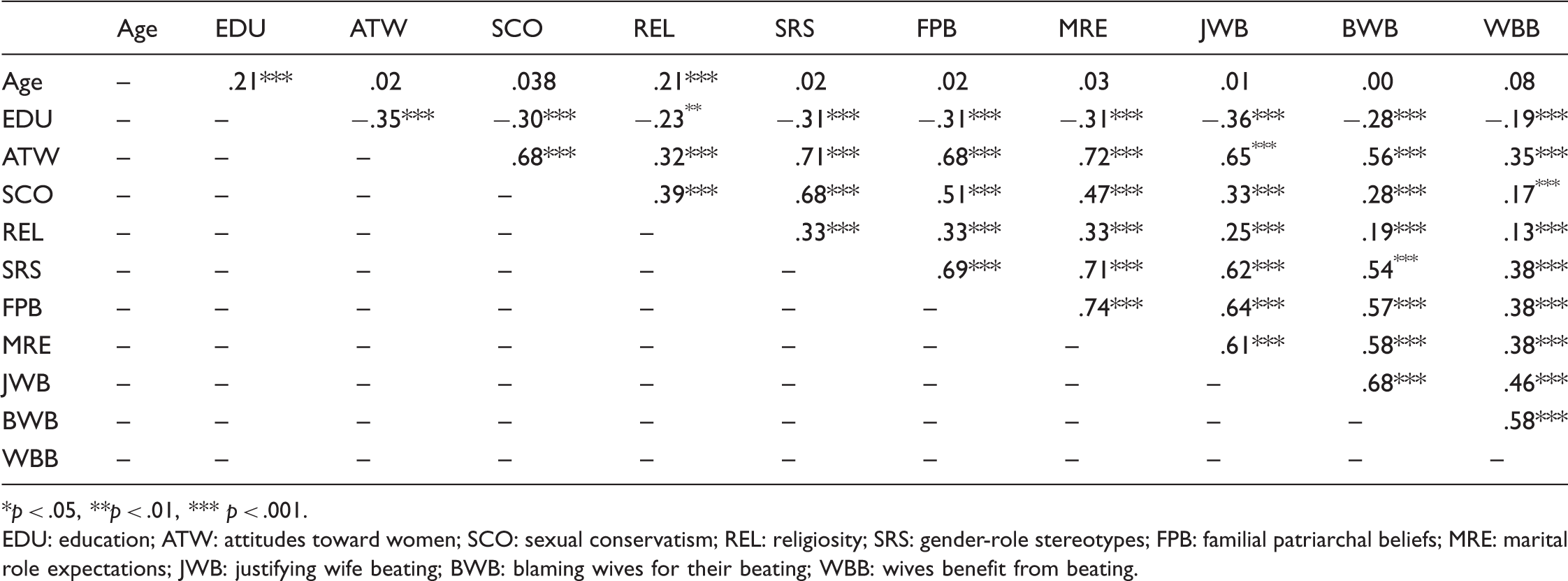
p < .05, **p < .01, *** p < .001.
EDU: education; ATW: attitudes toward women; SCO: sexual conservatism; REL: religiosity; SRS: gender-role stereotypes; FPB: familial patriarchal beliefs; MRE: marital role expectations; JWB: justifying wife beating; BWB: blaming wives for their beating; WBB: wives benefit from beating.
Hierarchical regression and multiple regression analyses for predicting justifying wife beating, blaming wives for beating, and wives benefit from beating (N = 701).
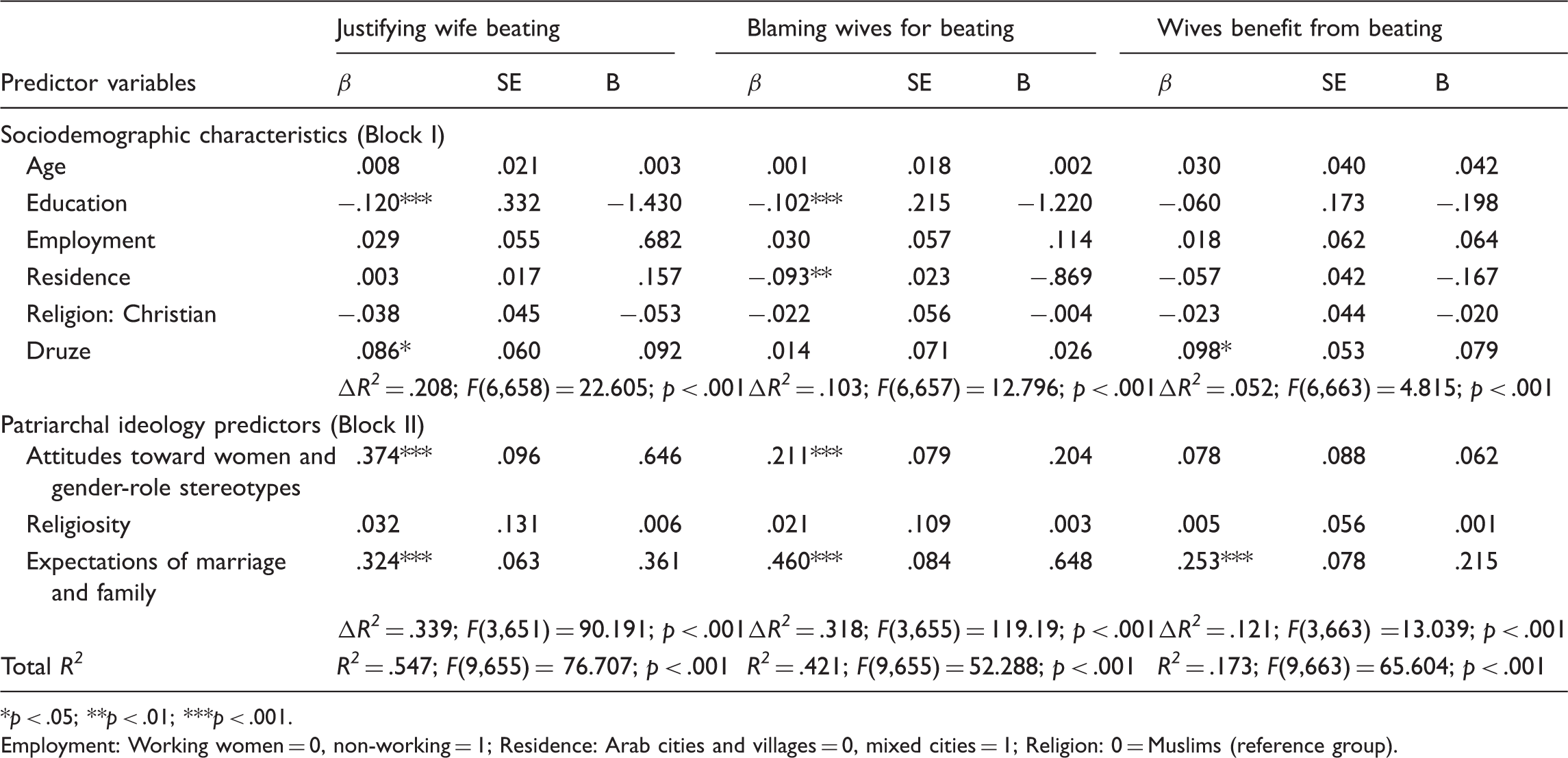
p < .05; **p < .01; ***p < .001.
Employment: Working women = 0, non-working = 1; Residence: Arab cities and villages = 0, mixed cities = 1; Religion: 0 = Muslims (reference group).
In the final step, hierarchical regression and multiple regression analyses were conducted to test the study’s central hypothesis, which seeks to determine whether patriarchal ideology can predict beliefs about wife beating held by Palestinian women in Israel, over and above the predictability of these beliefs by their sociodemographic characteristics. These analyses allowed us to determine the order in which variables were entered on the basis of their theoretical importance. In so doing, each block contains variables that are theoretically or conceptually linked. Thus, two blocks were formed for the present analyses. The first included the sociodemographic characteristics (i.e. age, place of residence, education, employment, and religion); and the second included the study’s main predictor variables (i.e. attitudes toward women and gender-role stereotypes, religiosity, and marital and familial expectations). By entering the variables into the models in this order, we can measure the extent to which the variance in each of the beliefs about wife beating is attributable to the main predictor variables in the study (i.e. the second block), over and above the variance explained by the sociodemographic characteristics (i.e. the first block; see Table 3).
Results
Justifying wife beating
The results indicate that a notable percentage of the participants tend to justify violence against women under certain circumstances. Although 71% of the participants either agreed or strongly agreed that “there is no excuse for a man to beat his wife” (M = 2.16, SD = 1.33), 43% still either agreed or strongly agreed that women deserve to be beaten if they are “sexually unfaithful” to their husbands (M = 3.18, SD = 1.67). In addition, 33% and 32% of the participants strongly agreed or agreed that a wife deserves to be beaten “if she challenges her husband’s manhood” (M = 3.42, SD = 1.30), and “if she insults her husband in front of his friends” (M = 3.37, SD = 1.39), respectively.
Correlation analysis revealed that each of the main six predictors correlated positively and significantly with the participants' tendency to justify wife beating. For example, the more participants held negative attitudes toward women, the more nonegalitarian and patriarchal their expectations of marriage, and the higher their level of religiosity, then the greater their tendency to justify wife beating (r = .65, p < .001; r = .61, p < .001; and r = .25, p < .001, respectively). To cite another example, the more the participants held rigid gender-role stereotypes, the greater their tendency was to justify wife beating (r = .62, p < .001, see Table 2).
The results of the hierarchal regression and multiple regression analyses, presented in Table 3, indicate that about 21% (ΔR2=.208; F(6, 658) = 22.605, p < .001) of the variance in participants' tendency to justify wife beating could be attributed to their sociodemographic characteristics (i.e. Block 1 of predictors), where their level of education and religion were the most significant characteristics in explaining this belief. Specifically, it was found that the lower the women’s level of education (β = −.120, p < .001), the greater their tendency to justify wife beating, and Druze women showed a greater tendency to justify wife beating than did their Muslim and Christian counterparts (β = .086, p < .05). However, no significant differences were found between Muslim and Christian women with regard to justifying wife beating (see Table 3).
The results of these analyses also indicate that the patriarchal ideology predictors (i.e. Block 2) explained about 34% (ΔR2 = .339; F(3,651) = 90.191, p < .001) of the variance in participants' tendency to justify wife beating, over and above the variance that could be attributed to their sociodemographic characteristics. More specifically, it was found that participants' negative and traditional attitudes toward women and gender-role stereotypes (β = .374, p < .001), and their patriarchal expectations of marriage and family (β = .324, p < .001) were the most significant predictors of their tendency to justify wife beating (see Table 3). In sum, the findings revealed that about 55% (R2 = .547) of the variance in Palestinian women’s tendency to justify wife beating could be attributed to both blocks of predictors: F(9,655) = 76.707, p < .001 (see Table 3).
Blaming wives for beating
The results indicate that participants showed a certain tendency to blame wives for violence against them. For instance, 51% and 42% of the participants agreed or strongly agreed with the statement that “if the wife knew her boundaries, the husband would most definitely not beat her” (M = 2.92, SD = 1.44), and with the statement that “if a husband beats his wife, it is mostly due to her mistaken behavior” (M = 3.10, SD = 1.15), respectively.
The results in Table 2 indicate that the more the participants held traditional attitudes toward women, the more rigid their gender-role stereotypes, the greater their SEC, and the more nonegalitarian their expectations of marriage, then the greater their tendency was to blame wives for violence against them (r = .56, p < .001; r = .54, p < .001; r = .28, p < .001; and r = .58, p < .001, respectively; see Table 2). The results in Table 3 revealed that about 10% (ΔR2 = .103, F(6,657) = 12.796, p < .001) of the variance in the participants' tendency to blame wives for violence against them could be attributed to their sociodemographic characteristics. Nonetheless, only the women's place of residence and level of education were found to be significant in predicting their tendency to blame wives for being beaten. Hence, women with lower levels of education (β = −.102, p < .001) and those who resided in Arab localities such as villages and cities (β = −.93, p < .01) showed a greater tendency to blame battered wives for violence against them compared with their counterparts living in mixed cities and those with higher levels of education (see Table 3).
Regarding the main predictors of the study, i.e. patriarchal ideology predictors (i.e. Block 2), the results of hierarchal regression and multiple regression analyses indicate that these predictors contributed to explaining about 32% (ΔR2 = .318) of the variance in the participants' tendency to blame battered women for violence against them, over and above the variance explained by their sociodemographic characteristics (i.e. 10.3%, see Table 3). More specifically, the findings revealed that the more the Palestinian women maintained traditional attitudes toward women and gender-role stereotypes (β = .211, p < .001), and the more nonegalitarian and patriarchal their expectations of marriage and family (β = .460, p < .001), then the greater their tendency was to blame women for violence against them (see Table 3). In sum, about 42% (R2 = .421) of the variance in Palestinian women’s tendency to blame battered women for violence against them can be attributed to both blocks of predictors: F(9,655) = 52.288, p < .001 (see Table 3).
Wives benefit from beating
Although 93% of the respondents either agreed or strongly agreed with the statement that “women feel pain and no pleasure when they are beaten up by their husbands” (M = 1.44, SD = .84), 21% and 17%, respectively, believed that “sometimes wives intentionally provoke their husbands to make them angry and get beaten” and that “wives try to get their husbands to beat them in order to get sympathy from others” (M = 3.74, SD = 1.19; and M = 4.08, SD = .99, respectively).
The results of correlation analysis indicate that the less the participants held negative attitudes toward women, the less they held rigid gender-role stereotypes, the less they maintained non-egalitarian expectations of marriage, and the less they held FPB, then the weaker their tendency was to believe that wives benefit from beating (r = .35, p < .001; r = .38, p < .001; r = .38, p < .001; and r = .38, p < .001, respectively). Furthermore, the higher the respondents’ level of religiosity and the greater their SEC, then the greater their tendency was to believe that women benefit from violence (r = .13, p < .001; and r = .17, p < .001, respectively; see Table 2).
The results of hierarchal regression and multiple regression analyses revealed that the participants' patriarchal ideology explained about 12% (ΔR2 = .121) of the variance in their belief that women benefit from beating, and about 5% (ΔR2 = .052) of the variance in this belief could be attributed to their sociodemographic characteristics. More specifically, the results revealed that of all the patriarchal ideology predictors examined in this study, the participants' patriarchal and non-egalitarian expectations of marriage and family was the most significant predictor that contributed to explaining the belief that women benefit from beating (β = .235, p < .001). In addition, Druze women showed a greater tendency than their Muslim and Christian counterparts to believe that women benefit from beating (β = .098, p < .05). However, no significant differences were found between Muslim and Christian women with regard to their belief that women benefit from beating (see Table 3). In sum, about 17% (ΔR2 = .173) of the variance in Palestinian women’s tendency to believe that women benefit from beating can be attributed to both blocks of predictors: F(9,663) = 65.604, p < .001 (see Table 3).
Discussion
The results of this study underline the importance of examining beliefs about wife beating in Arab Palestinian society in Israel, especially from the women’s point of view. Generally, the results lend empirical support to the notion that patriarchal ideology has a significant influence on the way Palestinian women perceive wife abuse. Specifically, we found that those who hold non-traditional and positive attitudes toward women and egalitarian expectations of marriage and family are more likely to condemn wife beating, hold men responsible for violence against women, and to perceive beating as harmful to women. These findings are in line with previous arguments made by proponents of the patriarchal perspective (e.g. Dobash & Dobash 1979; Haj-Yahia, 1998a, 1998b, 2002a, 2003; Sakalli, 2001; Smith, 1990; Yllö, 1993). In particular, these results support the findings of previous studies conducted among women from Arab countries in the Middle East (e.g. Btoush & Haj-Yahia, 2008; Dhaher et al., 2010; Haj-Yahia, 1998b, 2002a), and even Arab women from the United States (see Abu-Ras, 2007). Permissive attitudes toward spousal abuse were also found among men and women in Western societies such as Canada (Smith, 1990), the United States (Simon et al., 2001), and various countries in Western Europe (see European Commission, 2010; Gracia & Tomás, 2014). However, the magnitude and level of justification for violence against wives and victim-blaming attitudes found in this study is relatively higher than that found in Western societies. Overall, our study is unique in providing a more nuanced understanding of women’s perceptions of wife abuse in patriarchal settings.
The findings indicate that the participants tended to justify wife beating under specific circumstances, with the woman’s sexual infidelity as the most prominent justification. Justifying wife beating for ‘sexual misconduct’ is prevalent in Arab societies (Haj-Yahia, 1998a, 1998b, 2002a, 2003). Accordingly, it is perceived as a provocative act that constitutes a serious violation of a woman’s modesty, reputation and, perhaps most importantly, the reputation of her family (Haj-Yahia, 2000). Sexual behavior that is perceived as provocative is considered a challenge to the husbands’ masculinity, authority, and status – both as the head of the family and as a husband – and is therefore seen as undermining his control and manhood. Hence, it is not surprising that a significant minority tended to justify wife beating when the wife was perceived to be “challenging her husband’s manhood,” “insulting her husband in front of his friends,” and “constantly reminding her husband of his weaknesses.”
The findings also reveal that roughly half of the participants blamed wives for their beating. These findings reflect some prevailing beliefs concerning women’s “contribution” to the violence that is directed against them. In the context of Arab societies, blaming battered women for violence against them is associated with people's perceptions that these women have violated their ascribed gender roles, mainly as wives and mothers. These roles are based on a strict and clear code of conduct, along with expectations that should be met (Uthman, Lawoko, & Moradi, 2009). Accordingly, any perceived deviation from their roles as obedient wives or caring mothers is perceived as trespassing gendered boundaries and expectations. The lack of compliance with these roles can be perceived by the husband and by society as a threat to the stability of the household, thereby justifying a violent response. Based on these underlying sentiments, it is not surprising that over one-third of the participants strongly agreed or agreed that women are to blame for violence against them when they are perceived as “squandering money or neglecting the house and children.”
The findings also revealed that respondents expressed some level of agreement with the belief that women benefit from beating. Specifically, about one-fifth of the Palestinian women expressed some level of agreement that “Sometimes wives intentionally provoke their husbands to make them angry and get beaten” and that “wives try to get their husbands to beat them in order to get sympathy from others.” These beliefs reinforce the prevailing patriarchal belief that portrays women as naturally irritating, weak, and vicious creatures (Moghadam, 1992). This finding is consistent with that of Jordanian women (Haj-Yahia, 2002a) and of Palestinian women from the West Bank and Gaza Strip (Haj-Yahia, 1998b).
Nonetheless, a closer examination of the results indicates a high variation in women’s beliefs about wife beating. For example, while a substantial percentage of women in the sample expressed support for justifying wife beating and blaming women for their beating under certain circumstances, still, on the whole, a slightly larger percentage of women rejected such support. Even further analysis of the results points to the existence of latent ambivalence that can be detected in women’s responses, illustrating the complexity and contradictions concerning this issue among Palestinian women. For example, even though a substantial percentage of women justified violence against wives in certain circumstances, the majority of them still believed that “there is no excuse for a man to beat his wife.” Such dissonance in responses might be attributed to the changing social and political standing of the Palestinian minority in Israel along with the exposure of Palestinian women to the relatively egalitarian globalized social rhetoric prevalent in Western societies regarding wife abuse. This argument is consistent with Moghadam’s (1992) argument, which postulates that contradictions in the social reaction to wife abuse can be attributed to the social changes occurring in patriarchal societies. Importantly, she argues that the “collision” between two conflicting ideologies is conveyed in the social reaction to wife abuse (Moghadam, 1992, p. 39).
With respect to sociodemographic characteristics, it was found that participants’ level of education significantly affected two beliefs about wife beating (i.e. justifying wife beating and blaming wives for their beating). Hence, these findings suggest that the intersectionality of class (measured by level of education) and gender also tend to shape women’s differential beliefs about wife beating. Specifically, women with higher levels of education showed a weaker tendency to justify wife beating and to blame women for violence against them. This finding builds on previous research conducted among Palestinian men from Israel (Haj-Yahia, 2003) and among Palestinian women from the West Bank (Dhaher et al., 2010). This study also adds to the literature on Palestinian women’s attitudes toward wife abuse by suggesting that there is a significant difference between attitudes of women from different religious backgrounds (Haj-Yahia, 1998b). Specifically, the results of this study indicate that Druze women demonstrated a greater tendency to justify violence against women than did their Muslim and Christian counterparts. In this regard, Betts (1990) argued that the Druze community is relatively more conservative, patriarchal, and strict about women’s behavior (both married and single) than Muslims and Christians. This can be illustrated by the fact that in the last decade more Druze and Bedouin women were murdered in Israel in the name of “family honor” than their Muslim and Christian counterparts (Permutt, 2011; Touma-Sliman, 2006). In this context, it is not surprising that Druze women showed a greater tendency than their Muslim and Christian counterparts to believe that women benefit from beating.
Limitations and implications for future research
The present research is the first large-scale study conducted among Palestinian women in Israel that examined the extent to which their beliefs about wife beating are influenced by women's endorsement of patriarchal ideology. Furthermore, it should be noted that the present study utilized a relatively large and heterogeneous sample that included Palestinian women representing all levels of education and ages, as well as various religions and geographic areas in Israel.
Nonetheless, the generalizability of the findings may be limited owing to certain methodological limitations. First, the sampling method employed in this study was convenience sampling and the questionnaire did not include a measure for social desirability. Thus, it is recommended that future research among the Palestinian population in Israel include a random systematic sample and a social disability measure.
Second, the majority of the data (N = 606) was collected in 2000, and the rest (N = 95) was collected in 2008. Clearly, participants' responses in 2000 might vary considerably from responses of participants in 2008. Nonetheless, it is worth nothing that participants' gender-ideology reflects a broader system of existing norms, values, and attitudes. Thus, it can be argued that such cultural and gender indoctrination is unlikely to change drastically over a relatively short period (Hunnicutt, 2009).
Third, the present study utilized scales and measures that were created and mostly used in Western and developed societies. Scales developed in Western societies could potentially miss and inaccurately capture cultural nuances that measures created in the specific context of the patriarchal society would be able to identify. Future research should aim to account for specific cultural nuances by developing original Arabic scales and measures that can be used in research on different dimensions of violence against wives in Arab societies.
Finally, it should be noted that the current study focused on examining patriarchal ideology predictors but did not examine structural elements of patriarchy. Therefore, future research on beliefs about wife beating in the Palestinian society in Israel should examine structural elements of patriarchy that reflect the status of women in society and social institutions, including educational, political, legal, and economic institutions (Yllö, 1993). Additionally, future studies should also incorporate other patriarchal ideology predictors that were not examined in this study (e.g. “honor code” and behaviors that are perceived as threatening the honor of the family, attitudes toward male chauvinism, male dominance, male identification, and male centeredness).
Implications for prevention and intervention
The findings clearly indicate that the endorsement of patriarchal ideology significantly influenced Palestinian women’s beliefs about wife beating. To confront these patriarchal beliefs about wife beating, our findings point to the importance of considering macro-level changes, such as raising public awareness and implementing educational campaigns that aim to challenge these beliefs among Palestinian women in Israel. In this regard, many scholars posit that the endorsement of egalitarian gender roles and positive attitudes toward women will significantly reduce gendered justifications for violence and minimize the prevalence of victim-blaming (e.g. Nayak et al., 2003). Accordingly, Palestinian social organizations that work to advance the rights of the Palestinian minority in Israel must significantly increase their public education efforts at the local and national levels to promote attitudes that strongly condemn the belief that wives are to blame for their victimization and the belief that women benefit from violence against them. Moreover, such campaigns should also reinforce the idea that violence against wives is never justified under any circumstances, including in cases of sexual misconduct – where almost half of the women sampled justified such violence. Therefore, education and awareness programs about the problem of wife abuse in general and patriarchal attitudes toward women in particular could help women recognize this gendered violence as a form of abuse. This is also supported by our findings, as women with higher levels of education were less likely to hold patriarchal attitudes toward women, blame women for their victimization, and justify violence against them.
In addition, given the significant correlation found in the literature between women’s endorsement of patriarchal ideology, beliefs about wife beating, and their attitudes toward coping with such violence (see Abu-Ras, 2007; Haj-Yahia, 2000, 2002b), the results of this study could have significant implications for prevention and intervention in both the Palestinian society in Israel as well as in other Arab communities living in Western countries. In this regard, Abu-Ras (2007) found that battered Arab-American women’s help-seeking behaviors were significantly correlated with their attitudes toward wife beating. Specifically, she found that women who justified wife beating and blamed women for men's violence against them were less likely to seek formal support from mental health practitioners and other social services (e.g. legal, medical). Similarly, Haj-Yahia (2002b) found that Palestinian women who held patriarchal beliefs were less likely to support seeking help from formal organizations and more likely to believe that wife abuse should be dealt with inside the family. Thus, our findings could provide mental health practitioners, as well as advocacy organizations, with culturally appropriate knowledge that can be utilized for developing suitable interventions in cases of wife beating in the Palestinian society in Israel.
Footnotes
Declaration of conflicting interests
The author(s) declared no potential conflicts of interest with respect to the research, authorship, and/or publication of this article.
Funding
The author(s) disclosed receipt of the following financial support for the research, authorship, and/or publication of this article: This study was partially funded by a grant from the Kahanoff Foundation.