







Abstract
Postfeminist young women are encouraged to “embrace” their sexuality by sexualizing their bodies as a means of empowerment. In stark contrast, dominant understandings of violence identify these same bodily displays as risk factors, condemning women who enact them as “asking for” victimization. While these competing demands on the female body have been widely documented in popular media, empirical work has not investigated if, and the extent to which, women reproduce these tension-filled constructions of the body in their own lives. Using in-depth interviews with 15 participants of varied race, class and gender identity in the US, this paper explores the ways in which these conflicting discursive constructions of the body are enacted by participants in their everyday lives. While participants took up varied sensibilities of the body and empowerment (including several that emphasized sexiness and sexuality), participants uniformly discussed perceptions of risk that inscribed the female body as vulnerable. This produced tensions in reasoning for some participants (but not all), in ways that were intersectionally inflected by race and gender presentation. More broadly, data suggests that postfeminist (and other) visions of the body that appear to otherwise produce lived experiences of empowerment are deemed invalid in contexts of risk.
Women’s bodies have long existed as symbolically dense sites of cultural and political tension. Women receive multiple, often conflicting, messages about the appropriate or ideal way to display their bodies. Young women in the US and elsewhere who have come of age in the so-called “postfeminist” era are further entrenched in discourse that tethers their identities to their bodies. Under the terms of postfeminism, a sexy body is viewed as the ultimate source of women’s power, and a site of self-expression and self-worth (Gill, 2007a). This sexualized postfeminist ideal is at odds with numerous longstanding cultural demands on women’s bodies (e.g., constructions of pious mothers and sexual gate-keepers).
A prominent context that produces a sharp tension with the postfeminist sexy ideal is the risk management imperative stemming from decades of cultural discourse on violence against women. In contexts of risk (including experiences of harassment and violence), sexiness is strictly condemned, sexualized bodies are deemed to be “asking for” victimization, and the victimhood of alleged “overly-sexual” women is questioned (Moor, 2010; Whatley, 2005). The discursive tension produced at this intersection will be considered here, including the ways that intersectional constructions of risk and of sexiness create space for certain bodies and experiences, and erase others. This paper will present an empirical inquiry into the extent to which this discursive tension is reproduced and negotiated by individual women in their accounts of everyday experiences.
Violence prevention and restricted bodies
In the US, the dominant social narrative of violence prevention is addressed to women as potential victims and focuses on women’s behaviors and bodies as sites of intervention (Hall, 2004). The proliferation of self-defense courses, for example, encourages women to condition and discipline their bodies to be strong, capable and agentic (Cahill, 2009; McCaughey, 1997). The appeal of these programs, in part, discursively relies upon traditional constructions of the female body founded in passivity and vulnerability (De Welde, 2003). Further, in the neoliberal context, the responsibility placed upon women to prevent victimization is often framed as an opportunity for personal fulfillment and empowerment (Frazier & Falmagne, 2014). Of course, as many have argued (Burkett & Hamilton, 2012) and women’s own accounts demonstrate (Frazier, 2003), victimization is often understood as a woman’s personal failure to condition her body to meet either the risk management’s asexual ideal or self-defense’s strong, confident ideal. Although it should be noted that feminist-informed self-defense programs (Murphy, 2018), which have become increasingly visible alternatives, often explicitly challenge these sexist constructions.
Importantly, interlocking dimensions of gender, race, class, age and sexuality inform the construction of violence and who may occupy the viable victim (and perpetrator) positions (Crenshaw, 1991; see Butler, 1990, for a discussion of viable subject positions). In the US, as in many other societies, women’s bodies are constructed differently across the lifespan. Young women’s bodies are hypersexualized, while older women’s bodies are increasingly desexualized and viewed as frail and weak (Pain, 2000). Therefore, as women age, they are assumed to be increasingly vulnerable for assault, but become discursively illegible as victims of sexual assault. Women’s reported beliefs about their own risk reflect these constructions: younger and older women report being more fearful of violent crime than men, however fear of sexual violence decreases with age (Scott, 2003).
White women’s bodies are also discursively privileged as entities whose constructed purity is more violated by sexual violence (Crenshaw, 1991; Roberts, 1999), therefore marking white women’s victimization as more “legitimate” and worth preventing (Hall, 2004). On the other hand, racist constructions of black women’s bodies as more sexual and gratification-oriented frame black women as unintelligible victims, whose rape or assault is deemed less believable and less important (Pietsch, 2010).
Further, violence is largely understood as a heterosexual phenomenon, taking place between a sexualized female victim and a sexual male predator (e.g., Jindasurat, 2013). Reflecting the pervasive ideology of compulsory heterosexuality (Rich, 1980), gay, lesbian and bisexual victims of sexual violence are frequently ignored in public discourse, despite experiencing significantly higher rates of sexual assault across the life span (Rothman et al., 2011). Only recently has work critiquing the racist, classist and heterosexist workings of the prevention discourse begun to interrogate the discursive erasure of transgender victims of sexual violence (see Stotzer, 2009, for a review), despite the fact that transgender victims experience sexual violence at twice the rate of cisgender individuals (Stapel, 2013).
Across its intersectional inflections, the prevention discourse maintains women’s bodies as potential “rape spaces” (Hall, 2004) and holds women responsible for avoiding victimization by managing their bodies, in large part by avoiding sexualized displays. However, further complicating these messages, young women who have come of age during the rise of postfeminism are confronted with a media culture that equates sexiness with power—therefore imposing contradicting demands on the body.
Postfeminism and sexy bodies
Postfeminism is a highly contested term, with significant debate occurring over its ideological basis and relationship with feminism(s) (see Gill et al., 2017, for an introduction to some of these debates). The present study draws from Gill’s (2007a) proposal of postfeminism as a sensibility in which feminist rhetoric is appropriated in the service of naturalizing gender difference within a heteronormative paradigm, tying women’s identities to their bodies, and celebrating individualism and empowerment through a compulsory makeover project. Gill (2003) suggests that a postfeminist sensibility involves sexual subjectification—an internalization of the objectifying and disciplining heteronormative gaze—a process that Riley et al. (2016) termed “postfeminist gaze.” Some explorations of the psychological life of postfeminism, for example, of women’s hook-ups (Meenagh, 2017), use of beauty products (Stuart & Donaghue, 2012), and girls’ navigation of “sexy” clothing choices (Jackson et al., 2012), suggest that individuals enact a postfeminist sensibility differently depending on their social location, and with mixed results.
Critical distinctions exist between postfeminist and sex-positive feminist visions of sexuality. Most notably, sex-positive feminist accounts typically maintain a structural lens and hold the goal of expanding sexual rights and freedoms (Queen, 1997). For example, sex-positive feminism may recognize multiple modes of desire, dress and activity as empowering—not just the white, heterosexual and middle- to upper-class forms validated by postfeminism (Bleach, 2010; Gill, 2008a).
While the ideal and central figure in the postfeminist discourse is a white, middle-class, heterosexual woman, other women are not completely excluded from or unaffected by postfemininist ideology. Indeed, as Jess Butler argues, “the tendency to conceptualize postfeminism as primarily exclusionary obscures the ways in which this discursive formation includes (albeit in specific and limited ways) nonwhite and nonheterosexual subjects” (2013, p. 49). In developing an intersectional theory of postfeminism, some have suggested that, like gender, race is depoliticized, conceived as a characteristic that can be selectively displayed and celebrated as a quality of personal identity (Banet-Weiser, 2007). Through this formulation, however, race is denied its status as a marker of social difference, and reference to the cultural and historical communities associated with race are hidden. Therefore, a woman of color’s enactment of postfeminism is celebrated only if her actions conform to existing normative ideologies of race, class and gender and if her subordinate place within these hierarchies is accepted (Springer, 2007).
Importantly, and of particular relevance to the present study, beyond the ways that race is represented in the postfeminist imagination, the ways in which young women of color position themselves in relation to postfeminism has also been undertheorized. In a quantitative study with black and white women aged 18 to 55, Cole and Zucker (2007) suggest that while black and white women conceptualize femininity in the same way (a trend the authors ascribe, in part, to the hegemonic quality of cultural femininity norms in the US), the significance of femininity may not be the same. For example, unlike white women’s tendency to replicate the postfeminist construction of femininity and feminism as mutually exclusive (Riley & Scharff, 2013), black women’s enactment of femininity norms (e.g., feminine appearance, wearing feminine clothing) was actually a powerful predictor of their feminist identification (Cole & Zucker, 2007). In another quantitative study, while white women’s engagement with mainstream television was a predictor of poorer body image, black women’s engagement with the same material was unrelated to body image (Schooler et al., 2004). This might suggest that while women of color are “allowed” in postfeminist media representations and identify hegemonic femininity in the same way as white women, the representation of this femininity may not be as significant or relevant to the everyday meaning making and subjectivity of women of color. Exploring these issues qualitatively, as done in the present study, may allow greater insight into the processes through which women positioned throughout these intersections engage with and draw upon postfeminist discourses and representations.
The present study
As demonstrated by the acute tension regarding sexualized displays that is produced between violence prevention and postfeminist discourses, women’s bodies remain a contested site for cultural and political values. While a large body of literature has critically interrogated the discursive logic that produces varied meanings of the female body, less work has focused on the ways women selectively position themselves in relation to these tension-filled constructions. As Gill (2008b) argues, there is a need for work investigating the processes by which women draw upon, negotiate and enact postfeminist and other discursive sensibilities in their everyday thoughts, actions and subjectivities.
The present study examines the extent to which individuals from a variety of backgrounds selectively draw upon and position themselves in relation to the acute tension regarding sexualized displays that is produced between violence prevention and postfeminist discourses. Specifically, to what extent, and in what ways are these competing demands on the female body taken up and deployed in the meaning making and body labor that women, and those who identify with the female experience, use in their everyday lives?
Method
Participants
Fifteen participants aged 23 to 49 years joined the author for two in-depth, semi-structured interviews. Participants were recruited from throughout the Boston, MA, and Providence, RI, areas and responded to an advertisement for research interested in women’s experiences.
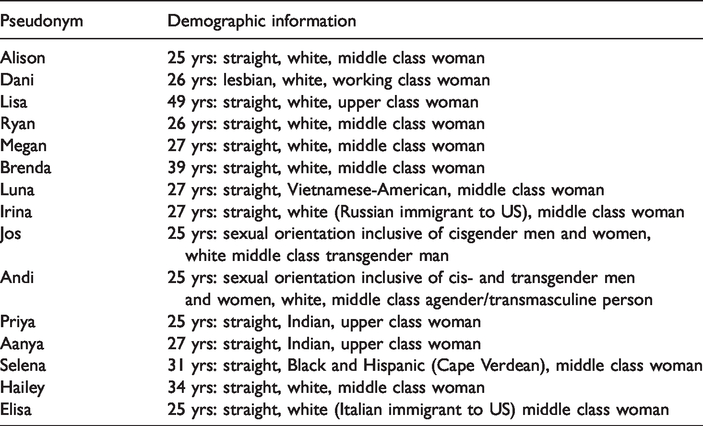
While the racial composition of the sample was predominantly white (n = 11, see Table 1), four women identified as persons of color, four women identified as recent American immigrants, and three participants identified as gay/queer. Further, two trans*men/masculine participants responded to the recruitment ads, suggesting that while these participants do not identify as women, they actively identify with elements of womanhood, femininity and the female experience (something that was also explicitly discussed at length by both participants in their interviews).
Participant demographic information.
Interview procedure
Participants were individually interviewed twice. Conducting two interviews with each participant fostered the development of rapport (Read, 2018) and, more fundamentally, allowed for a dialectic between data analysis and interviewing in such a way that allowed the participation of interviewees (approximating what Pessoa and colleagues [2019] term “reflexive interviewing”). For example, in the second interview participants often referenced their first interview to revisit responses that they had reflected upon and wished to correct or clarify, and in some cases, offered their own analysis of their experience or corrected what they believed my analysis to be. This process reflects an investment in critical respect for participants (see below) and also created additional space for meaning construction in the moment.
Interviews followed a flexible format, where participants’ responses guided the direction and content of the interview. The first interview included discussion of the participant’s social and cultural background (e.g., “Where did you grow up?,” “Can you tell me a bit about your family?”) and focused on the participant’s experiences and perceptions of femininity and sexualization in their everyday lives (e.g., “What do you usually do to get ready in the morning?,” “When do you feel the most confident? The least confident?”). Following the rapport established in the first interview, the second interview asked participants about their experiences and thoughts regarding risk in their daily lives. Participants were also asked to reflect upon their safety practices that implicate a specific presentation of their bodies (e.g., “On a typical day, to what parts of the [city/school] do you walk?,” “What are some things you do when you walk in areas where you feel uncomfortable?”). Each interview lasted approximately 30 to 75 minutes (M = 51 minutes), and all interviews were audio-recorded and transcribed verbatim.
Data analytic approach
Analysis was informed, in part, by Falmagne’s (2004) proposal of the dialectic of the system and the person. Falmagne’s metaphor of “self” as an anchor for social constitution and considerations of agency enables inquiry into the psychic life of discourse. Necessary to an analysis of tensions in discourse, Abbey and Falmagne’s (2008) conceptualization of tension-work in meaning making and subjectivity was integrated into the analytic approach. Therefore, individual participants were understood as socially constituted agents who selectively draw upon and modulate the discourses available to them. Participants’ social location and personal history were understood to shape their strategies and patterns in meaning making.
Finally, a discourse analytic lens was used such that language was not understood to be a transparent vehicle of meaning, but rather a cultural tool through which social phenomena are constituted and represented (e.g., Wetherell, 1998). This approach is informed by an investment in what Gill (2007b) terms “critical respect.” Kathy Davis (1991) and others argue for the need to avoid treating participants as either autonomous individuals whose choices and experiences exist outside problematic matrices of power and oppression, or as cultural dopes whose actions are wholly determined by these same matrices. Therefore, beyond the theoretical motivations outlined above, the present inquiry, as Gill suggests, takes care to contextualize participants’ discussions of choice and empowerment, allowing analytic space both for the ways participants’ experiences are informed by social discourses and systems of power, and for the ways they employ these discourses into personally meaningful experiences of choice and empowerment.
Initial coding marked passages meaningful to the research question, for example, instances in which a person’s discussion was read to reflect the logic of postfeminism, or discursive tension. Preliminary constructs were developed, and passages instantiating each construct were reviewed to check for conceptual consistency and theoretical meaningfulness. The final constructs were then established, defined and named.
Analysis
Postfeminist bodies
Five women in the sample drew from a postfeminist sensibility in discussing their bodies. Primary markers of these women’s discussions were: (1) compulsory femininity labor aimed at conditioning their bodies to meet a sexualized ideal, and (2) equating empowerment with a body that successfully acquires the desiring male gaze. Importantly, while not all white women in the sample drew from a postfeminist sensibility of the body, no women of color did so. While all women in this category drew upon elements of a postfeminist sensibility, the ways in which they did so was based on their perception of their body as viable (closely approximating the sexy feminine ideal) or unruly (unable to adequately approximate the ideal).
Viable bodies. Two women constructed their bodies as compatible with the postfeminist ideal. Both of these women were in their twenties, white, thin and feminine-presenting—thus fitting the constraints of ideal postfeminist subjects. The compulsory and perpetual body project that a postfeminist sensibility imposes was often embraced by these women as fulfilling and enjoyable, as described by Alison (a 25-year-old, white, straight woman): I like the feeling of getting nice and pretty and all that kind of stuff. [My boyfriend] really doesn’t put a lot of effort into his appearance. Even when I’m wearing heels, no it was too fancy, ‘you’re too fancy.’ I feel like I would dress a little funkier if I feel like he appreciated it. […] He mentioned the other day that he likes when I wear skirts and I’ve been wearing a little bit more skirts than I had been. I like wearing skirts, it’s not like I wouldn’t do it, I just have been putting more effort in.
Similar trends can be seen in Dani’s (a 26-year-old, white, lesbian woman) thoughts about the display of her body: I like to dress up. I like to put on a little bit of makeup, put on a pretty shirt and wear tight black pants or something, look hot. That’s fun for me. I feel like I don’t do it enough. I like doing that. We will like hit each other’s butts once the [guy] goes away, and just be like, “Yea you do look hot tonight!” [laughs] It’s great.
Although Alison and Dani discuss male approval of their bodies as related to feelings of fulfillment, tensions emerge for both of these women in contexts of violence. For Alison, this tension existed around wearing skirts, which as she described above, is something that her boyfriend desires. In public spaces, however, Alison associates the skirt with experiences of catcalling: I’ve definitely experienced [catcalling]. I definitely notice it depends on what I'm wearing to some extent. I get catcalled when I’m wearing this skirt. I don’t know what the deal with this skirt is. It’s so not sexy […] but I definitely get more catcalls when I’m wearing that. I tend to look down a lot and not make contact with strangers. When I was walking over here a guy waved to me from his car that I didn’t know. When it happens it can sometimes be fun, like if they’re saying hi, whatever, it’s fine. If they say something gross, then it’s gross. They need to be respectful.
Similar tensions are produced in Dani’s account of her experiences feeling unsafe when using public transit: I think it happened when I initially came into the city and I was not as aware of, you know, I was a young woman and was a lot more–I don’t know, I dressed up more then. And now I've learned like, this is what I do in that situation. Because I think you have to learn, especially living in [the city]. Unfortunately, I think a lot of girls learn that way or through their friends who have those experiences. I would sort of be like, “no, they’re not actually doing that.” Or I would be sort of awkward about moving, like I don’t want to make this person feel weird, which is ridiculous because they’re doing it for a reason. So I think I was very nice, and I was unaware that there were people who did things like this.
Unruly bodies. Three women perceived their bodies to be inadequate in approximating the postfeminist ideal, and discussed feeling compelled to continually condition their bodies (e.g., perpetual efforts to lose weight). Their perceived inability to access the empowerment that accompanies an ideal body was often discussed with frustration or a sense of mourning.
Lisa (a 49-year-old, white, straight woman) previously viewed herself as a viable postfeminist subject, but as she aged and became a wife and mother, expressed a distancing of the discourse from her changing subjectivity and body: I would flirt with people and I could tell if they were flirting back and that felt great. There was sort of a presence of my sexuality in it. Like, my sexuality was so much a part of my identity for years until I had kids and that really changed dramatically. Yeah, I’m also realizing that I think for a long time I just felt like I was young, I was attractive. But at some point I realized “Oh, so I’m not – I’m no longer in that category of being the youngest in the room.”
Along these lines, when asked about experiences of violence and safety, Lisa recounts experiences of catcalling from when she was younger, but avoids explicitly referring to them as unsafe or uncomfortable. Instead, she deliberately marks these experiences as harmless and humorous: Okay, so I’ve had probably a few experiences that didn’t feel unsafe to me. Um you know, kind of in the flirtatious end of it. Or I took it that way and moved on kind of thing. Once when I was in France this wise guy [laughs] walked toward me. I passed him on the street and as I passed him he reached out and grabbed my breast [laughs]. I was like, “What the hell was that?” You know, but then it was just over. I didn’t end up feeling unsafe, I just felt like “What an asshole!” So [laughs].
Megan (a 27-year-old, straight, white woman) viewed her weight as a significant obstacle to achieving the postfeminist ideal. A prominent feature of Megan’s interviews was her frequent conflation of sexiness and risk for violence, suggesting that she views the two as occurring together: There’s a little part of me that is like “why don’t I get street harassed?” [laughs] Like, do I not look good today? I don’t know if I give off a vibe that’s like “don’t fuck with me” … I don’t think of myself as giving off a vibe that’s like “don’t fuck with me” [laughs] but I don’t know. Like being like, an overweight girl … Like no one is like watching out for [rape] to be a thing that could happen. At least in my experience my parents were like desperately concerned that no one would ever want to date me, not that I might get assaulted at a party. Oh my god! Like I think at times it seemed like everyone around me, they were just like, hoping I would get harassed [laughs] because it means someone liked me.
The close equation of the postfeminist and prevention subject that Megan draws constructs risk and victimhood as a kind of status symbol. Paradoxically for Megan (although mirroring the tension produced by these discourses), the slim, sexualized woman who is at risk for violence is therefore also the woman who is empowered. This construction mirrors myths that equate rape with sex (instead of power and control), an idea that is still widely endorsed in print media and social media representations of rape (Stubbs-Richardson et al., 2018).
Alternate constructions of the body and empowerment
While threads of a postfeminist sensibility were present in most participants’ discussions, the majority of participants (n = 10) in the sample explicitly problematized postfeminist constructions of the body or took up alternate visions of empowerment that were uncoupled from the body.
Desiring bodies. For some women, a desiring body was a foundation for empowerment. Critically, this perspective was explicitly articulated as a subversion of postfeminist constructions of a body that is desired by men. Luna (a 27-year-old, Vietnamese-American, straight woman) explicitly articulates this position: I don’t think that there’s anything wrong with dressing the way that you want and dressing that [sexy] way, but I think that Beyoncé’s thing is like, “Be sexy and you will get a man,” more than like “Be sexy and you’re yourself,” you know? The idea of claiming your sexuality is something that’s not a norm, right? That’s not what most girls or young women think about unless they’ve actually had the discussion about it, unless someone’s told them, “You can actually control your own body because the world is telling you that you can’t.” I very rarely care about how the other person feels. Actually, I think if I was in a gay relationship with a same-sex partner, I think that I would care more about what the other person is thinking or doing, but with a dude I’m just like, “I don’t give a shit.” I usually am much more of like, “I will do whatever the fuck I want.”
Irina (a 27-year-old, white, straight woman) offers a similar perspective when she recalled her frustration with a friend’s advice on faking orgasms: My girlfriend will criticize me, like “You have to fake [orgasms].” I was like, “Okay so all girls are faking it now?” She had an orgasm before with [her boyfriend] and now she doesn’t have an orgasm. I don't know. She is always faking it. Either you break up the relationship or I don’t know. Sex in a relationship, it’s important.
Empowerment beyond the body. For other participants, the body was not deemed relevant to empowerment at all. Brenda (a 39-year-old, white, straight woman) was critical of the pressures placed on women to enact particular forms of femininity and discussed her concerns over how these pressures might impact her daughter: I built the chicken coop in the backyard. Not [their father]. To me that’s something the pretty princess, the Barbie girl can’t do. Every woman needs to be able to drive a stick shift and she needs a toolbox. And not the kind that just has a silver bullet in it. It needs to be a functional toolbox [laughs]. I want to raise my kids to be competent, to do stuff.
Priya (a 25-year-old, Indian-American, straight woman who had recently moved to the United States with her husband), discussed empowerment as linked with womanhood—not a feminine, or otherwise conditioned, body: I feel like why there is so much difference in girls and boys, men and women. Because men are used to living same life from the beginning to end but women have so many changes when they are growing up. Girls, when they get married, it’s a completely new thing. It’s not only their thinking level, it’s also physically they change. After that, then they get pregnant, have a baby, then everything is different. Maybe this is the reason why girls are so different compared to guys. That’s why I think girls are stronger than boys.
Bodies still dictate risk. Importantly, all participants who rejected postfeminist ideals uniformly identified the body as relevant in their talk about risk. Luna, who was adamant about subverting male power in her personal relationships, marks violence as an inevitable phenomenon: There was a shooting two blocks away on July 4th and there’s this guy that I sometimes run into and he harasses me on the street, but I don’t know. I feel like that’s just … Isn’t that terrible? It’s just part of being a woman. It’s the same dude. He lives right on the corner so it’s really annoying, but I haven’t run into him in a while, knock on wood.
Aanya (a 27-year-old, Indian-American, straight woman) who, like Priya, otherwise asserted that womanhood was inherently powerful, relies upon the victim-centered logic of the prevention discourse in her account: You should be able to think in your head, “I can walk outside whenever I want.” And I don’t feel that way. Last time I was constantly thinking “Is someone following me?” or “Is there somebody watching me?” I removed my rings so I didn’t attract attention; I never had my phone out, just to be on the cautious side. I kept watching and looking behind me just to be careful.
Andi (a 25-year-old, white, trans*masculine/agendered person), who, like Brenda, was otherwise highly critical of social pressures related to femininity and womanhood, equates both with vulnerability in their discussion of risk: Even when I’m walking home late at night I’m not antsy like I used to be because now I don’t look traditionally feminine and I don’t look like a girl even to most people so I feel a lot more secure being androgynous. It used to always be something that was on my mind but now I feel a lot more secure. I don’t look like a target as much anymore.
Discussion
This study examined the extent to which postfeminist notions of an empowered sexualized body were taken up by participants of diverse social identities. Of particular interest was the extent to which this sexualized vision of the body produced tensions in contexts of violence and risk—in which dominant modes of reasoning strictly condemn displays of sexiness.
While many participants referenced postfeminist ideals in their interviews, five consistently enacted this sensibility in their own meaning making. These women discussed risk in tension-filled ways, such that male attention was simultaneously framed as a product of empowerment and as threatening and risky. Participants’ accounts suggest that acknowledging the effects of patriarchy, including harassment and violence, is discursively impossible for women who successfully enact the postfeminist ideal. Alison’s discussion of catcalling as “fun” and Dani’s ambivalence toward making male strangers “feel weird” for leering at her suggest a peculiar undercurrent of collusion with the objectifying male gaze (reminiscent of Audrey Lorde’s [1984] “dangerous fantasy”), although repackaged in postfeminist terms of choice, pleasure and empowerment.
Despite the saturation of postfeminist ideology in popular media, most participants in the sample emphasized personal constructions of femininity or womanhood, rather than the body. Importantly, all of the women of color in the sample reasoned in this way. Although the sample was majority white (a serious limitation), this indicates that for the women of color in this sample—as suggested by Cole and Zucker (2007) and Schooler et al. (2004)—the pervasive representations of postfeminist femininity may not be seen to directly map onto, nor deemed relevant to, personal experience and meaning making. Future work is needed to explore the extent to which women of color engage with postfeminism in their everyday lives, and to identify the cultural discourses that may more meaningfully inform women of color’s personal constructions of empowerment.
Notably, all participants took up the terms of the violence prevention discourse—and its strict emphasis on the body—when discussing violence. Even for participants who otherwise did not view the body as relevant to their empowerment, in contexts of risk the body is made salient. One possible understanding of this trend may be that while most feminist sensibilities explicitly mark sexism as a problem that can be eradicated, violence prevention narratives maintain violence as inevitable (Hall, 2004). Instead, prevention efforts are addressed to women (as perpetual, potential victims) with the goal of reducing (not eradicating) risk. In other words, while feminism(s) create space to challenge the relevance of the sexed and gendered body to empowerment, there is no such space within the violence prevention discourse to challenge the relevance of the body to violence and risk.
This holds serious implications for efforts to critique and challenge the problematic terms of the prevention discourse—in particular, the terms that hold individual women responsible for avoiding (and to blame for experiencing) victimization. Implications for feminist and other activist organizing are plentiful. It could be the case that formal ideologies of activism founded in feminist or other structural terms may not seamlessly translate to lived experiences and action on the ground. An individual solution (e.g., not walking alone at night) cannot remedy a structural problem (e.g., violence against women) yet many would agree that small, individual acts can productively “count” toward activism (Martin et al., 2007). In the neoliberal context, however, it appears urgent for activist projects to also insist on the accountability and disruption of institutional power. Yet, the cognitive and emotional labor of maintaining space for both individual and structural efforts may produce dissonance (at best) or contribute to the rates of burnout and mental health concerns that have been documented among activists (e.g., Chen & Gorski, 2015). Additional research addressing tensions in discourse and any resulting tensions in individual action and personal experiences is critical to exploring this further.
Footnotes
Acknowledgements
I give sincere thanks to Dr. Rachel Joffe Falmagne for her mentorship and feedback on this project, and to Dr. Nicola Curtin and Dr. Rosalind Gill for their insight and helpful comments on earlier drafts.
Declaration of conflicting interests
The author(s) declared no potential conflicts of interest with respect to the research, authorship, and/or publication of this article.
Funding
The author(s) disclosed receipt of the following financial support for the research, authorship, and/or publication of this article: This research was supported in part by the Worcester State University Faculty Scholarship and Creative Activity Grant program.
