







Abstract
Organized in the US in 1917, dietetics emerged from the discipline of home economics as an “acceptable” area of study for women. Since its inception, dietetics has lacked diversity; most dietetics professionals identify as white, cisgender, heterosexual, middle to upper-middle-class women. In the supervised practice setting, interns are expected to dress “professionally” and follow health/safety protocols. Given the field’s history, it is reasonable to suspect that dress codes—rules/expectations regarding what employees/participants can/cannot wear—for dietetics programs may be problematic. To explore this, we conducted a discourse analysis using a Foucauldian feminist approach, drawing on the notion of governmentality. Eighty-five dietetics dress codes, supplemented with survey questions, from US-based accredited dietetics education programs were analyzed. Three primary discursive effects were identified: “Invisibilizing” informs dietetics students/interns how to be professional and modest. “Protecting” highlights dress to promote health and safety. “Normalizing” privileges conforming to thin, cisgender, white European women of higher SES. These findings show how the dress codes reify a “model” dietitian and privilege/oppress/discipline some bodies over others, supporting criticisms of dietetics dress codes as discriminatory and oppressing/privileging select societal groups. Recommendations are provided to address biases and prevent dress codes from negatively impacting diversity/inclusion in the profession.
How individuals dress, including the clothes they wear, hairstyle, and accessories, is deeply rooted in social structures and tied to personal expression (Clarke & Turner, 2007; Entwistle, 2015). Dress can also be heavily regulated, especially in professional or educational settings. Dress codes can be understood as a set of rules or expectations regarding what employees can and cannot wear to work (Kelly, 2019). Generally, they are formally posted or included in policies communicated to employees or students via handbooks or manuals, though they can also be informal and communicated through verbal explanation or unspoken expectation. These regulations not only express employer/program requirements regarding dress but may also reflect colleague or customer expectations around “appropriate” appearance at work. Dress codes can vary in terms of prescription, from broad and non-specific to narrow and fixed. In addition, they can define the culture or “brand” of an organization, while some components may be designed to provide safety to either the customer/client or to the employee/student themselves.
Dietetics as a profession emerged from the home economics movement of the early 20th century in the United States (Scott, 2009) as one of only a few professions deemed “appropriate” for women to study after graduating from high school. Since its inception in 1917, the American Dietetic Association, now the Academy of Nutrition and Dietetics (the Academy), has been a professional organization founded by and largely for white women; specifically white, middle to upper-middle-class, cisgender, heterosexual, thin women. As such, the profession was (and often continues to be) guided in the customs and mores of conservative America and training in dietetics both establishes and maintains traditional gendered and racial (i.e., white) norms.
Initiated in 1990, and updated bi-annually since 1991, the Academy's membership database contains data from surveys of Academy membership designed to capture demographic as well as other statistics. Data from a 1990 survey of members of the American Dietetic Association (active, technician, associate and retired) show that only 3.7% of Academy membership identified as African American (Bryk & Kornblum, 1993).
In 1987 the Academy began efforts to improve racial/ethnic diversity and inclusion in the profession through the establishment of diversity and inclusion committees, development of “toolkits”, and creation of diversity and inclusion promotion grants. Unfortunately, no real improvements in racial/ethnic diversity have been realized. In 2020, the percentage of dietetics professionals identifying as Black/African American declined to 3% (Rogers, 2021). Of note, the Academy does not collect demographic data regarding gender/sexuality or disability among its members. Therefore, it is unknown how diverse the profession is in terms of these characteristics (Burt et al., 2021), though the number of individuals who identify as male has been and continues to be small (currently 7%; AND Needs Satisfaction Survey, 2020). 1
Dietetics is a profession that by convention includes dress codes instituted across various settings. Rules regarding dress in dietetics are most apparent in the food service realm where student interns (the term used for individuals in the supervised practice component of their education) are generally, at the most basic level, required to wear non-slip, closed-toe shoes and hair restraints for safety purposes. Additional rules or expectations regarding dress are also common when interns move to clinical and community settings. Hospital-based experiences often require interns to wear lab coats in addition to “professional attire,” while community settings may allow for more casual clothing. Formal dress codes are less prevalent in dietetics academic programs. When formal, often written into the dress code are stipulations that outline the “punishment” for not following the code, most often being sent home and required to make up “lost hours.”
Recently, particularly in school settings, dress codes have been criticized as sexist, racist, classist, homophobic (Aghasaleh, 2018), disciplining, marginalizing, misogynistic, discriminatory (Neville-Shepard, 2019; Reddy-Best et al., 2019), hegemonic, and suppressive/oppressive (Crockett & Wallendorf, 1998). These negative aspects of dress codes most often affect students identifying as female, gender nonbinary/transgender, and/or Black, Indigenous, and People of Color (BIPOC). Given that the majority participating in accredited dietetics education programs in 2020 continue to overwhelming identify as female (87%) and white (62%; only 6.1% identifying as Black, not Hispanic; Accreditation Council for Education in Nutrition and Dietetics [ACEND], 2021), as well as the traditional, conservative nature of the profession, it is reasonable to assume that dress codes written for dietetics programs may be problematic and contributing to the lack of diversity seen in the demographic data.
Given dietetics is a feminized and predominantly female profession, members may be subject to increased “aesthetic labor,” or the effort that goes into creating and maintaining a specific visual appearance that conforms to societal standards for social approval (Mears, 2014). Women are particularly vulnerable to weight bias, or negative evaluations due to being considered overweight. This bias adversely impacts employees at every stage of employment, from hiring through to promotion (Nowrouzi et al., 2015; see also Strings, 2015). Not only are professional women constrained in their physical appearance, but they also have limited opportunities regarding their professional identities and behaviors. These outcomes increase women's emotional burden as they are “expected to find the right balance between feminine and masculine qualities … and that they should tacitly accept that sexism is an inextricable part of being a professional woman” (Chowdhury & Gibson, 2019, p. 489).
We conducted a discourse analysis of dress codes currently in place in accredited dietetics programs (both academic and supervised practice). Our purpose was to understand how dress codes in the context of dietetics, positioned within society at large, may impact individuals in accredited programs specifically, in terms of the impact dress codes may have on diversity and inclusion in the dietetics profession and other professions with regulated dress more broadly. Our work takes advantage of the well-documented comparatively static nature of the profession's demographic composition. It offers a rare opportunity to evaluate structural biases associated with gender and race/ethnicity that were present at the start of the profession and, as we shall show, are still present now. Given our desire to understand “regulation” within the profession, our analysis was grounded in a Foucauldian feminist approach and informed by Foucault's (2008) concept of governmentality, explained further below.
To that end, we used the following questions to guide our analysis: How do dress codes written for accredited dietetics programs (academic and supervised practice) reify, shape, and/or refine what is a successful or “model” professional dietitian? How do dress codes written for accredited dietetics programs (academic and supervised practice) privilege and/or oppress and/or discipline some bodies over others?
Methodology
Theoretical foundation
Our qualitative research methodology was conducted using a Foucauldian feminist approach drawing on Foucault’s (2008) concept of governmentality. Foucault's work overlaps with feminist critiques of biological determinism and scientific positivism, as well as the inclusion of social aspects in political analysis (Macleod & Durrheim, 2002). Thus, feminist scholars have used Foucault's concept of governmentality as a theoretical tool to analyze “the complexity of oppressive relations of power that may take on diverse forms in modern society” (Macleod & Durrheim, 2002, p. 57; see, e.g., Türken et al., 2016). Foucault (2008) defined governmentality as “the way in which one conducts the conduct of men” (p. 186), or the ways sociopolitical institutions police human behavior. Governmentality refers both to the ways in which individuals are enticed to govern themselves through discourse and the ways in which organizations are governed by other social institutions (Foucault, 1991). In patriarchal societies, the way governmentality impacts women needs to be explicitly examined, as women are subject to increased and unique levels of surveillance and pressure to conform to normative standards of femininity (e.g., body size, posture/manner of movement, dress/cosmetics; Bartky, 2020).
We employed discourse analysis; a theory-method involving the “study of social life, understood through the analysis of language in its widest sense (including face-to-face talk, non-verbal interaction, images, symbols and documents)” (Shaw & Bailey, 2009, p. 413). Discourse analysis offers ways to investigate the meaning of language beyond the literal; it excavates language in the context of culture and social life. As a research methodology, discourse analysis is conducted within the context of a theoretical framework/approach, often chosen for its ability to frame or construct a lens through which the discourse is situated. Since dress codes are most often documents (in the form of policy or written “rules”), these texts can be analyzed using discourse analysis to determine underlying meanings relative to society at large (see Hopton & Langer, 2022, and Mackenzie & Murray, 2021, for examples of discourse analyses of texts). “Foucauldian discourse analysis [FDA; emphasis in original] is concerned with language and its role in the constitution of social and psychological life” (Willig, 2013, p. 380), and is thus a particularly appropriate method for examining how dress codes may construct the model dietetics student, particularly as they shape expectations of appearance and conduct.
Materials and methods
Directors of didactic and supervised practice programs in the United States accredited by the Academy of Nutrition and Dietetics/ACEND were asked to provide a document detailing their program's dress code and to complete a survey about their ACEND-accredited education programs to characterize the types of programs from which the dress codes were obtained. Using the list of accredited programs on the ACEND website, the principal investigator sent a recruitment email (in January 2021) to 591 directors of ACEND-accredited programs, with a link to the survey to answer questions about their program and upload a copy of their program's dress codes. A month later (February 2021), a second recruitment email was sent to the same program directors as a final invitation to participate in the study. At the end of recruitment, we yielded 85 complete surveys and dress codes for analysis. Program directors who did not consent were not allowed to proceed to the survey or to upload their program's dress code.
The survey data were intended to be used to contextualize the results of the discourse analysis. The questions were designed to capture descriptive information, specifically a) whether the program was accredited, b) the type of accredited program, c) area of the country where the program is located, d) whether the dress code was a formal policy, e) the year the dress code was written and last revised, and f) the title of the person who approves the programs dress code. Participant program data were analyzed descriptively and are presented as frequencies and percentages. The study and consent process were approved by the Boston University Institutional Review Board.
Data collection
One hundred and eighty-four program directors began the survey. Twenty-seven did not consent to participate and therefore did not complete the survey. Of the 157 respondents, one responded that their program was not accredited, and that program's data were removed. A further 71 responses could not be analyzed because: a) the program did not have a dress code; b) the dress code was not uploaded after survey completion; c) the link to the document was “broken,” making it irretrievable; d) the dress code was verbally communicated to students, not written; e) students followed dress codes of individually supervised practice sites, not the supervised practice program. This left 85 dress codes available for discourse analysis. This represents a 31.6% response rate.
Participant program characteristics
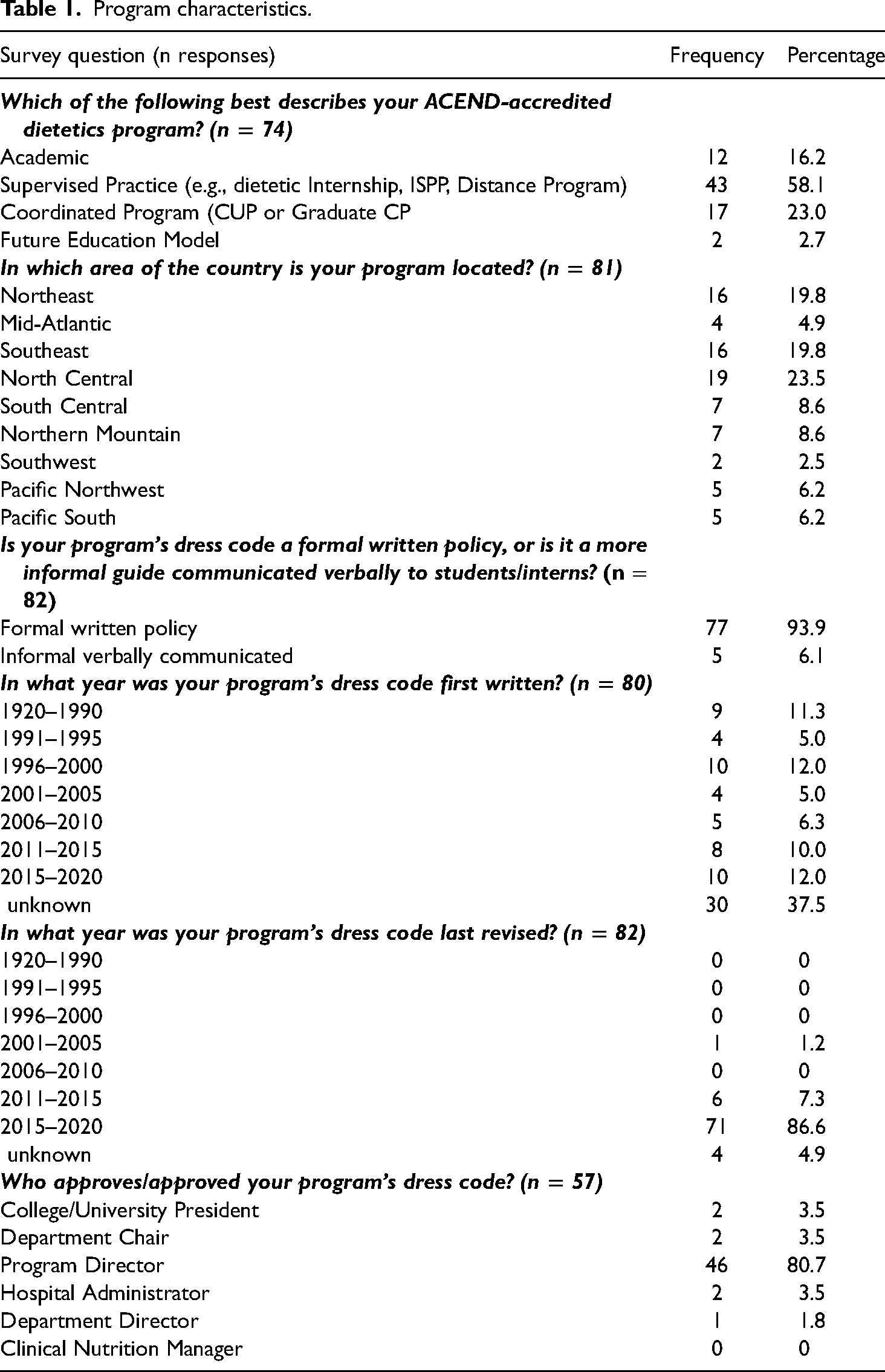
Over three-quarters of the dress codes analyzed were submitted by supervised practice and coordinated programs. Dress codes were submitted from all geographic regions of the United States, with the greatest number of submissions coming from the Northeast, Southeast, and South-Central portions of the country. We note, therefore, that the dress codes in our dataset are likely shaped by regional customs/mores. Almost all dress codes were described as formal written policies. Over one-third of all program directors did not know when their dress code was first written, but over three-quarters of the dress codes submitted were last revised in 2015. Over three-quarters of the program dress codes are approved by the program director. Participating program characteristics are summarized in Table 1.
Program characteristics.
Data analysis
It is generally agreed that there is no singular or “correct” way to conduct a discourse analysis. Instead, discourse analysis is informed by one's research questions as well as the theories and materials used to answer those questions. For this study, data analysis was informed by a Foucauldian approach to discourse analysis (Willig, 2013). First, all 85 dress codes were read and reread multiple times to develop familiarity with the text. As part of this process, all the researchers read through the dress code documents first, to gain an overview of the data and what the text of the dress code may be constructing. Following this reading, we coded the data, following Willig's (2013) six stages for FDA, using the research questions as the basis for text selection.
The first stage, discursive constructions, focuses on how discursive objects are constructed. For this study, we focused on the discursive object of “dress” (i.e., clothing, appearance, etc.). The second stage, discourses, explores similarities and differences in how the discursive object is constructed. The third stage, action orientation, asks, “What is gained from constructing the object in this particular way at this particular point within the text?” (Willig, 2013, p. 132). Otherwise stated, this stage examines the function of how the discursive object is constructed. In the fourth stage we identified the “subject positions” or the locations which people within a social structure can occupy. For this study, we specifically explored how dress codes position dietetics students and interns. The fifth, practice stage, focuses on the relationship between discourse and practice. We systematically explored how discursive constructions and subject positions expand or limit opportunities for action. Lastly, the final stage, subjectivity, examines the relationship between discourse and subjectivity. This stage asks, what are the consequences of these discursive constructions and subject positions? In this study, we were particularly interested in exploring how discursive constructions and subject positions in dress codes written for accredited dietetic education and supervised practice programs reify the “model” professional dietitian and how this may privilege or oppress some bodies over others.
We independently developed codes for each text by reading each one to determine its latent discursive constructions, primary discourses, function, positioning, practice, and subjectivity. After all the texts were individually coded, any discrepancies in coding were resolved through consensus. Following codebook refining, we met to discuss and determine the major discourses present in the dress codes. At all points in the analysis, we engaged in reflexivity, exploring and critically appraising our positionalities and how these may shape our reading and coding of the documents. As a research group, we challenged each other frequently to maintain fidelity to the dress code document text. In this way, the rigor of the analysis was improved.
Findings
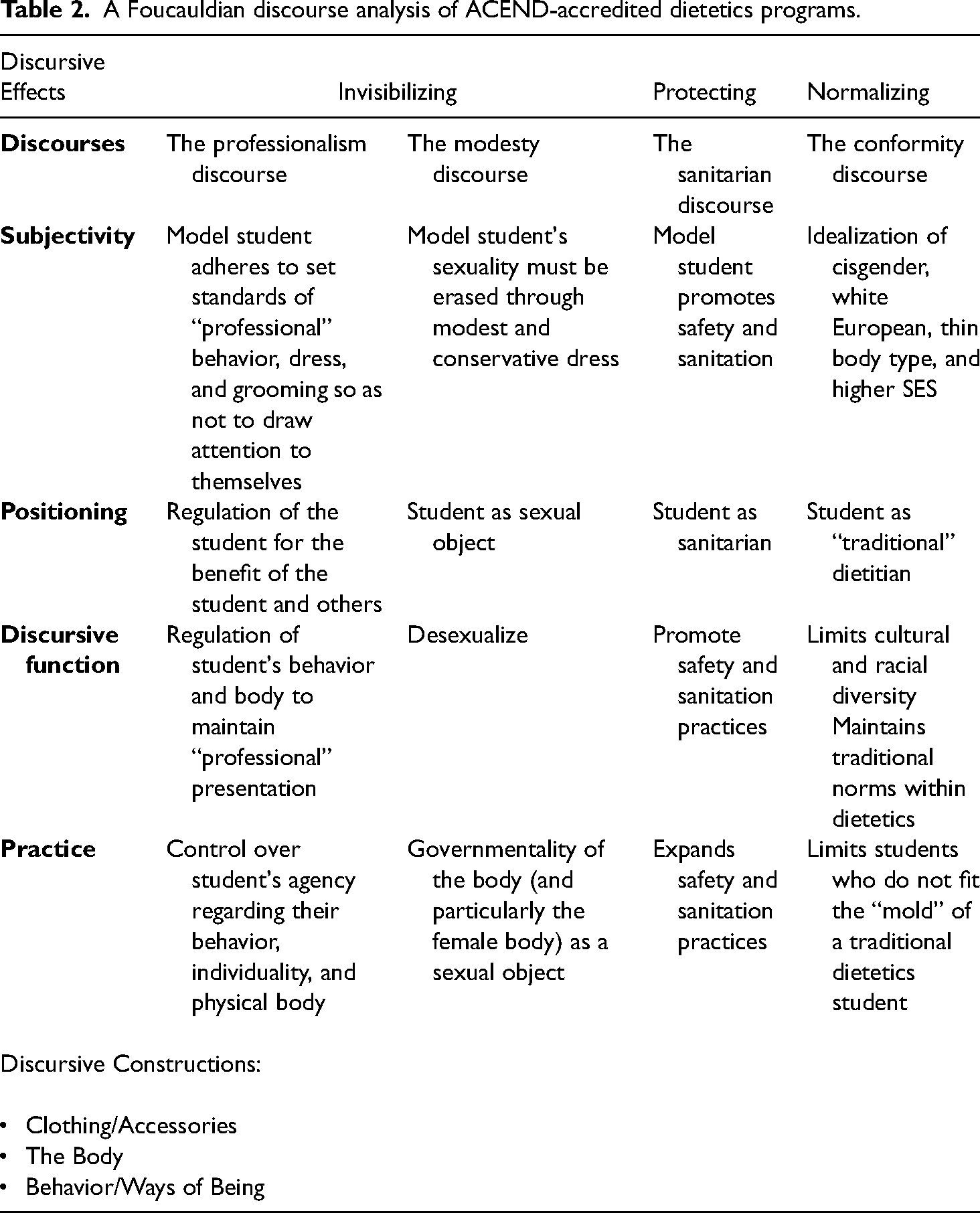
We identified three discursive constructions as ways that “dress” is defined in dietetics programs dress codes—namely, Behavior/Ways of Being, Clothing/Accessories, and The Body—and four primary discourses, which were organized under three discursive effects, as shown in Table 2. Numbers in parentheses after quotations from the texts refer to the program dress codes numbered for anonymity.
A Foucauldian discourse analysis of ACEND-accredited dietetics programs.
Our analysis generated the discursive construction of dress to include not only clothing and accessories (objects added to, in this case, an outfit to add beauty), but also bodies and behavior/ways of being. All the dress codes reviewed included mention of articles of clothing, though when specific pieces of clothing or accessories were mentioned, they were most often presented as prohibited. Inconsistent with the function of a dress code, we noted the frequent inclusion of “body parts” and body processes constructed as dress. Most of the dress codes analyzed included stipulations regarding the visibility of “cleavage,” “tattoos/piercings,” and direction regarding “personal hygiene.” Additionally, we found that the discursive construction of dress in the dress codes included “behaviors or ways of being” that were stipulated for the student/intern. About half of the dress codes analyzed included statements that students must maintain a high standard of “professionalism,” “act with integrity, and convey authority” and demonstrate “good taste and appropriateness in clothing selections.” Notably, there were no explanations, definitions, or descriptions of professionalism, good taste, and so forth provided for reference. We utilized all three of these discursive constructions (clothing and accessories; bodies; behavior/ways of being) to center dress in our analysis.
Primary discursive effects
Our analysis suggests three overarching discursive effects: Invisibilizing, Protecting, and Normalizing. “Invisibilizing” was effected through two distinct discourses. First, the professionalism discourse relates to erasure of the body through the elimination of any clothing/accessories, body, or behaviors/ways of being that mark dietetics students/interns as individuals; thus, students are compelled to conform to “professional” standards so as not to stand apart from others. Second, the modesty discourse involves erasure of the body through the removal of any clothing/accessories, body, or behaviors/ways of being that signal the body as a site of sexuality. The discursive effect of “Protecting” involves emphasis on students’ role in promoting health and safety by means of the sanitarian discourse. “Normalizing” involves the restriction of cultural and racial diversity through the conformity discourse. We discuss each of these discursive effects and the associated discourses below.
Invisibilizing: The professionalism discourse. This discourse assumes that dietetics students cannot discern what is appropriate professional dress, nor comport themselves and their dress without some sort of regulation. As written in one dress code, “Remember, you are representing yourself, the profession, and [University Name De-Identified]. Professional image and first impressions cannot be underestimated” (29). Similarly, “It is essential that students of the Dietetics & Nutrition Program present themselves as professionals. Students must look and act in a manner that conveys authority and integrity and maintain a high standard of professionalism at all clinical education settings” (67).
The function of this discourse is to regulate students’ behaviors and bodies to maintain “professional” presentation. One dress code identifies “correct posture” as a requirement for “professional physical appearance.” This regulation also extends to bodily function. As one dress code advises, “If privacy is required for restroom use, please take an extra few minutes, and seek out a restroom that will afford you the privacy” (49). Students are positioned within the dress codes as entities to be regulated for their own benefit as well as others. The practice of the dress code is to control (i.e., limit) students’ agency regarding their behavior, individuality, and physical body. For example, one dress code stipulated “No wild colored hair or outlandish hairstyles” (25). Our data contained several dress codes which included regulations regarding personal hygiene. For example: “Daily bathing is required. Good personal hygiene must be strictly enforced. Deodorants should be used” (10).
Several dress codes conveyed that the student/intern's dress and behavior should not draw attention, often with the stated rationale of not distracting others during patient care. For example, “In patient care facilities, the focus must be on the patient. If your hair or dress distracts from a patient-care focus, the intern will be asked to modify their appearance into one that is more conservative and appropriate” (58). Similarly, “your appearance should not distract from the message you are delivering or give a negative impression of the program you are representing” (80).
Regulation of student dress often fell under the auspices of the program or dietetic internship director. For example, one dress code states “the faculty and/or facility instructor will make final decisions on appearance” (63). In another, “Preceptors have the right to determine if the attire worn is consistent with the image desired” (65). When included in the dress code, several “punishments” were noted such as “you may be asked to leave a site if the preceptor does not think you are presenting a professional appearance” (38). Often the notation to leave the site would include the requirement that the student make up hours lost. At times, the punishment for infractions of the dress code could “result in progressive disciplinary action up to and including termination” (69).
Invisibilizing: The modesty discourse. This discourse reifies the (supposedly inherently hypersexual) female body that must be erased through modest and conservative dress. Modesty in the dress codes often extended to implicitly gendered undergarments and fabric of clothing. As one code advises “Proper undergarments (bra, panties, etc.) should be worn at all times” (41). Another stated, “All clothing will be modest. Sheer materials are not appropriate” (8). In many of the dress codes we analyzed, conservative dress was also implicitly gendered and extended to make-up. For example, “Keep make-up conservative and natural looking. A little is usually better than none for a polished look” (8).
Many of the dress codes we analyzed include stipulations regarding the appropriate fit and length of a student/intern's dress or skirt. For instance, “For women, dresses and skirts should not be skin-tight or shorter than fingertip in length. Do not wear midriff or low-cut tops; check yourself in the mirror by raising your arms and while leaning over” (27) and “Body covered from two inches below the clavicle to the knees” (80). Many dress codes also specifically named female body parts that they should not be visible. For example, “NO BELLY-BUTTONS, BREASTS, BUTTOCKS, OR BARE SHOULDERS should be visible at any time” (17; emphasis in original).
Several of the dress codes in the dataset include guidelines listed separately for men and women. In these dress codes, men's guidelines tended to focus on professional presentation, while the guidelines for women focused on modesty and desexualizing. For example: Dress code is Business Casual. Clothing: clean and pressed modest professional dress, blouse, skirt or slacks. Undergarments should be worn. Tops/blouse/dress must have sleeves and fit modestly. Tops should not fit tightly, be made of a sheer material and should not reveal cleavage, midriff or back. No low-cut or see-through tops are allowed. Dress and skirt length should be no shorter than 2 inches above the knee. (51)
Protecting: The sanitarian discourse. This discourse presents dietetics professionals as dressing with safety and sanitation in mind. The function of the dress code in this context is to expand health and safety practices through dress, behavior/ways of being and the body. In this way, “dress” is contextualized in health and safety practices. For example, “Skin below the waist must be covered to reduce the chances of burns if hot food/liquids are spilled and for infection control” (31). Similarly, “When working in the food service area, large or drop earrings and dangling jewelry [sic] are not allowed, because they can get caught in equipment, harbor bacteria, or fall into food. No more than one ring per hand is allowed” (83) and “Shoes must provide safe, secure footing, offer protection against hazards and should be appropriate for an employee's work environment” (69).
While the above examples provide rationales for the stipulations in the dress code, most dress codes did not provide an explanation when limiting dress presumably for safety. For example, “During food service rotations, hair covering, minimal jewelry [sic], and no artificial fingernails is [sic] required” (65) provides the limitations without rationale.
Students/interns are positioned as sanitarians with the practice of the code to promote safety and sanitation practices. For example, “The dress code has been established to help interns conform to the sanitary requirements of food service and health care” (73) and “For supervised practice in food production areas, all regulations from the Health Department must be followed” (2).
Normalizing: The conformity discourse. This discourse informs that professional dress follows gender norms and implicitly centers and privileges individuals from the dominant culture. For example, a dress code for men (cisgender implied) states, “Hairstyles should be clean and neat, avoiding extreme styles or colors, and trimmed above the collar, leaving the ear uncovered” (14). Similarly, “For women, coordinated business clothes include either dresses or skirt/pants and blouses/shirts. For men, coordinated business clothes include dress pants and shirt and/or sweater” (83). Although one dress code states explicitly, “Religious, gender specific or ethnic attire: this policy is not intended to and does not hinder the advancement of diversity,” that same code (69) has explicit women's and men's wear guidelines.
The function of the conformity discourse is to maintain traditional norms in dietetics; most are directly written to maintain gender norms, though also privileging cisgender, white European, thin, female-identifying students/interns of higher socioeconomic status. For example, “You may also be required to purchase and wear a specified uniform in order to train in a particular facility, i.e., scrubs, lab coat” (27) privileges higher SES student/interns. “Hair style: hair should be kept neat and in moderation at all times. If hair length should exceed shoulder length, it must be confined while in the lab area to prevent contamination and to promote safety” (1) privileges white, European interns/students as it assumes non-textured hair. We frequently noted evidence of privileging thin, smaller-breasted bodies. For example, “Clothing that reveals too much cleavage, your back, your chest, your stomach or your underwear is NOT appropriate for any work environment” (53). Students/interns in this discourse are positioned as the “traditional” dietitian, with a practice of limiting students who do not fit the “mold” of a traditional dietetics student.
Discussion
Our discourse analysis of ACEND-accredited dietetics program dress codes relied on the concept of governmentality to identify how these texts reflect and constitute ideologies, power differentials and models of gender which facilitate some practices of dress and constrain others, all with the aim (explicit or implicit) of creating the professional dietitian through dress. Dress codes, including those we reviewed, often mandate “professional” appearance without offering a definition of what “professional” means. The terms “professional” and “professionalism” have been incorporated into many businesses and industries in the US, including healthcare. Through the lens of governmentality, professionalism serves as a disciplinary technology to regulate and normalize people's dress and behavior (Foucault, 2008; Macleod & Durrheim, 2002).
Definitions of professionalism are not clear and unambiguous (Dubbai et al., 2019). According to Hammer et al. (2003), exploring dress codes written for the healthcare profession of pharmacist, professionalism can be described as behaviors or values that distinguish a profession. The implication is that professionalism encompasses several different ways of being, and together these ways of being identify and define a professional. We noted the term “professional” used consistently throughout dietetics dress codes, suggesting a universal importance of professional as a way of being for dietetics students and interns. Strikingly, many dress codes did not define “professional” dress, though when they did, the descriptors of articles of clothing were consistent with that typical of white, conservative notions of professional dress. As offered by Jones (2017), professionalism is discretionary, often “coded language” for white and middle class. This was evident from our analysis and was identified as our discourse of conformity.
In 2018, Aghasaleh analyzed professional dress code policies in the context of discourses of multiculturalism, racism, sexism, and homophobia, arguing that dress codes convey sexism that centers the male gaze and racism with “inherent biases” (white, middle-class norms) that serve as a “hidden curriculum.” In this way, Aghasaleh further argues, dress codes function as tools of oppression as educators and systems discipline bodies in implicit ways, “othering” those who do not fit the implied standards, particularly non-binary, BIPOC, lower SES identifying individuals. Consequently, the formation and maintenance of an inclusive environment is prohibited, and by extension, so is diversity.
Our analysis highlights this “hidden curriculum,” identifying many instances where dress codes were written to establish and maintain hegemonic white, cis-gender, and privileged presentation as consistent with “professionalism.” In this way, these dress codes serve as a proxy for conformity and function to limit diversity in the field. This homogenizing practice is most obvious in the dress codes that separate out required dress by gender. (See Stuart & Donaghue (2012) for a critique of gendered beauty standards.) Commenting on diversity in dietetics in a recent New York Times article, Iguchi relates that “the program itself as a culture is very cisgender, thin, white and female” (cited in Krishna, 2020, para. 24). They go on to say that “it is hard to be different and succeed” (para. 24). There is no practical reason why dress codes should be written to reify a gender binary. We recommend that this practice be discontinued.
Where we did find the dress codes written for dietetics programs were important was when they support health and safety practices. By virtue of their position, which often interfaces with food production operations and direct patient care, dietetics students and interns are required to understand and maintain appropriate food safety and sanitation practices. Inclusion of dress regulations that serve to support food safety and sanitation are essential to food service management. However, even in the context of food safety and sanitation practice, we found that dress code stipulations related to food safety and sanitation most often are not contextualized or explained. Students are left to guess at the rationale and programs therefore risk biases being “read into” dress codes and inadvertently included under the guise of health and safety. For example, one dress code states, “Jewelry and make-up should be conservative in amount and type in order to enhance professional image and ensure personal safety” (7). Without a clear explanation for how conservative make-up would ensure safety, this guideline appears more related to ensuring conformity to a specific beauty standard than personal safety. It is important for students/interns to understand why, for example, there are restrictions on hair styling, jewelry, and footwear rather than leaving them to “guess,” particularly when the unspoken rationale may be oppressive.
Our analysis also demonstrates how dress codes reinforce patriarchal structures and discipline non-normative bodies through governmentality. Dietetics students/interns are surveilled by their instructors and preceptors (i.e., authorities) who enact normalizing judgments based on discourses of professionalism, modesty, and conformity. Then, through a variety of regulation mechanisms—including punishment and extending to self-surveillance and self-consciousness—white, cisgender, thin student/interns are privileged (see, e.g., Macleod & Durrheim, 2002, for similar analysis in adolescent sexual health). “Insofar as the disciplinary practices of femininity produce a ‘subjected and practiced,’ an inferiorized body, they must be understood as aspects of a far larger discipline, an oppressive and inegalitarian system of sexual subordination” (Bartky, 2020, p. 103).
Much of the literature on dress codes addresses how they oppress and/or discipline some bodies while privileging others. Jones (2017) argues that grooming and dress code policies in academic settings and places of employment “not only criminalize, but also devalue and demonize perceived cultural representations of [B]lackness and what that means for society as a whole, especially the [B]lack community” (Macon, 2014, p. iii). Jones argues that people racialized as Black have been taught over centuries that Blackness is unacceptable and that to become a successful, productive member of society Black people must assimilate to the dominant culture. Our analysis illuminates “normative standards of whiteness” (Jones, 2017, p. 30) that underpin dress codes. In this vein, dietitians of color have discussed feeling compelled to alter their dress and/or ways of being to fit in. For example, in the New York Times article mentioned earlier, Jones (cited in Krishna, 2020) states: “It is a good-old-girls’ club where, as a person of color, you have to do so much to be invited” (para. 11).
Dress codes are not benign, though they may be presented as such. For example, Knipp and Stevenson (2021) identify five justifications in US public charter school dress code policies in their content analysis, namely: (a) preventing distraction, (b) promoting positive school culture, (c) allowing self-expression, (d) exhibiting professionalism, and (e) promoting safety. They argue that these justifications are deeply imbued with race, class, and gender biases. Specifically, “distraction”—in our case, “not drawing attention to (one)self”—has been identified as “veiled language” for perceived provocative dress that almost exclusively is directed at women (Neville-Shepard, 2019; Pomerantz, 2007). Hethorn and Kaiser (1999) argue that this modesty discourse is a proxy for cultural anxiety regarding sexuality. Who is viewed as provocative, and therefore who is regulated, surveilled, and controlled, is determined through gender, body size, class, and race.
Some dress codes, especially those written for schools, stipulate that one's peers (as opposed to oneself) must not be distracted by dress. The educational environment is consequently protected for some students, while the education of others—the “distracting” (usually minoritized) students—is compromised. This practice remains in place despite findings that school staff members are more likely to be distracted by what students wear than the students themselves (Hethorn & Kaiser, 1999). Research in this area commonly indicates that the students who are most likely to be labeled distracting are female, Black, low-income, and/or larger-bodied (Epstein et al., 2017; Hethorn & Kaiser, 1999; Neville-Shepard, 2019). As such, references to distractions can be understood as indexing race, gender, body size, and class.
Women of color are especially at risk of being judged and regulated if their bodies do not fit the thin, white ideal (Cheney, 2011). Pomerantz (2007) conducted a discourse analysis of a dress code for a secondary school in British Columbia, Canada, where a 15-year-old female-identified student was determined to be in violation of the dress code by wearing a tank top, though not prohibited specifically by the dress code. Pomerantz identifies that the issue was in fact related to the student's visible cleavage, visible only because of her body size. The student was therefore not being punished for a dress code violation, but rather for having the “wrong” kind of body: fat, messy, and not easily contained. Many of the dress codes we analyzed produced similar concerns, most often implicitly, but on occasion explicitly.
Our findings support scholarship indicating that dress codes affect and regulate women more than men owing to their problematization of female bodies, particularly Black female bodies. Given that dietetics is a profession comprised almost exclusively of women, it is interesting that our analysis suggests a need to regulate female bodies/sexuality. This suggests underlying misogyny (Spengler, 2014) in dietetics program dress codes.
Also consistent with the literature, the dress codes we analyzed frequently regulated fat bodies. (See Gentles-Pert, 2020, for a call to decolonize voluptuous Black female bodies.) We suggest that the dress codes reviewed reinforce and perpetuate dominant bodily norms and may support unhealthy relationships with food/bodies. Indeed, the prevalence of eating disorders/disordered eating among dietetics students, interns, and professionals is much greater than in the general public (Howat et al., 1993; Reinstein et al., 1992; Worobey & Schoenfeld, 1999). As such, it is no surprise that the “model” dietitian is viewed as having a “normal” (if not thin) body habitus.
To our knowledge, this is the first and only research that systematically interrogates the concept of “professionalism” as it relates to dress codes in accredited dietetics education programs. Given the lack of diversity in the dietetics profession, it is incumbent upon dietetics educators to explore systematically ways accredited programs may be hindering a diverse and inclusive profession. Our research contributes to that exploration and understanding. Further research may benefit from moving beyond textual analysis. Given the embodied nature of this issue and the complexity of the regulation of bodies, future work in this area should consider including other data sources such as interviews, photographs, and the like. As Foucault (2008) suggests, power is transmitted through diverse and heterogeneous elements.
Recommendations
We have shown how dress codes written for dietetics education programs are biased and as such may contribute to the lack of diversity and inclusion in the dietetics profession. Based on our findings, we provide the following guidelines for clinical training programs when developing dress codes.
Dress codes should remove any requirements related to ambiguous standards of “professionalism” and “modesty.” As stated above, these concepts are implicitly sexist, racist, and classist. Dress codes should use gender-inclusive language, without stipulations for what “men” and “women” should wear, which assumes a gender binary. Such thinking is outdated and incorrect, and when used within dress codes serves to erase and oppress gender non-binary students. Dress codes should only contain stipulations regarding dress that promote safety and sanitation best practices. It is important to be explicit about why particular stipulations are included, providing a learning opportunity and, perhaps most importantly, the underlying rationale. Dress codes should remove any punitive measures related to infractions unless related to the health and/or safety of self or others. Dress codes punishing a student/intern for not meeting a “professional image” are likely implicitly perpetuating sexist, racist, classist, and other oppressive norms.
Conclusion
From our Foucauldian discourse analysis of dress codes written for ACEND-accredited dietetics programs (academic and supervised practice) we identified several discourses that serve to marginalize and oppress individuals who do not fit the “model,” “professional” dietitian (i.e., white, cisgender, European, thin woman). Given the lack of diversity and inclusion extant in the dietetics profession, we call on all ACEND-accredited programs to review their dress codes and revise them to ensure biases are removed and rationales behind regulations regarding dress to promote food safety and sanitation are included. We hope our guidelines can inform a wider range of clinical training sites using dress codes. Removing formalized dress codes that delimit bodily autonomy and expression, and exert punishment for lack of conformity, is a first step toward creating a more inclusive environment in dietetics and training programs more broadly. We must also work toward cultural shifts in training programs that genuinely welcome, foster, and support diversity through formal and informal means. It is only when training programs develop guidelines without stipulations that oppress and discipline some bodies, while privileging others, that the profession can hope to achieve the diversity and inclusion so desperately needed.
Footnotes
Declaration of conflicting interests
The author(s) declared no potential conflicts of interest with respect to the research, authorship, and/or publication of this article.
Funding
The author(s) received no financial support for the research, authorship, and/or publication of this article.
