







Abstract
Autism research is often androcentric, and the experiences of autistic women have historically been underexplored. Recently, some researchers have argued that autistic women may experience a distinct phenotype (female autism), characterised in part by the ability to mask autistic social difficulties. However, others argue that the experience of autistic women is shaped by gender expectations and perceptions, and not the result of an essentialised difference. This study aimed to explore the lived experience of masking among autistic women from their own viewpoint, guided by feminist perspectives on epistemic injustice and standpoint theory, which emphasise social power and gendered norms as driving factors in how experiences are understood and validated. We conducted semistructured interviews with six late-diagnosed autistic women, and used interpretative phenomenological analysis to analyse the data. We identified three themes: ‘reconciliation of two identities’, ‘interplay of masking and individual notions of womanhood in society’ and ‘autism, masking and interpersonal relationships’. Our findings highlight the ways that gendered expectations can influence self-knowledge, shaping motivations to mask and the experience of masking itself. These findings have important implications for support for autistic women at all stages of the lifespan and diagnostic process.
Autism is a form of neurodivergence characterised by sensory differences, a monotropic attention style and differences in social communication styles (Pennington et al., 2014). Autism research is historically androcentric, and autistic women have largely been ignored by researchers and clinicians (Fox, 2025), with diagnostic methods and support services focusing on characteristics more frequently recognised in men (de Broize et al., 2021). The shift towards a neurodiversity paradigm approach in autism research has emphasised the importance of lived experience and the porting across of feminist theory and concepts (i.e., standpoint theory and epistemic injustice) to explain and explore pathological approaches to autism (Botha, 2021; Rosqvist et al., 2023). Epistemic injustice emphasises how individuals may be disadvantaged in their capacity to be understood as ‘knowers’ of their own experiences, particularly when these differ from dominant narratives, whereas standpoint theory (Harding, 1991) emphasises the importance of marginalised ‘insider’ knowledge in challenging dominant (outsider, limited) perspectives.
These theories position autistic people as legitimate sources of their own experiences and situate autism within the broad social and cultural context of their environment, rather than solely as an individual pathology. They also highlight how the exclusion of specific voices (e.g., autistic women, autistic people from racialised minorities; Franklin et al., 2025; Pearson & Rose, 2021) has led to a limited understanding of autistic experience.
Following Harding (1991), for autism research to be rigorous, it should engage the standpoints of autistic people and seek to acknowledge the heterogeneity of the autistic experience. From this perspective, autistic women's accounts are understood not simply as individual narratives but as situated knowledge shaped by their marginalised position within autism research and gendered social systems. Rosqvist et al. (2023) argue that applying standpoint theory to autism research can allow us to identify the ‘hidden’ harms faced by autistic people in the way that feminism has done for women more broadly. Moreover, embracing the standpoints of autistic women specifically can provide knowledge of how gender-based oppression works in combination with disability-based oppression. It is plausible that the triple burden of work, domestic labour and emotional labour (Duncombe & Marsden, 1995) experienced disproportionately by women is experienced differently by autistic women, particularly given the additional pressure to perform femininity in socially prescribed ways (Bargiela et al., 2016). Indeed, Fox (2025) recently introduced the concept of neuro-queer feminism, a framework for understanding how autistic women sit at the intersection of gender oppression and neuro-normative oppression. Similarly to Crenshaw's (1989) theory of intersectionality, this framework acknowledges autistic women’s experience as uniquely shaped by their gender–neurotype rather than ‘autism + female’. Thus, standpoint theory allows us as researchers or practitioners to both recognise and mitigate the privileges afforded to some autistic people but not others (e.g., the greater awareness and acceptance of autistic men compared to autistic women; Looms et al., 2017) whilst recognising the unique challenges autistic women may face.
There is a small but growing body of work that focuses on the experiences of autistic women, including the experience of autistic masking: suppression of natural ways of being and the projection of a more neuronormative, socially acceptable version of themselves to others (Miller et al., 2021). Research has suggested that autistic women are particularly affected by societal pressures to mask, to conform to both neurotypical expectations and gender norms (Gonzalez & Ewoldt, 2022). Some researchers have taken this as evidence of a ‘female autism phenotype’ (Hull et al., 2020), arguing that autism presents differently in women and that autistic women are more likely to mask their autistic traits compared to men (Hull et al., 2020; Lai et al., 2017). However, this notion has been challenged by both psychologists and feminist scholars such as Pearson and Rose (2021), who suggest that it is not a ‘female phenotype’ that drives the relationship between gender and masking but the wider sociocultural aspects and influences that make up one's identity that pressure autistic women to mask. Feminist scholars such as Moore et al. (2022) and Russell (2021) similarly argue that ‘pariah femininity’ is a common signifier of autism in women. That is, clinicians frequently cite nonconformity with traditional feminine gender norms as indicative of autism in women and girls, meaning that autism diagnostic processes are directly informed by, and themselves inform, societal understandings of normative feminine behaviour (Russell, 2021). It follows, therefore, that autistic women mask not because they are women or because they experience a different type of autism, but because they experience a ‘different prejudice’ (Rose, 2020). Gendered expectations may therefore explain differences in masking presented between men and women. Cage and Troxell-Whitman (2019) found that women tended to employ conventional strategies (managing formal settings like work) more often than relational reasons (facilitating everyday social interactions and relationships) for masking compared to men. Gonzalez and Ewoldt (2022) suggest that as the rate of women in positions of power increases, their margin for error (e.g., perceived emotionality) narrows. Similarly, Lai et al. (2017) observed that autistic women, but not autistic men, seemed to mask sociocommunicative differences. Thus, autistic women may not mask more than autistic men; rather, they mask for different reasons, influenced by the gendered sociocultural norms placed on women. In contrast, the masculine gendered sociocultural norms for social interaction and communication allow for more overt autistic presentations (e.g., ‘blunt’ or ‘direct’ communication). This nuanced understanding is crucial as social isolation in autistic females may go unnoticed during diagnostic assessments, contributing to under/misdiagnosis (Driver & Chester, 2021).
The failure to diagnose autistic women is likely an additional motivation for masking, as they are forced to navigate and conform to a highly gendered social landscape while lacking an understanding of their autism (Milner et al., 2019). While masking is often done unconsciously (e.g., supressing self-stimulatory ‘stimming’ behaviours), it can also be learned consciously (e.g., through imitation of observed social behaviour). Cook et al. (2021) noted that autistic participants felt that changing their interpersonal presentation was necessary to facilitate social connection and achieve acceptance. It is possible that this is particularly true for autistic women, who describe conflicts between their autism and the pressure to conform to traditional gender roles such as being a wife, mother or girlfriend, which often clash with the lives they aspire to lead as autistic women (Bargiela et al., 2016). Indeed, Jack (2012) suggests that autistic women are less likely than neurotypical women to conform to societal expectations and gender norms. This disconnection from traditional feminine identity can, in turn, exacerbate masking, as diverging from societal norms may incur social penalties such as increased scrutiny, social stigmatisation and a reduction in social acceptance, which may lead to heightened pressure to conform (Hull et al., 2017).
Consequences of masking can be multifaceted; it is apparent that these are different for each individual case. Dukes (2021) found that masking yielded positive outcomes, seemingly helping autistic individuals join social groups and generally easing feelings of incongruence. However, Cage et al. (2018) found that masking was associated with poor mental health outcomes for autistic individuals. Participants described masking as exhausting and stressful, with the propensity to induce both physical and mental health problems such as severe anxiety and depression. Autistic women, facing additional, gendered societal pressures and expectations regarding behaviour and conformity may find it even more difficult to navigate this landscape. As masking persists to adulthood, the struggle to reconcile one's true self with their perceived persona becomes increasingly daunting, potentially leading to a loss of self-identity. Bargiela et al. (2016) found that late-diagnosed autistic women described ‘pretending to be normal’ and developing ‘neurotypical personas’ to learn and use neurotypical social skills in everyday interactions. This can result in autistic women ruminating over their lives within the context of the diagnosis (Pearson & Rose, 2021), which in turn can lead to continuous introspection, obsessive thinking, persistent negative thoughts, anxiety and depression. Moreover, it can make it difficult to disassociate the ‘masked’ from the ‘unmasked’ self, and question which version of their identity is ‘true’ (Chapman et al., 2022). However, recognising masking in autistic women is challenging due to the obscured social landscape of autism in girls (Whitlock et al., 2020). Thus, understanding the complexities of masking in autistic women is crucial for providing appropriate support.
The present study aims to begin addressing this issue by examining the lived experiences of autistic women and how they navigate their daily lives, with specific acknowledgment of both masking and gendered sociocultural norms. Drawing on feminist theories and perspectives (e.g., Harding, 1991; Moore et al., 2022; Russell, 2021), we are engaging the standpoints of autistic women both as participants in the study and as members of the research team. Doing so allows us to design an in-depth interview study with effective questions to uncover the distinctive kinds of knowledge that can be produced from previously disregarded standpoints, that is, those of autistic women. It is important to acknowledge that masking varies among autistic individuals, regardless of gender. As such, while the present study focuses on autistic women who engage in masking, it should be noted that this not a trait shared by all autistic individuals. Jordan (2022) notes how clinicians can find it difficult to discern between ‘masked’ and ‘true’ presentations of personality; thus, this research hopes to support professionals in adopting a person-centred approach to autism by recognising and understanding the lived experiences of autistic women and how these experiences translate to their own behaviours.
Methods
Participants
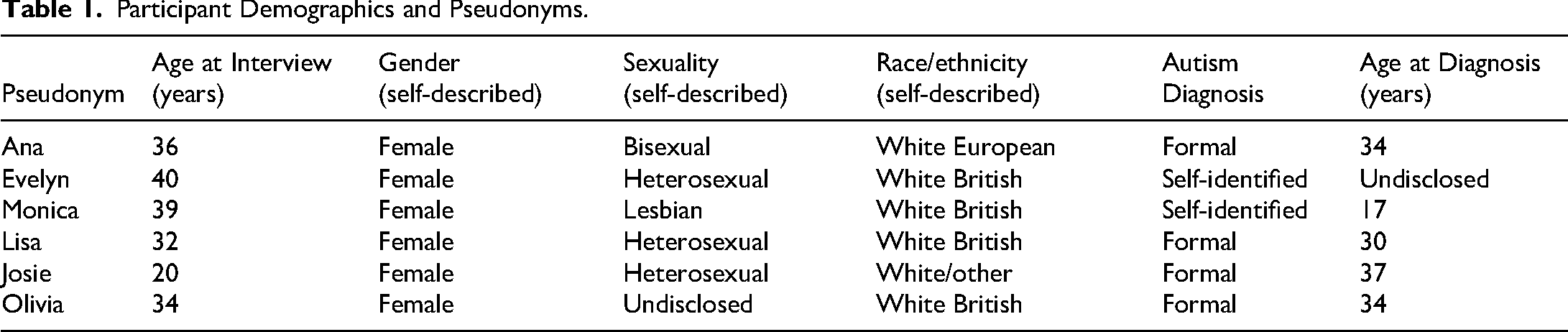
Three hundred and seven participants were recruited as part of a larger online study of gender and autism. Recruitment included advertisements across social media (Twitter/X, LinkedIn, Instagram) and undergraduate students from the authors’ current institution. Participants were given the option to provide contact information (e-mail) at the end of the larger study if they were interested in taking part in our interview study. Of the 307 participants, 97 expressed interest in the interview study and met our inclusion criteria (i.e., they were cisgender adult women who were either formally diagnosed or self-identified as autistic). Invites were sent to participants randomly selected from the eligible respondents. This resulted in six participants, allowing for manageable, rich analysis. Our small sample size was determined by our approach; interpretative phenomenological analysis (IPA) is not appropriate for use with larger samples due to the in-depth nature of the approach and its idiographic focus. We focused solely on the experiences of cisgender women as transgender women navigate additional sociocultural difficulties which warrant distinct attention to capture the complexity of their standpoint; the authors are currently addressing this as part of the larger study. Both formally diagnosed and self-identified autistic participants were included as diagnosis is unattainable for many people, especially women. Although the wider sample included women of colour, the interview sample comprised only white women due to sampling, self-selection and availability. Participant information is summarised in Table 1.
Participant Demographics and Pseudonyms.
Methodological Approach
IPA was chosen as it is situated in critical-interpretivist epistemology, allowing for the fact that each individual experience of autism is unique, but that commonalities and patterns exist among them. From the perspective of standpoint theory (Harding, 1991), knowledge is understood as reflections of cultural context, with autistic women as valid sources of knowledge of their own experiences. IPA allows us to recognise patterns and assess the meanings and motivations behind masking as a lived process shaped by gendered and sociocultural contexts. Moreover, IPA uses a double hermeneutic circle, where the participant and researchers work in conjunction with each other to make meaning from the participants’ experiences. We took this further by considering the meaning based on what was explicitly said by the participants and the societal context at the time the interpretation was made (Bertrand-Godfrey & Loewenthal, 2011). Participants occupied varied social positions, including differences in familial contexts and intersecting neurodivergent identities like attention deficit hyperactivity disorder (ADHD) and dyslexia. Consistent with standpoint theory (Harding, 1991), this intersection of identity shaped how participants experienced and interpreted masking. SDA interviewed all participants, considering these intersecting identities, and used semistructured interviews designed to guide the conversation while allowing for elaboration, collaborative interpretation and further questioning.
Procedure
In accordance with Academic Autism Spectrum Partnership in Research and Education guidelines (Nicolaidis et al., 2019), participants were offered multiple formats to interview them (i.e., in person, live video interview, asynchronous written interview). Interviews were conducted between December 2023 and February 2024. All interviewees proceeded with the interviews via Zoom. The interviewer summarised the study, assured anonymity and obtained consent with signed forms before conducting the interviews. She began the interview by taking demographic data before continuing with the interview questions (Supplemental Material S1). Each interview lasted between 32 and 41minutes (M = 36.35). SDA transcribed and deleted the recordings.
Data Analysis and Positionality
SDA analysed the data according to IPA guidelines (Pietkiewicz & Smith, 2014), focusing on the ideographic engagement of our participants’ lived experience and the personal meaning they derived from them. Each transcript was read and reread by SDA, with initial notes capturing linguistic, descriptive and conceptual observations. These notes were foundational in identifying themes that were grounded in the words used by participants but that ultimately materialised through interpretive engagement. Our analytic approach was grounded in IPA's double hermeneutic process, creating a ‘dialogue’ between us as researchers and our participants to ideographically engage with the data (Larkin & Thompson, 2012). SDA, as a nonautistic cisgender female, approached the initial analysis with a curious and reflective awareness that her own experiences and neurotypical perspective might shape how she interpreted the participants’ narratives. These interpretations and conceptualisations were discussed regularly with AP and SH, who are autistic researchers assigned female at birth. Following the initial generation of themes, the whole research team held open discussions of them in which different interpretations and perspectives were considered. This collaborative approach enhanced the interpretive engagement of the material by balancing the different perspectives (autistic and allistic) each author had to offer. Drawing on feminist standpoint theory (Harding, 1991), we recognised the value of the marginalised perspectives, particularly those of our participants: autistic women whose voices are often overlooked in mainstream research. This lens guided the development of themes grounded in gendered social expectations and structural power imbalances. For example, the concept of testimonial injustice (Fricker, 2007) heightened our sensitivity to moments where participants felt dismissed or misunderstood due to the intersection of their gender and autistic identity. Finally, SDA developed the themes ideographically by identifying initial ones within each individual account, focusing closely on their language and contextual position before looking at the participants as a whole and identifying larger cluster themes that encompassed the patterns found between participants. These themes emerged from both experiential authenticity and critical reflection. This was revised and finalised through further whole-team discussions to reach a final set of themes that depicted the shared connections between participants and their interpretations. This approach ensured that individual accounts were not lost within the group-level interpretations eventually established.
Results
The analysis of the data resulted in three group experiential themes (Figure 1). Each of these themes encapsulated the experiences of masking as told by autistic women, relating to different aspects of their lives.
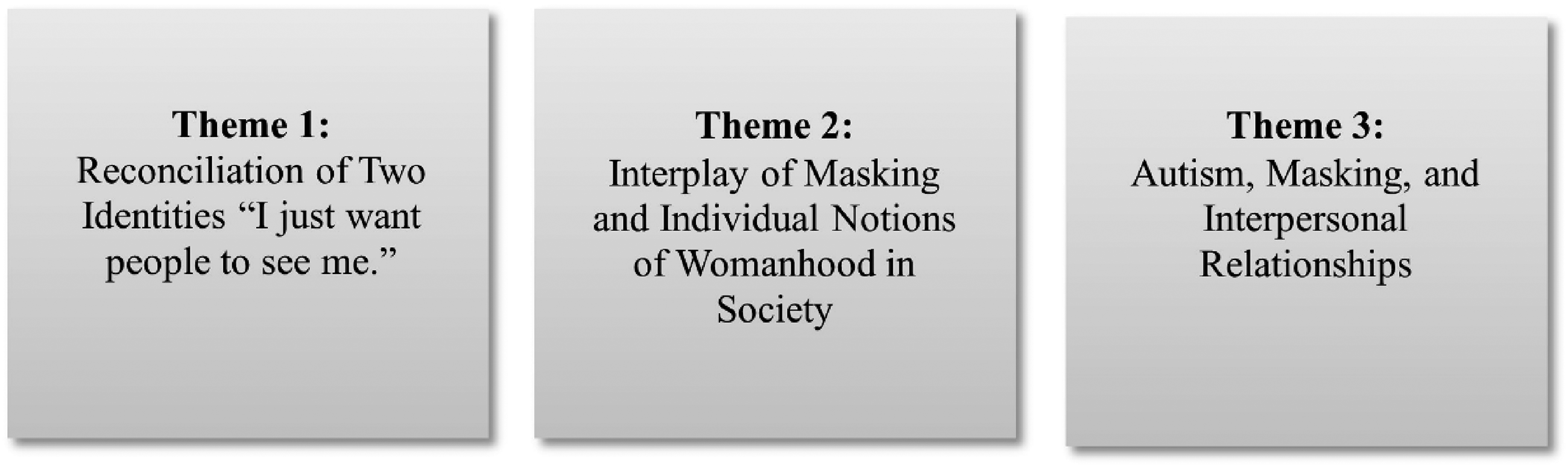
Final group experiential themes.
Theme 1: Reconciliation of Two Identities: ‘I just want people to see me’
All except one participant received their autism diagnosis in adulthood. This timing appeared central to the process of identity reconciliation. All participants expressed a sense of identity disconnection both when concealing and revealing their true autistic selves. Receiving a diagnosis in their postformative years alongside the concurrent realisation of masking prompted an introspective reexamination of past experiences through an autistic lens, intensifying uncertainty surrounding the authenticity of their presented self. Our participants also expressed a need to unveil a deeper understanding of their genuine selves ‘beyond the mask’: What I’m trying to do at the moment is really unpick what parts of my personality are me and what parts of my personality are the masked version of me and sort of learning to unmask and learning how to be myself. (Olivia)
‘Learning how to be myself’ seems to be an essential thought in the process of discerning the genuine aspects of an autistics person's identity from the masked version that has often persisted without conscious awareness. Navigating self-worth and authenticity in lieu of masking was approached in different ways within our participants. For Olivia, this involved a methodical examination of past behaviours, scrutinising the context, motivations and the potential repetition of masking. Olivia's reflection illustrates hermeneutical injustice (Fricker, 2007), where her experience is obscured by a lack of shared concepts in her wider environment. Autism is often misunderstood in women because diagnostic tools and expectations focus on male experiences. Consequently, autistic women like Olivia may struggle to discern or align their masking and true selves. Her ‘unmasking’ emphasises the dual challenge of personal discovery and navigating a social landscape that often fails to fully understand their unique experiences.
For some participants, realisation of their autism was an opportunity to understand themselves. However, others experienced self-doubt and disappointment, struggling to embody their authentic selves given the ambiguity of what authenticity really means. Lisa reflected on her past experiences through a more pessimistic lens, feeling regret for her masked actions, reinforcing a cycle of anxiety and isolation: ‘I’ve made up conversations before when people have been talking to me and I’ve not really understood what the hell is going on and I’ve like said stuff and I’m like, “oh god, why did I say that?”’
All participants expressed anxiety and self-doubt resulting from prolonged masking and discussed how it influenced their behaviour and shaped their coping mechanisms. For Lisa, ‘[making] up conversations’ in moments of confusion underscores the impact of social anxiety, where the fear of being misunderstood or saying the wrong thing becomes a driving force to mask. Similarly, Evelyn's inclination toward silence in group settings is a coping mechanism born out of this constant state of self-doubt: I sit in groups sort of not talking. Like I just try to sit there and just be ignored a little bit. Then, if they don’t talk to me, I can’t say something wrong. I can’t put my foot in it, I gotta sit there and smile, look and look. And I can’t get into trouble. (Evelyn)
The need to adopt a passive role suggests the normalisation of a behaviour born out of a prolonged necessity for self-preservation in social situations. This phenomenon may also be intertwined with gendered expectations. Brown and Gilligan (1992) discuss the expression of the ‘voice’ as being ‘unladylike’, crude or inappropriate. Ye (2013) suggests that girls internalise societal norms surrounding acceptable feminine behaviour, leading them to supress genuine thoughts and feelings. When an autistic individual encounters these norms, it may exacerbate the process of masking; this prolonged state of detachment can create a dissociative effect. Lisa's experience highlights this struggle as she grapples with the awareness of her masking and how she ‘really want[s] to be [her] authentic self’; this yearning to express her true self, despite her natural inclination to mask, illustrates the extent to which her identities have become disconnected. Her disappointment underscores the struggle to reconcile the desire for authenticity with the pressure to conform. Evelyn spoke about feeling like she was on the ‘bottom of the priority list’ within her family, with her needs and well-being mostly ignored. Gendered expectations likely play a role in these dynamics, as societal norms often dictate that women prioritise the needs of others over their own, potentially exacerbating feelings of neglect and further reinforcing the cycle of masking and dissociation.
Feeling a sense of isolation is a common experience among autistic people (Jones et al., 2022). Having an external source of support (such as a psychologist) seems to have helped Ana in learning to assert her needs effectively and has been useful in forming a therapeutic alliance. Now I’m seeing a psychologist and she's helping to find what's truly me … but also to teach me how to make myself clear and speak up when it's too much … and to find myself in some ways. Cause you’re just so used to it, to not be yourself for 34 years. (Ana)
Such external support allows participants to speak freely about issues surrounding their masking and other problems without fear of judgement, a feeling they may not have had before. We see this with Monica, who began to understand the underpinnings of her interpersonal relationships after conversations with her therapist: ‘the therapy that I had recently, I kind of realised that I don’t … when I enter into a friendship or a relationship, I never present as myself’.
Theme 2: Interplay of Masking and Individual Notions of Womanhood in Society
All our participants discussed the societal pressures of femininity, double standards compared to their autistic male counterparts and a feeling of incongruence with traditional notions of womanhood. Their accounts highlight the complex realities of navigating the intersection of autism and womanhood: ‘Well, I’ve got to be mummy, I’ve got to be Mrs. Leroy, I’ve got to be Evelyn. And I have all these hats that I’ve got to wear for other people and I sit there and I’m not me’ (Evelyn).
Evelyn's experience of ‘all these hats’ could be interpreted as an example of the triple burden, which describes how women bear diverse societal burdens, conceptualised as a combination of paid labour in formal work settings, unpaid domestic duties and additional emotional labour within the family sphere, such as managing conflicts between members (Schuldt, 2011). For autistic women, constantly adapting to meet external expectations leads to overstimulation, potentially resulting in mental and physical health challenges, possibly culminating in autistic burnout. Additionally, the expression of multiple ‘hats’ suggests that while fulfilling external expectations, there is a significant cost to Evelyn's personal identity. Similarly, Josie described how this can result in detachment from one's authentic self, resulting in difficulty in maintaining a genuine sense of identity. It doesn’t matter if all eyes are on you or not, there is a sense of performance to an extent. Like I think I can be masking and still be genuine with people. But I am putting a lot of effort in the sort of image of like a swan looking all graceful up top, and then down below, it's kicking and kicking and kicking and kicking. (Josie)
Fox (1977) describes a form of social control over women called normative restriction. This form of control is exerted via gendered norms that associate women with gentleness, kindness and noncontroversial behaviour. Consequently, women engage in daily performances that embody this internalised role-playing, reflecting the enduring societal expectation of a ‘perfect girl’. For neurotypical women, meeting this standard is mentally taxing; for autistic women, the added burden of masking as well as sensory and communication challenges intensify the struggle, contributing to burnout. The desire to fit in relates to the interplay of one's identity and how this contributes to the internal and external challenges of masking. Josie describes this well: Gloria's monologue [from the movie Barbie] where she's like, yeah, pretty, but not too pretty and you have to, you have to be a career girl but you also have to have a family but you can’t talk about family. All of those things are things that I think most women are probably thinking about all of the time and striking that balance. And that's just about, that's just about gender. I’m doing that feeling like an alien in a human suit. (Josie)
Here, Josie articulates the societal expectations and unspoken rules that create immense pressure to conform while not aligning with many autistic individuals’ communication style. Her ‘feeling like an alien in a human suit’ suggests that the everyday experiences of neurotypical women in society can be demanding on the autistic brain. This pressure to conform is reflected in participants’ accounts of feeling incongruent in the ‘typical female world’. For Ana, expressing her ‘geeky’ interests and preferences highlights the clash between their identities and societal expectations of women. She describes how she finally got ‘that cute [Pokémon] backpack’ and how it was the ‘first step to showing a bit of [her] identity’. Her gradual resistance to societal dictations on her interests demonstrates the effectiveness of her efforts in disentangling herself from the expectations of her masked persona.
For several participants, pressure to conform came directly from those around them. Ana spoke about how she felt out of place as a woman in her family. She used to ‘wiggle her feet’, but expressed that this ‘wasn’t allowed, so you learned to be quiet and nice’. Ana came to realise that these movements were stimming, which is often used to manage overwhelming sensory environments or to reduce anxiety by those with autism. As such, while stillness/quietness was expected of all women in her circle, supressing movement was particularly difficult for her. She describes how this expectation was not relayed to her autistic brother: ‘You should let him, he has autism, it’s okay, he has autism, and then for you, it’s like you should adjust’ (Ana).
Similarly, Monica recalled experiencing different reactions to autistic traits according to gender. She reflected on being afraid of being labelled ‘difficult’ in comparison to her father who was respected for having the same traits. For my dad, it works really well as a male. He's quite to the point with his character, quite frank. He can be quite rude sometimes but he can kinda get away with it … with me, if I was to be like that, which I would quite like, like I am naturally more like my dad. If I was like that all the time, I would be referred to as a real, you know, rude bitch … a difficult woman … I compensate and overcompensate for it so that I’m seen as a lovely person and a nice person so that I can fit into society a little easier. (Monica)
Monica's experience reveals testimonial injustice shaped by her gendered identity; her direct communication style is socially expected for men but stigmatised for women. Monica overcompensates for this to ensure she is seen as ‘lovely’, again demonstrating a drive to mask to fit into gendered societal moulds. When she communicates authentically, she risks being labelled a ‘rude bitch’ or a ‘difficult woman’, demonstrating how her credibility is unfairly diminished because of biased norms surrounding female conduct and communication. In sum, all participants agreed that society is generally less forgiving to women, and societal double standards push autistic women to supress their natural inclinations via masking. Moreover, many of our participants described first-hand experiences of a double standard with respect to autism, with differing expectations for autistic women compared to autistic men.
Theme 3: Autism, Masking and Interpersonal Relationships
Several participants said that new friendships and romantic partnerships were sources of anxiety, and expressed fear of unmasking in new relationships. Most participants agreed that masking is most dominant when in a new environment. This can be an unconscious behaviour, however, Monica described making a conscious effort to please those around her: I’m really good at mimicking friendships and relationships to start with. And give them what I think they want from me. But then, at some point, that slips. And I kind of default back to the things that made me feel comfortable and then that relationship or friendship just completely dissolves. (Monica)
This can lead to a clear breakdown in relationships when it becomes exhausting to maintain masking, and the outward presentation of oneself no longer aligns with what others have come to expect: I’ve always stepped in to make the other person happy. And to kind of please them and to do the things that they like and enjoy, and then what usually happens is I get about 6 months in and I can’t keep it up. I’m exhausted with it. It makes me feel unhappy because it's obviously not me. And then it just, it fractures, and it breaks and it breaks and then the worse part is I don’t know how to have that conflict resolution scale set. So then, when it does break, it breaks really badly. (Monica)
Monica explains how she masks to placate someone else in a relationship. However, exhaustion sets in and she is unable to continue masking, resulting in relationship breakdown, reinforcing the idea that masking is necessary to maintain relationships. Other participants expressed fears of the type of situation Monica describes: ‘Like a downside to unmasking is that you can potentially lose relationships’ (Olivia).
The fear of unmasking may be circumvented by a strong support system. Oftentimes, participants expressed that they felt the least need to mask when around other neurodivergent family members or friends, or around people who took the time to understand their needs. On the other hand, a handful of participants discussed the difficulties masking produced when around people who were less supportive. When asking Evelyn whether there was a situation in which she felt like she needed to mask more, she said: ‘I’m so scared of [my husband] finding out that I don’t want him to know. Yeah, definitely my husband and probably my dad. They’re probably the two people … [that I] hide myself from … I’m my dad's little girl; I want him to be proud of me. And I want my husband to love me. (Evelyn)
Evelyn's admission of fearing judgement from her husband and father reflects a common struggle amongst our participants. Her reluctance to disclose her autism to others highlights how the stigma surrounding autism can be internalised, causing autistic people to see themselves as lesser than (Pearson et al., 2024). For Evelyn, this manifests in the belief that autism makes her fundamentally unlovable and reinforces her feelings of isolation. This leads to her continual masking or, as she describes, ‘[putting] on her super armour’. We see similar notions with Lisa, whose parents seem indifferent to her diagnosis: ‘I like … asked my mom, like, was she gonna like learn about it [autism]? And she just was like, no … it just doesn’t interest her at all … she’s just not interested’ (Lisa).
Other participants discussed how having a strong support system that actively tries to understand autism and allows them to feel comfortable and heard reduced the need for masking and thus its consequences. Cage et al. (2018) reported that validation and acceptance are significant for autistic individuals to feel more comfortable in society, as exemplified by Olivia: I have my … husband who's, he's actually also neurodivergent, so he has self-diagnosed ADHD. And so that's who I kind of spend the majority of my time kind of talking about this stuff with. And I also have friends who kind of understand. You know, divergence as well. (Olivia)
Exploring feelings around interpersonal relationships allows participants to unpack the way they mask around specific people and identify in what situations they feel the need to mask the most and the least. For example, Josie described feeling less of a need to mask when around her partner, whom she views as a ‘safe space’. Her experience of masking has lessened recently, to the point where ‘masking is now something [she] switches on rather than switches off’. In contrast, Monica, Lisa, Ana and Olivia expressed being unable to unmask except when alone, perpetuating both the isolation and physical exhaustion that masking can cause. This highlights the impact of masking on interpersonal dynamics, underscoring the difficulties in fostering genuine connections when authenticity is hindered. Josie's experience emphasises the potential influence of a supportive environment in mitigating the effects of masking, shedding light on the need for understanding and acceptance within relationships with individuals on the autism spectrum.
Discussion
The present study examined the motivation for masking in autistic women and explored the intersectional aspect by which different identities interact to inform masking. Using IPA, three themes arose: reconciling the ‘masked’ and ‘unmasked’ self, masking and individual notions of womanhood and the effect of masking on interpersonal relationships.
Participants’ responses conveyed a profound sense of detachment between their outwardly projected personas (the masked self) and their genuine self (the unmasked self). All participants struggled with deciphering which aspects of their personality were genuine and which were merely adaptations to societal expectations. In line with arguments made by several feminist scholars (e.g., Jack, 2012; Moore et al., 2022; Pearson & Rose, 2021), societal gender norms consistently informed masking among the autistic women. This underscores the importance of considering the impact of gendered norms and expectations on masking for autistic women. The experience and impact of masking cannot be truly understood without considering how an individual's multiple identities (in this case, being autistic and female) intersect and influence their behaviours.
Several participants discussed challenges arising from societal expectations, gendered double standards and the inherent incongruity between personal identity and societal norms. Their accounts shed light on the pressure autistic women feel to adhere to social ideals of femininity, often resulting in a struggle to reconcile their authentic selves with societal norms. Some participants used this as an opportunity to resist conforming to social expectations by openly engaging with and expressing their interests to others. These differing approaches suggest that masking operates as a site of tension, on one side creating confusion and an erosion of identity, and on the other, functioning as a strategic performance of normative femininity. This tension can be understood as a form of double consciousness (Du Bois, 1897) in which autistic women simultaneously find themselves at odds with femininity while also developing skill in performing it as a social survival strategy. However, in doing so, participants often reported an accentuated feeling of alienation from neurotypical women. This may be understood through feminist theories of gender policing which suggest neurotypical women are often positioned as enforcers of normative femininity. Bordo (2003) contends that patriarchal power is maintained through women's internalisation of beauty norms, positioning them as enforcers of bodily regulations. In this way, the female body becomes a vessel where culturally prescribed ideals of beauty, diet and exercise are repeatedly reinforced (Deliovsky, 2008). While the studies referenced here focus on aesthetic norms, this framework may be extended to behavioural expectations and norms of femininity upheld by white, neurotypical women as key arbiters of acceptable feminine conduct, which autistic women may struggle to meet. As such, it is evident that taking a feminism-informed approach and challenging traditional gender norms, as well as fostering understanding and acceptance of neurodiversity in the wider environment, can facilitate and empower autistic women to embrace their authentic selves without fear of judgement.
There was a prevailing sense amongst the participants that masking transcends the individual, creating a significant barrier to genuine connections. Several participants described feeling a strong need to present their ‘best self’ in relationships, often masking aspects of their autistic identity that they feared might be seen as ‘undesirable’ by others. This reflects a common sentiment where masking becomes a way to navigate the vulnerability of new connections. Cook et al. (2021) describe this ‘impression management’ as an essential strategy in building initial relationships, noting that unfamiliar individuals are more likely to be critical of behaviour that deviates from social norms. While some of the autistic women described safe spaces within certain relationships, both intimate and otherwise, others described relying on masking out of fear that revealing their ‘true selves’ might shatter the image they have cultivated. Moreover, several participants described a struggle to sustain the personas they had created by masking, eventually culminating in the breakdown of relationships. This underscores the need for effective support systems to help manage these challenges for all autistic people regardless of gender. In emphasising the crucial role of support systems, this study highlights the importance of mitigating the effects of masking on interpersonal relationships. Particularly notable is the observation that individuals feel the least need to mask in the presence of supportive individuals who comprehend their needs and challenges, underscoring the importance of understanding and acceptance within relationships.
Several participants expressed the need to mask more during formal work settings. Their comments align with Cage & Troxell-Whitman (2019)), who suggested that autistic women tend to mask in these more ‘established’ settings, where (often unspoken) norms regarding behaviour are present. Indeed, several of our participants described their masking as dynamic and capable of changing depending on the social context. For autistic women, this constant adaptation is often driven by societal pressures and the need to avoid judgment or exclusion for their perceived lack of femininity (i.e., pariah femininity; Russell, 2021). A pervasive lack of awareness and unforgiving gendered social standards imposed on autistic women in settings such as work may exacerbate the need for masking, a prevailing sentiment agreed upon by several participants.
Our study shows that while masking can serve as a strategy to help all autistic people to avoid stigma in a predominantly neurotypical society, other barriers faced specifically by autistic women are harder to overcome. For example, several participants expressed a feeling of disconnect between themselves and neurotypical women. Similar findings were reported by Davidson (2007), who showed that autistic women feel a profound sense of distance from both autistic men and the stereotypes of femininity surrounding neurotypical women. In our study, Ana expressed a desire to pursue ‘geeky stuff’ but felt compelled to mask her interests due to their perceived lack of femininity, despite feeling disconnected from conventional feminine roles. Similarly, Lisa found herself assuming she ‘would get … married and have children’ despite this ‘not [being] something [she's] ever really wanted’. It is important to acknowledge here that this analysis is based exclusively on the experiences of white Anglo-European women. The feminine ideals our participants have described – pursuing ‘feminine’ rather than ‘geeky’ interests, expectations around marriage and motherhood – reflect what Deliovsky (2008) terms ‘normative white femininity’. Lisa's pressure to marry and have children exemplifies white heteronormative expectations where white women are positioned as the benchmark of white respectability. The pressure to mask their true desires whilst grappling with the fear of subverting societal expectations can exacerbate feelings of alienation from neurotypical women, supporting findings by Jack (2012). It is likely that autistic women from racialised and/or other sex and gender minorities encounter further barriers and unique forms of stigma, and as such, further research from an intersectional perspective is crucial.
Clinical Implications Toward Neuro-Affirming Practice
Several participants described therapists/psychologists as crucial in their exploration of identity. This suggests neuro-affirmative clinicians can play a key role in supporting self-acceptance. However, Ana's language of being taught how to navigate social contexts raises questions about therapeutic goals inadvertently reproducing normative expectations. While it functions for her as a form of validation and assistance, this may risk replicating wider power dynamics in which autistic women are positioned as inferior in relation to normative femininity. Moore et al. (2024) argue that professional practices can unintentionally reinforce gendered expectations by framing conformity as progress. Here, the clinician may subtly guide autistic women toward socially acceptable performances of femininity. Clinicians may choose to instead validate one's autistic identity and create a space where norms are explored and questioned.
Limitations
It is important to note that our sample predominantly consisted of white British individuals, with only one participant identifying as white European. Consequently, this study offers limited perspectives on how cultural identities intersect with masking. There remains a significant gap in research exploring the experiences of female people of colour (POC) generally, as well as of autistic POC and their experiences with masking. As Radulski (2022) explains, the dominance of white, Eurocentric cultural norms forces POC to adjust their behaviour, language and presentation to align with these standards. Already hyper-visible in predominantly white societies, POC who display autistic behaviours face additional challenges, all while navigating distinct cultural and gendered expectations placed upon them. Future studies should prioritise the examination of cultural influences on identity and their effect on masking in autistic women.
Conclusions
This study highlights the importance of exploring the lived experiences of masking among autistic women. The findings from this study indicate that prolonged masking can result in an erosion of identity, with significant repercussions for both mental and physical well-being. Masking is inextricably linked with one's sense of self, with gender norms playing a pivotal role in shaping masking among autistic women; furthermore, cultivating a supportive atmosphere for autistic women can reduce the need for masking. We emphasise the necessity of subverting gendered stereotypes to foster an inclusive environment where autistic women can flourish without fear of societal judgement.
Supplemental Material
sj-docx-1-fap-10.1177_09593535261445110 - Supplemental material for ‘And that’s Just About Gender … I'm Doing all of that Feeling Like an Alien in a Human Suit': Exploring the Lived Experiences of Masking in Autistic Women
Supplemental material, sj-docx-1-fap-10.1177_09593535261445110 for ‘And that’s Just About Gender … I'm Doing all of that Feeling Like an Alien in a Human Suit': Exploring the Lived Experiences of Masking in Autistic Women by Sumeera De Alwis, Amy Pearson and Sophie Hodgetts in Feminism & Psychology
Footnotes
Acknowledgements
The authors would like to thank the people who kindly gave their time and shared their experiences with us during the study.

Ethical Considerations
This study received ethical approval from the University of Durham’s Research Ethics Subcommittee (PSYCH-2023-10-10T12_52_00). All participants were assigned a pseudonym to ensure anonymity throughout the process. All participants provided informed consent verbally prior to beginning their interview.
Funding
The authors received no financial support for the research, authorship, and/or publication of this article.
Declaration of Conflicting Interests
The authors declared no potential conflicts of interest with respect to the research, authorship, and/or publication of this article.
Data Availability Statement
Data cannot be shared publicly because of the risk of participant identification (given the small samples, elements of the data could, in combination, become identifying) and restrictions that were subsequently imposed by the Research Ethics Committee of the authors’ institution. Participants did not consent to data being shared publicly, only to the possible sharing of their data with other researchers directly, that is, by request. Requests may be made to the Durham University’s Psychology Research Ethics Committee (contact via psychology.ethics@durham.ac.uk) for researchers who meet the criteria for access to confidential data.
Supplemental Material
Supplemental material for this article is available online.
Author Biographies
References
Supplementary Material
Please find the following supplemental material available below.
For Open Access articles published under a Creative Commons License, all supplemental material carries the same license as the article it is associated with.
For non-Open Access articles published, all supplemental material carries a non-exclusive license, and permission requests for re-use of supplemental material or any part of supplemental material shall be sent directly to the copyright owner as specified in the copyright notice associated with the article.
