







Abstract
In Latin America, the Judeo-Christian cis-heteronormative model remains a central framework regulating social, legal, and cultural norms around sexual orientation and gender, systematically excluding LGBT+ people from recognition within parenthood institutions. Drawing on an intersectional feminist perspective, we examine the barriers faced by lesbian, bisexual, and trans women in accessing, imagining, and experiencing mothering under conditions of structural exclusion. A qualitative approach was adopted, using semi-structured interviews and the Intersectional Loom to analyze how participants’ social identities shape these experiences. The analytic sample comprised seven participants from Chile and Mexico. Findings reveal multiple pathways to mothering, including previous heterosexual relationships, adoption, co-parenting agreements, and assisted reproductive technologies. Across these trajectories, participants described persistent constraints such as legal vulnerability, stigma, and limited institutional support. Despite the flexibility and adaptability reflected in these experiences, access to mothering remains unevenly shaped by legal, social, and cultural conditions. The participants’ narratives highlight alternative arrangements of care alongside enduring forms of moral scrutiny and unequal recognition, particularly affecting trans women. Overall, the findings underscore the need for legal reforms to ensure equal access to parental rights for LGBT+ families.
Scholarship on sexual and gender diverse parenting has largely centered on white, middle-class populations in Anglo-Saxon contexts (McKenzie, 2022; Reczek, 2020). It has also tended to privilege lesbian motherhood, leaving bisexual mothering largely invisible and framing trans motherhood as exceptional or marginal, thus reproducing hierarchies of recognition within the field itself (Jiménez, 2021; Reczek, 2020). In this article, we respond to these oversights, investigating the negotiation of mothering under conditions of partial, fragmented, or absent legal recognition, focusing on lesbian, bisexual, and trans (LBT) women in Chile and Mexico, and taking an intersectional feminist perspective (Crenshaw, 1991; Hancock, 2007).
Our aim is to expand and add nuance to understandings of the structural barriers encountered by diverse families and highlight the tactics of resistance and support networks that strengthen these women's resilience. An intersectional approach also allows us to examine how social identities—such as sexual orientation, gender identity, social class, and cultural context—shape mothering experiences. We attend to these subjectivities in relation to one another, making visible both shared structural constraints and the differentiated ways in which such experiences are lived and negotiated, without assuming uniformity across positions. An intersectional feminist perspective enables the production of situated knowledge grounded in Latin American contexts, where social, legal, and cultural configurations differ markedly from dominant Global North frameworks where most research has been conducted.
Finally, focusing on these forms of mothering allows us to document distinct practices of resistance, agency, and family reconfiguration that emerge from differently positioned margins. Some forms of mothering may achieve conditional recognition through alignment with normative expectations of femininity and care; while others remain more persistently contested, particularly those involving trans women. Examining these differentiated experiences contributes to understanding how counter-hegemonic mothering is unevenly lived and negotiated.
Intersectionality and Counter-Hegemonic Mothering
Our study is grounded in a feminist and intersectional framework that conceptualizes motherhood as a social and cultural mandate operating as an imperative within cis-heteronormative structures, where it functions as a central category for defining femininity in the Latin American context (Castañeda-Rentería, 2020). This mandate imposes normative expectations regarding what it means to be a “good mother,” including ideals of self-sacrifice, intensive emotional and temporal dedication, the naturalization of maternal care, the primacy of biological ties, and the attribution of primary responsibility for children's well-being to mothers, with limited recognition of structural or institutional support (O’Reilly, 2016; Rich, 1995). Women who do not conform to these norms—by choice, circumstance, or social position—are often subject to moral judgment and stigmatization. From a feminist perspective, we make a distinction between the mandate of motherhood as a social institution, and mothering as a historically situated practice shaped by power relations, normative expectations, and social inequalities.
Drawing on intersectional feminism (Crenshaw, 1991; Hancock, 2007), we conceptualize mothering among women with diverse sexual and gender identities as an embodied and relational practice shaped by the interaction of multiple axes of power, including gender identity, sexual orientation, class, legal status, and sociocultural context. Intersectionality allows us to examine not only shared experiences of exclusion, but also the differentiated ways in which this form of mothering is enabled or constrained across Latin America.
Historically, motherhood in the region has been organized around a dominant family model rooted in Judeo-Christian and cis-heteronormative assumptions, which positions biological reproduction within heterosexual and monogamous marriage as the legitimate foundation of family life. As Butler (2006) argues, kinship norms function as regulatory frameworks that define which forms of intimacy, reproduction, and care are socially intelligible and legally recognizable. Within this framework, sexually and gender diverse women and other non-normative family configurations are frequently positioned outside the boundaries of legitimate motherhood, facing symbolic delegitimation alongside legal and material exclusion.
We approach LBT women's mothering as counter-hegemonic, understood not merely as an alternative family arrangement, but as a set of practices that actively contest dominant norms through which kinship, reproduction, and parental legitimacy are regulated. Building on feminist and queer scholarship on non-normative parenting (Park, 2020; Reczek, 2020; Trujillo & Abril, 2020), counter-hegemonic mothering is conceptualized here as an active process through which institutionalized assumptions about who can mother, under what conditions, and with which forms of recognition are contested.
Following an intersectional approach, we do not conceptualize counter-hegemonic mothering as a homogeneous or uniformly resistant experience. Rather, we attend to the differentiated ways in which structural barriers and possibilities are experienced among this group, particularly along lines of gender, class, and legal, social and cultural context. While some lesbian and bisexual women may access forms of social “camouflage” that allow them to navigate mothering with relative social legibility, trans women often face heightened levels of surveillance, legal erasure, and stigmatization that profoundly constrain their parental trajectories (Jiménez, 2021).
Our analysis focuses on how the participants articulate their mothering practices in relation to structural barriers, everyday discrimination, and practices of resistance. Structural barriers refer to the legal, social, and cultural conditions that restrict access to mothering and parental rights. Practices of resistance are understood as a set of everyday ways in which they navigate, negotiate, and sometimes subvert dominant norms surrounding motherhood. Drawing on de Certeau (2000), these practices are conceptualized as tactics—situated forms of agency enacted within the constraints imposed by dominant power structures and operating in the interstices of institutional strategies that are planned, coordinated, and systematically reproduced. These concepts guide our analytic strategy and inform the interpretation of participants’ narratives throughout the analysis.
The Latin American context
In Latin America, social, legal, and cultural norms related to gender and sexuality continue to be shaped by a hegemonic family model grounded in Judeo-Christian traditions and cis-heteronormative assumptions. Rooted in colonial legacies (Gómez, 2009), this model enforces a binary and essentialist understanding of gender, recognizing only two social identities as legitimate: female and male. Within this normative order, sexual and affective attraction is strictly prescribed as a binary of opposites, rendering any orientation outside heterosexuality as invisible or deviant (Mann, 2012). Consequently, individuals are expected to conform to three interrelated mandates, namely, to be (a) cisgender and (b) heterosexual, and (c) to conform to the hegemonic family life cycle norm of forming a couple, getting married, having children, and forming a family (Castañeda-Rentería, 2016).
By positioning this arrangement as the only legitimate and socially sanctioned form of kinship, this dominant family model systematically excludes lesbian, gay, bisexual, trans, and other gender or sexually diverse people from full recognition within parenthood and family institutions. This exclusion materializes in a range of legal, social, and psychological constraints, including restrictions on the legal recognition of filiation and parenting, obstacles to registering children and accessing assisted reproduction, the persistence of so-called conversion therapies, and limited access to justice in cases of discrimination related to family and parental rights (Butler, 2006; Castañeda-Rentería, 2016; Del Villar & Astudillo, 2024). Together, these constraints produce unequal conditions of access to mothering and parental recognition in Latin American contexts (Alday-Mondaca, 2022; Alday-Mondaca et al., 2025).
The persistence of the cisheteronormative family model is deeply intertwined with the historical and ongoing influence of religious traditions, particularly Catholic and Evangelical Christianity, that continue to shape moral discourses on gender and sexuality in the region (Alday-Mondaca, 2022; Delgado & Madriz, 2014; Gómez, 2009). In contrast to many Global North contexts—in which the expansion of LGBT+ family rights has occurred alongside processes of secularization— religious and moral norms in Latin America remain powerful regulatory forces. As a result, access to parenthood is shaped not only by formal legal frameworks, but also by enduring moral regimes that delimit the conditions under which parenting becomes socially and institutionally recognizable.
The data analyzed in this study were produced between 2018 and 2020, a period marked by significant differences in the legal regulation of LGBT+ rights, across the countries included. In Chile, this period precedes the approval of the gender identity and marriage equality laws, situating participants’ experiences within a context of limited formal recognition for LGBT+ families. In Mexico, by contrast, the legal landscape was characterized by marked regional heterogeneity: although same-sex marriage had been recognized in some states, the absence of a homogeneous regulatory framework governing adoption, assisted reproduction, and parental recognition produced unequal conditions for the recognition and realization of parenthood, particularly outside the capital of the country. Attending to this shared yet differentiated temporal context allows us to examine how the participants negotiated motherhood under conditions of partial, fragmented, or absent legal recognition.
Methodology
The research team brings together four women academics, two in Chile and two in Mexico, with diverse positionalities in relation to motherhood and sexual and gender diversity. Our feminist commitments and research trajectories in the fields of gender, sexuality, and family studies informed both the study design and interpretation of the data. We used a qualitative holistic multiple-case study design (Flyvbjerg, 2004; Yin, 2008), which enables an in-depth and context-sensitive examination of parenting experiences within their social, legal, and cultural contexts. The research design was flexible and iterative, combining an abductive analytic logic with an emergent approach that allowed analytic categories to be refined in response to the data (Verd, 2021).
Participants
The broader study employed a socio-structural sampling strategy (Mejía, 2000) (see Figure 1 for a schematic representation of the sampling approach) aimed at capturing structural diversity in parenting experiences among sexually and gender diverse people across different social, legal, and cultural contexts in Latin America. The larger study included gay men, lesbian women, bisexual people, and trans participants. The current article focuses specifically on the experiences of LBT women in order to examine the gendered dimensions of counter-hegemonic mothering. The inclusion criteria for participation in this sub-sample were that participants had to (a) identify as lesbian, bisexual, and/or transgender women; and (b) be currently mothering or expressing a desire to become a mother in a Latin American context.
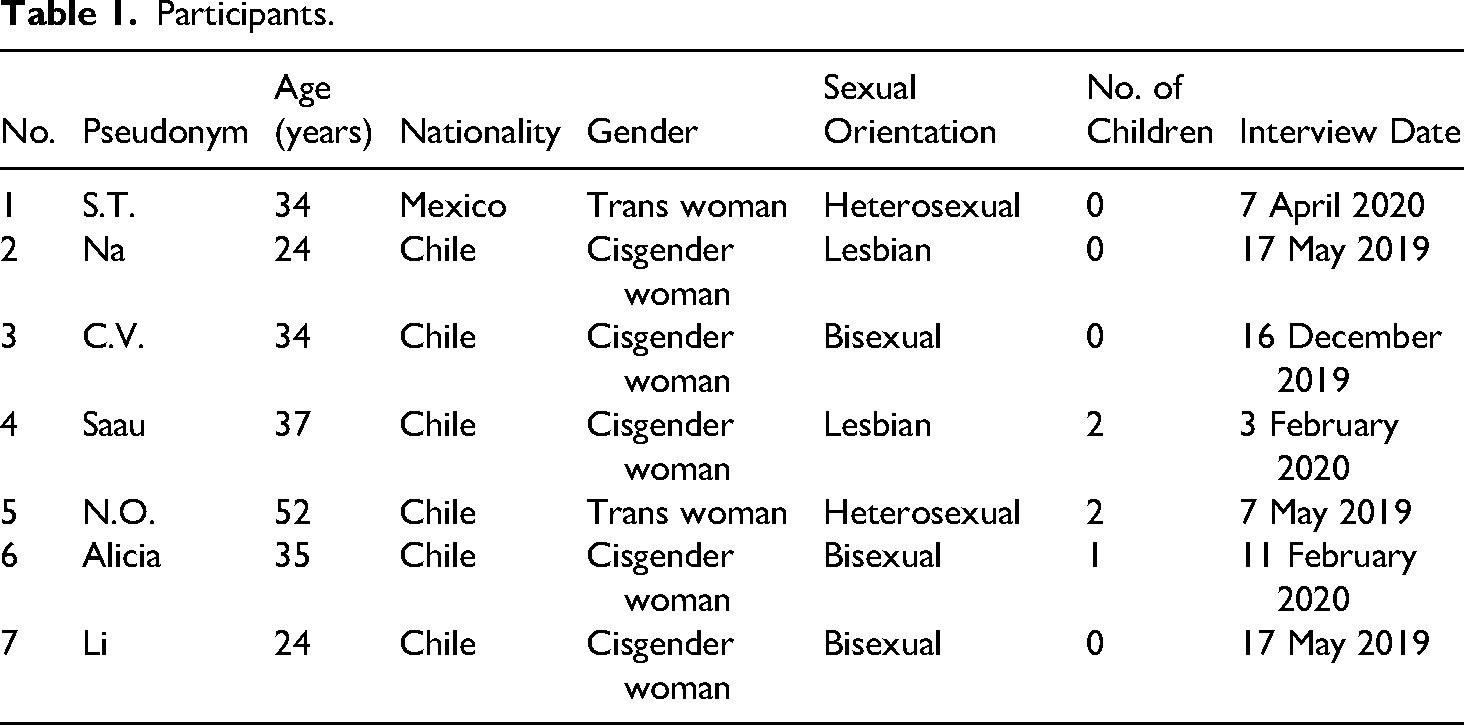
The participant group consisted of seven women from Chile and Mexico who identified as lesbian, bisexual, or trans. The group included two trans women and five cisgender women. In terms of sexual identity, two participants self-identified as lesbian, three as bisexual, and two as heterosexual. The participants’ ages ranged from 24 to 52 years (M = 34.29, SD = 9.4). All gender identities and sexual orientations reported correspond to participants’ self-identification, in accordance with feminist and ethical research principles. Finally, three of the participants were mothers, achieved via assisted reproductive technology, intrafamilial adoption, and a previous heterosexual relationship, respectively. These characteristics are summarized in Table 1 below.
Participants.
Data Generation
Data were produced using two qualitative tactics (de Certeau, 2000): semi-structured interviews and the Intersectional Loom. The interviews were conducted by the first author in Spanish between 2018 and 2020, either in-person or virtually depending on participants’ availability and COVID-19-related restrictions, and were audio-recorded. Interviews focused on the participants’ experiences and expectations regarding motherhood, pathways to mothering, mothering conditions, and perceived social, legal, and cultural barriers. During the interviews, participants were also invited to reflect on the idea that individuals occupy multiple social identities and on how these enable or constrain their access to rights and social benefits in different contexts. Using accessible examples, the participants discussed identities relevant to their mothering experiences—such as gender identity, sexual orientation, and socioeconomic position—and reflected on how these intersected and were hierarchically organized according to perceived levels of access or restriction, which were narratively mapped within the Intersectional Loom.
The Intersectional Loom is a qualitative methodological tool for data production and analysis designed to identify how social identities and positions intersect with structures of power to shape lived experiences (Alday-Mondaca & Lay-Lisboa, 2022a, 2022b). This tool also served as an analytic scaffold for subsequent stages of analysis, informing the refinement of analytic categories and enabling a deeper exploration of how intersecting identities shaped participants’ mothering experiences.
Using the Intersectional Loom as a methodological tactic (de Certeau, 2000), enabled a participatory and reflective process through which participants actively engaged in the articulation of their own experiences and positionalities. This contributed to a more horizontal and dialogical research process, in which meaning was not solely produced by researchers but co-constructed in interaction. In addition, as per the notion of in/visible tools (Reyes, 2020), we note that our positionalities also shaped the research encounters. Conducting the study within the same national contexts as participants, and in some cases from positions of proximity to sexual and gender diversity, facilitated rapport, trust, and the articulation of experiences that might otherwise remain unspoken. At the same time, differences in experience and positioning enabled critical distance and reflexive interrogation of the data.
Data Analysis
The interviews were transcribed verbatim and anonymized for analysis.
Guided by an intersectional feminist perspective (Crenshaw, 1991; Hancock, 2007), we examined how multiple axes of power—such as gender, sexual orientation, and socioeconomic conditions—intersect to shape participants’ mothering experiences. In practice, the Constant Comparative Method, rooted in grounded theory, guided the analysis process (Piovani & Krawczyk, 2017). Throughout the analytic process, constant comparison was applied by continuously contrasting new data with previously coded material. This iterative movement between data and analysis allowed categories to be refined, expanded, or redefined, ensuring that interpretations remained grounded in participants’ accounts.
Analysis began with inductive open coding of interview transcripts to identify significant concepts, meanings, and recurring themes related to the participants’ mothering experiences. Codes were generated from the data and remained open to revision throughout the analytic process. As analysis progressed, axial and selective coding were used to organize and integrate codes into broader analytic categories, examining how different dimensions of mothering experiences were shaped by structural barriers, everyday discrimination, and tactics of resistance. These procedures enabled the refinement of the core categories that structure the Findings section.
To enhance analytic rigor and reflexivity, our analysis was collaborative—moving between individual coding and collective debriefing sessions—allowing dialogue that helped us to balance proximity with analytical distance, ensuring that we did not project our own experiences, assumptions, or commitments onto the participants’ narratives.
This process was enhanced by working across contexts marked by varying degrees of institutional conservatism and shifting legal frameworks, which shaped our sensitivity to normative assumptions surrounding motherhood. This perspective allowed us to identify subtle forms of heteronormative regulation that are often naturalized in these regional settings, informing the formulation of interview questions, orienting our attention to specific forms of marginalization—such as bi-invisibility—and prompting us to revisit initial interpretations throughout the analytical process.
In addition, we shared our preliminary interpretations and analytic summaries with the participants for feedback. Although no substantive corrections were proposed, the participants offered comments reflecting recognition of their experiences and emotional engagement with the narratives. This feedback process allowed meanings to be to be negotiated, affirmed, and contextualized, in dialogue with participants, contributing to the refinement of analytic categories and strengthening the credibility of the findings.
Finally, maintaining a reflexive stance was essential to avoiding both the idealization and the pathologization of counter-hegemonic mothering practices. This involved ongoing attentiveness to how our own positionalities and commitments shaped the interpretation of the data, as well as to the ethical tensions involved in making visible experiences marked by structural inequality.
Ethical Considerations
The study received ethical approval from the Ethics Committee of the Universidad Católica del Norte, Chile (Resolution 039/2017), and we complied with all ethical requirements necessary to safeguard participants’ rights. Before each interview, we obtained written informed consent. We also ensured confidentiality through the use of pseudonyms chosen by the participants themselves, as well as a coding system designed to protect participants’ identities. Given the sensitivity of the topics addressed, we offered participants the possibility of accessing virtual or in-person psychological support after the interview, arranged with the support of the Centro de Intervención y Asesoría Psicosocial [Centre for Psychosocial Intervention and Counselling] affiliated with the School of Psychology at the Universidad Católica del Norte.
Findings
We present the results in three main sections, namely: (a) Pathways to mothering in the sexual and gender diverse community, (b) Discourses related to being a diverse family, and (c) Social vulnerabilities faced by LBT women in their mothering experiences.
Pathways to Mothering in the Sexual and Gender Diverse Community
Participants’ accounts show that access to mothering unfolds along a continuum of diverse trajectories, shaped by sexual orientation, gender identity, and socio-structural conditions. The pathways we identified include previous heterosexual relationships, intrafamilial and extrafamilial adoption, co-parenting arrangements, in vitro fertilization (IVF), and reproductive experiences among trans people. Each trajectory is marked by legal, social, and affective tensions—emotionally and relationally charged experiences produced by legal precarity, moral judgment, and uncertainty around parental recognition—which complicate, and at times render precarious, mothering outside the cis-heteronormative model.
Access to mothering through previous heterosexual relationships—understood here as relationships socially read and institutionally regulated as such, regardless of the sexual identities of the partners involved—emerged as one of the most frequently mentioned pathways. As noted by a heterosexual trans woman participant: “Many women and many gay men, lesbians, and trans people had a hetero-cis marriage, and that is how they currently engage in mothering or fathering” 1 (S.T., Mexico).
Another pathway identified by participants was adoption. They distinguished between intrafamilial adoption, involving custody transfer within the family, and extrafamilial adoption, through which a legal bond is established with a child without a direct biological link. Although intrafamilial adoption can facilitate integration into family bonds, it is not free from obstacles. One heterosexual trans woman participant recalled: Everyone knew he was our son … we named him and everything, but we had to register him under my sister-in-law's name, yes, that she was the mother, because they would ask me for my ID, and my ID did not say [Name] at that time. (N.O., Chile) Yeah, well, for example, if you try to adopt a child, they also give you a hard time. It's like, “No, because you’re a homosexual couple, you can’t adopt,” and that's something you think about too. I mean, there's a difficulty there as well. (Na, Chile) I have another friend [a trans woman] who… before she had her vaginoplasty, she wanted to become a mother, so the only way she could do it—so she could have the right—was to contribute her sperm and do it with this in vitro thing, with a woman she already knew, who… was a drug user… but she had to register her under her male name, as the father of the baby, so she could keep the baby. (N.O., Chile) A couple of friends… they offered to donate sperm to us… but we really didn’t want to. Our option was always an unknown donor. Mainly because same-sex parenting is not considered valid. So, what happens if they want to take your child away? Imagine—even if he's your best friend. There are even cases where cousins are donors. The issue is that you don’t know what might happen in the future. So, we said, “No. Better to do it this other way, so that one day they don’t come and try to take the child from us.” (Saau, Chile) Regarding fertility treatment covered by FONASA… access is still conditioned on being married to a man. So single women and women married to other women can’t access the benefits that FONASA offers. I remember it caused a lot of controversy, and honestly, it felt pretty awful. (Na, Chile) This happens at every level…everything is easier if you have more money. Not anyone can afford what some of us have paid. We’ve gone through three treatments, and that's a huge amount of money. (Saau, Chile) They [a lesbian woman and a trans woman] have been together for many years, in a very open relationship, and they have… several children and have registered them as their children, but the trans woman doesn’t have a legal identity as a woman, so they haven’t had problems registering them. (S.T., Mexico)
Discourses Related to Being a Diverse Family
In the process of family formation in contexts of sexual and gender diversity, participants described processes of self-definition through which they actively shape their own family identities. Three recurring themes emerged from participants’ accounts: flexibility in gender roles, the relevance of tribal/community support networks, and processes of counter-hegemonic generational reconfiguration of family meanings and practices.
Within the family configurations described by participants, caregiving roles tend to be more flexible, although this flexibility should not be understood as the absence of roles, hierarchies, or normative expectations within same-gender relationships. Participants’ narratives point to a reconfiguration of gendered expectations surrounding parenthood, whereby traditional divisions between provider and caregiver are questioned and renegotiated, opening up possibilities to redistribute responsibilities and challenge taken-for-granted assumptions about gender and parenting.
In this sense, a cisgender bisexual participant articulated how conceptualizing motherhood within non-heterosexual relational configurations allowed her to envision family life as a shared, collective project rather than a dyadic and gender-hierarchized one. Her reflection below illustrates how the possibility of “two mothers” disrupts normative expectations that assign caregiving primarily to women and paid labor to men, revealing the socially constructed character of gendered responsibilities: I was in a relationship with a woman while being with a man, as a couple, and I thought, “If I get pregnant by my partner while being in this relationship with this other woman… how beautiful it would be for the child to have two mothers!” You know? It feels like a form of tribal support (…) It also has to do with the position given to the role of the man in fathering versus the woman. Considering that women are assigned greater responsibility for the baby when they are born, responsibility for the baby itself. It's not that responsibility is taken away from the father in economic terms, as a provider, so to speak. But in that sense, I do see a gender difference (…) It's like the man is told, “You have to go to work, while your woman stays at home taking care of the baby.” [And would the experience be different if there were two mothers?] Because then, who is the one who is supposed to go to work? (C.V., Chile)
This critical awareness is also grounded in the lived experience of difference. As a cisgender bisexual participant reflected, being positioned as sexually diverse entails navigating a persistent sense of exposure that, over time, fosters a different way of understanding relationships, dependency, and family life: Being diverse means you feel constantly confronted; you are someone with a kind of visible wound—even if it's not directly seen, you see it yourself, and you carry that wound. You build yourself through that wound, through that way of being and feeling different. It gives you a different understanding of things, a different worldview (…) You become more aware that it's not only about being with a man, or about economic conditions, that you don’t necessarily have to be tied to a provider, so to speak; there are other kinds of dependency, and other ways of being with someone as well. (Alicia, Chile)
The personal and generational experiences described above suggest a counter-hegemonic reconfiguration of family models, grounded in lived experiences of exclusion, discrimination, and intergenerational rupture linked to histories of familial rejection. As expressed by a heterosexual trans participant: “We’re going to be better parents—better mothers or better fathers—than maybe our own parents were when they found out who we were and kicked us out of our house” (N.O., Chile).
At the same time, participants’ narratives also point to tensions between these transformative aspirations and dominant normative understandings of family. For some participants, there is no substantive difference between a family formed by a cisgender heterosexual couple and one from the sexual and gender diverse community as long as support networks exist to accompany parenting. This position was articulated by a cisgender lesbian participant as follows: I think it's exactly the same, because we’ve seen it… we have a group of friends, seven of us, and we’re all at the same stage, with all the children around the same age… because now straight people also plan. (Saau, Chile)
Social Vulnerabilities
LBT women face several social vulnerabilities in their mothering experiences, including barriers related to access to information, social stigma, and internalized discrimination (Alday-Mondaca et al., 2024). Limited access to formal support networks can make mothering more difficult. In this context, participants described social networks and online platforms as key resources for accessing information, advice, and rights-related knowledge that would otherwise remain unavailable. These digital spaces operate as informal infrastructures of support, facilitating connection and the circulation of experiential knowledge beyond institutional channels, as highlighted by a cisgender bisexual participant: Knowing that there are people like you; and I’ve found that through Facebook… [the internet] is a democratizing resource… Through social networks there's a lot of information available now, whereas before social media, it was difficult to make connections…honestly, besides meeting people that way, I don’t know of any other resource… It's still complicated, because now on Facebook, Grinder, and all those things, you have huge access; the apps, and the organizations now all have Facebook groups where you can ask for help. I think social media is fundamental for the current access we have to rights—it's wonderful. (Alicia, Chile) The issue of prejudice, social stigmas. To this day we still carry the stigma that “because you’re part of the sexual diversity population, at some point your perversion will surface and you’ll do something to children”… the stigma that people from the sexual diversity population only think about going out, having fun, or having sex, and we don’t think about the future, we don’t plan to have a family… when in reality there are many of us who do plan for the future, who do see ourselves forming a family. (S.T., Mexico) Up until about ten years ago, most of my friends, when I told them, “Well, it would be cool to have kids,” they would say, “No, because for us, we already like to party, we like to go out drinking, have casual sex,” and I started to change that mentality, and you realize, “It's like they give us the manual for how we should behave, how we should see ourselves, how we should live ourselves,” and we start hiding that part of our personality… we go along with it, with what the majority apparently perceives. When I realized this, I said, “Forget the stereotypes, forget the idea that because I’m a trans woman I have to dress provocatively and can’t think about having children or a family,” when that's what I’d wanted for a very long time. (S.T., Mexico)
Contrasts Between Lesbian, Bisexual, and Trans Mothering Experiences
Our findings suggest that mothering experiences among the LBT women in our study are shaped by how different identities are socially read and regulated within dominant gender norms. Although all participants described barriers to mothering, contrasts emerge in the forms and extent of discrimination they encounter.
In the case of lesbian and bisexual women, participants pointed to forms of discrimination that tend to be less overt and more readily accommodated through socially intelligible family arrangements. A cisgender bisexual participant, for instance, reflected on how dominant associations between motherhood and femininity can facilitate a degree of social acceptance or ambiguity, particularly in contexts where paternal absence is normalized, as the following quote shows: Society accepts that women are the ones who are supposed to raise and care for children… so as long as the children stay with the mother, it's seen as normal. If a woman becomes a single mother, she stays with the child and usually goes to live with her mother, her sister, her aunt, or a female friend. So, it's like, “Oh, okay, a family nucleus of women and a child”… Two women with a baby, or one of them pregnant, it's like, “Oh, how nice.” (C.V., Chile) There's also the camouflage. In a society where many fathers are absent from childrearing, or don’t exist at all… I think lesbian women would have better acceptance than men, because of expectations around caregiving. It's more expected that a child is raised by a mother than by a father, at least from what I observe in society. (C.V., Chile)
By contrast, trans women experience higher levels of discrimination toward their mothering, both social and institutional scrutiny. Participants emphasized how trans identities are more readily constructed as unintelligible or risky within dominant frameworks of motherhood, activating moralizing and pathologizing discourses that operate as structural barriers to parental recognition. These dynamics were articulated by a heterosexual trans woman participant, as shown below: People have this prejudice—they think you’re degenerate, that you’re a drug addict, that you’re a thief, that you have all of that… the prejudices still exist… maybe you can have money, you’re psychologically well, “Ah, but you weren’t born [a woman]! Then you’re a risk,” because many people think that way, that you’re degenerate… I have transsexual friends who, biologically, will not be able to be mothers because they don’t have everything necessary to carry a baby in their womb; but they want to, and why not give them a chance? Why do the prejudices remain? (N.O., Chile)
Discussion
Our findings suggest that access to mothering among these LBT women is shaped by diverse social, economic, and legal factors. The participants described multiple routes to mothering—including previous heterosexual relationships, intrafamilial and extrafamilial adoption, non-conventional agreements, and IVF—which illustrate both their flexibility in navigating restrictive contexts and the unequal conditions under which different forms of mothering become possible (Goldberg & Allen, 2022; Trujillo & Falguera, 2019). These pathways are neither equivalent nor equally accessible. Previous heterosexual relationships emerged as the most frequently reported pathway to gestation, while other routes were described as more uncertain, restricted, or costly. This pattern cannot be understood solely as an individual or biographical choice. Rather, it reflects the enduring influence of a hegemonic family model, which continues to organize social expectations, legal frameworks, and reproductive possibilities in Latin American contexts.
Within this normative order, heterosexual coupledom remains the most socially intelligible and institutionally supported framework for reproduction, positioning it as a comparatively accessible pathway to mothering—even for women whose current identities and relationships fall outside heterosexual norms. This pattern suggests that a tension remains between the practical possibilities of accessing mothering and everyday efforts to reconfigure hegemonic family mandates.
Extrafamilial adoption, in particular, was described as a pathway marked by institutional barriers, legal restrictions, and social stigma. At the time the interviews were conducted (2018–2020), joint adoption by same-sex couples was not legally recognized in Chile, with access formally limited to heterosexual couples and individual applicants. Although the second route may thus appear legally available in abstract terms, the participants’ accounts show how heteronormative assumptions about family legitimacy continued to structure evaluation and approval processes, reinforcing conditions of heightened scrutiny, moral judgment, and legal insecurity, as documented in research on obstacles faced by diverse families (Kelsall-Knight & Bradbury-Jones, 2024; Kurdek, 2008).
Assisted reproductive technologies, particularly IVF, also emerged as a potential route to mothering, yet one that is deeply structured by legal exclusion and economic inequality. In Chile, access to publicly funded IVF remained restricted to cis-heterosexual couples until 2020 (FONASA, 2020), which effectively shifted reproductive responsibility to the private market. From an intersectional perspective, this reliance on private fertility services renders class position a decisive factor in determining who can realistically pursue mothering through IVF. Legal exclusion thus translates into material inequality, intensifying disparities shaped by gender, sexuality, and recognition. Participants’ narratives reveal how reproductive possibilities are unevenly distributed across intersecting regimes of legality, normativity, and economic resources (Goldberg & Allen, 2022).
The themes we identified: family formation, caregiving, and support networks point to broader struggles over recognition and legitimacy in intimate life. These dynamics can be interpreted through the lens of intimate citizenship, a concept introduced by Plummer (2011) to refer to possibilities of decision-making, access, and choice in matters related to the body, intimacy, and personal relationships, as these are shaped, enabled, or constrained within legal, moral, and social frameworks. In this sense, intimate citizenship draws attention to how people negotiate constraints and possibilities around intimacy, reproduction, and family life. This conceptualization is particularly useful for understanding these experiences, because it foregrounds both formal legal rights and the everyday conditions—material, relational, and symbolic—that enable or constrain the possibility of living family life with dignity and security.
From this standpoint, the discourses we identified in this study—such as flexibility in caregiving roles, the construction of tribal/community support networks 2 , and the re-signification of family across generations—can be read as expressions of intimate citizenship. Rather than merely challenging the cis-heteronormative nuclear family model, these experiences actively redefine what counts as family, care, and parental responsibility, expanding the boundaries of socially intelligible kinship.
Reimagining family life as a shared and collective project, rather than a dyadic and gender-hierarchized arrangement, constitutes one of the key expressions of these dynamics. The possibility of “two mothers,” as articulated by a cisgender bisexual participant, points not simply to an alternative family form, but to a reconfiguration of intimate citizenship, in which caregiving, economic responsibility, and emotional labor are renegotiated beyond the traditional provider/caregiver divide. This interpretation aligns with research indicating that mothering in sexual and gender diverse families is often less constrained by rigid gender norms, allowing for more fluid and equitable distributions of parenting responsibilities (Farr et al., 2022; Kurdek, 2008).
This reworking of family relations is further supported by tribal/community networks described by participants, which operate as affective resources and informal infrastructures of intimate citizenship. In contexts marked by limited institutional recognition and state support, these networks provide practical assistance, emotional accompaniment, and a sense of belonging that enables family life to persist despite socio-legal exclusion.
These claims to intimate citizenship are enacted through everyday practices aimed at making motherhood possible under conditions of constraint. As the findings show, participants navigate cis-heteronormative frameworks from within by mobilizing what de Certeau (2000) conceptualizes as tactics—such as managed visibility, non-conventional reproductive agreements, and reliance on community-based support networks. Through these situated practices, intimate citizenship is sustained as a negotiated and contingent condition, shaped by ongoing structural inequalities and relations of power.
This reconfiguration of intimate life unfolds within a context of persistent legal vulnerability. Consistent with previous research, our findings confirm that the lack of official recognition of diverse families within legal frameworks constitutes a primary source of discrimination (Goldberg & Allen, 2022; Kelsall-Knight & Bradbury-Jones, 2024). Legal obstacles not only restrict access to benefits and fundamental rights, but also render parental relationships legally invisible, producing sustained conditions of insecurity and anxiety. Participants who pursued adoption—whether intra- or extrafamilial—described complex legal procedures accompanied by ongoing moral scrutiny and exposure to prejudice.
Stigma and discrimination continue to impact mental health and hinder access to mothering. Participants emphasized that the absence of formal support networks and reference models can discourage mothering and negatively affect emotional well-being, a pattern consistent with prior research on LGBT+ parenting (Herrera, 2009). For cisgender bisexual participants in this study, these dynamics are often intensified by processes of invisibility and double marginalization, whereby their experiences are questioned, minimized, or rendered unintelligible both within heterosexual contexts and within LGBT+ community. Existing scholarship demonstrates that bi-invisibility contributes to heightened isolation, identity invalidation, and psychological distress, with specific consequences for how bisexual women imagine and pursue motherhood (Bermea et al., 2018; Davenport-Pleasance, 2024).
The participants also highlighted the central role of digital platforms and online LGBT+ communities as alternative sources of support, information, and recognition. Particularly in contexts of limited institutional support, these networks facilitate access to knowledge, mutual recognition, and everyday practices of rights-claiming, while enabling the circulation of counter-narratives and the navigation of institutional barriers to mothering and family life.
Alongside these relational resources, internalized stigma emerged as a significant barrier to mothering, consistent with previous research on LGBT+ populations (Barrientos et al., 2019; Guzmán-González et al., 2023). Participants described how fear of moral judgment associated with non-conventional mothering shaped their decisions and parental self-understandings. Fueled by cis-heteronormative ideals of the good mother, this internalized stigma generates emotional tensions that affect mental health and constrain imaginaries of motherhood (McKenzie, 2022).
Differences in mothering experiences were shaped not only by the degree of discrimination encountered, but also by distinct regimes of recognition operating across lesbian, bisexual, and trans positionalities. For lesbian participants and cisgender bisexual participants in this study, mothering could become socially intelligible when it aligned with dominant associations between femininity, care, and maternal responsibility. The notion of camouflage identified in the findings captures this dynamic: same-gender mothering may be conditionally accepted insofar as it can be read as an extension of normative maternal roles, rather than as a direct challenge to cis-heteronormative family models. This conditional recognition does not eliminate discrimination, but relocates it into subtler, everyday forms grounded in invisibility and ambiguity, a pattern consistent with previous research indicating that lesbian and bisexual women tend to face less explicit discrimination than trans people (Barrientos et al., 2019).
This tactic should not be understood as mere concealment or as a lack of agency. In contexts marked by social hostility, legal precarity, or moral surveillance, managing visibility constitutes a situated form of agency (Sandford, 2000). Under these conditions, camouflage can be read as a practice of intimate citizenship through which recognition, care, and belonging are negotiated while minimizing exposure to risk. Even when visibility is strategically managed in everyday life, the sharing of mothering narratives—such as those we articulate in this study—constitutes a claim to intimate citizenship by asserting the right to define family, motherhood, and care on one's own terms.
The possibility of managing visibility, however, is unevenly distributed. Mothering experiences among heterosexual trans participants emerge as more persistently contested in our study, as trans identities are more readily marked as unintelligible or risky within dominant frameworks of motherhood. Participants’ narratives reflect how moralizing and pathologizing discourses operate as structural barriers to parental recognition, translating into heightened legal vulnerability and social exclusion, a pattern widely documented in studies on trans parenthood (Alday-Mondaca et al., 2025; Goldberg & Allen, 2022; Jiménez, 2021).
From an intersectional perspective, these differences reflect distinct configurations of power that shape how motherhood is rendered recognizable, tolerable, or illegible. Lesbian and bisexual mothering may attain conditional intelligibility through camouflage or managed visibility, although for cisgender bisexual participants in this study this recognition often remains fragile due to processes of invisibility and double marginalization. Mothering among trans participants, in turn, remains more persistently subjected to moral scrutiny and legal vulnerability, constraining not only recognition, but the very possibility of negotiating visibility as a protective strategy.
By foregrounding these differentiated trajectories, our study contributes to debates on LGBT+ parenting by demonstrating that counter-hegemonic mothering is not a singular or homogeneous practice, but rather a set of situated negotiations shaped by intersecting structures of power. Advancing legal frameworks, social policies, and support systems therefore requires not only the formal inclusion of diverse families, but a critical interrogation of the gendered, sexual, and moral norms that continue to regulate access to mothering and intimate citizenship in Latin American contexts.
Conclusion
In this study, we analyzed the structural barriers that LTB women faced in Chile and Mexico when accessing and experiencing mothering. Drawing on an intersectional feminist perspective, we examined how participants’ social identities—such as sexual orientation, gender identity, social class, and cultural context—shaped their mothering experiences.
From a public policy perspective, our findings highlight the urgent need for legal reforms that ensure the recognition and protection of LGBT+ families and their equal access to parenting rights. States should revise legal and administrative frameworks that continue to exclude them from reproductive health services, assisted reproductive technologies, and adoption. Beyond formal legal change, the findings underscore the importance of addressing institutionalized stigma within educational, social, and legal systems, where discretionary practices often reproduce exclusion.
These dynamics of recognition and exclusion also shape the psychological conditions under which parenthood is imagined and lived. From a feminist psychology perspective, the findings call for a critical examination of how dominant psychological frameworks continue to reproduce cis-heteronormative assumptions about motherhood. Participants’ narratives around stigma, managed visibility, and recognition point to the need for clinical, educational, and research practices that situate distress and well-being within structural conditions, rather than individualizing vulnerability. Attending to practices such as camouflage and community-based support networks invites feminist psychology to conceptualize agency and coping as relational and situated processes within unequal regimes of recognition.
Future research could build on these findings by developing subgroup-specific analyses that examine LBT women's parenting trajectories separately, allowing for a deeper understanding of the distinct mechanisms of discrimination, recognition, and vulnerability shaping access to mothering. It should also attend to racialized and classed dimensions of parenting, addressing the persistent overrepresentation of white, middle- and upper-class populations in existing research. In addition, longitudinal and policy-oriented qualitative research would be valuable for examining how recent legal and institutional changes are experienced over time, particularly in relation to access, recognition, and everyday parenting practices.
Taken together, these findings show that counter-hegemonic mothering in Chile and Mexico is not merely about accessing parenthood under adverse conditions, but about contesting the normative frameworks that define who can be recognized as a mother and under what terms. Rather than existing outside dominant models, these experiences unfold in constant tension with them, negotiating visibility, legitimacy, and belonging within unequal regimes of recognition. In this sense, mothering emerges as a deeply situated and political practice, through which participants not only navigate structural constraints, but also rework the boundaries of kinship, care, and intimate citizenship in Latin American contexts.
Socio-structural sampling scheme.Source: The original version of this figure was first published in Alday-Mondaca and Lay-Lisboa (2021).
Footnotes
Acknowledgements
We would like to express our sincere gratitude to the participants who generously shared their personal narratives for this study. Their voices and experiences are invaluable not only for advancing knowledge, but also as a powerful testament to courage, love, and the ongoing struggle for recognition and acceptance. Through their contributions, we can shed light on diverse experiences of mothering among lesbian, bisexual, and trans women, for which we are deeply grateful.

Funding
The authors disclosed receipt of the following financial support for the research, authorship, and/or publication of this article: This research was funded by the Chilean National Commission for Scientific and Technological Research (CONICYT), National Doctoral Scholarship, 2019, grant number 21190448.
Declaration of Conflicting Interests
The authors declared no potential conflicts of interest with respect to the research, authorship, and/or publication of this article.