







Abstract
As a female survivor of abuse in sport, the first author spent more than a decade engaging in harmful embodied practices including alcohol and prescription medication misuse, disordered eating, and self-harm as she attempted to reclaim control over her body. These practices were shaped by historical disciplinary practices imposed on her adolescent body by male sport staff. This paper uses arts-based feminist autoethnography as a methodology to examine how embodied experiences of abuse and trauma persist into adulthood and shape ongoing struggles for bodily autonomy. Drawing on creative methods including drawing, digital photo collage, and poetry, this paper demonstrates how arts-based methods can illuminate embodied, affective, and often invisible dimensions of abuse and trauma that are difficult to access through conventional research approaches. Positioned within feminist scholarship on embodiment, trauma, and creative methodologies, the paper outlines how arts-based autoethnography offers a trauma-informed approach that both supports survivor safety, and generates embodied knowledge. In doing so, the paper advances feminist methodological thinking by illustrating how arts-based approaches can enable survivors of abuse to articulate lived experiences, while minimising the risk of re-traumatisation. In doing so, it makes visible, forms of embodied knowledge, often marginalised in scientific research approaches.
Keywords
This paper explores the intersection of feminist psychology, embodied inquiry, and creative research methods through the lens of arts-based autoethnography. Drawing on my (McMahon) lived experiences as a female survivor of abuse in sport, I examine how historical disciplinary practices imposed on my adolescent swimmer body reverberated into my adulthood, shaping patterns of harmful embodied practices such as disordered eating, self-harm, and substance misuse. The aim of this paper is twofold. First, it demonstrates how psychology's empiricism can be enriched by creative, arts-based methods that foreground embodied experience. Second, it illustrates how creative methodological approaches, such as arts-based autoethnography can enhance feminist psychological inquiry by providing nuanced access to embodied and emotional dimensions of trauma and abuse. By engaging with methods including drawing, digital photo collage, and poetry, this paper highlights how creative forms offer distinctive ways to capture the often invisible, multi-sensory realties of embodied experience, while remaining sensitive to ongoing trauma. In doing so, it advances understanding of how creative research approaches can complement empirical inquiry, producing insights that are both methodologically rigorous and experientially grounded. This paper contributes original methodological and theoretical insights to feminist psychology and creative research, demonstrating the value of arts-based autoethnography for understanding and representing the complexities the lived embodied experiences of abuse, trauma, and recovery.
To situate the creative representations that follow within a broader feminist understanding of embodiment, I first reflect on a theoretical encounter that profoundly shaped how I came to understand my adult bodily practices. When diarising my adult embodied experiences, some of which are presented below as creative representations, I was simultaneously reading the work of Susan Bordo for an unrelated research project. Bordo's scholarship, particularly her feminist analyses of the body, discipline, control, and self-surveillance within western culture (Bordo, 1993a, 1993b, 2003), critically examines how women's bodies are sites upon which social power, regulation, and resistance are inscribed. At the time, my diary entries captured what I perceived as dysfunction and personal failure; however, encountering Bordo's work marked a moment of recognition. Her writing deeply resonated with me, offering language and conceptual clarity that enabled me to understand my embodied experiences, such as disordered eating, self-harm, and bodily monitoring, not as isolated or irrational acts, but as responses shaped within broader sociocultural and gendered regimes of discipline and control.
Importantly, Bordo's work was not engaged with as part of the original research design, analysis, or methodological framework of this study. Rather, it functioned retrospectively as a feminist lens through which I came to make sense of my lived experiences. This encounter with Bordo's work represented what felt like a “lightbulb moment”, revealing how my self-harm acts were reactions to my body being controlled, regulated, and punished in my adolescence. Initially, I hesitated to include these reflections, concerned that doing so might overly guide audience interpretation and constrain the openness that my arts-based work sought to preserve. However, as Leavy (2017) notes, arts-based research values open-endedness, inviting audiences into interpretive processes that allow “multiple meanings rather than definitive conclusions” (p. 16).
Nevertheless, as Bordo's work was central to my own embodied realisations, I felt it was important to include these reflections as part of a transparent feminist meaning-making process. Accordingly, Bordo is not included here as an interpretive lens to analyse the embodied experiences, but rather as a locus for reflection that shaped my understanding of my body and its responses to abuse. To maintain space for audience interpretation, I have deliberately avoided providing detailed explanations of the creative representations (e.g., artistic sequencing or symbolic intent), valuing the audience's capacity to form their own meanings. As arts-based researchers argue, arts-based methods invite interpretation and co-construction of meaning, rather than constraining them to fixed messages (Barone & Eisner, 2012; Leavy, 2017). In this way, the inclusion of Bordo reflects a feminist embodied approach to knowledge production, one that foregrounds reflexivity, lived experience, and the situated process through which understanding emerges, which are presented alongside the creative artefacts rather than imposed upon them.
Throughout the paper, the first-person voice “I”, is used at different points to reflect my (McMahon) deeply embodied experiences as a survivor of abuse. By contrast, the voice shifts to “we” at other points to represent the collaborative interpretive insights, theoretical framing, and development of the manuscript contributed by all authors. To contextualise my adult embodied self, what follows is a poetic representation of an adolescent experience of body scrutiny and abuse enacted on me by male sport staff, crafted from diary extracts in a previous study (McMahon, 2010; McMahon et al., 2012). This is one of many formative experiences that inadvertently shaped my adult self and the subsequent embodied practices I continue to engage with, some of which are illustrated later through creative representations.
In the Name of Discipline
Reflecting on the poetic representation above, I see how deeply the male sport staff enforced rigid body standards by measuring, scrutinising, and punishing my 15-year-old body. At the time, I experienced my young body as something controlled and manipulated, “an instrument and object for manipulation” (Bain, 1990, p. 29). Their daily public weigh-ins, constant surveillance of my eating, and punitive exercise (e.g., running) were ways they exerted power and control over me. Bordo (1993a) resonates here saying, “through the regulation of time, space and movements of our daily lives, our bodies are trained, shaped, and impressed” (p. 91) with the marks of culture. At 15, I internalised their expectations, that my body should resemble that of an adolescent male, and in response, I adopted harmful self-regulatory behaviours. Purging after meals and excessive laxative use became my “acquired resources” (Evans et al., 2004), tools I believed would help me to reshape my body to fit their ideal. These actions reflect, not just personal struggle, but the pervasive power male sport staff held over me (Bordo, 1993b).
It is through the detailing and reflecting on my adolescent embodied experiences such as the above, that arts-based autoethnography became the optimal research approach to explore my embodied trauma experiences. The creative representation above, alongside others presented later, illustrates how arts-based autoethnography allows me to detail and make sense of these experiences, transforming moments of previous silenced trauma into embodied, expressive knowledge. Arts-based autoethnography is therefore not only a method for sharing personal experience but also a critical feminist approach to connecting the individual body to broader sociocultural and structural forces. The next section situates arts-based autoethnography as a feminist methodology, explaining how it facilitates reflexive inquiry, engages with embodied trauma, and provides a platform for creative expression that honours lived experience.
Arts-Based Autoethnography as a Feminist Method
Arts-based autoethnography offered me a way to make sense of my deeply embodied, personally transformative experiences such as those described in the poetic representation detailing my adolescent female body. Arts-based autoethnography is a critical reflexive method of self-inquiry, whereby my researcher self is able to systematically examine my personal experience in connection with broader cultural structures, making visible the social, gendered, and political forces shaping identity (Hughes & Pennington, 2017). As Adams et al. (2015) note, arts-based autoethnography uses personal experiences to generate representations of cultural expectations and social practices; articulating ways of life and enriching sociocultural understanding (Bochner, 2020). Through creative forms, including prose, poetry, narrative, visual art, song or drawing, arts-based autoethnography allows researchers to share experiences that are often difficult to express in conventional language, making embodied and emotional dimensions of trauma visible (Greenwood, 2019; Hjorth & Sharp, 2014; Holman Jones et al., 2013a, 2013b).
Arts-based autoethnography aligns closely with feminist research principles, particularly in the context of embodied inquiry. Ettorre (2016) highlights four key feminist principles: (1) [A]utoethnography creates transitional, intermediate spaces inhabiting the crossroads or borderlands of embodied emotions; (2) autoethnography is an active demonstration of the personal is political; (3) autoethnography is feminist critical writing which is performative, that is committed to the future of women, and (4) autoethnography helps to raise oppositional consciousness by exposing precarity. (p. 4)
The following section therefore demonstrates how arts-based autoethnography operationalises these principles through McMahon's lived experiences and creative outputs.
Creation of Liminal Spaces and Crossroads of Embodied Emotions
Arts-based autoethnography allows survivors to inhabit liminal spaces between past and present selves, enabling embodied reflection and emotional exploration (Colacchio et al., 2025; Van Lith et al., 2013). For McMahon, composing poetry and visual representations of her adolescent and adult body created transitional spaces where her 15-year-old self and adult survivor self, converged. This process enabled reflection on past trauma, situating experiences such as self-harm and body regulation within broader sociocultural contexts in which she was immersed in her adolescence. By engaging with multiple creative forms such as poetry, visual art (drawing), and digital photo collage, arts-based autoethnography provided her with a way to express the complexity of her embodied experience while foregrounding feelings that would otherwise remain hidden (Adams et al., 2015; Bochner & Ellis, 2016; Brown, 2019; Carless, 2018; Greenwood, 2019).
Actively Demonstrating How the Personal is Political
Feminist theorists emphasise that personal experiences are shaped by social power dynamics (Ettorre, 2016; Tong, 2009). Arts-based autoethnography operationalises this principle by enabling McMahon to critically examine how her experiences of elite sport, abuse, and trauma were structured by cultural and institutional forces. Through embodied creative outputs, the personal became a lens for understanding broader systemic inequities, highlighting patterns of control and harm perpetrated by male staff, and demonstrating how lived experiences intersect with social and cultural power structures (Ellis et al., 2011).
Amplifying Voices and Possibilities
Arts-based autoethnography also functions as feminist critical writing, amplifying silenced voices, and exploring new social possibilities (Spry, 2001; Van Lith et al., 2013). McMahon's poetry, drawings, and mixed media representations transformed her previously suppressed adult and adolescent voices into one of agency and reflection, illustrating how arts-based methods provide survivors with a platform to articulate experiences of oppression, and advocate for others (Colacchio et al., 2025). Similar approaches have been used in feminist research to elevate marginalised voices and challenge systemic inequities, including Beltrán (2019), Clover (2011), Venäläinen (2023), and Gildea (2020, 2022).
Raising Oppositional Consciousness by Exposing Precarity
Arts-based autoethnography exposes precarity and encourages critical engagement with social inequities (Ettorre, 2016; Holman Jones & Adams, 2023; Ropers-Huilman, 1999). By sharing embodied experiences of trauma through poetry, visual art, and digital media, McMahon invites audiences to witness, and critically reflect on oppression and marginalisation, fostering empathy, dialogue, and social action (Holman Jones & Adams, 2023; Ropers-Huilman, 1999). Although engaging with such material carries the potential for emotional distress, the methodological value of foregrounding lived experiences of trauma is valuable, particularly for evoking emotional resonance in audiences; setting it apart from other qualitative approaches (McMahon & McGannon, 2021). Chilton and Leavy (2014) detail how, “free from academic jargon and other prohibitive barriers, the arts have the potential to reach a broad range of people and to be emotionally and/or politically evocative for diverse audiences” (p. 403).
Next, I turn to my life as an adult woman, using arts-based autoethnography to explore how earlier experiences of abuse shaped practices I engaged with, both purposeful and harmful, in my ongoing struggle to reclaim bodily autonomy. The Fight to Regain Power: Embodiment of Bodily Autonomy captures this period, serving as a central focus of this embodied inquiry. Through these representations, arts-based autoethnography allows me to illuminate the persistent, often invisible effects of trauma on my adult body, demonstrating how creative methods can render complex, embodied experiences visible, and accessible to readers.
The Fight to Regain Power: Embodiment of Bodily Autonomy
Engaging with Bordo's worked helped me to understand my embodied actions as an adult woman in a different light. The artistic representations above reveal purposeful acts through which I sought to reclaim power over my female adult body (Coy, 2009). Although I initially experienced behaviours of overeating, excessive alcohol consumption, and self-harm (e.g., scratching) as signs of dysfunction, Bordo's insights allowed me to reframe these actions as embodied strategies of reclaiming power from the control exerted by male sport staff during my adolescence (McMahon & McGannon, 2021).
Bordo's (1993b) observation that “in the absence of direct, verbal forms of protest, the body may become a text of resistance” (p. 190) resonated deeply with me. It helped me to see that while my body had once been a site of control, it also became a space where resistance and agency were enacted in adulthood (Bordo, 1993a). Through this lens, acts such as overeating, excessive alcohol consumption, and self-harm practices can be understood not simply as embodied forms of resistance, but as attempts to reassert control over my body (Bordo, 1993a). Bordo's (1993b) further insight that “what we often interpret as extreme lack of willpower or self-control may actually be strategies of control or attempts to reassert one's agency in a culture that so often demands its surrender” (p. 185) offered a critical shift in perspective, allowing me to recognise the complexity and meaning behind these acts.
At the same time, I remain conscious of the potential long-term consequences of these practices for my health (Mohl et al., 2014) which continue to shape my embodied experience. Building on these reflections, the discussion now turns the development of arts-based autoethnographic representations and consideration of how these processes align with trauma-informed research principles. In doing so, I show how arts-based autoethnography is an evidence-based way for exploring embodied experiences of trauma and minimising further harm in the research process.
Creating Arts-Based Autoethnographic Representations
Feminist autoethnographers interested in using arts-based methods do not need advanced creative skills; however, they may choose to collaborate with someone experienced in a particular art form to gain an artistic perspective, though this is not mandatory (Leavy, 2017). In this study, McMahon did not collaborate with an artist for her poetry or digital photo collage. For her drawings, however, she occasionally sought advice from her son, who is studying creative arts at university. The following sections detail how McMahon engaged with each arts-based mode to express her embodied self.
Creating a Digital Photo Collage
A digital photo collage is an artistic visual medium that merges numerous photographs into one cohesive or thematic composition (Yuen, 2016). In this study, it was used to visually represent the “backpack of choices” shown in Figure 1. McMahon photographed food, prescription medication, and alcohol items that she consumed while attempting to regain bodily control. These items were intentionally selected to show everyday decisions and the beginnings of their cumulative effects (starting to weigh on McMahon). All photographs were taken using a smartphone camera, and trademarks were deliberately avoided to prevent copyright issues. The collage was digitally assembled to emphasise visual cohesion while maintaining the distinctiveness of each item. The image was kept in colour to evoke familiarity and enable viewers to potentially recognise some of the consumed products, fostering a personal and affective connection to the work. The completed digital photo collage was then combined with a scanned pencil drawing which served as the base layer of the final image, allowing digital and hand-drawn elements to interact and reinforce the layered nature of choice, control and bodily experience.
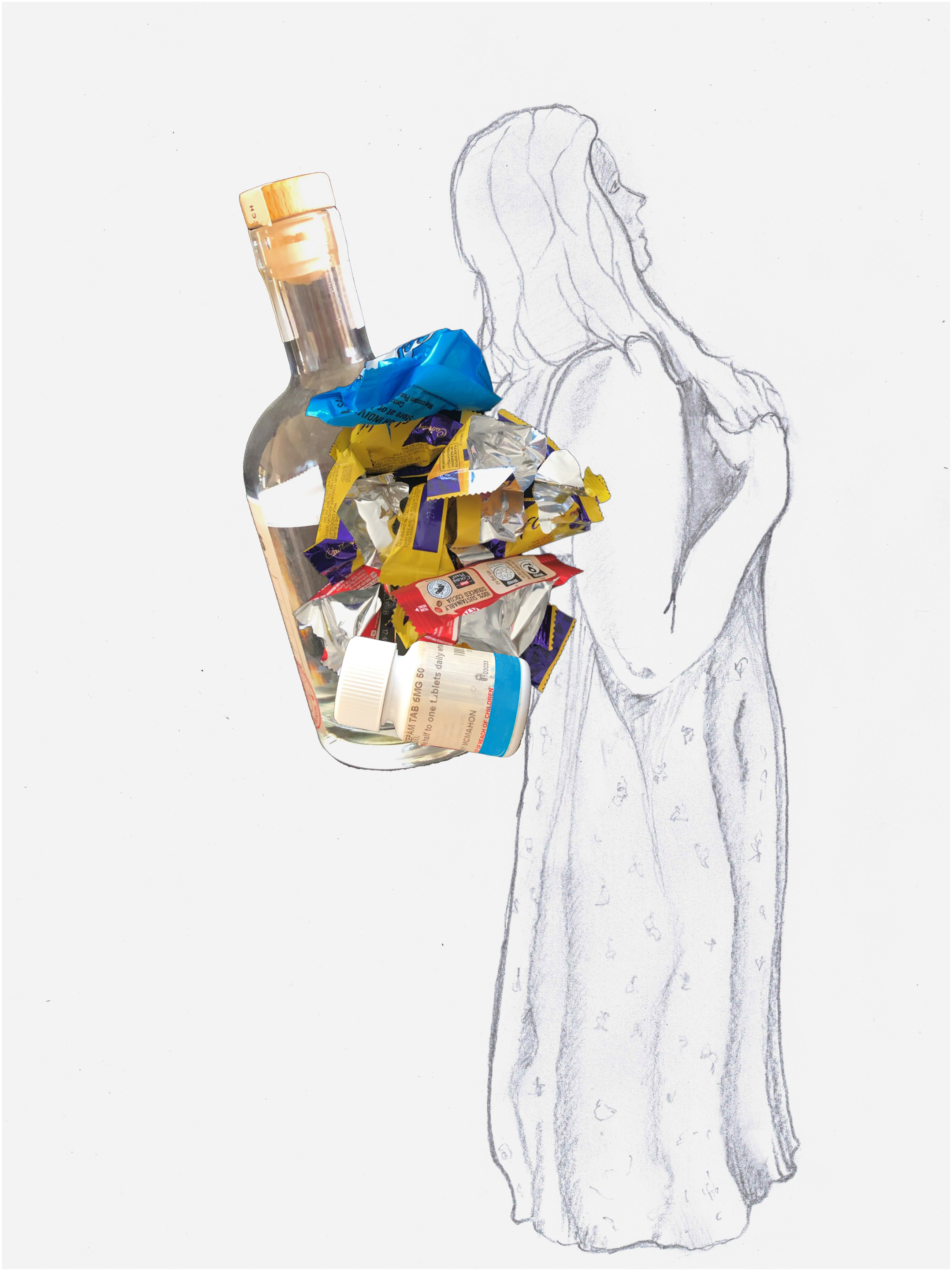
The weight of choices. The image shows McMahon as an adult woman, carrying a backpack filled with alcohol, prescription medication (i.e., Xanax, Valium), and chocolates, representing coping strategies used to manage the adolescent abuse that continues to impact her.
Drawing
Several photographs of McMahon were used as a point of reference for her to create the two drawings featuring in Figures 1 and 2. She commenced the drawing process by lightly sketching her body shape, and clothes, ensuring the profile drew attention to specific elements of her embodied experience. Once she was satisfied with her overall posture in each of the drawings, she consulted with her son regarding how she could add dimensional features to each drawing. He encouraged her to use light shading with a soft 6B pencil, and to smudge sections with her forefinger. An eraser was also used to complete the contours and shadows, giving depth and shape to her body thus highlighting folds in her clothes.
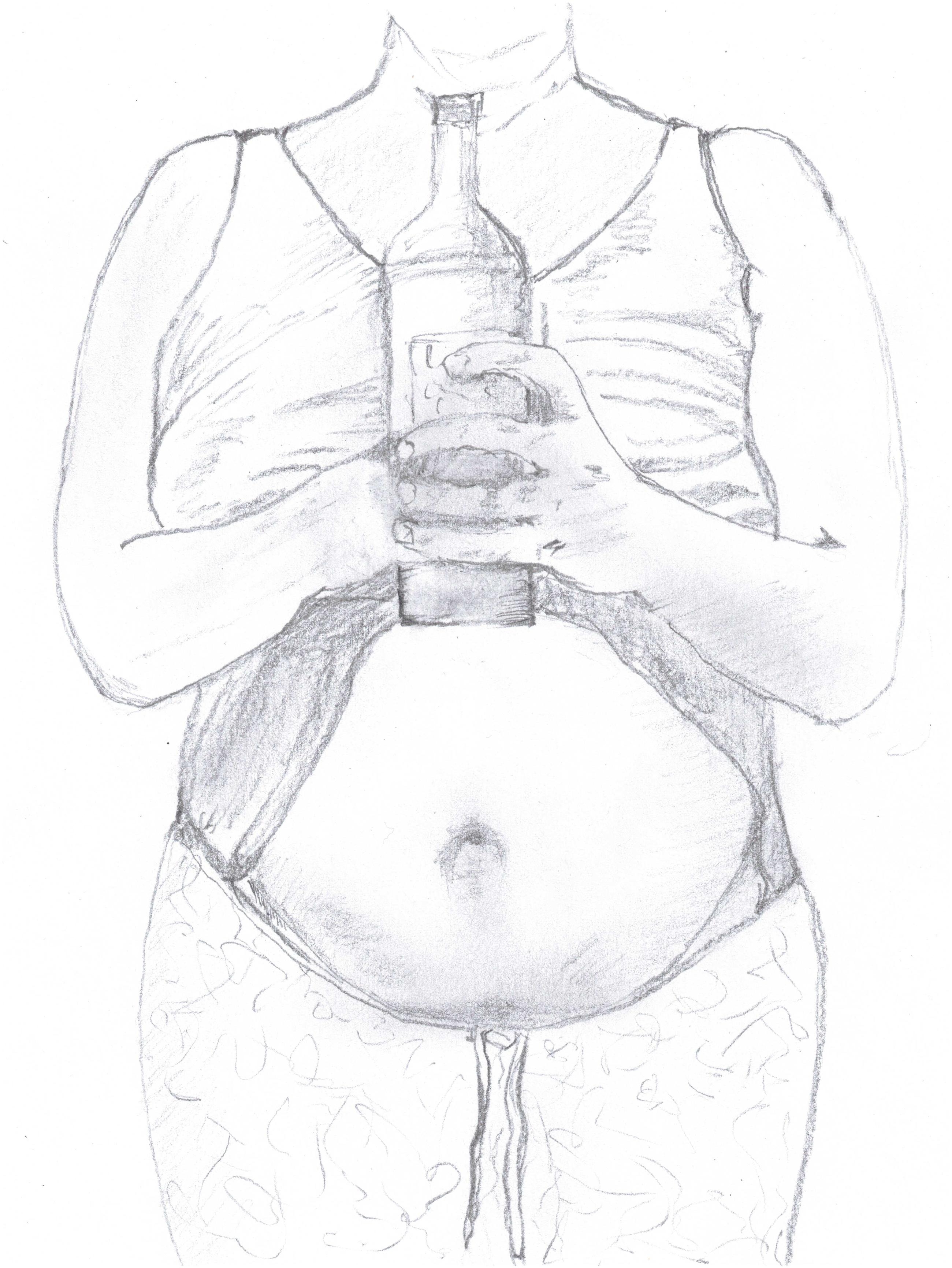
A bottle for the pain—a body for the memory. The image depicts McMahon as an adult woman, holding an alcohol bottle, her stomach exposed and rounded, illustrating the physical impacts of excessive alcohol use as a coping strategy for trauma/abuse.
Poetry
Poetry has been used in qualitative research to represent, analyse, or express embodied experience, data or findings (Leavy, 2017). Serving as both a mode of inquiry and a way to present embodied experience, poetry can capture emotional, sensory, and subjective aspects that traditional writing does not feature (Leavy, 2017). Leavy (2017) explains that a benefit of using poetry is that it can show rather than tell embodied experiences. To create the poetic representations, McMahon purposely chose the free verse style of poetry, which is detailed in more detail below. To transition her diary entries into a poetic form, she read and reflected deeply on aspects of her embodied experience that she wanted to bring forward or accentuate, whether that be emotions, practices, conversations, or tone. From there, she categorised these aspects into a theme that would underpin the topic of each poem (e.g., cutting, alcohol consumption, eating). She then used specific phrases or aspects of her embodied experiences as a starting point when composing each poem, choosing words and imagery that were representative of the experience and her feelings at the time. Poems were carefully deidentified to ensure others who featured, were protected. From there, a focus was placed on line breaks, punctuation and capitalisation to emphasise specific points.
Arts-Based Methods and Alignment with Trauma-Informed Principles
In this next section, McMahon's engagement with the arts-based methods of poetry, drawing, and digital photo collage is examined, with a focus on how these methods align with trauma-principles of safety; as well as empowerment, voice and choice (Substance Abuse and Mental Health Services Administration [SAMHSA], 2023). Each principle is discussed in relation to McMahon's rationale for selecting these methods. When combined with trauma-informed approaches, feminist autoethnographic arts-based methods can support other survivors to share their experiences while minimising the risk of re-traumatisation.
Sport and exercise researchers have documented trauma-related outcomes among abused athletes, including disordered eating, self-harm such as cutting or scratching, alcohol misuse, depression, or suicidal ideation (McMahon & McGannon, 2021; Papathomas & Lavallee, 2014; Roderick et al., 2017; Smith, 2019). These findings align with broader trauma research showing that exposure to adverse events such as abuse, witnessing abuse, as in McMahon's case, can lead to trauma. Other adverse events linked to trauma include, having a member of the family with a mental health or substance use disorder, traumatic injury, discrimination (e.g., racial or systemic), the death of someone close, natural disasters, hospitalisation, incarceration, terrorism, bullying, war, violence, or poverty (SAMHSA, 2014, 2023). Trauma is recognised as a global health crisis, with both short- and long-term impacts (Menschner & Maul, 2016; SAMHSA, 2014, 2023). Consequently, those impacted, like McMahon, require ongoing, diverse support to reduce risks of re-traumatisation, with the research context and researcher practice being no such exception (Dye, 2018; McMahon & McGannon, 2024; McMahon et al., 2024; SAMHSA, 2023).
If survivors of trauma are required to recall or discuss specifics of adverse events during research, as was the case for McMahon, re-traumatisation may result (Butler et al., 2011; Hira et al., 2023; McMahon et al., 2024). Other aspects of the research process that can affect both participants and researchers who are survivors, include environments resembling the original traumatic event, power imbalances between researcher and participant, room configuration (e.g., obstructed exit) or physical distance between researcher and participant, all of which can lead to re-traumatisation (Butler et al., 2011; Hira et al., 2023; McMahon & McGannon, 2024; McMahon et al., 2024).
Although arts-based autoethnography involves self-stories, researchers can occupy the position of survivors of abuse, as was the case with McMahon. In these instances, trauma-informed methods and purposeful decisions were implemented to minimise the risk of further harm. It was crucial for McMahon to foreground her embodied experiences in ways not always possible in other forms (e.g., written stories/vignettes). During her adolescence, male sport staff suppressed her body and voice, therefore, experiencing similar restrictions again, even in a research context, could echo aspects of her original trauma and cause harm (McMahon & McGannon, 2024).
McMahon also sought to weave together multiple elements of her embodied experience using several artistic methods (e.g., drawing, shading, various colour, collage and poetic prose) to reflect the depth and complexity of her trauma. This approach was important because she found it challenging to express these experiences through standard written academic writing. As van der Kolk (2014) explains, traumatic events are often remembered visually or in auditory ways rather than in written words, making arts-based representations especially valuable in trauma work (McMahon et al., 2024).
Trauma researchers have shown that arts-based methods can evoke sensory and embodied experiences, enabling survivors to express traumatic memories non-verbally (Goldner et al., 2021; Lev-Wiesel et al., 2022; Malchiodi, 2015). Arts-based autoethnography and the use of arts-based methods achieve what traditional written formats cannot by capturing the multi-sensory nature of trauma and opening new ways to share it with audiences (Holman Jones & Adams, 2023). This contrasts with mainstream positivist methodologies, which often prioritise disembodied objectivity over subjective, sensory experience (Colacchio et al., 2025).
Arts-based autoethnography aligns with trauma-informed practices and offers a safe approach for survivors to (re)engage with their lived experiences (McMahon et al., 2024). Using arts-based methods can reduce trauma symptoms, such as emotional distress, sleep disturbances, and anxiety (Morison et al., 2022). Arts-based methods also support survivors in expressing their trauma narratives, aiding meaning-making and the creation of new narratives (Malchiodi, 2020). The next section outlines how these methods align with the trauma-informed practices of safety as well as empowerment, voice and choice. Although arts-based autoethnography connects with all six trauma-informed practices (McMahon et al., 2024), space constraints limited our focus to two key principles relevant to other survivors of abuse (McMahon et al., 2024). SAMHSA's (2023) framework, developed by a working group of specialists, draws on literature, professional practise guidelines, and consultations with survivors. Beyond research, SAMHSA's framework has been applied successfully in diverse trauma contexts including “child welfare, education, criminal and juvenile justice, primary health care and the military” (SAMHSA, 2014, p. 3).
Arts-Based Autoethnography and Empowerment, Voice and Choice
Trauma researchers have shown how survivors have had their voices silenced and suppressed when being abused, alongside a loss of personal agency, choice, and control (Delker et al., 2020). To address power imbalances already experienced by abuse survivors, and further silence their voices in research (i.e., excluded from decision making), empowerment, voice and choice are integral considerations to abuse survivor research (McMahon & McGannon, 2024; SAMHSA, 2023). Addressing these issues allows for recognition of the complex dynamics between power and vulnerability, and enhances survivors’ involvement to lessen harm (McMahon & McGannon, 2024; SAMHSA, 2023).
As a trauma-informed research approach, investigators must adopt a strengths-based perspective, whereby survivors’ agency and individual strengths are recognised and valued throughout the process (Darroch et al., 2022). Arts-based autoethnography or arts-based research capitalises on a strengths-based approach because it enables participants to choose how they want to represent their embodied experiences whether it be visually, sonically, textually or through movement or performance (Leavy, 2017). In this respect, arts-based methods enable survivors to have voice and choice in the research process, because they can engage with creative representations of their choice, reinforcing their autonomy. Enabling choice and voice in the research process can help restore a sense of agency with the potential of empowerment (McMahon & McGannon, 2024). Empowerment in this context refers to survivors reclaiming control over their own narratives and experiences, fostering a sense of self-efficacy and confidence that counters feelings of powerlessness often caused by abuse, trauma and oppression. When participants have voice and choice in the research process, conventional power hierarchies are disrupted, which are often present in research contexts (McMahon & McGannon, 2024). As such, participants have power over what they wish to share and the way they want to share it in research processes (McMahon & McGannon, 2024).
Relating to this research specifically, free verse poetry was purposely chosen by McMahon as it enabled her to detail her survivor experiences without forcing it to align with poetry rules, such as rhyme or meter and linearity rules (Gildea, 2021; McMahon et al., 2024). As a survivor, McMahon's ability to decide (i.e., choice) how, and what aspects of her embodied experience was conveyed, provided meaningful agency and control in the research process. Yurkovich (2022) underscores this point by explaining how poetry provides individuals with creative control over the expression of their emotions, improving understanding of certain events or traumatic experiences, allowing for resolution and clarification. McMahon's use of free verse poetry in conjunction with expressing experiences of trauma in visual art (e.g., drawing, photo collage) also provided her with non-verbal ways to express her embodied encounters. Unlike language, which often requires clear and direct articulation, the use of colour, form, shading and other visual elements enabled symbolic expressions of her trauma, capturing its complexity without the constraint of words and academic writing conventions (Morgan & Johnson, 1995).
Arts-Based Autoethnography and Safety
Given that trauma often causes individuals to perceive the world and particular situations as unsafe (Menschner & Maul, 2016; SAMHSA, 2023), prioritising the physical, psychological/emotional safety of survivors is essential when shaping the research design when trauma and abuse work is being conducted (McMahon & McGannon, 2024). Although university ethics approval processes are intended to ensure participant safety (Hira et al., 2023), these typically follow rigid, step-by-step protocols focused on conventional research considerations (e.g., question types, recruitment protocols) (McMahon & McGannon, 2024). Consequently, these requirements often conflict with the unpredictable and nuanced nature of trauma (McMahon & McGannon, 2024; SAMHSA, 2023). Outside academic settings, therapeutic contexts have used arts-based methods to support trauma-affected individuals in safely expressing their emotions and experiences (Malchiodi, 2023). Creative expression serves not only as a form of communication and meaning-making, but also as a safe and protective mechanism for verbalising trauma (Malchiodi, 2023).
As a survivor of abuse, McMahon chose to share her embodied experiences of trauma, such as alcohol misuse, disordered eating and self-harm, in brief, manageable, creative ways, rather than through lengthy academic or narrative formats (i.e., stories with a beginning, middle and end, responses to interview questions/prompts). Having become skilled in providing simplified “cover stories” (e.g., a brief version that omits painful elements) to protect herself, she found extended verbal or written accounts anxiety-provoking and overwhelming (McMahon et al., 2024). Van der Kolk (2014) notes that trauma survivors often use abbreviated narratives as self-preservation, although these rarely capture the full emotional depth of their experiences. Instead, researchers have shown that expressing traumatic experiences in condensed forms, such as the poetry or visual arts (i.e., drawing, photo collage) shown in our examples, can be less (re)traumatising for abuse survivors, thereby emphasising important safety considerations (Gildea, 2021; Leavy, 2017; McMahon et al., 2024; Prendergast, 2009).
Methodological Reflections and Contributions
Building on our commentary above, this paper demonstrates the value of combining different arts-based methods with autoethnography to produce embodied knowledge (Greenwood, 2019; Holman Jones et al., 2013a; Leavy, 2017). The multi-modal approach where poetry, drawing, and digital collage were integrated enabled the expression of complex, sensory, and layered experiences that may not have been fully captured through a single medium, or through traditional academic writing (Malchiodi, 2015; van der Kolk, 2014). Importantly, these methods are situated within an autoethnographic framework, foregrounding the researcher's embodied experience, which shaped meaning-making and allowed the personal to illuminate cultural and structural dynamics (Adams et al., 2015; Ellis et al., 2011). Although arts-based methods have been used in feminist and trauma research more broadly (Colacchio et al., 2025; Morison et al., 2022), this work demonstrates how the combination of modalities can deepen insight, particularly for those exploring embodied experiences of abuse and trauma, and provides a reflective approach that prioritises safety, voice, choice, and empowerment (McMahon & McGannon, 2024; SAMHSA, 2023). These methodological reflections highlight the potential of using multi-modal arts-based approaches as a tool for feminist researchers seeking to engage with embodied knowledge, demonstrating both the opportunities and considerations involved in combining creative methods to generate nuanced, and trauma-informed research.
Conclusion
This paper demonstrates arts-based autoethnography as a feminist methodology that centres embodied inquiry and can amplify the voices of women who have been oppressed or silenced (abused). By foregrounding McMahon's lived experiences of abuse and the ongoing consequences of these, we showed how survivors can be provided with agency over how their trauma stories are communicated. Indeed, arts-based autoethnography challenges traditional research hierarchies, extending beyond conventional qualitative methods (e.g., interviews), enabling novel and more nuanced explorations of trauma that honour the complexity of survivor's lived realities. This prioritises subjective experience over detached objectivity. These approaches offer new ways of investigating, representing, and understanding embodied trauma experiences, providing insights that conventional empirical methods may miss.
Arts-based autoethnography enhances feminist psychological inquiry by enabling nuance through multi-sensory explorations of trauma that respect the complexity of survivors’ lived realities. By integrating drawing, poetry, and digital photo collage, this approach supports trauma-informed practices that foster empowerment, voice and choice. It also demonstrates the potential of creative methods to deepen embodied inquiry, offering both researchers and survivors alternate ways for understanding and communicating experiences that are often invisible in traditional empirical research.
While the benefits of using arts-based methods for survivors are becoming increasingly recognised (Leavy, 2017; McMahon et al., 2024), the absence of trauma-informed knowledge and practice still poses a risk of harm (Wang, 2024). Although the benefits of using this work are plentiful, some limitations include the tendency for traditional psychological research methods such as surveys, interviews, or focus groups to be prioritised over arts-based methods, because they are often viewed as more likely to generate measurable and lasting outcomes that are closely tied to research impact (Elliot, 2024). This reflects a broader issue in academia, where conventional structures tend to privilege certain epistemologies, such as post-positivist approaches (Coemans & Hannes, 2017; Elliot, 2024). Consequently, researchers working with arts-based methods may face challenges in presenting their creative outputs within academic formats such as peer-reviewed articles (Boydell et al., 2012).
Despite potential limitations, arts-based autoethnography in feminist psychologies highlights possibilities relating to how feminist psychology can be enhanced using creative methodological approaches. Importantly, this inquiry also highlights the value of engaging with feminist theory, including the work of Bordo, within autoethnographic inquiry. Although Bordo's work was not used as a framework through which lived experiences were analysed, her conceptualisations of the body and disciplinary practices provided clarity in understanding embodied experiences of trauma and the broader sociocultural conditions in which they occurred. In this sense, theoretical perspectives such as Bordo can support autoethnographic inquiry by offering insights that assist researchers in deepening their understandings of lived experiences and connecting personal narratives to broader sociocultural contexts. This paper underscores the transformative potential of arts-based autoethnography in terms of advancing embodied inquiry, centring survivors’ perspectives/experiences, and fostering trauma-informed approaches that integrates creative approaches with psychology's empiricism.
Footnotes

Funding
The authors received no financial support for the research, authorship, and/or publication of this article.
Declaration of Conflicting Interests
The authors declared no potential conflicts of interest with respect to the research, authorship, and/or publication of this article.
Data availability
No data in this paper can be reused without the authors’ permission.