







Abstract
Based on critical readings of the three main contributions of the special issue and on my own research experiences, the article points out three related features of developmental activity research projects as particularly challenging for the analysis and advancement of cultural-historical activity theory (CHAT). One feature is the nature of the joint developmental project. A second feature is the researchers’ role in the joint developmental activity. The third feature is the focus on the transformations of the central artifacts that make up the joint project. Finally, with departure from the stance that developmental activity research projects are propelled by two kinds of practitioners—the practitioners of research and the practitioners of another activity—which may support each other not only in practical matters but also with regard to concepts and perspectives, I consider advancement of CHAT methodology by outlining a beyond-interventionist methodology.
Keywords
CHAT interventionist methodologies and beyond
Interventionist research projects within the cultural-historical activity theory (CHAT) tradition span two positions. One position takes for granted that the only support to count within research is the support that professional researchers provide to other activities (e.g., work or after-school activities). Consequently, researchers in their analyses take into account a unit of analysis that includes only the “supported activity.” The research activity itself is not analyzed. The other position of research projects within the CHAT interventionist tradition takes into account at least two activity systems. For a period of time two or more activity systems establish a new joint hybrid activity, the developmental project, which aims at advancing the other activity as well as the research activity. As far as I can judge, most of CHAT interventionist projects take the first position for granted. However, when empirical cases are presented, something else is made visible as well.
Let’s take a closer look at the two positions. What they have in common is that researchers (i.e., the practitioners of the research activity) and practitioners from another profession (named the other activity in the article) come together in the undertaking of a developmental project. The positions differ, however, with regard to how the “coming together” is understood, and with regard to which activity is targeted. According to the first position, the coming together is seen as a series of meetings necessary for the researchers’ intervention and support to the development of the other activity. Thus, the view is that there are some problems in the other activity that need to be addressed, and the researchers are asked to be supportive. According to the second position, the coming together is regarded as the formation of a new joint hybrid activity. A developmental project is formed, oriented at the development of the other activity as well as the research activity. There are problems in the other activity as well as in the research activity, and the participants may mutually support each other in the joint developmental endeavor. It is acknowledged that the other activity and the research activity might be conducive to each other, that the partners might be supportive of the research activity as well as the other way around. If the first position on CHAT methodology aims at changing the other activity as well as getting challenges from the field so that, little by little, CHAT theory and methodology may be improved, the other position, in addition, strives for a substantial development of the CHAT methodology. The reason for that is, in my opinion, that CHAT interventionist methodology, like all social scientific approaches, strongly underestimates the resource that participants besides the professional researchers might bring to the research endeavor.
This article deals with the potential of the joint hybrid activity in developmental work research. The starting point concerns the approaches presented in this issue by focusing on novel tendencies in CHAT interventionist methodology. In addition, I briefly present the research approach developed by my colleagues and me as a further example of intervention in CHAT. I argue that new traits emerge in the practice of CHAT interventions and I try to present these traits in the article. In the article I point out three related aspects as being particularly challenging for the advancement of CHAT intervention methodology: the nature of the developmental project, the role of the researchers in the joint developmental activity, and the central artifacts that are transformed as part of the joint undertaking. On the basis of my findings, I envision an expanded CHAT interventionist methodology that goes beyond interventionism. In other words, a double perspective is taken: CHAT interventionist methodology and a prospect of a CHAT developmental methodology beyond interventionism.
CHAT interventionist research
Accounts of CHAT interventionist research often provide stories from the field which now and then point “beyond interventionism.” What I see proposed, often from the examples provided by researchers, is a “collectively and expansively mastered activity” (Engeström, 1987, p. 284). Given that the activity system of the research team is included in the joint activity system, which constitutes the developmental project, such a collectively mastering perspective may do justice to the competencies of the other partners too—their ability to develop their own activity as well as to support the research activity.
Thus, I find that wordings and expressions hinting at something new in CHAT most often originate from empirical examples given by the authors. If detailed enough and not simply illustrating theses by the authors, examples are richer than the authors’ explicit conceptualizations. To the reader such examples might be informative. That is the reason why I primarily go for interpretations of the examples, and I argue that the emergence of something new in CHAT intervention research may be envisioned from the examples the authors present.
None of the methodologies presented in this special issue focus on the activity of school education or school learning. I think this is not accidental. Mandatory schooling is a paradigm for interventionism. Compulsory school is a place for children, youth, and foreigners lacking some basic societal knowledge. Here interventionists enter the scene in order to change the state of affairs. Mandatory schools are institutions aimed at teaching and learning the core of what is societally given. Learning the given is the thing, and it can be done in several ways. Unfortunately, the grammar of schooling promotes a depressing picture (Tyack & Cuban, 1995). In the mid-1980s, Engeström and his colleagues (Engeström & Engeström, 1986; Toikka, Engeström, & Norros, 1985) coined the concept of “developmental work research” to refer to their interventionist methodology. It is not by chance that Engeström’s main idea that learning activity is an activity that produces or transforms activities came about within the methodological approach of developmental work research. In this approach the focus is on work activity. The fact that most CHAT interventionist undertakings have taken place in school settings—and that the bulk of projects have their disciplinary base in education—has, however, configured CHAT interventionist methodology (see Hedegaard et al., 1984, for an early collection of articles in an European context). I take it as symptomatic that the Fifth Dimension (5thD) approach grew out of a Field College methodology, invented by Cole and his team as a consequence of their research being more or less forced out of the school (see Cole, 1996, for an account of why the the research was moved “from the school day to after school,” p. 269). I fear a beyond CHAT interventionist methodology is very difficult to bring about in traditional schools—the reason being that the institutionalization of handing down central societally given knowledge does not create a context of mutual support and equity among the participants. In other words, we face a paradox: in order to make groundbreaking advances in learning and development, we had better leave the school. For the reasons indicated below, instead of developmental work research (DWR), in this article I use the expression “developmental activity research” as I need a more general term to be able to designate different CHAT methodologies, like, for example, those discussed in this special issue: that is, the Change Laboratory, the Clinic of Activity, and the 5thD.
When discussing the emergence of new tendencies in CHAT interventionist methodology I will bring to the surface the developmental project and the coalition that is formed to support the joint undertaking, as well as the role of the researchers and the central artifacts that are used in the joint undertaking. These aspects are intertwined, and the authors that I quote or refer to sometimes present them forged together. Notwithstanding, I will try to keep them apart in my account in this article.
The developmental project
In CHAT, probably the most foundational idea is what Vygotsky and Luria (1994) called “the most important and basic of genetic laws” (p. 138), namely that the interactional and communicative patterns occurring among participants in the activity are decisive for the participant at the level of motivation, agency, reflection, and so on. If this is the case, the organizing in itself of interventionist research is crucial for the kind of activity that will be developed. What the participants are doing together will impact what they learn and what they develop. Some basic questions for any interventionist methodology are therefore: As part of the coming together of the research activity and the other activity, what kind of coalition is organized, what kind of collective subject, and, consequently, what kind of activity is initiated? Is it a joint developmental project, strong enough and long-term to influence the other activity and the research activity, or is the organizing better described as an in-between and short-term formation? Is it a joint hybrid undertaking that takes time to establish and, when successful, will be of utmost importance for the outcome of developmental work research?
When Engeström (2011) in his article describes the methodology of formative intervention and the Change Laboratory toolkit in general, the participants form a group comprising the hospital practitioners and the researchers. The Change Laboratory setup seems to provide a good starting point. The key participants are given access to instrumentalities aiming at facilitating the approach of developmental work research—e.g., three surfaces: “model, vision,” “ideas, tools,” and “mirror”—each of which is layered in “past, present, and future” (Engeström, Virkkunen, Helle, Pihjala, & Poikela, 1996). In an introduction by Engeström (2005) to a book presenting DWR studies from the Helsinki Center of Activity Theory and Developmental Work Research, he gives a general account of DWR:
The longitudinal and interventionist methodology of developmental work research requires relatively durable partnerships between researchers and the organizations they study. Such partnerships are based on mutual benefit: researchers get data and findings, the organization gets new tools and critical impulses to examine and change its practice. (p. 15)
From his example of the Central Surgery Unity in this issue (Engeström, 2011)—a planned Change Laboratory of six sessions during a period of about 6 months, and follow-up sessions during the following 2 years—it is not possible to judge if a coalition of the partners really was formed, except in the sense that they occasionally met during the Change Laboratory sessions. Furthermore, Engeström suggests that formative interventions are made by different actors in the hospital project. And judging by the Change Laboratory case he renders, it seems as if the doctors and nurses at the hospital often play a central role in the formative intervention. So there are some indications of agency among the participants.
In their account of a Change Laboratory approach to DWR, Virkkunen and Schaupp (2011) argue that the constituting parts of the DWR project are two activity systems, scientific activity and productive activity, and that these two parts interact (Virkkunen & Schaupp, 2008). They claim that the societal activity of our time, which is complex and rapidly changing, generates a need for what they call “secondary work.” Secondary work means “creating new concepts and tools to master the changing activity.” Secondary work also “changes the relationship between research and practice and calls for a new kind of collaboration between researchers and practitioners” (Virkkunen & Schaupp, 2011, p. 633). Evidently, their analysis underlines the task of forming a collective subject of the joint activity. In the third generation of activity theory minimally two activity systems partially share objects (see Engeström, 2011, Figure 1, p. 608). Many studies have reported this third generation collaboration between activity systems. To my knowledge, however, none of the authors present a corresponding analysis, where an activity system of a research team partially shares an object with a partner activity within the framework of a DWR project. The unit of analysis is the other activity, not the joint developmental project.
Clot, Fernandez, and Carles (2002) claim that the Clinic of Activity is a methodology “based on a conceptualisation of activity . . . highlighting its conflicting dimensions” (p. 13). The focus of this approach is to get a grip on the “real activity” (or “reality of the activity”) in contrast to what they call the “performed activity” (or “realized activity”). The real activity, according to them
also includes what is not done, what one tries to do without succeeding—the drama of failure—what one wanted to do or could have done, what one thinks is possible to do somewhere else. To this must be added—a frequent paradox—what one does to avoid doing what is to be done. “Doing,” often and just as importantly, involves doing over again and undoing. The activity therefore has a volume that a purely cognitive approach to consciousness as representations deprives of its vital conflicts. (p. 14)
Getting to know “real activity” is not possible for the researchers without a coalition with the workers. The professional dialogues organized by the researchers “aim at making the work visible in the course of its actions.” (Clot & Kostulski, 2011, p. 686). The formation of the coalition between the workers and the researchers is, as the methodology of Clinic of Activity prescribes, confrontational. However, in the case they present in this issue, it occasionally became more than that. As a consequence the planned research phases had to be reduced. However, what seems to be a more favorable circumstance for realizing collaboration that advances research as well as the other activity has been reported (Clot et al., 2002). In that instance of the Clinic of Activity, professional researchers and train drivers conducted a relatively long-term collaborative undertaking (5 years). During a period of 2.5 years at the end of this collaboration, regular meetings were organized devoted to co-authoring a book.
In the 5thD as well as in the mutual appropriation approach, there is (in my opinion) an obvious design idea, not in the meaning of “design experiment” where the experimenters stand beside the activity that is going on, but as one where they design an activity in which they are involved as one of the partners. Cole (1997) has formulated the idea in the following way:
By contrast, my students, colleagues, and I literally create the systems of activity that are the focus of our research. We are participant observers in a quite unique way. In this, I believe we are invoking an idea that has been common to both the cultural-historical tradition and to the study of artificial intelligence: you can best understand something you have made.
The new approach that Downing-Wilson, Lecusay, and Cole (2011) call mutual appropriation appears to go further and form a “more or less horizontal mixing of approaches, where leadership is exercised by both sides of the partnership” (p. 666) where “a yours–mine–ours activity system is able to spawn hybrid activities that neither of the original players could have conceived on their own” (p. 666). And they continue: “The T&CLC [Town and Country Learning Center] partnership strives to be collaborative at every level. As needs and interests arise, appropriate activities are introduced by both the university and the T&CLC partners” (p. 672).
To sum up, CHAT interventionist research and development undertakings, as presented by the authors, in different ways take advantage of the contributions that participants besides researchers provide to the joint endeavor.
The role of the professional researchers
If the researchers are not the only interventionists in the joint hybrid activity, what special role will the professional researchers play in developmental activity research? Some suggestions are listed below.
Formative intervention by researchers in the Change Laboratory approach is a kind of guidance through triangle modeling of the activity system. The toolkit of Change Laboratory functions as a major mediating artifact or as a second stimulus. In the example presented by Engeström (2011), the Change Laboratory and the surgery unit, the hospital staff carried out a substantial part of the reconceptualization of their activity, at least when it came to the construction of an alternative organizational structure. It seems obvious that formative intervention actions are shared between the staff and the researchers, and even if the more detailed contribution of the researchers is not specified by the example, the reader may guess that the primary task of the researchers is to frame the Change Laboratory setting and provide the basic conceptual and complementary material instrumentality.
Virkkunen and Schaupp (2011), besides what is expected by the researchers as interventionists using the Change Laboratory instrumentalities, also add the researchers’ contribution to the formation of a collective subject of the joint undertaking to the agenda. A collective subject that encompasses researchers and their partners is suggested.
In the Clinic of Activity the role of the researchers is to arrange a setting that makes productive use of contradictions and that makes it possible for the participants (researchers and workers) to explore the features of the “real activity.” The features “talk back” to the participants, who get the option to take advantage of the feedback for the joint development of the activity they are studying. “A Clinic of Activity intervention acts upon the work and transforms it,” and this takes place “within the activity” (Clot & Kostulski, 2011, pp. 681–682). This characteristic is valid for all the Clinic of Activity interventions I have access to (Clot, 2009; Clot et al., 2002). One might say that this is the case when the interventions went more or less as planned. But the intervention accounted for in this issue “failed” and as a consequence it was broadened to take place not only “within the activity but also beyond the activity, in the work organization and in the institution” (Clot & Kostulski, 2011, p. 682).
I have not yet enough information to get a grip on the role of the professional researchers in the mutual appropriation approach. However, at least at the beginning of the joint undertaking, it seems evident that the researchers take a reserved attitude with regard to actions within the intervention:
Rather than jump in with solutions that had proven successful in the past, or to design activities based on theoretical models of how things might work, our goal at T&CLC is to listen deeply to the opinions of the local participants about their concerns and goals for the project …. Only after participating on local terms in locally organized activities are suggestions made for restructuring, adding, or eliminating elements of an activity. (Downing-Wilson et al., 2011, p. 674)
One may ask if there will be much research carried out with this kind of “distinctly non-conventional evolution of the intervention” (Downing-Wilson et al., 2011, p. 675). The idea of the joint undertaking is after all that the development of the joint hybrid activity eventually will result in development of each of the collaborating activities as well, research activity included. I suspect that a prospective professional researcher, eager to make an academic career, will have a hard time in researching aspects of the mutual appropriation activity, because it appears to be severely messy, entangled, and convoluted. Nevertheless, its forerunner, the 5thD approach, which has been practiced for more than two decades, shows that it is possible to provide a fruitful combination of research, higher education, and communal well-being identified as good environments within which children can play, learn, and develop (Cole & The Distributed Literacy Consortium, 2006.)
I claim that a CHAT approach beyond interventionism has to be taken into account in which the researcher’s role is reconsidered. We may, for example, organize research assistance for the “partners,” but the professional researchers have their special role. Which role is this? In CHAT tradition, focusing on the object of the activity is central: that is, finding the “germ cell,” the small “molecule” that shows the characteristic feature of the whole. In settings of “learning the given” like traditional schools, scientists and teachers know what constitutes the germ cell. But in real-life situations outside school no one knows beforehand what the core is. It has to be figured out, and it has to be locally mastered in practice. The conceptual and methodological ideas of CHAT will probably act as a guide here, but I suspect that what for now is available in DWR and other approaches will not suffice. Even if it is impossible to specify the challenges the researchers will face, it seems obvious that their effort, especially initially, has to be be oriented towards forming a collective subject, a coalition able to conduct developmental activity research. That means developing the joint undertaking of the researchers and the partners.
Transformations of central artifacts
If one accepts the idea that the developmental project can be seen as a joint hybrid activity, an appropriate question is: What is the object of the joint undertaking that the researchers and the professionals of the other activity accomplish together? Hence, in this section I address the object of the joint activity: that is, the transformations of the central artifacts that are in use. Like in the earlier sections, I primarily use as empirical materials the examples that the authors have presented in this special issue. What artifacts—conceptual, material, organizational—have been produced or transformed according to the examples presented by the authors?
In this article I have claimed that an important focus of CHAT interventionist methodology is to make the transformations of central artifacts an issue. The reason is that the transformation of artifacts that are central in an activity is equal to the transformations of the object of activity: that is, what the activity is about. The notion of the object of activity is as notoriously difficult as it is foundational in CHAT. Engeström, who consequently built on the notion by Leont’ev (1978) of the object of activity and puts it in action in empirical studies, for example writes:
It is relatively easy to envision the objects of basic material activities such as manual labor. However, a closer look at such an activity as scientific research or product design reveals the slippery and multifaceted character of its objects. Yet, it is clear that those activities are oriented towards something and driven by something larger and more durable than just the specific goals of particular actions and individuals. This something—the object—is constantly in transition and under construction, and it manifests itself in different forms for different participants and at different moments of the activity. (Hasu & Engeström, 2000, p. 64)
Further, the object
is to be understood as a project under construction, moving from potential “raw material” to a meaningful shape and to a result and an outcome. In this sense, the object determines the horizon of possible goals and actions. But it is truly a horizon: as soon as an intermediate goal is reached, the object escapes and must be reconstructed by means of new intermediate goals and actions. (Engeström, 1999, p. 65)
Hence, in order to know what activity the developmental project is about, what its object is, one has to trace the successive steps of transformations of the central artifacts in the work practice. If one does not want to lose the motivational character of the object when looking for transformations of artifacts, it is important to remember that even the “horizon” of the object consists of “traces of palpable corporeality” (Ilyenkov, 1977, p. 87), be it a conversation between two people, a personal note, a care agreement document, or something else.
The method of double stimulation is suggested as a central mediational means by Engeström (2011) and by Virkkunen & Schaupp (2011). They describe the process of intervention in terms of “first stimulus” and “second stimulus.” In general in Change Laboratory, the triangular model of activity is used as a “second stimulus.” In Engeström’s example of the hospital surgery unit, the account of how the double stimulation methodology is put into practice tells that the first stimulus is made up of the problems that were publicly known about the the surgery unit: long queues and waiting time for patients and negative publicity. The second stimulus is an alternative organizational structure, which was constructed and put into action by the hospital professionals themselves. A rough picture of the transformations of a central artifact in that case may look like the following: Initially there are tentative ideas communicated about organizational rearrangement among the participants in the Change Laboratory session. Then a more focused discussion about specific plans for the reorganization takes place—this is happening already during the first Change Laboratory session. In, and between, further sessions a detailed organizational plan is worked out and written down in a document by the staff. Hence we may state that the object of work in the early phase of this joint activity is some aspect of the organization. One may imagine how the object in a series of steps is transformed from loose ideas expressed in talk to a written document (and before that in several drafts) that will be pivotal in the realization of the ideas, plan, and intentions as an organizational change.
The concept of double stimulation can be understood as an overarching principle, the most general idea of mediation, in addition to which other mediating artifacts are put in use: for example, the web-based platform and the network-organized activity, as was the case with the in-house developer Tina in Virkkunen and Schaupp’s article (2011), or the organizational structure of the surgery unit, the plan of which was “entirely written by the practitioners themselves [and] detailed the new organizational model and guidelines for its implementation,” as Engeström asserts (2011, p. 621).
The Change Laboratory intervention reported by Virkkunen and Schaupp (2011) is spread over a period of many years and consists of several Change Laboratories performed by an in-house developer, inspired and given guidance by professional researchers at the Center of Activity Theory and Developmental Work Research. Change Laboratory is declared an interventionist approach, but it seems to be an emerging intervention. Recurring interventions in activities expand the overall intervention over time and transform it into something new: two activity systems collaborating, occasionally or permanently. In the process an institutionalization emerged of a long-term collaboration between professional researchers and the practitioners. A supportive network was organized using a web-based platform “for sharing methodological knowledge and getting support in applying the method locally” (p. 646) from the Center for AT&DWR, as well as arrangement of 6-day courses. By means of the case the authors draw the contours of a long-term process of a joint hybrid activity, and the reader may glimpse some of the transformed or produced artifacts of importance for the project.
At the end of his article, Engeström (2011) remarks that the researchers’ impact on everyday actions and activities is felt not only in the Change Laboratory sessions, but also between and after the sessions. If this is what happened in his case example—and the conclusion seems to be corroborated by the result of a follow-up of the effect of DWR interventions by Engeström, Kerouso, and Kajama (2007)—we have to find ways to build it into a research methodology, perhaps through a net-based supported activity in line with what is suggested in the empirical example presented by Virkkunen and Schaupp (2011).
The instrumental set-up in the Clinic of Activity is single and crossed auto-confrontation. The material artifacts transformed in the course of the intervention are videorecordings of typical or difficult work actions, and of comments on them in several versions. The intervention aims at exploring “real activity” (or the “reality of the activity”). Clot (2009, p. 299) describes the Clinic of Activity as a “dialogic intervention” where “professional disputes” (p. 300) are organized. This way of exploring the “reality of the activity” is dialogic in several ways. One kind of dialogue is happening between the professionals, another between the professionals and the researchers. The professionals use everyday concepts and develop them within “professional dispute.” The researchers use this development of everyday concepts as an object of scientific inquiry (Clot, 2009, p. 302). Hence, there is also a dialogue between scientific concepts and everyday concepts as part of the exploration of the “reality of activity”—a “double development,” Clot (2009, p. 290) points out, quoting Vygotsky.
In his book Cultural Psychology, Cole (1996) characterizes the 5thD model system as an artifact:
I consider the methodology of the research in the Fifth Dimension to be an extended example of romantic science, one that applies to the growth of the system of activity as well as the growth of the children and undergraduates who inhabit them and give them life. But I also see it as a particularly useful tertiary artifact for thinking about and acting on issues associated with my identity as a developmental psychologist. (p. 347)
It is an artifact that is constructed and put into action by the children, the undergraduates, and the researchers. In the 5thD undertaking, there is no “other activity” involved. Although related to some communal partner, who hosts the 5thD site, there is in general no joint hybrid activity, although exceptions might occur, as in the case that Downing-Wilson et al. (2011) mention of the communal fellow at the Boys and Girls Club in La Jolla.
In contrast to the Change Laboratory, the 5thD, and the Clinic of Activity, where there is a pre-planned set-up of physical/material artifacts and rules of the games build upon CHAT principles, the mutual appropriation approach has no pre-planned set-up. It is something that emerges depending on how the situation unfolds. Mutual Appropriation, Downing-Wilson et al. claim, shows what new challenges may turn up in an attempt to advance developmental activity research: “[W]e have made a qualitative leap in scale where old principles and modes of research are no longer adequate. … [There is] an apparent need for new modes of scientific organization that are not restricted to the university” (Cole, Downing-Wilson, & Lecusay, 2008, Slide 24).
Experiences of interventionist/interactional research
Like the researchers in this issue, my colleagues and I have conducted research in the interventionist tradition of CHAT. We have been particularly inspired by the Helsinki group and by the 5thD approach. The first large projects we were involved in were a school project “Man in a Changing Society” (1982–1987) and a temporary undertaking called Elder Center North (1999–2003), both of which were carried out in the north of Sweden. In addition we conducted two projects in the south of Sweden: 5thD Ronneby (1997–2007) and a wound care project (2001, ongoing). The school project was summarized in Sutter and Grensjö (1988), and the Elder Center North and related project in Sutter and Lindberg (1994). Reports related to the other projects are, for example, Nilsson and Sutter (2005) and Kyhlbäck and Sutter (2007).
Owing to circumstances (metaphorically, we had one leg in academia and one outside)the research resources we were able to mobilize had a research and development (R&D) nature, meaning that we were expected to give a scientific twist to developmental work rather than conduct traditional academic research. The result was that we had difficulties meeting the research standard we, and others, had set. Instead we had to do something else: for example, establishing long-term R&D relations with participants, involving undergraduate students as partners in R&D, and using forms of publication other than academic journals. Although CHAT was our intellectual home, circumstances forced us to be guided by other ideas of action research and a research methodology that were in line with our experiences and ideas. In analogy with “extensive farming,” we talked about labor-intensive and low-tech “extensive research” (in contrast and in addition to ordinary “intensive research”) or “service science.”
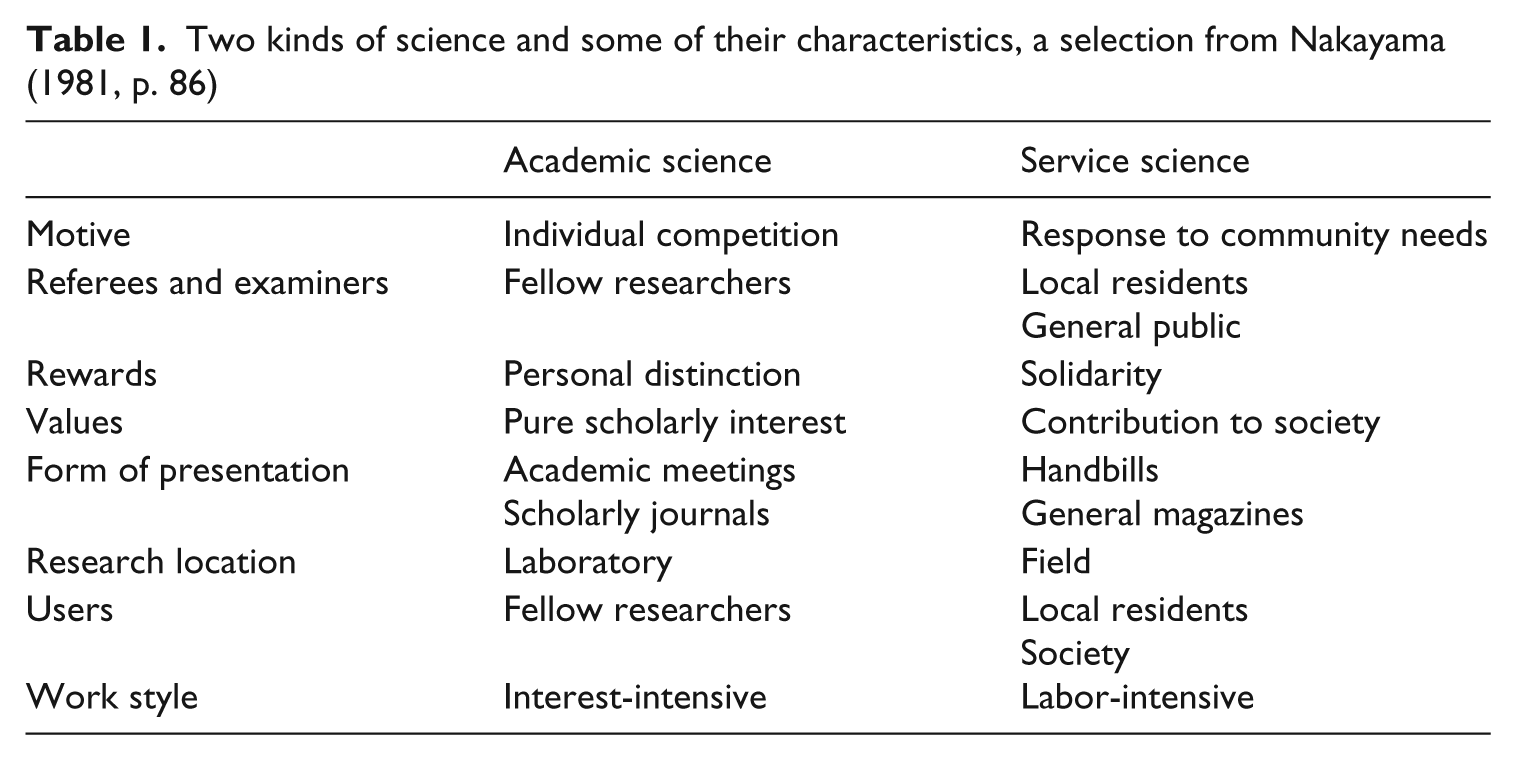
We found that the idea of science as expressed by Nakayama (1981; see Table 1) resonated well with the school and beyond school project that we ran in the 1980s, emphasizing that traditional academic science is not the only existing science. Liedman’s (1980) idea of a theoretical pole and an empirical pole in research became a theoretical underpinning for involving students and laymen in research “close to the empirical pole.” When in the 1990s we learned about a progressive educational practice in technical universities, namely to involve undergraduate students in real R&D projects, we realized that the technical full-scale design, accomplished by students in pretty large R&D projects, was just an instance of how undergraduates in academic disciplines might contribute to research, provided research is understood in the broad sense it often is in technical R&D. This consists in engaging students in R&D projects not only on an individual basis, which is nothing new in the academy, but by trying to make their participation in R&D an institutional part of higher education.
Two kinds of science and some of their characteristics, a selection from Nakayama (1981, p. 86)
On the basis of the results of these projects, I outline a framework for mastering developmental activity research that is based on a joint developmental project between professional researchers and partners, a project that is long-term in its range of collaborative actions.
The developmental activity research that we are conducting takes its point of departure from Yrjö Engeström’s conception of learning activity as an activity producing or transforming activities. I see what we do as a variant of DWR methodology, stressing that both the partner activity and the research activity are to be developed, and that mutual support between the partners takes place within the course of the joint undertaking.
Nakayama (1981) drew attention to the fact that science and research activity are historical phenomena undergoing historical changes, and he distinguishes three kinds of science: academic, industrialized, and service science. In Figure 1 I have depicted only academic science and service science, and I have rearranged a figure made by Nakayama by selecting comparable traits that are pertinent to my argumentation. It is worth mentioning that in service science Nakayama still seems to claim that it is professional researchers who are conducting research, although the “users” in the case of service science are “local residents” and not only “fellow researchers” as in the case of “academic science.”
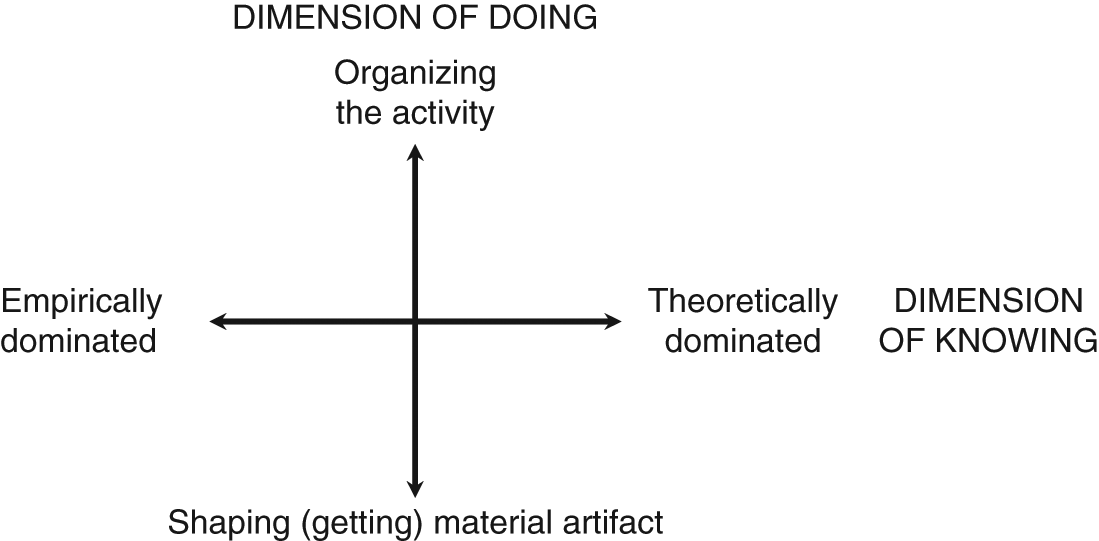
Dimensions in developmental activity research
The distinction between Mode I and Mode II of science proposed by Gibbons et al. (1994) and Nowotny, Scott, and Gibbons (2001) is similar to Nakayama’s classification and characterization of science in that traditional academic science (“Mode I”) is challenged as the one and only way to create scientific knowledge. Both these challenging perspectives stress a novel relation between researchers and practitioners. This is in line with what we have been striving for in our attempts to develop a kind of research activity that involves laymen, and particularly undergraduate students (Nilsson & Sutter, 2008; Sutter, 1991, 2007).
In my opinion there are more dimensions to mastering developmental activity research than are acknowledged in traditional science. Instead of just focusing on one dimension of mastering an activity—the dimension of knowing—where traditional scientists and representational knowledge come into the foreground, a dimension of doing should be taken into account, a dimension comprising, among other things, building organizations and networks, designing tools, and negotiating rules. This is in line with what Engeström (1987) highlights on the base line of his triangular model of general activity (rules—community—division of labor). However, I want to emphasize that the “organizational level” is not only an analytical aspect, but a practical one as well, the development of which must be regarded a substantial part of any scientific endeavor.
Figure 1 points out that scientific activity is a much broader undertaking than most often is acknowledged, and that not only representational knowledge is what counts. A dimension of doing, and not just “doing theory,” has to be regarded as a central trick of the trade too. Science cannot be restricted to the development of concepts, theories, methods, and perspectives. These things are crucial, but only as parts of a whole. Perhaps one may say, using a phrase from Holzman (2006), that one has “to reject truth”—if truth is interpreted as trust in one-sided knowledge—“in favor of activity” (p. 120) Thus, instead of just creating knowing, the thing is to transform activities (research included) in a desirable way.
What I claim is that the partners need help in the development of their activity, and so do the professional researchers. Research must be transformed into something other than it most often is today; it must turn into something beyond an isolated academic business and beyond theoretical-empirical generalizations. There is a need for a dimension of doing as well, and for generalizing (in the sense of Engeström and other authors in this special issue) by “making real.”
CHAT interventionist methodology and beyond?
Intervention research of different kinds seem to suggest that professional researchers have a privileged role in the development of the activity of “the others,” and that the “other activity” is the sole object of the research intervention, which in turn is regarded as the sole intervention.
One may ask why the researchers are not regarded as being partners of the practitioners. Is it difficult to imagine an objective that the “practitioners” and the professional researchers share? Or does it mirror an empirical fact, that the professional researchers and “the others” have never formed a real partnership? Or is it in discord with a purported conception of what research is about; an activity where participants besides the professional researchers fail to make substantial contributions?
In contrast, my reading of the authors in this special issue indicates that (a) the joint undertaking of professional researchers and “others” is the object of developmental activity research and (b) the partners of the joint project have the potential to support professional researchers in research activity, and professional researchers have the potential to help partners in developing their activity. They may form a partnership that is conducive to joint developmental activity.
CHAT interventionist methodology has been successful in several fields of practice. I take it for granted that this kind of research methodology will still be needed, but there is a call for something else as well. If this methodology is to be regarded as an alternate form of intervention, as suggested by Cole, or whether it preferably is regarded as something beyond interventionism, is not crucial. The crucial thing is that current CHAT interventionist methodology will be advanced.
A short presentation of what I suggest as going beyond interventionist CHAT methodology includes the following concerns: a coalition, the role of researchers, and new central artifacts.
A coalition
A coalition between professional researchers and participants from the other activity ought to be established and developed in such a way that the participants may support each other’s activity, including the partners’ support of the research activity. This means organizing a joint undertaking of researchers and partners that aims at developing the joint activity as well as the partners’ activity and the research activity.
A reasonable objection to my idea that the partners in the joint undertaking of developmental activity research may give support to research is to ask how the cooperative effort may work. My general answer is that it will probably be possible if research is perceived in a broader sense than usual. “Probably,” because we cannot be sure. If it could be calculated in the abstract, we would already have an answer. Instead we have to explore whether there might be another practice of conducting research, a practice where not only professionals are researchers. Although the core of research is the development of concepts, methods, theories, perspectives, and so forth, there is corresponding material and organizational development involved. In “pure research” this material and organizational aspect is perhaps minimal or out of sight, but in “social research” it is massive and cannot be ignored. Furthermore, the time scale of developmental activity research has to be considered. It has to be long-term, perhaps without fixed end. In such a joint undertaking, a lot of people, diverse in interest and specialty, will be involved for a long period of time. As their competences grow, they will in one way or another be able to contribute to the joint activity, and some of them will also contribute to what will be regarded as the research activity in a narrow sense.
Actually, how that might work is usually hinted at by Engeström when he presents the Change Laboratory approach (e.g., Engeström et al., 1996) or when he discusses in detail the collaborative concept formation at work (e.g., Engeström, Pasanen, Toiviainen, & Haavisto, 2006). The idea is that in formative interventions the participants—researchers and the other participants—each contribute to the necessary formation of the intermediate tools and intermediate concepts that are constructed as part of the developmental process. In this issue, Engeström (2011) says that “[i]n formative interventions, the aim is to generate new concepts that may be used in other settings as frames for the design on locally appropriate new solutions” (p. 606, point 3), and that “the unit of analysis” is turned into “an external auxiliary means, a mediating conceptual tool, for both the participants and the researchers” (p. 608). However, it is far from obvious whether the collaborative process of formation of concepts and construction of material tools is expanded into the research process as well, or is restricted to the development of the other participants’ work activity.
To my knowledge there is no study of a coalition in action or interactive research endeavor that is formed with the aim that the joint hybrid activity should influence the other activity as well as the research activity. However, the “practice research” approach by Nissen (2000) and Moerck (2000) and their long-term “joint venture” projects “Street Kids” and “Wild Learning” are underway.
The researchers’ role
The researchers’ role has to be expanded. If the activity comprises a joint undertaking, as well as the activity of the partners and the activity of the researchers, it wouldn’t be surprising if the researchers were to have an orchestrating role for the whole endeavor in the future, whatever that may signify in detail. “A new form of distributed leadership” has been suggested by Cole (Cole et al., 2008, Slide 25).
In traditional science, representational knowledge is what counts. To me it seems obvious that representational knowledge alone will not do. In practical matters there are other kinds of knowledge as well, and research is also a practical activity, as, for example, actor network theory reminds us (e.g., Latour, 1999).
The strength of representational knowledge is that it uses the generalizability of language. By words and other signs you get knowledge about things and events that you have not experienced directly. The weakness of representational knowledge corresponds to the weakness that Vygotsky attributes to scientific concepts: its verbalism, its “insufficient saturation with the concrete” (Vygotsky, 1987, p. 169)—that is, its bloodlessness and emptiness of experience. Representational knowledge is powerful because it lets you learn about things that you as an outsider are not familiar with. In addition, it might teach insiders “what they already know,” by putting the experience-based insider knowing in context.
I can imagine two important tasks that the researchers will have to master in the future. One is proposed by Aagaard and Lauridsen (2002) and it concerns stressing a “scientific concept” mission: to act as an generalizing advocate for “Das Allgemeine” (global ethics) as a counterweight to local nearsightedness and selfishness. Another, contrasting, mission is to challenge an outsider and generalist perspective by focusing on detailed and local knowledge in order to be on speaking terms with participants from the other activity—that is, with insiders—and get “sufficient saturation with the concrete.” An example of this is what Shotter (2006) calls “knowing of a third kind” (p. 20). The idea is that if you are going to persuade not only people who are outsiders in relation to a certain field of practice—and most often we are outsiders, so that kind of knowledge is important in order to get a grip of something by means of representations—but insiders as well, participants of the local activity, yourself included, you may go for what Shotter (2006) describes as “witnessable knowing along with others” (p. 17). If, as proposed by Nakayama (1981; see Figure 1), the users, examiners, and referees of a new kind of science (“service science”) are the local residents, they have to be addressed and engaged. This requires a new kind of research with a new role for researchers.
New central artifacts
We have seen that several artifacts have been in use in the examples presented in the articles of this special issue. Most of them are local, and in the local activity they are central. But when it comes to CHAT interventionist methodology only a few central artifacts are pointed out. One is “double stimulation,” mentioned in connection to the Change Laboratory. Another is the exploration of the “real activity” by means of “self-confrontation” and “crossed self-confrontation.” To me, Downing-Wilson et al.’s (2011) proposal for “a new kind of social-scientific undertaking, one for which an entirely new and expanded set of methodological tools are required” (p. 677), sounds convincing.
To sum up, I have argued that CHAT interventionist methodology could be expanded “beyond interventionism.” How, has to be figured out, but I think we could start by taking two key steps. One step consists of making the developmental project itself the unit of analysis. The other step consists of transforming the potential resource of the participants of the other activity into a productive one for the research activity as well.
I see a need for rethinking CHAT developmental research, and make closing connections to activities outside the university, be they firmly institutionalized or organized more loosely like a social movement. In short, it is time to break away from the “academization” of CHAT that has been going on for some years, and strengthen the relation to its former practice where CHAT, in the words of Engeström (2005), “has been involved in the actual formation of new material patterns of life and practice” (p. 13). A utopian methodology? Well, a rough sketch. In my opinion, we have to continue the change process in CHAT interventionist methodology that is underway, one that, judging by the contents of the articles in this special issue, is, to quote Engeström (2005) once again, both “utopian and practical” (p. 11).
Footnotes
This research received no specific grant from any funding agency in the public, commercial, or not-for-profit sectors.