







Abstract
Despite widespread awareness of the psychological dimensions of pain, researchers often and easily slip into essentializing understandings that treat pain as a purely physiological experience that can be isolated within experimental research. This drive towards scientific objectivity, while at times of tremendous utility, can also limit our understanding of pain to reductionistic conceptualizations that in effect deny the subjective and even the psychological dimensions of pain. In other words, researchers often attempt to understand pain by means of empirical, scientific explanations, while being simultaneously aware that such an approach cannot grasp the phenomenon in its entirety. This yearning for deeper, ontological understanding in a world that admits of only empirical, scientific explanations has been called Cartesian anxiety. In the current study, it is argued that cultural psychology can help to alleviate this Cartesian anxiety by helping us to appreciate the psychological aspects of pain as dynamic processes of meaning making.
These senses are not multiplied because one word signifies several things, but because the things signified by the words can be themselves types of other things.
Pain researchers have been long aware that pain states are “affective states—feeling states—par excellence” (Boddice, 2019, p. 61) and as such pose a serious problem for standardized measurement and quantification (Clark et al., 2002; Rey, 1995; for reflections on the challenge of measuring psychological phenomena more broadly, see Michell, 2004). Following larger trends promoting scientific objectivism and science as external practice (Daston & Galison, 2007; Harrison, 2015; Latour, 1993), researchers have nevertheless long pondered how best to measure pain so as to allow for its empirical study by means of the scientific method (Bromm, 1986; Meldrum, 2003; Rey, 1995; Tousignant, 2014). Across a wide range of specific methods and methodologies, researchers frequently attempt to conceptually and operationally “purify” pain so as to allow for its treatment as an independent or dependent variable within experiments. Thus, despite our awareness of the multifaceted nature of pain (Coakley & Shelemay, 2007; Duncan, 2017; Eisenberger, 2012; Good et al., 1994; Melzack & Torgerson, 1971; Rey, 1995; Scarry, 1985), contemporary pain research often expresses an implicit if not explicit commitment to the operationalization of pain as a quantifiable, unidimensional variable that can be separated from other variables in experimentally controllable causal chains (Jensen & Karoly, 2001; Knotkova et al., 2004; Schiavenato & Craig, 2010). However, as recent discussions about the nature of pain illustrate (Buchbinder, 2015; Schiavenato & Craig, 2010; Williams & Craig, 2016), no matter how convincing and valuable the research, there always remain large numbers of cases, and a large number of meaningful and important conceptualizations of pain, that simply do not fit the respective empirical model. This perennial, but ultimately dissatisfying, pull towards scientific objectivity has been referred to as Cartesian anxiety—the yearning for deep, ontological understanding in a (professional) world that admits of only empirical, scientific explanations (Bernstein, 1983).
Within pain research, the roots of Cartesian anxiety have indeed dug in deeply (Bendelow & Williams, 1995; Buchbinder, 2015). In the current article, we will argue that perspectives from cultural psychology (not to be confused with cross-cultural psychology) can be of help in reducing this anxiety. More specifically, cultural psychology’s notion of semiotic mediation (as well as other notions such as “polyvalence,” Boesch, 1980) can help us loosen our grip on implicitly essentialized conceptualizations within experimental psychological research. While not denying the physiological (nonsymbolic) dimensions of pain, nor the practical and powerful utility of experimental work in a wide variety of fields (including psychology), cultural psychology asserts the fundamentally semiotic nature of what we think of, and call, pain. With a focus on an additional variable that has received attention in the psychological pain literature—intentionality—we will provide an empirical illustration of how the experimental context within which we study pain is inherently a setting saturated with meaning-making processes, and thus prone to the shifting and expansive nature of human psychology as argued within cultural psychology. We will thereby illustrate how the notion of pain can be understood and studied as part of semiotic mediation, whereby the world is perceived through meaning-making processes (Bruner, 1990; Shweder, 1999; Valsiner, 2007, 2018a). The goal of the piece is not to denigrate the fantastic advances in pain research, including those based on experimental approaches, but rather to show how cultural psychology can help illuminate some of the reasons why scientific thinking often seems to fall short of its own ideals and high expectations when using specific operationalizations of pain. We will attempt to show why we can expect that no matter how well done our empirical research might be, pain—as a psychological, affective state—will always elude our attempts to conceptualize it, and then operationalize it, once and for all.
Cultural psychology and semiotic mediation
“Even though pain is a subjective experience and as such can hardly be ‘objectified,’ pain is nevertheless an activation of the nervous system; at least that is what the majority of us assumes [emphasis added]” (Bromm, 1986, p. 1). The honesty of this statement wonderfully captures the struggle researchers have, and have long had, when attempting to somehow reconcile the physiological and psychological dimensions of pain. More recently, in their discussion of working definitions of pain, Williams and Craig (2016) similarly attempt to develop a definition that “describes the essential subjectivity of pain experience, differentiating it from physiological processes, although at another level of understanding, biological mechanisms govern that experience” (p. 2420). Similarly, after applauding the value of McCaffery’s (1968) maxim that “Pain is what the person says it is and exists whenever he or she says it does” (p. 95), Williams and Craig (2016) show how in clinical settings, medical assessments of pain are often determined not only on the basis of (“subjective”) self-reports but also by means of (“objective”) biologic measures (e.g., heart rate and blood pressure). The challenge posed by this apparent dualism has manifested itself in interesting ways within pain research. For example, researchers have been attempting to bring social pain back into mainstream pain research by suggesting there are shared neural underpinnings of physical and social pain (Eisenberger, 2012; Tchalova & Eisenberger, 2017). In other words, while the scientific model has often discounted emotional and social pain as subjective and ultimately unmeasurable, scientists are attempting to bring those emotions back into the conversation by arguing them to be objectively measurable, now by means of various neuroimaging tools (on how scientific tools are understood to determine objectivity see Daston & Galison, 2007). Similarly, from the beginning of modern analgesic research, researchers have been leery of studying “real world” pain in “real world” settings because of the messiness of the data (Tousignant, 2014). For this reason, researchers have often opted to work with experimental participants rather than clinical patients (Meldrum, 2003). For example, while working on developing ostensibly objective measures of pain states, Bromm (1986) simultaneously recognizes the subjective nature of pain, especially in the case of clinical pain: “Indeed, the pain of the patient, clinical pain, is always an individual case. Every patient has their own, individual experience of pain which is also affected by, among other things, social cultural influences” (p. 2). After discussing further complications associated with the “objective” scientific study of pain in clinical conditions, he then makes a very interesting statement regarding how the scientific community should actually go about studying the phenomenon. Such research, Bromm writes, should be conducted on “carefully selected groups of healthy, informed, intelligent, and cooperative volunteers under strictly controlled experimental conditions” (p. 2). This example not only nicely captures many of the challenges faced by researchers working to operationalize pain as an empirical (independent or dependent) variable within causal chains of clearly delineated variables, but it also provides a nice contrast to how pain is understood within the context of cultural psychology, and as such serves as a useful point of entry into this field of thought.
From the perspective of cultural psychology, we might ask exactly what is meant by the adjectives used above to describe the ideal study participants. In reading that they should be “healthy,” the reader understands that they ought not be under any kind of pain not controlled by the experimenters. This description of the ideal participants also suggests they should be “informed” as to what (scientific) game is afoot, and they ought to be “intelligent” enough to play it. In other words, they should understand that their task is to provide “good” assessments of their pain (e.g., done in line with the given methodology) and they should be able to do it well (in line with the expectations of the researchers). The ideal patients should also be “co-operative” in “voluntarily” following instructions. While these conditions may very well be controlled (at least to some degree), they are anything but neutral or objective. Whatever conceptualization or operationalization of pain that may emerge from such research will be a product of the meaning-making processes engaged in by the researchers and patients, both independently and interactively, in that particular setting. Schiavenato and Craig (2010) in effect acknowledge this assertion when they write that “pain assessment is the intersubjective exchange of meaning between patient and clinician. It is a process, which is ongoing and is dependent on both the internal and external factors inherent to both the parties and their environment” (p. 674). This is also reflected to some degree in biopsychosocial formulations of pain communication wherein increased attention is paid to the communicative act (Brennan et al., 2007; Gatchel et al., 2007; Hadjistavropoulos et al., 2011). Extrapolating further from such claims, we see that researchers working within cultural psychology assert that: the procedures psychologists use in their research and clinical work [are] mutual meaning construction contexts. There can be no inherently “neutral stimulus” in the process of any research encounter. . . . In sum, the researcher inevitably changes the phenomenon under study—as any “administration of the research procedures” is also a trigger for construction of some new meaning on the side of the subject. (Valsiner, 2018a, p. 13)
Cultural psychology does not reject the causal claims of experimental research as such, but rather it rejects the implications of universality that such claims often imply, at least where psychological constructs are concerned (Knorr-Cetina, 1999; Shweder, 1999; Valsiner, 2007). In this regard, it bears some resemblance to the biocultural model of pain (Boddice, 2019; Morris, 1993, 1998), wherein a central role is given to the cultural context in which the pain is experienced and enacted, and a skepticism is found towards the assumed universal, invariable nature of feelings, as if their “true” nature were hidden under cultural variability. Even within singular national contexts, family history has also been found to play an important role in shaping the language of pain (Palermo & Chambers, 2005; Stanford et al., 2005). Cultural psychology, however, takes the role of culture further yet, primarily because it understands “culture” to mean something different from the way the term is more commonly used.
In order to understand this point, it is important to highlight the fact that cultural psychology ought not to be confused with cross-cultural psychology. In exploring differences between “cultures,” cross-cultural psychologists in effect assume a large degree of internal coherence, homogeneity, and consistency within the given collective, thereby largely equating culture with nation, ethnic group, religious group, civilization, time period, and so forth (Matsumoto, 2001; Poortinga, 1997; Segall et al., 1998; Shweder, 1999). Cultural psychology shares this general focus on the social as a semiotic field, but is explicitly leery of the ways in which cross-cultural psychologists tend to break up the social world by equating culture with relatively fixed collectives (however identified or defined). Within cultural psychology, culture is not the group, but rather the psychological processes whereby we as humans make sense of the world and ourselves therein (Matsumoto, 2001; Ratner, 1999; Shweder, 1991): If psychology is to be a science of prediction and control processes—of thinking, feeling, and acting—then cultural psychologies become the core of such science. It is not the outcomes of “prediction and control” but the processes through which these outcomes are attempted to be reached, that constitute the core of the investigation. These processes in human species are signification processes—meaning-making is the main realm of human efforts to control their relations with their worlds. (Valsiner, 2018a, p. 13)
Cultural psychologists assert that the moment we consciously engage with the world, we are doing so as meaning-making beings, which is to say that we engage with the world by means of what has been called semiotic mediation (Valsiner, 2007). This is true for people in the “real world,” for research participants, as well as for psychologists: “Psychology as science is necessarily cultural in its core” (Valsiner, 2018a, p. 10). The moment we classify diverse experiences as “pain,” not to mention use the construct to describe such experiences in communicative acts (either self- or other-directed), we are working within a semiotic field. Given its expansive, but limiting nature, this is arguably similar to Boesch’s (1991) notion of an “action field.” Cultural psychology does not ignore the role of physical stimuli in creating our symbolic language, but understands such stimuli to affect us in broad strokes relative to the complexity of the semiotic processes involved in our psychological lives. This does not downplay the complexity of the physical world independent of our psychological lives. Arguably in line with Descartes’ (1633/2003) belief that pain only appears once the soul has interpreted the movements of the body as such, cultural psychology asserts a qualitatively different nature to our symbolic understandings of the world relative to raw physical stimuli.
After initially perceiving a difference between “good” and “non-good” stimuli by means of what has been called the affective generalizing filter (Valsiner, 2018b) we are able to generalize this simple classification so as to include other, presumably related, events. In other words, we are able to link either “good” or “non-good” events across time and conditions. Such basic dichotomous classification schemata are found at the foundations of a wide range of psychological schools of thought (for an example of the numerous similar dichotomous classification schemata of external stimuli that serve as building blocks for more complex psychological phenomena see Kępiński’s, 1974, notion of “information metabolism”). On the basis of such basic building blocks, various combinations of experiences can be linked within these basic classifications. The diversity of the categories that can emerge from such basic processes is demonstrated by cross-cultural research showing tremendous variability in what experiences are connected with each other to form meaningful categories (Kirmayer, 2008). For example, Boddice (2019) nicely illustrates this point by showing how the Italian word pietà is linked with both piety and pity, and which is artistically captured in representations of a sorrowful Mary holding the dead body of Christ in her arms (known as a pietà). Similarly difficult for contemporary English speakers to understand are the etymological links between patience, pain, and patient (Boddice, 2019). Within cultural psychology, the process of linking such unique experiences into meaningful categories has been referred to as generalization (Valsiner, 2007). As cross-cultural research shows (along with other areas of research) we can meaningfully employ generalized symbols in an endless number of new and creative ways, often expanding well beyond the initial meaning of the construct. We can see an example of this in H. K. Beecher’s early analgesic research being meaningfully described as “painstaking” (Tousignant, 2014, p. 121). To “take pains” is clearly related to the experience of pain, and is itself an experience of pain (of sorts), but at the same time it is undeniably also something entirely different from how we more commonly understand the term. The process of generalization can help us to understand (from a psychological perspective), how we can speak of both the pain of a broken hand and the pain—even physical pain—experienced at the death of a loved one or due to a broken heart.
By means of generalization, pain can even come to mean something that is in some ways desirable. For example, within the world of sports one often hears such statements as “no pain, no gain”—asserting positive, desirable correlates of pain. These statements can often shift so as to express pain as being a positive indicator in itself, as in another sports expression asserting that “pain is weakness leaving the body.” Pain can even go from being a negative affective state to even meaning its opposite, as in the lyrics of the John Mellencamp song, “Hurts So Good.” In a similar vein, there is a large literature on how various religious traditions often see pain not only as desirable, but as a necessary part of the human condition, or even as a holy experience (Fitzpatrick et al., 2016). Similarly, there is a considerable literature, both scholarly and popular, on the links between pain and pleasure, arguably precisely because these connections are surprising and apparently contradictory, and yet somehow sound and seem even personally familiar to many people (e.g., the writings of Leopold von Sacher-Masoch or Marquis de Sade). Researchers have found that similar neurochemical pathways are active in the perception of pleasure and pain (Leknes & Tracey, 2008). These links are also not surprising within cultural psychology, or within various other areas of semiotics, as the process of generalization speaks to the expansive nature of semiotic mediation. Semioticians have long recognized the plasticity of symbols, and even their ability to shift in meaning 180 degrees, for example, as the notion of a “moot point” went from meaning that which is deserving of debate to that which is not worth debating (see broader discussions in the work of Charles Sanders Peirce on the creation of signs in the mind, or Ferdinand de Saussure’s understanding of the arbitrariness of signs). Similarly, cultural psychologists and semioticians have long wondered at the strong connections between opposites, such as our desire to be frightened or stressed, or the ability of that which is disgusting and repulsive to actually attract our attention and curiosity (Boesch, 1991). At the same time, while expansive, these processes cannot be random, lest they become meaningless and thus lose their semiotic value. The purpose of a symbol is to make the world and our lives appear intelligible and even predictable (Smedslund, 2016).
Within a cultural psychological perspective, due to the fact that it is a symbol, “pain” is not something that exists objectively in the world and that can be captured by independent scientific tools, but is inherently a semiotic construct that is created and recreated within our meaning-making processes. There are undoubtedly physiological stimuli that are more or less frequently correlated with assertions or perceptions of pain, but “pain,” in as far as it is a generalized psychological and affective state, is a product of semiotic mediation—our psychologically mediated engagement with the world. There are important implications of this point for any and all research on pain. Whenever we ask participants about “pain,” or even when we as researchers set out to study it, we are already engaging with meaning-construction contexts and therefore all attempts to turn the construct into a fixed variable within experimental research will inevitably be met with frustrating counter examples that undercut the universality of our causal models (although not necessarily their meaningfulness and even practical utility within the given context). It is the recognition of this core argument that is deeply embedded (albeit implicitly) in such calls for controlled experiments with “healthy, informed, intelligent, and cooperative volunteers” as mentioned above (Bromm, 1986, p. 2). This statement speaks to researchers’ desire to reduce the semiotic “noise” that arises within research, something that cultural psychology asserts is an impossibility when dealing with our psychological lives. When we ask research participants to evaluate pain, we are not only asking them to assess this particular construct, but we are asking them to engage in a meaningful process (e.g., of evaluation), or rather, a large number of meaningful processes. For example, asking people to evaluate pain on some sort of a scale is a process that is not immediately meaningful to everyone in all contexts, and that is completely unintelligible to people in a wide variety of contexts (Wagoner & Valsiner, 2005). Even being asked about something by another involves semiotic processes lest the exchange be literally meaningless. These processes often appear obvious and in effect invisible, so long as everyone is “informed, intelligent, and cooperative,” which is to say, as long as everyone is using the symbolic constructs and the scientific tools in the same way, consistently, and in a manner that meets the expectations of the causal model in question. But variations inevitably arise, an issue that researchers perennially struggle to address (e.g., by removing the data of noncomplying participants and statistical “outliers,” by working with more “informed” populations, or by avoiding replication entirely as seen in the recent “replication crisis”). However, it is a core assertion of cultural psychology that there is no getting beyond this challenge, not because no other reality exists beyond our psychological meaning-making processes, but rather because we are working within such semiotic fields any time we are dealing with human psychology. Again, this holds true for research participants and researchers alike. It is seen in all attempts by the mind to, in effect, study itself.
Cultural psychologists posit that the study of semiotic mediation does not involve the isolation of causally linked variables that can be frozen in time independently of each other, but rather that we should holistically examine the semiotic fields in which particular signs are meaningfully used in meaning-making processes (Marsico & Valsiner, 2018; Valsiner, 2007). Meaning-making can obviously appear in interpersonal communication, and even in self-directed communication, but cultural psychology understands these processes to take place in a wider number of contexts, namely, whenever we speak of psychological processes more broadly. For cultural psychologists, psychology is meaning-making, and meaning-making is psychological (Shweder, 1999). Cultural psychologists would agree that pain can potentially be experienced even when people are unable to explicitly communicate (to themselves or others) or in cases where symbolic communication has become distorted, as in the case of dementia or various forms of aphasia, as long as we can speak of someone functioning psychologically (not to be to confused with consciousness). However, cultural psychologists would not find the use of the term “pain” meaningful in the absence of psychological functioning (on the part of both first-person experiences or third-person experiences). In response to the question of whether a falling tree makes a sound if no one is there to hear it, cultural psychologists would reply by rejecting the question as misleading, in as far as “sound” is understood through the lens of semiotic mediation and not meaning the purely physical properties of sound waves (for an interesting discussion of the decoupling of pain and painfulness—i.e., physical pain without the experience of painfulness and the experience of painfulness without the physical experience of pain—see Grahek, 2007).
This point is important to stress as, despite growing support for various biopsychosocial approaches to pain, researchers often seem to implicitly assume a fundamentally biological understanding; a “deeper” experience of pain before it becomes a psychologically meaningful experience. In other words, there is often a purely biological, mechanistic conceptualization of pain implicitly assumed even within work that explicitly acknowledges its psychological dimensions. While cultural psychology would support the exploration of pre- or nonlinguistic experiences, from a cultural psychological perspective, one would not believe that one can study pain as pain, before it is somehow a meaningful event. That is, within cultural psychology, pain is seen as being fundamentally part of our semiotic, psychological engagement with the world. For example, researchers who study even quite complex and nuanced communicative acts surrounding pain often conceptualize pain as a thing that exists before it is a meaningful experience. We can read about pain expression (from the sender) or pain comprehension (by the receiver), conceptualizations that in effect posit the existence of pain as an experience before it is then encoded and subsequently decoded (Jackson et al., 2005; Simon et al., 2007). While cultural psychologists would not have a problem with these approaches to the communication around pain, they would add that we can really only speak of studying pain once we are dealing with meaning-making processes, that is, with psychologically meaningful experiences. Pain seems to get lost between its biological dimension and its communicative expression. It is somewhat like speaking about a cut by referring only to the (resulting) bandage and the (preceding) knife.
Cultural psychology asserts that the meanings of various symbols are simultaneously coconstructed within the given field (across situations, communicators, and other symbols). From this, cultural psychologists would conclude that whatever understanding of pain emerges from participants in psychological experiments cannot be meaningfully isolated from the (experimental) context in which the data are gathered. While researchers often think of independent variables causing or affecting dependent variables, cultural psychologists understand the variables to contain symbolic elements of the other in themselves, and to be mutually interwoven in webs of meaning (Boesch, 1991; Shweder, 1990, 1991; Valsiner, 2007).
Interwoven meanings within semiotic fields: The example of intentionality
Interesting examples of how pain—as a meaningful sign—is always necessarily embedded in semiotic fields, and how the context in which it is studied is never neutral, can be found in the issue of perceived intentionality. There is a considerable literature showing that perceptions of intentionality influence how pain is perceived in others (Ames & Fiske, 2015) and how we ourselves experience it (Gray & Wegner, 2008). Pain intentionally caused by a third party has been reported as being more painful than pain caused accidentally by a third party (Gray & Wegner, 2008). Such research usually assumes causal relations between otherwise independent variables, something that can be seen not only in the methodological design, but also in how the research is interpreted. For example, after showing that the levels of pain reported by participants in response to the same physical stimulus (an electric shock) were higher when they were told that the shocks were administered intentionally relative to when they were given accidentally, Gray and Wegner (2008) draw the following conclusion: “Specifically, the meaning of a harm—whether it was intended—influences the amount of pain it causes [emphasis added]. Although people can become accustomed to the pain of an unintentional harm, the malice behind an intentional pain keeps it stinging” (p. 1261). Here we see that the researchers are speaking of the experience of pain as if it were isolated (as a dependent variable) from the issue of intentionality (the independent variable). Cultural psychologists would not make such a clear distinction, but would rather examine what pain and intentionality mean in these various contexts and how they can be meaningfully linked into a coherent semiotic field in the particular situation. As we have already seen, cultural psychology rejects the essentialism necessarily hidden within clear divisions of causally linked variables, as well as the claims of universality that tend to result therefrom. In this case, cultural psychologists would be interested in understanding what pain is understood to mean by these participants in this particular context. More specifically, they would assume a priori that the notion of intentionality would itself definitionally bleed into the meaning of pain in that particular context (where the matter of intentionality is given by the researchers as meaningful information to the participants).
Within experimental social psychology, researchers have argued that people often overestimate the amount of damage caused by intentionally caused harm. For example, scholars working within the framework of motivated cognition assert that “perceived intent emerges as catalyzing a motivated social cognitive process related to social prediction and control” (Ames & Fiske, 2015, p. 3603). Cultural psychologists would generally agree with such statements to the extent that these various “puzzle pieces” are meaningfully interwoven, as by means of catalytic processes (Cabell & Valsiner, 2014), however, they would largely reject the essentialization and isolation of pain as a dependent variable as is usually found in such work (Matsumoto, 2001; Ratner, 1997; Ratner et al., 2001; Segall et al., 1998). Psychologists working on motivated cognition tend to treat pain (or pain levels) as the dependent variable that is affected by the independent variable under question (e.g., intentionality), and on that basis, make universal claims about the nature of the relationship between the two and of the nature of pain itself, such as “intentionality leads to increased levels of reported pain.” Other (moderating or mediating) variables are often added to the puzzle, such as the attribution of blame for intentionally caused harm (Ames & Fiske, 2015), but the same linear causal model is generally assumed to explain and predict relationships between otherwise independent variables. As we have already seen, cultural psychologists reject these assumptions. Cultural psychologists would assert that the notion of intentionality is itself richly symbolic, and that its appearance alongside symbolic judgments of pain would quite naturally influence the symbolic nature of pain (and vice versa). In other words, both the notion of intentionality and the notion of pain semiotically mediate our interaction with the world and together coconstitute the semiotic field in the given context (in combination with many other factors). According to cultural psychology, as researchers we are not in a neutral setting watching independent variables collide with each other as billiard balls on a table, but we are watching people search for, find, create, and recreate meaning within a particular context—a statement that holds just as much for the researchers as for the participants.
In as far as pain is understood to be something “negative,” something undesirable, to speak of intentionally causing it to another would reasonably make sense only to the extent that pain—that undesired state—is in fact caused to the other. If one is intentionally putting another through pain, they are presumably doing it because that will be the state experienced by the other. In other words, in this case intentionality would seem to support, and accentuate, the understanding of pain as a negative state. However, if pain is intentionally caused to oneself, we might see important shifts in the symbolic nature of pain itself. As an undesirable state, causing it to oneself—desiring that one experiences it—clashes with the basic symbolic understanding of pain as an undesirable experience, and may thus be associated with reduced levels of perceived pain. Speaking in terms of semiotic mediation (not actually physical sensations), one can ask if one intentionally gives oneself pain, if one desires it, to what extent can it really be undesirable (or “painful”)? There is a clear tension between these notions; pain as undesirable and pain as desirable. Thus, to the extent that pain is understood to be a negative affective state and in the given situation it is understood to be other-caused, we might reasonably assume perceived levels of pain would be higher, while we might expect intentionally self-caused pain to be perceived as being less painful. In the absence of intentionality, we might reasonably expect that the source of the pain should not matter as much, since unintentional other-caused pain would not seem to suggest an increase of pain, just as accidentally self-caused pain would not seem to suggest that the pain must somehow be bearable (if not desirable). If these meaning-making processes are part of our conscious (semiotic) functioning, we would expect that explicit changes to perceived intentionality would also change levels of perceived pain.
Thus, while meaningful patterns are expected to emerge—otherwise there would be no meaningful symbols at all—they are not taken to be universal, necessary, or eternal. Such patterns help make the world appear intelligible and predictable, while not necessarily making it so along the lines usually demanded in the natural sciences (Smedslund, 2016). While cultural psychologists generally refrain from quantitative experimentation, as the field has been built on different methodological foundations (Valsiner, 2007), we believe the empirical example below will be helpful for researchers not working within a cultural psychological framework. By providing an illustration of cultural psychological principles by means of an experiment, we hope to make cultural psychology more intelligible and of greater value to the larger community of pain researchers who may be more familiar with experimental research.
Empirical example
One hundred and sixty participants were recruited to take part in an online study (93 women, 67 men, Mage = 25.47, SDage = 11.48). Participants first read a short story about a girl whose hand was burned by boiling water. Participants were randomly assigned to one of four conditions. The burning of the girl’s hand was either caused by accident or was done intentionally, and the water was either poured by the girl herself or by someone else (a 2×2 design). Participants were then asked to assess the level of pain the girl felt as a result of the boiling water being poured on her hand (from 1–not at all painful to 6–very painful). Participants were then asked (yes–no) if their assessment of the level of pain would be different were they to learn that the intentionality were otherwise than had been initially presented (people who had first read about the water having been poured accidentally were asked to imagine that it had been poured intentionally, and those who read that it had been poured intentionally were asked to imagine that it had been poured on her hand by accident). They were then asked how they would assess the level of the girl’s pain on the basis of this information (from 1–much less pain to 6–much more pain). Finally, demographic information was gathered.
There was a main effect of agency, such that self-inflicted harm was assessed as being less painful than other-caused pain, F(159, 1) = 6.91, p = .009. There was no significant main effect of intentionality. There was a significant interaction effect between agency and intentionality, F(159, 1) = 10.55, p = .001 (see Figure 1). An evaluation of the simple main effects suggests that there were no differences between other- and self-caused harm when the action was unintentional, 95% CI [-0.55, 0.35], F(1, 156) = 0.19, p = .662, but that there was a significant difference between other- and self-caused harm when the action was intentional, 95% CI [.50, 1.40], F(1, 156) = 17.26, p < .000, ηp2 = .10. Similarly, other-caused harm was deemed more painful when it was intentional relative to when it was unintentional 95% CI [-1.10, -0.20] F(1, 156) = 8.08, p = .005, while a trend was found whereby self-caused harm was deemed less painful when it was intentionally caused relative to when it was unintentionally caused 95% CI [-0.05, .85] F(1, 156) = 3.06, p = .082.
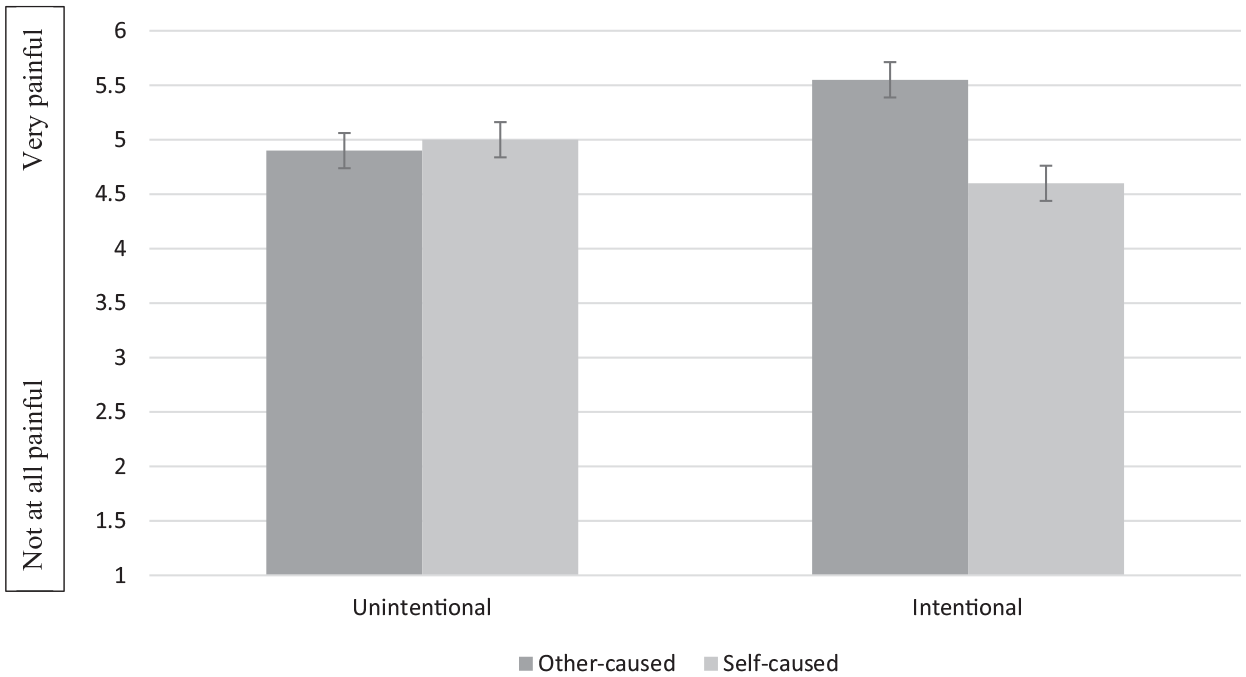
Level of perceived pain under different conditions of intentionality and agency.
Of the 160 participants, 128 (80%) explicitly indicated that they would change their assessments of the girl’s pain were they to learn that the intentionality behind the act had been different than initially presented. In their subsequent assessments of the pain, we see a significant interaction effect, F(159, 1) = 68.51, p < .000 (see Figure 2). When participants learned that what they thought had been an accidental self-inflicted burn had been done intentionally, they reduced their assessment of the level of pain the girl would have felt, while they increased that assessment if they were now told the burn had happened accidentally after having first been told that the burn had happened intentionally 95% CI [-1.88, -0.86] F(1, 143) = 27.77, p < .000, ηp2 = .16. The opposite was the case when it came to an other-inflicted burn. Participants reduced their assessment of the level of pain the girl would have felt after learning that an other-caused intentional burn had actually happened by accident, while they increased that assessment if they were now told the other-caused burn had happened intentionally after having first been told that the burn had happened unintentionally, 95% CI [1.17, 2.20], F(1, 143) = 41.38, p < .000, ηp2 = .22. Simple slopes analysis also indicates that the pain assessments increased for intentionally other-caused harm relative to when that harm was intentionally self-inflicted, 95% CI [0.98, 1.98], F(1, 143) = 33.84, p < .000, ηp2 = .19. Similarly, while being told that the harm had been accidental increased the pain assessment levels for self-caused harm, that information decreased the perceived level of pain for the other-caused burn, 95% CI [-2.10, -1.04], F(1, 143) = 34.70, p < .000, ηp2 = .20.
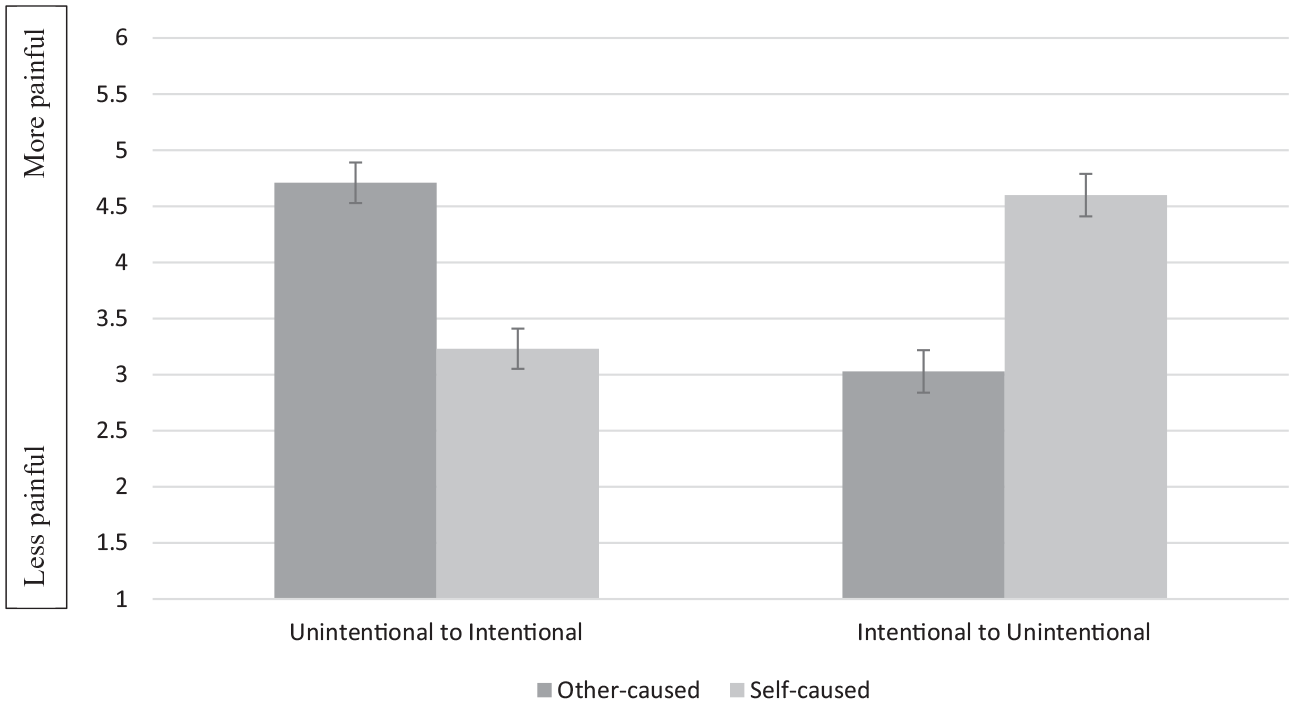
Degree of perceived pain after shift in intentionality.
Discussion
Despite widespread awareness of the psychological dimensions of pain, researchers often and easily slip into essentializing understandings of pain that treat it as a purely physiological, nonpsychological experience that can be isolated within experimental research. As researchers, we often think of psychology as in effect filtering pure, mechanistic, physical pain and thereby occluding our vision of it by means of various cultural, social, situational, and individual differences (Boddice, 2019). The psychological factors of pain are often implicitly thought of as “noise” which, if they could only be tuned out, would no longer distort our ability to understand what pain really is. While the semiotic nature of many emotion states is relatively easy to appreciate, as in the case of love, hate, or even fear, pain is arguably unique in the degree to which its physical dimensions appear in effect to overshadow its psychological dimensions (Boddice, 2014). Pain researchers have long found this implicit essentialism both perennially alluring and, ultimately, perennially problematic.
We have argued that this drive towards scientific objectivity, while at times of tremendous utility, can also limit our understanding of pain to reductionistic conceptualizations that in effect deny the subjective and even the psychological dimensions of pain. While researchers attempt to understand pain by means of empirical, scientific explanations, they often remain nevertheless aware that such an approach cannot grasp the phenomenon in its entirety. We see the persistent attempt to gain a deep, ontological understanding of pain by prioritizing its empirical, objective measurement as an expression of Cartesian anxiety. The desire to achieve the precision of the natural sciences colors much psychological research, not only that on pain (Danziger, 1990; Michell, 2004; Smedslund, 2016; Valsiner, 2012). While quantification and experimentation can shed light on meaningful patterns in psychological functioning (Mazur & Watzlawik, 2016), attempts to attain scientific objectivity regarding affective states run the risk of overemphasizing mechanistic relations between ostensibly isolable, essentialized variables at the expense of our more fluid, symbolic psychological processes (Smedslund, 2016). From within a cultural psychological perspective, one might agree with recent psychological research that perceptions of intentionality can catalyze motivated cognition—that is, our attempts to seek out, find, create, or recreate meaning so as to make the world intelligible, predictable, and controllable (Ames & Fiske, 2015)—however, from a cultural psychological perspective one would assert that these catalyzing processes cannot ultimately be limited to the kind of unilinear, causal relations that we usually find in experimental research (where precisely such relations are generally expected; Cabell & Valsiner, 2014). According to cultural psychology, our psychological engagement with the world is semiotically mediated, which in shorthand is to say that psychological processes are inherently symbolic and fluid. This is not to say that our semiotic processes are random; they are not. However, cultural psychology asserts that whatever nomothetic or ideographic patterns do arise are also likely to exhibit variation or change.
The current study illustrates how the same patterns found in experimental research can be interpreted through the lens of cultural psychology’s notion of semiotic mediation. When assessing the levels of pain another would feel as the result of a burn, participants were in effect treating pain as a sign whose meaning was coconstructed along with the other elements in the given setting, such as intentionality, agency, and of course, various other elements of the experimental context (e.g., the unidimensional scale being used to assess pain). By asking them to assess the level of someone else’s pain, participants were asked to engage in a meaning-construction context from the start (Valsiner, 2018a). Cultural psychology generally does not work quantitively or experimentally, precisely because it encourages implicitly essentializing, mechanistic thinking (Valsiner, 2007), and thus, this is the largest single limitation of the current article. In attempting to make the approach of cultural psychology intelligible and useful for researchers working within other theoretical and methodological perspectives, we have in effect “bent the rules” of cultural psychology. By operationalizing key elements as independent, quantifiable variables within causal chains, we run the risk of essentializing them as discrete, fixed “things” that stand apart from the psychological processes through which they are perceived. Cultural psychology warns against the implicit sense of ostensible objectivity that such assumptions suggest. Nevertheless, we believe this demonstration can be of value for researchers who use such “mainstream” scientific approaches, precisely because it shows how the meaningful patterns that emerge in such research can be understood as having arisen for reasons closely connected with the psychological processes of semiotic mediation. Thus, while quantitatively minded researchers may very well criticize the current paper as being too “soft” in its use of experimental methods, and qualitatively minded psychologists would criticize the project for being too “hard,” we believe the primary value of the project to lie precisely in this novel combination of the two. In this way, we hope to render cultural psychology more intelligible, and of greater value to the larger community studying such affective states as pain. Among other potential limitations (e.g., characteristics of the participants, elements of the story they read, the measures used), it is worth highlighting that the current study examines perceptions of another’s pain, not of one’s own pain. It would be useful in the future to examine semiotic mediation with regard to one’s own experience of pain. On a similar note, as self-inflicted harm can be understood to be the externalization, or concretization, of already existing emotional pain (Mangnall & Yurkovich, 2008; McAllister, 2003), one might reasonably argue that the self-inflicted burn used in the experiment was not understood as a cause of pain, but rather as an expression of pain, and was therefore associated with lower levels of perceived pain as caused by the burn. However, such an interpretation does not undercut the overall argument that pain as a psychological concept is inherently related to meaning-making processes. As those participants who initially read about intentionally self-inflicted harm increased their pain ratings after subsequently learning that the harm had actually been done unintentionally, we still see the processes of cultural meaning-making at work. What is more, this additional possible explanation of the perceived relationship between self-harm and pain provides further support for our general argument by illustrating yet another way in which harm, pain, and intentionality can be meaningfully interwoven, with the meaning of each, in effect, being interconnected with the meaning of the others.
It is also important to point out that the results of the current study are at least in part in line with what has been argued from the point of view of various other areas of psychology (e.g., in research on motivated cognition related to blame attribution; Ames & Fiske, 2015; Gray & Wegner, 2008). In fact, the current study does not rule out the fact that blame attribution may often play an important role in increasing pain assessments of intentionally caused harm. However, we are arguing that such patterns arise not because of necessary causation between isolable variables, but because humans are meaning-seeking and meaning-making beings whose perception of the world is semiotically mediated. Not only did participants create meaningful patterns that are intelligible to researchers, but they readjusted those patterns in the light of new information. Thus, just what harm, pain, and intentionality are understood to mean for the participants were interwoven, coconstructed, and dynamic. While intentionality, or blame attributions, might account for increased assessments of third-party pain in some situations, just what those variables mean in various situations is likely to change, as are related pain assessments. Similarly, just what pain is understood to mean can easily shift, and it often does.
Cultural psychological perspectives can help us to avoid thinking of pain, in as far as we take its psychological dimensions seriously, in essentializing terms. While this may seem obvious, it is easy to forget, especially within quantitative experimental research (Shweder, 1991; Valsiner, 2007). This message is uniquely challenging—and also uniquely valuable—for people studying pain, as pain researchers often implicitly shift toward biological, mechanistic understandings of pain, even after explicitly acknowledging its subjective, psychological dimensions. So long as this happens, we will be repeatedly surprised and disappointed by the wide number of “real-world” cases of pain that simply do not fit our empirical models, and our Cartesian anxiety in the face of pain will remain. However, to take cultural psychology seriously is not to disregard or downplay the value of mainstream pain research. Rather, cultural psychology can help us to better understand why pain is, and will remain, too dynamic, complex, and rich, to be fully pinned down, once and for all, in even the best of experimental research.
Footnotes
Funding
The authors received no financial support for the research, authorship, and/or publication of this article.
