







Abstract
Historically, media have been one of the key networks of power and influence in societies largely as a consequence of their utility in channelling information flows and, in doing so, persuading populations. However, the rapid expansion of social media platforms has revolutionised how such mediated persuasive power is wielded. Many nation states have engaged in sophisticated social media campaigns to influence how others understand economic, social, political, and, importantly, security issues. In some cases, these campaigns have undermined the legitimacy of democratically elected governments and threatened security at local, national, and global levels. Developing theoretical understandings of how these campaigns are undertaken is, therefore, essential. While there has been some excellent research undertaken towards advancing understandings of such campaigns, conceptual challenges remain in theorizing persuasion in contemporary social mediascapes. We propose that, although social media provide innovative and unique features that enable revolutionary changes in how communication and persuasion occur, a look to the past can be instructive in conceptualising contemporary acts of persuasion. More specifically, we argue that drawing on Aristotle’s rhetorical framework and reframing its canons of invention, arrangement, style, memory, and delivery to contemporary mediated worlds can deliver new insights into the theoretical processes of persuasion via social media.
Media institutions and technologies are active everyday players in the relationships and communicative processes through which people construct predominant understandings of political, economic, and social aspects of society. As storying institutions, media are implicated in how people make sense of the world and act in it through social processes that inform, reinforce, or challenge understandings and personal narratives, and arouse emotions. The centrality of information and communicative processes within society makes the media one of the key networks of power and influence in society (Bennett, 2016; Berger, 2012; Carah, 2021; Castells, 2013; Cottam et al., 2016; Couldry, 2000; Herman & Chomsky, 2010; Hoewe & Peacock, 2020; Miller, 1998; Mutz et al., 1996).
Theory and research relating to media persuasion is not new. An abundance of existing scholarship has focused historically on legacy media of print, radio, and television. However, the rise of the internet, and more specifically social media platforms, has provided opportunities for scholars and political analysts to explore how digital media forms contribute to collective thought and action, and are used to exert power in influencing others in a manner never before envisaged (Bennett, 2016; Bradshaw & Howard, 2018a, 2018b; Couldry & Hepp, 2018; Gilardi et al., 2022; Innes, 2020; Lipschultz, 2022; Margetts et al., 2015; Naderer, 2023). These social media platforms provide a range of features which draw on legacy media but also include a host of newer interfaces which provide various highly personalised, interpersonal channels offering complex reciprocal interactions (Bayer et al., 2020; Cho et al., 2022; Muhlmeyer & Agarwal, 2021; Valkenburg et al., 2016). Moreover, these platforms are both rapidly and continually evolving as dynamic algorithms, network compositions, and personal settings constantly change, making an already diverse and complex mediated ecosystem even more so.
The rise of these platforms has been celebrated as providing a new public-commons where democracy could flourish, as exemplified by the popular uprisings in North Africa and the Middle East in 2011 (Blagojević & Šćekić, 2022; Howard & Hussain, 2011; Kuznetsov, 2022). These platform-enhanced events were largely a consequence of the access to data, knowledge, social networks, and the collective engagement opportunities they afforded (Woolley & Howard, 2019).
However, such platforms have also given rise to much darker scenarios, whereby a variety of actors can generate information, misinformation, and disinformation to persuade others and impact how they understand economic, social, political, and, importantly, security issues (Bradshaw & Howard, 2018b; Dhawan et al., 2022; Gisondi et al., 2022; Muhammed & Mathew, 2022; Vaidhyanathan, 2018; West, 2016). Unsurprisingly, this capability has been co-opted by governments, political parties, and other organisations to shape the geopolitical environment in a manner favourable to them. Indeed, Bradshaw et al. (2021) identified evidence of 81 countries where social media was utilised to spread political disinformation in an effort to manipulate public opinion and effect persuasion. This included shaping public attitudes domestically to “suppress fundamental human rights, discredit political opponents, and drown out dissenting opinions” (p. i). For example, in the lead-up to the 2016 Brexit referendum in the United Kingdom, the ‘Leave’ campaign hired Cambridge Analytica, an organisation that describes itself as a “global election management agency,” (Cambridge Analytica, 2024) to influence the outcome of the referendum. Through a series of questionable practices (Rone, 2023), Cambridge Analytica utilised sophisticated psychological tools to microtarget voters on social media during the referendum campaign, with disinformation messaging focussed on immigration and lack of control of the borders (Kaiser, 2019). This was done with the intention of influencing voting on the issue in favour of the Leave campaign. More recently, following the fatal shooting of U.S. conservative activist Charlie Kirk, social media was exploited to reinforce partisan talking points, frame the incident as evidence of a growing threat to white, conservative Americans, and call for retaliation to “Crush the Left” (Rosenblat & Barnes, 2025, p. 17).
But as well as their use for persuading and controlling domestic populations, these tools have been used to undertake foreign influence campaigns and persuade global audiences. For example, social media has been utilised by states to influence election outcomes in adversary states (e.g., 2016 U.S. presidential election, 2017 French presidential election, 2024 Romanian presidential election); and to spread disinformation around the COVID-19 pandemic, contributing to growing fear and mistrust in any type of vaccine (European External Action Service [EEAS], 2021). These campaigns have evolved into a sophisticated form of information warfare that is an important part of an overall strategy to achieve geopolitical goals.
In terms of non-state actors, marginal social movements in numerous countries are undertaking divisive social media campaigns that are heightening ethnic, cultural, and racial tensions; inspiring violent nationalist movements; and causing civil disturbance. Terrorist organisations such as ISIS are leveraging the power of the social media environment through the propagation of socio-ideological messaging, including livestreaming terrorist attacks, to a global audience. This messaging is used to build communities, to share stories and grievances, and, ultimately, to radicalise and recruit potential members (Stengel, 2019).
No longer then is social media merely a tool to bring people together. Rather, this epistemic commons is being utilised as a persuasive tool to alter the geopolitical balance of power; to effect the polarisation of societies; to create uncertainty and anxiety; to undermine trust in knowledge, people, systems, and institutions; and to bypass critical faculties to shape both beliefs and behaviour, thereby reducing individual agency.
Understanding how persuasive campaigns are crafted and implemented to effect persuasion is, thus, important to enable effective responses to be developed that protect the security of individuals, groups, states, and the international environment. While such efforts can be informed by longstanding scholarship on media persuasion (Carraro & Castelli, 2010; Franz & Ridout, 2010; Glynn et al., 2018; Krupnikov & Connors, 2018), the complexity and ambiguity of the social media environment, and in particular the integration of the technical and social environments, creates additional challenges to theorising and documenting how persuasion is effected digitally. We posit that a return to the past, specifically to the rhetorical works of Aristotle, offers theoretical insights into understanding persuasion in the contemporary social media environment. In arguing this, we draw on lessons identified in case studies undertaken that utilise Aristotle’s rhetorical framework to theorise and analyse social media persuasion during the 2016 U.S. presidential elections and the 2022 Russian invasion of Ukraine (Nelson et al., 2025a, 2025b).
Background
The academic study of persuasion dates to at least the Ancient Greeks, where the term rhetoric was coined to refer to the use of argumentation, language, and public address to persuade audiences (Billig, 1996). Aristotle, one of history’s earliest and most influential figures on the art of rhetoric, distinguishes between the practice of rhetoric to persuade an audience and “. . . the faculty of analysing in any given case the available means of persuasion” (Aristotle, ca. 350 B.C.E./1991, p. 7). Our focus is on the latter of these, the analysis, to highlight the utility of a rhetorical framework in understanding political influence campaigns on social media. Originally founded for use in law courts to allow ordinary men to argue their case, forensic rhetoric provided a platform for the subsequent development of the two other branches of rhetoric: epideictic rhetoric—focussed on praise or blame during public ceremonies; and deliberative rhetoric—focussed on communicating support for a particular policy—the focus of this article.
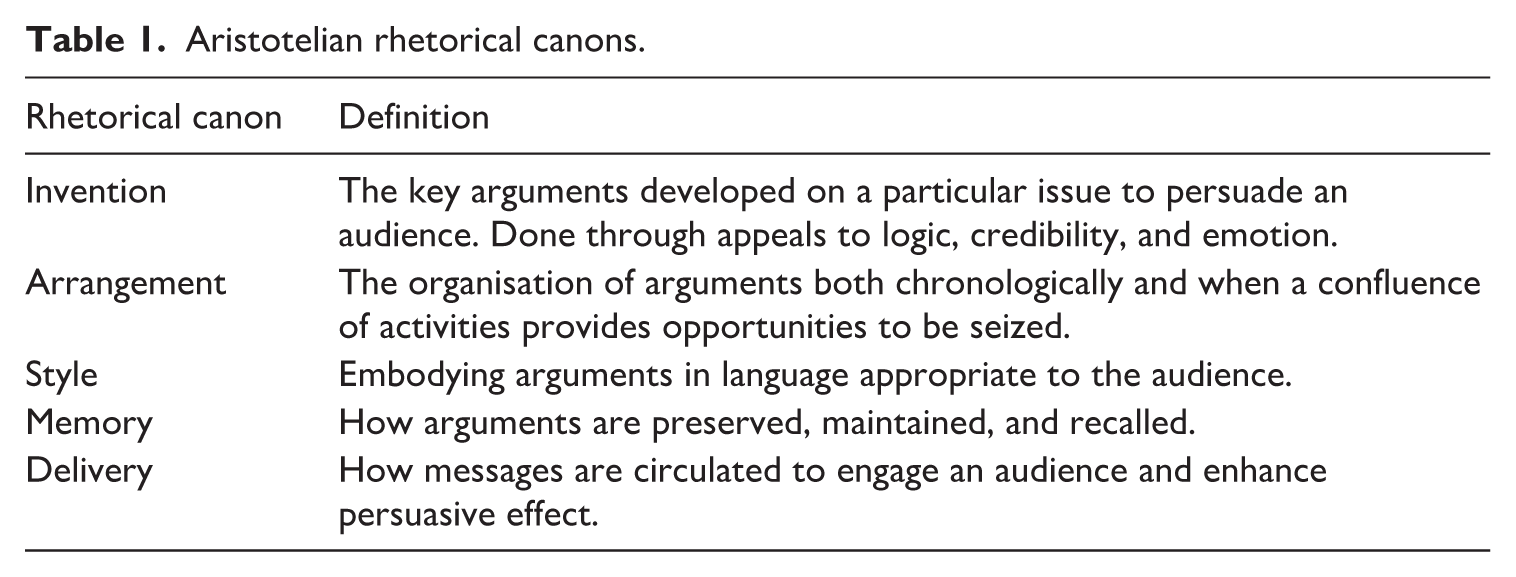
Classical rhetoric comprised several aspects, or canons (Table 1) (Nelson et al., 2025b), and while the emphasis on these canons has varied throughout history, at its core, rhetoric remained largely unchanged until the arrival of Classical Rationalism in the 16th century brought a physical sciences approach to the study of social relations.
Aristotelian rhetorical canons.
The physical sciences approach reached a peak around 1940 when experimental methods were adopted to solve rhetorical problems in an approach that Brewster Smith described as the “new rhetoric” (Petty et al., 1981, p. xii). This ‘new rhetoric’ was driven largely by Carl Hovland’s experimental studies into the persuasive effects of propaganda during the Second World War which sought to measure persuasion as an individualised cognitive process and in doing so to uncover general principles of persuasion (Billig, 1996; Hovland & Lumsdaine, 2017). Despite this desire, it has been widely recognised that clear general principles have not emerged from these laboratory-based efforts. Rather, it is argued that what has been found is “. . . an accumulation of largely contradictory and inconsistent research findings with few, if any, generalizable principles . . .” (Fishbein & Ajzen, 1982, p. 340).
In the 1970s, critical psychology emerged as a sub-discipline, in part as a reaction against traditional, experimental psychology which was seen as overly individualistic, reductionist, and detached from the social and political contexts in which persuasion occurred (Teo, 2009). For many early critical psychologists, discourse and rhetorical theory offered robust epistemological and methodological alternatives to mainstream psychology (Billig, 2006; Wetherell, 2015) and so a parallel movement in discursive and rhetorical research emerged alongside critical psychology in the early 1980s. In Western contexts, key scholars such as Billig (1987), Potter and Wetherell (1987), and later Parker (1992) advanced this movement that reorientated research into persuasion within the realm of language, rhetoric, and social interaction (Billig, 2008). These scholars argued that it is through language, a fundamentally social and dialogical process, that knowledge is constructed (Billig, 1987; Parker & Shotter 2015; Potter & Wetherell, 1987) and that these constructions bring social worlds into being to make things happen (Wetherell, 2015).
In this critical reorientation, classical rhetoric, notably Aristotle’s rhetorical proofs of logos (appeal to logic), pathos (appeal to emotion), and particularly ethos (appeal to credibility), became a useful conceptual resource for scholars. Although a detailed discussion is beyond the scope of this article, Michael Billig stands out as the most explicit attempt to link classical rhetoric with psychology. For example, in Arguing and Thinking (1987) he treats ethos not as an inherent trait of a communicator, as in Hovland’s ‘source credibility’ variable, but as an outcome of discourse. Credibility and character, he argues, is constructed and continually reconstructed through social interactions and discourse. In importing concepts from classical rhetoric then, critical psychologists recast persuasion research from an individualised cognitive process to a discursive rhetorical practice where meaning is constructed and reconstructed jointly, incorporating broader social and political contexts. We return to this issue later.
A further layer of complexity has been added to persuasion research with the rapid expansion of online social media platforms. These platforms have enabled a revolutionary change in how persuasion occurs because of the large number of highly personalised, interpersonal channels that offer near-instantaneous reciprocal interactions as opposed to the relatively simple unidirectional influences of legacy media forms (Bayer et al., 2020). Furthermore, social media platforms are characterized by continuous and rapid evolution which is driven by dynamic algorithmic processes, shifting network structures, and individualized user configurations, all of which contribute to the ever-increasing complexity of the social media ecosystem (Bradshaw & Howard, 2018a; Couldry et al., 2018; Gilardi et al., 2022; Lipschultz, 2022). Notwithstanding the challenges that these complexities raise, scholars have made significant gains in understanding how various factors are exploited to effect online persuasion. Some of this theory and research is focussed on technology (Aral, 2020; Hoffmann et al., 2019; Huszár et al., 2022; Muhlmeyer & Agarwal, 2021; Woolley & Howard, 2019) and seeks to understand how the technical aspects of platforms can be co-opted to spread information and facilitate change. Other research explores how various social and cognitive vulnerabilities can be exploited via social media to achieve persuasion. This body of research is broad and, from a political influence perspective, includes work investigating election influence (Bronstein, 2013; DiResta et al., 2018; Jensen et al., 2024; Samuel-Azran et al., 2015); broader geopolitical influence (Bradshaw & Howard, 2018b; Bradshaw et al., 2023; Carter & Carter, 2021; Crilley et al., 2022; Hall, 2022; Howard & Hussain, 2011); the exploitation of emotions to effect political influences (Crilley & Chatterje-Doody, 2020; Davis et al., 2018; Duncombe, 2019; Schmid, 2023); the use of memes and symbols in spreading propaganda (De Cook, 2018; Woolley & Howard, 2019); and both dis- and mis-information (Chen et al., 2021; Halversen & Weeks, 2023; Wojtowicz, 2022).
Building on Billig’s (1996) assertion that rhetorical psychology provides an alternative to standard social scientific approaches to persuasion, several authors have highlighted the utility of traditional rhetorical analysis in attempting to bridge knowledge gaps and provide a theoretical framework to gain a deeper understanding of persuasion in the social media environment (Bronstein, 2013; Chen et al., 2021; English et al., 2011; Pang & Law, 2017; Samuel-Azran et al., 2015). More specifically, these authors have undertaken research that examines participant responses to various social media messages categorised in terms of Aristotle’s rhetorical proofs of logos, ethos, or pathos. These studies highlight that both the usage and effectiveness of persuasive strategies varied dependent upon context and audience. For example, in looking at healthcare messaging on YouTube, English et al. (2011) found ethos as the most persuasive rhetorical proof and pathos, particularly as it appealed to humour, as the least persuasive. Similarly, Pang and Law (2017) found ethos to have the most persuasive appeal when presenting environmental issues on Twitter (now X). In contrast, research by Bronstein (2013) in the political environment revealed that U.S. presidential candidates Obama and Romney’s use of emotional appeals, or pathos, connected with voters most effectively on Facebook. This appeal was not similarly reflected in the 2013 Israeli elections where Samuel-Azran et al. (2015) showed that ethos was both the most prominent and most effective rhetorical proof. Of note in this latter research is that logos was the least preferred appeal by all the candidates. In looking at persuasion strategies in propagating misinformation on Weibo, Chen et al. (2021) found that pathos was the most common and effective rhetorical proof utilised. Clearly, contextual and audience variables impact the most appropriate approach to achieving persuasion.
While valuable in highlighting both the complexity and contextual nature of the effectiveness of rhetorical proofs in the social media environment, previous research has not moved beyond these rhetorical proofs—which are only one part of the classical rhetorical framework. Although analysing what arguments were utilised, the research left a gap in our understanding of persuasion in this environment as it did not explore how the key arguments were organised, designed, delivered, or remembered. In this sense, the research does not fully capture how both social interaction and platform technical affordances such as multimodality and algorithmic curation combine to effect persuasion. We suggest that by drawing on Aristotle’s rhetorical framework more fully and reframing it to the contemporary environment, these aspects can be explored, and a more comprehensive understanding of persuasive attempts can be gleaned.
We now turn to a discussion of each of the rhetorical canons, noting their classical utility along with their applicability to the contemporary social media environment. We then highlight how this rhetorical framework may be drawn on to analyse social media persuasion attempts.
Aristotle’s rhetorical framework
Invention
Traditionally, scholars have differentiated between the form and content of rhetoric, recognising that the content, or substance, of the discourse must first be determined before attending to issues of form (Billig, 1996). This aspect is best represented by the canon of invention which for those focused on the practice of rhetoric to persuade an audience involves determining, or inventing, what the essential arguments of a particular issue should be or, as Aristotle (ca. 350 B.C.E./1991) states, “the art (techne) of finding out the available means of persuasion” (p. 37). Invention is a comprehensive activity that goes beyond identifying how previously successful arguments can be applied to a particular situation to include a comprehensive analysis of new situations to identify what novel arguments could be developed that could be persuasive in those situations.
In the social media environment, everyone is a prosumer—both a consumer with access to information as well as a producer able to create and share both multimodal and multimedia data in ways never deemed possible. In this way, the social media environment is a much more social model of invention where arguments can be seeded and fertilised by a rhetor for prosumers to further develop, reshape, and amplify. But not only do prosumers actively reinvent arguments, these arguments, in turn, actively reinvent prosumers in a mutually constitutive, ongoing relationship akin to Gidden’s structuration theory (Lippuner & Werlen, 2009). Arguments, thus, exist in an ongoing relationship and come into being through social action. As Brooke (2009) notes, this reframes invention as “proairesis (action) as opposed to hermeneusis (interpretation)” and provides the opportunity for an ongoing process of invention. For analysts, such as academics and security professionals, our task is “not to persuade, but to discover the available means of persuasion in each case” (Aristotle, ca. 350 B.C.E./1991, p. 35). In seeking to understand the key lines of argument in the social media environment, we must look not only for the arguments occurring in individual archives but also for the continuously evolving arguments that occur through social interaction.
In looking to invention, Aristotle (ca. 350 B.C.E./1991) identified three key elements, logos, ethos, and pathos, as essential ingredients for understanding persuasive content. In exploring the first of these, logos, Aristotle (ca. 350 B.C.E./1991) proposed that people are most easily or most strongly convinced when they believe something has been proven or demonstrated. On the surface, this seems relatively straightforward—prove or demonstrate something, and persuasion will occur. However, this is an oversimplification of the concept which rests on two flawed assumptions. Firstly, that persuasion is merely about an audience learning something and that when educated with the ‘facts,’ or indisputable truth, they will be persuaded. Secondly, that truth must be unitary and agreed upon. This latter assumption is inconsistent with Aristotle’s rhetorical approach which recognises that there can, and indeed must, be open-ended contrary truths each of which can be reasonably justified (Billig, 2015).
A deeper exploration of Aristotle’s logos reveals that the process of rhetorical, as opposed to educational, persuasion consists of proving or demonstrating something based on what an audience already believes or sees themselves as aligned with. In that sense, an audience can be persuaded by connecting them to a premise they already agree with or believe in, and then making a logical deduction based on that—what Aristotle called the enthymeme. An important aspect of being able to make this connection is the need for the rhetor to be an expert in endoxa, or the accepted opinion of the group they are trying to persuade (Rapp, 2012). The social media environment provides a range of opportunities to connect prosumers to various propositions and, thus, lay the platform for a desired conclusion to be reached to effect persuasion.
For example, in seeking to influence the outcome of the 2016 U.S. presidential elections, the Internet Research Agency (IRA), a St Petersburg-based organisation working on behalf of the Russian government, undertook a sophisticated social media campaign targeting key audiences in the United States: African American, left-wing, and right-wing voters. This campaign targeted these audiences utilising three key arguments: racial injustice, liberal inequity, and white grievance and fear respectively. In targeting right-wing voters specifically, the accepted premise of this group that mass illegal immigration was occurring was deduced to pose a threat to the United States, its institutions, and its values. In turn, this threat was designed to create grievance and fear. The persuasive goal of this line of argument was not one of trying to change minds, but, rather, of reinforcing pre-existing beliefs, amplifying existing cleavages in society, and, ultimately, influencing voting behaviour by mobilising right-wing voters (Nelson et al., 2025a).
Because not everyone shares the same underlying premises, persuasion through logos alone may not be effective. As Aristotle (ca. 350 B.C.E./1991) notes, the orator should “not only look at the argument, that it may be conclusive and convincing, but should also present himself as a certain kind of person” (p. 14). We turn then to the second rhetorical appeal, ethos.
The means of persuasion called ethos relies on the establishment of the trustworthiness or credibility of the orator or author traditionally because of them presenting themselves as a morally upstanding citizen with good or virtuous character. However, Aristotle (ca. 350 B.C.E./1991) noted two other reasons why a speaker or author may be deemed credible: through either practical wisdom or good will. Importantly, the effect of persuasion through ethos is a judgement call about the credibility of the speaker which will vary depending on the audience—what one audience considers practical wisdom and goodwill may be very different from another audience or may vary over time. In that sense, arguments utilising ethos are not static; rather they are active and are reconstructed through an ongoing process as prosumers engage in their everyday lives and social activities. The importance of ethos grows and takes on greater importance when the audience is not convinced through a strong logical argument.
In the social media environment, analysing how ethos may enhance persuasion poses an interesting challenge, often as a consequence of the lack of transparency of the true source of a message. In some situations, this is clear, and influence can occur through the traditional notion of ethos. For example, during the Russian invasion of Ukraine, RT’s (formerly Russia Today) Twitter platform (@RT_Com) utilised statements, albeit misrepresenting or decontextualising these, from key Western figures to support carefully crafted Russian messaging. These included political figures such as Ukrainian Defence Minister Reznikov, NATO Secretary General Stoltenberg, and White House Press Secretary Psaki, as well as purported independent experts such as Earl Rasmussen of the Eurasia Center. These voices were further reinforced by messages parroting Russian talking points from high-profile U.S. politicians and key right-wing influencers such as former U.S. President Donald Trump, U.S. Senators Josh Hawley and Ted Cruz, and television host Tucker Carlson. By dint of their profile, these individuals could be said to add credibility to the messaging targeting the desired audiences (Nelson et al., 2025b).
In cases where there is a lack of transparency of the source of the message, the rhetorical analyst must look beyond identity to explore broader factors which may function as an enabler of ethos. These could include the number of followers a user has; who the followers are and whether they have strong or weak ties; the number of likes, shares, or retweets of a message; or even what particular hashtags have been used. Incorporating modern analytical methods into a rhetorical analysis framework may offer some useful insights into the human and non-human actors, as well as the networks they are part of, that enable ethos in the social media environment.
The third of Aristotle’s means of persuasion, pathos, involves the arousal of, or appeal to, feelings that affect target audience’s judgements, particularly those related to pain or pleasure (Aristotle, ca. 350 B.C.E./1991). The underlying assumption of this rhetorical appeal is that an audience may perceive issues differently when emotionally aroused and, thus, pathos can be used to bypass their critical faculties and modify their judgement on a particular issue (Rapp, 2012).
To arouse emotions in an audience, Aristotle (ca. 350 B.C.E./1991) notes that a rhetor must be cognisant of three key factors: the state of mind of the audience (e.g., angry, fearful, sad), the type of persons at which the specific emotion is directed, and the reason for that emotion. The utility of this rhetorical appeal to the social media environment is clearly highlighted in the research literature (Ferrara & Yang, 2015; Steinert, 2021; Steinert et al., 2025). In particular, these researchers have noted the power of social media to scaffold, or socially construct, emotions in a way that limits critical thinking and, in turn, impacts judgement and behaviours. For example, Steinert (2021) notes how the online sharing of emotional content during the coronavirus pandemic led to emotional contagion, which in turn influenced societal value structures. Similarly, in the 2016 elections, the IRA utilised the fear of mass immigration in threatening their way of life in the United States to mobilise right-wing voters to vote (Nelson et al., 2025a). The rhetorical analyst in this environment must explore the multitude of ways that pathos is generated to arouse the appropriate emotions that, in turn, generate the desired persuasive outcome.
These three elements, or as Aristotle termed them, rhetorical proofs of logos, ethos, and pathos, are the essential aspects of the classical inventional canon of rhetoric and focus on the substance, or form, of arguments. In the contemporary environment, we argue that prosumers are embedded within rhetorical spaces where rhetorical processes are increasingly dominated by image and spectacle in efforts to generate emotion through pathos rather than more traditional engagement with logos or the personhood of ethos. This distorts classical rhetoric from a position in which Aristotle emphasises the logical and ethical dimensions of persuasion to one in which Debord’s Society of the Spectacle would suggest inverts these, leading to a society where critical engagement is overshadowed by the seductive pull of images and superficial appeal. In this sense, while Aristotle’s rhetoric underscores the power of communication in shaping thought and action, Debord highlights how this power has been hijacked by a spectacle-driven culture that shapes both individual identities and social relations through mediated constructions of reality (Debord, 1967/2014).
Notwithstanding this, and irrespective of the emphasis placed on each of the rhetorical appeals as persuasive tools, in the digital environment, invention is an ongoing process of discovery where arguments can be seeded by a rhetor but understandings of these are socially constructed by target audience members. This leads to, arguably, more powerful persuasive effects and while rhetorical analysts must look for the continuously evolving arguments that occur through social interaction, they must also look for how these were initially seeded and what specific appeal is emphasised to understand such persuasive campaigns.
Aristotle (ca. 350 B.C.E./1991) notes that while arguments are central to persuasion, on their own they may be insufficient to persuade. With that in mind, we turn to the second canon, arrangement.
Arrangement
The way that arguments are arranged can be the difference between persuasive success or failure, and ancient rhetoricians understood that arguments, however good they were, needed to be organised into a convincing discourse (Billig, 1996). Arrangement (dispositio or taxis) in classical rhetoric was essentially a formal system of organisation, and classical textbooks provide broad guidelines focussed largely on the order in which a rhetorical act should occur. Aristotle recommended four parts (introduction, statement, argument, and epilogue) (Aristotle, ca. 350 B.C.E./1991), Quintilian five parts (the genesis of the five-paragraph essay) (Quintilian, ca. 95 B.C.E./1921), and Cicero six divisions (Cicero, ca. 90 B.C.E./1954). Cicero even linked specific divisions with rhetorical appeals for optimal persuasive effect. In the introduction he noted the importance of establishing credibility and, thus, suggested the employment of ethos. Through the middle of the oration, he suggested the use of logos to state the facts, provide proof, and refute alternative arguments. In the conclusion, Cicero argued the need for employing emotional appeals or pathos (Cicero, ca. 90 B.C.E./1954). While guidelines on structure were provided in classical texts, clear rules were not elucidated, and orators could choose to take a different approach as the situation dictated. However, this approach to arrangement has a largely chronological aspect, or chronos, to it and while its utility remains in the social media environment it poses some challenges.
In the social media environment, prosumers have much greater control over the order in which they experience information, and everyone’s path may differ in how they move through it. Further, discourse in this environment never really begins or ends but rather forms part of a continuous evolution of communications. In this sense, the ability to structure arguments in line with chronos is more challenging and authors need to utilise other tools, such as repetition of arguments, to allow prosumers who are immersed in the digital ecosystem to navigate the information in the order of their choice while still being exposed to key arguments. In exploring this, Brooke (2009) suggests a reframing of the chronological aspect of arrangement from one of sequence to one of patterns. This sees arrangement as an emergent feature within digital ecosystems as opposed to something that is fixed or predetermined. Techniques such as repetition of arguments and consistency of examples are key in creating the patterns that allow users to move through the information using any path while still being exposed to key arguments.
For example, in the three months leading up to Russia’s invasion of Ukraine, (Nelson et al., 2025b) note that of the 1977 tweets posted by @RT_Com, 1,587 of them focussed on only four key arguments. These arguments were continually repeated and supported with consistent examples to create patterns in the rhetorical field. This meant that prosumers could enter the conversation at any stage, and move through or navigate it in any order they chose, all whilst being exposed to the key arguments.
Although chronos was important in classical rhetoric, arrangement was also tied to Aristotle’s notion of kairos, that qualitative notion of time where a confluence of factors such as context, audience, and rhetorical purpose provides an opportunity to be seized (Kinneavy & Eskin, 2000). Arrangement in the digital environment is ideally suited to kairos, in large part due to the speed and scale of the dissemination of information. For example, leading up to the 2016 U.S. presidential elections, one key argument targeting African American voters focused on racial injustice. Messaging centred on the failure of the current political system in supporting African Americans and was designed to convince them to either opt out of voting or to vote for an independent candidate. Examples supporting this were historic incidents of police brutality where young African American men had been killed by police. During the final months leading up to the election, and in line with the notion of kairos, messaging seized on seven separate real-time incidents of African American men being killed by police officers in swing states to constantly reinforce the key racial injustice argument (Nelson et al., 2025a).
For those focussed on the practice of rhetoric to persuade an audience, the canon of arrangement in the contemporary social media ecosystem provides some considerable challenges in arranging arguments, particularly when considered from a lineal perspective of chronos. Notwithstanding this, social media also provides considerable opportunities for overcoming these challenges as well as for rapidly exploiting opportunities as they arise—the notion of kairos. Therefore, those focussed on undertaking a rhetorical analysis must remain cognisant of these challenges and opportunities and consider the many ways in which arguments can be arranged beyond the traditional linear approach to enhance the likelihood of key arguments being received and, in turn, the desired persuasive effect achieved.
Style
If invention concerns what is to be said, then style concerns how it is said. From a rhetorical perspective, style (elocutio) concerns the skilful use of language to express ideas. Although the importance of this canon has ebbed and flowed since Aristotle’s time and has often been misconstrued as merely window dressing (Billig, 1996), at its core, style is an intrinsic part of rhetoric that has an important reciprocal relationship with invention. Indeed, rather than asking whether form (style) or substance (invention) is more important, one should ask what kind of style is best utilised to support the arguments created (Leach, 2003; Martin, 2014).
For Aristotle (ca. 350 B.C.E./1991), style was predominantly about ensuring that the language used was clear and appropriately matched with both the discourse at hand and the audience. The “aptness of language,” he noted, was “one thing that makes people believe in the truth of your story” (p. 149). In this sense, the clarity and appropriateness of language plays an important part in ensuring the logical coherence and, thus, persuasiveness of the argument—making it important for logos. But as Aristotle (ca. 350 B.C.E./1991) notes, language is also appropriate if it expresses both emotion (pathos) and character (ethos). In this sense, persuasion, rather than mere understanding, needs to employ a style that goes beyond the logic of an argument and that connects an audience with emotions that are appropriate to the situation (pathos)—particularly those related to pleasure or pain—and allows them to identify with a rhetor (ethos) and the message they are conveying.
The proliferation of social media platforms and the consequent explosion of information on them makes attracting attention on social media a challenging proposition (Zhang et al., 2025). Yet, attracting attention to key arguments in this environment is important for engagement, which, in turn, is key for achieving a desired persuasive effect. This attracting of attention is the role of style, and social media offers the opportunity to enhance the persuasive capability of a communicative act through a wide range of multimodal and multimedia tools, and through the ability to develop and rapidly disseminate clear and appropriate messages to a variety of highly targeted audiences.
In looking at clear messaging, the fast-paced nature of social media where users look for quick reads rather than deep ones (Porubay, 2025) sees social media encourage brevity. With a maximum of 280 characters per post, X is certainly brief, and the limited length of posts means that key issues and conversations can be easily followed in real time. Although other platforms allow much longer posts (e.g., Facebook 63,206 characters), research has shown that those with 80 characters or fewer receive 66% higher engagement than longer posts (Tudhope, 2024). However, Duncombe (2019) notes that such short messaging makes “substantive engagement difficult and snark very easy” (p. 417)—a challenge for ensuring that messages are both clear and appropriate.
Notwithstanding this, the multimedia nature of social media allows prosumers to overcome the limitations imposed by brevity. In overcoming a lack of substantive engagement, short posts can be supplemented by hyperlinks, allowing users to move to sites where issues of interest can be explored in depth. Multimedia imagery, both still images and video, can also be utilised to support brief messaging and provide a more comprehensive understanding of a topic. Short messaging supported by hyperlinks and multimedia imagery has been shown to be more likely to engage an audience and to be shared (reposted, retweeted, etc.) (Hönings et al., 2022; Jaakonmäki et al., 2017)—an important goal for any rhetor seeking to persuade an audience.
In looking to capitalise on the ‘snark’ of short messaging, research has shown that messages that include high arousal emotions, both positive and negative, are more successful at stimulating engagement (Jaakonmäki et al., 2017; Zhang et al., 2025). When combined with multimedia imagery, particularly the use of memes, messages serve an important role in both identity and community building and enhance the viral transmission and persistence of key arguments. In turn, this has been found to enhance persuasiveness (De Cook, 2018). For example, IRA messaging during the 2016 U.S. presidential elections targeting right-wing audiences was focussed on arousing negative emotions (pathos), particularly those of anger and fear, to achieve persuasive outcomes. This was often supported with disparaging memes which proved successful at stimulating social media engagement by increasing likes, comments, and shares (Nelson et al., 2025a).
But as well as style needing to be clear, Aristotle (ca. 350 B.C.E./1991) noted that style also had to be appropriate if it was to influence. Social media provides a considerable opportunity to enhance the appropriateness of style through its ability to segment audiences and then, through microtargeting, to provide each prosumer with unique messaging in a style that is both clear and appropriate. Leading up to the 2016 U.S. elections, the IRA identified three target audiences (African Americans, left-wing voters, and right-wing voters) and invented means of persuasion to address each. They then segmented these audiences and targeted each with key messaging specific and appropriate to only them. Although messaging directed at each audience was different in style, and often contradicted messaging to other audiences, this did not matter as they were segregated. It also resulted in average clickthrough rates of 8.1%—significantly higher than the industry average of 1.1% for Facebook posts and greatly enhancing engagement, and thus, persuasive potential (Nelson et al., 2025a).
Style in classical rhetoric was focussed on ensuring that language was both clear and appropriate to the discourse at hand. While this focus remains fundamentally unchanged in the social media environment, style has gone beyond merely transmitting static, text-based messages to audiences, to a situation where a wide range of multimedia, interactive tools allow messaging to be highly targeted to specific audiences in a manner that is both clear and appropriate to them. This considerably enhances the persuasive potential of key arguments. Rhetorical analysis of style in this environment needs to consider the different styles employed, as well as those avoided, and how these styles connect with the targeted audiences to achieve the desired persuasive effect.
Memory
Much of the contemporary scholarship on the classical canon of memory (memoria) notes that in Ancient Greece, orators were judged both by the length of their speeches and by whether they were able to deliver the exact same speech twice or more in a row (Billig, 1996). The conclusion of this understanding of memory has been that with the advent of the print medium, this canon has lost much of its emphasis and, thus, in the contemporary environment, is considered largely redundant. Indeed, Corbett (1990) notes that of all the canons, memory has the least utility, as “not much can be said, in a theoretical way, about the process of memorizing; and after rhetoric came to be concerned mainly with written discourse, there was no further need to deal with memorizing” (p. 27). This perspective, however, conceptualises memory very narrowly, as merely storage and recall.
A deeper exploration of the classical literature indicates that the canon of memory was about far more than merely recall. Indeed, the Rhetorica ad Herennium [Rhetoric for Herennius] (1954) calls memory the “treasury of things invented” (p. 205), highlighting the important link between the canons of memory and invention, and noting that memory is about the rhetorical practices of storing and recollecting arguments at an appropriate time (kairos). In his short treatise De Sensu and De Memoria [On Sense and On Memory], Aristotle (ca. 350 B.C.E./1906) notes that memory is recollected, rather than simply recalled, through a process of deliberation, either individually or socially, that infers past experience to make sense of a particular thing—an approach not dissimilar to what contemporary cognitive psychologists have concluded (Schacter & Addis, 2007). Further, Aristotle (ca. 350 B.C.E./1906) notes that memory “belongs to that to which imagination must be assigned” (p. 105) and that “memory cannot exist apart from imagery” (p.103), highlighting the importance of sensations and emotions in memory recollection. In this sense, he argues that memories are not merely things that are recalled but are evoked and recollected through a dynamic, interactive process that is highly contextual.
The ever-evolving, seemingly context-lacking nature of rhetoric in the social media environment, based on both individual subjectivities and the social influences that shape and reshape messages, would seem at first glance to provide the canon of memory with some considerable challenges. However, the unique characteristics that social media offers enable memory, particularly memory related to invention, to be articulated through a range of new practices and activities that allow prosumers to create, preserve, recollect, and reshape key arguments. Interestingly, conceptualising memory in this way takes it back to its Aristotelian roots by shifting its focus from an individualised notion of storage to a collective rhetorical activity.
While memories on social media are initially individual archives that are created and stored as digital artefacts, they do not exist in isolation. Rather, they are automatically shared to a wide range of prosumers who then negotiate, reshape, and reshare the memories. This connects posts with a social framework which helps to define them and, through a process of social construction, repurposes and recreates collective memories. As Schudson (1993) notes, recollection of collective memories is, at its core, a form of storytelling, and social media allows the rhetor to shape this storytelling through seeding key arguments and then through strategic posts at particular points in the discourse, as well as through features such as X’s trending topics, to highlight the prominence of key arguments. This is akin to what Ben-David et al. (2024) has described as “a baseline presence of continuous social media discourse . . . alongside mnemonic bursts that occur on either commemorative . . . or non-commemorative occasions” (p. 19). This can be particularly powerful when messaging is microtargeting highly specific, like-minded audiences. For example, of the 1,977 @RT_Com tweets leading up to the Russian invasion of Ukraine, 1,587 focussed on only four key arguments which were continuously reinforced as part of the ongoing discourse. These messages containing the key arguments were retweeted a total of 160,572 times, received 74,437 replies, were liked 424,587 times, and were quoted (retweeted with a comment) 32,474 times, further enhancing the likelihood of collective memories being created and recollected around the key arguments (Nelson et al., 2025b).
Other key features of social media, in particular the multimedia opportunities it affords, provide powerful opportunities for the creation and recollection of memories. As Aristotle (ca. 350 B.C.E./1991) notes, imagination and imagery are key to the creation, storage, and recollection of memories, as are emotions, particularly those emotions related to pain and pleasure. The widespread use of memes by the IRA in the lead-up to the 2016 U.S. elections appears designed to provoke high arousal emotions in different target groups. To right-wing voters memes were focussed on stigmatising out-groups and defending the second amendment (Nelson et al., 2025a), both of which have been shown to be powerful in the construction of collective identities and the viral spread of views in right-wing audiences (De Cook, 2018). In targeting an African American audience, memes focussed on black youth killed by police were continually reinforced through repetition, both on key anniversaries of deaths and when new deaths occurred (Nelson et al., 2025a). The imagery in these memes and the emotions they were designed to evoke likely aided in embedding key arguments as collective memories.
Accordingly, social media affords those focussed on persuading an audience the opportunity to take memory beyond the narrow perspective of recall and articulate it through a range of features and practices that allow rhetors to create, preserve, recollect, and reshape key arguments. In doing so, this provides the opportunity to create powerful memories which are important for persuasive effect. Rhetorical analysts seeking to discover how persuasive attempts are being undertaken must keep in mind the need to look not only for the patterns emerging in the discourse to identify the key arguments that are trying to be embedded in memory but also the features and practices being utilised beyond the discourse to evoke memories and enhance recollection of key arguments.
Delivery
Delivery (actio or pronuntiatio), the last of the five canons, concerns itself with the presentation of discourse—how something is delivered rather than what is delivered. Much of the classical focus on delivery was on the delivery of speech in a public context and so attention was dedicated to training in vocal projection and physical gestures. Aristotle’s rhetoric was steeped in a strong ethical component that emphasised responsible persuasion in civic life (ca. 350 B.C.E./1991). While he asserted that a case should, in fairness, be argued only through facts, he recognised that other aspects of presentation, specifically the way things are said, affected its persuasive intelligibility. In this sense, he believed that delivery was concerned with the aesthetic qualities of speech to persuade through emotions (ethos and pathos) rather than just the rationality of an argument (logos). But Aristotle (ca. 350 B.C.E./1991) also recognised the importance of delivery in written prose, noting not only that it was different from spoken oratory but also that it needed to be tailored to different audiences. In the contemporary social media environment, we argue that the relevance of the classical perspective of the canon of delivery not only remains but is enhanced by the key features available on social media platforms—in particular, the highly interactive forms of multimedia; the algorithmic distribution of messages and the autonomous agents, or so-called social bots, that can engage an audience in a multitude of ways to achieve a desired persuasive effect.
In looking to the first of these, the interactive multimedia environment of social media, key arguments can be developed and supported utilising still and video imagery as well as memes, all of which have been shown to have an important psychological role in appealing to both ethos by adding credibility to messaging, and pathos though the evocation of key emotions (De Cook, 2018; Halversen & Weeks, 2023; Tabatabaei & Ivanova, 2021). This allows messaging to go beyond mere understanding of arguments and to generate persuasive effects. Utilising predictive analytics to narrow audience and message focus, these arguments can then be trialled prior to delivery proper. Woolley and Howard (2019) note that different versions of digital communication content are often A/B tested on small populations to identify key metrics such as click-through rates, likes, shares, etc. Based on this testing, the most likely persuasive versions can then be delivered. Once delivered, these key arguments undergo sharing, negotiation, and re-shaping through a process of social appropriation to make further meaning of them. Through a series of tools, rhetoricians seeking to achieve a persuasive outcome can monitor the effectiveness of these narratives and adapt strategies, in real time, to ensure the ongoing effectiveness of key arguments.
The algorithmic distribution that social media facilitates provides considerable advantages for the canon of delivery. Key of these is the ability for rhetors to utilise social media to segment audiences into various combinations of desired characteristics based on geographical, demographic, psychographic, and behavioural features (Kaiser, 2019). Unlike messaging conveyed by legacy media which addresses a large and diverse audience, social media allows for the delivery of carefully designed messaging to a highly targeted audience and creates echo chambers where a target audience engages in organic discussion that not only reinforces pre-existing beliefs but amplifies them in a closed system insulated from contradictory messaging (Begby, 2024). Arguably, this social construction of messages enhances the credibility or ethos of key arguments through consensual collective understanding. For example, during the lead-up to the 2016 U.S. elections, the IRA knew that it was not necessary to persuade all voters in the United States but, rather, a relatively small number in a few swing states. Using social media, they were able to segment audiences into three key categories in swing states: right wing, left wing, and African American. Each of these audiences was then microtargeted with specifically tailored messaging which was designed to exploit existing cleavages in society, elicit outrage, and sow confusion and distrust, all with the aim of influencing voting behaviour in different ways for each target audience (Nelson et al., 2025a). The multimedia nature of messaging meant that it was able to utilise various styles that incorporated all three rhetorical appeals (logos, ethos, and pathos) in the microtargeted delivery of unique arguments.
The use of autonomous agents, or social bots, affords the opportunity to enhance delivery of key messages both on and across social media platforms. These bots allow for the automatic replication and repackaging of key messages at scale and the viral redistribution of them to the target audience and beyond with relative ease. Not only does this make messaging more likely to reach a target audience but it can also add credibility to that messaging through automated liking, commenting, and following. Arguably, the opportunities that social bots provide can enhance the persuasiveness of messaging. During the lead-up to Russia’s invasion of Ukraine, it was found that 36% of accounts (1 million accounts) on @RT_Com were likely bots amplifying the delivery of key messaging. One of these bots was found to be posting an average of 19 tweets and 24 retweets every hour of every day for the entire three-month period under investigation (Nelson et al., 2025b). Doing this allowed @RT_Com not only to deliver key messages to target audiences both on and beyond Twitter but also to ensure viral repetition of messaging which, as previously discussed, can considerably enhance its persuasive potential.
Rhetorical analysis seeking to understand persuasive attempts in the digital environment must then look beyond the mere transactional nature of communicative acts to identify how the features offered by social media platforms are utilised in the delivery of key arguments. In particular, analysts need to explore how multimedia is being utilised to support the delivery of key arguments, how algorithms are being used to segment and microtarget audiences with key arguments, and how social bots are being used to further amplify key arguments.
Conclusion
As discussed in this article, research has shown that numerous nation states are engaging in sophisticated social media campaigns designed to shape how others understand economic, social, political, and, importantly, security issues. In some cases, these campaigns are undermining the legitimacy of democratically elected governments and threatening security at local, national, and global levels. Understanding how these campaigns are undertaken is essential, and while much good research has been undertaken towards this end, challenges remain in understanding how persuasion operates in the contemporary environment.
This article contributes to the psychological theory and research on persuasion in the social media environment through reconceptualising it as a socio-technical process that is co-constructed in a digital ecology. Conceptually, we go beyond previous research to advance an analytical framework that takes Aristotle’s five rhetorical canons from oratory and adapts them to platformed digital communications, showing how persuasion emerges from the interplay of social interaction and platform affordances such as multimodality, audience segmentation, and algorithmic curation. We highlight how this framework yields a practical, theoretically coherent, and empirically useful tool for analysing and understanding persuasive attempts via social media. In applying this framework to case studies in the social media environment, several valuable conclusions can be drawn.
First, this article highlights the potential of the social media environment to utilise the three Aristotelian elements of invention—logos, ethos, and pathos—to effect persuasion in new ways. In particular, it highlights the potential for invention to be seeded and shaped by a rhetor but socially constructed through collaborative consensus making by prosumers, arguably creating a more powerful form of persuasion. Second, this article demonstrates how the social media environment can incorporate aspects of both chronos and, more significantly, kairos to arrange arguments beyond a traditional linear approach and to rapidly exploit opportunities as they arise in the real world. Third, it highlights how social media can employ a style that goes beyond efforts to merely transmit messages to arguably and varyingly ‘passive’ audiences to one that engages audiences through a variety of multimedia means and generates emotion to amplify and intensify the impact of persuasion. Fourth, social media affords the opportunity to extend memory beyond a narrow perspective of the recall of arguments and to articulate memories through a range of features and practices that allow rhetors and audiences to create, preserve, recollect, and reshape key arguments. Finally, it highlights how the digital environment offers a range of features that can substantially enhance the delivery of key arguments. These include the multimedia nature of messages, algorithmic delivery that allows audiences to be segmented and microtargeted with specific arguments, and the utility of bots to amplify key arguments. Arguably, these findings together highlight the potential of social media to develop a far more powerful form of persuasive rhetoric than previously seen. But more than this, the discussion highlights the considerable utility of Aristotle’s rhetorical framework for gaining insights into the processes of persuasion in the contemporary social media environment.
While the focus of this article has been on understanding persuasive attempts in the social media environment, an essential first step in allowing practices to be developed to counter such attempts, it is worth noting the opportunity afforded by the rhetorical approach to move beyond understanding and to undertake anticipatory analysis and targeted intervention. While a comprehensive exploration of such developments is beyond the scope of this article, some preliminary thoughts are offered. With invention, the focus is on how arguments are tailored to commonplaces and shared assumptions within target audiences to achieve persuasive effect. An understanding of these commonplaces and early identification of potential arguments can inform pre-emptive narrative framings that can reduce an audience’s susceptibility to manipulation by exposing them to likely arguments and by seeding credible alternatives and inoculative refutations. Rhetorical arrangement allows analysts to track both message sequences (chronos) and, importantly, opportunity structures (kairos)—those moments when a confluence of events opens pathways for disruption. In practice, this requires real-time monitoring to identify and anticipate patterns of arguments rather than simply examining individual messages. Interventions can then be targeted at these patterns, as opposed to point-by-point refutation of individual messages, and timed to pre-empt persuasive attempts. Style analysis highlights the multimodal affordances that scaffold both identity and affect. This can be leveraged by developing repositories of high-fidelity, pre-tested messages tailored to specific audiences that local actors can rapidly adapt to pre-bunk manipulative messaging.
Further, in the platformed environment, memory is not a passive repository but a socially negotiated practice through which events are re-told and re-made salient (Nelson et al., 2025a, 2025b). This is aided by platform affordances that make retrieval and resurfacing effortless. A rhetorical approach offers practical opportunities for countering persuasive attempts by allowing analysts to follow the temporal dynamics of narrative persistence, attending to how invention and arrangement are combined, particularly during kairotic events and periods of ritualised retellings, to anticipate likely reactivation of persuasive themes and to prepare pre-emptive counter-narratives.
Finally, delivery in the social media environment looks beyond the simple transactional nature of a communicative act to identify how the features offered by social media platforms are utilised to deliver key arguments. Analysing delivery reframes practices for countering persuasive attempts away from an exclusive focus on content and towards network flows by making the process of delivery transparent—following the processes that describe how and why a message travelled in a particular way, for example whether a message was paid or organic, what targeting parameters were provided, and what amplification it obtained through various technical features. This allows analysts to reconstruct the pathways by which messages gain attention and to discriminate between organic circulation and manipulated cascades.
In sum, adopting a canon-complete rhetorical framework allows analysts the ability to move from reactive content policing to proactive ecology management. In this sense, not only does a rhetorical framework allow for a greater understanding of persuasive attempts via social media but it also provides an opportunity to more effectively counter the threats posed by manipulative messaging.
In utilising this framework, however, two key points are worth noting. First, the rhetorical framework does not provide rules for achieving persuasion. Rather, it offers conceptual guidelines for both effecting persuasion and analysing how it functions. The novelty of each situation and the uncertainty that this creates means that the rhetorical framework must be adapted to take the context and audience into account in each specific situation. Second, while the framework has been presented in a somewhat linear manner discussing each of the canons independently, the strength of the framework lies in all canons comprising integrated elements of a whole that link form (style, memory, and delivery) and substance (invention and arrangement) in mutually supporting and reinforcing ways to effect desired persuasion.
In concluding, in this article we sought to develop a framework for understanding a growing problem in contemporary society, that of the co-option of social media as a persuasive tool that threatens security at the individual, societal, national, and international level. We argue that a rhetorical framework derived from Aristotle’s thinking and reframed for the contemporary environment provides a valuable theoretical framework for understanding, and potentially countering, persuasion in the contemporary social media environment.
Footnotes

Ethical considerations
This study is part of a broader research project which was approved by the Massey University Human Ethics Committee (approval no. 4000023837) on 29 January 2021.
Consent to participate
Not applicable.
Consent for publication
Not applicable.
Funding
The authors received no financial support for the research, authorship, and/or publication of this article.
Declaration of conflicting interests
The authors declared no potential conflicts of interest with respect to the research, authorship, and/or publication of this article.
Data availability statement
The data that support the findings of this study are available from the corresponding author upon reasonable request.