







Abstract
Following ‘Brexit’, the UK leaving the EU, we analyse the effects of changes in the legal framework on EU residents and compare them with UK citizens, employing a difference-in-differences framework. The research focuses on several dependent variables, including labour supply and wages, self-employment rates, and changes in industry, using the Annual Population Survey (APS) data 2012−2022 in the UK (itself based on the Labour Force Survey (LFS)), National Insurance Number registrations, and visas issued. The evidence from our analysis on EU post-Brexit migration towards the UK, together with the observed overall increase in rates of (non-EU) net migration, shows rebalancing between EU and non-EU groups. Effects are strongest at the lower-skilled end of the labour market. However, wages for UK natives and EU migrants did not change with respect to each other, controlling for occupation, industry, and other factors.
Keywords
Introduction
Background and key findings
The referendum of 23 June 2016 marked the United Kingdom’s decision to exit the European Union (‘Brexit’). This outcome, which led to the UK’s separation from the EU, had a profound impact on EU citizens residing and working in the UK (Lulle et al., 2017). Attitudes to immigration and immigrants were a key driver of pro-Brexit voting (Goodwin and Milazzo, 2017) with an expectation of reduced immigration post-Brexit after ‘taking back control’. In 2015, the UK Conservative Party committed to reducing net migration to the ‘tens of thousands’, but by 2022 net migration was over 600,000.
One of the key points in the literature is that immigrant workers can either be substitutes for native-born workers or complement them (e.g. Chassamboulli and Palivos, 2013). Leavers often claimed that, when immigrant workers are substitutes for native-born workers, they will compete for similar jobs: an influx of substitutable workforce would then lead to an increase in the supply of labour, causing wages to fall for workers with similar skills. Since immigrants in the UK were overrepresented in jobs classified as low-skilled compared to the UK-born (Fernández-Reino and Rienzo, 2021), one of the key messages of leavers is that, in the UK, an influx of immigrants depresses wages for low-skilled native-born workers. However, literature worldwide (Edo, 2015; Peri, 2014) has shown that this analysis is too simplistic, and other important and more complex factors also need to be considered.
Our objective is to contribute to this debate and investigate the impact of ending the free movement of labour from the European Union into the UK labour market caused by Brexit. To this extent, we exploit three different data sources: the Annual Population Survey (APS), National Insurance number registrations (NINO), and the number of visas issued. The empirical analysis on APS data is conducted using statistical modelling. We use descriptive analysis of the administrative data sources – visas and National Insurance registrations.
The popular view of Brexit, reducing immigration to improve the conditions of British workers, contrasts with our three key findings. First (using descriptive methods), we observe an overall increase in rates of (non-EU) net migration. Second, a strong substitution of EU workers for non-EU workers, particularly at the lower-skilled end. Third, no improvement in rates of UK pay relative to EU workers, controlling for industry and other factors.
We believe that this work is among the first contributions that develop an empirical analysis of the effects of Brexit on labour markets, at an individual level, providing an assessment that goes beyond the sectoral analysis of Portes and Springford (2023) and extends the one carried out by Clifton-Sprigg et al. (2023) and Di Iasio and Wahba (2023).
Literature review
Changing rights for migrant workers
By definition, Brexit reduced the rights of those from EU countries seeking to work or reside in the UK. What economic lessons may we learn from past actions to limit rights in this way? On several occasions, governments have introduced immigration restrictions to ‘protect their countries’, limiting the foreign presence in the labour markets or more generally excluding people with specific cultural or national backgrounds. Often these have had explicitly racial design or been associated with periods of conflict. Most examples are somewhat historic, pre-dating modern evaluations.
For example, at the end of the 19th century, with a rise in the number of migrants from China and the Pacific, Australia introduced an ‘Immigration Restriction Act’, to exclude non-English speaking settlers, 1 in a ‘racialized act of self-conscious nation building’ (Fitzgerald, 2019). After the First Word War, Canada introduced the Chinese Immigration Act (1923), the culmination of anti-Chinese racism and policies. All Chinese persons living in Canada had to register with the government or risk fines, detainment, or deportation. Similarly, in Europe, countries including France introduced national preference employment policies in the 1930s and reserved certain occupations for French citizens only, aiming to exclude immigrants such as Belgians, Italians, and Poles from their labour market.
More recently, in 1973, Germany introduced a ban on the recruitment of workers outside the European Economic Community (Galli and Russo, 2019) 2 ; in Saudi Arabia, the Gulf War led to a mass expulsion of Yemeni workers (over 1 million people expelled) in 1990, as Saudi Arabia sided against Yemen. Earlier this century, in India, the 2003 Citizenship Amendment Act created a category of ‘illegal immigrant’ applied selectively to target Muslim migrants from Bangladesh which led to deportations and loss of rights (Roy, 2010).
This non-exhaustive list of examples highlights the persistent nature of immigration as a contested, divisive, and potentially explosive challenge (Menz, 2009). In the previously mentioned examples, as well as in all the occasions where national governments have taken actions to limit or stop immigration, any benefits of immigration have been ignored. Angelini et al. (2015) argue that immigrants may bring with them habits, resources, experiences, and personal skills that constitute an important economic return for the host country. Galli and Russo (2019) identify the effect of restrictive immigration policies on the cultural assimilation of the second generation. They stress how, paradoxically, the effort to preserve the national identity by restricting immigration may ultimately foster the persistence of foreign cultures in the receiving country, therefore reducing assimilation. Zimmermann (2014) similarly stresses how free labour mobility is likely to generate benefits for both immigrants and host countries.
Some literature has looked at the effects of acquiring legal status on immigrants’ outcomes and behaviour. (Fasani, 2015) argued that legal status increases wages and returns to skills for employed immigrants, with an ambiguous effect on employment. He also reports findings from previous studies concerning Italy that show how obtaining legal status significantly reduces immigrants’ propensity to commit crimes. Lofstrom et al. (2013) analysed how the acquisition of legal permanent resident (LPR) status affects occupational mobility and wages of individuals who previously worked illegally in the United States. Their findings confirm that highly skilled immigrants, regardless of how they arrived in the United States, exhibit occupational improvements after gaining legal status. For different outcomes, Dustmann et al. (2017) found that legalisation programs seem to lead to increased immigrant consumption in the host country, with associated benefits.
EU enlargement and the UK
A distinct body of literature has investigated the EU enlargement process. Ruhs (2017) provides a detailed exploration of the effects of EU enlargement on workers from the A8 countries who had already been employed in the UK before 1 May 2004, regardless of whether their employment was legal or illegal. The study treats the EU enlargement as a quasi-natural experiment that modified the legal immigration status of A8 migrants but did not influence the status of other Eastern European migrants in the UK. His findings suggest that the acquisition of EU status had a statistically significant and positive impact on the earnings of Eastern European migrants in the UK because they could finally freely switch jobs and employers following EU enlargement. However, the process of legalisation itself did not significantly affect changes in earnings.
In a related study, Ruhs and Wadsworth (2018) utilised a similar empirical design to investigate the impact of the 2007 EU enlargement on Romania and Bulgaria (known as the A2 countries 3 ). They examined the impact of lifting these restrictions on the labour market outcomes and welfare benefits usage of A2 migrants. The elimination of all work restrictions on 1 January 2014 was considered as a quasi-natural experiment altering the legal work status of A2 migrants but not affecting the work status of other Central or Eastern European migrants. They showed that the removal of employment restrictions led to a significant decrease in the incidence of self-employment among A2 migrants. However, no other effects were observed regarding A2 migrants’ other labour market outcomes and use of welfare benefits in the UK. The authors reason that a substantial number of A2 citizens had previously used self-employment status as a legal means to work in the UK before January 2014, which included jobs typically undertaken by employees. A similar result, described as ‘self-employment as a means of evasion’, was found by Ulceluse and Kahanec (2023: 720) in the context of A2 countries in the EU labour market, following the removal of transitional arrangements. Interestingly, this phenomenon was not observed in the case of A8 countries. Overall, most studies have emphasised the disadvantaged labour market position of East Europeans from the ‘new’ EU member states vis-a-vis their ‘old’ European counterparts. There have been however a few analyses that have disaggregated further confirming a ‘division of labour’, with West Europeans concentrated in the highest-ranked occupations, and East and South Europeans in lower and intermediate ones, respectively (Felbo-Kolding et al., 2019).
Migrants and the UK labour market: theory and evidence
EU migrants moved to the UK largely for work-related reasons: according to ONS (2020), 48% of EU migrants arrived to take up a definite job to improve their occupational profile. Montesclaros and Caballero-Anthony (2018) emphasise that the motivation behind the migration of individuals is often the wage differential between the country of origin and the destination country. Migrants are inclined to accept wages that, albeit lower than the host country’s average, still exceed the compensation they would have received in their home country. This introduces wage pressure for native workers, who may find it challenging to preserve their living standards, perhaps fostering resentment towards the migrant population.
The economic implications of migration have been rigorously examined in scholarly discourse, with a focus on its influence on employment opportunities and wage structures for both the migrant population and the workforce in the host nation (Dorn and Zweimüller, 2021). Overall, however, most studies have found either small or no effects. Specifically for the UK, Manacorda et al. (2012) conclude that the more recent immigration has the biggest negative effect on the wages of previous immigrants and of university-educated immigrants, with little impact on the wages of the native-born.
Dustmann et al. (2005) used data from the Labour Force Survey (1983−2000) to investigate how immigration affects labour market outcomes of native-born workers in Britain. The overall skill distribution of immigrants was remarkably similar to that of the natives, and they could not find strong evidence that immigration had overall effects on aggregate employment, participation, unemployment, or wages. An update carried out in 2018 by the Migration Advisory Committee (MAC) confirms that, overall, there is no evidence that EEA migration has reduced employment opportunities for the UK-born on average. There is some evidence that any impact of immigration is usually concentrated among certain groups. Specifically, a negative effect for those with lower education and a positive effect for those with higher levels of education are found, suggesting that migration could reduce employment of some groups, specifically the young and less well-educated.
The importance of distinguishing between the effect of immigration on the average wage of all workers in the economy and on the wages of different groups of workers along the wage distribution (e.g. low-, medium-, and high-paid workers) is now well established (Vargas-Silva and Sumption, 2023). The existing empirical analyses tend to agree that immigration exerts a downward pressure on wages below the 20th percentile. However, it also contributes positively to wage growth above the 40th percentile (Dustmann et al., 2013). In a more recent contribution, Nickell and Saleheen (2015) break down their analysis into different occupational groups showing that the pattern of immigration across occupations has changed dramatically in the past two decades.
In the UK in more recent years, the pattern of immigration across occupations tends to be higher in lower-skilled jobs, particularly from EU countries (ONS, 2023). This outcome is possibly driven by the EU enlargement, as a result of which there was increased labour mobility, with many individuals from newly admitted EU countries seeking employment opportunities in the UK which opened access to its labour markets immediately following the 2004 enlargement (Kahanec et al., 2009).
These individuals from the A8 (Eastern European countries that joined the EU in 2004) and A2 (Romania and Bulgaria) often found employment in sectors characterised by lower-skilled jobs, such as agriculture, building services, hospitality, and healthcare, where labour demand is consistently high and lower-skilled jobs are often more accessible to those with limited language proficiency and educational qualifications, making them attractive to newly arrived immigrants. Secondly, the flexible labour market policies in the UK made it relatively easier for individuals from EU countries to secure employment in these sectors.
The UK/EU legal framework
The end of the transition period removed free movement for EU citizens in the UK. From January 2021, the points-based system operates uniformly for all prospective migrants. The new system has introduced a more structured and standardised approach to immigration, highlighting an ‘apparent return’ of the UK state ‘taking back control’ over its borders (Alberti and Cutter (2022); Sumption and Walsh (2023)). This new approach has led to certain limitations on the influx of lower-skilled and lower-paid workers from EU countries, while opening opportunities for individuals from around the world (Portes and Springford, 2023). As the restrictions on lower-skilled and lower-paid workers from the EU have had an impact on this labour flow, the new system has been providing new opportunities for international migrants.
It is worth noting that the points-based system continues to evolve and adapt based on ongoing assessments of labour market needs in order to ensure that the immigration policies remain responsive to the ever-changing demands of the UK economy and allow talented people from all corners of the world to contribute to the nation's prosperity (Walsh, 2021).
Brexit, EU migration, and legal rights
Before Brexit, all EU citizens residing in the UK, along with their families, were afforded rights of free movement and residence, irrespective of their economic activity. The Brexit referendum’s outcome implied that these residential rights would henceforth only be protected for EU nationals and their families who had been residing in the UK before the cut-off date of 31 December 2020 and who intended to stay on thereafter. However, even these individuals were required to apply for the EU Settlement Scheme in the UK to be granted a new status for permanent residence.
In the immediate aftermath of the referendum in 2016, many EU citizens were compelled to re-evaluate their plans, resulting in significant shifts in their mobility strategies and long-term aspirations (Benson et al., 2022). However, the legal rights and conditions for those EU citizens living in the UK remained unchanged until the conclusion of the Brexit transition period on December 31, 2020. It was the following day, January 1, 2021, that new regulations were introduced (the above-mentioned points-based system), effectively differentiating between ‘settled’ EU citizens and ‘post-Brexit’ EU migrants.
In the context of these significant changes, our research investigates the impact of changes/alterations in the legal framework on EU citizens who are residents in the UK and active in its labour market. We make comparisons between UK and EU citizens, who saw a divergence of rights, from 2021.
We further compare those from older EU member states (‘EU15’) against more recent additions (A8 and A2 4 ). Our main statistical methodology is a difference-in-differences (DiD) analysis. DiD was recently affirmed as ‘one of the most popular methods in the social sciences for estimating causal effects in non-experimental settings’ (Roth et al., 2023: 2218). In our analysis, the treatment group consists of EU citizens in the UK and the control group is UK citizens.
In contrast with Clifton-Sprigg et al. (2023) and Di Iasio and Wahba (2023) whose analyses were restricted to a few years before the Brexit referendum in 2016 and a few years after that, given that the pivotal cut-off date is the 1 January 2021, we consider the period before 31 December 2020 as the pre-treatment phase and the period after 1 January 2021 as the post-treatment phase.
With respect to our pre-treatment phase, we acknowledge that the period from 2016 to 2020 may indicate a kind of ‘adjustment phase’, during which we might still observe effects, as this period could have influenced people’s long-term plans and strategies. However, given the great uncertainty that followed the Brexit vote, and the time needed by people to adjust their plans and strategies, we expect the effects in this adjustment period to be softened. In particular, we acknowledge the impact of the COVID-19 pandemic that has led to a reconsideration of the risks and benefits of migrating, with effects controlled-for by time-specific dummy variables. By extension, any effects found for EU migrants compared to the UK may be interpreted as effects on UK natives. We do not examine any effects on UK citizens living in the EU, where effects could be considerable and mirror the kinds of effects that we are studying in this paper – perhaps an interesting area for others to explore.
Methods
As previously mentioned, the analysis of APS data is conducted using statistical modelling. We also use descriptive analysis of administrative data sources – visas and National Insurance registrations.
Models
The main statistical analysis employs a difference-in-differences (DiD) model that estimates the causal effect of a treatment by comparing the change in outcomes over time between a treatment group and a control group. Therefore, any difference between the two groups’ changes over time can be attributed to the treatment. The DiD model relies on certain assumptions. One critical assumption, known as the ‘parallel trends assumption’, is that in the absence of the treatment, the average outcomes for the treatment and control groups would have followed the same trend over time. If this assumption is violated, the estimates from the DiD model may be biased.
The general form of a DiD model is:

where Yit is the outcome variable for individual i at time t, Treati is a binary variable indicating treatment status for individual i, Postt is a binary variable indicating the post-treatment period (e.g. 1 for after treatment and 0 for before treatment), and εit is the error term. The coefficient of interest is δ, which represents the difference-in-differences estimate of the treatment effect.
To include two separate interaction terms relating to different post-treatment periods, the DiD model may be modified as follows:

where
For our purposes, it is those from EU countries who count as the ‘treated’ group, with UK citizens counting as the untreated as their circumstances do not change.
For this study, we assume that the key date is the change in immigration conditions that took place from 1 January 2021. However, the timing of the Brexit vote (in June 2016) provides another opportunity to consider more immediate effects from the vote itself. This well-known pivotal point in time might have affected migrants’ uncertainty about their immigration status and affected future plans, in advance of clear legislative changes. Despite this, Braakmann (2021) did not find any deleterious effects on mental health during the 2016−2019 period for EU migrants.
Data
For our analysis, we exploit three different data sources: the Annual Population Survey (APS), National Insurance number registrations (NINO), and the number of visas issued.
The Annual Population Survey (APS) is a crucial resource for demographic and socio-economic research within the United Kingdom. The Office for National Statistics (ONS), in collaboration with regional statistical authorities, produces this comprehensive dataset. It incorporates data from the Labour Force Survey (LFS), bolstered by additional regional samples which enhance the dataset’s representativeness and detail. The APS is conducted continuously throughout the year, annually gathering detailed information from a sample size of approximately 320,000 individuals aged 16 and above. Participants are drawn from all regions and socio-economic groups across the UK. We use data from January 2012 to December 2022, inclusive, which has consistent or comparable data for the variables that we use.
Historically this dataset has been the main UK data source for analysts on labour market and migration on the UK labour market (Portes and Springford, 2023). However, the LFS is in the process of being replaced with a ‘transformed Labour Force Survey’, following concerns about rates of response 5 , with an acknowledgement that this ‘… became more acute in the Labour Force Survey (LFS) data collected for August 2023’, leading to a suspension of statistics from October 2023 (ONS, 2024). Whilst that time frame does not impact our analysis (which ends at the end of 2022), it is clear that earlier changes (perhaps particularly the move to telephone interviewing during the pandemic 6 ) increase concerns about the reliability of the LFS data. ONS responded by temporary changes to their weighting approach, incorporating first housing tenure as a weight target, then using PAYE admin data to improve population targets, and using deprivation indicators to enhance the non-response weighting. The advent of Census 2021 also meant that the weighting approach was changed, affecting indicator results for June–August and July–September 2022.
These changes clearly pose difficulties for migration analysis in the UK. Despite these limitations, researchers have tended to keep using this data as they remain the best data source for migrants’ analysis – there are no good micro-data alternatives (Clifton-Sprigg et al. (2023); Di Iasio and Wahba (2023); Migration Advisory Committee, (2022); Portes and Springford (2023)) – whilst noting the relevant cautions (e.g. Portes and Springford, 2023). An interesting analysis by Rampazzo et al. (2024) found a general match between LFS trends and Facebook advertising trends between March 2019 and March 2020.
Moreover, whilst weighting affects descriptive indicator results based on aggregation, weighting itself is somewhat less determinative of results using multivariate statistics, where the inclusion of relevant variables may be sufficient (Winship and Radbill, 1994). Our approach therefore includes looking at the sensitivity of results to the weighting, and to data from July 2022 onwards. The Annex compares the main results, with results using a shorter time window and results using weights (‘svy’ version in Stata, which scales weights appropriately). In most cases, the substantive nature of the results is unchanged: sometimes the effects are smaller, and sometimes larger, using these alternative formulations, but the direction of our findings remains unchanged.
National Insurance Number (NINO) registrations for overseas migrants are used as a measure of migrant inflow into the UK, particularly for employment purposes. These quarterly administrative data are obtained from the Home Office. They are unique personal reference numbers that link individuals with their records of national insurance contributions, social security benefits, tax payments, and student loans. The NINO statistics cover all adults allocated a NINO for any type of work – including the self-employed and students working part-time – irrespective of the length of stay in the UK (including short term), via two routes: His Majesty’s Revenue and Customs’ (HMRC’s) Juvenile Registration scheme, or via the Adult NINO Allocation and Registration service provided by the Department for Work and Pensions (DWP) which applies to those foreign adult nationals in order to work or claim tax/benefits in the UK.
Finally, to complement the analysis and better appreciate the immigration patterns in the UK, we look at the number of visas issued to the UK in the time frame 2015−2023.
Variables
In the analysis of Brexit’s impact on EU migrants in the UK, we employ several dependent variables. These variables, which include employment status, type of employment and hourly pay, allow us to measure and understand the diverse effects of Brexit.
Our first set of dependent variables is binary, capturing whether an individual is working, self-employed, or in a temporary job. Hourly pay is a continuous measure which we transform taking the natural log of hourly pay. The use of the natural logarithm helps to normalise the distribution of this variable, thereby reducing the impact of outliers and skewness and allowing for a more accurate analysis of wage disparities. These dependent variables are analysed using Ordinary Least Squares (OLS) regression models.
We select a range of relevant independent variables in examining the impacts of Brexit on workers. These variables offer various demographic and temporal points that help model the nuances of labour dynamics before and after Brexit. The first variable is a binary variable, ‘Female’, to investigate potential differences in the Brexit impacts on male and female workers. We also have variables relating to age (and its square) to model potential nonlinear effects of age on our dependent variables. We also include the highest level of education (3 dummy levels) and region (13 levels). Where models are, by definition, limited to those in work (e.g. hourly earnings) we also include industry (9 levels) and occupation, where we adopt the NS-SEC analytic classes based on SOC2010 7 .
We also include two temporal dummy variables to represent different time periods. The first, from 24/6/2016 till 31/12/2020, represents the period after the Brexit vote but before the implementation of the new migrant system. The second, for 1/1/2021 onwards, identifies the period after the introduction of the new migrants’ system.
The variable ‘EU nationality (“treated”)’ represents whether or not the individual being studied is an EU national. This is critical for identifying our treatment group in the difference-in-differences (DiD) analysis. Likewise, we include two interaction terms reflecting our overall econometric strategy. ‘Inter_Vote’ is an interaction term between the Brexit vote period (June 2016 till the end of 2020) and EU nationality. ‘Inter_New_System is an interaction term between the period from 2021 onwards (post-implementation of the new migrant system) and EU nationality. These interaction terms will allow us to measure the specific impacts of Brexit on EU nationals during these two distinct time periods.
Additionally, we include variables for the year of observation to control for any time trends. Plus, we include the month to account for potential seasonality in our analysis (and rather finer-grained than the standard quarterly variable).
Results
Analysis of recent UK immigration trends
Data for UK immigration come from different sources, including surveys and administrative data. Whilst our new statistical analysis relates to survey data, we start with descriptions of overall trends from administrative sources – visas and registration of tax status.
The registration of new National Insurance Numbers (NINOs) among migrants in the UK serves as an indicator of the inflow of economically active foreign nationals entering the country. NINOs are allocated to non-UK individuals aged 16 or above who are engaged in legal employment, planning to work, or claiming benefits in the UK, regardless of their intended duration of stay. As shown in Figure 1, over the past twenty years, the trends indicate a general increase in NINO registrations across different nationality categories, with fluctuations influenced by factors such as Brexit, changing migration policies, and global events. The number of NINO registrations for individuals from the European Union (EU) shows fluctuations throughout the years. There is a notable increase from 2002/3 to 2015/16, peaking at 630,022 registrations, but then declining in subsequent years. NINO registrations for individuals from Asia display a steady increase over time. The numbers rise gradually from 113,520 in 2002/3 to a peak of 353,576 in 2021/22. Overall, in the most recent data, we see that NINO registrations from Asia are higher than for the EU – compared with the EU dominating this chart until 2020/21. New National Insurance Registrations in the UK, by origin. Source: NINO registrations to adult overseas nationals entering The UK, DWP Stat-Xplore, 22 May 2023.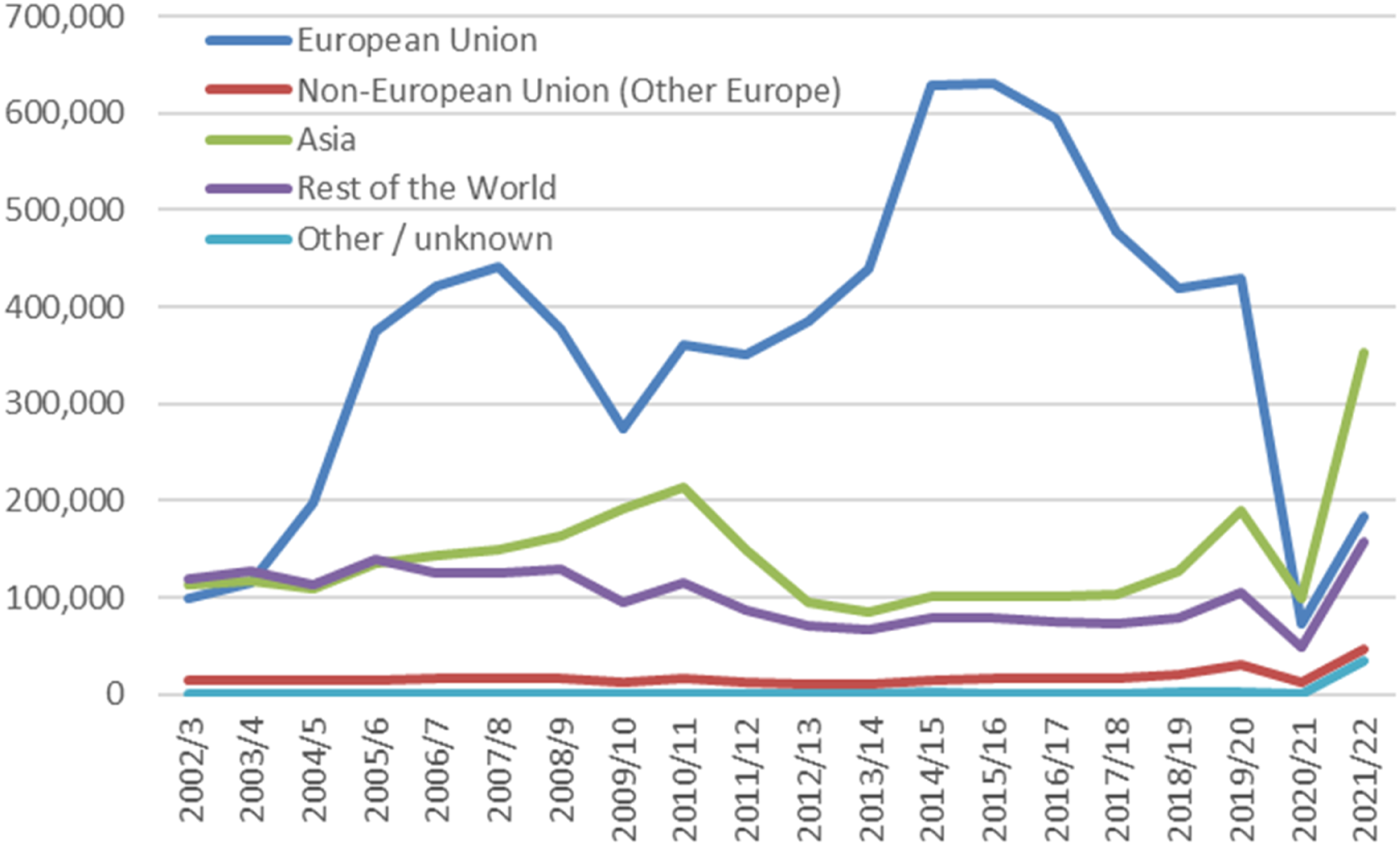
An alternative set of data comprises the number of visas issued for those coming to the UK (see Figure 2). In the period since 2017, we observe sizeable increases in the number of visas issued to those from Bangladesh, Ghana, India, Nigeria, and Pakistan. Indeed, for the peak of Q3 2022, we see over a quarter of a million visas issued for India (283,801). In the same quarter, Nigerian applicants received 95,099 visas and Pakistan around half that number (48,921). There is a significant ‘peak’ for the Ukraine scheme, but very time concentrated. Visas issued, by origin, for 2015Q1-2023Q1 [note separate vertical axes for each country]. Source: visas issued by quarter.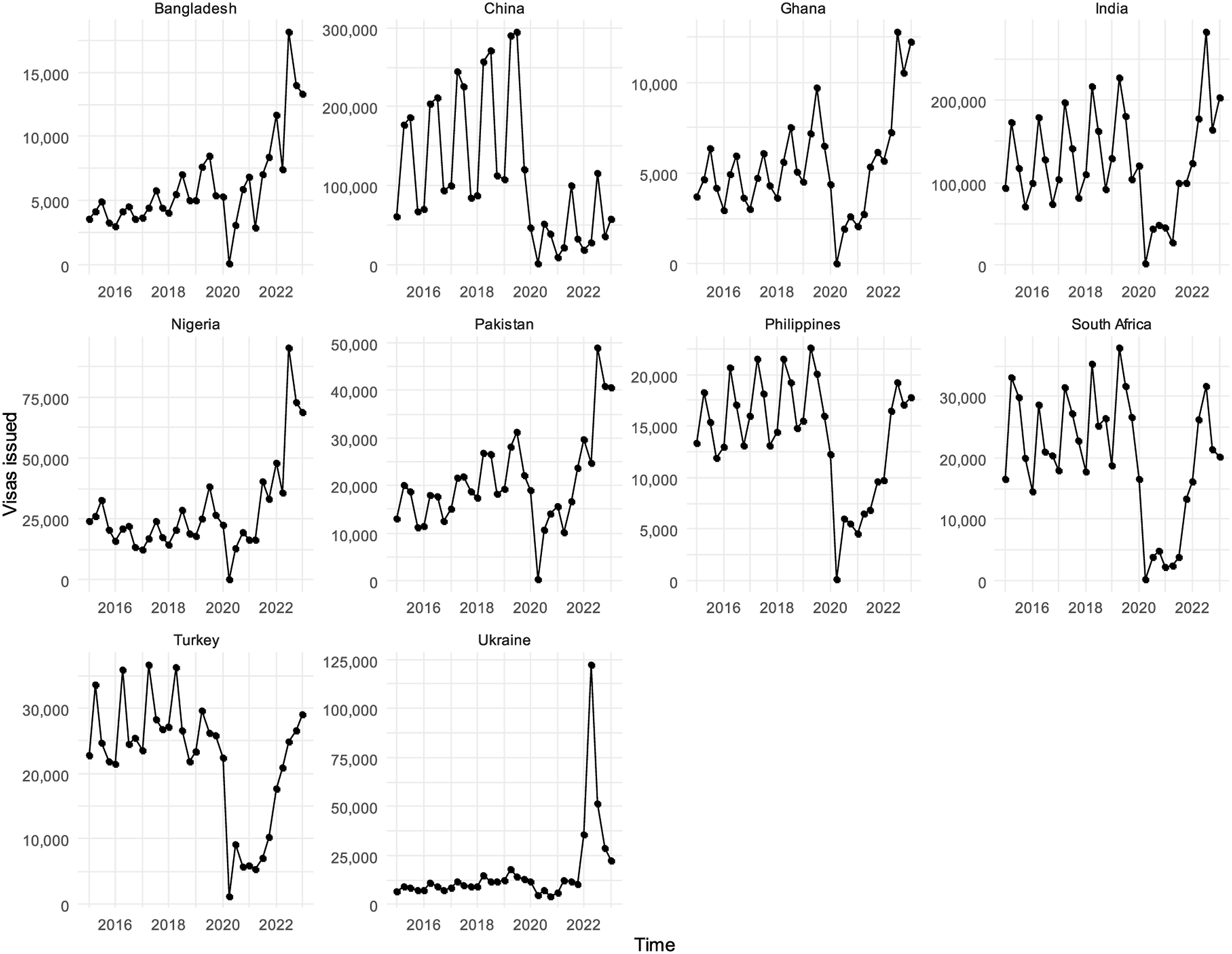
All these numbers (both for new NINOs and for visas) show a marked increase in migration from non-EU countries in the period since 2021.
Analysis of individual-level data
Descriptive statistics on independent and dependent variables.
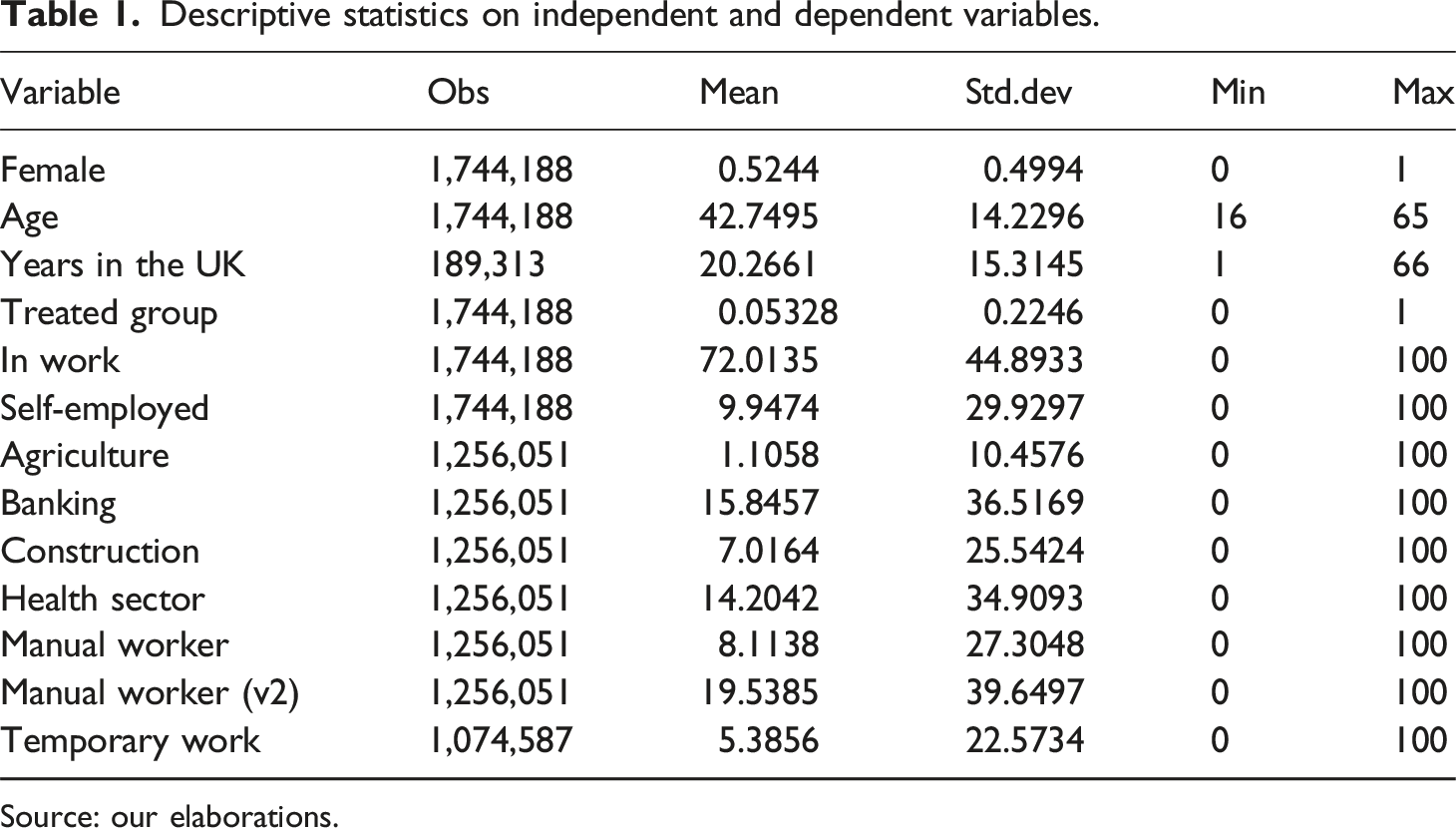
Source: our elaborations.
Parallel trends assumption
The parallel trends assumption in the difference-in-differences (DiD) model is critical. This assumption requires that, in the absence of treatment, the average outcomes of the treated and control groups would have followed the same trend over time. Of course, this is an untestable assumption because it concerns what would have happened in the absence of treatment, which, by definition, is not observed. However, some checks may provide suggestive evidence regarding this assumption. In Figure 3, we show rates of working according to nationality (UK vs EU), which did seem to track similar courses before the EU referendum. This continued for a time after the Brexit vote, with some convergence for 2020 as the changes in rules were being put in place and implemented from 2021. The period from 2020 to 2022 saw somewhat compressed employment differentials between these two groups. Rates of employment by nationality and year, in the UK. Source: weighted APS figures.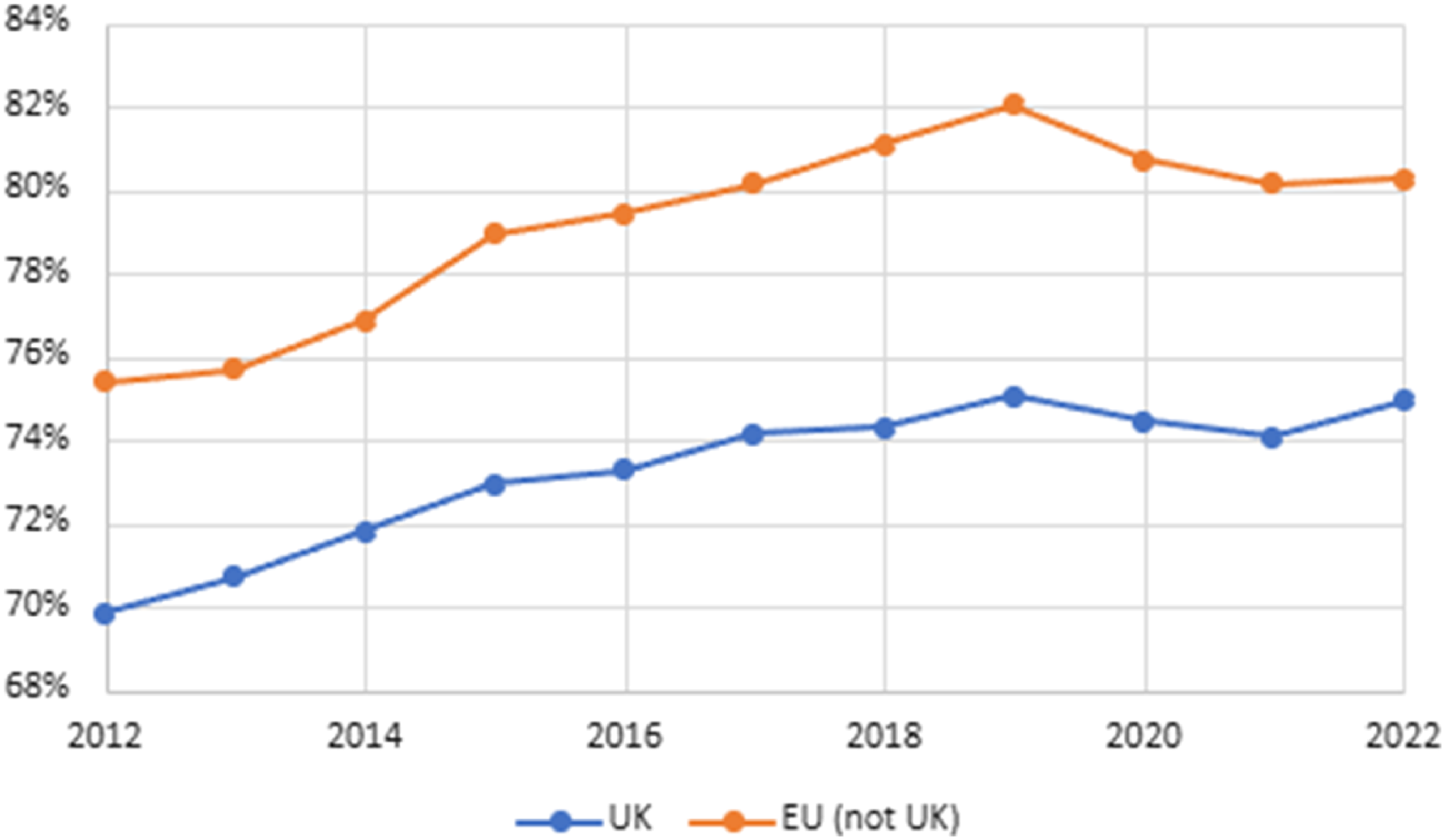
Turning to levels of self-employment as a proportion of employment, see Figure 4. The patterns for the UK and EU do seem to move somewhat in parallel, the divergence at the end doubtless reflecting the change of rules. Rates of self-employment as proportion of employment by nationality and year, in the UK. Source: weighted APS figures.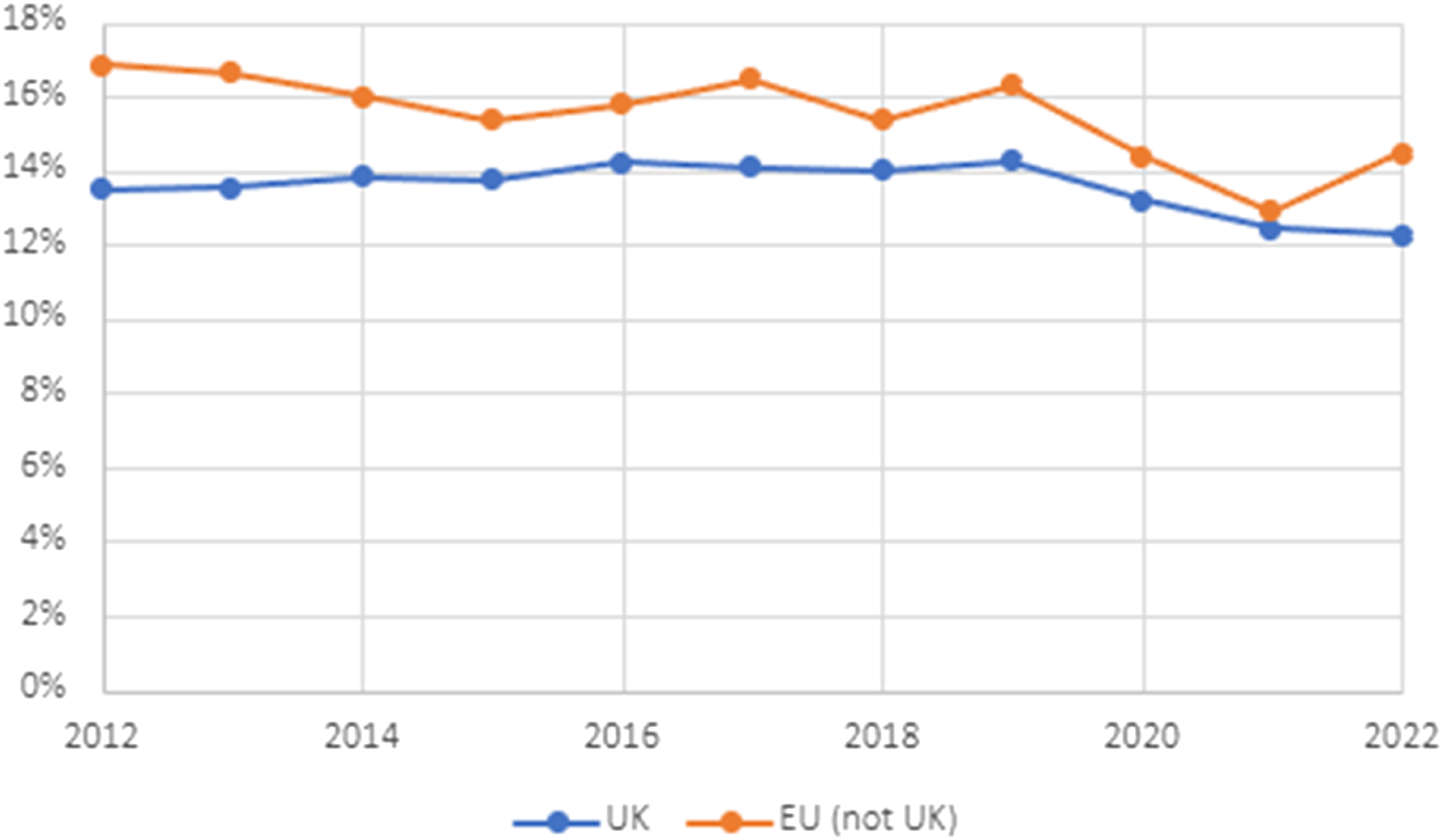
Regression models
We work with a sizeable number of dependent variables under two thematic groups. • Labour market status – whether in paid work, earnings, or self-employment. • Employment sector – whether working in the agricultural sector, the hotels sector, in a routine and/or semi-routine job, or a temporary job.
Labour market status
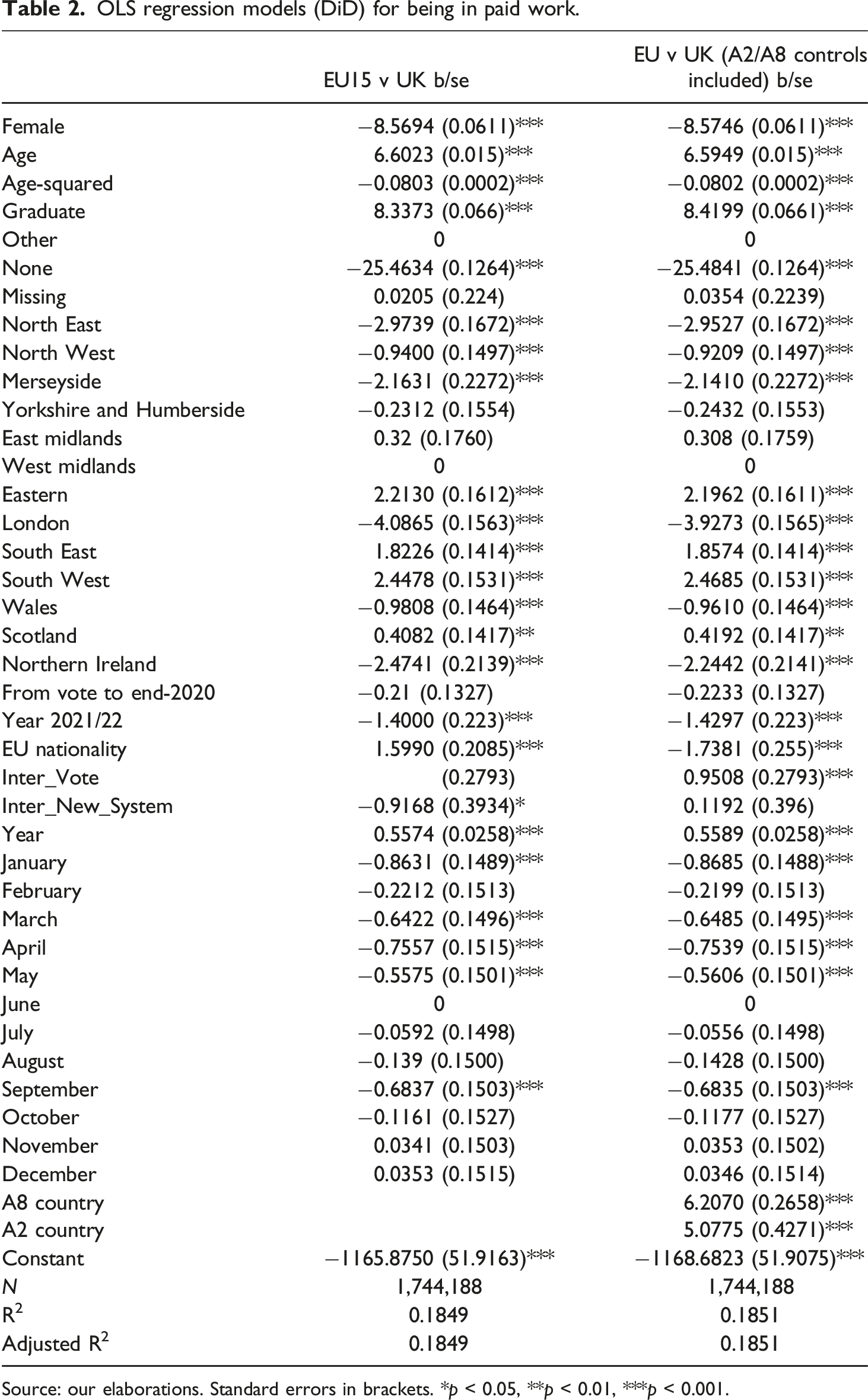
OLS regression models (DiD) for being in paid work.
Source: our elaborations. Standard errors in brackets. *p < 0.05, **p < 0.01, ***p < 0.001.
Moreover, EU nationals are the ones being the most likely to be in paid work when compared to UK workers.
Our main attention must be devoted to the interaction term ‘Inter_Vote’ – between the Brexit vote period (June 2016 till the end of 2020) and EU nationality, and more importantly to the interaction term for 2021 – ‘Inter_New_System’ – between the post-implementation of the new migrant system period and EU nationality.
For EU15 versus UK, the post-2021 DiD term (Inter_New_System) is statistically significant. Since the model is OLS and the dependent variable is either 0 or 100, the coefficient may be interpreted as a change in percentage points of being in paid work, other things being equal. Overall, compared to UK nationals, the EU group had about one percentage point lower rate of paid work.
When we look at Inter_Vote, indicating the ‘adjustment phase’, we observe a significant positive effect on EU migrants when compared with UK workers. This may indicate that EU workers tend to enter the UK job market till this is still possible, that is, in a period of huge uncertainty about future rules, EU workers tend to ‘secure’ their employment.
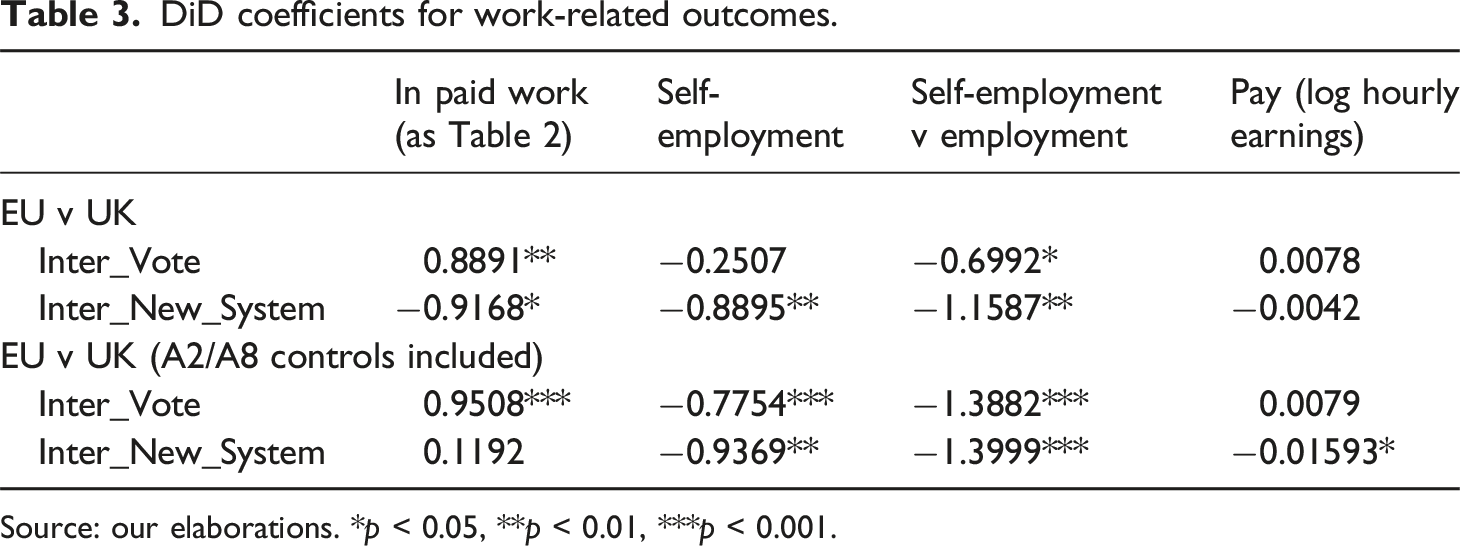
DiD coefficients for work-related outcomes.
Source: our elaborations. *p < 0.05, **p < 0.01, ***p < 0.001.
In detail, we focus on self-employment and log hourly earnings (the first column only reports results from Table 2, to help comparisons). We also compare self-employment versus employment. Starting from the second column, post-vote differences (2016–2020 period) are rather smaller and often statistically insignificant. These coefficients include the A8 and A2 nationals that have turned to self-employment as a means to evade the transitional arrangements introduced right after the EU enlargement in 2004 and 2007, leading at that time to an increase in self-employment rates. Later on, the removal of those transitional arrangements reduced the self-employment rates of A2 nationals, but seemingly had no effect on the self-employment rates of A8 nationals as demonstrated by Ulceluse and Kahanec (2023).
Results are instead strongly significant when we refer to the post-2021 DiD term. The negative impact on EU nationals is indeed clear concerning all the outcome measures.
Employment sector
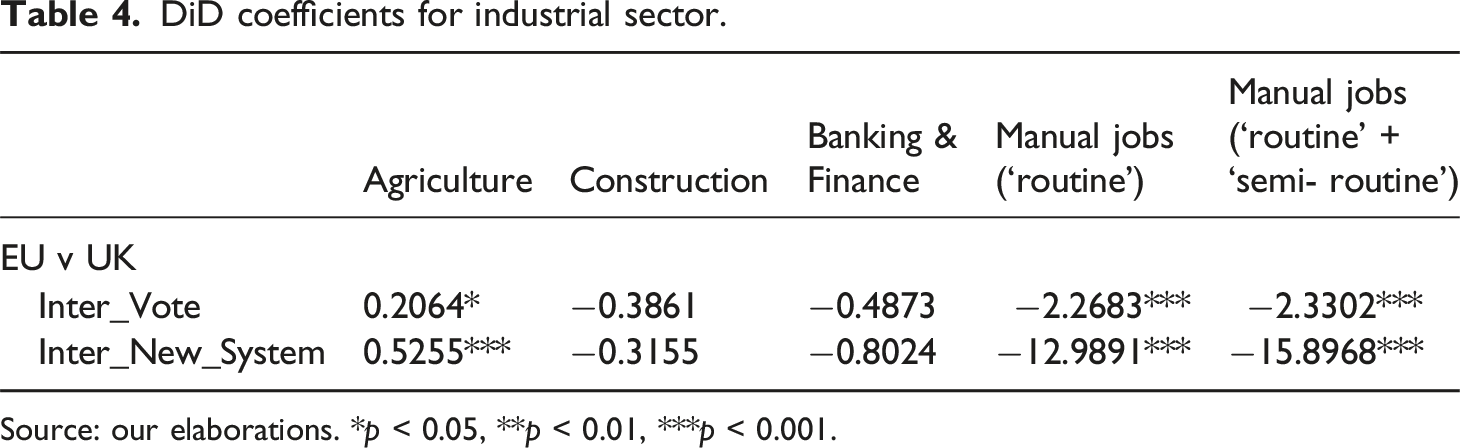
DiD coefficients for industrial sector.
Source: our elaborations. *p < 0.05, **p < 0.01, ***p < 0.001.
We observe significant negative effects for Manual jobs (‘routine’) and (‘routine' + ‘semi-routine'), where the form of employment regulation is the labour contract, employees give discrete amounts of labour in return for a wage calculated on the amount of work done or time worked in sales, service, production, technical, or operative occupations. These sectors experienced significant negative impacts both after the Brexit vote in 2016 and even more in the period after 2021. The effect was much larger in the period after 2021, with the coefficient of −12.9 for ‘routine' jobs and −15.9 for ‘routine' + ‘semi-routine' jobs.
A smaller but positive effect is observed for the agricultural sector, with a larger effect in the after 2021 period. This can be attributed to the pressure multiple agricultural sector organisations exerted onto the government (because of labour shortages in the food and farming sector) that decided then for the introduction of a ‘Seasonal Workers Pilot’ in 2019, which became later a confirmed visa route until 2024 9 . Moreover, in 2020, the UK government also added certain agricultural roles to the list of eligible occupations for the Skilled Worker route, part of the revised points-based system. Turning to a generally higher-skilled sector – Banking & Finance – we found generally insignificant and small effects. It is increasingly clear that the effects of the Brexit vote and the actual exit are apparent for the lower-skilled sector, but largely absent from higher-skilled sectors.
Conclusions
This analysis has examined the impacts of Brexit on EU migrants in the UK labour market using a difference-in-differences approach. In this work, we have analysed the effects of changes in the legal framework on EU residents following Brexit and compared their outcomes with UK citizens. Brexit and the new immigration policies have clearly disadvantaged EU migrants. Both Tables 2 and 3 emphasise the negative effects of Brexit on EU workers. This is indeed a strong result if discussed in the framework of the Brexit vote.
Our negative findings are especially strong for low-skilled occupations, as confirmed by the results in Table 4, where we observed a large adverse impact on routine and semi-routine jobs. On the other hand, for skilled jobs, such as those in the banking & finance sector, there were no effects. These results demonstrate that in deciding the main features of its immigration policy, the UK is adopting a less restrictive regime for higher-skilled workers than for lower-skilled workers in a system where there is no preference for EEA over non-EEA workers.
We have already discussed the issues related to the reliability of the LFS data, and how, despite some limitations, the data we included in our empirical analysis remain the most used source in the literature (e.g. Portes and Springford, 2023). To add further robustness to our findings, we have also compared, in the Annex, our main results, with results using a shorter time window and using weights, and we obtained similar figures.
Overall, the results show EU migrants experienced significant labour market disadvantages from Brexit and the post-2021 immigration regime changes. The new policies appear to have uniquely harmed opportunities for EU migrants versus other groups. Lower-skilled occupations were especially hard hit. These conclusions point to clear evidence EU migrants have been disadvantaged by Brexit.
We may extract some implications for policy and for key actors, such as employers and trade unions. Changes in the rules surrounding working in the UK saw people EU become disadvantaged compared to before, and the reverse for workers from the rest of the world. On average, the newer set of migrants came from countries with lower average living standards, replacing those from countries with higher living standards in most of Europe. The remaining EU workers seem to have maintained their earnings, but the newer set of migrants might arrive with lower expectations. The scene seems set for the possibility of downward pressure on wages, which unions might resist but which may be seen as a key benefit for some employers. The UK’s own laws on minimum wages (for employees) may offset the worst of any downward pressures.
Among the key benefits of Brexit, in the eyes of many leave voters, was the increased power over immigration that the UK acquired. Indeed, one of the key arguments of ‘leavers’ was that British workers should have been employed instead of EU workers. However, our results, compared to some descriptive statistics on the overall post-Brexit migration towards the UK, suggest that what happened seems closer to a substitution exercise: in other words, it seems that EU migrants were substituted with other international migrants, with apparently no benefits for UK workers. It seems unlikely that this is the outcome sought by leave voters. Moreover, wages of UK workers do not seem to have increased related to the remaining EU migrants, which again may be a disappointment to some Brexit supporters.
Footnotes
Declaration of conflicting interests
The author(s) declared no potential conflicts of interest with respect to the research, authorship, and/or publication of this article.
Funding
The author(s) received no financial support for the research, authorship, and/or publication of this article.
