







Abstract
Diatom assemblages from Holsteinsborg Dyb on the West Greenland shelf were analysed with high temporal resolution for the last 1200 years. A high degree of consistency between changes in frequency of selected diatom species and instrumental data from the same area during the last 70 years confirms the reliability of diatoms (particularly sea-ice species and warm-water species) for the study of palaeoceanographic changes in this area. A general cooling trend with some fluctuations is marked by an increase in sea-ice species throughout the last 1200 years. A relatively warm period with increased influence of Atlantic water masses of the Irminger Current (IC) is found at
Keywords
Introduction
During the last few decades, considerable interest has emerged, involving both social and environmental conditions, as to the possible effects of future climate changes. In this context, the growing focus on both magnitude and rate of future climatic change has, in particular, led to an increased recognition of the importance of studies on palaeoclimatic fluctuations and their ecological impacts (e.g. Goosse et al., 2008; Jones and Mann, 2004).
Being located in the climatically highly sensitive Arctic part of the North Atlantic region, West Greenland is an area which is highly suitable for conducting studies on regional climate changes. Palaeoclimatic data from this region are particularly important because of the proximity to both the Greenland ice sheet and Davis Strait, which play important roles in North Atlantic climate dynamics, including both the oceanic and atmospheric circulation patterns in the region (Davis et al., 1998; Williams and Bradley, 1985).
Only a limited amount of data have been published on marine Holocene sediments and palaeoenvironments from West Greenland, and most of these studies have focused on northernmost Baffin Bay (e.g. Knudsen et al., 2008; Levac et al., 2001) and the Disko Bugt area (e.g. Desloges et al., 2002; Krawczyk et al., 2010; Lloyd, 2006; Lloyd et al., 2005, 2007; Moros et al., 2006; Seidenkrantz et al., 2008). Holocene palaeoenvironments in fjords and shelf areas of South and Southwest Greenland have been studied in detail by e.g. Jensen et al. (2004), Lassen et al. (2004), Roncaglia and Kuijpers (2004), Møller et al. (2006), Seidenkrantz et al. (2007) and Ren et al. (2009).
Furthermore, studies of proxies such as pollen, diatoms and macrofossils in lake sediments in West Greenland provide information on climatic changes during the Holocene (Anderson et al., 2000, 2001; Bennike, 2000; Brodersen and Anderson, 2000; Gowan et al., 2003; Ryves et al., 2002).
Diatoms are widely distributed in marine environments and are ecologically extremely sensitive to temperature and salinity changes of the sea-surface waters. The siliceous walls of diatoms are generally well preserved in marine sediments, and changes in abundance, as well as in species composition are, therefore, often sufficiently recorded in the sediments for palaeoenvironmental interpretations. Diatom-based reconstructions of palaeoenvironments are widely applied across the North Atlantic (e.g. Birks and Koç, 2002; Jiang et al., 2002; Witak et al., 2005) and have also proven to be useful in the West Greenland area (Jensen, 2003; Krawczyk et al., 2010; Moros et al., 2006).
Two distinctive climatic intervals during the last millennium have been intensively studied in the North Atlantic region and elsewhere around the Northern Hemisphere, namely the so-called ‘Medieval Warm Period’ (MWP) and the ‘Little Ice Age’ (LIA). Evidence for the MWP and LIA climatic periods has, for instance, been identified in ice-core records (Dahl-Jensen et al., 1998; Johnsen et al., 2001), as well as in Greenland fjord and shelf sediments (e.g. Jennings and Weiner, 1996; Jensen et al., 2004; Knudsen et al., 2008; Lassen et al., 2004; Lloyd, 2006).
The purpose of this study is to reconstruct palaeoceanographic changes off West Greenland for the last 1200 years in high time resolution based on a precisely dated diatom record. As a basis for the interpretation of our fossil record, proxy data from the last 70 years are compared with instrumental data from the same area and with the annual Atlantic Multidecadal Oscillation (AMO) index (cf. Enfield et al., 2001; Kerr, 2000), and the data are discussed in relation to the North Atlantic Oscillation (NAO) index as well (cf. Jones et al., 1997; Osborn, 2011). Climatic and oceanographic changes during the MWP and LIA, as well as the twentieth-century warming, on the West Greenland shelf are discussed and compared with similar marine records from the area and with the general climatic development in the North Atlantic region.
Study area
Holsteinsborg Dyb is a deep submarine valley crossing the West Greenland shelf from the town of Sisimiut towards the southwest (Figure 1). Seismic profiles show that the valley was presumably repeatedly eroded during glaciations and subsequently filled up by a series of Quaternary deposits (Lykke-Andersen and Knudsen, 2007). This deep WSW-trending trough runs for about 60 km towards the middle shelf, before it shallows into a trough mouth fan at the shelf edge (Lykke-Andersen and Knudsen, 2007). Holsteinsborg Dyb coincides with a major thrust line that continues through the Ikertooq fjord (Jensen et al., 2002), one of four large fjords that are located to the east of the trough (Figure 1B).
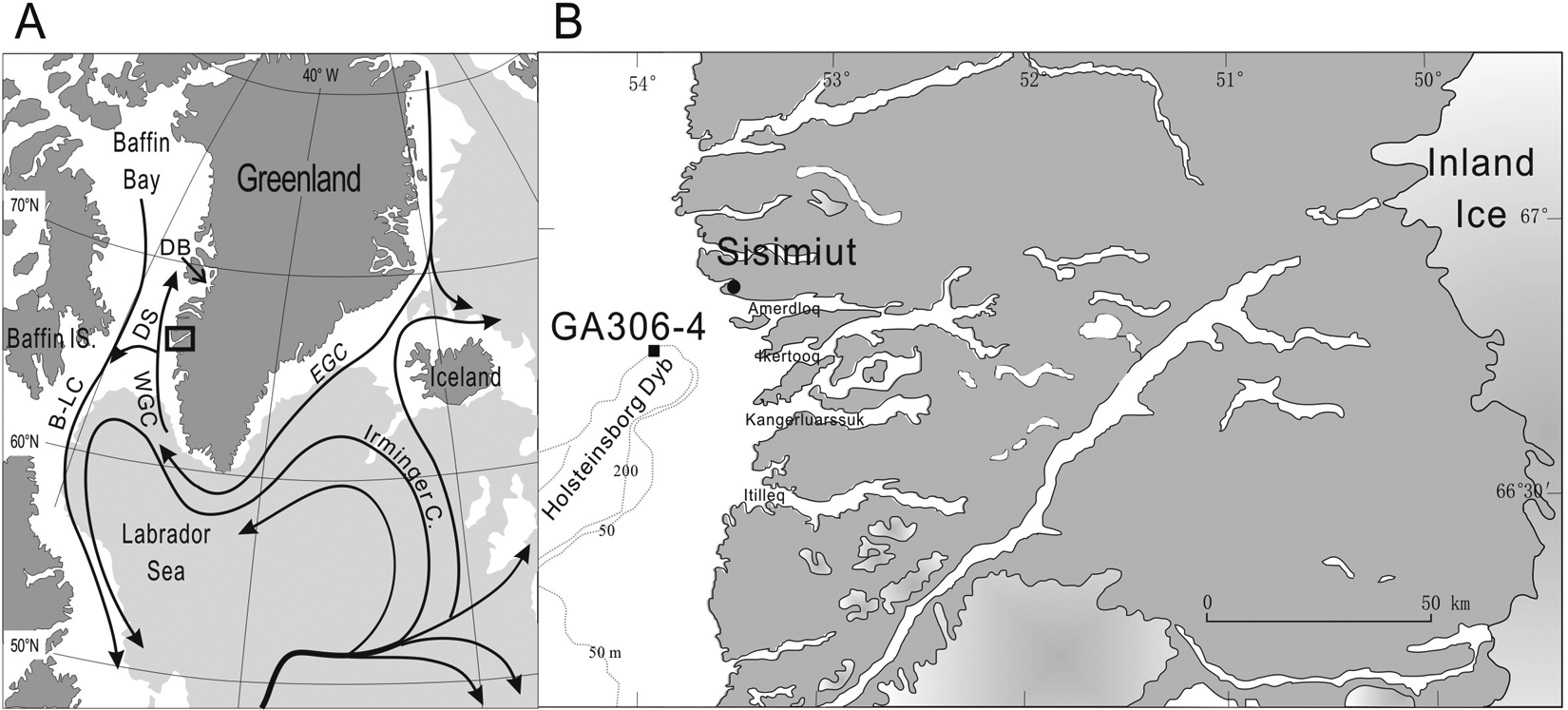
(A) Oceanographic surface current system in the northern North Atlantic and around Greenland. EGC, East Greenland Current; WGC, West Greenland Current; B-LC, Baffin-Labrador Current; DS, Davis Strait; DB, Disko Bugt. (B) Location of core site GA306-4 in Holsteinsborg Dyb
Much of the interannual climatic variability in the North Atlantic region can be explained by fluctuations in atmospheric pressure, the NAO, which is defined by the difference in sea-surface pressure over Iceland and over the Azores. It controls temperatures, wind speed and direction, as well as moisture over much of the Northern Hemisphere (e.g. Hurrell, 1995; Hurrell and van Loon, 1997; Osborn et al., 1999; Qian et al., 2000). West Greenland is situated in a climatically sensitive region, and both the atmospheric and oceanographic conditions therefore are influenced by changes in the NAO.
A climatic see-saw pattern between Greenland and western Europe, with warm winters in Europe corresponding to severe winters in Greenland and vice versa (e.g. Dawson et al., 2003; Ribergaard and Buch, 2005), has been demonstrated to be consistent at subdecadal to decadal timescales, although with a few exceptions (Cappelen, 2007; Dawson et al., 2003). Over a longer timescale (c. 140 years), however, Cappelen (2007) found that the temperature patterns co-vary in the two regions.
At the Sisimiut coastal meteorological station, northeast of Holsteinsborg Dyb (Figure 1), the maritime influence is relatively high (Ryves et al., 2002). The annual precipitation is 200–300 mm (cf. Hansen et al., 2004) with maximum rainfall in August (~60 mm), and the mean annual air temperature is approximately −6°C. The coldest month is February (mean −16°C), and the highest temperatures are obtained in July or August with means about +6°C (Hansen et al., 2004).
Davis Strait is a preferred area for outbreaks of cold air blowing southward, as well as for the injection of warm air deep into the Arctic Basin. A typical feature for the arctic West Greenland waters is a low sea-surface temperature all the year round and a summer air temperature below 10°C (Hansen et al., 2004).
The hydrography west of Greenland is governed by the north-flowing West Greenland Current (WGC), which consists of two components of different origin. Closest to the shore, the East Greenland Current (EGC) component brings water masses of Polar origin northward along the West Greenland coast. On its way, this water is diluted by runoff water from the various fjord systems, and it turns westward towards Canada at around 65–66°N. Below and offshore, the WGC consists of the Irminger Current (IC) component originating from the Atlantic Water (Irminger Sea-derived subsurface water). This relatively warm, high-salinity water can be traced all the way along the west coast of Greenland to the northern parts of Baffin Bay (e.g. Andersen, 1981; Tang et al., 2004).
The properties and amounts of the IC water that propagate north in the WGC have been demonstrated to be related to the Subpolar Gyre circulation and the NAO state (Holland et al., 2008; Myers et al., 2007), with the highest salinity and temperature, as well as the largest volumes of Irminger Water inflow in the 1960s and after 1995, apparently related to negative NAO index.
There is an increased mixing of the two components of the WGC, as it flows northward, although still distinguishable as far north as Disko Bugt (Andersen, 1981; Holland et al., 2008). Our core site is located in the present ‘Irminger Mode Water’ with a bottom-water temperature around 4°C and salinity around 34.9 PSU (e.g. Buch, 2000a; Ribergaard et al., 2008).
Sea-ice is an important environmental parameter in Greenland waters. The area west of Greenland is dominated by two types of sea ice. ‘Storis’, is a multiyear ice, which is transported by the EGC around Cape Farewell (the southern tip of Greenland), and continues northward assisted by the WGC. The amount of ‘Storis’ entering Southwest Greenland waters shows great interannual variability, determined by, among other factors, the outflow from the Arctic Ocean and the formation of sea ice, as well as the wind conditions in the Greenland Sea (Buch, 2000a). ‘Westice’ is a first-year ice formed during winter time in Baffin Bay, the Davis Strait, and the western part of Labrador Sea. The waters off Southwest Greenland are normally not affected by the ‘Westice’, only occasionally the ice limit has reached as far south as Kangerlussuaq (Buch, 2000a).
Material and methods
Core material
A 501 cm long gravity core GA306-GC4 and a 35 cm long boxcore GA306-BC4 were both retrieved in the offshore trough, Holsteinsborg Dyb, on the West Greenland shelf at 66°44′41″N, 53°56′25″W (water depth 445 m) during the Galathea 3 expedition in 2006 (Figure 1). In the following, the core site is referred to as GA306-4 and the two cores as GC4 and BC4, respectively. A total of 99 samples (a 1 cm sediment sample slice at every 5 cm) were analyzed for their diatom contents between 500 cm depth and the top of core GC4. In boxcore BC4, a 1 cm sample slice was analysed at every 2 cm (18 samples).
The samples were prepared according to the method described by Håkansson (1984). All samples were treated with 10% HCl to dissolve calcareous matter and with 30% H2O2 (3 h in a water bath at 70°C) to oxidize organic material. In order to dilute the remaining acid, test-tubes were filled with distilled water and left to settle for 12–24 h, after which the supernatant was decanted. The procedure was repeated until no acid was left in the sample. An aliquot of shaken suspension was placed on a cover slip and mixed by a pipette in order to settle diatoms evenly on the cover slip. After the material had completely dried up, cover slips were transferred onto permanently labeled slides, mounted with Naphrax (refraction index = 1.73) and heated to 250°C.
A Leica microscope with phase-contrast was employed for diatom identification and counting under oil immersion at a magnification of ×1000. More than 300 diatom valves were counted in random transects for each sample (excluding Chaetoceros resting spores, cf. Koç Karpuz and Schrader, 1990). Diatom percentages were calculated based on the diatom sum, excluding the Chaetoceros resting spores.
Age models
The age model for gravity core GC4 is based on accelerator mass spectrometry (AMS) 14C age determinations of marine mollusc shells (Table 1, Figure 2C) performed at the AMS 14C Dating Centre, Aarhus University, Denmark. All 14C ages are calibrated with the OxCal 4.1.3 software (Ramsey, 2009) using the Marine04 calibration data set (Hughen et al., 2004; Stuiver and Braziunas, 1993) with a standard marine reservoir correction of 400 years (cf. Reimer and Reimer, 2005), which is a reasonable estimation, because the sea floor is swept by Atlantic subsurface waters.
AMS 14C age determinations from core GA306-GC4 in Holsteinsborg Dyb, West Greenland. The ages are calibrated (cal. yr BP) with the OxCal 4.1.3 software (Ramsey, 2009) using the Marine04 calibration data set (Hughen et al., 2004; Stuiver and Braziunas, 1993) with a standard marine reservoir correction of 400 years (Reimer and Reimer, 2005)
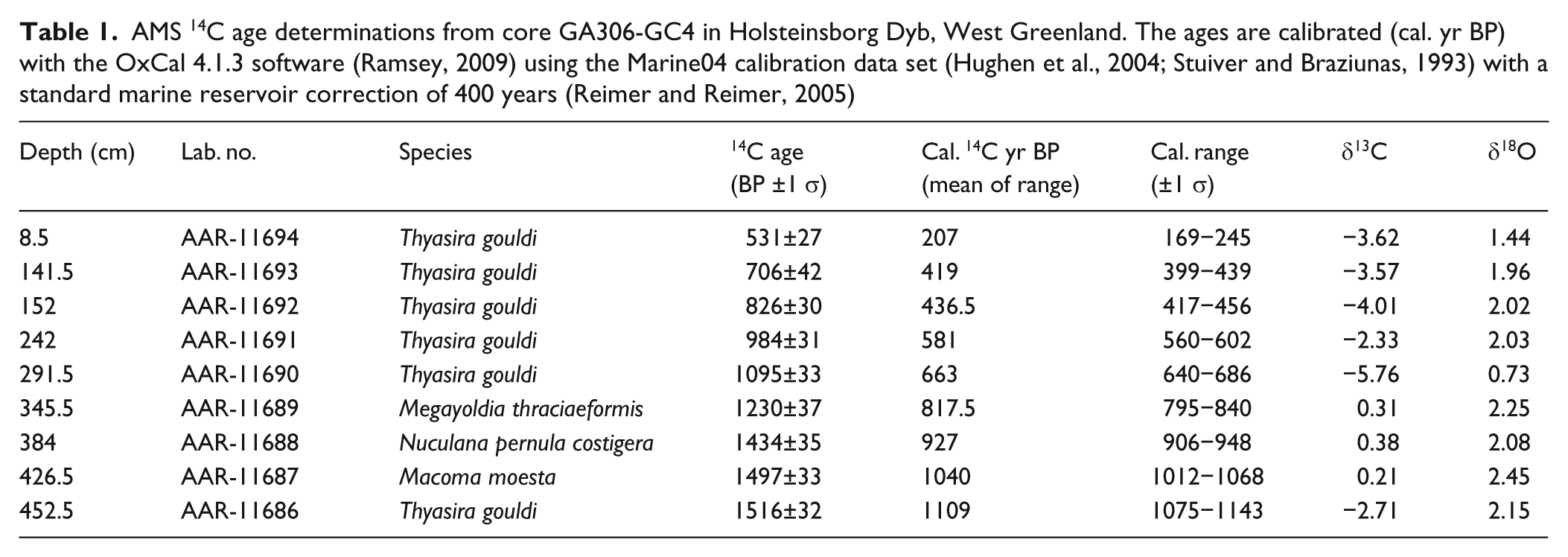
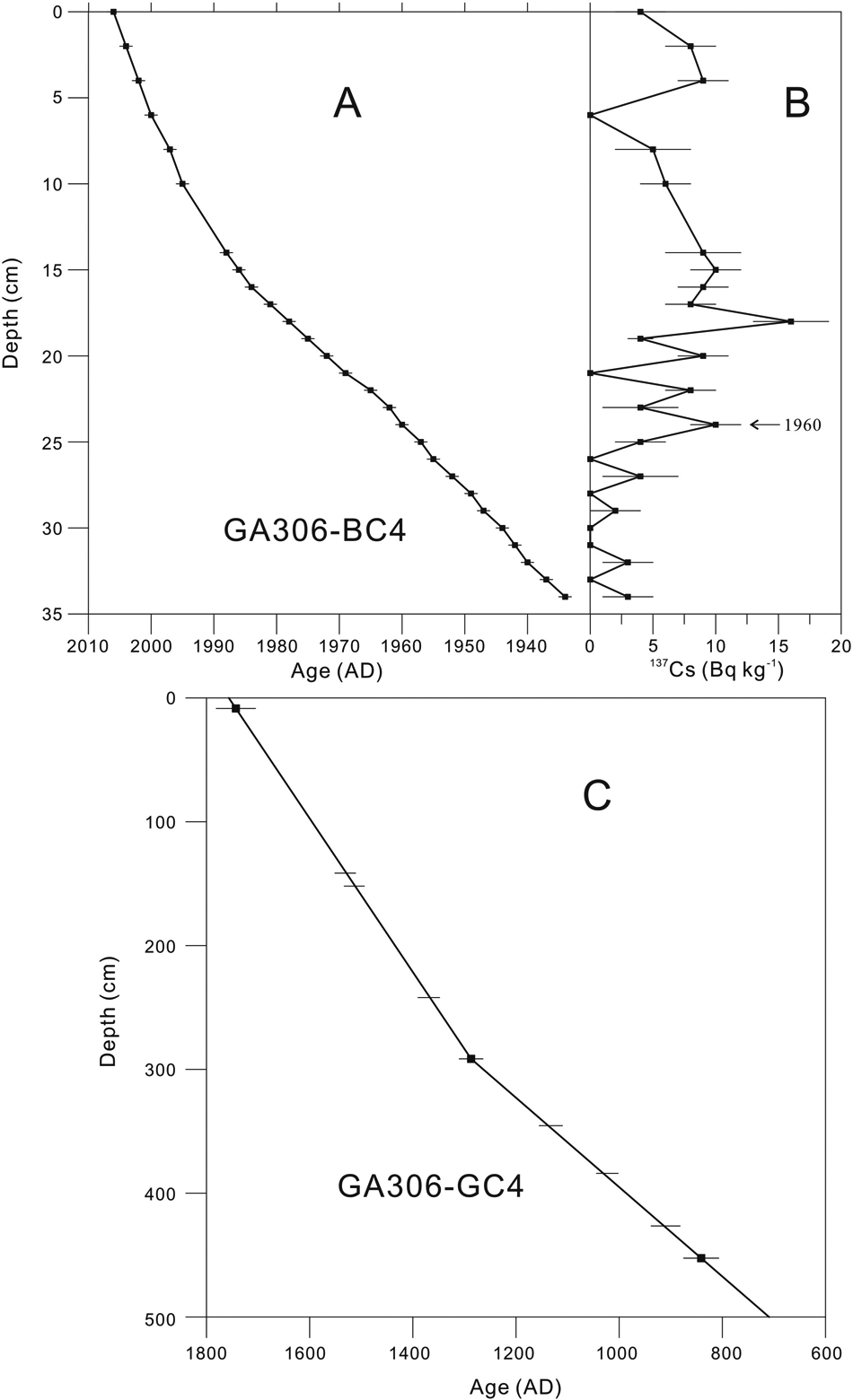
(A) Age–depth model for boxcore GA306-BC4 based on 210Pb dating. (B) 137Cs activity for GA306-BC4. (C) Age–depth model for gravity core GA306-GC4. Calibrated 14C ages are marked with ±1 σ error bars (see also text). The squares indicate the data points used for the age model
For the age–depth model, the simplest approach has been employed, i.e. sections of straight lines drawn through the 14C date error bars, assuming a constant sedimentation rate for each section (Figure 2C), but a change at 291.5 cm (663 cal. yr BP;
Samples from boxcore BC4 have been analysed for the activity of 210Pb, 226Ra and 137Cs via gamma spectrometry at the Gamma Dating Centre, Institute of Geography, University of Copenhagen, Denmark. The measurements were carried out on a Canberra low-background Ge detector. 210Pb was measured via its gamma peak at 46.5 keV, 226Ra via the granddaughter 214Pb (peaks at 295 and 352 keV) and 137Cs via its peak at 661 keV.
An age–depth model for BC4 (Figure 2A) was performed applying a modified CRS-modeling approach (Appleby, 2001), even though an almost uniform 210Pb activity in the top 20 cm may be caused by some bioturbation of the sediment. This chronology gives a profile of 137Cs versus depth (Figure 2B), which is in agreement with the known history of releases of this isotope (cf. Abril, 2004).
Instrumental data
For comparison with the top part of our proxy data, we have used the most complete and well-known oceanographic and atmospheric instrumental data series from West Greenland, which are from the Fylla Bank section west of Nuuk and from the meteorological station in Nuuk, respectively, situated about 300 km to the south of Holsteinsborg Dyb (e.g. Buch, 2002; Buch et al., 2004; Vinther et al., 2006).
The present-day climate of Nuuk is low arctic with a mean annual temperature of −1.4°C and a mean precipitation of 752 mm (Cappelen et al., 2001). A time series of the summer mean air temperature in Nuuk during the period
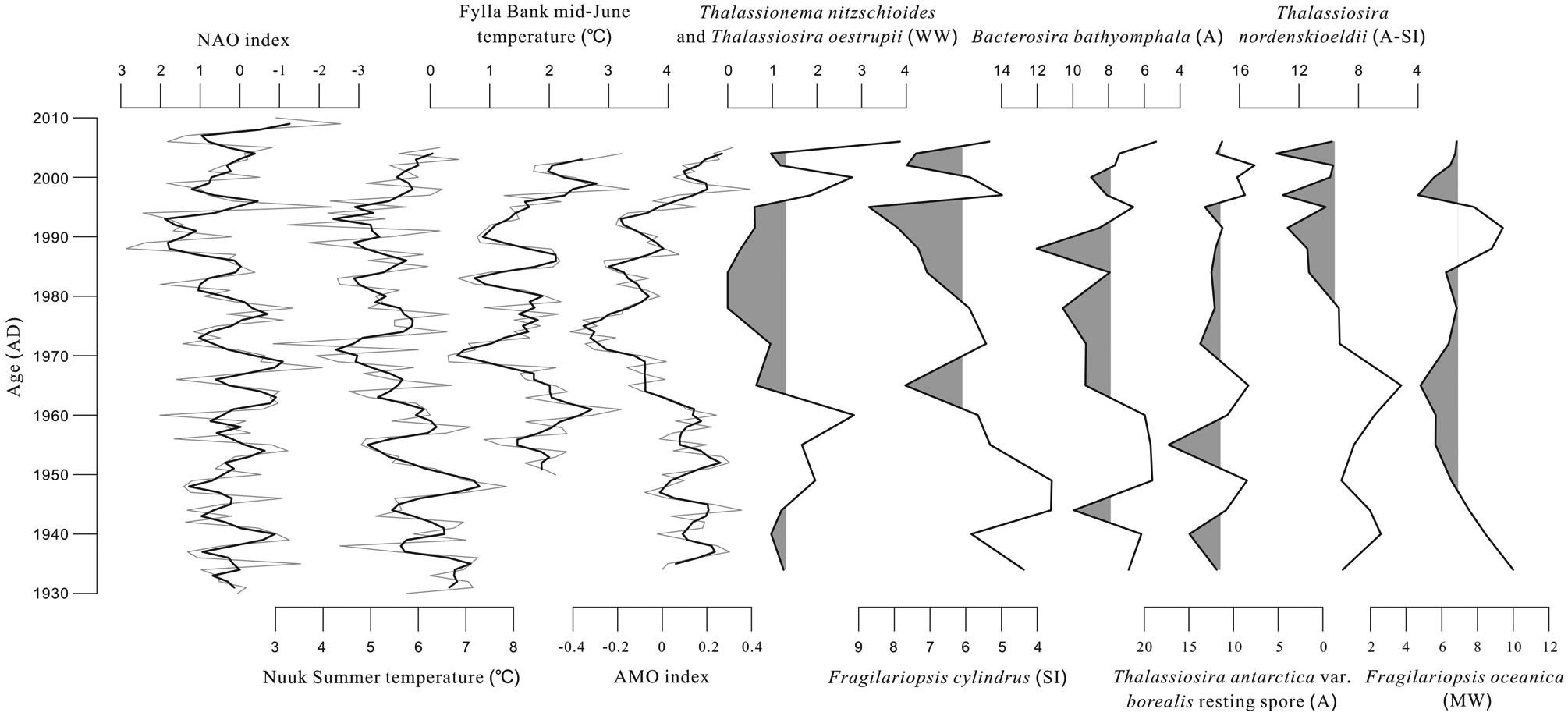
Comparison of selected diatom species and species groups (percentages) for the time interval
In addition, our data are compared with atmospheric and oceanographic data from the North Atlantic region, i.e. the NAO index (cf. Jones et al., 1997; Osborn, 2011) and the AMO index (cf. Enfield et al., 2001) (Figure 3).
Results
As a background for palaeoenvironmental interpretations of the gravity core GC4 record, diatoms from the boxcore BC4 (
Core BC4, ad 1934–2006 (16 to −56 cal. yr BP)
From the mid-1930s to the early 1960s, the diatom assemblage is characterized by relatively high abundances of Thalassionema nitzschioides and Thalassiosira oestrupii and a low proportion of Fragilariopsis cylindrus (Figure 3). Also, the percentages of Bacterosira bathyomphala and Thalassiosira nordenskioeldii are relative low, whereas the amount of Thalassiosira antarctica var. borealis resting spore is fluctuating. There is a decrease in Fragillariopsis oceanica from c. 10% to relatively low values through the time interval. This assemblage indicates relatively high sea-surface influence of Atlantic waters (see below) in the area.
From the early 1960s to the mid-1990s, T. nitzschioides and T. oestrupii decreased markedly and occasionally almost completely disappeared, with generally low abundances of F. oceanica (Figure 3). There is a pronounced increase in F. cylindrus, B. bathyomphala and T. nordenskioeldii, and T. antarctica var. borealis resting spore remains at a relatively high level during this time interval, suggesting cold sea-surface environments as a result of an increase in Polar Water influence.
Relatively high, but fluctuating contents of T. nitzschioides and T. oestrupii are found after
Thalassionema nitzschioides is the main species of the warm Atlantic Water (e.g. Jiang et al., 2001, 2004), indicating warm sea-surface conditions influenced both by enhanced Atlantic Water inflow and surface-water heating. This species is described as a widespread neritic species, commonly found in the North Sea and English Channel (Hendey, 1964), and it never occurs in the high Arctic and Antarctic regions (Hasle and Syvertsen, 1997). Abundant occurrences of T. nitzschioides in the Nordic Seas (Koç Karpuz and Schrader, 1990), Skagerrak (Jiang, 1996) and to the south and west of Iceland (Jiang et al., 2001) indicate its affiliation to Atlantic waters (salinities >34.9 PSU and SST >3°C). Thalassiosira oestrupii often occurs in warm-water regions (Hasle and Syvertsen, 1997). It is the main species of the warm Atlantic assemblage in the Nordic Seas (Koç Karpuz and Schrader, 1990), and it reaches the highest abundances south of Iceland as the most important species of the warm-water assemblage (Jiang et al., 2001). The number of the two species T. nitzschioides and T. oestrupii decreases as the Irminger Current waters flow from the Irminger Sea and clockwise around Iceland and southern Greenland. They comprise ~20% of the total assemblage south of Iceland, up to 10% west of Iceland and ~5% north of Iceland, and they almost disappear southeast of Greenland, where no influence of the Atlantic Water is found (Jiang et al., 2001: figure 3A, B). Therefore, these two species are combined here as a measure for the influence of warm Atlantic-derived water masses west of Greenland, although their absolute values are low (Figure 3).
Fragilariopsis cylindrus is a bipolar planktonic species connected to sea ice (Hasle and Syvertsen, 1997; Medlin and Priddle, 1990). It is among the dominant species in the Barents Sea and off Northeast Greenland (von Quillfeldt, 2000), as well as in Disko Bugt, West Greenland (Jensen, 2003). Moreover, F. cylindrus is one of the major components of the Sea Ice assemblage in the Nordic Seas (Koç Karpuz and Schrader, 1990) and Labrador Sea (De Sève, 1999). Fragilariopsis cylindrus is here used as an indicator of the amount of sea ice west of Greenland.
Bacterosira bathyomphala is found in the northern cold-water region (Hasle and Syvertsen, 1997), and it is the main species of the Arctic diatom assemblage around Iceland, indicating the influence of Arctic water masses from the East Icelandic Current (Jiang et al., 2001). Thalassiosira antarctica var. borealis resting spore, an Arctic neritic taxon found in northern cold-water to temperate region (Hasle and Syvertsen, 1997; von Quillfeldt, 2000), is the dominant taxon of the Arctic Water assemblage in the Nordic Seas (Koç Karpuz and Schrader, 1990) and is widely distributed in surface sediments from the Labrador Sea (De Sève, 1999). It is also the chief component of the cold-water diatom assemblage off Iceland, which is strongly affected by the East Icelandic Current (Jiang et al., 2001). Thalassiosira antarctica var. borealis resting spore shows similar temperature preference as B. bathyomphala in surface sediments around Iceland (Jiang et al., 2001), and there is a high degree of similarity between the environmental indication of this species and that of B. bathyomphala. On the West Greenland shelf, these two taxa are used as indicators of the influence of Polar waters.
Thalassiosira nordenskioeldii, a neritic Arctic-boreal species, usually blooms in the spring and may be found in drifting sea ice (Cremer, 1998; De Sève and Dunbar, 1990). Karentz and Smayda (1984) found that it was a part of the winter phytoplankton with a population maximum at temperatures of 2.8±1.8°C. Moreover, diatom assemblages consisting of T. nordenskioeldii and Fragilariopsis spp. were also found in the Chukchi Sea and northern Bering Sea (Sancetta, 1982).
Fragilariopsis oceanica is generally described as a Polar plankton species associated with sea ice (Hasle and Syvertsen, 1997; Jensen, 2003; von Quillfeldt, 1996), and it is therefore normally regarded as a sea-ice indicator with a habitat similar to that of F. cylindrus (Jiang et al., 2001; Koç Karpuz and Schrader, 1990). However, some studies have shown a significant variation in the distribution patterns of these two species (e.g. Jensen et al., 2004; Ren et al., 2009). Heimdal (1989) described F. oceanica as a representative of the mixed water masses of the WGC. Moreover, Jensen et al. (2004) argued that F. oceanica should be interpreted as a proxy for the EGC rather than purely an indicator for sea ice. This would indicate that changes in abundances of F. oceanica at our study site may reflect variations in mixing of the water column rather than sea ice.
The instrumental data from the Nuuk area (Figure 3) show that the West Greenland shelf area generally experienced relatively high air temperatures and sea-surface temperatures from the mid-1930s to the mid-1960s, with the initial rise in temperature occurring already in the early 1920s (Buch, 2000a). This warm period corresponds to an interval with relatively high abundance of warm-water species and low proportions of sea-ice species, coinciding with a period of high AMO index values (Enfield et al., 2001) and generally relatively high, but fluctuating NAO index (Figure 3). The relatively high amounts of F. oceanica at beginning of this period may reflect enhanced mixing of the water column.
The following about 30 years, including three extremely cold spells around 1970, the early 1980s and the early 1990s, which are reflected both in the air temperature and in the sea-surface temperature, correspond to an interval with a decrease in the warm-water indicators T. nitzschioides and T. oestrupii, a remarkable increase of the sea-ice species F. cylindrus and relatively high percentages of Arctic species (Figure 3), including T. nordenskioeldii. A weakly mixed water column is suggested by generally lower abundances of F. oceanica. The most sustained interval of low AMO index occurred during this cold period (Figure 3). The NAO index was also particularly low during the late
After the late
In summary, there is a reasonably high degree of similarity between the environmental indication of the diatom species and the instrumental data for the last 70 years, suggesting that the diatom record (particularly sea-ice species and warm-water species) is reliable for the interpretation of palaeoceanography and palaeoclimate off West Greenland in pre-instrumental time (core GC4).
Core GC4, ad 715–1760 (1235–190 cal. yr BP)
The gravity core GC4 record is divided into three assemblage zones (Figure 4) on the basis of the distribution of diatom taxa.
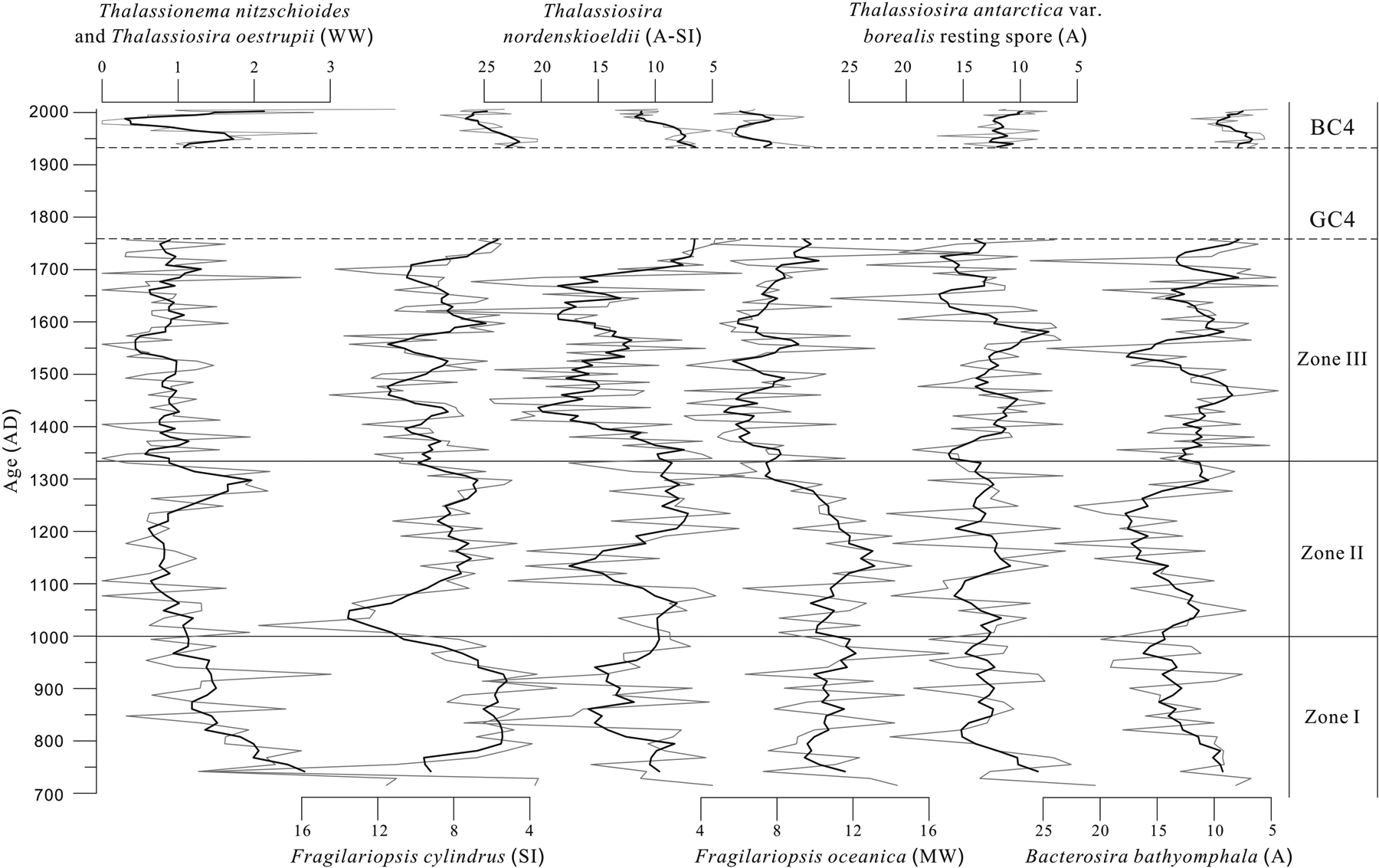
Percentage distributions of selected diatom species and species groups in cores GA306-GC4 (
Zone I, ad c . 715–1000 (1235–950 cal. yr BP)
The diatom assemblage in zone I is characterized by generally low proportions of the sea-ice species F. cylindrus and relatively high, but fluctuating abundances of the warm-water species T. nitzschioides and T. oestrupii. In general, the percentages of T. nordenskioeldii are low, with the exception of two abundance peaks around
In zone I, there appears to have been a generally high influence of Atlantic Water, and there is indication of mixing of the water column. An increase in the influence of Atlantic Water may either be a result of generally high inflow of IC waters to the area, mixing of the water column, surface-water heating, or reduced amounts of meltwater from land. Periods with enhanced influence of Polar water masses, on the other hand, may partly be caused by periodically increased amounts of meltwater from the onshore fjord systems to the area.
Zone II, ad c . 1000–1330 (950–620 cal. yr BP)
At the transition to zone II, there is a change to increased fluctuations in the assemblages compared with zone I, reflecting pronounced climate instability. Thus, there is an interval with significant increase in percentages of the sea-ice species F. cylindrus in the lower part of the zone (
The contents of warm-water species (T. nitzschioides and T. oestrupii) are generally lower than in zone I, but with an increase towards the top. The percentages of T. nordenskioeldii, B. bathyomphala, T. antarctica var. borealis resting spore and F. oceanica remain at about the same level as seen in zone I, but with considerable fluctuation. There is a clear decreasing trend in the abundance of F. oceanica between about
Zone II is characterized by relatively high influence of Atlantic Water between
Zone III, ad c . 1330–1760 (620–190 cal. yr BP)
In the upper part of the core (zone III), F. cylindrus and T. nordenskioeldii become abundant, suggesting considerably colder conditions than for zones I and II. Low contents of F. oceanica presumably indicate stratification of the water column. There is a marked decline of the warm-water species T. nitzschioides and T. oestrupii, indicating decreased influence of Atlantic waters. The abundances of the Arctic species B. bathyomphala and T. antarctica var. borealis resting spore are generally low, but fluctuating, and there is an increasing trend in the percentages of T. antarctica var. borealis resting spore towards the core top indicating increased influence of Polar Water.
The diatom assemblage of zone III thus mainly consists of sea-ice species, indicating an extended sea-ice cover and cold sea-surface conditions with high influence of Polar Water in the area.
Discussion
The diatom assemblages at core site GA306-4 reveal a general cooling trend and a number of changes in the environmental conditions, indicating that significant shifts occurred in the oceanographic and climatic regime off West Greenland during the last 1200 years. In adjacent marine areas, a similar cooling trend has been recorded over the last 1500 years, for instance in western Baffin Bay and offshore Labrador (Keigwin and Pickart, 1999) and in South and East Greenland shelf areas (e.g. Jenning et al., 2002; Roncaglia and Kuijpers, 2004). A comparison of the percentage distribution of the sea-ice species F. cylindricus in core GC4 with a series of atmospheric climatic proxies is shown on Figure 5. F. cylindricus appears to provide the best single proxy for the oceanographic and climatic changes in this area.
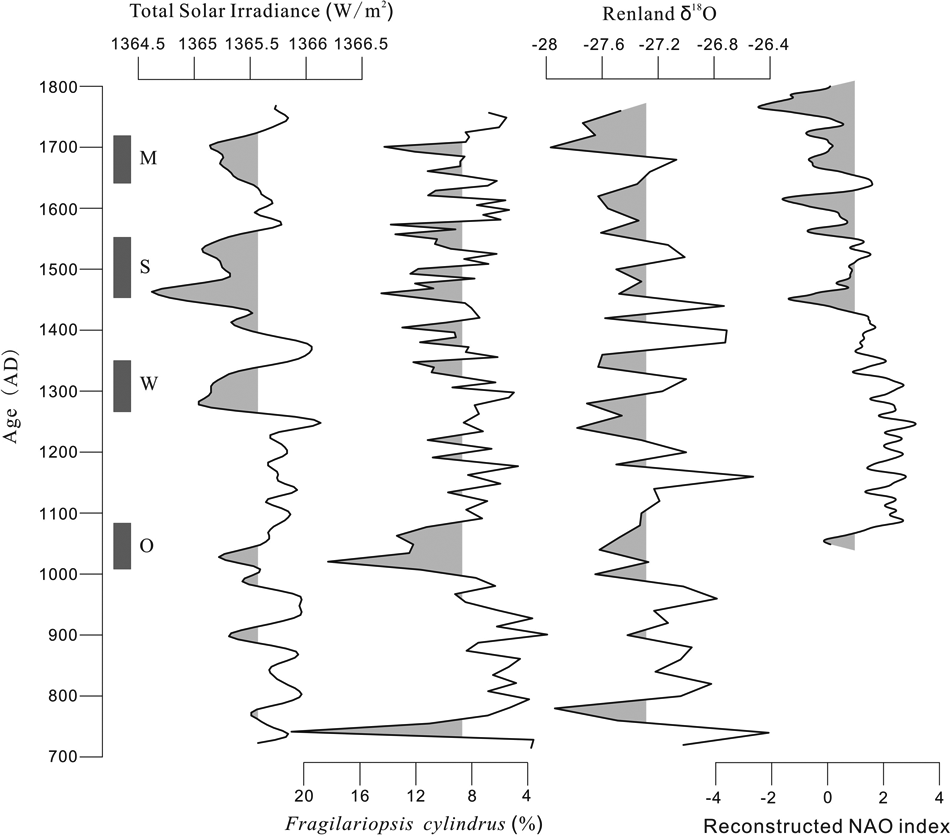
Percentage distribution of the sea-ice species F. cylindrus (
Oceanographic and climatic changes during the MWP
After a pronounced maximum in the sea-ice species F. cylindricus between
The concept of a MWP was first introduced by Lamb (1965), who found evidence for warm, dry summers and mild winters in western Europe, centered around
Evidence of the MWP can be found throughout the northern North Atlantic region. In Southeast Greenland (Igaliku Fjord), Roncaglia and Kuijpers (2004) identified a period with a decline in cold-water dinoflagellate taxa as evidence of high sea-surface temperatures during the time interval
It is interesting to note that Jensen et al. (2004) found diatom indication of a cold episode with increased ice cover (
In Skagerrak in the eastern North Atlantic, a similar cold interval has been observed within the MWP, although with large temporal and regional differences (
Along the West Greenland coast, the MWP is clearly documented as a brief relatively warm event at
It should be noted, however, that the generally warm MWP has also been reported as a particularly cold period at some sites in West and South Greenland. For instance, it was reported to be a relatively cold interval in Disko Bugt by Moros et al. (2006) and Krawczyk et al. (2010), and similar results were demonstrated by Møller et al. (2006) from Ameralik Fjord in South Greenland, indicating that climatic anomalies in the Greenland area are characterized by complex patterns.
A study of foraminifera and lithofacies on the East Greenland shelf shows that the influence of the Polar Water was sufficiently reduced from
The indication of relatively high sea-surface temperatures and warm climate at core site GA306-4 during the time interval
Documentary and archaeological data show that The Vikings colonized Greenland around
Oceanographic and climatic changes during the LIA
The marked increase in sea-ice species indicate an abrupt change to colder sea-surface water conditions after
It appears that the percentage of sea-ice species at our core site experienced quasi-periodic changes during the LIA, with three particularly cold intervals at
The detailed mechanism how changes in solar activities result in climate change has not been established, but one theory is that modifications of the Arctic Oscillation/North Atlantic Oscillation are caused by solar irradiance changes (Shindell et al., 2001). This appears to be in overall accordance with the long-term reconstructed NAO index of Trouet et al. (2009), which show generally low values during the LIA, particularly after about
The decreasing trend in the percentage values of F. oceanica towards the end of the MWP (
On the East Greenland shelf, Jennings and Weiner (1996) found a marked lithological and foraminiferal faunal change to a pronounced influence of Polar waters at the sea floor at
Onshore evidence for a LIA cooling is recorded by a decrease in oxygen-isotope values after
The LIA climate deterioration in Southwest Greenland appears to have had serious implications for the Norse culture in Greenland, and the last Viking settlement, the ‘Eastern Settlement’, near the southernmost tip of Greenland, was abandoned around
Oceanographic and climatic changes during the last 70 years
As already discussed, there is a high degree of consistency between the proxy data from core BC4 and instrumental data from the same area during the last 70 years. The general pattern also corresponds to Northern Hemisphere mean temperatures (e.g. Mann et al., 1999; Osborn and Briffa, 2006). Zweng and Münchow (2006) found a statistically significant warming trend during the last 70 years in most of the Baffin Bay area and demonstrated a significant correlation of the deep subsurface (800–600 m depth) temperature fluctuations in Baffin Bay with the NAO index. They did not, however, find a similar correlation for the upper subsurface waters (600–50 m depth).
The relation between sea-surface temperatures off West Greenland and the NAO index is rather complex. The cold interval between the early 1960s and the mid-1990s at site GA306-4, which is characterized by a marked increase in sea-ice species and Arctic species, includes the effects of Great Salinity Anomaly (GSA) that can be followed all over the North Atlantic area during the late 1960s and 1970s. The GSA was a result of a period of extremely high frequency of northerly winds over the Arctic Ocean and northern North Atlantic in the 1960s (Belkin et al., 1998; Dickson et al., 1988). The anomalously high inflow of Polar Water propagated into the West Greenland waters around 1970 (Buch, 2002; Buch et al., 2004) and is clearly evident in the mid-June sea-surface temperature on Fylla Bank (Figure 3). This inflow was related by Buch (2002) and Buch et al. (2004) to the particularly low NAO index in the late
The cold period around the early 1980, on the other hand, has been explained by Rosenørn et al. (1985) as a result of the presence of an extremely cold air mass situated over the Davis Strait area, with its center around Disko Bugt in West Greenland. Buch (2000b) also pointed at the 1982–1984 period as one of the coldest episodes ever recorded in West Greenland, although not the coldest (see Figure 3).
A general warming trend, as found at core site GA306-4 from the mid-1990s to the present, has been shown throughout the North Atlantic. Thus Stein (2005) found that a warming in the Subpolar Gyre became gradually more evident from 1997 and onwards. A similar trend was reported by Mortensen and Valdimarsson (1999) south of Iceland, indicating increased strength of the Irminger Current since the mid-1990s, which appears to have influenced the West Greenland waters. The sea-surface temperature rise coincides with an increase in the AMO index (Figure 3), and there is a generally high degree of consistency between the sea-surface and air temperature trend during the last decades in Southwest Greenland.
Although there is a clear increase in sea-surface temperature during the twentieth century compared with the LIA, the environmental indication is not directly comparable with that of the MWP. The oceanographic change in the twentieth century is particularly expressed by a drop in the sea-ice species F. cylindrus, as well as in some of the Arctic species, whereas percentages of warm-water species are fluctuating (Figure 4).
Summary and conclusions
Reconstruction of palaeoceanographic and palaeoclimatic changes during the last 1200 years on the West Greenland shelf is based on diatom assemblages in a high-resolution sedimentary record at site GA306-4 in Holsteinsborg Dyb.
There is a reasonably high degree of similarity between changes in the diatom species of boxcore BC4 (35 cm long) and instrumental air and sea-surface temperature data from West Greenland during the last 70 years, demonstrating the reliability of diatoms (particularly sea-ice species and warm-water species) as a tool for the interpretation of palaeoceanographic and climatic changes through longer pre-instrumental time series in this area.
The decline of the sea-ice species throughout gravity core GC4 (500 cm long) shows that there has been a general cooling trend during the time interval
A marked increase in sea-ice diatoms at
During the last 70 years (core BC4, 35 cm long), two relatively warm intervals are indicated by generally high contents of warm-water diatom species, the first one from the mid-1930s to the early 1960s, and the second one from mid-1990s to the present (Figure 3). A relatively cold period from the early 1960s to mid-1990s, reflected by the decline of warm-water species and an increase in sea-ice species and Arctic species, is a result of enhanced influence of Polar waters and sea-ice cover west of Greenland. In some respects, the twentieth-century oceanography off West Greenland corresponds to that in the MWP, but the stratification of the water masses appears to have remained as indicated for the LIA.
The palaeoceanographic and climatic changes revealed by the diatom species distribution on the West Greenland shelf coincide with the general pattern of palaeoceanographic and atmospheric changes in the North Atlantic region (Figure 5). The shift in diatom indication to increased sea-ice cover and water-column stratification at the transition from the MWP to the LIA west of Greenland at
During the last 70 years, there is a high degree of consistency between the temperature indication of the diatoms off West Greenland and the AMO index, whereas the relation between sea-surface temperature and the winter NAO index appears to be more complex.
Footnotes
Acknowledgements
The core material was obtained from the Galathea 3 cruise in 2006, and we are grateful to the crew for coring operations onboard R/V Vædderen. We would like to thank Jan Heinemeier, Aarhus University, Denmark, for providing the 14C age determinations and Thorbjørn Joest Andersen, University of Copenhagen, Denmark, for the lead-210 datings. We are grateful to three anonymous referees for valuable comments.
We acknowledge financial support from the National Natural Science Foundation of China (Grant 40976115, 41076038), the Fund for Creative Research Groups of China (No. 40721004), the European Union 7th Framework project No. 243908 (Past4Future), and the Danish Natural Science Research Council project 09-072321 (GREEN-ICE).