






Abstract
Human access to natural resources (or provisioning ecosystem services) is controlled by climate conditions and usage. In the central Andean highlands, around Lake Titicaca, water and woodlands have been critical resources for human populations over the last 5000 years. During this time period, human society developed from mobile hunter–forager groups into settled agrarian populations (c. 3400 years ago) through to the rise of some of the first ‘civilizations’ in the central Andes (c. 2500 years ago). Records of past environmental and vegetation change reveal that coincident with these societal reorganizations were variations in the availability of water and woodland resource. Prior to Hispanic arrival in the central Andes (before
Keywords
Introduction
The Lake Titicaca region of the Andes (Bolivia/Peru) has supported human populations for thousands of years and saw the development of one of the first civilizations in the central Andean highlands (c. 2500 years ago). However, the environmental background to the changing organization of Andean societies from mobile hunter–forager populations, through small settled village communities onto urban civilizations remains ambiguous (Stanish, 2011). Today, rural human population activity in the Titicaca region is limited by access to two key natural resources/provisioning ecosystem services: (1) water and (2) woodlands. Rains are seasonal with 3–4 ‘dry’ months (<10 mm precipitation), and consequently, human populations rely on seasonal snow and glacier melt to maintain agricultural production (Fjeldså and Kessler, 1996). The high Andean vegetation is dominated by grasslands which contain only patches of woodland. Woodlands are restricted to isolated, high-elevation areas and are dominated by the tree genus Polylepis (Fjeldså and Kessler, 1996). The patchy spatial distribution within the landscape forces rural populations to travel long distances to access timber resources for building and fuel. It therefore seems probable that variation in the availability of water and woodland resources would have been particularly important to people prior to the Hispanic ‘conquest’ of populations in the Lake Titicaca region (Bennett, 1946a), that is, before the arrival of Pizarro on the continent in
Throughout the last 5000 years, the amount of both water and woodland resource in the Andes has varied in response to climate changes as well as human exploitation (Bush and Gosling, 2012). The impact of climate variation on regional human populations (10s km scale) close to Lake Titicaca has been suggested to be potentially catastrophic on timescales of 10–100 years (Binford et al., 1997). However, establishing causal links between societal change and the environment/climate on the basis of archaeological and past environmental change records is challenging due to the fragmentary nature of the evidence and the difficulty in constructing comparable chronologies (Bennett, 1946b; Calaway, 2005); consequently, any suggested links are often subject to vigorous debate, for example, Binford et al. (1997), Erickson (1999) and Kolata et al. (2000). In addition, it is important to remember that people within landscapes are not passive and have the capacity to innovate when faced with changes to their environment, climate and/or ecosystem service provision. For example, palaeoecological evidence from three sites in the Cuzco region of Peru indicate that agroforestry techniques were deployed in response to landscape degradation in three separate instances during the last c. 1300 years (Sublette Mosblech et al., 2012). In interpreting past human–environment/human–climate interaction, it is therefore necessary to be careful not to either: (1) assume that environment/climate determines human activity or (2) disregard the influence of changing baseline environment/climate conditions on human populations. Given the fragmentary nature of the evidence available, striking this balance is challenging.
In an attempt to mitigate the uncertainty caused by the comparison of fragmentary records of different time resolution, we have chosen to examine variation at the larger temporal and spatial scales, that is, by examining societal change alongside landscape scale environmental or climatic change (Figure 1) (Gunderson and Holling, 2002). In this paper, we combine archaeological data with records of long-term (100–1000s years) past environmental change to place pre-Hispanic societal reorganization within the context of variations in baseline ecosystem service provision (sensu Pauly et al., 1998) across the Lake Titicaca region (100–1000s km2) (Figure 2). The comparison of the societal development (derived from the archaeological record) and ecosystem service provision (inferred from records of past environmental change) over the last 5000 years reveals three coincident cycles of societal and ecological change.
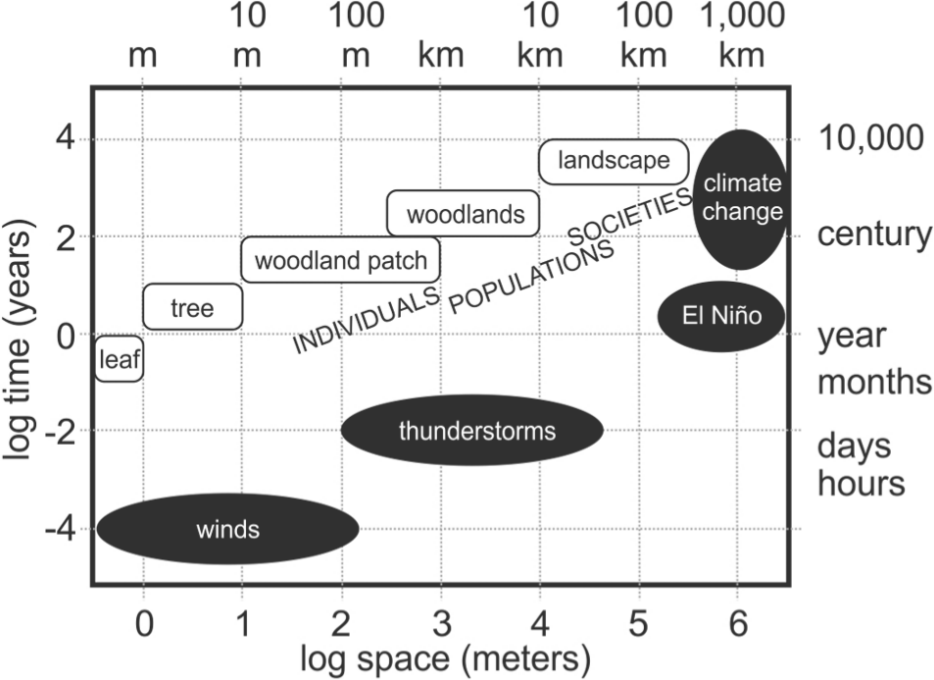
Time and space scales of the high Andes related to environmental systems (white boxes), climate systems (black ovals) and humans (text in capital letters).
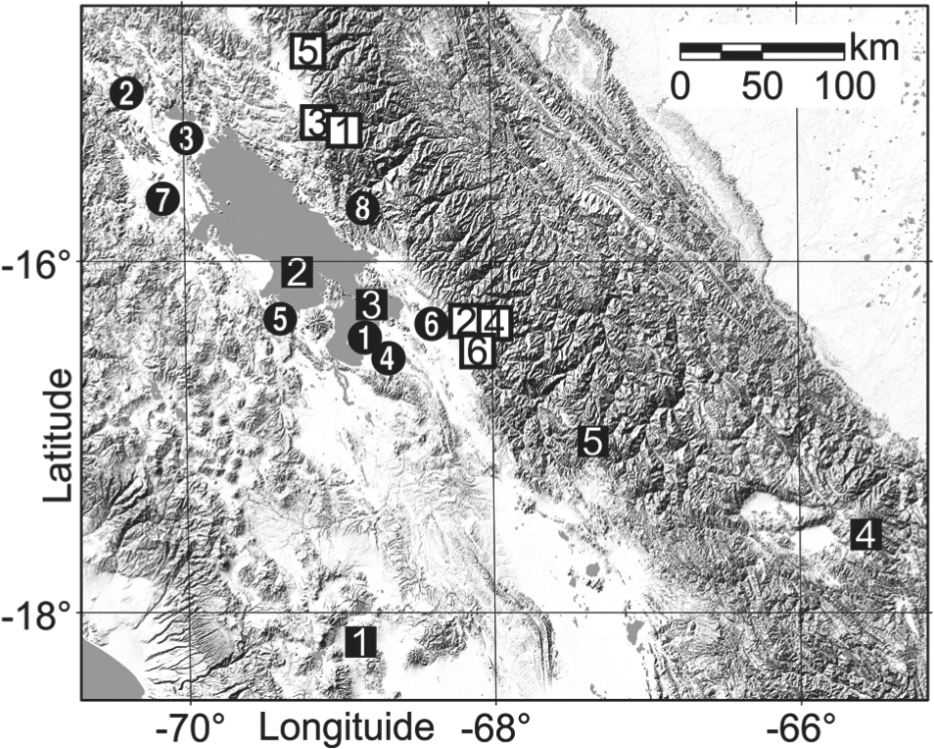
Topographic map of the Lake Titicaca region showing sites discussed in the text. Archaeological sites (circle, black): (1) Chiripa, (2) Pucara, (3) Taraco, (4) Tiwanaku, (5) Lupacas, (6) Pacajes, (7) Collas and (8) Omasuyus. Past environmental change sites (squares) from which data are presented (black): (1) Sajama, (2) Lake Titicaca (main basin), (3) Lake Titicaca (Huiñiamarca sub-basin), (4) Lake Challacaba and (5) Monte Blanco; and other sites mentioned (white): (1) Amarete, (2) Chacalataya, (3) Cotapampa, (4) Cumbre Unduavi, (5) Katantica and (6) Rio Kaluyo (Graf, 1992).
Materials and methods
We selected four types of past environmental change record from the published literature from which we have extracted the pattern of change in water and woodland ecosystem service provision: (1) ice accumulation (Thompson et al., 1998), (2) lake level (Abbott et al., 1997, 2003), (3) calcium carbonate precipitate (Williams et al., 2011) and (4) percentage abundance of the key woodland taxa Polylepis (Graf, 1992; Paduano et al., 2003; Williams et al., 2011; Ybert and Miranda, 1984). We do not attempt to reconstruct exact amounts of resource available in the past due to the great uncertainty in converting proxy records into actual numbers, for example, it is very difficult to take a given abundance of pollen in the fossil record and quantify the amount of woodland area to which it related. Instead, we use the proxy records to identify the trajectory of change in resource availability, that is, a decrease in the amount of woodland taxa in the fossil pollen record equates to a reduction in the woodland resource available for people to use.
We also use the record of past environmental change to provide an insight into how people were utilizing the landscape in the past. We present two types of data which give insight into human usage of the landscape: (1) charcoal (>180 µm) (Paduano et al., 2003; Williams et al., 2011) and (2) Sporormiella or dung fungus (Williams et al., 2011). We have chosen to present charcoal data for particles >180 µm found in lake sediments because these data provide information related to fire activity close to the lake, that is, large particles do not travel very far (Whitlock and Larsen, 2001). The abundance of Sporormiella within lake sediments is a function of lake level and the amount of herbivores present within the landscape (Raper and Bush, 2009). In the context of the Lake Challacaba study site presented here, the abundance of Sporormiella is thought to most strongly relate to the numbers of camelids using the lake as a watering hole (Williams et al., 2011).
Results
Evidence for change in societal organization
Archaeological records reveal three major states of pre-Hispanic societal organization around Lake Titicaca during the last 5000 years: (1) mobile populations engaged in hunting and foraging (before 3750 yr BP), (2) at least partially settled populations organized into village groupings with trade links and agricultural activity (c. 3250–2750 yr BP) and (3) urban centres containing complex social, political and religious structures often termed ‘civilizations’ (c. 2500 yr BP onwards) (Aldenderfer, 1998; Stanish, 2011). The transition from mobile hunter–foragers to more sedentary communities is evident in the archaeological record from the appearance of at least semi-permanent settlement sites at Chiripa, Pucara and Taraco (Figure 2) from c. 3350 yr BP (Figure 3B(b)–(d)). The settled populations are closely associated with extended human capability to modify the environment at a landscape scale, for example, widespread implementation of basic irrigation systems, Quinoa cultivation and crude pottery (Figure 3A(b)–(e)). Regional political organization is indicated from c. 2500 yr BP with the growth of a settlement at Chiripa and the widespread presence of complex storage, residential and religious structures (Stanish, 2011). The first evidence of the site of Tiwanaku (Figure 2) becoming a regional focal point dates from c. 2200 yr BP (Figure 3E). Within a few centuries of the foundation of Tiwanaku, the settlements at Chiripa, Taraco and Pucara declined while Tiwanaku continued to grow and reached a maximum population of 30,000–60,000 people c. 1200–950 years ago (Figure 3B(e)). During the period of maximum population at Tiwanaku, technological and agricultural practices were developed, including intensification of camelid pastoralism, commencement of silver mining, raised bed agriculture and integrated flood and irrigation systems (Figure 3A(f)–(i)). The gradual decline of Tiwanaku (c. 950–850 yr BP) saw power transfer into four regional polities (Figure 3B(f)–(i)), which developed new styles of monumental, funereal and defensive structures (Figure 3A(j) and (k)). Subsequently, external rule was imposed by the Inka from c. 580–530 yr BP (Figure 3B(j)) and later the Spaniards in
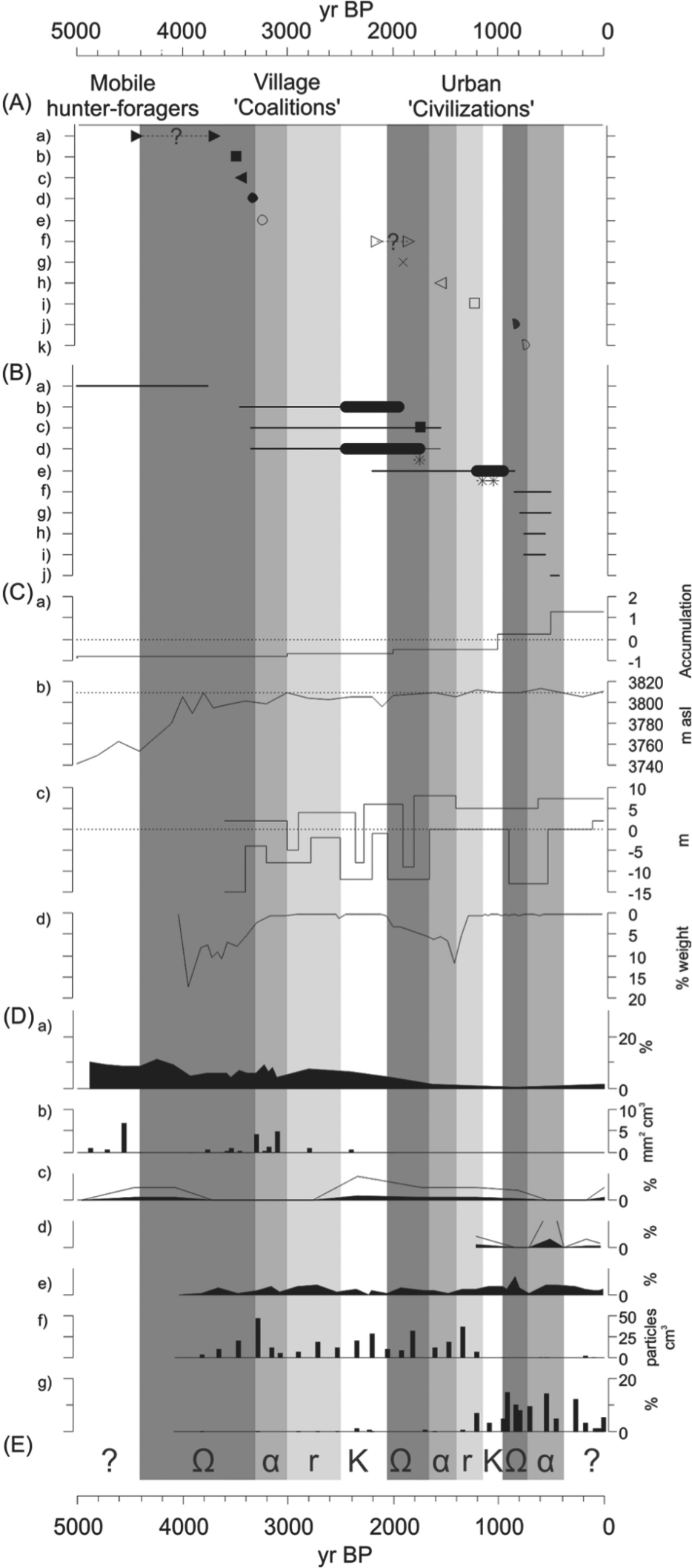
Societal development and natural resource provision in the Lake Titicaca region over the last 5000 years.
Evidence for change in ecosystem service provision
Past environmental change records allow the reconstruction of the pattern of change in ecosystem service provision which have accompanied the last 5000 years of societal change. The availability of water resources in the central Andes is recorded by markers within ice and lake sediment cores, which reflect change at different spatial scales. Around 5000 years ago, the Andes emerged from a multimillennial period characterized by increased drought frequency. This mid-Holocene dry event has been recognized across the central Andes (Bush and Gosling, 2012). Following the end of the mid-Holocene dry event, the Lake Titicaca region became, on the landscape scale, gradually wetter (Figure 3C(a) and (b)). However, lake sediments which record changes in water-level formed in the wider region (Lakes Huiñiamarca and Challacaba; Figure 2) indicate that variation in moisture balance was spatially heterogeneous on 100–1000 year timescales (Figure 3C(c) and (d)). Fossil pollen records obtained from lake sediments indicate that, at a landscape scale, the amount of Polylepis woodland within the grassland-dominated landscape varied naturally in extent prior to the arrival of humans > 8000 years ago (Dillehay, 2008; Erickson, 2000; Gosling et al., 2009). Between 5000 and 2000 years ago, Polylepis pollen constituted c. 8% of the total terrestrial pollen inputting into Lake Titicaca, but after 2000 yr BP, this figure rarely reaches above 2%. High elevation (>4000 m above sea level) sites to the northeast (Katantica, Cotapampa and Amarete) and southeast (Chacalataya, Cumbre Unduavi and Rio Kaluyo) of the Titicaca basin do not record Polylepis as present during the last 5000 years (Graf, 1992) (Figure 2), while to the south, there is evidence of the persistence of Polylepis in the landscape for the entirety of the last 5000 years (Figure 3D(c)–(e)).
Discussion
Abundant resources and settled society
The end of the mid-Holocene dry event is marked by the rise in Lake Titicaca water-level from 5000 years ago (Figure 3C(b)), and the inception of Lake Challacaba at c. 4300 yr BP (Figure 3C(d)). The increased moisture availability coincides with the cultural transition from mobile hunter–foragers to more sedentary populations, which were organized into coalitions of villages (Figure 3B(c) and (d)) (Stanish, 2011). The increase in local fire activity within this period of ‘wetter’ climatic conditions (Williams et al., 2011) strongly suggests that populations close to lakes were expanding, that is, collecting, transporting and burning increasing amounts of wood (Figure 3D(b)). However, the transition to more settled populations does not appear to have had a long-term detrimental impact on the woodland resources (Figure 3D(a)) despite clear evidence of larger human populations (proliferation of villages) and increased resource use (buildings and charcoal). After 1000 years of relative cultural stability, around 2250 years ago, villages at Chiripa and Taraco began to expand and the settlement at Tiwanaku was founded (Figure 3B(b), (d) and (e)). The change in societal organization marked the establishment of the first regional-scale political organization or ‘civilization’ (Stanish, 2011).
Scarce resources, technological innovation and centralization of societal organization
The reduced availability of water and woodland resources in the Lake Titicaca region from c. 2250–1750 yr BP spans a period which saw the gradual emergence of Tiwanaku as a consolidated single regional urban centre for societal organization. As Tiwanaku developed, people diversified their economic activity and improved their use of the landscape, for example, commencement of silver mining and advent of raised bed agriculture (Figure 3A(g)–(i)). The reduction in water availability from c. 2200 yr BP is likely to have been driven by external climate factors (Bush and Gosling, 2012). However, the decrease in woodland resources close to Lake Titicaca (Figure 3D(a)), but not in the surrounding region (Figure 3D(c)–(e)), supports the suggestion that exploitation by the human population close to the lake was the likely cause for locally reduced woodland (Paduano et al., 2003).
The gradual loss of both water and woodland ecosystem service provision is broadly coincident with the consolidation of disparate village-based populations into the more substantial urban centre at Tiwanaku (Figure 3B(e)). Due to uncertainties inherent with chronologies of the archaeological and past environmental change data, it is not possible to directly attribute specific decreases in resource availability as a ‘trigger’ which instigated societal change. However, it seems likely that the landscape scale (10–100 km) changes to baseline resources, as indicated from the past environmental change record, would have impacted the trajectory of societal change (100–1000 years), as suggested by the archaeological record, because of the population’s reliance on environmental resources. In addition, it seems plausible that the underlying environmental pressure could also, in part, have influenced the need, or desire, for people to diversify resource use (i.e. silver mining) and develop new agricultural practice (i.e. raised bed agriculture).
Increased water resource and regionalization of societal power
The positive accumulation balance for the Sajama ice core and deepening of Lake Challacaba indicate that regionally, the water balance started to increase again around 1000 yr BP (Figure 3C(a) and (d)). Almost immediately, there was an increase in regional camelid herding (Figure 3D(g)) as the site of Tiwanaku and its distal influence expanded to its maximum (Figure 3B(e)). The rapid expansion of Tiwanaku suggests that the ephemeral societal structures that had developed during the preceding arid period meant that people were well placed to take advantage of increased water availability despite there being no recovery in woodland resources close to the lake (Figure 3D(a)). After almost 1000 years as a significant centre of civilization in the central Andean highlands, Tiwanaku began to gradually decline around 900 years ago and was replaced by numerous regional polities (Figure 3B(f)–(i)). The decline of Tiwanaku has been previously linked to both climatic (Binford et al., 1997; Ortloff and Kolata, 1993) and societal pressures (Kolata, 1986). The information collated here is not at a sufficient temporal resolution to comment on the nature of any specific trigger for the decline of Tiwanaku; however, the environmental data suggest that the transition occurred within the context of a general increase in regional water resource availability.
Abundant resource attracts inward migration
Societies in the Lake Titicaca region were altered c. 580–530 years ago with the arrival of the Inka (Figure 3B(j)) who imposed an external control over the populations (Hastorf, 2003; Rowe, 1946). The desire for extra-regional Andean peoples to control the Lake Titicaca region indicates the presence of valuable resources. During the Inka period, the Titicaca region remained an important regional centre within the empire, became part of an increasingly complex inter-connected Andean society (Stanish, 2011), and the more peripheral Cochabamba region (Lake Challacaba) became one of the centres for maize production (La Lone and La Lone, 1987). The brief period between the arrival of the Inka and Europeans in
Long-term (>100 year) patterns of change in societal organization and ecosystem services
The spatial and temporal disparity between the archaeological and past environmental change records considered places a fundamental limit on the inferences that can be drawn, for example, we acknowledge that there is uncertainty in the dating control on many of the archaeological data (Figure 3A and B). In an attempt to negate these concerns, we focus on larger spatial and longer timescales (i.e. upper right portion of Figure 1) and discuss the larger/longer-term patterns of change rather than referring to specific events. To assess whether the sequence of change observed in the archaeological and past environmental change record follows any regular pattern, we will now consider the evidence presented within the context of ‘adaptive cycles’ (Gunderson and Holling, 2002). Adaptive cycles are an element within the wider concept of ‘resilience theory’ designed to aid understanding of ecosystems, agencies and people, based upon potential, connectivity and resilience within a landscape (Holling and Gunderson, 2002). The ‘potential’ of a landscape relates to the opportunities for change that are present, that is, are there resources present which can be better utilized or unlocked by a technological advance; the ‘connectivity’ relates to the degree of linkages within the systems and ‘resilience’ relates to the robustness of that system. As the amount of these various factors fluctuates within a system, a pattern of change occurs which can be summarized into four key states: (1) release or destabilization of a system allowing previously ‘locked up’ resources to be released (Ω), (2) renewal or reorganization when system undergoes change (α), (3) growth and exploitation as resources are easily accessed (r) and (4) conservation or maximum connectivity as systems peak and resources are locked up (K) (Gunderson and Holling, 2002; The Resilience Alliance, 2002). The use of the adaptive cycle’s framework provides a concise way of describing the long-term (>100 year) complex interactions between humans and the environment (Figure 4). In addition, the application of adaptive cycles to the record of past human and environmental change allows discussion to be placed in a language relevant to international policy development (Dearing, 2012).
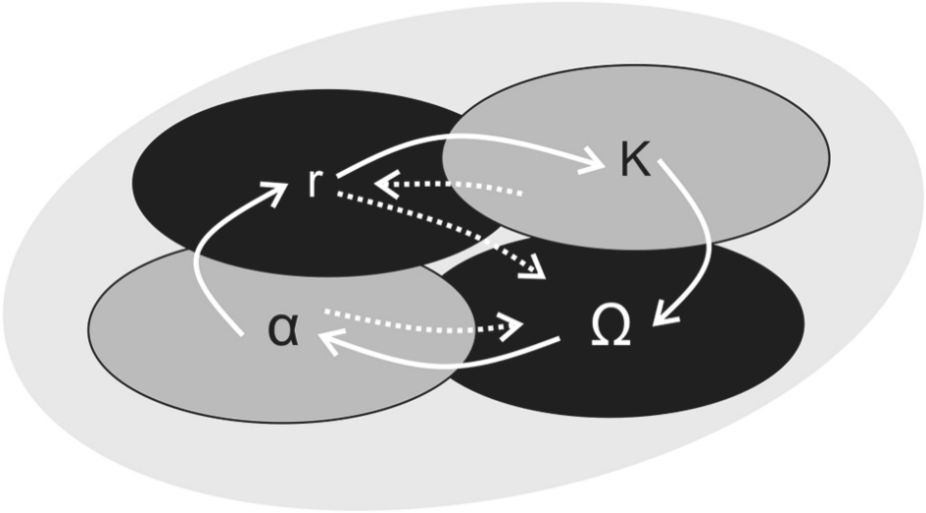
Adaptive cycle loop showing connections between system states identified in the Lake Titicaca region (solid white arrows), and other potential conceptual connections (dashed white arrows).
The overall pattern of societal (Figure 3A and B) and ecosystem service (Figure 3C and D) development observed in the Lake Titicaca region during the last c. 5000 years show three repeated adaptive cycles (Figure 3E). Increased water resources c. 3400 yr BP saw the destabilization (Ω) of hunter–forager societies and their reorganization (α) into more sedentary village coalitions. The subsequent period of resource stability (water and woodland) resulted in growth (r) until a period of ‘maximum connectivity’ was achieved (K) and the first regional-scale political and societal organization in the central Andes was established (c. 2500 yr BP). The decline in woodland and water resources near Lake Titicaca c. 2200 yr BP resulted in another gradual destabilization (Ω) and reorganization (α) of societies. Societal organization was consolidated into one regional urban centre (Tiwanaku), activity within the landscape diversified and new methods for maximizing natural resource use were developed (r), despite low water and woodland resource availability. Technological advances and increasing water availability culminated in the growth of Tiwanaku to its maxima by c. 1000 yr BP (K). Increase in access to water resource regionally from c. 1000 yr BP destabilized the region again (Ω), facilitated a regionalization of power and attracted the Inka into the region (α).
Conclusion
The central Andean highland landscape has been modified by humans since their arrival over 8000 years ago (Dillehay, 2008; Erickson, 2000). Our synthesis of archaeological data and records of past environmental change reveals the pattern of background environmental/climate change to the human activity in the Lake Titicaca region over the last 5000 years. In terms of access to provisioning ecosystem services through the last 5000 years, Andean people have had: (1) constant access to water resource (no evidence of extended regional drought) but have had to deal with major change in water availability at a landscape scale, for example, arid event in the agriculturally important Cochabamba (Lake Challacaba) area (c. 2250–1750 yr BP) and (2) relatively constant, albeit low level, access to woodland resource at the landscape scale; however, a decline in woodland resource is evident close to Lake Titicaca c. 2000 yr BP coincident with regional drying and the establishment of the urban centre at Tiwanaku.
Three coincident repeated cycles of adaptive response are evident within both the societal and environmental systems in the Lake Titicaca region. Increases and decreases in the availability of water and woodland resources are concomitant with repeated destabilization, reorganization, growth and maxima within pre-Hispanic societies. We suggest that the coincident long-term (100–1000s years) cycles demonstrate a sensitivity of the human populations to the shifts in the baseline availability of ecosystem service provision. Long-term change in baseline resource, either as a consequence of human or environmental change, on 100–1000 year timescale is likely to be unrecognized by individual populations (sensu Pauly et al., 1998); however, long-term environmental change can still set the pace for societal change, that is, ecosystem service provision underpins societal function. This environmental pacing of societal change does not imply environmental determination of the nature of that change. The diversity of societal responses to both increases and decreases in resource availability shown for the Lake Titicaca region demonstrates the complexity of competing interactions which are responsible for the societal changes. The ability of pre-Hispanic societies to respond to changing resource provision by reorganizing political structures and diversifying/change landscape scale activity to release previously ‘locked up’ resources may provide a useful model for policymakers in the future. In particular, adaptation to past reductions in water availability may be particularly pertinent in the light of predicted increases in the scarcity of water resource in the Titicaca region over the coming decades (Gosling and Bunting, 2008).
Footnotes
Acknowledgements
The authors thank Mark Brandon, Angela Coe (both The Open University), Dolores Piperno (Smithsonian Tropical Research Institute) and two anonymous referees whose comments substantially improved this manuscript.
Funding
This research received no specific grant from any funding agency in the public, commercial or not-for-profit sectors.