






Abstract
The South China Sea (SCS), situated to the north of the Indo-Pacific Warm Pool (IPWP), is under the strong influence of the Asian monsoon system. However, coastal sea surface temperature (SST) records from the SCS, which are of vital importance to exploring ocean-atmosphere-land interactions behind the Asian monsoon system, remain scarce. Here, we use a sediment core collected at the coast of northern SCS to investigate alkenone-SST variations over the past two millennia. On multi-centennial timescale, SST changes in our record exhibit an opposite pattern to that of Northern Hemisphere temperature and solar irradiance, for example, relatively cool SST during the Medieval Warm Period (MWP) and warm conditions during the Little Ice Age (LIA). Together with alkenone content and existing records, we suggest that the regional SST changes result from a strengthening (weakening) of wind-driven coastal upwelling, associated with variability of the Asian summer monsoon intensity during the MWP (LIA).
Introduction
The Indo-Pacific Warm Pool (IPWP), usually characterized by sea surface temperature (SST) exceeding 28°C and also called the ‘heat engine’ of the Earth, is fundamental to atmospheric circulation and thus the hydrological cycle (e.g. Fasullo and Webster, 1999; Neale and Slingo, 2003). To the north of the IPWP, the South China Sea (SCS) beneath the rising branch of the Pacific Walker circulation (Figure 1) plays an important role in ocean-atmosphere-land processes and is known to supply, for example, a large fraction of moisture carried by the Asian summer monsoon (ASM) (e.g. Guo et al., 2017; Wang et al., 2004; Zhang et al., 2017). In turn, the SCS oceanic conditions, variations of which strongly interact with the ASM and Asian winter monsoon (AWM) (e.g. Chu and Wang, 2003; Lau and Nath, 2009; Liu et al., 2004; Liu and Zhu, 2016; Wang et al., 2003; Xie et al., 2003), have attracted broad attention from multiple scientific disciplines over the past decades (e.g. Tao and Chen, 1987; Wang et al., 2009; Xie et al., 1998). For example, both the ASM and AWM, although governed by the southwesterly and northeasterly winds, respectively, induce upwelling of subsurface waters and enhance vertical mixing over the SCS (e.g. Jing et al., 2009; Ning et al., 2004; Su, 2004; Yuan et al., 2011). As such, winter SSTs along the northern SCS coasts could cool down to ~20°C, while in summer season, upwelling-related cooling is identified in mosaic regions along the coasts (e.g. Jing et al., 2009) (Figure 1). Moreover, the winds prevailing alongside the ASM and AWM also drive clockwise and anti-clockwise surface water circulations in the northern SCS coasts, respectively (e.g. Caruso et al., 2006; Chen et al., 2016; Su, 2004; Wang et al., 1995).
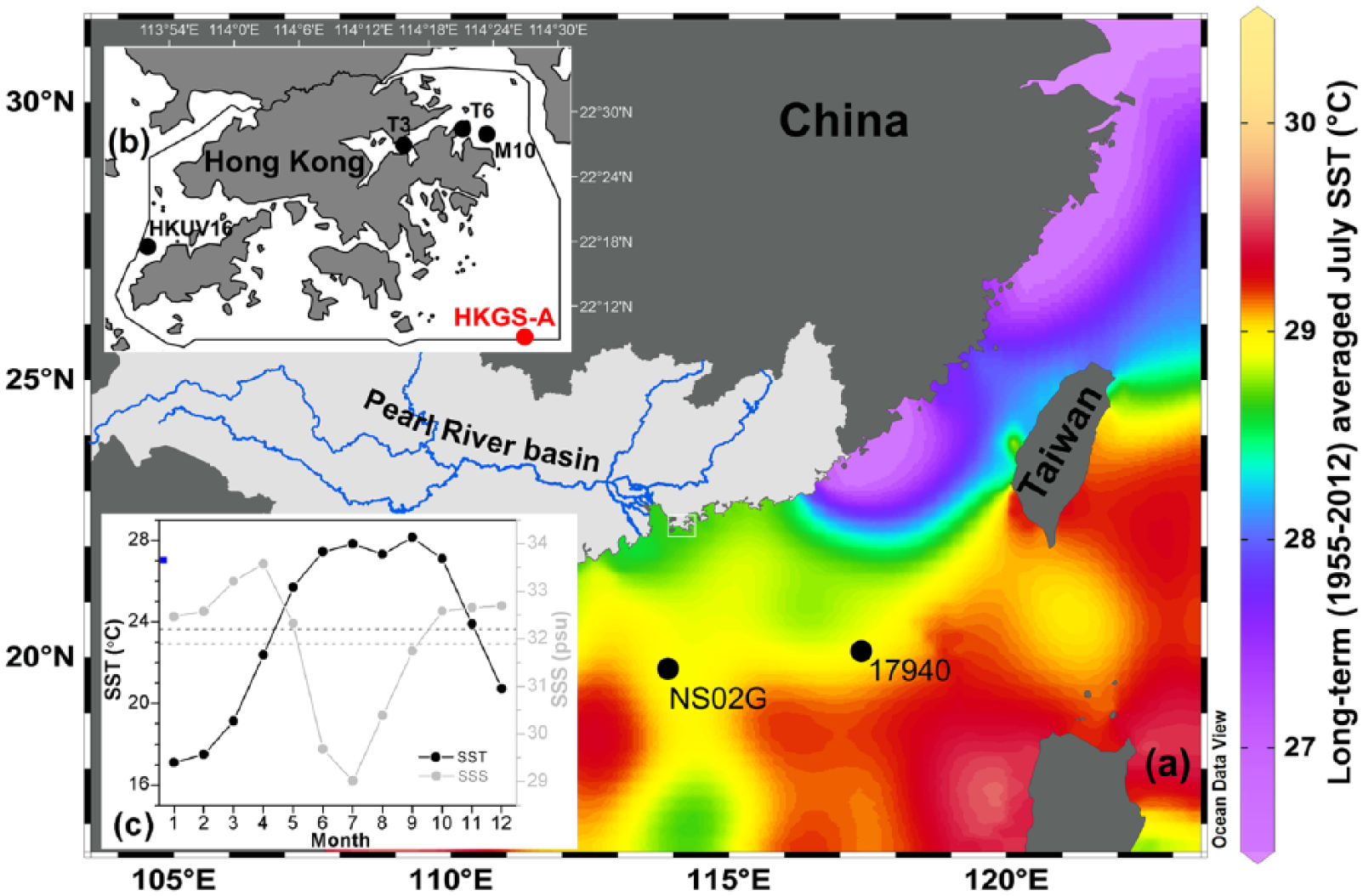
Regional environment. (a) averaged July sea surface temperature (SST) from the World Ocean Atlas 2013 (Zweng et al., 2013), (b) site of our core HKGS-A (red dot) and other published records from the Mirs Bay and South China Sea (black dots) as mentioned in the text, and (c) comparison between
Abundant datasets including instrumental and satellite-based records have been compiled to investigate the evolution of the Asian monsoon system (Wang et al., 2017). However, detailed knowledge about the ASM and/or AWM, as triggered by the land-ocean thermal contrast, also requires a thorough understanding of the contribution of oceanic counterpart (e.g. Thompson et al., 2000; Wang et al., 2005; Yancheva et al., 2007). Recent studies, based on analyses of observational data and numerical simulations, indicate the primary control of anthropogenic-induced warming on SST signal across the IPWP and SCS since ~1950s (Rao et al., 2012; Ratna et al., 2016; Weller et al., 2016). Geochemical proxies from marine archives offer an excellent opportunity to differentiate human-forced/natural variability of oceanic conditions and associated impacts over the globe (e.g. Abram et al., 2016; McGregor et al., 2015). For the SCS, despite a large number of studies presenting SST reconstructions from its open ocean (e.g. Kong et al., 2017; Lin et al., 2006; Oppo and Sun, 2005; Shintani et al., 2008; Steinke et al., 2011; Wang et al., 1999; Wei et al., 2007; Zhou et al., 2012), very few records have been achieved in the coastal region. A gravity core HKGS-A collected from the southeastern waters off Hong Kong suitably fills this gap, allowing an in-depth examination of ocean-atmosphere-land interactions along with the ASM/AWM changes.
Long-chain alkenones in marine sediments are exclusively produced by haptophytes (e.g. Marlowe et al., 1984; Volkman et al., 1980) and broadly used to reconstruct SST changes by its unsaturation index (
Materials and methods
Study region
A 60.2-m-long gravity core HKGS-A (22°09′09′′N, 114°26′55′′E, 30 m water depth) was retrieved from the southeastern waters off Hong Kong via a Hong Kong Geological Survey Project (Figure 1). In-situ measurements of four monitoring stations surrounding our core site (data are available at www.epd.gov.hk) show prominent seasonal variations of both SST (~27.5°C in summer season (June-July-August, JJA) and ~18.5°C in winter season (December-January-February, DJF)) and sea surface salinity (SSS) (~29.5 psu in JJA and ~32.5 psu in DJF) (Figure 1c). At this site, seasonal SSS variations demonstrate the influence of the Pearl River discharge in summer, which, notably, exerts little impact on SST changes (e.g. Chen et al., 2017; Jiang and Wang, 2018; Jing et al., 2009; Kong et al., 2015). Furthermore, investigations of three nearby cores in the Mirs Bay (Kong et al., 2015) have indicated that regional SST variations over the past four centuries, as mainly controlled by changes in coastal upwelling, are able to reflect the ASM intensity (Kuang et al., 2011; Liu et al., 2013).
Age model
Lithological and seismic profiles suggest that the upper ~10 m of this core is composed of continuously deposited soft sediments which contains bioturbation and shells (and shell fragments), roughly covering the Holocene as constrained by using three radiocarbon (14C) dates (Fyfe et al., 1999; Owen et al., 1998). In this study, we present the results of upper ~3.0 m from core HKGS-A down which alkenone analysis was implemented (see Section 2.3). To develop the chronology, we performed additional 14C measurements (at the Beta Analytic Inc., USA) of other seven samples based on shells (and shell fragments) (Table 1 and Figure 2). These 10 14C dates were calibrated into calendar ages using the Marine13 curve (Reimer et al., 2013) in the Calib7.1 software (Stuiver and Reimer, 1993), with consideration of a regional correction in reservoir age (ΔR = 200 ± 50 (error) years) (e.g. Southon et al., 2002). Ages at discrete depths were then calculated via polynomial regression (with degree of 2) of all calibrated 14C dates by fixing the core-top to 1993 AD when our core was drilled. To corroborate the age model, we also operated the BACON software (Blaauw and Christen, 2011) with default parameters (Figure 2). An ensemble of 10,000 age–depth realizations incorporated into this approach allows us to include all six 14C ages within our target interval (upper ~3.0 m) to calculate mean ages and associated 2σ uncertainty. The results are in good agreement with those derived from polynominal regression, substantiating robustness of our age model. However, it is worth noting that the 210Pb/137Cs analyses were not conducted due to insufficient sediment materials from the top section (actually dried up and shrunk already).
Raw 14C conventional dates and calibrated ages of upper 11 m in sediment core HKGS-A.
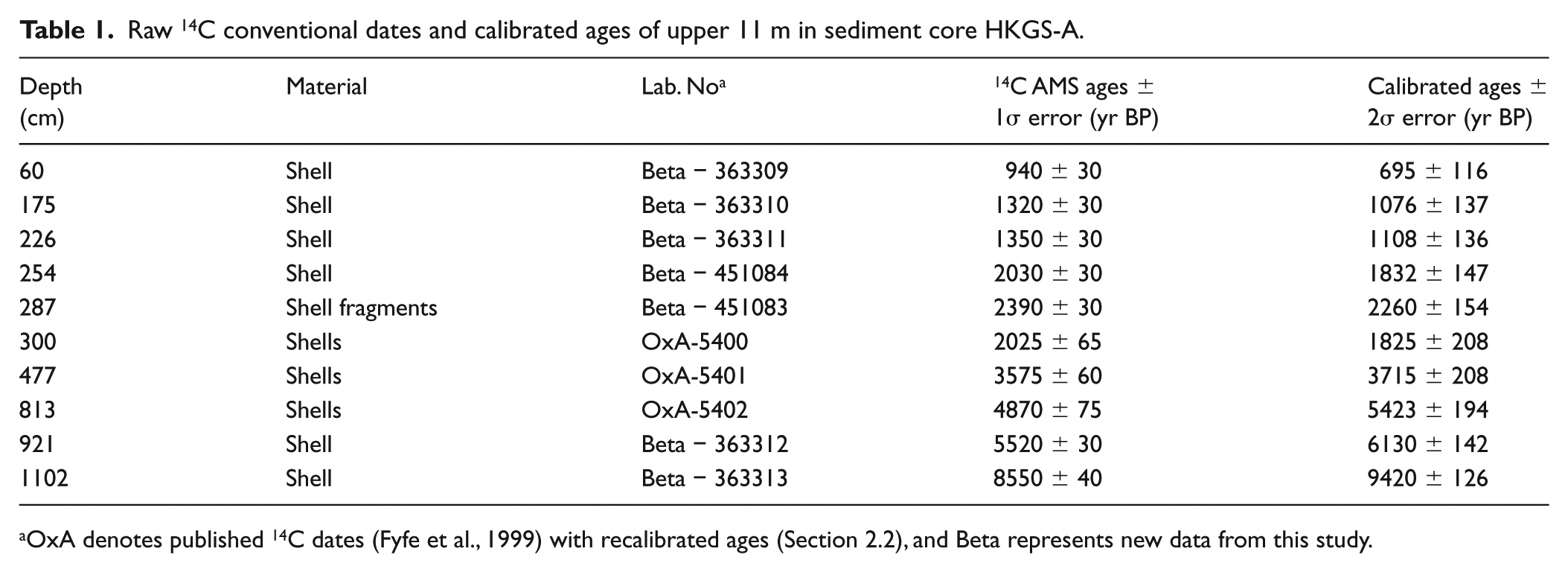
OxA denotes published 14C dates (Fyfe et al., 1999) with recalibrated ages (Section 2.2), and Beta represents new data from this study.
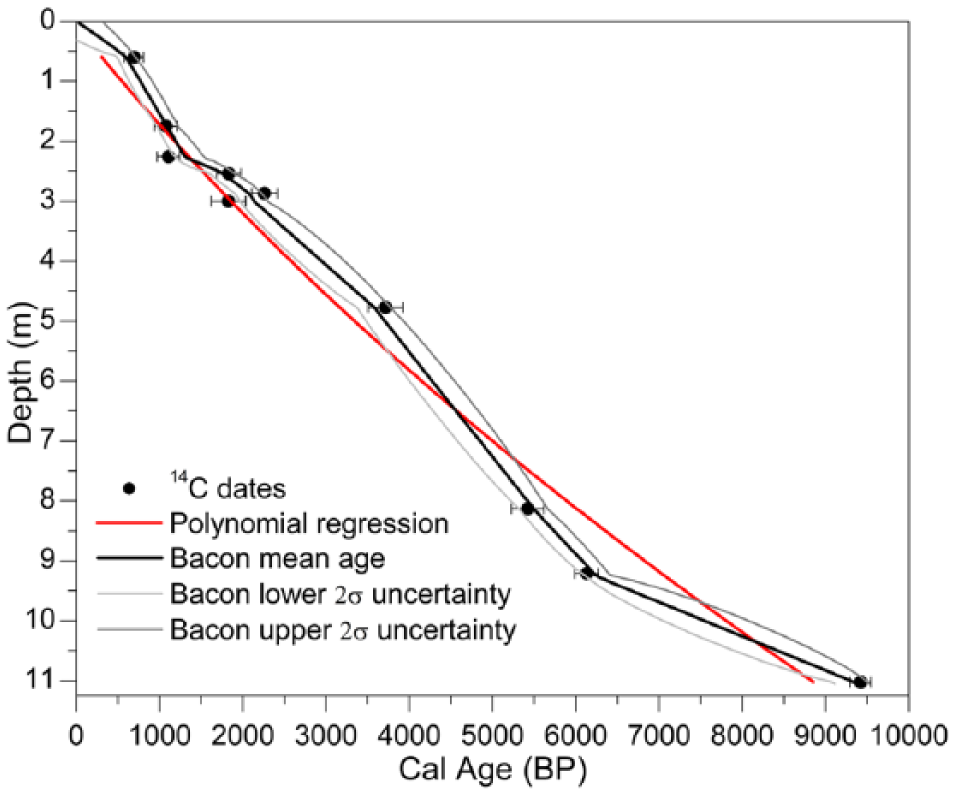
Age models of sediment core HKGS-A based on polynominal regression approach (red line) and BACON algorithm (black line) of all calibrated 14 C ages (black dots). Gray lines represent the 2σ uncertainty derived from the BACON output (see Section 2.2 for details).
Alkenone analysis
We analyzed alkenones following the procedure as described in Kong et al. (2014). In general, the sediment core was sampled continuously with a ~5 cm step for upper 1 m, and a ~2 cm step between 1 m and 3 m. Then, samples of bulk sediment were dried (~5 g), powdered and soaked to extract total lipids using organic solvent of dichloromethane (DCM): methanol (MeOH) 9:1 solution, under ultrasonic waves in 40°C-water bath for three cycles (lasting 30 min each). The extract was hydrolyzed with 6% KOH in MeOH to remove alkenoates, and subsequently separated into three fractions using silica gel column chromatography with eluents of n-hexane, DCM and MeOH. Finally, alkenones were analyzed on the Agilent 7890 Gas Chromatography equipped with a flame ionization detector, at the University of Hong Kong. An internal standard (n-C36 alkane) was used to quantify alkenones, and replicate injections were also performed every 10 samples.
The index
Results
The
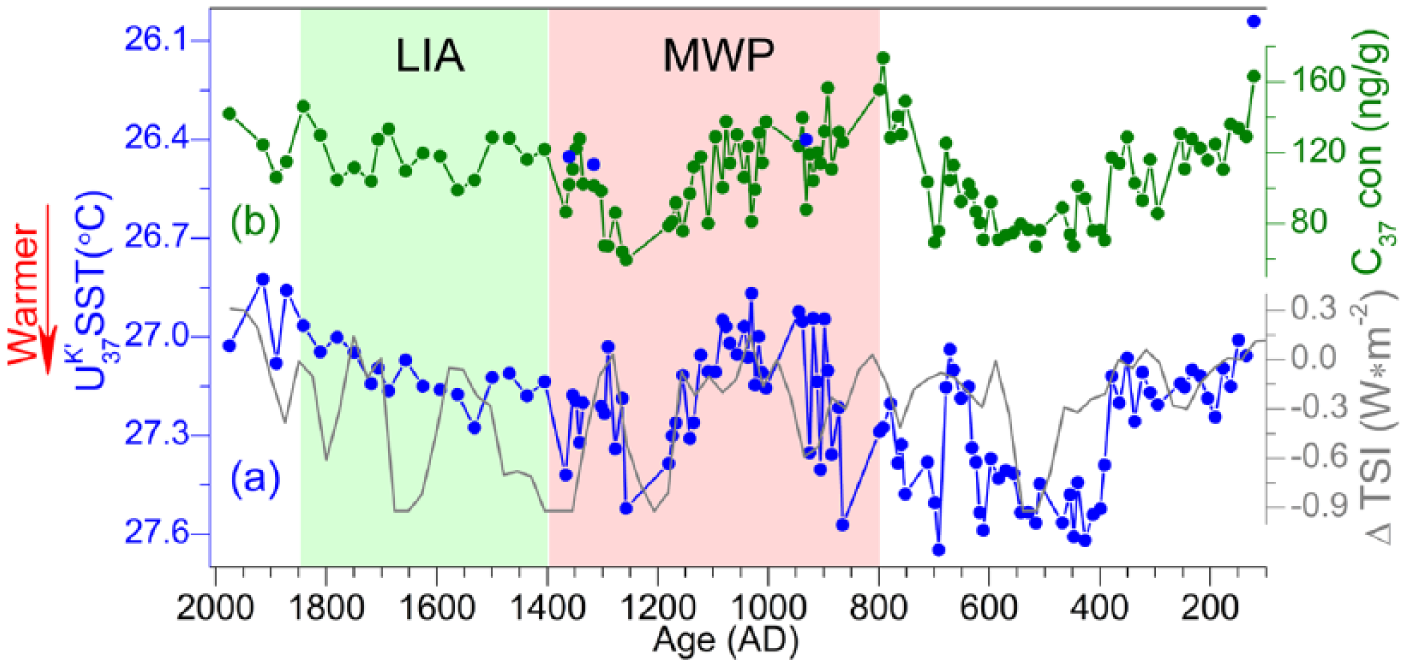
The
The
Discussion
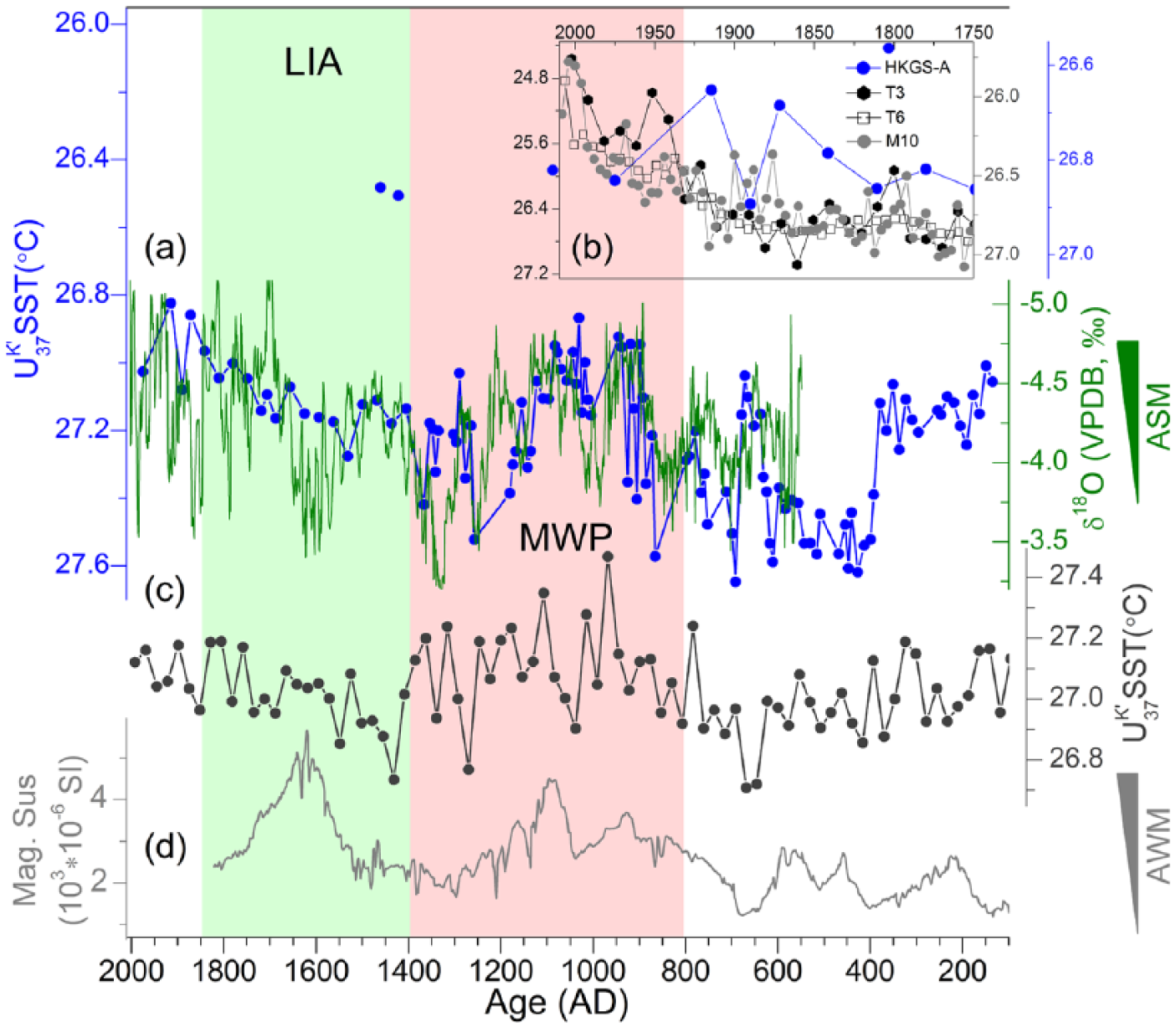
The multi-centennial-scale SST changes in sediment core HKGS-A are apparently anti-phased with Northern Hemisphere temperature (Moberg et al., 2005), for example, marked cool conditions for the MWP and relatively warm SSTs for the LIA (Figure 3a). In particular, a declining SST trend since ~1850 AD, corroborated by previously published SST records from nearby short sediment cores (T3, T6 and M10) in the Mirs Bay (Kong et al., 2015) (Figure 4b), strongly conflicts with the recent warming background. Furthermore, combined with the opposite patterns between our SST record and TSI (Steinhilber et al., 2009) (Figure 3a), it is very likely that regional features overturned global/Northern Hemisphere temperature changes. Identifying this underlying mechanism would help to clarify the role of how the SCS interacted with the Asian monsoon system. To this end, we first need to address the chronological uncertainty and alkenone-SST signal.
Chronological uncertainty
To calibrate conventional 14C dates, we use a regional correction of radiocarbon reservoir age (ΔR = 200 ± 50 years, Kong et al., 2014; Southon et al., 2002) that coincides well with the estimation of conventional age at core-top (ΔR = 213 years) via polynomial regression of all these conventional 14C dates together (Figure 2). Both the polynomial regression and BACON methods yield rather consistent age models, except for the lower part, for example, about 200 years difference at 350 AD (254 cm depth). However, there is only slight discrepancy (less than 50 years) for the age at about 900 AD which was outlined as the MWP interval. The dating uncertainty thus does not modify the time window of the MWP. The LIA time window indeed contains uncertainty of about 150 years and hence allows a possible shift of ages (in particular at 60 cm), which, notably, still maintains the general pattern of our SST record. Furthermore, the sedimentation rate of its upper 60 cm, as roughly estimated by 14C date in Table 1, is also comparable with that of several nearby cores derived from the 210Pb results (e.g. Kong et al., 2015; Owen and Lee, 2004).
More importantly, the cooling trend over the last two centuries observed at our study site, which is corroborated by previously published SST records from nearby sediment cores in the Mirs Bay (Kong et al., 2015) and unlikely influenced by chronological uncertainty, should be a robust regional feature. If the cooler SSTs in the MWP were shifted toward the LIA (the typical cooling interval), one could then see warmer SSTs during the MWP (Figure 3a). However, any reasonable modifications of our current chronology, like applying different ΔR values, could not accommodate this shift. Furthermore, such ‘warmer’ conditions during the MWP at our study site, as compared to cool SSTs after ~1850 AD, would also require a completely different mechanism to account for. It hence enables us to consider the above-mentioned shift of cooler SSTs at MWP toward LIA very unlikely. Altogether, our chronology in this study, despite its uncertainty, is able to capture the general pattern of SST changes during the typical MWP and LIA, and should not affect our conclusion.
Alkenone-SST signal
At (or near) surface waters of northern SCS open ocean, the species of coccolithophore Gephyrocapsa oceanica and Emiliania huxleyi, producing alkenones, dominantly bloom in the winter season when AWM prevails (e.g. Chen et al., 2007). In contrast, a set of modern surveys show that, at the Pearl River estuary, phytoplankton and haptophyte are primarily abundant in the summer season (Dai et al., 2008; Le et al., 2008; Song et al., 2010). Moreover,
It is necessary to evaluate whether the alkenone signal at our study site can be influenced by lateral transport, for instance, from the Taiwan Strait or Pearl River discharge. We note that the AWM northeasterly winds, which drive anti-clockwise currents in the northern SCS, are able to induce strong vertical mixing and bring subsurface nutrients to the euphotic zone (e.g. Ning et al., 2004; Su, 2004). However, this mechanism gives rise to thermal homogenization of the water column over our study area in winter (from ~15 to 20°C, Kong et al., 2015), thus being difficult to reconcile with the range of our
Another important point is that the Pearl River discharge, although exerting little impact on our SST changes (e.g. Chen et al., 2017; Jiang and Wang, 2018; Kong et al., 2015), delivers a large amount of fluvial nutrients into the northern SCS coasts in summer (e.g. Dai et al., 2008; Le et al., 2008; Song et al., 2010). At the same time, prevailing clockwise surface currents are also able to transport such nutrient-enriched freshwater to our site and hence allow algal blooms and maximal primary productivity (Le et al., 2008). It is likely that both current-carried fluvial nutrients and upwelling-induced subsurface nutrients are favorable for alkenone production at our site. However, two alkenone records from cores HKUV16 (22°17.5′N, 113°52′E) and NS01 C (21°51′N, 113°49′E), located at the Pearl River estuary (Kong, 2014; Kong et al., 2014), bear little similarity with C37 record from our core. For those two cores, warmer SSTs and no increase in C37 contents during the MWP, in contrast to the cooler SSTs and increased alkenone contents at our site, definitely rule out a major control of the Pearl River discharge on the alkenone signal in core HKGS-A.
Summer monsoon-induced upwelling
Our topmost SST value is close to summer temperature, but there is still a possibility that relative SST changes might be largely ascribed to winter temperature changes. Such case has been reported previously across the Yellow Sea and Bohai Bay (He et al., 2014). However, at our site, the opposite SST changes (Figure 3) cannot be explained by the AWM intensity since the AWM strengthened at cool intervals and would only have reinforced the global temperature signal (Figure 4). Regarding substantially cool SSTs in winter (~20°C) in our study region, winter temperature signal could essentially contribute to regional SST change. However, it is other factors that ultimately overprint the winter temperature signal. By comparing with global temperature, the AWM and ASM changes over the past two millennia (Figures 3 and 4), summer monsoon-induced upwelling stands out as a viable driver (perhaps the only one) of the opposite SST changes at our site. In summer, the prevailing southwesterly winds from the ASM circulation blow over the northern SCS. A stronger ASM leads to intensification of wind-induced upwelling, which, subsequently, decreases the coastal SSTs of northern SCS (e.g. Kong et al., 2015; Kuang et al., 2011; Liu et al., 2013). Moreover, an enhanced upwelling also promotes vertical mixing of nutrient-rich subsurface waters that allows favorable conditions for haptophyte production (Villanueva et al., 1998) and would thereby explain higher C37 concentrations (Figure 3b). By contrast, a weaker ASM results in increased coastal SSTs and lower C37 concentrations (Figure 3). Although C37 content changes could be attributed to multiple factors, summer monsoon-induced upwelling remains as the most likely explanation in our case (see Section 4.2). Thus, coupled variations of our SST record and alkenone content effectively reflect the ASM intensity.
In fact, additional analysis of observational data shows negative correlation between in-situ measured summer SSTs nearby our core site and the 850 hPa meridional winds over central India and adjacent ocean (Figure 5), which apparently facilitates usage of
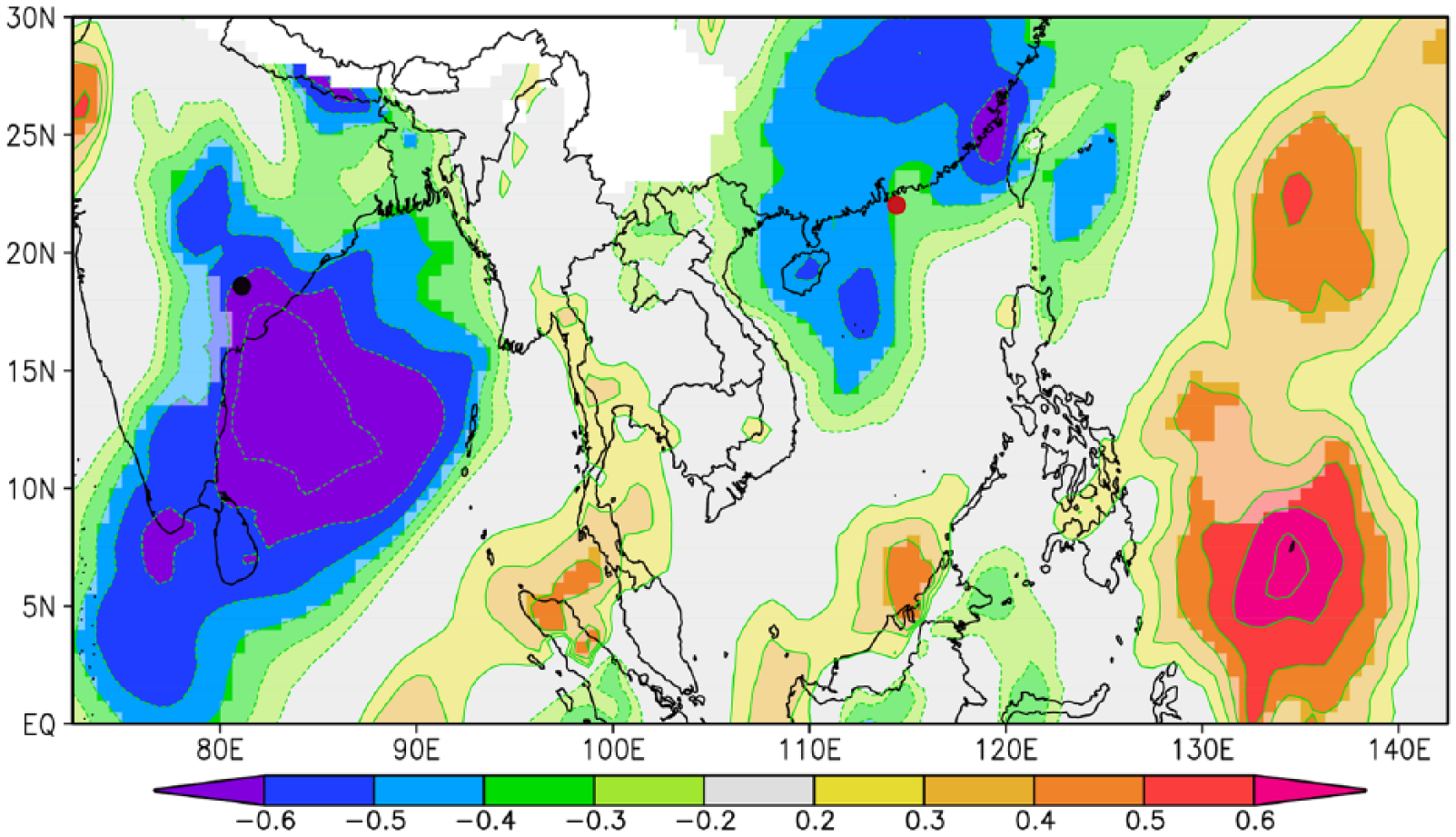
Spatial pattern of correlation coefficients between averaged (June-July) 850 hPa meridional winds (NASA MERRA) and in-situ SST measurements nearby site HKGS-A during 1991–2016 AD (colorful rectangle marks regions where p < 10%). The negative relationship, although existing at our site (red dot) as expected, is more significant over central India and adjacent ocean (black dot marks location of stalagmite δ18O record in Sinha et al., 2011).
Modern El Niño–Southern Oscillation (ENSO) variability also modulates SST changes across the SCS (e.g. Yang et al., 2015; Zhou and Chan., 2007), for example, ~0.1°C as evidenced by observational data (not shown). However, we are unable to quantify the ENSO contribution to SST changes at our site, because available paleorecords support prevailing conditions of either La Niña (Yan et al., 2011) or El Niño (Rustic et al., 2015) over the same interval, such as the LIA. Additional works by model simulations may shed further insight on this topic, which is beyond the scope of this study. Nevertheless, we stress a specific point that the Pearl River discharge would suppress the wind-driven coastal upwelling to the southwest of Hong Kong (e.g. Chen, 2014; Chen et al., 2017; Jing et al., 2009; Wang et al., 2012; Zu and Gan, 2015). Finally, an enhanced upwelling since ~1850 AD calls for more attention to future ASM change under global warming scenarios, and its possible impact in the coastal region.
Conclusion
We have reconstructed alkenone-SST variations over the last two millennia from sediment core HKGS-A, collected from the southeast waters of Hong Kong. Multi-centennial-scale SST variations display an opposite pattern to that of Northern Hemisphere temperature, for example, relatively cool conditions during the MWP and warm SSTs during the LIA. Together with alkenone content changes, our SST record indicates that the strength of wind-driven coastal upwelling in the northern SCS, associated with summer monsoon intensity, could overturn the original signal of global temperature changes. Comparison with published records also allows further insight on the spatial characteristics of SST changes across the northern SCS. In the context of global warming scenarios, future ASM change and the associated impact upon the coastal upwelling are particularly timely topics.
Footnotes
Acknowledgements
We thank two anonymous referees for constructive comments that greatly improved this manuscript. RJS also appreciates the permission from Head of Geotechnical Engineering Office and Director of Civil Engineering and Development Department.
Funding
This work was supported by the National Key Research and Development Program of China (2016YFA0601204) and HK Research Grants Council (17325516 and 707612 P).
