






Abstract
In eastern China, on the southern end of the Yangtze Valley, early Holocene hunter-gatherers were foraging various plants, including wild rice – Oryza rufipogon Griff. – an aquatic and perennial plant which is the wild progenitor of domesticated rice. According to optimal foraging theory, these foragers should have tried to enhance the efficiency of harvesting wild rice seeds by draining water around the plants before seeds ripened and shattered. This proto-cultivation practice led to unintended consequences given that wild rice responds to drought stress owing to its phenotypic plasticity. Plant and panicle architectures were modified with transitions to more compact and erect tillers and to a closed panicle shape. They provide incentives to early foragers for intensifying their proto-cultivation practices and so could have also triggered initial cultivation of rice. They also triggered incipient domestication of rice, starting by the transition to selfing. According to this narrative, it is even possible that rice incipient domestication preceded cultivation.
Keywords
Introduction
The last two decades have seen a tremendous amount of information related to Asian rice domestication. Two main sources of information are provided by archeological records and molecular analysis (Fuller, 2007; Gross and Zhao, 2014; Ishikawa et al., 2020). Concerning archeological records, it is now widely agreed that Asian rice was domesticated in the lower Yangtze basin around 6700 BP (Fuller, 2020). Such domestication was the issue of a protracted process spanning from 1 to 2 millennia or more. In fact wild rice cultivation started around 11,000–9000 BP according to most recent studies (He et al., 2020; Ma et al., 2018). During this pre-domestication cultivation (PDC thereafter) period, early cultivators have managed wild rice plants and harvested their seeds. Selective artificial pressures on wild rice – Oryza rufipogon Griff. – mostly unintended, combined with natural selection, finally led to rice domestication, Oryza sativa L.
At the molecular level, a large number of domestication markers – locus, alleles, QTLs, genes, microRNAs – have been identified by genetic analysis, and their number is growing larger with the passage of time. These markers concern especially the morphological and physiological transformations undertaken by rice during its cultivation and leading to the so-called domestication syndrome (Fuller, 2007; Ishikawa et al., 2020; Xu and Sun, 2021).
Despite the abundance of archeological and genetic knowledge on rice domestication, what remains poorly known are the putative actions undertaken by early cultivators and leading to the fixation of domestication traits. Some, but very few, explanations of these early agronomic practices exist in the academic literature; they concern the fixation of the seed retention trait (Svizzero, 2018), the reduction of seed dispersal aids (Svizzero et al., 2019), the role of weedy rice (Svizzero, 2021a), the causes and consequences of the outcrossing-selfing transition (Svizzero, 2021b), and the transition from a prostrate to an erect growth habit. What is even less known and explored are the reasons underlying the forager-cultivator transition. Theories about the commencement of agriculture are numerous, in Asia and even more in Southwest Asia, and are usually classified in two groups, denoted the “pull” and the “push” theories (Svizzero and Tisdell, 2014). Even though they are all worthy of interest, they all consider macro-explanations. Our goal is different; we intend to provide explanations at the micro-level, that is, why Asian pre-cultivation foragers who gathered wild rice seeds started to manage wild rice plants, and how this might have triggered the rice domestication process. For this purpose we consider archeological records, the results of genetic analysis as well as the principles of Optimal Foraging Theory (Winterhalder and Kennett, 2006). By using this triple foundation we contend that pre-cultivation foragers tried to improve the efficiency of the harvest of wild rice seeds. For this purpose they modified the environment in which wild rice was growing, that is, they started to manage wild rice by temporarily reducing its access to water. This agronomic practice had inadvertent cascading effects on the morphology of the wild rice plant and on its yield that were beneficial for these early proto-cultivators. Then the latter perpetuated these practices which in turn triggered rice domestication and cultivation.
Foraging before proto-cultivation
There is numerous archeological evidence that in Southern and Eastern-central China, early Holocene hunter-gatherers (HG thereafter) had a broad–spectrum diet based on animals (terrestrial and aquatic) and plants (Chi and Hung, 2012), a situation quite similar to what happened in southwest Asia (Flannery, 1969). Various plants – more than 50 species (Fuller et al., 2009) – such as nuts, seeds, and fruits – were gathered. The most frequently foraged plants were acorns (Quercus sensu lato and Lithocarpus), and to a lesser extent water chestnuts (Trapa) and foxnuts (Euryale ferox). Seeds from various grasses were also harvested, such as from Barnyard grass (Echinochloa sp.) (Yang et al., 2015) along with wild rice seeds (Oryza rufipogon Griff.).
Biology and ecology of wild rice (Oryza rufipogon Griff.)
Oryza rufipogon Griff. is an Asian AA genome diploid (2n = 24) species considered to be the wild progenitor of domesticated rice, Oryza sativa L. It is a perennial usually defined as a predominantly outcrossing species which is wind-pollinated. It has a running habit, creeping on the ground and rooting at internodes. Its growth exhibits two successive phases: during the vegetative phase, wild rice tends to have a prostrate growth, a short stature with many tillers and a larger tiller angle, while it develops erect panicle-bearing stalks in the reproductive phase. It is a tufted and scrambling herb, 150–400 cm tall. Anthers are usually >3 mm, reaching 7 mm or more, spikelets are usually 8–9 mm and awns are usually 6–10 cm. Oryza rufipogon is an aquatic or semi-aquatic plant growing in water 0.2–4 m deep. It is found in swamps, marshes, open ditches, channels, and along the boundaries of lakes and ponds (Neelam et al., 2018; Vaughan, 1994). Some of these previously described physiological and ecological features had important consequences for early foragers.
A perennial plant
Wild rice is a perennial, and so it means that even though it produces seeds, its main reproductive system is by means of vegetative propagation, through rhizomes and new tillers. This implies that it is possible to gather its seeds season after season without having to store and later to sow some of these seeds. This biological characteristic has important consequences pertaining to what we usually define as cultivation. Fuller et al. (2014: 6147) define “cultivation” as “a group of behaviors aimed at modifying soil environments and the management of the plants that grow in them.” For us it seems important to be more precise about what are the behaviors leading to cultivation compared to those that are associated with proto-cultivation (or the management of wild stands) (see Figure 1). So we consider that the term “cultivation” can be used only when the whole growth cycle – harvesting, storing, and sowing seeds – is human-mediated. If people do not sow some of the seeds they have harvested, then their behaviors are of the proto-cultivation type. Once sowing is included, then cultivation really starts.

Evolutionary pathway of rice, from foraging to agriculture.
Since wild rice is a perennial, it was not necessary – even though it was possible – for early foragers to sow some seeds, and then not necessary to start cultivation. This observation is quite important because most of the wild progenitors of the cereals domesticated in southwest Asia (emmer, einkorn, barley) where annual species and so their management required explicit cultivation, that is, included sowing. Even though wild rice seeds were not sown, it was nevertheless possible to manage wild stands of wild rice, for instance by controlling – possibly by fire (Fuller and Qin, 2009; Zong et al., 2007: 91) – other plants (weeds) that were competing with them (Brown, 2018).
An aquatic plant
Wild rice is an aquatic plant, so it was possible for early foragers to manage the water level in the environment where wild rice was growing (Fuller and Qin, 2009). For instance, in the case of water-deficiency, early foragers could have tried to channel water close to the plants, and/or to preserve this water around the plants by bunding small plots of land, since bunding improves soil moisture conservation. Wooden as well as bone spades or hoes, which could have been used for building levees around a small field, have been recovered, for example, from the well-known site of Hemudu, a major center of rice exploitation from the very early Holocene (Fuller et al., 2007). This proto-cultivation practice likely led later – between 7000 and 4000 BP – to wet rice cultivation systems and more precisely to the first paddy fields (Fuller et al., 2007; Zheng et al., 2016; Zong et al., 2007). Of course, all these devices – water-channel, water pit, reservoir, dike, bund – built to control the water level can be used in both directions, that is, either to reduce or to induce a water-deficit.
On the efficiency of gathering wild rice
Another important feature of wild rice, and also of most wild grasses – is that its seeds shatter when mature. This is an important mechanism provided by natural selection in order to ensure reproduction through seed dispersion. This trait has evolved gradually during the PDC and it is only when most if not all rice plants had the non-shattering phenotype that full domestication is considered to be achieved, between 6700 and 5900 BP (Fuller, 2020). The natural dispersal habit of wild rice should have been a problem for early foragers. Indeed, seeds from wild rice ripen unevenly – another trait of wild rice compared to domesticated rice – and so it was not possible to harvest all the seeds of a plant in one pass. One possibility could have been to harvest mature and immature grains at the same time, for instance by panicle cutting or uprooting. However, this technique is not efficient since many immature grains could be empty or only partially filled; moreover archeological evidence of harvesting immature grain of wild rice remains controversial (Crawford, 2012; Fuller and Qin, 2008, 2009; Fuller et al., 2007; Pan, 2008). If we assume that only mature grains were gathered, then two strategies were possible to minimize grain losses. On the one hand, as it is suggested by several Asian and African ethnographic evidence of wild grasses gathering, early foragers could have used knotting or bundling, that is, tying wild rice in small bundles before the seed was ripe (Fuller and Qin, 2009: 90; Harlan, 2014). However, given the prostrate growth habit of wild rice, knotting was not easy and so it is less likely that it was adopted for O. rufipogon. On the other hand, if the harvesting technique used was based on basket beating or basket swinging, then several passes were necessary to harvest as much grain as possible from a given wild rice plant. Even if the number of harvesting passes was quite high, some seeds could have shattered between two passes.
The low efficiency of rice gathering in an aquatic environment
However, these shattered seeds were not necessarily lost for the foragers, since they also collected various parts of plants on the ground, such as acorns, nuts, and seeds. Ground collection of cereal seeds is even easier when these cereals are wild because in most cases their seeds are awned, and awns – which are usually 6–10 cm long for wild rice – provide to collectors an easier grip (Kislev et al., 2004; Svizzero et al., 2019). Then, gathering wild rice seeds can be done by using – separately or not – two methods. On the one hand mature seeds that have not yet shattered are harvested on the plant, for example by the basket beating method. On the other hand mature seeds that have already shattered can be collected on the ground. According to Optimal Foraging Theory (Winterhalder and Kennett, 2006), early Holocene foragers could have maximized the grain gathered by means of both methods.
The main problem for early foragers aiming to ground collect wild rice seeds is that wild rice is an aquatic plant, so when its seeds shatter, they fall in the muddy water (Fuller and Qin, 2009: 91). These muddy seeds, with their long awns, can nevertheless be collected. However they have first to be cleaned, in order to remove the mud, and after to be either consumed on the spot, or dried to reduce their moisture content in order to avoid spoilage during storage. If grain is not dried correctly they get moldy or may germinate, and so become either non-edible or unpalatable. These activities – cleaning and drying seeds – require extra labor expenditure and so reduce the harvest (and post-harvest) efficiency.
Draining rice plots to improve ground collection of shattered grains
One solution to this previous problem faced by early foragers could have been to dry the small plots of land were wild rice was growing, just before seed maturation. If small plots of land where wild rice was growing were organized as paddy-field-like, for example, based on simple artificial bunding, and were used for instance to retain some nutrient rich seasonal floodwater, then they could also have been used to temporarily drain the water surrounding the plants. With such drainage, the seeds that shatter between two successive harvesting passes would have fallen on a dry soil and so could have be collected on the ground without extra labor expenditure. In other words, draining the plots improved the collection efficiency, and even though the drainage required some extra labor, the cost-benefit analysis would have led early foragers to adopt it. This conclusion is reinforced if it is also taken into account that wild rice is a poor grain producer, compared to domesticated rice, with 20–50 seeds per plant, because it mainly relies on vegetative reproduction (Lu, 2006: 143; Mohapatra et al., 2011). Moreover, and according to recent experiments, harvesting mature seeds before they shatter provides a very low efficiency – around 90 kcal per hour of work – compared to the collection of other wild plants and animals (e.g. shellfish, bamboo roots, yam) (Lu, 2006: 143). So, any improvement in the ground collection of shattered seeds, such as one induced by draining, would have been highly valuable for early foragers.
Phenotypic plasticity and wild rice responses to drought stress
Wild rice plants are highly sensitive to drought stress during their vegetative phase, at panicle initiation and booting stages. O. rufipogon contains abundant drought-resistant genes that are used nowadays to improve rice resistance, productivity, and quality (Atwell et al., 2014; Zhang et al., 2017).
Plant architecture: Transition toward a more erect growth habit
At the vegetative stage, drought stress results in reduced height, tiller number and leaf area (Menguer et al., 2017). It is often observed that the prostrate habit of the perennial O. rufipogon when the plants grow in standing water is modified compared to when it is grown in drier environments. Indeed the tillers then develop into semi-open bushy plants and give the appearance of the annual species (Nayar, 2014: 225). Tillering determines the plant architecture and canopy development for capture of incident light for primary production.
Tiller development is determined by genetic and environmental factors, resulting in high phenotypic plasticity for plants responding to different environmental conditions (Hussien et al., 2014). Under abundant supply of water and nutrients, the extent of tillering might be especially important; on the contrary under water deficits and short growing seasons, activation of tillers should be genetically restrained to accommodate the limited resource supply (Atwell et al., 2014: 53). In other words, under drought stress, plant reproduction through vegetative propagation is hampered and so natural selection leads to the production of more seeds in order to preserve plant survival by means of seed reproduction.
This implies that during the domestication process, the transition from floating to erect habit could be the consequence of phenotype plasticity in a water-deficient environment (Fuller, 2020). In fact the species adapts according to the level of soil moisture available and modifies phenology, biomass production, and grain yield. Such resilience in aberrant climatic conditions led to the origin of new ecotypes, landraces, species, and ultimately cultivated rice (Mohapatra et al., 2011).
Panicle architecture: Presumed transition toward a closed panicle
A simple morphological change in rice panicle shape, namely a shift from an opened to a closed panicle, has recently been identified by QTL analysis (Ishii et al., 2013; Zhu et al., 2013). An open panicle – controlled by the SPR3 locus – is a feature of wild rice while domesticated rice has a closed panicle. The shift from a spreading to a closed panicle could have had two main consequences, both related to the rice domestication process (Fuller, 2020; Ishikawa et al., 2020). On the one hand, since wild rice has long awns, when the panicle is closed they retain grain longer on the plant, that is, seed retention is improved even though the plant still has the wild phenotype pertaining to seed shattering. On the other hand, with a closed panicle pollination is hampered; then the shift to a closed panicle should also have promoted the outcrossing-selfing transition in rice, the latter being crucial for rice domestication since recessive mutants are more easily fixed under selfing. Indeed in wild rice the evolution of the mating system from cross- to self-fertilization resulted from the modification of panicle and floral morphology that was controlled by QTL of small-to-moderate effect (Grillo et al., 2009; Svizzero, 2021b).
What remains a puzzle is which selective pressure could have induced this morphological change from an open to a closed panicle. Our previous narrative, based on the unintended consequences of drainage by early foragers, provides a possible explanation. Indeed, we have previously demonstrated that the wild rice response to a water-deficient environment was a more compact growth habit, that is, tillers are less numerous and more erect. Then, the problem with more erect and compact tillers is that their respective panicles – when they are open – clashed more frequently, especially under windy conditions, and this damaged the flowers or the grains. So natural selection could have led wild rice growing in a water-deficient environment to modify the panicle shape from a spreading to a closed shape; indeed this would have preserved flowers or grains integrity, and thus enhanced plant survival.
The higher efficiency of gathering wild rice in a water-deficient environment
Wild rice cultivation into a water-deficient environment could have happened either naturally, for example, as the result of climatic fluctuations, or artificially. There exist several possible artificial selective pressures leading to rice cultivation in drier conditions. First it may result from the spread of rice cultivation from wet lowland to drier upland situations (Nayar, 2014). Second, it may result from the systematic use of paddy fields, as in Caoxieshan (5900 BP). This site, the first known with a small field system, provides archeological evidence of wild rice cultivation under drier conditions, the latter being confirmed in the form of a phytolith index indicative of water availability of all grasses in rice assemblages (Fuller, 2020). Third, as we assume, before rice domestication and even before rice cultivation, early proto-cultivators could have nevertheless started to drain temporarily wild rice stands in order to improve harvest efficiency. Let us turn to the possible consequences of this strategy, given the previously identified phenotypic responses of wild rice to drought stress.
Modified plant architecture and grain productivity
Plant architecture is of major agronomic importance as it determines plant survival ability under environmental stress, the suitability of a plant for cultivation, and potential grain yield (Mathan et al., 2016). Rice plant architecture is mainly determined by the tillering pattern, plant height and panicle morphology (Bai et al., 2018; Wang and Li, 2008). The ehrhartoid (e.g. rice) cereal grasses possess many tillers but do not produce axillary branches. These wild grasses and their domesticated forms produce profuse tillers terminating in an inflorescence. Besides, tiller angle, the angle between the main culm and its side tillers, can significantly affect grain yield in Asian rice (Jin et al., 2008; Tan et al., 2008). The vegetative patterns play a major role in determining the overall biomass of the plant (Li et al., 2017) as well as the number of inflorescences produced and finally the amount of seeds borne by the inflorescence.
A more erect growth habit, resulting from artificial drought stress, enhances photosynthesis efficiency, and improves grain yield. Indeed the number of grain-bearing branches per plant increases, and so harvested grains increase by around 100% (Fuller, 2020; Tan et al., 2008: 92–94). Then, an increase in grain production is another response of wild rice to drought stress (Fuller, 2020: 91).
Modified panicle architecture and harvest efficiency
Once rice plants grow erect, the domesticated panicle is more compact, enhancing photosynthesis of the lower leaves (Zhu et al., 2013), and so grain production increases. On its own the shift to a compact panicle increases grains harvested by around 50% because it improves seed retention (Fuller, 2020; Ishii et al., 2013: 92). Both previous effects are combined, that is with a closed panicle, grain productivity increases as well as harvest efficiency, and so both effects are obviously advantageous for foragers.
Cascading effects of drainage on rice harvest, domestication, and cultivation
We have assumed that, initially, foragers aiming to improve the ground collection of shattered seeds introduced proto-cultivation, that is, the management of the water-level in small rice fields. The intended consequence of drainage was, as expected, an increase of the harvest efficiency since grains present on the dry soil were easily collected and then stored without additional effort. This initial action has also had several unintended consequences – cascading effects, as depicted in Figure 2 – on rice plant and then on foragers’ strategy.
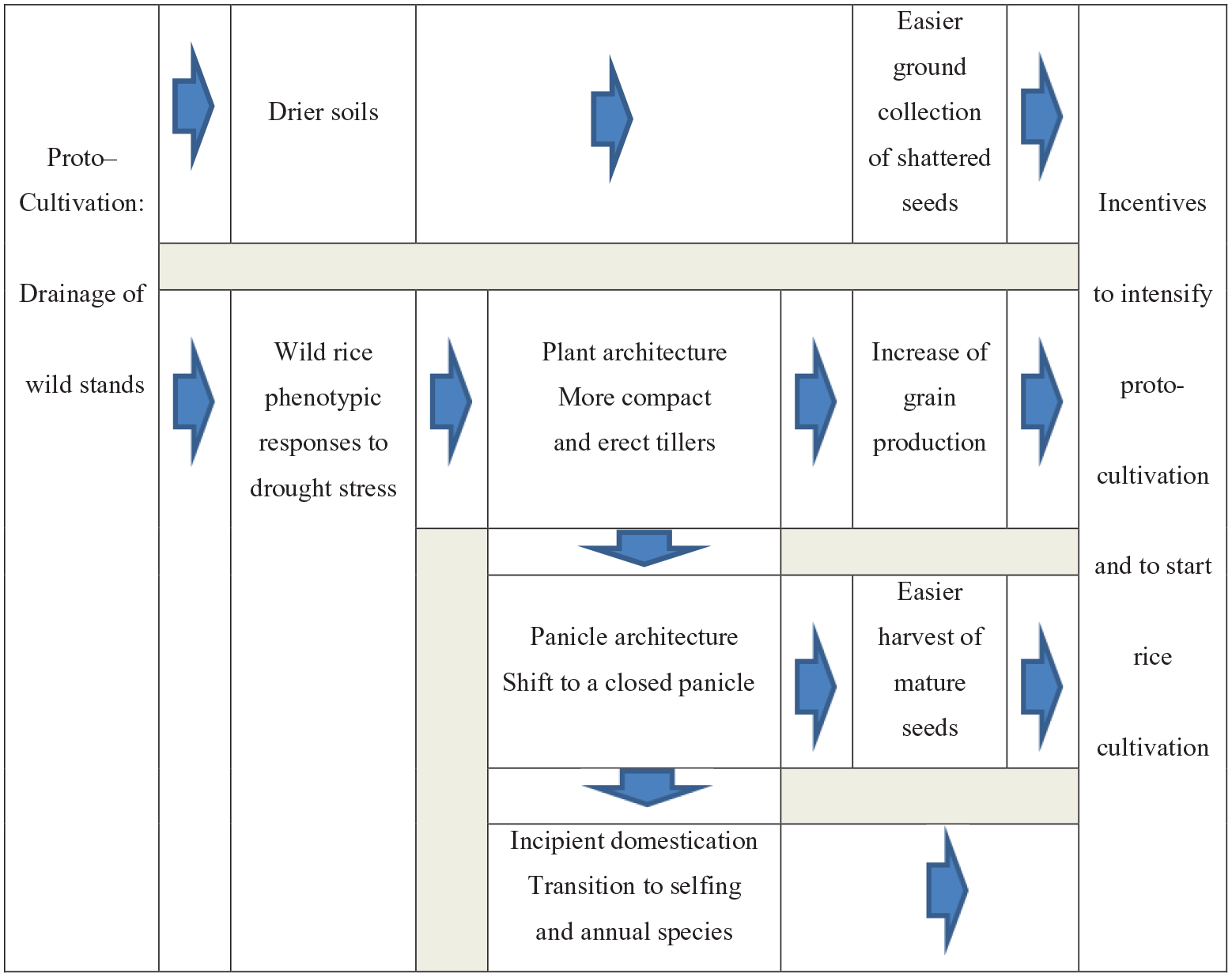
Intended and unintended (direct and indirect) consequences of drainage on rice domestication and cultivation.
First, by phenotypic plasticity, wild rice responded to drought stress by reducing the number of tillers which became more compact and erect. As a corollary, grain production increased – by natural selection – to counterbalance the more difficult reproduction by vegetative propagation. This was for foragers the first positive unintended consequence of drainage: they became able to harvest and to ground collect more grains.
Second, because plant architecture was now based on more compact and erect tillers, their panicles were more prone to clash and then to preclude reproduction by seeds. Here again it is very likely that natural selection fostered the shift from an open to a closed panicle. This shift has had two consequences for foragers. On the one hand, even though the plant still had the wild phenotype pertaining to seed dispersal, a closed panicle improved seed retention, especially when awns were long; therefore, it became easier for foragers to harvest mature seeds on the plant. On the other hand, a closed panicle hampered pollination; then the selfing rate increased by reproductive assurance. This shift from outcrossing to selfing induced wild rice transition from a perennial to an annual species; it also triggered the domestication process of rice because domestication traits are associated with recessive mutants which are easily fixed under selfing (Svizzero, 2021b).
According to the previous narrative it is therefore possible, even though it is only a conjecture, that proto-cultivation – namely drainage – led to incipient domestication before rice cultivation (i.e. including seed sowing) starts. What is more certain is that drainage provided foragers more grains that were also easier to harvest and collect; in other words, the unintended consequences of proto-cultivation (drainage) implied strong incentives for foragers to intensify proto-cultivation practices and ultimately to start cultivation per se.
Conclusion
Recent archeological records and genetic analysis have provided new information related to rice early cultivation and domestication. For instance archeo-botanical records confirm that wild rice was foraged in the early Holocene and support the existence of pre-domestication cultivation, that is, a period during which wild rice was cultivated before being domesticated. Genetic analyses have confirmed that wild rice, O. rufipogon, was the progenitor of domesticated rice. Despite these recent advances some important questions remain unanswered, for example, when the incipient domestication started, is it during pre-domestication cultivation or even before, and what were the initial selective pressures which triggered it? In order to answer such important questions, it is necessary to consider human agricultural practices in order to bridge the gap between archeological and genetic approaches. This is the method we have considered in this paper. We have identified goals and actions of early foragers and then we have logically deduced what could have been the unintended consequences of one of these actions, namely drainage. This led us to conclude that incipient domestication of rice could have been the unintended consequence of proto-cultivation practices; in other words, rice cultivation could have started after incipient domestication of rice. According to this view, domestication is not the ultimate result of cultivation; rather incipient domestication could have fostered the transition from proto-cultivation to cultivation. Now a “pre-cultivation domestication” period could be therefore added to the evolutionary pathway of rice from foraging to agriculture.
