







Abstract
In North American temperate forests, white pine (Pinus strobus L.) and red pine (Pinus resinosa Ait.) establish on sites cleared by infrequent high-severity crown fires and persist in the long-term when low-severity surface fires clear the understory and expose mineral seedbeds, facilitating regeneration. Considerable reduction of white pine and red pine abundance over the last two centuries due to overharvesting and fire suppression prompted experiments with prescribed burning. In La Mauricie National Park (LMNP; southern Québec, Canada) all natural fires have been actively suppressed since the 1970s, and only prescribed (surface) burns occurred since the 1990s. Taking advantage of this unique setting, we quantified charcoal particles in the sediments of three lakes within LMNP to identify a tentative charcoal accumulation threshold differentiating surface fires from crown fires. We then compared the signal left by the current regime of surface fires with the fire regimes of other periods of the Holocene. Based on the threshold, we showed that a mixed regime of frequent low-severity surface fires and infrequent high-severity crown fires was associated to high abundance of white pine and red pine during the Holocene Thermal Maximum (ca. 8400–4500 cal. yr BP). Regimes of only surface fires during the early neoglacial period (ca. 4500–1500 cal. yr BP) or only crown fires during the early Holocene (before 8400 cal. yr BP) were less conducive to the establishment and persistence of white pine and red pine. Instead of systematically suppressing crown fires, they should be allowed to burn while protecting infrastructures.
Introduction
The northern temperate forests of eastern North America are shaped by numerous biotic (insect outbreaks, pathogens, gap dynamics) and abiotic (fires, windthrow) natural disturbances (Després et al., 2017; Drever et al., 2006; Grenier et al., 2005) resulting in a mosaic of forest patches of varying composition and structure. Some temperate tree species depend on fire for their regeneration, particularly white pine (Pinus strobus L.) and red pine (Pinus resinosa Ait.; Abadir et al., 2019; Nyamai et al., 2014; Weyenberg et al., 2004). Relatively infrequent severe crown fires with a return interval of 100–350 years allow white pine and red pine to colonize new sites (Engelmark et al., 2000; Pastor, 2023; Stambaugh et al., 2021), whereas frequent (every ca. 20–50 years) low-severity surface fires are necessary to clean the understory vegetation and expose the mineral soil, both conditions ensuring long-time persistence of white pine and red pine through understory regeneration (Bergeron and Gagnon, 1987; Brown, 2009; Marschall et al., 2022; Weyenberg et al., 2004).
The abundance of white pine reached a peak between ca. 8000 and 4500 cal. yr BP (calibrated years before present), that is, during the Holocene Thermal Maximum (hereafter HTM; Bennett, 1987; Larochelle et al., 2018; Terasmae and Anderson, 1970). During that period, the distribution of white pine expanded at least 100 km further north than its current northern limit (Liu, 1990; Terasmae and Anderson, 1970). Then, during the Neoglacial period (ca. 4500–0 cal. yr BP), the abundance of white pine decreased and its distribution receded southward (Larochelle et al., 2018; Liu, 1990; Richard, 1993). Red pine likely followed a similar trend during the Holocene, but it is difficult to ascertain because previous studies did not always differentiate its pollen grains from those of jack pine (Pinus banksiana Lamb.), which is a boreal species.
While climate change is likely part of the explanation for the Holocene fluctuations in the abundance and distribution of white pine and red pine (Larochelle et al., 2018; Robles et al., 2024), changes in fire regimes could have also played a role, although this hypothesis has yet to be fully tested. According to fire regime reconstructions based on the quantification of charcoal particles embedded in lake sediments, fire occurrence was high in northern temperate forests during the early Holocene, before decreasing during the HTM, increasing during the early Neoglacial, and decreasing again over the last 1500 years (Blarquez et al., 2015, 2018; Paillard et al., 2023). These reconstructions, however, do not allow to distinguish surface fires from crown fires, which is essential to properly understand fire-vegetation dynamics in temperate red pine and white pine forests.
The La Mauricie National Park (LMNP) in south-central Québec (Canada) offers a unique setting to study fire regimes in temperate red pine and white pine stands, as the park has only been affected by prescribed burns (human-ignited controlled surface fires) since 1991. Lightning-ignited fires have been suppressed systematically to prevent the risk of high-severity crown fires, whereas prescribed burns have been conducted to facilitate the regeneration of white pine stands (Hébert et al., 2020; Montour et al., 2020). Hence, charcoal particles in the topmost sediments of lakes located near prescribed burn areas in LMNP, representing the last few decades of accumulation, would provide a surface fire signal.
We quantified charcoal particles in the sediments of three lakes in LMNP to reconstruct the Holocene fire regime. We hypothesized that white pine and red pine would be most favoured by a mixed regime of frequent low-severity surface fires and infrequent high-severity crown fires, and that regimes of only surface fires or only crown fires would be respectively less conducive to the establishment and persistence of white pine and red pine (Brown, 2009; Engstrom and Mann, 1991; Pastor, 2023; Stambaugh et al., 2021). We discuss the implications of our findings for fire management practices in white pine and red pine forests.
Material and methods
Study area and local vegetation
LMNP was created in 1977 and covers an area of 536 km² (Hébert et al., 2020). It is located in the northern temperate zone of Québec (Canada), more precisely within the sugar maple (Acer saccharum Marsh.) – yellow birch (Betula alleghaniensis Britt.) bioclimatic domain (Saucier et al., 2010). The forests of LMNP are mainly composed of maples (Acer spp.), birches (Betula spp.), as well as balsam fir (Abies balsamea (L.) Mill.), black spruce (Picea mariana (Mill) B.S.P.), white pine and red pine. Some old eastern hemlock (Tsuga canadensis (L.) Carr.) trees are also present (Marchand and Filion, 2014). The Shawinigan weather station (25 km south of the park) recorded an average annual temperature of 4.8°C for the period 1981–2010 (Environnement Canada, n.d.). Total annual precipitation for the same period was 1085.3 mm, with 226 mm falling as snow.
During the century preceding the creation of LMNP, the abundance of white pine and red pine declined in the study area ‒ as in all northeastern North America ‒ due to overexploitation and fire suppression (Danneyrolles et al., 2016; Robles et al., 2025). There are records of fire events dating back to 1836 in the area now corresponding to LMNP (surface and crown fires were not differentiated in the record), but since the 1970s, all natural fires within the park have been suppressed as soon as they appeared. Between 1991 and 2020, 22 prescribed burns were conducted within red pine and white pine stands in the park (Hébert et al., 2020; Montour et al., 2020). Hence, starting from the 1990s, only prescribed burns contributed to the area burned within LMNP, except for one natural crown fire which temporarily escaped suppression measures in 2003, burning 385 ha in the northeastern part of LMNP, at least 8 km from the nearest studied lake (Pool).
Experiments with prescribed burning were prompted by growing awareness of the negative effects of fire suppression policies on white pine and red pine populations in various areas of northeastern North America (including LMNP). While prescribed burns were thought to favour pine regeneration and restoration (McRae et al., 1994; Scherer et al., 2018; Schiks et al., 2024), they did not achieve the expected results, because they have not been severe enough to expose the mineral soil (Gagnon, 2024), but maybe also ‒ as we hypothesized ‒ because a regime of only surface fires does not allow new pine stands to establish.
Sampling design
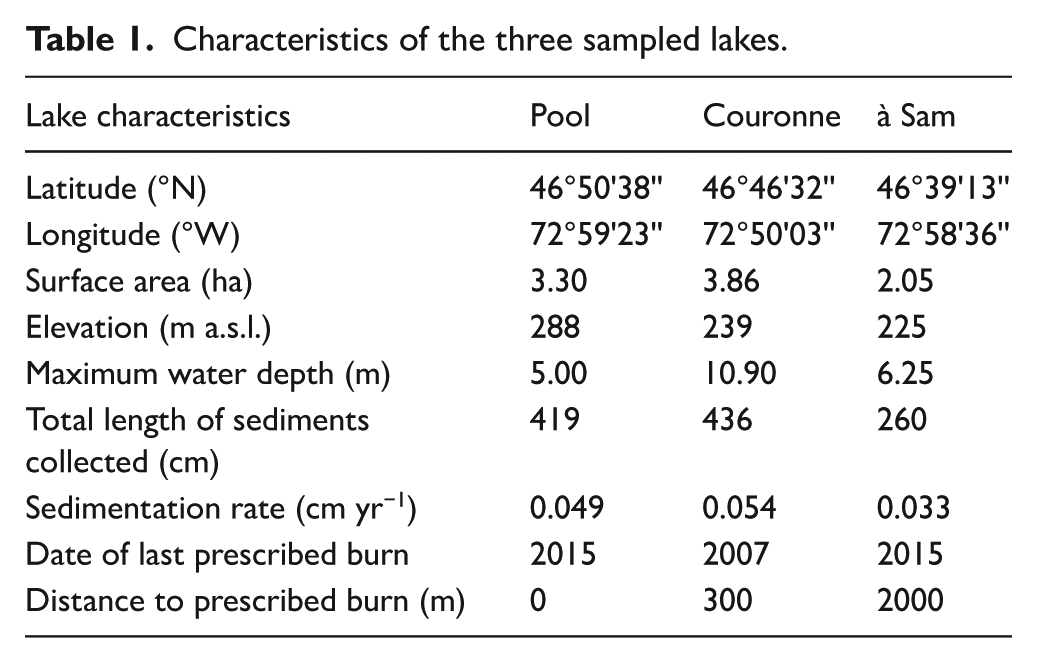
We collected sediments from three lakes (Pool, Couronne, and à Sam) with pine stands in their watersheds in February 2022 (Figure 1; Table 1). To avoid bioturbation, we collected the sediments from the deepest part of each lake. We used a Kajak-Brinkhurst gravity corer (Glew, 1991) to sample the water-sediment interface, which we subsampled in the field into 0.5 cm thick slices stored in plastic bags. We collected deeper sediments, down to the underlying inorganic sediments, in 1 m cores using a 5 cm diameter Livingstone corer (Deevey, 1965). The cores were wrapped in plastic film and aluminium foil and placed in hemicylindrical PVC tubes for transport. In the laboratory, the cores were sliced into 1 cm thick samples and placed in plastic bags for storage at 4°C.
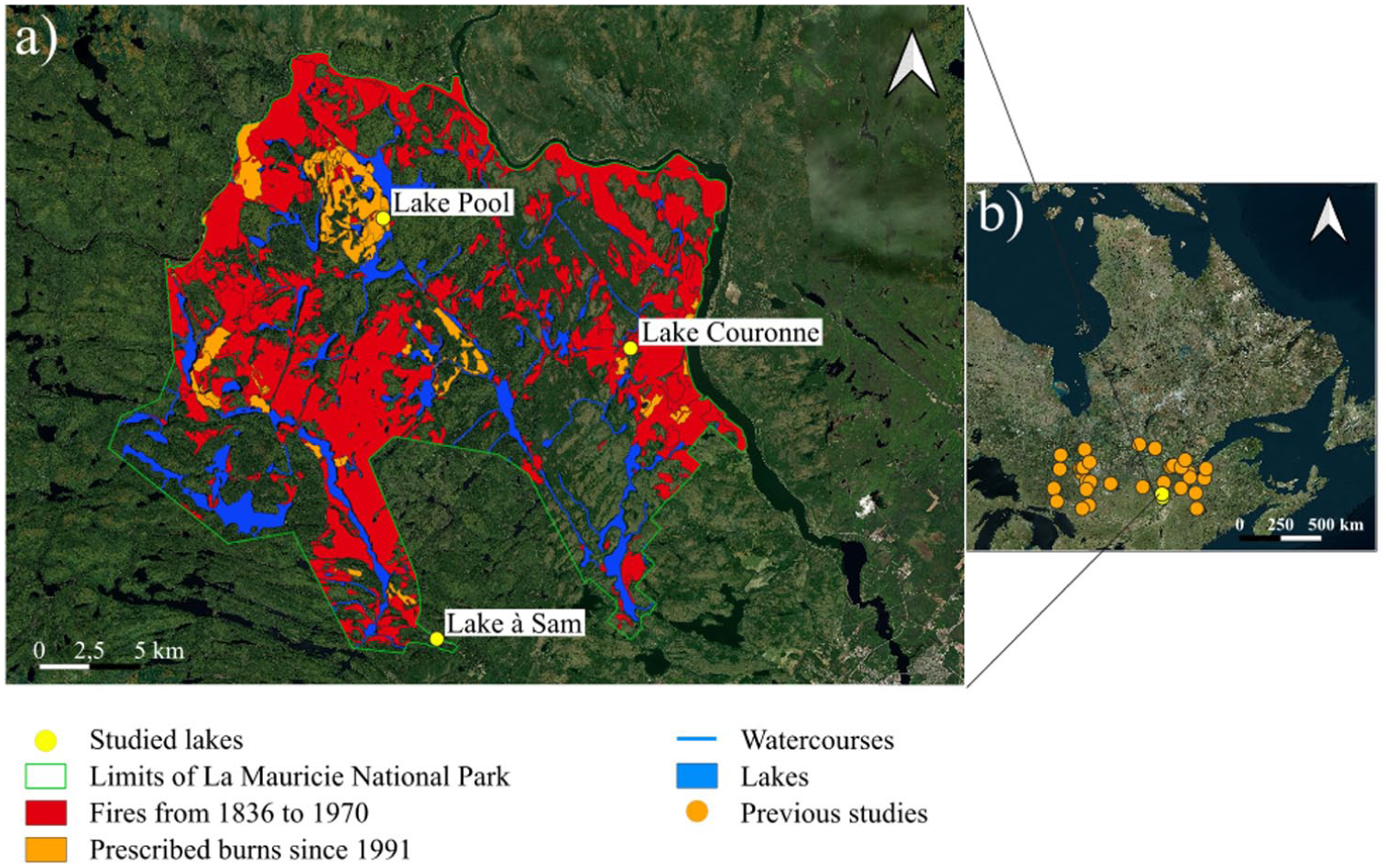
(a) Locations of the three sampled lakes in La Mauricie National Park (LMNP) as well as areas where prescribed burns were conducted since 1991, and where natural fires occurred between 1836 and 1970 (one natural fire occurred in 2003 and took longer than usual to extinguish, but only burned 385 ha, 8 km southeast of lake Pool). (b) Locations of some of the previous studies having recorded high abundance of white pine and red pine during the Holocene Thermal Maximum in Quebec and Ontario (see Supplemental Table S1).
Characteristics of the three sampled lakes.
Radiocarbon dating and age-depth models
Macro-remains from each core were dated using 14C accelerator mass spectrometry (Supplemental Table S2). We calibrated each radiocarbon date using the IntCal20 Northern Hemisphere calibration curve (Reimer et al., 2020) to obtain calibrated years before present (hereafter cal. yr BP). We used the rbacon package v.3.2.0 in R v.4.4.0 (R Core Team, 2024) to build Bayesian age-depth models (Blaauw and Christen, 2011). We subsequently interpolated ages of contiguous 1 cm samples.
Charcoal quantification
We took a 1 cm3 subsample from the middle of each sediment sample to limit contamination (Courtney Mustaphi et al., 2015). To deflocculate the sediments and to distinguish charcoal particles from dark organic matter, the subsamples were placed in a potassium hydroxide (KOH) solution with bleach (NaClO) and sodium hexametaphosphate (NaPO3)6 and left on a stirring table at 130 revolutions per minute (rpm) for 24 h at ambient temperature (Braadbaart and Poole, 2008). We then filtered the solution through a 160 μm mesh sieve to collect charcoal particles corresponding to fires having likely occurred 0–10 km from the lakeshores (Oris et al., 2014). The retained charcoal particles were counted and measured (mm2) under a camera (AmScope, version x64) mounted on a binocular microscope and connected to an image analysis software (WinSeedle v2022a).
Fire history reconstruction
We used the charcoal accumulation rate (CHAR) series decomposition method (Higuera, 2009) to detect the fire events having occurred during the Holocene in LMNP based on charcoal particles embedded in the sediments of the three sampled lakes. The charcoal accumulation rate was divided into a high-frequency signal (CHARpeaks) and a low-frequency signal (CHARbackground) using the open-source software CHARAnalysis (https://sites.google.com/site/charanalysis/; Supplemental Figure S1). Peaks were then identified as either fire or non-fire events based on a Gaussian mixture model (99th percentile threshold).
For each of the three lakes, we used linear interpolation of the charcoal accumulation rate (mm²·cm−2·yr−1) to reconstruct annual biomass burned (BB) at each lake with the R paleofire package (version 1.2.4; Blarquez et al., 2014). Biomass burned was rescaled using the min-max method to allow for between-lake comparisons (Power et al., 2008). The regional biomass burned (RegBB), combining the three lakes, was calculated and its confidence interval (95%) was obtained using bootstrap resampling (Ali et al., 2012).
The fire return interval (hereafter FRI), corresponding to the time between two consecutive fire events, was also computed and LOWESS smoothing was applied to the data to reconstruct long-term trends at local (individual site) and regional spatial scales (composite of the three sites). Confidence intervals (95%) were calculated for each lake’s FRI values and for the regional values using bootstrap resampling.
Around the studied lakes, fires from the last 30 years were all prescribed burns, as natural fires have been suppressed. To identify a surface fire signal (to be compared with signals reconstructed during the rest of the Holocene), we used the maximum charcoal accumulation rate in the topmost 10 cm of the surface cores, thought to correspond to the last ca. 50 years of sediment accumulation based on 210Pb dating from previous studies conducted in Quebec’s northern temperate forest: one within LMNP (Bérubé Tellier et al. 2016) and two 200–450 km to the west (Paillard et al., 2023; Paquette and Gajewski, 2013; Paillard et al., 2023).
Pollen analysis
To reconstruct vegetation dynamics in LMNP, we used raw data from a previous analysis of the pollen grains retrieved from a 425 cm long sediment core collected from lake à Sam in 1975 (Pierre J.H. Richard, unpublished data; Supplemental Figure S2). Pollen grains had been counted at depth intervals ranging from 5 to 15 cm, for a total of 53 samples, with a minimum of 500 grains counted per sample, and differentiating pollen grains from red pine and jack pine (Pierre J.H. Richard, unpublished data). Using these raw data, we transformed pollen counts into percentages, and we calculated the pollen influx (PI) using the following formula (Hicks and Hyvärinen, 1999):

where SR is the sedimentation rate (cm·yr−1) deduced from the age-depth model, and PC is the pollen concentration (grains·cm−3; Jørgensen, 1967).
We produced pollen diagrams with the R package rioja v1-0-6 (Supplemental Figure S2). Pollen zones were determined using cluster analysis (constrained incremental sum-of-squares method; CONISS) applied to the relative pollen abundance of Pinus spp. using the Bray-Curtis index for the calculation of the distance matrix.
Because the climate of the study area has fluctuated during the Holocene, including periods when it was cooler than it is presently, we calculated a temperate/boreal species ratio (based on pollen percentages), to verify if LMNP was temperate or boreal at any given time. To do so, we used the two main boreal tree taxa as the numerator (Pinus banksiana and Picea mariana) and four characteristic temperate taxa as the denominator (Acer saccharum, Pinus strobus, Pinus resinosa, and Tsuga canadensis). As the pollen grains from Betula papyrifera Marsh. (boreal) and Betula alleghaniensis (temperate) are difficult to distinguish, they were not used in the calculation of the ratio.
Results
Age-depth models
The sampled cores were all composed of gyttja with clay underneath. The gyttja-clay transition occurred at lake Pool between 403 and 411 cm, at lake Couronne between 429 and 438 cm, and at lake à Sam between 237 and 241 cm. The age-depth models were based on eight radiocarbon dates for lake Pool and lake Couronne, and five radiocarbon dates for lake à Sam (Supplemental Table S2). The oldest ages of sediments found at each study site were 9642 cal. yr BP at lake Pool, 10,041 cal. yr BP at lake Couronne, and 13,158 cal. yr BP at lake à Sam (Figure 2). The sedimentation rate was relatively constant for the three lakes during the Holocene.
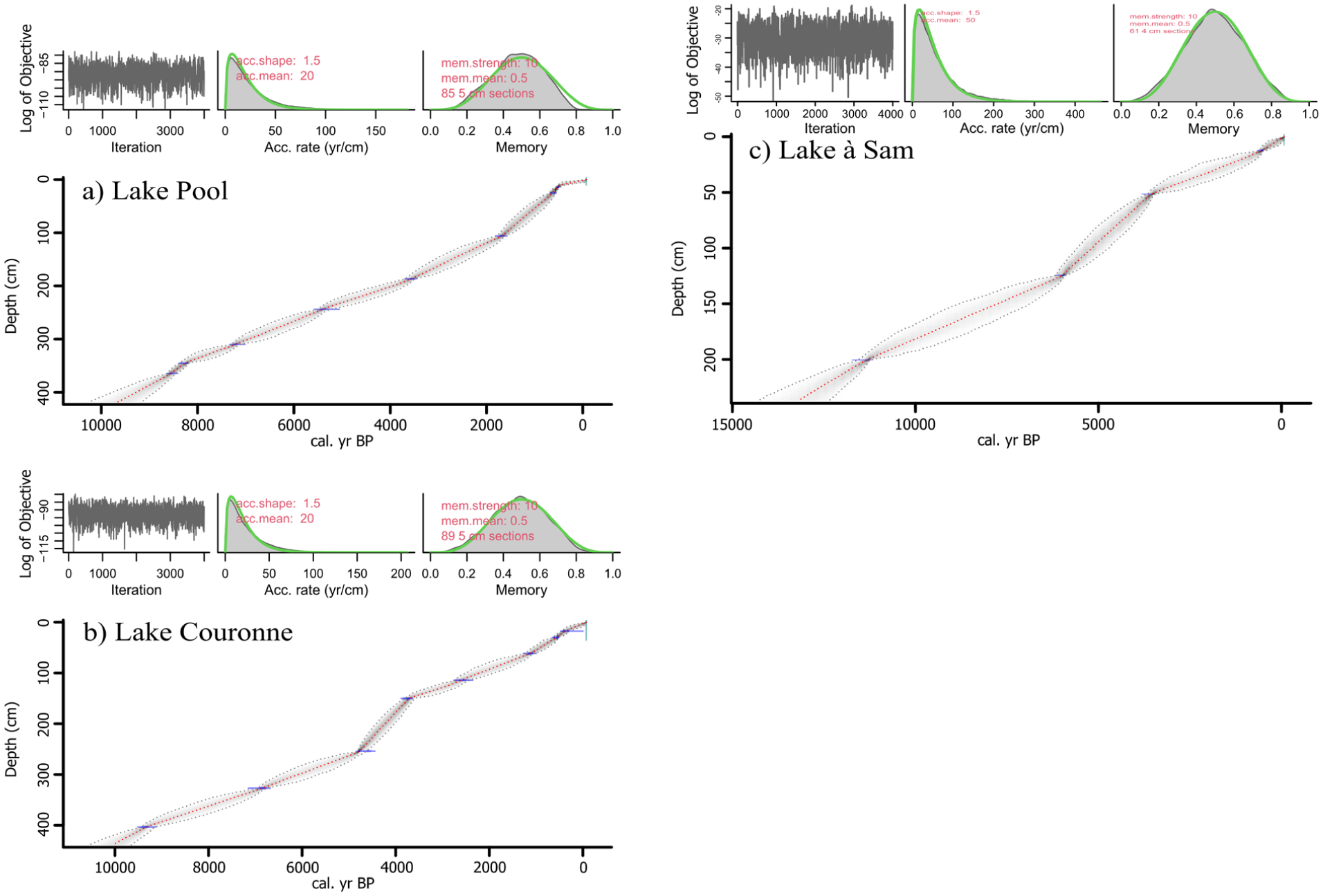
Age-depth models for (a) Lake Pool, (b) Lake Couronne, and (c) Lake à Sam, obtained from rbacon v.3.2.0 using the 14C dates listed in Supplemental Table S2.
Determination of the surface fire signal
To detect the CHAR signal left by prescribed burns, we considered the uppermost 10 cm of sediments from the cores sampled with the Kajak-Brinkhurst corer. Only lakes Pool and Couronne contained charcoal particles in the top 10 cm of sediments, because they had prescribed burns nearby (<300 m), whereas lake à Sam was 2 km from the nearest prescribed burn. The CHAR values were low (<0.1 mm2·cm−2·yr−1) throughout the uppermost 10 cm at lake Pool, and 7.5 cm at lake Couronne (Figure 3). CHAR values from 8 cm and below at lake Couronne were much higher (reaching > 0.3 mm2·cm−2·yr−1 at 8.5 cm depth) and clearly represented crown fires having occurred before the fire suppression policy was introduced in the 1970s. The maximum CHAR value of the uppermost 7.5 cm (both lakes considered) was 0.058 mm2/cm2·yr−1 and was thus selected as the surface fire signal.
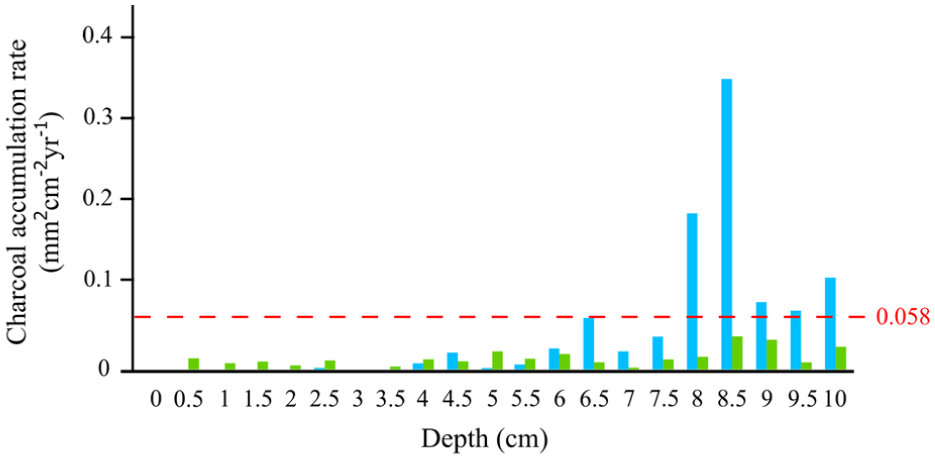
Charcoal accumulation rates recorded in the uppermost 10 cm of sediments from lake Pool (green) and lake Couronne (blue; lake à Sam did not have charcoal within the top 10 cm). The horizontal dashed line corresponds to the surface fire signal, that is, the maximum charcoal accumulation rate (0.058 mm²·cm−²·yr−1) of the period when only surface fires (prescribed burns) occurred in the study area. Only the uppermost 7.5 cm were considered to identify the threshold, as from 8 cm and below, very high charcoal concentrations at lake Couronne are clearly indicative of crown fires having occurred before the fire suppression policy was introduced in the 1970s.
Biomass burned during the Holocene
Biomass burned estimated from the charcoal accumulation rate can be divided into three periods at lake Pool. Charcoal accumulation rates were highest in the early Holocene with a maximum value of 1.4 mm2·cm2·yr−1, intermediate and variable during the HTM, and lowest during the Neoglacial with values below 0.1 mm²·cm−²·yr−1 (Figure 4a). A total of 57 fire events were identified over the Holocene, 39 of which displayed CHAR values below the threshold differentiating surface fires from crown fires (0.058 mm2·cm2·yr−1), mostly during the Neoglacial.
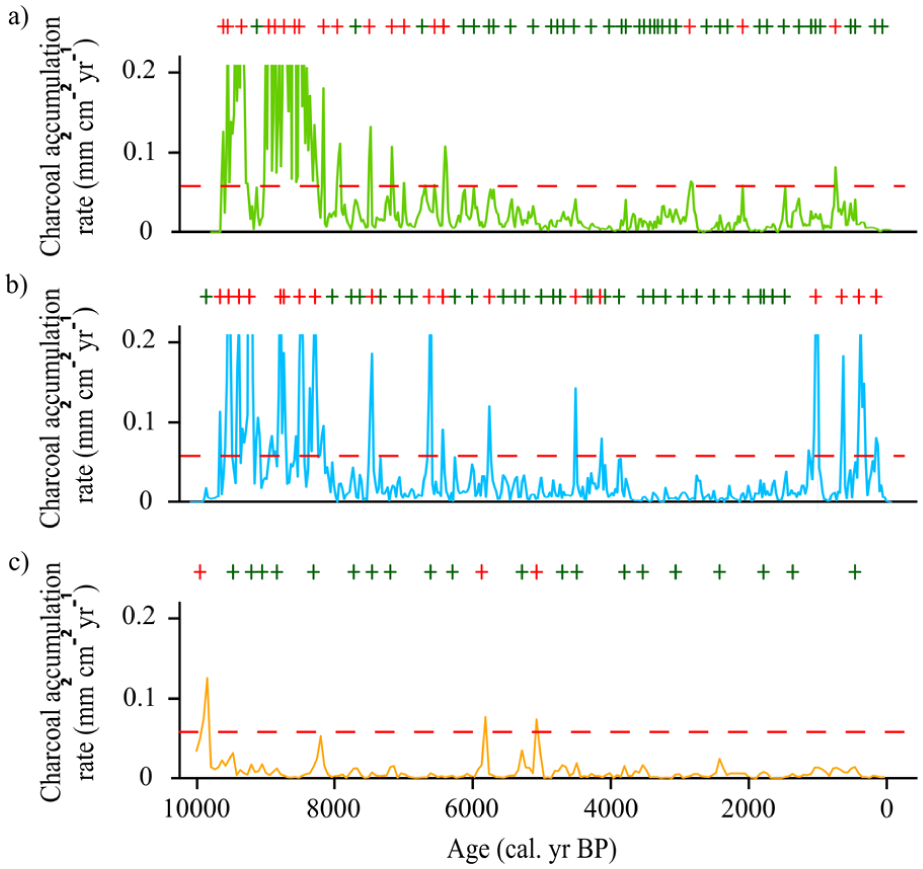
Holocene biomass burned based on charcoal accumulation rates at (a) lake Pool, (b) lake Couronne and (c) lake à Sam. The horizontal red dashed line corresponds to the threshold value (0.058 mm²·cm−²·yr−1) differentiating surface from crown fires. The red crosses represent high-severity crown fires, and the green crosses represent low-severity surface fires.
Biomass burned at lake Couronne was highest during the early Holocene with charcoal accumulation rates reaching up to 0.9 mm²·cm−²·yr−1 (Figure 4b). During the HTM, charcoal accumulation rates were intermediate and variable. The lowest accumulation rates were recorded during the early Neoglacial, below 0.05 mm2·cm−²·yr−1. Then, biomass burned increased during the last 1000 cal. yr BP, reaching 0.3 mm²·cm−²·yr−1. A total of 49 fire events were identified over the Holocene, 31 of which displayed CHAR values below the threshold, mostly during the Neoglacial.
At lake à Sam, biomass burned was lower than at the other two sites, almost always below 0.05 mm2·cm2·yr−1 (Figure 4c). Three periods had markedly higher CHAR values: around 9800 cal. yr BP, around 8200 cal. yr BP, and between 5900 and 5000 cal. yr BP. A total of 23 fires were identified, 20 of which displayed CHAR values below the threshold, distributed throughout the Holocene.
Fire return interval
At the regional scale, the mean FRI (FRIm) during the Holocene was 229 years, with lower values in the early Holocene and early Neoglacial periods, although the confidence intervals overlap (Figure 5). The three studied lakes followed similar trends, although FRI values for Lake à Sam were about twice higher than at the other two lakes. FRI values were lower during the early Holocene (mostly below the long-term mean between 10,000 and 8500 cal. yr BP), higher during the HTM (mostly above the long-term mean between 8500 and 4000 cal. yr BP at lake Pool and between 8500 and 5000 cal. yr BP at lake Couronne), then decreasing in the early Neoglacial (around or below the long-term mean up to about 1000 cal. yr BP), and finally increasing again in the most recent millennium (above the long-term mean).
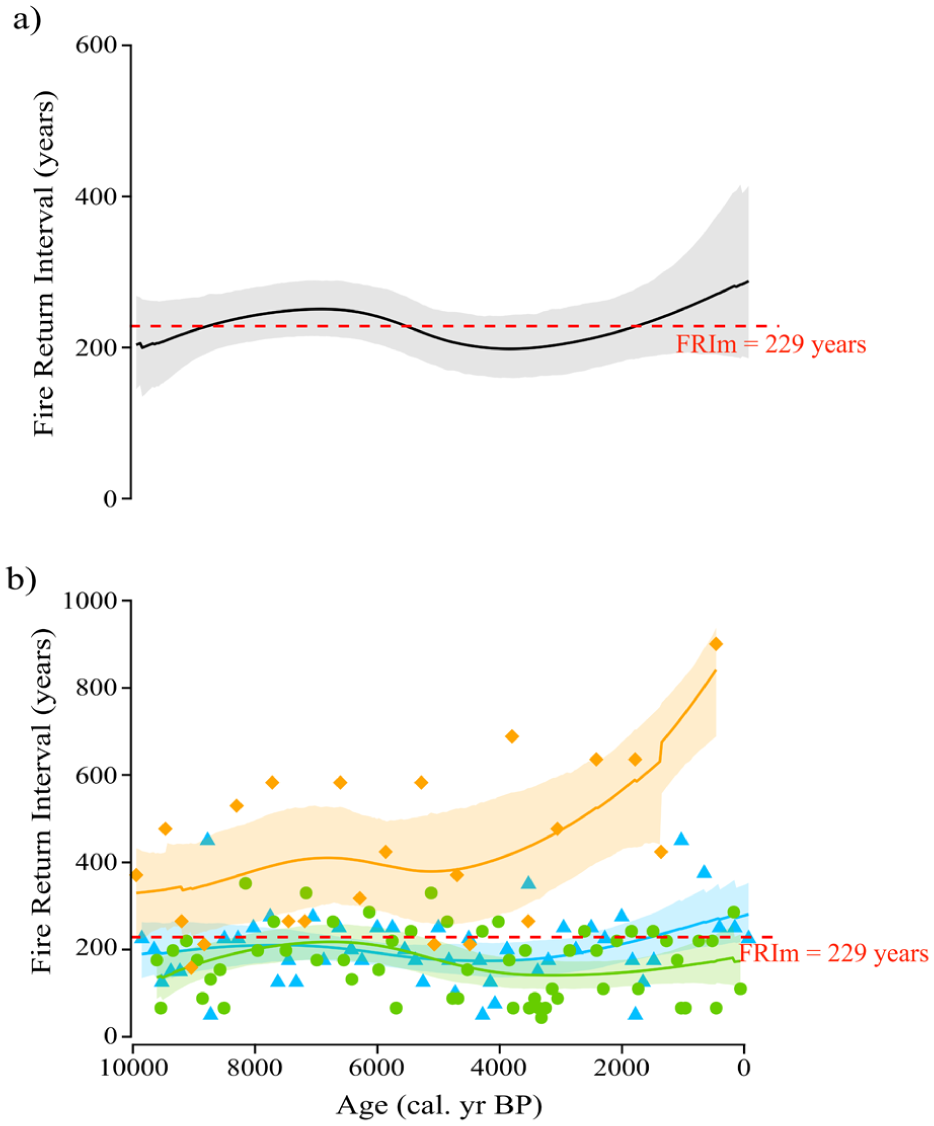
Holocene variations of the fire return interval (FRI) at the regional scale (a) and at lakes Pool (green), Couronne (blue) and à Sam (orange; b). The shaded areas represent the 95% confidence intervals. The horizontal red dashed line represents the average regional FRI for the Holocene.
Pine dynamics during the Holocene
Three pine pollen zones (PPZ) were reconstructed based on the CONISS analysis (Figure 6). The first zone (PPZ1: 9600–8400 cal. yr BP) was characterized by a high proportion (30%) of boreal taxa, notably jack pine (Supplemental Figure S2). The relative abundance of white pine started to increase at the end of PPZ1, from 5% to 20%. Red pine was also present but at low relative abundance (<2%). The second zone (PPZ2; 8400–6700 cal. yr BP) was dominated by white pine, which reached almost 40%, while jack pine and red pine were lower (respectively 10% and 4%). During this period, the abundance of boreal taxa decreased markedly. In the third zone (PPZ3; 6700–0 cal. yr BP), the relative abundance of white pine decreased by half, but it remained more abundant than the other two pine taxa. Red pine’s relative abundance peaked between 5000 and 4000 cal. yr BP, reaching 5%.
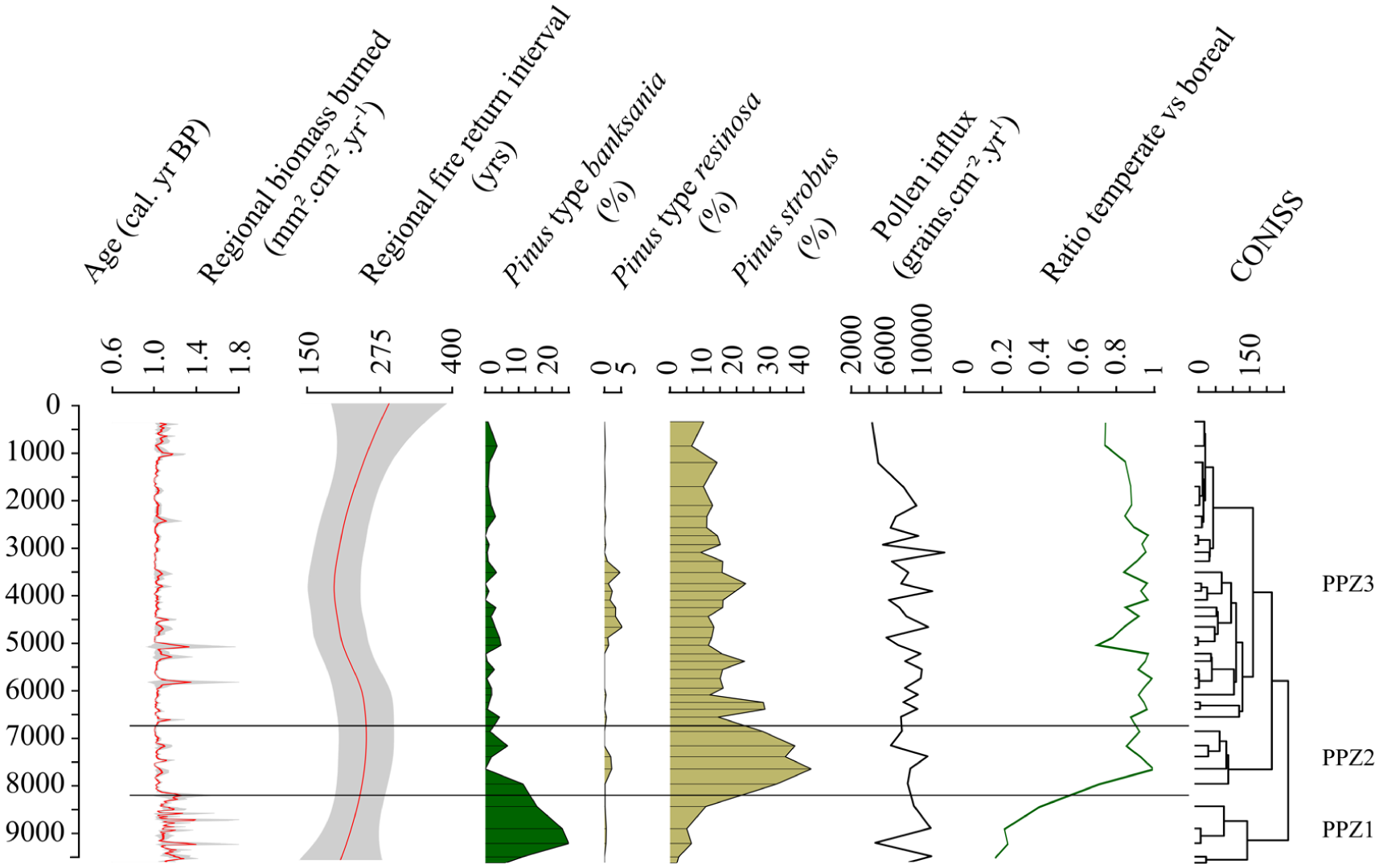
Regional biomass burned (mm²·cm−²·yr−1) and regional fire return interval (years) from 9600 cal. yr BP to the present, plotted alongside the abundance (percentage) of pollen grains of Pinus banksiana, Pinus resinosa, and Pinus strobus. Total pollen influx is also shown (grains·cm−2·yr−1), as well as the ratio of key temperate to boreal taxa. Three pine pollen zones (PPZ) were identified from the CONISS analysis.
Discussion
Fire regimes and pine dynamics
The early Holocene (PPZ1: 10,000–8400 cal. yr BP) in LMNP was characterized by the dominance of jack pine, under a regime of frequent (low FRI values), likely high-severity fires (high biomass burning). Because charcoal accumulation rates are positively correlated with fire severity (Hennebelle et al., 2020) the fact that the early Holocene recorded the highest CHAR values of the Holocene at lakes Pool and Couronne is a clear indication that crown fires dominated. Moreover, jack pine is a shade-intolerant species whose regeneration depends on high-severity crown fires to open its serotinous cones (Asselin et al., 2003; Smirnova et al., 2008). As we hypothesized, the early-Holocene fire regime, dominated by crown fires with few surface fires, was not favourable to white pine and red pine.
Then, during the HTM (PPZ2 and beginning of PPZ3: 8400–4500 cal. yr BP), dominance switched from jack pine to white pine, with red pine also present although probably at lower abundance. At that time, regional biomass burning was lower and FRI values were higher than during the early Holocene, and both components of the fire regime showed great variability. The fire regime was a mix of frequent low-severity surface fires and infrequent high-severity crown fires. Some of the surface fires were likely ignited by Indigenous people who used prescribed burns to increase berry production (e.g. Vaccinium spp.), create habitats for wildlife species (e.g. Alces americanus, Lepus americanus), and to reduce the risk of crown fires (Christianson et al., 2022). As we hypothesized, the mixed fire regime was well suited to the development and persistence of white pine and red pine (Engstrom and Mann, 1991; Pastor, 2023; Stambaugh et al., 2021). It is during the warmer HTM that the temperate species gradually colonized the study area, with fire-adapted species coming first (e.g. Pinus strobus, Pinus resinosa, Quercus spp.) followed by other typical temperate species (e.g. Acer saccharum Marsh., Fagus grandifolia Ehr., Betula alleghaniensis Britt., Tsuga canadensis (L.) Carr.).
The onset of the cool Neoglacial period around 4500 cal. yr BP coincided with a decrease in the abundance of white pine and red pine in LMNP, as elsewhere in Québec (Larochelle et al., 2018; Richard, 1993), although they remained more abundant than during the early Holocene. The fire regime was characterized by the lowest values of biomass burning and by low FRI values, likely because of the increased presence of deciduous hardwood taxa not prone to burning (e.g. Acer, Fagus, Betula). Most of the fire events corresponding to the surface fire signal occurred during the Neoglacial. Again, this finding corroborates our hypothesis that a fire regime with only surface fires would not be favourable to white pine and red pine. The species decreased in abundance, but remained present, because surface fires created favourable seedbeds for some stands to regenerate, but lack of crown fires prevented new sites from being colonized (Engelmark et al., 2000; Pastor, 2023; Stambaugh et al., 2021).
Over the last 1000 years, biomass burning and FRI increased again, maybe in response to warmer and drier conditions during the Medieval Warm Period (Paquette and Gajewski, 2013) and recent climate warming. The alternance of frequent low-severity surface fires and infrequent high-severity crown fires resumed. It is during that time that the white pine and red pine forests logged by the first European settlers in the 19th century were established (Brisson and Bouchard, 2003; Clifford and Castonguay, 2022). Then, because of overexploitation and active fire suppression during the last few decades, white pine and red pine declined in most temperate Quebec (Danneyrolles et al., 2016; Uprety et al., 2014; Weyenberg et al., 2004), including the LMNP, where the regime of only surface fires (prescribed burns) allows to maintain some pine populations, but not to create new ones.
While our vegetation reconstruction relied on a single site, it is well-known that the pollen rain at a lake has both a local and a regional component (Davis, 2000). The general trends we observed in the abundance of the three pine species (jack, white, red) and other tree species correspond with the Holocene vegetation history of Quebec’s northern temperate forests (Richard et al., 2025).
The fire history at lake à Sam differs from those at lakes Pool and Couronne in that it was largely dominated by low-severity surface fires, with only three crown fire events recorded in the early Holocene (1) and during the HTM (2). This could be due to local site conditions (e.g. topography, comparatively smaller watershed). Nevertheless, the general trends observed in terms of biomass burning and FRI were consistent with those at the other sites.
Detection of surface fires in lake sediments: insight and limitations
The unique setting of LMNP, with only surface fires (prescribed burns) having occurred over the last 30 years, allowed us to identify a charcoal accumulation rate threshold below which fires could reasonably be considered as surface fires. This threshold (0.058 mm²·cm−²·yr−1) is likely perfectible and more studies should be conducted to refine it and to determine if it is region-specific or if it applies more broadly. For example, traps could be installed at lake surface or on the ground nearby to collect charcoal during wildfires and prescribed burns (e.g. Hennebelle et al., 2020; Lynch et al., 2004; Oris et al., 2014). In addition, more precise chronological markers (e.g. ¹³⁷Cs and ²¹⁰Pb) could be used to more accurately date the surface sediments. Nevertheless, the threshold seems acceptable as, by way of comparison, in coniferous boreal forests mainly affected by high-severity crown fires, CHAR values are well above 0.1 mm²·cm−²·yr−¹ (e.g. Ali et al 2008; 2009). Hence, the odds of wrongfully identifying a crown fire as a surface fire (and vice versa) are very low.
Conclusion
We introduced a charcoal accumulation rate threshold to differentiate surface fires from crown fires in lake sediment-based fire history reconstructions in temperate forest ecosystems. The Holocene fire and vegetation histories we reconstructed for three sites in La Mauricie National Park (Québec, Canada) suggest, in line with our hypothesis, that white pine and red pine are most favored by a mixed regime of frequent low-severity surface fires and infrequent high-severity crown fires, and that regimes of only surface fires or only crown fires are respectively less conducive to the establishment and persistence of white pine and red pine.
The regime of only surface fires in place at LMNP since 1991 differs from the mixed regime of frequent low-severity surface fires and infrequent high-severity crown fires which could be considered ‘ideal’ for white pine and red pine establishment and persistence. Prescribed burns should be severe enough to expose the mineral soil and favour pine regeneration (Gagnon, 2024). Moreover, instead of systematically suppressing natural crown fires, they should be allowed to burn while increasing preparedness to protect infrastructures and reduce their vulnerability (Tymstra et al., 2020).
Supplemental Material
sj-docx-1-hol-10.1177_09596836251378033 – Supplemental material for Fire-controlled variations in abundance of white pine and red pine in Quebec’s northern temperate forest during the Holocene: Implications for fire management
Supplemental material, sj-docx-1-hol-10.1177_09596836251378033 for Fire-controlled variations in abundance of white pine and red pine in Quebec’s northern temperate forest during the Holocene: Implications for fire management by Marion Blache, Adam A. Ali, Dorian M. Gaboriau, Sébastien Joannin, Mathis Jean-Sepet, Martin P. Girardin, Yves Bergeron and Hugo Asselin in The Holocene
Footnotes
Acknowledgements
We would like to thank Kim Charron-Charbonneau and Mathieu St-Laurent-Addison for providing us with the archives concerning the fires in La Maurie National Park. We are grateful to Marc-André Lamothe (LMNP), Raynald Julien (UQAT), David Gervais (Canadian Forest Service – CFS) and Mathieu Gauvin (CFS) for their help during fieldwork. Thanks also to professor Pierre J.H. Richard for providing the detailed pollen diagram of lake à Sam and for his comments on an earlier version of the manuscript.
Author contribution(s)
Funding
The author(s) disclosed receipt of the following financial support for the research, authorship, and/or publication of this article: This project received financial support from La Mauricie National Park and an Alliance grant from the Natural Sciences and Engineering Research Council of Canada (NSERC; grant # ALLRP 572229-22). This article is a contribution of the Cold Forests International Research Network, funded by the Fonds de recherche du Québec – Nature et technologie (FRQNT) and the Center national de la recherche scientifique (CNRS).
Ethical approval and informed consent statements
This article does not contain any studies with human or animal participants.
There are no human participants in this article and informed consent is not required.
Data availability statement
The data that support the findings of this study are available from the corresponding author, M. B, upon reasonable request.

Supplemental material
Supplemental material for this article is available online.
References
Supplementary Material
Please find the following supplemental material available below.
For Open Access articles published under a Creative Commons License, all supplemental material carries the same license as the article it is associated with.
For non-Open Access articles published, all supplemental material carries a non-exclusive license, and permission requests for re-use of supplemental material or any part of supplemental material shall be sent directly to the copyright owner as specified in the copyright notice associated with the article.
