






Abstract
High-magnitude Late-Holocene volcanic eruptions contributed to the climate-related hardships of past societies. It has been theorised that memories of one of the volcanic events and its terrible consequences are recorded in the Old Norse traditions of the Fimbulwinter and Ragnarök (possibly also in the Old Kalevala). This Fimbulwinter theory suggests that the eruption (or double-eruption) responsible for the calamity was the one that caused the AD 536 dust veil and led to strong reductions in incoming sunlight and in summer temperatures especially over the next decade. The theory is explored here with tree-ring records from Sweden, Finland, Norway and Denmark, historical data on dust veils, ice core evidence for major volcanic eruptions, and North Atlantic proxy records. Very low summer temperatures and reduced irradiance are evident across the study region over the duration of the AD 536/540s event. Alternative cold events (656–655 BC, 420–419 BC, 42–41 BC, AD 800–801 and AD 1127–1128) were less prominent than the AD 536/540s event. A cold event in AD 1601 serves as an interesting counterpart for the prehistoric events as it occurred, akin to the 536/540s event, at the height of the North Atlantic pulses of drift ice. This suggests that the coupled sea ice-ocean mechanism needed to deepen the anomaly is sensitive to the initial climate state and emphasises the importance of longue durée structures when reconstructing the human past. Overall, the AD 536/540s event appears a climate-related natural catastrophe to be remembered by following generations, which accords with the Fimbulwinter theory.
Keywords
Introduction
The climatic downturns of the first millennium AD have long intrigued scholars from various disciplines. Central to this topic and serving as the cornerstone of the discussions is the AD 536 dust veil (Baillie, 1994; Stothers, 1984, 2002; Stothers and Rampino, 1983), which, according to Mediterranean textual sources dimmed the sun from March AD 536 until June AD 537, with a coinciding famine devastating “the whole world” (Arjava, 2005; Stathakopoulos, 2003). The likely cause was a Northern Hemisphere/North American eruption, dated to AD 535 or early 536 by means of Greenland ice-core geochemistry (Sigl et al., 2015). Reductions in solar radiation reaching Earth’s surface and in summer temperatures are indeed observed for 1–2 years after major volcanic eruptions (Robock, 2000). The aftermath of the AD 536 dust veil was extended, however, with another major (tropical) eruption in AD 539/540, identified from Greenland and Antarctica ice cores (Sigl et al., 2015). In climate simulations, decadal-scale Northern Hemisphere extra-tropical radiative forcing from the 536/540 CE double-eruption exceeds any other period over the last 1200 years (Toohey et al., 2016). Moreover, tree-ring data indicate that the summers in the Northern Hemisphere were colder than normal in these years (Büntgen et al., 2021; Helama, 2023; Larsen et al., 2008; Stoffel et al., 2015).
A northern connexion bridging the Late Antique texts and Old Norse literature, Prose Edda, especially the Fimbulwinter myth, describing the mighty winter predating the destruction of all the worlds according to Norse mythology, was initiated by Axboe (1999), based on his studies of precious golden objects as sacrificial investments during the crisis. Gräslund (2008) and Gräslund and Price (2012) went on to argue that the Fimbulwinter myth could in fact narrate the atmospheric effects of the AD 536/540s event, thus forming a counterpart to Mediterranean documentary sources. Parallels in the Finnish national epic Kalevala with eloquent verses describing darkened skies were later highlighted by Price and Gräslund (2015). Importantly, the same authors provided a wider archaeological context for the period, the Scandinavian “Migration Period Crisis” (AD ~400–550), with changes in the archaeological settlement histories of Scandinavia, to augment their interpretation of calamities becoming mythologised in the Norse account. On these grounds, the Fimbulwinter theory has stimulated a great deal of research in archaeological and natural science (see reviews in Anagnostou et al., 2025; Arthur et al., 2024; Gjerpe, 2021; Gundersen, 2019) and the period discussed under the theory now encompasses not only the AD 536 dust veil but a more extended timeframe of ±150 years or so around that event.
This paper’s main objective is to examine the Fimbulwinter theory in the light of Nordic tree-ring records and climate reconstructions, identifying circumstances that may correspond to those encountered in the Prose Edda and Kalevala verses, as no such topical account exists in the literature. Whether or not these conditions really concern to the AD 536/540s event remains unclear. As Gräslund and Price (2012) note, Prose Edda represents an early 13th-century text but of much earlier oral tradition. Kalevala represents oral tradition collected during the early 18th century. Like the Norse material, some elements of Kalevala appear to be derived from the Iron Age but may also incorporate later tales (Price and Gräslund, 2015). Despite the complex nature of oral-to-written transmission (Mundal, 2016; Quinn, 2000), Gräslund and Price (2012) suggest that the relevant verses may have mid-sixth century AD roots.
This comparison was extended to documentary data on other historical dust veil events from Mediterranean sources (Stothers, 2002) and ice core data indicative of volcanic forcing and eruption dates (McConnell et al., 2020; Sigl et al., 2015, 2022). Moreover, the region is located downwind of the North Atlantic, which links local atmospheric conditions to large-scale hemispheric and global circulation variability (Helama et al., 2009, 2021), for which reason the tree-ring data were also collated with a set of records attributable to long-term processes in the North Atlantic circulation patterns (Bianchi and McCave, 1999; Bond et al., 2001; Lapointe et al., 2020). A timeframe of the last 3000 years was selected as the era of agriculture (Lahtinen and Rowley-Conwy, 2013; Widgren and Pedersen, 2011), a subsistence system proposed as central in mediating the climatic effects on society and thus a key for transforming the myth into a scientific hypothesis.
Edda and Kalevala
Gräslund and Price (2012) excerpt a description of Fimbulwinter from translated (Faulkes, 1987) sources of Norse mythology as follows: “First of all that a winter will come called Fimbulwinter. Then snow will drift from all directions. There will then be great frosts and keen winds. The sun will do no good. There will be three of these winters together and no summer between.”
The passage describes the disturbed weather in surprising detail, with accumulating snowdrifts, harsh weather, a reduction in incoming sunlight (irradiance), and, as Gräslund and Price (2012) also emphasise, at least 2 years without a summer. Clearly, the weather is described in a way that indicates no similar event since time immemorial. Price and Gräslund (2015) highlight an interesting parallel from the translated Old Kalevala (Magoun, 1969) when the Mistress of the Northern Land has captured both the sun and moon: “Now the night was perpetual, long, dark as pitch, a deep place unreached by the sun. It was night for five years, no sun for six years, no moon for eight years”
Surprisingly, the English translation has lost the following two lines, included in the original Finnish Old Kalevala (Lönnrot, 1835), that extend the event by 2 years with the following celestial description: “nine without the Great Bear, a full ten with no stars.”
1
Interestingly, the passage suggests a much longer period of solar dimming than Edda, from 5 to 10 years, including a gradual recovery.
In comparison, existing tree-ring evidence from Sweden, Finland, Norway, and Denmark demonstrates deteriorated tree growth in AD 536 and over the following decade (Figure 1; see supplemental information for methods). Frost rings in AD 536 are observed in Finland (Figure 1b–d), indicating very low temperatures at the height of the growing season. Growth curtailments and cold summer temperatures (<12°C) in AD 536 continued, especially during the AD 539–545 period (Figure 1e–k). Relevant for this analysis, stable carbon isotopes (δ13C) from tree rings indicate a sharp drop in irradiance in AD 536 and, consistent with the temperatures, a period of markedly low irradiance for the AD 541–544 period (Figure 1l). The volcanic forcing from the double-eruption is demonstrated by increased stratospheric aerosol optical depth over the intervals, with the highest values being observed in AD 536 and AD 541 (Figure 1m).
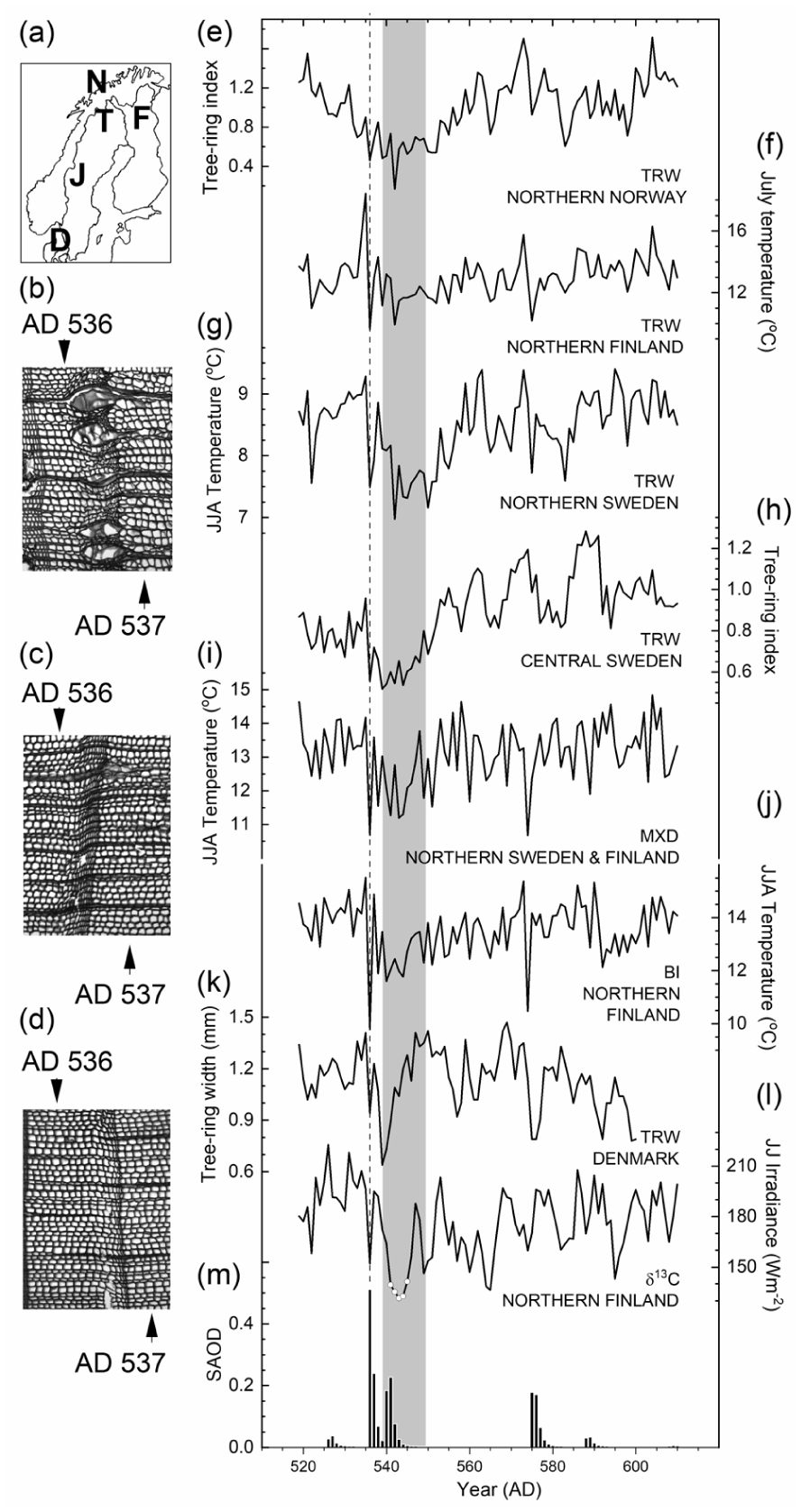
Fennoscandian map showing the study area and the tree-ring sites in northern Norway (N), northern Sweden ((Torneträsk region (T)), northern Finland (F), central Sweden (Jämtland (J)), and Denmark (D); a). The frost ring in AD 536 in samples N3-1 (b), NK2-6 (c) and K8-99 (d) from northern Finland portray under-lignified deformed tracheids (Helama et al., 2019). Tree-ring width (TRW) records sensitive to summer (June to August, JJA) temperatures produced from northern Norway (Kirchhefer, 2005; e), northern Finland (Helama et al., 2010; f), northern Sweden (Grudd et al., 2002; g), and central Sweden (Gunnarson, 2008; h). Summer (JJA) temperature reconstructions from latewood maximum densities (MXD) combining the northern Swedish and Finnish materials (Matskovsky and Helama, 2014; i) and from minimum blue channel light intensities (BI) representing northern Finland (Helama et al., 2022; j). The tree-ring width (TRW) record is from Denmark (Ellegård Larsen et al., 2024; k). Summer irradiance (June to July; JJ) is reconstructed from tree-ring stable carbon isotopes (δ13C) for northern Finland (Helama et al., 2018), with open circles representing the strongest 5-year anomaly (l). Stratospheric aerosol optical depth (SAOD) is reconstructed from volcanic stratospheric sulphur injection estimates obtained from Greenland and Antarctica ice-core data (Sigl et al., 2022), shown here for the summer (June to August (JJA)) months and Scandinavian latitudes (70–55°N; m).The vertical dashed line denotes AD 536, and the shading the AD 539–548 period, with common indications of cold temperatures and low irradiance. See Supplemental Table S1 for data characterisation.
Collectively, these data indicate that the anomalous conditions in temperature and sunlight not only in AD 536 but over the AD 540s are required to mirror the multi-annual duration of the event, which Edda and Old Kalevala both convey. This interpretation would extend the length of the event to ~5–10 years, akin to that found from the Old Kalevala. Such an extension would not even be at odds with the Fimbulwinter of Edda, where the number of years without a summer may not be limited to two, as Gräslund and Price (2012) construe. It is notable that the presence of the extension in multiple proxy types supports a direct climatic interpretation instead of legacy effects (Zweifel and Sterck, 2018) in explaining the AD 540s anomaly.
The AD 536 dust veil – The only candidate for Fimbulwinter?
Despite the degree of similarity between the textual and natural-scientific descriptions, an essential question remains concerning whether the mid-sixth-century AD dust veil represents the only possible event behind the Fimbulwinter myth (Gjerpe, 2021). A comparison of cold events, expressed as negative departures from the mean record of Swedish and Finnish tree-ring chronologies over the last 3000 years, reveals that the 536/540s event was not the only strongly negative anomaly (Figure 2). However, when the examination of similarly strong events is limited to a period before the thirteenth centuries AD (when the Edda was textualised), the number of candidate events challenging the strength of the 536/540s event is much reduced.
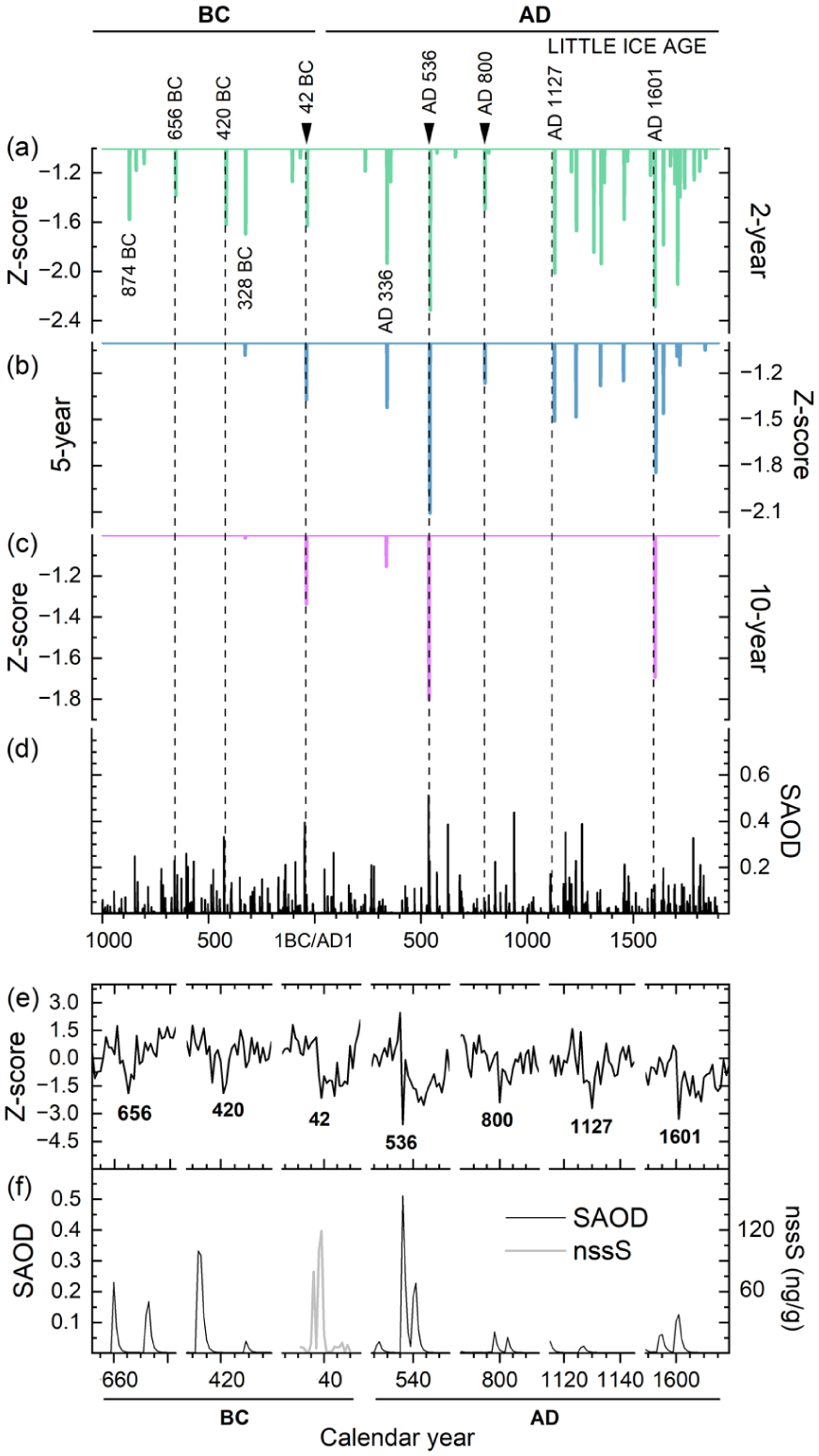
Tree-ring and ice core data over the last three millennia. Cold events are shown as negative anomalies calculated from the mean record of tree-ring data representing central and northern Swedish and Finnish sites (Grudd et al., 2002; Gunnarson, 2008; Helama et al. 2010, 2022; Matskovsky and Helama, 2014) expressed as z-scores with 2-year (a), 5-year (b) and 10-year (c) running means. Stratospheric aerosol optical depth (SAOD) is reconstructed from volcanic stratospheric sulphur injection estimates obtained from Greenland and Antarctica ice-core data until AD 1900 (Sigl et al., 2022), shown for the summer (June to August) months and Scandinavian latitudes (70°–55°N; d). The mean record of the abovementioned central and northern Swedish and Finnish tree-ring chronologies over the intervals that have a peculiar agreement with ice-core data (e). SAOD (Sigl et al., 2022) and volcanic fallout is expressed as non-sea-salt sulphur (nssS) concentration of NGRIP2 ice core for the summer months (McConnell et al., 2020; f).Tree-ring dates denoted by downward arrowheads indicate dust veils from Mediterranean sources (44 BC, AD 536 and AD 797; Stothers, 2002) with agreement with cold events as discussed in the text. The vertical dashed lines denote agreements between tree-ring based cold events and high values of SOAD/nssS. Tree-ring dates are indicated by the first year of the cold event. The variance of the mean record was stabilised using the methods of Osborn et al. (1997). The BC/AD timeline (1000 BC to AD 1900) does not have “year zero”. See Supplemental Table S1 for data characterisation, Supplemental Figure S1 and Supplemental Table S2 for the mean tree-ring record and Supplemental Table S3 for the numerical values of the cold events.
Interestingly, the strongest anomalies in the BC era are mainly observed as 2-year cold events (Figure 2a). The one in 874 BC and another in and around 330 BC have been noted in Fennoscandian tree-ring literature (Eronen et al., 2002; Grudd et al., 2002; Helama et al., 2013; Jones et al., 2013) but cannot be associated with any volcanic signals, whereas those in 656 BC and 420 BC can be tentatively linked to stratospheric aerosol optical depth anomalies dated to 661 BC and 429–428 BC (see Figure 2d–f). The absolute age uncertainties in the ice cores, which are suggestively better than ±5–15 years over the earlier anomaly, may permit such a connexion. However, the uncertainties better than ±1–5 years over the last 2500 years may not in any case favour the fifth-century BC connexion (Sigl et al., 2022).
Historically documented dust veils observed in 44 BC, AD 536 and AD 797 (Stothers, 2002) coincide with 2-year and 5-year cold events (Figure 2a and b). Regarding the cold event starting in 42 BC, one of the largest volcanic eruptions of the last 2500 years is known to have started in early 43 BC, with elevated volcanic fallout lasting more than 2 years (McConnell et al., 2020). Low summer temperatures, reconstructed previously by Luterbacher et al. (2016) for the duration of the eruption, have been linked with crop failures, famine, and disease, exacerbating social unrest throughout the Mediterranean region (McConnell et al., 2020). However, the cold event in AD 800–804 postdates the AD 797 dust veil in the Mediterranean (Stothers, 2002) by 3 years, in any case coinciding with a Northern Hemisphere eruption in AD 800 (Sigl et al., 2015). Collectively, the stratospheric aerosol optical depth increased in both AD 798 and 803 (Sigl et al., 2022).
Among the remaining tree-ring anomalies, the cold event in AD 1127 can be compared with ice-core evidence for a tropical eruption in AD 1127 (Sigl et al., 2015). This is not the case with an earlier cold event in AD 336, for which no counterpart in the volcanic record has been found (Sigl et al., 2015, 2022; Figure 2).
There were many cold events during the Little Ice Age (Figure 2a), potentially reflecting the effects of volcanic activity increasing over the same period (AD ~1250–1850) and likewise cooling the Northern Hemisphere summer climate (Wanner et al., 2008, 2011). While this interval postdates the textualisation of the Edda, the cold event starting in AD 1601 compares in strength with the AD 536/540s event. This observation holds for the 2-, 5-, and 10-year events (Figure 2a–c). Following the eruption of Huaynaputina in Peru in AD 1600 (Briffa et al., 1998), existing documents indicate exceptionally bad harvests in AD 1601 in Denmark and Norway, and for AD 1601–1603 in southeastern-to-western/central Sweden (Dribe et al., 2015; Dybdahl, 2012; Utterström, 1955). In Finland, AD 1601 is known as the “great straw year” (the amount of harvested grain was in some cases less than that sown) and was likewise followed by several poor crop years (Supplemental Figure S2; Holopainen and Helama, 2009), which resulted in the authorities deciding not to collect grain tithes in many provinces (Huhtamaa and Helama, 2017). As a result, approximately 13% of the farms in Finland could be classified as deserted at the end of the 1610s (Sundquist, 1931). The sun was obscured in Norway and Sweden in AD 1601 (Kalela-Brundin, 1997) but tree-ring δ13C data from northern Sweden (Loader et al., 2013) do not indicate any marked drop in irradiance around that date (Supplemental Figure S3). Overall, the AD 1610s data may set a yardstick for the AD 536/540s event demonstrating the extent of agriculture-related calamities attributable to such volcanic forcing.
A context of slow changes: Longue durée
The essential point from the Fimbulwinter theory is that the AD 536/540s event may provide the “Migration Period Crisis” with a climatic/environmental context, for the perturbed climate during the event would serve as a forewarning of the Ragnarök, the destruction of all the worlds and their inhabitants. Gräslund and Price (2012) and Price and Gräslund (2015) illustrate a possible reflection of such a process through the dramatic sixth-century AD decline in the number of excavated settlements in eastern central Sweden (Figure 3a), constituting the greatest change in settlement patterns in Sweden for 6000 years. Somewhat optimistically, they also cite consistent results “over the rest of Scandinavia for which we have data,” suggesting that the populations of Scandinavia may have been halved in the middle of the century.
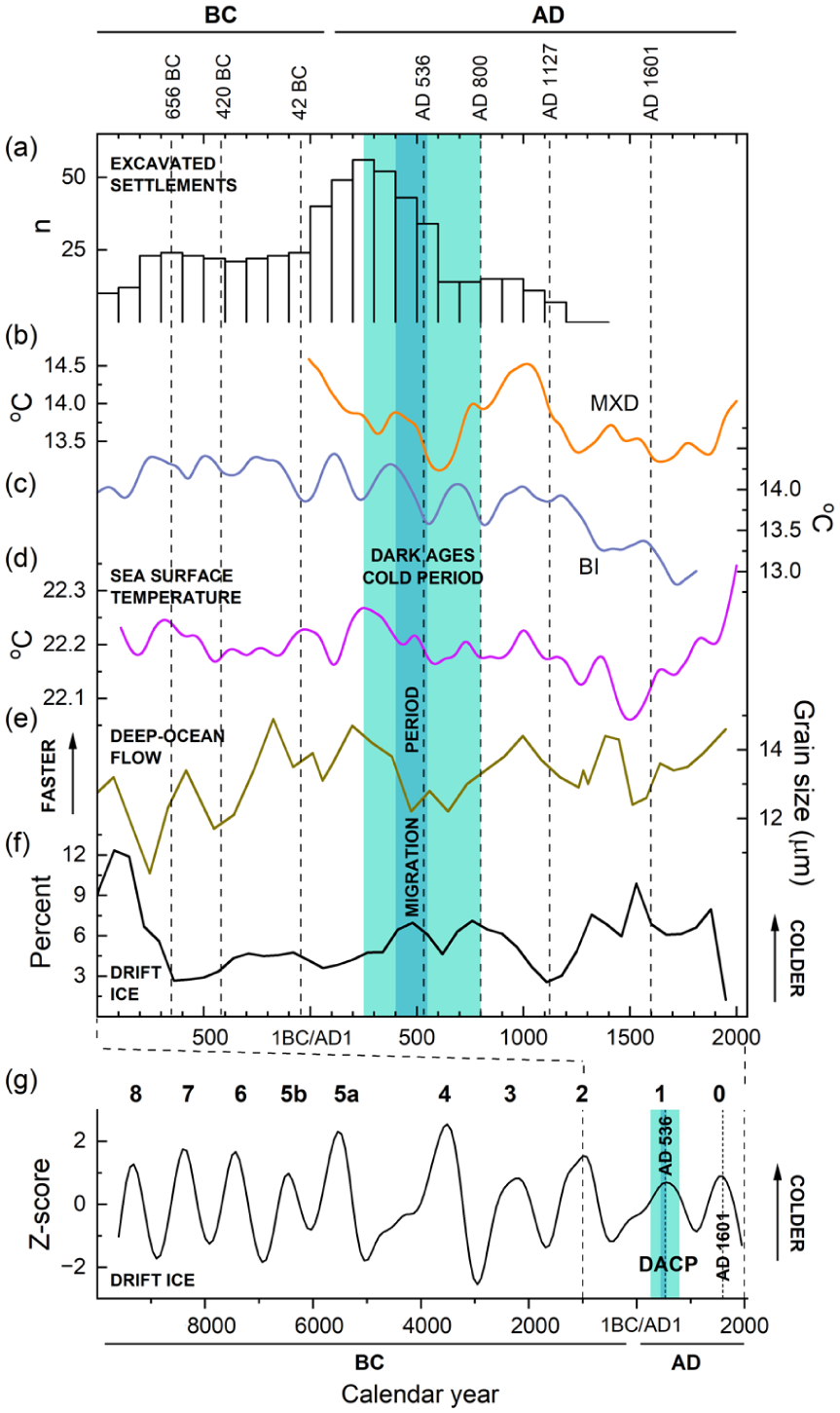
Long-term changes. The number of excavated prehistoric settlements (n) in eastern central Sweden (digitised from Gräslund and Price, 2012; a). Latewood maximum density (MXD) record combining the northern Swedish and Finnish materials (Matskovsky and Helama, 2014) available since 8 BC (b). The minimum blue channel light intensity (BI) record from northern Finland (Helama et al., 2022; c). Reconstructed North Atlantic summer (June to August) sea-surface temperatures (0°–70°N) are inferred from titanium counts of an annually laminated sedimentary archive from High-Arctic Canada (Lapointe et al., 2020; d). North Atlantic sedimentary records of mean sortable silt grain size (10–63 µm) as a deep-ocean flow speed proxy (Bianchi and McCave, 1999) reflect flow changes in the Iceland-Scotland Overflow Water which is an important component of the thermohaline circulation (e) and percentages of lithic grains as a measure of ice-rafted debris (Bond et al., 2001) reflecting advections of ice-bearing surface waters from polar sea regions (f), both constrained by calibrated 14C dates. The North Atlantic pulses of drift ice, using the same proxy data as above, are filtered to demonstrate millennial (1000–2000 year) timescales, previously numbered from 8 to 0 (Bond et al., 2001; Wanner et al., 2011). Pulse numbers one and zero correlate with the Dark Ages Cold Period (DACP) and Little Ice Age, within which periods the vertical dotted lines denote the AD 536/540s and AD 1601 events (g).The timeframes of the DACP (AD ~250–800) and the “Migration Period” (AD ~400–550) are illustrated as areas of light and dark shading, respectively. The vertical dashed lines (a–f) denote agreements between tree-ring-based cold events and ice core volcanic signals as discussed in the text. The BC/AD timeline (1000 BC to AD 1900) does not have “year zero”. See Supplemental Table S1 for data characterisation and Supplemental Figure S2 for annually resolved tree-ring records.
However, placing the population history in this context has been contested, for the decline had actually begun as early as the third century AD, a view several archaeologists emphasise (Gundersen, 2019; Moreland, 2018; Näsman, 2012). The AD 536/540s event must therefore also be studied in a longer time perspective (Gjerpe, 2021). Relevant for this discussion, the Dark Ages Cold Period (DACP; AD ~250–800) has been determined in the palaeoclimate literature with a cool and disturbed climate over the Northern Hemisphere (Helama et al., 2017a, 2017b; Lamb, 1995; Ljungqvist, 2010; Riechelmann and Gouw-Bouman, 2019; Wanner et al., 2011). The palaeoclimatic DACP thus encompasses the Migration Period, providing a particularly meaningful context for the AD 536/540s event.
Indeed, the early part of the DACP overlaps with the long-term settlement decline from the third century AD. Consistent with this view, latewood-based temperature records from Sweden and Finland show that long-term cooling started several centuries before the AD 536/540s event (Figure 3b and c). It is essential to note that parallel trends coeval to the putative population decline can also be observed in the North Atlantic proxy records, indicated by colder sea surface temperatures, the slowing of the deep-ocean flow of thermohaline circulation, and the intensified pulse of drift ice on subpolar North Atlantic waters (Figure 3d–f). It is noteworthy that the concept of Late Antique Little Ice Age (AD 536–660; Büntgen et al., 2016) that overlaps with DACP cannot explain the climatic downturn that started before AD 536 and remains unconnected with North Atlantic climate history before that date (Helama et al., 2017a, 2021).
Moreover, the DACP has been commonly juxtaposed (e.g. Berglund, 2003; Helama et al., 2017a; Spencer et al., 2025) with the North Atlantic drift-ice pulse number one at about 1400 years ago (Figure 3g) and is therefore viewed in a palaeoceanographic context of similar events representing a continuum of solar-forced variability through the Holocene global-scale climates (Bond et al., 1997, 2001). Making the juxtaposition here places the AD 536/540s event at the height of the drift-ice pulse number one (Figure 3g). Intriguingly, a similar observation is evident for the drift-ice pulse number zero, correlated with the Little Ice Age (Bond et al., 1999) thus positioning the AD 1601 event in the high phase of that pulse (Figure 3g).
Discussion and concluding remarks
This examination had both expected and unexpected outcomes. Although it may be impossible definitively to prove a connexion between the Fimbulwinter myth and any climatic event recorded in climate proxy data, it is indeed possible to evaluate whether natural-scientific data are supportive or unsupportive of the theory. Overall, the AD 536/540s event is characterised by very low summer temperatures and reduced irradiance across the study region and period, providing plausible support for the Fimbulwinter theory entailing an unforeseen climate-related natural catastrophe (Gräslund and Price, 2012; Price and Gräslund, 2015).
While the data demonstrate alternative 2-year cold events that can be associated with historical dust veils and/or ice core signals of volcanic eruptions dating from times before the Edda was written down (656–655 BC, 420–419 BC, 42–41 BC, AD 800–801, and AD 1127–1128), extreme conditions seem more evident for the AD 536/540s event, especially when the examination is extended to 5-year and 10-year events. The emphasis on the longer events directs attention to the Old Kalevala with its verse descriptions of similar atmospheric occurrences. These results not only confirm the severity of the AD 536/540s event but provide its multi-dimensional characterisation within natural science and mythologised contexts.
Interestingly, multiple lines of evidence suggest that the AD 1601 event provides a more recent counterpart for the AD 536/540s event. This would make the Fimbulwinter myth less mythic for us, perhaps, and the AD 536/540s event less enigmatic for research, as much natural-scientific and historical data exist across the region for the early AD 1600s, thus becoming available for building analogues to interpret the mid-sixth-century hardships.
While this is not to suggest that the prehistoric and historical agricultural systems were similar in all respects, the suggested halving of the populations of Scandinavia by the AD 550s (Gräslund and Price, 2012) would appear an overestimate. Nor should starvation due to crop failures be underestimated, as the historical analogues from the early seventeenth century AD subsistence crises indicate.
Furthermore, placing the AD 536/540s and AD 1601 events in the context of slow palaeoclimatic/palaeoceanographic changes hints at their unique timing at the heights of the North Atlantic pulses of drift ice. First, the coupled sea ice-ocean mechanism may be sensitive to the initial climate state (Zhong et al., 2011). Such a setting suggests that pre- and coexisting influences from long-term cooling trends paved the way for the abrupt volcanic events (Helama et al., 2021) which, secondly, may induce a deepening of anomalies through feedback mechanisms (Brönnimann et al., 2019; van Dijk et al., 2022, 2024). The setting could also be behind the relatively weak 42 BC event, which may not have been similarly preconditioned by the palaeoceanographic circumstances.
It is evident that these signals of different scale are superimposed within the palaeoclimatic archive, and it seems important to combine their diversity instead of examining just one type of forcing factor (e.g. volcanism) when working towards the synthesis of climatic data and analysing their effects on human populations and actions. The results also demonstrate the unification of historical and natural-scientific scales in the framework involving very long-term changes, longue durée structures (Braudel, 2009; Lee, 2018), and the need for such unification when reconstructing the human past (Izdebski et al., 2024) and, relevant for this paper, when theorising the Fimbulwinter myth. The longue durée remains invisible to contemporaries but can be revealed as geological processes, as shown here, evolving through deep time with Earth’s changing climate.
Supplemental Material
sj-pdf-1-hol-10.1177_09596836261458243 – Supplemental material for The Fimbulwinter myth in the context of Nordic tree-ring climate proxy data
Supplemental material, sj-pdf-1-hol-10.1177_09596836261458243 for The Fimbulwinter myth in the context of Nordic tree-ring climate proxy data by Samuli Helama in The Holocene
Footnotes
Acknowledgements
Hanne Marie Ellegård Larsen and Andreas Joachim Kirchhefer are thanked for providing tree-ring data.

Author contributions
Funding
The author disclosed receipt of the following financial support for the research, authorship, and/or publication of this article: This study was supported by Grants 339788 and 355268 from the Academy of Finland.
Declaration of conflicting interests
The author declared no potential conflicts of interest with respect to the research, authorship, and/or publication of this article.
Data availability statement
Sources of the data used in this paper are detailed in Supplemental Table S1.
Supplemental material
Supplemental material for this article is available online.
Notes
References
Supplementary Material
Please find the following supplemental material available below.
For Open Access articles published under a Creative Commons License, all supplemental material carries the same license as the article it is associated with.
For non-Open Access articles published, all supplemental material carries a non-exclusive license, and permission requests for re-use of supplemental material or any part of supplemental material shall be sent directly to the copyright owner as specified in the copyright notice associated with the article.
