







Abstract
This paper keeps on the series of articles aimed at presenting to the readers of NIR News the research groups active in the field of NIR spectroscopy in Italy. In detail, the activities of the Sensing Lab research group of the Department of Food, Environmental and Nutritional Sciences (University of Milan) are described.
Sensing Lab
The Sensing Lab has been established few years ago by Professors Ernestina Casiraghi, Cristina Alamprese, and Susanna Buratti in order to strengthen the visibility of the specialized and exclusive research activities they conduct at the Department of Food, Environmental and Nutritional Sciences (DeFENS). The research group also includes Dr. Simona Benedetti, lab technician, and Dr. Silvia Grassi, Research Fellow (Figure 1), besides several PhD students and post-doc fellows.
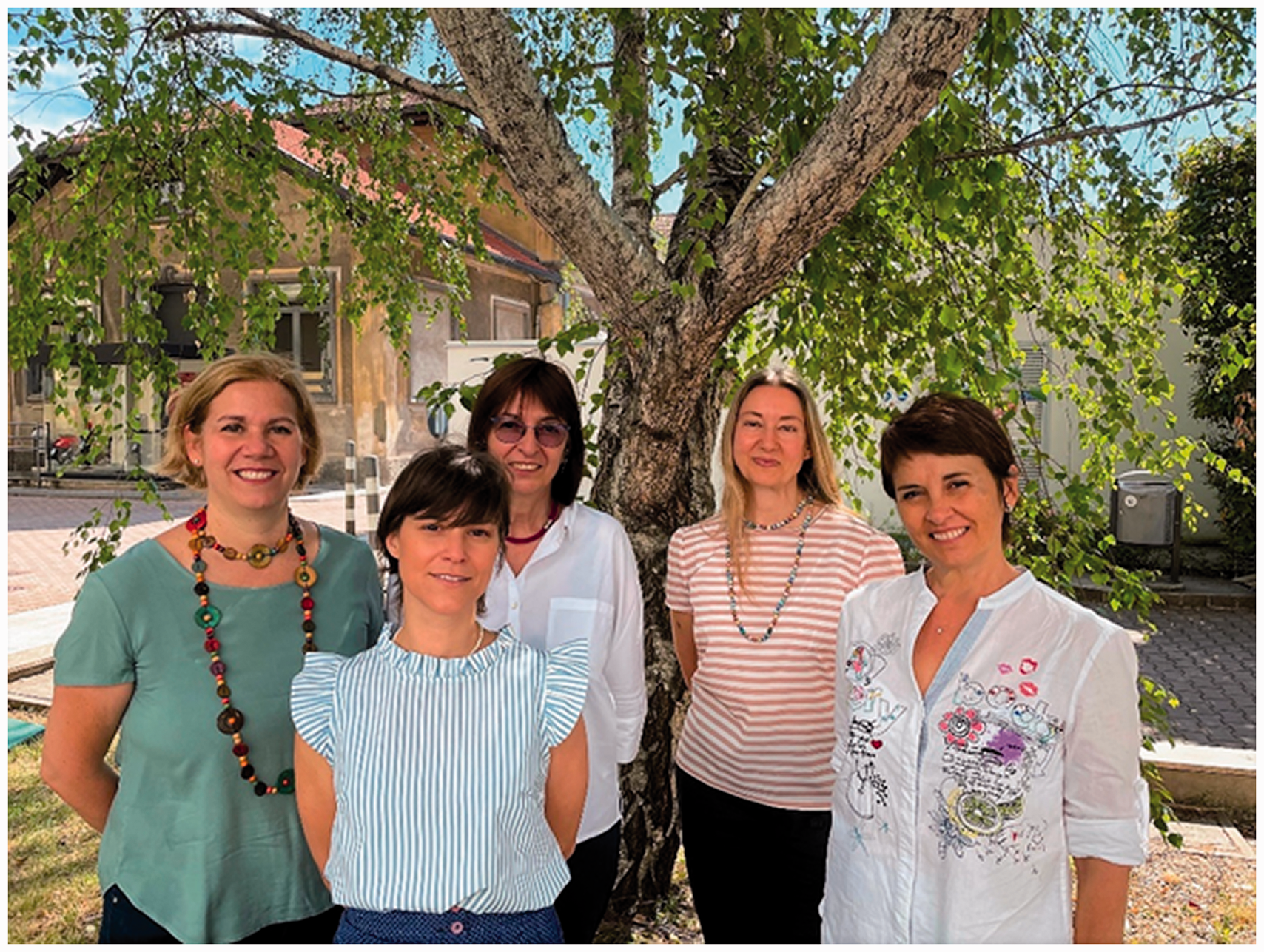
Sensing Lab Team. From left to right: Simona Benedetti, Silvia Grassi, Ernestina Casiraghi, Cristina Alamprese, and Susanna Buratti.
The Sensing Lab research group applies several e-sensing tools and techniques to different fields of the food sector. The basic idea is to apply technologies based on e-sensors to perceive and measure chemical and physical changes in food products. So far, the most important applications concern spectroscopic techniques (UV-VIS, NIR, and MIR spectroscopy), electronic nose and tongue, and image analysis approaches (both digital and thermal), always coupled with Chemometrics. The above-mentioned techniques are applied to the optimization of food products and processes, the authentication of foods, and the evaluation of shelf life, thus responding to the current needs of food market and industries in terms of food safety, quality assurance, and sustainability.
In addition to the research activity, the Sensing Lab is aimed at counseling agri-food companies approaching these techniques. In this perspective, the Sensing Lab is a reference partner for new users of e-sensors in the food sector, providing support for the development of new applications, from data collection to model construction and maintenance, for feasibility studies, and for training courses.
The instrumentation currently available includes a spectrophotometer UV/VIS (V-650) equipped with both transmission sample holder and integrating sphere for solid sample analysis; a portable NIR device (MicroNIR, Viavi Solution); a fully equipped FT-NIR spectrometer (MPA, Bruker Optics); a FT-IR spectrometer (Vertex, Bruker Optics) provided with both single and multiple Attenuated Total Reflectance sample holders; different imaging systems such as digital cameras, high resolution scanners, and a long-wave IR camera (Gobi 640, Xenics); an e-nose (Applied Sensor Lab Emission Analyser 3320, Applied Sensor Co.); and a e-tongue (Taste-Sensing System SA 402B, Intelligent Sensor Technology Co. Ltd).
Near infrared spectroscopy research lines
Within the different e-sensing techniques, the Sensing Lab has an established experience in the application of IR spectroscopy to the study of food quality indices, authentication, and shelf life, and to the monitoring of production processes in view of their optimization.
The success in the field is also linked to collaboration of the Sensing Lab with other national and international research groups, among which the Department of Applied Science and Technology of Politecnico di Torino; the Chemistry Department at Università di Roma “La Sapienza”; the Department of Food Science of the University of Copenhagen; the Department of Fundamental Chemistry at the Federal University of Pernambuco; the Faculty of Veterinary of Universidad de Extremadura; and the Instituto de Ciencia y Tecnología de Alimentos of the Universidad Nacional de Colombia.
The collaborations gave rise to several research projects funded on the basis of competitive calls, such as AGER-Valorvitis (grant 2010-2222) concerning the application of novel strategies in the fresh-cut vegetable sector, AGER-Filiera suino verde (grant 2011-0280) aimed at improving the heavy pig farm sustainability, and AGER-SOS (grant 2016-0105) dealing with the sustainability of the olive-oil system. In the mentioned projects, the members of the Sensing Lab played a leading role in NIR spectroscopy and computer vision implementations. Recently, Dr Alamprese took part to the COST Action SensorFINT, a European Network for assuring food integrity using non-destructive spectral sensors.
The expertise of the Team in NIR spectroscopy application for the food system is recognized also by the participation in a working group of the Italian National Unification (UNI) Body about the release of a guideline for the development of calibration models based on NIR spectroscopy.
The main research topics are described here (Figure 2) briefly reporting some of the scientific publications produced in the last years.

Sensing Lab main research topics concerning NIR applications in the food sector.
Evaluation of food quality and shelf life
In the field of food quality and shelf life, the Sensing Lab Team has an established experience, also preceding the Sensing Lab academic recognition, mainly focused on fruit, 1 cheese, 2 egg, 3 , 4 and meat. 5 The gained experience has been strengthened in the last years with research activities covering the whole olive oil production chain. 6 , 7
Monitoring and optimization of production processes
In the field of process monitoring and control, the Sensing Lab has developed different studies at laboratory and industrial scale by applying NIR sensors, doing the groundwork in bridging the gap between NIRS potentials and its actual implementation as Process Analytical Technology tool in the food industry. 8 The studies cover beer 9 and wine 10 fermentation, milk coagulation,11–13 and grain milling. 14
Food authentication
Several activities of the Team deal with the exploitation of infrared spectroscopy, eventually coupled with image analysis techniques, for food authentication, in order to develop analytical methods able to recognize and prevent frauds. In particular, the research framework focused on the identification of valuable animal species substitution with cheaper ones,15–17 the assessment of designations of origin and geographical provenance of various agro-food products,18–20 and the authentication of extra-virgin olive oil. 21
Another mission of the Sensing Lab is to contribute to the spreading the e-sensors’ potential, by means of scientific and technical publications, as well as participations in several national and international conferences since 2007. Moreover, the group has been involved in the organization of conferences, meetings, and school, among which it is worth mentioning the “VII Simposio NIR” held in Milan in 2015, the “NIR&PAT 2017 workshop” and the “SISNIR Winter School—Combining NIR spectroscopy and chemometrics” hosted in Milan in 2019. 22 These dissemination and teaching activities show the strong connection between the Sensing Lab group and the Italian Society of NIR Spectroscopy (SISNIR), supported by the involvement in the SISNIR Board of Prof. Casiraghi (2014–2018) and Dr. Grassi (2018–2022).
Unfortunately, due to the pandemic emergency, the last interactions and exchange occasions were postponed or moved to online platforms, but the Sensing Lab Team is strongly willing to share moments of aggregation with the whole NIR scientific community!
Footnotes
Declaration of conflicting interests
The author(s) declared no potential conflicts of interest with respect to the research, authorship, and/or publication of this article.
Funding
The author(s) received no financial support for the research, authorship, and/or publication of this article.