







Abstract
The present study investigated the processes information professionals, working in a business environment, follow to meet business clients’ information needs and particularly their involvement in information synthesis and analysis practices. A combination of qualitative and quantitative data was collected via a survey of 98 information professionals across North America and follow-up interviews with eight Canadian information professionals. It was found that there is an increasing need for value-added services, which incorporate synthesis and analysis but the level of information professionals’ involvement differs depending on a range of factors such as clients’ needs and attitudes, information professionals’ knowledge of the subject area and their length of time working in a particular organization. Information synthesis and analysis in a business context is mostly a collaborative process and principles of analysis are required throughout the entire cycle of information seeking. For the effective transition of information professionals to information synthesists and analysts more effective support may be required to develop a set of essential skills and knowledge.
Keywords
Introduction
With the phenomenon of information explosion business information users are experiencing more difficulty in handling information overload (Wyllie, 1993). Although the increased availability of information via the Internet has improved physical access, it has not necessarily enhanced intellectual access (Bundy, 1999). The process of filtering the useful, valid and reliable information from the massive volumes of (often unsolicited) information available requires individuals and organizations to equip themselves with new levels of knowledge, skills and understanding to deal effectively with the challenges of the rapidly growing and changing nature of the information world. These include not simply the skills for searching and retrieving information but also the ability to critically select, analyse, evaluate and effectively synthesize information for specific decision making and problem solving.
Except for their traditional role of custodians, keepers or providers of information (i.e. selecting, managing and organizing information resources and services) information professionals have long been involved in the provision of synthesized information services/products in response to specific information needs by highlighting and extracting key information from multiple sources in order to answer a client’s specific question. However, with the growing complexity of the information environment in which people are faced with a range of information choices of expanding quantity together with information of questionable quality, there is now more need for the provision of synthesized and analysed information. This is particularly true in business and industry related environments where there is a need not just for data, but for information that has been efficiently filtered, distilled, and analysed.
The business environment is a complex information environment. Information comes from many different sources both external and internal. It may, for example, be directly received from clients or staff and local archives (e.g. the company’s past budgets, policy documents, performance appraisals and projected goals and plans) or from external sources, such as documents of other institutions (e.g. case studies), formal publications, competitive intelligence, market surveys and government regulatory information (Agada, 1995). The range of business information needs is also multifaceted. They may vary from detailed to aggregated, from historical to current and future estimates, or from local to global. Information needs may differ on the basis of how often they occur and whether they address routine actions (i.e. information that is readily available) or more complex tasks which are more difficult to be determined beforehand (Skyrius, 2005: 192).
Business information is used for decision making, problem solving and competitive intelligence. Effectively interpreting, analysing and using the right information at the right time plays a crucial role in the success or failure of a business or organization. Unfortunately, many decision makers often lack the time and skills required to search for, interpret, synthesize and apply information to their decision-making and problem-solving processes and often fail ‘to take full advantage of the abundance of information at their disposal’ (Agada, 1995).
It is also worth noting that many organizations and individuals are unaware of the value of information or of the consequences of lack of information. The information professional can, therefore, perform a vital function in coordinating, organizing and synthesizing information from a variety of sources and presenting that information in a manner that is useful to those working in different units of the organization.
Background and rationale
Library and information professionals are well established in the provision of reference and enquiry services offering direction to information and advice on different types of information and methods for accessing multiple information sources. However, there is also a need for value-added services which go beyond simply offering access to information. Information professionals working in ‘special libraries’ or information services designed to meet the specialized information needs of particular user communities (e.g. business organizations, research organizations/agencies) are often involved in synthesis and analysis of information. Special librarians are expected to synthesize information to help resolve a question, provide a direction, or to solve a problem and know what information should be included or excluded in the decision-making process. They ‘provide not just raw information but an analysis of this information for the purposes of decision-making at the highest levels’ (Schachter, 2006: 13).
For example, the Special Library Association (SLA) places emphasis on managing the entire life cycle of information services, one stage of which includes the ability to research, analyse and synthesize information into accurate answers or actionable information for clients (Abels et al., 2003). This ability has also been referred to as ‘problem solving’, including a set of skills such as ‘creative solutions, quantitative skills, analytical modeling, logical capabilities, deductive/inductive reasoning, strategic planning and innovation’ (Cortez et al., 2004). The NRC-Canada Institute for Scientific and Technical Information (NRC-CISTI, 2007) recently conducted a survey in order to guide future product and service development. One of the most desired services was a synopsis or summary of the content of a document or set of documents.
However, there is a minimum of literature published that discusses the issue of the increasing need for value-added, synthesized and analysed information in a business context and particularly the role that the information professional plays in this process. In a survey of business information managers in a corporate setting, Foster examined users’ needs and what level of value added synthesis and analysis has been incorporated into corporate environments. Foster found that one of the strategies of information managers was to provide evaluation and analysis in addition to simply supplying information. In addition, more than half of the respondents provided an element of competitive intelligence, in which analysis and synthesis are core functions (Foster, 2008: 25).
An earlier study conducted by Langley (1989) found that analysis for information purposes was an aid in strategic decision making. It reduced the uncertainty around a decision by providing analysis for decision alternatives, verifying information provided by other sources and assessing the internal viewpoints of an organization. Bowes (1995) predicted that with technology developing so quickly, businesses would easily become data rich and information poor. They would be flooded with disconnected facts, findings and statistics, but the data would not be brought together in a useful manner. Bowes also stated that ‘competitive differentiation will revolve around an intensification of analysis’, that is turning data into information and analysing that information quickly and intelligently enough to generate superior knowledge (Bowes, 1995: 120).
Yet research which addresses the information needs of business information users indicates that although this user group is expert in their particular areas, they are unlikely to have the expertise in data analysis and statistics to make decisions based on the data collected by and about their organizations. Kohavi found that business information users rely on data analysts to extract information by providing knowledge about the business to the analyst and then waiting for the analyst to organize and analyse information and communicate back the results (Kohavi et al., 2002). Terblanche and Adeline (1996) concluded that business managers have a growing need for operational knowledge – how to conduct their business – and a need to be aware of competition. They tend to use personal contacts rather than published information sources and mostly due to lack of time, they need to have information readily available. For example, business managers may have access to a wide range of sources but they often prefer personal insight (knowledge, intuition, experience) to external formally published information (e.g. newspapers, periodicals, government publications, regulations, legislation, conferences, external libraries, reports from research companies, electronic information services), especially when seeking information about developments in the fluid, market-related sectors. In addition, they are often unable to articulate their information needs accurately.
Information analysis and synthesis are also often discussed as part of organizational information literacy, which is an integral component of the knowledge management strategy of the ‘learning organization’. This is an organization which places value on continuous learning and improvement and has a specific plan for capturing organizational knowledge and encouraging learning at all levels (Gasteen and O’Sullivan, 2000: 117). At the root of the learning organization is the creation of new knowledge, which provides a competitive advantage, and the effective handling of information, which is essential to productivity and performance (Kirton and Barham, 2005). Cooperation, communication, sharing of information between individuals and groups and using the knowledge and skills of all within the organization are also key for organizational creativity (Argyris, 1999). Cheuk (2002), for example, describes how the inability to relate information creation and use to a broader context may have a negative impact in the organization. Very few people actually take the time to share information with their colleagues, and when these same people need information, they expect others have shared theirs. Colleagues working for the same organization may not know what information already exists or has already been created.
The effective integration and consolidation of information may help in improving the diffusion and sharing of knowledge and expertise across the organization, linking communities of practice and fostering inter-group and intra-group collaboration. The creation of current, accurate and synthesized evidence can also help in reducing information overload in information-intensive work environments (Blake and Pratt, 2006). Analysing, synthesising and managing organizational knowledge can therefore be a key component of transforming the organization into a learning organization.
In order to meet the business user’s needs, information professionals need to develop a strong understanding of their client base, and present conclusions in formats and terminology that speaks to their experience. Berkien (2006: 31) envisages this as a transition from the traditional role of the librarian who provides information that is limited to the ‘intelligence professional’, who can provide ‘tailor-made’ information. The transition from library work to intelligence is viewed as significant in corporate information settings. This concept is often referred to as ‘competitive intelligence’ and it is a recognized business process based on the intelligence cycle (Correia, 2006: 23). Hohhof and Chitwood (2000: 25) provide a summary of key analyst characteristics and compare them to an information professional’s characteristics. For information professionals seeking to become analysts, ‘the key action is to understand the process and goals of an intelligence analyst’. Successful analysts have an intellectual curiosity which encourages them to be self-directed, without a need to wait until explicit directions are received before pursuing a line of enquiry; they have to be organized, with the ability to balance chaotic information and develop logical thinking skills that will allow them to see patterns and seek out information using both logical and intuitive methods.
Purpose and scope of the study
The present study aims to examine how information professionals working in a business environment meet business clients’ information needs and the information synthesis and analysis practices they are involved in. In particular it seeks to answer the following questions:
Do information professionals working in a business context provide synthesis and analysis services? Are they making a transition from information gatherers to information synthesizers/analysts?
Is there an increased need for information analysis and synthesis services (e.g. as reflected in requests for summation and report writing as well as opinions, conclusions and recommendations)?
What level of team work is involved in the processing of information? How are responsibilities shared?
Do information professionals require/are they offered special training in order to answer business information needs? How are these skills developed?
Definitions
Despite the recognition of the importance of information synthesis and analysis in the profession there appears to be a lack of clear definitions of these processes. ‘Synthesis’ and ‘analysis’ are also often interchangeable or seen together as one concept. Analysing and synthesizing information for example, has been viewed as not simply a matter of processing objective information but as ‘tapping the tacit and often highly subjective insights, intuitions and ideals of individuals and groups’ (Bowes 1995: 121).
Earlier definitions describe analysis as a step in the process of synthesis. Synthesis is the outcome of critical selection, analysis, evaluation and restructuring of information for the purpose for the purpose of serving some of the immediate decisions, problems, and information needs of a defined clientele or social group (Saracevic, 1981). Goldschmidt (1986: 217) describes information synthesis as a process that includes the assessment of the validity, accuracy and usefulness of information, the presentation of findings in a form that is going to be useful for the intended audience and the discussion of critical information gaps. Information synthesis helps overcome problems for the users in terms of the amount of information, its format, language and level of complexity. Potential benefits derived from information synthesis include reducing uncertainty, helping people and organizations to make informed decisions and evaluate alternatives, increasing the level, depth and breadth of knowledge and competence of individuals and groups, assisting in responding to challenges and demands of the external environment, and increasing the levels of productivity (Seetharama, 1997: 9).
Studies of the information analysis process in an organizational context offer a clearer description of the distinctive properties and the critical role of analysis. Halliman (2003), for example, has defined analysis as the process where information is converted into ‘actionable intelligence’, which is the ‘creation of data of value in decision making’ (Yovlts and Foulk, 1985). This process involves interpretation of data or information to provide meaningful insights by means of examining correlations, trends, patterns and performance gaps which help organizations identify and evaluate opportunities (Bensoussan and Fleisher, 2008: 19). There is also an emphasis on the methodology by which analysis is achieved. For instance, finding ‘relationships between different pieces of information, and then draw[ing] inferences from the relationships’ (Halliman, 2003) or ‘performing mental operations on the data’ and examining closely related items of information ‘to determine the extent to which they confirm, supplement, or contradict each other’ (Fleisher and Bensoussan, 2007: 4). However, there is still a lack of understanding of the place of synthesis in this process.
Considering the lack of clarity in these definitions a simple description of the properties of synthesis and analysis for the purposes of this study was given to enable the participants elaborate in a meaningful way on these processes in their day-to-day professional activities. Synthesis was defined as the process of putting raw data/information together in a logical way, while analysis is the process of finding relationships between different pieces of information and then drawing inferences from the relationships to convert information into actionable intelligence.
Data collection methods
In this research a combined data collection approach was used, employing quantitative and qualitative data-gathering methods. A questionnaire was initially sent out to business and industry librarians in North America with the purpose of collecting information on general trends and statistics on librarian involvement in synthesis and analysis (Appendix A). The questionnaire was also used to identify a sample of librarians that would be willing to be interviewed for the second part of the data collection (the interview stage). The interview was used as a follow-up to the questionnaire to allow detailed collection of information and to probe into a librarian’s synthesis and analysis involvement, methods and processes more thoroughly. The questionnaire and interview were tested with a small pilot group and although the definitions of analysis and synthesis were clear a few of the questions had to be reworded and reformatted.
Questionnaire
Permissions were sought from 13 North American library associations to distribute the questionnaire to their membership. Five organizations responded positively to the request, and an outline of the research and a link to the online questionnaire was sent out for distribution on 1 October 2007 to the Canadian provincial library association listservs (Manitoba, Alberta, Saskatchewan, Newfoundland and Labrador) and one national organization: the Canadian Association of Special Libraries and Information Services (CASLIS). (Permissions had been sought from all Canadian provincial organizations but these are the only ones who responded.) The survey was also sent to the reference librarians at the NRC-Canada Institute for Scientific and Technical Information as they have implemented a competitive technical analysis programme. One of the initial respondents to the questionnaire forwarded the survey link to the Eastern Canada chapter of SLA as well.
The survey was made available for one month, from 1 October 2007 to 1 November 2007 using an online survey software tool.
Responses were anonymous unless the respondent provided contact information voluntarily. No attempt was made to track the location of the respondents via a computer address or other means.
Interview
Questionnaire respondents were given the opportunity to participate in a follow-up telephone interview to further discuss the details of their individual synthesis and/or analytical process. The purpose of the interviews was to gather details on analysis and processes that were difficult to gather in a questionnaire format (Appendix B).
The interviews took place with eight respondents (Respondents 2, 4, 5, 6, 9, 10, 15 and 18) and were conducted over a three-week period from mid-November to early December 2007. Each one of the interviews lasted from 20 to 50 minutes.
Analysis of results
The quantitative data collected from the questionnaire were coded and analysed using the analytical features available in SurveyMonkey, the online survey tool that was used for the construction of the questionnaire. In addition, the data were exported to Microsoft Excel for further analysis and consolidation. The qualitative data collected from the interviews and the questionnaire were initially coded under a number of broad categories (e.g. level of involvement in analysis and synthesis; work processes). These categories were further refined as new themes were generated from the data and conceptual similarities as well as contradictory evidence were identified. Different information segments were cross-examined until theoretical saturation was reached and there were no new categories emerging from the data.
Discussion of results
Librarian qualifications and job description
A total of 98 individuals took the survey. Most of the respondents (78%) held a Masters of Library Science (or equivalent) and 15 percent held diplomas in library technology (or equivalent). Just over one-third of the respondents worked in Canadian Government libraries (31%). The rest were employed in business and academic libraries (24% and 17% respectively), public (14%), science (9%) and industrial/manufacturing libraries (4%), (Figure 1).
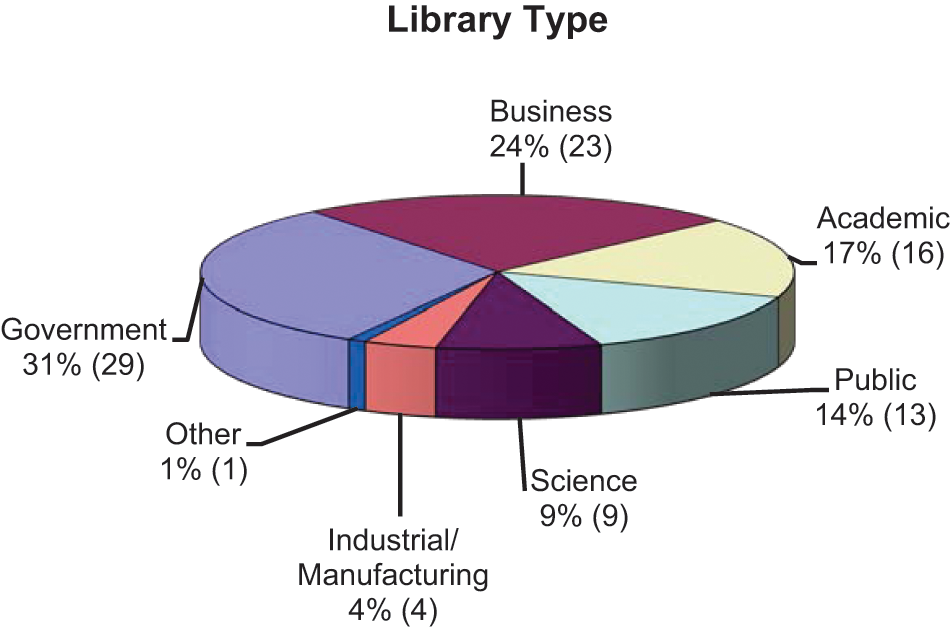
Distribution of respondents by type of library by percentage and number of respondents
The respondents’ experience in the library field was quite varied but almost one-half of the population (47%) had experience of working in the field for more than 15 years (Figure 2).
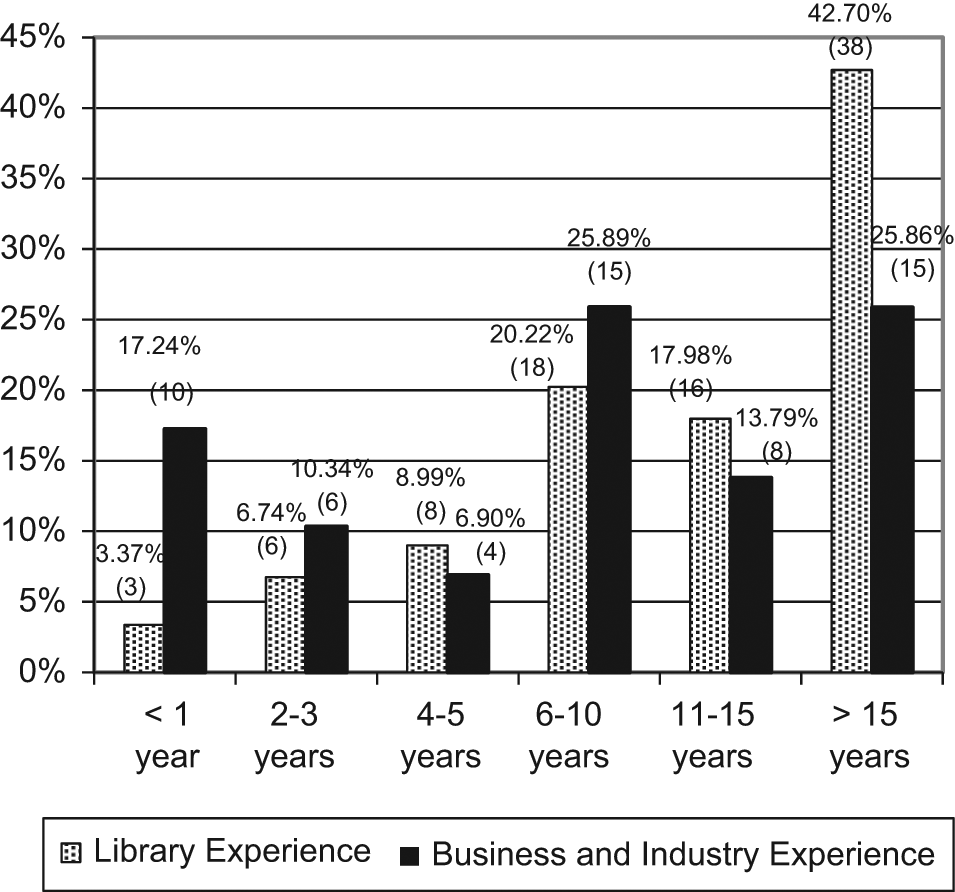
Library and business experience by percentage and number of respondents
The analysis of the questionnaire responses revealed that almost half of the surveyed population (46.3%) had the terms ‘analysis’ and/or ‘synthesis’ (or a variation of these terms) in their job description. There were also a high number of respondents (42%) who had taken courses or training to develop their analytical, synthesizing and report-writing skills. For the majority of information professionals surveyed (73%), training had significantly helped in effectively addressing clients’ information needs. However, less than half of the respondents (42%) indicated that they had received on-the-job training in order to assist them in developing skills that can be used in analysis and synthesis. Descriptions of the training highlighted mentors or supervisors who were very encouraging in expanding the respondents’ skill base. Most of these situations were informal, for example, ongoing coaching in developing skills such as strategic thinking, oral and written communication, presentation skills, leadership and project management.
Clients’ synthesis and analysis needs
The clients most often served were managers and researchers (60%). However, one-third of the respondents (30%) also referred to gathering and synthesizing information for small businesses, consultants, analysts and other librarians.
Literature searches and industry information were the types of information that clients requested most often (16% and 17% respectively). Other types of information included company information (15%), market overviews (12%), competitive intelligence (11%) and identification of experts/vendors (10%) and patent searches (7%), (Figure 3).
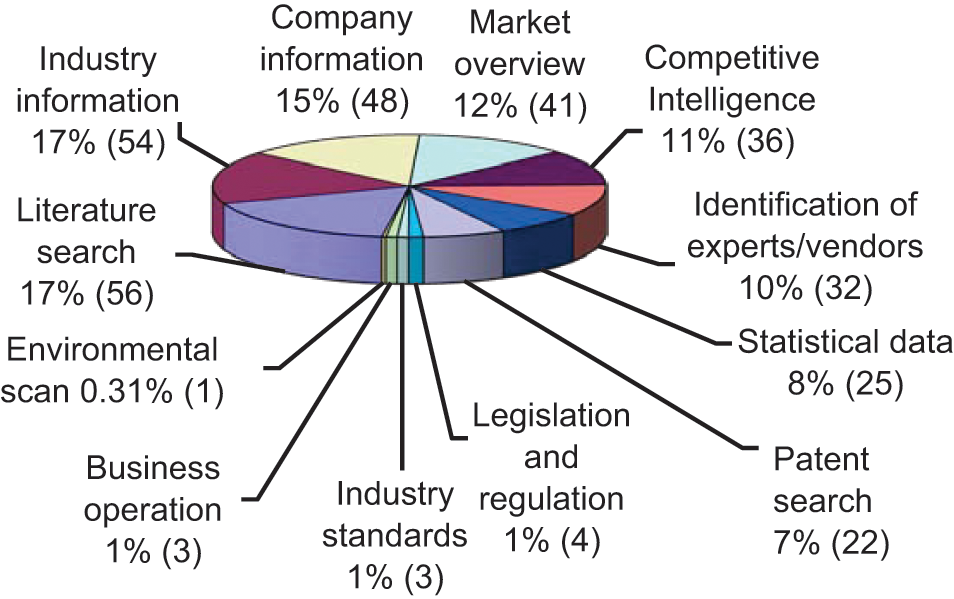
Types of information requested by clients by percentage and number of responses
The most popular format for receiving information was in the form of raw data (30%) so that the end-user could perform their own analysis. Literature reviews and reports (described as a summary with conclusions drawn) were slightly less popular information formats (24%), while analysis (i.e. with an opinion provided) was less frequently preferred (18%).
However, almost half (48.6%) of the respondents indicated that clients were requesting more analysis or synthesis of information now than in the past and the complexity of questions received has increased. Although there is easier access to information there is also a greater need for sifting through, verifying and organizing information. There is an increased demand for information that is synthesized and analysed which goes beyond the delivery of results obtained from literature searches. The importance of providing synthesis and analysis services was highlighted by several respondents in the additional comments provided in the questionnaire:
Clients have responded to the increased skills that the Competitive & Technical Information department has been able to provide. They have moved from a ‘data dump’ to summary and analysis (Respondent 11). Where once only literature searches were requested, reports that contain analysed information are now the norm (Respondent 6).
For one of the respondents this even meant the transition from an information gatherer to an information synthesist and analyst:
It used to be that only literature searches were requested. Now I am being asked to much more (information evaluation, critical appraisal, literature reviews, etc.) to the point that I am given author or major contributor status to reports (Respondent 9).
On the other hand, another participant felt that the involvement of the librarian or information professional in analysis and synthesis may not be always recognized or valued and the end-user of an analytical report may be unaware of their contribution:
I think that the intermediaries between the people at the top who want concise analysis they can act on and the people in the library getting the information don’t want analysis from us; they want their jobs, and the people at the top don’t need to know that we contributed in any way. Which is why the people at the top are deciding that we aren’t necessary (Respondent 39).
Business information users have limited time to read through a lot of information and to have the information culled down to a manageable level helps them significantly. Sometimes this may just involve a brief synthesis of the most important information. The shorter and the more synthesised answer the better when working on a business question:
My clients don’t want reference lists, they want to know what are the best sources (Respondent 21).
In other cases they find it useful to know what the person who has gathered the information has concluded and will ask advice on what to do next with the information (Respondent 15).
I think Business people have less time to read through information and are more interested in what you, the person who has gathered the information and are already familiar with the content, think or what conclusions you may have drawn (Respondent 52). [Clients] often want recommendations based on the information we collect. [They] ask about next steps (Respondent 5).
However, there is also preference for initial information gathering without seeking assistance from a librarian or information professional. Business clients have become better at conducting searches for basic information themselves, usually through an Internet search and it is only when they cannot find what they need that they will approach a librarian. This means that not only are expectations of clients now higher, but also the questions received are more complicated:
Questions of all types are increasing in their complexity. I suspect that people are doing preliminary research themselves via the Internet, then coming to the library later in the search process when they have been unable to locate the specific information they wish and are seeking help (Respondent 1). A lot of the simpler requests of the past are now resolved by the clients with a Google search; I get the questions they can’t answer themselves after using Google for half an hour (Respondent 30). Now that clients have access to Google and e-journal and databases, when they come to see us, the questions and expectations are greater (Respondent 85). Due to the Internet, many of our clients have done some preliminary research so by the time they get to us, the questions are usually that much more complicated (Respondent 40).
Information professionals’ involvement in synthesis and analysis
Most of the respondents indicated that when dealing with a business question they worked collaboratively with others, either with another librarian (24%), as part of a larger team (22%) or together with a business analyst (9%). However, a high number of information professionals also worked independently (39%).
The role of the respondents involved collecting data or information (34%), summarizing the literature (21%), summarizing market information (18%), drawing conclusions (13%) and making recommendations to the client (14%), (Figure 4).
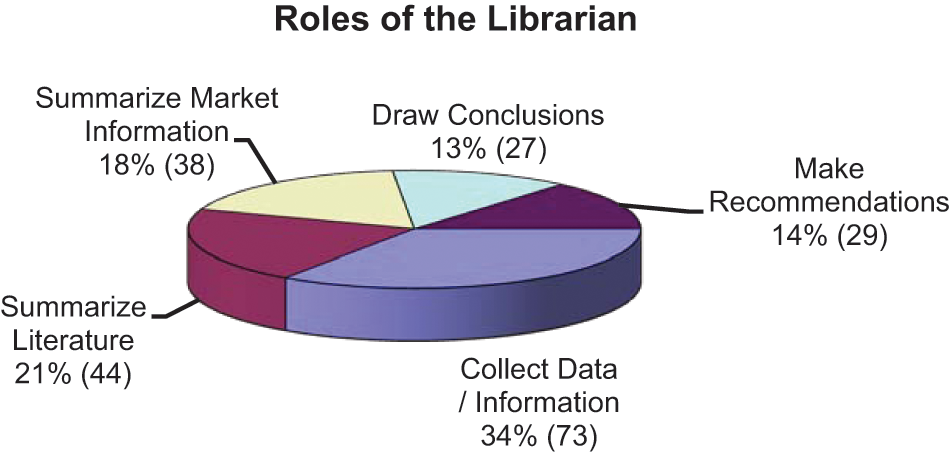
Librarian roles in information synthesis and analysis by percentage and number of responses
Just over one-third of the information professionals surveyed were involved in both synthesis and analysis (37%). The rest (35%) had the role of providing one or the other service while some (28%) did not consider themselves as part of the synthesis/analysis process at all, although in their comments some described what they do as ‘condensing’, ‘summarizing’ information or eliminating irrelevant material.
In some cases the involvement of an information professional in the process of synthesis and analysis depended on the level of knowledge and understanding of the subject area. For instance, as one of the respondents explained with librarians’ knowledge of an industry growing, more may also be expected of them by clients (Respondent 18). Ten respondents felt that to be able to participate in the synthesis or analysis processes, a strong knowledge of the subject is beneficial or even a requirement. For one of the participants, lack of subject expertise especially when influencing business decisions meant that there may be liability concerns that an organization (if providing information services to a paying client) may not be willing to risk:
Synthesis, Analysis or Recommendations may be made by the librarian if the results and subject expertise is there. If expertise is subject related (i.e. expert scientific), and business decisions are being made, there is a liability issue that neither the employer nor the librarian is prepared to take on with respect to analysis/synthesis and recommendation of information retrieved (Respondent 2).
Another factor which influences the level of synthesis or analysis information professionals are requested to do is the length of time they work with an organization. The client needs to learn to trust the librarian and the analysis that can be provided. Once this trust is established, requests for synthesis and analysis increase. One drawback is that information professionals often work on their own, so finding the time to do synthesis or analysis can be a challenge when trying to coordinate other additional duties:
The longer I am in a position – the more the clients are apt to trust analysis, but I find that once the trust is there, I do get an increase in requests. As a solo librarian this can be very challenging to get this done and do all of the other things we have to do in a day, but it is one of the more satisfying aspects of the job (Respondent 33).
Description of synthesis/analysis process
Information synthesis and analysis was described by participants as a circular and repetitive process. This involved reviewing and analysing the information collected at different points in the information-seeking process with the purpose of identifying existing gaps and areas which needed to be more thoroughly examined:
The process is not performed in a linear or strict systematic way. I find it difficult to just collect all the data and information upfront and then analyse it. I find this doesn’t always work well, because once you sit down to analyse it, you will always find that you are missing something or that the information you did find uncovers a new issue that should be addressed. Most times I like to review the information and data periodically and start analysing it to start to get a better feel for the direction of the project (Respondent 22).
This idea coincided with the views of another respondent who described their information synthesis and analysis style as ‘serendipitous’. This involved gathering information from many sources, reviewing the content and offering ‘a brief overview of what I have found as I go along’ to the client before engaging into further searching (Respondent 58).
Analysis of the interviews
Research problems requiring synthesis and/or analysis
During the interview the participants were asked to describe a typical research problem for which they may need to perform synthesis or analysis. The most common types of questions included patent searches, literature searches, market research and even collection development.
Half of the respondents indicated that they deal with both recurring and unique questions while the rest tend to only receive unique questions. Recurring questions referred to specific information requested either on a regular basis or every few years for an ongoing project or business plan. A unique question referred to information that has not been requested before and may not be requested again. It is only needed at one point in time for a specific project or business plan. The nature of the question (recurrent or unique) depends on the clientele the information professional/librarian serves. For example, recurring questions are addressed on a regular basis in small organizations with a subject focus. In most cases, however, the information professional/librarian is in a reactive situation, looking for information on a topic that is new to them.
The questions received may also fall into two other broad categories: the ones that start off as naïve questions and seem simple, especially to the enquirer, but end up being complicated searches; and those which are obviously complex from the start. For example, one of the participants explained a simple question such as ‘What is the unemployment rate’ may in reality refer to finding information on ‘the unemployment rate in a particular neighbourhood and what is it the cause or effect of the social issues that have been tracked in that neighbourhood’ (Respondent 10). Similarly a seemingly simple question of ‘What is the hydro potential of all rivers in Atlantic Canada?’ may require the information seeker to first define ‘Atlantic Canada’, then compile a list of all rivers that run through this geographic area, and finally determine whether the rate of current is tracked by any interested party, before obtaining the actual information (Respondent 10). An obviously complicated question may be, for example, ‘Where are the gaps in tourism research in Atlantic Canada’ or ‘What are the trading economic platforms of the political parties?’ (Respondent 10).
Level of involvement in analysis and synthesis
The level of involvement in synthesis and analysis by the respondents ranged from basic to very involved. In some cases the level of involvement depended on the type of question and the client’s needs. For example, one respondent referred to summarizing patent results to show the precedence or date of a technology in addition to providing all the patent results (the raw data) so that the client could do their own analysis if they wished (Respondent 2). Another participant described conducting a systematic review involving a significant amount of information synthesis for a big government ministry project that looked at the increased interpersonal collaboration in primary care and what the different models were in various regions and countries (Respondent 9). In another case, a respondent described working with an institutional animal care committee which had strict processes in place for research experiment approvals. The synthesis described here was of a more simple nature, involving database searching and culling down the results into a single paragraph to determine that the required data were not available from other sources (Respondent 4).
The level of synthesis and analysis involvement by the information professional may also be restricted by the attitude of the client. For example, respondents referred to a difficulty in preparing a focused information synthesis and analysis of licensing and patenting technology due to an unwillingness of the client to disclose the purpose for which the information was going to be used:
Clients may keep a lot of information close to their chests so it is impossible to know exactly what they are looking for (Respondent 2).
Often analysis is applied in how to approach a question. For example, when a specific type of data is needed to prove a point, but that specific type is not found, the information professional may examine and interpret other information and take an alternative approach to provide an answer to the question. For instance, one respondent referred to an incident of encountering difficulty in finding information on ‘bagged ice sales’. An alternative approach to the problem was to use a proxy approach – where do people use bagged ice, what drives the demand for ice, i.e. national parks camping attendance, football game attendance – (Respondent 18).
It is also typical for information professionals involved in business and industry to answer enquiries related to a market for a product/service or improving/developing a product further which may also help in highlighting areas of future trends (e.g. technological). This involves literature and patent searches for identifying competitors and related technology but also using software to manipulate and analyse data (e.g. sales, estimates, market data) in order to answer the client’s information needs. For example, one participant used software to determine markets, who investors are and where technology is going in the future (Respondent 6).
Although information professionals are not always involved in the final analysis of information they are often responsible for condensing the content and format so that the information is easy to read and scan. They may also be required to highlight key points and then pass this information on to another person who performs the more specific business analysis.
Work processes
The interviewees were asked to describe their usual work or thinking processes as they performed their synthesis or analysis tasks. All of the respondents found it difficult to step back and look at themselves objectively in this process as it had become second nature to most of them. Each person had developed their own approach to searching and followed the same methodologies in conducting their searches and putting together a product for a client. An overview of the common steps (mainly followed for in-depth, detailed questions) were identified in the group interviewed and are discussed in the following sections.
Reference interview
Every respondent mentioned this step as a significant starting point for the information-gathering process. The reference interview is essential for clarifying the client’s information needs, determining the purpose for which the information is going to be used (e.g. decision making, educational reasons) and identifying keywords for a search. It is also required for specifying the type (e.g. synthesis, analysis or just raw data) and the level of the information requested (e.g. extracting specific statistics from a report or the entire report).
The level and nature of the reference interviews conducted varies, with some taking place by email, and others taking the form of longer face-to-face interviews. For instance, one participant referred to conducting very thorough reference interviews which can last for two hours. The reference interview is a very important first step that helps determine the needs of the client (Respondent 9) and gather key words and concepts (Respondent 6). For another respondent the reference interview meant more than just deriving suitable search terms. It is a useful process for understanding the working context of question and the purpose for which information is going to be used (e.g. learning, decision making) (Respondent 15).
Brainstorm
The process of brainstorming includes thinking of keywords, sources and approaches to take in order to find information. At the end of the brainstorming session, the key concepts are determined, the type of information needed to answer the question is established, and the end result is planned, i.e. how to package the information best to make it easier for the client or analyst to use.
In this stage, the information professional also plans whether there is a need to perform a literature search to find the information, or whether to contact primary sources. Brainstorming may be an individual or group activity. For example, one of the interviewees described working together with other librarians as well as business analysts and following a process of collaborative brainstorming in the office (Respondent 18).
Strategize
Strategizing refers to deciding upon final search terms, synonyms and other related words that describe the search topic, selecting sources and outlining the limitations and specifics of the search. If the question is business related, this may involve identifying other companies with related information or following up other references in patents and published articles.
Pilot search
As one respondent put it, a pilot search is an informal, ‘quick and dirty’ search (Respondent 9) to get a sense of what is available. It helps find additional terms and clarify main concepts. It can also be an assessment of sources. One starts with the sources most likely to provide the needed information, and then moves broader, or determines whether the information can only be obtained by consulting primary sources or experts in a field.
However, one participant also mentioned a more systematic approach in the form of a formal 30-minute pilot. She takes the half-hour to apply her strategy to see how it will go. Then she looks at the results and contacts the client to give them an estimate of time or what problems are coming up. At this point she can address little details that did not come up in the reference interview (Respondent 15).
Plan again
Depending on what results the pilot search produces, the process may need to start over again, even as far as conducting a second (or third) reference interview to clarify concepts, needs and expectations.
One of the respondents indicated that after a pilot search, she would start again with a needs assessment if necessary (Respondent 15). Another would touch base with a client to make sure that the research was proceeding on the right track (Respondent 9). In another case planning again, or reassessment, was constantly followed throughout the process (Respondent 6). However, time constraints can be an issue for clients, so an early reassessment can save time in the long term (Respondents 6 and 2).
Searching for information
After establishing the search and the criteria, the next major step is undertaken: finding the information. But it is important to note that a search usually does not remain static. The information professional learns new key words as the search is implemented, so often a search is resubmitted in the same database a few times as new terms arise. It is definitely a ‘learn as you go’ process in that the search techniques remain the same, but the vocabulary continuously changes. There is often a learning curve for topics new to the librarian (Respondent 15).
Depending on the question, the client and the circumstances behind a request, a search may be exhaustive or targeted or as one interviewee put it, ‘exhaustive yet very specific’ (Respondent 4). The circumstances that affect this are time constraints, whether the client is paying for information services (this limits the amount of data that can be retrieved if using fee-based information sources) and whether decision making on the part of the client will be based on the bare minimum of information or on every possible angle.
Distil and evaluate information
The participants in this study explained that they do not necessarily wait until all the information from a search is gathered before evaluating it and determining what to include in the results given to a client or analyst. Results are critically evaluated as they are gathered and possible alternate search avenues are kept track of in case further searching is needed:
Evaluate as you go, then process it, identify key points and abstracts (Respondent 10).
The quality of raw data is also evaluated and facts verified and cross-referenced although the process by which this happens may differ across participants. For example, one participant indicated that they do not pass on a ‘fact’ unless they can find at least two sources to verify it. Another interviewee, on the other hand, explained that they make notes, comment and highlight relevant information only once they have gathered it altogether. Another part of this step is to cull the results by applying inclusion and exclusion criteria that have been defined during the reference interview. Software is also used in order to organize the results and to remove duplicate citations if the source is from multiple literature databases. In reading and evaluating results, one respondent indicated that the desired result is ‘the perfect article’, one that answers the client’s question exactly. Unfortunately, at this level of information service, this rarely happens (Respondent 9).
The evaluation is either done individually, in the case of a small library (such as in the case of Respondents 10, 5, 2 and 18), or with a co-worker if working in conjunction with an analyst or another librarian (as is the case for Respondents 15, 9, 6 and 4). Depending on the team dynamic, the librarian may pass on information as it is found, either as raw data or synthesized down into key elements.
Synthesis and analysis
Seven of the eight people (the exception was Respondent 5) who were interviewed, saw themselves involved in the synthesis of information, but not so much in the analysis. This was particularly true of the information professionals who serve clients in a wide variety of subject areas. They find it difficult to analyse information that is in a field they are unfamiliar with (Respondents 2 and 10). Knowledge and experience in a particular field were therefore deemed to be a great asset for both information searching and synthesizing/analysing information. Specifically, knowledge of specific vocabulary, understanding of the industry process and awareness of legislation were considered as essential time-saving and communication shortcuts in the information gathering, analysis and synthesis process. This verified the importance of subject knowledge which also appeared as an essential component of information analysis in the comments given in the questionnaire.
Through the interviews, it also became apparent that another interpretation of information analysis incorporates not only the process of finding objective relationships between different pieces of data and information, but also information evaluation on the basis of what is considered to be valuable for and by a specific client (the analysis process can be therefore context specific). One of the respondents described analysing the information throughout the search to determine what is good material to give to her analyst colleague (Respondent 15). In a similar fashion, another examined the quality of the data accumulated to determine whether to include them in the results to the client (Respondent 2). Evaluation was also performed not only at the level of information gathering but also of the information tools and sources used and the specifics of the search. This helped to identify gaps and trends which led to more information searching and this process can be repeated several times (Respondent 6).
The synthesis tasks described by participants included keeping most of the raw data intact, but reading through the information and highlighting passages, text, and data that particularly address the client’s information need. This was followed by synthesizing the data into one document for ease of reading, and producing a reference list or bibliography when the client requested additional background information. For example, one respondent (Respondent 9) mentioned the technique of using data extraction sheets to collate key information from articles. All the information related to statistics, or the focus of the client question, is gathered into one large document. Spreadsheets were also used by other respondents to gather and organize data.
One interviewee (Respondent 10) pointed out that synthesis and analysis flow parallel to information gathering. Assembly of the information also happens concurrently with information collection, with commentary added where needed (either on the data or notes on the process). A similar approach was also described by another participant. Information is analysed as it is collected to identify any gaps and trends. This leads to further information gathering in order to address the gaps and trends identified and the process can be repeated many times, until the report is finished or time dictates an end to the process. Constant reassessment is required for eliminating the possibility of following a wrong route (Respondent 6).
Format and distribute
Once the information professional and the analyst (if working in a team environment) have completed the information-gathering and analysis stage, a report is created which is condensed down to the basic facts. An example given by one of the participants was the preparation of ‘one pagers’ of basic facts for company staff who are travelling to another country on business (Respondent 15).
A key part of formatting is deciding how to package the results so that they are most easily used and understood by the client. Pulling statistics into a table for instance, instead of leaving the statistics scattered throughout various documents, makes the information much easier to find and understand because it is easy to compare (Respondents 15 and 6).
Collaboration
As the questionnaire data demonstrated, collaboration was a common method of working in the provision of information synthesis and analysis services. The interviews elaborated on this process further and revealed a variation in the level and type of collaboration taking place. For example, two participants (Respondents 15 and 6) referred to working closely with business analysts who perform most of the business analyst applications and formatting of final reports and recommendations. There may also be some overlap in duties where the analyst may gather some information and the librarian may analyse some of it before passing it on to the analyst. Another respondent (Respondent 18) worked as part of a larger team of librarians and analysts in a very collaborative atmosphere, with some analysts being more involved than others, and some topics requiring more collaboration than others. Finally, one interviewer mentioned working with technology advisors who act as analysts only when it is necessary. They usually pass on the information to the client in the form submitted by the information professional (Respondent 2).
Discussion
The value of information synthesis and analysis for end-users has been emphasized in previous research (Bowles, 1995; Kohavi 2002; Terblanche and Adeline, 1996). However, there is minimal research evidence of information professionals’ level of involvement in this process. This study confirmed that information professionals are active in the provision of synthesis and analysis services but their level of engagement differs. There is, however, a common recognition that there is a need for developing a set of necessary analytical, synthesizing and report-writing competencies. This is also evident in the types of end-products delivered to the client, which include more complex information and are delivered not only in the form of raw data or literature search results but also as structured reports, literature reviews, market overviews and competitive intelligence.
The analysis of the questionnaire responses and interview data also revealed that subject specialists rather than information professionals are more likely to be involved into analysis and synthesis of information due to having greater understanding of the subject area and an ability to apply analysis or synthesis techniques more easily. The skill that information professionals require most in order to be able to analyse information is specialization and familiarization with the subject area before proceeding in depth with a search. This can take the form of initial trial searches, developing a glossary, and conducting an in-depth reference interview with the client. This finding agrees with earlier research which has found that subject expertise and internalizing knowledge are essential components of a librarian’s successful work in a subject-specific environment (Hohhof, 2000). Furthermore, according to Herring (1998), a successful analyst should have a strong understanding of the subject area/business. This is particularly important in view of the results of this study which revealed that the terms ‘analysis’ and ‘synthesis’ appeared in the job description of almost half of the population surveyed and that there is now a higher involvement of information professionals in information synthesis and analysis.
Information professionals can obtain subject specialization by a number of means (e.g. further education and training in the subject area, time and experience working in a specific organization). Hohhof (2000) suggests that finding a mentor, getting involved with a team, developing subject specialization and gaining financial and business skills can help information specialists seeking to become analysts. However, more emphasis may be required to be given to the importance of subject expertise for analysis and synthesis tasks specifically. This has been confirmed by the participants’ responses in the present research which indicated that more on-the-job training may be required in order to assist them in developing skills that can be used in analysis and synthesis.
The amount of teamwork involved in information synthesis and analysis and the distribution of responsibilities varies from respondent to respondent. Previous research on information seeking in an organizational context has found that information-seeking roles of individuals differ. Hertzum (2002), for instance, has described how collaboration takes place in project work, when one member of the group formulates an information need and another one suggests an appropriate information source but the consultation of this source may be conducted by another participant and then discussed in a project-group meeting. Prekop (2002) has identified a number of different collaborative information-seeking roles: the information gatherer whose main task is to find and gather specific information; the information referrer, who directs unsolicited information from the organizational context into the collaborative information seeking context; the information verifier who validates the gathered information on the basis of accuracy and completeness; and the information-seeking instigator who directs participants to gather specific information, monitors the seeking activity and takes any action if needed. However, there is a lack of specific focus on the activities of information synthesis and analysis and further investigations may be required to explore the role of collaborative, synergistic nature of this process.
Further research may also be necessary to understand the nature of the information analysis activity in particular. This study found that information analysis is a reiterative and circular process which can be incorporated within the information-searching process itself as analysis may be required in different stages of answering a need and reporting back to the client. In the literature, analysis is often seen as the separate stage following information collection which creates actionable intelligence (Kahaner, 1997). Similarly, Correia’s (2006) cycle lists ‘Analysis and Production’ as the final step before ‘Dissemination’ which is a distinct step from information collection.
Conclusion
As we move further into the ‘information age’, the ability to both locate and synthesize information becomes a highly valued competency by the business community. Recent research in organizational environment verifies a need to develop a set of information management skills to support business strategy and operations. These include generating, gathering, analysing, disseminating and using the appropriate information effectively, ensuring information security, validity and integrity (Sen and Taylor, 2007).
This study clarified the direction that the profession is taking towards offering more value-added information analysis and synthesis services which require the development of a good intelligent mind characterized by the ability to spot patterns, process and filter information, and identify trends and key relationships in data (Herring, 1998). In addition, with easier access to information and with more information to handle and process, the complexity of business requests has increased and information professionals may require more support and training in developing subject expertise. It is believed that the role of the information professional as an intelligence provider will continue to evolve and therefore it is important to ensure that effective mechanisms that support this transition are present in the workplace.
Footnotes
Appendices
Appendix B – Interview questions
I would like to focus on your process for analyzing and synthesising information.
This research received no specific funding from any agency in the public, commercial or not-for-profit sectors.