







Abstract
This research highlights the status of the information technology (IT) skills and competencies being taught at LIS schools in the United States. Results list specific IT topics that the library schools are teaching and the ones that are missing from the curriculum. Based on a literature review these skills are then juxtaposed with the expectations of the employers as well as the graduates of these programs. This research was conducted in multiple steps, starting from extensive literature review, secondary data collection regarding courses from top LIS schools’ websites, identifying and creating an IT competency list, content analysis on the course names and descriptions in relation to IT competencies and recommendations for further improvement. In conclusion, some potential courses consisting of the lacking IT skills are proposed as a recommendation.
Introduction
Technology competency is not an option, it is critical for all librarians and staff. (Core Technology Competencies for Librarians and Library Staff: A LITA Guide, Thompson, 2009)
Growth of technology has had a significant impact on the way libraries function, on the education of librarians, on the skills and competency expectations of library employers, and on the curriculum in library schools. In this paper, we present findings from a study that explored the status of information technology (IT) and information and communication technologies (ICT) skills and competencies as observed from a content analysis of curriculum available on the websites of the top 25 Library and Information Science (LIS) schools in the United States.
Rubin claims in Foundations of Library and Information Science (2004: 79) that:
the scope and rapidity of change within our profession has never been as great as it is now and the growth of electronic information technologies has challenged [the role of libraries] and resulted in considerable instability and uncertainty among librarians.
Thompson (2009) in the Library and Information Technology Association (LITA) handbook provides an overview of the changes in libraries related to technology in the last five decades and explains the current situation as being different from the past because of the following factors:
the pace of changes in technology;
the breadth of technological tools that are involved in the job of a librarian;
the depth of technical knowledge expected of librarians in the 21st century.
In the same handbook the author further writes that the librarian’s job has become more challenging and requires librarians to be IT experts. Now librarians are expected to be aware of a wide variety of tools, proficient at troubleshooting, able to create content using IT, and able to change rapidly with the technological environment of their users. Many librarians are finding that their IT departments are no longer able to handle all of the demands stemming from the many different types of technology now available in the area of library sciences. Therefore, librarians are increasingly expected to provide some level of technology support for themselves. Libraries have traditionally played a key role in providing access to information and disseminating it across a community. That role has now extended to include facilitating access to innovative technologies (Thompson, 2009).
Bosque and Lampert (2009) echo a similar sentiment, writing that the current changing scenario of library science was initiated in the 1980s and that familiarity with tools and technology has emerged as an essential skill for jobseekers. They further add that this most recent era has raised interesting issues as the role of librarians continues to intersect and converge with the roles of information technologists, computer scientists, and commercial information providers. Looking forward at the same situation with a perspective on training, Jones (1988: 224) emphasizes the importance of training incoming librarians, concluding that: ‘Librarianship has been, and will remain for some time, in the throes of professional insecurity and identity confusion, all exacerbated by the heavy thrust of technology’.
Literature review
In this section we present a literature review divided into four sub-sections. The first sub-section provides an insight into what professional organizations expect from the graduates of LIS programs. The second sub-section describes the changing expectations of the employers of graduates of LIS programs; it also presents a review of changing job descriptions. The next two sub-sections present studies that look at LIS curricula from the perspective of current students and LIS educators. This comprehensive literature review provides an understanding of the same issue from different perspectives.
Professional organizations’ guidelines
In 2009 LITA published a LITA Guide for Core Technology Competencies for Librarians and Library Staff distinguishing between the skills needed by all librarians and the skills needed by librarians working in the ‘systems department’ (Thompson, 2009). The author cites the rapid changes in technology as the cause of the imminent need of identifying the relevant skills needed by librarians. When librarians become more sophisticated in their technology use, their support needs change as well. Technically skilled personnel look for advanced technical support from systems librarians, and hence systems librarians need to keep their skills updated with the latest and most complex technologies. In this article we look at the role that library schools are playing in providing this set of growing technical skills.
The core values of the International Federation of Library Associations and Institutions (IFLA) do not specifically mention IT, although the agency provides an oblique reference in its aim to ‘promote high standards of provision and delivery of library and information services’ (IFLA, 2009). The possible reason for this conspicuous absence can be attributed to IFLA’s identity as a leading international body representing the interests of library and information services and their users throughout the world, including those geographic and cultural environments where IT may not be significantly integral to the provision of library and information services as experienced in the western world.
On the other hand, the American Library Association Council (2009) identifies ‘Technological Knowledge and Skills’ as part of ALA’s Core Competencies of Librarianship to be possessed by all persons graduating from an ALA-accredited Masters program in Library and Information Studies, in addition to the specialized knowledge that librarians working in school, academic, public, special, and governmental libraries, and in other contexts need. These include (p.3):
Information, communication, assistive, and related technologies as they affect the resources, service delivery, and uses of libraries and other information agencies.
The application of information, communication, assistive, and related technology and tools consistent with professional ethics and prevailing service norms and applications.
The methods of assessing and evaluating the specifications, efficacy, and cost efficiency of technology-based products and services.
The principles and techniques necessary to identify and analyze emerging technologies and innovations in order to recognize and implement relevant technological improvements.
One of the ALA competencies states, for example, that a newly graduated student from an accredited program should demonstrate ‘a comprehension of current information and communication technologies, and other related technologies, as they affect the resources and uses of libraries and other types of information providing entities’ and ‘proficiency in the use of standard information and communication technology and tools consistent with prevailing service norms and professional applications’ (ALA, 2005: 2).
Similarly, the LITA (a division of the ALA) provides a broad, practice-oriented perspective as reflected in its vision: ‘As the center of expertise about information technology, the LITA leads in exploring and enabling new technologies to empower libraries. LITA members use the promise of technology to deliver dynamic library collections and services’ (ALA Council, 2011: para. 2). Further, LITA’s function statement is focused on the planning, development, design, application, and integration of technologies within the library and information environment. Its focus is also on the impact of emerging technologies on library service and on the effect of automated technologies on people. Its major focus is on interdisciplinary issues and emerging technologies. LITA:
disseminates information, provides educational opportunities for learning about information technologies and forums for the discussion of common concerns, monitors new technologies with potential applications in information science, encourages and fosters research, promotes the development of technical standards, and examines the effects of library systems and networks. (ALA Council, 2011: para 4)
The educational guidelines of the American Society for Information Science and Technology (ASIST) include IT as one of six general areas which Information Science programs would be most likely to include in their curricula; the focus is specifically on the design, evaluation, and implementation of technologies relevant to information processes. The following particular categories of IT are included (ASIST, 2002):
information systems: software, hardware, retrieval;
telecommunication and networking;
information architecture and infrastructure;
programming for information processes.
Houghton-Jan (2007) outlines the competencies needed by librarians and provides information on creating a technology training program for working librarians. In this paper we focus on programs in LIS and how they are preparing students to take jobs which require technological competencies. We measure the responsiveness of ALA-accredited LIS programs in the United States with an objective of providing recommendations for competencies that are not being taught in these programs.
Expectations of the employers: Changing job descriptions
In this section we present the studies that have given us an insight into the changing perceptions of employers based on the changes in job descriptions. Numerous studies of library-related job skills have found that IT skills are considered very important by employers. Keenan et al. (2006: 34) discuss how:
Technological change (for example a high incidence of requirements for Web design and maintenance, and E-resources) has profoundly influenced the LIS field of employment, as have the behavioral characteristics and Interpersonal skills (such as flexibility, creativity, and negotiation and communication skills) required to operate in an increasingly technological and changing environment.
Some other examples of studies that have looked at changing job descriptions as a result of changes in technology are Xu and Chen’s (1999) exploration of evolving skills for systems librarians, Adkins and Esser’s (2004) analysis of employers’ technology needs for children’s librarians, and Kwasik’s (2002) job advertisement analysis of serials librarians’ qualifications. Nearly all of these publications highlight the emphasis on changing technology. Some recent articles also address the introduction of new job titles—such as digital librarian, web services librarian, electronic resources librarian, metadata librarian, and emerging technology librarian—in the workplace, thus reflecting a new focus on information roles meshed with new technologies (Bosque and Lampert, 2009).
Tennant (1998: 102) emphasizes that the skills of learning, flexibility, and risk taking are crucial for new librarians because they will help them pick up new talents that are identified as ‘skills for the new millennium’ along with expertise in things like database technology, programming, and web development that are ‘essential’ for digital librarians. Tennant is concerned primarily with technological agility in his discussion of digital librarians. He cites a need for fresh candidates to possess a
capacity to learn constantly and quickly. I cannot make this point strongly enough. It does not matter what they know now. Can they assess a new technology and what it may do (or not do) for your library? Can they stay up-to-date? Can they learn a new technology without formal training? If they can’t, they will find it difficult to do the job.
Similar to Tennant, Nofsinger (1999: 9) emphasizes ‘reference skills and subject knowledge, communication and interpersonal abilities, technological skills and knowledge, analytic and critical thinking skills, supervisory and managerial skills, and commitment to user services’. Bosque and Lampert resonate with the same idea, writing that:
technology expectations of employers require new graduates to be able to learn quickly on the job, be willing to experiment by taking on new duties, and meet expectations with technical assignments that may not be part of an official job description. (Bosque and Lampert, 2009: 280)
In the LITA handbook Thompson (2009) says that the rapid pace of change in technology and library services has made it difficult for employers to determine exactly what technology skills the various types of librarians should know, much less to actually ensure that they know them.
Expectations of library students/new practitioners
In recent years students as well as new librarians have voiced concerns about their lack of preparedness for jobs. They expect to learn the required technical competencies in their graduate programs but realize when they are searching for jobs or are working at their first jobs that they have to learn a lot of new skills while working (Holt, 2005). Hall-Ellis (2006: 46) writes that employers and students alike now expect that: ‘graduate library education will include the mastery of technical competencies supported through the incorporation of computer-dependent technologies into the teaching and learning environment’. Based on findings from a survey of 33 experts in 20 countries, Feret and Marcinek (2005) found that IT skills were the most important characteristics in both the librarians of 2005 and the predicted librarians of 2015, followed closely by communication and training skills. These results matched those of a previous survey done by the same authors in 1999.
Bosque and Lampert (2009) did a study to understand the preparedness of new practitioners and students for their job environments in today’s library and reported that: ‘new employees perceive that they are not prepared with the technical skills their employers expect once they start work’ (p. 274). New librarians are leaving library school feeling unprepared to tackle the technical needs of their new workplaces; however, they also realize that they could not perform the duties of librarianship without LIS education. Furthermore, the authors report that new librarians are responsible for a wide variety of jobs requiring technical expertise that might not have been part of their original job descriptions. The expectations for new librarians are that they need to be able to adapt, evaluate, and embrace new technologies but must also be knowledgeable about more specialized tools. The authors state that employers and employees recognize this gap and would like it to be smaller. They conclude by calling upon library schools, saying that: ‘new librarians perceive some of this gap as coming from their education, and it may be in the best interest of library schools to take a look at the expectations of employers and ensure their education is addressing these needs’ (p. 284).
Newhouse and Spisak (2004) describe their respondents’ desire for a more practical training in library education, saying that all of their respondents wanted less theory and more practicality from their education. An article in the Student Library Journal by Fortney (2009) concludes that:
More LIS programs should have a technology literacy component as part of their requirements and integrate information technologies into the infrastructure of their programs. Given today’s technological landscape, they are doing their students and the profession a disservice by not doing so. Programs still need to have some requirement that gives their students technological adaptability and comfort with change so that they are able to be useful professionals in today’s information environment.
Tenopir (2002: 12) reports that core curricula in library schools are built around information resources, information management, information access, information systems, and technology, research, and information policy but are mainly focused on the first three categories.
Expectations from Library and Information Science educators
Gorman (2004), the ALA President from 2005–2006, went so far as to declare that there is a ‘crisis in LIS education’. A number of research studies and commentaries have also been written regarding the success of current LIS programs in producing sufficiently skilled librarians for the current demand. A majority of these studies demand some kind of change in the current curricula of LIS schools. For example, Myburgh’s (2003: 214) work suggests a shift in education from ‘a document management perspective to an information management perspective’. Tammaro (2007) studies curricula, competencies, and emerging roles for new technologically driven positions such as digital librarians. Holt (2005: 522) asserts that library education must change because we are not preparing our students for the job market. She states that: ‘[e]ither the hiring libraries change the standards for their candidates, or the library schools include work experience as one of the standards for applicants. Either lower the door or raise the floor’. This opinion is regarding the overall experience with MLS programs; some others have looked at specializations and have evaluated the performance of library schools. Fessler (2007) reports that a review of the course catalogs of ALA-accredited programs reveals that they did not match the competencies required by listings at the Fairfax County Public Library, Fessler’s home institution. Fessler writes that (p. 143): ‘while all library schools had courses or topical coverage for competencies required before the advent of the Internet, most did not address the needs emerging for libraries to integrate technological advances and respond to economic and social changes’ like copyright in digital resources, thus demonstrating that in one specific case library schools were not able to meet the needs of employers.
Markey (2004) surveyed online course descriptions of 54 ALA-accredited LIS programs and found that 21 schools had required courses in IT and that IT was the sixth most popular subject area (out of 11) for required courses to cover. The author writes that the number and variety of IT course offerings has continued to increase since an earlier study in 2001. While IT appeared to be ‘the driving force behind the development and enhancement of ILS programs’ (Markey, 2004: 319) this was no longer the case seven years ago in 2004. In another analysis of courses taught, Fortney (2009) writes that schools vary widely in what skills are taught and whether they are taught in required courses or electives.
The Association for Library and Information Science Education (ALISE, 2005) has examined LIS curricula and cited general trends within graduate LIS programs. ‘Collaboration’ and ‘effective use of technology in the curriculum’ are two of these important trends. Perry (2004: 28) concludes that there is ‘a troubling gap between the promise and the reality of innovative instructional and learning practices in much of higher education in areas relating to technology and information’.
Neal (2009) holds a more positive impression of the level to which library schools are preparing their graduates to work with technology in a chapter in the LITA guide. Neal posits that: ‘it is undeniable that the need for basic technology competencies will pervade all twenty-first-century LIS jobs’ (p. 41). Many recent library school graduates already have more advanced technology skills than veteran librarians, and library schools seem to be recognizing that: ‘technology competency is not just a preferred skill set for new librarians to possess; it is a required skill set’ (p. 51).
Bosque and Lamperts’s (2006) study also shows that the professors at library schools are well aware of changing needs and are making their students aware of the same: ‘Overall responses indicate that professors are letting their students know that technology is important to the profession’ (p. 271). Callison and Tilley (2001) found evidence of technology topics being inserted across graduate programs’ general course offerings and write that they see an increased number of technology-related elective courses with keywords such as informatics, networking telecommunications, and computer-mediated communication.
To summarize, in this literature review we explored different professional organizations and their expectations for teaching IT competencies to students in graduate programs. We found that ALA, ASIST, and LITA—all organizations based in North America—have very specific IT competencies expected from the graduates of ALA-accredited programs. We also found that in international organizations such as IFLA and CIP the emphasis is not so clearly on technology competencies but on the underlying concepts of Library and Information Sciences, which in current times employ technology. We also found that employers increasingly expect students to be skilled in technology and able to adapt and evaluate new technologies quickly, that there are more jobs with IT competencies as a requirement, and that there are new technology jobs being created for libraries. As a reactive response to employers, students also expect to learn more IT competencies in their schools and are voicing their perceptions of the gap that exists between the curriculum and the real world. Looking at the research on LIS educators, we found that they are quite aware of the issues and are calling for changes in core curricula for LIS to include IT competencies. Overall, we found that there is an expectation of IT knowledge by the professional organizations, a demand for learning IT competencies from employers and students, and an awareness of the gap in the curriculum and job market among educators. Based on these studies we want to evaluate the current status of IT competency education in LIS schools and identify the strengths and weaknesses of the current curricula of LIS schools. This exploratory study examines the status of IT skills and competencies as observed from a content analysis of the curricula of the top 25 LIS schools in the United States.
The main research questions in this study are:
What are the technology competency areas that LIS schools are teaching?
What are the technology competency areas that are expected of LIS graduates that LIS schools are not teaching?
What areas of information technology education in the top 25 LIS schools can be strengthened and how?
Research methods
Step 1
To answer these questions we selected a sample of the top 25 ALA-accredited Library and Information Science Masters degree programs in the United States. These schools were selected from the US News & World Report Top LIS School rankings for 2010. This list has the top 25 schools with rankings for each school. Some rankings are shared by schools, however, meaning there are more than 25 schools in the list; thus, we selected the first 25 schools that occur in this list.
Data were collected about the courses that these 25 library schools offer for their ALA-accredited Masters program in Library and Information Science. Some might object to the practice of ranking schools or to US News & World Report’s methodology in particular, but in this study this list is being used as an indicator of good LIS schools. We believe that the level of LIS education they provide, technological and otherwise, should be average or better. Also, since other schools consider these rankings significant, it is expected that the curricula of these other schools will replicate these practices; hence this list of schools is being used in this research.
Step 2
A list of the courses offered in each program was created, and the course number, course name, course description, and course syllabus from the school’s website were collected. The course list that was created did not distinguish between core and elective courses because very few universities had technology courses as core courses. The majority of the universities address technological competencies in electives and special topics courses. Also, all the courses that were on the website were listed; these included special topics courses. However, the frequency of the course offerings was not considered; if a course was taught even once and was listed online, then it was included in the list.
Step 3
All these data were analyzed to categorize the courses into IT courses and non-IT courses. The data collection and analysis were done by a coder and a supervisor. The coder and the supervisor had weekly meetings in which they discussed the list and the coding of the courses as mentioned in Step 5. Taking the list from Markey (2004) as a baseline, the coder and the supervisor created a broad keywords list for identifying IT courses. The categories from the referred study include library automation, technical services, database management, system design, and general surveys of information technologies. Since this list was created in 2004, we added a few more categories to represent more IT topics being covered in LIS schools. The additional keywords were web design, networking, computers, programming, informatics, and human-computer interaction. These additions were made from the personal experience of the author, who has been teaching IT-related courses for almost 10 years across three different ALA-accredited LIS schools in the US. Based on these categories all the courses were coded into IT and non-IT courses. If the titles and descriptions did not include these specific categories but were technology-related courses, they were included in the category called ‘general survey of information technologies’. Using this coding scheme, we labeled 208 courses as IT courses in the complete dataset.
Step 4
Next, the technological competencies that are addressed in these 208 courses across the 25 schools were identified by reviewing curricula standards/competency lists for IT instruction within the Information Science field provided by several organizations, libraries, and agencies. Most of the standards that are provided in the lists from professional organizations are at a higher level because their intention is to serve as a guideline to be realized through multiple courses in a program. For the purpose of this study we wanted to use a competency/skills list that was at the right level of granularity, which in this case is the competency level because individual courses address competencies and skills. After a careful review the WebJunction Competency Index for the Library Field (2009) was chosen in this study because of its comprehensive and descriptive attention to the area of information technology. The competencies for the index were compiled using input from a wide spectrum of library practitioners, leaders, and other library organizations. After communicating with Webjunction we discovered that the index was developed to reflect and supplement the standards of ALA and professional standards presented by ASIST and LITA. Based on a comparative review of other such lists, this index was found to be very detailed, comprehensive, and at the right level of granularity for this study. This WebJunction Competency Index is available at http://www.webjunction.org/c/document_library/get_file?folderId=67024497&name=DLFE-16500008.pdf. This index covers all areas of competencies for librarians including library management, personal and interpersonal, public services, technical services, core technology, and systems and IT, with core and systems and IT being the two types of technology-related competency areas. The core has six competency areas required for all librarians irrespective of their area of specialization; from the systems and IT section of the list we included all 12 competency areas. The last competency area for systems and IT is administration of software applications; this competency area consists of multiple proficiencies which are very distinct in nature, including, for example, database, e-publishing, and photo-editing. Because this competency was too general to evaluate against competencies for specific skills, we took each of these proficiency areas as a separate competency area. Through this process we generated a list of 28 competency areas from the WebJunction list of competencies listed on pages 42–64 of the WebJunction Comptency Index. We chose these competency areas as our unit of analysis over the skills list for each of the standards because the course descriptions that we analyzed present informaiton at the competency level.
Step 5
All 208 courses and their descriptions were then labeled for the related comptency from the list of 28 comptencies. Each course could have more than one competency that it covered, which was often the case. This coding was discussed in weekly meetings between the coder and the supervisor, and any dissension in coding was resolved by discussing the competency and the course description. As a result of labeling we came up with a frequency distribution of each competency area, that demonstrates which competency areas are being covered more versus which were being neglected in the curricula of the top 25 LIS schools. During this analysis we identified three competencies that were being covered multiple times in all schools; looking closely at the standards, we realized that these standards are expected to be the knowledge base of students before they entered the LIS program and that there is currently no need for the curricula to address the training of these core competencies. These competencies are the basic use of email, MS-Word, and MS-Excel. Some LIS schools—for example, GSLIS, UIUC, and SIS UTK—have an IT profiencey test that students take on their own before starting classes in the program, and these competencies are part of that test. After eliminating these three competencies as part of the knowledge base of the student entering the Information Sciences programs, we did a more in-depth analysis on the final 25 competency areas, which are comprised of multiple skills and described in detail in the WebJunction Competency Index.
Findings
IT comptency areas
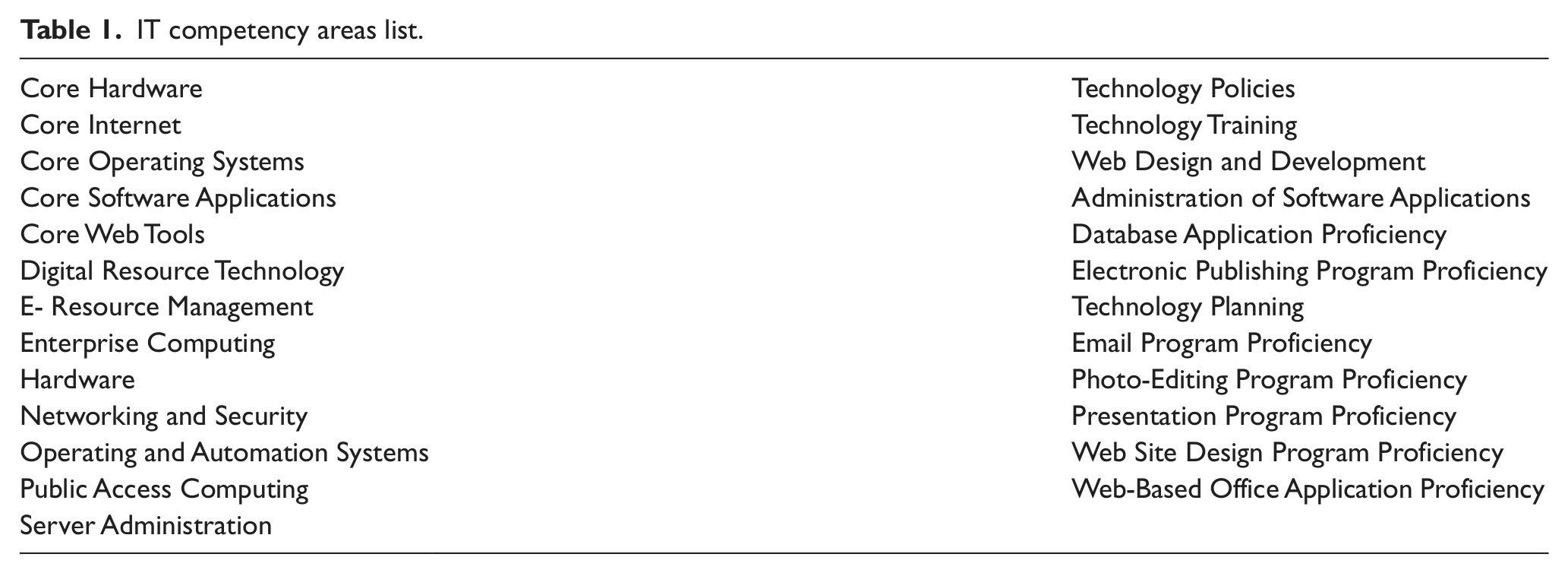
Table 1 lists all of the 25 competency areas that were used in this research. These 25 competency areas comprise a wide range of skills starting from core email skills to advanced database and networking skills. These reinforce the claims from the LITA guide of the increased expectations of librarians in today’s work environemnt. It is also evident from the list of competency areas that it includes not just techonlogy skills but also technology policies and the planning and administration of different resources.
IT competency areas list.
IT courses and comptencies taught at Library and Information Science schools
The 208 courses that were coded as IT courses were then evaluated against this list of 25 competency areas. In the coding process we found 448 occurences of these competency areas across all courses. As mentioned earlier, one course could address multiple competency areas. The courses were identified by the univeristy where they were being offered. At the end of this coding process a list of the IT courses being offered by the top 25 universities and the competency areas that each course addressed was created. These results are presented in Table 2. The number of courses offered in column 2 refers to the overall IT courses taught by the LIS school; these are not divided by yearly courses or one-off courses, but are all the courses that the school offers.
IT competencies taught at LIS schools.
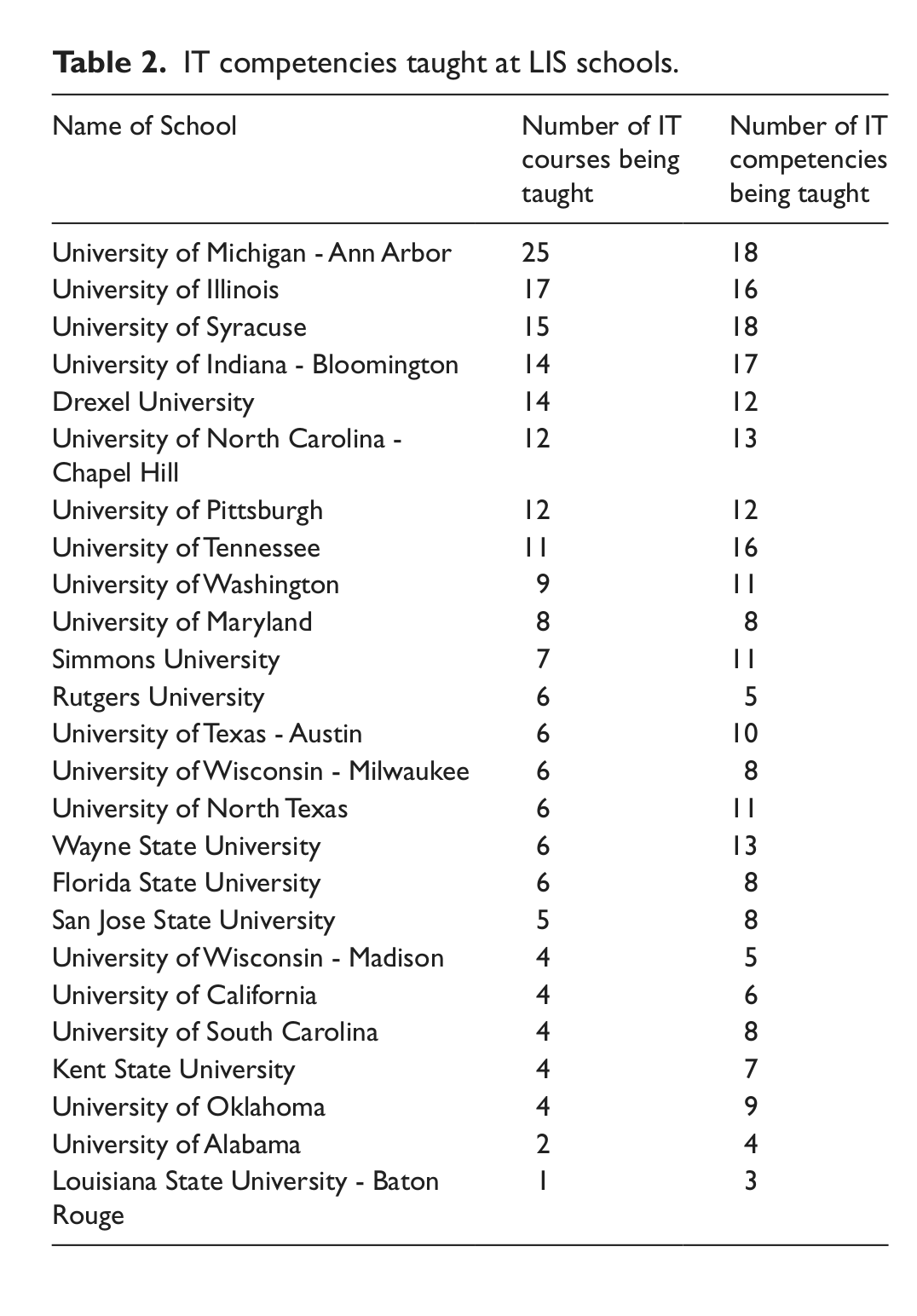
This list is sorted by the number of IT courses from highest to lowest. From this table we can see that the highest number of IT-related courses are being taught at the University of Michigan - Ann Arbor (25) followed by the Univeristy of Illinois (17) and Syracuse University (15). At the University of Michigan - Ann Arbor, the number of competency areas being addressed is 18 out of 25; this shows that one of the top-ranking schools with the highest number of technology courses is not addressing all of the competency areas from the index. As seen in the table, the number of competency areas addressed by the IT courses taught decreases as we scroll down from the University of Michigan - Ann Arbor to Louisiana State University - Baton Rouge. This shows a glaring gap between the skills demanded by employers and the curriculum taught by universities. This study focuses on the top 25 schools, and not even one of the top-ranking schools is teaching everything the students need to know to be succcessful in their employment. This forces us to wonder what would be the level of the skills of the students who are graduating from schools with lower rankings or no ranking at all? How can we expect our students to be successful in their job interviews and work environment when we do not equip them with the tools that they will need on a daily basis?
Also, Table 2 shows the wide range of competency areas being addressed in these top 25 schools. Some students are learning only three of the 25 competency areas seen as essential in their work environment as regular library staff, not systems libarians.
The analysis presented in Table 2 was done to gain an insight into how many competency areas an individual school is covering in its courses. analysis gave us an understanding of the number of courses as well as the competency areas of IT being covered across the board. After this analysis, we also wanted to find out what competency areas are being covered and the competency areas that are being ignored.
Mapping of competency areas: Strengths and weaknesses of the curriculum
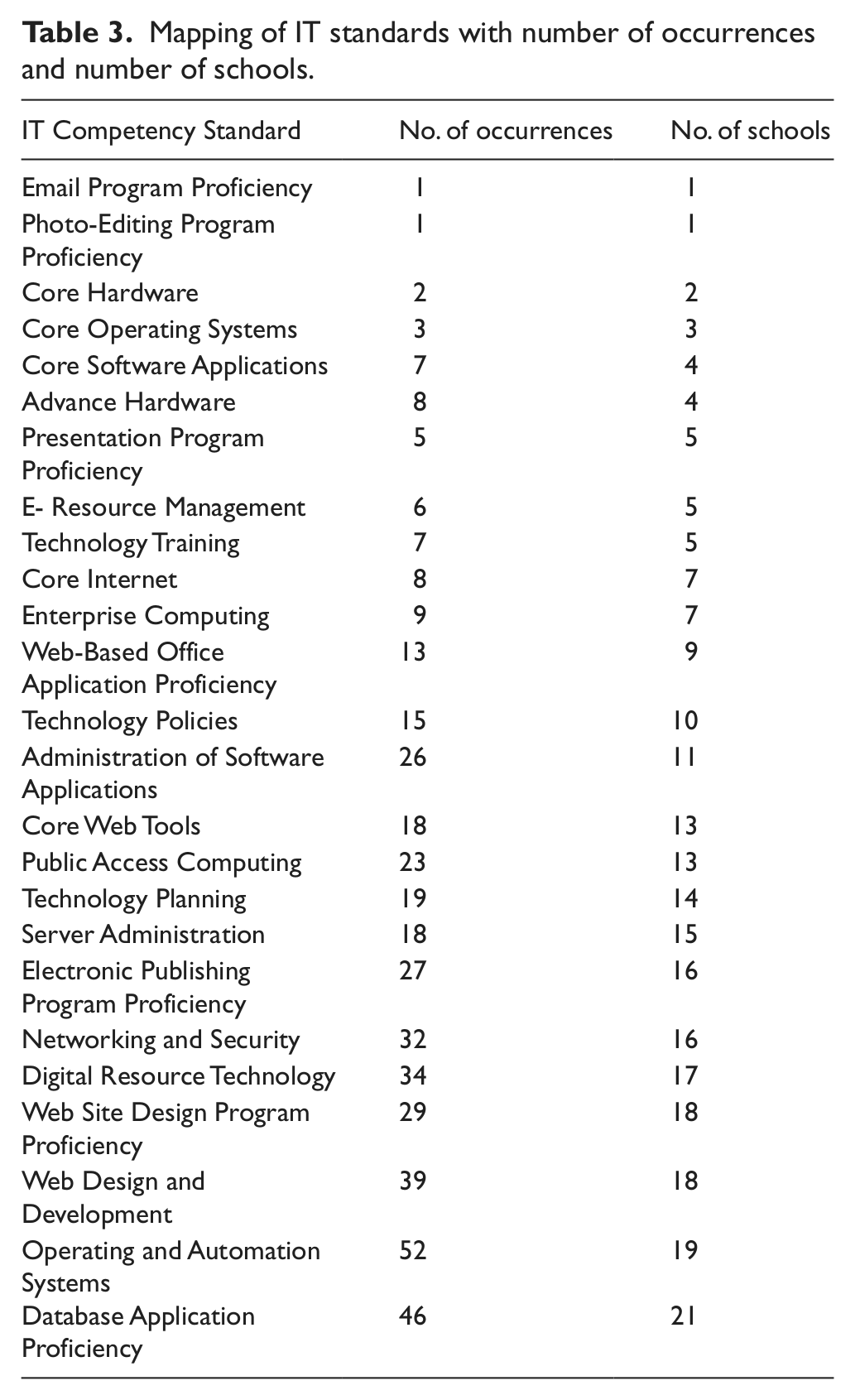
Table 3 presents the results of mapping the information technology competency areas to the number of classes and the number of schools. This list is sorted by the number of schools covering the standards. Table 3 shows that the results of this mapping are presented in the following four categories:
Competency areas offered by fewer than 5 schools;
Competency areas offered in 5–10 schools;
Competency areas offered in 10–20 schools;
Competency areas offered in more than 20 schools.
Mapping of IT standards with number of occurrences and number of schools.
Weaknesses of the LIS curriculum in top 25 LIS schools
From Table 3 we see that email programs, photo-editing programs, core hardware, core operating systems, core software applications, advanced hardware, presentation programs, e-resource management, and technology training are taught at fewer than five schools. Some of these competencies—such as email programs, presentation programs, core software applications, and perhaps even photo-editing programs—are not necessarily taught as course objectives, but students still learn them by taking courses. However, the other areas—including electronic resource management, operating systems, hardware, and technology training—are very important for students to know, but students do not learn them by default. The importance of these areas is seen in the fact that they occur multiple times in the research articles that were reviewed for this study. The LIS schools definitely need to pay attention to these areas if they want to graduate students who are successful in getting desirable jobs. Based on the above categories we see that three of the core technology areas are being covered in fewer than five LIS schools. The fact that these competency areas are in the Core Competency Index means that all library staff should be skilled in these areas. The technology competency areas that are covered in more than five but fewer than 10 schools are core Internet, enterprise computing, web-based office application proficiency, technology policies, administration of software applications, core web tools, public access computing, technology planning, and server administration. We believe that all of these areas, with the exception of server administration, are very important for students in today’s job market. Students need to understand these technology competency areas to be successful in getting and then maintaining a job. It is surprising to see that no school offers all the technological competencies identified in this study.
Strengths of the LIS curriculum in top 25 LIS schools
Table 3 shows that electronic publishing program proficiency, networking and security, digital resource technology, website design program proficiency, web design and development, operating and automation systems, and database application proficiency are the areas that are taught in more than 15 schools. Table 3 also shows that the highest numbers of technology courses are offered in the area of operating and automation systems; a total of 52 instances are offered in this area, which accounts for a quarter of the total technology courses offered. This illustrates that library automation systems have been considered very important by librarians as well as library educators for decades now. The area that is covered by the largest number of schools is databases; out of the top 25 schools, 21 offer at least one course that covers database application proficiency. Other than databases and automation systems, all of these technology competency areas can and should be taught at more schools. Because these numbers mean that there are almost 10 schools that are not offering these courses, they definitely should offer these courses to better equip their students.
Recommendations
In the next few paragraphs we choose five competency areas and skills adopted from the WebJunction Competency Index that are not being covered in most of the schools but are recurring in demand from employers and considered essential for efficient performance in any librarianship job. The individual skills in these competency areas are being presented because, based on the literature reviews and our research, we believe that they address topics that are of high importance and should be covered in LIS programs. These skills are also presented to help universities decide which topics can be taught in their courses. Out of the competency areas being covered in fewer than 15 schools, we chose a few that we consider significantly important for the graduate students in LIS programs to succeed in the workplace. Next we recommend five courses that should be taught in all LIS programs. For each of the courses we suggest the main topic and the skills that should be learning objectives. These courses and specific skills should be seen as guiding tools for developing single courses focusing on single areas or more general information technology courses. The first three competency areas are related to regular library staff, and the last two are geared toward systems librarians.
Course title: E-Resource Management
In our analysis (Table 3) we found that only five schools are offering courses that focus or touch on electronic resource management, which is such an essential part of work for librarians.
After completing a course on e-resource management, students should be able to meet the following course objectives:
Students should understand the concepts behind e-resource management systems and maintain an awareness of available products.
Students should be able to select, organize, and maintain the library’s collection of e-resources.
Students should be able to gather, maintain, and provide reports on the library’s subscriptions and/or purchases of e-resources, to interpret usage data for electronic journal and database subscriptions, and to recommend adjustments to the allocation of resources or renegotiation of license agreements.
Students should be able to evaluate, implement, configure, and maintain online library resources in terms of an Open URL service, meta-search tools, authenticated access options, and restricted access.
Additional topics that a course on e-resource management should cover include purchasing issues like content coverage, usage rights, licenses, and usage statistics; Open URL linking services like A and I databases and catalogs; meta-search tools for streamlined access to library resources; tools for authenticated access to e-resources appropriate for the parent institution; and services for restricting access to e-resources like proxy service, single sign-on, and Shibboleth.
Course title: Core Web Tools
After completing a course on core web tools, students should be able to meet the following course objectives:
Students should be familiar with and be able to locate web news sources, including blogs, RSS feeds, and podcasts.
Students should be able to use web communication tools, including instant messaging tools, social networking sites, social bookmarking, and web conferencing programs for synchronous, online meetings.
Students should be familiar with online sharing mechanisms, including photo-sharing, music-sharing, video-sharing, file-sharing, and collaboration tools.
Students should demonstrate lifelong web learning through the identification and use of help menus, tutorials, support communities, and other information sources.
Additional topics that a course on core web tools should cover include micro-blogs like Twitter; RSS feed readers like Google Reader and Bloglines; instant messaging tools like Meebo, Trillian, and Skype; social networking sites like MySpace, Facebook, LinkedIn, Ning, and Second Life; social bookmarking tools like Delicious and Diigo; photo-sharing tools like Flickr and ShutterFly; music-sharing tools like Last.fm, Pandora, and iTunes; video-sharing tools like YouTube; collaboration tools like Google Docs, Zoho, wikis, LibraryThing, and Slideshare; and information sources to stay informed about new technologies and social tools.
Course title: Public Access Computing
After completing a course on public access computing, students should be able to meet the following course objectives:
Students should be able to determine the need for public access computers, wireless access, and programs, as well as to select, install, and configure appropriate networking and peripheral hardware and operating systems and software applications.
Students should be able to maintain and update public computer hardware, operating systems, security, applications, and software licenses to ensure currency, as well as to keep current of advances in tools and applications of benefit to users.
Students should understand the nature of security threats to a public access system, as well as to select, install, and configure appropriate computer security measures.
Students should establish and publish acceptable use policies, as well as select, install, and configure restrictions on access, bandwidth, and content, such as filters.
Additional topics that a course on public access computing should cover include public versus non-public computers and networks; reservation, time, and print management systems; ADA recommendations for physical and electronic equipment; the pros and cons of open-source versus proprietary software in terms of meeting user needs; filtering issues in relation to the e-rate and LSTA funds; and issues related to access to social networking sites and programs.
Course title: Technology Policies
After completing a course on technology policies, students should be able to meet the following course objectives:
Students should be able to establish network usage policies that balance convenience and usability with security concerns and the wise stewardship of resources.
Students should be able to effectively explain underlying library technology policies and procedures in nontechnical language.
Students should be able to continuously evaluate the need for new or revised policies and procedures relative to changing technologies, as well as to seek staff and stakeholder feedback during policies and procedures development.
Students should be able to develop, review, and maintain technology procedure manuals.
Additional topics that a course on technology policies should cover include policies on privacy, intellectual freedom, and filtering as they relate to technology access and use; and plans for disaster preparedness and recovery for library technology.
Course title: Advanced Hardware
After completing a course on advanced hardware, students should be able to meet the following course objectives:
Students should understand in detail the functions of computer hardware, as well as be able to install and configure a variety of computer components.
Students should understand hardware performance and the impact of individual components on performance.
Students should be able to isolate, identify, and articulate problems with hardware, as well as to perform advanced troubleshooting methodologies for computer hardware and peripherals.
Students should be able to connect, support users’ access to, and troubleshoot problems with printers and scanners.
Additional topics that a course on advanced hardware should cover include the internal components and peripherals of computer hardware like external storage drives; effective and efficient ways to obtain technical support; and driver properties and networking for printers and scanners.
Discussion and conclusion
The results of this article present the strengths and weaknesses of the current IT curriculum in LIS schools. The recommendations of courses give a game plan or guidelines for the types of courses that different schools can teach. In the results, we were able to see very clearly that the strongest areas of technological competencies for LIS graduates are database management systems and automation systems. The schools that have these courses need not necessarily offer more advanced courses in these areas, but should target the areas where their curriculum is lacking. We found the same thing as Markey (2004: 326): most IT courses are offered as electives rather than requirements and cover multiple technology competency areas such as ‘library automation, technical services, database management, system design, and general surveys of information technologies’. Also, we agree that the offerings in IT-related areas are increasing, but because of the constant increase in demand for IT skills, we believe that LIS schools need to offer more courses and keep increasing the IT competency areas they are teaching. Our results are in agreement with those from various studies mentioned in the literature review that report the dissatisfaction that the students (Bosque and Lampert, 2009; Feret and Marcinedk, 2005; Hall-Ellis, 2006) and employers (Adkins and Esser, 2004; Kwasik, 2002; Thompson, 2009; Xu and Chen, 1999) feel due to a large gap in the LIS schools’ curriculum. We also agree with the research on educators (Fessler, 2007; Holt, 2005; Myburgh, 2003) who claim that we are doing a disservice to our students by not teaching enough IT competencies in the courses that we offer. In order to address concerns we proposed some ideas for courses with detailed descriptions of the skills to be covered in each. We highly recommend that one core course at all the LIS schools should be a technology course and cover basics of IT competencies. We strongly urge all of the schools to implement this in order to comply with the requirements of the professional organizations of our field as well as to enable our students to be successful in the workforce. It is our duty to provide them with the competencies and skills that will be useful in their jobs and will improve the quality of services provided by libraries.
In this study we did not discriminate among the course offerings on the basis of core courses or electives, and therefore one limitation of this research is that a student might obtain a degree from one institution but still not have the necessary IT skills. In addition, because we looked at only online course descriptions and not the entire syllabi (including lecture topics and readings), we might have misjudged some of the areas being covered by certain courses if the descriptions were not comprehensive enough.
The research presented in this article is novel, and the findings draw immediate attention to several levels of urgency. First, IT is a functionality that is here to stay, and LIS professions need to further consolidate, represent, integrate, and market themselves in terms of IT values, constructs, and practices in order to stay relevant and competitive (Mehra et al., 2010a; Rubin, 2010). This will shape external perceptions (including those of the public) and realities in American society more effectively as compared to the past where LIS has been viewed as disconnected and unrelated to IT, leaving the profession behind others (e.g. computer science, computer engineering, and business and organizational information systems management) in generating community outcomes and in sharing resources, recognition, prestige, and power (Dillon and Norris, 2005; Mehra and Sandusky, 2009). Second, there has been limited research of IT representations in the LIS curriculum beyond isolated, anecdotal, or case-study-like analyses that reveal underlying trends, patterns, and content implementations across the varied LIS educational programs (Johnston and Webber, 2004). Third, understanding these IT representations in LIS education is vital for our survival; it will help us to acknowledge and recognize strengths, weaknesses, opportunities, gaps, and threats, as well as to take action, grow, and extend our impacts in the local, regional, national, and global arenas (Mehra et al., 2010b). Fourth, if we do not assimilate IT content, capacities, capabilities, and critical analysis in LIS education and practice, we will be doing a terrible disservice to our students and preventing them from staying competitive and relevant, and developing as true leaders in the global information society (Leckie et al., 2010). Fifth, the research findings in this article provide an overarching yet detailed analysis of IT in the LIS curriculum that includes a mapping of IT topic areas and possibilities for different LIS schools and programs to identify and share curriculum development, best practices, and policy implementation matters (Wiegand, 2003). Sixth, the research methodology of the content analysis of LIS schools’ websites is one that can be replicated in other contexts of research on varied disciplinary trends in other domains of knowledge as well as documentation of IT patterns in other parts of the world (Neuendorf, 2001). Lastly, the focus and use of LIS program website content analysis research draws attention to the importance of representing accurate, updated, and complete information about our programs and curricula online since the Internet will continue to have a pervading and encompassing impact on our knowledge, experiences, networking, and skill-opportunities. If LIS programs believe that they can get by with inadequate and limited representations online, it is important for them to realize that they are making a grave mistake.
In future research we would like to study detailed course outlines, textbooks and suggested readings, core versus elective courses, and the frequency with which elective courses are offered, because all of these factors are important to form a comprehensive picture of IT competencies in LIS school curricula.
Footnotes
Funding
This research received no specific grant from any funding agency in the public, commercial or not-for-profit sectors.
Author biographies
