







Abstract
Ownership and rights issues relating to electronic resources can be a source of angst, confusion and litigation. This is due in part to the automatic copyright many individuals receive, including in the United States, upon creation of an original work. However, there are options available for relaxing these rights. One of these options is Creative Commons Zero. Essentially, Creative Commons Zero permits originators of materials of varying sorts to opt to put their creations into the public domain – waiving all copyright and intellectual rights. The ability for originators of works to place these items into the public domain affects not just that individual, but also all others who might make use of the resources or be affected by others who make use of the resources. One area likely to be both directly and indirectly impacted is libraries. After all, a public library is accessible by the public and contains a collection of materials or records kept for reference or borrowing and is generally funded from public sources. In the United States there are approximately 9225 public libraries (administrative entities) in all 50 states and the District of Columbia (US Census Bureau, 2009). Based on the above, this document researches the awareness, complexity and effects of Creative Commons Zero and related licenses on libraries as perceived by library directors and managers across the United States. In order to accomplish this, a quantitative survey was administered in an anonymous web-based format.
Situational overview
Ownership and rights issues relating to electronic resources can be a source of angst, confusion and litigation. This is due in part to the automatic copyright many individuals receive, including in the United States, upon creation of an original work. However, there are options available for relaxing these rights. One of these options is Creative Commons Zero (CC0). Essentially, CC0 permits originators of materials of varying sorts to opt to put their creations into the public domain – waiving all copyright and intellectual rights. The CC0 license is offered by Creative Commons, which was founded in 2001. As Creative Commons (n.d. a) states: Using CC0, you can waive all copyrights and related or neighboring rights that you have over your work, such as your moral rights (to the extent waivable), your publicity or privacy rights, rights you have protecting against unfair competition, and database rights and rights protecting the extraction, dissemination and reuse of data.
For those who are not familiar with Creative Commons, or public domain, some additional explanation may be necessary. Creative Commons (http://creativecommons.org/) is a non-profit organization that has established alternative copyright licenses for the public, which are known as Creative Commons licenses. These licenses vary based on legally attached criteria: attribution requirements, share alike stipulations, non-commercial or commercial permissions, and whether the works can be altered. Most of these licenses do not release materials into the public domain (Creative Commons, 2013). The public domain is ‘the realm of material—ideas, images, sounds, discoveries, facts, texts—that is unprotected by intellectual property rights and free for all to use or build upon’ (Center for the Study of the Public Domain, n.d.). Items go into the public domain when rights have expired, been forfeited, or are not applicable for some reason. A simple example of public domain materials can be found in Project Gutenberg (http://www.gutenberg.org/) which houses a large number of books whose copyrights have expired.
In the case of CC0, the creator chooses to put the works in the public domain. As Creative Commons (2013) states: Copyright and other laws throughout the world automatically extend copyright protection to works of authorship and databases, whether the author or creator wants those rights or not. CC0 gives those who want to release those rights a method to do so, to the fullest extent allowed by law. Once the creator or a subsequent owner of a work applies CC0 to a work, the work is no longer his or hers in any meaningful sense under copyright law. Anyone can then use the work in any way and for any purpose, including commercial purposes, subject to other laws and the rights others may have in the work or how the work is used. Where once rights had to be claimed, they now have to be given away. Think of CC0 as the ‘no rights reserved’ option.
What it means socially and culturally
The ability for originators of works and materials to place these items into the public domain affects not just that individual but also all others who might make use of the resources or be affected by others who make use of the resources. In the field of technology management this could have an impact on virtually all disciplines and areas of emphasis. It also has direct ties to consideration of what constitutes appropriate technology. In technology management, a technology is appropriate when ‘its intended positive consequences outweigh its unintended negative consequences’ (Markert and Backer, 2010: 254). The appropriateness of the technology is evaluated on technical, cultural and economic factors (Markert and Backer, 2010: 256).
The implementation of copyright or intellectual rights options such as CC0 directly, or indirectly, brings up a number of legal, ethical and social considerations. One such consideration is how an individual’s decision to place materials in the public domain could potentially affect others both positively and negatively. Another consideration involves situations in which the person who waived rights may not have had clear authority to do so for the full extent of the materials. Consider, for example, if the author used other individuals’ resources in which to make his or her own work. Still another consideration may be the value, quality and social or cultural meaning of the content put in the public domain. Still one more consideration may be how an individual’s, group’s or institution’s rights might merge, converge or diverge from those of the individuals affiliated with that institution or company.
One area likely to be both directly and indirectly impacted by the increasing availability of public domain, and perceived to be in the public domain, resources are libraries. After all, a public library is one that is accessible by the public, contains a collection of materials or records kept for reference or borrowing and is generally funded from public sources. In the United States there are approximately 9225 public libraries (administrative entities) in the 50 states and the District of Columbia (US Census Bureau, 2009). These libraries are affected by the changing dynamics of copyright, public domain, and resource availability.
According to Laura N Gasaway, an Associate Dean for Academic Affairs and Professor of Law at the University of North Carolina, Chapel Hill, works passing into the public domain have been declining over the past 35 years because of changes to copyright law: ‘Since 1978, there are increasingly fewer and fewer of these works because formalities of copyright were eliminated by the 1976 act’ (Gasaway, 2009: 458). Connie Strittmatter, a reference librarian at Montana State University, sees this same trend and is concerned that stricter copyright is hindering the library’s traditional role as preservationist. Strittmatter and Tanner (2009: 24) believe that Creative Commons can help counteract these trends: With growing restrictions on the use of intellectual properties, CC is keeping the commons alive, The Internet was built with sharing in mind. However, a growing array of copyright restrictions are being developed, which make it harder and harder to share information and collaborate. Data shows that older works are being lost because we aren’t sure if we can share them or can’t find out who to ask.
Copyright infringement in libraries is often described as a type of risk management. It is difficult to preserve items—by creating copies or other techniques—when it is not clear from whom to procure permission. If doing so seems too risky for a librarian, the item will go unpreserved and possibly be lost forever. Laura Gordon-Murnane (2010: 18) warns that we are losing much more than just concrete works, we are losing culture: Today, cultural media of the 20th century is largely off limits, locked away from the public domain … copyright, intended to be the servant of creativity, a means of promoting access to information, is becoming an obstacle to both. This is what led the Creative Commons Foundation to find an alternative to ‘All Rights Reserved’.
Research
This document researches the awareness, complexity and effects of CC0 and related licenses on libraries as perceived by library directors and managers across the United States. In order to accomplish this, a quantitative survey was administered via email inquiry (see Appendix A) and an anonymous online Web survey form (see Appendix B). The questions on the survey were listed in a fixed order for all respondents and contain clear and concise language for the population being studied. The survey contained a series of content items, written as semi-structured questions, which ask about the respondents’ opinions, attitudes, knowledge and behavior (Graziano and Raulin, 2004; McMillan and Schumacher, 1997). A pilot test was performed prior to full interview implementation. Additionally, human subjects’ clearance was obtained and a cover letter written which explained the intention of the survey, how it will be administered, and how the information will be dispersed (see Appendix A).
Again, the population of interest is the approximately 9225 public libraries across the United States and in particular the library directors and managers at these locations. Manual email inquiries were sent to 750 randomly selected libraries across the United States between the dates of September 2012 and March 2013. Of the 750 sent, 35 were rejected or obsolete email addresses, leaving 715 total emails delivered. These 715 email addresses were sent an original inquiry (see Appendixes A and B), as well as a reminder email two weeks later (see Appendix C). Of the 715 inquiries and reminders, 113 responses were received. However, of these 113 responses, 59 had over half of the survey answers blank, rendering the data incomplete and not usable. This left us with a total of 54 valid responses.
Although this research is not testing a hypothesis, but instead is an exploratory study, the survey sample size was based on numbers used for inferential statistics in order to best illustrate the potential range of feedback the survey results represent. Our goal was to have a minimum of 95% confidence level with a confidence interval, otherwise known as a range of scores or margin of error, of 10%. Based on the United States public libraries number of 9225 a sample size of 95 would have been necessary to achieve a confidence level of 95% and a confidence interval of 10%. We hit this target if one includes the responses with less than 50% of the questions answered, but only had 54 responses which we considered valid, which instead is a confidence level of 95% but a confidence interval of only about 13%. Again, as this is actually an exploratory study we are opting to move forward with our assessment of the results.
The results in this study may be too small to prove statistical validity or significance; however, the goal is an exploratory study that presents areas for potential assessment or improvement, thus the information may still be of practical importance, particularly if improvements can be made with little expense or risk. Just as statistical results that demonstrate statistical significance do not necessitate them being of practical importance, results that do not demonstrate statistical significance do not necessitate them being of no practical importance. Practical importance or significance represents the educational value of the results. It may be shown in effect sizes that present degrees to which a phenomenon is present, replicability potential, or simply by being noteworthy (Gliner et al., 2002; Onwuegbuzie and Leech, 2004; Thompson, 2002; Utts, 2003).
Theoretical framework
Everett Rogers’ four main elements in the diffusion of innovations as described in his book Diffusion of Innovations (2003), was used as the framework to assess individuals’ viewpoints on the adoption and diffusion of the varying aspects of Creative Commons. Rogers was chosen due to his prominence in the field and use in prior research (Allard, 2003; Al-Shohaib, 2005; Liebermann, 2006; Schroll, 2007).
Getting new ideas, technologies, products, or processes adopted on a wide scale is difficult. Rogers discusses the challenges and end-user tendencies in adopting new innovations. Rogers defines an innovation as ‘an idea, practice, or object that is perceived as new by an individual or other unit of adoption’ (2003: 12). He refers to the spread of an innovation as its diffusion, ‘the process in which an innovation is communicated through certain channels over time among the members of a social system’ (2003: 5). This does not assume, however, that the adoption of an innovation is necessarily good for all participants nor does it assume they will accept all aspects of an innovation. Equally it does not assume all potential participants will adopt at the same rate. Instead, Rogers (2003: 282–285) identifies varying adopter categories including (a) innovators who are the first to adopt, (b) early adopters, (c) early majority, (d) late majority, and (e) laggards.
As Rogers (2003: 11) states: we defined diffusion as the process by which (1) an innovation (2) is communicated through certain channels (3) over time (4) among the members of a social system. The four main elements are the innovation, the communication channels, time, and the social system.
The four main elements in the diffusion of innovations include: (1) The innovation: An idea, practice or object that is perceived as new by an individual or other unit of adoption; (2) Communication channel: The means by which messages get from one individual to another. The nature of the information exchange relationship between a pair of individuals determines the conditions under which a source will or will not transmit the innovation to the receiver and the effect of such a transfer; (3) Time: The time dimension is involved in diffusion in (i) the innovation-decision process by which an individual passes from first knowledge of an innovation through its adoption or rejection, (ii) the innovativeness of an individual or other unit of adoption compared to other members of a system, and (iii) an innovation’s rate of adoption in a system, usually measured as the number of members of the system who adopt the innovation in a given period of time; and (4) Social system: Defined as a set of interrelated unites that are engaged in joint problem solving to accomplish a common goal. The members or units of a social system may be individuals, informal groups, organizations, and/or subsystems (Rogers, 2003). It is assumed that these four elements will play a role in the diffusion of CC0 and related mechanisms intended to place resources into the public domain. It is also assumed these four elements will play a role in the perception of these diffusions.
Rogers writes, potential adopters go through a systematic decision-making process. First, knowledge must occur where an individual is exposed to an innovation’s existence. Next, persuasion must occur where the individual forms a positive or negative viewpoint toward the innovation. A decision is then made by the individual to adopt or reject the innovation. Implementation of the decision then occurs by the individual, and finally confirmation occurs when the individual seeks reinforcement of the decision that had been made (Rogers, 2003: 169). Before potential users can be persuaded positively or negatively toward an innovation they must be informed about its existence.
Results
A complete collection of the results and all original feedback can be found at http://www.ourdeskdrawer.com/~papers/libraries-cc0-research/full-results-contact-removed.xlsx
Overall, our results were surprising. While all librarians who responded (n=54) knew at least to some extent the definition of the public domain, only 32% were able to accurately define Creative Commons and only 11% were able to accurately define CC0. This means that a great majority of respondents were unaware of these innovations.
Public domain definitions
Participants were asked to briefly describe what they understand public domain to be. The 53 descriptive responses received can be broken into five definition categories as shown in Table 1.
Librarian definitions of public domain.
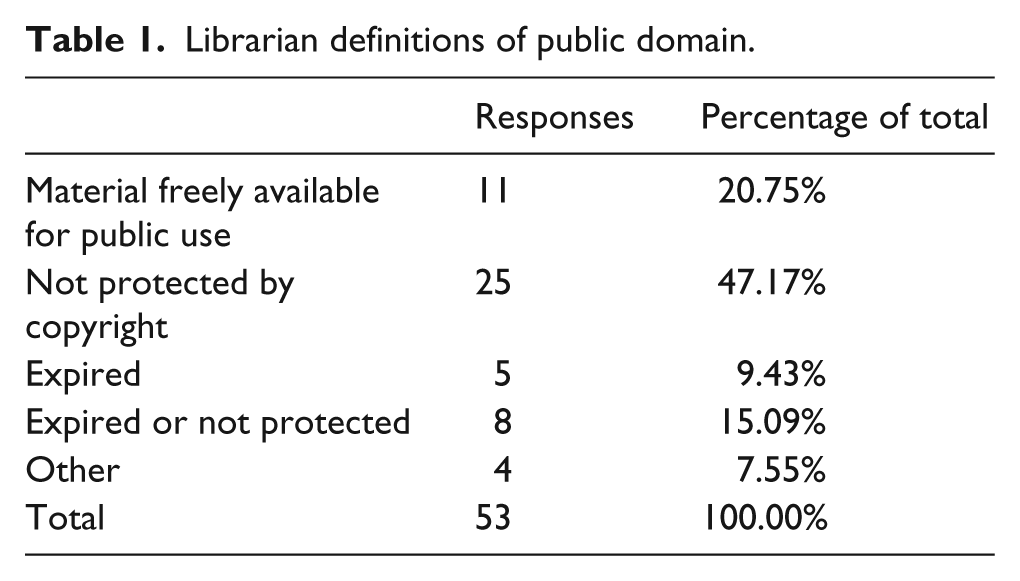
Participants generally described the public domain correctly. If we consider Merriam-Webster’s (n.d.) dictionary definition then it would be: ‘[Public domain is] the realm embracing property rights that belong to the community at large, are unprotected by copyright or patent, and are subject to appropriation by anyone’. It should be noted that public domain is recognized on a country-by-country basis.
The most common response dealt with not being protected by copyright. This focused on materials without restrictions for unspecified reasons, though a smaller group of responses focused on the expiration of copyright as a theme. Discussing public domain in connection to copyright was popular; however, the second most common theme discussed materials belonging to the people or free for all to use without mention of copyright. Most of these responses fit the aforementioned definition nicely, showing that respondents understand the public domain. Below is a summary of the responses.
Material freely available for public use
The first theme in the definition of public domain revolved around material free and available for public use. There were 11 responses (20.75%) in this category which included definitions such as: information belonging to the people, free for all patrons to use at will, or rights which are owned by all people.
Not protected by copyright
While public domain does indeed incorporate material freely available for public use, it also entails levels of release or modification of copyright. This category was the most common definition. There were 25 responses (47.17%) revolving around the freedom from copyright restrictions because the items never had copyright or because copyright no longer applies for reasons not specified. This category included definitions such as: free from copyright restrictions on use, items not protected by copyright, belonging to or being available to the public without copyright, and published works that are not protected by copyright
Expired
Five (9.43%) individuals explicitly noted that public domain is tied to copyright that has expired. While this is not the only means for an item to end up in the public domain, it is certainly a traditional means. These definitions included definitions such as: the copyright has expired and not been renewed, anything on which the copyright has lapsed or was created so long ago there was no copyright law, and ideas, thoughts, items that have outlived the copyright.
Expired or not protected
Eight (15.09%) of the responses noted that while expiration of copyright matters, there are other means for items to end up in the public domain and thus unprotected by copyright. These are the most accurate descriptions of public domain.
Other
Four (7.55%) additional answers did not fit well into any of the above categories.
Creative Commons definitions
Participants were asked to briefly describe what they understand Creative Commons to be. Results are shown in Table 2. While 21 (39.63%) individuals submitted a definition, another 32 (60.38%) individuals stated they did not know the definition in the description field. Of those who submitted a definition, 17 (32.08%) gave definitions that were accurate or partly accurate and 4 (7.56%) gave definitions that were inaccurate.
Librarian definitions of Creative Commons.
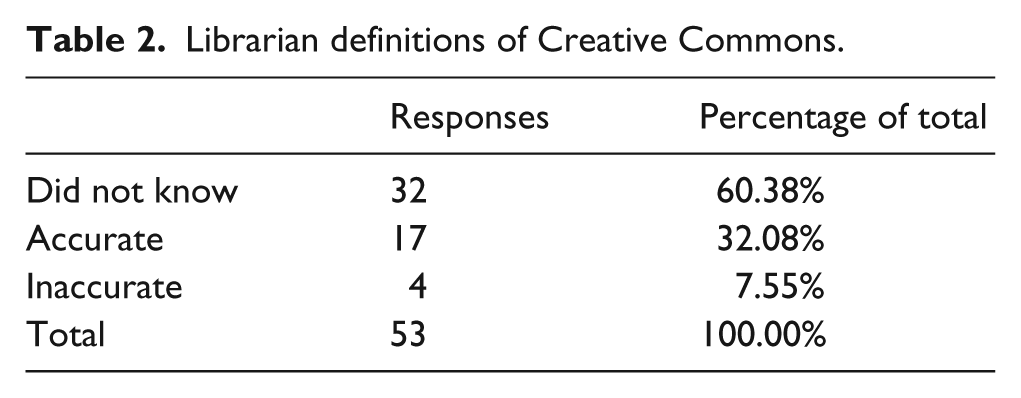
There were accurate explanations of Creative Commons such as the statement: ‘A place to intentionally share ideas and information with at least a partial forfeiture of individual intellectual rights’ or ‘Creative Commons offers text, music, images, etc. that are free of copyright restrictions’; however, general understanding of Creative Commons plummets in comparison to the public domain. For example, some incorrectly claimed Creative Commons is: ‘Things that are created by a group and others can use and change as needed’ or ‘it is an organization that works with copyright licenses’. Respondents do not represent a body in which an understanding of Creative Commons has diffused.
CC0 definitions
Participants were asked to briefly describe what they understand Creative Commons Zero (CC0) to be. Of the 52 responses received, 13 (25%) individuals submitted a definition, while another 39 (75%) individuals stated they did not know the definition in the description field. Individuals that offered a definition are as follows: of the 13 definitions, 6 (11.54% of all responses) were accurate or partly accurate, 4 (7.69%) were definitions that actually relate more to Creative Commons generally than CC0 specifically, and 3 (5.77%) were inaccurate. These results are shown in Table 3.
Librarian definitions of CC0.
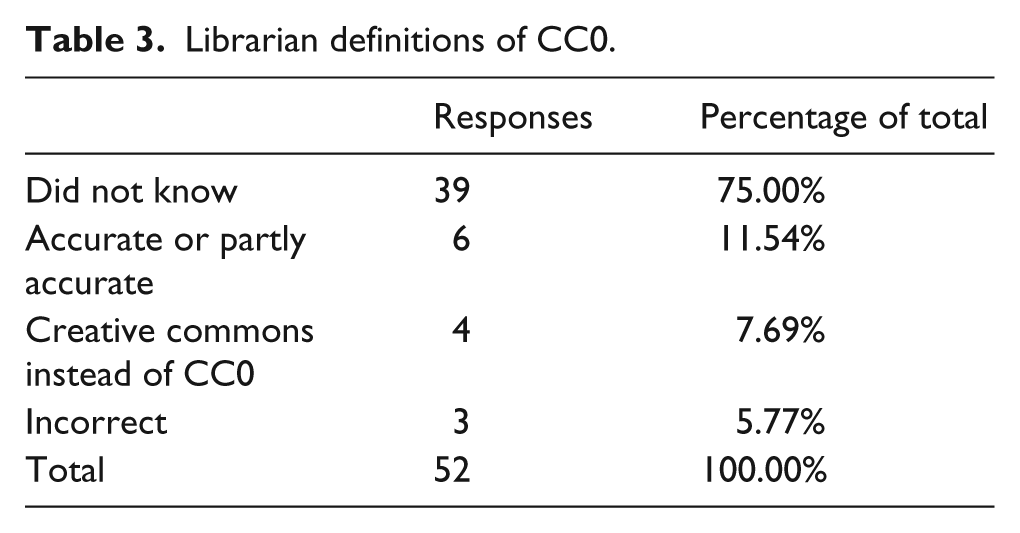
Accurate understanding continues to plummet with CC0 in comparison to the public domain. A minority of respondents do understand CC0 as a method to pass works into the public domain, but are far outnumbered by the respondents that simply do not know what CC0 is. This is not surprising since CC0 is a more recent innovation of Creative Commons. If Creative Commons has not diffused among respondents it is unlikely that CC0 would have either.
Examples of definitions that were accurate or partly accurate include: ‘CC0 is for people who want to completely give up copyright to materials they have created’ or ‘The creator of a work has waived his or her intellectual property rights and declared the work to be public domain’. However, incorrect answers include comments such as: ‘Taking someone’s work and making changes’ or ‘Copyrights that protect databases for commercial use for the public’.
Effects of ability to put items in public domain
Respondents understand and define the public domain well, but are preponderantly unaware of Creative Commons and CC0. Participants were given working definitions of these innovations in order to respond to the remaining inquires. Librarians were asked to identify the effect of the ability of an originator to place items into the public domain on: (a) our social and cultural perceptions of copyright and/or intellectual property, (b) our perceptions or practices of copyright and/or intellectual property, (c) our perceptions or practices of citation and attribution, (d) the impact it may have on public libraries, and (e) whether or not it is generally a positive or negative outcome.
Effects on our social and cultural perceptions of copyright and/or intellectual property
Participants were asked to answer the question, ‘Can you see the ability of an originator to place items into the public domain affecting our social and cultural perceptions of copyright and/or intellectual property? If so, how?’ The results are shown in Table 4.
Effect on our social and cultural perceptions.
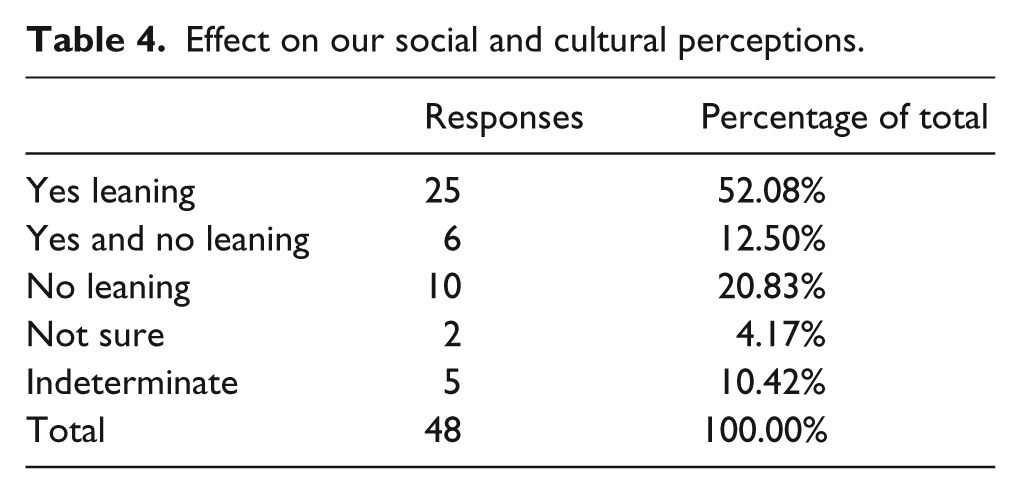
A good example of a yes answer is: ‘I imagine it would build an expectation in society for even more property to move to the public domain, and to move so more quickly’. This idea seems to resonate throughout yes responses. The expectation is that it would increase creativity and inter-connectivity in society.
Answers that leaned more toward both yes and no seemed more inclined to believe that placing items in the public domain legitimizes what is probably already taking place. A yes and no leaning answer introduces an important idea: ‘Somewhat, anyone aware of the concept would be inclined to ask about the works status. Also creators might be encouraged by some to seek a Creative Commons status for their creations’. So, if people are aware of the innovation, it might be sought out more often, this idea speaks directly to diffusion of the innovation.
Others did not believe that it would change social/cultural perceptions. The most common idea is that things are either in the public domain or they are not and it does not particularly matter how they got there.
Effects on our legal perceptions or practices of copyright and/or intellectual property
Participants were asked, ‘Can you see the ability of an originator to place items into the public domain affecting our LEGAL perceptions or practices of copyright and/or intellectual property? If so, how?’ The results are shown in Table 5.
Effect on our legal perceptions.
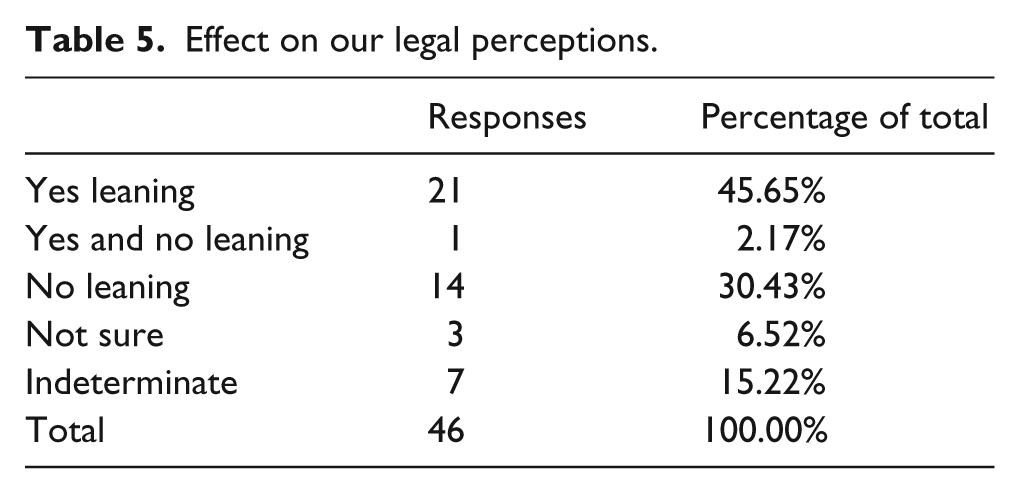
Most respondents think that these innovations have an effect but they actually complicate the legal perception and situation. Whether things are copyrighted or not becomes murkier if there are new ways to place works into the public domain. This comes with a host of new complications highlighted by respondents such as: ‘Would the item remain in the public domain or could one of the subsequent owners make it a copyrighted item?’ or this would have an effect especially in a public library where users may ask for copies of things we heretofore considered under copyright law. I would think I’d have to do a great deal more research to be sure of the status of the document/work in question.
Those who answered no emphasize that works will still legally be considered in the public domain or copyrighted regardless of what licenses are applied through the innovations of Creative Commons and CC0. Seven individuals simply said that it will have no legal effect. Others made statements such as: ‘Once it was determined that it is was in public domain, the item would be thrown out of court’ or ‘as it takes an additional step to allow CC0, I see that as something they can do if they wish it, it shouldn’t change existing ideas or practices’.
Effects on our perceptions or practices of citation and attribution
Participants were asked, ‘Can you see the ability of an originator to place items into the public domain affecting our perceptions or practices of citation and attribution? If so, how?’ The results are shown in Table 6.
Effect on citation and attribution.
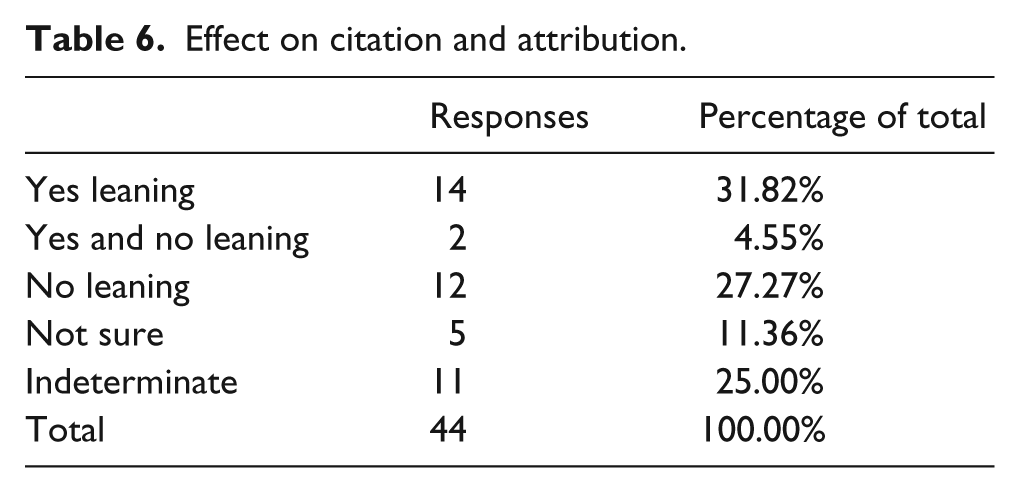
Much of the discussion (n=10) for yes respondents focuses on works not being cited because they have been remixed, altered, or generally edited from the original work. Remixes and mashups with multiple authors become more complicated over time. This can be seen in statements such as: ‘It seems obvious that content that can be altered, copied, remixed, or edited may lead to confusion when it is cited or attributed to the person who created the original work’ or ‘Odds are that the originator will not be credited every time the creation is used, therefore, it will become an anonymous piece in fairly short order, making proper citation and attribution nearly impossible’.
No responses remind us that many works are already in the public domain and are often correctly cited if the author and other vital information are known. A majority of no responses simply said there would be no effect on citation and attribution (n=8). Others made statements such as: ‘If the originator is still identified with the item then citing or properly attributing a creator to an items will not be a problem’ or ‘I don’t think public domain has anything to do with citing or attributing a work. Either a person is conscientious about that or not’.
The impact it may have on public libraries
Participants were asked, ‘Can you see the ability of an originator to place items into the public domain affecting public libraries? If so, how?’ The results are as shown in Table 7.
Impact on libraries.
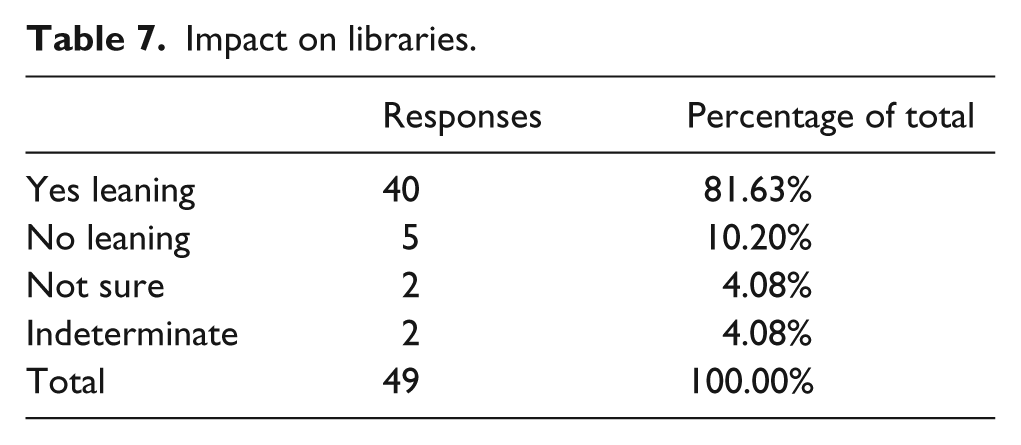
This question drew general agreement. Libraries are more invested in the public domain than other institutions. Respondents seem to agree that more methods for more works to pass into the public domain would benefit libraries. For example: ‘Yes, it would make freely available more works and open source materials such as full text availability for everyone including public library collection development’. There seems to be agreement that more accessible information in the public domain benefits libraries because it would make freely available more works and open source materials for everyone including public libraries (n=7). This segues directly into our next question.
Generally a positive or negative outcome
Participants were then asked, ‘Can you see the ability of an originator to place items into the public domain as a generally positive or negative thing? Please explain’. The results are as shown in Table 8.
Generally positive or negative outcome.
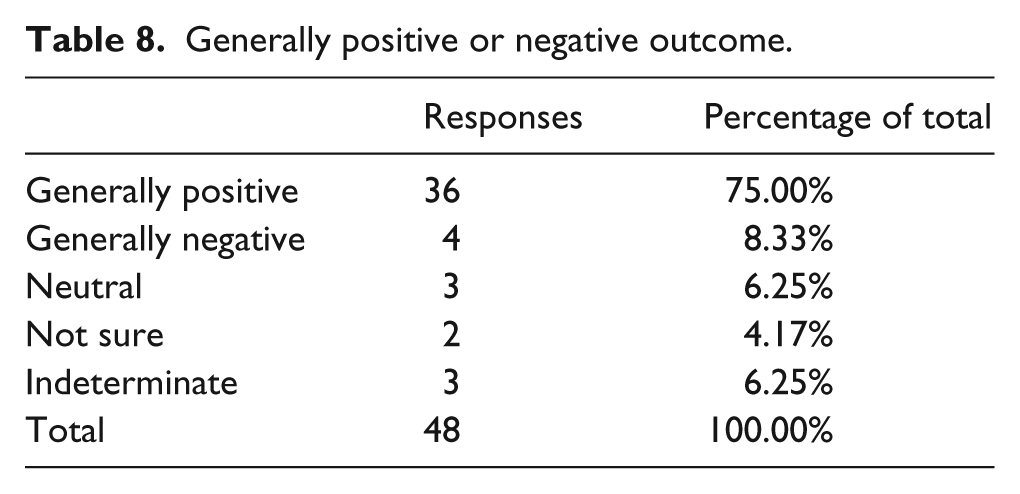
Overwhelmingly, the responses were positive, with 36 (75%) saying it was positive or generally positive of 48 responses. There are many repeated ideas in this section. Overall, the respondents believe that more public domain resources will positively affect creativity and innovation by giving creators of works and users of works more options. Six responses, for example, emphasized that it would give free access to items to more people and puts the distribution and sharing of the work in the purview of the creator. Another five answers emphasized that it offers a means of sharing ideas or materials with the public in an accessible manner. Others were ambiguous in their application of the innovation: ‘A little of both. It could free up uses of items for educational purposes but it could also increase the sense of entitlement in the public’.
Diffusion of innovation results
Lastly, librarians were asked to explain what they perceive to be the affect certain elements of diffusion of innovation including: (a) the role of the innovation itself (idea, practice or object that is perceived as new), (b) the role of the communication channel (nature of information exchange), (c) the role of the time (time between knowledge and adoption or rejection, rate of adoption, etc.), and (d) the role of the social system (individuals, informal groups, organizations, and/or subsystems)
The role of the social system
This question was answered by 38 respondents. Six said they do not know or do not have an opinion and four simply said it had an important or strong role. Of the 28 additional answers eight themes emerged. Of all the elements of diffusion this area had the greatest number of overall themes emerge, implying that the role of social systems is broad but relevant. First, that the social system creates a broader audience and more possible consumers (n=4). Second, the distribution of information is increased or disseminated more rapidly (n=3). Third, dissemination, awareness and storage of an item is increased when placed in public domain (n=3). Fourth, bringing a resource into the public eye is a way to share and learn (n=3). Fifth, social systems allow for greater exchange of ideas, formation of groups, identification of similar likenesses and ability for individuals to publish (n=2). Sixth, social systems can tremendously impact the sharing of an item because the Internet informs us faster and more globally than ever (n=2). Seventh, more information readily available to every social system helps level the playing field for all (n=2). Eighth, the social system will continue to recommend certain works over other works, based on many factors, but mostly on merit (n=2).
The role of the time
This question was answered by 40 respondents. Six said they do not know or do not have an opinion, three simply said the role is not significant, and two said the role is significant. Of the 29 additional answers four themes emerged, the first and second being notably stronger than the third and fourth. First, time greatly accelerates the speed which ideas are exchanged, spread, built upon, expanded, refined, and/or developed (n=7). Second, items will be adopted or rejected more quickly (n=5). Third, some items take time to be understood and then adopted whereas some have a short span (n=3). Fourth, new ideas will be a constant in our lives and not held up by bureaucracy; the delay between creation and judgment by the world can be sped up exponentially (n=2).
The role of the communication channel
This question was answered by 39 respondents. Five said they do not know or do not have an opinion and four said the role is important. Of the 30 additional answers four themes emerged, and as with the role of time, the first and second were notably stronger than the third and fourth. First, a direct pipeline to the public through online resources is a prime method to disseminate information and resources quickly and easily with little or no cost (n=7). Second, Creative Commons could open more efficient channels of communication online and affect how and when the items are used and by whom, serving to increase sharing and adoption (n=7). Third, social media, mixed media, and Internet connections are the new and relevant connections (n=4). Fourth, communication is becoming faster, especially in the global environment (n=2).
The role of the innovation itself
This question was answered by 37 respondents. Six said they do not know or do not have an opinion and two said the role is important. Of the 29 additional answers only three themes emerged and each of these themes were limited in scope. This implies either the role of the innovation itself is less relevant, or the responses relating to the role of the innovation were not consistent. First, the innovation itself opens more channels of thought and gives exposure to news ideas. We may actually innovate faster and with better quality in this model (n=3). Second, ideas will not be filtered so some may be unwanted or unneeded (n=2). Third, Creative Commons is good for the exchange of ideas but not so good for the support of the creators (n=2). The other answers covered a broad array of topics from societal accustomization to change to the democratization of the sharing of ideas.
What this means for public libraries
If librarians remain woefully unaware of Creative Commons, and more specifically CC0, they will be complicit in a tremendous opportunity loss. This can be considered from several vantages. Librarians who are unaware of these licenses, and in the case of CC0, release of all rights, cannot disseminate this innovation to patrons and other librarians. Without this knowledge patrons and librarians are neither directed towards using these resources nor contributing to these movements. Unaware librarians cannot take advantage of accessible and free resources in order to enhance library content and programming. New innovations and trends such as CC0 must be disseminated quickly and professionally by librarians in order to support equal access to information. This responsibility falls upon every level of librarianship. Local, state, national, and international library organizations must publicize innovations in notorious ways.
Unawareness of these innovations and trends delegitimizes librarians as information and technology professionals. Librarians must noticeably contribute to all information and technology movements and fields in order to maintain their place at the proverbial table. Remaining in the conversation enables librarians not only to contribute to the fields of information and technology, but to create value by combining these emerging innovations with the more unique aspects of librarianship such as community outreach and programming. Librarians must take responsibility to remain credible information and technology professionals by focusing on the diffusion of innovations within the field.
Preservation and access to information are cornerstones of librarianship. With that in mind, the public domain must be anxiously protected and expanded by librarians. Copyright laws are restrictive and onerous, so any innovation with a goal of accessibility must be supported and assimilated by librarians. CC0 can help rejuvenate the dwindling public domain.
Librarians and paraprofessionals need to learn more about the innovations that will likely affect them. New innovations must be disseminated in understandable, digestible, and memorable ways. Library-related Creative Commons’ projects are a great way to accomplish diffusion. One example of a project is a Creative Commons ILEAD USA project called Creative Libraries Utah, found at http://creativelibrariesutah.org/. Creative Libraries Utah is amalgamating uniquely created library content and programs from across the state of Utah on one collaborative website which publishes these materials under CC0 (Creative Libraries Utah, 2013).
Possibly the best example is the Digital Public Library of America found at http://dp.la/. The DPLA: brings together the riches of America’s libraries, archives, and museums, and makes them freely available to the world. It strives to contain the full breadth of human expression, from the written word, to works of art and culture, to records of America’s heritage, to the efforts and data of science. The DPLA aims to expand this crucial realm of openly available materials, and make those riches easily discovered and more widely usable and used. (Digital Library of America, 2013)
These types of projects must become the standard of librarianship and not the exception. The expansion of library-related projects that use Creative Commons licensing or CC0 have the ability to diffuse the innovation by increasing general awareness.
Creative Commons and CC0 create opportunities for libraries to freely access massive amounts of resources that must be considered and included as librarians evolve and adapt in the 21st century. Librarians must espouse these movements by raising awareness of these innovations. Librarians must also educate patrons and other organizations to do the same. Thus far, there has been an inadequate diffusion of these innovations. Though it is the responsibility of all librarians to publicize innovations, opinion leaders such as the American Library Association must take the lead.
Understanding of innovative trends must be disseminated more quickly throughout the librarian profession. As Rogers sees it, potential adopters go through a systematic decision-making process. First knowledge must occur where an individual is exposed to an innovation’s existence. Next, persuasion must occur where the individual forms a positive or negative viewpoint toward the innovation. A decision is then made by the individual to adopt or reject the innovation. Implementation of the decision then occurs by the individual, and finally confirmation occurs when the individual seeks reinforcement of the decision that had been made (Rogers, 2003: 169). In the results of this study it seems there is work to be done starting at the initial step of knowledge of the innovation.
Before potential users can be persuaded positively or negatively toward an innovation they must be informed about its existence. According to Rogers there are key communication channels that are used. Mass media are useful for rapid awareness communication to wide audiences, but interpersonal channels involving face-to-face exchanges are often more effective. Often innovations, particularly those in social systems that favor change, will have opinion leaders who effectively influence other individuals’ attitudes and who carry information across boundaries between groups. Equally innovations will have change agents who influence individuals’ innovation decisions by either encouraging a particular change or by mediating the diffusion process to ensure its success (Rogers, 2003: 366). In the case of Creative Commons and authors’ newfound abilities to place items to varying degrees in to the public domain, our social systems and communication channels will play vital roles in the diffusion of the innovation over time.
Further research into how librarians disseminate emerging innovations and technologies within the profession is essential to the legitimacy and credibility of the field. This exploratory study shows an almost unbelievable dearth of understanding by librarians of an important trend in the information and technology community. This must be rectified and future lapses must be avoided.
Limitations
This study has many limitations, from its small sample size to its limited information on the background of the respondents other than whether they are library directors and managers. The key issues for this survey, though, seemed to be response rate and non-completion rate. Of potential participants 15.8% actually responded, but only 4.8% completed the full survey. This implies our survey was too long, confusing, or time consuming. It could also imply individuals feel they are being over-surveyed or have an otherwise unfavorable attitude toward surveys generally. That said, a number of efforts were made to avoid this outcome. These included personalizing all email contacts, sending follow-up letters, keeping the cover letter brief, including questionnaire link in reminder email, avoiding differences in the visual appearance of questions, permitting users to skip questions, offering the ability to move back and forth from question to question, and using a graphical symbol to convey where the respondent is in the completion process (Dillman, 2000; Miller and Smith, 1983). However, even with these strategies in place the response rate and non-completion rates were lower than desired.
Additionally, this research is limited to public librarians residing in the United States. The information cannot be generalized to areas outside this category of people, nor will it address issues of gender, ethnicity or other group indicators or demographic descriptors. The intention of the research is not to pinpoint specific segments of the population, but instead to give a general overview of the state of public domain and Creative Commons from the perception of librarians. Of equal concern was doing an exploratory study to assess potential areas of further study or inquiry.
Conclusion
The book Contemporary Technology, notes, technology transfer is ‘the process by which technology developed for one purpose is employed either in a different application or by a new user’ (Markert and Backer, 2010: 224). It also describes two important aspects of technology transfer study to include the nature of the transfer item itself and the recipient’s capacity to adopt the technology once it has been transferred. There is much work to be done in relation to the technology transfer of ideas and resources relating to Creative Commons and the public domain. There is little doubt that Creative Commons will impact libraries. What is not known, however, is the scope, breadth, and depth of that impact. One must consider the consequences of diffusion of an innovation, remembering, as Rogers notes, that those consequences may be desirable or undesirable, direct or indirect, and anticipated or unanticipated.
Footnotes
Appendix A
Dear [librarian name here] of [library name here],
We are inviting you to participate in a research project to study the impact of public domain resources on public libraries in the United States.
Below is a link to a short questionnaire that asks about your perspective on items placed in the public domain by the originators of the works. We are asking you to complete a questionnaire at below URL via an anonymous Web survey form. It should take you about 10 minutes to complete. The results of this project will be used by educational institutions nationally and globally to access and improve their offerings of public domain resources. Through your participation we plan to gain a better understanding of factors affecting use of public domain resources. We hope to share the results by publishing in a scholarly journal and by making them publicly available on the Web. We know of no risks to you if you decide to participate in this survey and we guarantee that your responses will not be identified with you personally. Your response will remain anonymous and confidential.
We hope you will take the time to complete this questionnaire and return it. Your participation is voluntary and there is no penalty if you do not participate. Regardless of whether you choose to participate, you may like to view a summary of our findings. Once the research is complete we will post the results at http://www.ourdeskdrawer.com.
To take the survey now regarding items placed in the public domain, go to:
This project has been approved by the Institutional Review Board at Utah Valley University (IRB # 00939). If you have any questions or concerns about the research please contact us.
Anne Arendt
Primary investigator
Instructor
Utah Valley University
801-863-5418
Dustin Fife
Library Director
San Juan County, Utah
Appendix B
Appendix C
Impact of public domain resources on public libraries in the United States
Recently you were sent a survey letter inviting you to participate in a research project to study impact of public domain resources on public libraries in the United States. For those who have responded we would like to send a sincere thank you for participating, and for those who have yet to complete the survey we encourage you to do so as soon as possible at the link below. We count on your responses to help us in our effort to better understand the impact of copyright released items on public libraries and rights of content ownership generally.
The results of this project will be used by individuals nationally and globally to access and improve their treatment of public domain or copyright released resources. Through your participation we plan to gain a better understanding of factors affecting use of those resources. We hope to share the results by publishing in a scholarly journal and by making them publicly available on the Web. We know of no risks to you if you decide to participate in this survey and we guarantee that your responses will not be identified with you personally. Your response will remain anonymous and confidential.
We hope you will take the time to complete this questionnaire at http://www.ourdeskdrawer.com/librarysurvey/index.php?sid=49372&lang=en if you have not already done so. Your participation is voluntary and there is no penalty if you do not participate. Once the research is complete we will post the results at http://www.ourdeskdrawer.com
This project has been approved by the Institutional Review Board at Utah Valley University (IRB # 00939). If you have any questions or concerns about the research please contact us.
Anne Arendt
Primary investigator
Instructor
Utah Valley University
801-863-5418
Dustin Fife
Library Director
San Juan County, Utah
Funding
This research received no specific grant from any funding agency in the public, commercial, or not-for-profit sectors.
Author biographies
 and contact her at