







Abstract
The purpose of this study is to examine the relationships between knowledge management dimensions and organizational culture types in higher education libraries in Qatar using the competing values framework. A descriptive, quantitative research design was employed to determine the correlation between the variables. Two research instruments are used in this study: (1) Organizational Culture Assessment Instrument and (2) Knowledge Management Assessment Instrument. The results of the study revealed that, while the culture types clan and market predicted the knowledge management dimensions of creation, capture, organization, storage and application, the culture types adhocracy and hierarchy predicted the knowledge management dimensions of storage and dissemination.
Keywords
Introduction
This research examined the relationship between organizational culture types and knowledge management dimensions in higher education libraries in Qatar using the Competing Values Framework, a research framework devised by Robert Quinn and John Rohrbaugh (1983). The framework was used to analyze the different organizational culture profiles of higher education libraries and how they might be influencing the dimensions of knowledge management. The results of this study can be significant for libraries as they prepare the strategic plans and policies and implement knowledge management initiatives.
Organizational culture
Organizational culture is the pattern of basic assumptions that a given group has invented, discovered or developed in learning to cope with its problems of external adaptations and internal integration and that have worked well enough to be considered valid, and therefore, to be taught to new members as the correct way to perceive, think and feel in relation to those problems (Schein, 1985).
The Competing Values Framework
The Competing Values Framework (CVF) is a theoretical framework for organizational development developed by Robert Quinn and John Rohrbaugh (1983), to determine the culture of an organization.
The CVF has two major dimensions organized into four main clusters. One of the dimensions differentiates effectiveness criteria that emphasize flexibility, discretion and dynamism from those of stability, order and control and the other dimension differentiates effectiveness criteria that emphasize an internal orientation, integration and unity from criteria that emphasize an external orientation, differentiation and rivalry (Cameron and Quinn, 1999). According to Cameron and Quinn, these two dimensions together form four quadrants, each representing a distinct set of organizational effectiveness indicators (see Figure 1). These indicators represent what people value about the organization’s performance and define what is seen as good and relevant. In other words, these four clusters of criteria define the core values on which judgments about organizations are made (Cameron and Quinn, 2011).
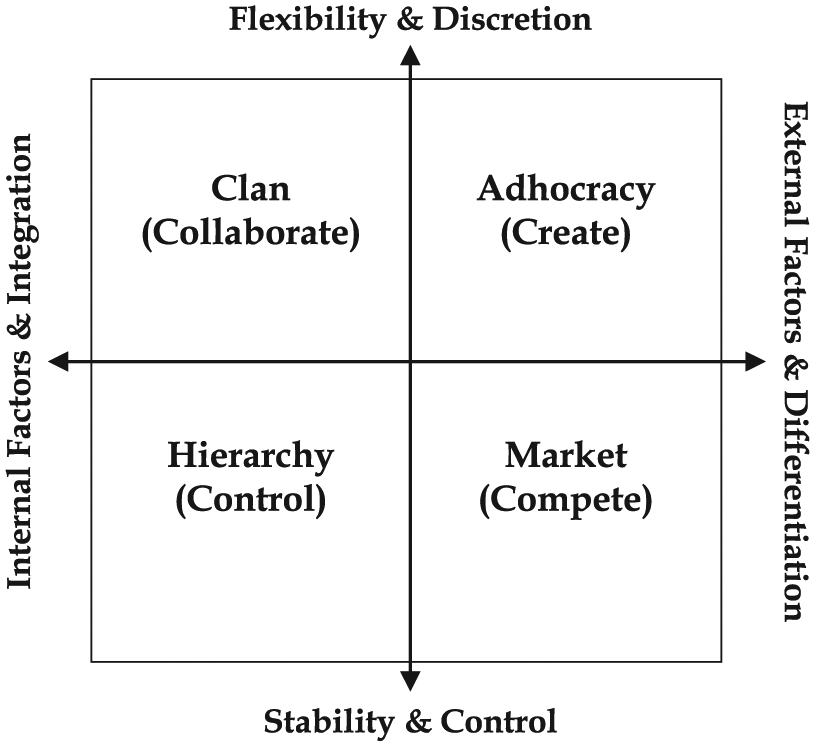
The Competing Values Framework.
Organizational Culture Assessment Instrument (OCAI)
The Organizational Culture Assessment Instrument (OCAI) is a research tool developed by Cameron and Quinn based on the CVF. It has a set of four statements within six main items used to extract employees’ opinions based on their experiences. These are:
Knowledge management
Knowledge has become one of the most powerful and strategic asset of an organization and an extremely important tool to achieving a sustainable competitive advantage. Knowledge management (KM) is the conversion of tacit knowledge into explicit knowledge and sharing it within the organization. In other words, knowledge management is the process through which organizations generate value from the intellectual and knowledge-based assets.
Knowledge Management Assessment Instrument
The Knowledge Management Assessment Instrument is a research tool developed in 2003 by Sheron Lawson to measure the knowledge management activities in an organization. It encompasses a “six process” knowledge management cycle, covering: knowledge creation, knowledge capture, knowledge organization, knowledge storage, knowledge dissemination, and knowledge application (Lawson, 2003).
Statement of the problem
The Qatar Foundation for Education, Science and Community Development nurtures higher education in Qatar. It is a private, chartered, non-profit organization, focused on education, scientific research and community development (www.qf.org.qa). Within Qatar, there are some foreign universities outside the ambit of the Qatar Foundation and a few state-sponsored universities and institutions. Qatar in general, and higher education libraries in particular, have a large expatriate population living and working in the country. When employees leave a job, they take with them valuable knowledge about the systems and procedures that they had established and core technical knowledge. KM offers the best solution to manage this brain drain and capture the tacit knowledge of employees. However, libraries around the world have not only failed to take advantage of the benefits of KM, but also ignored the organizational culture of their libraries, failing to grasp how culture affects organizational effectiveness and functioning. A review of the literatures also reveals the absence of any credible study done to understand the influence of culture on KM in libraries. This empirical study tries to fill the gap in the literature.
In order to understand the effects of organizational culture types on the dimensions of KM the following research questions were investigated and answered:
Is organizational culture related to knowledge management dimensions in higher education libraries in Qatar?
Are there any organizational culture type or types that promote or impede the activities of knowledge management in higher education libraries in Qatar?
Literature review
KM has a close association with information management so that some researchers (Blair, 2002; Koenig, 2003; Roknuzzaman et al., 2009) believe the term itself is reflective of conventional library activities like knowledge acquisition, storage, organizing, retrieval and dissemination. However, it is the corporates who have used it to improve organizational success. KM activities involve knowledge capture and retention, knowledge classification, knowledge creation, and knowledge dissemination (Lee, 2005). It is driven by competitive pressures and the need to manage an organization’s intangible assets more efficiently. Fundamentally, it refers to changes that enhance competitive advantage and maximize profits (Davenport and Prusak, 1998; Drucker, 1999; White, 2004). Spender and Scherer (2007: 17) suggest “KM may be more about managing an organization’s knowledge absence than about managing its knowledge assets.” KM principles and practices in a Library and Information Studies (LIS) context have emerged as areas of interest in the library literature. Many people in the library sector do not consider KM as a new phenomenon, but an integral part of the work of librarians. Some LIS professionals claim that librarians have long developed and applied many KM principles in reference, cataloging, and other library services (Townley, 2001). Some others believe librarians have been knowledge managers for decades and centuries in a paper world and they are obviously candidates for leadership in this area (Dillon, 1999). Several studies suggests that KM is an integral part of libraries (Anderson, 2007; Bell and Shank, 2004; Carpenter and Steiner, 2005; Coyle, 2007; Dempsey, 2006; Fichter, 2005; Foo and Ng, 2008; Harris and Lessick, 2007; Jain, 2007; Macgregor and McCulloch, 2006; Mahnke, 2007; Maponya, 2004; Srikantaiah and Koenig, 2000; Wen, 2005).
Little research has been done to identify the organizational culture in libraries in relation to KM. Porumbeanu (2010) conducted a study to establish the elements that characterize organizational culture in the library in order to successfully implement KM. The study was conducted in five university libraries in Romania, and the results showed that 89% of the respondents expressed their willingness to share pertinent knowledge with colleagues. Kaarst-Brown et al. (2004) asserts that there are characteristics of organizational cultures in information-based organizations such as a library, that lead to increased collaboration, collegiality, and organizational effectiveness. Dale Lick and Roger Kaufman (2000) assert that many efforts to bring about change in higher education fail because of inadequate planning to adjust the academic culture, which is actually hard because of its rigidity and strength. The literature review reveals that very little research has been conducted in libraries to diagnose the organizational culture using the CVF. One particular example of the benefits of understanding cultural issues in libraries can be found in a study conducted by Varner (1996). The study shows the existence of mixed culture with a dominance of Clan and Hierarchy culture types as an overall culture profile of the library concerned. However, the study also reveals that there are subcultures that exist in the various departments within the library. Others studies to identify the organizational culture of libraries that came up during the literature search are Baker (1995); Shepstone and Lyn (2008); Awan and Mahmood (2009); Owens and Anghelescu (1999). The literature survey also yielded some conceptual literature on the application of organizational culture in libraries: Budd (1996); Day (1998); Kamenskaya (2010); Lakos and Gray (2000); Moniz (2010); Oberg (2009); Shaughnessy (1988); Stephens and Russell (2004), all of whom have advocated diagnosing the culture profile of libraries and the advantages of doing so. Some, such as Lakos and Gray (2000), have suggested how library web portals can be used as an effective agent for changing the culture of libraries.
However, there is no published evidence relating to any research that has been conducted in the library sector that examined the relationships between organizational culture and KM. This is an important gap in the evidence base and hence the results of this research are valuable to the knowledge base and attempts to fill that gap.
Research design and methodology
The study used a descriptive and quantitative research design. Two research instruments were used in this study: (1) Organizational Culture Assessment Instrument (OCAI) developed by Cameron and Quinn for measuring four types of organizational culture (Clan, Adhocracy, Market and Hierarchy); (2) Knowledge Management Assessment Instrument (KMAI) developed by Sheron Lawson for assessing KM dimensions (capture, creation, organization, storage, dissemination and application). The data consisted of two major sets of information (Figure 2): (1) the four different types of organizational culture and (2) the six dimensions of KM. These six dimensions were calculated to give the dependent variable of KM. The existence of a significant relationship was used to permit prediction.
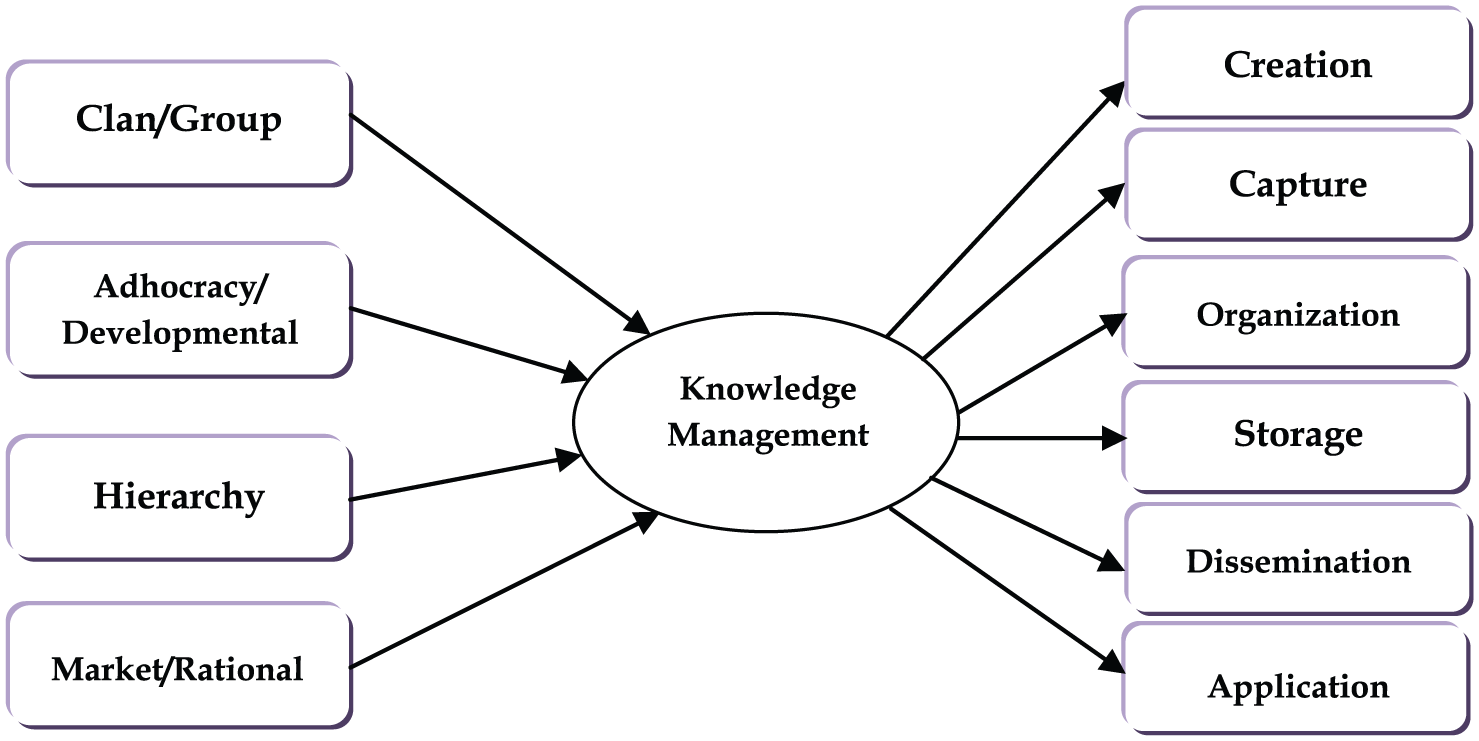
Research model (variables relationships).
At the time of the survey, there were 20 higher education libraries affiliated to various universities and institutions in Qatar and 195 full-time employees worked in these libraries. All 195 employees were taken as a sample, and an electronic questionnaire was designed through the website Surveymonkey.com and sent to them. Both the instruments used a five-point Likert scale to measure the responses, with 5 being ‘strongly agree’ and 1 ‘strongly disagree’. The respondents were asked to give their assessment on how they related to each of the statements in the questionnaire to their library. A total of 136 responses from 16 higher education libraries were received, of which 14 responses were incomplete and hence were dropped. No responses were received from four libraries leaving 122 fully completed usable responses for analysis at a return rate of 62%. The responses were then exported to SPSS statistical package for analysis.
The following null hypotheses were framed to find answers to the research questions:
1. NHo1: There is no significant relationship between organizational culture types (Clan, Adhocracy, Market and Hierarchy) and the dimensions of KM in higher education libraries in Qatar.
The following sub-hypotheses were framed to test the hypothesis NH01:
NH01:1: There is no relationship between the organizational culture types and the creation of knowledge among the higher education libraries in Qatar.
NH01:2: There is no relationship between the organizational culture types and the capture of knowledge among the higher education libraries in Qatar.
NH01:3: There is no relationship between the organizational culture types and the organization of knowledge among the higher education libraries in Qatar.
NH01:4: There is no relationship between the organizational culture types and the storage of knowledge among the higher education libraries in Qatar.
NH01:5: There is no relationship between the organizational culture types and the dissemination of knowledge among the higher education libraries in Qatar.
NH01:6: There is no relationship between the organizational culture types and the application of knowledge among the higher education libraries in Qatar.
2. NH02: The organizational culture types (clan, adhocracy, market and hierarchy) do not serve to significantly predict the dimensions of knowledge management.
The following sub-hypotheses were framed to test the hypothesis NH02
NH02:1: The organizational culture types do not serve to significantly predict knowledge creation.
NH02:2: The organizational culture types do not serve to significantly predict knowledge capture.
NH02:3: The organizational culture types do not serve to significantly predict knowledge organization.
NH02:4: The organizational culture types do not serve to significantly predict knowledge storage.
NH02:5: The organizational culture types do not serve to significantly predict knowledge dissemination.
NH02:6: The organizational culture types do not serve to significantly predict knowledge application.
Analysis and results
The research hypotheses were tested and analyzed using quantitative research methods. The hypotheses were tested using Pearson’s correlation for finding the relationships between the variables and stepwise regression analysis was done to check the predictability of the dimensions of knowledge management. The results are presented here.
The demographic details from Table 1 reveal that more than half of the respondents (68.9%) were women, and less than half of them (31.1%) were men. A little less than half of the respondents (44.3%) were in the age group 40–49; followed by a little over one-fourth (27%) in the age group 31–39. Very few of the respondents (11.5%) were in the age group of 50–59, and 9.8% in the age group of 30 years or less. A small number of the respondents (7.4%) were 60 years or older.
Demography – gender, age, education, residency, and hierarchy.
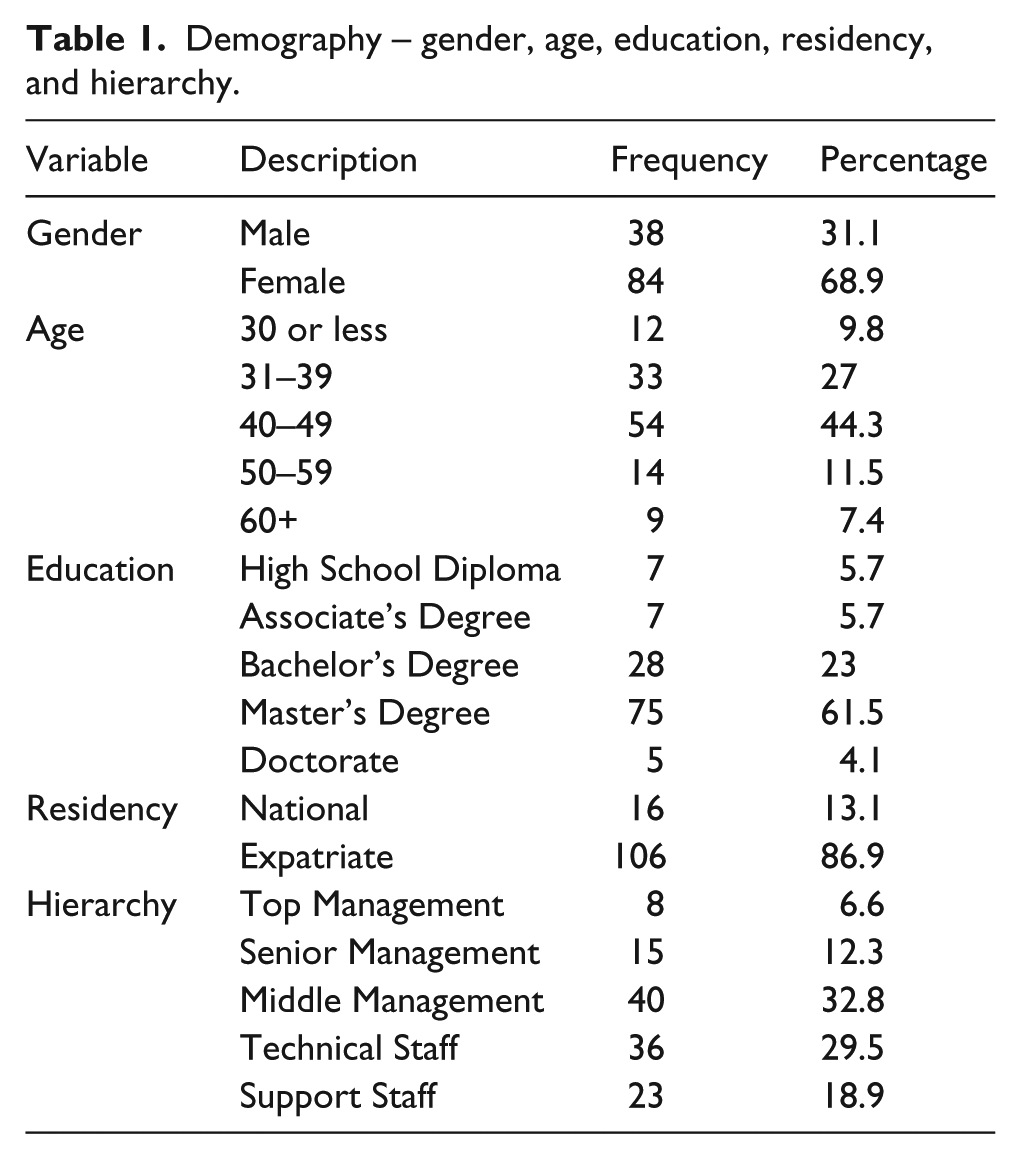
It is also clear that a more than 50% of the respondents (61.5%) had a Master’s degree followed by 23% with a Bachelor’s degree; 5.7% of the respondents had an Associate’s degree and high school diploma, and 4.1% of the respondents had a Doctorate. It is also clear that 13.1% of the respondents were nationals and more than three-fourths of the respondents (86.9%) were expatriate employees. It also reveals that the majority of the respondents (32.8%) were from middle management, followed by technical staff at 29.5% and support staff at 18.9%. Senior management was 12.3% and top management was 6.6% of the respondents.
Organizational culture types and knowledge creation
It is inferred from Table 2 that there was a high degree of positive correlation between clan culture and knowledge creation (r=0.71) and this was statistically significant at 0.01 level, (p=0.00); a moderate degree of positive correlations between adhocracy culture and knowledge creation (r=0.62); market culture and knowledge creation (r = 0.29), statistically significant at 0.01 level, (p=0.00). However, there is a low degree of negative correlation between hierarchy culture and knowledge creation (r = -0.15) and this is not statistically significant 0.01 level (p= 0.10). Since all the culture types are correlated with knowledge creation, with the exception of hierarchy culture type, we reject the null hypothesis NH01:1.
Inter-correlations between organizational culture types and knowledge management dimensions.
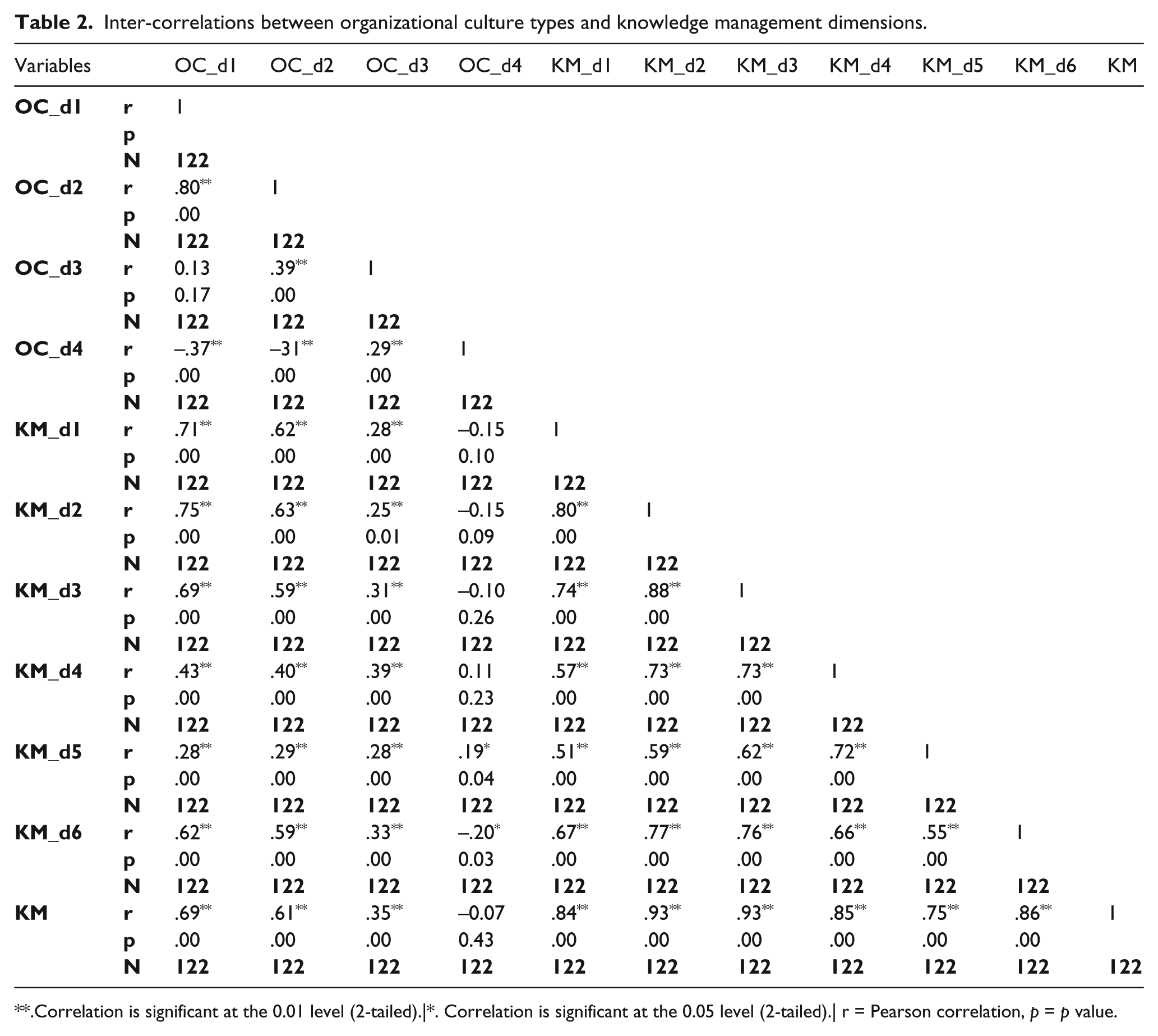
Correlation is significant at the 0.01 level (2-tailed).|*. Correlation is significant at the 0.05 level (2-tailed).| r = Pearson correlation, p = p value. 
Organizational culture types and knowledge capture
It is inferred from Table 2 that there was a high degree of positive correlation between clan culture and knowledge capture (r=0.75) and this was statistically significant at 0.01 level, (p=0.00); adhocracy and knowledge capture (r=0.63); market and knowledge capture (r = 0.25), statistically significant at 0.01 level, (p= 0.01). However, there is a low degree of negative correlation between hierarchy and knowledge capture (r = -0.15) and this was not statistically significant at 0.01 level, (p= 0.09). Since all the culture types are correlated with knowledge creation, with an exception of hierarchy culture type, we reject the null hypothesis NH01:2.
Organizational culture types and knowledge organization
It is inferred from Table 2 that there was a moderate degree of positive correlation between clan culture and knowledge organization (r=0.69) and this was statistically significant at 0.01 level, (p=0.00); adhocracy culture and knowledge organization (r=0.59); market culture and knowledge organization (r=0.31), statistically significant at 0.01 level, (p=0.00), (p=0.01). However, there is a low degree of negative correlation between hierarchy culture and knowledge organization (r=-0.10) and this was not statistically significant at 0.01 level, (p=0.26). Since all the culture types are correlated with knowledge creation, with an exception of hierarchy culture type, we reject the null hypothesis NH01:3.
Organizational culture types and knowledge storage
It is inferred from Table 2 that there was a moderate degree of positive correlation between clan culture and knowledge storage (r=0.43); adhocracy culture and knowledge storage (r=0.40) and this was statistically significant at 0.01 level (p=0.00); market culture and knowledge storage (r=0.39), statistically significant at 0.01 level, (p=0.01). However, there is a low degree of positive correlation between hierarchy and knowledge storage (r=0.11), and this was not statistically significant at 0.01 level, (p=0.23). Since all the culture types are correlated with knowledge creation, with an exception of hierarchy culture type, we reject the null hypothesis NH01:4.
Organizational types culture and knowledge dissemination
It is inferred from Table 2 that there was a low degree of positive correlation between clan culture and knowledge dissemination (r=0.28), statistically significant at 0.01 level, (p=0.00); adhocracy culture and knowledge dissemination (r=0.29); market culture and knowledge dissemination (r=0.28), statistically significant at 0.01 level, (p=0.00); hierarchy culture and knowledge dissemination (r=0.19) and this was statistically significant at 0.05 level (p=0.04). Since all the culture types are correlated with knowledge creation we reject the null hypothesis NH01:5.
Organizational culture types and knowledge application
It is inferred from Table 2 that there was a moderate degree of positive correlations between clan culture and knowledge application (r=0.62), (p=0.00); adhocracy culture and knowledge application (r=0.59), (p=0.00); market culture and knowledge application (r = 0.33), (p=0.00), statistically significant at 0.01 level. However, the culture type hierarchy and knowledge application is negatively correlated (r=-0.20) and this is statistically significant at 0.05 level (p=0.03). Since all the culture types are correlated with knowledge creation we reject the null hypothesis NH01:6.
In summary, it was concluded that there is a significant relationship between all the culture types and the dimensions of KM except the hierarchy culture and knowledge creation, capture, organization and storage and hence we reject the null hypothesis NH01.
Predicting the outcome variables
Multiple regression analysis was carried out to predict the dependent variables viz. knowledge creation, capture, organization, storage, dissemination and application based on the independent variables clan, adhocracy, market and hierarchy culture.
Knowledge creation
All the four culture types, clan, adhocracy, market and hierarchy of the CVF were subjected to a stepwise regression analysis to check the predictability of knowledge creation. However, of the four entered, only two culture types – clan and market types – showed significance (see Table 3) and the other two variables – adhocracy and hierarchy – failed to meet the selection criteria.
Model summary of multiple regression analysis for knowledge creation.

The ANOVA test to find out the goodness fit of the model revealed that the variables namely, clan and market, significantly predicted knowledge creation. For this model, the F value is 68.03 and the significance value is 0.00, which showed that the regression model has a good fit. Table 3a lists the coefficients of the predictor variable.
Coefficients of variable in the regression equation predicting knowledge creation.
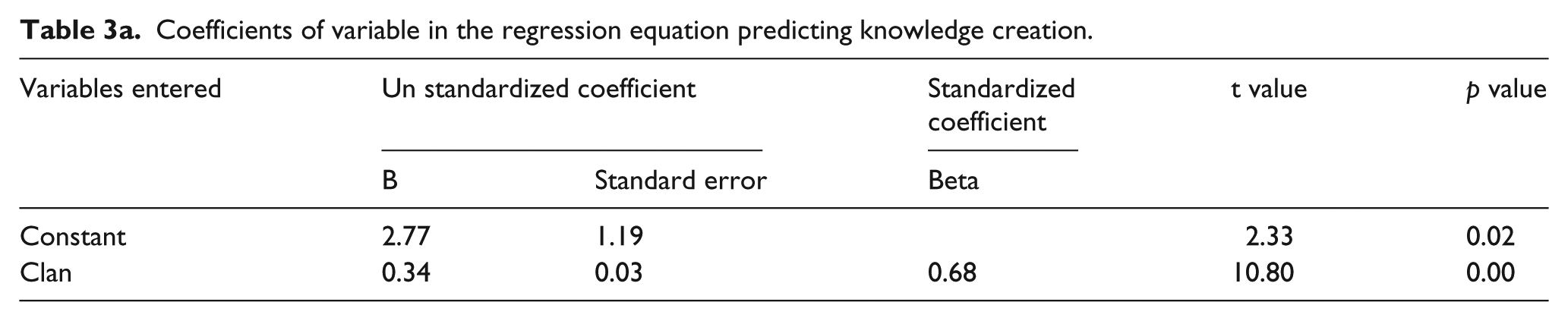
Standardized coefficients highlight the relative importance of each variable. The variable with the largest beta coefficient makes the strongest unique contribution in explaining the dependent variable. In this analysis, clan culture (0.68) made the strongest unique contributions in explaining the same. The significance levels of the t-values revealed that all these variables were significant variables. As the t-test results were statistically significant (p<0.05), therefore it is concluded that the two variables clan and market culture types served to significantly predict the variance in knowledge creation and hence we reject the null hypothesis NH02:1
Knowledge capture
All four culture types, clan, adhocracy, market and hierarchy of the CVF were subjected to a stepwise regression analysis to check the predictability of knowledge capture. However, of the four entered, only two culture types – clan and market types – showed significance (see Table 4) and the other two variables – adhocracy and hierarchy – failed to meet the selection criteria.
Model summary of multiple regression analysis for knowledge capture.

The ANOVA test to find out the goodness fit of the model revealed that the variables namely, clan and market, significantly predicted knowledge capture. For this model, the F value is 83.06 and the significance value is 0.00, which showed that the regression model has a good fit. Table 4a lists the coefficients of the predictor variable.
Coefficients of variable in the regression equation predicting knowledge capture.
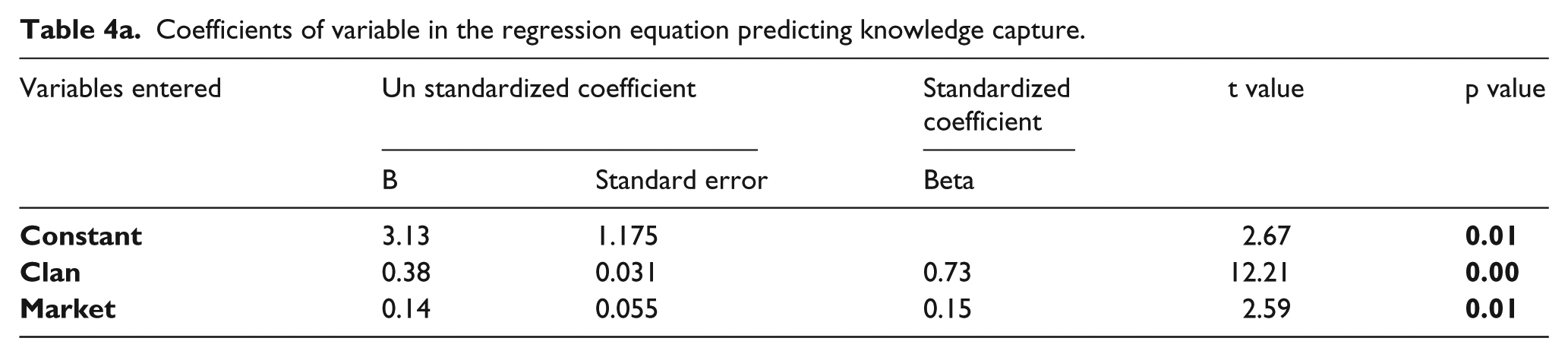
Standardized coefficients highlight the relative importance of each variable. The variable with the largest beta coefficient makes the strongest unique contribution in explaining the dependent variable. In this analysis, clan culture (0.73) made the strongest unique contributions in explaining the same. The significance levels of the t-values revealed that all these variables were significant variables. As the t-test results were statistically significant (p<0.05), therefore it is concluded that the two variables clan and market culture types served to significantly predict the variance in knowledge capture and hence we reject the null hypothesis NH02:2.
Knowledge organization
All four culture types, clan, adhocracy, market and hierarchy of the CVF were subjected to a stepwise regression analysis to check the predictability of knowledge organization. However, out of the four entered, only two culture types – clan and market types – showed significance (see Table 5) and the other two variables – adhocracy and hierarchy – failed to meet the selection criteria.
Model summary of multiple regression analysis for knowledge organization.

The ANOVA test to find out the goodness fit of the model revealed that the variables, namely clan and market significantly predicted knowledge organization. For this model, the F value is 66.66 and the significance value is 0.00, which showed that the regression model has a good fit. Table 5a lists the coefficients of the predictor variable.
Coefficients of variable in the regression equation predicting knowledge organization.
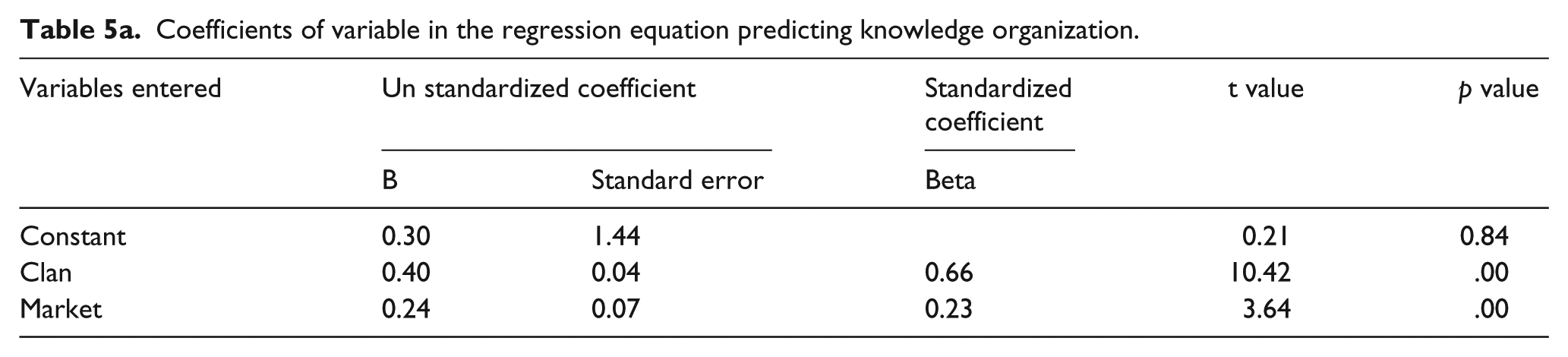
Standardized coefficients highlight the relative importance of each variable. The variable with the largest beta coefficient makes the strongest unique contribution in explaining the dependent variable. In this analysis, clan culture (0.66) made the strongest unique contributions in explaining the same. The significance levels of the t-values revealed that all these variables were significant variables. As the t-test results were statistically significant (p<0.05), therefore it is concluded that the two variables – clan and market culture types – served to significantly predict the variance in knowledge organization and hence we reject the null hypothesis NH02:3.
Knowledge storage
All four culture types, clan, adhocracy, market and hierarchy of the CVF were subjected to a stepwise regression analysis to check the predictability of knowledge storage. However, out of the four entered, three culture types – clan, market and hierarchy culture types – showed significance (see Table 6) and the other variable – adhocracy – failed to meet the selection criteria.
Model summary of multiple regression analysis for knowledge storage.
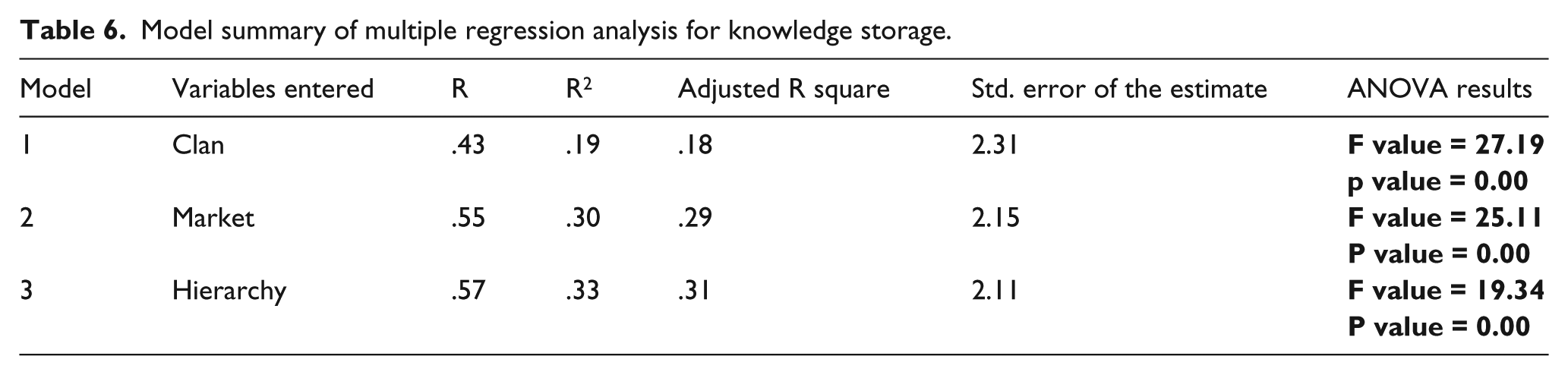
The ANOVA test to find out the goodness fit of the model revealed that the variables, namely clan, market and hierarchy significantly predicted knowledge storage. For this model, the F value is 27.19 and the significance value is 0.00, which showed that the regression model has a good fit. Table 6a lists the coefficients of the predictor variable.
Coefficients of variable in the regression equation predicting knowledge storage.
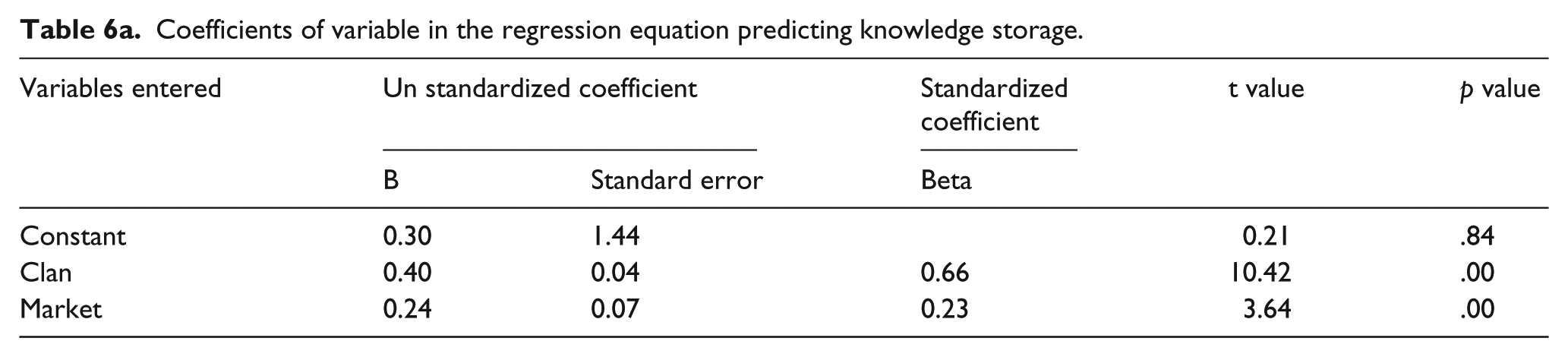
Standardized coefficients highlight the relative importance of each variable. The variable with the largest beta coefficient makes the strongest unique contribution in explaining the dependent variable. In this analysis, clan culture (0.66) made the strongest unique contributions in explaining the same. The significance levels of the t-values revealed that all these variables were significant variables. As the t-test results were statistically significant (p<0.05), therefore it is concluded that the three variables – clan, market and hierarchy culture types – served to significantly predict the variance in knowledge storage and hence we reject the null hypothesis NH02:4.
Knowledge dissemination
All four culture types, clan, adhocracy, market and hierarchy of the CVF were subjected to a stepwise regression analysis to check the predictability of knowledge dissemination. However, out of the four entered, two culture types – adhocracy and hierarchy culture types – showed significance (see Table 7) and the other variables – clan and market – failed to meet the selection criteria.
Model summary of multiple regression analysis for knowledge dissemination.

The ANOVA test to find out the goodness fit of the model revealed that the variables namely, adhocracy and hierarchy significantly predicted knowledge dissemination. For this model, the F value is 11.97 and the significance value is 0.00, which showed that the regression model has a good fit. Table 7a lists the coefficients of the predictor variable.
Coefficients of variable in the regression equation predicting knowledge dissemination.
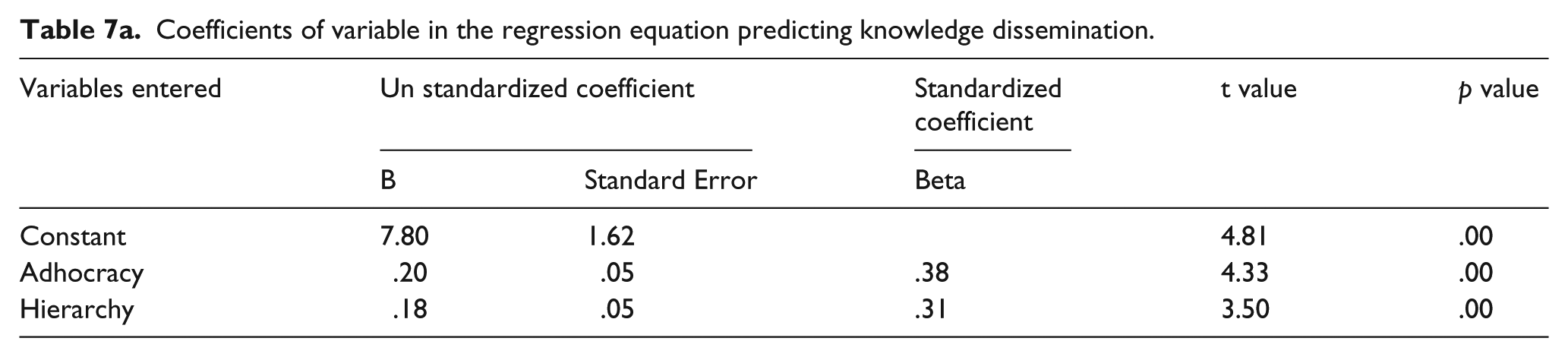
Standardized coefficients highlight the relative importance of each variable. The variable with the largest beta coefficient makes the strongest unique contribution in explaining the dependent variable. In this analysis, adhocracy culture (0.38) made the strongest unique contributions in explaining the same. The significance levels of the t-values revealed that all these variables were significant variables. As the t-test results were statistically significant (p<0.05), therefore it is concluded that the two variables – adhocracy and hierarchy culture types – served to significantly predict the variance in knowledge dissemination and hence we reject the null hypothesis NH02:5.
Knowledge application
All the four culture types, clan, adhocracy, market and hierarchy of the CVF were subjected to a stepwise regression analysis to check the predictability of knowledge application. However, out of the four entered, two culture types – clan and market culture types – showed significance (see Table 8) and the other variables – adhocracy and hierarchy – failed to meet the selection criteria.
Model summary of multiple regression analysis for knowledge application.

The ANOVA test to find out the goodness fit of the model revealed that the variables namely, clan and market significantly predicted knowledge application. For this model, the F value is 73.00 and the significance value is 0.00, which showed that the regression model has a good fit. Table 8a lists the coefficients of the predictor variable.
Coefficients of variable in the regression equation predicting knowledge application.
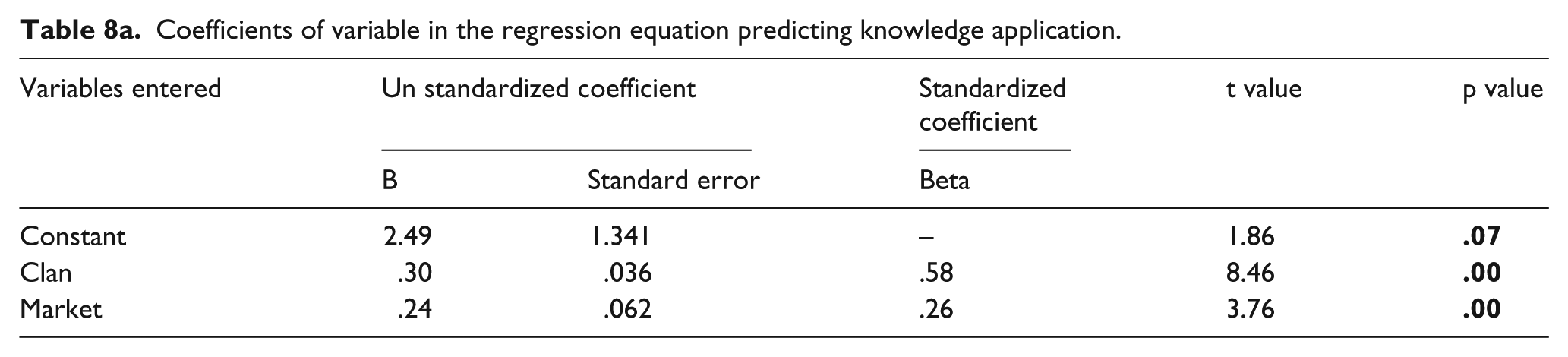
Standardized coefficients highlight the relative importance of each variable. The variable with the largest beta coefficient makes the strongest unique contribution in explaining the dependent variable. In this analysis, clan culture (0.58) made the strongest unique contributions in explaining the same. The significance levels of the t-values revealed that all these variables were significant variables. As the t-test results were statistically significant (p<0.05), therefore it is concluded that the two variables – clan and market culture types – served to significantly predict the variance in knowledge application and hence we reject the null hypothesis NH02:6.
In summary the results of the regression analysis from Tables 3 to 8a indicate that organizational culture types do serve to significantly predict the dimensions of knowledge management and hence the null hypothesis NH02 is rejected.
Discussion and implications
The results of the study had clearly established the fact that organizational culture types are related to the KM dimensions and the culture types affect the KM dimensions in higher education libraries. Although the positive correlation is an expected and reasonable result and in congruence with other similar studies by Cameron and Quinn (2006); Chin-Loy (2003); Lawson (2003), the negative correlation is an unexpected result. This could be attributed to the socio-political and religiously conservative nature of the society. It has also revealed that the organizational culture type clan and market are the most significant in predicting KM dimensions and hierarchy culture is the least significant. What is unique about the results of this study is the role of adhocracy culture. According to Cameron and Quinn (2011) clan and adhocracy culture types are the most favorable ones to promote KM and market and hierarchy actually impedes it. However, it is not altogether unexpected that such results were found. The research conducted by Michael B. Jones (2009) revealed that adhocracy, clan, and hierarchy culture types were significant predicators of knowledge management (Clan=0.178, 0.008, Adhocracy=0.350, 0.000 and Hierarchy=3.043, 0.000 but Market= 0.935, 0.351).
The results have also helped in answering the research questions: (1) Organizational culture types are positively related to knowledge management dimensions except hierarchy culture which is negatively correlated; (2) Clan and market are the two culture types that significantly predict the dimensions of knowledge creation, capture, organization, storage, and application and adhocracy and hierarchy culture types significantly predict the dimensions of knowledge storage and dissemination in higher education libraries in Qatar.
The results of the study have national repercussions, since it has been conducted at a national level involving all higher education libraries in the country. Considering cultures are created by people, it is quite complex in countries like Qatar where there is a large expatriate population that constantly keeps changing. Change in people brings changes in culture types and subsequently affects the organizational effectiveness. Library directors and managers have to understand the values of culture and take on board the effects of it while planning and decision making. Strategic planning has to be undertaken to identify the culture types of each library and decisions have to be taken in such a way that there evolves a culture that promotes KM.
Conclusion
KM is an effort to capture and harness an organization’s experience and wisdom and to make them available and useful to everyone else in the organization. It has also become critical for organizational effectiveness and success. Library leaders need to understand their organizational culture in order to plan new strategies. To transform them, they need to adapt organizational values to reveal the underlying values that may need to be changed or which may act as barriers to adaptation. The CVF contributes to the analysis and diagnosis of organizational values to reveal how the academic library is likely to behave when faced with challenges. The CVF allows the library leadership to weigh strategies from the perspective of organizational culture in order to design the most effective means to attain the desired ends.
Footnotes
Declaration of Conflicting Interests
The author(s) declared no potential conflicts of interest with respect to the research, authorship, and/or publication of this article
Funding
The author(s) received no financial support for the research, authorship, and/or publication of this article.