







Abstract
How can user surveys lead to better decision making to improve libraries? While there are more surveys published on specialised aspects of academic libraries, there are relatively few user surveys published of academic libraries in general. First and foremost this paper argues the user survey is a useful tool for library managers interested in developing their libraries in response to changing user needs, and secondly, for more published accounts of surveys and their usefulness. However, the user survey as a tool for generating evidence-based decision making in libraries fails to achieve its potential if two further important practices are not implemented. First and most importantly, the findings obtained from the survey must be used to inform decision making on managing and leading improvements to the library. This aspect of follow-through from survey findings to management decision making, may well lead to changing resource allocation and priorities, new practices, and improvements to collections and the physical environment. Second, the findings of the survey should be fed back to users as a means of raising their interest and engagement in the academic library as a hub of learning.
Introduction
According to statutes dating back to 1511 the work of St John’s College is built on four aims, namely, education, religion, learning and research. As the College Library has traditionally been seen as the ‘hub’ of resources for learning, teaching and research, it is important that library staff understand users’ needs to provide the best support to them, thereby enabling the fulfilment of the College’s aims. One of the best ‘tools’ for assessing the quality of library services is the user survey. Such surveys – if executed rigorously – are a useful means of improving library management because they enable data-driven, evidence-based decision making, and consequently, more efficient resource allocation, to meet both individual user needs and the wider objectives of the organisation goals. Conducting library user surveys across an organisation also reaps other benefits, such as helping to inform its membership about the services provided by, and the value of, the library. However, even with rigorous user surveys, their potential remains unrealised if the survey findings fail to influence library decision making, and ultimately, library provision. This paper is an account of a recent Working Library User Survey (WLUS) carried out at St John’s College. As a case study, the aims of the paper are to describe how the College Library set out to determine the answers to two questions. First, to what extent did the library meet the needs of its students and academic staff? Second, according to the perspectives of users, in what ways, and how, could the library improve to provide a better service? Accordingly, this paper is structured as follows: the first section reviews relevant literature on previous user surveys conducted in academic libraries; a second section gives an account of, and justification for, the methodology designed and adopted for the present WLUS of St John’s College – including the methods of data collection and analysis. The third section reports the survey findings, the fourth provides a discussion and a final section, conclusions and implications.
Literature review
Given the aim of this study, it is important to engage in a critical review of the literature that examines the criteria used by previous studies to assess the extent to which academic libraries meet the needs of students and academic staff. This literature search revealed a number of library user surveys conducted previously in academic institutions that proved relevant to the present study. Some of these studies focus on assessing a single group of students’ needs – either undergraduates or postgraduates. Single group studies include those by Dahan et al. (2016), Clougherty et al. (1998), Gunasekera (2010), Kayongo and Helm (2010), Gibbs et al. (2012), and Tracy and Searing (2014). In contrast, examples of multiple group usage include studies by Berger and Hines (1994) whose survey included undergraduate and postgraduate students, faculty and university staff. Likewise, Woo (2005) surveyed undergraduate and postgraduate students, academic staff and non-academic staff as well as alumni. Further multi-user studies (undergraduates and academic staff) include those by Hayden et al. (2005) and Adeniran (2011). A further aim of this study is to argue and affirm a case for academic librarians to use and apply the findings and recommendations from their user surveys in subsequent decision making, aimed at improving the provision and resource allocation in their libraries. However, an extensive literature research of the process of implementing survey recommendations into improved library provision and practice proved disappointingly fruitless. That is, previous studies of academic library user surveys stop at the point of making recommendations, thereby making the assumption that in some way recommendations would automatically lead to improved provision and allocation of library resources. It is surprising that little or no attention seems to have been paid by previous researchers to the crucial intermediary stages of decision making and management that are responsible for adopting recommendations and implementing them in practice. The remaining review of literature is divided into methodology and survey findings, the latter of which is sub-divided into library usage, information resources used and user satisfaction.
Literature on methodology
Various methods of studying library service quality and user satisfaction characterise previous studies. Tracy and Searing (2014) surveyed the Graduate School of Library and Information Science students at the University of Illinois to ascertain their library usage patterns and their perceptions of library services. The survey was conducted online and designed in such a way that the findings can be compared with previous surveys of general graduate student populations. Berger and Hines (1994) used mixed methods for data collection – quantitative was used for gathering large sample data, while qualitative interviews allowed issues to be explained in more depth. The survey was conducted in two phases. The first phase of six focus groups (qualitative methodology) included undergraduate and graduate students, and faculty staff. The findings of the focus groups defined issues to be addressed in the second phase. The second phase comprised a survey mailed to 1250 randomly chosen participants including undergraduates, graduates, faculty and university staff. Woo’s (2005) survey was designed for users to evaluate the performance of the main library and six branch libraries of the University of Hong Kong. It also surveyed user preferences for print and electronic materials. Administration of the survey was mainly online with the option of print format. The study by Gibbs et al. (2012) aimed to assess the research needs of graduate students at Georgetown University, USA. Mixed methods were used to conduct the survey – questionnaire and interviews. The first part of the survey, which was a questionnaire, was posted online. About 4200 graduate students and professional students were contacted, with 737 completing the survey, a response rate of c.16%. Typically, response rates for social surveys in western countries range between 20 and 32% (Nulty, 2008). The survey was followed by three focus groups a few months later. The aim of the focus groups was to probe more in-depth views on some of the questions included in the online survey. Gunasekera (2010) assessed library user satisfaction, services and resources in order to identify users’ needs. Questionnaires were distributed to 800 undergraduates from the Faculty of Arts of the Sri Lankan University of Peradeniya when they visited the library. Dahan et al.’s (2016) study was to measure library users’ perceptions on service quality and to find ways to meet users’ expectations. A customised survey instrument was developed based on the LibQUAL+ survey tool. The study used four perspectives to measure the quality of service, namely, library staff, library services, the library’s collections and the library as a physical space. The survey was distributed to 400 library users in two campuses.
Literature on user survey findings
Three main themes emerge in the previous studies to evaluate the extent to which academic libraries meet their users’ needs: these are: library usage, information resources used and user satisfaction.
Library usage
Since students form the largest and the most important population in academic institutions, it is not surprising that they are the largest user group in most academic libraries. Among the students, undergraduates are usually the largest sub-group. Clougherty et al. (1998) assessed undergraduate resource and service needs at University of Iowa library, and found that 86% of undergraduates used the main library. However, the author fails to report how often they used the library. Gunasekera’s (2010) study reinforces the impression of heavy usage of libraries by undergraduate students, finding that a majority of them (59.5%) visited the library daily. Dahan et al.’s (2016) study showed 56.8% of undergraduate students went to the library either daily or several times a week. The key question in these studies, however, is – what level of user satisfaction is indicated by these high usage metrics?
In contrast, the library usage of postgraduate students may seem to depend on their disciplines. Gibbs et al. (2012) surveyed how graduate students use and perceive the library. Although the findings did not show how frequently graduate students used the library, they reported that those pursuing humanities subjects were most engaged with the library, while none of the PhD social science students knew their subject librarian. Tracy and Searing (2014) found that library and information science graduate students at Illinois University made greater use of libraries than other graduate students. Another factor that may affect the library usage of postgraduate students is the extent to which their studies are research based. If their research is more laboratory based rather than literature based, they are likely to rely less on library resources. Increased digitisation may also play a role: Kayongo and Helm (2010) found, for instance, that more than half (65%) of the graduate students conducted their research from a home computer, with science and engineering postgraduates making slightly more use of non-library facilities than students of other disciplines.
Very few studies have assessed the library usage of academic staff. Hayden et al.’s (2005) study focused on two groups – undergraduates and academic staff. The survey found that 98% of students and 95% of academic staff used the library in person. Woo’s (2005) study did not report library usage of the academic staff. Adeniran (2011) also surveyed both undergraduates and academic staff satisfaction levels with library services. However, the sample size of academic staff was only seven out of 150, which was too small to yield any insightful information.
Information resources used
Although electronic books and other online information resources are widely available, a number of studies have indicated that print books remain widely used. Hiller’s (2001) study found that the top priority for faculty and staff was to maintain the quality of the print collections. Hayden et al. (2005) reported that the major resource for both undergraduates and academic staff was print books. Gunasekera (2010) reported that 96% of undergraduate respondents borrow books from the library. Similar findings have been made in Hong Kong by Woo (2005), and in the United States by Tracy and Searing (2014), where respondents prefer to use print books. It seems the switch from print to e-books, if there is a switch at all, is proving very gradual and slow.
The picture is somewhat different, however, for trends in accessing electronic journals over the last 10 years. Unlike printed books, there is a stronger trend to use electronic journals at the expense of print journals. Woo’s (2005) study found that nearly 70% of the respondents prefer to use journals online. Kayongo and Helm’s (2010) research found that electronic journals were the second most important information resources after print books. Tracy and Searing’s (2014) findings corroborate the evidence of increased usage of e-journals at the expense of print copies. Such results are perhaps influenced by the policy of many libraries to remove print journals from open shelves to storage when their electronic versions become available according to the studies (Genoni, 2008; Johnson, 2007).
User satisfaction
Some studies have indicated that most respondents are generally satisfied with the library environment and overall performance. Nearly 90% of respondents in Adeniran’s (2011) study, for instance, viewed the library environment as conducive for learning, teaching and research activities. Haden et al.’s (2005) findings indicated that the library scored high as a work environment and the library was well maintained. Gunasekera’s study (2010) also showed that respondents were satisfied with the cleanliness, lighting and seating capacity in the library. Dahan et al. (2016) found that the perceived service quality exceeded users’ expected minimum levels. Respondents were most satisfied with library staff, who were courteous, showed individual attention and confidence in delivering services.
The area on which respondents expressed relatively low levels of satisfaction was the library collection. Clougherty et al. (1998), for example, found that respondents indicated there was a need to update and expand the collections. Woo (2005) found that respondents ranked the range and provision of books in their disciplines the most important factor, compared with the other 29 library service areas; furthermore, with regard to book collections, there was a significant gap between user expectations and service quality. Gunasekera (2010) found that nearly half of the respondents suggested that the library should add more books and reference materials in various subject disciplines. Similarly, Gibbs et al. (2012) found that students expressed the need for more library holdings in their subject, namely, Arabic and Russian.
In summary, the following salient points emerge from this literature review. First, over this 20-year period, relatively few studies of user surveys on academic libraries appear to have been conducted. Second, of these studies, just as many focus on a single group – usually undergraduate students – as on both students and academics, thereby providing a limited user perspective. Third, some of the studies are based on small samples, thus throwing into question the representativeness of the findings. Fourth, most of the studies raise methodological issues: among these are low response rates of about 15%, and a failure to explain the derivation and origin of the questionnaire design, including the justification for dimensions and items, and the place of the questionnaire within the larger research paradigm of aims, purposes and research questions to be addressed.
The present study aims to address all the vulnerabilities exposed by these previous studies. Above all, and of most profound implication for the present study, none of the studies report the impact of the surveys in terms of subsequent improvements in, or changes to, library decision making, more efficient and effective re-allocation of library resources, or improvements to the physical environment. In particular, this latter point is of crucial importance to the present study, the main argument of which is that surveys should always be undertaken with a clear purpose and justification in mind. Invariably, this purpose will be to provide sound evidence on which librarians can make more informed decisions about improvements to library services.
Methodology
The WLUS at St John’s College, Cambridge is conducted every fourth year. This paper reports on the WLUS in 2013, when the survey was significantly upgraded to become more comprehensive and substantial. The newly created 2013 version of WLUS was specifically designed for the purpose of measuring the extent to which the College’s Working Library meets the needs of its students and academic staff, and at the same time, to garner their views as to how the library could be improved to provide more effective support to College members in enhancing their academic and research performance. Since the College has a population of over 1000 undergraduates, postgraduates and academic staff, it was decided that a quantitative approach using a questionnaire was most appropriate in order to include all users. While some studies of academic libraries gain the benefits that derive from mixed method approaches (namely quantitative and qualitative), such as the ability to gather data on a large scale as well as exploring more complex issues in-depth (Berger and Hines, 1994; Gibbs, 2012), the present study confined itself to a large scale quantitative survey for the following reasons. First, it is an established College policy to conduct a large survey of its population every four years. There was no tradition of previous surveys including mixed-method approaches. Second, as the sole researcher conducting the project, a large-scale survey was sufficiently demanding and consuming of time and resources. Third, it was the first time that such a survey had been conducted online, which required considerable preparation time.
Decisions were made on the composition and structure of the WLUS by addressing the aims of the study. Similar user surveys in previous studies were also consulted. Accordingly, the WLUS consisted of eight sections: demography; library usage patterns; library rules; satisfaction with current provision of resources and facilities; changes in patterns of library usage; satisfaction with the working environment and services offered by library staff; delivery on Departmental aim; and finally, comments on any services users would like to see improved or made available in the library. The eight sections were in turn broken down into 23 survey questions seeking information on topics such as library usage patterns, including the frequency of library visits; purpose in using the library; and usage patterns of library services. Further questions on user satisfaction with the library as a physical work environment included: cleanliness of carpets and toilets; the condition of desks and chairs; comfort of chairs; and suitability of temperature and lighting.
A draft questionnaire was given to library colleagues to check the layout and wording in order to avoid ambiguity. A final draft was tested out on two undergraduates, two postgraduates and a member of the academic staff. Constructive feedback was received, and some changes were made as a result. For example, respondents were asked to indicate their level of satisfaction with the resources and facilities, one of which was ‘selection of DVDs’. A female student commented that while she was not dissatisfied with the DVD collection, she was critical of its narrowness of subject. Accordingly, another point in the Likert scale – ‘neither satisfied nor dissatisfied’ – was added for this particular question.
A decision was taken to administer the survey online, using LimeSurvey. After due consideration of all options, the advantages of online administration were apparent. First, online surveys have the benefit of giving participants flexibility as to when they complete the questionnaire. For example, respondents may start it, save and then complete at a later time. Respondents can also access the survey through different media, such as laptops, desktop computers and mobile devices. Online administration is also cost-efficient, since there are no expenses in paper and printing. It is also quicker to administer, easier to follow-up with non-respondents, and time efficient in collecting and analysing data.
While the literature review revealed that many previous studies focus on a single user group, the WLUS included all the College’s students – both undergraduates and postgraduates – and academic staff. A total of 1040 email invitations were sent out to the College population, which included 596 undergraduates, 317 postgraduates and 127 academic staff. Participants were reassured that their responses would remain confidential and anonymous. Print copies of the questionnaire were available upon request for any respondents who were unable, or preferred not to use the online version.
An initial sending of the survey was followed by two reminders, the first after five days, and the second after seven days. In all, 426 (41%) of respondents completed the survey, yielding a very high response rate (previous response rates were typically between 15% and 20%), the highest ever achieved by the WLUS. Of the total respondents, 230 were undergraduates; 155 were postgraduates; 36 were academic staff and five were others.
The survey responses were exported to an Excel spreadsheet for analysis and reporting. The data were presented in graphs, charts and tables, and accompanied by detailed analysis. Free text comments were transcribed directly from the questionnaire.
Findings
The WLUS instrument, and hence the findings, were designed around five themes, some of which were sub-divided resulting in eight sections. These themes were: library usage patterns; library services; library collections; physical environment; and user satisfaction.
Library usage patterns by frequency
This section reports general findings relating to frequency with which users access the library. This is followed by more specific findings relating to the frequency with which undergraduates, postgraduates and academic staff access the library across the three terms.
Frequency of accessing the library
Survey findings showed that 92% (n=392) of College members used the Working Library. The highest group (27%) used the Working Library on average two or three times a week; the second highest group (19%) visited the library once a week; and the third (about 9%) accessed the library every day.
Undergraduate usage
A total of 93% (n=214) undergraduate respondents used the library both in Michaelmas and Lent Terms, while 83% (n=191) used the library in the Easter Term. Overall, there appeared to be slightly less usage of the library in the Easter Term compared with the other two terms.
Termly usage by undergraduates
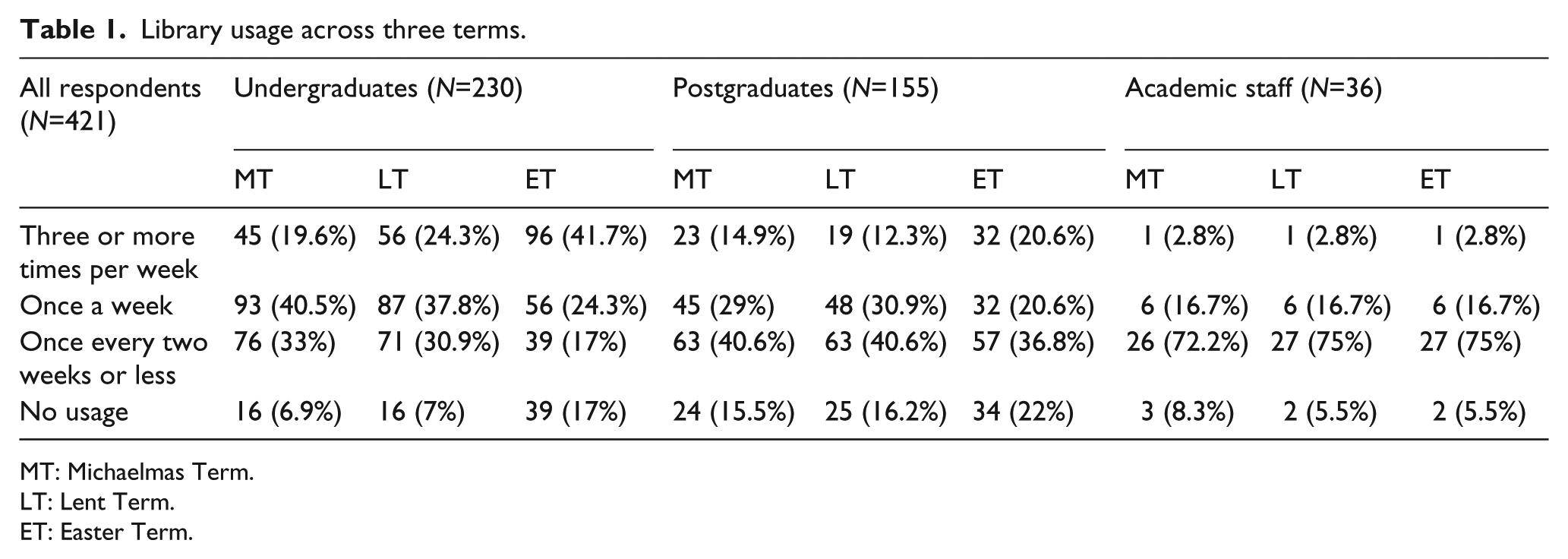
There appears to be interesting variations of intensity of usage between and across the three terms. For example, the number and proportion of undergraduates frequenting the library three or more times per week increases successively for each of the three terms: ranging from n=45 (19.6%) in Michaelmas Term, n=56 (24.3%) in Lent Term, to n=96 (41.7%) in Easter Term. The number of undergraduates frequenting the library three or more times per week in Easter Term was significantly higher than the first and second terms (Table 1).
Library usage across three terms.
MT: Michaelmas Term.
LT: Lent Term.
ET: Easter Term.
A further point of note occurred in the pattern of non-usage which showed equal numbers for Michaelmas and Lent Terms (n=16, 7%), but a dramatic rise for the Easter Term (n=39, 17%).
Overall, Easter Term usage stood out as markedly different from the other two Terms. Easter Term is the examination period, and student intensity of usage reflected their need for revision. Somewhat paradoxically, the Easter Term saw a drop in total numbers using the library, but an increased intensity of usage among those still using the library. The increase in non-users during the Easter Term was probably accounted for by their preference to locate themselves elsewhere for revision.
Postgraduate usage
Survey findings showed that 131 (85%) of the postgraduate respondents used the library in the Michaelmas Term, 130 (84%) in the Lent Term, and 121 (78%) in the Easter Term. Overall, there appeared to be slightly less usage of the library in the Easter Term compared with the other two terms. This was in line with the trends noted for undergraduate usage.
Termly usage by postgraduates
The number and proportion of postgraduates frequenting the library more often, that is, three or more times per week was highest in the Easter Term, it was about one-third higher than in the earlier two terms (Table 1).
There was a rise in non-users (n=34, 22%) in the Easter Term compared to Michaelmas (n=24, 15.5%) and Lent Terms (n=25, 16.2%), similar to the undergraduate trend, but less pronounced.
Postgraduate usage of the library in Easter Term stood out as markedly different from the other two terms. The trends resembled those for undergraduates, although they are less marked. Since Easter Term was the examination period and/or the period for submission of theses, student intensity of usage reflected such pressure. The increase in graduate non-users during the Easter Term was probably because undergraduates took up most spaces in the library for their revision, and/or postgraduates preferred to locate themselves elsewhere, such as their departments, for writing up of theses.
The findings show that both undergraduates and postgraduates frequented the library more often (that is, three or more times per week) in Easter Term, compared to Michaelmas and Lent Terms. This finding is corroborated by library entry figures recorded in the people counter, positioned next to the entrance to the Working Library. The average number of daily entries during Easter Term 2012 was 770, compared to 491 and 457 in Michaelmas and Lent Terms respectively, as noted in the St John’s College Library Annual Report 2012–13 (Lewsey, 2013: 27).
Academic staff usage
The findings showed that 72.2% (n=26 or n=27) of academic staff frequented the library once every two weeks or less; 16.7% (n=6) used the library once or twice a week. Only one academic staff member claimed to use the library three times a week or more. Non-users were also consistent across the three terms (Table 1).
Unsurprisingly, the pattern of academic staff usage bore no relation to that of both student groups. For example, first, there was absolute consistency of usage patterns across all three terms. Secondly, the dominant group was what which used the library less often, notably, once every two weeks or less. Again, this finding was not surprising given that the Working Library is regarded primarily as serving its student population.
Usage of library services
This section reports general findings relating to usage patterns of library services for all three terms. This is followed by more specific findings relating to patterns of usage of library services by undergraduates, postgraduates and academic staff across the three terms.
Usage patterns of library services for all three terms
The findings show that the most common library services used by students and academic staff were borrowing/returning/renewing items (68%), followed by studying or revising (65%), and consulting books or journals (64%). Library lockers were least used (95% of respondents did not use them).
Undergraduate usage of library services by term
The survey findings show that the library services most used by undergraduate students across all three terms were: borrowing/returning/renewing of items (75.7% of respondents), followed by study/revision (73.6%), and consulting books/journals (68.3%). The Michaelmas Term was the busiest, with 80% of the respondents borrowing library items; while the Easter Term had the lowest level of borrowing, with 69% of the respondents. Unsurprisingly, as Michaelmas Term is the beginning of the academic year, the borrowing rate was the highest. The percentage of borrowers declined slightly for the Lent Term, and was the lowest for the Easter Term (69%), presumably because most students were studying or revising for their examinations.
Postgraduate usage of library services by term
The library services most used by postgraduate students across all three terms were: studying or revising (61%), followed by borrowing items (56%) and using computers (56%). The Michaelmas Term was the busiest, with 63% of the respondents using the library for studying/revising, while the Easter Term had the lowest level of revising/studying, with 56% of the respondents. It was noticeable that usage of all three services slightly declined successively for each term, if only marginally for Michaelmas and Lent Terms, but more markedly for the Easter Term.
There appears to be little difference in postgraduate student use of the three most used services across the Michaelmas and Lent Terms, although there was a slight fall in the use of all three in the Easter Term. One may surmise that the library was especially busy during Easter Term with undergraduate students studying and revising, hence postgraduate students might prefer to go elsewhere to work.
Academic staff usage of library services by term
The three top library services used by academic staff were: consulting books/journals in the library (83%), followed by borrowing (64%), and using the library catalogue (50%). The pattern of usage of these top three services was consistent across three terms.
The findings show that patterns of library use adopted by academic staff bore little similarity to either of the student cohorts (undergraduates and postgraduates). Academic staff’s most used service was to consult books and journals (a reference function), which was in neither of the student groups’ top three services. While borrowing/returning/renewing – academic staff’s second most used library service – aligned with the priority reflected in students’ usage, academic staff accorded importance to use of the library catalogue as their third most important service (not mentioned in either of the student groups’ top three services).
A further difference between academic staff and students’ patterns of use was the more stable and consistent patterns exhibited by academic staff across all three terms. Consistent usage among academic staff throughout the year was probably reflective of their academic and research functions which were on-going, whereas students attended to revision, examinations and thesis completion in the Easter Term, with consequential changes in their usage patterns.
Library collections
According to the data, print books are still the most commonly used learning resource (average score 6.16), followed by e-journals (average score 4.51) and e-books (average score 3.86). Seven learning resources were ranked by respondents from 1 to 7, with the most used resource given the score 7, and the least used a score of 1. Then an average score was calculated for each of the seven resources by multiplying the number of times it appeared in each of the seven positions, and then dividing by the total number of respondents. Despite the recent increase in online resources, print books still remained the dominant learning resource. By contrast, e-books were ranked third in the order of the most used learning resources. However, the position was reversed when it came to journals; e-journals were ranked second, while print journals were pushed to fourth rank. It appears that users still prefer to learn from print books rather than e-books; however, the reverse is the case with journals, where e-journals have a generally higher level of acceptance.
When respondents were asked to predict how their usage of learning resources might change in the future, over one-half of the respondents (58%) indicated that they would continue to use print books. This finding further reinforces the conclusion that print books will for the time being continue to be the preferred choice of learning resource.
Undergraduate levels of satisfaction with library collections
The findings show that 62% (n=143) of the undergraduate respondents were either ‘very satisfied’ or ‘satisfied’ with the range of books for background reading; 63.5% (n=146) of the undergraduate respondents were either ‘very satisfied’ or ‘satisfied’ with the availability of core textbooks and course books; 55.7% (n=128) of the undergraduate respondents were either ‘very satisfied’ or ‘satisfied’ with the updated editions of books. Over one-half of the undergraduate respondents (51.3%, n=118) were ‘neither satisfied nor dissatisfied’ with the library collections. However, 36.5% (n=61) of the undergraduate respondents were either ‘very dissatisfied’ or ‘dissatisfied’ with the range of books for background reading and the availability of core textbooks and course books; 10% (n=23) of the undergraduate respondents were either ‘very dissatisfied’ or ‘dissatisfied’ with the lack of updated editions of books.
This disparity between the majority of undergraduate students who feel positive about the collections, and the one-third minority who do not, may be accounted for by unevenness in the subject collections, which have developed differently over the years. The Working Library is a generalist College Library which is unable to stock comprehensive collections in every subject. The library has more complete collections in some subjects than others.
Postgraduate levels of satisfaction with library collections
The findings show that 49% (n=76) of the postgraduate respondents were either ‘very satisfied’ or ‘satisfied’ with the range of books for background reading; 47.7% (n=74) of the postgraduate respondents were either ‘very satisfied’ or ‘satisfied’ with the availability of core textbooks and course books; 45% (n=70) of the postgraduate respondents were either ‘very satisfied’ or ‘satisfied’ with the updated editions of books. However, 19.4% (n=30) of the postgraduate respondents were either ‘very dissatisfied’ or ‘dissatisfied’ with the range of books for background reading and the availability of core textbooks and course books; 10.3% (n=16) of the postgraduate respondents were either ‘very dissatisfied’ or ‘dissatisfied’ with the lack of updated editions of books. Again, this disparity may be explained by the library having more complete collections in some subjects than others.
Academic staff levels of satisfaction with library collections
The findings show that 69% (n=25) of the academic staff respondents were either ‘very satisfied’ or ‘satisfied’ with the range of books for background reading; 58.3% (n=21) of the academic staff respondents were either ‘very satisfied’ or ‘satisfied’ with the availability of core textbooks and course books; 61.1% (n=22) were either ‘very satisfied’ or ‘satisfied‘ with the updated editions of books. None of the academic staff expressed dissatisfaction with the library collections.
Overall, the majority of student respondents were ‘satisfied’ with the library collections. This is reassuring as it signals that the College Library fulfils its role of supporting learning, teaching and research. However, in regard to the minority who feel critical about the collections, the clue to their disenchantment may be in the comments of a few respondents related to their subjects. One such respondent states that (s)he would appreciate a wider selection of general reading/fiction books; another says (s)he would prefer a wider selection of international law texts; and still another suggests the library acquire more books on American history. Further critical comments from respondents indicated the need for up-to-date books to be acquired in their subject, and another would like to see more common course textbooks be made available online.
Physical environment
Three elements of physical environment were included in the WLUS – noise levels, cleanliness and lighting and heating.
Noise levels
Since the Working Library is a place for learning and studying, it is important to gauge users’ views on whether the library environment is conducive to study. Nearly half of the respondents (n=206, 48%) said they preferred silence when working in the Working Library. A further 191 respondents (45%) said they preferred ‘subdued noise’. Nearly two-thirds of the respondents (65%, n=279) said they either ‘always’ or ‘often’ found a work space that met their preferred level of noise; and a further 82 (19%) replied ‘sometimes’. It was encouraging to see that most respondents were able to find a work space at their preferred level of noise.
Cleanliness
The overall cleanliness of the library (94%) drew the highest levels of ‘very satisfied’ or ‘satisfied’ from respondents. This was followed in descending order of ‘very satisfied’ or ‘satisfied’ by the cleanliness of carpets (93%), the condition of desks and chairs (89%), cleanliness of toilets (82%), and comfort of chairs (82%). The two lowest levels of ‘very satisfied’ or ‘satisfied’ were for temperature (76%), and lighting (73%). Conversely, the only significant levels of ‘dissatisfied’ or ‘very dissatisfied’ were for temperature (18%) and lighting (21%). The relatively high level of dissatisfaction on these two areas also reflected in the free text comments at the end of the survey.
Lighting and heating
While respondents were very positive about most aspects of the work environment of the library, two aspects in particular attracted most dissatisfaction. The first was the low levels of lighting in many parts of the library, a problem which was most experienced in winter evenings and at night. The second was the temperature, which many criticised as too cold to permit productive work. Library users were most vulnerable when they were sitting still for long periods, and during unstaffed periods overnight, when the heating might be turned down. In both respects, it was recommended that appropriate action be taken to address the problems.
User satisfaction
This section on user satisfaction is based on two elements: the quality of service offered by library staff and the provision of equipment and facilities.
User levels of satisfaction with the quality of service offered by Working Library staff
Respondents were asked to assess their levels of satisfaction/dissatisfaction with the quality of service offered by the Working Library staff. These aspects included staff politeness, helpfulness, knowledge and expertise, and efficiency.
Data show that respondents were either ‘very satisfied’ or ‘satisfied’ with the following characteristics of Working Library staff, in descending order – helpfulness (88%), politeness (88%), efficiency (86%), knowledge and expertise (84%). Such high levels of satisfaction with the quality of service offered by the Working Library staff are very re-assuring.
User levels of satisfaction with the current provision of library equipment and facilities
Undergraduate responses to this aspect (see Figure 1) show more than two-thirds were either ‘very satisfied’ or ‘satisfied’ with the self-borrowing machine (69%), and with the availability of individual desk space (n=159, 69%). This was followed by satisfaction with the wireless facility (n=156, 68%). It is worth noting that nearly one-half of the respondents (n=104, 45%) were ‘very satisfied’, and 56 (24.3%) were ‘satisfied’ with the self-borrowing machine, while only 7.4% (n=2) were ‘dissatisfied’ with the self-borrowing machine. However, in passing, it is interesting to note that 22.7% (n=51) of the undergraduate respondents claimed the self-borrowing machine ‘does not apply’ to them. This rather high ‘does not apply’ figure may signal that some respondents still prefer to get their books issued manually at the Desk.
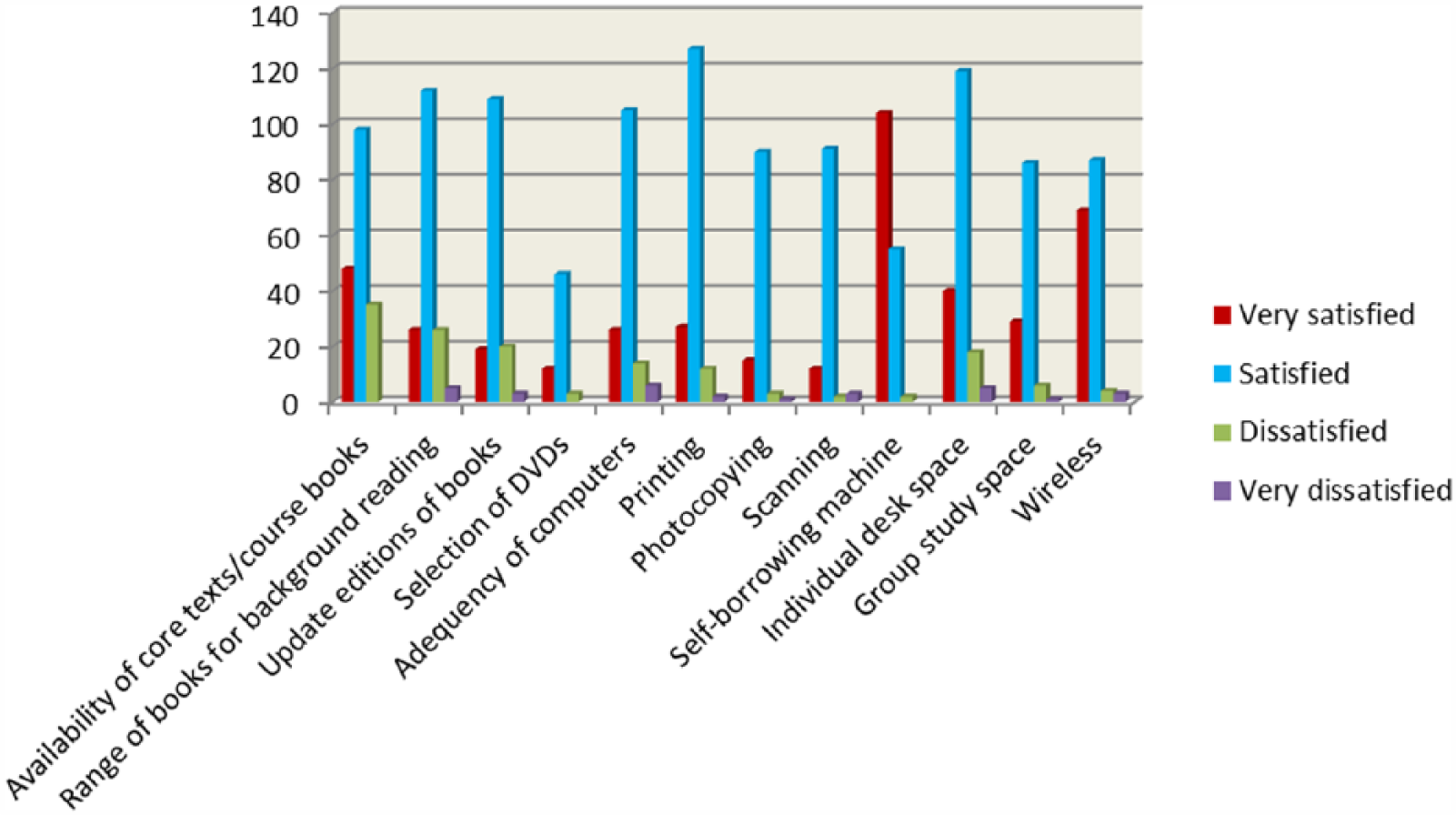
Undergraduates’ levels of satisfaction of library resources/equipment/facilities.
In regard to postgraduate responses, more than one-half were either ‘very satisfied’ or ‘satisfied’ with the wireless facility (n=96, 62%); this was followed by the availability of individual desk space (n=88, 57%) and printing (n=86, 56%). Of all resources, the two that attract the highest ‘very satisfied’ response were the self-borrowing machine (26% of respondents) and wireless facility (22%) stand out.
Overall, undergraduates expressed highest levels of satisfaction with the self-borrowing facilities and with individual desk space, followed by wireless facilities. Postgraduates, however, ranked the wireless facility as their highest level of satisfaction followed by individual desk space and then printing. High usage of, and satisfaction with, the self-borrowing facility was encouraging, especially as the Working Library is open 24 hours, seven days a week. It is important that students are able to self-issue books regardless of the time of day or night they use the library. High levels of satisfaction regarding the provision of wireless and individual desk space indicate that the library is providing a positive environment for users, conducive to their learning.
Discussion
This section discusses the main findings of the survey and their implications in regard to the aims of the survey. The discussion is followed by a summary of the main conclusions of the study and decision making to improve library services. The first two specific research questions were:
Research Question 1: How often do College members frequent the library?
Research Question 2: Which library services do they use?
Both research questions were commented on together since the frequency of library use is closely related to library services.
The findings of the survey confirmed that students use the library with higher frequency than academic staff. Undergraduates and postgraduates show a similar trend in library usage across three terms, that is, most students frequent the library more often (three or more times a week) during the Easter Term than the first and second terms. Interestingly, the number of non-users for both groups is also the highest during the Easter Term. This may indicate that students are unable to find spaces in the library to study or revise, or that they prefer to locate somewhere else for revision.
The reason why undergraduates appear to be the most intensive users of the library is that the library stocks most of the textbooks required by undergraduates. This is supported by the evidence that the library service used most intensively by undergraduates is to borrow/return/renew items, followed by study/revision; whereas the most used library services by postgraduates is study/revise, followed by borrow/return/renew items – a reverse order of the service used by undergraduates.
Not only do undergraduate students use the library more often during the Easter Term than the other two terms, they also tend to commandeer the desk spaces for long periods. The library has a seating capacity of about 150; however, the student population is about 800. Clearly there are not enough seats and desk spaces to cater for all. This raises a key issue of how to ensure those who wish to study in the library are able to find desk spaces, especially during the Easter Term.
Research Question 3: What are the most/least used library learning resources?
The findings show that the most used learning resources are, in descending order: print books, followed by e-journals, e-books, print journals, reference materials, information and advice from library staff, and audio-visual items. Despite the availability of electronic learning resources, print books remain the preferred learning resource for the majority of users. This finding corroborates previous studies. Hiller (2001), for example, found that the top priority for faculty staff was to maintain the quality of the print collections. Hayden et al. (2005) reported that the major resource for both undergraduate and academic staff was printed books. Tracy and Searing (2014) also indicated that respondents preferred to use printed books. The WLUS findings further show that over one-half (58%) of the respondents claimed they would continue to use print books going forward. Based on these findings, it is important that the library maintain comprehensive and up-to-date print collections.
Research Question 4: To what extent do library users feel satisfied/dissatisfied that the library meets/does not meet their needs?
Satisfaction with library collections
Although the most frequently used category of library service by undergraduates is to borrow/renew/return items, this category is also the source of most dissatisfaction. In particular, the highest level of dissatisfaction is with the ‘availability of core textbooks and course books’ (n=35,. 15%), followed by the dissatisfaction with the ‘range of books for background reading’ (n=26, 11.3%), and the lack of ‘updated editions of books’ (n=20, 8.7%).
The library collections also draw some dissatisfaction from postgraduates – 9% (n=14) of postgraduates were either ‘very dissatisfied’ or ‘dissatisfied’ with the ‘availability of core textbooks and course books’; 10.3% (n=16) were either ‘very dissatisfied’ or ‘dissatisfied’ with the range of books for background reading and the lack of updated editions of books. This finding is reinforced by a number of other studies. Clougherty et al. (1998), for example, found that in the library they surveyed, there was a need to update and expand the collections. Woo (2005) also found that there was a significant gap between user expectations and book collections, while Gunasekera (2010) felt that the library surveyed should add more books and reference materials in various subject disciplines. Gibbs et al.’s (2012) study concluded that students expressed the need for more library holdings in specific subjects, notably Arabic and Russian.
It may be that some core textbooks are invariably on loan whenever students wish to borrow them. Some minority subjects may have fewer students compared with other subjects, hence there are fewer books available. This finding suggests that multiple copies of heavily used books should be stocked in the library. Also, more books should be stocked for minority subjects.
However, unlike a faculty or departmental library which focuses on purchasing books within a field and limited number of subjects, and which purchases multiple copies of core textbooks, the collections in the College Library cover nearly 30 subject areas. Given the limited book budget and shelf space, it is not feasible to stock multiple copies of all core textbooks in all subjects. The findings pose a challenge to library staff as to how to maintain up-to-date collections, and, at the same time, ensure that enough core textbooks of a wide range of subjects are available to library users.
Satisfaction with the physical environment
While a majority of respondents expressed high satisfaction with all aspects of the work environment of the library, there are two aspects that cause most dissatisfaction – lighting and temperature. The low levels of lighting and cold temperature are particularly problematic at night in winter. Since the library is open 24 hours, seven days a week, the environment needs to be conducive to work and study at all times. Clearly, problems of poor lighting and cold temperatures need to be addressed as soon as possible.
Satisfaction with the library staff performance
Finally, respondents expressed very high levels of satisfaction with library staff performance in terms of their politeness, helpfulness, efficiency, and knowledge and expertise.
Overview of library provision and constraints
As a way of measuring the constraints the College Library faces, users’ dissatisfaction provides a useful indicator. There are three themes of users’ dissatisfaction. First, there is some dissatisfaction with the book collection, but only in some subjects, particularly the availability of core textbooks in main subjects and supporting text in minority subjects. Second, some users expressed concern about the lack of desk space during peak time in the exam term. Third, criticism was made of by some users of inadequate lighting and heating. These three areas of dissatisfaction, criticism or constraint may be seen as surprisingly few in number for a large academic library. Partly at least, they reflect the fact that the College is large and relatively well endowed, a point which is elaborated in the section on decision making below.
Conclusions and implications
The following six conclusions are derived from the main findings reported above.
There is a varied pattern of library usage among College members. Students use the library more often than academic staff. The library is especially busy during the Easter Term (examinations period) when both undergraduates and postgraduates use the library more often (three times or more per week) than the other two terms for studying and revising.
Among all three user groups, undergraduates use the library most extensively. This orientation to undergraduates is reflected in the College Library stocks, although coverage across subjects varies.
Of all library services, the borrowing/renewing/returning category of items is the most frequently used by undergraduates, and it is also the least satisfactory. Undergraduates particularly criticised the library collections because of the heavy demand on core textbooks and course books, which sometimes means that the books they want to borrow are out on loan. The library collections also drew some dissatisfaction from postgraduates.
Print books remain the most popular learning resource for College members, who also predict that print books will remain heavily used going forward. This is however, not the case with print journals, which are less used than electronic journals.
Most respondents express high satisfaction with the College Library as a work environment. The two areas of least satisfaction are inadequate lighting (21%) especially in winter evenings. The second area is the temperature, which many criticise (18%) as too cold to permit productive work.
A majority express satisfaction with the performance of library staff across the range of services.
In addition, these findings suggest important implications regarding an evidence-based approach to decision making that results in improved library services, as outlined in the section below.
Implications for decision making to improve library services
A major theme of this paper is that user surveys in academic libraries are of little use in themselves. That is, their potential is only fully realised when they lead to informed decision making and improved resource allocation. In some cases it appears that survey reports are shelved and lead nowhere. This section therefore records the procedures and processes undertaken in the critical transitioning from survey findings and recommendations on the one hand, to full adoption and implementation in library provision on the other. Before detailing these management procedures, however, it is important to provide information on the College context.
In relation to Oxbridge colleges as a whole, the College in question is large and well endowed. This matters, as previously stated, in helping explain the relative absence of constraints especially in terms of resources. As a large College, a substantial Maintenance Department exists to address issues pertaining to plumbing, electrical and building work. Hence most problems and constraints affecting the library’s physical environment are handled by the College Maintenance Department, with its own budget. Costs of improvement to the library’s physical environment thus come from the Maintenance budget and not from the library.
A key contribution of this study is the explication of the steps taken to win acceptance and action based on the survey. In expediting the survey findings in the case of the present study, a number of key aspects are worth highlighting. First, it is important that the user survey yields clear actionable findings and recommendations which was evident in the present case. Second, there is a well-established organisational structure and procedure for the actioning of evidence-based recommendations. Third, once the recommendations had been formally accepted by the College Library body, there was the need for a champion to advocate and oversee their implementation. This often took the form of bringing sustained pressure on for example, the Maintenance Department to commit resources and do the work.
Once the initial findings and clear recommendations of the WLUS were finalised, they were reported to the Head Librarian. After referring the document to the Head Librarian, a summary of the findings was presented to the Library and Records Committee, composed of the Librarian, the Archivist, and elected representatives of students and academic staff. A full report of the WLSQ findings was subsequently submitted to every member of the Library and Records Committee. The Committee’s anticipated response served as a precursor to decisions and actions. The composition of the Committee, including students and other users, is noteworthy in gaining acceptance of improvements to be made and actions taken, in that all stakeholder groups are represented. The survey report and its recommendations were unanimously accepted and implementation endorsed by the Committee.
Appropriate actions have since been taken to address the main issues raised in the user survey, including: a system aimed at a fairer use of desk space during the busy Easter Term; improvements in library collections; and better temperature and lighting. Actioning the recommendations particularly in regard to the physical fabric of the library has necessitated by the Academic Services Librarian liaising with the Maintenance Department to agree a programme of building work and a time scale. In regard to improving the book collections, additional resources, including donations, have been forthcoming.
Once the survey findings and recommendations formally accepted by the Library and Records Committee, it was considered important to share the results with users. This was done in the following ways. First, the full report was posted on the library website for all members to access. Second, a summary of major findings was posted on the information board at the main entrance to the library, and on the plasma screen in the library. In these ways feeding the results of the survey back to users is an important way of raising their interest and engagement in the academic library as a hub of learning.
In order that as many College members as possible can have access to desk space during the Easter Term, library staff met with students’ representatives to generate a solution which would ease the pressure during the Easter Term. Consensus decision making led to implementing a ‘desk in use’ system. This allows students to reserve desk space for up to two hours by filling in a ‘desk in use’ slip when they temporarily leave the library. If they plan to return within two hours, the desk will be reserved for them and all materials will be left undisturbed. If they do not return within two hours, the desks will be cleared by library staff. The ‘desk in use’ system has now been implemented and has so far proven to be seen as reasonably fair in enabling those who wish to work in the library during the Easter Term to find a desk.
In terms of improving library collections, every effort has been made to liaise with the College Academic Directors of Studies and those who have subject expertise to encourage their subject recommendations and advice on essential books required by undergraduates. Multiple copies of core text books are being purchased if they are recommended by Directors of Studies. E-books of core texts have been purchased centrally by the e-books team at the University of Cambridge to enable wider access. In order to address the shortage of some core books, a decision has been taken to initiate an ‘Adopt a book’ scheme to generate extra funds for book purchasing. Through generous donations from alumni, the library is now able to acquire most up-to-date editions of core textbooks and course books to meet the academic needs of students. More non-academic (general interest) books have also been purchased to widen the library collections. In fact, improved management of the library collections is an on-going part of the College Library as it endeavours to fulfil its aim of being the ’hub’ to support teaching, learning and research.
Data from the WLUS has also led to a decision to address one of the most problematic areas experienced by users. This concerns improvements to the physical environment of the library. As previously mentioned, many users complained about inadequate lighting and cold temperature when trying to study. Using the evidence from the WLUS, these matters were brought to the attention of the College Maintenance Department. With their support, modern energy saving and sunken lighting has now been fitted to each of the five floors in the library. The central heating has also been turned on 24 hours a day during cold winter months. It is also worth emphasising that there are close relationships between the learning and physical environment. It may be that library decision makers often see the two as discrete rather than interconnected, failing to realise that a comfortable and attractive physical environment generates a more conducive learning environment for users, in this case, students and academics.
As previous studies have shown, library user surveys have proven to be a popular tool to measure the extent to which libraries meet their users’ needs. However, the studies referenced in this paper fail to report what decisions and measures were taken to improve library services to better meet users’ needs. Surely, they therefore miss perhaps the most important point about library user surveys: that they are a tool for collecting user data, and they are helpful in raising awareness and interest of users in library matters. However, even this is secondary to their key function of enabling librarians and managers to use evidence-based, more informed decision making to improve library services by becoming more responsive to the changing needs of users.
Footnotes
Acknowledgements
The author wishes to thank the academic staff and students of St John’s College, Cambridge for their support for, and participation in, the Working Library Users’ Survey (WLUS).
Declaration and Conflicting Interests
The author declared no potential of conflicts of interest with respect to the research, authorship, and/or publication of this article.
Funding
The author received no financial support for the research, authorship and/or publication of this article.