







Abstract
Listening to young children’s voices is crucial to improving children’s library services. The first step is unveiling how young children think about the library. Thus, researchers recruited the Mosaic approach including photography, interview, and drawing to explore the features of children’s libraries in children’s perspectives in six libraries in China. The results indicate that first, the children’s library is a “primary third place”. Second, the children’s library is an overlapping of home and society. Third, children can read books in the children’s library, but not just read. Fourth, the children’s library improves children’s awareness as patrons. It is suggested that young patrons already form initial understandings of the library, begin to complain about any problems, and put forward requirements for the library. Additionally, their interpersonal needs should be paid attention to. Therefore, librarians and researchers should respect the rights of children and listen to their voice when designing and providing library services associated with children.
Introduction
Although children’s librarianship has developed over more than a hundred years, adult discourses are still in charge of library services for children. For example, some Chinese libraries require children to keep quiet, and some public libraries even reject children under 14 years old because “children are too noisy”. Young children are seldom included in the administrative procedures of a children’s library. They are rarely asked about their preferences when book purchasing and their rights to evaluate library services are usually pre-empted by their guardians. Although adult-sized furniture has been absent for decades in the children’s section, adults remain in charge of the decision-making in children’s libraries. While children’s librarians are dedicated to offering exceptional service to children, and many are trained in children’s reading preferences and child development, children’s “voices” are still often not heard when adults make decisions about the services to offer. Noticing the problem of the dominance of adult perspectives in children’s issues, researchers in other fields have been appealing for “listening to children’s voices and valuing their own rights” (Burroughs, 2012; Clark and Statham, 2005; Roche, 1999; Sutherland, 2013). In librarianship too, some researchers have begun to notice this (Barriage, 2018; Hughes-Hassell and Miller, 2003; Wang et al., 2017).
Since children are the primary stakeholders of children’s library services, letting children use their own voices to participate in the library decision-making process is important. Above all, how children perceive the library and its services as the foundation should be examined. Recently, teenagers’ and older children’s experiences and feelings in libraries have earned more attention from information and library science researchers (Bolin and Dyson, 2000; Chandrasekar and Sivathaasan, 2016; Chang and Tsai, 2015; Druin, 2005; Jeong and Lee, 2015; Önal, 2009). However, young children from 3 to 6 years old are not part of this. The adult-children power structure (Burroughs, 2012; Druin, 2002) and young children’s limited cognition and verbal skills especially in relation to abstract concepts and actions (Druin, 2002; Given et al., 2016; Piaget, 1973; Piaget and Rosin, 1977) are considered limitations to empowering this group.
In other fields, these two problems have been addressed. Along with the emphasis on young children’s rights and their priority to talk about their own life (Burroughs, 2012; Clark and Statham, 2005; Druin, 2002; McTavish et al., 2012; Novinger and Smith, 2003; Roche, 1999; Sutherland, 2013), more researchers are beginning to explore bringing this group into design, administrative decision-making, and strategic planning. At the same time, paradigms of studies on young children are turning from young children as research objects to young children as research participants (Michail and Kellett, 2015; Woodhead and Faulkner, 2008). Thus, researchers have more opportunities to explore young children’s experiences and perspectives.
In librarianship, there are few investigations on young children’s experiences as patrons of library services. Moreover, most of them focus on the parts which adult researchers are interested in and recruit methods which are not particularly designed for young children. For example, some researchers and institutions evaluate children’s libraries according to the criteria of materials, programs, and children’s satisfaction with the libraries by questionnaires (Ministry of Culture, 2017; Wang et al., 2014).
It is still unclear that what young children think about their library, let alone including this in the practice and evaluations. Thus, this research attempts to address the question of what preschool children think about their library, as a reference to children’s participation in their library’s decision-making process.
Literature review
Preschool children and their characteristics
The age of preschool children varies by country. In China and the US, it usually refers to children aged from 3 to 6.
Preschool children are not small-size adults. They have many characteristics different from the adult. These help researchers to understand the capabilities and limitations when conducting research with preschool children. In Piaget’s theory of cognitive development, children aged from 3 to 6 are in the preoperational stage. During this stage, children begin to express themselves orally, engage in symbolic play, and learn to manipulate symbols. However, they are not yet capable of understanding concrete logic (Beilin, 1992; Rathus, 2011; Santrock, 2004). Some characteristics pertinent to this study include: first, preschool children are able to complete a sentence and pick up the essential active words of an adult; second, preschool children like to express a certain meaning by painting; third, they cannot read a clock, but they can use words to organize time (the routine of a child’s day also contributes to his perception of time); fourth, space is organized around what is within a child’s reach. Space is understood to comprise the area within which a child might take action(Brazelton and Sparrow, 2002; Ministry of Education of the People’s Republic of China, 2012) .
According to these characteristics, more appropriate research approaches and methods can be selected.
Preschool children’s perspectives and measurement
The emphasis on children’s perspectives complies with the tendency of valuing children’s participation rights. Children’s participation rights include the right to a name and identity, to be consulted and taken account of, to physical integrity, to access to information, to freedom of speech and opinion, and to challenge decisions made on children’s behalf (Alderson, 2000; Clark, 2005; Lansdown, 1994; Smith, 2002). Researchers use “listening to children” to refer to a complex variety of terms and understandings in relation to children’s participation and their rights to participate (Clark, 2005; Clark and Statham, 2005; Macdonald, 2017; Roche, 1999). Children’s perspectives are recognized in the process of listening. When involving children in making decisions about their own rights and welfare, it is necessary to understand their perspective of the world, their experiences, feelings, and views (Kirby et al., 2003). Numerous researchers and caregivers have noticed the importance of young children’s perspectives in making decisions regarding their own care and services.
Two topics figure most prominently in the literature on preschool children’s perspectives : their experiences in kindergartens and child care centers (Alvestad, 2011; Atwool, 2006; Demarie, 2010; Im and Swadener, 2016; Kragh-Müller and Isbell, 2011), and their perspectives of particular items and programs (Adams and Savage, 2017; Demarie, 2001; Klein, 2005; Lakestani et al., 2011).
With the limitation of young children’s verbal skills, a combination of methods is required to stimulate them to express themselves in more forms and enrich the research data. Most of the researches associated with young children’s perspectives recruit more than one research method (Cooper, 2002; Large et al., 2014; Nesset, 2013, 2005). Clark and his colleagues developed a “mosaic approach” framework to facilitate young children being heard. Fundamental to the Mosaic approach is a belief that children, including very young children, are experts in their own lives, skillful communicators, rights holders, and meaning makers (Clark and Moss, 2011; Clark and Statham, 2005). This is a multi-method approach which is proven to be applicable to very young children and disabled children (Clark and Moss, 2011; Håkansson et al., 2008; Liu, 2014; Pickering, 2013; Pickering et al., 2013). The Mosaic approach recruits different methods to bring young children’s life segments as mosaic pieces together to reveal young children’s views, opinions, and understandings from their perspectives. Three methods of the Mosaic approach are frequently used: interviews, photography, and drawing.
Interview: Interview is frequently recruited in young children’s perspective researches since verbal skills are gained dramatically in the early childhood period and preschool children are able to have conversations with researchers. Some researchers found that children preferred to be interviewed with friends (Cheng, 2009; Clark and Moss, 2011). However, more interviews with young children as participants were conducted individually because this can make them feel they are important and provide more information (Alvestad, 2011; Demarie, 2010; Einarsdottir et al., 2008; Kragh-Müller and Isbell, 2011). The semi-structured interview is the most frequently used form when interviewing children. However, exclusive use of interviews is not viewed as optimal for collecting data from young children since they may not be able to verbally express all of their ideas or knowledge about a topic. Also, an unequal power structure may be present when adults interview children that may influence their responses (Druin, 2002; Hayden and Ward, 2010). Thus, some principles should be carefully obeyed when interviewing young children: choosing settings according to the children’s preference, being flexible as to interview place and participants, being sensitive to the power structure between adult researchers and children, preparing to take time with children (Clark and Moss, 2011; Demarie, 2010).
Photography: Cameras appeal to young children and provide a form of communication that is fun. Additionally, photography as a participatory method provides young children a more in-depth view of life, which they usually do not discuss directly (Clark and Moss, 2011). Photography is conducted as a method of supporting the interview for children in order to give more abundant descriptions. The photography method is conducted in two approaches: taking photos, and making albums with selected photos (Clark and Moss, 2011; Clark and Statham, 2005; Demarie, 2001, 2010; Ziller, 1990). The first one requires children to take photos to answer the questions such as “the most important thing here”, “your favorite item” or “who am I”. The latter one requires children to complete the task of picture selection. The pictures are either taken by researchers or children themselves. In Demarie’s (2010) research, researchers presented children with a standardized set of labeled, representative photographs and asked them to pick the ones which could best answer questions. In Clark’s Mosaic approach, the pictures for selecting were taken by young children (Clark and Moss, 2011; Clark and Statham, 2005).
Drawing: Researchers treat drawing as a meaning-making and constructive process for children to express themselves (Anning, 2010; Einarsdottir et al., 2009; Wright, 2007). In some researches, drawing was used mainly to “warm up” and stimulate children to join in the following activities (Harpham et al., 2005), while in the others, drawing provided a context where children had some control over the nature of their engagement in data-generation activities (Anning, 2010; Einarsdottir et al., 2009; Wright, 2007). No matter what the purpose of the drawing is, the consensus of researchers is that they value drawing as a process, rather than the drawing product (Einarsdottir et al., 2009).
Preschool children’s usage and experience of libraries
During the early years of life, children rapidly develop literacy skills such as reading, writing, and oral skills. Many research studies have shown that reading exposure is vital to children’s literacy skills acquisition (Anderson, 1985; Chomsky, 1972; Cunningham and Stanovich, 1997; Dickinson et al., 2003; Doyle and Bramwell, 2006; Jensen et al., 2012). The library is a place where children can mostly get reading exposure and gain the reading habit. One study found that the amount of reading children from poor homes did and their gains in reading achievement over the summer were negatively correlated to the distance they lived from a public library (Anderson, 1985). The children’s library has a key partnership role in facilitating the right of every child to information, literacy, cultural development, lifelong learning, and creative programs in leisure time (Rankin, 2018). Therefore, a high quality of library environments and services which could bring a good experience in libraries is vital to children’s literacy development.
There are some surveys on children’s satisfaction with libraries but few focus on preschool children. Håkansson and colleagues interviewed five-year-old children to find out if they could connect experiences they made from other situations to questions about the library (Håkansson et al., 2008). M Liu (2015) let patrons (including eight preschool children) of Guangzhou Juvenile and Children’s Library evaluate the library’s user education function which included the criteria of overall knowledge of the library, information retrieval, information technology, reading promotion, safety knowledge, information literacy. In many studies, children under six years were excluded from the study, because they were fewer in number and not able to effectively communicate their views (Chandrasekar and Sivathaasan, 2016; F Liu, 2015; Qi, 2015).
Researches on preschool children’s library experience are mainly focused on library places and equipment. Chang’s research shows that desktop shape affects parent-child interaction. The shape of a flower table allows parents and children to work alone, while the round table is conducive to parent-child interaction. Children tend to sit or stand by the book shelf and read. The comfortable and undisturbed reading space is the main factor for the user to choose a seat. The secondary factors include the size of the table and chair, the style of the table and chair and the lighting (Chang and Tsai, 2015). According to the study of Zheng and his colleagues (2016), the optimum height of book shelves for preschool boys is 111.8–129.9 cm, and for the girls is 96.2–112.0 cm.
In conclusion, there are just a few studies on preschool children’s experience of children’s libraries; moreover, most of them focus on the parts which are from more adult perspectives rather than preschool children’s perspectives. Thus, it is still unclear what preschool children think about their library. Thus, researches on preschool children’s perspectives of the children’s library should be conducted.
Research design
Participants
Participant preschool children were recruited from three juvenile and children’s libraries and three public libraries in Tianjin, Hangzhou, Shanghai, and Fuzhou city. Since this study is a university-led initiative without funding, researchers chose the cities and libraries based on convenience and accessibility. In China, juvenile and children’s libraries and children’s sections of public libraries are two main places that offer children’s library services. A juvenile and children’s library is one which offers a library service particularly to juveniles and children.
Investigations were conducted on weekends since there were more preschool children in libraries. Researchers first looked for young children and confirmed that they were in the three to six age range. Then the research purpose and a brief description of the investigation procedure were explained to both children and their guardians. After the informed consents were given by the guardians and permissions were given by children, the formal study took place.
Data collection
The study was conducted in March to July 2017. Researchers used the Mosaic approach (Clark and Moss, 2011) to collect data. The actual procedure was as follows:
All the preschool children and their parents were told that the purpose of this study was gathering children’s library experiences for improving library services. After getting permission from both young participants and their parents, the researchers introduced themselves, and then chatted and played games with the participants to relieve their anxiety toward strangers. After participants were familiar with the researchers, the Mosaic approach was conducted in the order of photography, interview, and picture-drawing. This whole process was tape recorded and transcribed into texts.
After the formal research started, researchers taught participants to use a digital camera and take photos. Then, these preschool children were asked to talk about this first photo. After making sure that participants were able to use a camera, they were free to take photos (including people, things, places, etc.) in the young children’s section of the library. This process finished when participants felt they had taken enough photos. At this time, researchers took them back to their seats and discussed the photos.
Interview is a participant-centered data collection method. The researchers used a semi-structured interview with questions which were discussed by researchers and organized to address the following areas:
Why did you come to the library today? Whose idea was it to come?
What did you do this time?
Do you have some memorable experiences in this library?
What are your favorite things, places and people here?
What are your least favorite things, places and people here?
What things are hard to do here?
If there is a chance to add something to this library, what would it be?
If there is a chance to remove something from this library, what would it be?
What is a library? What can you do in a library?
The interviews were designed to last no more than 15 minutes to avoid making preschool children lose patience. Interviews were conducted in relatively undisturbed places in the young children’s section but ensured that participants could see others to avoid making them feel isolated and nervous.
Children’s drawings were used to access their views and experiences by listening to children as they drew and paying attention to their narratives and interpretations (Einarsdottir et al., 2009). Picture-drawing enables children to illustrate their opinions on libraries in a more innovative way. Since this method takes more time than other methods, which may affect children’s patience to cooperate with the rest of this study, picture-drawing was arranged as the last part of the whole study to keep participants as engaged as possible. In this session, researchers offered each child a piece of paper and colored pens then asked them to “draw a picture about a library”. Unless they asked for help, researchers did not intervene in this process. After completing the pictures, researchers discussed the pictures with participants and probed for details.
Data analysis
The Mosaic approach is a mixed-method approach (Clark and Moss, 2011). This approach uses triangulation which involves the use of at least three different methods to collect data to make the result more valid. Through the use of systematic comparative analysis of grounded theory (Glaser and Strauss, 1967), similar themes and patterns are identified from the data. From these patterns and themes emerge theoretical constructs (Patton, 2002: 124–127). Researchers used MAXQDA 10.0 to analyze qualitative data on three levels. First, all the transcripts and notes were browsed and coded line by line, and then the codes were grouped in relation to each child’s library experience. For example, a girl complained that too many children were in the library for her to ride the kiddie ride. Also, she said she knew that toys in the library were for everybody to play with, not only for her. This was coded as “too many people in the library” and “understand public goods are for public”. Another girl told the researchers that she had come convenience food with her mom outside the library since the library was not a place for eating. This was coded as “understand the rule of library”. Second, initial categories were identified and developed based on similar topics. For example, codes related to public rules and public goods and other public topics were categorized as “understand library is a public place”. Third, major categories on preschool children’s view of libraries were generated by comparing cases and categories. For example, categories of “library is a public place”, “library is a social place”, etc. were gathered. Then, the researchers found that these library features were similar to “the third place”. After comparing these concepts, researchers entitled the new category “a primary third place”.
Findings
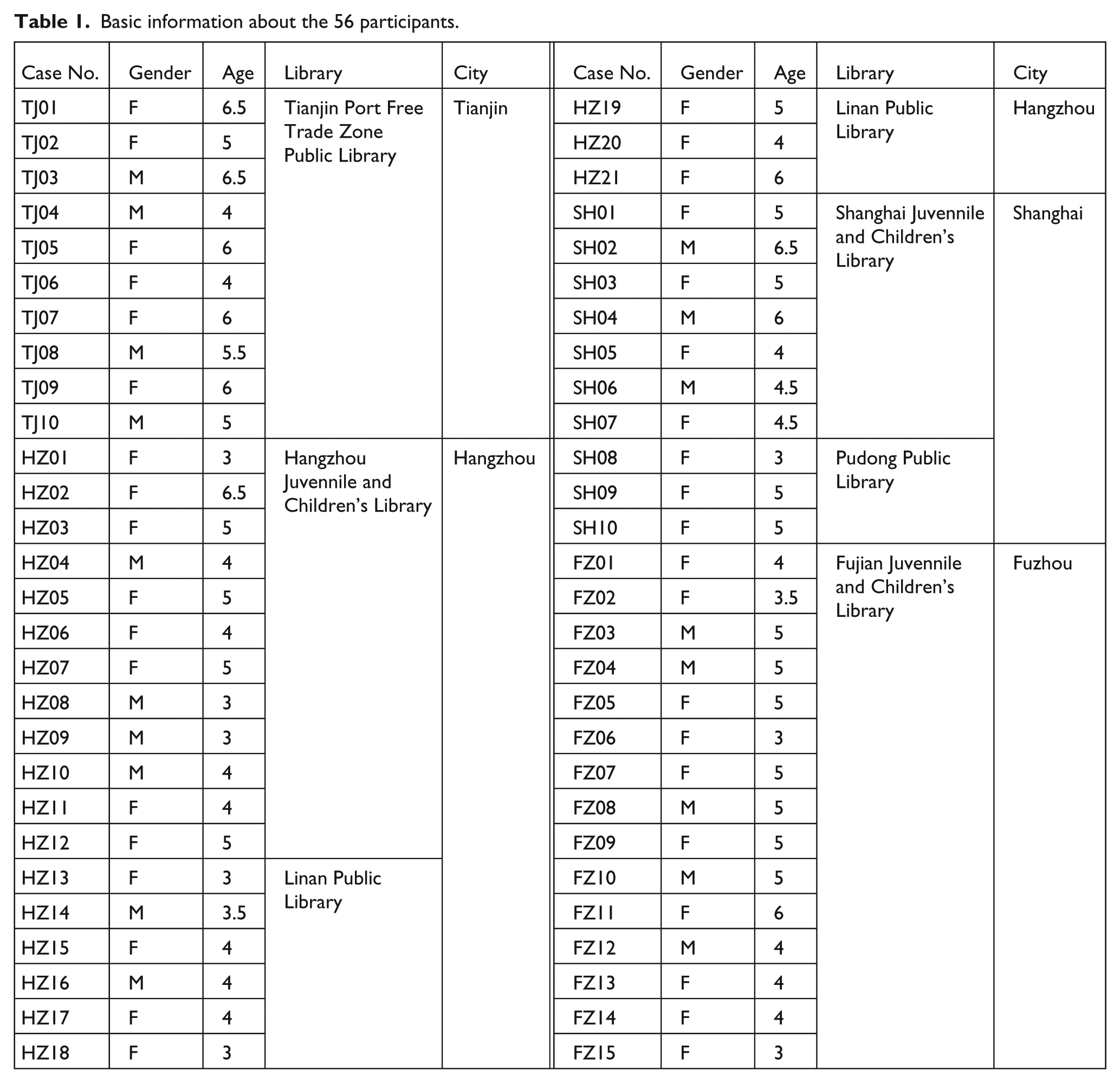
The researchers investigated 56 preschool children and obtained 45 sets of photos, 46 interview transcriptions, and 15 drawings. Basic information on these cases is given in Table 1. According to the qualitative data, the researchers concluded a children’s library contains the following characteristics.
Basic information about the 56 participants.
The children’s library is a “primary third place”
“Third place” is a term put forward by Oldenburg. He defined the third place as “a generic designation for a great variety of public places that host the regular, voluntary, informal, and happily anticipated gatherings of individuals beyond the realms of home and work” (Oldenburg, 1999: 16). Following this definition, a children’s library as a primary third place in preschool children’s perspectives is comprised of the following characteristics.
The children’s library is a public place
Preschool children notice that the library is a public place. A main theme of the photos taken by preschool children is strangers (see Figure 1). Children take photos of adults, their peers, and younger children, which indicates that young children notice the others and their existence.
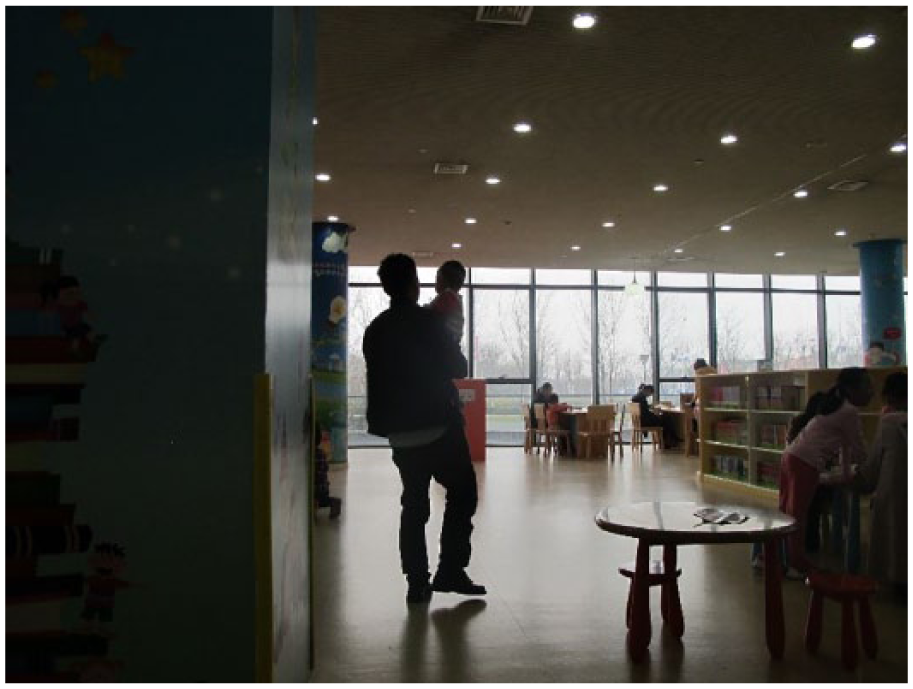
An uncle and a little brother (taken by TJ03).
Preschool children talked about strangers’ behaviors in interviews: “The library once was in a mess, so I told them not to mess it up!” (HZ11). “I found that some books were torn by others, which makes me feel unpleasant” (FZ07). Young children realize that the library is a place filled with “others”, and it is always out of control.
Some preschool children are able to follow the rules of public places. They know the facilities in libraries such as toys, digital devices should be shared. For example, “Toy cars here are for everyone to play with, not just for someone” (HZ02).
Most participants perceive the restriction and inconvenience of a public place. Complaints such as “All the books I want to read are borrowed” (HZ04, FZ11): “too noisy” (TJ02, FZ07): “There are so few tables that I always have to wait until someone else has gone” (TJ07): “We can’t play with LEGO blocks if too many people are here” (HZ20) suggest their dissatisfaction with others in public places.
The children’s library is different from home and kindergarten
Preschool children think that the library has different functions from home and school. For example, two participants told the researchers that there were more book shelves than at home/kindergarten. Besides, book-returning carts, interactive equipment, shared iPads, and cushions for reading are only seen at libraries instead of other places.
A child mentioned that he preferred to learn different knowledge at the library and at kindergarten. “When I am in the library, I prefer to learn human science while I prefer to learn natural science when I am at school” (TJ03).
The children’s library has social functions
Children’s libraries stimulate preschool children’s desire for social interactions, which may be related to their understanding of the library as a public space. Some participants expressed their desires to have friends in the children’s library. “I have a friend who doesn’t come to the library as frequently as I do, so I feel bored when I stay alone” (TJ01).
In libraries, preschool children have opportunities to make new friends. Some participants consolidated existing friendships in libraries. For instance, SH06 and SH07 were classmates and friends in kindergarten. Their families often spent time together, and the library was one of their meeting places. Two kids often shared books, read books, and made handcrafts together in the library. In other cases, three participants did not know the library until their friends brought them there. After being there for a while with their friends, they began to enjoy the library.
The children’s library is a place full of fun
Preschool children have a good feeling about libraries. Some told the researchers that the “library is a place full of fun” (HZ19, SH02). Eleven children liked their parents’ companionship in libraries. In some libraries with iPads or toys, the researchers observed that children ran in immediately after the door opened.
Three participants mentioned the activities such as story time or handcraft programs they took part in recently because “they are attractive and joyful”. Additionally, their photos show they paid attention to the drawing and handwriting works on the wall (see Figure 2) from art competitions held by libraries.
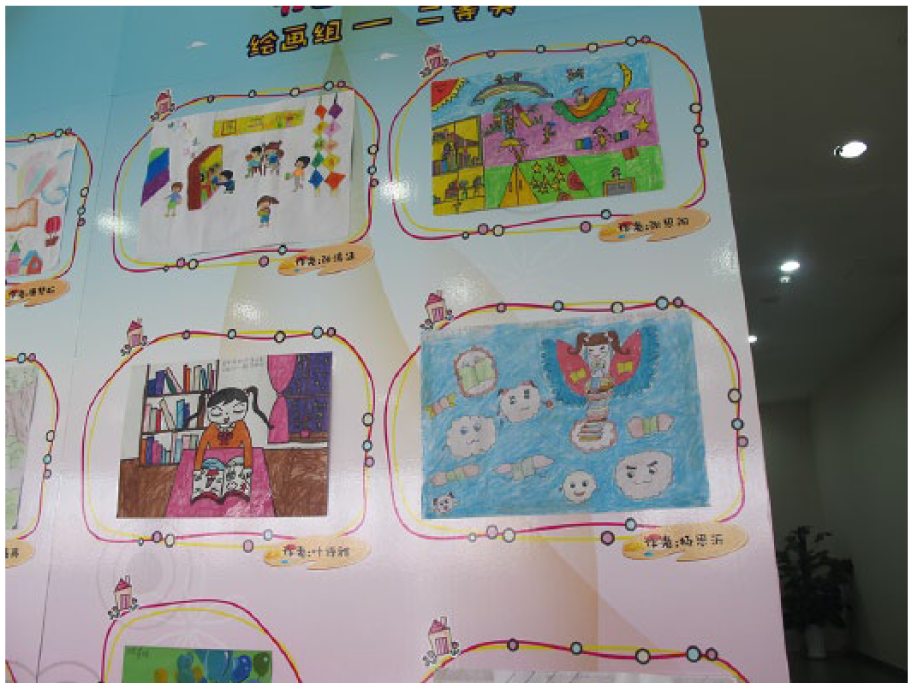
Drawings on the wall (by TJ05).
The children’s library is an overlapping of home and society
The overlapping of home and society refers to the fact that preschool children enjoy both family life and social life in the children’s library.
In family life, children are their parents’ children, which means they interact with parents, enjoy parents’ company, and they are under the authority of their parents. Parents and young children have three kinds of interactions in libraries. First, parents read books to preschool children and select books which are going to be borrowed. Second, parents play games with preschool children. Third, parents help preschool children who cannot find particular books, or the book is too high to reach. These interactions foster a close relationship between preschool children and parents and encourage preschool children to come to the library. On the other hand, some participants reported negative interactions with their parents. One child said “I wanted to borrow this book, but Mom didn’t allow me to. She told me to borrow that one” (TJ03). Regardless whether they are positive or negative interactions, these phenomena can be considered as preschool children and parents extending their family life patterns into the library.
Preschool children experience social life in libraries as well. They deal with friendship and gain understandings of the rules of public places. Additionally, preschool children have improved autonomy. Despite being under the supervision of their parents, some children have a lot of autonomy in libraries. They can decide what to read or to borrow, or what story to share in story time. They are able to complete the borrowing procedure all by themselves, or even stay alone when parents go out of the reading room for a while. Some preschool children achieve self-perception during the social interaction with other people. One child showed the baby and toddler area to the researchers and said, “Those books are for younger children, not for older children like me” (SH04). These phenomena suggest that preschool children begin to explore societal life in libraries. The growing self-awareness and increasing autonomy gradually let preschool children step over the boundaries from home to society.
Preschool children can read books in the children’s library, but not just read
Books are symbolic of the library. Preschool children took photos, talked about, and drew pictures of books and related items. Every child told the researchers that they came to the library for reading books, and the library was a place for reading books. Their favorite item in the library was books. Some participants noticed the facilities and equipment for books, such as book shelves, self-borrowing machines, returning carts, and new books recommendation boards. Some general objects were also perceived to be related to books in the library. There is a cushion which covers about three square meters in Tianjin Port Free Trade Zone Public Library. Participants named it as “a cushion for reading books” (TJ03, TJ05, TJ08).
Books are also symbolic of knowledge. When probed why they read books in the library, preschool children often answered: “for learning” (TJ01, TJ06, HZ05, FZ07). A girl drew a picture of a bookshelf full of books and explained each theme of the books to researchers (FZ07). The themes included “how to whistle”, “why caterpillars become butterflies”, “death”, “Chinese Zodiac”, etc. which she was always curious about. In her opinion, the library was a place for answering questions.
At the same time, preschool children gave attention to the other items and functions other than books in libraries. Preschool children liked to use iPads, toys, recreation facilities such as slides, simulated kitchen, etc. They also made full use of library spaces, such as drawing pictures on the table, or dancing on the cushion. Some preschool children liked to attend activities held at the library. Thus, they knew that they could also make handcrafts, hear stories, and attend a lecture on scientific knowledge in a library.
The children’s library improves preschool children’s awareness as patrons
The researchers define patron awareness as the following expressions: readers’ behavior, knowing and following the library rules, understanding the librarian as a professional and their work, the cultivation of information retrieval ability, the realization that friends and relatives are also readers of the library, and the suggestions from patrons for improvement.
The reading behavior of preschool children includes that the purpose of their coming to the library is to “read books” and “borrow books”. They have been to the library several times, and have established the habit of regularly coming to the library (e.g. every holiday, every due date, etc.). In addition, some children said “I want to come to the library again” (SH03, FZ09).
Preschool children know the library rules. They can clearly express the library rules, including lending/borrowing processes, open and closing times, overdue fines, etc., and they are interested in the posted rules. They believe that the rules and order of the library should be maintained, such as “We cannot eat in the library, because it is not allowed. We should eat outside” (HZ05).
Understanding the librarian as a professional and their work refers to the ability to distinguish between librarians and other adult patrons, and to understand the duty of librarians. The former can be demonstrated by the behavior of preschool children actively seeking the help of librarians, and complaining when librarians do not help. The latter includes that the duties of librarians in preschool children’s eyes include “book issues” such as “borrowing and returning books” (TJ01): “managing books” (SH10) and “finding books for readers” (HZ08). It is important to note that a child drew a robot in the heart of the picture for “managing books” (FZ08, as shown in red circle of Figure 3): because “it is too much work to do to manage bookshelves for a human librarian”. In his perspective, the repetitive tasks of sorting the books can be processed by robots. Does it imply that they have new requirements for librarians’ work? Further exploration is needed.
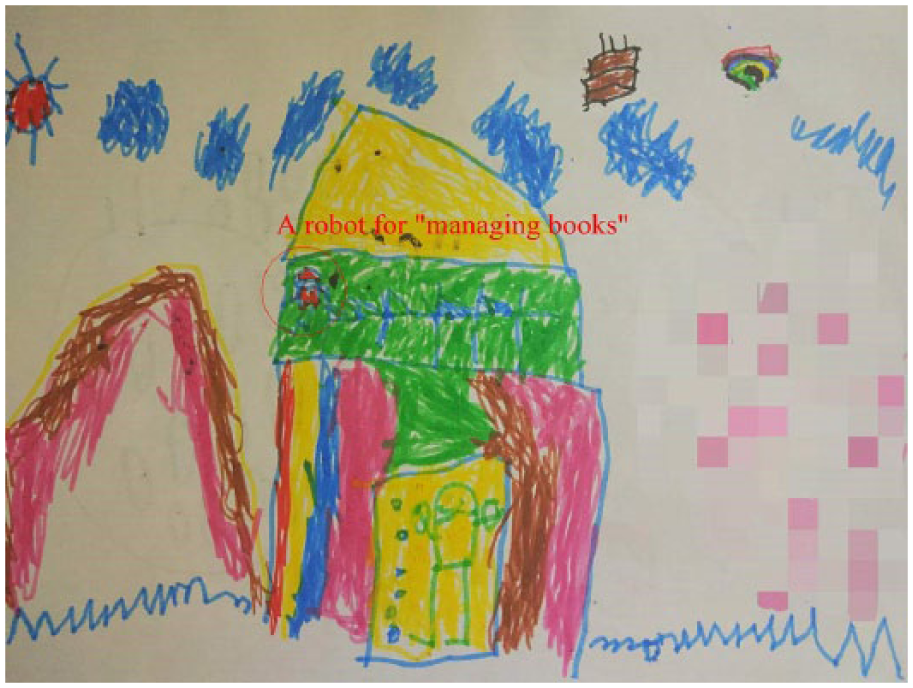
Library (by FZ08, his name is omitted by Mosaic).
Preschool children cultivate the ability to retrieve information in children’s libraries. They know the layout of book shelves, and know where to locate the particular theme of books. They look for a book or judge whether or not to continue to read the book by the illustration and author names on the book cover.
Preschool children’s parents, relatives or friends bring them to the library, but they go to other areas of the library, such as lectures, adult reading areas and youth reading areas. The researchers think that when participants report the whereabouts of their parents, they are able to realize that the function of the library is not limited to the services for young children.
Finally, some of the participants’ complaints and suggestions to the library show that they have started to offer improvement advice to children’s library services. To sum up, suggestions included collection advice (such as adding themes of the collection or toys that interest participants): borrowing experience suggestions (such as the books shelved too tightly, books are too heavy, borrowing procedure is too complicated, etc.): programming advice (such as inviting a zoologist to give a presentation on animal behaviors): and physical space suggestions (such as the restroom is too far, hopes to set up a science laboratory, hopes to add more decorations, etc.).
Discussion
The primary third place
The researchers conclude the children’s library in preschool children’s perspectives is a “primary third place” because it has some, though not all, of the characteristics of “the third place”.
In Oldenburg’s (1999) description, a third places has the following characteristics: on neutral ground, a leveler, conversation is the main activity, accessibility and accommodation, the regulars, a low profile, the mood is playful, and a home from home. Comparing preschool children’s views and Oldenburg’s definition, the researchers discovered that some characteristics are shared by both domains.
In a third place, conversation is the main activity. Conversation does not only refer to talk between people; activities and agencies that interfere with conversation and encourage it are also included (Oldenburg, 1999). In children’s libraries, preschool children start conversations by simply greeting each other, sharing books/toys, or being involved in activities. Conversation naturally occurs and is reinforced by children’s every interaction.
Many preschool children reported that they came to the library routinely. This coincides with “the regulars” characteristic of the third place. They came every weekend, item due date, or even every day and became the regulars of the children’s library. To the newcomers, acceptance into the circle was not difficult in most cases since newcomer children were often brought by their peers or accompanied by their parents. Thus, trust is established more easily and faster than a third place with just adults, which helps keep the regulars and converts newcomers into regulars.
Preschool children like children’s libraries. Their preference makes children’s libraries places for joy and play. The photographs show their favorite places and items; preschool children draw the sun, clouds, rainbows, and colorful walls to decorate the libraries. These all indicate that their joy and acceptance reign over anxiety because children choose bright colors and multicolor to explain their positive emotion (Arcari and Ferro, 2008).
To preschool children in this study, the children’s library is a public place, and different from home and kindergarten. It has social functions which help them meet new friends and consolidate their old friendships. It is a place full of fun, and interesting activities impress them. Although preschool children are not able to express some abstract concepts and conclusions such as “third place is on neutral ground, a leveler, low profile”, some characteristics of the children’s library in preschool children’s perspectives primarily coincidence with Oldenburg’s third place. This suggests that preschool children’s feelings about the library are primarily similar to the adults’, and their requirements are basically the same. With the efforts of the practitioners, preschool children who come to the library regularly could gradually comprehend the mission of the library, then be familiar with the library, and become a lifelong user.
Library features influence preschool children’s views of libraries
In the study, the researchers also found that preschool children are strongly influenced by library features. Participants’ interviews and drawings show that their talk about libraries rarely exceeded the current library environment or proposed new ideas. For example, the Tianjin Port Free Trade Zone Public Library provides iPads, so participants said that “the library is a place to play with the iPad”, but no one suggested that they wanted to add toys to the library. As a counterpart, Hangzhou Juvenile and Children’s Library provides toys, and no one asked for an iPad. For another example, preschool children’s main activities area is on the second floor of Fujian Juvenile and Children’s Library and parents prefer to use an elevator to bring their children to the reading room. Thus, the existence of the elevator can be seen in paintings.
The researchers speculate that this is because the cognitive level of children in this age group is still more affected by the environment, and they know more about the space depending on their own eyesight and what they can physically reach (Brazelton and Sparrow, 2002). On the other hand, this phenomenon also implies that the more preschool children experience in the library, the more abundant views on the library they can achieve. This suggests that providing more services in the library is an effective way to extend preschool children’s understanding of the library.
Meet preschool children’s interpersonal needs: A new orientation for children’s library services
The findings reveal preschool children’s perspectives on libraries. With preschool children’s voices, they could shed light on the future development of library services for preschool children.
The principal lesson to be learned from this study is preschool children’s interpersonal needs. It has been proposed that libraries can help build social capital by providing a safe place to meet, socialize, and relax (Rankin, 2016a). However, children’s libraries used to put an emphasis on materials and activities (IFLA, 2003a, 2003b; Rankin, 2018). Two essential evaluation criteria for children’s libraries are resources and programs (Chandrasekar and Sivathaasan, 2016; F Liu, 2015; M Liu, 2015; Qi, 2015; Seong and Kim, 2015).This research reveals that preschool children value their interpersonal relationships. They stay with their parents or guardians, play and chat with their friends, and notice the librarians and strangers. From preschool children’s perspectives, the library is a public place as well as a place where they can access materials and activities. Thus, the design of children’s sections and services could be more socially oriented. For instance, since parents are the most important reading role models for their children (Rankin, 2016b) and children value parents-children interaction, the findings of Chang and Tsai (2015) on the shape of tables could be applied to library space design, i.e. a flower table allows parents and children to work alone, while the round table is conducive to parent-child interaction. Rankin (2016a) indicated that the library has a leading role to play in helping generate social capital at the individual or microlevel by providing greater support for families and parenting activities. Additionally, librarianship is one of the key professions in providing access to universal service, and librarians’ intervention is more than just reading stories aloud and singing nursery rhymes. Thus, the children’s library should pay attention to young children’s interpersonal needs and create the atmosphere to encourage children to communicate, play with their parents, peers, and librarians. More approaches could be implemented to enhance preschool children’s interpersonal relationships in libraries.
The application of the Mosaic approach
This study proved that the Mosaic approach could be applied to investigate and reveal children’s perspectives on public libraries.
The Mosaic approach could help adult researchers to get a clearer understanding of important details such as meaningful people, places, and items in young children’s life (Clark and Moss, 2011). For example, in this study, from preschool children’s perspectives, cushions in the library are not only for sitting on but also for “reading books”. With the meaningful interpretation from children, items and places in library present a different image from the adults’, which could help adult researchers and librarians to reexamine and improve library services to children. Additionally, the Mosaic approach uses at least three different methods to collect data to make the result more valid. This triangulation makes children’s answers more reliable and powerful.
The Mosaic approach is a framework which recruits different methods to bring children’s life segments as mosaic pieces together to reveal children’s views, opinions, and understandings of their surroundings from their perspectives. The more methods applied, the more views could be revealed. However, young children are able to focus just about 20 minutes, which means it is difficult to apply too many mosaic methods at one time. This study recruited photography, interview, and picture-drawing instead of the tour, magic carpet, and other mosaic methods since children are not required to be too familiar with the library. Further researches could recruit more methods with children who come to libraries frequently to find more details of preschool children’s perspectives of libraries. Additionally, the Mosaic approach could reveal children’s perspectives, but it is hard to explain why children have such opinions, views, and understanding. Thus, further researches should explore the formation and motivation of children’s perspectives.
Conclusion
This study has obtained the characteristics of children’s libraries in the perspective of preschool children and provided some suggestions for improving children’s library services. According to this research, young patrons have already formed an initial understanding of the library. They complain about the problems and put forward some requirements for the library. Therefore, librarians and researchers should respect the rights of preschool children and listen to their voices when designing and providing children’s library services.
The researchers hope that this exploration could provide support for the improvement of children libraries, and finally let young children have priority to express what they think about their own libraries and participate in their own library’s decision-making process.
Footnotes
Declaration of conflicting interests
The author(s) declared no potential conflicts of interest with respect to the research, authorship, and/or publication of this article.
Funding
The author(s) received no financial support for the research, authorship, and/or publication of this article.
Author biographies
 .)
.)