






Abstract
This study was initiated to examine the factors that influence knowledge sharing among academics in Bowen University, Nigeria. Although previous research has identified several factors that affect knowledge sharing, further research needs to be carried out to ascertain factors that affect knowledge sharing, in particular among higher academic institutions, especially in Nigeria. Due to a paucity of knowledge sharing research among faculty in Nigeria higher institutions and the fact that there is no existing framework that provides all constructs needed to interrogate knowledge sharing among academics, the study examined the influence of organisational, individual and technological factors on knowledge sharing behaviour of academics and the influence of demographic variables on how they share knowledge. Survey design guided the study and a questionnaire was used to collect data from 151 respondents. Data was analysed using descriptive statistics, Chi-square analysis and Logistic regression. Findings showed that among the organisational factors, only university policy (β= .641, p= .023) significantly influences knowledge sharing while among individual factors only trust (β= .785, p= .05) significantly influences knowledge sharing. None of the technological factors was found to influence knowledge sharing. Gender has a significant influence on knowledge sharing while academic cadre and faculty do not. Personal satisfaction, personal belief, mentoring, being knowledgeable and availability of fund/sponsorships were the other factors identified to influence knowledge sharing behaviour. The findings have extended knowledge and theory building in knowledge sharing through the conceptual framework. The study recommended that there should be a university policy on knowledge sharing which should be accompanied by rewards to motivate academics to share their knowledge.
Introduction
Knowledge has recently been increasingly recognised as one of the most valuable assets of an organisation (Zahari et al., 2014). It is identified to be a source of competitive advantage (Ngah and Ibrahim, 2010), a core competence and tool for superior organisational performance (Lin, 2007b), and critical for the long-term sustainability and success of any organisation, be it government owned or private (Elogie, 2010). Knowledge is taken to be information that has been understood and applied which helps in decision making and also reduces uncertainty. It is the ‘insights, understandings, and practical know-how that people possess and a fundamental resource that allows people to function intelligently’ (Omotayo, 2015). The global economy is moving from physical labour to knowledge based (Cheng et al., 2009; Ngah and Ibrahim, 2010). The emergence of a knowledge-based economy has given rise to placing emphasis on knowledge management processes such as knowledge sharing. Noor et al. (2014) regarded knowledge sharing as a fundamental part of knowledge management because it enables knowledge to be accessible and usable within and between organisations. Knowledge sharing has been defined as a social interaction culture which involves the exchange of employee knowledge, experiences and skills through the whole organisation (Lin, 2007b). Knowledge sharing can occur by means of direct interaction between individuals, communication via online means, documents, handbooks and expert lecturing (Noor et al., 2014).
An academic institution such as a university serves as a knowledge repository, especially if knowledge has been curated and organised. Knowledge is one of the most important resources in an academic environment because all institutions are knowledge centred. Managing knowledge is thus key to organization performance. Teng and Song (2011) noted that the importance of knowledge management is no longer restricted to knowledge-intensive firms in the high-tech industries but to all sectors of the economy. Thus, knowledge management is beneficial to all sectors, be it educational, banking, telecommunications, production/manufacturing, and even the public sectors. In the educational sector, an efficient way of managing the diverse types and sources of knowledge used by academics towards sustainable performance improvement is by sharing knowledge. Academics are knowledge producers and better knowledge-sharing practices could facilitate the development of quality education and also improve performance in their institutions (Jolaee et al., 2014). However, knowledge is regarded as power and having knowledge is similar to holding the competitive power of the new economy (Cheng et al., 2009). This makes individuals reluctant to share. Cheng et al. (2009) also stated that once knowledge is shared, it becomes a public good. The perceived need to retain power has produced knowledge hoarding among academics. This is in spite of the fact that sharing also implies that the sender does not hand over ownership of the knowledge, rather, it results in joint ownership of the knowledge between the sender and the beneficiary (Ipe, 2003).
Several studies (Al-Alawi et al., 2007; Alam et al., 2009; Cheng et al., 2009; Lin, 2007a, 2007b; Oluwaniran, 2015; Zawawi et al., 2011) have identified the factors that can influence the success of knowledge sharing among different groups and professionals. Noor et al. (2014) noted that some factors are found to be attributed to cultural factors while others viewed that successful knowledge sharing is influenced by top management and personal motivation. Further, many researchers claimed that knowledge sharing could be influenced by rewards and incentives (Al-Alawi et al., 2007; Alam et al., 2009; Cheng et al., 2009). Recent trend attributes the knowledge sharing to information technology (IT) and social media (Alam et al., 2009; Lin 2007b; Supar, 2012). Findings of researchers vary based on the nature of the organisations and the industry in which the knowledge is being shared. Although previous research has identified several factors that affect knowledge sharing, further research needs to be carried out to ascertain factors that affect knowledge sharing, in particular among higher academic institutions (Supar, 2012), especially in Nigeria. Existing studies on knowledge sharing by academics (Elogie, 2010; Jolaee et al., 2014) focus more on behavioural factors using different behavioural theories with little consideration for organisational and IT-related factors. Worthy of note is also the fact that little attention has been given to private institutions where the ultimate goal is profit motivated and knowledge sharing is important to its survival. The study seeks to begin to fill these gaps in the knowledge-sharing literature.
Therefore, following an extensive review of literature, a conceptual framework was developed, mapping out direction to guide the study in examining the organisational (organisational culture, reward system, management support and university policy), individual (knowledge self-efficacy, trust, personal interactions, personal expectations and willingness to share) and technological (availability of IT infrastructure and usage of social media) factors influencing knowledge sharing among academics in Bowen University, Nigeria. It is one of the pioneer private universities in the country, established on 17 July 2001 and located in Iwo, Osun State. The following research questions guided the study:
(a) What organisational factors influence knowledge sharing among academics in Bowen University?
(b) What types of rewards and incentives are provided by Bowen University to promote knowledge sharing?
What individual factors influence knowledge sharing among academics in Bowen University?
What technological factors influence knowledge sharing among academics in Bowen University?
Do demographic variables (gender, academic cadre, faculty) influence knowledge sharing among academics in Bowen university?
What other factors influence knowledge sharing among academics in Bowen University and to what extent?
In what ways does Bowen University promote knowledge sharing among its academics?
This rest of this paper is structured and organised as follows: the next section presents the review of related literature and the conceptual model that guided the study leading to the formulation of research hypotheses. The methodological procedures adopted in the execution of the study are then presented followed by the findings and discussion. The conclusions and recommendations complete the paper.
Literature review and theoretical framework
Conceptualising knowledge and knowledge sharing
Knowledge is described as the result of interpreting information based on one’s understanding (Al-Alawi et al., 2007). It is usually based on learning, thinking and proper understanding of a problem. Knowledge exists not only in documents but also in people’s minds and is exhibited through their actions and behaviours (Al-Alawi et al., 2007). Knowledge is invisible and lies in the human mind; however, it can be documented which turns it into explicit knowledge. Literature has revealed basically two major types of knowledge: explicit knowledge and tacit knowledge. Tacit knowledge is informal knowledge that is embedded in mental processes, is obtained through experience and work practices, and can be transferred by observing and applying it (Jain et al., 2007). It is not easily documented and cannot be easily communicated without the owner of the knowledge being shared. Every employee in the organisation has knowledge embedded in their minds as tacit knowledge which often takes a longer process to be extracted (Ipe, 2003). Examples of tacit knowledge are insights, intuitions, gut feeling, ideas and visions (Okyere-Kwakye et al., 2010). Explicit knowledge, on the other hand, can be easily codified, stored and transferred across time and space independent of individuals (Ipe, 2003). It is easily communicated and disseminated. Explicit knowledge can be found in manuals, drawings, audios and computer programmes.
The growing use of knowledge in businesses contributed to the emergence of the topic of knowledge management, which is now an established topic in information technology and management literature (Al-Alawi et al., 2007). Knowledge management has given many organisations such as Xerox, IBM, Microsoft, Schlumberger Limited, Shell, British Telecom and Mitsubishi, a sustainable competitive advantage, setting them at the high ranks in their market domains (Okyere-Kwakye et al., 2010). While traditional knowledge management emphasis was placed on technology or systems that efficiently process and leverage knowledge, the new model of knowledge management involves people and actions. It aims at creating an environment where power equals sharing knowledge rather than keeping it (Al-Alawi et al., 2007). Okyere-Kwakye et al. (2010) observed that knowledge sharing is perhaps the most important aspect of knowledge management.
A review of literature has shown that there is no precise definition of the concept of knowledge sharing. Knowledge sharing has been defined in many ways depending on the academic field of the authors. According to Zahari et al. (2014), scholars and academicians interpret the concept of knowledge sharing from different perspectives such as that of knowledge interaction, learning, knowledge market and communication. However, it has generally meant transfer of knowledge between and among individuals. Knowledge sharing between individuals is the process by which knowledge held by an individual is converted into a form that can be understood, absorbed and used by other individuals (Ipe, 2003) and transferred to other individuals. Knowledge sharing is basically the act of making knowledge available to others within the organisation (Ipe, 2003).
Lin (2007a) also defined knowledge sharing as a social interaction culture, involving the exchange of employee knowledge, experiences and skills through the whole department or organisation. Lin went further to give examples of knowledge sharing to include employee willingness to communicate actively, donate knowledge and actively consult with colleagues to learn from them. Examples of knowledge sharing are also given at the individual and organisational levels: for individual employees, knowledge sharing is talking to colleagues to help them get something done better, more quickly or more efficiently while for an organisation, knowledge sharing is capturing, organising, reusing and transferring experience-based knowledge that resides within the organisation and making that knowledge available to others in the business.
Knowledge sharing enables managers to keep individual learning flowing throughout the company and integrate it for practical application (Ngah and Ibrahim, 2010). Recently, many organisations have been encouraging knowledge-sharing behaviour among their employees in order to meet the organisation’s objectives and goals. Since knowledge is dispersed and embedded in individuals, equipment or routines, it would be difficult to manage knowledge-related activities if knowledge cannot be thoroughly shared within the organisation (Zahari et al., 2014). Once knowledge is created, there is an economy of scale that results from its sharing because two or more individuals can use knowledge at the same time which thus fuels the creation of new knowledge (Zahari et al., 2014). The tacit nature of knowledge sharing often gives rise to the knowledge retention problem, making it pertinent to quickly adopt procedures for knowledge sharing (Thorpe et al., 2005). Without effective functioning of knowledge sharing, the knowledge embedded and instilled in individuals will be less likely to be transferred within the organisation (Zahari et al., 2014). In order to create a culture of knowledge sharing, organisations need to encourage employees to work together more effectively to pool resources and to share organisational knowledge more productively so they can better perform their jobs (Zahari et al., 2014).
In order to promote and enable knowledge sharing, managers need to understand the motivations that drive individuals to contribute their valuable knowledge (Liang et al., 2008). Due to this reason and to the importance of knowledge for the development and competitiveness of enterprises in the information age, knowledge management theoreticians and practitioners analyse sharing this strategic, nonmaterial commodity from numerous perspectives, trying to identify both the barriers to and factors favouring knowledge exchange (Krok, 2013). Bock et al. (2005) argued that even though knowledge sharing among individuals has been recognised as a positive force for the survival of an organisation, the factors that promote or discourage knowledge-sharing intention and success in the organisational context are still poorly understood.
Knowledge sharing among academics
According to Cheng et al. (2009) knowledge management initiatives were first adopted in profit-oriented organisations, and thus, studies on knowledge management and knowledge sharing were concentrated largely in business organisations. However, recently, knowledge management practices have also been extended to universities and other knowledge-based institutions, which has made knowledge sharing in academic institutions a popular debate. In general, the roles of academic staff are teaching, researching, consulting and publishing (Jolaee et al., 2014). Sharing of knowledge among academics is important to improve the quality and quantity of knowledge possessed by individuals, bring about creation of more knowledge and improve the overall performance of the institution. In an academic environment, particularly in universities, sharing of knowledge is critically important because all staff often deal with knowledge (Trehan and Kushwaha, 2012).
Knowledge sharing is envisaged as a natural activity of academic institutions as the number of seminars, conferences and publications by academics far exceeds any other profession, signifying the eagerness of academics to share knowledge. However, instead of knowledge sharing, ‘knowledge hoarding’ could be more prevalent in academic institutions (Cheng et al., 2009). Although there is no direct way to measure the outcome of knowledge sharing in knowledge institutions, the impact of knowledge sharing in such environments could be larger than those created by business organisations (Cheng et al., 2009). Just as is the case in its application in business organisations, knowledge management can also create a competitive advantage for academic institutions, if utilised appropriately. This is possible since the knowledge created and stored will serve as the repository to benefit scholars and researchers to advance the knowledge cycle and distinguish the institution in the academic market place (Basu and Sengupta, 2007).
Saad and Haron (2013) carried out a qualitative case study to explore and describe the academicians’ knowledge-sharing motivations in a Malaysian public university. Data were collected through semi-structured interviews from a total of 15 renowned academics who were interviewed and asked why they shared their knowledge. The content analysis method was used to extract the knowledge-sharing motivations from the qualitative data and the research results reveal seven important factors which motivate academics to share their knowledge. These motivations are: build reputation, acknowledgement (includes gain rewards, get a promotion and recognition), to be knowledgeable, reciprocity, vision and mission, mentoring, personal beliefs (includes culture, sense of responsibility and religion).
Utilising the theory of reasoned action (TRA), Jolaee et al. (2014) examined the relationship between attitude, subjective norm and trust with knowledge-sharing intention, and also the relationship between self-efficacy, social networks and extrinsic rewards with attitude toward knowledge-sharing intention among academic staff in universities. A total of 117 responses from questionnaires were gathered among academic staff at three social science faculties in one public university in Malaysia. Partial Least Square analysis was utilised to analyse the data and findings indicated that of the two components of the TRA, only attitude was positively and significantly related to knowledge-sharing intention. The findings also show that social network and self-efficacy significantly affect attitude and organisational support showed a strong influence on subjective norms toward knowledge-sharing intention.
Cheng et al. (2009) examined knowledge-sharing behaviour among academics in a private university in Malaysia. Factors affecting the willingness to share knowledge were broadly classified as organisational, individual and technological factors. Online questionnaires were distributed to all academics in the university and the analysis and findings were based on the sample of 60 responses. The questionnaire contained questions to elicit academics’ behaviour as the knowledge contributor and a few questions were also included to grasp respondents’ behaviour as knowledge receiver at the same time. The overall findings revealed that incentive systems and personal expectation are the two key factors in driving academics to engage in knowledge-sharing activity. ‘Forced’ participation is not an effective policy in cultivating sharing behaviour among academics. Supar (2012) conducted a study to determine the factors that affect knowledge sharing among academic staff in Malaysian higher academic institutions. Based on non-random purposive sampling, 194 academic staff from public and private institutions located in the Klang Valley area of Malaysia were selected to be included in the study. A questionnaire was constructed to assess dimensions on technology, knowledge sharing and performance. Findings indicated that the technological factors of distributed model and presence of IT for knowledge sharing are positively related to knowledge sharing and that knowledge sharing is positively related to performance.
Theoretical framework
As stated above, different behavioural and social theories have been used to explain the factors that affect knowledge sharing in different organisational contexts. Two theories of behaviour that have been used for investigating in the context of knowledge sharing are the theory of reasoned action (TRA) by Fishbein and Ajzen and its expanded version, the theory of planned behaviour (TPB) (Jolaee et al., 2014; Krok, 2013). The theory of reasoned action posits that individual beliefs and attitudes explain most human behaviours (Lin, 2007a). TRA assumes individuals to be rational and suggests that their behaviour is being influenced by three elements, namely attitude towards the behaviour, subjective norms and behavioural intention (Jolaee et al., 2014). Similarly, according to the theory of planned behaviour, every behaviour is preceded by a deliberate intention to do something, which is shaped by the individual’s attitude towards that behaviour, a subjective norm and a perceived behavioural control (Krok, 2013). However, both the TRA and TPB are used for anticipating planned, deliberate human behaviour rather than spontaneous behaviour that occurs as a result of a sudden external factor (Krok, 2013). Also, Bousari and Hassanzadeh (2012) stated that the factors that affect behaviour in knowledge sharing can be reviewed based on the theory of planned behaviour; however, those factors are not enough to determine the performance of active behaviour, but there is a collection of factors and infrastructures which should be provided in addition to elements of the theory. Furthermore, sometimes individuals may have the intention to share knowledge but lack of facilities and proper organisational, cultural and economic infrastructures prevent them from doing so (Bousari and Hassanzadeh, 2012).
The social exchange theory (SET) by Blau (1964), is a commonly used theoretical base for investigating an individual’s knowledge-sharing behaviour (Liang et al., 2008). According to the theory, our actions are motivated by the desire to maximise profit and minimise costs, and basic human nature is being concerned about our own interests (Krok, 2013). That is, individuals regulate their interactions with other individuals based on a self-interest analysis of the costs and benefits of such an interaction. (Liang et al., 2008). According to the theory, there is no altruism, which is defined as acting to benefit others without considering one’s own interest. However, different studies have provided proofs to support the postulation about the existence of true altruism in research.
These theories have helped a lot to reveal the knowledge-sharing behaviour and intention in organisations; however, using one of the theories to explain knowledge-sharing success can never be sufficient. This is because the variety of determinants of knowledge sharing make it very difficult to find one universal model that presents this problem from various perspectives, such as psychological, business, organisational, sociological and technological (Krok, 2013). Despite the use of the same theory, different studies tend to adopt different factors to fit the theory (Liang et al., 2008). Based on the factors developed and derived from the literature and modified to suit the study for university academics, a conceptual model is proposed as shown in Figure 1. Variables in the model are organisational factors (organisational culture, reward system, management support, university policy), individual factors (self-efficacy, trust and willingness to share, personal interactions, personal expectations), and technological factors (availability of IT infrastructure and social media usage).
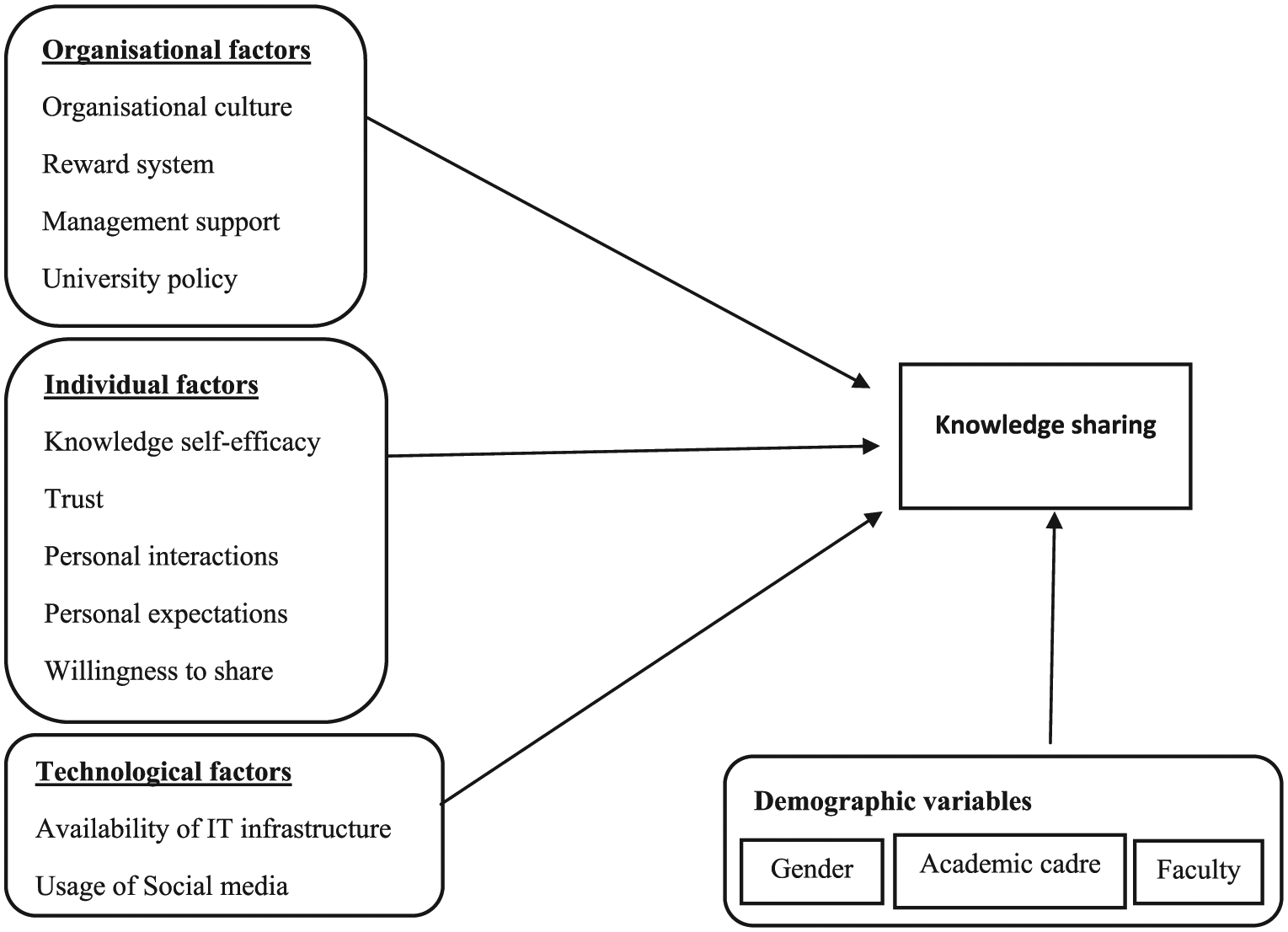
Conceptual framework.
Each of the variables in the conceptual model is described as follows:
Organisational factors are those factors external to the individual. That is, they are factors not derived from the individual personally; they can be environmental or caused by another individual to stimulate the knowledge sharing attitude (Cheng et al., 2009). Organisational factors are categorised into organisational culture, reward system, management support and university policy on knowledge sharing.
(i) Organisational culture – culture is one of the main factors that significantly contribute to the success of knowledge sharing in literature (Alam et al., 2009; Bousari and Hassanzadeh, 2012; Cheng et al., 2009; Noor et al., 2014). Visible culture includes the philosophy, mission and embraced values that guide the daily operations of an organisation (Kathiravelu et al., 2014). An institution that encourages a culture of having vision and mission for knowledge sharing, strategically planning knowledge sharing, encouraging mentoring, strengthening trust and communication among employees, openness to change and innovativeness will likely succeed at knowledge sharing.
(ii) Reward system – apart from organisational culture, reward system is another important factor that is often mentioned in studies as it has the ability to affect the willingness of employees in an organisation to share or not to share knowledge (Alam et al., 2009; Cheng et al., 2009; Ipe, 2003; Noor et al., 2014; Saad and Haron, 2013). This is because individuals generally are motivated by rewards and incentives. Reward is one of the most effective methods of encouraging employees to share their knowledge with others (Alam et al., 2009). Reward can be monetary or non-monetary. It can come in form of monetary incentives such as increased salary or bonuses, or non-monetary rewards such as promotion, job security (Lin, 2007b): recognition, research grant, confirmation of position, reputation, or even being invited as an external examiner.
(iii) Management support – top management support is an important factor that influences organisational knowledge (Lin, 2007b). Numerous studies have found management support essential to creating a supportive climate and providing sufficient resources (Lin, 2007b). Organisational support is a subjective measure of the degree of encouragement provided to and experienced by an employee in sharing solutions for work-related problems through the openness of communication, opportunity for face-to-face and electronic meetings to share knowledge, and so on. An organisation seeking to establish a knowledge-sharing culture must ensure that the management supports the initiatives and pays efforts and attentions to the practices of knowledge sharing. That is, management must support and enforce the positive behaviour of knowledge sharing (Kathiravelu et al., 2014; Lin, 2007b).
(iv) University policy – very little research can be found on the effect of a policy on knowledge sharing (Grünfelder and Hartner, 2013). However, establishing a knowledge-sharing policy is essential for a company to succeed because knowledge-sharing policies are crucial to ensure a satisfying performance for the company (Lodhi and Ahmad, 2010). A knowledge-sharing policy should support the employee to share his/her knowledge on the one hand and provide a guideline to keep a certain standard on how to externalise knowledge from tacit to explicit on the other hand (Grünfelder and Hartner, 2013). Furthermore, Lohdi and Ahmad (2010) explained that policies are real advantage for management to create a culture of knowledge sharing within a company. They stated that since policies are in line with the management values, they are the tools to generate the corporate culture and thus, be the starting point for promotion and development of knowledge-sharing activities. Similarly, universities have policies on knowledge sharing. For instance, academic titles and appointments may be based on such criteria as academic responsibilities and professional achievement in areas of teaching, research, public lectures, publications, contributing to institutional repository, mentoring, and so on. Grünfelder and Hartner, (2013) posited that having an associated promotion plan with the knowledge-sharing policy would ensure that the employees would recognize the necessity to share their knowledge
Individual factors are on the other hand intrinsic and more personal. They are factors derived from individually-driven considerations. That means it comes from the person’s internal being (Cheng et al., 2009). Individual factors are categorised into knowledge self-efficacy, trust, personal interactions, personal expectations and willingness to share.
(i) Knowledge self-efficacy – knowledge self-efficacy has to do with people’s judgments of their capabilities to share knowledge, that is, how they perceive the extent to which they can disseminate information. When people think that their expertise and know-how can improve work efficiency and increase productivity, their attitude will change (Bock et al., 2005). Therefore, employees who believe that they can contribute to organisational performance by sharing knowledge, will develop greater positive willingness to contribute and to receive knowledge (Lin, 2007b).
(ii) Trust – trust is a factor that has been frequently found to affect knowledge sharing (Alam et al., 2009; Bousari and Hassanzadeh, 2012; Cheng et al., 2009; Jolaee et al., 2014; Okyere-Kwakye et al., 2010). The common definition of trust that most researchers agree on is ‘a psychological state of willingness to be vulnerable based on the positive expectations of the intentions or behaviour of another’ (Abdullah et al., 2011). Trust is the most effective and at the same time least costly means that can motivate people to share their individual knowledge. Trust creates and maintains exchange relationships, which in turn may lead to the sharing of good quality knowledge (Liang et al., 2008). Individuals will be willing to share their knowledge with others if they feel that the person can be trusted. Higher trust will make people not think about any future negative occurrence on the knowledge-sharing activity and to share their knowledge more freely (Lin, 2007a).
(iii) Personal interactions – knowledge sharing actually occurs without our realisation. Knowledge transfer can happen while communicating or talking with people (Alam et al., 2009). Employees should interact more in order to gain knowledge. When both employees and employers communicate, it indirectly reduces the status differentials among them which may increase the knowledge sharing (Connelly and Kelloway, 2003, as cited in Alam et al., 2009). This also suggests that when senior academics and junior academics interact more, it reduces status differentials, thereby, increasing knowledge sharing.
(iv) Personal expectations – in order to contribute knowledge, individuals must think that their contribution to others will be worth the effort and that some new value will be created, with the expectations of receiving some of that value for themselves (Nahapiet and Ghoshal, 1998, as cited in Wasko and Faraj, 2005). Expectations such as being recognised as the expert in the area, as a contributor to improve the knowledge repository in an institution and as connector to link other researchers working on same research area (Cheng et al., 2009), build a good reputation and improve their status within their social group (Liang et al., 2008), approval, respect and so on.
(v) Willingness to share – willingness to share knowledge with other people is a very important consideration in knowledge sharing. It refers to a person’s readiness to share valuable and useful knowledge with others, that is, how disposed a person is towards the practice of sharing knowledge. Willingness to share is critical and should be studied as a factor. This is because even when the other factors are present, an individual may still choose to hoard knowledge. However, elements such as altruism, self-satisfaction, enjoyment in helping others, willingness of mentee, empathy, attitude, desire to build reputation, personal relationship can enhance a person’s willingness to share.
Technological factors are important in sharing knowledge in this information age because knowledge has to be shared through means and channels. Technological factors are categorised into availability of IT infrastructure and usage of social media.
(i) Availability of IT infrastructure – IT has the potential of acquisition, storage, processing, retrieving and transferring the knowledge and enables individuals, geographically close or far from each other, to share their knowledge simultaneously or separately (Bousari and Hassanzadeh, 2012). Zack (1999, as cited in Lin, 2007b) also believes that ICT plays the following three different roles in knowledge management activities: (a) obtaining knowledge (b) defining, storing, categorising, indexing and linking knowledge-related digital items (c) seeking and identifying related content. Top (2012), found empirically that the highest risk in in-house knowledge sharing, is the lack of technical infrastructure and information system. Availability of IT infrastructure not only allows employees to share their knowledge internally but also across a wide geographical separation. Thus, technical infrastructure and IT provide employees with the ability to share, obtain feedback and create ideas.
(ii) Usage of social media – traditional means of sharing knowledge among academics includes face-to-face, training, seminar and workshop, reading of manual and instructions and so on. However, due to the advancement in technology many means have developed, one of the most important of which is the social media (Noor et al., 2014). Social media is no longer an insignificant phenomenon; tools like Facebook, LinkedIn or YouTube have become very popular in the world of today. Social media has modified personal relationships, allowed individuals to contribute to a number of issues and generate new possibilities and challenges to facilitate collaboration (Gaal et al., 2015). As a result, organisations are increasingly finding ways of integrating social media into their business processes. Social media also helps individuals who are shy or very busy to share their knowledge because it reduces physical contact.
Methodology
The study utilised a survey design approach (quantitative) covering academics in various faculties in Bowen University. Due to the relatively small size of the population, a total enumeration of the population was carried out. The study focused on academics at different cadres and from the six faculties present on the university campus. The population of the study comprised Professors, Readers, Senior Lecturers, Lecturer I, Lecturer II and Assistant Lecturers in the university which came to a total of 250 academics. Data were collected using a validated questionnaire, the questions in which were structured in sections based on the variables the study intended to measure. The questionnaire was divided into two parts. Part A captured demographic information from the respondents. Part B was divided into four sections and most items were adopted from previous studies and modified to fit in the context of this study, while others were developed by the researchers. The content of Part B is detailed as follows:
Section 1: Organisational factors – measures organisational culture (Jain et al., 2007), reward system (Kathiravelu, 2013, cited in Oluwaniran, 2015), management support (Jain et al., 2007), and university policy.
Section 2: Individual factors – measures knowledge self-efficacy (Jain et al., 2007; Wangpipatwong, 2009), trust (Kathiravelu, 2013), personal interactions, personal expectations and willingness to share (Wangpipatwong, 2009).
Section 3: Technological factors – measures availability of IT infrastructure (Jain et al., 2007; Kathiravelu, 2013) and usage of social media
Section 4: Knowledge-sharing behaviour (Elogie, 2010; Jain et al., 2007; Mustapha and Abubakar, 2008)
The questionnaire had a five-point Likert scale closed-ended questions from 1 – Strongly agree to 5 – Strongly disagree. The last section provided open-ended questions to gather information on the types of rewards and incentives provided by Bowen University to encourage knowledge sharing, ways in which it promotes knowledge sharing among its academics and other factors that may influence knowledge sharing among them. Copies of the questionnaire were self-administered with the assistance of secretaries from the various departments. Electronic copies of the questionnaire were later administered in order to facilitate and speed up the process of data collection. Out of 250 copies of the questionnaire administered, only 133 were filled and returned and only 18 responses were received from the electronic form sent out, making a total of 151 responses which was 60.4% return rate.
Data collected from the questionnaire were coded and analysed using the statistical package for the social sciences (SPSS) version 20. Descriptive statistics was used to describe the socio-demographic characteristics of the respondents and other variables in the study. Chi-square analysis was used to determine if there were significant associations between gender, academic cadre and faculty and knowledge sharing among academics. Logistic regression analysis was carried out to determine if one or more independent variable had influence on the dependent variable and the extent of influence. The dependent variable was measured as a dummy variable with codes of 0 and 1. Zero implies that respondents will not share knowledge while one implies that respondents will share knowledge with other colleagues in the institution.
Results
In this section the results from the study were presented starting with the socio-demographic characteristics of the respondents as presented in Table 1.
Distribution of socio-demographic data of the respondents.
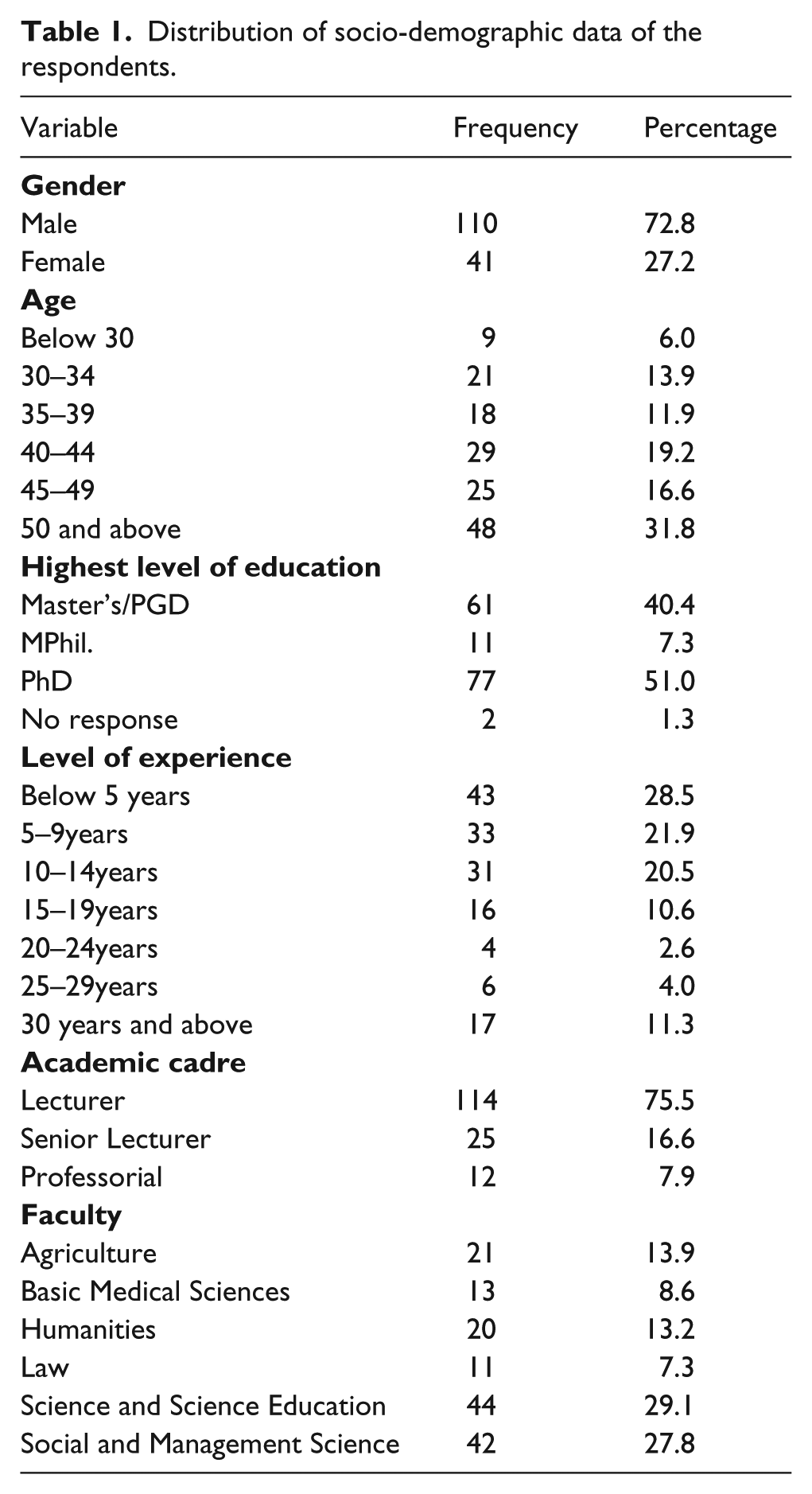
The demographic characteristics of the respondents presented in Table 1 revealed that the male respondents accounted for a majority of the respondents with 73% while about 27% are female. The largest proportion of the respondents was within the age group of 50 years and above (32%) while young men and women below 30 years are least represented (6.0%). This implies that for this survey, the majority of the respondents are mature adults. As expected in academia, most (51%) of the respondents have PhDs, approximately 7% have MPhils while 40% have Master’s/PGD. A majority (29%) of the respondents have below five years’ working experience in the academic institution, followed by those who have 10–14years of work experience (20%): while those who have worked between 20 and 24 years are the least represented (3%). A large proportion (76%) of the respondents are either Lecturer I or II or Assistant Lecturer, about 17% are Senior Lecturers, while only 8% belong to the Professorial cadre. Most of the respondents (29%) are from the Faculty of Science and Science Education while the Faculty of Social and Management Science comes next at 28%, and the least represented is 7% from the Faculty of Law, while Accounting is ranked highest at the departmental level.
Evaluation of research questions
In order to answer research questions 1(a), 2 and 3, binary logistic regression was used to ascertain the extent at which certain variables could increase or decrease the likelihood that respondents will share knowledge. In the result presented in Table 2, the regression coefficient estimates the change in the odds ratio of the knowledge-sharing behaviour of the respondents which is presented as Exp. (B) in the results on the table. If the value exceeds 1 then it predicts that there is an increasing likelihood that the respondents will share knowledge while less than 1 implies that the likelihood that the respondents will share knowledge drops based on the independent variable factors.
Logistic regression showing the factors influencing knowledge sharing among academics.
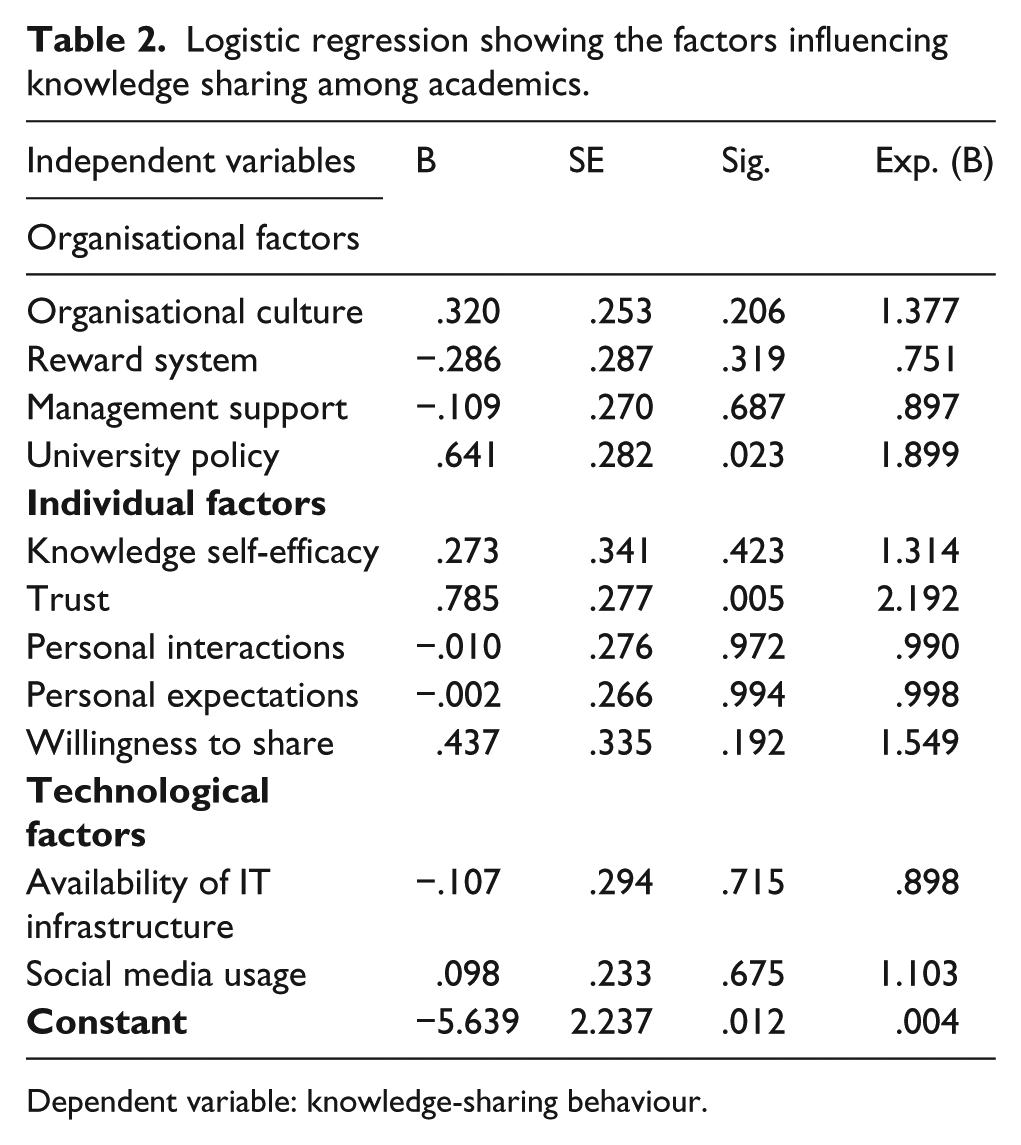
Dependent variable: knowledge-sharing behaviour.
The results pertaining to research question 1(a), 2 and 3 are presented as follows.
Research question 1(a): What organisational factors influence knowledge sharing among academics in Bowen University?
Table 2 revealed that organisational culture has a positive and weak correlation with knowledge-sharing behaviour (KSB) (β= .320) with no significant influence. In addition, the reward system and management support both have a negative and weak correlation with no significant influence. However, university policy has a positive and strong significant influence on knowledge sharing behaviour (β= .641).
Research question 2: What individual factors influence knowledge sharing among academics in Bowen University?
Table 2 revealed that knowledge self-efficacy of the respondents has a positive and weak correlation with knowledge-sharing behaviour (β= .273); however, there is no significant influence (p= .423 > 0.05). There is also a positive and strong relationship between trust and knowledge-sharing behaviour (β= .785). It also indicates a significant slope (p=0.05). In addition, personal interaction has a negative and weak influence on knowledge-sharing behaviour (β= -.010) and has no significant slope (p= .972 > 0.05). The result also showed that personal expectations of the respondents does not significantly influence knowledge-sharing behaviour because p-value is greater than 0.05 level of significance (p= .994). The willingness to share knowledge also does not significantly influence knowledge-sharing behaviour (p= .192 > 0.05).
Research question 3: What technological factors influence knowledge sharing among academics in Bowen University?
As shown in Table 2, there is no significant relationship between availability of IT infrastructure in the institution and knowledge-sharing behaviour (β= -.107, p= .715 > 0.05). Also, social media usage has a positive and weak correlation but no significant influence on knowledge sharing (β= .098, p= .675>0.05).
Furthermore, the findings indicate that the presence of organisational culture that promotes and supports knowledge sharing increases the likelihood that respondents will share their knowledge – Exp. (B)= 1.377. Also, the existence of university policies on knowledge sharing increases the likelihood that respondents will share their knowledge – Exp. (B)= 1.899. In connection to this, knowledge self-efficacy of the respondents increases the likelihood that they will share their knowledge – Exp. (B)= 1.314. Also, respondents that have high level of trust are more likely to share knowledge – Exp. (B)= 2.192. Willingness of respondents to share also increases the likelihood that they will share their knowledge – Exp. (B)= 1.549. Finally, usage of social media among respondents for knowledge sharing increases the likelihood that they will share their knowledge – Exp. (B)= 1.103.
Research question 1(b): What types of rewards and incentives are provided by Bowen University to promote knowledge sharing?
In order to answer research question 1(b), an open-ended question was structured at the end of the questionnaire to know what types of rewards and incentives are provided by Bowen University to promote knowledge sharing. The answers that emerged were awards, recognition, salary, academic promotions, letter of appreciation, bonus, sponsorships for conferences and seminar as presented in Table 3.
Percentage distribution of types of rewards and incentives offered for knowledge sharing.
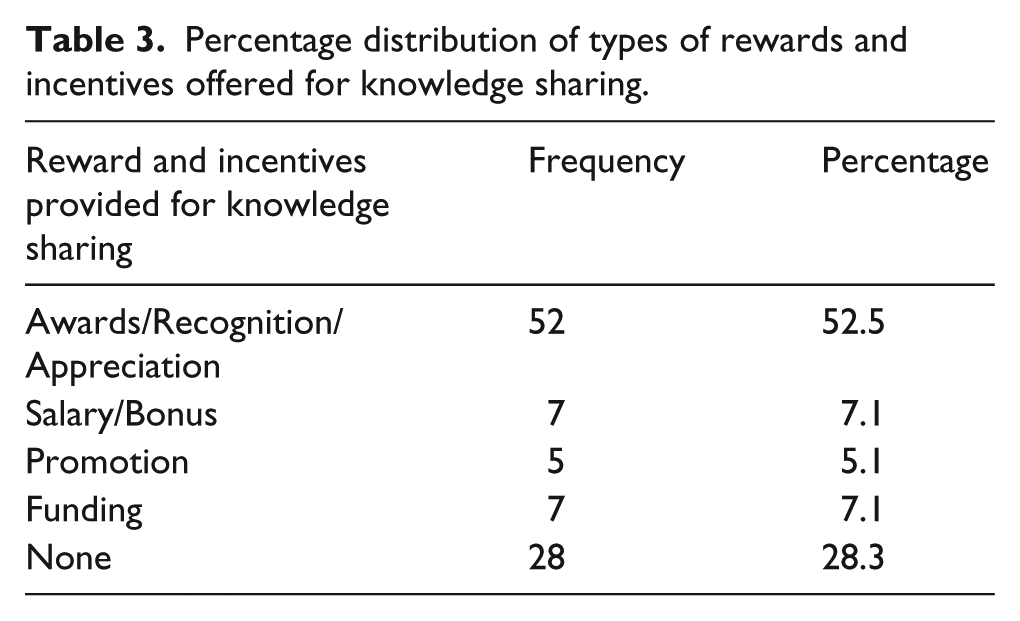
Results in Table 3 showed that more than half of the respondents (53%) identified that awards/recognition/appreciation are offered for knowledge sharing in the institution. About 7% each identified salary/bonus and funding rewards and incentives offered for knowledge sharing, 5% cited promotion, while 28% affirmed that there are no rewards and incentives offered for knowledge sharing in the institution. Judging from this, one can surmise that when rewards and incentives are offered for knowledge sharing in the institution, they are mainly in the form of awards/recognition/appreciation.
Research question 4: Do demographic variables (gender, academic cadre, faculty) influence knowledge sharing among academics in Bowen University?
In order to answer research question 4, cross tabulations and Chi-square analysis were carried out to determine which of the groups of each of the demographic variables share knowledge the most and to check if there is a significant association between socio-demographic variables: gender, academic cadre and faculty and knowledge sharing. The result is presented in Table 4.
Chi-square analysis showing the socio-demographic factors influencing knowledge sharing among academics.
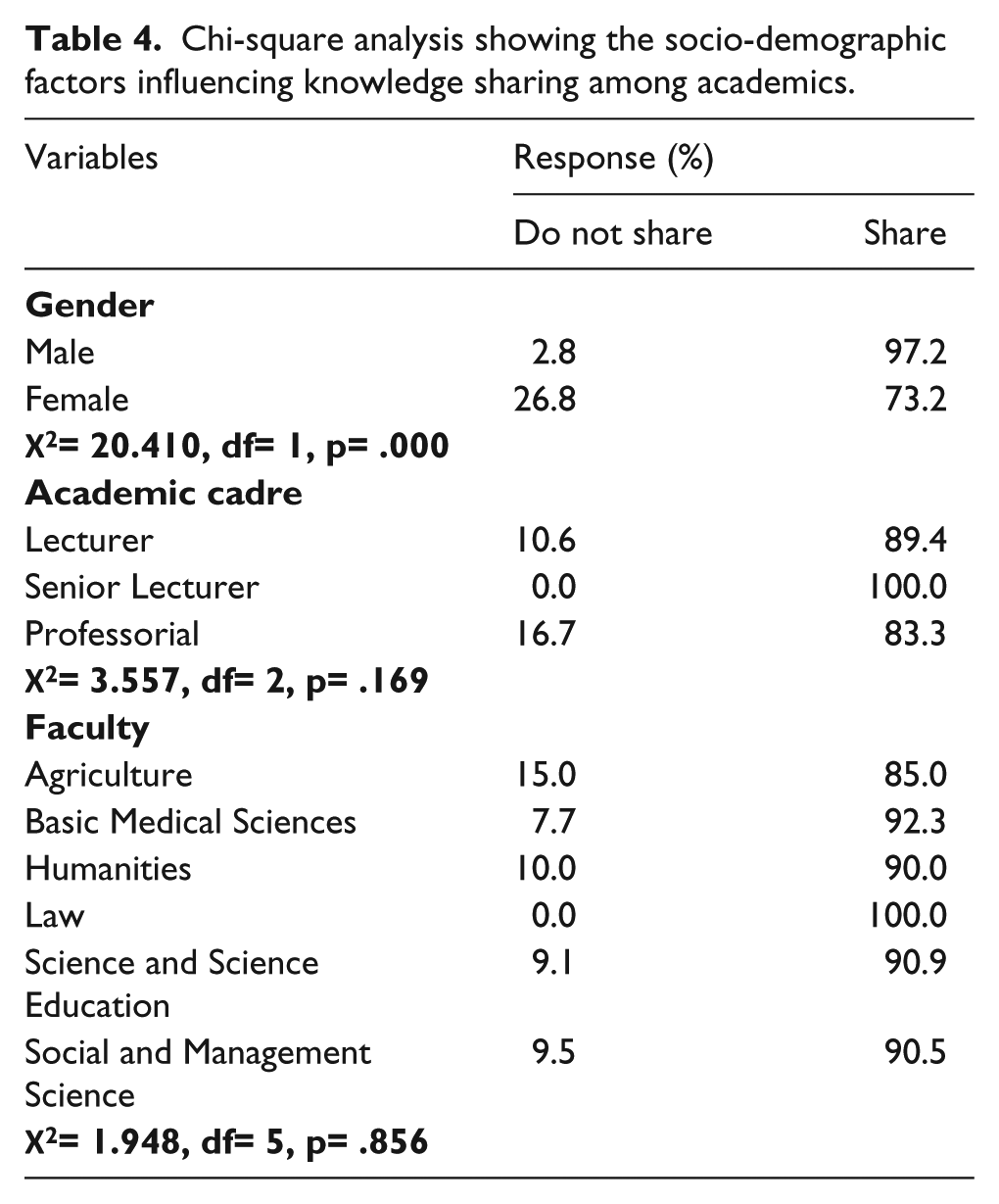
Table 4 reveals that among the gender groups, 97.2% of males share their knowledge while 2.8% do not and 73.2% of females share knowledge while 26.8% do not. Subjects’ self-reported perception suggests that male academics in Bowen University share their knowledge more than females. Also, within the academic cadres, 89.4% of academics in the Lecturer cadre share their knowledge while 10.6% do not, 100% of academics in the Senior Lecturer cadre share their knowledge, and 83.3% of academics in the Professorial cadre share their knowledge while 16.7% do not. This implies that academics who are Senior Lecturers are involved in knowledge sharing more than academics in the Lecturer and Professorial cadre. Lastly, results presented in Table 4 shows within the faculty groups, 85% of academics in Agriculture share their knowledge, 92.3% of academics in Basic Medical Sciences share their knowledge, 90% of academics in Humanities share their knowledge, 100% of academics in Law share their knowledge, 90.9% of academics in Science and Science Education share knowledge and 90.5% of academics in Social and Management Science share their knowledge. This therefore suggests that academics in the Faculty of Law actively engage in knowledge sharing the most while those from the Faculty of Agriculture engage in knowledge sharing the least.
Furthermore, results from the Chi-square analysis as presented in Table 4 reveal that gender significantly influenced knowledge sharing among academics in Bowen University (Χ2= 20.410, df= 1, p= .000). Academic cadre did not influence knowledge sharing (Χ2= 3.557, df= 2, p= .169). So also, the faculty where academics come from did not influence knowledge sharing (Χ2= 1.948, df= 5, p= .856).
Research question 5: What other factors influence knowledge sharing among academics in Bowen University and to what extent?
In order to answer research question 5, an open-ended question was structured at the end of the questionnaire which encouraged respondents to state their views on other factors that influence their knowledge sharing by asking ‘Please state any other factor not covered in the questionnaire that motivates you as an academic to share your knowledge’. Some factors were personal/intrinsic, some religious, some as a matter of responsibility while others were simply due to benefits that accrue to the practice of knowledge sharing. Regardless of the reasons behind their knowledge sharing, there is generally a good disposition towards knowledge sharing among academics. These other factors are as presented in Table 5.
Frequency and percentage distribution of other factors influencing knowledge sharing.
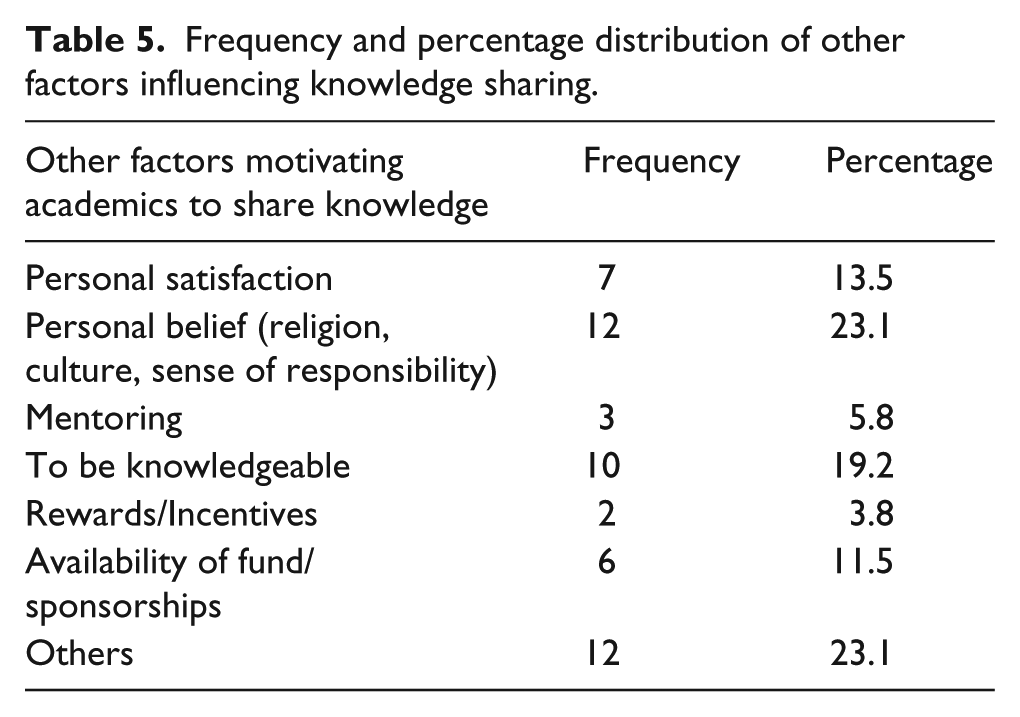
Results presented in Table 5 revealed that about 14% of the respondents cited personal satisfaction as a motivating factor to share knowledge. A respondent asserted that ‘sharing knowledge with colleagues and the wider community brings deep sense of satisfaction’. Another 23% state their motivating factor to be personal belief, either religious, cultural, or as a sense of responsibility. An academic stated that ‘acknowledging God as source of wisdom and knowledge which shouldn’t be hoarded’ is a factor that motivates him to share knowledge. About 6% state their motivating factor to be mentoring as reflected in the response of an academic who said: ‘I am a retired professor on contract appointment. My main function is to train, encourage and motivate younger lecturers to develop themselves. I am a mentor!’. Also, 19% share their knowledge because of the value of knowledge – they believe sharing knowledge makes them knowledgeable. A respondent answered that ‘Knowledge sharing enhances retention and also makes room for gaining brighter ideas’ while another confirmed that ‘sharing my knowledge better shapes my ideas, conceptions’. Furthermore, about 4% of the respondents are motivated to share knowledge through rewards and incentives. A respondent simply gave his response to be ‘annual increment and regular promotion’. About 12% are motivated through availability of funds/sponsorships while about 23% identified other diverse motivating factor as the basis for sharing knowledge. Other factors such as ‘passion’, ‘the encouragement from the performance of end-users e.g. students and colleagues’, a bid to move the society forward at large’, ‘writing books together with other colleagues’, and so on.
Research question 6: In what ways does Bowen University promote knowledge sharing among its staff?
In order to answer research question 6, an open-ended question was structured at the end of the questionnaire to know in what ways Bowen University promotes knowledge sharing among its staff. Workshops, conferences, seminars, retreats, forum, staff development funds to carry out research, publish research findings, training, colloquiums, sponsorships, periodic IT workshops were the answers given as presented in Table 6.
Percentage distribution of ways of promoting knowledge sharing.
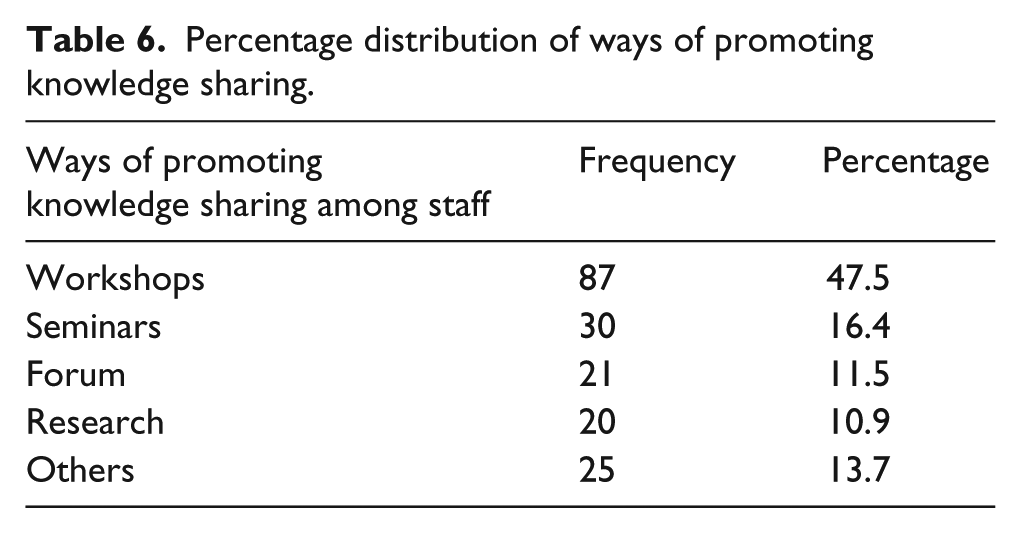
Table 6 presents the percentage distribution of ways knowledge sharing is promoted among staff in the institution. About 48% of the respondents specified that knowledge sharing is mostly promoted through organized workshops, 16% indicated that it was through seminars while about 11% specified that it was mainly through research. The other various ways cited included conferences, training, retreats, sponsorship, lectures, colloquiums, repositories and meetings.
Discussion of findings
The results indicate that on the average, a majority of the respondents in the university study are male, in the age group of 50 years and above, have a PhD degree, have below five years of experience and are in the academic cadre of Lecturers (Lecturer I/Lecturer II/Assistant Lecturer) in the university. Also, there is a growing awareness of the importance of knowledge sharing in the university and the general disposition of academics towards knowledge sharing is highly positive. Results also indicate that gender has a significant relationship with knowledge sharing but academic cadre and faculty on the other hand had no significant influence. Findings also revealed that male academics share knowledge more than female academics. This may be accounted for by the fact that the majority of the academics are male. Also, knowledge sharing varies across academic cadre and faculties. Academics in the Senior Lecturer cadre share their knowledge more than academics in Lecturer and Professorial cadres and knowledge sharing occurs the most among academics in the Faculty of Law.
Also, organisational culture did not influence knowledge sharing in Bowen University. This finding is strengthened by that from the study of Cheng et al. (2009) on knowledge sharing in academic institutions using Multimedia University Malaysia as a case study, which did not find any influence of culture on knowledge sharing. This may be explained by the fact that both studies were carried out among academics in private universities. Also, Rad et al. (2011) conducted a study on the factors influencing knowledge sharing among personnel of an agricultural extension and educational organisation in Iran and found that organisational culture did not exert any influence. This finding deviates from research findings and theoretical discussion within the existing knowledge-sharing behaviour literature (such as Alam et al., 2009; Oluwaniran, 2015) where organisational factor is often identified as an important determinant of knowledge-sharing behaviour among employees. The relationship between organisational culture and knowledge sharing in this study was positive but too negligible to be significant. Although no significance was found for organisational culture, it cannot be concluded that organisational culture does not have any effect on knowledge-sharing behaviour in the context of academics. Its impact requires further examination.
Findings on a reward system revealed that it does not influence knowledge sharing among academics in Bowen University. This is inconsistent with the findings of some previous studies (Al-Alawi et al., 2007; Alam et al., 2009; Cheng et al., 2009) where rewards and incentives were found to significantly influence knowledge sharing. However, it supports findings from other studies such as Jolaee et al.’s (2014) study on factors affecting knowledge-sharing intention among academic staff. The study indicated that extrinsic reward has no positive effect on the attitude toward knowledge sharing. They explained that, in the academic context and for academic staff, monetary and tangible rewards may not significantly contribute to formation of attitude to share their knowledge. Moreover, the study was conducted in a public university in Malaysia, where the respondents were predominantly Muslims and they argued that taking into account Islamic beliefs, knowledge sharing is encouraged by religion. Hence, the respondents may think about sharing their knowledge without looking for monetary rewards. Similarly, this study was conducted in a private university owned by a religious body and where the respondents were predominantly Christians. Therefore, this explanation may also be extended to the study which is revealed also from the analysis of the open-ended questions where some respondents asserted that they share their knowledge for religious reasons. Hence, respondents may think about sharing their knowledge without looking to monetary rewards. The finding of this study also support those from other works (Bock et al., 2005; Lin, 2007a, 2007b; Oluwaniran, 2015) where rewards did not influence knowledge sharing.
Finally, top management support did not influence knowledge sharing while university policy did. Interestingly, the finding on management support is inconsistent with some literature. According to the study of Top (2012) on assessment of knowledge sharing in terms of risk-level in-house service sector, the biggest influencer on knowledge-sharing effectiveness is the role of top management’s attitude and their facilitator role according to perceptions of participants. Also, in the study of Lin (2007b) on knowledge sharing and firm innovation, top management support was effective for employee willingness to both donate and collect knowledge with colleagues. However, the findings of this study are supported by findings from the study of Liang et al. (2008) where it was found that the correlation between management support and individuals’ knowledge-sharing behaviour is not as significant as many would believe. They explained further that one possible explanation is that the effect may be diluted by the heterogeneity of different organisational support including formal support (e.g. training) and informal sanction and help from top management, supervisors and co-workers, and that while some types of organisational support may have an effect on knowledge-sharing behaviour, others may not. On the other hand, studies on knowledge sharing among academics have not investigated, while only few other studies have investigated, the impact of policy on knowledge sharing. Since university policy influences knowledge sharing, a knowledge-sharing policy that would support the employee to share his/her knowledge on one hand and provide a guideline to keep a certain standard on how to externalize knowledge from tacit to explicit on the other hand, is important in a university as posited by Grünfelder and Hartner (2013). Furthermore, Lohdi and Ahmad (2010) explained that since policies are in line with the management values, they are the tools to generate the corporate culture and thus be the starting point for promotion and development of knowledge-sharing activities.
Although findings showed that the level of self-efficacy of academics in Bowen University is high as expected, it did not significantly influence knowledge sharing. This means that how academics perceive their ability to provide knowledge does not necessarily translate into knowledge sharing. This may be explained by the concept of knowledge hoarding among academics. They would rather keep the knowledge they think can benefit others to themselves even though they have the ability to give out such knowledge. This is however in contrast with findings from many studies (Bock et al., 2005; Elogie, 2010; Jolaee et al., 2014; Lin, 2007a, 2007b; Oluwaniran 2015; Omojowolo, 2014) which showed that self-efficacy significantly influenced knowledge sharing. In more detail, although self-efficacy is proven to be an important factor in previous knowledge-sharing studies, it might not be among the important factors of knowledge sharing among academic staff in Bowen University. Therefore, it cannot be concluded that self-efficacy does not have any effect on knowledge-sharing behaviour in the context of academics. Its impact requires further examination.
Trust was also found to significantly influence knowledge sharing among academics in Bowen University. Not only was it significant, it had a strong and positive influence, suggesting that the higher the trust among academics, the more they engage in knowledge sharing. According to the study of Van Acker et al. (2014), benevolence-based trust is important when teachers consider sharing with their colleagues interpersonally. The expectation that one teacher would act in their best interest and would provide help when needed is more important than competence-based trust for school-based sharing. The result of this study also bolstered the work of Alam et al. (2009) on knowledge-sharing behaviour among employees in SMEs where they tried to assess the factors that influence knowledge sharing among them. Trust was found to have a significant influence. The finding from the study of Al-Alawi et al. (2007) carried out on critical success factor of knowledge sharing also supported this finding that trust is an influencer of knowledge sharing. Based on their findings, the authors asserted that generally, when an average person trusts his/her colleagues and feels free to express feelings and perceptions, this person is also likely to express information relating to his/her life outside work. On the other hand, a finding from the study of Jolaee et al. (2014) among academics rejected the hypothesis that trust has a positive effect on the intention to share knowledge.
Personal expectation and personal interactions were found not to influence knowledge sharing. The finding on personal interactions is in support of that from the study of Alam et al. (2009) among employees in SMEs where the results showed that the association between social interaction and knowledge-sharing behaviour is not significant. As regards personal expectation, Cheng et al. (2009) in their study revealed that personal expectations among academics in Multimedia University, Malaysia provides the strong inspiration for academics to share their valuable knowledge. Also, academics will be encouraged to contribute knowledge if they can expect to receive useful knowledge in return. This is in contrast to the findings of the present study. This may be explained by the presence of other factors not present in this study. Despite the findings of this study, further investigations need to be made especially in the context of a private university to assert the influence of personal interactions and personal expectations on knowledge sharing. Willingness to share was also not found to significantly influence knowledge sharing among the academics. This is consistent with findings from the study of Wangpipatyong (2009) which was conducted to examine the factors influencing knowledge sharing among university students and willingness to share was not found to be a significant influence. On the contrary, in the studies of Oluwaniran (2015) among researchers in Agricultural institutes and Omojowolo (2014) among students of the University of Ibadan, willingness to share was found to influence knowledge sharing. Findings of this present study may suggest that the willingness of an individual to share knowledge is not necessarily enough to share knowledge, there has to be presence of other factors such as trust towards the recipient of the knowledge or a policy that effects knowledge sharing among employees.
Both availability of IT infrastructure and usage of social media did not influence knowledge sharing. Rad et al. (2011) revealed in their study that ICT did not exert influence on knowledge sharing. Cheng et al. (2009) also in their findings did not find ICT to influence knowledge sharing. They posited that ICT functions as a platform for knowledge sharing and is by itself insufficient to encourage it. The findings suggested that to promote knowledge-sharing activity in knowledge-based institutions, it is essential to create an environment which is people-oriented, rather than technology-oriented because while technology plays a crucial role in minimising the barriers and increases the propensity to share knowledge, knowledge sharing is still a people-practice. Lin (2007b) in her study on organisational and individual factors that influence knowledge found a positive significant relationship between ICT use and knowledge collecting, but no significant relationship with knowledge donating. It was explained further that this finding might also be caused by the fact that investing in ICT alone is not enough to facilitate knowledge donating, because ICT can provide access to knowledge, but access is not the same as using or applying knowledge. That is, knowledge sharing involves social and human interaction, not simply ICT usage. Knowledge thus cannot be distributed simply via online database or intranet. Nevertheless, we do not deny the need for further investigation regarding the role of availability of IT and social media usage in knowledge sharing among academic staff.
Findings also identified other reasons other than organisational, individual and technological factors that predispose the academics to sharing knowledge. Results showed that academics share their knowledge also for religious reasons, sense of responsibility, to be knowledgeable, mentorship, personal satisfaction. These other factors were also identified in a study conducted by Saad et al. (2013) on a case study of knowledge sharing motivations of academics in public institutions in Malaysia. Rewards was another factor identified in this present study but to a low degree which supports the findings from this study that a reward system does not significantly influence knowledge sharing.
Conclusions, recommendations and future studies
The study provided an empirical data on the knowledge-sharing behaviour of academics in Bowen University. This study has shown that there is low level of use of reward in the university to promote knowledge sharing. Academics in the university share their knowledge even though the reward system is not encouraging. Also, trust that exists among them and the existing university policy affect them in sharing their knowledge. They also have good personal interactions and they have personal expectations but they do not contribute to the reasons they share their knowledge. Furthermore, technological factors are important in sharing knowledge but they can only serve as platforms. As suggested by Cheng et al. (2009): for knowledge-sharing activity in knowledge-based institutions, it is essential to create an environment which is people-oriented, rather than technology-oriented because while technology plays a crucial role in minimising the barriers and increases the tendency to share knowledge, knowledge sharing is still a people-process. It is also concluded that majority of academics share their knowledge to gain a sense of satisfaction and self-worth, to build others, because of their personal beliefs and for other personal reasons that are not organisational or technological.
In view of these conclusions, the following recommendations emerge:
Knowledge-sharing practices should be further encouraged as a culture in Bowen University and made known to all members of faculty in the institution. Management should create an environment that encourages knowledge sharing so that it can become a way of life for academics and knowledge can flow easily within the institution. This could be by adding knowledge sharing to faculty’s key performance indicators and used as basis of their annual evaluation.
There should be a sensitisation of academics on the university’s policy on knowledge sharing to serve as a wakeup call for them to share knowledge. The university can achieve this by reiterating the importance of knowledge sharing during the school’s various staff/faculty meetings and induction programmes for newly employed faculty.
More knowledge-sharing activities such as workshops, seminars, training, etc. should be organised in order to boost the confidence of academics to share knowledge. When academics have the right perception about the value of their knowledge, it will motivate them to share more.
In addition to promotion, awards, recognition and appreciation which are the most common forms of reward, management can improve on the use of other types of rewards and incentives to encourage knowledge sharing. The presence of tangible monetary rewards and incentives may trigger effective knowledge-sharing behaviour among the academics.
This study, which is limited to Bowen University, is not without some limitations. Therefore, the following recommendations are made for future studies. Future studies could be carried out among academics of other private universities for the findings to be generalizable. A comparative study between private and public universities could also be undertaken to determine how knowledge-sharing behaviour of academics in both types of institutions differs. In addition, the study examined organisational, individual and technological factors. Future studies can examine the influence of other factors such as cultural and religious factors on academics’ knowledge-sharing behaviour. Methodologically, the study made use of only questionnaire for data collection. Future studies can employ mixed methods to interrogate the issues surrounding knowledge sharing among academics better.
Footnotes
Appendix I
Declaration of conflicting interests
The author(s) declared no potential conflicts of interest with respect to the research, authorship, and/or publication of this article.
Funding
The author(s) received no financial support for the research, authorship, and/or publication of this article.
