







Abstract
This paper uses citation analysis to measure the intellectual impact of Chinese library and information science on outside disciplines. It analyses 469 journals in disciplines outside the library and information science field containing citations to 20 Chinese library and information science journals from 1996 to 2015. It shows that Chinese library and information science mainly receives citations from related disciplines, such as business and management, communication, and computer science, and that the majority of library and information science articles are rarely cited. The library and information science subjects of bibliometrics, information technology and knowledge management are most likely to be cited.
Keywords
Introduction
Interdisciplinary knowledge transfer involving the import and export of knowledge is an important aspect of knowledge creation (Linderman and Chandrasekaran, 2010) and technology development (Mei and Liu, 2013), as it enhances the impact of research on policy and practice (Fazey et al., 2014). In scientific communities, knowledge import shows the influence of knowledge from outside disciplines (Chen et al., 2018), while knowledge export is an indicator of the scientific strength and impact needed to cross the traditional boundaries of the home discipline (Wormell, 1998). The effective adoption and diffusion of knowledge are the keys to maintaining the value of research achievements and bringing that knowledge into full play (Zhai et al., 2018). The international library and information science (LIS) community has made a strong effort to demonstrate knowledge export from LIS and to explore its external intellectual impact (Cronin and Meho, 2008; Larivière et al., 2012). Chinese LIS was once a separate academic field found in only a few universities with an emphasis on humanities and social sciences (Hu, 1990). With the opening up of China and the iSchools movement, Chinese LIS has been growing rapidly (Chen et al., 2012; Wu and Yuan, 1994). From 1996 to 2015, 560,449 Chinese LIS publications were listed in the China National Knowledge Infrastructure (CNKI) database. However, the impact of this large volume of knowledge on disciplines outside the field has not been explored. This study aims to fill the gap by analysing the characteristics of Chinese LIS knowledge export and unveiling its external impact.
Since the path and extent of knowledge flows cannot be observed directly in the process of knowledge export, it has been generally assumed that citations can be used as a proxy to characterize and quantify knowledge flows, thus providing a theoretical base for empirical studies on knowledge export (Yan and Zhu, 2017; Yan et al., 2013). The citation-based measurement is widely employed to quantify explicit knowledge export, and it has both advantages and disadvantages. The validity of measurement using citation data has been questioned due to the complexity of citing motivations (MacRoberts and MacRoberts, 2010) and inadequacy in measuring tacit knowledge flows (Orazbayev, 2017). The strengths of the method, however, lie in the following aspects. First, citations included in peer-reviewed publications can be regarded as a credible proxy (Zhai et al., 2018) that partially represents the intellectual impact of knowledge export (Thornley et al., 2015). Second, in scholarly communications, knowledge is disseminated primarily by reading, adopting and citing scientific publications (Zeng et al., 2017); therefore, citations may capture aspects of the main scientific knowledge flows (Orazbayev, 2017). Finally, the citation analysis approach creates new opportunities for discovering patterns and trends of knowledge export and its impact. In general, the citation-based measurement is a common approach to assess explicit knowledge export across disciplines.
Researchers conduct quantitative analysis of cited entities to measure knowledge export at both the micro-level (e.g. papers, topics, authors and journals) and macro-level (e.g. disciplines) (Hassan and Haddawy, 2013; Zhu and Yan, 2015). In addition, the application of the ‘trading metaphor’ in citation analysis allows researchers to focus on a clustering group of disciplines (Yan et al., 2013). Journals aggregated by subject category provide a close representation of a discipline, while the discipline itself is invisible (Sugimoto et al., 2008). Citations from reputable journals in outside fields are regarded as an indicator of high-value knowledge export, and high-quality journals can be identified quickly based on their journal impact factor (Hessey and Willett, 2013). While this approach provides a unified classification and close representation of knowledge export with different weights, it also has limitations, such as the subject classification of interdisciplinary publications and the measurement of informal scholarly communications.
This study assesses and then adopts the assumption that high-value knowledge export can be measured by citations to the high-quality journal articles of one discipline from high-quality journal articles in other disciplines. Citations to Chinese LIS journal articles from Chinese journal articles of outside disciplines are analysed in terms of the citing discipline, citing author, citing subject, cited journal, cited author and cited subject. The techniques of time series mining, text classification, association rule mining and visualization are employed for the multi-level/multi-dimensional analysis of knowledge export. The following questions will be answered:
RQ 1. What outside disciplines are most likely to cite Chinese LIS articles?
RQ 2. What kinds of LIS knowledge are most likely to be exported to outside disciplines?
RQ 3. What strategies should be used to improve the impact of Chinese LIS on outside disciplines?
This study analyses citations to Chinese LIS articles from outside disciplines to uncover the external impact of knowledge export. Strategies for optimizing knowledge production, enhancing knowledge dissemination, and bridge-building between theory and practice are also suggested to promote and spread the value of LIS research. For methodology, data mining and visualization techniques are used to identify the underlying associations between the citing entities and cited entities, potential interdisciplinary partners and their interests.
Literature review
Citation: A measurement of explicit knowledge export
Academics create explicit and tacit scientific knowledge through their research activities, such as publishing and social interaction (Behn, 2017; Mezghani et al., 2016). Zeng et al. (2017) found that once knowledge is created, diffusion is the next process. The channels of knowledge diffusion include scientific publications (via reading, adoption and citing); scientific meetings; and other informal communications, which propagate ideas in both physical and virtual spaces (Zeng et al., 2017). Researchers from various fields conducted quantitative studies of knowledge export to show the external impact of scientific research using the trading metaphor (Cronin and Pearson, 1990; Sullivan et al., 2011). A general assumption has been made that the empirical study of capturing, characterizing and measuring knowledge transfer with citations as proxies may contribute to a better understanding of the mechanism of interdisciplinary knowledge transfer (Yan, 2014; Yan and Zhu, 2017). As publishing is the primary channel for knowledge dissemination (Zeng et al., 2017), citations are used as a measurement of explicit knowledge export and serve as an approximation of the actual flow (Zhang et al., 2013). Citation analysis is regarded as a powerful method to map interdisciplinary knowledge export (Cronin and Meho, 2008; Lee et al., 2017) and to evaluate scholarly impact within and across disciplines (Herther, 2015; Johnston, 2009).
However, citations are an indicator of knowledge export instead of a direct representation of knowledge dissemination and adoption. Previous studies have questioned the validity of citation-based measurement. Scholars’ citing behaviours are driven by various motivations beyond intellectual recognition and influence. Some citations are casual, perfunctory and even ‘negational’ (Peritz, 2010). Additionally, it has been found that influential or extensively used works may be ‘uncited’ or ‘seldom cited’ (MacRoberts and MacRoberts, 2010). Therefore, citations only partially indicate the knowledge that has an influence on researchers. Focusing too narrowly on visible citations may result in overlooking tacit knowledge flows (Orazbayev, 2017), thus widening the gap between measured knowledge flows and the actual knowledge export.
Despite methodological limitations, citation analysis is broadly considered an effective way to evaluate knowledge export and intellectual impact. The main reasons are as follows. First, citations still play a major role in the reliable measurement of research quality (Guerrero-Bote et al., 2007) and its impact (Bornmann and Daniel, 2008). Since publications are admitted to the academic community via peer review, citations, especially those in peer-reviewed journals, are associated with high quality and credibility (Zhai et al., 2018). Citations are at least a partial acknowledgement of the intellectual influence of cited documents on the citing documents (Cole and Cole, 1972; Thornley et al., 2015). Second, if tacit knowledge flows play a role in complementing explicit knowledge flows rather than substituting for them, citations may capture at least part of such flows (Orazbayev, 2017). Third, citations are ‘frozen footprints in the landscape of scholarly achievement’ (Cronin, 1981), document the diffusion process (Zhai et al., 2018) and imply the knowledge flows across various disciplines (Yan, 2014). Citations, a common indicator of knowledge flows, are evaluated empirically by a large number of quantitative studies in interdisciplinary knowledge transfer (Hassan and Haddawy, 2013; Rodríguez, 2017; Sugimoto et al., 2008; Yan, 2014). Finally, with the increasing ease of access to large publication databases that capture major scientific activities (Zeng et al., 2017) and cumulative citation data over a long period (Zhai et al., 2018), new opportunities are created for multi-level/multi-dimensional analysis. This data-driven approach tracks and quantifies the permeable process of knowledge export (Yan et al., 2013) using rich mathematical and computational models (Zeng et al., 2017).
Citation analysis of knowledge export
Researchers in LIS, information systems and business have measured knowledge export by analysing citations to journals in one discipline from journals outside the discipline to demonstrate the external impact of a discipline (Hessey and Willett, 2013; Sullivan et al., 2011; Wade et al., 2006). Since high-quality journals play a key role in academic knowledge management (Lockett and McWilliams, 2005), researchers use journal impact factors to select high-quality journals and to investigate knowledge export across disciplines.
This journal-based approach for the measurement of knowledge export has the following strengths: first, the use of journal subject categories in classification reduces the arbitrariness of the classification scheme (Hessey and Willett, 2013), thus providing a clear and consistent discipline definition suitable for tracking interdisciplinary knowledge flows (van Raan, 2008; Yan et al., 2013). Journal data integrate publications, citations, journal impact and subject category (Hessey and Willett, 2013), which are valuable for mining the structure and evolution of knowledge diffusion (Goldman, 2014). Second, researchers have noted that knowledge production needs to be ranked appropriately due to the difference in the weighting of citations (Zhang et al., 2013); for example, citations from high-ranked journals may represent high-value exports (Hessey and Willett, 2013). Yan and Zhu (2017) found that journals considered important in knowledge trading are also highly ranked in other journal-level evaluations. Finally, researchers may quickly and efficiently identify reputable journals in their fields based on journal impact factors (Hessey and Willett, 2013).
This journal-based approach also has limitations. First, researchers have questioned the accuracy of the subject classification of journals (Yan et al., 2013), the credibility of journal impact factors, and the arbitrary and uncritical use of journal impact factors (Archambault and Larivière, 2009; Lancho-Barrantes et al., 2010). Second, while journals are one of the major channels of knowledge export, other scholarly communications should also be considered (Milojević et al., 2014). Third, with the development of interdisciplinary research, journals in a specific field may publish articles outside that field (Laffan, 2010). An approach that analyses the discipline distribution of documents based solely on the subject categorization of their source journals is not rigorous. Finally, since an individual journal may be assigned to more than one subject category, the extent of knowledge export may be overestimated by using this journal-based approach (Hessey and Willett, 2013).
Quantitative studies on knowledge export via the journal-based approach use primarily the following bibliometric indicators to measure the extent of knowledge export and trading impact:
Knowledge export ratio. Guerrero-Bote et al. (2007) and Lancho-Barrantes et al. (2010) calculated the knowledge export ratio proposed by Wormell (1998). For each journal, the proportion of external citations (the total number of citations reduced by the number of citations by journals belonging to the same category) in total citations is calculated to measure the size of knowledge export via journals.
Generality index. The degree of knowledge export can be measured by employing the generality index, which is an effective indicator of the degree of knowledge export and is suitable for analysing external citations that are classified into broad categories (e.g. medicine and education) (Huang and Ho, 2009).
Citation frequency and dynamics. Hessey and Willett (2013) proposed that when a large number of citations to discipline X are found in the works of other disciplines, it may indicate that discipline X has a strong external influence. The number of external citations and the dynamics of change in the number respectively represent the size of the scientific trading impact and the scientific trading dynamics (Yan et al., 2013; Zhu and Yan, 2015).
Although no consensus has been reached on the extent to which citations can be proxies for knowledge export, researchers agree that a discipline that exports the most knowledge should be extensively cited by researchers in other disciplines.
External impact of LIS
The international LIS community has conducted quantitative research on citations to LIS from other fields to demonstrate the external impact of LIS. Meyer and Spencer (1996) found that disciplines that frequently cite library science articles primarily include computer science, social sciences, medicine, psychology and general sciences. Tang (2004) noted that disciplines that frequently cite LIS include computer science, education, communication and management. Odell and Gabbard (2008) revealed that computer science and technology, business and management, medicine, engineering, psychology, neurology and behavioural sciences are the research areas in which LIS journals are cited most frequently for the years 1996–2004. Larivière et al. (2012) found that LIS had begun to receive a growing number of citations from outside disciplines, including management, computer science, general and internal medicine, education and general biomedical research. Hessey and Willett (2013) found that the top-ranked subjects citing LIS research include communication, computer science and information systems, computer science and interdisciplinary applications, operations research and management science, and education and educational research. LIS was once a young and less influential field (So, 1988) that exported less knowledge to other disciplines (Cronin and Pearson, 1990). However, it has been found to have increasing influence on outside disciplines, especially computer science and engineering, and business and management (Cronin and Meho, 2008).
In the aforementioned articles, the subject categories of journals are acquired and then used to classify articles. This classification approach has the advantages of clarity, consistency, availability and efficiency. However, with the development of interdisciplinary research and publishing, the sole reliance on the subject classification of journals cannot be justified. In addition, although researchers have analysed entities at both micro- and macro-levels, few studies have conducted a multi-dimensional analysis to discover the association among different entities.
Few studies on the impact of Chinese LIS on other disciplines have been published in international publications. An et al. (2015) found that compared with American LIS research institutions, most Chinese LIS research institutions with high research output fail to contribute to emerging or salient themes. Quantitative studies on the knowledge export from Chinese LIS published in Chinese journals have analysed the characteristics of citation data, but few researchers have discussed the external impact. Zhao et al. (2012) found that the fields that frequently cite Chinese LIS include higher education, journalism and communication, publishing, civil and business law, and business economy. Based on the Biglan (1973a) model, most outside disciplines that cite Chinese LIS articles fall in the soft-applied science category (Xu, 2016). Su (2010) found that Chinese LIS had a great impact on related disciplines, such as management, communication, economics, education and law. Zhao and Liu (2014) noted that Chinese LIS research mainly exerts an influence on the following non-LIS fields: computer software and applications, journalism and communication, publishing, higher education and Internet technology.
Methodology
Research design and data collection
This study conducts a quantitative analysis of citation data to measure knowledge export using the following elements: citing discipline, citing author, citing subject, cited journal, cited author and cited subject (see Figure 1).
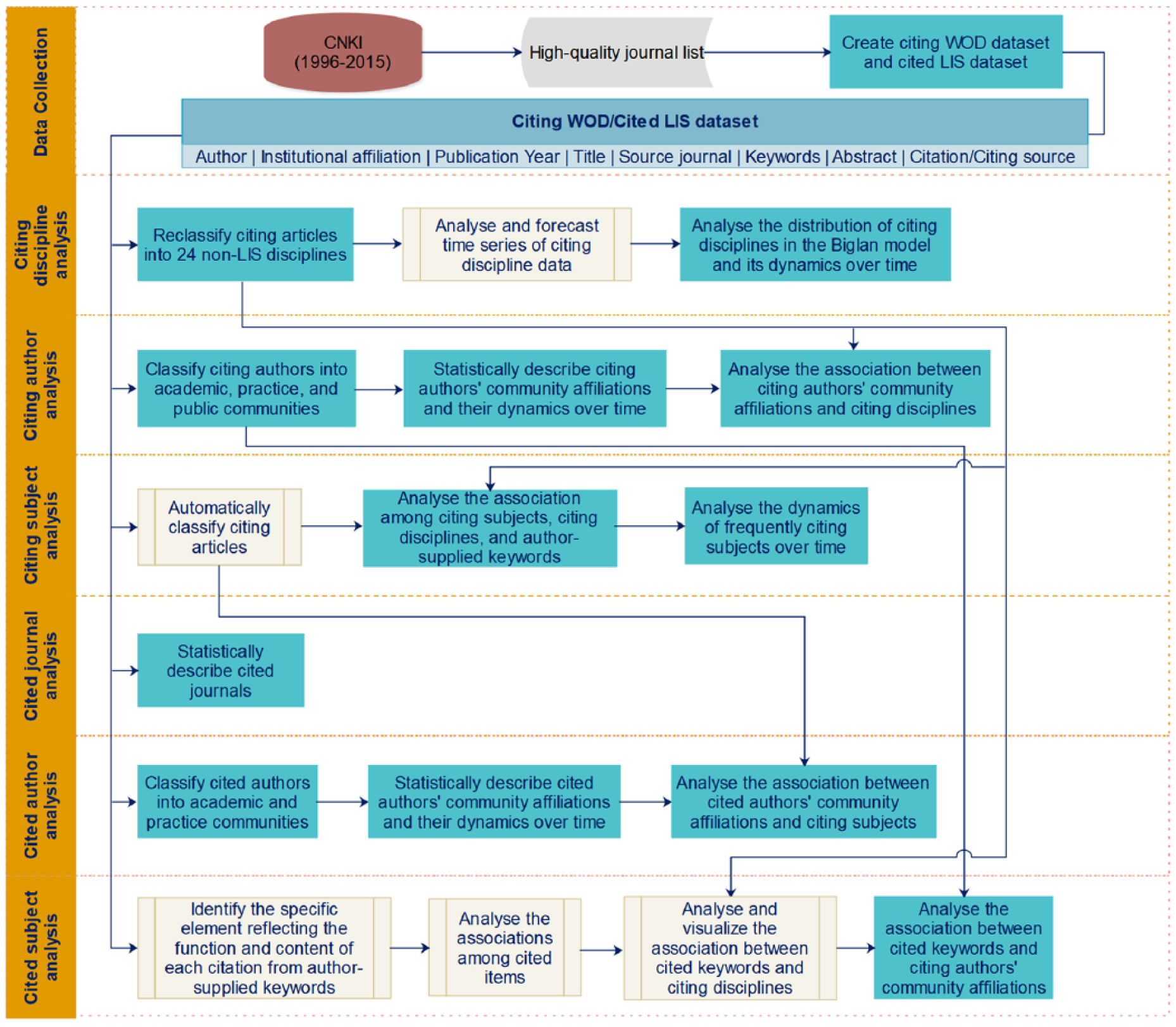
Since Chinese LIS articles are rarely listed or cited in international databases such as the Web of Science and Scopus, this study uses data from CNKI, which is a Chinese full-text database frequently used by researchers from various fields and which has the largest quantity of Chinese academic publication data. Twenty Chinese LIS journals with the highest impact factors were selected for this research. In addition to impact factor, these 20 journals are widely recognized by the Chinese LIS community as representing the knowledge production in the Chinese LIS field (Hu et al., 2011; Zhao and Wu, 2014).
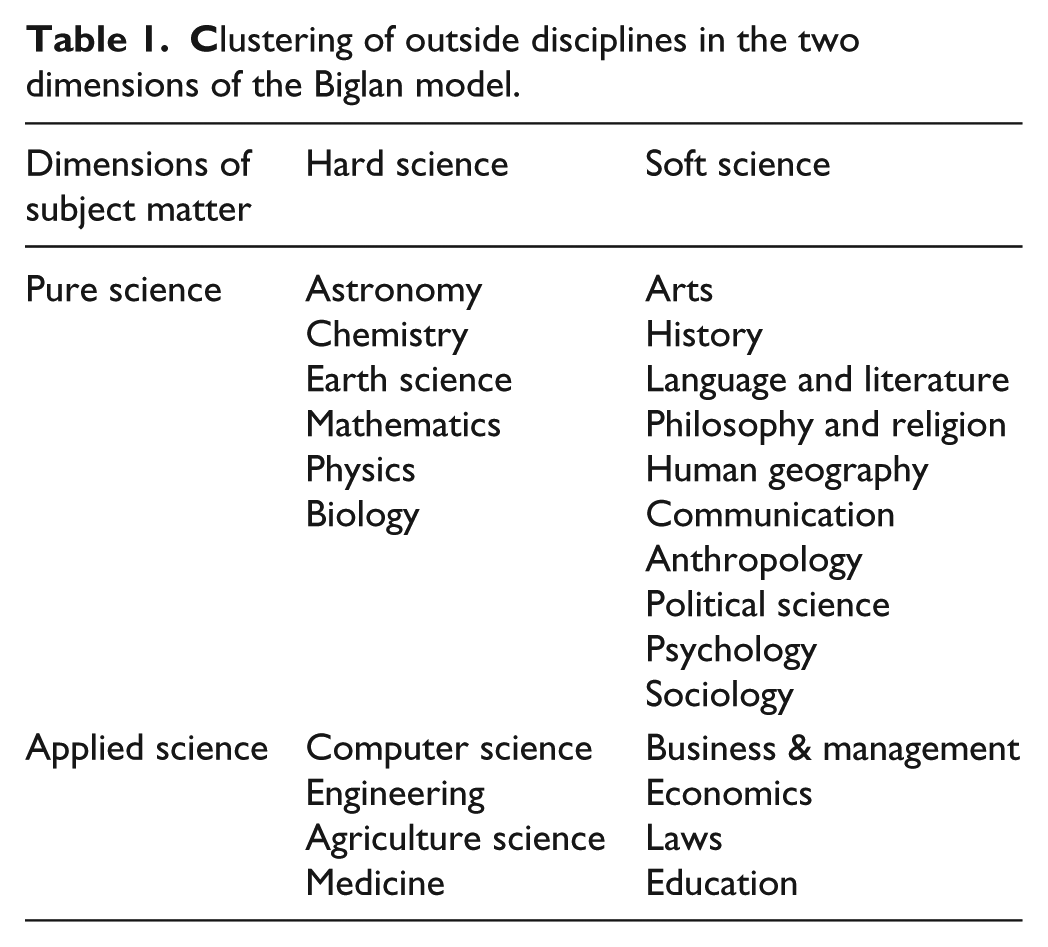
To obtain citations from works outside the discipline (WOD) to selected Chinese LIS journals, a discipline-balanced dataset of 469 non-LIS journals was created in the following steps. First, the non-LIS fields were divided into 24 sub-disciplines (see Table 1). As for the LIS journals, 20 non-LIS journals with the highest impact factors in their corresponding fields were selected for each non-LIS discipline, which resulted in a list of 469 non-LIS journals in 24 disciplines (only nine journals were available under astronomy). Finally, the bibliographic and full-text data of the LIS journal articles cited by the 469 non-LIS journals were collected from CNKI to create the initial dataset of cited LIS articles. Similarly, a dataset for the citing WOD was also created. Since journals assigned to a specific discipline may publish articles outside that discipline, for this study, LIS articles are defined as academic publications written for the purpose of solving issues in the LIS field and contributing to the development of LIS. Any data beyond the scope of this study (i.e. LIS articles published in selected non-LIS journals or WOD published in selected LIS journals) were manually excluded. After the two datasets were prepared, 4334 records remained in both the citing WOD dataset and the cited LIS dataset. Each record comprised eight fields: author, institutional affiliation, publication year, title, source journal, keywords, abstract and citation/citing source. Although the journal impact factor is a tool commonly used to measure the visibility and diffusion of a journal for its stability, facility of calculation and accessibility (Lancho-Barrantes et al., 2010), its reliability has been questioned due to possible biases in calculating and using journal impact measures, such as biases regarding document type and subject matter (Glänzel and Moed, 2002). Since this study uses journal impact factors provided by CNKI to identify high-quality journals, especially non-LIS journals, the use of journal impact factors may result in the exclusion of some journals that are reputable in their fields.
Citing articles analysis: Characteristics of disciplines, authors and subjects
Since the number of external citations and their dynamics over time have been regarded as indicators of the size and dynamics of knowledge trading, respectively (Yan et al., 2013; Zhu and Yan, 2015), they were employed to analyse the extent and dynamics of knowledge export for citing disciplines, citing author communities and citing subjects.
To analyse the disciplinary distribution of the citing articles, first, the authors identified the research areas of the citing WOD by analysing bibliographic data, including publication titles, abstracts and keywords. Then, based on their research areas, the citing WOD were classified into 24 non-LIS disciplines. For the citing disciplines, this paper analyses the dynamics of the citing disciplines over time and the distribution of the citing disciplines in the Biglan model.
Forecasting is one of the major tasks in time series mining (Esling and Agon, 2012). Past observations of the same variable are collected and analysed to develop a model that describes the underlying relationship, which is used to extrapolate the time series into the future (Zhang, 2003). In this study, the prediction of future external citations is regarded as a time series forecasting task to reveal the time trend hidden in citation data. The time series is defined as a collection of organized data obtained from sequential measurements over time (Esling and Agon, 2012); thus, in the analysis of the time trend in the citing disciplines, the dynamics of the citation frequencies of the 24 non-LIS disciplines from 1996 to 2015 constitute a time series, which was created as input variables including the annual citation frequency from each non-LIS discipline during this period. The autoregressive integrated moving average (ARIMA) model is one of the extensively used linear models (Zhang, 2003). Since it is regarded as an automatic forecasting model that can be used to generate a time series model, to estimate the parameters and to compute the forecast effectively and efficiently (Mena and Viteri, 2015), it was selected for time series forecasting. Finally, the prediction performance was assessed primarily through commonly used measures for evaluating forecasting models, including root mean square error (RMSE), mean absolute percentage error (MAPE) and mean absolute error (MAE) (Zhang and Qi, 2005).
The two dimensions in the Biglan (1973a) model, with an updated discipline-to-dimension relationship, were used to analyse the disciplinary difference in non-LIS authors’ citation preferences. Biglan (1973a, 1973b) proposed a discipline classification scheme in which academic areas were clustered based on their (a) concern with a single paradigm (hard vs. soft) (dimension I), (b) concern with their application (pure vs. applied) (dimension II), and (c) concern with the life system (life system vs. non-life system) (dimension III). Dimension III is generally less recognized and less cited than other dimensions (Simpson, 2017), although Rotidi et al. (2017) proposed that a better differentiation of Biglan’s classification scheme can be concluded for dimension III than for dimension I or dimension II. Dimension I and dimension II have been suggested to have current validity among a wide range of higher education systems (Simpson, 2017). Since 1973, efforts have been made to update, refine and re-create the discipline-to-dimension relationship (Simpson, 2017; Stoecker, 1993; Xu, 2008) that have enabled the Biglan model to track contemporary discipline development. Dimension I and dimension II have been widely applied to explore disciplinary differences by researchers from a variety of disciplines, such as LIS, education, and language and linguistics (Durrant, 2017; Huang et al., 2018; Madden et al., 2018; Munk and Thomsen, 2018). Although the two dichotomies of dimension I and dimension II are challenged by a heterogeneous pattern across disciplines (Prinsloo, 2018), they are currently validated, ever-developing and widely applied in a discipline classification that divides disciplines into four categories: hard-pure, soft-pure, hard-applied and soft-applied. For this study, this four-fold typology of disciplines was chosen from all the feasible classification schemes to categorize the 24 non-LIS disciplines according to their disciplinary nature and the definitions of the two dimensions of the Biglan model (see Table 1).
The citing authors are classified into three community categories: academic, practice and public, mainly based on their institutional affiliations. The academic community is identified as institutions with the core mission of conducting research, such as universities and research institutions. The practice community includes institutions in the practice and operation of certain industries. The public community refers to institutions that are open to the public (e.g. media and public sectors). The community affiliation of the first author of each citing article was noted manually as an output variable. To reveal the association between the citing authors’ community affiliations and citing disciplines, a two-dimensional crosstab was created to show the citation frequency of authors from the three communities (columns) belonging to different disciplines (rows). To better explain the results, the meaningful findings shown in this two-dimensional crosstab were summarized and explained in words rather than in a table.
To analyse the subject characteristics of the citing articles, a supervised classification technique was employed to automatically classify the citing WOD. First, 66% of the records (2874) in the citing WOD dataset were randomly selected to create a training set. Then, 70% of the records in the training set were used to train a classifier, and the rest were used for evaluation. Each record in the training dataset contained the title, author-supplied keywords and a manually annotated subject. Second, the data in the training set were pre-processed by segmenting titles into words, building a corpus and creating a document-term matrix. Third, a support vector machine classifier was trained and then evaluated by calculating the proportion of correctly classified instances. The reasons for training a support vector machine classifier are as follows: (a) the support vector machine is an effective tool for text categorization (Leopold and Kindermann, 2002), and (b) in comparison with other classifiers, including the naive Bayes classifier, decision tree classifier, random forest classifier, and k-nearest neighbour classifier, the support vector machine classifier has the highest proportion of correctly classified instances for the training set (73.6%), which implies a better classification accuracy. Next, the 1460 records in the citing WOD dataset that were not included in the training set were pre-processed and automatically labelled by the support vector machine classifier. Finally, the classification results were manually inspected to ensure that the subject of each citing article was correct.
Cited articles analysis: Characteristics of authors and subjects
In terms of cited authors, 4322 LIS authors were divided into academic and practice communities based mainly on their institutional affiliations, while the remaining 12 authors did not provide their institutions. The community affiliation of the first author of each cited article was noted manually as an output variable. A two-dimensional crosstab was created to show the frequency with which LIS authors from the two communities (columns) were cited by different disciplines (rows) and to reveal the association between the cited authors’ community affiliations and citing disciplines. The results are represented in text form.
Keywords supplied by the LIS authors were not cited equally in a single citation. Therefore, the keywords in the LIS articles that can reflect specific elements (i.e. research areas or concepts) cited by WOD were identified and selected from the author-supplied keywords by following three steps to reflect the subject characteristics of cited articles:
Step 1: The full text of the citing articles was accessed.
Step 2: The function and content of each citation in one citing article were analysed.
Step 3: The keywords (i.e. specific elements) that could reflect the function and content of this citation were selected from among the keywords supplied by the LIS authors.
In the sample data of this study, the element of each single citation could be described by no more than three author-supplied keywords. For the analysis of the changes in the cited keywords over time, the ranking of frequently cited keywords and their dynamics were analysed based on the citation frequencies of these keywords in different years.
To discover subjects that might potentially interest non-LIS researchers, an analysis of the associations among the subjects of Chinese LIS articles cited by WOD authors was needed. After comparing methods for detecting patterns hidden in data, such as correlations and sequences, association rule mining, a widely used data mining technique, was adopted since it aims to explore relationships between variables in large datasets (Ibrahim et al., 2016; Lee and Chen, 2012; Leung et al., 2010; Yildirim, 2015). Additionally, the Apriori algorithm was selected to generate association rules because it is a classical technique of association rule mining (Pattanaprateep et al., 2017) that is easy to be parallelized and implemented (Kumar and Rukmani, 2010). It was performed in the following two steps:
Step 1: Support measure. A candidate set is generated by discovering frequent itemsets that are co-occurring items with frequencies exceeding a minimum support (i.e. a pre-defined threshold).
Step 2: Confidence measure. Association rules are defined by identifying pairs of items with a conditional probabilities value exceeding a minimum confidence (i.e. a pre-defined threshold) (Leung et al., 2010; Pattanaprateep et al., 2017).
However, the Apriori algorithm using a uniform minimum support may result in the omission of interesting patterns with low support (Vijayalakshmi and Raja, 2005). To avoid this omission, considering the usefulness of the information hidden in the frequent itemsets in this dataset, the support threshold was set to be > 1.0%. The confidence threshold was set to be > 50.0%, which is the recommended level (Pattanaprateep et al., 2017). In addition to support and confidence, the significance of the generated association rules was then measured using lift (Ordonez et al., 2006). A rule with lift greater than 1 is regarded as a useful rule that supports decision making by providing extra information (Piri et al., 2018); thus, the lift threshold is set to be > 1.0 to identify meaningful rules. The association between LIS keywords and the citing disciplines/communities was analysed using two-dimensional crosstab analysis. The findings were then summarized and shown in graphic or text form.
Results
Citing articles from outside disciplines
Citing disciplines
Of the selected 469 journals in disciplines outside LIS, 288 (61.41%) cited Chinese LIS articles during the years under survey. The citing disciplines listed in descending order based on their citation frequency are business and management (939), communication (916), computer science (711), education (547), economics (267), medicine (147), engineering (117), law (117), political science (107), psychology (58), earth science (52), sociology (50), history (44), language and literature (44), human geography (41), anthropology (40), biology (31), agricultural science (30), philosophy and religion (27), arts (23), chemistry (11), astronomy (8), mathematics (6) and physics (1).
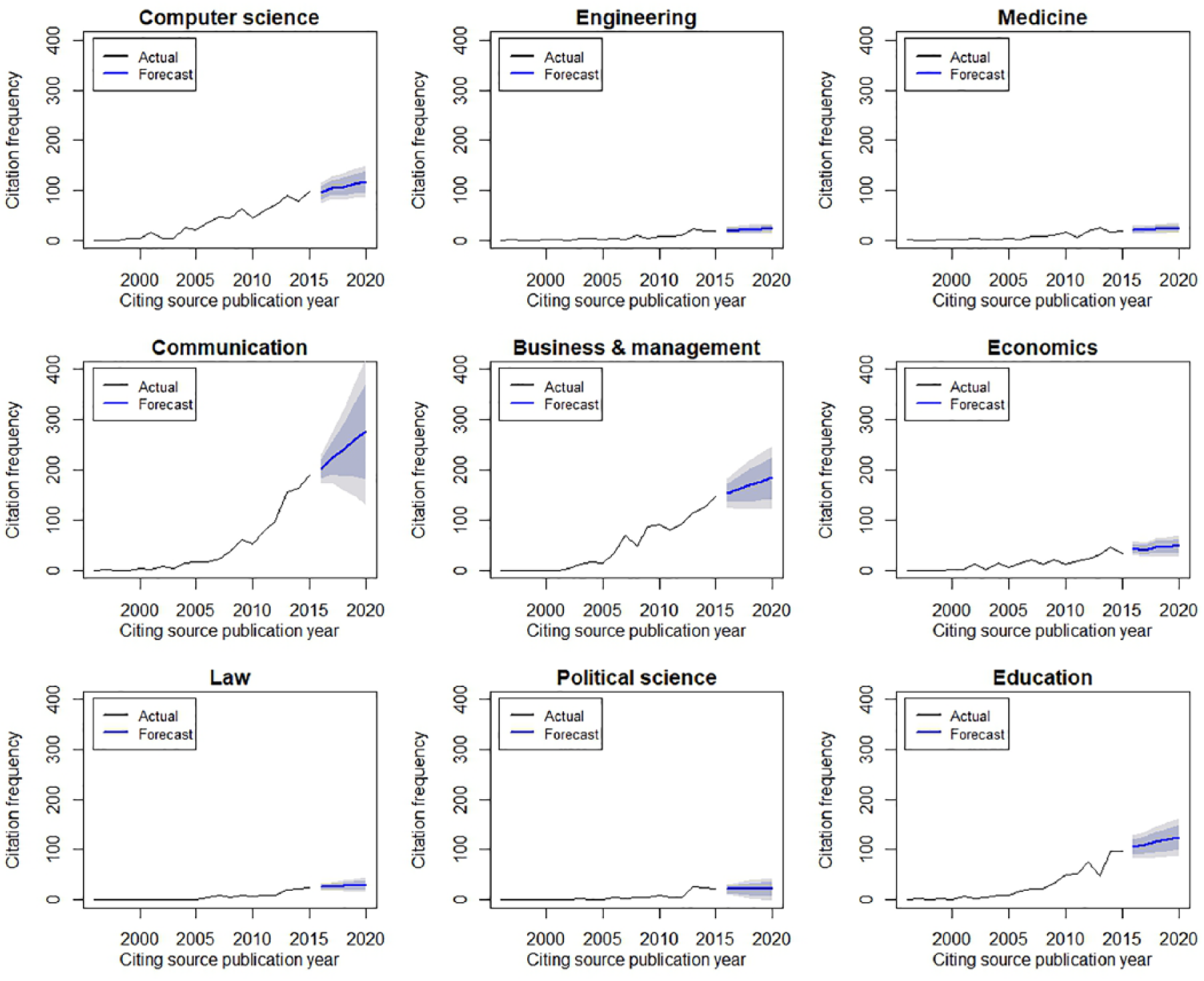
The time trends in the citation frequencies of the nine disciplines with an average annual citation count higher than five were analysed. The predicted citation frequency and both the 80% and 95% prediction intervals (PIs) were calculated for these citing disciplines (see Figure 2). During the analysed 20-year period, citations by the communication, business and management, education and computer science disciplines showed an increasing trend. Citations by the economics, law, political science, medicine and engineering disciplines showed a stable trend. The forecasting result of citation frequency indicated that communication (95% PIs (129.6, 424.3), 80% PIs (180.6, 373.3)), business and management (95% PIs (121.0, 247.9), 80% PIs (142.9, 225.9)), education (95% PIs (86.9, 163.4), 80% PIs (100.1, 150.2)) and computer science (95% PIs (85.8, 150.3), 80% PIs (96.9, 139.1)) will be the most frequently citing disciplines in 2020.
In terms of dimension I and dimension II in the Biglan model, the citing disciplines mainly belong to soft-applied science (1870), followed by soft-pure science (1350) and hard-applied science (1005), with hard-pure science (109) making up the rest. Citations received from soft science (from 33.3% to 78.5%), or pure science (from 0.0% to 41.4%) showed a tendency to increase from 1996 to 2015.
Citing authors
Chinese LIS articles are mostly cited by authors from the academic community (3775), followed by the practice community (469) and the public community (90). The percentage of citations received from the practice community decreased from 66.7% (1996) to 8.6% (2015), while the percentage of citations received from the academic community increased from 33.3% to 89.3%. In addition to 1996, the proportion of citations from the academic community remained higher than that of the citations from other communities. More specifically, two of all the citing articles (3) in 1996 belonged to the practice community (e.g. Lvliang District People’s Hospital, Shanxi Province), with the academic community making up the rest. The percentage of citations received from the public community remained low (from 0.0% to 2.2%) during the period under study.
The characteristics of the citing authors’ community affiliation vary by discipline. The majority of the citing authors are from the academic community, such as authors in business and management (98.1%), engineering (96.6%) and psychology (96.6%). However, the authors from the practice community in the disciplines of communication (352, 38.4%) (e.g. the editorial department of Forum on Science and Technology in China) and medicine (52, 35.4%) (e.g. Shandong Mental Health Centre) cited LIS articles more frequently than authors in other disciplines from the practice community. Authors from the public community in the disciplines of language and literature (7, 15.9%) (e.g. the China National Office for Teaching Chinese as a Foreign Language) and law (13, 11.1%) (e.g. the State Intellectual Property Office of China) cited LIS articles more frequently than authors from that community in other disciplines.
Citing subjects
The subjects of WOD citing Chinese LIS articles the most are data and information processing (671), bibliometric analysis of research (474), knowledge management (336), editing and publishing of science and technology periodicals (285) and intellectual property (184). These citing subjects overlap with the research areas of LIS.
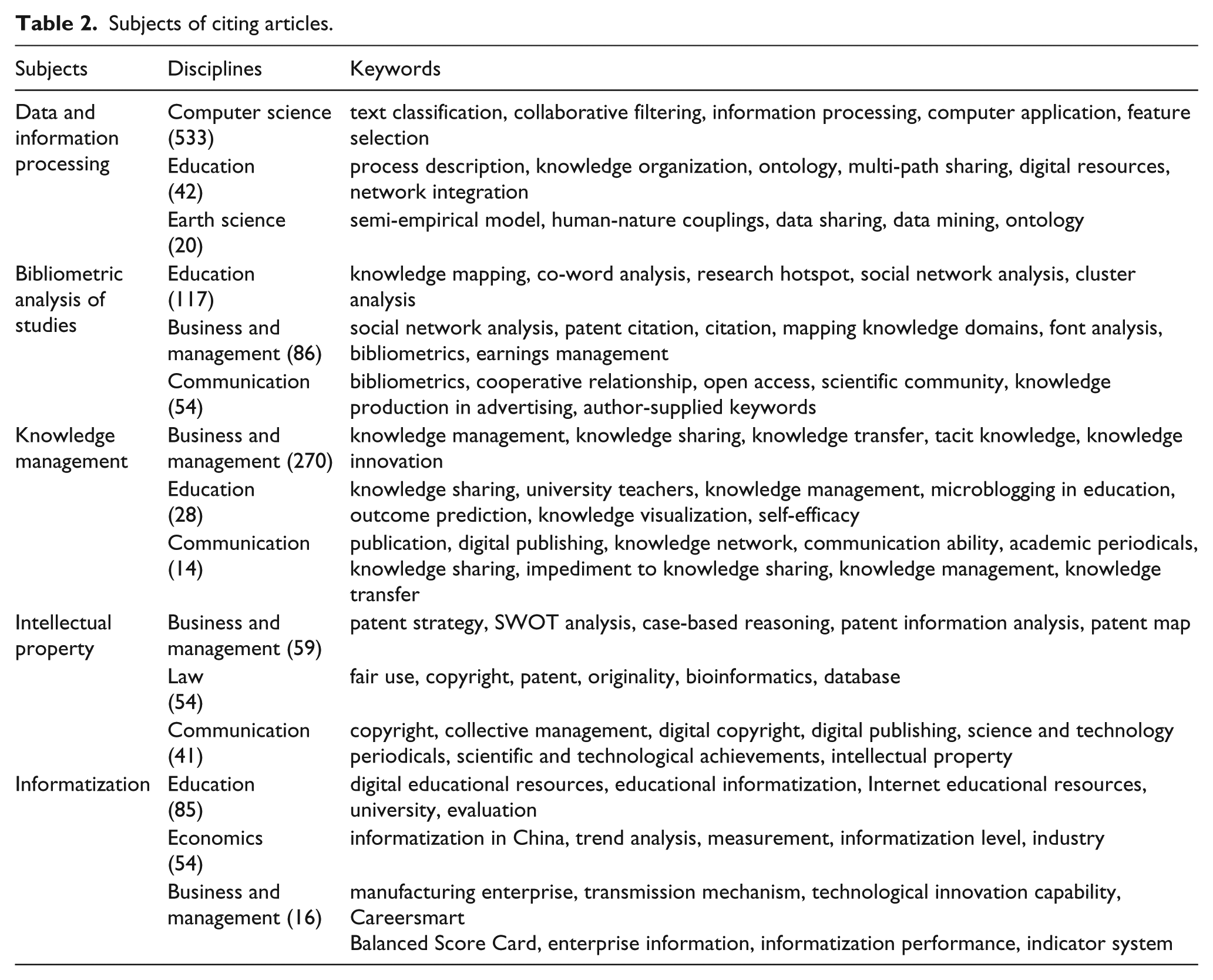
Citing articles studying the same subject may belong to different disciplines and focus on different research aspects (i.e. keywords) (see Table 2). Researchers in computer science, education, and earth science conduct studies on data and information processing to explore various areas and problems such as text classification, knowledge organization and ontology. For example, in citations from earth science, articles on the subjects of the construction of ecological domain ontology, standards for geographic information metadata, and geographic data integration (e.g. the construction of domain ontology for large-scale ecosystem nitrogen flux calculation) tend to cite LIS studies on ontology, metadata, and information integration (e.g. research on construction methods of domain ontology).
Subjects of citing articles.
According to the percentages of citations from different subjects in each four-year period, data and information processing, bibliometric analysis, editing and publishing of science and technology periodicals, and educational activities were the subjects in which LIS studies were cited frequently. Starting in 2004, the percentages of citations from studies on knowledge management, intellectual property and publishing increased, while the percentages of citations from articles on informatization, educational activities, and information and knowledge discovery decreased.
Chinese LIS articles cited by outside disciplines
Cited journals
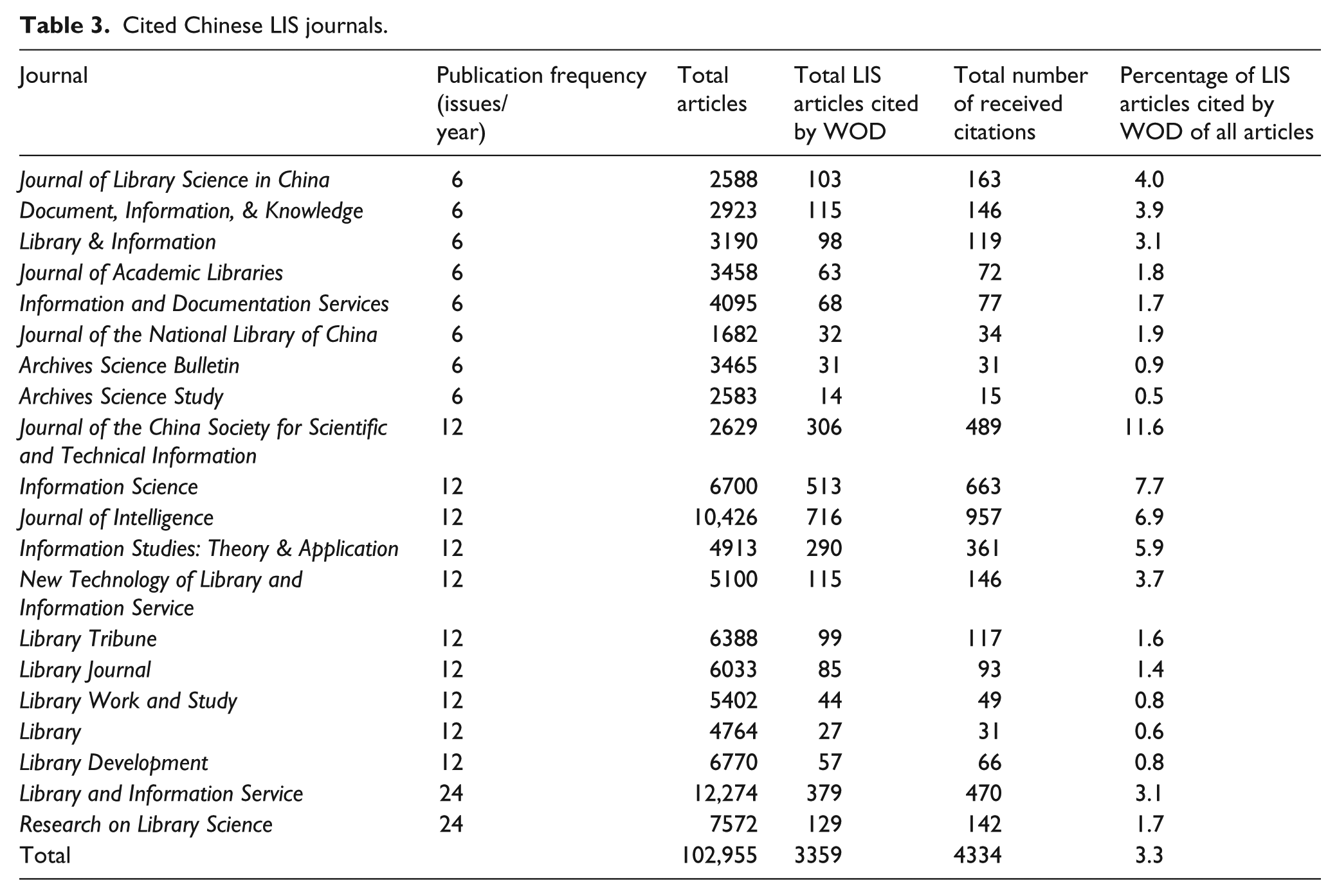
In a period of 20 years, 3359 LIS articles were cited by WOD (see Table 3). Chinese LIS journals such as the Journal of the China Society for Scientific and Technical Information and Information Science had a relatively high percentage of articles cited by WOD.
Cited Chinese LIS journals.
Cited authors
Authors of Chinese LIS articles from the academic community received the most citations by WOD (80.1%). The percentage of citations received by the academic community increased from 66.7% to 81.7% during the period under study.
According to the frequency and percentage of citations from subjects in WOD to the LIS practice community, the majority of subjects in WOD most frequently cite knowledge created by the academic community. However, articles on editing and publishing of science and technology periodicals (137, 48.1%), publishing (56, 35.0%) and intellectual property (46, 25.0%) cite the practice community more frequently than other subjects.
Cited subjects
The keywords receiving the most citations include bibliometrics (107), knowledge management (102), content analysis (68), citation analysis (67) and network information (63). Frequently cited keywords change over time. Keywords related to bibliometrics (e.g. citation analysis, co-authorship network analysis and co-words analysis) and those related to information technology (e.g. automatic abstract and ontology) are the LIS subjects with the most citations. Non-LIS authors also frequently cite Chinese LIS articles related to information economy (e.g. informatization and information industry). Citations to LIS articles on knowledge management (e.g. knowledge management and knowledge sharing) have increased since 2004.
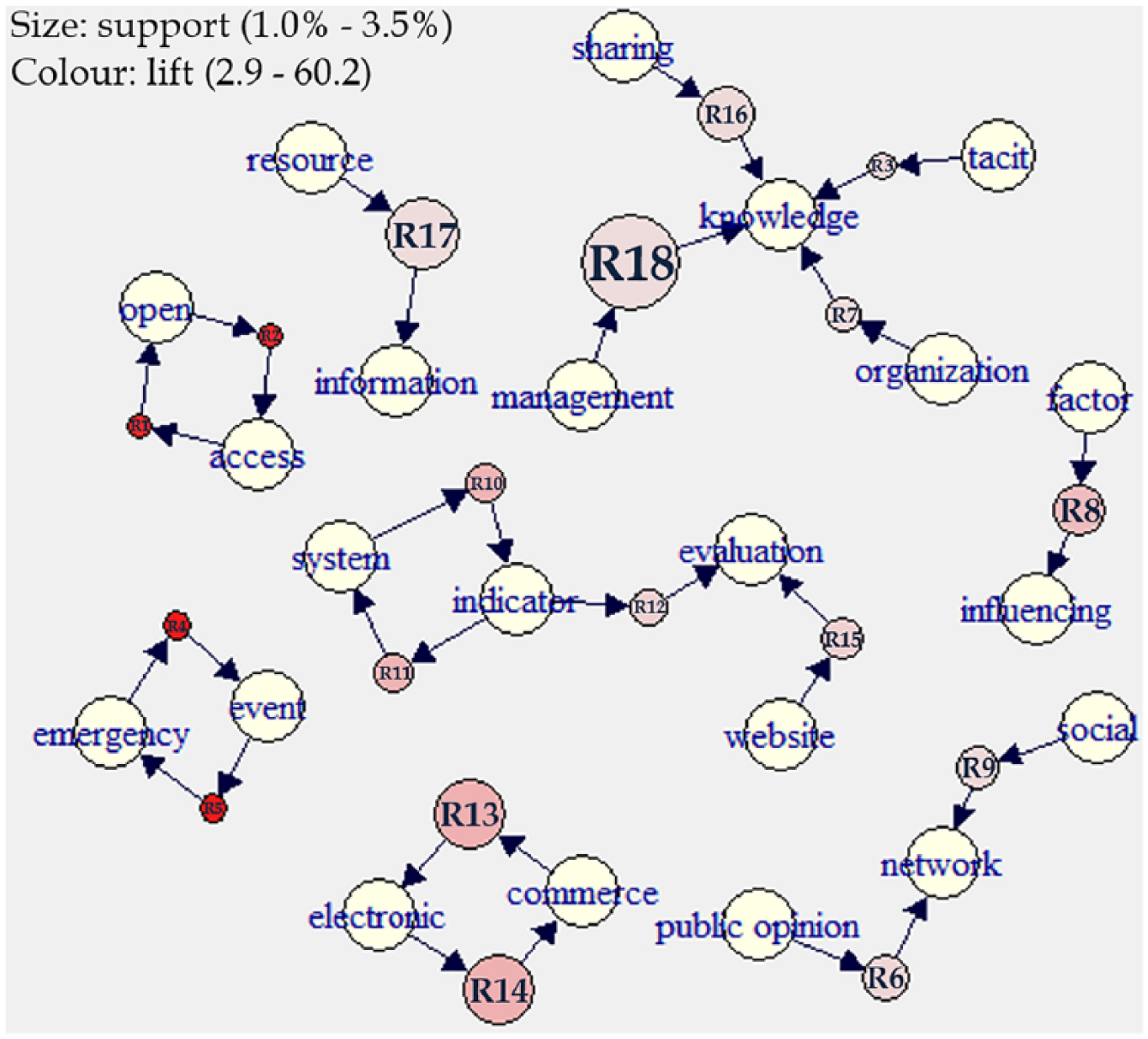
According to the results of frequent itemsets analysis, {information, network} (155), {knowledge, management} (152), and {information, resource} (117) are the two-itemsets that most frequently appear in the cited articles dataset. There are 18 rules exceeding the pre-specified thresholds (see Figure 3). In Figure 3, the support and lift values of each rule are represented by the size and shade of the colour of the respective circle: the larger and darker the circle is, the larger the corresponding value is. Rule 13 (R13) and rule 14 (R14) indicate the strong interdependencies between commercial activities and electronic environment. ‘Knowledge’ is the centre of the cluster consisting of items associated with knowledge management (i.e. R16, R18 and R3) and knowledge organization (R7). ‘{Indicator} => {evaluation}’ (R12) is associated with ‘{website} => {evaluation}’ (R15) via ‘evaluation’.
Frequently cited LIS keywords (vertical axis) receive citations from a variety of disciplines belonging to hard science and soft science (horizontal axis) with different citation frequencies (area of circle) (see Figure 4). Based on the citation frequencies of disciplines from hard/soft science, LIS articles related to data mining (e.g. text classification, automatic segment and automatic abstracting), information retrieval (e.g. search engine), and information organization (e.g. ontology) received more citations from hard science. LIS studies on bibliometrics, network information and social network analysis receive an approximately equal number of citations from the above two categories. LIS studies on knowledge management, informatization, information use (e.g. information behaviour and information service), intellectual property and information literacy receive more citations from soft science.
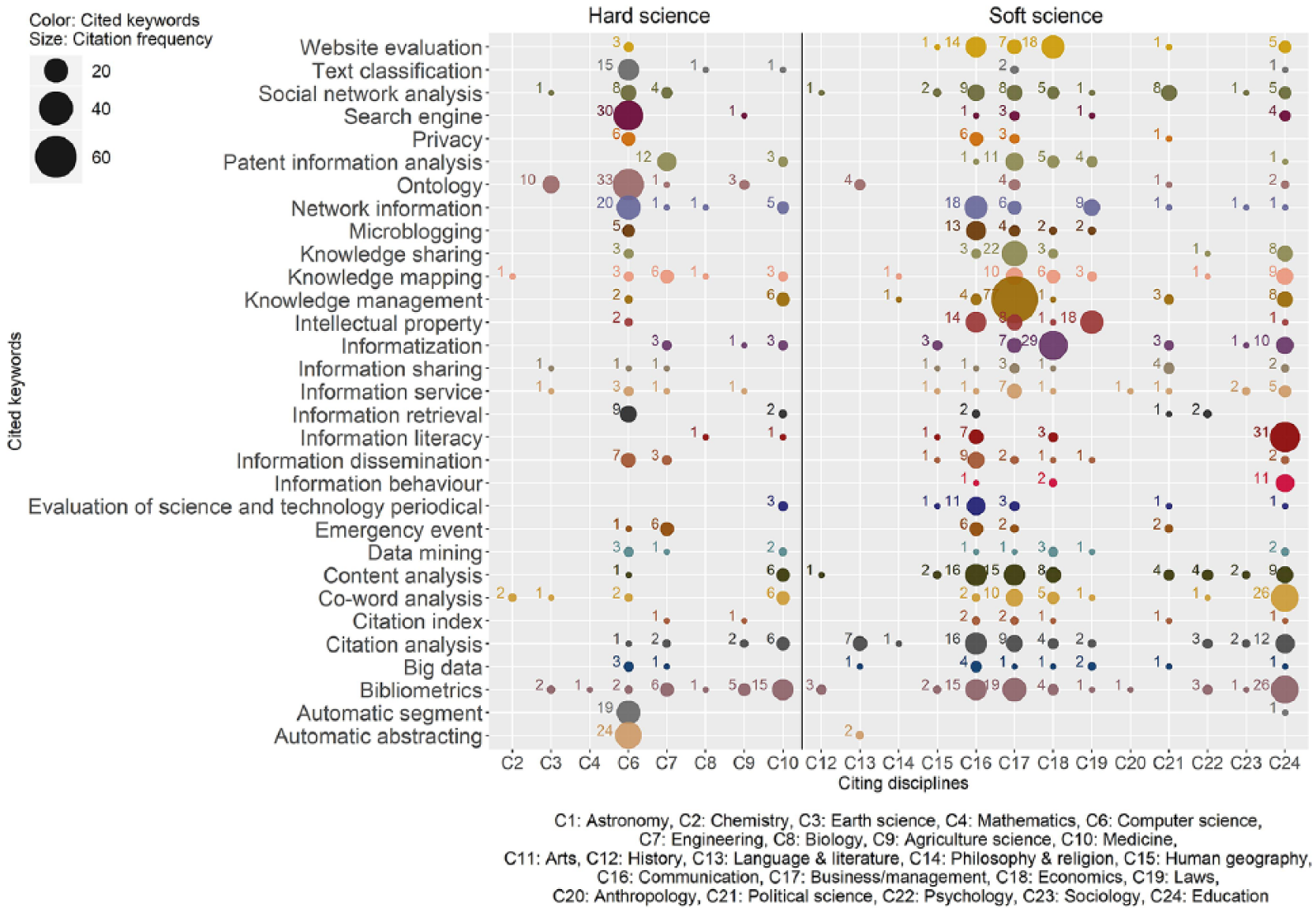
LIS keywords cited by outside disciplines in hard science and soft science.
The keywords frequently cited by non-LIS authors vary by their community affiliation. Authors from the practice community prefer citing subjects related to science and technology periodicals (e.g. open access, science and technology periodicals evaluation, and DOI). Authors from the public community prefer citing subjects related to information (e.g. informatization, information industry, information security and information integration). The academic community prefers to cite research related to knowledge management, social network analysis and the evaluation of Internet information resources. Moreover, there are intersecting areas of the keywords cited by these 3 communities. The keywords that receive a relatively large number of citations from all kinds of communities are bibliometrics, citation analysis, informatization, content analysis, search engines and patent information analysis. The practice community and public community prefer to cite research related to science and technology periodicals evaluation, copyright and knowledge organization.
Discussion
A proximal range of disciplines is more likely to cite LIS
Chinese LIS receives the most citations from related disciplines, such as business and management, communication, computer science, education, economics, medicine and engineering, which coincides with the citation pattern for the international LIS community of frequently being cited by cognate disciplines (Cronin and Meho, 2008; Hessey and Willett, 2013; Larivière et al., 2012; Meyer and Spencer, 1996; Tang, 2004). Non-LIS studies in highly interdisciplinary subjects that overlap with LIS most frequently cite Chinese LIS knowledge. The cognitive and collaborative challenges associated with interdisciplinary research have been found to be likely to increase as the cognitive distance between disciplines increases (Leahey et al., 2017). Therefore, one of the possible reasons for these related disciplines frequently citing Chinese LIS articles is that the cognitive distance between these disciplines and LIS is relatively small, thus contributing to reducing the hurdles in cognition and interdisciplinary collaboration, which in turn increases the probability of importing knowledge from Chinese LIS.
LIS subjects with interdisciplinary nature are more frequently cited by outside disciplines
During decades of development, Chinese LIS made a strong effort to explore interdisciplinary research topics, such as bibliometrics, knowledge management, information technology and information users (Xiao et al., 2015). LIS articles on information technology attract more citations from hard science, while research on knowledge management or information use attracts more citations from soft science. Bibliometrics studies receive a relatively high level of attention from both hard and soft science. Regarding the citing community, bibliometrics, citation analysis and network information attract citations from various communities. According to the results of association rules mining, a knowledge cluster consisting of central ‘knowledge’ and other cluster members (i.e. ‘management’, ‘organization’, ‘tacit’ and ‘sharing’) has formed, indicating that non-LIS researchers citing studies on knowledge management may be interested in LIS studies on knowledge organization. In general, bibliometrics, information technology and knowledge management are types of knowledge that non-LIS researchers draw on extensively. Thus, the interdisciplinary research of Chinese LIS has better performance in knowledge export.
Innovative interdisciplinary strategies are needed to expand the external impact of Chinese LIS
Chinese LIS, once a discipline with low visibility, has begun to receive an increasing number of citations from outside disciplines, especially disciplines closely related to LIS. The knowledge export performance of the international LIS community shows a similar trend (Cronin and Meho, 2008; Cronin and Pearson, 1990; So, 1988). However, in contrast to the international LIS community, which has received more external citations than citations within the discipline (Larivière et al., 2012), the Chinese LIS community receives fewer external than internal citations. More than 38% of the selected Chinese non-LIS journals have not cited any LIS articles in the 20 years evaluated in this study. On average, only three of 100 Chinese LIS articles receive citations from WOD. Therefore, the overall extent of Chinese LIS knowledge export is relatively low. More strategies for optimizing knowledge creation and dissemination are needed to increase the impact of Chinese LIS on wider fields.
Conclusions
Here, we provide possible strategies to facilitate the creation and dissemination of LIS knowledge, which may help advance its external impact. To optimize knowledge creation, Chinese LIS may develop research agendas in areas of greater significance. In our findings, subjects such as bibliometrics, information technology, knowledge management and information use have relatively high potential for knowledge export and may be considered areas in which LIS can exert an influence.
As publishing, teaching, and service are regarded as major channels of knowledge dissemination (Lockett and McWilliams, 2005), Chinese LIS may promote knowledge dissemination through enhancing scholarly publishing and optimizing education and service across disciplines. Inter-institutional collaboration may also be developed to provide scholars, learners, practitioners and policy makers with appropriate interdisciplinary knowledge that meets their needs. The disciplines or subjects frequently citing Chinese LIS may serve as gateways for collaborative research projects. Users’ potential interest in Chinese LIS knowledge revealed by the association rules in this study could also be considered areas for potential knowledge collaboration.
LIS researchers should make more efforts to identify the needs of the practice and public communities and to bridge the boundaries between research and practice. As subjects such as journal evaluation, copyright, and knowledge organization are frequently cited by the practice and public communities, Chinese LIS researchers could make progress in such subjects to provide scholarly references and support to practitioners and policy makers.
This study explores the external impact of Chinese LIS using citation analysis. It highlights the scholarly achievements of Chinese LIS and offers support in developing strategies for knowledge dissemination. It may also help to develop research agendas that may exert a greater impact on wider fields. By revealing the association between citing and cited entities, this study offers an overview of the Chinese LIS knowledge export in multiple dimensions. The application of data mining and visualization techniques will also help scholars identify research topics that may have greater potential for knowledge export. The main limitation of this study is that it collects and analyses citation data only from journal articles and does not include other channels of scholarly communications. Future research will collect citation data from a more comprehensive range of types of literature, add new analytical perspectives, and conduct a multi-dimensional analysis to further investigate the motivation of authors in citing LIS works.
Footnotes
Declaration of conflicting interests
The author(s) declared no potential conflicts of interest with respect to the research, authorship, and/or publication of this article.
Funding
The author(s) disclosed receipt of the following financial support for the research, authorship, and/or publication of this article: This work was supported by the National Natural Science Foundation of China (Grant Number 91546124).
