







Abstract
The impact of job rotation in the overall performance of an organization has been well documented in the literature. Despite a considerable number of studies on job rotation, only a handful are carried out in the context of librarianship. Further, the dynamics of job rotation as experienced by librarians in the Philippines remains a research blank spot. Cognizant of the dearth in literature, this grounded theory inquiry purports to shed light on the process of adjustment of a select group of Filipino librarians who experience job rotation within their organization. A total of 15 participants from Luzon were purposively selected and interviewed. Field texts were read, reread and constantly compared via open, axial and selective coding process. Interestingly, a novel and distinct process surfaced how a select group of Filipino librarians experience job rotation. The emerged Puzon and de Guzman BELT Theory of Adjustment process by which Filipino librarians adjust after being transferred to another post is typified by four distinct phases of: bemusing, establishing, leveraging, and transforming. This theory offers a number of implications on personal development, departmental initiatives, and institutional assistance and support relative to the phenomenon under study.
Introduction
Across the literature and in many disciplines, it is observed that companies are looking for other measures to minimize or reduce work-related injuries like work-related musculoskeletal disorders (WMSDs) (Schneider et al., 2005); avoid job boredom (Reh, n.d., as cited by Abrams and Berge, 2010); decrease the effects of plateauing on employees by adding variety in terms of tasks (Campion et al., 1994); and improve interpositional knowledge of staff within the organization (Cooke et al., 2000). To address these issues, organizations have initiated the practice of job rotation. Job rotation or “cross-training” (Ho et al., 2009) is described as a work design system (Jorgensen et al., 2005), a lateral transfer or systematic movement of employees between tasks and jobs (Mallinski, 2002) within an organization, that involves change in assignment, department, unit, or title, but compensation level remains the same (Campion et al., 1994; Gopinath and Shibu, 2014). It is seen as being a low-cost tool and one that is relatively quick to implement (Schneider et al., 2005).
Sung and Ashton (2005), for their part, mentioned that job rotation is one of the 35 high performance work practices (HPWPs) that could impact the organization’s overall performance. Further, they maintained that the practice of job rotation often results in positive outcomes involving the employee, which include higher level of involvement at work, increased organizational knowledge and work skills, all leading to a long-term commitment of the employee to the company. However, they averred that despite the merits of the practice, adoption of job rotation, along with some other important HPWPs is marginal at best, due to some companies seeing these as too costly to implement and the lack of adequate knowledge on how to implement it.
Notably, only a handful of studies focusing on job rotation in the context of library practice exists. Baro (2012) found that through the job rotation program, librarians at the Niger Delta University enhanced their productivity, developed new relationships within the organization, and learned new skills that will ultimately help them further their career. Newcomers also got to be mentored by experienced librarians and gained tacit knowledge through job rotation and on-the-job training. Similarly, Gossen, et al. (1990) found that a cross-training experience can alleviate feelings of isolation and frustration that is brought about by the lack of understanding of functions between departments. Consequently, librarians who were involved with the program reported a greater sense of cooperation, increase in technical skills successively enhancing their self-sufficiency, improved communication with colleagues, better understanding of other departments’ responsibilities, and a boost in their morale and professional confidence. Additionally, Rowley (1996) mentioned that high quality performance of staff is grounded on their motivation and satisfaction in their job. Further, she detailed that one possibility for increasing motivation is by providing the librarian opportunities for self-development by gaining experience in tackling different jobs through job rotation.
Considering the limited studies about job rotation in libraries, empirical evidence on how adjustment to job rotation as experienced by librarians in the Philippines remains a research blank spot. Historically, library studies have concentrated more on the evaluation of the effectiveness and perceived benefits of implementing a job rotation program than issues and the process of adjustment it entails.
This naturalist inquiry sought to develop a model that describes the process of adjustment of a select group of Filipino librarians who experienced job rotation. Findings of this empirical attempt may help improve policies and practices that afford the seamless and successful implementation of cross-training in library practice.
Methods
Design
To achieve the overall intent of this paper, the grounded theory design was used. Developed in 1967 by two sociologists, Barney Glaser and Anselm Strauss, the very essence of grounded theory lies in the inductive development of a theory derived or “grounded” from data (Punch, 1998; Khan, 2014) and not from prior knowledge (Robrecht, 1995).
Selection
The 15 librarians who met the following inclusion criteria were eligible to participate in this qualitative study: (a) Filipino licensed librarian; (b) currently employed in academic or school library in the Philippines; and (c) had experienced lateral job rotation in a library. This study did not include librarians who were promoted to administrative positions.
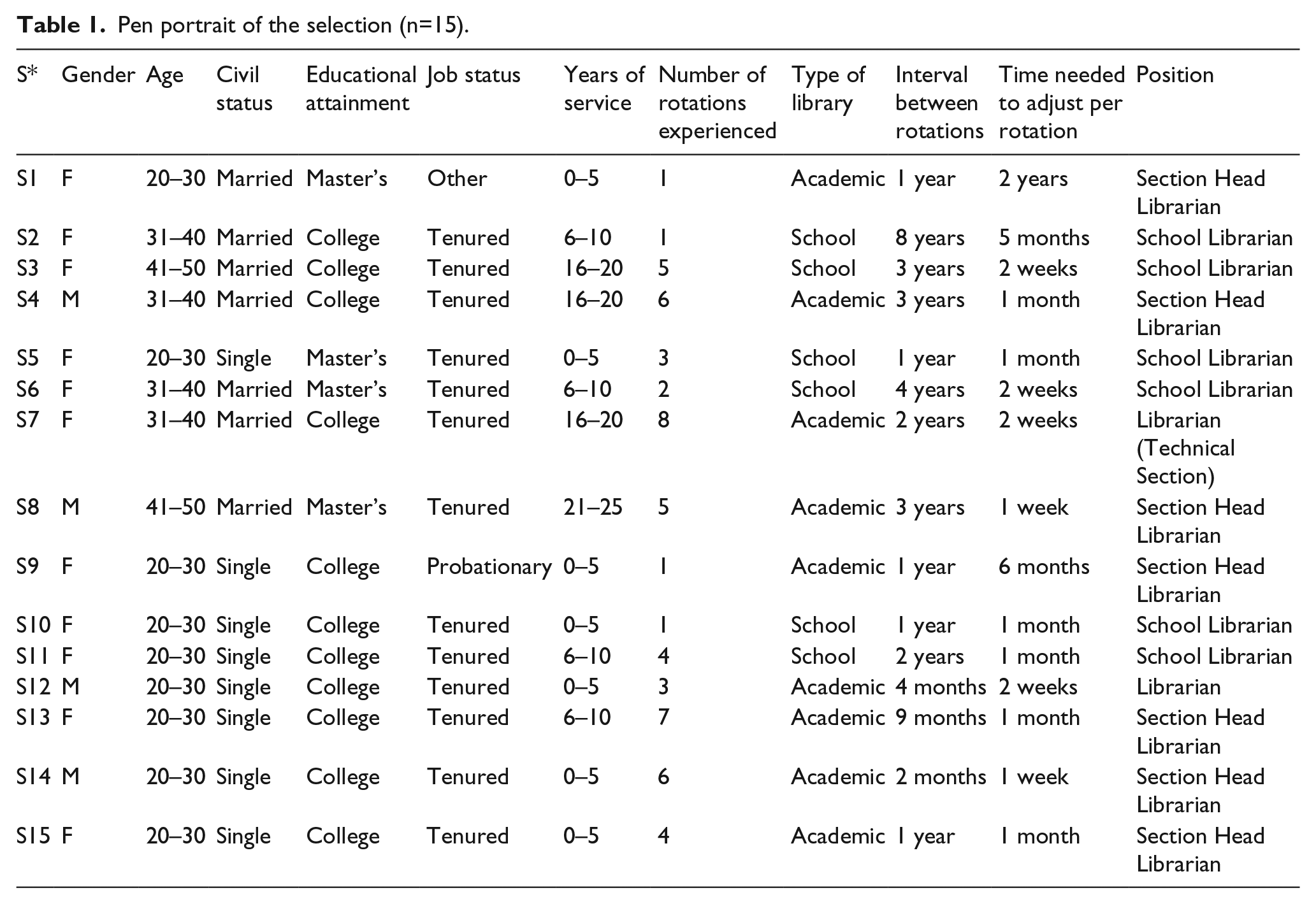
Of the participants (Table 1), 11 (73%) are female, mostly ranging from 20–30 years old (60%), single (53%) and are at the minimum college graduates (73%). Nine, or 60% work in an academic library, with majority being tenured employees (13 or 86%), have been serving for at least seven years (7 or 46%), were rotated at least once (4 or 27%) with an interval rotation between 2–3 years (40%).
Pen portrait of the selection (n=15).
Instrumentation
Data and information gathering were done by utilizing a two-part instrument. Comprising the first part was a robotfoto (Kelchtermans and Ballet, 2002) which was used to obtain the preliminary characteristics of the selection such as their age, gender, civil status, educational attainment, employment status, years of service, number of rotations experienced, type of library, frequency of rotation, interval between rotations, time needed to adjust per rotation, and position in the library
For the succeeding segment of the study, an aide memoire was developed that assisted the researchers in the conduct of the one-on-one, face-to-face semi-structured in-depth interview (Patton, 2015) in the understanding of the dynamics of adjustment. It explored the librarians’ experiences of adjustment from the moment they learned of the impending change and the time they had been accustomed to the new assignment. Some of the questions asked included the following: What was your reaction upon learning this impending change? Why did you feel that way? How did you handle that feeling? What did specifically do to address that feeling? With these changes, how did you begin the process of adjustment? Can you say that you have fully adjusted to your current position? How can you say that you have adjusted to your new assignment? If not, what do you think are still needed to adjust to your new unit? A total of 16 open-ended questions were following a set of a priori codes. These codes were based on an extensive literature review and the lexical definition of the human experience under study.
Data gathering procedure and ethical considerations
Upon securing clearance from the Ethics Review Committee of the University of Santo Tomas Graduate School, the researchers then secured permission from the administrators of the library where participants were mainly selected and recruited. The researchers then proceeded to discuss the purpose of the study with qualified participants. A written and signed informed consent as well as permission to audio-record the interview were obtained from those willing to participate. Upon their consent, assurance of their choice and freedom to withdraw from the interview and study at any time was clearly stated. Data gathering took place based on the availability of the participants and venue of their own choice and convenience. The audio-recorded interview lasted for about 45 to 60 minutes.
Data explicitation
Audio-recorded interviews were transcribed verbatim into field text. Data yielded from the interview transcripts in any language other than English were then cautiously translated into English in preparation for analyses prescribed for grounded theory. To achieve naive understanding of the librarians’ verbalizations, field texts were read and reread. This allowed for cool and warm analyses of data. In the succeeding open coding, significant statements or anchors were identified and through cutting and sorting, codes, thereafter, were specified on the basis of similarities and differences (see Table 2). Properties of codes were taken into account as these were lumped and clustered into categories in a process known as axial coding (Heath and Cowley, 2004), which paved the way for the development of an axial coding paradigm (see Figure 1). This coding paradigm consists of categories that relate to the: (1) identification of the core category or the layer of experience, (2) delving into the causal conditions that bring about the phenomenon (adjustment), (3) identifying other conditions associated to the phenomenon such as context, and (4) the intervening variables, (5) enumerating strategies aimed at managing the phenomenon, and lastly, (6) indicating the consequences of the actions. Ultimately, the utilization of selective coding facilitated the integration of emergent themes into the developed core category. Themes were subjected to correspondence technique (De Guzman and Tan, 2007) where interpreted data were brought back to the participants to ensure trustworthiness and ensure truthfulness (Huberman and Miles, 2002).
Examples of meaning units, condensed meaning units and codes.

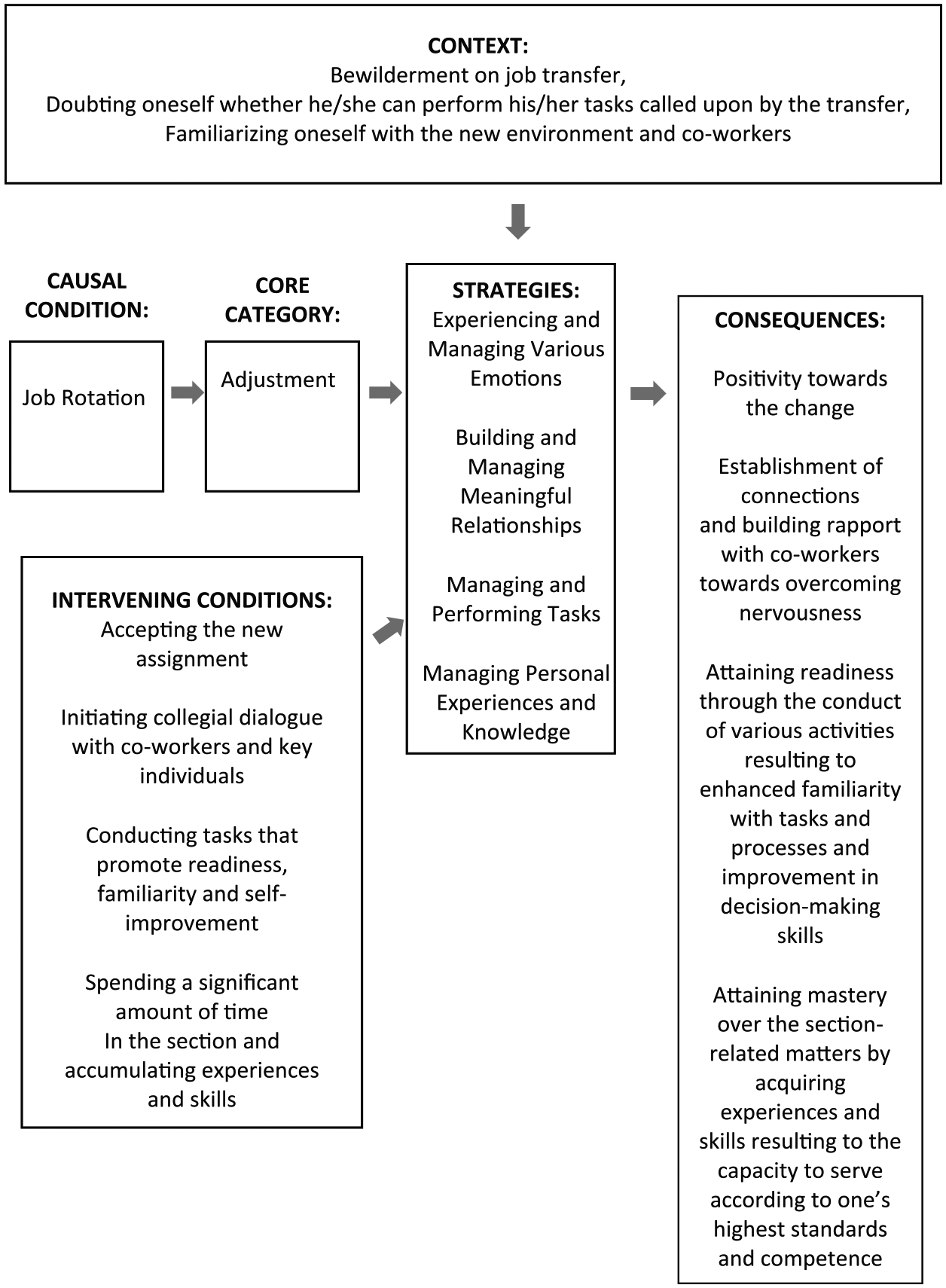
Axial Coding Paradigm.
Findings
After a thorough analysis of the participants’ individual and collective experiences, a novel process, dubbed as the Puzon and de Guzman BELT Theory of Adjustment, afforded a rich description of experiences of a select group of Filipino librarians who went through job rotation. Interestingly, four distinct yet interrelated phases of: bemusing, establishing, leveraging, and transforming (see Figure 2) constitute the adjustment entailed by the job rotation experience.
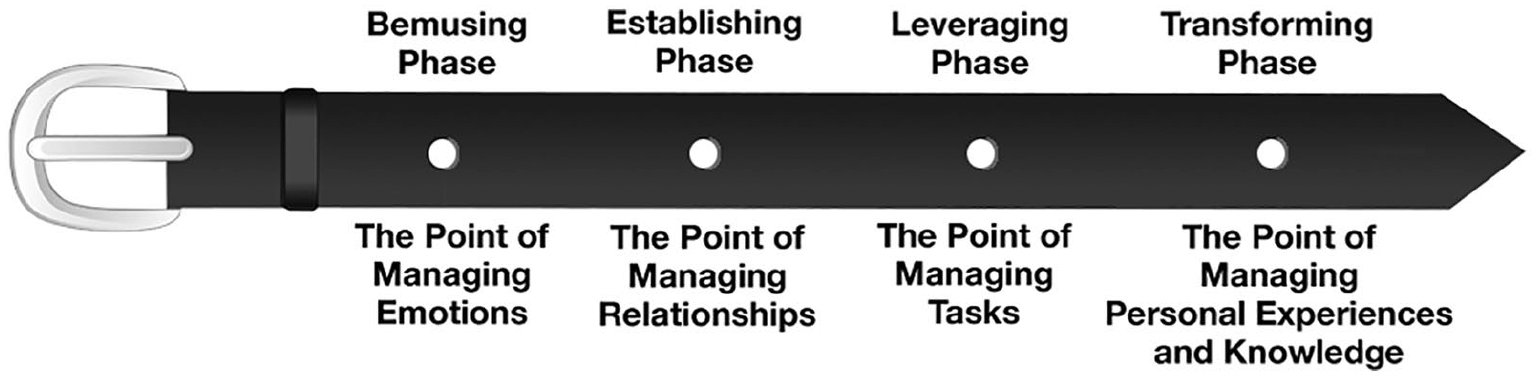
Puzon and de Guzman BELT Theory of Adjustment.
Bemusing phase: The point of managing emotions
In this study, the process of adjustment of a select group of Filipino librarians who experienced job rotation commences with the bemusing phase where they are informed of their impending transfer. During this phase, the participants experience a variety of emotions as they realize the need to step out of their individual comfort zone. At the outset, they were bewildered with the news. As one participant verbalized: Honestly, I was shocked. For I don’t know why I will be transferred. (S13)
Another shared: Ah, it was very surprising. Because I am already used to that section, then, I will be transferred again. I will have to adjust. (S14)
Others entertained the thought of possibly lacking certain qualifications as reason for the constant transfer, as shared: Like I said, “why am I being transferred again when I was just recently transferred?” Was it because I don’t have a Master’s degree? (S8)
Due to the forthcoming change, some were confronted with the feeling of self-doubt as whether they could manage what the new position would entail, as stated: It seems like the work load is quite heavy. I also thought that I may not be able to do the job. (S10)
Another expressed reluctance: At first, I was quite reluctant. I was thinking it might be difficult as I was already comfortable being in [Section X] and the Head there. (S12)
Besides self-doubt and reluctance, one participant felt pressured for fear of performing poorly in the new section, as verbalized: A bit pressured because the tasks there were different. I was thinking . . . because in [Section 0], [people X and Y] are involved. I might make a mistake, and that is my fear. (S7).
It is interesting to note that as the participants make sense of their initial feelings, receiving words of encouragement and support from the superior and new workmates promoted a sense of reassurance to the concerned librarian: I was also assured by my Head that the people I will be working with in that section will be okay to work with. When the staff there knew that I will be the one in charge of handling them, they welcomed me as their new Head. (S1).
Focusing on the possibilities and opportunities for new learnings led the participants in this study to accept not only the job rotation, but also to assume a more positive attitude towards the change, as articulated in the following statements: I was very excited. Now I have something to look forward to at work in terms of new learning. I was happy because at least I get to experience a different area in the library. In this way, I am growing professionally. (S15)
Another shared: The only thing I did was to accept it. At least in the new environment, I get [to] deliver my service to my clients. I am indeed thankful that I have a job. It is up to me now to adjust. (S3)
Summarily, the bemusing phase is a process by which a librarian due for rotation and faced with self-doubt and reluctance thus seeks for comfort and reassurance from superiors and workmates with the hope of finding new learnings and opportunities through positivity and openness to change.
Establishing phase: The point of managing relationships
As the news of being transferred to another post dawned on them, the participants’ experiences of a myriad of emotions ushered them to gradually enter a realm where adjustment to the new work environment, as well as new co-workers, and library users entailed building sound relationships.
To familiarize themselves with the new work environment, the participants noted that they actively sought for the incumbent and learned about the demands of the new post. As shared: I just coordinated with the person I am to replace and asked for the task flow and the policies involved. (S7)
Another mentioned: I did ask the retiring librarian about the policies and procedures governing the task. Interestingly, she shared all the information I needed to know. I gained additional knowledge. I became ready. (S15)
Additionally, endorsing reports to the newly designated librarian and discussing pending work was viewed with equal importance, as pointed out by the following remarks: Endorsement of the tasks at hand is vital. It was easy for adjusting to the new post because the person I am replacing was my colleague ever since. The turnover became so smooth and easy. (S11) I prepared the turn over report for the one who will handle the section I am leaving. This is to my mind will make his transfer easy and friendly. (S6)
Notable in the participant librarians’ transition is the positive effect of the support coming from colleagues, as well as from the Library Administrator to overcome the feeling of nervousness. As one librarian shared: First of all, there is the moral support of my colleagues, as well as my boss who never let me down. In fact, during the orientation, she introduced me to the school unit head and the head of the faculties. What is good about it is that I was able to overcome my nervousness because I knew from the very start that I have their moral support and they are there for me. (S4)
By asking colleagues who have already been assigned in the section before, the participant librarians managed to get vital points relative to the new expectations and how to meet these. As verbalized: They have always been helpful to me. They are always there when I needed help, they guided me and gave me suggestions on how to do the job. (S9) What I did was to consult my fellow librarian who was previously assigned there. It was a big help for me. (S15)
As they continue to learn the ropes of their new post, seeking assistance from seasoned co-workers becomes inevitable and likewise proves invaluable. As hinted by these participants: I find it beneficial when there are librarians who have stayed in the unit for a considerable time. I can easily seek for help. (S7) In my experience, I was the only one new in that department, but the staff was retained. That made me learn the procedure to follow and the problems they usually encounter. In that way, I was able to prepare myself better on what to do if ever I encounter the same problems that they had before. (S2)
In this study, the participant librarians owed their adjustment in no small measure to how they related with others, as shared: I believe that my good relationship with my co-workers and vice versa contributed much to my adjustment. (S8)
As the sense of camaraderie is steadily being developed, librarians in this study, especially those assigned at the service areas, attempted to build relationships with the library patrons. They considered creating good relationships with their users, as well as stakeholders, as an effective mechanism to manage their situation as a newcomer in the section, detailing strategies such as talking to them to understand them better, and generally being friendly to the students. As most of the librarians shared: At first, I observed how my new clients behave since I really do not have any idea on how to handle teenagers. (S11) During free time, I walk around, I talk to familiar students so I would know their interests. (S4) When I was new in the unit, I tried to mingle, socialize and please my clients. I needed to familiarize myself with them. (S3)
At the institutional level, librarians in this study get the chance to be introduced and familiarized themselves with other members of the organization by attending meetings. As a participant affirmed: In my institution, we are to join the faculty meeting. This to my mind is good practice to blend myself with my patrons. (S2)
Likewise, participants also went out of their way to introduce themselves to faculty members through informal talks and visits. Befriending teaching staff makes relaying concerns less challenging. As shared; I also made sure to get to know the advisers so if I have concerns on their students, I can easily talk to them. “Ma’am, I need your help on this student because of improper behavior.” To be friends with the advisers is the first thing I did. (S6)
The establishing phase refers to the process where librarians due for rotation manage to build relationships with fellow librarians and other support staff through collegial dialogue for purposes of overcoming nervousness and understanding the dynamics of the new work environment.
Leveraging phase: The point of managing tasks
As rapport and relationships are established in the previous phase, newly transferred librarians come to a stage of commencing in the leveraging phase. This phase details the process by which the participant librarians exert effort in grasping the fundamentals of the new work environment as they adapt a take-charge mindset and attitude towards learning its inner dynamics capitalizing on the knowledge gained from previous experience. This phase consists of three levels, namely: initializing, routinizing, and innovating.
The initializing level involves the participants’ initiative to familiarize themselves with the new tasks at hand. Activities such as reading of the manual of operations, physical restructuring of work area and continuous training resulted to decreased feelings of being lost and ill in unfamiliar surroundings. As exemplified: Though I am quite familiar with collection in my new assignment, I feel that I needed to learn the small details such as guidelines, rules and regulations, as well as the job description of each personnel. (S8)
Another commented: I am quite OC at work. As much as possible, I want everything organized. I am the type of person who could not focus until I get the orderliness I wanted. I easily find things I need because it was my own arrangement, even if I close my eyes. I know where to get this and that. (S15)
Interestingly, the initializing level situated the participants in a realm where they see the value of committed activities, hence they engaged in activities such as prioritizing tasks, organizing collections, conducting routine work, and acquainting oneself with foreign terms to augment their understanding and gain familiarity with the mechanics of their new work assignment.
As expressed: Creating a list that serves as guide is what I adopted from my previous assignment. It gives me a sense of direction and details of what I have accomplished.
Another participant shared: I did shelf reading as I am not proficient with Classification system 1.
Another participant added: I was able to familiarize myself with new subject terms by consulting a dictionary or by looking it up in Google, which also enabled me to accomplish technical library tasks faster. (S14)
Armed with sufficient knowledge and initial understanding of the needs and inner workings of the unit, the participant librarians in this study find themselves in the innovating level characterized by the exercise of their capacity to conceptualize, as well as propose plans, implement changes, and suggest courses of action with the hope of achieving positive results and significant improvement in the unit’s internal processes, likewise achieving better time and work management skills. As emphatically expressed: The previous librarian never utilized the system that was installed but instead continued using the borrower’s card. Hence, I made some improvements on the borrowing procedure when I transferred here. I initiated the utilization of the unused system to make the processes much easier. (S10)
Another articulated: It was difficult to think of a project that I have to squeeze in my usual work. The advantage I got from it was learning time management and balancing my work. (S15)
In this study, the leveraging phase is the process where newly transferred librarians achieve a sense of readiness and familiarity through the conduct of various didactic activities resulting in the acquisition of time and work management skills, likewise the bolstering of one’s knowledge of the mechanics of the work environment, thus expanding the individual’s capacity to carry out significant improvements for the new unit.
Transforming phase: The point of managing personal experiences and knowledge
Notably, the librarians in this study arrived at the final stage of the adjustment process, the transforming phase, where achieving mastery over section-related matters becomes more evident. The participants were one in claiming that both spending a significant amount of time in the workplace and tapping into skills, as well as their experiences from previous assignments are contributory factors in improving one’s efficiency and in facilitating their adjustment. Some of their responses include the following: For the last two years, I was able to adjust already as this section’s librarian. I gained enough knowledge on the behavior of the students, how the collections are arranged, as well as how to do the inventory. For me, two years is enough to adjust. The longer 1 stay, the more activities 1 could think of. (S10) I can already say that given my several months stay here, I have fully adjusted. The feelings of doubt and pressure have disappeared. I am confident in my work and I am able to process materials faster. (S15) I do not experience difficulty in doing a particular task as I already have the skills which I learned from my past assignment. (S8)
Consequently, as one becomes accustomed to the new work environment, besides gaining enhanced personal skills and improved efficiency, change becomes more evident as feelings of confidence increase as the librarians provide service with the utmost professional capabilities and competence. It is the point where the librarians are able to go beyond their limits and triumph over restrictive aspects of being a newcomer and transitions to becoming a more well versed member of the unit. As one participant claimed: Truly, I became much more confident. I learned a lot of new things. I can manage wherever I may be placed. (S8)
Another participant added: Yes, I’m fully adjusted to my new position. I can hit my targets and goals more efficiently as compared to my first few weeks in this post. (S13)
Further, the self-improvement aspect of the librarians’ adjustment is not only limited to providing better library services, but more importantly, it is viewed as an empowering experience as they are able to establish and maintain sound interpersonal interactions outside of the work environment. One participant shared: My communication skills were enhanced and I learned how to relate with different kinds of people. As I overcome my shyness, my interpersonal skills also improved. I get to apply these skills I acquired through job rotation outside of library work especially when meeting other people. (S14)
Lastly, adjustment in this study was regarded by the participating librarians as a never-ending process that calls for a certain degree of openness. As shared: I see my profession as an ever evolving entity. The success and the future of my professional practice lies on my ability to open up myself to new learning, new perspectives, new insights and new developments. (S4)
Summarily, the transforming phase is the stage where newly transferred librarians achieve mastery over section-related matters as a result of spending a significant amount of time in the post, as well as tapping into skills and experiences gained from previous assignments which bring about increased feelings of confidence and a sense of empowerment as a highly capable member of the unit.
Discussion
Taking into account the paucity of literature in the field of library and information science pertaining to job rotation experiences, this grounded theory inquiry explores the process of adjustment among a select group of Filipino librarians. Interestingly, this study afforded the emergence of Puzon and de Guzman’s BELT Theory of Adjustment which involves four distinct yet interrelated phases which include the bemusing, establishing, leveraging, and transforming phases. These stages are valuable guides for understanding the gradual transition of newly transferred librarians from being a newcomer to becoming a more capable member of the unit.
Bemusing phase
Viewed as a form of organizational change (Olorunsola, 2000), job rotation displaces the individual from his/her comfort zone. At the onset, librarians in this study operate in the bemusing phase where they are faced with varying intensities of emotions as they receive news of their impending transfer to another unit within the organization. Among the emotions felt was surprise, which, according to Weiss and Cropanzano (1996), is part of several basic emotions. Interestingly, surprise tends to foster negative emotions as the astonished librarian would rarely have time to process the announcement inciting resistance (Odini, 1990) as well as other emotions.
Librarians due for rotation likewise experience feelings of self-doubt and reluctance due to uncertainty brought about by the change. Rafferty and Griffin (2006) affirm that uncertainty on the part of the employee is a principal outcome of change. This study supports that communicating facts about the change could diminish fears and negative emotions born out of the librarian’s cognitive appraisal of the event. As noted by Odini (1990), a good communication program which details the reason for the change and what support is to be conveyed, among others, could pave the way in eliminating much of the anxiety for the librarian involved. The appropriateness and need for the change must be justified by management and must be clearly conveyed to the employee involved bringing to light foreseeable improvements and benefits for both the individual and for the organization, as well (Self, 2007). Additionally, Martin (2018) emphasized the importance of a leader’s communication skills in times of emotional distress and that good communication enables a more effective approach to situations. Most individuals are inclined to feel flustered with the possibility of change until they come to an understanding that it would not imperil their well-being (Morgan, 1972, as cited by Odini, 1990), thus reinforcing the statement of Scherer (2005), with emotions viewed as being dynamic in nature and recognizing that as new information is obtained, individuals are then prompted to reappraise an event accordingly. Moreover, Self (2007) shares that as individuals encounter change and evaluate its impact, they react by either adjusting to it or by resisting it. It is therefore vital that the availability of support and reassurance coming from superiors and colleagues is present. Apprehension about change may be rooted in pressure of performing well in the new work environment, hence affording the individual a chance for peer support may be able to address this (Michela and Burke, 2000 as cited by Martin et al., 2005). Further, Rafferty and Griffin (2006) claimed that supportive superiors that are likewise cognizant of the needs of concerned individuals allayed feelings of uncertainty.
In light of findings from this study, after gaining reassurance from superiors and workmates, librarians due for rotation would shift their attention to learning opportunities through positive outlook towards the change. According to Morgan (1972, as cited by Odini, 1990), change that is viewed positively revitalizes most individuals, makes them more open to taking part (Mosquera et al., 2014) and may broaden options for workers (Avey et al., 2008). Moreover, Liu and Perrewé (2005) averred that emotions are reactions to events and generally involve readiness in tackling the source or object that caused the aforementioned emotions (Frijda 1993, as cited by Weiss and Cropanzano, 1996). The openness of librarians in this study towards job rotation gave rise to a more positive and hopeful attitude resulting in self-motivation and appreciation of their position in the organization (Jaime, 2010, as cited by Ajusa and Atambo, 2016).
Establishing phase
As librarians due for rotation come to terms with their imminent transfer, they seek to further reduce feelings of nervousness by actively initiating collegial communication and building relationships with key individuals in the establishing phase. Integral to newcomer socialization are the relationships that are created as these will serve as invaluable resources of information and support, and may facilitate social integration resulting in feelings of being accepted (Choi, 2014). Identifying central persons to act as mentors is crucial as these individuals may assist newly assigned employees to adapt especially in the first few months. Assuming the role of information resources would be the co-employees upon acknowledging the fact that they would have the most frequent interactions with the newcomer (De Vos and Freese, 2011). As suggested by the findings in previous studies (see Jablin and Kramer, 1998; Morrison, 2002), newcomers may gain understanding of the dynamics of the new work environment through the establishment of work relationships. People in authority, notably immediate supervisors and library administrators as mentioned by librarians in this study, play a significant role in decreasing lingering feelings of uneasiness brought about by unfamiliarity and uncertainty (Martin, 2018) in a new work setting or the thought of being transferred to a new unit. For Larkin and Larkin (1994, as cited by Martin et al., 2005) and Terry et al. (1996), superiors, with their influencing authority, may impact an individual’s behavior and could modify how people perceive stressful situations. Through discussions, may it be employee-initiated or instigated by the superior, concerns about the change could be properly addressed and be given appropriate action, enhancing the librarian’s control over the change. Vardi (2000), for his part, averred that support from managers is indeed crucial to employees experiencing transition in their careers. Additionally, Martin (2018) mentioned empathetic leaders are better equipped at handling emotions during change in the organization. Empathy, as he further describes, is a leadership trait that permits managers to relate to and better understand others. Newcomer integration and learning largely depend on the relationship and interaction the individuals experience in their transition period. Morrison (2002) reported that the availability of a supervisor, as compared to just having peers to interact with, resulted in greater role clarity and job learning.
A librarian transferred to another unit within the organization is typically asked to communicate with their successor as well as with the person they are to replace. This is required to facilitate better understanding of pending and ongoing activities in the section. Odini (1990) posits that communication takes many forms, including oral, informal, and written. When used judiciously and effectively, these variations in communication could impart useful knowledge. Adomi (2006) found that the top tool for transferees to learn what their new position entails is the review of department files or handover notes. According to Jablin and Kramer (1998), consulting available resources is vital to avert any unmet expectations upon relocating to their new work setting.
Most librarians in this study are regarded as proactive during the socialization process. It is through organizational socialization that a newcomer learns to appreciate the organizational culture and obtains the necessary skills, knowledge, expected attitudes and values the individual would need to assume a role and participate in the organization as an effective member (Chatman and Cha, 2003; Oud, 2008). Louis (1980) stressed that organizational culture varies in each organization, and even in roles from within the organization, thus “learning the ropes” through the application of different strategies throughout the socialization process would precipitate role appreciation and adjustment. The dynamism of newcomers during workplace socialization not only prompts them to actively seek out information (Oud, 2008), but also employs means in order to construct networks that would aid them to learn the ropes in the new work setting (Morrison, 2002). In line with the findings of the study, Oud (2008) affirms that the presence of a mentor or a peer buddy in the new workplace helps foster adjustment and learning as they provide support for the newcomer in times of confusion or when faced with a wide range of questions that need answers in their pursuit of gaining substantial understanding of the mechanics of the new work setting. Additionally, the interaction between the newly transferred and existing librarians or staff would promote a comfortable workplace that enables the former to be more at ease in reaching out for help and guidance. Additionally, such interaction develops an awareness for both parties of possible issues that may come about and implement ways on how to properly deal with them. These key resource individuals may come in the person of the senior, junior, established colleagues (Filstad, 2004), or for the lack thereof, newly transferred librarians would have to learn through trial and error (Adomi, 2006). Building relations is not limited to workmates: newly transferred librarians likewise recognize the advantages of steadily forming good social relations with library patrons and stakeholders. The participant librarians stressed that by engaging in cordial dialogue with library users and other members of the organization, familiarity would be attained and their needs would be better understood, resulting in improved delivery of service and less difficulty in conveying concerns.
Leveraging phase
Having awareness of the need to grasp the rudiments of the new environment and the work at hand, participant librarians in this study endeavor to assimilate the inner workings, particularly tasks in their new work setting, and make effective use of the knowledge acquired during the leveraging phase. Noteworthy are the three sub-levels that are integral to this phase: initializing, routinizing, and innovating.
Addressing the need for readiness, librarians plan their approach in preparation for task handling in line with the initializing level. Literature suggests that a newcomer entering an unfamiliar work setting feels disoriented (Louis, 1980) and conscientious planning prior to engaging these changes decreases the foreignness such an environment induces (Rafferty and Griffin, 2006). Response to change vary individually. Employees may cope actively through their actions, or by adjusting expectations as a means of coping passively (Liu and Perrewé, 2005). The proactive librarian looks for ways to mitigate unfamiliarity through the conduct of various activities that would commence the adjustment process. Librarians in the study pay close attention to non-interpersonal information sources that are at their disposal, such as manuals or notes, to further their understanding of the nature and extent of the new job. Vardi (2000) explains that forward-looking individuals who actively direct transitions in their career by understanding job requirements tend to have increased levels of career motivation. Worth mentioning is the apparent association between training and work performance (Adjei, 2012; Baro, 2012) that is prevalently referred to in the literature. Findings in this study as well as in the literature claim that frequent and continuous training lessened feelings of being uncomfortable in dealing with different unfamiliar aspects of the new workplace and correspondingly reveal increased competence and work performance on the part of the individual (Cobblah and Van der Walt, 2016). Similarly, training could curtail fears of self-efficacy and work performance issues (Martin et al., 2005). Morgan (1972, as cited by Odini, 1990), for his part, encourages the exercise of patience and the carrying out of constant training in order to adapt and adjust to change.
The process of regularly performing customary functions to augment understanding and promote greater familiarity as regards the mechanics of the new work assignment is experienced in the routinizing level. Providing oneself with the opportunity to gain direction and awareness in relation to tasks both accomplished and pending, librarians take charge of their current circumstance by way of prioritizing and setting attainable goals. Similarly, Vardi (2000) indicates that individuals that actively took control of changes in their careers by plotting realistic goals exhibited higher career motivation as well. Goerg (2015) avers that through individuals’ motivation to accomplish these attainable goals, work performance and productivity is subsequently enhanced. Additionally, newly transferred employees experience unfamiliar cues in the new work setting (Louis, 1980), eliciting confusion as to the expected manner in which they are to respond to specific cues. According to Brown et al. (2015), cues are what individuals act on as they attempt to make sense of a situation. To facilitate adjustment, librarians in the study commit to acquainting themselves through dedicated efforts of frequent interactions with these otherwise persistent situations thus gradually learning what each cue refers to, prompting responses appropriate to deal with each.
As participant librarians gradually yet continually accumulate knowledge through direct participation in the activities in previous levels, it is in the innovating level that they utilize effectively the knowledge acquired bearing in mind the possible outcomes it may yield. The field of librarianship is ever-changing in terms of creation, storage, and dissemination of information and services (Martin, 2018) and with the librarians having raised comprehension of the functions, most especially gaining awareness of the needs of their workplace, they recognize the value of applying the learnings from prior levels, pinning hopes on improvements and positive results for their unit. Consistent with the findings of Martin et al. (2005), participant librarians display of increased situational control may facilitate adjustment. Librarians in this level exhibit leadership traits and display their creativity by setting in motion plans they have conceived. As they progressively adjust and successively gain knowledge, newly transferred librarians develop solutions to routine situations by advancing novel practices in performing tasks, procedures and in implementing programs all for the improvement of their workplace.
Transforming phase
The participant librarians eventually come to a point of realization of attaining full adjustment in the transforming phase. In no small measure can the adjustment process be attributed to spending significant time in the post. It is evident that findings in this study fit well with previous research stating that time is a significant factor (Adomi, 2006; Azizi et al., 2010) for a newcomer to assume a new role or position, master the fundamentals of the job (Jablin and Kramer, 1998; Louis, 1980), improve self-efficacy and achieve adjustment. Azizi et al. (2010) further claim that the longer individuals do or perform certain operations, the more likely their skills and efficiency will be enhanced, as in the case of the participant librarians in this study. As previously discussed, oftentimes relocated employees would feel confused due to the “newness” of the workplace and with lack of familiarity with cues, would experience decreased work efficiency in the first few weeks, prompting the individual to find ways to compensate for the effect, such as by undergoing training. Effectiveness of such training and development programs manifests in the librarian’s provision of quality library service and improved work performance and output (Cobblah and Van der Walt, 2016) leading to increased confidence. As a result of the positive relationships built, tacit knowledge, which is described as contextual (Lam, 2000), is likewise acquired by the newcomer, furthering his transition to becoming a more proficient member of the unit. Experiencing a sense of empowerment, librarians in the study affirm findings of Pierce (2001) and Martin et al. (2005) that attainment of adjustment to job rotation widened their perspective and brought about opportunities for personal and professional growth as well as increased dedication to the profession. In the transforming phase, librarians, acknowledging that adjustment is a never-ending process, always stand ready for any eventualities they may encounter. As librarians successfully achieve adjustment, increased enthusiasm for subsequent change occurs, encouraging wise utilization of knowledge gained from previous profound experiences inducing informed decisions towards future change.
Conclusion
This grounded theory paper purported to examine the process of adjustment by a select group of Filipino librarians who experienced job rotation. Interestingly, the BELT Theory of Adjustment that emerged vividly describes four interrelated phases that librarians underwent, namely: bemusing, establishing, leveraging, and transforming. The phases advance appreciable understanding on the adjustment process of librarians who experienced job rotation as they look for ways to manage their emotions (bemusing), subsequently build meaningful work and social relationships (establishing), handle various tasks to promote readiness, familiarity, and increase planning and decision-making skills (leveraging), and make effective use of accumulated experiences and knowledge as they realize their transition to becoming a more well versed member of the unit (transforming).
Outcomes of this study offer a number of implications relevant most especially to library and information science theory, research, and practice. The emerged model not only serves as an extensive theoretical guide in the field of library and information studies but also provides practical benefits to practitioners in terms of identifying proactive strategies in adjusting to the different challenges posed by job rotation. While findings in this study suggest that information about the change was communicated to the affected librarian to some extent (e.g. informed of new assignment), not all pertinent details were conveyed (e.g. reason for being chosen and why the need for the change, among others), and thus warrants the formulation of a built-in communication platform geared specifically towards job rotation that is comprehensive in nature. Included in the suggested platform, for instance, would be the holding of a one-on-one meeting with the librarian due for rotation, where the superior may mitigate initial and subsequent apprehension and resistance to the change by clearly stating the rationale for the aforementioned change, likewise, citing its possible advantages both for the individual and for the organization. This open channel afforded to the librarian due for rotation will allow for a more comfortable exchange of concerns and expectations, hence minimizing much of the negative feelings the change may bring about. As most librarians in this study relied on their proactivity towards the change, superiors and peers may be able to impart more adequate and timely support by initiating socialization activities such as departmental and institutional meetings for purposes of introducing and acquainting staff with the newly transferred librarian, thus facilitating easier integration. Included still in the platform are more in-depth training activities that may be instituted and properly scheduled to maximize potential advantages it may induce for the librarian. More importantly, a feedback mechanism may be put in place for a clear-cut exchange of information and to identify aspects of the change process that need to be addressed, improved, or maintained. Through the utilization of an effective communication platform, feelings of uneasiness brought about by the change may be reduced, personal and professional development may be attained, and an overall feeling of renewed dedication to work may be realized resulting in a smoother transition and adjustment.
Cognizant of its limitations, this study recommends a replication that involves other types of librarians, such as but not limited to, special and public, especially those libraries with a larger pool of librarians in their employment, with a view to generating a more lucid and eidetic portrait of job rotation as an intersubjective experience. Finally, the emerged model in this grounded theory initiative may invite future researchers for scale development efforts on job rotation with the phases identified in this paper as theoretical anchors.
Footnotes
Declaration of Conflicting Interests
The author(s) declared no potential conflicts of interest with respect to the research, authorship, and/or publication of this article.
Funding
The author(s) received no financial support for the research, authorship, and/or publication of this article.
