







Abstract
The purpose of this study is to examine how different ethical dimensions of egoism, utilitarianism, and deontology all help in the formation of psychologists’ research ethics for data sharing, and how the research ethics eventually affect psychologists making decisions regarding whether to engage in data sharing. This research utilized consequentialism theory of ethics as its theoretical framework to develop its research model of psychologists’ data sharing as mediated by research ethics. It conducted an online survey with psychologists in US academic institutions and collected a total of 362 valid responses. Then, it employed the structural equation modeling technique to evaluate the research model and related hypotheses of psychologists’ data sharing intentions as mediated by the profession’s research ethics. This research found that perceived career benefit, perceived community benefit, and norm of data sharing all significantly contribute to the formation of psychologists’ research ethics for data sharing, and then these research ethics, along with perceived community benefit and norm of data sharing, significantly influence psychologists’ data sharing intentions. This study suggests that the consequentialism theory of ethics nicely explains psychologists’ formation of their research ethics for data sharing and their decision to engage in data sharing. The study also suggests that research communities can better promote researchers’ data sharing behaviors by stimulating their research ethics through different ethical dimensions, including egoism (career benefit), utilitarianism (community benefit), and deontology (norm of data sharing).
Keywords
Introduction
Conducting scientific research requires significant communication features for sharing scientific findings and knowledge. Recently, information and communication technologies have changed the way in which scientists communicate and collaborate regarding their scholarly works from traditional publications or article preprints to original data. Scientists treat both research publications and data as important sources of scholarly communication, and they have shared their research data and relevant materials (e.g. computer source codes) as parts of their scholarly communication (Eglen et al., 2017; Tenopir et al., 2015). Data sharing refers to providing raw data to other scientists by depositing it into data repositories, or by sending it via personal communication methods upon request (Kim and Stanton, 2016). Borgman (2007) argued that sharing data is just as meaningful as publishing, and both improve scientific communication through increasing research transparency and reproducibility. Furthermore, shared datasets can help scientists not only validate previous research, but also design future research studies in a better way. In the new perspective of scholarly communication, research communities and academic institutions need to support researchers’ data sharing and reuse by providing appropriate data services and relevant technologies such as data repositories (MacMillan, 2014).
Contemporary scientists consider data sharing among researchers to be an obligation rather than a voluntary activity (Fisher and Fortmann, 2010; Stanley and Stanley, 1988). In modern scientific research, data sharing is closely linked to the ethics of research, and scientists recognize data sharing as an ethical dilemma they need to follow as a researcher (Drachen et al., 2016; Duke and Porter, 2013). Bebeau and Monson (2011) found that social science fields such as psychology, sociology, and education have data sharing agreements in the form of research ethics. Scientific organizations across a variety of disciplines have implemented similar policies mandating data sharing (Duke and Porter, 2013; Faniel and Zimmerman, 2011; Langat et al., 2011). In particular, data sharing has been encouraged in the discipline of psychology by the American Psychological Association’s code of ethics (2017); however, psychologists’ data sharing behaviors have remained the same over decades (Martone et al., 2018; Wicherts et al., 2006). A recent study by Houtkoop et al. (2018) reported that psychologists’ public data sharing is not well-received despite the recent developments of data repositories and data sharing requirements by journals and funding agencies. This research focused on psychologists as the target population, and it investigated psychologists’ data sharing with regard to their research ethics for data sharing, and how data sharing can be better promoted by research communities and academic institutions eventually.
This study assumes that psychologists’ decision to engage in data sharing behaviors is closely linked to their research ethics for data sharing, and an individual’s research ethics are formed by diverse underlying motivations. This research employed a theory in ethics to explain how different ethical dimensions in individual motivations contribute to the formation of psychologists’ research ethics for data sharing, and how the research ethics lead to psychologists’ data sharing intentions. This study focused on three ethical dimensions, including egoism, utilitarianism, and deontology; these three dimensions of ethics are mapped to describe psychologists’ career benefit, community benefit, and norm of data sharing. This research aims to investigate how psychologists’ perceived career benefit (egoism), perceived community benefit (utilitarianism), and norm of data sharing (deontology) all affect their research ethics for data sharing, and how their research ethics combined with these motivational factors influence data sharing intentions.
Literature review
Prior studies in data sharing and withholding behaviors cover diverse aspects of data sharing, including (1) the current status of data sharing (or withholding) in different scientific disciplines, (2) the factors either facilitating or hindering data sharing, and (3) the advantages or disadvantages of data sharing or withholding in scientific communities. A substantial body of scholarship reports that data sharing varies widely across disciplines in various contexts. In the discipline of psychology, data sharing is not a common research practice. Pienta et al. (2010) reviewed the studies in the social sciences for 40 years, and they found that only a limited number of datasets were deposited into institutional repositories. They also found that in social science disciplines, personal data sharing is a more common practice than formal data sharing methods like through institutional repositories. Scholars indicate that scientists’ actual data withholding behaviors is more prevalent than what scientists self-reported in surveys (Blumenthal et al., 2006; Savage and Vickers, 2009).
Prior studies in data sharing have investigated different factors affecting scientists’ data sharing behaviors. These data sharing factors can be categorized into three groups: individual perceptions, institutional settings, and availability of resources. First, in terms of institutional pressure factors, prior studies identified funding requirements (McCullough et al., 2008; Piwowar, 2011), journal requirements (Piwowar and Chapman, 2008; Savage and Vickers, 2009), and the requirements of industry sponsors (Campbell and Bendavid, 2003; Louis et al., 2002). Second, in terms of individual-level factors, prior studies have found that perceived benefits in data sharing significantly increase scientists’ data sharing behaviors (Kim, 2017; Kim and Stanton, 2016). However, prior studies have also found that the perceived risks and efforts involved in data sharing prevent scientists from sharing data. Scientists’ data sharing behaviors are significantly hindered by perceived risks in data sharing, including the loss of publication opportunities (Reidpath and Allotey, 2001; Savage and Vickers, 2009) and the loss of exclusive rights of the data (Kim and Stanton, 2012). In addition, previous research has also found that scientists avoid sharing data when they feel that data sharing takes too much effort (Kim and Stanton, 2016; Tenopir et al., 2011). Finally, scholars also identified technical resources and institutional support as important factors that affect data sharing. King (2011) argued that in spite of the importance and benefits of data sharing in the social sciences, the current infrastructures do not always support data sharing, especially in organizing diverse types of unstructured data that are often common among the social sciences.
Previous studies in data sharing have also examined the benefits of data sharing and the consequences of data withholding. Data sharing has diverse advantages and can assist in the validation of previously published studies (Borgman, 2012), allows researchers to examine new research constructs based on the exiting data (Borgman, 2010; Vickers, 2006), utilizes data for education (Campbell et al., 2002; Vickers, 2006), and advances scientific research based on shared datasets (Borgman, 2010; Tenopir et al., 2011; Vickers, 2006). However, scholars have also emphasized the negative outcomes of data withholding on the research process (Blumenthal et al., 2006). Campbell et al. (2002) reported that data withholding prevents scientists from confirming, replicating, and building on previous published research. Scholars also report that data withholding actually ruined trust and collegiality among researchers (Blumenthal et al., 2006); data withholding also had significant negative influences on the quality of their education, communication in their research team, and their relationships with their colleagues (Vogeli et al., 2006).
Much of the prior research has focused on different main disciplines such as biological sciences (Blumenthal et al., 2006; Duke and Porter, 2013) rather than on a specific research discipline. Although prior studies touched diverse aspects of data sharing, those studies on scientists’ data sharing behaviors are limited to general data sharing factors (such as institutional, individual, and resource factors) in general; they did not investigate data sharing behaviors in the perspective of research ethics. This research employed a new theoretical framework to understand psychologists’ data sharing behaviors in the ethical perspective. Therefore, further research must study the dynamics of these factors within a specific research discipline. This research aimed to investigate how individual motivations affect psychologists’ formation of research ethics, and how their research ethics influence data sharing intentions. This research also investigated how different ethical components affect psychologists’ research ethics toward data sharing, which eventually influences their data sharing intentions.
Theoretical framework
This research employed the consequentialism theory of ethics to explain and predict psychologists’ data sharing in the perspective of research ethics. Since an individual’s behavioral intention is strongly affected by his or her ethical decisions (Bass et al., 1999), this research focuses on what kinds of motivational factors affect psychologists’ research ethics, which in turn affects their data sharing intentions. Consequentialism theory of ethics is a well-known normative ethics theory, and it focuses on what differentiates moral rightness or wrongness in a certain behavior based on the results of the behavior. Since the morality of a behavior is dependent on the behavior’s outcome or result, the consequentialism theory of ethics has several theoretical dimensions, depending on the moral reasoning of the outcome (e.g. egoism, benevolence, or principle) (Victor and Cullen, 1988).
Victor and Cullen (1988) identified the three ethical components in the consequentialism theory of ethics, including egoism, utilitarianism, and deontology by considering the morality based on the outcomes or results of performing the behavior. First, egoism focuses on the evaluation of the outcome of a certain behavior in the perspective of the individual without consideration of the greater community. Egoism suggests that a behavior is considered ethical if it increases the interests of the individual who conducts the behavior. In contrast, utilitarianism means that a certain behavior is considered moral when it produces benefits to the community. Utilitarianism considers all the possible outcomes of one’s behavior and calculates the net benefit of the behavior for society as a whole. Utilitarianism focuses on the efficiency of a behavior; a more ethical behavior is expected to produce more utility to their communities than a less ethical behavior (Reidenbach and Robin, 1990). Finally, deontological approach involves conducting a certain behavior in the perspective of moral obligation to others (Reidenbach and Robin, 1988). Deontology assumes that an individual makes his or her ethical decisions based on rules and professional codes in a community (Barnett and Vaicys, 2000; Ferrell and Fraedrich, 2015).
The consequentialism theory of ethics and its three ethical constituents (e.g. egoism, utilitarianism, and deontology) can be applied in understanding psychologists’ formations of their research ethics and data sharing intentions based on the research ethics. In egoism, individual psychologists would seek their own interests in their research practices, and they would consider data sharing as ethical since it increases their personal benefits (e.g. academic reputations). Also, since psychologists belong to their discipline-specific research community, psychologists would consider the utilitarian criterion for their data sharing intentions as a way in which to increase the benefits of their community and the larger society. Finally, since the community of psychology is controlled by regulations (e.g. funding agencies and journal publishers) and norms (e.g. expectations by other researchers), deontological perspective of ethics needs to be included in this research (Wimbush and Shepard, 1994).
Therefore, this research examines how the three ethical dimensions affect psychologists’ formations of ethical judgments about their data sharing behaviors, and their research ethics for data sharing influences their data sharing intentions. Based on the prior literature and this theoretical framework (i.e. consequentialism theory of ethics), this study designed a research model of factors affecting psychologists’ research ethics toward data sharing. The research model was evaluated by using a survey method to understand the egoistic, utilitarian, and deontological factors affecting psychologists’ research ethics, which determines their data sharing intentions. By applying the consequentialism theory of ethics, this research can better explain the formations of psychologists’ research ethics and the link between research ethics and data sharing intentions.
Research model and hypothesis development
Research model
The research model presents a map of psychologists’ data sharing intentions mediated by their research ethics for data sharing. This research model is designed to explain how different factors influence psychologists’ research ethics for data sharing, which eventually determines their data sharing intentions. The consequentialism theory of ethics can provide insights into how psychologists’ data sharing intentions are primarily affected by their research ethics for data sharing, which are influenced by three ethical components including egoism (perceived career benefit), utilitarianism (perceived community benefit), and deontology (norm of data sharing). Drawing from the consequentialism theory of ethics and the previous literature on data sharing, this research model was developed to explain how the three ethical components influence psychologists’ research ethics for data sharing. The research ethics, along with perceived community benefit and the norm of data sharing affect psychologists’ data sharing intentions. Figure 1 presents the research model of psychologists’ research ethics for data sharing.
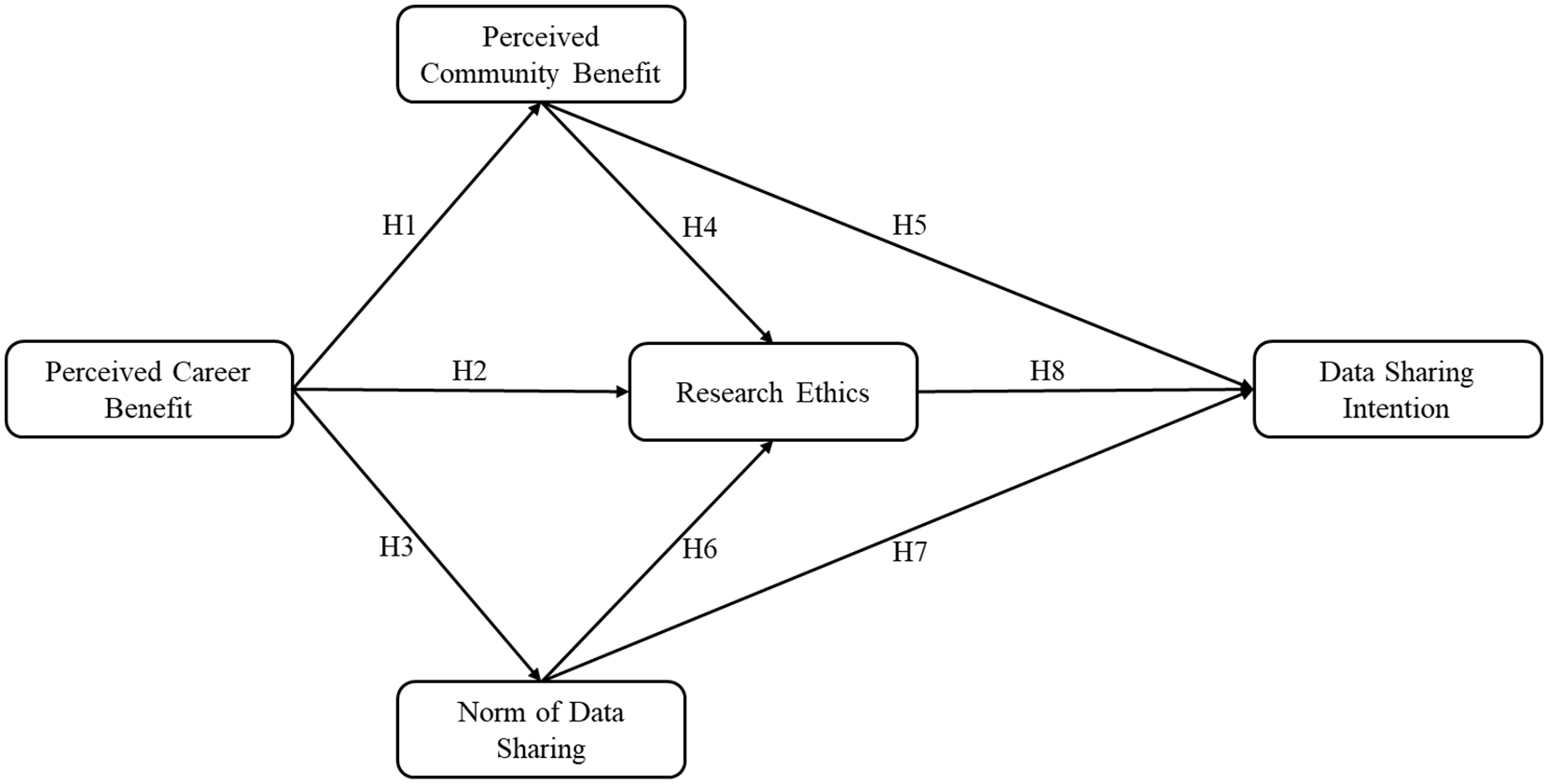
Research model of psychologists’ research ethics and data sharing.
Hypotheses development
Perceived career benefit
This research assumes that perceived career benefit of data sharing can positively influence perceived community benefit, research ethics for data sharing, and the norm of data sharing. Perceived career benefit is defined as the extent to which a psychologist believes that data sharing can provide academic rewards such as publications, citations, and acknowledgment (Kim and Stanton, 2016). First, prior studies found that an individual’s perception about the reward mechanism (i.e. perceived career benefit) can increase his or her belief about the value of performing the behavior to the overall community (Lin and Huang, 2013; Liou et al., 2016). In such a circumstance, psychologists who perceive more career benefits in data sharing are likely to consider that data sharing can also assist their academic research community. Second, in prior studies, perceived career benefit acknowledged that academic rewards (Kling and Spector, 2003), institutional recognition (Kankanhalli et al., 2005), and academic reputation (Kim and Stanton, 2016) all influence scientists’ data sharing behaviors. In this research, according to the theoretical framework above, perceived career benefit was assumed to influence psychologists’ data sharing intentions as mediated by their research ethics for data sharing (Victor and Cullen, 1988). Third, prior studies in knowledge sharing found that expected personal benefit associated with knowledge sharing can increase the subjective norm of knowledge sharing (Bock et al., 2005; Trumbo and O’Keefe, 2005). In this research, psychologists who perceive more career benefits in data sharing would have stronger normative pressure in conducting data sharing behaviors. Therefore, this research hypothesizes as follows:
H1: Perceived career benefit would positively affect a psychologist’s perceived community benefit.
H2: Perceived career benefit would positively affect a psychologist’s perceived research ethics for data sharing.
H3: Perceived career benefit would positively affect a psychologist’s norm of data sharing.
Perceived community benefit
This research assumes that perceived community benefit can positively influence both a psychologist’s research ethics and their data sharing intention. Perceived community benefit is defined as the extent to which a psychologist believes that data sharing can help other individual psychologists and eventually help the discipline of psychology as a whole. Since scientific communities rely on other scientists’ findings and supporting materials to advance the research community, psychologists may consider the community benefit of data sharing. According to the consequentialism theory of ethics, perceived community benefit as the utilitarianism component of ethics would contribute to psychologists’ research ethics for data sharing (Reidenbach and Robin, 1990; Victor and Cullen, 1988). Prior studies of knowledge sharing report that people’s perceptions about community benefit by sharing their knowledge can significantly affect their knowledge sharing behaviors (Chiu et al., 2006; Posey et al., 2010). Therefore, this research hypothesizes as follows:
H4: Perceived community benefit would positively affect a psychologist’s research ethics for data sharing.
H5: Perceived community benefit would positively affect a psychologist’s data sharing intention.
Norm of data sharing
This research also assumes that the norm of data sharing can positively influence a psychologist’s research ethics and their data sharing intentions. In a research community, scientists may have developed collective expectations about data sharing, which can be called the norm of data sharing. Similar education and research practices in a discipline can allow scientists to develop a similar norm about data sharing (Kim and Stanton, 2012; Scott, 2007). According to the consequentialism theory of ethics, norm of data sharing as the deontology component of ethics would affect psychologists’ research ethics for data sharing (Reidenbach and Robin, 1988; Victor and Cullen, 1988). Also, since a certain norm in a community is influenced by the accepted expectations by the people in the community, the expectation by other psychologists about data sharing influences their data sharing intentions. Prior studies of data sharing already found that the norm of data sharing significantly affects scientists’ data sharing intentions and actual behaviors (Kim and Nah, 2018; Kim and Stanton, 2016). Therefore, this research hypothesizes as follows:
H6: Norm of data sharing would positively affect a psychologist’s research ethics for data sharing.
H7: Norm of data sharing would positively affect a psychologist’s data sharing intention.
Research ethics
Finally, this research considered research ethics for data sharing as the central mechanism strongly affecting psychologists’ data sharing intentions. Research ethics for data sharing is defined as the extent to which a psychologist considers data sharing as a moral obligation as a researcher (Victor and Cullen, 1988). Based on the consequentialism theory of ethics, this research assumed that three ethical components, including perceived career benefit (egoism), perceived community benefit (utilitarianism), and norm of data sharing (deontology), all contribute to psychologists’ formations of research ethics for data sharing, and then the research ethics for data sharing influence psychologists’ data sharing intentions (Bass et al., 1999; Victor and Cullen, 1988). In the context of scientific data sharing, prior studies point out that scientists’ research ethics for data sharing can play an important role in their data sharing behaviors (Duke and Porter, 2013; Langat et al., 2011; Reidpath and Allotey, 2001). Therefore, this research hypothesizes as follows:
H8: Research ethics for data sharing would positively affect a psychologist’s data sharing intention.
Data sharing intention
Data sharing intention refers to a psychologist’s behavioral plan for whether s/he is going to upload their data of the published articles into a data repository and allow other researchers to freely use the data for another research purpose. This research examined the construct of data sharing intention as the proxy of actual data sharing behavior due to both methodological and theoretical reasons. In terms of theoretical reason, according to the theory of planned behavior, a person’s actual behavior is closely linked to his or her behavioral intention, which is explained by individual motivations such as their attitude about the behavior, the subjective norm, and behavioral control factors (Ajzen, 1991). Recent studies have found that attitude, norm, and behavioral control factors all predict behavioral intention, which eventually leads to performing the actual behavior (Jeon et al., 2011; Kuo and Young, 2008). Also, in terms of methodological reasoning, data sharing is not yet a well-established practice in the community of psychology, so measuring actual data sharing behaviors may cause a bias in evaluating the relationships between actual data sharing behaviors and other constructs. Therefore, this research measured data sharing intention as the proxy of actual data sharing behavior.
Research methods
This study utilized an online survey as the main data collection method. The survey questionnaire was designed to measure the research constructs and evaluate the hypothesized relationships among the constructs. In this section, the data collection method was described to include the study’s target population and sampling, measurement, online survey procedure, and demographics of respondents.
Target population and sampling
The target population of this research is psychology researchers who belong to US academic institutions. This research used the Pivot scholar database as the sampling frame. The survey participants include faculty members, postdoctoral researchers, and graduate student researchers in psychology. There were a total of 42,016 psychology researchers in US academic institutions registered in the Pivot scholar database (as of 31 October 2016). This study used structural equation modeling approach for its data analysis method, and a minimum of 200 responses are required to appropriately evaluate psychologists’ data sharing model (Chin, 1998; Fornell and Larcker, 1981). A total of 3000 scholars were randomly selected for the research sample based on the sampling frame in this study, aiming to receive a 10% of response rate; 81 people were excluded from the actual survey distribution because they did not have valid email addresses. Therefore, a total of 2919 potential survey participants were identified as the sampling for this study.
Measurement of constructs
The majority of measurement items were adapted from prior data sharing studies including perceived career benefit, norm of data sharing, and data sharing intention (Kim and Nah, 2018; Kim and Stanton, 2016) and a few survey items for perceived community benefit and research ethics for data sharing were newly developed based on the prior studies (Hernandez et al., 2011; Lee et al., 2014; Victor and Cullen, 1988). These measurement items are slightly modified for the context of psychology researchers and their data sharing practices. A total of 14 measurement items for 5 research constructs were modified based on the context of psychologists’ data sharing practices. All the survey items were measured using a 5-point Likert-type scale, in which the respondents are supposed to indicate their agreement on each statement ranging from 1 (strongly disagree) to 5 (strongly agree). Appendix 1 presents the measurement items for each construct and related studies.
Data collection procedure and result
The survey questionnaire was created based on the measurements of research constructs. The initial message with the online survey link was distributed to the potential survey participants in early November 2016, and three reminders were sent in mid-November, mid-December 2016, and late January 2017, respectively. The survey was closed on 15 February 2017. Throughout the email campaigns, 337 emails were returned because of spam filters and invalid email address, and 2582 emails were actually delivered to the potential survey participants. The data collection procedure led to a total of 557 initial responses, and among the 557 initial responses, 160 responses were excluded since more than 10% of survey responses were missing and/or those did not provide their answers about their data sharing intentions. A total of 397 valid survey responses were received, and this represented a 15.38% (= 397/2582) response rate. Since this research only focused on psychology researchers, those who were non-psychologists (35 survey participants) were excluded for the final data analysis. Therefore, a total of 362 responses from psychologists were used for the final data analysis in this particular study.
Demographics of the respondents
The survey participants provided demographic information including their gender, age, position, tenure status, and their specific discipline in psychology. In terms of gender, survey respondents are almost equally distributed by male (171, 47.2%) and female (181, 50.0%). The majority of the participants are in the age groups between 35 and 44 (124, 34.3%) and 45 and 54 years (87, 24.0%). With regard to position, the majority of survey participants have different levels of professorship, including Assistant Professor (80, 22.1%), Associate Professor (119, 32.9%), and Full Professor (143, 39.5%). In terms of tenure status, about two-thirds of survey participants received their tenure (261, 72.1%), and 73 respondents are currently on tenure track (20.2%). Table 1 presents the demographic information of the survey participants.
Demographic information of survey participants.

Data analysis and results
In terms of the primary data analysis technique, a structural equation modeling (SEM) was employed to assess the research model and the hypothesized relationships among the research constructs. This research used the variance-based partial least square (PLS) method since PLS-SEM is suitable for an exploratory analysis (Chin, 1998) for a few reasons: the PLS-SEM can be performed without meeting the normality assumption (Hair et al., 2006) and with a small sample size (Chin, 1998; Fornell and Bookstein, 1982). This research used SmartPLS 2.0 to assess the eight hypotheses based on the online survey data (Ringle et al., 2005). This research employed a two-stage approach suggested by Hair and colleagues (Hair et al., 2006): a measurement model was evaluated to warrant the reliability and validity of the measurement items, and then a structural model was assessed to validate the proposed research model of psychologists’ data sharing intentions and the hypothesized relationships among the research constructs.
Measurement model
The measurement model was evaluated in terms of reliability and validity of research constructs. Cronbach’s alpha and CR (composite reliability) values were employed to assess the reliability of the measurement items for each construct. Cronbach’s alpha and CR values range from 0.79 (norm of data sharing) to 0.96 (data sharing intention), and from 0.88 (norm of data sharing) to 0.97 (data sharing intention), respectively, which exceeds the recommended value of 0.70 for satisfactory reliability of research constructs (Chin, 1998; Nunnally and Bernstein, 1994). With regard to construct validity, both CR and AVE (average variance extracted) were utilized to warrant convergent validity for each construct. All the CR values are within the acceptable value of 0.70 (Chin, 1998; Nunnally and Bernstein, 1994), and the AVE values range from 0.70 (norm of data sharing) to 0.92 (data sharing intention), which are greater than the acceptable value of 0.50 for satisfactory validity (Fornell and Larcker, 1981; Hair et al., 2006). Table 2 shows the reliability and validity values, including Cronbach’s alpha, CR, and AVE.
Cronbach’s alpha, CR, and AVE values.

CR: composite reliability; AVE: average variance extracted.
In addition, this research ensured the discriminant validity of research constructs by assessing the square roots of the AVEs with the inter-construct correlation matrix. The square roots of AVEs for each construct (the bold-face diagonal entries in Table 3) are greater than the inter-construct correlations (the off-diagonal entries in Table 3), which indicates the satisfactory discriminant validity. Table 3 shows the square roots of AVEs and the inter-construct correlation matrix.
Correlation matrix and square roots of AVEs.

Bold values indicate the square roots of AVEs for each construct.
The convergent and discriminant validity of the measurement items were also ensured by conducting the principal component factor analysis with Varimax rotation using SPSS 24. All the measurement items are loaded on each designated construct with factor loading value of 0.744 or more, which are greater than the acceptable value of 0.60 for convergent validity, and each measurement items are loaded on non-designated constructs (i.e. cross loading) with factor loading value of 0.319 or less, which are lower than the recommended value of 0.40 for discriminant validity (Field, 2009; Hair et al., 2006). The factor analysis result shows the satisfactory convergent and discriminant validity.
Structural model
The assessment of the measurement model ensured the reliability and validity of each construct used in the research model, and it warranted the evaluation of the structural model. The structural model of psychologists’ data sharing was assessed using PLS-based SEM. Perceived career benefit was found to have significant positive influences on perceived community benefit (β = 0.508, p < 0.001), research ethics (β = 0.135, p < 0.01), and norm of data sharing (β = 0.423, p < 0.001). Perceived career benefit itself accounts for 25.8% of the total variance in perceived community benefit (R2 = 0.258) and 17.9% of the total variance in norm of data sharing (R2 = 0.179). Along with perceived career benefit, perceived community benefit (β = 0.325, p < 0.001) and norm of data sharing (β = 0.327, p < 0.001) were also found to have significant positive influences on psychologists’ research ethics. All these factors explained 38.9% of the total variance in research ethics. Finally, scientists’ data sharing intentions were significantly influenced by perceived community benefit (β = 0.241, p < 0.001), research ethics (β = 0.265, p < 0.001), and norm of data sharing (β = 0.318, p < 0.001). All these three factors including perceived community benefit, research ethics, and norm of data sharing account for 43.4% of psychologists’ data sharing intentions (R2 = 0.434); see Figure 2.
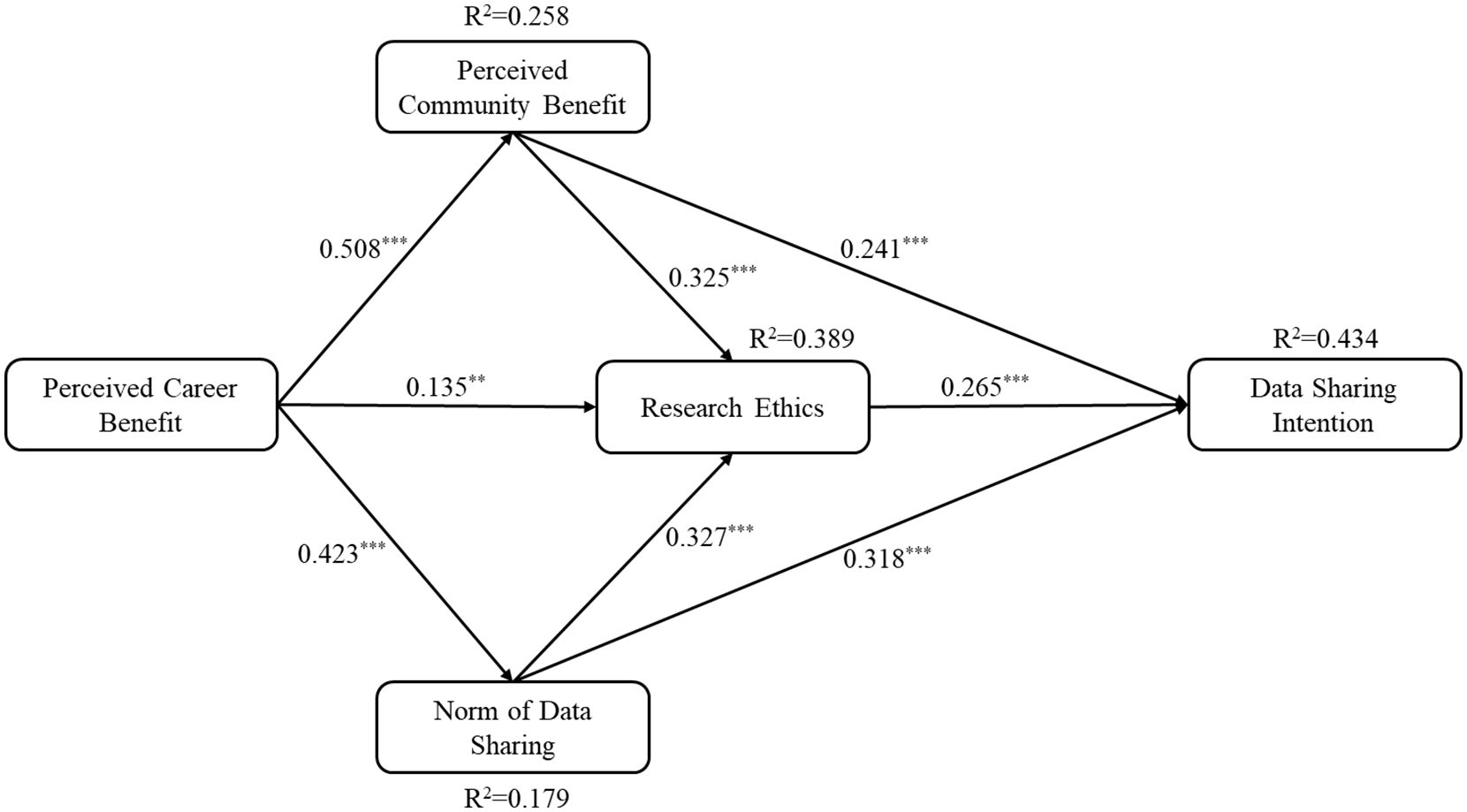
Hypothesis testing results.
Discussion
The main objective of this study was to investigate the factors affecting psychologists’ research ethics for data sharing, and to examine the link between their research ethics and their data sharing decision making. The findings of this study demonstrated that psychologists’ research ethics for data sharing are significantly influenced by three ethical components, including perceived career benefit (egoism), perceived community benefit (utilitarianism), and their norm of data sharing (deontology). Particularly, this research found that perceived career benefit influences research ethics for data sharing directly and indirectly as mediated by perceived community benefit and their perceived norm of data sharing. This research also revealed a strong relationship between psychologists’ research ethics for data sharing and their data sharing intentions. In addition, this research found that both perceived community benefit and norm of data sharing significantly influence psychologists’ data sharing intentions as well.
Egoism dimension of ethics
With regard to egoism dimension of ethics, this research found that psychologists’ perceived career benefit significantly increases their perceived community benefit (utilitarianism), norm of data sharing (deontology), as well as their research ethics for data sharing. These results suggest that psychologists who recognize more career benefits toward data sharing are likely to perceive the behavior as providing greater community benefit, higher levels of normative pressure, and favorable research ethics toward data sharing. In contrast, the results also suggest that psychologists who observe less career benefits in data sharing are less likely to perceive data sharing as providing community benefit, lower levels of normative pressure, and unfavorable research ethics toward data sharing. The results show that the ethical egoism through career benefit in data sharing can not only increase psychologists’ research ethics directly, but also affect the research ethics indirectly through increasing other ethical dimensions such as utilitarianism (perceived community benefit) and deontology (norm of data sharing). Therefore, in order to increase psychologists’ research ethics toward data sharing, it is critical to have a reliable and trustworthy reward/reputation mechanism of data sharing, which can stimulate psychologists’ egoism aspect of research ethics for data sharing.
Utilitarianism dimension of ethics
With regard to the utilitarianism dimension of ethics, this research showed that perceived community benefit significantly influences both psychologists’ research ethics for data sharing and data sharing intentions simultaneously. This result suggests that psychologists who are aware of more community benefits in data sharing are more likely to develop stronger research ethics toward data sharing, and they are more willing to share their data with other researchers. This result demonstrated that the ethical utilitarianism through community benefit in data sharing can affect both psychologists’ data sharing intentions directly, and indirectly increase their research ethics for data sharing, which eventually leads to their data sharing intentions. Therefore, in order to facilitate psychologists’ data sharing, the research community of psychologists needs to emphasize the utilitarianism aspects of data sharing (i.e. community benefits involved in data sharing). This will not only affect psychologists’ research ethics for data sharing, but it will also affect their data sharing intentions directly.
Deontology dimension of ethics
With regard to the deontology dimension of ethics, this research found that the norm of data sharing significantly affects psychologists’ research ethics toward data sharing and their data sharing intentions simultaneously. This finding suggests that psychologists who perceive more favorable subjective norms in data sharing are more likely to have robust research ethics toward data sharing, and subsequently are more willing to share their data with other researchers. This result also confirmed that the ethical deontology through the norm of data sharing can not only influence psychologists’ data sharing intentions directly but also indirectly as mediated by their research ethics for data sharing. Therefore, in order to expedite an increase in psychologists’ data sharing intentions, it is important to build more favorable normative pressures in the community of psychology. A reasonable way to ensure that these favorable attitudes are instilled is to have workshops and implement educational programs to promote data sharing as a means of career and community benefit regarding the norm of data sharing. In addition, journals and funding agencies in the fields of psychology can require their authors and grant awardees to share research data upon request or in repositories for already published manuscripts, which will provide more normative pressures on psychologists to engage in data sharing behaviors.
In sum, this research demonstrated that psychologists’ research ethics toward data sharing are significantly affected by three ethical components: perceived career benefit (egoism), perceived community benefit (utilitarianism), and norm of data sharing (deontology). This finding suggests that psychologists who recognize greater career benefit, community benefit, and favorable norms of data sharing are likely to build stronger research ethics toward data sharing, which eventually influence their data sharing intentions. This research also found that in addition to their personal research ethics for data sharing, psychologists’ data sharing intentions are also significantly affected by their perceived community benefit and the norm of data sharing. This finding suggests that psychologists who have stronger research ethics toward data sharing, recognize more community benefit, and see favorable normative pressure to engage in data sharing are more likely to have strong data sharing intentions.
Theoretical implications
This research employed the consequentialism theory of ethics (Victor and Cullen, 1988) for understanding psychologists’ data sharing on decision making, and the results of this research provide several theoretical implications. First, this research demonstrated that the consequentialism theory of ethics nicely explicates how psychologists’ research ethics for or toward data sharing are formed, and how those research ethics paired with perceived community benefit and the norm of data sharing affect psychologists’ data sharing intentions. Especially, this research confirmed that the three dimensions of ethics, which include egoism (i.e. perceived career benefit), utilitarianism (i.e. perceived community benefit), and deontology (i.e. norm of data sharing), all contribute to psychologists’ research ethics toward data sharing. Second, this research suggests that research ethics can play a critical role in researchers’ data sharing behaviors. Prior studies did not focus on the role of research ethics for data sharing; however, this study shows that research ethics is an important antecedent of psychologists’ data sharing intentions. Psychologists’ ethics for data sharing functions as a central mechanism to make their data sharing decisions. Third, this research verified that the egoism component (i.e. perceived career benefit) of research ethics can stimulate other ethical components including utilitarianism and deontology factors in addition to psychologists’ research ethics for data sharing. This research shows that perceived career benefit as egoism not only influences psychologists’ research ethics for data sharing directly, but it also affects research ethics indirectly by increasing psychologists’ perceived community benefit (utilitarianism) and norm of data sharing (deontology). Finally, this research revealed that utilitarianism and deontology components of ethics have direct relationships with ethical decision making. This research shows that perceived community benefit (utilitarianism) and norm of data sharing (deontology) directly affect psychologists’ data sharing intentions; it also has an indirect affect as mediated by research ethics toward data sharing. In conclusion, the findings of this research confirmed the existing theoretical framework of consequentialism theory of ethics, and it also suggests new relationships among the components of ethics formation and ethical decision making.
Practical implications
This research provides practical implications for research communities and academic institutions in that they can better promote researchers’ data sharing behaviors by encouraging the education of research ethics with regard to data sharing and reuse. Research communities and academic institutions can serve researchers by not only providing data services and data repositories, but also educating researchers about research ethics related to data sharing and reuse. This study suggests that research ethics toward data sharing can play a crucial role in researchers’ data sharing decision making. It is important to help researchers have veracious research ethics toward data sharing, which can lead to their data sharing behaviors. In order to help researchers as well as psychologists form reliable research ethics regarding data sharing, it is necessary to encourage the three ethical components of egoism, utilitarianism, and deontology of ethics. These three ethical components can be stimulated by emphasizing the career and community benefits associated with data sharing, as well as increasing favorable norms of data sharing, which will increase an individual’s research ethics toward data sharing. Research communities and academic institutions need to develop appropriate incentive mechanisms such as a data citation and acknowledgment for those who share their data with other researchers. Also, they need to highlight the advantages of data sharing to other researchers and to their research communities. Scientists can better develop their research ethics toward data sharing through understanding the personal benefit (egoism aspect) and community benefit (utilitarianism aspect) of data sharing. Finally, they need to promote data sharing actively, so more researchers are aware of data sharing in their research communities. Research communities and academic institutions can consider to organize workshops on the topic of scientific data sharing and develop more explicit guidelines for data sharing. These activities will increase favorable normative pressures about data sharing, which will subsequently increase research ethics toward data sharing, and eventually affect the actual data sharing behaviors of researchers.
Conclusion
This study investigated how psychologists’ research ethics toward data sharing are formed by the three ethical dimensions of egoism, utilitarianism, and deontology, and how the research ethics toward data sharing lead to psychologists’ behavioral intentions to engage in data sharing. This research found that perceived career benefit, perceived community benefit, and the norm of data sharing all significantly influence psychologists’ research ethics; these research ethics, along with perceived community benefit and the norm of data sharing, significantly influence psychologists’ data sharing intentions. This study employed the consequentialism theory of ethics in understanding psychologists’ data sharing decision making, and the results of this research confirmed that the three dimensions of ethics, egoism (perceived career benefit), utilitarianism (perceived community benefit), and deontology (norm of data sharing) all contribute to the formation of psychologists’ research ethics, which lead to their data sharing intentions. This study suggests that researchers’ data sharing intentions are closely connected to their research ethics toward data sharing, and scientific communities can better encourage researchers’ data sharing behaviors by stimulating research ethics and the three ethical dimensions of egoism, utilitarianism, and deontology. This means that research communities and academic institutions can educate their researchers about data sharing and reuse by emphasizing that it is important in the perspective of research ethics, which is based on researchers’ recognitions of community benefits, norms, as well as career benefits. The findings of this study can be applied to promote scientific data sharing as mediated by research ethics, and eventually advance data-intensive scientific research.
Limitations and future research
Although this study tried to minimize the limitations, there are still a few theoretical and methodological limitations. First, the measurement items used in this study are limited to cover research ethics for data sharing and different ethical dimensions. This study included the research constructs which cover three ethical dimensions, including egoism, utilitarianism, and deontology, based on prior studies; however, these measurement items need to be extended to address more delicate aspects of each ethical dimension. Also, this research measured the research ethics for data sharing by using two items (see Appendix 1), which may not be enough to measure the construct of research ethics. Future studies need to develop more extensive measurement items to cover research ethics for data sharing, as well as for the three ethical dimensions of data sharing. Second, the sampling strategy employed in this research has its limitations as well. The online survey planned to recruit psychologists only; however, the sampling strategy does not work well because of the inaccuracy of researchers’ disciplines registered in the Pivot scholar database. This discrepancy caused to remove a significant number of non-psychologists who completed the online survey. Third, this research used the general measurement items which were developed and tested in diverse disciplines and applied them to the discipline of psychology. Although the findings of this research can be potentially generalized to other disciplines, the results may differ if this survey was conducted with researchers from other disciplines than psychology, because this research newly employed the construct of “research ethics” to understand psychologists’ data sharing based on different ethical dimensions. Future studies can consider recruiting more researchers from diverse disciplines in order to empirically validate the research model with researchers from many different disciplines for generalization and/or to conduct a comparative analysis among various disciplines.
Research Data
sj-docx-1-lis-10.1177_09610006211008967 – An empirical study of research ethics and their role in psychologists’ data sharing intentions using consequentialism theory of ethics
sj-docx-1-lis-10.1177_09610006211008967 for An empirical study of research ethics and their role in psychologists’ data sharing intentions using consequentialism theory of ethics by Youngseek Kim in Journal of Librarianship and Information Science
Footnotes
Appendix
Measurement items for research constructs.

| Construct | Items | Sources |
|---|---|---|
| Perceived career benefit | • I can earn academic credit such as more citations by sharing this data. • Sharing this data would enhance my academic recognition. • Sharing this data would improve my status in a research community. |
(Bock et al., 2005; Wasko and Faraj, 2000; Kim and Stanton, 2016) |
| Perceived community benefit | Sharing this data would help the scientific community in the following ways: • Accumulate or enrich scientific knowledge • Increase research productivity • Improve research processes. |
(Lee et al., 2014; Hernandez et al., 2011) |
| Norm of data sharing | • It is expected that researchers would share this data. • Researchers care a great deal about sharing this data. • Many researchers are currently participating in sharing this data. |
(Ajzen and Fishbein, 2005; Kostova and Roth, 2002; Kim and Stanton, 2016) |
| Research ethics | Sharing this data is: • An ethical obligation as a researcher. • At the heart of who we are as researchers. |
(Victor and Cullen, 1988) |
| Data sharing intention | • I am likely to share this data with other researchers. • I intend to share this data with other researchers. • I will try to share this data with other researchers. |
(Ajzen and Fishbein, 2005; Tohidinia and Mosakhani, 2010; Kim and Nah, 2018) |
Acknowledgements
The author acknowledges the ProQuest Pivot for allowing the use of its Community of Scientists (CoS) Scholar Database in recruiting the survey participants.
Author note

Declaration of Conflicting Interests
The author(s) declared no potential conflicts of interest with respect to the research, authorship, and/or publication of this article.
Funding
The author(s) received no financial support for the research, authorship, and/or publication of this article.
Author biography
References
Supplementary Material
Please find the following supplemental material available below.
For Open Access articles published under a Creative Commons License, all supplemental material carries the same license as the article it is associated with.
For non-Open Access articles published, all supplemental material carries a non-exclusive license, and permission requests for re-use of supplemental material or any part of supplemental material shall be sent directly to the copyright owner as specified in the copyright notice associated with the article.
