







Abstract
A substantial part of the work conducted by librarians at Swedish regional libraries concerns staying alert and informed in ways that allow for continuous development of the kind of knowledge and abilities that are required for doing a qualified job, but this part of the work is elusive and hard to identify. This paper presents an empirical study that elucidates this specific kind of work of keeping abreast and updated with professional information. Empirical data were produced through interviews and logbooks with 10 members of staff at 4 regional libraries in Sweden. The data were analysed by employing Marcia Bates’ model of different information-seeking modes. The results of the study show that the activity in focus is seamlessly intertwined with other work activities and enacted in a variety of ways that are adapted after other work tasks (than the information seeking in itself) and dependent on individual preferences and routines. Since there is a certain conception of this activity as something that should be carried out in a certain systematic way and since it is something that one as a librarian ought to be good at, it is furthermore often associated with a normative dimension that provokes a sense of guilt among the study participants.
Introduction
The function of regional libraries is well established in the Scandinavian countries. The public library systems of Sweden, Norway, Denmark, and Finland all include the administrative level of regional libraries even though the number of regions, and thus libraries, vary. The general approach in Scandinavia enjoins two major responsibilities for the libraries on this level. In addition to the provision of ‘books and other library materials that are not within what is generally expected that the individual public libraries purchase’ (The Danish Agency for Culture and Palaces, 2020), the regional libraries are expected to offer competence development schemes, consultation to the municipal public libraries, and coordination of public library activities in their regions. The Finnish library act concludes that the ‘regional development responsibility refers to a duty assigned to a given public library to support the rest of the public libraries within its area of operation in their endeavours to improve their activities’ (Ministry of Education and Culture, Finland, 2016). The Norwegian library act describes the county council’s library duties as ‘including providing advice to local authorities, providing library-related guidance and assistance and arranging meetings and courses on library issues’ (Ministry of Culture, Norway, 2014). Also in Sweden, which is the concern of this article, the activities of the regional libraries are legislated.
The work conducted in Swedish regional libraries tends to differ from that in municipal public libraries. As in the other parts of Scandinavia, the work revolves around consultation, development and coordination of local public library activities, which requires the staff to emphasize the task of keeping up to date with what is going on in the library sector at large. That these libraries are without traditional media collections and not open to the public is also likely to shape the work going on in them.
A recent study (Pilerot, 2019) of the work conducted by the staff at Swedish regional libraries establishes that a substantial part of the work is about keeping up to date with what is going on in the surrounding world, both near and afar. On an overarching level, this part of the work concerns staying alert and informed in ways that allow for continuous development of the kind of knowledge and abilities that are required for doing a qualified job. Keeping up to date and staying informed in regional library work is this far an unexplored area (Pilerot, 2019).
There are no formal professional competence frameworks in Sweden, which provide guidance on the professional knowledge and skills required by librarians. The Swedish Library Association, for example, regularly issues various reports on topical subjects of relevance for professional librarians, but the general idea is that this knowledge is supposed to be developed in connection to the degree programmes in library and information science (LIS) that are offered at universities in Sweden. Universities with LIS study programmes offer short continuation courses, which cover a range of topics, but the responsibility for maintaining expertise and professional knowledge and staying updated with the developments in the library field resides in the individual professionals and their respective workplaces (cf. Varlejs et al., 2016: 8).
The aim of this article is to discuss and deepen the knowledge about regional librarians’ work with staying informed and professionally updated with information. The study addresses the following two research questions:
How do the study participants keep abreast and stay updated with professional information?
What are the areas they consider relevant to their professional duties?
The insights gained through a study like the one presented in this article should be of interest also to other categories of professionals, in other workplaces, since professionals’ abilities to follow, search for, interpret and benefit from information in order to sustain work practices is an area that generally is assigned increasing importance (see, for example, Forster, 2017).
The study builds upon empirical data, which was created through interviews with, and logbook entries produced by, people who work in regional libraries. The remainder of the article is structured accordingly: the following section presents an explanation of the Swedish library sector focusing on regional libraries. This is followed by a review of relevant literature. Then, the theoretical frame made use of for analysing the empirical data is introduced. Thereafter follows an account for how the study was conducted, that is, a method section. Then the results of the analysis are presented, which is followed by a discussion. The article is finally wrapped up by a brief conclusion section, which includes suggestions for further research and practical actions.
Regional libraries in Sweden
The Swedish public library sector contains three interconnected organizational levels laid down by the Swedish Library Act (Bibliotekslag, 2013). In each municipality, the local authority is required to run a public library or to ensure that someone runs it. In round figures there are about 1100 public libraries in Sweden, ranging from large city libraries to small rural branches. The National library is both a library with substantial collections and services and the government agency responsible for library matters in Sweden. From an organizational perspective, the regional libraries are placed on a mid-level, between public municipality libraries and the National library. Sweden is divided into 21 counties of which each has its regional council. Among the duties of these councils is to run regional library activities. There are thus 21 regional libraries in Sweden. According to the Library act (Bibliotekslag, 2013) their purpose is to promote collaboration, development activities and quality at the public municipality libraries in the respective region. The regional library staff predominantly consist of trained librarians. The size of the staff depends on the size of the region, but it is generally small groups of staff with around 10 people in the biggest regions. As already mentioned, the work they do is oriented towards development of the services offered by the region’s public libraries. In a general sense, the staff acts as consultants to which the public libraries can turn in order to get advice and expert help in a range of library-related areas. A specifically important function is to organize further education for public libraries. This happens in various ways, e.g. through seminars, lectures and library visits. It is also common that regional libraries engage researchers for commissioned work where various public library issues are explored and investigated through small-scale projects. Reports from these projects are often made publicly available through publication series run by the regional library. In sum, it can be concluded that this specific type of library work, which indeed requires a lot of current awareness, is especially rewarding to study concerning the task of keeping updated with information.
Literature review
The topic of this study is not particularly visible in previous research. This is probably due to the somewhat diffuse character of the activity of keeping abreast and staying updated. It could be conceptualized as a form of information use (e.g. Pilerot and Lindberg, 2018), but it also contains a clear feature of information seeking (e.g. Bates, 1989). Studies that concentrate on the information practices of librarians are thus far scarce even though there are exceptions in the form of a few studies on academic librarians (e.g. Lindberg, 2015; Nel, 2020). How librarians’ knowledge and competencies are developed, shaped and maintained in the workplace, is not clear (e.g. Research Libraries UK, 2012; Swedish Library Association, 2009). As stated by Varlejs (1999): ‘The broader question of how the profession at large copes with day-to-day learning needs within the context of the work environment generally is not asked’ (p. 174). In particular, this seems to be the case in the research on public librarians and certainly even more so concerning the specific target group of this study, librarians in regional libraries. However, this area of research can also be framed in wider themes such as continuous professional development (CPD) or self-directed, work-related learning (SDL), which are more visible in the research literature. A recent bibliometric study on the research productivity concerning CPD of librarians nevertheless concludes that ‘research pertaining to CPD of librarians is dominant in academic libraries’ (Shone, 2020: 8) and that, therefore, future research should concentrate on public and school libraries. Some insights into the work of public librarians’ self-directed learning is provided by Varlejs (1999) who surveyed 521 members of the American Library Association of which 34% were employed by public libraries. She concludes that over three-fourths of the study participants engage in SDL ‘and that they spend much more time learning on their own than they do in formal’ (p. 192) continuing education.
Being a local phenomenon, Swedish regional library activities have not been extensively researched. Apart from Pilerot (2019), the few previous studies that exist are not dealing with work practices but primarily with organizational and political aspects. In a report by The Swedish Agency for Cultural Policy Analysis (2018), it is asserted that the work that these libraries do has changed over the years from being of an operational character, where, for example, additional media supply used to be an important task, to a more strategic one where expertise and consultancy are in focus. In another report issued by the Swedish Association of Local Authorities and Regions (2019), it is highlighted that the activities and the ways in which the work is organized in the respective regional library tend to differ somewhat from each other depending on regional population density and geographical constitution. These differences are however sanctioned in legislation and steering documents since it is assumed that the libraries should adapt their services and work in accordance with local demand and context. In extension, this means that the staff at a regional library has a great deal of freedom concerning how they chose to plan and conduct the work.
That it is difficult to exactly delimit what the activity of keeping abreast and staying updated is about is also reflected in the terminology used for referring to the kind of activities that come to mind when discussing these matters. When consulting the literature in this area, it becomes clear that several terms circulate concerning the description of what professionals do in order to keeping up to date, staying informed and equipped with current and relevant knowledge required for doing a qualified job. ‘External monitoring’, which is a term that, for example, seems to be generally employed in documents issued by the European Union, implies that it concerns a continuous watching of something outside of one’s own workplace. The related and more established term ‘environmental scanning’ (e.g. Choo, 2001; Sobel, 2020) signals an activity that is slightly less controlled and not necessarily so continuous; it rather seems to concern some sort of guarding of the local environment. In another article, environmental scanning is said to focus ‘on the identification of emerging issues, situations, and potential pitfalls that may affect an organization’s future’ (Albright, 2004: 40). The common denominator for the activities that these two terms aim for seem to be that the people who are staying informed and updated are turning their gazes outwards, beyond the workplace or organization in which they are working. In this sense, these two terms differ from two other terms that frequently occur when probing the literature. ‘Knowledge sharing’ and ‘organizational learning’ are rather pointing inwards, towards the own organization or workplace. The common denominator here is that the emphasis is on the activity of staying up-to-date as something that concerns knowledge sharing, learning together and securing the knowledge that exists among the colleagues in the workplace. Kaffashan Kakhki et al. (2020) state that ‘[n]o organization can survive without knowledge’ and describe ‘[k]nowledge sharing [as] the process of gaining experience from others’ (p. 19). This is similar in tone to expressions concerning organizational learning, which can be explained as the kind of learning that goes on in ‘an organization where it is the norm for employees to be continually learning how to work together collaboratively for constant improvement’ (Sinclair, 2017: 684). We are thus dealing with an activity that, according to the terminology in the reviewed literature, can be more or less systematic and continuous and that can be enacted both as outward and inward in relation to the workplace. Adding to this complexity, it also seems reasonable to conceptualize this activity as being more or less individual or collective. In order to illustrate these different dimensions of the activity of following and staying updated with information, the following model was developed (see Figure 1).
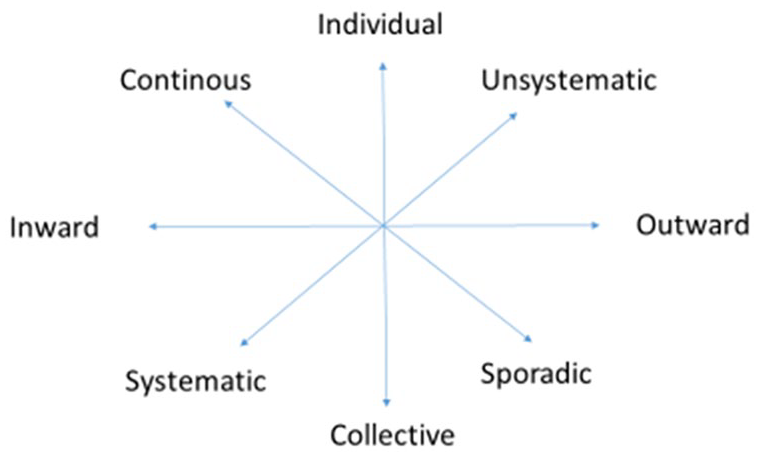
Possible dimensions of the activity of keeping abreast and staying updated with information.
The above model, which is grounded in the literature review, highlights the dynamic character of the study object, but it also functions as a reference point in the discussion of the results of this study (see Figure 3 towards the end of the article).
In this article, the general understanding of the activity of keeping abreast and staying updated is that it concerns something that a professional does on his or her own or together with others in order to follow the knowledge development within his or her own professional area. It springs to mind to describe and analyse this activity with support from theoretical concepts and research results from the area of library and information science often referred to as information behaviour or information practices. That is from where the prime analytical tool employed in this study comes. In order to analytically ponder and thereby deepen the understanding of the activity of keeping abreast and staying updated with information, this activity is conceptualized as a broad form of information seeking.
Theoretical frame and analytical tool
The main theoretical assumption on which the present study rests is that the activities in focus are reasonable to conceptualize as information practices (c.f. Pilerot et al., 2017). The notion of practice implies an understanding of the numerous actions comprising the seeking, using and sharing of information as an inseparable unit where the parts that make up the practice are more or less intertwined and embedded in other work practices. However, on an analytical level, there is need for a theoretical device that can make visible the different ways in which information is sought for and discovered. For this purpose, there is a plethora of models of information seeking ranging in focus from general (e.g. Wilson, 2021: 30ff.) to more specific contexts such as the academic workplace (e.g. Ellis, 1993), everyday life (Savolainen, 1995) and secondary education (Kuhlthau, 2004). There are also those that specifically concentrate on work-related contexts (e.g. Leckie et al., 1996). Nevertheless, in the present study, the major influence comes from a model developed by Marcia Bates (2002), which is deemed compatible with the overarching practice approach. It enables description and analysis of interactions with information as a fluid and dynamic practice, which has proven to resonate with the activities the participants in the study engage in. However, a specific feature from another model has also been found useful, namely the notion ‘by proxy’, which is picked up from McKenzie (2003) and introduced further on in this section.
Bates (2002) suggests that information seeking can be understood as a complex activity, which schematically and analytically comprises four different ‘modes’. The subsequent figure (Figure 2) serves as a lucid illustration of Bates’ reasoning around the four different ”modes of information seeking”, that is, the ways in which information is sought for.
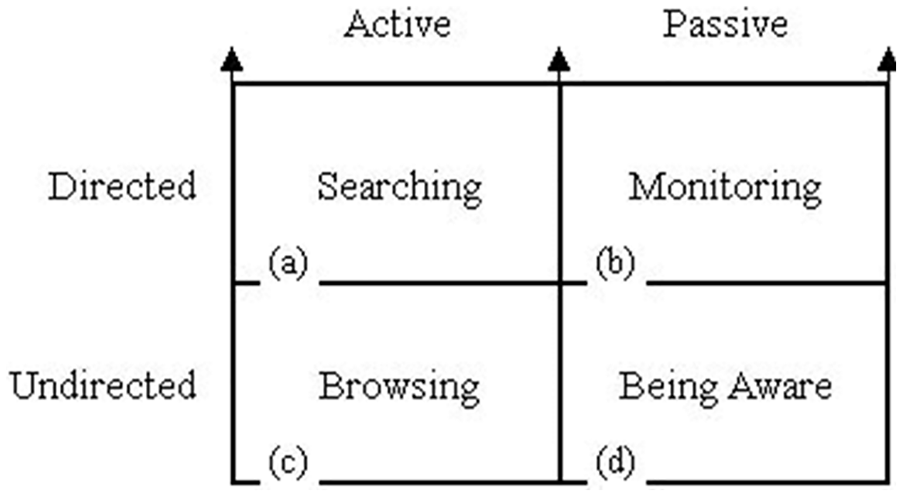
Information seeking modes, according to Bates (2002).
The following brief sections present the way in which Bates’ line of reasoning around how information seeking can unfold is understood in this article. The presentation constitutes the ground for the analysis of the empirical data.
Active-directed information seeking
On the one hand, information seeking can be seen as either active or passive and, on the other, as directed or undirected. That information seekers are active means that they take a certain conscious measure in order to find information. It can, for example, concern a triviality such as the seeker wanting to find a factual piece of information (when does the bus depart?, what is the capital of. . .?, who is in charge of. . .?) and therefore decides to conduct a Google search (or using another search tool that is deemed suitable). This is an example of active-directed information seeking.
Active-undirected information seeking
It is also possible to imagine examples of active but undirected information seeking. The example that is referred to in Figure 2 concerns the kind of information-seeking activity that has become known as browsing, which means that the person who is experiencing a need for information decides to actively search for it. However, in contrast to active-directed information seeking, the information seeker’s goal with the browsing is unclear. The person who seeks for information knows that he or she is after something, but not exactly what this something is. This is a case of the combination of active and undirected information seeking.
Passive-directed information seeking
Passively engaging in directed information seeking may seem peculiar at first sight. This mode of information seeking does actually demand a certain activity but, according to the way in which Bates’ work is interpreted here, it concerns an initial, limited activity that soon turns into passivity. The example referred to in Figure 2 concerns monitoring a certain flow of information, for example a newsletter. The active engagement required is to sign up for the newsletter. According to Bates’ line of reasoning, the seeker can thereafter passively monitor or follow the newsletter, which from that point does not require any active information seeking. It will rather be a case of the letter regularly appearing in the e-mail inbox. Other examples of this passive-directed information-seeking mode could be to follow a certain hashtag on Twitter, to once and for all create a RSS-feed, which is passively followed through the web browser, or to benefit from an alert-service, which means that one receives through e-mail new results from a search query once formulated with a search tool of some sort.
Passive-undirected information seeking
Another way in which information can be sought according to Figure 2 is the mode that implies that the information seeker passively and undirected simply is attentive to the surrounding world, that is, being aware. It may be reasonable to question if it at all is a matter of information seeking when one in a passive and undirected manner is attentive to the surrounding world. However, it does seem likely that a great deal of what we know is the result of us being aware, as Bates (2002) states, ’through simply being aware, being conscious and sentient in our social context and physical environment’ (p. 4).
Information seeking by proxy
The mode of information seeking ‘by proxy’ as described by McKenzie (2003: 27) is varied in character. The key idea is that the information seeker interacts with information through the initiative of someone else. It might be the case of someone identifying someone else as an information seeker or being recommended or directed to a source by an intermediary.
In addition to the analytical categorisation of information seeking modes that Bates and McKenzie are offering, the empirical data on which the study rests also imply that there is need for a distinction between formal and informal information sources. The typical formal source is in printed format and consists of, for example, handbooks, encyclopaedia or a news articles. Informal sources often appear in the shape of colleagues and friends. It is not unusual to also include in this category popular-cultural expressions such as TV-programmes, e-mail lists, Facebook updates, tweets, et cetera (Cf. Case and Given, 2016: 13–14).
When reasoning in the result section about the specific information sources used by the participants, Patrick Wilson’s (1983) concept of ‘cognitive authority’ is employed. Cognitive authorities are people or information sources that are turned to for knowledge and advice on certain matters. These sources have gained their authority not by formal appointment, but because they are considered trustworthy to influence our thinking. According to Wilson, cognitive authorities are ‘those whom we think know something that we do not know’ (p. 10). Sources that are identified as such are thus those that we think should have influence on our thinking and action since they seem to have good reasons for saying what they say.
Method
The empirical data constituting the ground for this study was produced within the frame of a previous research project that served to contribute knowledge about professional practices in regional library work (Pilerot, 2019). The previous study aimed for a broad picture of the work practices in regional libraries. One pertinent finding was that the study participants spent much effort and time on staying updated and following areas that were experienced as professionally relevant, which contributes to motivate the present study.
The combination of methods was motivated by the ambition to obtain different kinds of data sets that would serve slightly different purposes, but together provide a rich picture of the study object. Interviews were conducted to provide ample time for the participants to expand on their responses. This is also reflected in the loosely structured interview guide that gave room for the participants to deviate and explain in detail such matters that they thought of as particularly relevant in this context. The logbooks provided a different kind of data in that they enabled a structured account of regular, often mundane, activities taking place over a longer period. In sum, the interview data provided nuances and specifics whereas the logbook data enabled insight into the regular events and everyday structure of the participants’ work.
Individual interviews were conducted with 10 people who are professionally engaged in regional library activities. The interviews were conducted in Swedish, lasted in average 60 minutes and were recorded and transcribed. Excerpts from the empirical data included in the presentation of the results are translated into English by the author. The study participants represent a great variety concerning years in the profession – from 6 months up until 20 years – and work tasks. Together they gather experiences from a number of work and responsibility areas within regional library work. Furthermore, they represent four different regional libraries.
The interview guide that was used during the interviews was relatively loosely structured. It did not include questions about specific sources of information or about certain ways in which the participants seek for information, but addressed the overarching issue of how they keep up with what is going on in their area of work. The overall ambition with the interviews was to accomplish a free but structured conversation about the work that is conducted in regional library activity, about what is considered worth knowing and how this knowledge is gained and developed. It turned out, however, that a great deal of the conversations dealt with issues that connect to keeping abreast and staying updated and the ways in which this activity is enacted.
In addition to the empirical data produced through interviews, three of the participants during a period of 15 weeks kept logbooks in which work activities and tasks were recorded. The task of keeping a logbook in addition to the regular work was assumed to be perceived by the participants as somewhat arduous and was therefore only given to a small selection of them in order to not provoke research fatigue (cf. Clark, 2008). However, since this method still resulted in a substantial contribution to the overall data it is not seen as a drawback. As already indicated, the two data sets are considered as a whole, which support the analysis. Nevertheless, the interview data constitutes the prime source for direct quotations in the results section, but when considered fruitful, excerpts from the logbooks are also included. Altogether, the transcribed interview data and the logbook entries comprise some 350 pages.
Analytical strategy
The analysis of the empirical data can be described as a combination of data and theory-driven analysis. The two research questions about how the activity of keeping abreast and staying updated is enacted in regional library work and what areas that are covered have been in focus, but the analysis has also been guided by Bates’ (2002) categorization of information seeking modes. More specifically, this means that the empirical data has been scrutinized with close attention to passages that contribute to shed light on the research questions and on passages that connect to the various ways in which information is sought for according to Bates’ model (Figure 2). It should, however, be mentioned that using Bates’ model as a lens does not mean that everything that falls outside of it is disregarded, rather the opposite, it has helped to see the activities in focus more clearly.
Results
The presentation of the results is primarily structured following Bates’ concepts for categorizing different information-seeking modes, which function as sub-headings. However, these concepts are analytical constructions and cannot fully capture the dynamic character of the participants’ activities of staying updated. According to the broad and encompassing way in which information seeking is conceptualized in this article, it can not only be asserted that it is an important activity in the participants’ professional practice. It also tends to be going on all the time and largely it seems to be embedded in and intertwined with other work activities, and thus hard to identify as an individual, separate activity. Therefore, an additional set of themes are included in the presentation. These highlight how the modes of information seeking tend to mix and overlap each other, the areas that are monitored, the fluctuation in individual and collective information seeking, and, finally, how the border between work and leisure tend to be dissolved in connection to the participants’ information seeking.
The presentation is supported with a generous amount of quotations from the empirical data. The ambition has been to include as many participant statements as possible, but since the empirical data is considered as one unit, the quotations are not accompanied with details declaring which individual it is that speaks.
Active-directed information seeking and its normative dimension
When considering the parts of the empirical data that specifically relate to the issue of searching for work-related information and following matters that are seen as crucial for being able to do the work, it can be concluded that the information-seeking mode, which is characterized as active-directed, constitutes a very small part of the participants’ information seeking activities. In contrast to the general conception of information seeking as a distinct activity that is carried out in order to find concrete answers to actual questions, it is worth noting that the participants rarely seem to be engaged in such an activity. This somewhat simplified and putatively rational view of information seeking can only be discerned in connection to the (actually) numerous instances in which several of the participants independently of each other imply that they feel a little guilty because of their way of seeking for information, which ‘surely could be much more systematic’.
This guilt seems to also be connected to a sense of not having enough time for doing information seeking in a way that one perceives that it should be done: I am not really on track yet, there is so much to keep abreast with and I feel like . . . well, there is a bit of guilt.
It is not only the experience of lacking time or not being ‘on track’ that is resulting in guilt. The empirical data is also implying that there is a certain assumption concerning what should be perceived as proper, ‘structured environmental scanning’. In the following quotation, it is possible to discern that some ways of keeping up to date are considered better than other ways: I am on Facebook, I check Facebook every day [. . .] but it is . . . I feel like it is something that gives me a sense of guilt, it is a bit of what happens to pass by, that is what I take part of, so I feel I would prefer a more structured approach to keeping abreast and I don’t think I have had the time for developing the routines for doing that.
In addition to displaying the normative dimension that seems to be inherent in the active-directed information seeking-mode, the above quotation also indicates another information seeking-mode, which is highlighted in the following sub-section.
Active-undirected information seeking
When returning to the previous quotation, it can be seen that the person speaking asserts that information that ‘happens to pass by’ is what one is taking part of. This statement correspond with the information-seeking mode that in the theory section was described as active and undirected. The participant actively decides to, in this case, ‘check Facebook every day’, but once there, it is a matter of an activity that can be described as browsing whereas the ‘structured approach to keeping abreast’, which is also mentioned, seems to be more akin to an active-directed mode of information seeking.
Passive-directed information seeking
Other participants simply conclude that one necessarily must allow information seeking to be unstructured, which is reflected in the subsequent excerpt: It is hard to be structured and it may not even be possible to structure . . . I don’t know . . . and this feeling that it is so much, that one is flooded . . . at the same time as we have the opportunity to go deeper, it is quite a split feeling . . . we don’t only need to keep updated with our own field, we also need to keep up-to-date with the surrounding world and the society [. . .] keeping abreast doesn’t only concern library issues, that is too internal. The surrounding world contains other parts that influence us.
When the participant who is speaking in the above quotation says ‘that one is flooded [by information]’, it is close at hand to relate this to an arrangement in which the participant has established a certain flow of information that is being monitored. This implies a passive stance towards information that the person once actively decided to monitor. It is also possible to trace a negative tone in the above quotation, as if there are times when information overload is experienced. In particular, this relates to the assertion that what is supposed to be monitored is almost infinite. It is not only the library field that is in focus.
Passive-undirected information seeking
A passive-undirected information-seeking mode is mainly a matter of being attentive to one’s surroundings. An evident connection to the information-seeking mode described as being aware, namely passive-undirected information seeking, can be traced in the following statement: I suppose that I have a number of different channels that I have followed . . . through the years. It is Facebook, for example, TV, newspapers, radio . . . one talks to people, professional library press . . . newsletters . . . those things. It is just . . . just through being . . .
Parts of what is seen here can be described as passive-directed information seeking – ‘channels that I follow’ – but when the participant concludes that it is ‘just through being’, it is almost as if the terminology from Figure 2 was used. Information comes in one’s way if one is being aware.
Mixed and overlapping modes of information seeking
This far in the presentation of the results, it can be asserted that information seeking emerges as an activity that the participants not only actively engage in but also reflect upon, for example through relating it to feelings of insufficiency and guilt. Another pertinent feature is how information seeking is integrated in the overall work practices. However, the most prominent quality that appears in the analysis of the empirical data is that of information seeking as a multi-facetted, complex, continuous interaction with information where the different modes depicted in Figure 2 are mixed and overlapping. Furthermore, this interaction with information seems to constitute an inseparable part of almost all of the work tasks the participants engage in. This complex, integrated information seeking-activity appears clearly in the following quotation: I read and watch lectures [on the web] and . . . look for things in different ways . . . sort things out. [. . .] I am googling around, clicking on links. It is actually quite an arbitrary kind of information seeking. [. . .] I might be checking out if there is a researcher that has published a lot on the topic [that interests me], and then I am checking out one of the [researcher’s] lectures, and I check where this person works and have a look at the department website: ‘Ok, this person has worked with this person in that project. Who is that? He works there’, so I visit that institution’s website and then I go on to LinkedIn for a further check . . .
One mode of information seeking tends to transform into another. In the above quotation, there seems to be a movement from an active-directed mode to a more undirected mode. The quotation offers a variety of different sources and tools for information seeking. From filmed lectures available on the web, on to Google and a brief session of following different links, further on to research literature leading to a departmental website, which in turn makes the information seeker wanting to find details regarding a certain person. It can be stated that the person speaking through the quotation seems to be engaged in some sort of a billowing information-seeking process. In a way, the parts of this process are connected since it concerns a process that is enacted in one place – at the desk, in front of the computer – and during an uninterrupted time. The connected character of the activity implies that what is going on can be described in terms of active, directed information seeking. However, the frequent moves from one web page to another, between sources and tools, the whims that makes the person describe the information-seeking process as ‘arbitrary’, all this taken together makes it reasonable to speak of some kind of active, undirected information seeking.
What is monitored and sought for
To provide a fair picture of the empirical data, it should also be mentioned that there are numerous passages that demonstrate concrete examples of what it is that is monitored and sought for, what kinds of publications, organizations and cognitive authorities (Wilson, 1983) that are referred to. Apart from constituting an example of passive-undirected information seeking, the following quotation offers a brief, concentrated description of what is being kept an eye at: It is very much what comes in one’s way . . . there is a new report on this, I should read that but I never get the time. I don’t have any current routine, I subscribe to newsletters from various instances, that’s a good way. Then you make sure that you kind of keep abreast with things. The Swedish Arts Council, Peter Alsbjers’ [prominent Swedish library figure] blog, research.se, newsletters and such things, but otherwise I am quite bad at following research [. . .] much is done ad hoc. But then, of course, one meet . . . one talks to colleagues and one visits the libraries. There is plenty that turns up, but there is less of peace and quiet, systematic checking out of things. The publications from Stockholm regional library is also something that one often reads.
Apart from the kind of sources and contacts that are mentioned in the quotation, it should also be highlighted that there are frequent mentions in the empirical data of the importance of other people as sources of information. In combination with visits at the public libraries, that the participants work for, planned and random conversations with colleagues constitute an important part of the activity that concerns keeping up to date of things and staying informed. The importance of ‘knowing about existing networks’ and of being in places where one meet colleagues – in physical spaces such as conferences but also through digital channels – appears as a central feature of staying updated.
From individual to collective information seeking
This far, focus has primarily been on individual information seeking, but it should also be mentioned that a significant part of the empirical data indicates that environmental scanning takes place as a collective enterprise. Participants talk about how they receive recommendations and suggestions for things to look into and about more or less developed strategies for how the responsibility for keeping updated can be distributed over a group of people: In our work group, we have talked a little about how we keep up-to-date and how we can help each other. If I have a colleague who has already read a report, it might be enough that I am told about [the content of the report] but we have not yet fully implemented this, it is something that we have talked about, how we together can accomplish a broader scope and cover more.
Apart from the collective dimension of information-seeking that appears in this quotation, there is also an indication that other people act as initiators of interaction with information, which is something that can be described by McKenzies’ (2003) notion of ‘by proxy’.
Dissolving the border between work and leisure time
A final observation concerning the where and how of keeping abreast and updated with information relates to a certain aspect of time and place for information seeking. The prime example here is the position of Facebook in this activity. It is known that for many jobs, the border between work and free time tends to become vaguer (e.g. Orlikowski, 2007), which can be traced to changes in the IT infrastructure. One example frequently referred to concerns the spreading of mobile Internet solutions, which makes it possible for people to read their e-mail, answer their phone and generally be available in a work context also outside of regular working hours (e.g. Mullan and Wajcman, 2019). It is in adherence to this line of reasoning that one often hear that work intrudes into employees’ leisure time. Examples of this phenomenon exist in the empirical data, but in a reversed manner where activities of a private character appear among professional ones. Several participants report how their private Facebook accounts have been transformed into work tools: I have restructured my Facebook account so that it is only focusing on work matters. It is almost only work stuff that appears in the flow. I do a lot of Facebooking at work, but it is almost only related to work. That’s what I do, listening to podcasts. . . reading foreign newspapers, all possible things.
The person talking through the quotation thus concludes that the private Facebook account is ‘restructured’ so that it ‘almost only’ deals with work-related issues. A similar approach to Facebook is visible in a number of statements in the empirical data. There is, for example, someone who says that ‘[a great part of] my keeping abreast with things happens through my Facebook account because I have changed it so that it has become pretty much a news feed for work matters’. Both these participants’ Facebook accounts apparently have become a digital space where private matters is mixed with work issues even if work-related information seems to play a prominent part.
Discussion
In order to get into sight the activity that in this study has been conceptualized as information seeking, Bates’ (2002) line of reasoning about different modes of information seeking was utilized. The analysis of the empirical data shows that the participants in their work almost incessantly engage in keeping abreast and up-to-date in all of the modes that Bates suggests. What seems to be the least common mode among the participants is the active-directed one, which perhaps is somewhat surprising since this mode is likely to be the one of the modes that is most similar to a widespread conceptualization of information seeking, as a rational and intentional activity enacted towards a clear goal. The activity can rather be seen as having its emphasis on respectively active-undirected and passive-directed information seeking with a significant inclusion of passive-undirected information seeking. In plain language, it is a process of incessant browsing, exploring and monitoring of established information sources. A mix of formal and informal sources are used, e.g. organizations (such as The Swedish Library Association, The Swedish Arts Council, the National Library of Sweden), publications issued or disseminated by these organizations, professional communities (on Facebook or at conferences), various cognitive authorities in the form of renowned library people and institutions as well as people in the vicinity of and at the participants’ workplaces.
In the literature review, it was observed that the terms that are frequently used to refer to the activity of keeping abreast and staying updated with information seem to point in different directions. According to this study, a person who is engaging in this activity turns both inwards to knowledge residing with colleagues in the own organization and outwards beyond the organization. As illustrated in the figure below (Figure 3), this article has contributed to nuance the object of study.
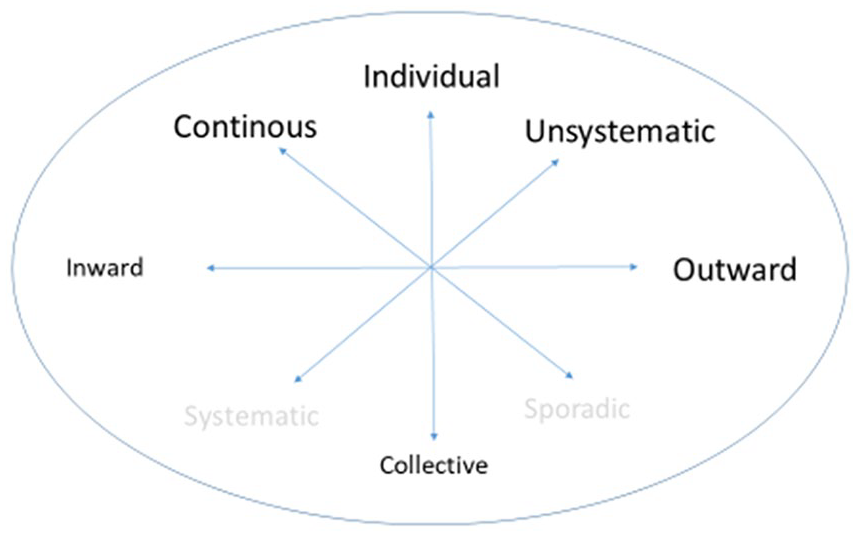
Revisiting the dimensions of the activity of keeping abreast and staying updated with information.
By applying as an analytical tool Bates’ (2002) model of different modes of information seeking, and by bringing into the analysis the dimensions highlighted in Figure 3, it is possible to identify both the inward and the outward directions depicted in figure. The ways in which the participants in this study are keeping abreast and staying updated with information includes most of the dimensions that appear in the figure. It includes monitoring information within the own organization, through consulting colleagues in the workplace, but even more so outside of the organization. Regarding the latter, it is often a matter of staff in one regional library turning to staff in other regional libraries for networking and exchanging information. Information is almost exclusively interacted with in an unsystematic manner even though there are normative perceptions dictating that information seeking should be carried out in a certain manner, namely in a systematic fashion. Moreover, it appears to be a continuous activity, which is more often enacted on an individual basis rather than on a collective one.
The areas the participants consider relevant to monitor and follow are to a degree reflected in the kinds of information sources they make use of, but it is also possible, in relation to the empirical data, to discern a fluctuating landscape consisting of several areas that vary in relation to their own workplace. Some are near, others afar. There is a clear focus on issues closely related to library activities in the vicinity. The municipal public libraries in the region are apparently in focus since those and the activities going on in them are part of the regional libraries’ formal responsibility, but issues appearing in the Swedish library sector at large are also of interest to the participants. Legislation, official reports and debates that are rendered relevant to the work the participants do are monitored. However, there are also statements that indicate that this fluctuating landscape stretches beyond the library sector and further than the Swedish borders. Some of the participants are following international news channels of various sorts, some are, furthermore, stating that it is too internal to only monitor library issues and refer to the encompassing notion of the ‘surrounding world and the society’ as an influence for their work. A more specific area that is mentioned concerns research findings from different disciplines, not only the area of library and information science.
It has previously been asserted that the work going on in regional libraries in Sweden has transformed over the years, from being operative in character to a more strategic function (e.g. Swedish Agency for Cultural Policy Analysis, 2018; Swedish Association of Local Authorities and Regions, 2019). There are reasons to believe that this development reflects the intense activity of keeping abreast and up-to-date with information, which appears in this study. In a time and context that is characterized of knowledge-intensive activities and where the supply of information with a potential bearing on library work seems to increase and be more multifaceted, there are reasons to believe that the expectations and demands of both individual and collective competences regarding information seeking will increase. Through the nuanced picture it offers, the study presented here can constitute an important support for meeting such expectations and demands.
Conclusion
Keeping abreast and staying updated with information is an activity that is enacted in a variety of ways, which are suited and adapted after other work tasks (other than the information seeking in itself) and dependent on individual preferences and routines. This activity is seamlessly intertwined with other work activities. It is not a matter of assigning specific time for it, but it is an activity that is constantly ongoing even if it varies in intensity. Since there is a certain conception of this activity as something that should be carried out in a certain systematic way and since it is something that one as a librarian ought to be good at, it is often associated with a normative dimension provoking a sense of guilt.
Suggestions for further research and practical actions
The findings and conclusions give rise to a number of issues that deserves to be investigated further and considered in practical library work. For example, how can library management mitigate or solve the problem of guilt at the lack of pro-activeness that the participants in this study express? Another issue concerns how work can be organized and what systems or support that can be put in place to encourage library staff to engage in information seeking in a more consistent way. If it is a matter of limited time, management should probably consider how to alleviate this. This study has explored activities of monitoring and keeping up to date in regional library work where there is emphasis on keeping up to date with what is going on in the library sector at large. The literature review showed a lack of studies focusing on how staff in public libraries keep up with the developments in their field. Future studies should look into that area. The study presented in this article was purely qualitative in character and was not conducted in order to offer a general view of the issues at hand. It does, however, provide a thorough and nuanced description of the various ways in which members of staff in Swedish regional libraries go about when seeking for and discovering information that they need for accomplishing their work. Future studies in this area should consider other methodological approaches that may capture more general traits of the study object.
Footnotes
Declaration of conflicting interests
The author(s) declared no potential conflicts of interest with respect to the research, authorship, and/or publication of this article.
Funding
The author(s) received no financial support for the research, authorship, and/or publication of this article.
