







Abstract
There are many studies on the learning support services of university libraries, but there are few on the first-year students’ perception of learning support services in Chinese university libraries. As a special user group, first-year students are in a transition period of learning modes and have special perceptions on learning support services of university library. Therefore, this study aims to explore the perception of first-year students on the learning support services of Chinese academic libraries, by adopting questionnaire survey method. Three hundred and fifty-two valid questionnaires were collected. Descriptive statistics are used to analyse numeric data. The results show that the information needs of first-year students in Chinese university libraries can be divided into two types. The university library can meet the information needs of first-year students through venue visits and welcoming activities for first-year students. At present, first-year students are satisfied with the service projects of university libraries in China, but the learning support services of university libraries still have some problems, such as weak publicity, lack of experience sense, and lack of rich form and content of service. This study provides support for librarians and managers in university libraries to develop strategies for improving first-year students’ satisfaction with learning support services.
Introduction
As the knowledge center of colleges and universities, university libraries are the key link to improve the quality of education and teaching and undertake the important task of learning support by supporting the research and learning of teachers, researchers and students. The concept of learning support service originates from the field of distance education, which refers to the sum of various types of services provided in various forms and ways to guide and help distance learners to learn independently and achieve their learning goals (Li, 2021). Library learning support service refers to a variety of library service programs which give full play to the advantages of library itself, provide space, equipment, resources and guidance for learners, and effectively support learners to carry out subjective and spontaneous learning (Wang and Yu, 2019). University library services such as citation reports, resource guides, courses and training can effectively expand the role of the library on campus and contribute more directly to research projects (Gutzman et al., 2018). Yan’s (2019) study proposes that the learning support services of university library in Canada include learning policy support, learning resource support, information literacy promotion support and learning ability cultivation, and learning space support. Other studies have found that university libraries not only play an important role in the course homework, examination, after-class extension study and self-improvement, but also provide innovative ideas for the discipline construction, educational quality, and educational mechanism (Chu and Sun, 2020; Conley et al., 2019). However, there are still many college students, especially for first-year students, who do not understand the nature and role of college libraries and librarians (Hughes et al., 2018).
At present, the problems of university library’s support for learning have attracted the attention of researchers in the field of library and information science. For example, Xu (2019) studied the learning support services of university library under the background of new environment and technology. Similarly, Robison et al. (2018) explored experience and achievements in providing learning support services in foreign university libraries. In addition, Wang (2015) examined the exploration of entrance education of first-year students and the cultivation of new students’ information literacy. However, there are few studies on first-year students’ perception of and satisfaction with learning support services in Chinese university libraries.
Because of the transition from high school to college learning (Maunder et al., 2013), first-year students generally have problems such as insufficient information acquisition and processing ability, and their information needs may haven’t been satisfied (Wang, 2015). These factors will lead to the information needs and behaviors of first-year students have unique characteristics. Entrance education mainly refer to the services, which include learning support, life support and mental health support programs offered by schools, to help the first-year students to adapt to the new college life (Zhao et al., 2019). Personalized learning support services for first-year students will enhance their information and academic literacy skills at all levels, which will help them achieve academic progress and achievement at today’s higher education institutions (Holderied, 2013; Sally et al., 2010; Stagg and Kimmins, 2014). Based on these, our research will collect data from the students who have experienced their first-year of college life by interview and questionnaire survey, to explore the supporting mechanism of university libraries for first-year students’ learning.
Nowadays, many university libraries have carried out learning support services for first-year students with different degrees and different effects, which can help them to improve their information literacy skills and awaken their information awareness during the transition period (Han and Wang, 2020). Library entrance education is a common form of learning support services for first-year students among university libraries (Xu et al., 2020) and the librarians will introduce the library’s various paper and digital collections and related services to first-year students. But as far as we know, few university libraries in China have dedicated positions to provide special learning support services for first-year students. At present, most university libraries in China provide learning support services for first-year students only limited to information literacy lectures, first-year students entry education, collection resource’s introduction, and other basic services (Chu and Sun, 2020). To explore whether university libraries in China provide satisfactory learning support services for first-year students, we propose the following research questions:
RQ1. During the transition period, what are the learning support service needs of first-year students for university libraries?
RQ2. What learning support service items do Chinese university libraries use to meet the service needs of first-year students?
RQ3.How do first-year students perceive and evaluate the effects of learning support services in Chinese university libraries and what their suggestions for library’s future learning support services?
Literature review
The first-year students’ needs of learning support
From the perspective of education psychology, when the first-year students are still at the stage of learning mode transition from high school to university, their psychology is still tending to be more like high school learning style, passively accepting the knowledge that their teachers tell them. During the transition period, it is difficult for them to adapt to college learning mode, actively seeking information and knowledge with the help of the library and the pace of life, and this will confuse first-year students’ psychological distress and learning (Wang et al., 2013). Therefore, an in-depth understanding of first-year students’ learning support service needs for university libraries will help university libraries to develop learning support service projects specifically aimed at them, guide them to realize the transformation of learning mode and integrate into university learning and life as soon as possible. Existing studies on the needs of college first-year students mainly focus on the field of pedagogy (Janne et al., 2021). Existing studies define adaptation as the individual’s adaptation to the environment, both physically and mentally (Berk, 1994; Chen et al., 1995), identified multiple levels of adaptability (Pang et al., 2016) and influencing factors of adaptability including personal character, attitude, and learning ability (Yu, 2020). Prior studies can help us better understand the background and the causes of demand for learning support services for first-year students in their adaptation to university learning from the individual perspective of students.
From the perspective of demand theory, the learning needs of college first-year students can be analyzed and represented by Maslow’s (1943) hierarchy of needs theory. According to Maslow’s hierarchy of needs theory (Maslow, 1943), first-year students are dependent on the learning environment and learning system before and after the transformation, which is different from the undergraduate learning thinking that pursues independence, individuality, and speculation more. Based on the theory, for example, some scholars analyse the first-year students’ needs for learning support by identifying the changes they face from high school to university (Wang, 2015). Also, to analyse their needs, it is important to study the characteristics of population. Previous studies have found that first-year students’ learning shows the characteristics of dependence, due to the influence of high school passive learning mode (Xu et al., 2020). There are also many studies on the learning support systems of existing colleges and universities. Recently, scholars have studied the learning support systems of four Universities in Shanghai (Dou and Yin, 2019). They found that the student’s evaluation of learning support services varies depending on the student’s grade and score, so learning support services need timely and targeted adjustment. From the perspective of new learning space in the library, scholars analyzed services provided by library of the university of Minnesota Twin Cities (Qin and Du Z, 2021). They recommend their plans of library space of operation, integrating various resources and online learning support services and so on. And scholars analyzed the learning support services in Macao universities libraries (Ma, 2021), and figured out the open, cooperative and abundant service system.
Many scholars in the field of education have noticed the difficulties in the adaptation of college first-year students in the transitional period. As the architect of the student learning system, the school should take the corresponding responsibility to help first-year students through the transitional period of learning difficulties. As the knowledge center of colleges and universities, university libraries should play an important role in helping first-year students to adapt to the learning system in the transitional period. However, it is still unclear what first-year students’ needs for learning support services in Chinese university libraries are.
Learning support services of university libraries
As an important teaching and scientific research supporting institution in colleges and universities, library plays an important role in improving the quality of student training. The university library mainly improves students’ learning ability by providing students with various learning support services (Xu, 2019), and cultivates their ability to adapt to the higher quality and high-level academic environment.
The related studies on learning support services of university libraries mainly focus on the construction of learning sharing spaces, reader services, digital libraries, remote mobile education supports (Allison et al., 2019; Jiang, 2021; Zhao et al., 2020). Some researchers analyzed the learning support service modes suitable for university libraries, through comparing the purpose, object, content, and influence of learning support service, based on the regional differences in the construction of learning support services in university libraries. For example, Japanese university libraries pay more attention to the refinement of service objects, the service object is divided into learning, writing, seminars, information search, IT and life counseling and other regular services, resource promotion, data analysis, and other characteristic services (Zhu and Liu, 2017), while North American university libraries provide more innovative, technical support, and comprehensive professional academic support (Zhang, 2018). In respect to the comparison between Chinese university libraries, it is common to make a comparative study of the current situation of learning support services in university libraries in a certain region like the service comparison of Beijing-Tianjin-Hebei universities’ libraries (Han and Wang, 2020). In addition, many researchers explore the application of mobile information platform and technology in the learning support service of university library, trying to find a more suitable learning support service mode for students in the mobile network environment (An and Zhang, 2019; Zhao et al., 2020). From the perspective of user service, some studies have explored the changes that should be made in the learning support service of university libraries under different user-led scenarios. These studies mainly explore the change of the user service environment, the change of students’ adaptation to the information learning mode, the needs of users in different learning stages and other topics (Zhang, 2020; Zhang et al., 2020). Research on learning support services based on user needs shows that (Zhang, 2020), learning support services in university libraries should turn to a more detailed, personalized, and dynamic service model.
The libraries’ learning support services for first-year students
“Academic integration” (Robison et al., 2018) is one of the learning challenges for first-year students during the transition period, which requires the help of university libraries. This is also in line with the transformation goal of university libraries in recent years, that is, university libraries need to prove their indispensable value in supporting students’ learning (American Association Library, 2016). Some studies have analyzed the resources cited by first-year students in completing schoolwork to explore the proportion of learning resources used by first-year students, to prove that library guidance can exert a positive influence on students’ learning (Rafferty, 2013). Other studies have shown that students who have gone through multiple library counseling courses during the transition period perform better and are more confident in learning, and make better use of library resources (Gilbert, 2010). These explorations also prove “the Primacy Effect,” that is, the earlier university libraries provide learning support services for first-year students, the better the Effect will be achieved. So it is necessary and beneficial for libraries to provide learning support services for first-year students at the entrance period.
As for the learning support services for the first-year students in libraries, the research of scholars shows a trend of refinement, and the content and subject of research become more and more specific (Hughes, et al., 2018; Robison et al., 2018; Rafferty, 2013; Yao et al., 2018). First, the research content is becoming more and more specific, including the exploration of the library entrance education for first-year students, orientation program, information literacy courses, students’ learning, and the cultivation of their academic competence, etc. Second, the research on population is more detailed. Specific population like transfer students, international students, Ethnic Minority Students, and poor students receive more attention. The concept of personalized, refined service and humanistic care of the latter is worth promoting to the learning support services of university libraries, because it is not only suitable for specific population of students, but also valuable for everyone. In addition, on the issue of improving the effect of first-year students’ learning support services, many researchers also mentioned the concept of inter-agency cooperation (Keshavarz et al., 2020). It is necessary for university libraries to cooperate with departments or other institutions in order to exert a more positive and effective influence on first-year students learning.
Existing researches have explored the learning support services of university libraries for first-year students to a certain extent. However, university libraries, especially in developing countries (such as China), have not systematically investigated and sorted out the specific learning support services provided for first-year students. Also, in practice, it can be found that most university libraries lack systematic support services for first-year students in China (Chu and Sun, 2020). Since the first year of college is foundational, we call on university libraries to pay more attention to first-year students’ learning support services through this study.
Methodology
Research method
The purpose of this study is to explore first-year students’ perception of learning support services in university libraries in China. As far as we know, Chinese university libraries have not set up special librarian positions to provide learning support services for first-year students. In the Chinese context, the study related to the learning support service of university library for first-year students is also relatively rare, which can provide limited research supporting materials. Therefore, we first carried out an exploratory study and chose interview as the research method. Fifteen first-year students or students who have experienced first-year studies were selected as our interview subjects (The results and findings of the interview research will be reported in another paper). Since the questionnaire research method can be used for large-scale surveys, we have chosen this research method to carry out further research on the basis of exploratory research.
Based on the results of literature survey and interviews, we designed a questionnaire for survey. The questionnaire consists of two parts. The first part is demographic characteristics, including the gender, grade of the respondents, etc. The second part is the sixteen specific survey questions. Please refer to Appendix 1 for the questionnaire.
Data collection
The questionnaire survey was conducted using a stratified sampling method. First, we uploaded the questionnaire on the questionnaire star website (https://www.wjx.cn/) and then generated an online questionnaire. Through social media platforms such as WeChat and QQ, college students from different universities were invited to take part in this survey. To increase the representativeness of the sample, we also consciously invited students from Soochow University, Peking University, Communication University of China, University of Electronic Science and Technology of China, North-eastern University, Zhejiang University, Nanjing University, Nanjing University of Information Science and Technology, Southwest University of Science and Technology, China Agricultural University, and other universities to participate in this survey. We invited these participants with some social medial (like WeChat and QQ) video calls and phone calls. The survey is from March 19, 2020 to March 25, 2020. A total of 456 questionnaires were received. We cleaned the data in accordance with the following rules, including deleting those whose response time was less than 1 minute, those who didn’t answer what school they were from and content was skipped and not answered. In the end, a total of 352 valid questionnaires were obtained for subsequent analysis. The characteristics of respondents in the survey are summarized in Table 1.
Characteristics of respondents in the survey.

Results
RQ1. During the transition period, what are the service needs of first-year students for university libraries?
The results show that the user’s information needs are related to learning resources, learning methods and information consultation needs, that is, to seek senior students, teachers, librarians for learning help. Each of these information needs includes knowledge-based information need (e.g. specific IT knowledge or learning resources), news-based information need (e.g. disciplinary trends, job search and employment), and data(fact)-based information need (e.g. scientific and technological data and economic statistics data).
First-year students’ information needs
According to the survey (Figure 1), we can see that the academic difficulties encountered by first-year students during the transition period can be summarized as follows: academic research difficulties, academic career planning difficulties, difficulties in learning methods, difficulties in obtaining learning resources, etc. At the same time, the survey shows that the most important learning information that respondents need during the transition period are the ways to obtain learning resources, learning materials, academic planning information, employment information, and professional frontier information.
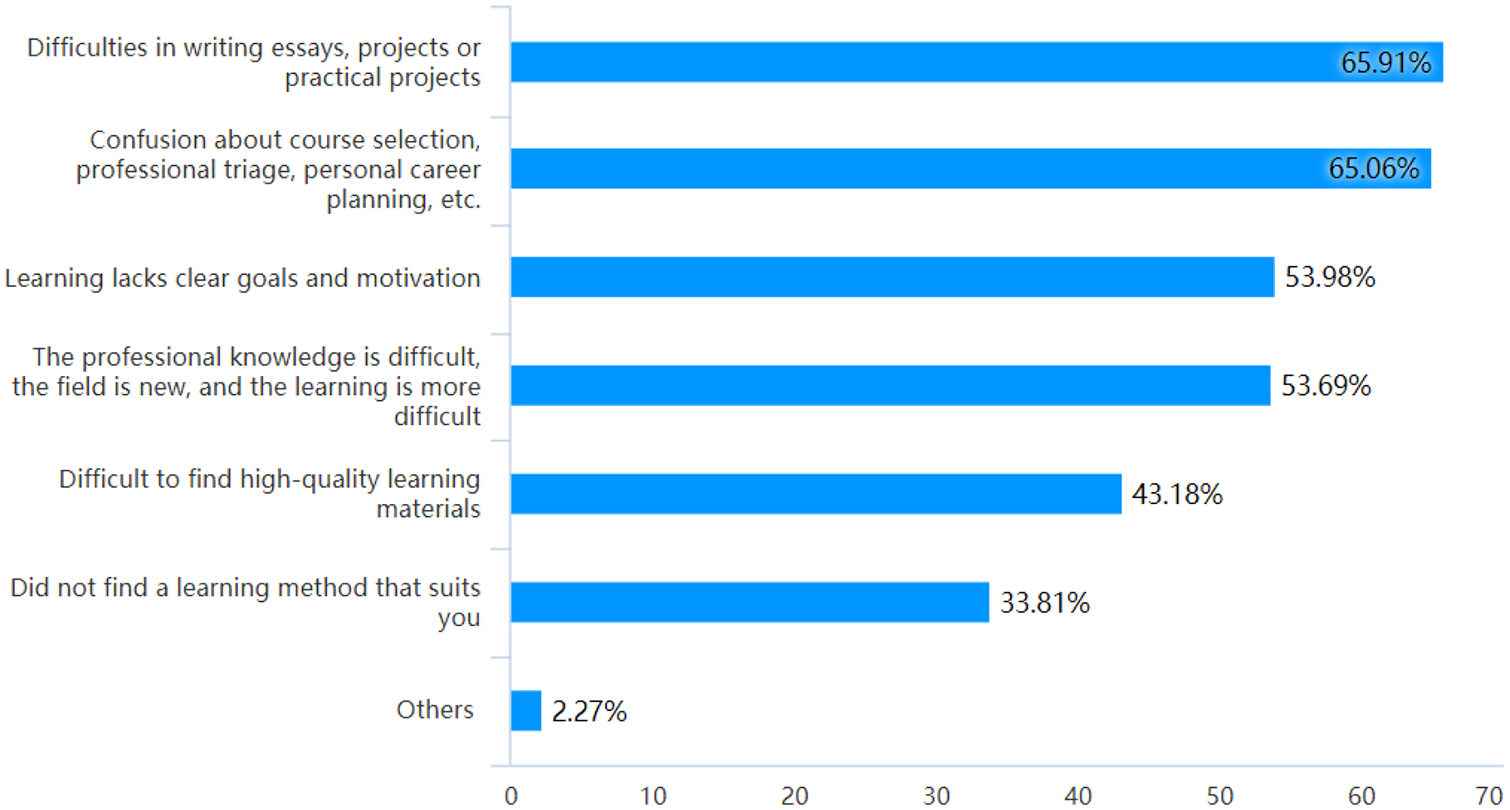
Difficulties encountered by first-year students during the transition period.
According to the Figure 1, 65.91% of the students said that they would encounter difficulties in doing projects or writing papers; 65.06% of the students were confused about course selection, major diversion, individual academic planning, and so on; 53.98% of the students said that they lacked clear goals and motivation in learning; 53.69% of the students found professional knowledge broad, profound, and difficult to grasp; 43.18% of the students were troubled in failing to find high quality learning materials; and 33.81% of the students had difficulty in finding appropriate learning strategies.
From the result we can conclude that the knowledge-based needs of first-year students are expressed as the needs for learning resources and materials; the news-based needs are expressed as the needs for latest information on discipline development, major trends, and job search and employment; the data(fact)-based information needs are expressed as the information authority like scientific and technological data and economic statistics data. In addition, first-year students show a need to learn how to acquire knowledge and information. The transition period is also a critical period for first-year students to gradually learn more about their majors, which is fully reflected in the first-year student’s information needs. In the questionnaire survey, the information needs of first-year students are more of a “commonality,” that is, the general information needs of students in the transition period.
First-year students’ information consulting needs
The following is an analysis of the results of the survey on the information consulting needs of first-year students (Figure 2).
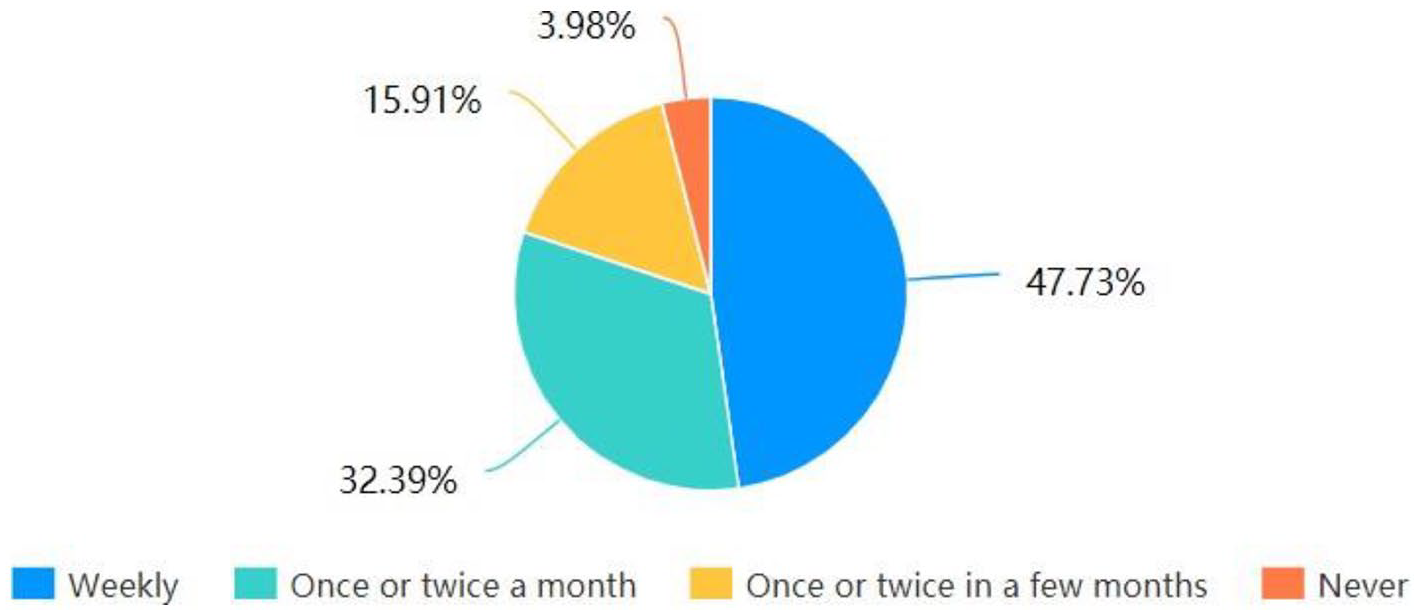
How often first-year students use the library during the transition period.
About 47.73% of the respondents visited the library every week during the transition period, this shows that most first-year students have visited the library during the transition period. So, what library services did the first-year students mainly use during the transition period (Figure 3)?
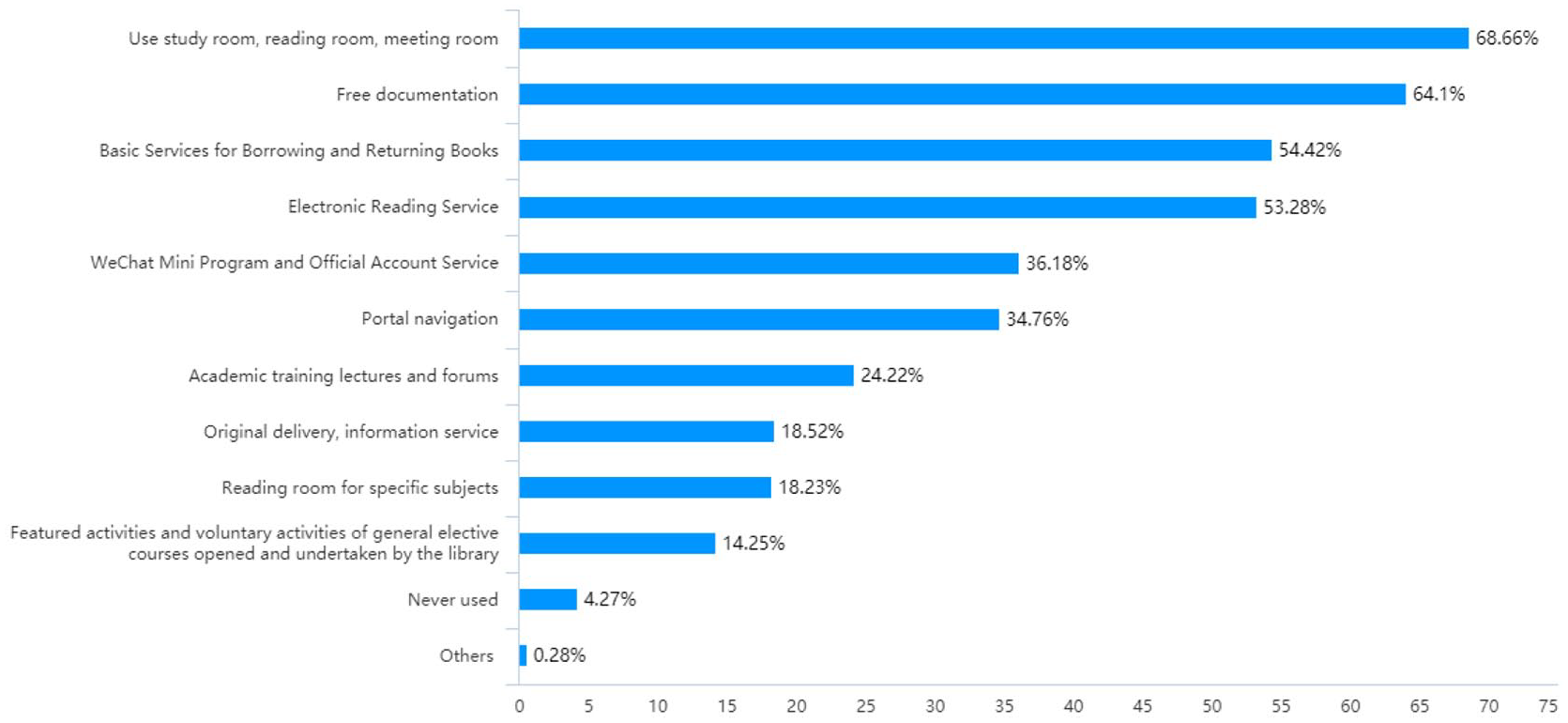
Library services used by first-year students during the transition period.
The survey shows that learning spaces such as study rooms, reading rooms, and meeting rooms are the services most frequently used by new students during the transition period. More than half of the respondents have tried borrowing and returning books, free electronic reading and searching in database. The second is portal services, such as portal navigation, WeChat applet, and WeChat official account services. The use and participation frequency of library services such as the subject reading room, digital resources reading room, and special activities are relatively low. Respondents also complain that sometimes the books they plan to borrow are not in the actual collection. The possible reason is that libraries in China may not have positions specially set up to serve first-year students, so the needs of first-year students may not be accurately grasped.
At the same time, in the learning support services provided by university libraries, the library entrance education for first-year students is an important service content. From the results of the questionnaire survey, the respondents’ evaluation on the satisfaction of library entrance education for first-year students are measured by five points (See Figure 5 for more detailed data). Overall, the respondents’ evaluation is 3.859 points (The maximum score is 5), above medium, indicating that the interviewees have a better degree of acceptance and satisfaction with the library entrance education for first-year students.
According to the correlation analysis of the satisfaction evaluation of the library entrance education for first-year students and the evaluation of the library to meet the service needs of the first-year students, it can be concluded that the correlation coefficient is 0.626, indicating that there is a significant positive correlation between the two issues. This can better reflect the significant relationship between the two. Therefore, university libraries help first-year students analyse their various information needs when making library entrance education for first-year students. This should improve their use of the library and their satisfaction with library entrance education.
In general, according to the analysis of the first-year students’ learning needs and consulting needs in the transition period, we can see that the first-year students’ learning needs in the transition period are mainly manifested in the demand for knowledge-based learning resources, information literacy and methods, academic consultation and help, and academic and career planning. According to the first-year students’ use of library services during the transition period, the needs of knowledge-based learning resources are the easiest to meet, followed by meeting the needs of some students for information literacy and methods, and other related needs are not well met. The library needs to adjust in the later stage to attract more student users to use related services.
RQ2. What service items do university libraries use to meet the service needs of first-year students?
Guide to library use
About 88.48% of the respondents knew that their libraries had provided guide to library use, indicating that it is one of the most basic and common services for first-year students (Figure 4). We visited several university digital library websites and found that the user guide is usually presented to students in the form of printing paper manuals, displayed on the “First-Year Students” column of the digital library website establishing new students’ columns on the official websites, published on WeChat subscription accounts, or displayed on the mobile library page based on the WeChat application. In terms of the specific forms of presentation, in addition to traditional pictures and text, many universities have also tried audio and video, hand-painted, and small games to attract the attention of first-year students.
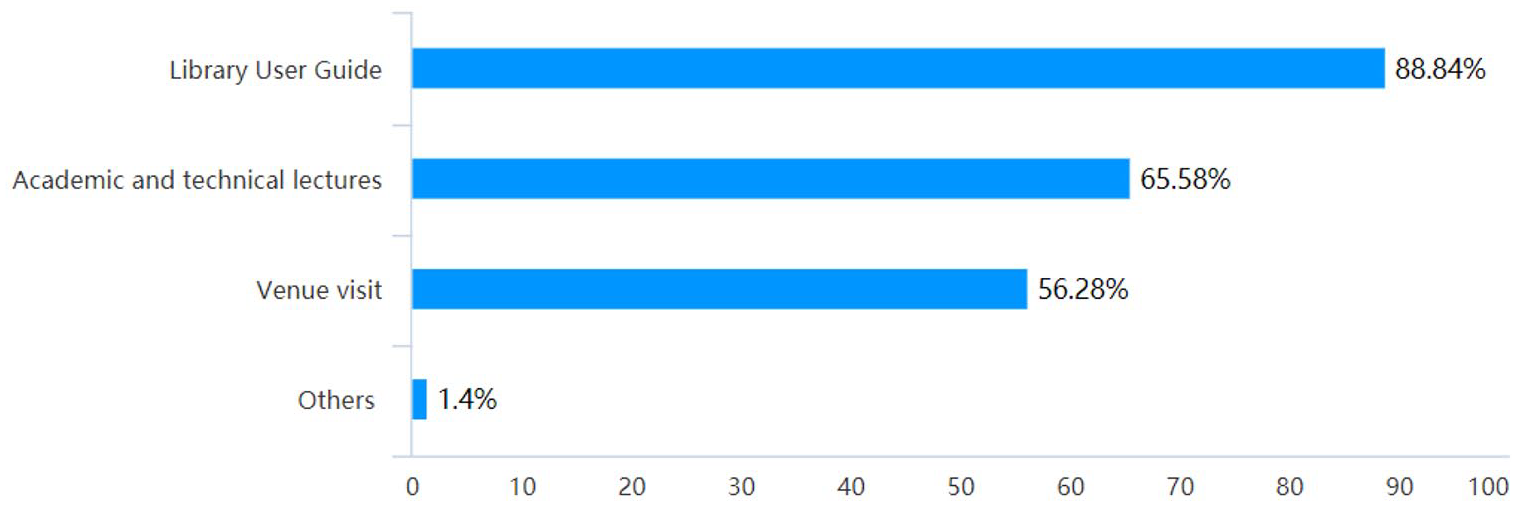
First-year students admission education form.
Academic and skill lectures
Academic and skill lectures are also common forms of first-year students service, accounting for 66.58%, according to Figure 4. These lectures include not only the guide to the library use, but also other projects and courses that are more meaningful to first-year students. Many university libraries have incorporated this part into their training plans for students’ Information Literacy, which benefits both their transition period and long-term learning process. Based on the survey sample data, we visited the university library websites used by the respondents. The main contents of the academic and skill lectures posted on the websites of the university library are summarized in the Table 2. Please refer to Appendix 2 for links to university library websites we visited.
Classification of academic and skill lectures.

Venue visit
About 56.28% of respondents said their university libraries provide venue visit service (Figure 4). Under the leadership of the teacher, students can enter the physical space of the library and learn about the library’s facilities and services. This will help to narrow the distance between new students and the library and lay the foundation for further exploration of the library in the future. But its shortcomings are also obvious. It is time-consuming, laborious, and easily affects the normal operation of the library.
Others
Some libraries have also initiated a series of programs such as knowledge contests, collection of works, book fair and film exhibitions, characteristic cultural experiences, etc. Although these activities are not directly related to the library learning support of first-year students, they can bring the library closer to first-year students, alleviate the anxiety and fear caused by the unfamiliar environment, and lay a good psychological foundation for them to truly enter the library in the future.
RQ3.How do first-year students perceive and evaluate the effects of college library service projects and what their suggestions for library’s future services?
In the first-year students’ evaluation of library services to meet their needs (Figure 5), a five-point scale was selected to survey respondents. The average score of 352 effective response questionnaires was 3.86. The score distribution is shown in the figure. The scoring is concentrated on four points (38.35%), five points (28.13%), and three points (26.42%). Most of the respondents are satisfied with the library to meet their needs, but there are still some problems. The top three items with the most options in the survey of first-year students’ dissatisfaction with library services all point to the library’s hardware facilities (e.g. study rooms and other environments need to be transformed) and book resources (e.g. the number of books in the collection and the structure of the books in each professional collection), reflecting first-year students’ use of libraries is more focused on infrastructure utilization and book borrowing. Items 3–6 in the dissatisfaction ranking involve library service items, including information acquisition, information retrieval, and information utilization.
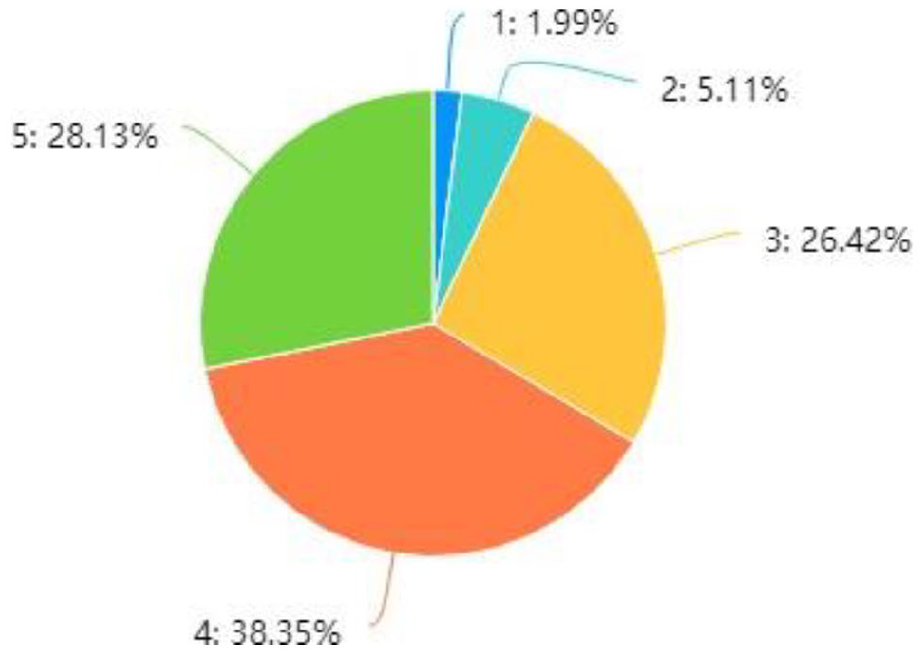
First-year students’ evaluation of library services.
A correlation analysis is made between first-year students’ satisfaction with library services and first-year students’ recognition of the library, and the correlation coefficient is 0.689. It shows that there is a positive correlation between the two, that is, whether the library services meet the first-year students’ learning needs affects their recognition of library and importance placed on it.
Discussion
This study mainly discusses the first-year students’ perception of the learning support service of the university library when they are in the transition period of learning mode transformation. On the basis of the interview, we designed a questionnaire. Through the analysis of the data collected from the questionnaire, we systematically analyzed the demand of first-year students for learning support services, the learning support services provided by university libraries for first-year students, and the perception of first-year students for these learning support services provided by university libraries.
First-year students’ needs for learning support in transitional period
The results show that they need to get support in resource acquisition, academic research, academic planning, learning methods, and so on. They usually turn first to friends, close classmates, and senior students, and the Internet when they have difficulties in using the learning support service of the university library. Sometimes, they go to college libraries to consult with librarians by face to face, but this is not the first choice. Most of the respondents seeking help from the library tend to visit online portal and We Chat subscription instead of going to the library and asking a librarian.
This inspires university libraries to look at the specific learning needs of first-year students, create more online services in order to shorten the space-time distance of service, thus improving the efficiency and sense of satisfaction in using the library. Since first-year students are more likely to trust their interpersonal relationships and professional teachers, it also inspires university libraries to collaborate with university administrators and educators to create support services and take action to encourage peer education. This is consistent with the conclusion of some studies that university libraries should create a teaching method that combines learning and transition (Wang and Tian, 2012). In summary, the university library should look at the academic needs of First-year students based on deep investigations, join hands with professional teachers and university management institutions, and combine learning with adaptation problems in the transitional period, to help first-year students better solve a series of problems during the transition period. Therefore, we put forward the following points where university library can make efforts.
Pay attention to investigating users’ needs regularly and act timely. It is suggested to build a dynamic learning support service system oriented to user needs, thus improving the service efficiency and level.
Refine the service content and carry out support services for different levels and aspects.
Improve the digital level of Library Collection and attach importance to online support, which will enable new users to get help immediately, enhancing their willingness to use.
Learning support services provided by university library during first-year students transition period
In the survey, most respondents indicate that they have used some library services, such as going to the self-study rooms, borrowing books during the transitional period. While the rest of the services are less used, which indicates that first-year students do not make good use of the learning support services provided by the library. Something similar occurred in a study (Allison et al., 2019) of three university libraries in California, USA, in which international first-year students visited the library in an all-round way but did not use the full range of services, and had less interaction with librarians. The reasons why first-year students do not use other learning support services provided by the library and the obstacles encountered in using these services remain to be explored by further research.
At the same time, most Chinese university libraries have carried out learning support services mainly based on library entrance education of first-year students, in the form of manuals, lectures, on-the-spot visits and so on. Some studies have shown that (Hughes et al., 2018), university libraries should adopt a flexible and export-oriented development direction, provide inclusive services, and space for student users, and make timely responses to students’ needs. Other studies more specifically put forward that information literacy learning should be nested into first-year students’ s daily learning by cooperating with their first academic year curriculum, to improve their adaptability to university learning more effectively (Yang, 2017).
In this regard, we propose the following suggestions to the university library planning to improve library entrance education of first-year students. At first, strengthen the construction of the library’ s user guide, replace the complex instructions with something readable and vivid, or use more advanced VR technology to guide new users. The user guide can help first-year students increase their understanding of university libraries, and systematically understand the resources and services of the library, to establish a good first impression of the library. Secondly, librarians should enrich the content of skill training, and make detailed service contents for students of different majors and different knowledge backgrounds, to improve the pertinence of support services. Thirdly, librarians should strengthen the cooperation with professional teachers, embed information literacy education into the curriculum of freshman year, and promote first-year students to improve their information literacy while accepting professional knowledge.
Students’ perceptions and suggestions for learning support services provided by university library
According to our research, most of the respondents have high evaluation on the learning support service of their university library, and at the same time, they also put forward many suggestions. The most prominent problems are hardware facilities, structure, and update of resources, lack of targeted information literacy training and other issues. Our research results also show that if the university library provides poor infrastructure (such as learning space and collection resources), it will affect the first-year students’ cognition of the library, and then affect their satisfaction evaluation of the library. For example, first-year students feel that the library is not a suitable place to study, and the library resources cannot meet their needs, thus reducing the use of the library. Moreover, we have noticed that most university libraries provide lectures and elective courses related to information literacy. So why do students still think that university libraries are lacking in this aspect?
At present, first-year students are satisfied with the service project of university library, but there are still some problems in the learning support services of university library, such as weak publicity, low experience satisfaction, and lack of rich form and content of service.
We believe that the problems stem from the following points. First, the information gap between first-year students and university libraries makes it difficult for first-year students to obtain relevant training information. Second, the training activities are not attractive enough that resulted in the first-year students’ willingness to participate is not strong. Third, first-year students lack the awareness of improving information literacy, which can be seen from the first-year students’ demand for learning support services—most of them tend to ask for resources directly, ignoring training in the ability to independently acquire resources.
We suggest that we should expand the publicity of services and activities to ensure that the information can be delivered to most students in time. And we should use new technology to enrich the form and content of library entrance education of first-year students, enhancing the attractiveness of activities. What’s more, we should cooperate with professional teachers to strengthen first-year students’ learning awareness of literacy in class. Finally, we should simplify the use guide of library services, replacing the complex sentences with clear and vivid charts.
Implications, conclusion, and future work
The theoretical implication of this study is to provide a framework for exploring first-year students’ perceptions on the learning support services of Chinese university libraries. As far as we know, Chinese university libraries do not have positions dedicated to helping first-year students. On the website of Chinese university digital library, it is rare to see learning and resource columns specially set up for first-year students. The reason may be that the development stage of Chinese university libraries is still in its infancy, and university libraries provide more unified services rather than personalized services. Therefore, the main purpose of this research is to call on more people to study the first-year students’ perception on learning support services of university libraries in developing countries (such as China).
The practical implication of this study is to provide ideas for university libraries in developing countries to improve the satisfaction of first-year students’ learning support services. As mentioned above, university libraries in developing countries should strengthen the publicity and promotion of learning support activities for first-year students, reduce the information gap between librarians and first-year students, increase the attractiveness of learning support activities, and strengthen information literacy training and education for first-year students. Only in this way can first-year students learn about the learning support programs offered by the university library, attract them to use these services, and improve their satisfaction with these learning support services.
This study is mainly to investigate the first-year students’ perceptions on the learning support services of Chinese university libraries. The findings suggest that first-year students’ information needs for university libraries can be divided into information needs and information consulting needs. University libraries can meet first-year students’ needs through library use guide, academic and skill lectures, venue visits and programs. Although every effort has been made to ensure the reliability and validity of the results of this study, the results should be used with caution for the following reasons.
At first, this study was conducted in China, and the sample may lack multinational and cultural diversity, as users’ behavior may be influenced by their national culture. Therefore, the results of our research need to be generalized to other countries with different ethnic cultures. Second, this study focuses on the overall information needs and search behavior of first-year students during the transition period, lack of comparative research on information needs and behaviors of first-year students in different disciplines and different countries. In fact, students from different social backgrounds, different education backgrounds, different subjects, and different majors experience different changes in the transition period, varying in academic needs. And the corresponding library learning support services should be different. Future researchers can also carry out a more detailed division of student groups on this basis to further explore the direction for the personalized service of the library. Lastly, the survey is based on first-year students’ perceptions on library using experience during the transitional period. To explore the change and continuity of service, so the survey objects are not limited to first-year students, but distributed in all grades, as they too were once first-year students and experienced the learning support services. Although we have reminded non-first-year students to try to recall the intersection with the library during the first-year period and answer on this basis, we cannot guarantee that the situation reflected by them is completely consistent with the experience at that time.
Future studies can focus on comparative research of university library learning support services from regional, national and global perspectives, and case studies of best practices of university library learning support services. At the same time, researchers can also expand the specific learning support service object of university library, so as to make the study of learning support service more complete. For example, future research can simultaneously study the difference of learning support service items and effects of university libraries for undergraduates of different grades and majors.
Footnotes
Appendix 1. The questionnaire
Which university are you from?————————
What’s your grade? (Multiple choices)
What’s your major?————————
Acknowledgements
The authors appreciate the valuable suggestions from peer reviewers.
Declaration of conflicting interests
The author(s) declared no potential conflicts of interest with respect to the research, authorship, and/or publication of this article.
Funding
The author(s) disclosed receipt of the following financial support for the research, authorship, and/or publication of this article: This work was supported by the College Student Innovation and Entrepreneurship Program of Soochow University (grant numbers 2020) and Qing Lan Project of Education Department of Jiangsu Province in China (grant numbers 2019).
