







Abstract
While many studies have attempted to understand librarians’ academic engagement (e.g. publication), there is a dearth of knowledge about the determinants of the research collaboration behavior of librarians, especially in Chinese libraries. This study focused on Chinese academic librarians and investigated factors that affect their intentions to engage in research collaboration based on a conceptual framework integrating the Theory of Planned Behavior and Social Exchange Theory. A survey containing 318 respondents was used to evaluate the research model by partial least square based structural equation modeling. The results showed that the integrative model could explain 53% of the variance of academic librarians’ intentions to collaborate. The findings revealed that attitude, subjective norms, perceived behavior control, and perceived benefits showed significant direct influence on Chinese academic librarians’ collaborative intentions. Perceived positive consequences (benefits, relationships, and reputation) in research collaboration had indirect effects on academic librarians’ intentions through attitude. Meanwhile, there were significant differences existing in path coefficients for librarians with different disciplinary backgrounds, professional ranks, and research projects. This study contributes to the existing literature by empirically studying factors that impact Chinese librarians’ intention to research collaboration and examining the intrinsic relations among these factors. It helps the universities’ managers and librarians finding ways to boost factors in supporting the research collaboration.
Keywords
Introduction
Due to the tenser “publish or perish” environment, an increasing trend of academic collaboration has been found in many disciplines (Norelli and Harper, 2013). Recently, the increasing collaboration trend has also been confirmed in the field of library and information science (LIS) (Ramos-Eclevia et al., 2018). Some studies that have addressed the contribution of academic librarians to the scholarly endeavor in or beyond the field of LIS (Blecic et al., 2017; Borrego et al., 2018), yet a little research has examined the issues about research collaboration among academic librarians (Tran and Chan, 2020), especially for academic librarians in Chinese universities.
There is a relatively special scholar environment for academic librarians in Chinese universities compared with some universities in certain countries such as the United States (Hosburgh, 2011) and African countries (Opoku, 2013). Firstly, the disciplinary backgrounds of Chinese academic librarians present multi-disciplinary, and the acquisition of a LIS degree is not a requirement for becoming a librarian. Thus, there are many librarians working for Chinese universities who obtain degrees in disciplines other than LIS (Tang, 2020). Secondly, although the assessment of the professional rank for librarians in Chinese universities is related to their research output or publications, there is very little publication pressure for them. Because the promotion of professional rank is not the mandatory requirement for their institutions, it all depends on their respective plan of career development. Lastly, the research outputs used for the promotion assessment must be related to LIS and published as the first author in Chinese libraries. These characteristics of Chinese librarianship academia have impacts on research collaboration among academic librarians. Overall, the research collaboration among Chinese librarians may not occur frequently and fruitfully. According to Han and Qiu (2017), the coauthorship rate of publications by Chinese academic librarians was 42%, lower than 60.8% of ASEAN (the Association of Southeast Asian Nations) librarians (Ramos-Eclevia et al., 2018) and 53.9% of U.S. academic librarians (Blecic et al., 2017), respectively.
Although a special scholarly context exists for Chinese academic librarians, there has been little research about their academic activities, even not to mention research collaboration among them. Furthermore, there is a lack of clarity on the factors that affect research collaboration among Chinese academic librarians. Therefore, this study turns the attention to the group of academic librarians in Chinese universities and aims to fill the gap by identifying the factors that affect the intentions of librarians about research collaboration in Chinese university libraries. The types of research collaboration in this study include both with other librarians and with disciplinary faculty. To better understand the influencing mechanism of potential factors, we develop a theoretical model by combining two psychological theories. The findings of this study can be helpful in improving the willingness of librarians to engage in research collaboration and in facilitating more effective librarians’ collaborations with other librarians or faculty. This study addresses the following two research questions:
What factors influence Chinese academic librarians’ intentions to participate in research collaboration?
Do Chinese academic librarians’ intentions about research collaboration differ significantly with the demographics (such as disciplinary background, length of career, professional rank, co-authored papers, and research projects)?
Literature review
Different patterns of research collaboration have been described in previous articles. Classified according to the organizational level, the forms of collaboration include between two or more researchers, between research groups within a department, between departments within the same institution, between institutions, between sectors, and between geographical regions and countries (Katz and Martin, 1997). Hart (2000a) divided the models of collaborative authorship into “collegial,” “mentoring,” and “directing,” based on the nature of working relationship. A collegial model was described that authors sharing the work as colleagues, and the mentoring model existed when a senior author mentored one or more junior authors, so that the junior members could learn from the senior member. The directing model was described as a situation in which the first author has primary responsibility and takes the lead in organizing the research.
Some studies focused on the collaboration in librarianship have examined the coauthorship among librarians or librarians and faculty in the LIS literature. The academic librarians prefer more to collaborate with their colleagues (i.e. other librarians in the same institution). For example, the results in the study of Winston and Williams (2003) indicated limited collaboration between librarians and library and information science members. They found that of those academic library administrators who co-authored articles with others whose affiliations were indicated, the largest percentage (45.5%) worked with other academic library administrators. Lamptey and Boshoff (2020) investigated the coauthorship patterns of academic librarians in Ghana. Although there were 54% of articles were co-authored, 38% of all articles by individuals from a single university. Generally, the collaboration between librarians and faculty is not extensive. Chang (2021) reported that the number of articles from academic-academic and practitioner-practitioner (i.e. librarians) collaboration both were higher than that of academic-practitioner collaboration in the field of LIS. Therefore, many researchers have advocated promoting practitioner-researcher collaboration in LIS (Joint, 2005). But in fact, most researches about practitioner-researcher collaboration in LIS studies typically focused on teaching more than on research practices, and on the development of information literacy skills for students within the framework of their course (Pham and Tanner, 2014; Waggoner and Yates Habich, 2020; White and Cossham, 2017).
One of the external characteristics for academic collaboration based on research practices is coauthorship occurring in the work of researching, writing, and creating scholarly publications. Therefore, the examination of coauthorship in literature has been used as a main and direct method to investigate academic collaboration (Norelli and Harper, 2013), although this is not infallible (White and Cossham, 2017). The relationships of coauthorship collaboration with research productivity and article quality were frequently examined in the studies which employed bibliometrics. Hart (2000b) noted that the amount of collaboration increased with the increasing quality of the journal articles, which was defined by the three categories of non-refereed journals, refereed journals, and a core of important LIS journals. Additionally, Chang (2021) confirmed that three types of coauthored articles (academic-academic, academic-practitioner, and practitioner-practitioner) had greater academic impact (average number of citations) than did single-authored articles.
The reasons or motivations of librarians to conduct research collaboration have been addressed in some prior studies. Hart (2000a) identified the top three reasons of librarians’ collaboration: improved quality of the article, the expertise of the co-author, and the co-author’s valuable ideas. The survey results by Tran and Chan (2020) indicated that the most prevalent motivators of librarians for seeking a collaborator were to acquire expertise that one lacked, sustain research interest, and obtain a sounding board. Some scholars considered that collaboration appears to be a good way to help librarians overcome barriers in conducting research (Chang, 2021), which included lack of skills or knowledge, a tight work schedule and lack of research grant (Clapton, 2010; Ibegbulam and Jacintha, 2016). Collaboration in research can help librarians to increase their research productivity, specifically forming writing groups among librarians (Campbell et al., 2011). Furthermore, collaboration among librarians and faculty have more impacts on identity and status of librarians. Research collaboration between librarians and academics in the field of LIS could help the growth of LIS research (Joint, 2005), while collaboration in the non-LIS fields may promote the transdisciplinary knowledge flow (Borrego et al., 2018). Chang (2021) claimed that a research topic can be enriched when it is contributed to by both academics and practitioners with various concerns and views.
Theoretical framework
The present study employed a theoretical framework integrating the Theory of Planned Behavior (TPB) and Social Exchange Theory (SET) to better guide this study and interpret the results. TPB is a psychological theory that links beliefs to behavior and has been widely employed in many fields, like article sharing and gifting behavior in online games (Kim and Oh, 2021; Sharma et al., 2021). TPB mainly includes three components that explain behavioral intention—namely, subjective norms, attitude, and perceived behavior control (Ajzen, 1991). A subjective norm is an individual’s perception that the people close to them believe they should or should not conduct a particular behavior. Attitude is defined as an individual’s overall assessment of a particular behavior. Perceived behavioral control is defined as an individual’s perceived ease or difficulty in conducting a particular behavior. In this study, behavioral intention refers to academic librarians’ intentions to collaborate in research.
Since TPB is a generic behavior model and cannot capture the specific dynamics of individuals’ behavior, many researchers have attempted to add other relevant factors or other models to extend TPB. For example, Kim and Oh (2021) integrated TPB, community considerations, and reciprocity to examine social and individual motivation factors affecting researchers’ article-sharing intentions. Opesade and Alade (2021) employed TPB constructs and personality traits to assess factors affecting the knowledge-sharing behavior of pharmacists in Oyo State, Nigeria. Sharma et al. (2021) developed a conceptual framework incorporating the Social Identity Theory, SET and TPB to investigate factors that impact gamers’ gifting behavior in online games.
Referring to the previous studies, this study attempted to integrate TPB with SET to explain librarians’ intentions to collaborate in research. SET is a key theoretical framework for understanding human social activities. It was founded by G. C. Holmans, an American sociologist, in the 1960s. This theory posits that individuals participate in a specific behavior when the benefits of the social exchange outweigh the costs (Yuan et al., 2019). Attitude in TPB conforms to the expectancy-value model and attitudinal belief links the behavior to a certain outcome, or to some other attribute such as the cost incurred by performing the behavior. Hence, the researchers considered that might form a relationship with SET, as SET also evaluated the benefits and costs of people’s certain behavior.
Hypotheses development
Figure 1 shows the research model built based on TPB and SET in this study. It comprised 11 latent variables and five moderators (disciplinary background, length of career, professional rank, co-authored papers, and research projects), and highlighted 10 hypotheses that have been proposed in this section to meet the objective of this study.
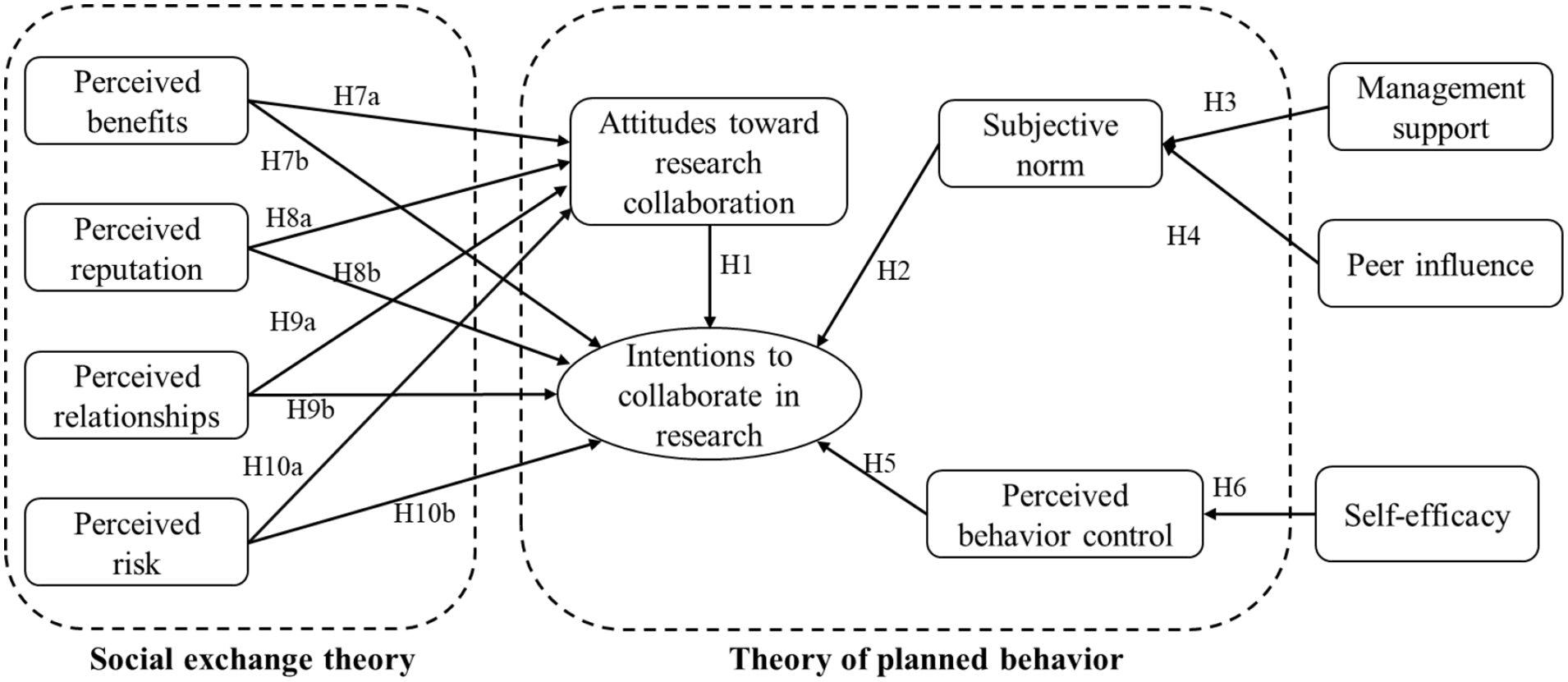
The TPB and SET research model.
Attitudes toward research collaboration
Attitude, one of the major elements of intention, is known as the degree that a person’s evaluation favors a specific behavior (Ajzen, 1991). According to TPB, attitude toward a certain behavior has a robust impact on a person’s behavioral intention. This eventually leads to an actual behavior. In the context of this study, the attitude was the academic librarians’ negative or positive assessment of research collaboration. The positive association between attitude and behavioral intention have confirmed in various studies (Fauzi et al., 2019; Kim, 2018). A study conducted by Cheng (2016) found that attitudes toward the behavior positively and significantly predicted project partnering intentions. In this study, it was expected that academic librarians who have favorable attitudes toward research collaboration would be more likely to participate in research collaboration. Therefore, Hypothesis 1 was proposed.
Subjective norm of research collaboration
A subjective norm is defined as “a person’s perception that most people who are important to him/her think that he/she should or should not perform the behavior in question” (Ajzen, 1991). According to TPB, subjective norms would positively affect the intention to collaborate. A community where a person resides or works can form a person’s behavior (Fauzi et al., 2019). Therefore, individual behavior will be influenced by the thoughts and behavior of others. In the context of this study, the subjective norm of academic librarians was influenced by management support and peer influence. On the one hand, research collaboration among academic librarians must have the necessary management support, which included funds, policies, rules, and regulations set for librarians by the management of the university libraries (Fauzi et al., 2019; Hoffmann et al., 2017). On the other hand, the culture of collaboration can also affect forming academic librarians’ subjective norms about research collaboration. The study by Kim (2018) related to article sharing has confirmed that the perceived academic culture of article sharing positively affects a scientist’s community norm of article sharing. Scientists would perceive more cultural-cognition of article sharing in their research communities if they observe more scientists in their communities participating in article sharing through ResearchGate. In the same vein, Brachten et al. (2021) also confirmed peer influence that people tend to act in a way that they think is widely accepted by a large number of desirable peers. Therefore, it is expected that academic librarians would increase their normative pressure on research cooperation when their institutions support the research resources and structures or other colleagues around them actively participate in research collaboration. This study proposes hypotheses 2–4.
Perceived behavior control of research collaboration
Perceived behavior control (PBC) is defined as a person’s perception of whether it is easy or difficult to perform a specific behavior (Ajzen, 1991). In this study, PBC is described that academic librarians perceived ease or difficulty of conducting research collaboration. Previous studies have proven that PBC is one of the strongest predictors of behavior (Fauzi et al., 2019; Koay et al., 2021). PBC mainly refers to the sense of capability, control and self-efficacy (Kari and Makkonen, 2014). Self-efficacy, or efficacy, is related to a person’s perceived ability to execute a certain task, which is the internal behavioral control and can directly influence an individual’s actual behavior (Brachten et al., 2021; Kim and Adler, 2015). In the two studies of Kennedy and Brancolini (2012, 2018), the results both reported that self-efficacy was a significant predictor of a librarian conducting and disseminating research. The positive impact of self-efficacy on PBC have proved in prior studies based on the decomposed TPB (Brachten et al., 2021; Taylor and Todd, 1995). Hence, we posit the following hypotheses 5 and 6.
Perceived benefits
As mentioned earlier, the attitudinal belief links to the perceived outcomes of performing a particular behavior, including positive or negative consequences and an evaluation of the consequences (Cheng, 2016). Hence, the positive consequences comprise of perceived benefits, perceived reputation, and perceived relationships, while the negative consequence mainly refers to perceived risk in this study. These four factors are developed based on SET and described in more detail below.
Perceived benefits were defined as the degree to which academic librarians believe that conducting research cooperation will bring academic advantages or benefits, such as improving research quality, increasing research output, and stimulating research inspiration (Hart, 2000a). Prior studies on data sharing showed that perceived benefits would encourage psychologists to have more favorable attitudes about the open data badge (Harper and Kim, 2018). Besides, it is also found that perceived benefits could influence data-sharing intentions and actual behaviors (Kim and Oh, 2021). Based on the discussions of previous studies, hypotheses 7a and 7b were formulated.
Perceived reputation
Perceived reputation was defined as the extent to which librarians believe that research cooperation can increase their academic reputation through recognition and/or the number of citations. This definition was adapted and modified according to the previous study by Kim (2018). In this study, there are three aspects to explain perceived reputation, including enhancing academic recognition, improving academic status, and earning respect from others. As demonstrated by some studies, publishing, including librarian-faculty collaboration publishing, could reflect academic librarians’ value and contribution to their home institutions (Borrego et al., 2018; Chang, 2021), thereby helping librarians improve their academic recognition and academic status. From a perspective of altruistic motivation, the senior librarians with more research experience would be respected form their collaborators who are junior librarians or lack of research experience. Hart (2000b) noted that collaboration with senior librarians could “help younger colleagues” gain skills and experience. Lamptey and Boshoff (2020) also found strong altruistic undertones affected librarians’ research behavior, for example, they wanted to create opportunities for others in research. Previous studies reported that reputation expectancy can significantly increase a researcher’s attitude toward knowledge sharing (Kim, 2018). Therefore, hypotheses 8a and 8b were developed, which are similar to perceived benefits.
Perceived relationships
Apart from perceived benefit and perceived reputation, librarians engaged in research collaboration as a means of developing relationships with others, which is also a positive consequence. In this study, perceived relationships refer to the degree to which a librarian believes that research collaboration behavior would help them develop new and/or existing associations with others. This definition was adopted and modified from the previous study by Kim (2018). Perkins and Slowik (2013) indicated that the benefits of academic librarians’ research included developing better relationships with faculty. Similarly, research collaboration could also develop better relationships with faculty. Further, the studies related to article-sharing behavior have found that relationship expectancy significantly contributes to people’s positive attitude (Kim, 2018). Therefore, this research proposed hypotheses 9a and 9b.
Perceived risk
Perceived risk refers to the degree to which a librarian believes that research collaboration would cause adverse consequences. Some researchers indicated that improper authorship order could be the most outstanding risk of research collaboration (Gómez-Ferri et al., 2019). In Chinese librarianship academia, the first author of publications (including the corresponding author in foreign language literature) can be recognized within the assessment framework of professional rank promotion, while other authorships are generally neglected. Consequently, many librarians are reluctant to engage in research collaboration, since they would take risks with no reward. According to a survey from Lan and Liu (2020) in Shanghai, China, the order of authorship in collaboration publications has an obvious influence on the collaboration intentions of about 71.24% of faculty. Besides, the first applicant of funded projects has the right to allocate funds for scientific research. Hence, there may also be an uneven allocation of economic benefits in research collaboration. In the context of this study, academic librarians in China universities would perceive that they would not get credit to the first authorship of publications or take economic conflict of interest in research collaboration. Therefore, this research developed hypotheses 10a and 10b that the perceived risk involved in research collaboration would negatively affect librarians’ attitudes and intentions to collaborate.
Categorical moderators
In the previous studies, some researchers have identified some variables which described background characteristics would influence individual behavior. For example, Binaymin et al. (2020) investigated the moderating effect of gender and age on the students’ behavior toward learning management systems (LMS). Their results revealed that gender had a significant moderating effect, while age has no moderating influence on the students’ use of LMS. In the context of librarian-faculty collaboration, some studies also have confirmed that individual characteristics could influence librarian-faculty collaboration. Amante et al. (2013) illustrated that 14% of the willingness of the faculty to collaborate with librarians can be attributed to key faculty attributes, namely, gender, age, department, academic qualifications, professional rank, and the length of career in the Librarian-Library/Faculty Relationship Mode. Alabi (2018) examined those weak negative correlations that exist in librarian-faculty collaboration between gender, age, and area of collaboration.
In addition to individual characteristics, the influence of one’s past behavior was considered as a fundamental and important factor to understand one’s current behavior (Kidwell and Jewell, 2008). More and more studies found past behavior as a moderator in the prediction of behavioral intentions. For example, Høie et al. (2010) used past behavior as the moderator in the extended TPB, and they found that predictive utility of the TPB increased with the number of quit attempts (splitting the sample into three categories of past quit attempts). According to Norman et al. (2000), they considered the moderating effect of past behavior in the prediction of exercise intentions and behavior with an application of TPB. They found past behavior moderated the perceived behavioral control–behavior relationship which was found to be significant when the frequency of past behavior was moderate or high, but non-significant when the frequency of past behavior was low. The moderating effect of past behavior was also found in the prediction of other behaviors, like consumers’ digital piracy behavior (Koay et al., 2021), texting while driving (Shevlin and Goodwin, 2019) and so on. Similarly, it was a need to consider past behavior as the moderator in the prediction of academic librarians’ intentions to collaborate. In this study, the past collaboration behavior for academic librarians included publishing co-authored papers or participating in research projects, because these two aspects were relatively easy to measure.
Overall, we considered disciplinary background, length of career, professional rank, co-authored papers, and research projects as moderator variables, to examine the differences in librarians’ collaboration intentions in this study. Among them, disciplinary background, length of career, and professional rank presented the educational background and work experience of academic librarians. Co-authored papers and research projects were used to reflect their past behavior in conducting research. The detailed survey results for categorical moderator variables can be found in the later.
Research methodology
An online questionnaire survey was used to systematically investigate the extent to which the factors identified from TPB and SET influence academic librarians’ intentions to collaborate. The survey data have been analyzed using descriptive statistics, reliability and validity analysis, and structural analysis.
Online survey questionnaire
An online survey questionnaire (Appendix 1) was developed using Wenjuanxing (https://www.wjx.cn/), consisting of two parts: (Ⅰ) participants’ personal information, (Ⅱ) measurement of research constructs. The background questions asked academic librarians’ gender, age, education, disciplinary background, length of career, professional rank, co-authored papers, and research projects. With respect to the measurement of research constructs, this study used a total of 33 measurement items to quantify 11 research constructs for this study: perceived relationships (Kim, 2018; Perkins and Slowik, 2013), perceived reputation (Chang, 2021; Kim, 2018), perceived risk (Lan and Liu, 2020), perceived benefits (Hart, 2000a; Kim and Oh, 2021), management support (Fauzi et al., 2019; Hoffmann et al., 2017), peer influence (Brachten et al., 2021), self-efficacy (Kennedy and Brancolini, 2012, 2018). Items for attitudes, subjective norms, perceived behavior control, and intentions came from Ajzen (1991) and Cheng (2016).
All the items of research constructs in the questionnaire were carefully developed using related prior studies as well as the researchers’ observations and experience in Chinese scholar environment. Also, we are following to use the same scale survey tool referring to prior studies, a five-point Likert scale, in order to easy to design questionnaire and analyze data. This five-point Likert scales ranged from “Strongly Disagree,” “Disagree,” “Neither Disagree nor Agree,” “Agree,” and “Strongly Agree” for the items measuring academic librarians’ diverse perceptions toward research collaboration. The details measurement items for research constructs can be found in Appendix 1.
Data collection and preliminary research
Before the extensive dissemination of questionnaire, we carried out the preliminary research for a small sample (N = 100). According to the results from factor analysis and reliability analysis, we were carefully deleted two items so that the overall scale had the better construct validity. The deleted items were marked in Appendix 1.
Based on the final questionnaire after deleting two items in the preliminary research, an online links of questionnaire was disseminated via e-mail and social media platforms (e.g. WeChat and QQ). All respondents to this questionnaire were academic librarians who were working in Chinese university libraries, including colleges and universities. There were 327 respondents answered the online questionnaire in total from May 2021 to August 2021. However, nine responses were invalid because of the short answer time (less than a minute) and the same choice for each question. This resulted in only 318 valid responses used in the later data analysis.
Analysis methods
A structural equation modeling (SEM) approach was adopted to assess the proposed research model and hypothesized relationships. This study used a variance based Partial Least Squares (PLS) method (Chin, 1998), which was a convenient and powerful technique with complex research models because of an advantage over regression in that it can analyze the whole model as a unit, rather than dividing it into pieces (Goodhue et al., 2012). The data analysis using PLS-SEM entailed a two-stage approach for evaluating measurement and the structural model. The measurement model was used to assess “the extent to which indicators used for each construct measure the same concept,” and the structural model was used to evaluate the proposed research model and hypothesized relationships among constructs in this research (Kim and Adler, 2015). Following the assessment of the measurement and structural models, multigroup analysis (MGA) was used to explore the effect of differences between different groups based on the nonparametric method called Henseler’s MGA (Henseler et al., 2016). Henseler’s MGA directly compares group-specific bootstrap estimates from each bootstrap sample (Barroso et al., 2018). Moreover, before performing the MGA, measurement invariance was assessed using the measurement invariance of composites (MICOM) approach. All the above analysis processes were done using the statistical software SmartPLS.
Data analysis and results
Demographics of the respondents
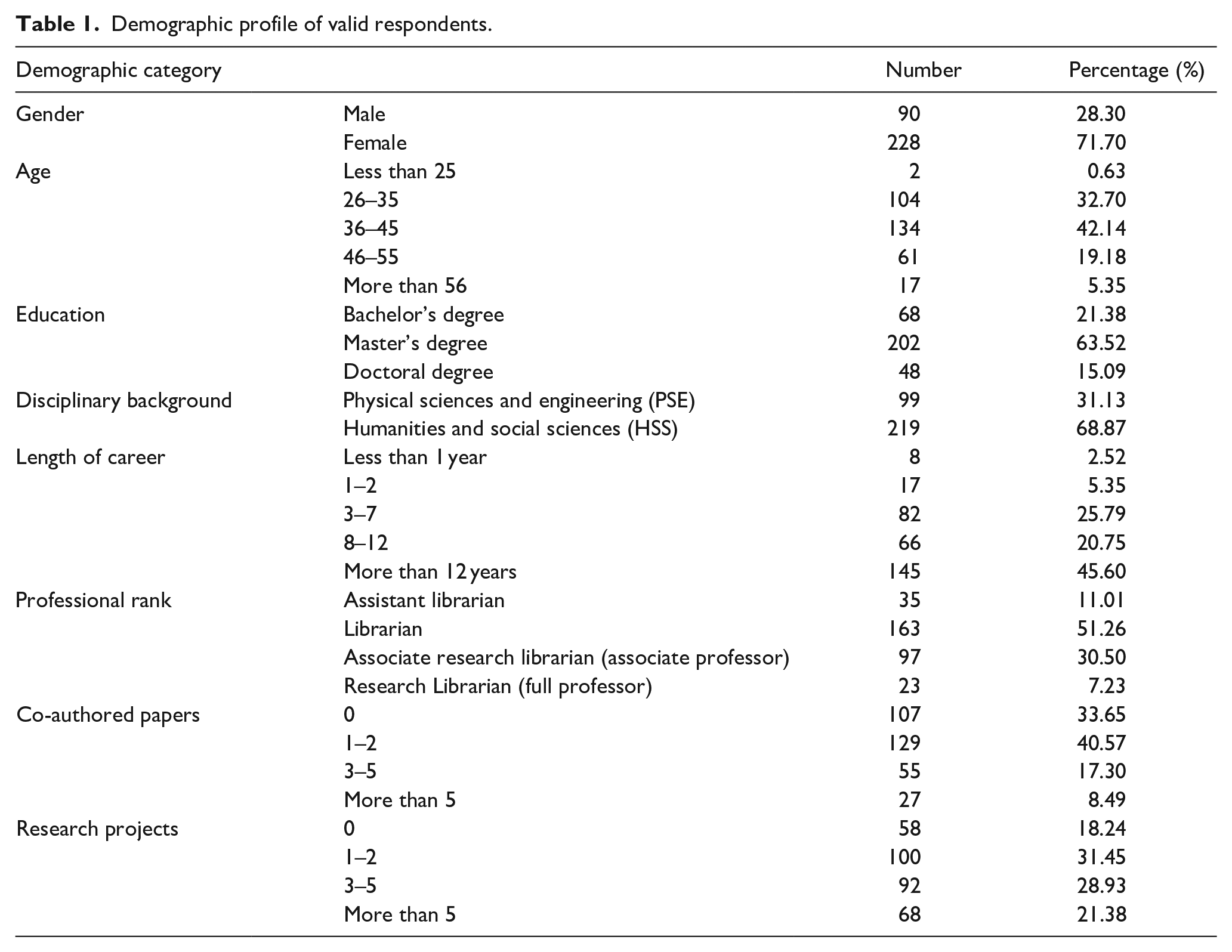
The demographic profile of the valid respondents indicated that 28.30% (N = 90) were male, while 71.70% (N = 228) were female. Their ages ranged primarily from 26 to 45 (74.84%). Of the 318 valid responses, 63.52% (N = 202) had Master’s Degrees, and 21.38% (N = 68) and 15.09% (N = 48) had Bachelor’s Degrees and PhDs. The respondents’ disciplinary backgrounds were classified as physical sciences and engineering (PSE) and the humanities and social sciences (HSS). The PSE category included physical sciences, engineering, medicine, and agriculture, while the HSS category included management science, pedagogy, history, and philosophy, art, language and literature. Most of the respondents were from HSS (N = 219, 68.87%). Many of the respondents have worked as librarians for more than 12 years (45.60%). Among the 318 respondents, there were research librarians (full professors) (N = 23, 7.23%), associate research librarians (associate professor) (N = 97, 30.50%), librarians (N = 163, 51.26%), and assistant librarians (N = 35, 11.01%). Most respondents (40.57%) have published one or two co-authored papers, while 33.65% of respondents have never published a co-authored paper. It’s worth noting that the single-author papers are not counted in this study, due to the research aim of the influence of past collaborative behavior on the current collaborative behavioral intention. Looking at the research projects of the respondents, 31.45% have led or participated in one to two research projects, 28.93% have led or participated in three to five research projects, 21.38% have led or participated in more than five research projects, and 18.24% did not have research projects. The detailed demographic profile of the respondents is given in Table 1.
Demographic profile of valid respondents.
Measurement model
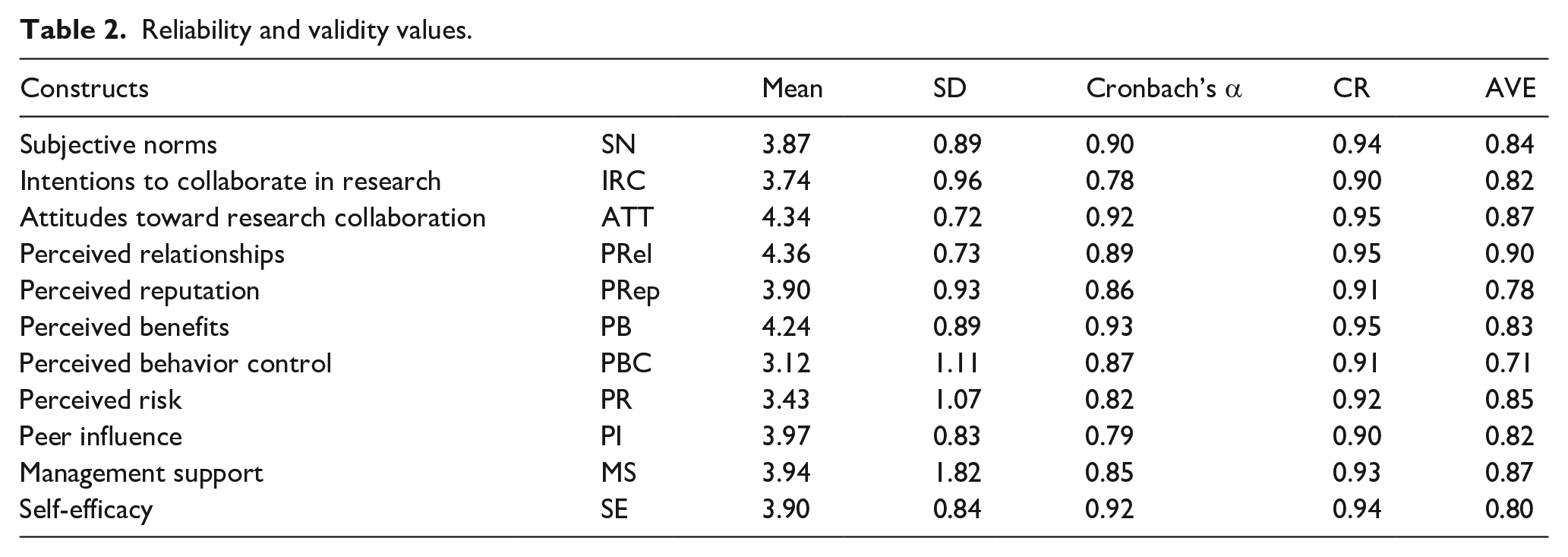
The internal consistency, convergent validity, and discriminant validity were examined in this section to assess the quality of the model. Cronbach’s α and Composite Reliability (CR) were used to assess the internal consistency. Generally, Cronbach’s α and CR values are greater than the recommended value of 0.70 (Chin, 1998), indicating acceptable reliability of the measurement items. In this study, all Cronbach’s α values were above 0.70. They ranged from 0.78 (intentions to collaborate in research) to 0.93 (perceived benefits). All CR values were greater than 0.70 and ranged from 0.90 (intentions to collaborate in research, peer influence) to 0.95 (attitudes toward research collaboration, perceived benefits). This suggested that each construct used in this study was acceptably reliable. The Average Variance Extracted (AVE) and the CR values were used to evaluate convergent validity (Fornell and Larcker, 1981). The AVE values ranged from 0.71 (perceived behavior control) to 0.90 (perceived relationships). All AVE values were more than the recommended values of 0.50 (Fornell and Larcker, 1981), and CR values also exceed 0.70. Therefore, the research constructs in this study were valid for estimating the structural model. The Cronbach’s α, CR, and AVE values are shown in Table 2.
Reliability and validity values.
The discriminant validity was tested based on Fornell and Larcker (1981) criterion. It required that the square root of the AVE all exceed the inter-construct correlations. The square roots of AVEs and the correlation matrix are presented in Table 3. Additionally, the principal component factor analysis with Varimax rotation was used to evaluate convergent and discriminant validity as shown in Table 4. The results showed that each measurement item was loaded on its expected factors with a minimum loading value of 0.53, which was greater than the recommended value of 0.40 (Kim and Adler, 2015). No item was loaded on more than two constructs with cross-construct loading above 0.44, which is lower than the recommended value of 0.60 (Kim and Adler, 2015). Therefore, this indicated that there were a satisfactory convergent validity and discriminant validity of the construct and its items in this study.
Square roots of AVEs and correlation matrix.
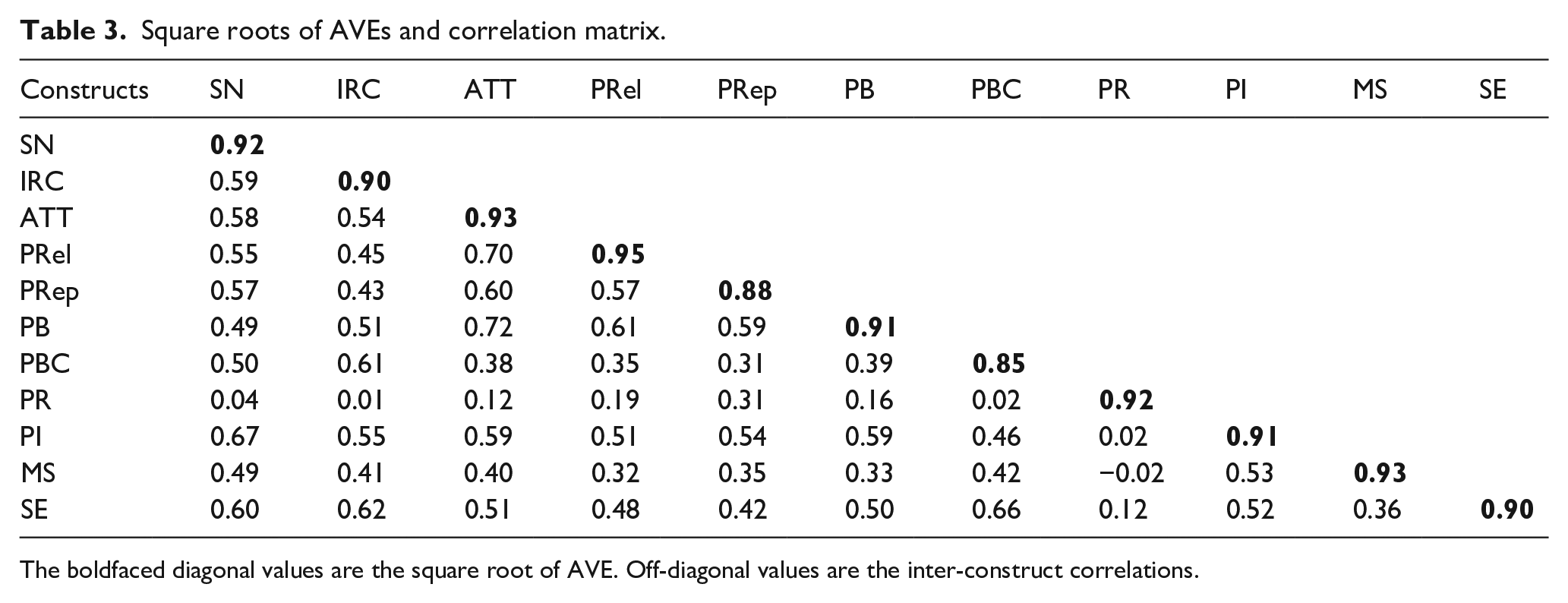
The boldfaced diagonal values are the square root of AVE. Off-diagonal values are the inter-construct correlations.
Results of principal component factor analysis with varimax rotation.
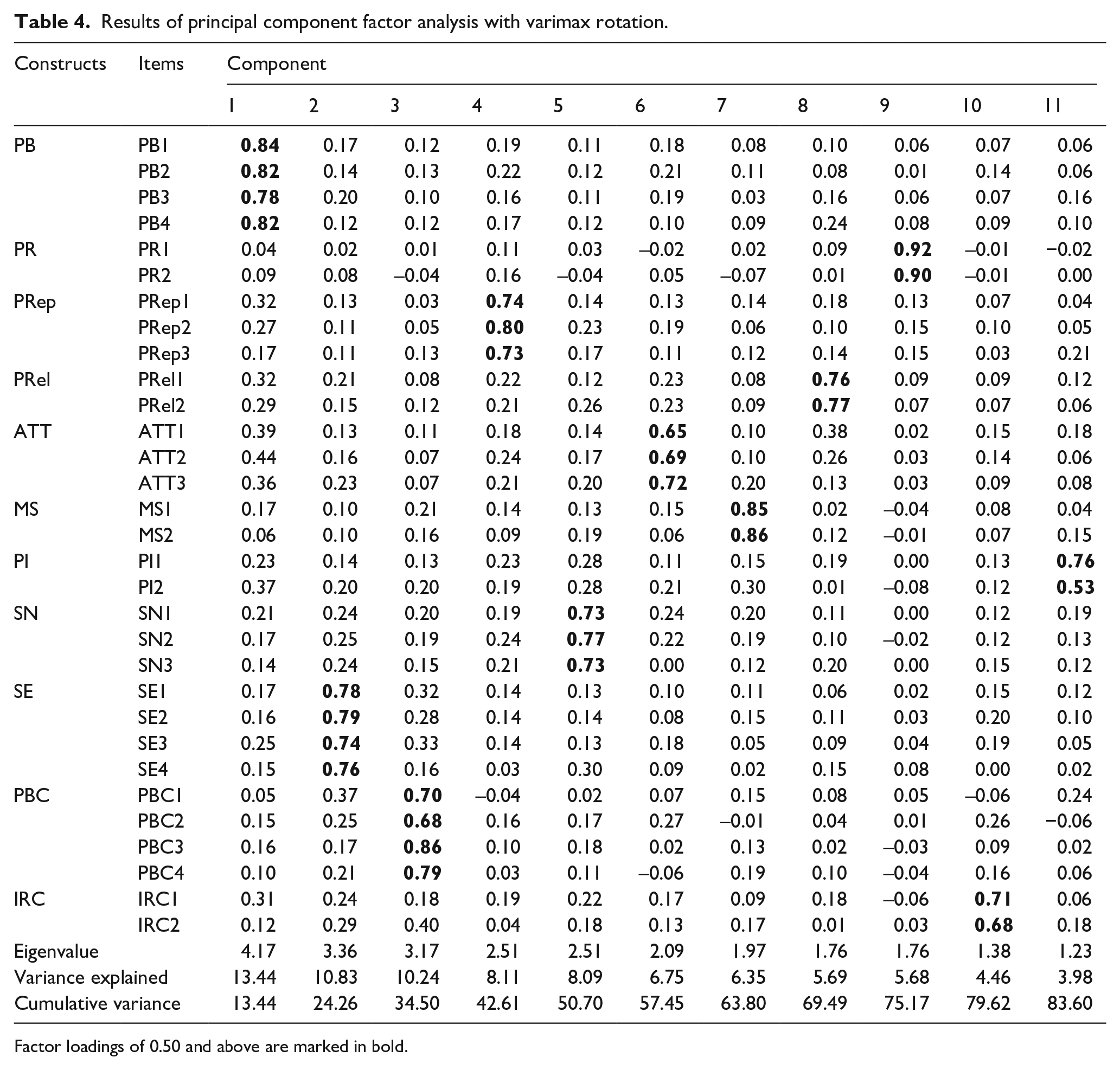
Factor loadings of 0.50 and above are marked in bold.
Structural model and hypothesis testing
The structural model was assessed to determine path coefficients and evaluated to investigate the hypothesized relationships among constructs. The path coefficients were determined by applying the resampling technique of bootstrapping in PLS-SEM. R2 values were reported to assess the exploratory power and range between 0 and 1 (R2 ⩾ 0.67 is considered substantial, 0.33 is moderate, and 0.19 is weak) (Chin et al., 2008). Figure 2 shows the result of the structural model.
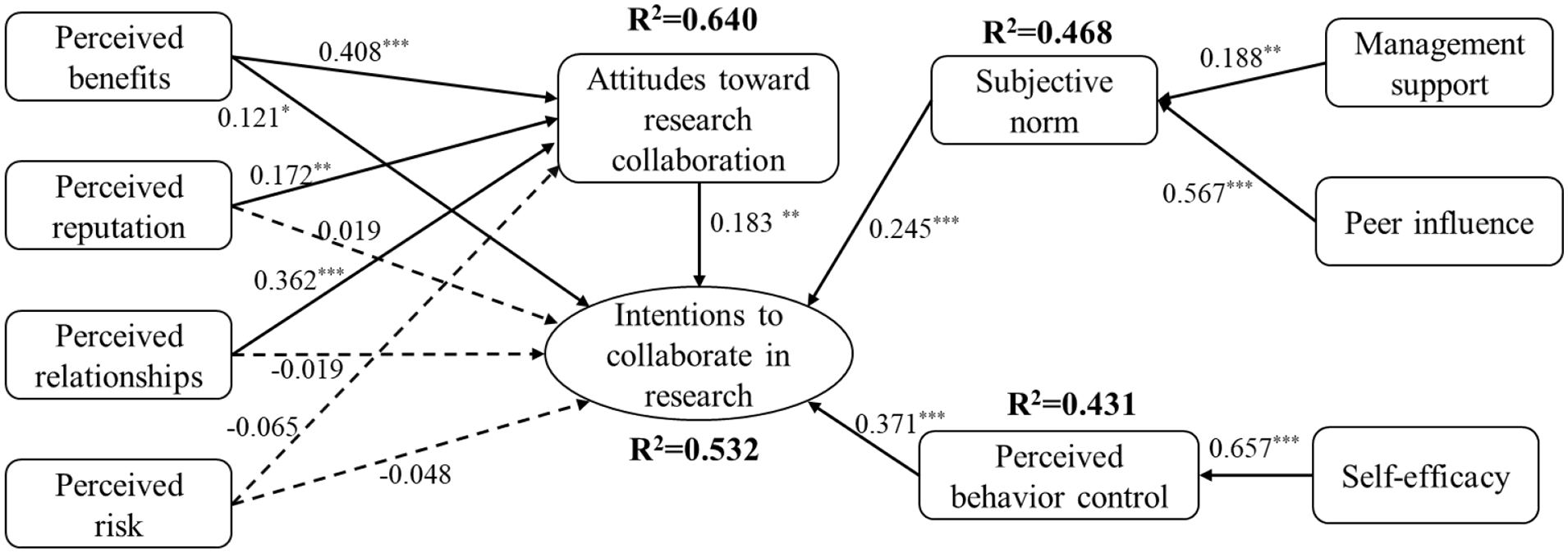
Results of the structural model.
The path coefficients suggested that the attitude toward research cooperation (β = 0.183, p < 0.01), subjective norms (β = 0.245, p < 0.001), and perceived behavior control (β = 0.371, p < 0.001) were all detected to have positive statistically significant relationships with librarians’ intentions to collaborate in research. Management support (β = 0.188, p < 0.01) and peer influence (β = 0.567, p < 0.001) were both found to have a significant positive influence on subjective norms. Self-efficacy (β = 0.657, p < 0.001) showed a significant positive effect on perceived behavior control. Perceived benefits (β = 0.408, p < 0.001), perceived reputation (β = 172, p < 0.01), and perceived relationships (β = 0.362, p < 0.001) was found to have positive statistically significant relationships with librarians’ attitudes toward research collaboration. However, perceived risk (β = −0.065, p > 0.05) was not detected to have a significant negative influence on librarians’ attitude toward research collaboration. Furthermore, perceived reputation (β = 0.019, p > 0.05), perceived relationship (β = −0.019, p > 0.05) and perceived risk (β = −0.048, p > 0.05) were also not found to have any significant relationships with librarians’ intentions to collaborate in research. However, only perceived benefits (β = 0.121, p < 0.05) positively influenced librarians’ intentions to collaborate in research.
The model could explain 53% of the variance of the librarians’ intentions to collaborate in research (R2 = 0.532), which indicated a moderate exploratory power. Additionally, perceived behavior control showed a more significant positive effect on the intentions to collaborate in research, accounting for its larger path coefficient, while the effect of perceived benefit was small.
Perceived benefit, perceived reputation, and perceived relationships could explain 64% of the variance in librarians’ attitude toward research cooperation (R2 = 0.640). Among these factors, perceived benefit and perceived relationships had stronger effects on attitude toward research collaboration than perceived reputation. Management support and peer influence explained 47% of the variance in subjective norms (R2 = 0.468), whereby the former had a small effect and the latter had a large effect. Finally, a single factor, self-efficacy, explained 43% of the variance in perceived behavior control (R2 = 0.431).
Multigroup analyses
When engaging in a multigroup analysis, the number of observations in each group must meet the general rules for minimum sample size requirements (Hair et al., 2017). In this study, we would need 110 (11 × 10, 11 is the number of latent variables) observations per group. For this reason, some categorical variables were merged and regrouped. Finally, five categorical variables were described as moderating variables in the multigroup analysis, including disciplinary background (physical sciences and engineering (PSE) vs humanities and social sciences (HSS)), length of career (⩽12 vs >12), professional rank (Assistant Librarian & Librarian (ALL) vs Associate Research Librarian & Research Librarian (ARLRL)), co-authored papers (0 vs >0), and research projects (⩽2 vs >2).
To ensure the validity of outcomes and conclusions, the measurement invariance must be evaluated before carrying out the multigroup analysis. Henseler et al. (2016) suggested a three-step procedure to analyze the measurement invariance of composite models (MICOM) when using variance-based SEM, such as PLS path modeling. Measurement invariance of composite models consists of the following procedures: (1) the configurational invariance assessment; (2) the establishment of compositional invariance assessment; and (3) the assessment of equal means and variances.
According to the outcome of the MICOM, the configural invariance and compositional invariance of the constructs were both established, while the equality of means and variances could not be verified (see Appendix 2). Therefore, the partial measurement invariance for five categorical variables was established. However, multigroup analysis was feasible because assumed partial measurement invariance was allowed (Henseler et al., 2016).
The results of PLS-MGA for five categorical variables are shown in Table 5. It was revealed that there was a significant difference between librarians from PSE and HSS concerning the effect of MS (management support) on SN (subjective norms). In terms of the moderating effect of professional rank, the effect of PR (perceived risk) on ATT (attitudes toward research collaboration) for librarians with lower professional ranks (i.e. the ALL group) was significantly stronger than the higher professional rank (i.e. the ARLRL group). The results indicated significant differences between librarians with ⩽2 research projects and >2 research projects concerning the effect of ATT and PRel on IRC. However, the moderating effects of length of career and co-authored papers of librarians did not exist in any path coefficients and relationships.
Summary of multigroup analysis results.
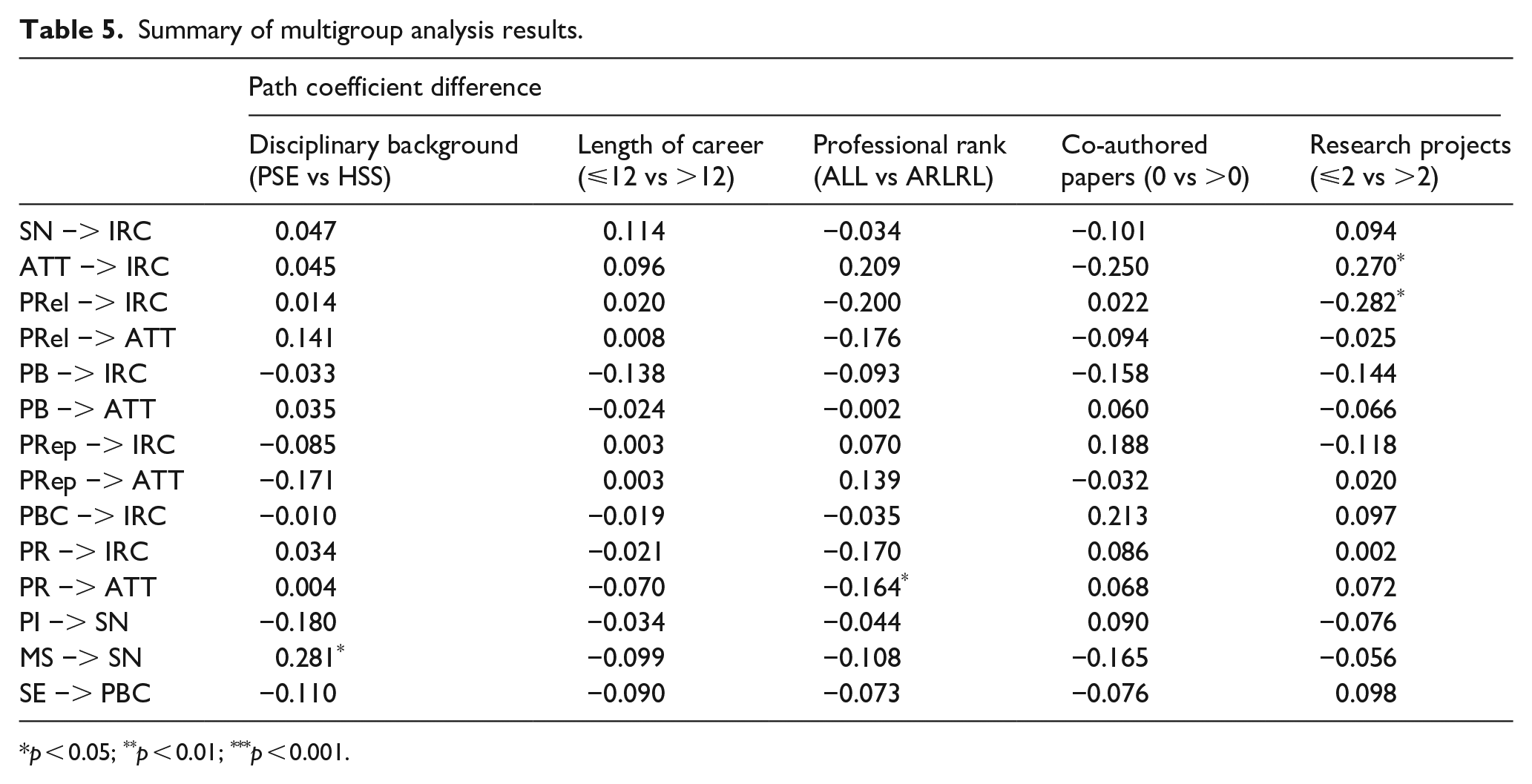
p < 0.05; **p < 0.01; ***p < 0.001.
Discussion
This research developed an integrative model using TPB and SET to demonstrate the influencing factors of Chinese academic librarians’ intentions to collaborate in research and to understand the differences of intentions among different groups of librarians. The results have shown that the overall observed variance in the model was appropriate (R2 = 0.532), according to the R2 value recommended by Chin et al. (2008). This could indicate that the integrative model using TPB and SET was useful and valid in explaining Chinese academic librarians’ intentions to collaborate in research.
Overall, four constructs showed significant influence on Chinese academic librarians’ intentions to collaborate, which were attitude, subjective norms, PBC, and perceived benefits. PBC was the most determinant variable, compared with the other three constructs. Further, self-efficacy was a significant factor in PBC, which explained 43% of the variance (R2 = 0.431). This suggested that the endogenous confidence could prompt academic librarians to believe that they were capable of handling difficulties and challenges in research collaboration. Self-efficacy can be developed by mastery experiences and social persuasion. For example, the library managers could offer some training courses or academic lectures to librarians who are lack of research skills. The improvement of research skills may increase librarians’ confidence in research collaboration (Kennedy and Brancolini, 2012). Besides, two decomposed constructs for subjective norms, management support and peer influence, both showed a positive impact on subjective norms and explained 47% of the variance in subjective norm (R2 = 0.468). In line with previous findings (Brachten et al., 2021), peer influence was found a more dominating impact on subjective norms than management support. This result indicated that the influence from colleagues was larger than managers when academic librarians decided whether to conduct research collaboration. Thus, there was a need to develop a good culture of research collaboration in libraries (Jacobs and Berg, 2013). Meanwhile, management support was essential, including research funding and policies (e.g. research leave or release time) (Smigielski et al., 2014).
Looking at the influence of the attitude and perceived benefits, they both had significant positive effects on academic librarians’ intentions to collaborate. Additionally, perceived benefits, perceived relationships, and perceived reputation showed significant positive influence on librarians’ attitudes toward research collaboration, which can explain 64% of the variance in attitude (R2 = 0.640). This suggested that perceived positive consequences (benefits, relationships, and reputation) in research collaboration have indirect effects on academic librarians’ intentions through attitude. Nonetheless, it’s worth noting that perceived risk didn’t show significant negative relationships to intentions and attitude. Contrary to the findings of this study that there is no relationship between perceived risk and collaborative intentions, Lan and Liu (2020) reported that one of the main reasons for most Chinese universities teachers’ unwillingness to collaborate is the potential risk that they could not obtain their ideal authorship order. Overall, it indicated that the positive consequences of research collaboration showed more important than the negative risk for academic librarians. As reported by Campbell et al. (2011), collaborating or working together has more benefits than challenges for librarians. Although the significant effect of perceived risk was not supported in this study, it can still remind the institutional manager that the promotion framework of professional rank should be improved. It is unfair for other collaborative authors that only the first author can be approved by the promotion framework of professional rank. Maybe it is a better method to score the authors in different order when evaluating their professional rank.
According to the results of multigroup analyses, there were significant differences existing in path coefficients for librarians with different disciplinary backgrounds, professional ranks, and research projects, while no significant differences were presented in groups by various lengths of career and co-authored papers. The path coefficient running from MS to SN was statistically different between librarians in the PSE discipline and the HSS discipline. In other words, the influence of management support on librarians’ subjective norms was more considerable for librarians in the PSE discipline compared with those in the HSS discipline. A possible explanation is that academic librarians educated by different curriculum system between PSE and HSS disciplines might have different research paradigm and research methods. While LIS belongs to the HSS disciplines in Chinese education system, those librarians graduated from the PSE discipline could have some difficulties in conducting LIS studies regarding to research paradigm and research methods, especially when they were new to libraries. Therefore, they might need more management support to engage in research collaboration. This support included funding support, work support, and the opportunity to collaborate (Kennedy and Brancolini, 2012; Tang, 2020). Another significant difference was found in the influence of PR on ATT when comparing the path coefficients of two groups for different professional ranks. The effect of perceived risk on attitude of librarians with lower professional ranks (i.e. the ALL group) was significantly stronger than those with higher professional ranks (i.e. the ARLRL group). This may due to the unequal working relationship between collaborators with different professional ranks. Generally, the directing collaborative relationship existed when the collaborators are of unequal standing in term of seniority (Hart, 2000a). In this collaborative relationship, librarians with higher professional ranks (e.g. senior librarians) were more likely to maintain primary control and direct other collaborators, and they have more discursive power about the listed order of authors. While collaborators with lower professional ranks were in a passive situation and more worried that they will not be able to be credited the authorship order approved by the promotion framework in China, namely the first author or the corresponding author (Lan and Liu, 2020). Finally, the results demonstrated that collaborative experience in research projects has a significant moderating effect, regarding the relationship between ATT, PRel, and IRC. The effect between attitude and collaborative intentions was stronger for the librarians with less research projects (⩽2) than those with more research projects (>2). This indicated that academic librarians lacking of collaborative experience in research projects tend to engage in research collaboration when they have a more positive attitude, with compared to experienced librarians, because their desire for help in collaboration is stronger. However, the librarians with more research projects (>2) display higher effects of perceived relationships on their collaborative intentions rather than the librarians with less research projects (⩽2). This might be the librarians with more collaborative experience have developed the stable relationship networks, which can be help them easy to engaged in collaboration rather than less-experienced librarians.
Conclusion
This study provided a theoretical understanding of research collaboration among Chinese academic librarians by using the quantitative analysis methods and examined the internal influencing mechanism of various factors. In prior studies, most researches have used co-authorship on articles or publications as a method for identifying existing research collaborations (Blecic et al., 2017; Chang, 2021). Although some studies used a survey questionnaire to examine the motivations of faculty to collaborate with librarians, the main research object was the faculty (Amante et al., 2013; Montiel-Overall, 2009; Yu et al., 2019). While this study mainly was focused on the librarian’s perspective to understand the motivations or influencing factors of their intentions to collaborate in research. The findings of this study can help the institutional manager to make more effective incentives to promote collaboration among librarians. Furthermore, the development of librarianship requires large collaborative and participatory measures (Tran and Chan, 2020). Therefore, promoting research collaboration is also important for the profession and the organizations.
This study had certain limitations that must be highlighted as they would provide some reference for future studies. The first limitation was related to data collection, which was conducted in the Chinese context. Hence, future studies could compare librarians’ collaboration from multiple countries and analyze how these factors differ in different countries. Secondly, it is unclear from this study whether different collaborators will affect the librarians’ intention, as the types of research collaboration include both with other librarians and with disciplinary faculty. These limitations could lay the foundation for future research.
Footnotes
Appendix 1. Questionnaire for academic librarians in Chinese universities libraries
Declaration of conflicting interests
The author(s) declared no potential conflicts of interest with respect to the research, authorship, and/or publication of this article.
Funding
The author(s) disclosed receipt of the following financial support for the research, authorship, and/or publication of this article: This research received support from the Shanghai Planning Office of Philosophy and Social Science (Project No.2019ETQ004), Fundamental Research Funds for the Central Universities (2021ECNU-YYJ011) and the Research and Innovation Program of the library in East China Normal University (Project No.48609230/009).
