







Abstract
Research in early childhood development widely supports play as a vital learning mechanism for young children. Consequently, many libraries are beginning to embrace play as an intentional strategy for meeting targeted early learning outcomes. However, sufficient research on how play can be incorporated into storytimes to support children’s early development has yet to be conducted. This study begins to address this need by exploring how two other informal learning environments—a museum and a zoo—use educator-led dramatic play experiences in storytimes with the goal of understanding how libraries might be able to incorporate dramatic play experiences in their storytimes to create a more in-depth playful learning experience. To elucidate the nature of the museum and zoo’s educator-led dramatic play experiences, this study explored (1) characteristics of their educator-led dramatic play experiences, and (2) the learning behaviors that children were exhibiting while participating in the dramatic play. The results revealed that the educator-led dramatic play episodes in both environments consisted of one long, immersive oral story with other types of play interspersed within the larger story structure. The data also revealed that the children were exhibiting many different types of learning behaviors while participating in the dramatic play experiences. Based on these findings, implications, and recommendations are provided for libraries around designing and using dramatic play in their storytimes to help transform the traditional library storytime structure into a more in-depth playful learning experience.
Keywords
Introduction
As one of the most common, and arguably well-known, children’s programs in public libraries, storytimes have long been recognized for their role in family engagement and learning for young children and caregivers. Library storytime programs often incorporate a wide variety of elements including songs, rhymes, and chants, books, props, and manipulatives, puppets, music, and movement-based activities to encourage multimodal engagement opportunities (Campana, 2021). Previous research on public library storytimes has found that these programs can support a variety of early learning and school readiness skills including literacy, mathematics, and others for young children (Campana, 2021). As child enjoyment is frequently a key motivator for family attendance at storytime (Cahill et al., 2020), it is perhaps not surprising that the field has also emphasized the importance of play in public library storytimes, especially as a method for engaging families and supporting children’s development (Diamant-Cohen et al., 2012; Nespeca, 2012). And while play is an important mechanism for supporting children’s development, some child development scholars have moved beyond play to “playful learning,” where educators or other adults intentionally support learning through play, as a more effective way to support learning and development (Hassinger-Das et al., 2017). Given that many libraries highlight early literacy and early learning as goals for their storytimes (Campana, 2021; Campana et al., 2016), it is likely that there are some elements of playful learning present in library storytimes; however, research and professional development is needed to help libraries be more effective with playful learning in their storytimes.
Despite storytime’s documented benefits, popularity, and multimodal methods for family engagement; research focused on storytimes in public libraries continues to be sparse, with calls from scholars for more work in the area of storytime research (Cahill et al., 2020; Mills et al., 2018; Prendergast and Sharkey, 2021). Additionally, there may be continued room to examine new models and ideas for improved practice, potentially from other community-based organizations (Stooke and McKenzie, 2009). Reflecting this, in 2019, the Association for Library Service to Children (ALSC) approved a National Research Agenda which outlined multiple lines of needed inquiry and noted that research into public libraries could benefit from looking at other informal learning environments’ work engaging young children and families, including work by museums and zoos (Campana et al., 2019). Given these needs, and the rising evidence for the importance of play and playful learning in early learning contexts, this study examines the nature and early learning outcomes of one specific type of playful learning experience—dramatic play—in museum and zoo storytimes.
Study background
This paper utilizes a secondary analysis of video-recorded storytimes from a previous Institute of Museum and Library Services-funded dataset that included storytimes from a library, museum, and zoo. All three institutions aim to support learning and enjoyment for their communities through the things they house and provide access to—books, objects, and animals—and the programs they offer. Because of these similarities, the original goal of the analysis was to look at aspects of educator-led playful learning and the types of early learning behaviors they supported across the three environments’ storytimes. However, during initial observations, it became clear that the storytime structures were different between the library and the other two environments. While the library storytime consisted of several short elements (i.e. books, songs, and rhymes), reflective of a common library storytime structure (Campana, 2021), the museum and zoo storytimes were framed around one long, oral story, transformed into an interactive dramatic play episode, accompanied by fewer short elements. This resulted in the zoo and museum educators facilitating much richer, and longer, dramatic play experiences in their storytimes than the library. These differences led us to focus on exploring the nature of the dramatic play present in the zoo and museum storytimes as a potential alternative method and structure for library storytimes. This article presents the results of this exploration by detailing the findings from the educator-led dramatic play experiences in the museum and zoo storytimes along with implications for libraries on incorporating and enhancing dramatic play experiences in their storytimes with the goal of creating a more in-depth playful learning experience.
Literature review
Play has become widely acknowledged as being vital for children (White, 2012; Zosh et al., 2017), with many researchers and practitioners embracing the idea that play is not just a powerful tool for learning, but an essential mechanism for healthy childhood development. Informal learning environments are increasingly prioritizing play as a way to support and encourage important early childhood learning outcomes. Significantly, some informal learning environments, such as libraries, museums, and zoos, have identified play-based learning as one of their goals for how they engage and support the learning process for children and their families (Luke et al., 2017; Nespeca, 2012; Worch and Haney, 2011). Both the Association of Children’s Museums (n.d.) and the Association for Library Services to Children have promoted the value of play for children (Nespeca, 2012) - particularly through ALSC’s Every Child Ready to Read initiative (Celano et al., 2018), and zoo spaces designed on play-based learning principles are becoming more common (Worch and Haney, 2011).
Educator-led play & playful learning
As play has become more widely recognized as a learning mechanism, insights into its benefits and effective practices have led to the development of different approaches to play. Play has long been characterized as a child-directed act, where the child initiates, directs, and chooses to participate in the play experience in the ways that they want (Schlesinger et al., 2020). And while child-directed play offers significant benefits for the children involved, scholars have begun to realize that the involvement of an adult at certain levels can help to elevate the play experience to where children learn more through play (Gardner-Neblett et al., 2016; Weisberg et al., 2016). The concept of playful learning has emerged from this realization that it is possible to intentionally offer support for learning through play. Hassinger-Das et al. (2017) describe playful learning as “play experiences that result in learning” (p. 192) and portray it as an umbrella concept that incorporates both free and guided play. While free play is the same as purely child-directed play, guided play refers to play experiences where an adult provides some support and scaffolding for the child(ren) during play with the goal of supporting learning (Schlesinger et al., 2020). Even though children can learn during both free and guided play, Hassinger-Das et al. (2017) and additional scholars acknowledge that the adult-facilitated nature of guided play helps the learning process to be more efficient (Gardner-Neblett et al., 2016; Weisberg et al., 2016).
Considering the possible importance of the adult in elevating the learning process in play (Gardner-Neblett et al., 2016; Weisberg et al., 2016), research is also needed to explore how educators in informal learning environments facilitate playful learning. Experiences that are led by educators are often excluded from being characterized as play, even if they have some play characteristics, due to the fact that the experience is not solely child-directed. In fact, multiple play scholars paint a stark dichotomy between educator-led experiences and play experiences (Hassinger-Das et al., 2017; Paterson, 2020; Pyle and Danniels, 2017). However, many educator-led experiences in informal learning environments blur the lines of the educator-led/play divide with the way they (1) give the children freedom to engage in the experience in the ways that they want; (2) incorporate multimodal, interactive, playful methods for children to engage with the topics in the program (Campana, 2021); and (3) sometimes use child-led approaches in their programs, like being a “guide on the side” (Mitchell et al., 2020) or incorporating child-directed moments (Campana, 2021). Because of this, it is important to understand how playful learning might be present in these educator-led programs in informal learning environments.
Dramatic play
While play in general has been noted for its learning-related benefits for young children, dramatic play, with its often-complex development and narrative, has been of particular interest for both formal and informal learning settings. Common among young children, dramatic play can be a highly rich and developed form of play that is supportive of age-appropriate development (Gao and Hall, 2019), if children are given the time and support to develop it (Christie, 1990). This type of play is typically characterized by pretend or imaginative playful experiences that focus on the construction of a fantasy world or alternative reality with complex storylines, characters, and rules (White, 2012). Other elements of different types of play can be incorporated into dramatic play, as long as it adheres to the rules of the constructed reality and narrative of the play (Whitebread et al., 2012). While socio-emotional benefits have been frequently tied to dramatic play (White, 2012), evidence exists that dramatic play can support early reading and writing practices as well with appropriate adult support and facilitation (Christie, 1990; Loizou et al., 2019). Dramatic play also offers opportunities for children to deepen their understanding of the world around them, build empathy, and practice life skills, and roles (Gao and Hall, 2019). While the use of narrative—or oral—storytelling skills, which rely heavily on elements of dramatic play, have been incorporated into public library storytimes since the late 1940s (Albright et al., 2009), there is still limited research focused on this specific type of play in storytimes in informal learning environments such as libraries, zoos, and museums.
Similar to the importance of the adult’s role in children’s play more broadly, researchers have found that adults or educators can enrich the dramatic play experience for children (Gao and Hall, 2019). Indeed, evidence from early childhood classrooms has found that educators can be important facilitators and guides for children’s dramatic play (Robertson et al., 2020), helping to deepen the experience for children by incorporating additional elements and encouraging a more complex play scenario (Loizou et al., 2019). Adult-facilitated dramatic play, with its opportunities for meaningful child contributions, lends itself particularly well to Pyle and Danniels (2017) child-centered approach to playful learning, where the play experience is developmentally appropriate; based on the children’s interests and abilities; and is offered in a fun, engaging, and interactive manner.
Informal learning environments
As public libraries and other informal learning environments offer similar educator-led programs for children, such as storytimes, STEM, art, movement, and more, with the goal of supporting learning and engagement with a variety of concepts and topics through playful methods (Sirinides et al., 2017), implications from studies on a variety of informal learning environments about how play and playful learning can be incorporated effectively into child-focused programing are of interest to library sciences as well as the larger field of informal learning.
Some studies have revealed that informal learning environments are supporting and encouraging play and playful learning through providing play materials, spaces, and structures (Hassinger-Das et al., 2020; Shine and Acosta, 2000; Worch and Haney, 2011), however research on play and its relation to early childhood learning remains limited in some informal learning settings, services, and programs. Play has been of particular prominence in museum research (Henderson and Atencio, 2007; Krakowski, 2012), with past studies primarily centered on child-directed play and parent-child interactions that support play in museum programs and services (Piscitelli and Penfold, 2015; Shine and Acosta, 2000). There have been limited explorations into the presence of play in zoos. The few studies that have been done have focused on nature-based play (Ernst, 2018) and the occurrence of different types of play in zoo spaces curated to promote unstructured child-led play (Worch and Haney, 2011).
For public libraries, the second edition of the Every Child Ready to Read initiative stressed the use of play as an important learning practice and tool that library staff can incorporate into their programing, including library storytimes (Nespeca, 2012). Emerging literature and practitioner-focused writings have indicated that public libraries have been focusing on creating library spaces (Hassinger-Das et al., 2020), providing “loose parts” toys (Swadley, 2021), and offering programs (Ruscio, 2019) to better incorporate and facilitate children’s unstructured play. For public library storytimes, the use of play has ranged from offering time and space before and after the program for unstructured and less adult-guided play (Diamant-Cohen et al., 2012), to more actively adult-led short, playful elements during the program (Campana, 2021). Understanding more about how educator-led play, and specifically dramatic play, may be effectively sustained and fostered throughout the entirety of the library storytime program holds potential to benefit children’s development and move the incorporation of play in storytimes more toward a model of playful learning.
The study described here begins to address this need by providing holistic insight into the nature of dramatic playful learning experiences present in both museum and zoo storytimes, including (1) the characterization of educator-led dramatic play experiences, and (2) the learning behaviors that children were exhibiting during the educator-led dramatic play experiences. The findings are then used to inform a section focused on implications for libraries with recommendations and effective practices for incorporating dramatic play in storytimes and ultimately transforming the traditional library storytime structure into a more in-depth playful learning experience.
The study
The following research questions were used to guide the exploration into the nature of these educator-led dramatic play experiences in the zoo and museum and how they might be used to create an alternative structure for library storytimes with the goal of offering in-depth playful learning experience for the children who attend.
How can library educators use educator-led dramatic play experiences to transform their storytimes into more in-depth playful learning experiences?
What can educator-led dramatic play experiences look like in storytimes?
What types of early childhood learning behaviors can occur during these educator-led dramatic play experiences?
Storytime settings and participant populations
During the original study, three storytimes were video recorded in an art museum and a zoo over 3 weeks to provide more consistent insight into the nature of storytimes in that environment. At each storytime, two video-recordings were created: one of the storytime educator(s) offering the program and one of the children and caregivers attending the program. While the storytimes in both environments were offered for preschool children (ages ~3–6) and were 30 minutes in length, each environment had distinct features. The storytimes at the museum were offered in one of the art galleries and incorporated a lengthy dramatic play experience based on an oral story that was developed and led by educators from a dramatic arts troupe. The educators also used games during the storytime to get the children looking at and observing the art in the gallery. The museum storytimes ended with the children getting to bang on a large drum and share something about themselves with the educators in a one-on-one interaction. The storytimes at the zoo were offered in the zoo’s family play area and led by educators from the zoo who centered the storytime on an extended dramatic play experience which was based on an oral story and used puppets to help bring the animal storyline to life. The dramatic play experience was followed by guessing games where the children guessed the live animal that was visiting the storytime. Then the storytime ended with the children getting the opportunity to interact with the live animal one-on-one.
Across all of the storytimes in both environments, the participants included 7 educators, 121 young children, and 52 caregivers. 1 For the zoo, a different zoo educator led each of the three storytimes and there was an average of 18 children and 9 caregivers at each storytime. The museum had a dramatic arts troupe from an outside theater organization come in to lead their storytimes. Three educators from the troupe led the first storytime and the same two educators led the last two storytimes. The museum had an average of 23 children and 8 caregivers per storytime.
Coding for educator-led dramatic play experiences
Observations of both the educator and child/caregiver participant videos were completed for all three storytimes in each environment, resulting in a dataset of 12 videos from six storytimes. For the observations, the storytime videos were evenly divided among the research team, with two researchers watching each storytime video from the start of the program until the end, individually taking field notes on both the educator and participants. In line with other literature on public library storytimes (Campana et al., 2016), programs were considered as starting at the commencement of an introduction or an announcement and ending with a closing activity or announcement. Each researcher then applied the current iterative codes to their own field notes before discussing and agreeing upon final coding.
Each storytime incorporated an oral story as a central part of the storytime, so group consensus among the research team was used to determine if the oral story could be considered an educator-led dramatic play experience. Dramatic play experiences were defined as a pretend or imaginative playful experience that focused on the construction of a fantasy world or alternative reality with complex storylines, characters, and rules (White, 2012). Based on discussions, the research team determined that the oral story in each storytime did fit within the criteria for dramatic play experience and educator-led playful learning. Criteria for educator-led playful learning was based on the surmised motives, context, and behavior of the educators, children, and caregivers (Jenvey and Jenvey, 2002), along with the playful learning characteristics identified by Hassinger-Das et al. (2017). These included the level of interest, engagement, interactivity, activeness, inhibition of reality, fun, and content that were present (Hassinger-Das et al., 2017). During these initial observations, it became apparent that within the educator-led, dramatic play experiences there were many other types of educator-led playful learning occurring. As a result, the research team coded for playful subtypes that were present in each dramatic play experience to capture the richness and diversity of playful learning (see Figure 1).
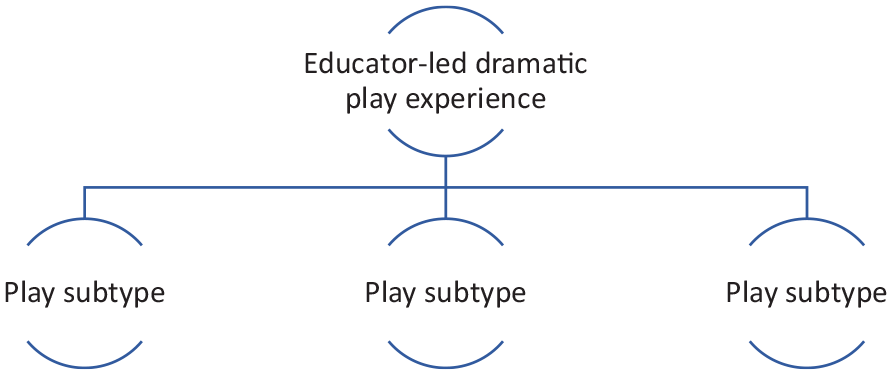
Relationship between dramatic play experiences and subtypes.
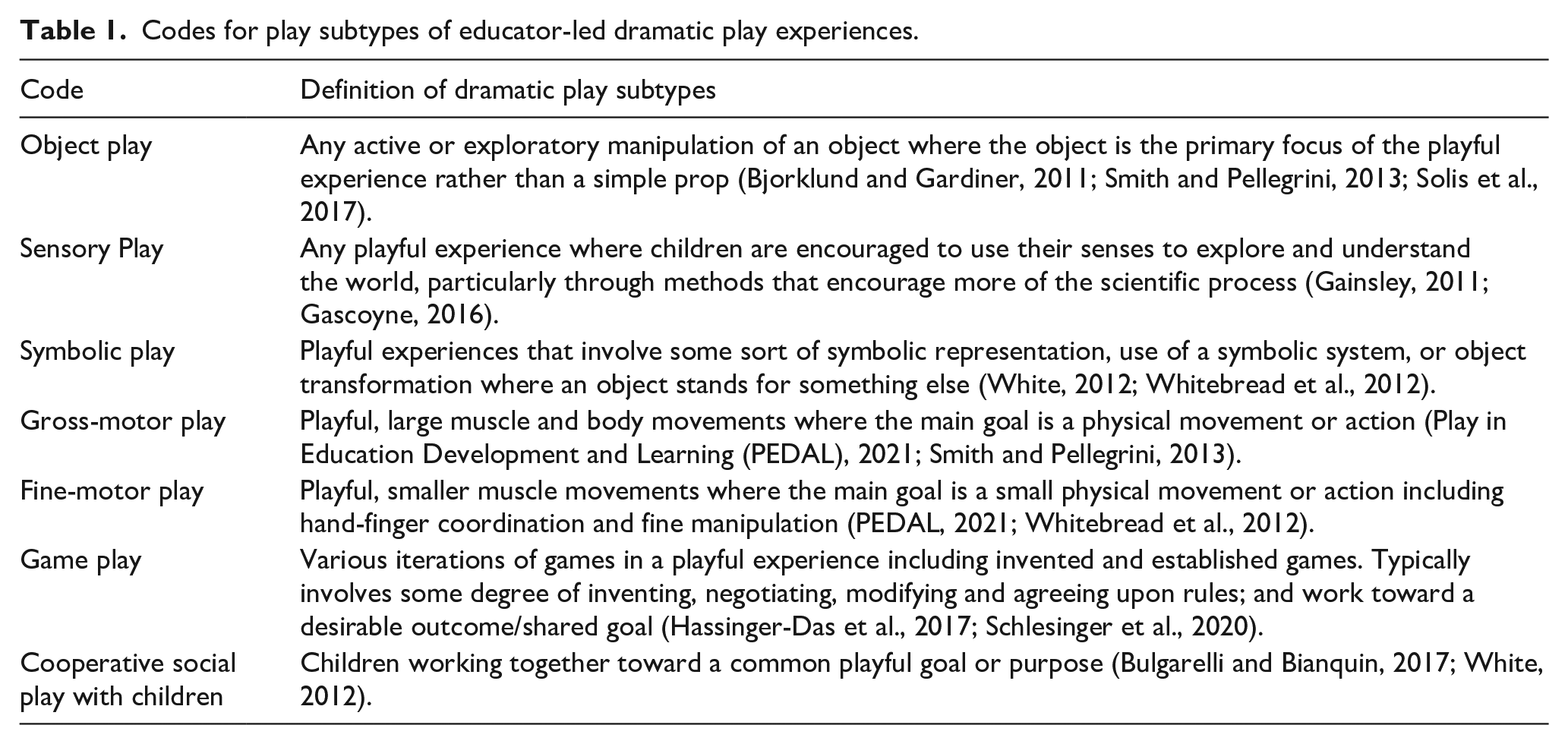
Initial playful subtype code definitions were derived from free and guided play literature with iterative rounds of consensus coding used to refine the definitions (see Table 1). After the codebook was developed all three researchers coded their own field notes individually and then discussed the dramatic play experiences and playful subtype codes with the goal of reaching agreement on the final application of codes, per Saldaña’s (2013) previous work on collaborative coding practices. Disagreements around the application of codes were handled through group review of the video and/or field notes, followed by discussion between the researchers. If the disagreement persisted, the final code was decided by majority vote between the three researchers. The codes for the dramatic play experiences and playful subtypes were then analyzed by environment using frequency counts.
Codes for play subtypes of educator-led dramatic play experiences.
Coding for learning behaviors of children
To better understand what types of early childhood learning behaviors can be effectively supported by educator-led dramatic play experiences in storytimes, this study utilized an observational tool derived from the Head Start Early Learning Outcomes Framework (Campana, 2018; Office of Head Start, 2015). While Head Start preschools are formal learning environments, the Head Start Framework is not specifically linked to formal learning environments and instead provides basic information on what young children should know and be able to do during their early years, similar to early learning guidelines developed by each state in the United States (Administration for Children & Families, 2016). Both the Head Start-based observational tool and another tool based on individual state early learning guidelines have been used in previous library research (Campana, 2020; Campana et al., 2016).
The Head Start Framework and the related observational tool present developmentally appropriate learning indicators for preschoolers organized into indicators, goals, subdomains, and then ultimately into five broad developmental domains. The observational tool was used to code the learning behaviors children were exhibiting during educator-led dramatic play experiences. However, only four of the developmental domains were used in this study. In addition, two subdomains—Writing (under the Language and Literacy domain) and Measurement (under the Mathematics Development domain)—were not observed at all during the dramatic play experiences, likely due to the indicators’ reliance on specific tools that were not present in the environments. All indicators were coded and analyzed at the goal level for each dramatic play experience in each storytime. The goal was considered observed if at least one indicator was present. Using one set of field notes for consistency, each storytime was reviewed and coded independently by two researchers. The researchers engaged in discussions to agree on the final application of codes. Then, for each environment, the average percentage of goals observed was calculated for each developmental subdomain to provide a generalized overview for each environment’s storytime program.
Results
The observations revealed that storytimes in both environments offered multi-faceted and diverse educator-led dramatic play experiences. The sections below will provide more information on these play experiences along with the learning behaviors that children exhibited during the dramatic play experiences.
Zoo storytimes
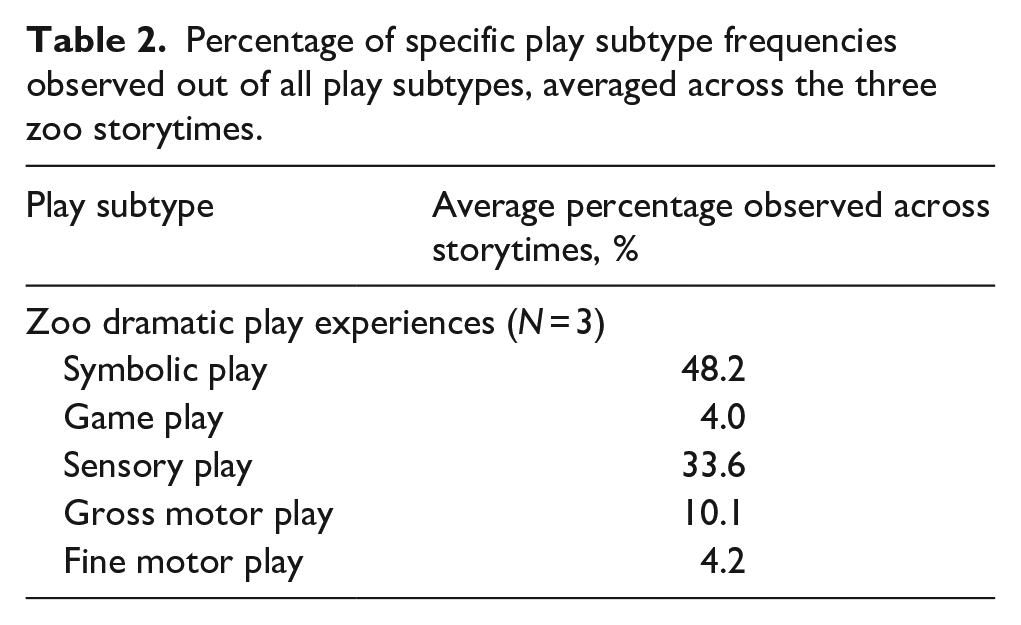
All three zoo storytimes offered a dramatic play experience consisting of an oral story focused on animals, illustrated through the use of animal puppets, that ultimately led to a reveal of a featured live animal with which the children were allowed to interact. In each of the three educator-led dramatic play experiences, five play subtypes were used at varying frequency (Table 2). While the oral storylines differed across the three storytimes, some parts of the oral story structure were similar, such as one specific animal puppet interacting with a variety of other animals to reveal particular characteristics about the different animals. In one oral story the crow puppet becomes tired of flying and meets a variety of other animals trying out their modes of locomotion such as hopping like a rabbit, inching like a caterpillar, and walking like a moose. In another, the educator uses a cockroach puppet who meets and learns about how an assortment of other insects’ sounds and appearance, encouraging participants to mimic the noises and point out the unique features of each animal.
Percentage of specific play subtype frequencies observed out of all play subtypes, averaged across the three zoo storytimes.
Dramatic play subtypes
Within the educator-led dramatic play experience in each storytime, the zoo educators incorporated a variety of playful subtypes (Table 2) that drew the child participants into acting out portions of the oral story and exhibiting different learning behaviors. Symbolic play was the most frequently observed play subtype in the zoo dramatic play experiences, accounting for 48.2% of all subtypes, and tended to revolve around the children representing some of the puppet’s behaviors and actions in brief interludes. In one example, the zoo educator asked the children to show them what a “scared face” looked like when one of the puppets heard an unknown noise from a hidden animal. These different symbolic play interactions helped to support learning behaviors in a number of subdomains, including Creativity, Emotional Functioning, and Comprehension.
The sensory play subtype was the second most common (33.6% of all subtypes) and tended to focus on encouraging children to draw conclusions from visual and auditory observations, such as describing a butterfly’s colors and spots or making the same noise as a crow. These sensory play interactions supported a variety of learning behaviors, including Counting and Cardinality, Scientific Inquiry, and Vocabulary. Gross motor, fine motor, and game play were the least frequent subtypes (10.1%, 4.1%, and 4% respectively). Fine motor was only present in one of the storytimes and involved making finger motions to mimic a caterpillar inching along while gross motor occurred slightly more frequently at once per storytime, typically involving a stretch or action to mimic an animal’s actions. The two instances of the game play subtype were the same between storytimes and consisted of making a bee buzzing noise while the bee was flying but stopping as quickly as possible when the bee landed. This game was meant to mirror real bee behavior.
Children’s learning behaviors
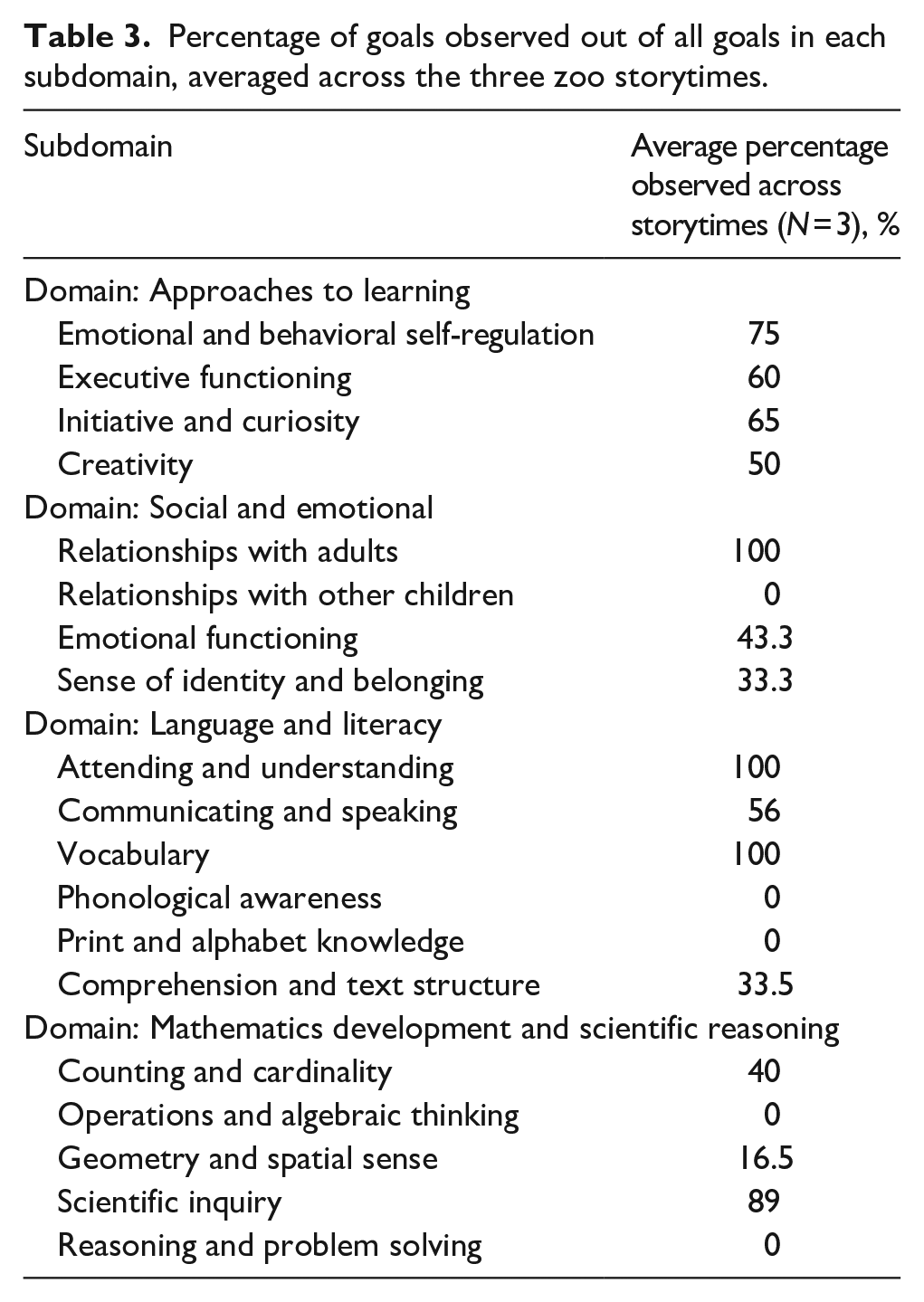
During the educator-led dramatic play experiences in the zoo storytimes, children exhibited learning behaviors across the four developmental domains coded for in the study (see Table 3). Learning behaviors under the subdomains of Approaches to Learning, Social and Emotional, and the Language subdomains of Language and Literacy (Attending and Understanding, Communicating and Speaking, and Vocabulary) were the most frequently observed. These behaviors were mostly due to having the children interact in a group setting and with the educators; participate in the interactive, detailed, dramatic play experiences; and control their own participation (verbal and physical), choices, information seeking, and more. However, the prevalence of learning behaviors under Vocabulary was due to the unusual science-related words children were able to engage with and use during the sensory play subtype opportunities. Learning behaviors under Mathematics Development and Scientific Reasoning were not observed as frequently as the others, but it is important to note that an average of 89% of the goals under Scientific Inquiry were observed, which was due to the observation skills and information sharing children engaged in during the sensory play subtype opportunities. Finally, the Literacy subdomains of Language and Literacy (Phonological Awareness, Print and Alphabet Knowledge, and Comprehension and Text Structure) were observed the least, with no learning behaviors observed under Phonological Awareness and Print and Alphabet Knowledge.
Percentage of goals observed out of all goals in each subdomain, averaged across the three zoo storytimes.
Museum storytimes
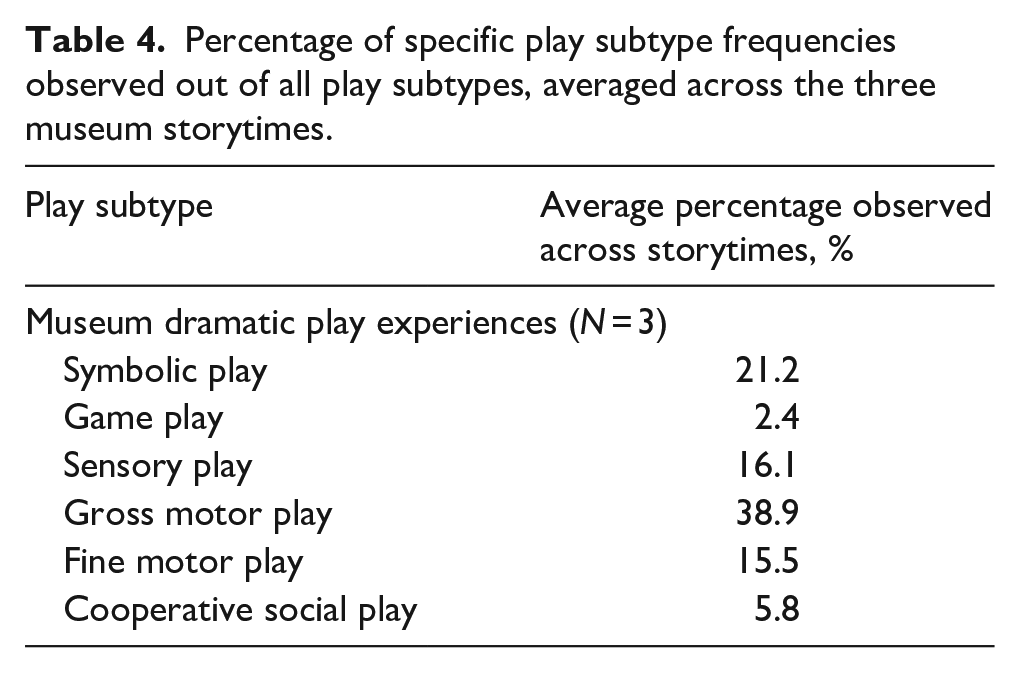
The dramatic play experiences in the museum storytime were longer and more complex than those in the zoo storytimes, with one dramatic play experience, in the form of an immersive and interactive oral story, taking up the majority of the storytime across each of the three programs observed. While the storyline changed slightly across the three storytimes, repetitive sequences of gross motor, fine motor, and sensory play subtypes (Table 4) were common across the dramatic play experiences and typically used as a transition element in the storyline such as moving from a “forest” to the “ocean” setting. In two of the storytimes, physical books sat at the center of the educator-led dramatic play experience. In one, the educators used the 1986 Caldecott Honor picturebook King Bidgood’s in the Bathtub by Audrey and Don Wood. In this dramatic play experience, educators led the children through pretending they were going to a king’s birthday party, which included activities such as learning how to greet the king, be a page, and decide what to give as a birthday gift, before reading the book aloud. After which, while one educator pretended to be the king in the bathtub, the children and other educators pretended they were at the party and worked together to problem-solve how they could get the “king” out of the bathtub.
Percentage of specific play subtype frequencies observed out of all play subtypes, averaged across the three museum storytimes.
Dramatic play subtypes
Of the play subtypes present in the dramatic play experience, gross motor was the most prevalent with symbolic as the second most common. The symbolic play subtypes appeared when the educators encouraged the children to act out a variety of concepts. This could be seen in one of the storytimes where the children acted out wind and trees blowing, ocean waves rolling, rain coming down, and more as part of the dramatic play experience. These instances of the symbolic playful subtype helped to encourage a high occurrence of learning behaviors under the subdomain of Creativity as children were able to incorporate their own interpretations and ideas when pretending or acting things out. In the King Bidgood’s in the Bathtub-related dramatic play experience children pretended to give the king a variety of presents of their own devising such as a necklace, pieces of cake, and a wand. Similar to the zoo, sensory play subtypes appeared when the children were encouraged to make observations from visual and tactile interactions, but the museum educators also used a variety of sounds to encourage the children to use their auditory sense. Game play and cooperative social play were only occasionally observed. Cooperative social play, while observed less frequently, was important because it helped to support behaviors under the Relationships with Other Children subdomain.
Children’s learning behaviors
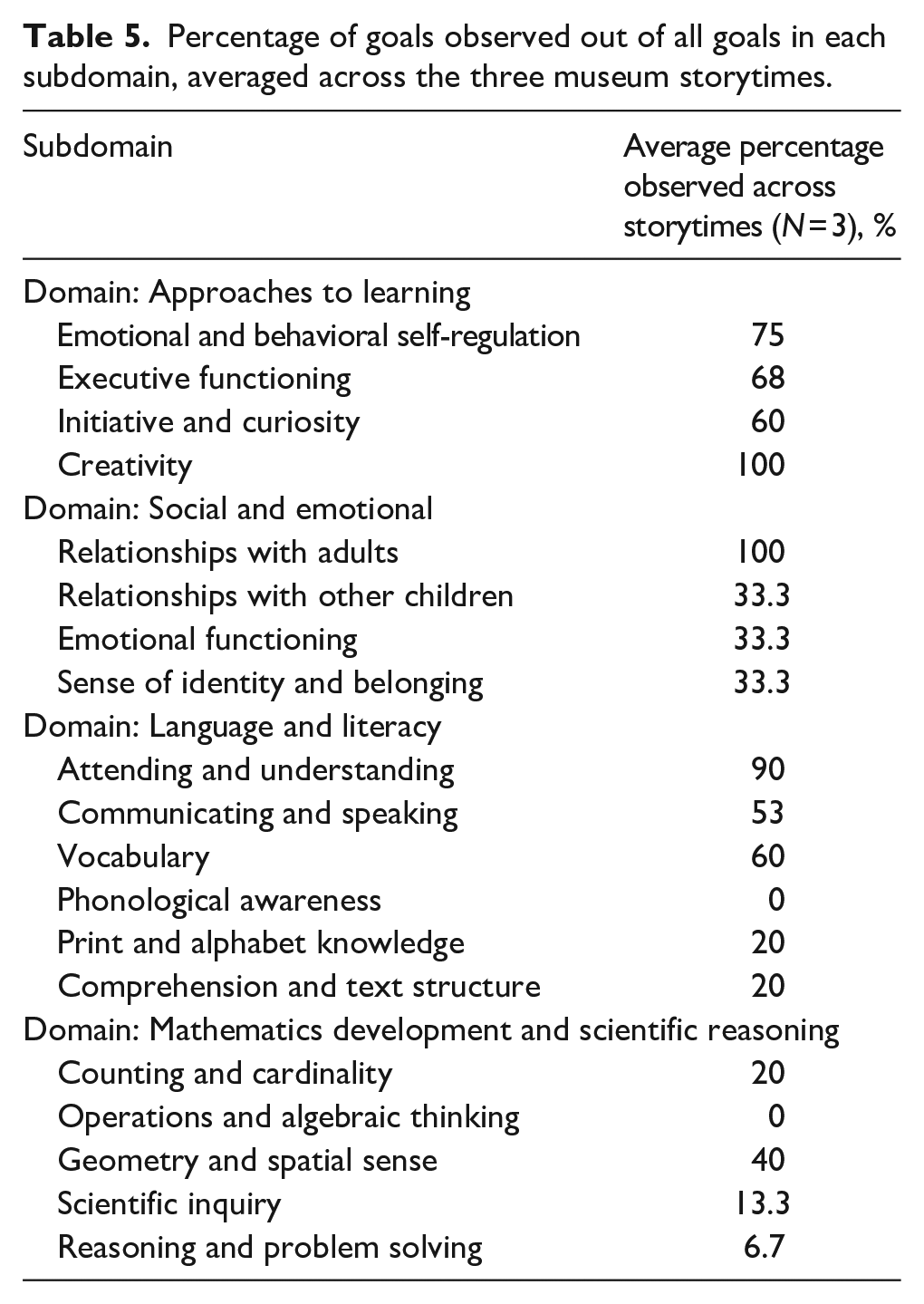
While participating in the museum educator-led, dramatic play experiences, children demonstrated a variety of learning behaviors across all four developmental domains (see Table 5). In comparison to the zoo storytimes, the museum dramatic play experiences were slightly higher in terms of the percentage of Approaches to Learning and Social and Emotional goals observed, which may be due to the richness of their play. However, they were a little lower than the zoo in the Language and Literacy and Mathematics Development and Scientific Reasoning domains, which is due to the zoo’s higher occurrence of Vocabulary and Scientific Inquiry behaviors during their instances of the animal-related, sensory playful subtype. Similar to the zoo, the most commonly observed learning behaviors were from the subdomains of Approaches to Learning, Social and Emotional, and the Language subdomains of Language and Literacy (Attending and Understanding, Communicating and Speaking, and Vocabulary). These behaviors were mostly due to the children’s engagement in the group setting and their active participation. Learning behaviors under the subdomain of Creativity were also prevalent in the museum storytimes with 100% of the goals observed, this was mostly due to the instances of the symbolic playful subtype present in the storytime. Finally, similar to the zoo, learning behaviors under Phonological Awareness and Operations and Algebraic Thinking were not observed at all.
Percentage of goals observed out of all goals in each subdomain, averaged across the three museum storytimes.
Discussion
The data presented here provides insight into how educators in an art museum and zoo are using educator-led dramatic play to engage children during storytime programs. These findings provide insight into potential ways public libraries can use educator-led dramatic play experiences to transform their storytimes into more in-depth playful learning experiences. The results revealed that the dramatic play experiences in both environments consisted of one long, immersive oral story with small pieces of other play subtypes interspersed within the larger story structure. Each of these overarching and elongated dramatic play experiences resulted in a detailed and interactive program for children and caregivers by building a participatory narrative structure over almost all of the half-hour storytime. Considering dramatic play’s holistic learning and developmental benefits for children (White, 2012), the extended nature of these dramatic play experiences was a solid strength of these storytimes. While public library storytimes do traditionally use oral stories in their storytimes, they are typically shorter and only one of several discrete program elements that comprise the program length (Campana, 2018), rather than remaining a consistent narrative thread throughout the entirety of the storytime as seen in the zoo and museum programs. Indeed, providing longer periods to plan, initiate, and build dramatic play experiences - with and without active adult leadership - has been shown to create a more meaningful learning experience for children (Christie, 1990).
While the dramatic play experiences consisted of one oral story per storytime, within these stories the educators utilized multiple smaller thematic elements, consisting of a number of different play subtypes, which helped to extend the dramatic play narrative, often through active child participation or contributions. This reinforces Whitebread et al.’s (2012) point that additional types of play can be effectively added into children’s dramatic play as enrichment so long as they reinforce the overarching narrative that has been constructed. These play subtypes also helped to engage the children in a variety of ways and encouraged different types of learning behaviors that often aligned with previous study findings on the benefits of play. In addition, the number and frequency of the different playful subtypes found in the dramatic play experiences supports previous literature that denotes an inherent richness in dramatic play (Schlesinger et al., 2020). Throughout the study, the educators themselves appeared to be a large determinate in how playful subtypes were incorporated into the dramatic play. Changes in educators in both the museum and zoo resulted in some subtle shifts in play richness and observed learning behaviors. Similar to conclusions drawn by Pyle and Danniels (2017), it is possible that educators’ pedagogical beliefs and training around dramatic play and playful learning may also have affected how playful subtypes were used in these storytimes.
Of the playful subtypes observed, the symbolic and sensory playful subtypes were observed more frequently across both environments, while the gross motor playful subtype was observed more frequently in the museum setting than the zoo. Sensory play usually appeared as science content appropriate for early childhood, which aligns with Solis et al.’s (2017) findings on connections between sensory play and cognition. Given that previous research has linked symbolic play to dramatic play (Gao and Hall, 2019), it was not surprising to find it a frequent play subtype in both environments. In addition, its presence was positive as symbolic play has been found to correlate with children’s executive functioning, helping to build working memory (Schlesinger et al., 2020) and practice real-world skills including interpersonal relationships and other roles (Gao and Hall, 2019).
While less frequent, other play subtypes—game play and social play—were utilized, adding to the richness of the dramatic play experiences. Game play has been recognized by both Hassinger-Das et al. (2017) and Pyle and Danniels (2017) as an important type of playful learning. Educators used various developmentally appropriate ways to incorporate game play into the dramatic play experiences including the use of guessing and observation, mainly as a way to ease transitions between parts of the story. With social play, while some categories—parallel play and social play with adults—were inherent throughout the entirety of dramatic play experiences, cooperative social play with children was only observed in the museum storytimes and even then, it was not a frequent occurrence. Given that research has documented young children can benefit from playing cooperatively with their peers (White, 2012), a need exists to improve pedagogical training for educators in informal learning environments around supporting this aspect of playful learning experiences.
As children exhibited a variety of learning behaviors during these dramatic play experiences, the evidence suggests that this storytime model can both support early learning behaviors effectively and that this structure aligns with Hassinger-Das et al.’s (2017) definition of playful learning by providing “playful experiences that result in learning” (p. 192). The dramatic play experiences across both environments supported a high prevalence of learning behaviors under the subdomains of Approaches to Learning, Social and Emotional, and the Language subdomains of Language and Literacy (Attending and Understanding, Communicating and Speaking, and Vocabulary), suggesting that these are somewhat inherent when participating in educator-led dramatic play and group-based playful learning experiences more broadly. In addition, each environment was strong in supporting a variety of other specific learning behaviors, such as the zoo with Scientific Inquiry and the museum with Creativity, which suggests that the educators in each environment are intentionally focusing on encouraging different types of learning that align with their storytime goals, as well as the goals and mission of the broader informal learning environment.
Implications
As informal learning environments have become increasingly aware of the value of play for young children (Luke et al., 2017; Nespeca, 2012; Worch and Haney, 2011), it is vital that public libraries—as a free public learning space for all families—consider how to better incorporate playful learning experiences into their storytime programs for children. Findings from this study point to a potential new storytime model, used in other informal learning environments, that utilizes oral stories to provide longer, educator-led dramatic play experiences for families that support early learning. Dramatic play lends itself particularly well to playful learning experiences in library storytime due to its holistic learning benefits (White, 2012), the potentially beneficial role of educators as guides (Loizou et al., 2019), and its reliance on a rich narrative structure (Whitebread et al., 2012). Increasing the length and depth of playful learning through the use of dramatic play experiences in library storytimes may help practitioners continue to satisfy the desires of families for the program to be a place of both child enjoyment and learning (Cahill et al., 2020).
One of the most notable differences between the zoo and museum storytimes and the traditional public library storytime model was the length of time devoted to one dramatic play experience. The zoo and museum storytimes observed for this study used one oral story—rooted in dramatic play—for almost the entire program. This allowed for the dramatic play in the storytime to be deeply developed and more cooperatively shared between the educator and the children. This was a key element of the playful learning experience as sufficient time and support have been shown to be important factors for effective dramatic play (Christie, 1990). Because of this, library educators should consider cutting down the number of short elements they include in their storytimes to free up time and space for a longer dramatic play experience. Library practitioners already possess narrative skills (Albright et al., 2009), so it should be a fairly simple process to elongate and adapt an oral story, either from their existing repertoire or inspired by popular children’s picture books, into a deeper playful learning experience.
Another aspect of developing effective dramatic play experiences, and effective playful learning experiences overall, is finding ways to encourage active participation from all participants. Because educators play an important role in guiding the dramatic play experience, it is crucial that library educators consider and intentionally plan out the ways they can actively participate and guide the children’s play. Encouraging and supporting children and caregivers’ active participation is equally important. The museum and zoo storytimes encouraged frequent, prolonged, and diverse methods of active participation for the children and caregivers—by having the children act out and even direct parts of the narrative, as opposed to the prevalence of verbal interactions used in library read-alouds (Campana, 2021). During these participatory moments, the zoo and museum educators often had the children and caregivers add their own creative flair to take the story in new directions mirroring more of Mitchell et al.’s (2020) suggestion of being a “guide on the side” during playful learning. In addition to active participation in the dramatic play narrative, it is important to incorporate opportunities for participants to interact with each other. Cooperative social play, a subtype of play where participants work together to achieve a playful goal or purpose (Bulgarelli and Bianquin, 2017), offers a variety of benefits for young children (White, 2012), so library educators should build opportunities into the dramatic play experience for the storytime participants to interact with each other and work toward a common goal in the story.
The different play subtypes and types of learning are some of the most crucial aspects libraries need to consider when designing dramatic play experiences. With these, the key is intentionality. Intentionality is “being mindful and deliberate” when designing content and activities for learning experiences and drawing on “knowledge of the developmental abilities and capabilities” of the children who participate (Mills and Campana, 2019: 258). The variety of dramatic play subtypes and learning behaviors observed in the data denote a high level of intentionality in the storytime design for both settings. For libraries, intentionality is important because it can help to simplify the planning process. Instead of focusing on all play subtypes and types of learning, library educators can select specific play subtypes and types of learning to support and really emphasize those aspects. Because of this flexibility to select different play subtypes and types of learning, library educators still have room to weave traditional storytime elements, such as chants and physical book read-alouds, into the dramatic play experience in a playful manner, so long as those elements actively extend the co-created narrative of the dramatic play (Whitebread et al., 2012). Indeed, these other storytime elements were often used by the museum and the zoo as ways to extend the oral story further, introduce a different play subtype, and support diverse learning behaviors. The museum used a recurring chant, accompanied by gross motor play, as a transition between different settings within the oral story. Meanwhile the zoo utilized puppetry throughout the oral stories drawing in sensory play. Additionally, library practitioners may consider the inherent strengths of the library environment—such as literary-related elements—when incorporating playful learning and dramatic play into their storytimes. The zoo, with its obvious ties to STEM learning and animal science leaned heavily on these themes in their dramatic play while the museum setting pulled in aspects of its art collection.
Finally, informal learning environments as a whole could benefit from engaging with and learning from each other in peer communities focused on how to effectively incorporate playful learning into their programs and spaces. In some areas, opportunities for co-learning between different informal learning environments have been occurring on a small scale. However, to truly grow, evolve, and center playful learning in informal learning environments across the nation, co-learning opportunities need to be more widespread and prioritized at the national level. As previous work on public library storytimes has noted, various funding and resource-related challenges can hinder change implementation (Celano et al., 2018). The US Play Coalition’s (2022) “Partners for PLAY” Program might be a helpful source of infrastructural support for practitioners across all types of informal learning environments as they work to create opportunities for co-learning with each other around the playful experiences they offer.
Limitations
As with other qualitative studies that examine play and playfulness, it is important to acknowledge that perceptions around play can be influenced by one’s culture and background (Whitebread et al., 2012). While the researchers attempted to be impartial during this study, the authors’ life experiences may still have affected the coding schemes and interpretation. Additionally, as this study used previously recorded storytime videos from only one zoo and museum, it is possible that educator-led dramatic play can be structured in many other ways beyond what is described here. Finally, it is possible that the children were exhibiting additional learning behaviors while outside of the camera range, given that video cameras can only capture a specific area.
Conclusion
This study reveals that educator-led dramatic play can be used in storytimes to provide engaging, enjoyable experiences for young children that support learning across a variety of concepts and skills. By transforming an oral story into an extensive dramatic play experience and using a storytime structure that centers the dramatic play, complemented by a few other short elements, the educators were able to fully develop and deepen the dramatic play experience, incorporate other types of play, and support different types of learning. To offer a more playful learning experience for young children and their caregivers in their storytimes, libraries should consider employing this alternative storytime structure which focuses on an educator-led dramatic play experience as a central piece of the storytime.
To continue to evolve library storytimes and ensure that they are relevant, enjoyable, and inviting for the young children and families who attend, research is still needed that provides insight into other alternative models for storytime that emphasize and support playful learning. A more in-depth systematic literature review of research on playful learning in informal learning settings—such as museums and parks—may be a helpful starting point for this work. By examining other playful learning experiences in informal learning environments and the diversity and richness of those experiences, practitioners and researchers can identify areas in need of improvement or increased emphasis in order to support holistic child learning in informal learning settings. Future work might also draw implications from public library storytimes’ more open-ended play options for museums and educators from other informal learning settings. In addition, research could further explore the role of the educator in the playful learning experience and how their intentionality, views, and training related to play impacts the experience, with the goal of improving and enriching educator-led playful learning experiences in informal learning environments.
Footnotes
Declaration of conflicting interests
The author(s) declared no potential conflicts of interest with respect to the research, authorship, and/or publication of this article.
Funding
The author(s) disclosed receipt of the following financial support for the research, authorship, and/or publication of this article: The dataset used in this article was funded by the Institute of Museum and Library Services.
