







Abstract
Many older adults residing in rural communities faced particularly damaging consequences of the COVID-19 pandemic crisis. Given the impact of the pandemic on the ability to rely on traditional forms of information (i.e. interpersonal communication), reliance on digital technology and other non-traditional sources of information grew. Those who lacked the information literacy, defined in this study as the ability to find and evaluate the reliability of information to address an information need, may have faced psychologically damaging consequences caused by the proliferation of misinformation and information poverty. Informed by an ecological understanding of human information behavior, this paper reports on the findings of a study of rural older adults’ information literacy skills and sense of well-being during the COVID-19 pandemic crisis. A mail survey, based on concepts from psychology and information science and question wordings adapted from the 2021 Health and Retirement Survey and Jones-Jang et al.’s study of literacies and fake news, was distributed in the summer of 2021 to older adults living in rural Kansas. About 206 valid responses to the survey were received. These were analyzed using correlation and regression testing. The findings indicate a significant relationship between information literacy skills and one’s overall sense of well-being. Personal (age, gender, health, life control), economic (employment, finances), and social-relational resources (social engagement, relationship quality) all were shown to relate positively to information literacy skills. These findings provide definition to our understanding of the importance of information literacy in modern understandings of psychological well-being.
Introduction
The 2020 coronavirus pandemic in the United States fundamentally altered the information experiences of the American public, exacerbating divisions and highlighting the importance of technology use and information literacy skills. Face-to-face communication became sharply limited, as social distancing forced individuals to resort to technology as a major source of information. The need for accessible, reliable information peaked just as the production of misleading or false information (misinformation) proliferated across all forms of digital media. Older adults were especially susceptible to the inequities of the digital divide, as the information literacy skills and technology adoption of older populations has been shown to generally be more limited than for younger adults (Hargittai and Dobransky, 2017; Roque and Boot, 2018).
Given the importance of access to reliable information and well-being as an aspect of the human condition, further research is needed to understand better the information searching and evaluation behavior of older adults residing in rural communities in independent-living settings so that improvements in information services and resources can be addressed. This study focuses specifically on factors that predict or are associated with to the ability to evaluate digitally published information among rural older adults.
In illustrating a relationship between these variables, this study may further emphasize the importance of information literacy in the psyche of the modern human, particularly the rural older adult. Kansas was selected as the setting of this study, as communities in the western half of the state embody many of the characteristics of the “typical” rural community: declining and aging population, lack of sufficient infrastructure, and opportunities for financial mobility for the population, and a considerable distance between these communities and the nearest metropolitan area.
Mackey and Jacobson (2011) define information literacy as a metaliteracy, which combines a set of literacies (e.g. media literacy, digital literacy) necessary for navigation of increasing complex information situations encountered in digital contexts. For the purposes of this study, we are primarily interested in information literacy as the process whereby individuals find and evaluate the reliability of information to address an information need. Social and psychological factors, which, according to Kim and Moen (2002), include (among others) age, health, employment status, and quality of interpersonal relationships, are proposed as contributors and/or predictors of the acquisition of information literacy skills. This study evaluated these factors among rural, independently living older adults, to determine the validity of the Kim and Moen (2002) theoretical model by quantitatively measuring the relative strength of each factor as they contribute to the development of information literacy skills.
Research questions
This study was guided by one central question: To what extent does a sense of well-being relate to information literacy skills among independent-living older adults in rural Kansas during the COVID-19 pandemic? Sub-questions include: To what extent do economic factors relate to information literacy skills? To what extent do personal factors relate to information literacy skills? To what extent do social-relational factors relate to information literacy skills?
Literature review
The boundaries of what constitutes “information literacy” have been debated and refined a multitude of times over the years. Traditionally, within library and information science (LIS), information literacy has been viewed as the concept that describes the work of information professionals in preparing individuals (generally, students) to address their research-related information needs (Lloyd, 2005; Snavely and Cooper, 1997). In recent decades, researchers in the discipline of library and information science have expanded this definition to include multiple literacies necessary to be able to navigate a rapidly transforming information landscape (Mackey and Jacobsen, 2011). However, researchers in other disciplines—and even some within LIS—have very different conceptions of information literacy. Sometimes these conceptions are more narrow; other times they are more technology focused than in the past (Leaning, 2019; Park et al., 2021). For this reason, it is important to clarify how the concept of “information literacy” is defined and operationalized in any study. In this study, information literacy is understood in one of its broadest senses, simply referring to the “ability to find and evaluate information to address an information need,” whether this information need developed and is addressed in traditional contexts (e.g. a library search) or new media/information environment contexts.
As with any behavior exhibited by humans, variation is natural. Information behaviors, including information literacy, have both a biological (Spink, 2010) and environmental (Dutta, 2009) basis. However, relatively little is known about how these factors may have converged among older adult populations during the COVID-19 pandemic. Those studies that do explore older adults information literacy skills and practices suggest considerable differences among populations of various ages and cultural backgrounds. Older adults’ trust in interpersonal information sources increases with age (Poulin and Haase, 2015). They are more likely to believe that information shared by their families, friends, and neighbors was credible and accurate (Li and Fung, 2013). They may strategically select to trust or distrust information. Compared with younger adults, older adults have been found to be worse at telling the truth from the lies, especially on social media (Ruffman et al., 2012 ), increasing the possibilities of exposing to and deceiving by fake news (Brashier and Schacter, 2020). However, several studies indicate that it is not only biological (aging) factors at play, as exposure to technology over time and sociability also play a considerable role (Hicks and Lloyd, 2016; Lund and Long, 2022; Wang et al., 2011).
Several studies have suggested that individuals with limited information literacy skills are likely to have less educational attainment, limited access to technology, and lower socioeconomic status (Guess et al., 2019; Malbon, 2013; Morris and Brading, 2007). In turn, a lack of access to reliable information contributes to social, economic, and health-related challenges and disadvantages in today’s technologically modern society (Rubin, 2017), such as poor financial planning and decision making (Dou et al., 2012; Malbon, 2013; Zhu and Zhang, 2010), detrimental personal health and care decisions (Gastil and Marriott, 2019; Wen et al., 2020; Zheng et al., 2020), and social withdrawal and isolation that, in turn, often results in an increased risk of cardiovascular disease, cognitive deterioration, and mortality (Holt-Lunstad et al., 2015; Steptoe et al., 2013). For older adults, susceptibility to harmful misinformation increases with cognitive decline and unsuccessful information diffusion, which is further increased by disadvanced information infrastructural in rural communities and the social and digital divide exacerbated by the COIVD-19 pandemic (Bursztyn et al., 2020; Hallows, 2013; Jacoby, 1999; Probart et al., 1989; Radwan et al., 2020; Smith et al., 2020).
Recent demographic statistics (Kansas State Department of Aging, 2018) indicate that the state of Kansas is an ideal location to investigate information behavior among rural seniors, with a large number of smaller and rural communities with a large proportion of older individuals. According to the Kansas State Department of Aging (2018), individuals over 60 make up more than 20% of the state’s population, which is well above the national average (14.5%). Most of these older adults live in rural (population less than 5000) or semi-rural (population less than 25,000, surrounding rural areas) communities, and it estimates that more than one-third of these individuals have severe disabilities that limit activities of daily living (Kansas State Department of Aging, 2018).
Access to reliable information and social support has been identified as a major challenge faced by Kansas’s rural aging population. Similar to the findings by Poulin and Haase (2015) and Li and Fung (2013), Capel (2009) and Andrade and Urquhart (2010) also have indicated that rural older adults, in general, typically rely on family and friends as primary information sources, and distrust other sources of information. The physical divide between older adults and others caused by a lack of physical mobility, geographic separation, and, most recently, the spread of the coronavirus has deprived this population from face-to-face contact with these sources of information and increased the importance of digital technology to facilitate communication. However, older adults have shown greater susceptibility to misinformation and relevant sources than younger adults (Rampersad and Althiyabi, 2020). They are more likely to rely on members of their community as arbiters of information quality which may not result in the best outcomes for the population, as many of these members themselves remain poor judges of information quality (Yu et al., 2017). These conditions, which persisted throughout the COVID-19 pandemic, were likely to have produced social, economic, and health crises for many rural older adults.
Recently, several studies have examined barriers to acquiring reliable social information during the COVID-19 pandemic, with health risks compounding the existing structural barriers (Chu et al., 2021; Lund and Maurya, 2022; Lund and Ma, 2022; Skarpa and Garoufallou, 2021). These studies illustrate that the COVID-19 pandemic forced older adults to rely more on digital technology to find information, as they were isolated from others due to social distancing measures. However, not all older adults had the information literacy skills necessary to access reliable information from these digital sources. In these cases, these individuals faced a greater sense of unsatisfied information needs. However, none of these studies have gone so far as to examine the relationship between this lack of ability to find reliable information and the older adult’s overall sense of well-being.
Conceptual framework
Williamson’s Ecological Theory of Information Behavior and Kim and Moen’s life-course, ecological model inform the framework for this study. Williamson’s Ecological Theory of Information Behavior described that the behavior of an information seeker is the product of their personal factors and the information seeker’s interactions with their environment. The development of information behavior, like information literacy skills, can be understood better, according to Williamson’s (1998) theory, by considering factors including lifestyle, social and cultural values, socio-economic circumstances, work situation, personal/biological characteristics, affective/spiritual influences, and physical environment.
Kim and Moen’s (2002) life-course, ecological model (adapted into Figure 1) is the second influence on this study’s framework. The model suggests that the behaviors of older adults are the product of personal resources (i.e. innate characteristics), economic resources, and social-relational resources. In the Kim and Moen model, all factors (divided among the three categories of resources) may influence one another as well as the behaviors of individuals. The personal resources category consists of age, gender, subjective ratings of health, sense of life control, morale, and depression. The economic resources category consists of employment status (i.e. retired, part-time employed, full-time employed), income, and finances (i.e. accumulated wealth). The social-relational resources category consists of the level of social engagement, quality of relationships, technology access, and media consumption. These factors are all anticipated to influence older adults’ behaviors, including information behavior, the intentional or unintentional glimpsing, encountering, or avoiding information (Case and Given, 2016). As such, the Kim and Moen (2002) model, paired with Williamson’s conception of information behavior, influences the research questions, hypotheses, survey questions, and analysis for this study. Though these two models (one from psychology and one from information science) have not been previously used together, they both have a basis in better understanding human behavior and align together to understand how this behavior occurs in context.
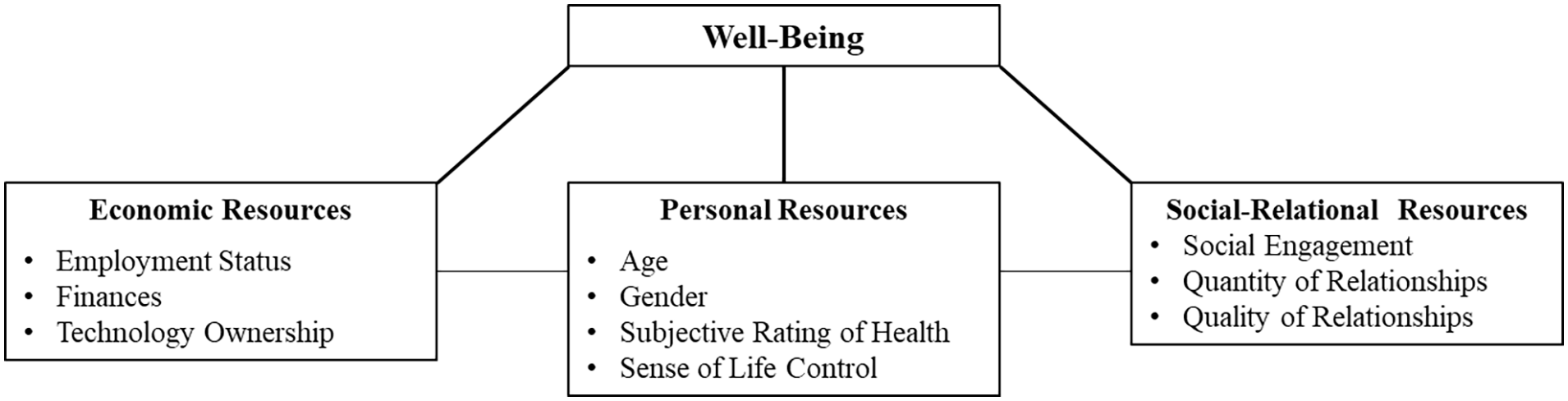
Visual depiction of Kim and Moen’s (2002) model as it may apply to well-being and later-life behavior.
Methods
This study utilizes a cross-sectional survey approach. The questions for this survey were adapted from existing, widely used/adapted surveys that have been reliably used with diverse adult populations. They offer clarity and repeated use and validity as instruments, however not all questions aligned precisely with the necessary wording and theoretical framework for this study and were thus adjusted accordingly. Questions adapted from the Health and Retirement Survey, a biennial study conducted by the University of Michigan RAND Center for the Study of Aging (2020), were used to obtain demographic background information about participants (e.g. age, social activity, use of various digital communication technology). Question wordings from Jones-Jang et al.’s (2021) survey of literacies and fake news detection were used to examine participants’ level of information literacy. Notably, the Jones-Jang et al. study defines and classified “information literacy” differently from the present study, characterizing it in a way that the authors of the present study believe does not entirely accurately represent how this concept is understood within the information science discipline, yet the wordings of certain questions are very clear and concise; so, we have adapted wordings from that study for questions in this study, but have not incorporated additional theory or concepts into the framework for this study. Indeed, this study combines questions that in the Jones-Jang et al. study are classified as “media literacy,” “news literacy,” and “information literacy,” but that we, understanding the concept of information literacy from a broad perspective, feel better fit together as the single concept of “information literacy.”
The survey instrument for this study consisted of 38 questions arranged, for analysis purposes, into four categories: personal resources questions, economic questions, social-relational questions, and information literacy questions. All of these questions, with the exception of age, used a five-point Likert scale in order to support statistical analysis. The personal resources section includes questions pertaining to the respondents age, health (both physical and mental), and overall sense of life control. The economic resources section focuses on employment status (employed, unemployed, retired), financial situation, and ownership of digital devices. The social-relational resources section included questions about strength of family and friend relationships, participation in social activities (activities in one’s physical or virtual communities), and sense of connectedness with one’s community. The final section, focusing on information literacy, included questions comprising an “information literacy scale,” which were based upon the Jones-Jang et al. (2021) study (this includes questions characterized by the Jones-Jang study as both “media literacy” and “information literacy,” but combined based on our definition of information literacy, as noted above), and questions about how strongly respondents trust a variety of interpersonal (family, friends, experts) and mass media (television, newspaper, social media) information sources.
The survey was distributed to older adults (age 60+) in western Kansas, which was defined, for the purposes of this study, as all counties within the state’s first congressional district. The survey was distributed in two ways: through the mail, to a random sample of 300 older adults within western Kansas; and through the assistance of information intermediaries within the communities in this region, such as political figures, church leaders, and public librarians. IRB approval was received from the researchers’ university.
Statistical analyses including correlation analysis and regression modeling were used to examine relationships among variables and compare these findings to those of the previous (University of Michigan RAND Center for the Study of Aging, 2020 and Jones-Jang et al., 2021) studies of a nationwide sample. Confirmatory factor analysis was used to validate the proposed constructs (personal resources, economic resources, social-relational resources, and information literacy).
Results
About 206 responses to the survey were received. Table 1 presents an overview of basic demographics for this study’s respondents. Respondents skew young, but this was anticipated, as there are much more 60–70-year-olds in the United States than 71–80-year-olds and 81+-year-olds. Given the sample size and response rate, there was still a sufficient number of respondents age 71+ to evaluate the relationship of age and information behavior. The gender composition is roughly equivalent to that of the United States population as a whole. The slightly larger number of women respondents may be due to a gender difference in who is more likely to respond to mail and print survey requests. About three-fourths of respondents indicated that they had nine or fewer close friends and a similar amount indicated that they owned a smartphone (with about a quarter of respondents owning a “regular” cell phone, and 3% indicating that they own no type of cell phone). A large majority of respondents indicated that they had experience using the Internet/computers in order to find information, but this was not unanimous. Additionally, over four-fifths of respondents indicated that they owned a personal computer or Internet-connected device (smartphone, tablet), while several others noted in their additional comments that they typically rely on the local public library for computer access.
Overview of respondent demographics.
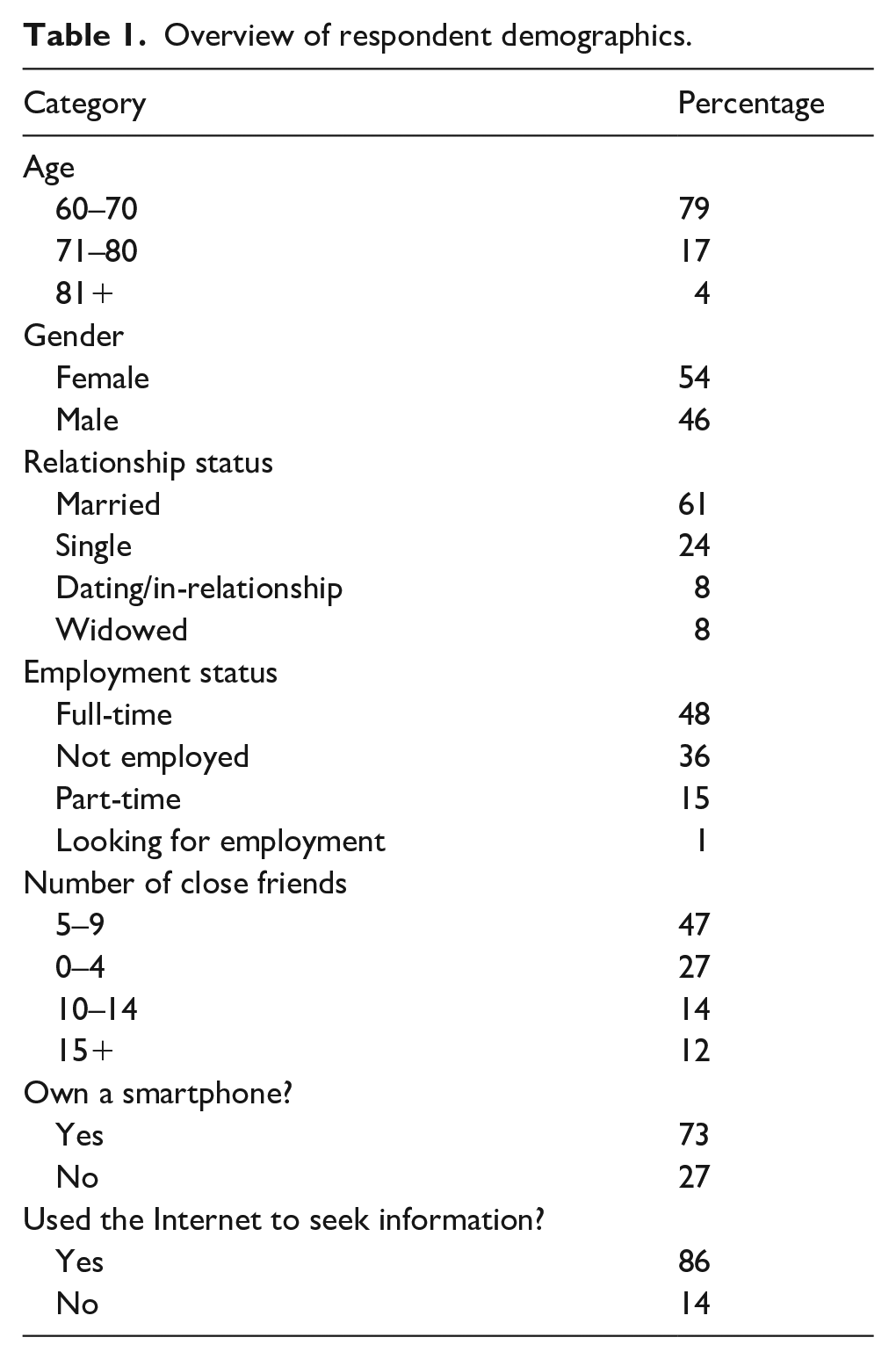
The demographics of this study’s respondents roughly align with that of the overall United States’ population, based on recent research (Perrin and Atske, 2021). About one-fifth of individuals age 60+ in the U.S. only rarely or never use the Internet (with the rest using it on a daily or regular basis), with a majority of the non-users being age 75+. Though the percentage of Internet non-users in the U.S. is a bit higher than the among the participants in this study, the margin (14% in this study vs ~20% overall) is still quite close.
Correlation analysis
Table 2 displays the significant correlations for the three information literacy components in this study (information literacy scale scores, trust in interpersonal information sources, and trust in mass media information sources). The first column of the table indicates a variable, and the second column indicates what other variables correlate to the variable in the first column. The third column indicates whether the correlation is positive (as the value of the first variable increases, the value of the second variable also increases) or negative (as the first increases, the second decreases), and the fourth column indicates the significance level/p-value (the likelihood of observing a relationship at least this strong if the null hypothesis were true), with a level of p = 0.05 (5%) considered statistically significant. The write-up for this section highlights the statistically significant findings and discusses their meaning.
Statistically significant findings from correlation analysis.
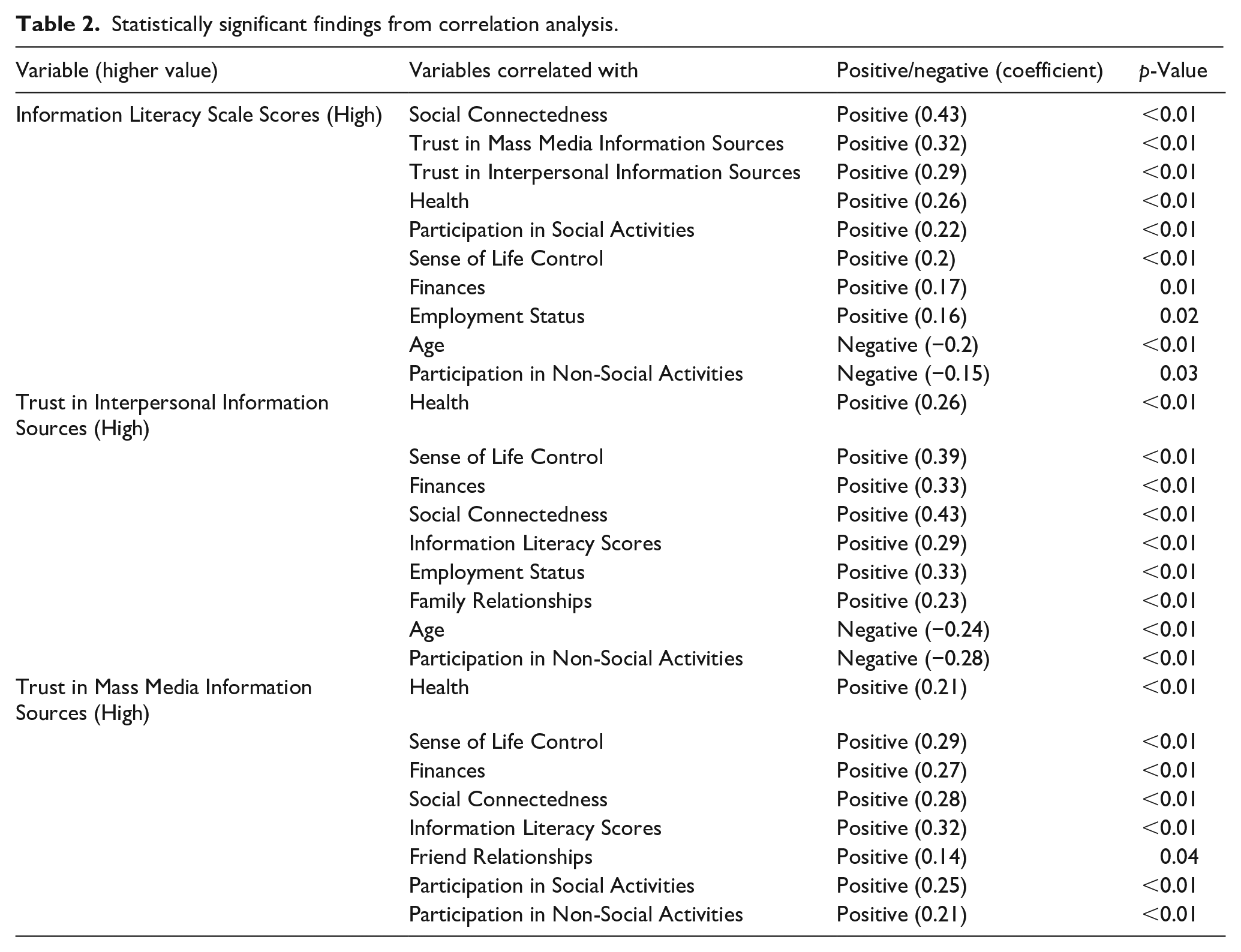
Finances and employment correlate with well-being (social connectedness, participation in social activities, and sense of life control) and information literacy (information literacy scale scores, trust in interpersonal and mass media information sources). Participation in social and non-social activities can also indicate much about one’s well-being and information literacy. While participation in social activities is positively correlated with many of the variables that comprise these two constructs, participation in non-social activities is negatively correlated with many of them. This indicates that those who participate in more isolated activities are more likely to have less-advanced information literacy skills.
Social connectedness has some of the strongest correlations of any variable in the study. The variable is strongly correlated with health (0.42), finances (0.38), participation in social activities (0.36), information literacy scale scores (0.43), and trust both in interpersonal (0.43) and mass media (0.28) information sources. This indicates that individuals with a high sense of social connectedness also tend to be healthier, have a better financial situation, have better information literacy skills overall, and be more trusting of information sources (though causation or directionality for this relationship cannot be inferred).
From this table, one can also see all of the variables that directly correlate with the three aspects of information literacy (information literacy scale scores, trust interpersonal information sources, and trust mass media information sources). Four variables are positively correlated with all three of the information literacy variables: social connectedness, health, sense of life control, and finances. Employment status, age, participation in social activities, and participation in non-social activities are all correlated with two of the three information literacy variables. The fact that so many variables are correlated with the information literacy variables is a positive sign for the feasibility of the regression analysis in showing significant results.
Structural regression model
A structural modeling approach was utilized to compare individuals with high and low levels of well-being across the information literacy scale. The chi-square statistic for the model was significant, X2 (61) = 256.27, p < 0.001, indicating a good fit for the statistical model. Shown in Figure 2 is the visual depiction of the structural model for this study with all of the regression coefficients added. The significant result coefficient (0.293) connecting well-being and information literacy is shown in the center of the figure. While this coefficient is substantially weaker than that of economic resources and social-relational resources on well-being, it is stronger than the effect of personal resources on well-being (i.e. information literacy is actually a stronger predictor of well-being than age, health, and sense of life control). The variables of gender and participation in nonsocial activities (reading, doing puzzles, browsing Internet) were excluded from the model, as they were not found to be statistically significant contributors. However, all other variables were found to have some statistically significant influence as proposed in the theoretical model.
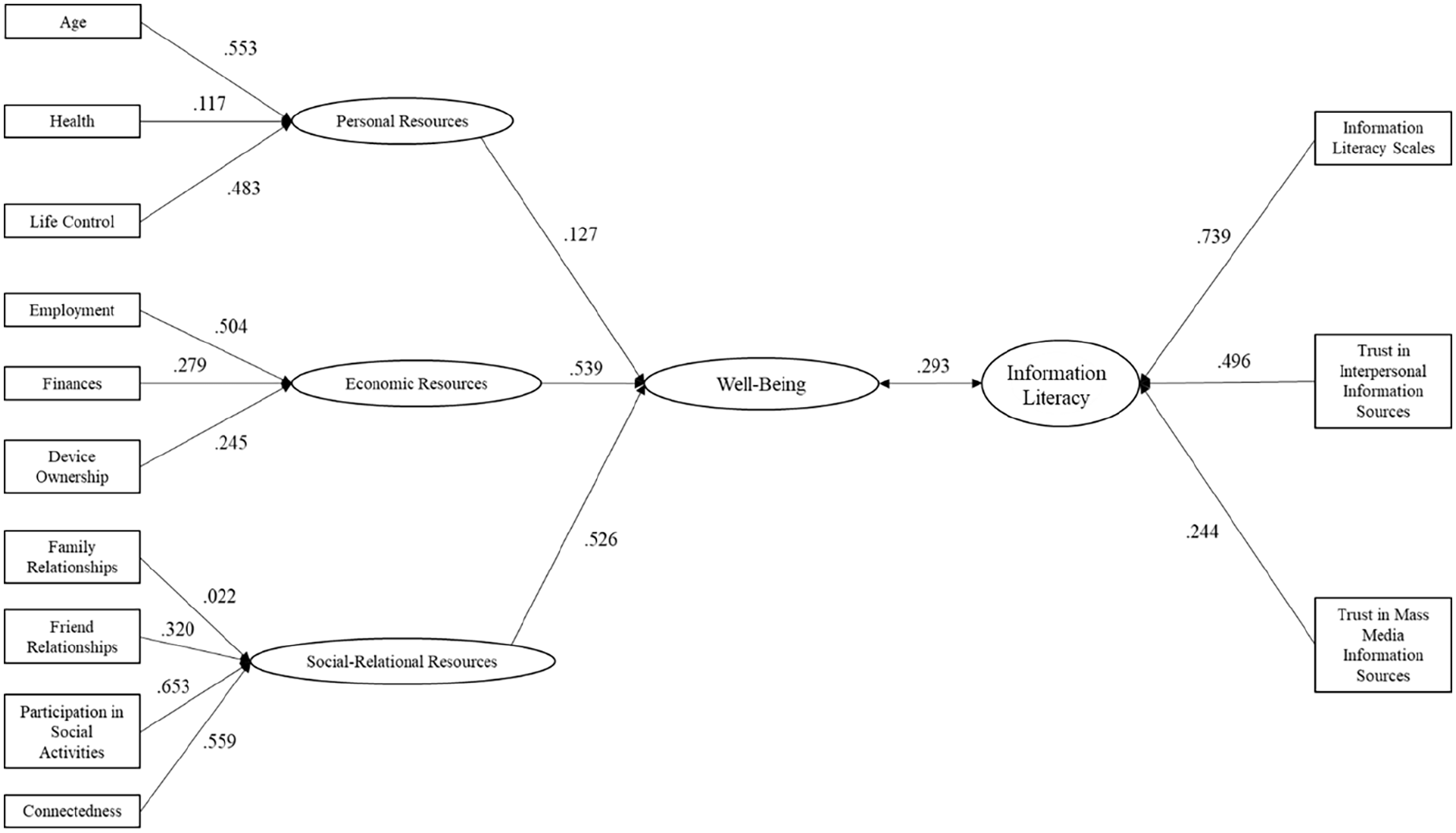
Structural model for this study with coefficients.
Personal resources as a construct relate to age, health, and life control. Age was the strongest contributor, followed by the sense of life control. Health had a much smaller effect. Health may be a reason that sense of life control drops (i.e. poor health may equal poor sense of life control), but it is the sense of life control, not health, that has the more significant direct impact on “personal resources.” This category of resources has the least significant impact of any of the three categories and information literacy (0.127, p < 0.01), but it was still a statistically significant impact. The coefficients indicate that, as age increases or health or sense of life control decreases, the value for personal resources decreases, which results in a drop in overall sense of well-being.
Economic resources was found to be the most substantial influence on the sense of well-being. Employment status plays the greatest role of the three factors, with those who are employed having a greater sense of well-being. The ability to “make ends meet” and ownership of digital devices have similarly significant coefficients. Based on the findings of this analysis, those who are best able to make ends meet and who own a variety of digital technology generally have a stronger sense of well-being, based on the findings of this analysis.
Social-relational resources has a similarly strong influence on well-being as do economic resources. Relationship status (married or not married) plays only a very minor role in this category, with a coefficient of 0.022 (p < 0.01), however it is still statistically significant, with those who are married having a slightly stronger sense of well-being on average. The number of close friends one has, the frequency of participation in social activities, and the sense of connectedness to one’s community all play a much larger role than relationship status. As one might reason, those with more friends and those who are more socially active have more social-relational resources and tend to have a stronger sense of well-being.
The construct of information literacy was most strongly influenced by the respondents’ scores on the information literacy scales, with those with stronger scores having stronger information literacy skills. Interestingly, trust in interpersonal information courses has a considerably stronger influence than trust in mass media sources. However, it is notable that virtually all populations across the board placed less trust in mass media information sources than interpersonal sources. Even the older respondents, who had less of a gap than younger respondents, still placed interpersonal sources as more trustworthy than mass media ones. Again, information literacy and well-being (itself based around the three constructs of personal, economic, and social-relational resources) have a moderately-strong effect on one another.
Discussion
Central research question
In answering the question, “To what extent does a sense of well-being relate to information literacy skills among older adults living in rural Kansas during the COVID-19 pandemic,” this study revealed a significant, moderately strong relationship between well-being and information literacy. Thus, the null hypothesis (H1) that there is no relationship between these factors can be rejected. As noted in the conceptual framework section of this study, it is not clear if greater well-being results in greater information literacy, greater information literacy in greater well-being, or if they are mutually influential or influenced by additional yet-unknown factors. However, some of the coefficients do shed some greater light on these relationships. For example, it is noteworthy that the relationship between information literacy and well-being is stronger than that between personal resources and well-being. This suggests that knowing how one scores on a basic information literacy assessment may be more helpful in predicting their overall sense of well-being than knowing their age, health, or sense of life control. This is significant because age and health have traditionally been two of the more important factors in understanding well-being, as demonstrated in the studies of Rodriguez-Blazquez et al. (2012) and Steptoe et al. (2015). Of course, age and health are largely physical attributes, so the use of them to predict an overall sense of well-being (an attitudinal attribute) may have been questionable in the first place.
The findings of the present study also illustrate that there is a strong relationship between the overall well-being of the rural older adult and each of the three components of information literacy: with information literacy scale score, r = 0.386; with trust in interpersonal sources of information, r = 0.452; and with trust in mass media sources of information, r = 0.154. Based on these coefficients, one may predict that an elevated sense of well-being will co-occur with greater trust in information sources and considerably better information literacy skills overall. Further, consistent with previous research findings, older adults express higher trust in social networks (e.g. family members, friends, and neighbors) as information resources (Andrade and Urquhart, 2010; Capel, 2009; Li and Fung, 2013; Poulin and Haase, 2015), which highlights the urgent need to improve information literacy among elderly in general for providing trustworthy information and confirmation for older neighbors and friends.
Subquestion 1: To what extent do personal factors relate to information literacy skills?
As evidenced by the structural model, personal resources had the weakest overall impact on sense of well-being. Nonetheless, it did have a statistically significant relationship, and thus the null hypothesis (H2) that no relationship exists may be rejected. Of the three variables (age, health, life control), age had the strongest impact, with older respondents having lower information literacy skills by a significant margin, which could be attributed to older adults’ declined cognition and fewer Internet experiences (Brashier and Marsh, 2020; Pew Research Center, 2021). However, Martínez-Alcalá et al. (2018) pointed out that as long as older adults understand the ease of use and perceived usefulness of Internet and Communication Technology, they consequently have a strong motivation for receiving information literacy training, their relevant training results are positive. Therefore, there is a need for public libraries in rural areas to promote further awareness of information literacy among the elderly in the community and provide relevant training.
Subquestion 2: To what extent do economic factors relate to information literacy skills?
Economic resources had the single-greatest influence on overall sense of well-being, but only the second-strongest relationship with information literacy skills (r2 = 0.325). Given the finding of a statistically significant relationship, the null hypothesis (H3) that no relationship exists may be rejected. Access and exposure to technology through work and the financial ability to purchase new technologies likely have a major role in these relationships. The positive impact of wealth on technology exposure and information literacy has previously been explored by Seo et al. (2019) that the higher income may lead to older adults being more likely to purchase smart devices and access the Internet and social media. Seo et al. (2019) further proposed that the community and academic institutions cooperate to improve the information literacy of the elderly in the community and pay attention to the diversity of the relevant instructors to accommodate a broader range of older adults. In western Kansas, an area with few academic institutions, public libraries can collaborate with academic institutions through digital platforms to provide synchronous or asynchronous webinars to older adults and provide instant answers to their questions.
Subquestion 3: To what extent do social-relational factors relate to information literacy skills?
Social-relational resources are most-strongly correlated with information literacy skills (r = 0.360). As with the other factors, this statistically significant relationship allows for the null hypothesis (H4) to be rejected. Social connectedness, in particular, had some of the strongest correlations in this study with the information literacy scale scores (r = 0.43), trust in interpersonal information sources (r = 0.43), and trust in mass media information sources (r = 0.28). Participation in social activities also held moderately strong correlations with these information literacy variables.
Theoretical implications
The structural model for this study was informed by Kim and Moen’s model of well-being and Williamson’s ecological model of information behavior of older adults. With the model, it was proposed that three categories of variables—personal resources, economic resources, and social-relational resources—collectively constituting one’s overall well-being, would be found to positively relate to one’s information literacy skills. The findings of this study have supported this hypothesis, as a moderately-strong, positive relationships was found between well-being and information literacy (r2 = 0.293).
Regarding Kim and Moen’s model specifically, with its emphasis on the three components of well-being (personal, economic, and social-relational resources), it seems feasible, given the findings of this study, to add a fourth category of resources that will produce an even better-refined assessment of well-being. Information literacy resources could be added to the Kim and Moen model in order to create a combined model that acknowledges information behavior as an important component of well-being in the modern world. This model may prove to be more useful for evaluating well-being in a modern, technology-driven society than many existing models. Future research can further examine the validity of this model.
Limitations and future research
It is difficult to know what impact the COVID-19 pandemic, specifically, had on the information literacy of rural older adults during this study. The COVID-19 pandemic can be seen as a context for this study—the study was conducted during the pandemic, so it cannot be divorced from it—more so than a factor that necessarily caused a fundamental change to the factors examined in the study. A further post-pandemic study would be necessary to reveal whether the relationships between the factors vary in a world without COVID.
Conclusion
The findings of the survey support the central research hypothesis that factors of well-being and information literacy are related or influence one another. Each of the three primary factors of the construct of well-being—personal resources, economic resources, and social-relational resources—was found to relate to the construct of information literacy, itself informed by participants’ scores on an information literacy scale and trust in various information sources. Several factors, in particular, were found to correlate strongly with information literacy skills, including age, health, sense of life control, employment and financial situation, and sociability and connectedness. Understanding the impact of factors of rural older adults may be helpful in identifying and responding to the needs of individuals most at-risk for making meaningful use of digital information.
Footnotes
Declaration of conflicting interests
The author(s) declared no potential conflicts of interest with respect to the research, authorship, and/or publication of this article.
Funding
The author(s) received no financial support for the research, authorship, and/or publication of this article.

Copy of survey questions
1. What is your age?
a. 60-70 b. 71-80 c. 81 and older
2. What is your gender?
a. Male b. Female c. Other
3. Which of the following describes you?
a. Married b. Widowed c. Single d. Dating/In-relationship (not married)
4. What is your current employment status?
a. Employed full-time b. Employed part-time c. Looking for Employment d. Not Employed
5. How big is the circle of people you regularly interact with?
a. 0-4 b. 5-9 c. 10-14 d. 15 or more
6. Which of the following devices do you own?
a. Computer b. Smartphone c. Regular cell phone
d. Smart technology (Alexa, Google Speaker, Ring Home Security)
7. I often feel hopeless in dealing with problems in my life.
a. Do Not Agree b. Agree Only a Little c. Somewhat Agree d. Agree e. Strongly Agree
8. Other people determine most of what I can and cannot do.
a. Do Not Agree b. Agree Only a Little c. Somewhat Agree d. Agree e. Strongly Agree
9. What happens in my life is often beyond my control.
a. Do Not Agree b. Agree Only a Little c. Somewhat Agree d. Agree e. Strongly Agree
10. I have little control over the things that happen to me.
a. Do Not Agree b. Agree Only a Little c. Somewhat Agree d. Agree e. Strongly Agree
11. There is really no way I can solve the problems I have.
a. Do Not Agree b. Agree Only a Little c. Somewhat Agree d. Agree e. Strongly Agree
12. I frequently feel that I lack companionship.
a. Do Not Agree b. Agree Only a Little c. Somewhat Agree d. Agree e. Strongly Agree
13. I frequently feel isolated from others.
a. Do Not Agree b. Agree Only a Little c. Somewhat Agree d. Agree e. Strongly Agree
14. I frequently feel in tune with the people around me.
a. Do Not Agree b. Agree Only a Little c. Somewhat Agree d. Agree e. Strongly Agree
15. I frequently feel that I have a lot in common with the people around me.
a. Do Not Agree b. Agree Only a Little c. Somewhat Agree d. Agree e. Strongly Agree
16. I frequently feel that people in my community can be trusted.
a. Do Not Agree b. Agree Only a Little c. Somewhat Agree d. Agree e. Strongly Agree
17. I frequently feel that my identity is impacted by the community in which I live.
a. Do Not Agree b. Agree Only a Little c. Somewhat Agree d. Agree e. Strongly Agree
18. How do you rate your physical health?
a. Not Good at All b. Not Very Good c. Good d. Very Good e. Extremely Good
19. How do you rate your mental health?
a. Not Good at All b. Not Very Good c. Good d. Very Good e. Extremely Good
20. How well would you say you are able to make ends meet (pay bills, purchase groceries and medications, etc.)?
a. Not Good at All b. Not Very Good c. Good d. Very Good e. Extremely Good
21. How often do you participate in group activities like volunteering, church or group meetings, and attending classes?
a. Daily b. Several Times a Week c. Several Times a Month d. About Once a Month
e. Rarely f. Never
22. How often do you read books or magazines, put together puzzles, or play games (like crosswords or Soduku)?
a. Daily b. Several Times a Week c. Several Times a Month d. About Once a Month
e. Rarely f. Never
23. How often do you typically meetup (in person) with people living outside of your home?
a. Daily b. Several Times a Week c. Several Times a Month d. About Once a Month
e. Rarely f. Never
24. How often do you communicate by using video conferencing, Facebook or other social media with people living outside of your home?
a. Daily b. Several Times a Week c. Several Times a Month d. About Once a Month
e. Rarely f. Never
25. I trust what my family tells me.
a. Do Not Agree b. Agree Only a Little c. Somewhat Agree d. Agree e. Strongly Agree
26. I trust what my friends tell me.
a. Do Not Agree b. Agree Only a Little c. Somewhat Agree d. Agree e. Strongly Agree
27. I trust what politicians tell me.
a. Do Not Agree b. Agree Only a Little c. Somewhat Agree d. Agree e. Strongly Agree
28. I trust what newspapers tell me.
a. Do Not Agree b. Agree Only a Little c. Somewhat Agree d. Agree e. Strongly Agree
29. I trust what I read on Social Media (e.g., Facebook, Twitter).
a. Do Not Agree b. Agree Only a Little c. Somewhat Agree d. Agree e. Strongly Agree
30. I trust what I hear or see from my favorite news source (e.g., Fox News, NBC News, CNN, KAKE, KSN).
a. Do Not Agree b. Agree Only a Little c. Somewhat Agree d. Agree e. Strongly Agree
31. I trust what I hear from experts and scientists.
a. Do Not Agree b. Agree Only a Little c. Somewhat Agree d. Agree e. Strongly Agree
32. I follow the news using multiple media sources/perspectives.
a. Do Not Agree b. Agree Only a Little c. Somewhat Agree d. Agree e. Strongly Agree
33. I exchange information with my family or friends about the news I see in newspapers or on TV.
a. Do Not Agree b. Agree Only a Little c. Somewhat Agree d. Agree e. Strongly Agree
34. The owner of a news company influences the news content.
a. Do Not Agree b. Agree Only a Little c. Somewhat Agree d. Agree e. Strongly Agree
35. Two people might see the same story and get different information from it.
a. Do Not Agree b. Agree Only a Little c. Somewhat Agree d. Agree e. Strongly Agree
36. I caution people around me about the negative sides and negative effects of media.
a. Do Not Agree b. Agree Only a Little c. Somewhat Agree d. Agree e. Strongly Agree
37. News coverage of a political candidate will influence peoples’ opinions.
a. Do Not Agree b. Agree Only a Little c. Somewhat Agree d. Agree e. Strongly Agree
38. The news makes things more dramatic than they really are.
a. Do Not Agree b. Agree Only a Little c. Somewhat Agree d. Agree e. Strongly Agree