







Abstract
Open access (OA) scholarly journal publishing is a recently emerged phenomenon of scholarly publishing in Pakistan. This study has been designed to find out the current status of open access (OA) scholarly journal publishing in Pakistan. A quantitative research method was used to evaluate the contents of the websites of 329 Pakistani journals on a checklist of 12 items. OA publishing paradigm has emerged in Pakistan as a majority (90%) of Pakistani scholarly journals are following the OA publishing paradigm. More than two-thirds (69%) of journals are following the Diamond OA model, followed by Gold OA (26%) and Crowdfunding OA (3%). The majority (97%) of journals belongs to the Y (the lowest) category of journals and the majority (97%) of journals do not have an impact factor. Indexing in Scopus and Web of Science is 24 (16%) and 20 (13%), respectively. Average article processing charges (APCs) per article in Sciences and Social Sciences journals of Pakistan are 46 $ and 90 $, respectively. In terms of ranking, Pakistani journals are in the stage of infancy. The present study is the first comprehensive exploration to explore the current status of OA scholarly journal publishing in Pakistan. This study may help to come up with recommendations to strengthen the credibility of OA journals in Pakistan. This study may be generalized to developing countries that have similar circumstances to Pakistan.
Keywords
Introduction
With the eruption of the World Wide Web and Information & Communication Technologies (ICTs), the traditional scholarly publishing paradigm is transforming into open access (OA) scholarly publishing paradigm. OA scholarly publishing is the emerging paradigm of free access to scholarly communication on the Web for wider community usage. In this digital era, it has been a widely accepted phenomenon that scholarly information resources such as journals, research articles, books, theses, and so forth should be available freely on the Web without any financial, legal, or technical restrictions except the right of acknowledgment and citation of authors.
Insufficient budgets of the libraries to subscribe to scholarly journals, research articles, and monographs due to expensive subscription prices of the scholarly literature created the situation of a “serials crisis.” Publishers or journals were the main beneficiaries of the traditional subscription-based publishing model. Libraries and researchers were bound to pay subscription charges for scholarly communication (Bernius et al., 2009). In these circumstances, the academic community decided to transform into an OA publishing paradigm so that scholarly literature could be available free of cost on the Web without any usage restrictions (Albert, 2006; Gross and Ryan, 2015).
In 2002, the Open Society Institute introduced the Budapest Open Access Initiative which defined open access as:
By open access to the literature, we mean its free availability to the public Internet, permitting any users to read, download, copy, distribute, print, search, or link to the full texts of these articles, crawl them for indexing, and pass them as data to software, or use them for any other lawful purpose, without financial, legal, or technical barriers other than those inseparable from gaining access to the internet itself. The only constraint on reproduction and distribution, and the only role for copyright in this domain should be to give authors control over the integrity of their work and the right to be properly acknowledged and cited. (Open Society Institute, 2002).
The rise of OA scholarly journals and institutional repositories in any country represents its acceptance of OA in the scientific world. With the advent of the OA movement, OA scholarly journals emerged to fulfill the information needs of scientific researchers and to prompt the OA movement in the digital era. Community curated Directory of Open Access Journals (DOAJ) developed for the indexing of high-quality peer-reviewed OA journals around the world. A total of 17,508 OA journals were indexed in DOAJ from 130 countries in 80 different languages (DOAJ, 2022). OA journals and research articles have greater citation advantages as compared to non-OA journals and research articles (Gaule and Maystre, 2011). Moreover, researchers have better collaboration, more citations, and greater efficiency in the age of the OA publishing paradigm (European Commission, 2014; Gaule and Maystre, 2011).
OA journal publishing has erupted in the developed and developing world to prompt the OA publishing paradigm for wider community usage. USA and UK as the developed countries were leading the whole world in OA journal publishing (Ul Haq Akhoon et al., 2018). There were 1024 OA-indexed journals from the USA, and 1902 from the UK (DOAJ, 2022). Sheikh (2020) revealed that 3271 OA journals in DOAJ were from the Asian region. Indonesia with 1905 OA journals was leading the Asian region. Iran had 690 OA journals. Russian Federation with 536 and Turkey with 417 were securing third and fourth positions in publishing OA journals as was noted in DOAJ (2022). The contribution of India and China in the context of OA journals in DAOJ was 326 and 215, respectively (DOAJ, 2022).
In the context of OA journals in Pakistan, Qutab (2012) identified 135 full-text OA journals from Pakistan. Likewise, Sheikh (2020) explored that the Higher Education Commission (HEC) of Pakistan has recognized 201 OA journals of Pakistan. A 94 OA journals of Pakistan were recorded in DOAJ (2022). In Pakistan, Gold OA showed significant growth whereas the progress of Green OA was relatively slow (Qutab, 2012; Sheikh, 2017, 2020).
Globally, a good number of studies were conducted to find out the status of OA scholarly journal publishing. From a Pakistani perspective, a few studies on a smaller scale (Qutab, 2012; Sheikh, 2017, 2020) were conducted but no comprehensive study was available that might describe the current status of OA scholarly journal publishing in Pakistan. Hence, there was a gap in the literature that was required to be filled.
The present study is the first comprehensive exploration of the current status of OA Pakistani scholarly journals, OA models of Pakistani scholarly journals, average APCs of the scholarly journals of Pakistan, the prestige and credibility of Pakistani scholarly journals regarding category/credibility and impact factor of journals, and indexing and abstracting in Scopus and Web of Science (WOS). Academicians, higher educational institutes, publishers, editorial boards, and policymakers may assess the current status of OA Pakistani scholarly journals to make new strategies for the up-gradation of the Pakistani scholarly journals.
Objectives of the study
The objectives of the study are to:
1- Explore how many journals of Pakistan are OA.
2- Identify which OA publishing model is being opted for by Pakistani journals.
3- Assess the category and impact factor of the journals that originated from Pakistan.
4- Determine the Pakistani journals that were indexed in Scopus and WOS.
5- Find out the average APCs of the journals that originated from Pakistan.
Research methodology
A quantitative research method was used to evaluate the contents of the websites of 329 Higher Education Commission (HEC) recognized journals of Pakistan based on the HEC journals lists for 2019. The websites of the journals were thoroughly analyzed while considering the checklist of 12 items (Appendix A). In the first step, the titles and websites of the journals were collected from the HEC journals list for 2019. The titles of the journals were also searched on Google to confirm the websites of the journals. The titles of the journals were searched in Higher Education Commission Journal Recognition System (HJRS) to find out the quality/category of the journals. The titles of the journals were also searched in HJRS to find out the indexing of the journals in Scopus and WOS. HJRS is the journal ranking system developed by HEC of Pakistan, is available on https://hjrs.hec.gov.pk/. HJRS is used to categorize the category of journals that is W, X, and Y from highest to lowest based on the Eigen factor (EF), Article Influence (AI), SJR, SNIP, etc. Moreover, the impact factor of journals was verified from the Journal Citation Report (JCR) list of 2021 of Clarivate Analytics. Data were entered in an Excel sheet and analyzed with SPSS (22.0). The websites of those OA journals that did not provide any information regarding APCs or submission fee for articles, the Diamond OA model was considered in those cases.
Literature review
The literature review provides insight into the objectives of the study, OA journals, OA publishing models, category of journals, indexing in Scopus or WOS, and APCs of the journals of world. Different databases, such as Google Scholar, LISTA, Science Direct, Emerald Insight, and JSTOR were searched for the relevant literature. The terms used for literature search were: Open access, open access publishing, OA journal publishing, journal impact factor, and indexing in Scopus and WOS. The researcher accessed most of the literature within university campus by using university subscribed databases.
Being the developed countries of the world, USA and UK were playing their magnificent role in the OA journal publishing paradigm. USA was leading UK in the subject-wise contribution of OA journals in the field of sciences either life or physical. It was revealed in the study that both countries were moving ahead with the same pace of OA publishing in the discipline of Social Science, and Arts and Humanities (Ul Haq Akhoon et al., 2018).
Europe was also playing its remarkable role in the OA journal publishing movement and OA journals may become 43,000 in 2020 due to the support of research funders. European Commission initiated a program for OA publishing platform named Open Research Europe that was started for free OA services for the beneficiaries of Horizon 2020 and researchers of Horizon 2020 (European Science Media Hub, 2019).
Shen (2017) identified that the majority (80%) of Chinese journals have been converted into the OA publishing paradigm. The majority of Chinese OA journals were in Chinese and were published by scholarly societies and Universities. Publishers were convinced and motivated to convert all journals into OA for higher academic impact and more submissions.
OA journal publishing were following different OA publishing models to accomplish their expenditures. A Crowdfunding model or sponsorship model emerged to support the OA publishing paradigm. It allowed the libraries to facilitate the authors to pay for APCs. Some libraries and institutes have taken initiatives to support authors for APCs (Reinsfelder and Pike, 2018).
Asai (2021) indicated that large and small publishers may create better results in collaboration with each other to prompt OA journal publishing. Similarly, Boissy and Schatz (2011) described that every stakeholder of the publishing industry will have to cooperate to disseminate scholarly resources for wider community usage.
In 2015, Horizon 2020 (H 2020), an €80 billion program was announced by the Europeans Commission (EC) to refund APCs between 2014 and 2020 to strengthen the OA journal publishing paradigm (Dunn et al., 2018). APC-funded OA articles had more citation advantages than toll-access articles and the increasing number of APC-funded OA articles was also noted (Sotudeh and Estakhr, 2018).
Jubb et al. (2015) identified that two-thirds of journals in the world were offering OA and the majority of the journals were following the Gold model of OA by charging APCs. Likewise, Hrynaszkiewicz (2016) illustrated that OA journals have emerged for political and social scientists and APCs from authors were the main source of funding for the OA journals. Similarly, European Science Media Hub (2019) revealed that the share of Gold OA in Europe was (15.4%) and in North America was (12%).
A majority of Indian publishers were using the Platinum or Diamond model of OA publishing. There was a considerable contribution from India in OA publications in the global context (Misra and Agarwal, 2019).
Laakso (2014) described that research articles of subscription-based journals could be made OA by permitting authors to self-archive their researchers for wider community usage. This method of OA publishing is called Green OA. The study assessed research articles of the 100 biggest journal publishers of the Scopus Bibliographic Database of the year 2010. It was concluded in the study that 80% of 1.1 million articles were self-archived on the web as accepted or publisher’s version of articles. Journal publishers were allowing researchers to self-archive. OA publishing on a personal Web page was 78%, on institutional repository was 80%, and on subject-based repository was 33%.
OA publishing paradigm was slow in Western Asia. However, Turkey was leading in OA publishing as compared to Iraq, UAE, and Saudi Arabia. Iraq, UAE, and Saudi Arabia were also formulating favorable policies for OA Publishing to compete in the world. Green and Gold models of OA publishing were recorded as the favorite routes of OA publishing. Turkey and the United Arab Emirates have emerged to follow OA publishing. Cyprus has also developed OA national policy (Dandawate and Dhanmjaya, 2021). Likewise, Misra and Agarwal (2019) revealed that PubMed Central, and Directory of OA Journal were used for digital archiving of Indian journals.
Asai (2019) identified that APCs were higher for frequently publishing OA journals and APCs were less for novice OA journals. Conversely, Asai (2020) demonstrated that large subscription journal publishers were not charging higher APCs for their OA journals.
Sunny (2022a) revealed that 54 Indian journals were indexed in WOS and 18 journals were indexed in Scopus out of 326 total journals of India recorded in DOAJ (2022). The USA was indexing 5927 (26%) journals in the Scopus database (Ul Haq Akhoon et al., 2018).
The quality and credibility of OA journals have been considered important factors in scholarly communication circles. Indexing and abstracting services were used by the prominent databases for the quality and impact factors of the journals and articles. WOS and Scopus have indexed hundreds of OA journals in their databases (Björk, 2017). Likewise, Grech and Rizk (2018) illustrated that the quality and credibility of scientific journals are measured by the Thomson and Reuters’ Journal Impact Factor (IF). If articles of any journal received higher citations of its articles, higher will the IF and credibility of that journal.
OA publishing in Pakistan
HEC of Pakistan has been monitoring and upgrading the policies for national journals in Pakistan since 2005. HEC was the main funding body of the scholarly journals of Pakistan. On 30th September 2019, HEC announced the publication and registration policy for national journals of Pakistan. It was made compulsory for every journal that it must have International Standard Serial Number (ISSN) and Universal Resource Locator (URL) verified from the international ISSN register for its registration and accreditation. The website of every journal should have online availability of its articles and the journal was also bound to make online availability of its previous issues. HEC also developed HJRS for the ranking system of Pakistani scholarly journals based on international standards. HEC has recognized 329 research journals of different disciplines and categories in Pakistan (HEC, 2019). The academia was required to publish their articles only in HEC-recognized journals for promotion and appointments.
In Digital Pakistan Policy 2018, it was encouraged that e-portals should be developed by all academic organizations to accelerate the OA movement. Academic, research, and supplementary material should be available freely on the Web for all schools, colleges, and universities across Pakistan (Ministry of IT and Telecom, 2018).
The pioneer researcher of OA in Pakistan, Qutab (2012) identified that the Gold model of OA was growing rapidly in Pakistan. She identified 135 full-text OA journals from Pakistan. The majority of the OA journals belonged to medical sciences. The majority contribution of OA publishing in Pakistan was started on an intuitional or personal basis. Pakistan was also emerging in the OA publishing paradigm but its pace of growth in the OA movement was slow due to the lack of funding, and lack of interest of policymakers and the Government.
Sheikh (2017) investigated that the low pace of OA publishing in Pakistan was due to the low awareness level of OA avenues of publications, and the high demands of APCs by the OA journals. Likewise, Sheikh (2020) explored that 259 were the national journals of Pakistan as recognized by the HEC of Pakistan. (77%) of journals were found OA in Pakistan. The gold model of OA was the preferred model of OA publishing by the Pakistani journals. A 79 OA journals of medical sciences were found in the database of PakMediNet.
The reviewed literature confirmed that there have been several studies carried out worldwide on the status of OA scholarly journal publishing. From a Pakistani perspective, a few studies on a smaller scale (Qutab, 2012; Sheikh, 2017, 2020) were conducted. Hence, there was a potential gap in the existing literature which motivated the researcher to explore the current status of OA scholarly journal publishing in Pakistan.
Findings and discussion
Since this is the first comprehensive study regarding OA publishing of Pakistani scholarly journals, OA models of journals, APCs of journals, quality/category of journals, impact factor of journals, and indexing in Scopus and WOS. The results of this study will fill the major gap in the existing literature. The results of the study are below.
Open access models followed by scholarly journals of Pakistan
The analysis of the websites of the Pakistani scholarly journals revealed that the majority 297 (90%) out of a total of 329 HEC-recognized scholarly journals of Pakistan were OA (Figure 1). However, the websites of 32 (10%) remaining journals were untraceable or available but without any content of current and previous issues; thus, considered as not OA journals. It was further identified that (Figure 2) more than two-thirds (69%) of journals were following the Diamond OA model, followed by Gold OA (26%), Crowdfunding OA model (3%), and (1%) journals were following both Gold and Crowdfunding model.
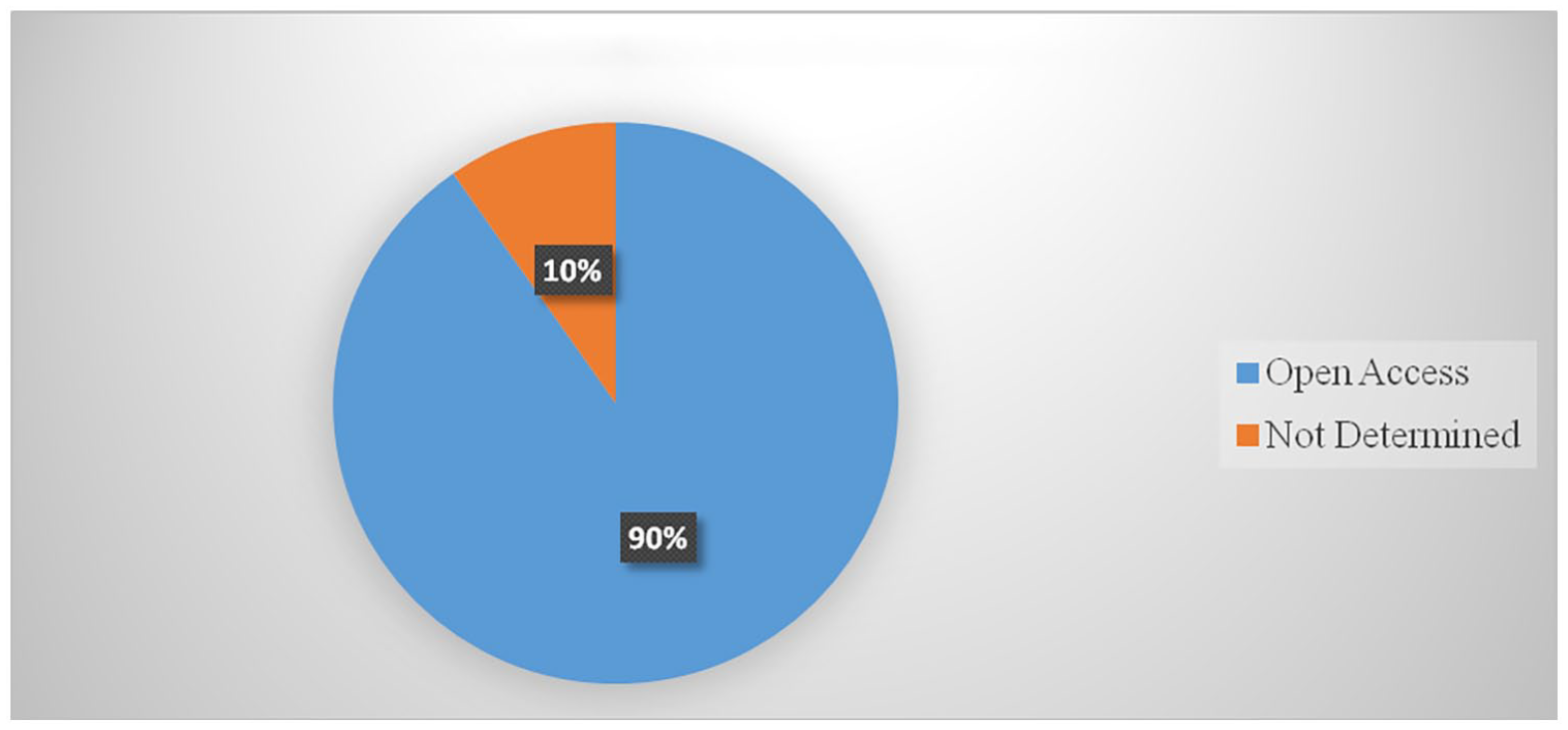
Open access scholarly Journals of Pakistan (N = 329).
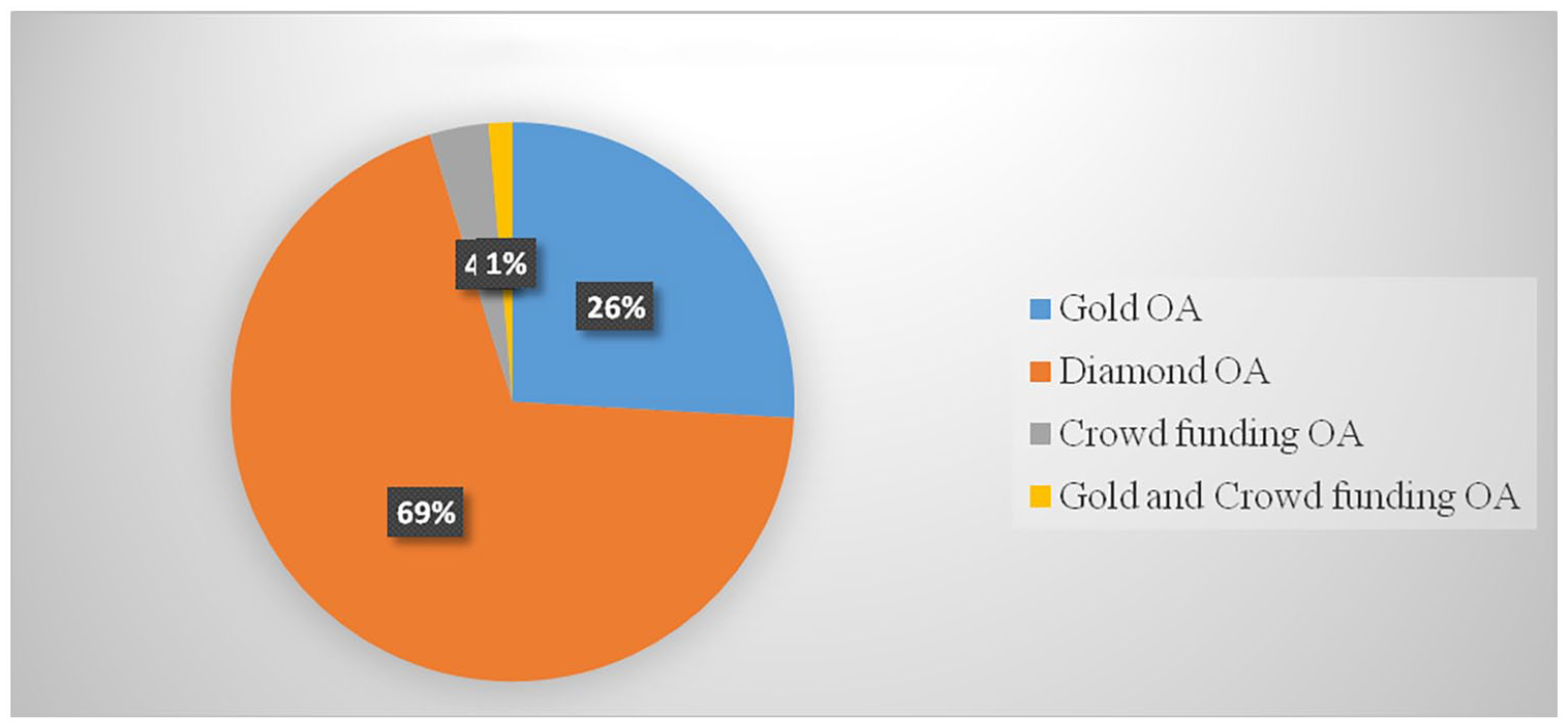
Open access models of scholarly Journals of Pakistan (N = 329).
Indexing and abstracting and HEC recognition status: Impact factor of journals and journals indexed in Scopus and Web of Science (WOS)
The analysis of the websites of the Pakistani research journals (Table 1) revealed that 5 (3%) journals belonged to the X category of journals and 144 (97%) journals belonged to the Y category of journals. This Ranking Category was defined by the HEC of Pakistan as W, X, and Y from Highest to lowest ranking. Categories of 148 journals were not traceable in the HJRS.
Category and impact factor of journals and journals indexed in scopus and web of science (WOS; N = 329).
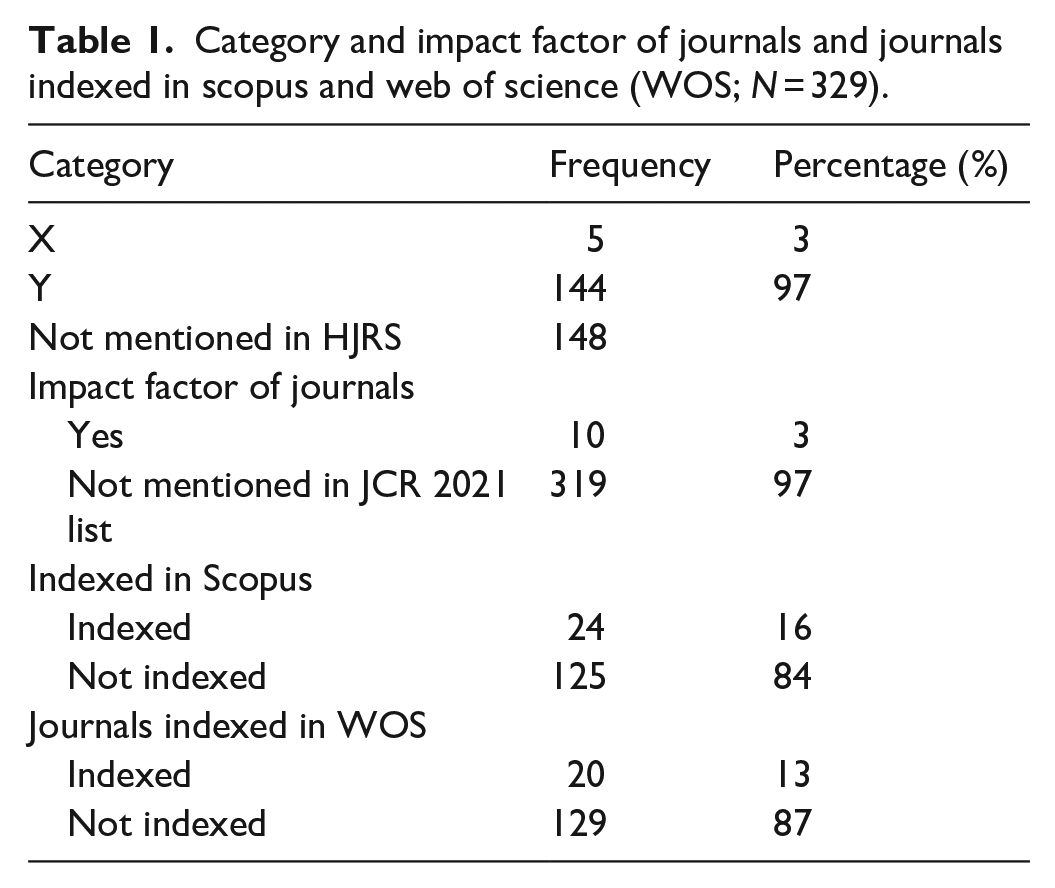
Not a single journal belonged to the W category of journals. Table 1 also illustrated that 10 (3%) journals were impact factors. Furthermore, Table 1 described that 24 (16 %) journals of Pakistan were indexed in the Scopus database. Scopus is Elsevier’s citation database of peer-reviewed journals. The information from 180 journals was not available from the HJRS. It was also concluded that 20 (13 %) journals were indexed in WOS. WOS is a citation database of peer-reviewed journals maintained by Clarivate Analytics.
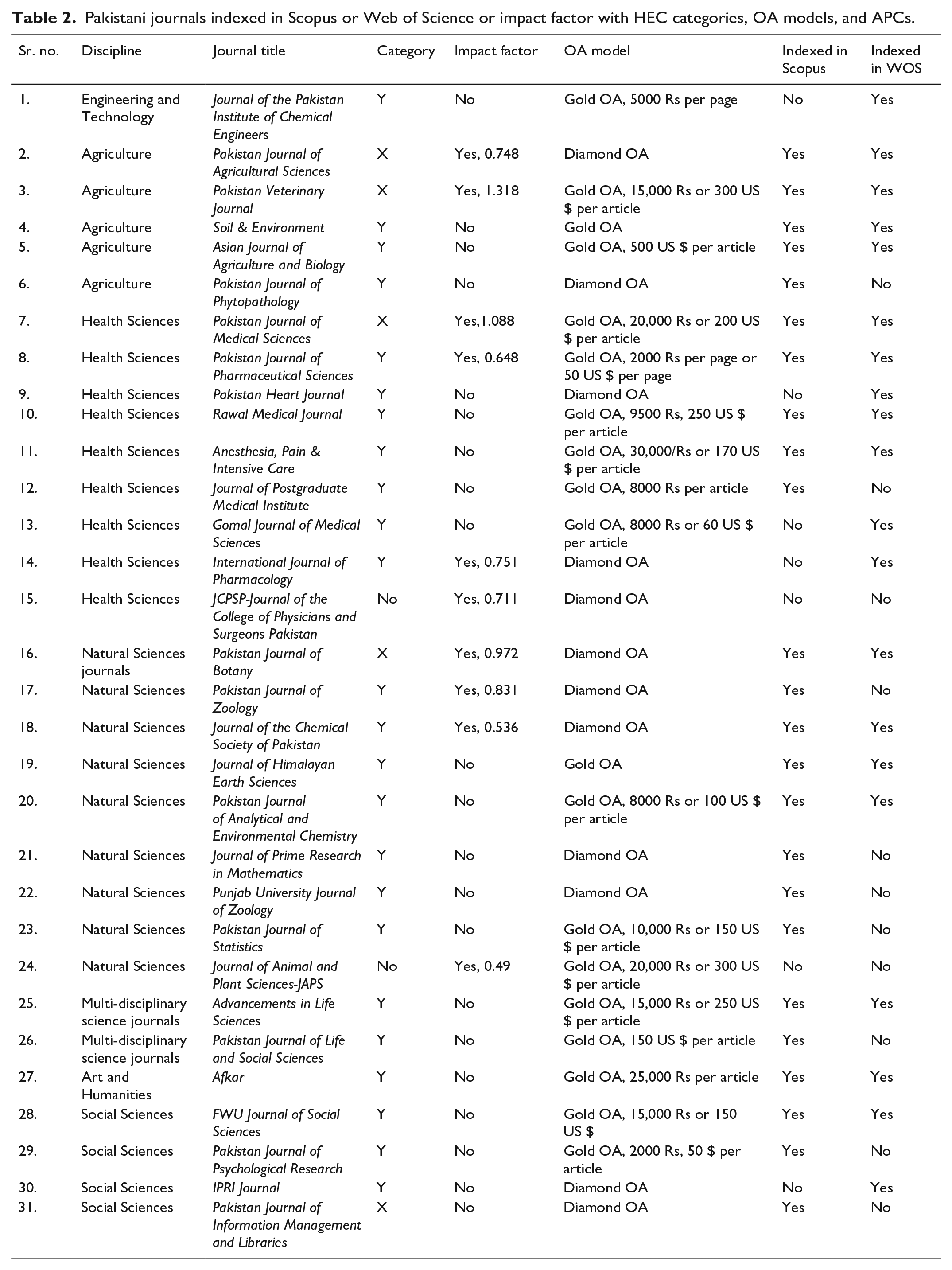
While analyzing the websites of the journals of Pakistan (Table 2) it was extracted that the average APCs per an article of eleven Sciences journals and two Social Sciences journals that were either indexed in Scopus or Web of Science or impact factor, were 13,863/PRs or 225 US $ and 8500/PRs or 100 US $, respectively. Twelve journals that were either indexed in Scopus or Web of Science or impact factor, were following the Diamond model of OA. Average APCs per an article in Sciences and Social Sciences journals of Pakistan that were not indexed in Scopus and WOS or not impact factor were 11,125/PRs or 46 $ and 21,600/PRs or 90 $, respectively.
Pakistani journals indexed in Scopus or Web of Science or impact factor with HEC categories, OA models, and APCs.
Observations
While evaluating the websites of Pakistani HEC-recognized scholarly journals, it was observed that the websites of the Sciences discipline journals were much more exhaustive and comprehensive. The information related to the 12 items of the checklist (Appendix A) of journals was easily collected from the websites of the Sciences journal. The websites of the other discipline journals were lacking the required information. A 14 impact factor journals were recorded on the websites but 10 impact factor journals were confirmed in the JCR of Clarivate Analytics of 2021.
Discussion and conclusion
This study filled the literature gap and concluded that Pakistan has emerged in the OA publishing paradigm by publishing a large majority of 297 (90%) journals in OA from the total 329 HEC-recognized journals of Pakistan. There was a blend of OA models in practice; however, more than two-thirds (69%) of journals were following the Diamond OA model, followed by one-fourth (26%) Gold OA and Crowdfunding OA model (3%).
My study explored 329 HEC-recognized journals on the lists 2019 of HEC. Conversely, Sheikh (2020) described 259 national journals of Pakistan on the lists 2018 of HEC. He explored that Pakistan had 201 (77%) OA journals and DOAJ (2022) had registered 94 OA journals originating from Pakistan. Qutab (2012) identified that Pakistan had 135 full-text OA journals. However, my study explored 297 (90%) OA scholarly journals in Pakistan. This emergence of OA scholarly journal publishing in Pakistan was due to the OA policy initiative of the HEC of Pakistan. On 30th September 2019, HEC made it compulsory for every journal in Pakistan that it must have International Standard Serial Number (ISSN), title, and Universal Resource Locator (URL) verified from the international ISSN register for its registration and accreditation due to which every journal of Pakistan was struggling to be OA as soon as possible.
HJRS was developed by HEC based on international standards to upgrade the credibility of Pakistani scholarly journals. Pakistani journals converted into OA due to the pressure of HEC and now Pakistani scholarly journals are on the way to register themselves in DOAJ. Pakistan with 297 OA scholarly journals was competing with its neighboring counterparts, Iran with 690 OA journals, Turkey with 417 OA journals, India with 326 OA journals, and China with 213 OA journals (DOAJ, 2022). In the region, Iran was leading with 690 OA journals to contribute profoundly to the OA journal publishing paradigm.
Qutab (2012) identified that the Gold model of OA was growing in Pakistan. Likewise, Sheikh (2020) described that the Gold OA model was getting popularity in Pakistan. Though, my study explored that more than two-thirds (69%) of journals were following the Diamond OA model, followed by one-fourth (26%) Gold OA and Crowdfunding OA model (3%). However, the Diamond model (Misra and Agarwal, 2019) of OA was common between India and Pakistan.
The present study concluded that the majority of 144 (97%) journals in Pakistan belonged to the Y category of journals and 5 (3%) journals belonged to the X category of journals. It was also concluded in the study that the majority of 318 (97%) journals in Pakistan were not impact factor. It is evident from the study that Pakistani journals are lagging in finding the W and X categories of the journals, that is, the ranking system which was developed by the HEC of Pakistan. This is alarming situation for the academicians, educationist, editors, and policy makers of Pakistan. It is due to not following the criteria of HJRS and Journal Publishing Practices and Standards (JPPS) by the journals of Pakistan. Pakistani journals belongs to the lowest ranking system and their lowest rankings may be addressed to find the credibility/categories and impact factor of the journals.
The present study illustrated that 27 (18%) journals of Pakistan were indexed in the Scopus database and 19 (13%) journals were indexed in WOS. Likewise, Sunny (2022b) revealed that 54 (14%) Indian journals were indexed in WOS and 18 (5%) journals were indexed in Scopus out of 326 total OA journals of India registered in DOAJ. Indexing and abstracting in Scopus or WOS of Pakistani and Indian scholarly journals are almost the same but were lagging as compared to the US. Pakistani scholarly journals need more authenticity and credibility for indexing and abstracting in Scopus and WOS. Pakistani scholarly journals need more struggles to gain quality and prestige by following the HJRS and JPPS criteria.
While analyzing the websites of the journals of Pakistan it was extracted that the average APCs per article of 11 Sciences journals and two Social Sciences journals that were either indexed in Scopus or Web of Science or impact factor, were 13,863/PRs or 225 US $ and 8500/PRs or 100 US $, respectively. Average APCs per article in Sciences and Social Sciences journals of Pakistan that were not indexed in Scopus and WOS or not impact factor were 11,125/PRs and 21,600/PRs, respectively. Such high demands of APCs from the Social Sciences journals look like a big hurdle for potential authors to contribute to OA publishing. Likewise, Sheikh (2017) highlighted that the low pace of OA publishing in Pakistan was due to the high demands of APCs by the OA journals.
Recommendations of the study
It is recommended in the present study that Academicians, higher educational institutes, publishers, editorial boards, and policymakers should frame new strategies for the up-gradation of the status of Pakistani scholarly journals. The category/credibility and impact factor of Pakistani journals are not satisfactory, more efforts are required to upgrade the category and impact factor of the journals. The category and impact factor of journals may be improved by addressing the issues related to infrastructural, technological, financial, and human resources of the journals. Indexing in Scopus and WOS needs to be improved as the present number of Pakistani indexed journals is not satisfactory. International standards such as JPPS may be followed to prompt OA scholarly journals publishing paradigm in Pakistan. Indexing of Pakistani journals in DOAJ may also be improved by following the registration rules and guidelines of DOAJ. Professional associations may also play their role to enhance the standards of the Pakistani scholarly journals. The capacity of editorial boards of journals may be enhanced to boost the standards of Pakistani scholarly journals. More training and workshops may be executed to enhance the capacity of editorial boards of Pakistani scholarly journals. Remuneration of editorial staff may be increased to gain their significant role in the up-gradation of the standards of the journal. OA scholarly journal publishing conferences and seminars may be executed to prompt the OA journal publishing paradigm in Pakistan. The high demands of APCs from Social Sciences journals may be reduced to attract more potential authors for OA publishing. Funding agencies, donor organizations, and HEC should play a pivotal role to address the funding problems of the journals. More studies may be executed by considering the updated HEC-recognized journals lists and following the JPPS.
Footnotes
Appendix A
The checklist of 12 items of journals was contained:
Declaration of conflicting interests
The author(s) declared no potential conflicts of interest with respect to the research, authorship, and/or publication of this article.
Funding
The author(s) received no financial support for the research, authorship, and/or publication of this article.
