







Abstract
Social media platforms have been adapted into society in various ways during last two decades. Few studies have examined social media content from the perspective of the individual library professional, and in particular, from librarians’ social media posts about their work. This research explores social media complaints from library professionals to reveal insights into the areas of concern related to libraries as expressed in an informal, discursive style. Reddit data from three library subReddits was collected through a Python script. A total of 272 complaint posts with enough information were coded manually. A computational tool, Linguistic Inquiry and Word Count (LIWC), was also used to extract linguistic characteristics of each post. The majority of the sources of the complaint posts came from librarians (86.76%). The top five categories of the target of the complaints were patrons (27.94%), the poster’s organization (20.22%), the poster’s supervisor (11.03%), the library field (11.03%), and the poster’s coworkers (10.29%). The top four topics of the complaint posts were patron behavior (21.69%), negative work environment (16.18%), job expectations (11.76%), and service expectations (10.66%). Organizations should put into place mechanisms and processes through which employees may share their concerns and exercise their voice, with no retribution, to solve workplace problems.
Introduction
Social media platforms have been adapted into society in various ways during last two decades. Popular platforms such as Facebook, Twitter, and Reddit allow users to express their opinions and interact with others on those sites in anonymous ways. One way users tend to use social media is as a platform to air complaints about various issues, such as institutions, policies, causes, or other people (Zappavigna, 2013). Studying the discourse of social media, Zappavigna (2013, p. 70) writes: “complaining can invoke solidarity via the potential for commiseration as people bond around shared irritations . . .” Posters to social media platforms who choose to hide their identity and project anonymity may feel some freedom to express negative emotions, dissatisfaction, or frustration and look for peer support.
Many library and information science (LIS) institutions have established accounts on social media platforms to promote their services and communicate with patrons, such as creating Facebook pages or groups, or Instagram or Twitter accounts. Various studies have examined the effectiveness of social media engagement within the LIS community in recent years (AlAwadhi and Al-Daihani, 2019; Al-Daihani and Abrahams, 2018; Ihejirika et al., 2021; Jones and Harvey, 2019; Joo et al., 2018). However, fewer studies have examined social media content from the perspective of the individual library professional, and in particular, from librarians’ social media posts about their work. 1 Previous research (Ming et al., 2022), has uncovered that the social media site Reddit, and specifically library-related subreddits, is a place for people to post complaints related to their professional experiences. These complaints are unique from other facets of research on negative communication on social media. They are not bullying, they are not political discourse, nor are they expressions of incivility directed at someone. They are not examples of negative-word-of-mouth feedback directed toward retailers, brands, celebrities, politicians, or government institutions (Balaji et al., 2016; Pfeffer et al., 2014). Rather, this discourse reflects the thoughts, feelings, and areas of concern that people affiliated with libraries—primarily employees in libraries, but also patrons—choose to express in public fora. The general range of such complaints include common themes such as frustrating patron behaviors, negative thoughts about the work environment, and instances where expectations about the job were not met. Exploring this discourse can shed light on perceptions of the field of librarianship from a unique vantage point. Posters are almost exclusively anonymous and their connections to a specific institution are usually hidden. Such anonymity may embolden posters to reflect and share concerns in a more personal and authentic manner than if they were to make those comments in public space where their identity and professional connections would be revealed (Christopherson, 2007). As a result, the discourse in such sites is worth examining to explore the values and expectations around libraries and librarianship that are revealed in the posts. We base this research in Uses and Gratifications theory which posits that people choose to interact or consume media to satisfy certain needs (Papacharissi, 2008). Users and Gratifications theory can also provide an underlying explanation for why and how people choose to use social media and what kinds of gratifications they receive from doing so (Quan-Haase and Young, 2014). For instance, research examining the gratifications received from using Facebook and Instant Messaging identified six categories of gratifications: pastime (e.g., because it is fun), affection (e.g., to help others), fashion (e.g., to look stylish), share problems (e.g., because I just need to talk about my problems), sociability (e.g., to meet people), and social know (e.g., to feel involved with what’s going on with other people) (Quan-Haase and Young, 2010).
The affordances of Reddit make it a space where posters can vent to people with a shared professional connection and potentially gain satisfaction by expressing complaints regarding topics relatable to other readers. Given that people post to library related subreddits, and Reddit affords anonymity, what they post about can be an illuminating look at topics and issues that are relevant to the field. Therefore, this research explores social media complaints from library professionals to reveal insights into the areas of concern related to libraries as expressed in an informal, discursive style. The research can bring to light topics of concern and attitudes and beliefs that library managers may wish to consider in terms of the relevance to their own locations and develop strategies to tackle such situations in the future.
Literature review
Library complaints
According to Merriam-Webster (2022), the definition of complaint refers to “expression of grief, pain, or dissatisfaction” and “something that is the cause of subject of protest or outcry.” Although a complaint can also refer to filing a grievance or lawsuit, this study concentrates on the expression of dissatisfaction and negative feedback within the context of the LIS field as expressed on Reddit. Various methods have been utilized by public and academic libraries to collect feedback, including complaints, from patrons. Typical methods include implementing feedback buttons on websites, providing online or physical suggestion boxes, or distributing user surveys (Farnum et al., 2011; Given and Julien, 2005; King, 2005; Probst and Pelikan, 2006). Feedback and suggestions from patrons are typically collected to help the improvement of various library services. Existing studies have examined patrons’ complaint behaviors within public and academic libraries and have found that user complaints are valuable for library management teams to develop strategies and make crucial decisions (Oh, 2003, 2004, 2006). Vance (2018) examined noise-related complaints within a university library and emphasized that libraries could benefit from such complaints to enhance the physical environment arrangements within libraries. Suki (2011) observed that public library users were more likely to complain to a third party while some may complain to department managers or chief librarians.
User complaints from different social media platforms have also been studied. Borrego and Navarra (2021) analyzed Google Map reviews for public libraries in Barcelona (Spain) as an unobtrusive way to understand library users’ perceptions of the hours, facilities, services, and collections of the libraries they reviewed. They found that although reviews were generally positive, there were some negative reviews for facilities, staff, opening hours, and technology of the libraries and suggested that social media channels can be a helpful channel through which libraries can receive feedback quickly and easily. Complaints about libraries or other LIS institutions come not only from patrons. Lee and Ke (2020) conducted content analysis on a library-related Facebook confession group that included complaints from both librarians and patrons. Librarians, other library users, and management policies were the top three topics that posters to the group mentioned.
Dissatisfaction from employees about their institutions can be more difficult to study. Some organizations may have complaint procedures in place for employees to voice such complaints, but it may not be the most comfortable way for employees to express their negative opinions. With the development of social media platforms that allow users to share their thoughts anonymously while connecting with peers around the world, library professionals may seek out such platforms to post complaints or express negative emotions and look for suggestions for handling difficult work situations (Lee and Ke, 2020). Indeed, researchers have suggested that librarians prefer to express emotions anonymously through social media platforms, such as Facebook groups, instead of making direct complaints to their institutions (Lee & Ke, 2020).
Reddit is a community-based social media platform which facilitates users’ communication with their peers around shared topics of interest. There are many different subreddits, or themed discussion fora, that users can join based on their interests. Reddit also provides a function that allows users to create throw-away accounts to post content when they wish to retain anonymity. Researchers from various disciplines have developed interest in studying conversations on Reddit for research on mental health issues, political issues, and social support (Miller, 2020; Park and Conway, 2018; Soliman et al., 2019), and more recently there is research on using Reddit for research (Proferes et al., 2021).
There are three major LIS related subreddits which will be examined in this study, r/library, r/librarian, and r/libraries. Prior research has explored the nature of posts shared on library-related subreddits (Ming et al., 2022). One of the topical categories uncovered in prior research is posts expressing complaints. This phenomenon of posting complaints to a social media platform is of great interest because it reveals unmet expectations related to the LIS field. Examining complaints on the LIS community Reddit posts can help further an understanding about the nature of the complaints that library professionals and patrons choose to voice on a public, third-party platform. It can also shed light on issues or concerns within the field by raising awareness of those issues that can subsequently lead to policies and solutions for patrons and employees. The research reported here is an exploratory study of a subset of all posts to the three library subreddits that were coded as “complaints” from Ming et al. (2022). Ultimately, the purpose of the research is to explore what the social media-based complaint behavior reveals about the field of librarianship. The following research questions guided the study.
RQ 1: What roles are identified in the complaints posted to library subreddits?
RQ 2: What are the topics of the complaints posted to library subreddits?
RQ 3: What resolutions are proposed in the complaints?
Methods
Reddit data were collected on January 4th, 2020, from Pushshift, a comprehensive social media monitoring platform that collects real time and historical Reddit data using a Python script (Ming et al., 2022). The top-level post from three library related subreddits (r/library, r/libraries, and r/librarians) were collected, resulting in a collection of 17,049 posts. The time range of the dataset starts from October 27th, 2008, to January 4th, 2020. An initial round of coding on the topic of each top-level post resulted in a set of 338 posts that were categorized as complaints (Ming et al., 2022). After the second round of coding, a total of 272 posts with enough information for further analysis remained. The unit of analysis was the entire post. Two coders were involved during the coding process. Each post identified as a complaint in the previous round of coding was then manually coded by both researchers following a modified version of a taxonomy of complaints from the work of Decock and Depraetere (2018) and Depraetere et al. (2021). The taxonomy identifies four components of a complaint: 1) an ongoing situation which does not meet an expectation; 2) a clear expression of dissatisfaction with the situation; 3) an indication of who or what is responsible for the situation and the consequences of the situation; and 4) a desire for there to be a remedy to the situation. We modified the taxonomy slightly to add an indicator of the source of the complaint and to capture if the poster explicitly mentioned they were posting anonymously, a feature of Reddit. Thus, we coded each of the 272 posts using these coding categories to identify: 1) the source of the complaint (e.g., a librarian, student, patron, etc.); 2) the target of the complaint (e.g., a person such as a patron, or a supervisor, or an organization or institution); 3) whether there was a request for a remedy or not, and if so, what was it (e.g., yes/no); 4) anonymity (yes/no); and 5) topic (e.g., patron behavior, negative work environment, job expectations, etc.). We used the constant comparative method while coding the topic of each post (Boeije, 2002). We first read through the collection of posts and created codes derived from the data. We adjusted the codes as we progressed through the complete dataset. Next, we compared data looking for similarity and overlap across codes and analyzed the posts within each code, expanding or narrowing codes according to the patterns that emerged.
Additionally, we used a computational tool, Linguistic Inquiry and Word Count (LIWC) (Pennebaker et al., 2015), to automatically generate four linguistic characteristics of each post: 1) emotional tone (a comprehensive score from 0 to 100 for overall tone for the post, a higher score represents a more positive tone while a lower score represents a more negative tone); 2) use of angry words (yes/no); 3) use of sadness words (yes/no); and 4) use of swear words (yes/no).
Results
Source and target
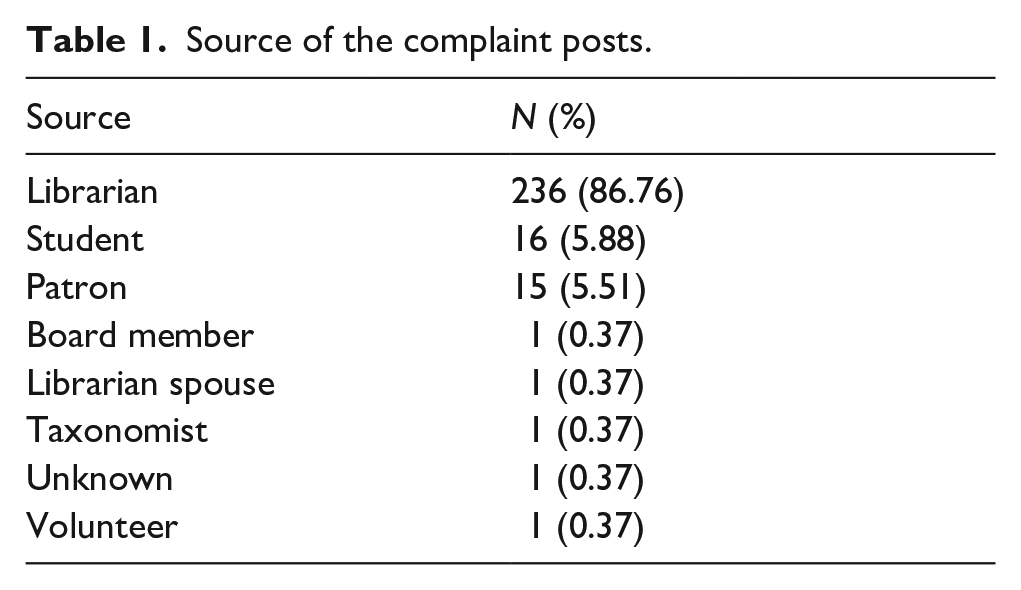
The majority of the sources of the complaint posts came from librarians (86.76%), while a small portion of posts were from LIS students (5.88%) and library patrons (5.51%). The top five categories of the target of the complaints were patrons (27.94%), the poster’s organization (20.22%), the poster’s supervisor (11.03%), the library field (11.03%), and the poster’s coworkers (10.29%). Table 1 lists all the sources of the posts. Table 2 lists all the targets of the posts.
Source of the complaint posts.
Target of the complaint posts.
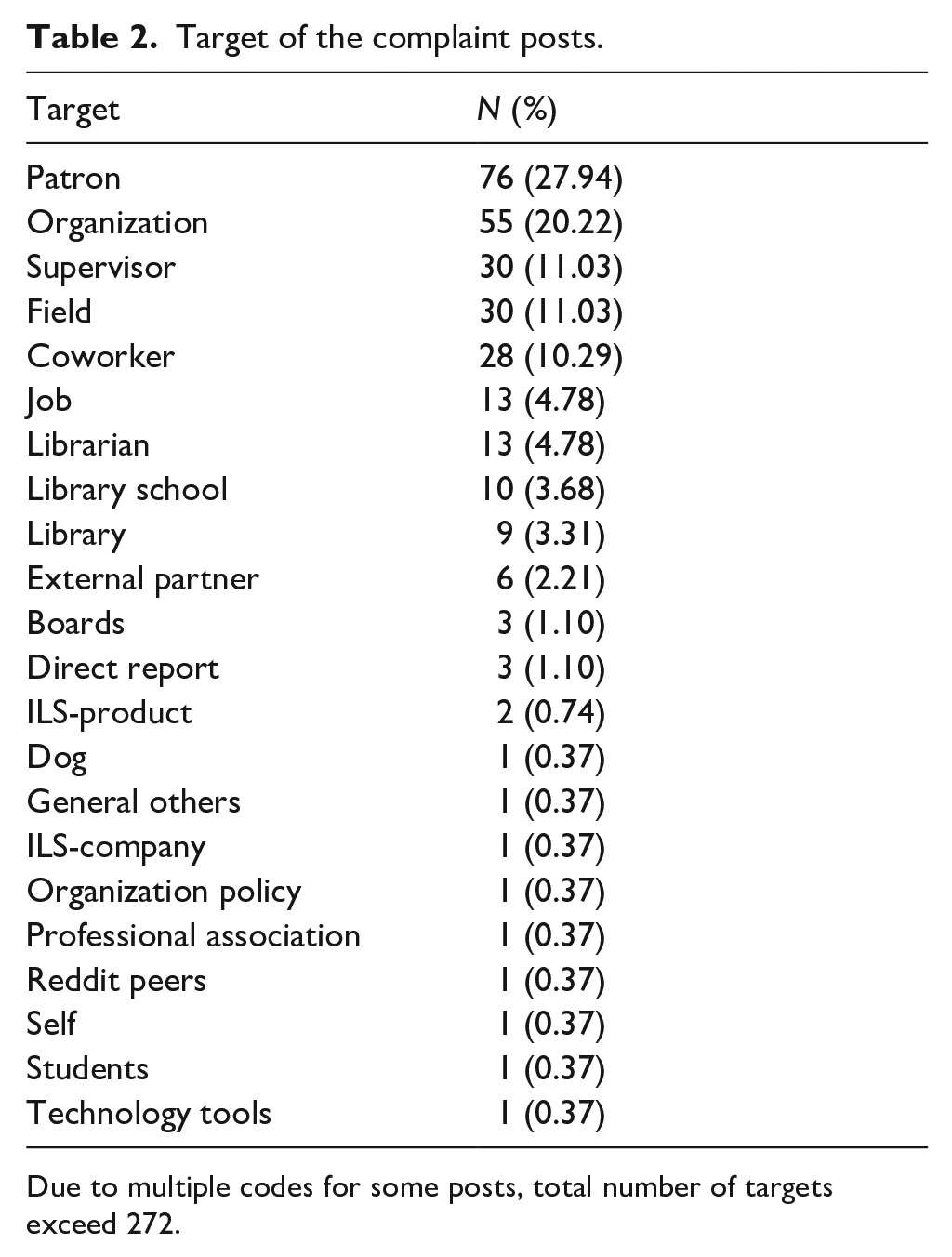
Due to multiple codes for some posts, total number of targets exceed 272.
Remedy and anonymity
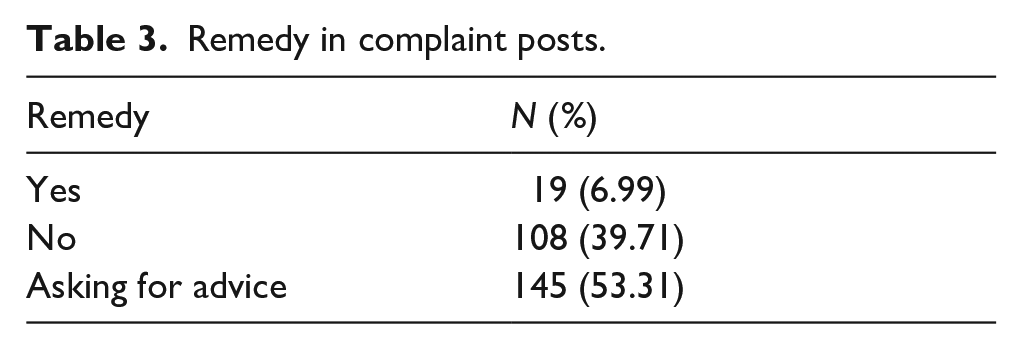
Just over half of the complaint posts did not mention a specific remedy to the situation that was the topic of the post but did express a request for advice (n = 145, 53.31%). We treated this request for advice as a separate category because conceptually asking for advice seemed to fall in between an explicit remedy to a situation and no remedy. Only 19 posts (6.9%) contained an explicit statement of a desired remedy to address a situation, and 108 posts (39.7%) made no mention of any remedy nor asked for advice, see Table 3.
Remedy in complaint posts.
A feature of Reddit is the ability to create a throwaway account to maintain anonymity on the site. We explored the dataset to see how frequently posters chose to use that feature of the platform, but because we did not have access to the users who posted to the three subreddits, we were not able to know for sure who might be using a throwaway account. Instead, we coded for any instance where the poster explicitly mentioned they were using a throwaway account, which would be a conservative estimate of the use of that feature. We found only 3.68% of posts (n = 10) mentioned using a throwaway account for the purpose of being anonymous. However, many of the posters indicated in their writing that they were purposefully omitting or changing details that might reveal their identity or expose their specific organization, indicating a desire to share their complaints anonymously.
Topicality
Each post was coded for the topicality or the aboutness of the post. The posts ranged in word length quite significantly (M = 295.95, SD = 252.07) so we assigned a code related to the overall topic of the whole post. During the coding process, a short word or phrase was established that summarized the meaning of the post. Most posts were coded in only one category, with six posts coded under multiple topics. Although the characteristics of patrons are likely different compared to other posters, the number of complaints from patrons (15) is not big enough to separate them for further analysis. The top four topics of the complaint posts were patron behavior (21.69%), negative work environment (16.18%), job expectations (11.76%), and service expectations (10.66%). Table 4 lists all the topics of the posts.
Topics of the complaint posts.
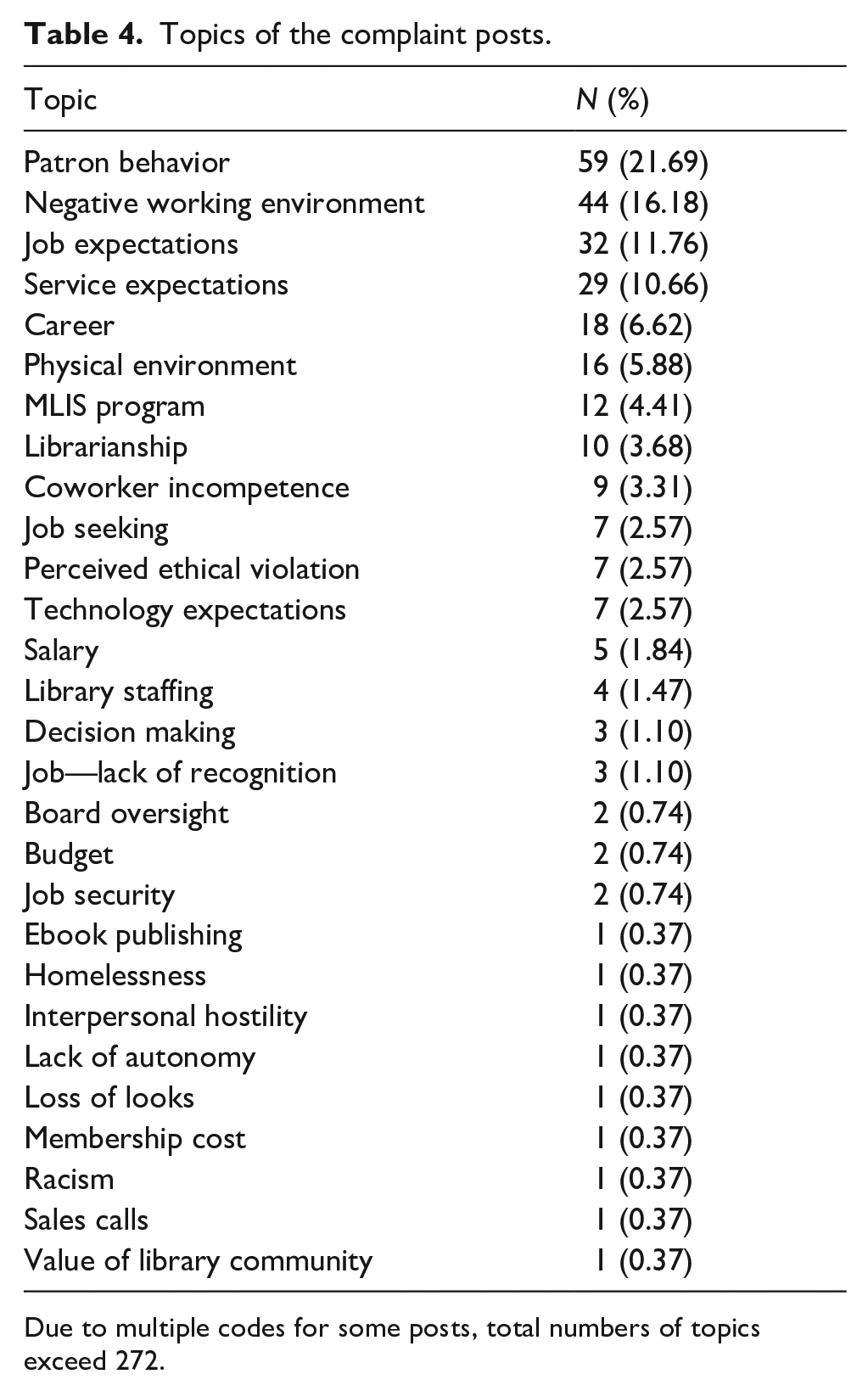
Due to multiple codes for some posts, total numbers of topics exceed 272.
The greatest number of complaints were about patron behaviors in the library. Most posts described typical minor irritations such as complaints about patrons yelling, requesting excessive help with computers, failing to read instructional signage, and so on. In describing these situations, some posts were short, seemingly off the cuff quick descriptions of a minor event. Other posts were longer including much more detail, often closing with an invitation to others to share similar stories. A few posts, however, revealed more profound concerns around issues such as the personal safety of a patron, how a library policy may be inadvertently hurting a patron instead of helping, questioning the appropriateness of certain programming, or expressing complaints related to unhoused patrons.
The category negative work environment was used for posts describing specific negative workplace situations. We further analyzed the posts in this category by the target of the post which showed that of the 44 posts in total, 16 were about the organization; 14 were about a supervisor, 9 were about a coworker, 5 were about a patron, 3 about the field, 2 about the job, 1 about librarian (posted by a patron), and 1 for dog, with some posts having multiple targets. Extracting key concepts using words from within the set of posts about negative work environment, we observed a range of strong negative concepts including: Bullied Burnt out Corrupt place Drama Fired Gloomy attitude Gossip and bickering Harassment HIPPA violation Hostile environment Internal politics Joyless purgatory Lack of training Micromanaging Old boys club Paycut Quit
One interesting observation to note about the posts in this category is that many posts contain the phrase “I love libraries” or “I love being a librarian but” and then describe a negative work experience, after which they reveal that the negative experience (or continued negative experiences) are causing them to question their job, their organization, and/or their desire to stay in the field. In many cases, it is clear that the situation has been ongoing and for some reason, the poster chose that moment to turn to social media to air their grievance.
The category for job expectations included situations where librarians felt they were expected to do work outside their job descriptions taking on additional tasks and responsibilities beyond the scope of their jobs. This category also included examples where the job included tasks they did not expect to have to fulfil, or that their job was not challenging enough. Dissatisfaction with the hours or the schedule was another subtheme in this category.
The complaints coded as service expectations came mostly from librarians (n = 22) and were often about a frustration with how a library service was being offered. Some examples of the issues included criticisms of an unnecessarily complicated shelving for new books, inadequate space for teens, inability to provide meaningful help with tax forms, observing poor reference service by a colleague, or being restricted by others in the library from offering particular programs or choosing particular books. The interesting theme underlying the posts in this category is how the librarians genuinely cared about the services in their organization and took to social media to express their views when they felt the services were not being adequately offered. It seems the posters had expectations that their libraries would provide better service that what they observed.
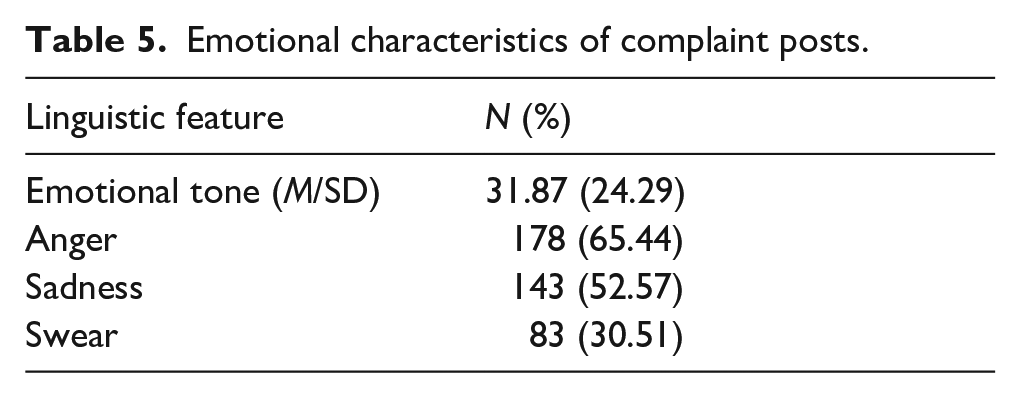
Finally, we also applied computational analysis to the dataset. The average emotional tone score, an indicator of the overall degree of positivity or negativity in a corpus scored on a scale of 0-100 where higher numbers indicate more positivity, was 31.87, with a standard deviation of 24.29 across the whole dataset. This average score indicates that the overall emotional tone of the posts leans solidly toward a pessimistic and cynical tone, not a surprising finding given that the posts expressed complaints. We also explored the prevalence of words related to anger, sadness, and swear words. Table 5 shows the mean and standard deviation of emotional tone score as well as the number of posts conveying anger, sadness, and swear words. As expected, a large number of posts contained words associated with anger and sadness.
Emotional characteristics of complaint posts.
Discussion
The complaint posts shared on the three library-related subreddits form an interesting set of data to explore. Our research sought primarily to analyze who contributed complaint posts, directed at whom, related to what situation. We further explored whether posters sought out remedies for their complaints and whether they took advantage of the anonymity afforded by the platform. We also did some linguistic analysis of the words included in the posts to better understand the presence of emotion words in the posts.
Not surprisingly, librarians were the primary posters of complaints to the subreddits. In order to create a post, someone would need to be a user of Reddit and then on the platform they would need to discover these particular subreddits so it stands to reason a professionally-oriented subreddit would appeal to those in the profession. But unlike other social media platforms with a professional focus, such as ALA Connect, a social media platform for members of the American Library Association, there is no requirement to be formally affiliated as a professional in LIS to participate on the library-related subreddits and so we also saw a small number (n = 15) of posts from people who described their experiences as patrons in a library. Students pursuing a library science degree also posted complaints to a small extent. This shows that Reddit is an online platform where librarians can go to interact with other librarians, without having to make the effort of seeking people out individually and establishing a virtual connection with them as is the process on other social media platforms. Knowing that one is interacting with others in the same profession can be an attractive feature of the platform. The shared experiences that come from being a part of the same profession affords posters a built-in sense of community that may be an inviting characteristic of the site. Although this study did not explore users of the library subreddits, there is value in future research examining the motivations of people who participate in library subreddits.
Our study examined the target of the complaint posts. This line of inquiry is important as it demonstrates the range of actors that library workers encounter. Here we see an interesting contrast in the target of the complaint from specific individuals (such as a particular patron, supervisor, or coworker) to entities (such as the organization, the job, or the library), and then to the even more broad targets (e.g., the library school and the field of LIS) which may encompass a broad set of practices, attitudes, and beliefs. Complaints targeting specific individuals are a natural element of the narrative of a complaint—somebody did something that did not meet the poster’s expectation and they are the target of the poster’s complaint. Complaints against the organization or the job, however, may point to broader issues related to organizational culture and climate that permeate a work environment but are not attributable to a particular person. Complaints about library school or the LIS field point to concerns with conceptual issues that suggest ontological questions about who and what LIS is as a discipline. For example, although there were a relatively few total number of posts about library school across the whole dataset, many of the posts that were focused on library school were complaints about the curricula. Certainly frustration with curricula is not a new complaint, but the views expressed on Reddit may add to the ongoing dialog about effective library education.
Interestingly, very few posters included a desired remedy to the situation they were sharing. Many posts did contain a request for advice, although it was unclear how many such requests were genuinely seeking input from experienced others, and how many requests treated asking for advice more as a rhetorical device of seeking connection with others in the online community. Further research on professional social media platforms could explore the expectations of posters about the connections they hope to form with others on the platform around complaint behavior. Do they seek a back-and-forth engagement from others with similar backgrounds, expertise, and experience? Is there an expectation of peer support from an online community formed around a profession? Or perhaps is the act of posting a complaint itself a form of a remedy in that the act of disclosing a concern to others provides some type of relief sufficient for the poster to feel a sense of resolution?
The topics of the complaint posts provided interesting insights into areas of unmet expectations. The largest category, patron behavior, described irritations large and small with patrons. This category though the largest, is in other ways the most benign of the topical categories. These complaints describe common issues librarians face given the public-facing nature of the work. The three library subreddits offer a supportive space where librarians can vent to sympathetic others who can relate to the situations being shared. Posting their complaints to professionally oriented subreddits can be an effective way to cope emotionally with the challenges of serving difficult patrons as well as to create a sense of esprit de corps among their fellow users of the platform. More profound are the insights revealed through the complaints of negative work environment, job expectations, and service expectations. Many of the complaints in these categories showed posters’ intense frustration at very difficult work situations. Even though the stories shared in these kinds of posts cannot be verified for truthfulness or accuracy, the fact that the posters perceived the situations to be as negative as described raises questions: How common do such negative work experiences occur in libraries generally? How many librarians feel equally frustrated by similar experiences? What pathways or mechanisms are available for library employees to seek productive resolution to the conflicts described in these posts? While these data in no way can be understood as a scientifically representative sample of all libraries, the stories and situations described still suggest areas of concern worth exploring. Similar to a suggestion box, complaints shared in professional social media platforms may bring awareness to generalized areas of concerns that library leaders may find useful to consider. Ensuring that communication lines between supervisors and direct reports are open and honest, regularly evaluating job descriptions and staffing patterns to detect imbalances, empowering employees to voice concerns without fear of retribution are just a few examples of management best practices that can be drawn from the complaint posts shared on professional social media sites.
Implications
First, not all complaints are of equal seriousness or severity. Some dissatisfaction is not unusual in the workplace. Naturally people will complain about minor situations and that is to be expected. But the serious or more longstanding complaints may reveal deeper structural problems, and organizations may focus on whether they have effective mechanisms in place to capture and address those concerns, and how to improve them. Employee voice, first introduced in the management literature in 1970 (Hirschman, 1970) describes the voluntary feedback employees provide to their organizations with a goal to bring about positive change. Bashshur and Oc (2015, p. 1531) define employee voice as “the discretionary or formal expression of ideas, opinions, suggestions, or alternative approaches directed to a specific target inside or outside or the organization with the intent to change an objectionable state of affairs and to improve the current functioning or the organization group, or individual.” The two key components of the voice construct are that voice is offered voluntarily and that it is offered with the intent to bring about change. Generally speaking, research findings suggest that employee voice is positively associated with greater levels of employee performance, organizational justice, job satisfaction, and organizational commitment (Colquitt et al., 2001). However, employee voice can also bring some risk to the voicer in raising their concerns to the organization as it may bring harm to existing relationships (Seibert et al., 2001). A meta-review of employee voice literature found that higher levels of strains and stressors in the workplace predicted lower use of voice, suggesting that employees do not always feel comfortable sharing their concerns with their organizations (Ng and Feldman, 2012).
The rise of social media creates new channels through which employees may express their voice. Where prior to social media, employees’ options for sharing their concerns were largely limited to communication channels internal to the organization such as suggestion boxes, meeting with human resources staff or managers, posting to an intranet, or replying to a survey, now employees have a wider choice of channels with much greater reach (Miles and Mangold, 2014). How and where employees choose to express their voice may have positive or negative effects on the organization and Miles and Mangold argue that without appropriate internal channels in place for employees to voice their concerns, they are more likely to turn to social media channels to air their thoughts.
Employee voice may be a valuable construct through which to make sense of the social media complaint posts analyzed in this study. The posts to Reddit that describe challenging circumstances in an organization are voluntarily supplied, but are they posted with an intent to bring change? Clearly posting anonymously to social media instead of taking a concern to someone within one’s organization is a less direct way to bring awareness to an issue within the workplace. But, is posting to a professionally related social media channel such as library Reddit a half-step in the direction of employee voice? Could it be a means of sharing a thought to a public, but anonymous and likely an understanding audience to gain the confidence or clarity of thought to then bring the complaint to the organization? Researchers of employee voice may find it fruitful to explore the motivation and intent of grievance posts on professionally-themed social media sites as a substitute way to express employee voice.
Limitations
There are several limitations within this study. First, the dataset only includes publicly available online information from one social media platform. As a result, it only reflects the thoughts and ideas the posters chose to contribute and cannot speak to posters’ motivations or purposes for posting. Future research could reach out to those who posted complaints to collect additional information about their preferences and motivations for posting. Second, the sample is not representative of the library profession. Therefore, the results we present may not be generalizable to all libraries or librarians. Third, this study only examines the content of the main posts on the three library subreddits. Further examination of replies may contribute further understanding of the issues and reveal more insight through the analysis of posters’ interactions.
Conclusion
Social media sites such as library subreddits provide a dynamic communication channel for people to interact around topics of professional interest. The tremendous reach of such platforms expands networking opportunities and enables librarians to connect with colleagues beyond their in-person networks. The anonymity available in social media creates a space for employees to share grievances that they may not be comfortable taking directly to their places of work. For some kinds of complaints, just having a place to vent may be enough of a remedy for the poster to process their emotions and move on. But as noted in this study, other kinds of complaints can be more significant and longer lasting. Organizations should put into place mechanisms and processes through which employees may share their concerns and exercise their voice, with no fear of retaliation, to solve workplace problems.
Footnotes
Declaration of conflicting interests
The author(s) declared no potential conflicts of interest with respect to the research, authorship, and/or publication of this article.
Funding
The author(s) received no financial support for the research, authorship, and/or publication of this article.
