







Abstract
Digital preservation encompasses policies, technologies, and strategies to ensure that digital objects and collections will sustain for future use. This study aimed at investigating the trends toward digital preservation in terms of in-house activities versus outsourcing by systematically reviewing the extant literature. The relevant studies were identified by accessing multiple databases and indexing and abstracting services. After retrieving the relevant literature, necessary filtering was done by following the PRISMA protocols, and thereafter the selected studies were finalized for further review. The meta-analysis of the final studies affirms a strong global preference of libraries, archives, and other cultural and memory organizations toward in-house activities for the preservation of their digital objects and collections compared to outsourcing digital preservation activities by third parties. The results of this study provide a holistic view of how digital assets are being preserved in memory institutions across the world and underpin the global management (in-house or outsourced) approaches for digital preservation.
Introduction
Technological advancements have brought dramatic ease to the creation, dissemination, and accessibility of information (Becker et al., 2008; Ross, 2006). Technological affordances have made information access much easier and faster. Digital objects hold multiple benefits in comparison to conventional library materials (Okoh and Sambo, 2014). As a result, there is an increasing growth in the creation (Okoh and Sambo, 2014), and demand, and use of digital content (Rafiq and Ameen, 2012). Digital objects may comprise simple textual files, photographs, and audio/video files to exceptionally sophisticated web-based contents which make use of the benefits of technology to the optimum. Technological innovations are progressing incessantly, however, also posing certain challenges. According to Krubu and Osawaru (2011), “new advancements in technology affect the way information is handled in libraries.” A key issue these developments carry is technological obsolescence. Hedstrom and Montgomery (1998) and Rothenberg (1998) professed that rapid innovations in computer technologies make certain that digital obsolescence will turn into a problem. Xie and Matusiak (2016) identified technological failures, technological obsolescence, storage media obsolescence, hardware and software obsolescence, and file format obsolescence as the major challenges to digital preservation. Likewise, digital objects are also susceptible to some other risks like disasters/accidents, for example, floods, earthquakes, tornadoes, fire, short circuits, accidental deletion, mishandling, etc. Thus, digital preservation strategies are necessary to counter these issues.
Digital preservation is defined by individuals/organizations differently pointing toward the long-term preservation of digital content. The National Library of Australia describes its prime task as “maintaining the ability to meaningfully access digital content over time” (Hutchins, 2012: 8). Whereas Feather et al. (2004) simply elaborated on it as “the preservation of digital documents for future use.” Contrarily, Beagrie and Jones (2008: 24) have given an all-encompassing and diverse definition: “. . . the series of managed activities necessary to ensure continued access to digital materials for as long as necessary.” Likewise, in an earlier and widely cited definition, Hedstrom (1997) defines it as “the planning, resource allocation, and application of preservation methods and technologies necessary to ensure that digital information of continuing value remains usable.” Digital preservation comprises of diverse array of important actions necessary for the preservation of digital objects and materials. The main objective is the precise representation of trustworthy digital information over time (Okoh and Sambo, 2014). Several strategies are used to ensure the integrity and preservation of digital objects such as bit-stream copying, refreshing, migration, normalization, emulation (Xie and Matusiak, 2016), replication (Ruusalepp, 2003; Zaste, 2016), online archiving (Krtalic et al., 2016), development of trustworthy digital repositories (Donaldson, 2020), distributed digital preservation networks, and digital archeology (Okoh and Sambo, 2014; Samiei, 2020).
The execution of these techniques can warrant the preservation of contents and vice versa. Libraries throughout the ages have remained the storehouse of knowledge. Likewise, they have also been performing the role of information preservation (Hedstrom, 1997), and seem to have been fulfilling this role successfully. However, till the recent past digital preservation remained at the experimentation and research stages. Digital resources are altering the relationships between librarians and information technology professionals as the activities related to the preservation of these contents are making them more reliant on each other (Mason, 2018). Preservation of conventional resources is usually reflected as a one-time job that may result in the preservation of resources for years and in certain circumstances even for decades and centuries. However, it is not possible to profess digital preservation as a one-time task as the retention and accessibility of digital content require constant efforts (Samiei, 2020). Looking into the rise in the production of digital information, the importance of digital preservation has increased gigantically. If the first decade of the 21st century was the era of digitization, the second decade seems to have been the decade of digital preservation (Trehub, 2011; Trehub and Wilson, 2010).
This study is divided into eight sections. First, the introduction of this research is presented. Section 2 explains the statement of the problem. Section 3 illustrates the objective of the research. Section 4 discusses the research methodology adopted to conduct this research. Section 5 presents a qualitative analysis of the reviewed studies. Section 6 provides results and a discussion of the research findings. Section 7 highlights the limitations and directions for future research. Finally, Section 8 presents the conclusion of this study.
Statement of the problem
“Digital preservation is a complex technical, social, economic, and organizational issue” (Xie and Matusiak, 2016: 256). The fields of digital preservation and digital libraries are interlinked but the emphasis of research has been primarily on expanding access to resources rather than long-term digital preservation of cultural, heritage, and scientific resources (Ross, 2012). Implementation of digital preservation strategies can aid in avoiding the loss/inaccessibility of contents in the long run. A bulk of studies investigated the practices related to these strategies in organizations around the globe. However, most of them have addressed this phenomenon by inquiring about the prevalent practices. Only some have tried to investigate the phenomenon in terms of management perspective (in-house or outsourcing). Resultantly, there is a lack of evidence that explicitly highlights the global tilt of organizations for performing these activities in-house or through outsourcing. Therefore, this research systematically reviewed the relevant studies and conducted a meta-analysis for drawing clear conclusions regarding the preferences of organizations worldwide toward in-house activities or toward outsourcing the activities for digital preservation. The results of this study provide a holistic view of how digital assets are being preserved in memory institutions across the world and underpin the management (in-house or outsourced) approaches for digital preservation.
Purpose of the study
The purpose of the study was to review the existing literature systematically and draw conclusions based on a meta-analysis regarding global trends toward in-house digital preservation versus outsourcing.
Methodology
This study chose to perform a systematic literature review. In this approach, the pertinent studies are reviewed, and results are synthesized accordingly for responding to the research purpose. Likewise, it also includes qualitative analysis of the reviewed studies. For obtaining the relevant studies, authors searched different scholarly databases including Google Scholar, Science Direct, Emerald Insight, Springerlink, Taylor & Francis journals, Wiley–Blackwell journals, JSTOR, etc. We also searched indexing and abstracting services like Library and Information Science Abstract, Institute of Scientific Information Web of Science, etc. to identify the relevant studies.
Initially, for identifying the relevant studies we used the following keywords in our search strategy: “Digital preservation” and “in-house” or “outsourcing” or “outsource”
There were surveys that might have investigated this phenomenon, however their titles might not have included these terms. As such in the first instance, such studies were not traced. Consequently, we modified the keywords in our search strategy with the idea of including the maximum number of possible studies for comprehensive coverage the phenomenon comprehensively. To select all the potential studies, keywords were restructured for more flexibility. The revised keywords were: “Digital preservation” and “in-house” or “outsourcing” or “outsource” or “outsourced’ or “vendors” or “third parties” or “commercial sector” or “practices” or “survey”
To identify maximum studies, we sidestepped the inclusion of date ranges in the search strategy. Such a malleable style facilitated in the retrieval of a good number of studies that could be vetted further. The search process resulted in the identification of 1666 titles. These titles were screened/filtered to eliminate irrelevant studies. The Proper Reporting of Items and Meta-Analysis (PRISMA) steps were followed for selecting and rejecting studies (Figure 1). Initially, from 1666 titles, 262 duplicates were removed. Thereafter studies in languages other than English, conceptual papers, and titles with missing full text were removed from 1404 titles. Consequently, 197 eligible titles were left for further filtering. We further reviewed these titles for excluding conceptual and other irrelevant documents and at the end we got 49 empirical studies on digital preservation in an institutional context. We finally reviewed these 49 titles to identify the studies that contained the phenomenon of in-house practices versus outsourcing. This last step led to the selection of 24 studies for review and meta-analysis (Figure 1). A checklist was applied for extracting important data from these 24 studies for meta and qualitative analysis. The extracted data were organized and tabulated to outline the clear picture.
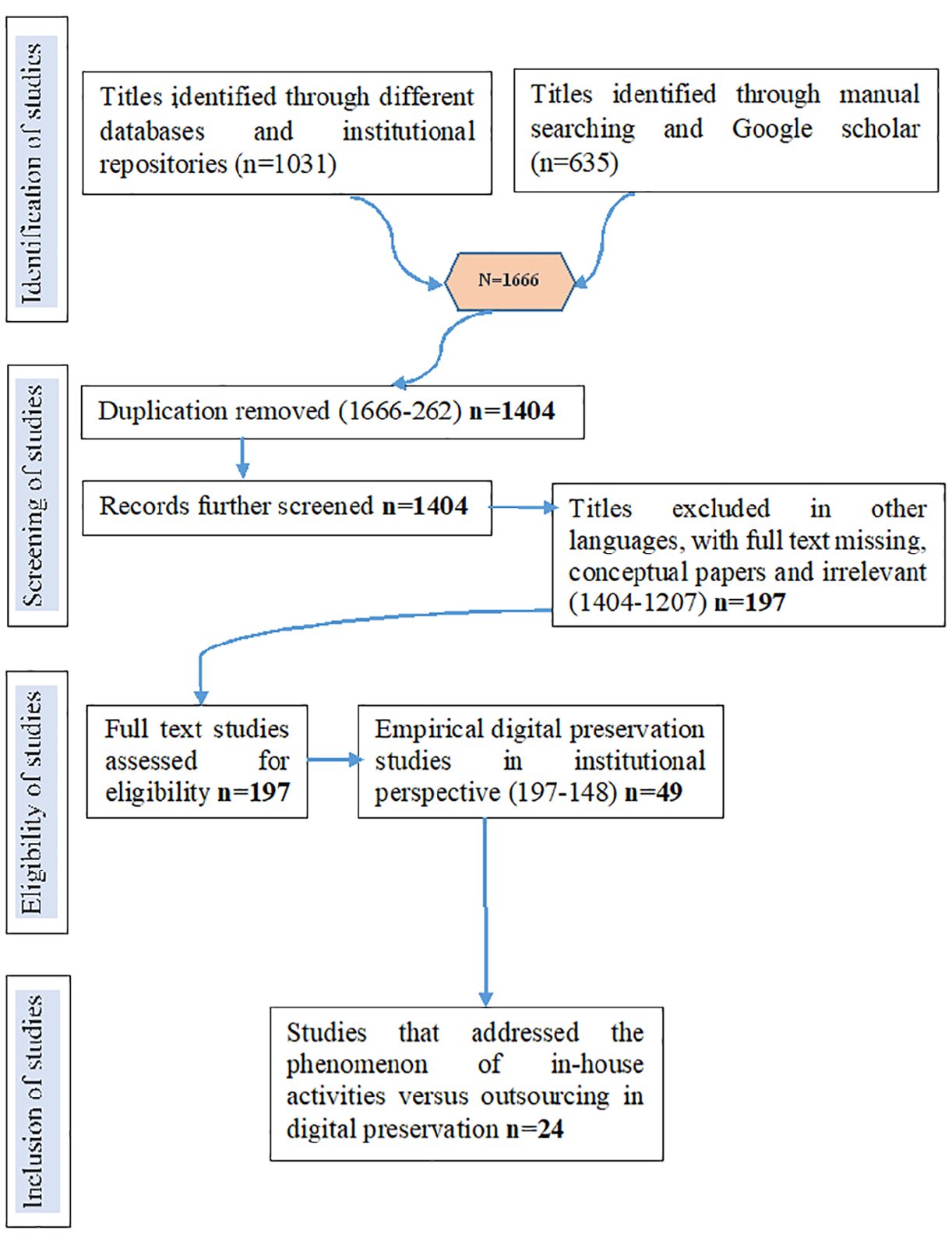
Proper Reporting of Items and Meta-Analysis (PRISMA) filtration chart.
Qualitative analysis of the reviewed studies
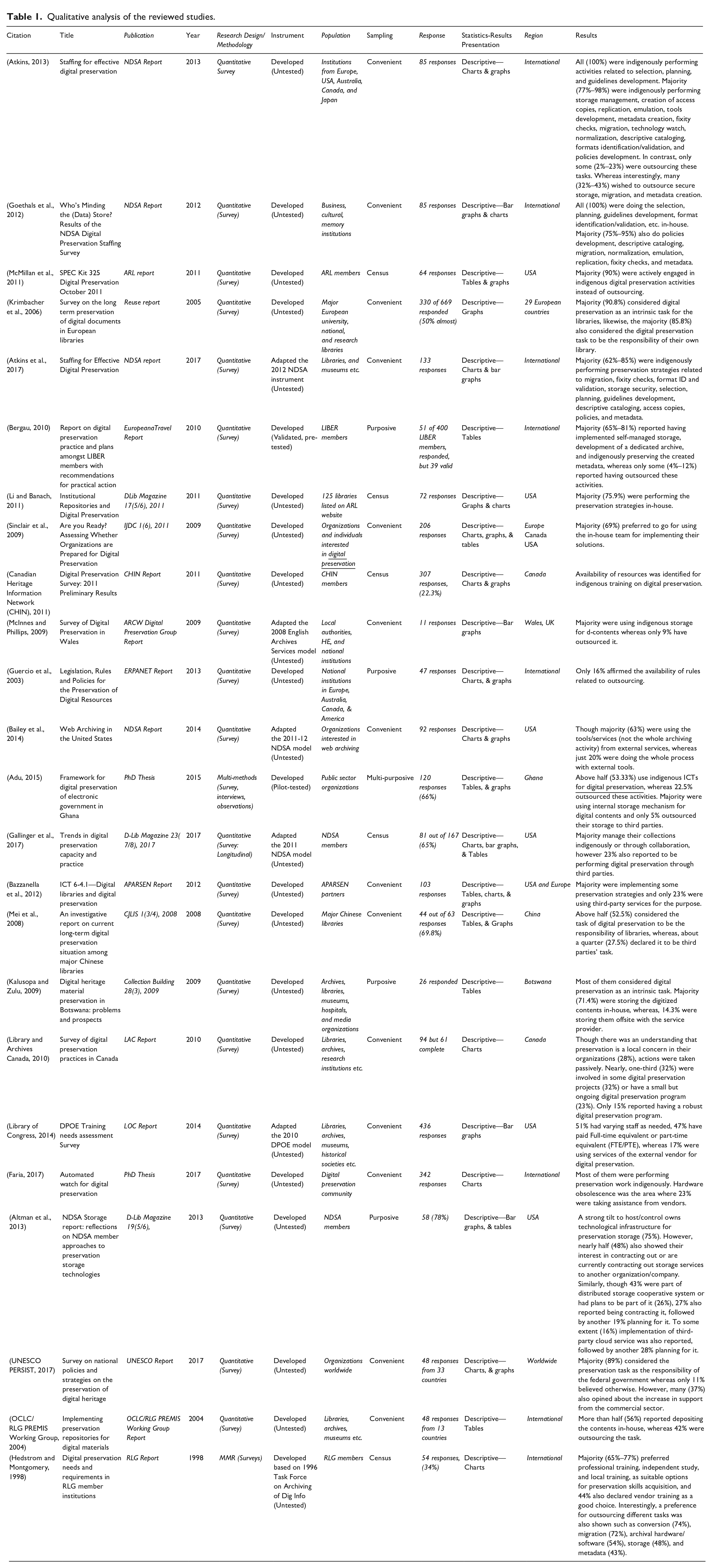
The data extracted from the final studies are presented in Table 1. These results are tabulated in descending order. Surveys that highlighted a higher preference toward in-house activities are put in the beginning while the studies that show a tilt toward outsourcing are sequenced thereafter. Further, temporal, and geographical analysis is also done to check decrease or increase in preferences based on time period and geographical aspects (Figures 2 and 3). Different dimensions of these studies were qualitatively analyzed. The qualitative analyses included information about the population surveyed, sampling techniques applied, response rate obtained, scales development, statistics applied, results presentation, and geography where the surveys were carried out. These analyses affirm that the scope of the studies varies in terms of geographical coverage. Many surveys have been carried out covering institutions worldwide (Atkins, 2013; Atkins et al., 2017; Bergau, 2010; Faria, 2017; Goethals et al., 2012; Guercio et al., 2003; Hedstrom and Montgomery, 1998; OCLC/RLG PREMIS Working Group, 2004; UNESCO PERSIST, 2017). Some studies have been conducted in the North American region (Altman et al., 2013; Bailey et al., 2014; Bazzanella et al., 2012; Canadian Heritage Information Network (CHIN), 2011; Gallinger et al., 2017; Li and Banach, 2011; Library of Congress, 2014; McMillan et al., 2011) and Europe (Bazzanella et al., 2012; Krimbacher et al., 2006; McInnes and Phillips, 2009; Sinclair et al., 2009). However, very few studies come from other parts of the world like China (Mei et al., 2008), Ghana (Adu, 2015), and Botswana (Kalusopa and Zulu, 2009). Overall, many geographies have been covered in these surveys. The majority have used convenient sampling techniques, followed by census and purposive. Most of these studies have been conducted through newly developed data collection instruments of which the large majority were untested. All the surveys selected for review have applied descriptive statistics rather than inferential statistics. A variety of results presentation approaches like tables, charts, bar graphs, and charts have been used to present data in these studies.
Qualitative analysis of the reviewed studies.
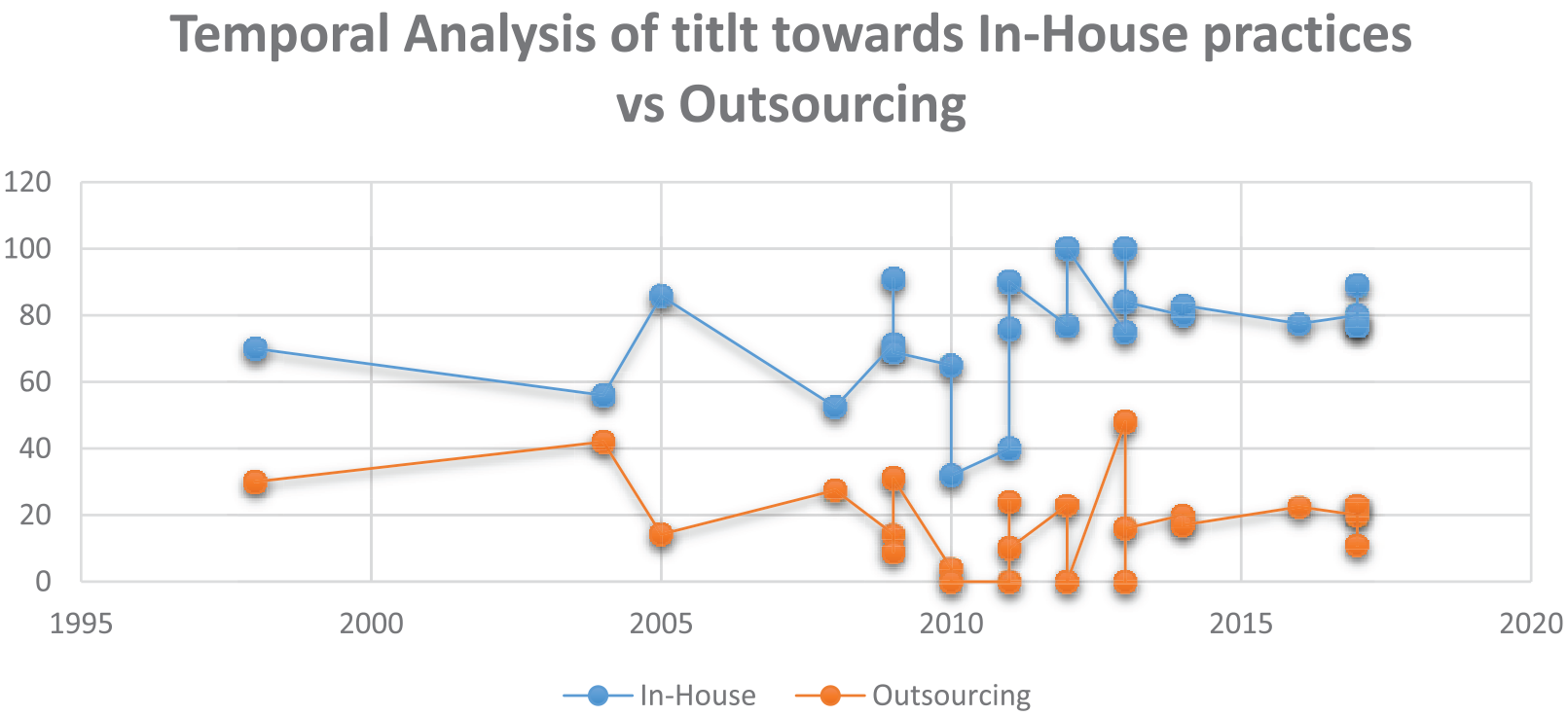
Temporal analysis of tilt toward In-House practices versus Outsourcing.
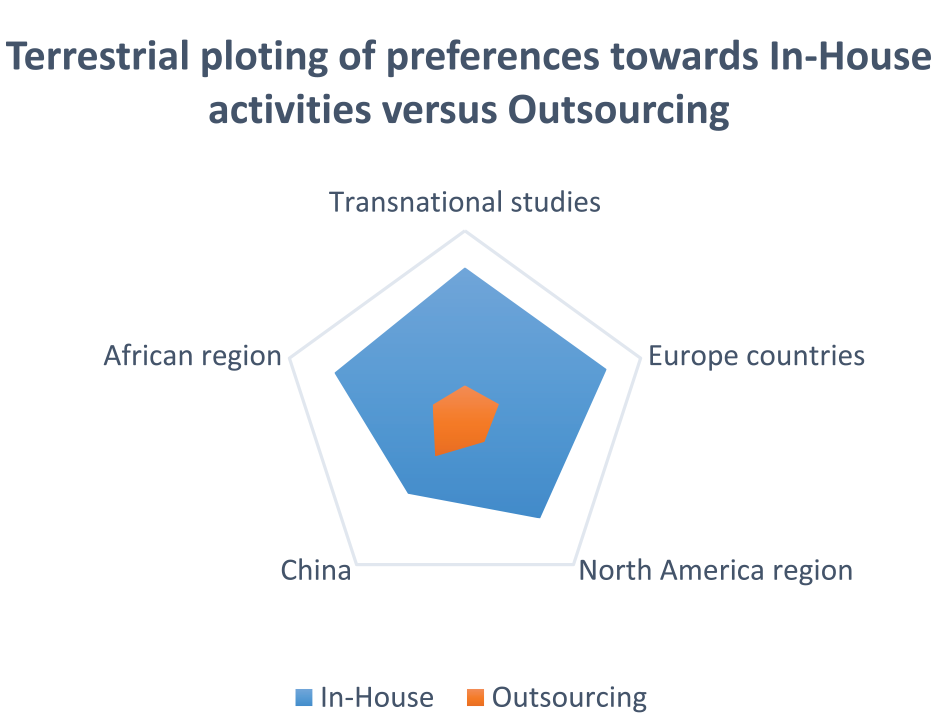
Terrestrial plotting of preferences.
Results
The reviewed studies are ordered for providing an understanding of global trends toward in-house activities versus outsourcing for digital preservation. The studies are first arranged based on terrestrial mapping and thereafter ordered chronologically for drawing meaningful inferences. This was done for the purpose of getting an understanding of whether institutions established in certain geographies have a strong tilt toward in-house activities versus outsourcing or otherwise. The additional chronological arrangement was done with the objective of seeing whether there is a growth in one phenomenon against the other or otherwise. The terrestrial organization comprises studies covering institutions worldwide at the beginning and thereafter the studies conducted in the developed world. In the end, the studies conducted in developing countries are presented.
An earlier study by Hedstrom and Montgomery (1998) amongst 54 Research Libraries Group (RLG) member libraries in different parts of the world reported that most of them wished to outsource digital preservation activities to third parties. Though the majority (65%–77%) preferred professional training, independent study, and local training as suitable options for the acquisition of digital preservation skills, however, 44% also declared vendor training as a good choice. Interestingly, a preference for outsourcing the tasks like conversion (74%), migration (72%), archival hardware/software (54%), storage (48%), and metadata (43%) was also shown by them. Likewise, the survey of OCLC/RLG PREMIS Working Group (2004) amongst 48 institutions from around the globe also showed a tilt toward outsourcing to some extent. More than half (56%) reported depositing the contents indigenously, whereas 42% were outsourcing the tasks.
However, the later survey of Bergau (2010) amongst 39 LIBER member institutions in different parts of the world showed a tilt toward in-house activities for digital preservation. The majority (65%–81%) reported having implemented self-managed storage, development of dedicated archives, and preservation metadata creation indigenously, whereas some institutions (4%–12%) reported having outsourced these activities. Another, survey that investigated 85 organizations in different countries also reported that all (100%) were doing the selection, planning, guidelines development, format identification/validation, etc. in-house. The majority (75%–95%) were carrying out in-house activities related to policy development, descriptive cataloging, migration, normalization, emulation, replication, fixity checks, and metadata (Goethals et al., 2012). In the same manner, the survey of 85 institutions in different parts of the world by Atkins (2013) reported that all (100%) were performing in-house activities related to selection, planning, and guidelines development. It reported that the majority (77%–98%) were also indigenously performing storage management, creation of access copies, replication, emulation, tools development, metadata creation, fixity check, migration, technology watch, normalization, descriptive cataloging, formats identification/validation, and policies development. In contrast, only some (2%–23%) were outsourcing these tasks. However, interestingly the survey reported the desire of many (32%–43%) to outsource secure storage, migration, and metadata creation. Another survey by Atkins et al. (2017) amongst 133 institutions worldwide also confirmed the prevalence of an in-house approach as the majority (62%–85%) were performing in-house activities related to migration, fixity checks, format ID and validation, storage security, selection, planning, guidelines development, descriptive cataloging, access copies, policies, and metadata. Likewise, another survey (Faria, 2017) of 342 institutions worldwide reported that most of them were performing in-house digital preservation. Only hardware obsolescence was the area where 23% were taking assistance from vendors. The survey of UNESCO PERSIST (2017) amongst 33 institutions worldwide reported that the majority (89%) considered the task of digital preservation as the responsibility of the federal government whereas only 11% believed otherwise. However, many (37%) favored an increase in support from the commercial sector.
The survey of McMillan et al. (2011) amongst 64 Association of Research Libraries (ARL) members in the USA affirmed that the majority (90%) were engaged in in-house preservation activities instead of outsourcing. On the same pattern, another survey (Li and Banach, 2011) of 72 ARL member institutions in the USA reported that the majority (75.9%) were engaged in in-house digital preservation activities instead of outsourcing. The same phenomenon of in-house digital preservation practices was reported amongst the National Digital Stewardship Alliance (NDSA) member institutions in the USA (Altman et al., 2013) by observing a strong inclination for hosting their own technological infrastructure for preservation storage (75%). However, nearly half (48%) also showed their interest in outsourcing or are currently outsourcing storage services to another organization/company. Similarly, though 43% were part of distributed storage cooperative system or had plans to be part of it (26%), 27% also reported to be outsourcing it or planning to outsource it (19%). To some extent implementation of (16%) or plans for implementation of (28%) of third-party cloud service was also reported (Altman et al., 2013). Another survey amongst 92 organizations involved in or planning to start web archiving in the US affirmed that though the majority (63%) were using the tools/services from external services, however, just 20% were doing the whole process with external tools (Bailey et al., 2014). The survey by the Library of Congress (2014) amongst 436 institutions in the USA reported that 51% had varying staff as needed, followed by 47% having paid full-time equivalent/part-time equivalent, whereas only 17% were using services of the external vendor for preservation work. The study by Gallinger et al. (2017) amongst 81 NDSA members in the USA also reported that the majority were managing their collections in-house or through collaboration, whereas 23% were outsourcing.
Library and Archives Canada (2010) investigated 61 institutions in Canada and reported that though there was an understanding that digital preservation is a local concern at their organization (28%), actions were taken passively. Nearly, one-third (32%) were involved in some preservation projects (32%) or had a small but ongoing program (23%). Only 15% had a robust program. Another survey in Canada by the Canadian Heritage Information Network (CHIN) (2011) investigated 307 reported the availability of sufficient in-house resources for training in this area.
Guercio et al. (2003) surveyed 47 national institutions in Europe, Australia, Canada, and America and reported that more than half were using outside sources of expertise for training their staff. Only 16% affirmed the availability of rules for outsourcing. However, another survey by Sinclair et al. (2009) amongst 206 organizations and individuals from Europe, Canada, and the USA revealed that the majority (69%) preferred to go for using the in-house team for digital preservation. The survey of Bazzanella et al. (2012) also revealed a similar trend of in-house practices amongst 103 institutions in Europe and the USA as a majority were implementing some preservation strategies in-house and only 23% were using third-party services for the purpose. Likewise, the survey of Krimbacher et al. (2006) amongst 330 major libraries, etc. in 29 European countries also revealed that the majority (90.8%) considered preservation as an intrinsic task of the libraries, and as such majority (85.8%) also considered it the responsibility of their own library. In UK, the survey of McInnes and Phillips (2009) in 11 institutions also reported that the majority were using in-house storage for contents, whereas only 9% have outsourced it.
Out of 44 major libraries holding digital collections in China, the majority preferred the self-managed or in-house preservation model. Above half (52.5%) reflected the preservation task to be the responsibility of libraries, whereas 27.5% declared it to be third parties’ task (Mei et al., 2008). In Africa, the survey of Kalusopa and Zulu (2009) amongst 35 national institutions in Botswana affirmed a favor toward in-house activities instead of outsourcing. Most of them considered it to be an intrinsic task as the majority (71.4%) were storing the contents in-house, while 14.3% were storing them with the service provider. Adu (2015) investigated 120 public sector organizations in Ghana and revealed that above half (53.33%) were using in-house ICTs for digital preservation, whereas 22.5% were carrying out these activities through the services of third parties. Similarly, the majority were using internal storage mechanisms for digital contents whereas, only 5% have outsourced it to third parties.
We made an attempt to plot the data chronologically to see whether there is a decrease or increase of one phenomenon against the other or not. The temporal analysis of the studies affirm that in the earlier empirical studies show a preferences toward the phenomenon of outsourcing for digital preservation to a certain level. However, the later studies show a comparatively stronger preferences toward in-house activities for digital preservation (Figure 2). As a hole this graph also affirms a strong tilt of organizations toward in-house practices.
We also plotted the preferences of memory institutions geographically. However, Figure 3 affirms that in this context the preferences did not vary to a greater extent. It showed an altogether tilt toward preferences for in-house digital preservation practices.
Limitations and directions for future research
The meta-analysis is limited to studies that addressed the phenomenon of in-house activities versus outsourcing. Those studies which avoided this comparison are not part of this analysis. We suggest that further investigations should be made to highlight the reasons for such a strong preference toward in-house digital preservation activities in memory institutions worldwide. Further research may also be conducted to highlight the requirements these memory organizations would like to be fulfilled for successfully implementing their digital preservation program.
Conclusion
Though the earlier studies on digital preservation conducted internationally show a tilt toward outsourcing to some extent, however, the studies conducted later oppose those results and affirm an altogether shift toward in-house activities. Likewise, the studies conducted in the USA also show a complete inclination toward in-house digital preservation activities instead of going for outsourcing. The same phenomenon of preference toward indigenous activities is also highlighted in the studies conducted in Canada. The studies from the European region also affirm the same preference toward in-house digital preservation activities. Likewise, the empirical evidence from China and the African region also point out a leaning toward in-house digital preservation activities.
This empirical evidence affirms that globally there is an understanding amongst memory institutions that digital preservation is an intrinsic task of organizations. This does not completely eradicate the involvement of the commercial sector, as there are some areas like the development of tools etc. in which their support is unavoidable. However, for fruitful and efficient digital preservation, these organizations need to be supported by regulatory bodies in terms of rules and regulations, technological infrastructure, and related expertise.
Footnotes
Declaration of conflicting interests
The author(s) declared no potential conflicts of interest with respect to the research, authorship, and/or publication of this article.
Funding
The author(s) received no financial support for the research, authorship, and/or publication of this article.
