






Abstract
The study presented here was motivated by the desire to understand the current state of Ukrainian public libraries and share their stories with the broader international professional community. Twelve heads of different types of public libraries in several regions of Ukraine were asked to describe how the Russia-Ukraine war has affected their libraries. Participants’ stories largely confirm and extend previous reports of the Ukrainian libraries’ emerging functions as humanitarian aid and learning hubs, shelters, and emotional support centers. Expanding earlier accounts, participants also discussed initiatives focused on media literacy, decolonization of their collections, and strengthening of Ukrainian national identity. Based on the findings and the reviewed sources, we propose a theoretical framework of library user needs that are addressed by the war-affected public libraries in Ukraine. We argue that these needs, ranging from basic psychological, physical, safety, and informational to the need to be part of a community and a nation, are not unique to Ukraine and can explain the functions and value of public libraries in other countries.
Introduction
Since the full-scale Russian aggression against Ukraine that started in 2022, Ukrainians keep fighting not only on the military front, but on the information front as well. Yet, little is known outside of Ukraine about the role of libraries in these trying times. The study presented here was motivated by the desire to understand the current state of Ukrainian public libraries and share their stories with the broader international professional community. The findings informed the development of a theoretical framework of library user needs. Twelve heads of different types of public libraries in several regions of Ukraine were asked to describe how the Russia-Ukraine war has affected their libraries. The main themes in their stories and the resulting theoretical framework of the user needs addressed by the public libraries in Ukraine are presented here.
Relevant literature
Brief history and the current state of Ukrainian libraries
Ukraine’s multi-tiered public library system includes local town and city libraries, regional libraries, and national and state libraries, with smaller countryside libraries accounting for nearly 80% of the total number (Anghelescu, 2022; Ukrainian Libraries during the Wartime: A Year in Review, 2023). The library system in Ukraine as it exists today is relatively new and has developed alongside independence and democracy in the country. The National Library of Ukraine was founded in August 1918, following the Revolution of 1917, when statehood was briefly restored (Strishenets, 2018). This establishment of the library was soon followed by a period of brutal censorship and repression by the Soviet Union, during which it was renamed the State Public Library of the Ukrainian Soviet Socialist Republic and would not regain its original name or status until 1996 (Strishenets, 2018). In 1996, the newly formed Ukrainian Library Association (ULA) published the country’s first Code of Librarian Ethics and began to stake out a role for librarians and libraries in contributing to the theoretical development and intellectual freedom in a democratic society (Ukrainian Library Association, no date). In the years since, this early focus on the connection between libraries, democracy and independence has remained strong.
Thanks to international support, modernized library systems became information hubs that provided internet access to many Ukrainian citizens for the first time (How modern public libraries are serving Ukraine, 2017; Ukrainian Library Association, no date; USAID, no date). These newly created information hubs focused on the specific needs of Ukrainian citizens, including employment services, access to information about governance and reforms, land ownership rights, and economic development of the country. In the years leading up to the current Russia-Ukraine war, the ULA adopted a 2014–2018 strategic plan, which focused in part on upholding the principles of intellectual freedom, developing libraries into powerful informational and educational centers, and opening community centers (Ukrainian Library Association, no date). At the time of the Russian full-scale invasion of Ukraine in February of 2022, nearly 15,000 Ukrainian public libraries were serving the country’s citizens in various capacities, with essentially every city, town, or village having access to a public library. By the end of 2022, that number had fallen to 11,993, with nearly one-fifth of the libraries rendered inoperative (Gosart, 2023). Speaking in a July 2023 event hosted by UC Berkeley, Oksana Brui, president of the ULA, outlined the myriad challenges that public libraries had faced since the start of the war, ranging from destroyed or damaged infrastructure and collections to ongoing psychological trauma, with small towns experiencing a particularly high rate of library closures (Ukraine One Year Later: Ukrainian Librarians and Libraries Revisited, 2023).
Post-invasion library services in Ukraine have varied depending on the capabilities of the libraries, the proximity to active fighting, and the evolving needs of patrons (Gosart, 2023; Ukraine One Year Later: Ukrainian Librarians and Libraries Revisited, 2023; Ukrainian Libraries during the Wartime: A Year in Review, 2023). Services are often offered as a hybrid of remote and in-person. In regions with no active hostilities, libraries are largely able to function as usual, but with extra challenges to meet the changing needs of local and displaced patrons (Ukraine One Year Later: Ukrainian Librarians and Libraries Revisited, 2023). Even in areas where active fighting is ongoing, some damaged libraries have been repaired, and some new ones have been built (Ukraine One Year Later: Ukrainian Librarians and Libraries Revisited, 2023; Ukrainian Libraries during the Wartime: A Year in Review, 2023). In addition to typical library services, public libraries now also function as collection points for food, medicine, and clothing; bomb shelters; logistic centers for internally displaced persons; remote schooling sites for children; and sites for therapy events and support groups (Gosart, 2023; IFLA, 2022; Ukraine One Year Later: Ukrainian Librarians and Libraries Revisited, 2023; Ukrainian Libraries during the Wartime: A Year in Review, 2023). One particular example of the evolving needs of users after the invasion is that many users who spoke Russian now wanted to develop their Ukrainian language skills, leading to a hugely increased demand for Ukrainian language classes and conversation groups (Ukraine One Year Later: Ukrainian Librarians and Libraries Revisited, 2023).
In the areas most heavily affected by fighting, librarians’ abilities to provide services have been greatly limited by extensive damage to buildings, technology, and collections (Chappell, 2022; Gosart, 2023). Some of these destroyed or damaged libraries have adapted by relocating library services to a different location or transitioning almost entirely to online services (Gosart, 2023). These online services have included official digital information channels that share locations of bomb shelters, relevant hotline numbers, transportation schedules, and various other local services. Some libraries with basement spaces have transitioned to being open 24 hours a day (Ukrainian Libraries during the Wartime: A Year in Review, 2023). In addition to a multitude of services focused on meeting basic physical needs, libraries continued to focus on combatting disinformation and increasing digital literacy within communities they serve (Gosart, 2024; IFLA, 2022; UNDP, 2023).
The war has led not just to ad-hoc, immediate responses on the part of libraries to meet changing needs at the moment but also to changes in official strategy and long-term vision for the role and purpose of the public library in Ukrainian society. The current mission statement on the ULA website directly references the war, stating: “The Ukrainian Library Association offers active librarians and leaders who are ready for change an innovative platform for cooperation to mobilize efforts and overcome the consequences of war, to develop and implement professional capacity and achieve a new quality of library work” (Ukrainian Library Association, no date). An official strategy document published in 2022 describes major goals for libraries in the coming years, including responding promptly to the needs of society, communities, and individuals in the conditions of both active conflict and post-war reconstruction (Ukrainian Library Association, 2022).
In addition to needing to be forward-looking to better mess what has been lost and strategize restoration, replacement, and preservation. This includes planning the rebuilding of physical library spaces that have been damaged or destroyed, and assessing the cultural loss of collections that have been damaged or looted in the fighting (Ukraine One Year Later: Ukrainian Librarians and Libraries Revisited, 2023; Ukrainian Libraries during the Wartime: A Year in Review, 2023). This destruction has led to an increased urgency on the part of libraries to preserve physical artifacts, as well as to rapidly digitize collections (Marche, 2022). The development of a Digital National Library, funded in part by UNESCO, is focused on digitizing the National Library’s collection, with the goal of providing both immediate access to cultural heritage materials, as well as preserving digital copies of this heritage for future generations (Ukrainian Libraries during the Wartime: A Year in Review, 2023).
Public libraries during and after wars
The challenges that Ukraine’s libraries now face are not unique. Knuth (2003) reviews multiple historical precedents when, in the 20th century, libraries were targeted and/or destroyed in an effort to erase the cultural identity of a group or nation, a practice she calls “libricide.” Much can be learned by examining a few examples of how libraries in different countries have responded to the devastation of war.
Like in Ukraine, the development of cultural institutions in Kosovo was long suppressed by occupation by more powerful countries. The development of a modern library system in Kosovo dates back to the years immediately following World War II, when Communist Yugoslavian leader Josip Broz Tito was relatively liberal about the development of non-Slavic cultural institutions (Bashota and Kokollari, 2013; Olluri, 2015). Following Tito’s death in 1980, ethnic tensions rose, and by 1990, the circumstances of Kosovar public libraries had devolved rapidly, with ethnic Albanians purged from public library positions and replaced by Serbians. Numerous public libraries in Kosovo were burned, with the highest levels of library destruction occurring in rural areas (Olluri, 2015; Riedlmayer, 2007). Kosovo’s “once vibrant” public library system was decimated (Montoya, 2021: 813). According to one source, 175 libraries with a total collection of 1,665,496 items were destroyed by the Serbian army and paramilitary forces between 1998 and 1999 (Bashota and Kokollari, 2013). The damage was compounded by the lack of countrywide, coordinated librarian education programs to help rebuild the profession and restaff libraries after the war (Montoya, 2021).
Following the war, Kosovo’s National Library took on a “clear mission to collect, organize, serve and preserve the documented intellectual heritage of the territory of Kosova” (Bashota and Kokollari, 2013: 10). Like in Ukraine, rebuilding the library system in Kosovo with book donations, financial assistance, and international collaborations was an international effort (Bashota and Kokollari, 2013; Olluri, 2015; Patrick, 1999).
The current devastation in Gaza, in addition to the horrific loss of life, represents a tragic setback for the struggling library systems there. In 2020, the poet Mosab Abu Toha gave a presentation at an ALA conference, in which he described the heavy reliance on donations and international aid in developing collections, as well as the byzantine regulations that could often hold up shipments of books, resulting in lack of resources, specifically for children (with only one library in Gaza specializing in children’s services at the time; Toha, 2021). The author cites a 2010 report by the Palestinian Central Bureau that highlights the limited scale of the library system, with 65 operating libraries throughout the Palestinian territories; only 16% of these libraries use classification systems, and just over one-third provide computers for users. Libraries in Palestine have also historically struggled with limited staffing and a shortage of trained library professionals; those who do attain higher degrees in library science must travel to various foreign countries to do so (Bergan, 2000).
The ongoing struggles in establishing a functioning public library system to meet users’ needs have since been overshadowed by the destruction of library buildings in the Israel-Hamas war. Since October of 2023, numerous public libraries in Gaza have been destroyed, including the main municipal library, which was founded in 1999 in partnership with the French city of Dunkirk and with funding from the World Bank (El Chamaa, 2023; Librarians and Archivists with Palestine, 2024). 1
The literature summarizes some of the commonalities in the work of public libraries in times of man-made disaster, with library workers continuing to provide crucial information and services, taking on both traditional information work roles as well as stepping into non-traditional roles to meet community needs (Halsted, 2014). “Library and librarians have always consistently played a role—though perhaps rarely a central one—as either victim or agent in the events that characterize periods of social upheaval. Here one might instance the public library acting as a key agency for the Americanization of immigrant populations during the U.S. Progressive Era and libraries as sanctuaries of subversive thought that were subjected to the massive book-burning spectacles orchestrated by the Nazi Party in Germany in 1933” (Rayward and Jenkins, 2007: 363). During disasters, libraries are becoming the places of community resilience, not only connecting people to vital resources and information but also offering spaces and opportunities to network and socialize, creating a “culture of resilience” by adapting services to meet changing user needs and expectations (Vårheim, 2016, 2017; Swanson, 2021; Veil and Bishop, 2014). Libraries make vital contributions to community resilience by fulfilling specific functional roles and by acting as “(1) adaptive sustainers in volatile conditions, (2) socio-organizational mediators in community networking, (3) stewards of cultural integrity, (4) facilitators of inclusive information access, and (5) navigators in collaboration with governmental and social entities” (Lee, 2024: 194).
In the face of crisis and threats to national identity, libraries “act as a formidable symbol around which to mobilize opinion and support not merely for the reconstitution of the libraries but also in affirming the value of the cultural heritage and national identity that these depredations had seemed to threaten” (Rayward and Jenkins, 2007: 363–364). The collection of essays, edited by Rayward and Jenkins (2007), details how, during wars and social upheavals, libraries save cultural memory by preserving collections, become important informational, educational, and communication hubs, and help local communities form opinions and carry on with their lives. Prochaska (2023) reviews the historical role of libraries in countries affected by World War II and more recent conflicts in Bosnia, central Africa, Ukraine, Afghanistan, and Syria, and argues for their crucial part of the national and ethnic identity and source of strength for individuals and communities. Buenrostro and Cabbab (2019) discuss how Philippine libraries kept subversive materials during books bans and martial law and helped to recover cultural memory and document the recent history during the recovery period.
Being grounded in these prior reports on war or disaster-affected libraries, we designed a study to (a) investigate the current work of war-affected public libraries in Ukraine and (b) find or develop a theoretical framework to represent uncovered trends in library functions. We chose the grounded theory approach to move from evidence (a) to theory development (b), instead of relying on the deductive method and trying to fit data into an existing framework. Therefore, we performed an analysis of existing frameworks after we analyzed the study data to identify the framework that closely fits the evidence (see Discussion).
Methods
We conducted a study to investigate the current state of Ukrainian public libraries, to confirm, and possibly extend, our understanding of the individual and community needs addressed by the war-affected libraries.
The heads and senior staff members from 12 public libraries in various regions of Ukraine were recruited for the study. The researcher recruited one participant, who in turn recruited their peers, who recruited more participants, resulting in purposeful snowball sampling that ensured the representation of different geographical regions and public library types in the sample (Figure 1) and reduced the researcher’s sampling bias. Table 1 provides descriptions of participating libraries. The data were collected in the spring of 2024. Participants received monetary compensation for their participation. The study was approved by the Institutional Review Board.

Map of Ukrainian libraries that participated in the study.
Participating libraries’ profiles.

The study employed a qualitative self-report method. 2 The theory development component of the study relied on the grounded theory approach (Glaser and Strauss, 2017). Interviews are commonly used to provide rich data about individuals’ experiences and perspectives, leading to a deeper understanding of a topic and, often, theory development (Fontana and Frey, 2005). The researcher had previously employed videoconference interviews of the war-affected Ukrainians (Lopatovska and Coan, 2024). However, the method of remote synchronous interviewing had been proven difficult due to unreliable connectivity (i.e. due to air raids/shelling, electrical outages, and time zone differences), and well as the emotional burden placed on participants by a requirement to share traumatic experiences within a limited time (no possibilities for prolong breaks, contemplation). Based on these prior interview experiences, the study procedure was changed, and instead of an interview, participants were emailed a questionnaire and asked to provide comprehensive, essay-like written responses. Participants were asked to return their responses within 3 weeks (with possible extensions) and allow a researcher to ask follow-up questions/seek clarifications. The format of the narrative interviews (Horsdal, 2016) allowed participants to think about and research their answers, often supporting them with references to internal and external resources (i.e. institutional or events websites, announcements, and additional artifacts). The questionnaire included the following items aimed at collecting information about the state of Ukrainian public libraries, library users, and librarians:
What is your job title?
Describe your library (i.e. size, location, type)
Describe your typical patrons
Describe your typical services/programs before the 2022 full-scale war
What changed after the war? a. Do you observe any changes in the needs of your library patrons? b. How did the war affect the programs and services of your library? i. Any other changes (budget, staff?) c. What innovative programs your library implemented during the war were successful? Which ones failed? Why do you think it happened?
What does your library need now? What kind of support would be helpful?
What do your staff/librarians need now? What kind of support would be helpful? How are librarians coping?
What would you want libraries in other countries to know about your current experiences?
Is there any additional information you’d like to share?
The average length of the participant’s written responses was 2712 words. Due to the article length limits, only the results pertaining to the library profiles, their typical and war-related services (items 1, 2 and 4) are presented.
The lead researcher’s ties to Ukrainian library community eased the data collection process and data analysis, including translating the textual dataset and preparing it for analysis (the quality of the author’s translation was validated by an independent Ukrainian-English interpreter). The study used a thematic analysis framework to analyze interview transcripts (Nowell et al., 2017, also detailed in Lopatovska and Coan, 2024). Participant responses were coded by two researchers following the grounded theory procedure (Charmaz, 2014); initial codes were grouped into larger themes and related sub-themes (Braun and Clarke, 2019) and incorporated into the story of the war-time public library services in Ukraine. The analysis of the interview data was supplemented by the analysis of the publicly available library artifacts (i.e. social media sites, programming documents, public calendars, and announcements on the libraries’ websites). The consistency in participant responses, publicly available library artifacts and published sources about the current state of Ukrainian libraries (cited throughout this paper) attest to the high degree of reliability of participant responses.
Findings
This section first introduces participating libraries and the leaders who filled out the questionnaire and then presents the main themes in participants’ descriptions of their current library services. Participants were recruited from various types of public libraries: large metropolitan central libraries, small town or village libraries, and specialized public libraries (i.e. children’s libraries) across multiple regions of Ukraine (Figure 1 and Table 1). Libraries’ profiles are based on responses to items #1, 2, and 4 of the questionnaire and additional information gathered from the libraries’ websites. In the libraries’ titles, “Universal” refers to the diversity of knowledge areas covered by the collection, as opposed to specialized.
Current library services
Analysis of common themes in participant responses led to the development of broader categories of services currently offered by Ukrainian public libraries: (1) services that address communities’ basic psychological, physical, safety, and information needs, (2) services that support needs for connectedness, love, and offer a sense of community, (3) services that help shape and/or address identity needs and national ideology.
Services that address basic psychological, physical, safety, and information needs
The new realities of war led to changes in the types of library users, as well as their life circumstances and basic needs. Librarians have noted the decrease in the number of regular visitors who left their residences and the arrival of internally displaced persons (IDPs) from other regions of Ukraine. Kyiv Children’s library (ID2) notes: Many patrons left the city, and some - the country, during the first months of war. This situation had significantly affected the work of the library. But in time, new readers and their family members who moved [to Kyiv] from occupied territories to seek refuge, came to us. This new category of patrons, internally displaced persons (IDPs), partially replaced our usual visitors. For people who, due to war, lost their usual lifestyle, work and home, the library offered an accessible platform for communication, personal growth, art and leisure, a quiet place for healing and renewal. (ID2)
Libraries in close proximity to the front lines report a decrease in young visitors and an increase in elderly users (ID4, ID6); libraries located further from the front lines see an increase in the overall number of patrons and volunteers (ID10, 12).
Due to the changes in library users and the wartime conditions, libraries adjusted several of their traditional services and introduced new programs to better address their communities’ needs. Some examples include:
Digital literacy programs for seniors. Many senior citizens depended on younger family members to manage their devices and assist with online services. Now, when many younger family members relocated, seniors are receiving digital support from libraries, which help seniors “master gadgets, smartphones, obtain’ other digital skills to support communication [. . .] with children, grandchildren, friends, to have the opportunity to receive administrative services online, pay utility bills, order medicine, communicate in social networks, receive information” (ID4).
Increase in digital services for patrons who cannot visit the library. Examples of such services include online schooling, programs for youth and adults (ID4, 7, 8). ID2 reports a new trend that involves grandparents and fathers checking our children’s books and reading them aloud to their relocated children via digital channels. “Just imagine what a miracle one book from an ordinary library can do: unite and support a family, a child continues to communicate in their native language, Ukrainian literature is popularized abroad! Well, isn’t it a miracle! A family and a country hangs on a book like on a strong button!” (ID2).
Increase in informal education programs (ID4), Ukrainian and English language learning programs (ID8, 9, 10); summer programs (ID7), and information literacy programs that help users deal with increased Russian disinformation and propaganda (ID5).
Reduced number/scope of national and regional events due to safety concerns (ID9, 12).
Users’ reading preferences have been affected by the war, with libraries reporting decreased interest in Russian language materials and increased interest in Ukrainian authors, historical genres, life stories, and novels that offer a distraction from daily stress (ID2, 8). Librarians note the dominance of a physical book that “works” during electricity blackouts (ID2). ID3 and ID5 collect Ukrainian books and send them abroad to support IDPs’ connection with their home country. For people who lost their homes, ID9 started checking out donated books that don’t need to be returned. (ID9).
Libraries are aiming to be more accessible and welcoming by extending working hours/days, moving the library desk into the lobby, removing all library membership fees and requirements, and offering free library services to all visitors (ID3, 8, 9).
One of the most frequent themes in participants’ responses refers to the emerging role of libraries in supporting the basic psychological and safety needs of their current users. In addition to offering traditional services and programs that aim to inform, educate and/or entertain, Ukrainian libraries cater to the physiological needs of their users. Some libraries offer services that allow users to measure blood pressure (ID7) and provide them with over-the-counter anti-anxiety medications (ID10), or, during scheduled black-outs (times when electricity is turned off to prevent overload of remaining infrustructure), allow users to charge their phones, warm up their coffee/tea and sandwiches (ID2).
Libraries support physical safety needs by offering shelters during air raids (ID1, 5, 10) and programs on air-raid safety, first aid, handling of explosives, and mine safety (ID4, 5). Libraries also provide spaces for remote work and offer programs and opportunities for professional development (ID9, 10, 11) All participating libraries offer psychological support to their users by facilitating access to psychologists (with ID3 opening a dedicated psychologist position in the library), organizing mental health workshops, art therapy and other programs (ID2, 4, 5, 8, 9, 10). A number of libraries report having specialized programs for children: Since the start of the war, the library has organized a club “Active space” for local and IDP children. The club offers daily programs, meetings with psychologists, volunteers, specialists who help children deal with stress, anxiety, negative emotions, fear. (ID9)
For IDPs, many libraries became humanitarian centers that offer temporary shelters, centralized access to government services and documentation, doctors, psychologists, and social workers, programs on social adaptation and professional training, and job search assistance (ID1, 2, 4, 5, 9, 10). For all its visitors, libraries provide spaces for remote work and offer programs and opportunities for professional development and networking (ID9, 10, 11).
During the first 6 months after the start of the war, without stopping its main activities, the library turned into a hub of humanitarian aid for internally displaced persons from the Kharkiv, Sumy, and Chernihiv regions, where active military operations took place. Also, after the start of the war, measures aimed at the safety of library users were increased. During air alarms, users of the library and residents of the city located nearby can find safety in the [library] shelter, which has multimedia equipment and tables necessary for conducting events and workshops, has shelves with books for reading. The shelter is equipped with everything one needs (water, bio-toilet, generator, blankets, a place to rest) in case of a long stay. Also, librarians began to pay more attention to the users’ mental health. . . (ID1)
The evidence discussed in this sub-section illustrates the importance of libraries in addressing basic human physiological, psychological, and informational needs.
Services that support needs for connectedness, love, and offer a sense of community
The previous section describes several examples of library programs that, while addressing basic informational, physiological, and safety needs, also address the need for social connectedness (i.e. families’ read-aloud virtual sessions, program offerings). All libraries also serve as important centers for volunteers, uniting staff and community in contributing to war efforts. For example, ID5 reports organizing and hosting staff and volunteers to make masking nets, trench candles for the front, collecting and distributing humanitarian aid, money, books, stationary, toys for people in de-occupied regions. ID10 describes librarians who are sewing clothes, cooking non-perishable snacks and organizing various fundraisers for the military needs, as well as teaching volunteers to cook instant soup packets for the soldiers.
Libraries offer spaces for young and adult visitors to meet, socialize, and connect to partner organizations and businesses (ID6, 10).
Changes have taken place in that people who have never been interested in reading began to come to the library, and today there is a need to distract themselves from the horrors of war, insufficient communication, and for children – to socialize. (ID12) [Library] became a place of informal education, communication, exchange of ideas and skills, spiritual and creative growth. (ID 5) [Library became] an institution where the doors open every minute and the movement of people resembles life in an anthill. Someone brings something, someone asks something, asks for help or offers help. (ID10)
ID9 reports offering programs to foster communication between IDPs and the local community: A number of events took place that provided space for communication, mutual understanding and support among local residents and displaced persons, thus strengthening community cohesion and preventing conflicts. (ID9)
These library accounts provide evidence that libraries are being used as places for strangers and families to come together for a common purpose and a sense of belonging.
Services that help shape and/or address identity needs and national ideology
This quote from ID3 illustrates how libraries are not just busy “anthills” addressing the daily needs of their communities, but also centers of identity and ideology development and nation-building: At the start of the war, we were certain we would have to close our projects and provide material support to dislocated persons and the military; however, in time it became clear that libraries have to support the national resilience of Ukrainians. I try to avoid the term “cultural front” but our aim is to resist Russian aggression through cultural and educational resources. (ID3)
Even before the war, all participating libraries offered programs focused on “patriotic education” and local histories, aimed primarily at younger patrons. After February 2022, these types of programs extended to older audiences: The library staff constantly organizes events related to patriotic education, state holidays and anniversaries. (ID4) Streaming of lectures [on the history of Ukraine-Russia relationships] on social media channels [YouTube] increased interest in library events, and Odesa historians, philologists, journalists, and writers approached us with a proposal to hold similar events. A whole series of lectures focused on the restoration of historical memory and countering enemy propaganda are now offered on the library’s channel. (ID8) In January 2023, the project “Station: Ukrainianization” was launched, aimed at the patriotic education of young people and exposing them to the work of modern Ukrainian poets and writers. In 2024, we decided to extend the project and popularize the common heritage of Ukrainian national culture. (ID10)
All participating libraries mentioned current efforts to de-Russify collections and increase programs focused on Ukrainian history, art, and language. Three libraries (ID3, 9, 12) discussed weeding out Russian-language material due to decreased demand and re-assessment of collection development priorities: We canceled the screening of all Russian-language plays, the vast majority of plays were in Russian until February 2022, and we are still working on cleaning the funds from Russian propaganda literature. [The weeding criteria are specified in the Recommendations of the Ministry of Culture and Information Policy (Ukraine Ministry of Culture, 2022).] As for examples of propaganda books, these are primarily books published in the times of the USSR, which contain anti-scientific myths and stereotypes about Ukraine and Ukrainians [. . .] After the open invasion of Russia and its crimes [against Ukrainian people], there is a rethinking of Russian literature and culture in general. [. . .] Previously, a lot of time was devoted to the study of the works of Dostoyevsky, Tolstoy, and other classics of Russian literature in educational programs. Accordingly, library funds were well stocked with them. Today it is no longer relevant [. . .] as the programs focus on the world, not just Russian literature. (ID3) At the beginning of the war, all books published in the language of the aggressor were removed from the library shelves. [. . .] Many IDPs became patrons of our library. [. . .] Many of them discovered modern Ukrainian literature, which, according to them, they did not have in their libraries. (ID9)
The range of library offerings, from teaching Ukrainian language to events that recognize important Ukrainian figures and rich history, attest to the libraries’ efforts (driven by state and community initiatives) to promote Ukrainian culture and counter the centuries of Russian physical and ideological colonization.
Discussion and framework development
Information shared by participating librarians largely confirms and extends previous reports of the Ukrainian libraries’ emerging functions as humanitarian aid and learning hubs, shelters, and emotional support centers (Gosart, 2023; IFLA, 2022; Ukraine One Year Later: Ukrainian Librarians and Libraries Revisited, 2023; Ukrainian Libraries during the Wartime: A Year in Review, 2023). Expanding earlier accounts, participants also discussed initiatives focused on media literacy and the strengthening of Ukrainian national identity. The categorization of themes in our study data, as well as the common structure of participants’ narratives, point to a human-centric hierarchy of library functions ranging from addressing individual’s basic psychological, physical, safety, and information needs to the needs of the community and a nation. Once these categories of services emerged from our participants’ accounts, we conducted a second round of literature review to seek a framework that best describes the hierarchy of human needs currently addressed by the Ukrainian public libraries.
We examined the most influential hierarchy of human needs outside of information science—Maslow’s hierarchy of needs (Figure 2; Maslow, 1943; Osemeke and Adegboyega, 2017). Maslow categorized individuals’ motivational needs into one of five types, from most basic physiological and safety needs at the bottom to highest order needs related to self-actualization and self-esteem at the top of the hierarchy. Once the most basic need has been fulfilled, the individual moves up to the next level of need, meaning that self-actualization cannot happen in this hierarchy without physiological needs, safety needs, love and belonging, and esteem needs first being met (Osemeke and Adegboyega, 2017).

Maslow’s hierarchy of needs (Hopper, 2024).
Critics of Maslow argue that the layers of need are, in fact, overlapping, not mutually exclusive and operate simultaneously (Figure 3, Chen, 2021; King-Hill, 2015; Osemeke and Adegboyega, 2017). Critics consider the hierarchy to be American-centered, with its emphasis on the individual and failure to consider collective or societal needs (Gambrel and Cianci, 2003; Mawere et al., 2016; Osemeke and Adegboyega, 2017). Nonetheless, Maslow’s hierarchy remains influential and cited throughout scholarly literature, including in the library and information science (LIS). Scholars applying Maslow’s hierarchy in the LIS fields have most frequently done so to understand the work of librarians and library employees (Alajmi and Alasousi, 2018; Ogungbeni et al., 2013; Ugah and Arua, 2011). Some scholars have mapped Maslow’s hierarchy to library’s user needs. Francis (2010) applied Maslow’s hierarchy to the academic library setting and explored how academic librarians can address students’ physiological needs (sleep and food), safety needs (help students deal with library anxiety), improve students’ sense of belonging in the library, their esteem and confidence by interactions with respectful library staff, and, finally, students’ self-actualization through problem-solving search methods. Anderson (2004) maps Maslow directly to teen librarians and their users, stating that a teen librarian should have YALSA membership and professional affiliations and training materials (physiological needs); a comfortable and secure-feeling space for teens in the library (safety); respectful, teen-sensitive service (love and belonging); teens’ input and involvement in the library programs and committees (esteem); and an “eclectic” and well-balanced multi-format collection that supports informational needs of teens and all users (self-actualization) (Anderson, 2004).

Maslow’s hierarchy as overlapping waves of need (Chen, 2021).
Scholars have also reformulated Maslow’s hierarchy of needs for cultural institutions’ users. Olinsky (2017b) proposed a hierarchy museums could use to better understand visitors’ needs (Figure 4). At a foundational level, museums need to address accessibility and safety needs, moving to the visitors’ basic psychological needs, higher psychological needs, and highest psychological needs before they can address self-actualization needs (Olinsky, 2017b). Olinsky argues that museums are very good at the top three “content” levels but have room to improve at the three lower “comfort” levels by listening, looking, and providing better solutions to achieve these goals (Olinsky, 2017a).
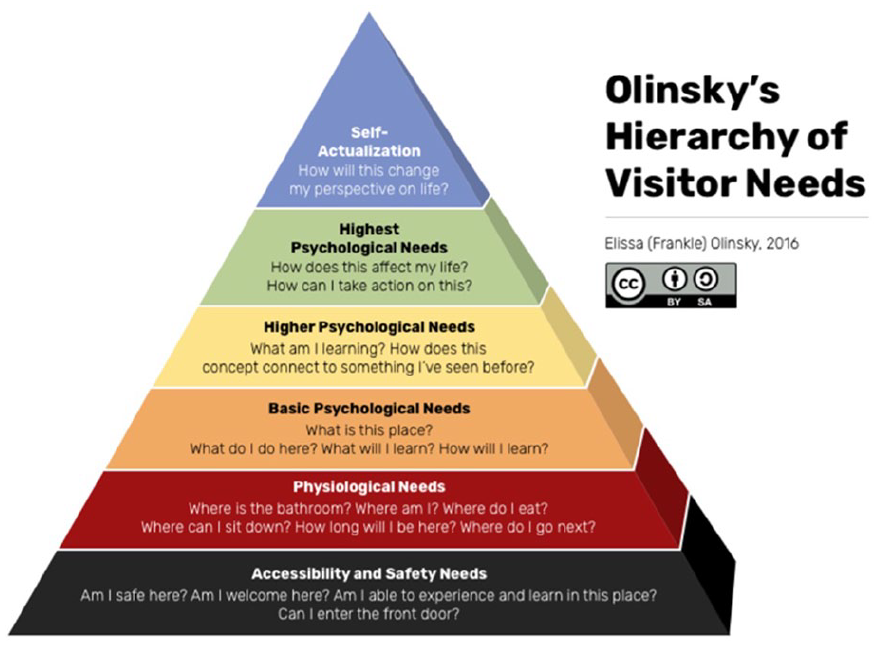
Olinsky’s hierarchy of visitor needs (Olinsky, 2017b).
Logan and Everall proposed an adaptation of Maslow’s hierarchy for library users that could be used in different types of libraries, including public libraries (Logan and Everall, 2019a, 2019b). In their hierarchy, the needs go upward from the library as “minimum viable product” up through to “community as library” (Figure 5). For example, a library as a minimum viable product might translate into a catalogued collection, physical space that is safe and accessible, availability of public computers, and Wi-Fi; library as convenience is evidenced in circulation services, offerings of the home internet hot spots’ role of a library as a connector and incubator is supported by library programming, meeting spaces, and events; and community as library can be manifested in patrons’ involvement in setting the directions of the library (Logan and Everall, 2019a).

The hierarchy of library user needs (Logan and Everall, 2019b).
The gap in the frameworks echoes the critiques of the original Maslow hierarchy, which does not consider the individual’s identity as part of a national or collective whole (Pearson, 1999; Gambrel and Cianci, 2003). Loach and Rowley (2022) partially address this gap by examining special libraries’ contributions to cultural sustainability through heritage preservation, cultural identity, cultural vitality, and cultural diversity. The authors define libraries’ work on cultural identity as “preserving and promoting the culture of a particular cultural group (e.g. a town, region, or a country)” (Loach and Rowley, 2022: 85). For authors, heritage preservation includes not only physical artifacts such as books but also “intangible heritage in the form of folklore, traditions, languages, practices, and skills and knowledge” (Loach and Rowley, 2022: 85). Integration of this higher level of community needs that libraries address is particularly applicable to countries and regions undergoing severe crises, like Ukraine. Based on the reviewed frameworks, we organized the functions of war-affected libraries by the human needs they address (i.e. Maslow’s hierarchy of needs) and included the broader perspective of community identity development (as in Loach and Rowley, 2022). The framework of library user needs (Figure 6) is a response to our findings, which did not closely fit any reviewed frameworks. This framework is based on the evidence of crisis-affected public libraries’ work in Ukraine, and we argue that it also helps to understand the main functions of public libraries in general.

The framework of library user needs.
In this framework, we propose a simultaneously collapsed (in terms of levels) and expanded (in terms of what is covered) model of public library functions. Mapping onto Maslow’s hierarchy’s lower-level individual needs, libraries address the basic psychological, physiological, informational, and safety needs of their users. In a crisis, public libraries provide shelter, warmth, internet access, other technologies that may not be available at home, and a safe place to be. We add “information” needs to this level as information is vital for sustaining the basic needs for physical and psychological resources and is an essential library service. This fundamentality of information is demonstrated by access to information being the first article of the IFLA’s Code of Ethics for Library and Other Information Workers (IFLA, 2012). “The notion of human beings having the freedom, as articulated in human rights, to exercise civil and political rights, freedom of economic participation and the ability to enjoy their individual liberties and socio-cultural rights can therefore only be actualised if there is access to the information needed to exercise these rights” (Britz and Lor, 2010: 16–17). Public libraries offer a reliable, free-to-all source of information and play a crucial role in supporting individual and communities’ information resilience, the ability to navigate, learn from, and share information (Lloyd, 2015), particularly valuable during disruptions of information landscapes. In times of crisis, such as war or natural disasters, when usual information sources may be disrupted, or information is heavily filtered by the government, the library is often the only functioning community infrastructure that can be relied upon for information about food, shelter, how to fill in forms to receive assistance, general safety and government information (Syn et al., 2023; Veil and Bishop, 2014; Yang and Ju, 2021).
Our participants’ and previous reports indicate that Ukrainian libraries address basic needs by offering shelters, access to resources to support physical and psychological needs. Library services during natural disasters and, more recently, COVID-19 pandemic support this. The literature demonstrates how public libraries supported communities’ and changing users’ needs during the COVID-19 crisis, including emergency information, health information, sites for vaccination, first responder support, food security support, water, meals, and more (Alajmi and Albudaiwi, 2021; Syn et al., 2023). Stricker (2019) describes how, in the aftermath of natural disasters, libraries are “ports in a storm in this time of crisis,” meeting shelter and information needs and supporting community resiliency. Libraries have become support centers, providing vital emergency information, community spaces, and electricity or Wi-Fi in times of hurricanes, tornados, and other natural disasters (Jaeger et al., 2006; Veil and Bishop, 2014; Yang and Ju, 2021). Libraries’ response to the aftermath of the recent hurricane Helene has shown once again how crucial libraries are to communities facing disaster (American Library Association, 2024a; Gault, 2024; Hanft, 2024; New York Times, 2024; O’Donnell, 2024).
The increase in services to support mental health is yet another testament that one of the fundamental functions of public libraries in Ukraine and other countries is to support the basic needs of their users. All participating Ukrainian libraries reported having programs, and sometimes, dedicated staff, to offer mental health support to community members. Adle et al. (2023) describe how in response to the COVID-19 pandemic, US public libraries attempted to reduce health disparities by providing health information and supporting the mental and physical health of their patrons (Adle et al., 2023; Syn et al., 2023). Similarly, the Ferguson Public Library offered mental health support during the summer of 2014, when the community experienced significant unrest and difficulties as a result of the police killing of community member Michael Brown (Chiochios, 2016).
The middle tier of Maslow’s hierarchy maps onto the proposed framework’s library services that support community development, and individual needs for connectedness and love. Public libraries have long supported local community resilience by offering opportunities to develop and maintain social relationships (Edwards et al., 2011; Medeiros and Olinto, 2018; Vårheim, 2016; Wiegand, 2015). Vårheim (2016, 2017) discusses the concept of social capital, which refers to close relationships within families, friends, neighborhoods, ethnicities, and social groups, as well as relationships between strangers. The author reviews several examples of libraries creating social capital and trusting relationships in communities, inevitably supporting their resilience. Vårheim (2017) and Veil and Bishop (2014) examined the role of public libraries in the tornado affected areas in the U.S. and concluded that libraries improved community resilience and disaster recovery by not only providing information but also serving as a meeting and working place, and a place for people to share their disaster narratives. Ukrainian libraries are no exception. They, too, run programs that bring people together, connect community members with common interests, provide a safe haven and appropriate programs for patrons of all ages (Stringer, 2020; The New York Public Library, no date).
The higher levels of Maslow’s hierarchy refer to individuals’ need to realize their potential and connect to “a wider circle of identifications” (Maslow, 1969: 59). We propose mapping this level of individual needs that shape and support one’s identity at the cultural and national levels. At this level, the library fulfills a nation-building or societal identity formation role by preserving cultural heritage and identity, including language, customs, and traditions (Loach and Rowley, 2022; MacLennan, 2007). Beel et al. (2015) discuss how cultural heritage institutions (i.e. museums and libraries) and activities (i.e. festivals and volunteer initiatives) can contribute to local cultural resilience and support the creation and consolidation of place-based, local identities. As mentioned in the literature review section above, Ukrainian libraries, similar to the libraries in other formerly colonized nations, prioritize the long-ignored needs of the indigenous populations to help reclaim and reshape their own identity (Alsabbagh, 2021; Haigh, 2009; Mutonga and Okune, 2022). As early as the 1830s, Croatian public libraries were building a national identity in opposition to the Austro-Hungarian empire’s rule (Sabolović-Krajina, 2019). Libraries in Africa are working to reprioritize oral traditions and indigenous language and knowledge systems, contextualize or remove colonial propaganda and attempt to correct legacies of colonial power and abuse (Masenya, 2022; Mutonga and Okune, 2022; Plockey and Ahamed, 2016). Libraries affirm national identity not only during or immediately after the crisis, but in peaceful times as well. For example, the First Amendment to the U.S. Constitution, which guarantees people the right to freedom of speech, of assembly, and freedom of and from religion, is consistently held to be vital to the US national identity, with many public libraries’ missions and collection development policies linked to the First Amendment’s ideals (Fraser-Arnott, 2022; Freedom Forum, 2024).
Our framework is not a unidirectional hierarchy like Maslow’s, where an individual has one level’s needs met, and then moves up to the next. Instead, the focus moves between the patron as an individual, as part of a local community, as part of a nation and culture, and back again, with libraries a constant throughout. The boundaries between them are not one-way; instead, a library’s support permeates all three aspects of users’ identities and needs.
Conclusion
To understand the current state of Ukrainian public libraries, we surveyed twelve heads of libraries across Ukraine. Participants shared stories of their institutions’ resilience in addressing the needs of individuals, communities, and the nation. Their stories informed the development of the framework of library user needs (Figure 6). At the basic individual level, Ukrainian libraries offer safety programs, shelters, informational and emotional support to address the psychological, physiological, informational and safety needs to their users. They support individual needs for connectedness, love, and community by connecting stakeholders and offering safe spaces to get together, volunteer, learn and grow. Ukrainian libraries support individual identities and a sense of cultural and national belonging by decolonizing libraries from Russian propaganda, promoting European values and national pride. Ukrainian public libraries demonstrate a high degree of attunement to the needs of their patrons and communities during wartime. By offering safe spaces to receive informational, educational, social, and emotional support, and uniting communities under national ideals, libraries that participated in the study, as well as prior research, have inspired us to propose a framework of user needs that are addressed by public libraries. While the hierarchy is rooted in evidence from Ukrainian libraries, we argue that all libraries cater to the proposed three levels of individual needs. Information literacy and professional development programs, reference services, and safe “third places” (Aabø and Audunson, 2012), are all examples of how libraries across the globe address their patrons’ basic needs. By offering physical and digital spaces, programs, and events that bring people of similar ages, interests, and needs together, libraries support individual needs for connectedness and love. Collections and services of public libraries in many countries promote national ideas and democratic values by fighting censorship and disinformation, supporting freedoms, and self-determination of their patrons. The proposed hierarchy can be used as a lens to understand the value of public libraries to individuals, communities, and nations, as well as help libraries with their strategic planning initiatives (for example, by designing programs, spaces, and collections that cater to all levels of user needs, from basic physiological, psychological, and informational to community and cultural/national identity.)
From the early days of the Russia-Ukraine war, international support for Ukrainian libraries has been invaluable (Anghelescu, 2022; Kosciejew, 2023). We hope that the stories of our participants’ resilience will help to maintain this support, will continue inspiring librarians in other countries, and will generate additional theoretical developments to expand conceptual understanding of the practice and value of public librarianship.
Footnotes
Acknowledgements
We want to thank our participants for their stories and for inspiring us. We are incredibly grateful to Olha Romanyuk for her work in connecting us with dedicated library professionals in Ukraine. We are also thankful to the anonymous reviewers for their helpful suggestions.
Declaration of conflicting interests
The author(s) declared no potential conflicts of interest with respect to the research, authorship, and/or publication of this article.
Funding
The author(s) received no financial support for the research, authorship, and/or publication of this article.
