







Abstract
This study provides insights into how emergent readers categorise visual content relevant to picture storybooks. While natural categorisation is a well-established area of psychological research, this study focuses on the practical educational challenge of how children’s librarians, early childhood educators, and parents can identify the most “fit for purpose”—that is, meaningful, appropriate, motivating, and relevant—sources of information to support children’s learning. Semi-structured interviews and repertory grid techniques were employed to identify the schematic constructs applied by 5- and 6-year-old children when interpreting visual images. A total of 111 children participated in the study. The majority identified and used schema categories such as live animals, community jobs, dinosaurs, superheroes and robots, buildings, vehicles, Pokémon, and princesses. Additionally, most participants applied a range of commonly recognised action schemes, including connecting, positioning, rotation, trajectories, and transporting. By adopting a radical child-centred approach, this study contributes to the categorisation of children’s library resources, particularly picture storybooks for emergent readers. The findings have the potential to support early childhood education for sustainable citizenship, a global objective aligned with the United Nations Sustainable Development Goals, especially SDG 4: Quality education.
Keywords
Introduction
Many picture storybooks for young children are explicitly written to address sustainability themes while others can be readily identified as potentially relevant. The Mess That We Made (Lord and Blattman, 2020), which focuses on ocean plastic waste, and A Story of Chimneys (Liu, 2019), which addresses industrial pollution, are clear examples. In addition, many texts provide early introduction to a diverse range of sustainability-related issues, including renewable energy, wildlife protection, gender equality, and poverty reduction. For the purposes of future study, the authors are currently identifying and reviewing a substantial collection of such texts, guided by the Greening Curriculum Guidance published by the United Nations Educational, Scientific and Cultural Organization (UNESCO, 2024). The central problem this paper addresses is how to match a given text to the prior knowledge, understanding, and immediate interests of an individual child.
Library science has a long-standing tradition of research into categorisation, but much of this work has focused on children aged seven and above, primarily investigating their information retrieval (IR) behaviour (Large et al., 2008; Schlebbe, 2018). These studies often identify the “subjects” of user interest, but rarely engage with the socio-cultural contexts or embodied nature of children’s learning. While research with older children typically emphasises conceptual learning, Murray and Reuter (2005) argue that such approaches often overlook categorisation as a socio-linguistic activity. Moreover, children think differently from adults, yet libraries, as knowledge communities, often use adult-centric frameworks to arrange children’s collections. These practices can hinder children’s access to books that genuinely interest them (Cooper, 2002a; Harris and McKenzie, 2004).
Although recent advances in developmental psychology and early childhood education have shed light on children’s cognitive processes, the ways in which preschool children select printed or digital books remain underexplored. In particular, their intense and repetitive engagement with specific operative schemes has received insufficient attention. Research in early childhood education (Athey, 2007; Nutbrown, 2011; Siraj-Blatchford and Brock, 2016) has documented schematic behaviours in children’s play that align with Piaget’s (1969, 2006) theories of perception. These insights are further supported by findings from cognitive linguistics (Gallese and Lakoff, 2005; Lakoff and Johnson, 1999) and neuroscience (Gallese et al., 2009; Iacoboni, 2008). These studies emphasise that the mind is inherently embodied, a concept further explored by Lakoff and Johnson (1999), who argue that thought is largely unconscious and metaphorical.
Ausubel (1968), a prominent psychologist, once remarked: “The most important single factor influencing learning is what the learner already knows. Ascertain this and teach him accordingly” (p. iv). This study takes inspiration from this principle, addressing the challenge of matching books with the prior knowledge, understanding, and immediate interests of the individual child. Understanding how children acquire categories is vital for developing classification schemes and IR systems that support their evolving categorisation abilities (Murray and Reuter, 2005).
To that end, this study adopts a radical child-centred perspective grounded in embodied cognitive development to investigate emergent readers’ categorisation behaviour. It addresses the following research questions (RQs):
By deepening our understanding of emergent readers’ cognitive categories and information interests, this research contributes to the development of child-centred taxonomies. Such taxonomies have the potential to improve both physical shelving systems and digital services in libraries, ultimately supporting children’s book selection strategies and learning needs.
Literature review
Emergent readers’ book selection
Preschool and kindergarten children in the pre-operational stage (Piaget and Inhelder, 1969) are often regarded as emergent readers. At this stage, children demonstrate natural tendencies to explore, think of their world in concrete ways, and rely heavily on visual and auditory cues in their information-seeking behaviours (Cooper, 2002a; Druin, 2005). Self-selection of books by emergent readers has been shown to support their reading interests and motivation—factors positively associated with the development of emergent literacy (Fresch, 1995, 2005; Timion, 1992).
Current research into book selection patterns among emergent readers tends to focus on identifying the “subjects” that interest children. For example, studies have consistently shown a strong preference for books on favoured topics such as animals (Mohr, 2006; Timion, 1992). Similarly, research on children’s play has identified a range of recurring thematic interests, including vehicles, trains, dinosaurs, live animals, babies or dolls, and dressing-up (DeLoache et al., 2007; Johnson et al., 2004; Krapp, 2002; Renninger et al., 1992).
In addition to thematic interest, physical attributes play a crucial role in early childhood sorting and categorisation (Cooper, 2002b; Druin, 2005). Book covers—especially front covers—offer vital visual cues that significantly influence emergent readers’ selection decisions (Cooper, 2004; Hiebert et al., 1990; Maynard et al., 2008; Mohr, 2006; Raqi and Zainab, 2008). Emergent readers often interpret and categorise visual information literally, drawing upon real-life experiences or previously encountered stories (Goldsmith, 1984; Siegler, 1991). For instance, Yu (2012) found that children familiar with Kitten’s First Full Moon (Henkes, 2004) recognised a circular image as representing the moon. Similarly, Cooper (2008) described a child who interpreted an image of chickens, ducks, cows, and pigs as depicting a “zoo,” based on prior visits. Beak (2012) also observed that children relied heavily on illustrations to glean narrative meaning, with many focusing on physical actions and plot when choosing books—a tendency noted by Applebee (1978, as cited in Reuter, 2007).
Categorisation and classification in early childhood
Understanding how categorisation and classification develop in early childhood has significant implications for organising information for preschool children. Increasingly, experimental studies suggest that infants and young children form categories not only based on perceptual similarity but also on conceptual, abstract, non-obvious features (Gelman and Meyer, 2011). As Mandler (2003) explained, whilst perceptual categories are formed as a natural part of perceiving, conceptual categorisation is grounded in perception and concept formation develops in tandem with perceptual learning.
It was once assumed that children begin to categorise as they notice differences in figurative appearances (schema). However, early examples—such as distinguishing cats from dogs—highlight the limitations of this assumption. Despite wide variation within each category, cats and dogs share many perceptual features: four legs, two eyes, ears, and tails. Unsurprisingly, young children often do not initially distinguish between them. The first categories formed in infancy are more global, based on group characteristics rather than individual members, and they are categories based upon operational schemes rather than figurative schemas, a distinction introduced by Piaget (1969, 2006).
To the infant, what stands out about both cats and dogs is not their appearance but their autonomous movement and purposeful interaction with the environment. These characteristics distinguish them from inanimate objects such as chairs, toys, or cars, which do not move independently or display intentionality. As infants encounter more creatures that move autonomously and with purpose, they begin to form a concept of “animal”—a category not named or labelled by the child at this stage, but described in the research literature as “biological” (as opposed to “mechanical”) (Mandler and McDonough, 1993).
Mandler and McDonough (1993) conducted a series of experiments with infants between 9 and 14 months of age. Young children were strongly motivated to imitate, and the researchers used the infant’s imitation behaviour to investigate their learning and development. Small toy animals and vehicles were used in the experiments. At first an adult modelled giving water to an animal figure, and the child was then encouraged to do the same. Infants readily extended the feeding action to other animals—even a fish—but rarely, if ever, to vehicles, including those with anthropomorphic features like faces. This suggests that the operative scheme of “drinking” was central to their categorisation, rather than any figurative feature such as a visible mouth.
From an adult perspective, it may seem difficult that infants treat all animals as equivalent. However, just as adults intuitively group varied clothing items like jackets under a common category, infants group moving entities based on shared functional characteristics. In early infancy, all objects capable of autonomous movement are perceived similarly. This principle extends to other early schemes: plates and spoons, for example, follow a trajectory to the floor, or across the room; frying pans and cups are functionally equivalent containers. Gradually, children begin to differentiate more precisely, but even then, the distinctions remain rooted in operational behaviours: cats meow and drink milk; dogs bark and like bones; rabbits jump; birds fly; and fish swim.
Early childhood educators and caregivers instinctively support this mode of learning by encouraging songs and activities that emphasise action and function—for example, teaching animal sounds or singing Old MacDonald Had a Farm. Such activities align with children’s natural tendencies to organise knowledge through observed actions rather than visual resemblance.
The key argument here is that young children’s categorisation is primarily shaped by embodied experience—by the operative schemes they observe and imitate—rather than by figurative schemas based on visual features. Categories emerge from meaningful interactions with the environment, grounded in relational information such as function and behaviour. Emerging studies have reinforced this view, showing that relational features play a central role in preschool children’s verb learning and concept development. As Ware (2017) suggests, parents and educators can enhance early learning by focusing more explicitly on these relational aspects in their conversations and play with children.
Embodiment and children’s action schemes
For both Piaget and Vygotsky, it is the child’s play that provides the primary context for learning, and the importance of engaging with young children’s free play in the formal and informal contexts of early childhood education is therefore widely recognised. From the perspective of embodied cognition, conceptual knowledge develops from motor behaviour. Similarly, as Holland et al. (2018) argued, preschool children’s object knowledge is built on sensorimotor representations formed through the actions made with them (Piaget and Inhelder, 1969). Related research in embodied cognition has further developed these ideas, proposing that many features of human, or other types of, cognition are shaped by aspects of the body beyond the brain. Recent discoveries in neuroscience, particularly the identification of mirror neurons, have provided concrete evidence supporting many of these theoretical structures and functions that have been posited. For example, Hauk et al. (2004) demonstrated that reading the word kick activates the same region of the motor cortex as actually kicking. Numerous studies confirm that the motor neurons of the brain simulate actions whenever they are observed, heard, or even read about. The Cambridge Primary Review also underscored the contribution of neuroscience to understanding the embodied nature of cognition: The basis of cognition is indeed in sensory-motor learning, as Piaget proposed. However, sensory-motor representations are not replaced by symbolic ones. Rather, they are augmented by knowledge gained through action, language, pretend play and teaching (Goswami and Bryant, 2007: 7).
As Mandler and McDonough’s (1993) research demonstrated, from the earliest stages of infancy, children’s attention is drawn more to some things than others, and they begin to build their world of experience as they interact with perceptual objects: “In particular, attention is directed to objects when they move: the ways that they begin movement, the nature of the trajectories they follow, and the ways in which they interact with each other” (p. 313). These movements—vertical and horizontal trajectories—as well as the positioning, connecting, and containing objects, thus form children’s very first proto-concepts, often referred to as “conceptual primitives” (Núñez, 2000: 11).
Throughout early childhood, children exhibit a fascination with these very first proto-concepts or “schemes” as Piaget (1969) referred to them. Athey (2007), and many other early childhood education researchers (Atherton and Nutbrown, 2013; England, 2018; Grimmer, 2017; Louis and Featherstone, 2013; Mairs, 2013; Meade and Cubey, 2008; Siraj-Blatchford and Brock, 2016), and an increasing number of early childhood educators, have identified and documented these common “schemes” that young children repeatedly apply during free play. In much of the literature, the term schema is applied due to a mistranslation from the French; however, the term scheme is applied here in order to correctly distinguish between the operative schemes and figurative schema, as presented in Piaget’s (1969) The Mechanisms of Perception. One of the earliest, more complex schemes (or concepts) that was identified by Athey (2007) in her studies of children’s play was the child’s application of a proto-concept of “Transporting,” which is often developed by the child as a more elaborate combination of “Containing” and “Trajectory” schemes, and employed (often repeatedly and with great satisfaction) as they carry different items from one location to another in different containers. Gibson (1988) has also written about the affordance the child gains from “transportability”: Theories of the evolution of bipedal locomotion in man have sometimes proposed that the advantage of being able to carry food, young, materials for shelter, tools, etc greatly favored the emergence of walking on two legs. Observing the joy of a novice walker in carrying small objects around, often handing them to someone and then retrieving them to transport again, the possibility does not seem fanciful (p. 33).
Table 1 summarises the meanings and examples of each common scheme, as drawn from the literature on children’s actions, speech, mark-making, drawings, paintings, and symbolic play. Athey (2007) further illustrated the developmental continuity between tracking (schemes) and mapping (schema), noting that “[a]ctual maps are graphic representations of trajectories in relation to fixed points” (p. 182).
Commonly identified schemes and their meanings, and examples.
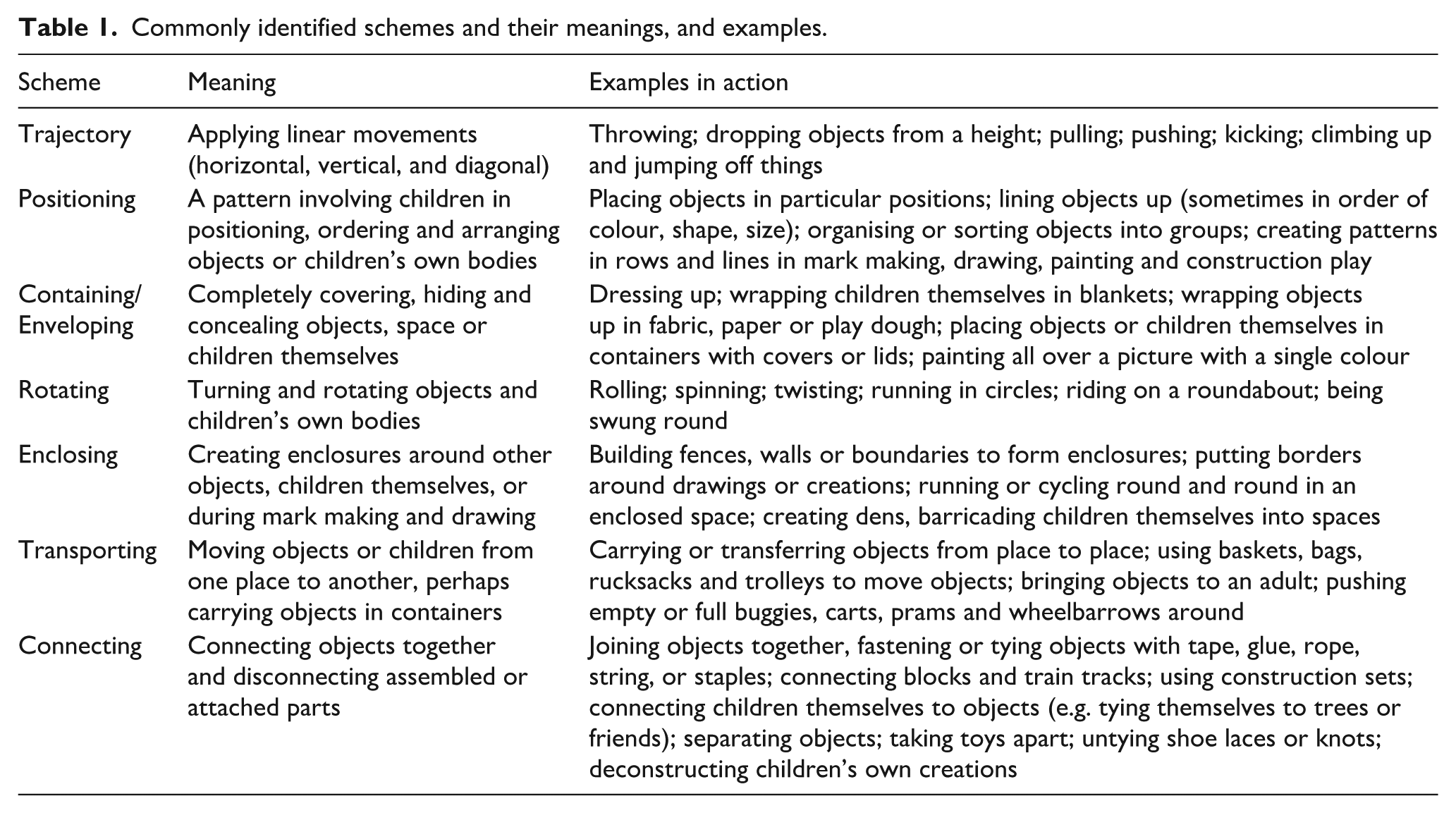
Emerging research has linked action schemes to early categorisation and, subsequently, to logical classification. For example, Athey (2007) illustrated how dynamic trajectory schemes, practiced and played with in early education, later become conceptualised as distinct categories of travelling, such as walking, taking a taxi, riding a ferry, or flying. Positioning is another scheme particularly relevant to early categorisation. Concepts such as size, colour, shape, number, space, and measurements are evident through children’s exploration of positioning schemas, where they line up objects, and begin to match, organise and sort objects into groups (Louis and Featherstone, 2013). Containers further facilitate this process and, understood as the “conceptual primitives” of sets, form a foundational basis for the child’s development of mathematical understanding. As Athey (2007) observed, children initially think in absolutes (e.g. big and small) before acquitting seriation structures (e.g. bigger and smaller). Progression occurs as children apply these schemes across contexts and combine them—positioning, for example, provides the possibility of matching and sorting, which in turn opens up the possibility of ordering, sequencing, and grading. Thus, children’s pursuits of particular schemes provide them with a rich repertoire of first-hand experiences upon which they can draw in developing early categorisation and classification. Recognising the importance of these action schemes in child categorisation, the present study analysed children’s utterances during their categorisation tasks through the lens of these schemes (see Table 1), in order to provide insights into the most appropriate information organisation strategies that best support preschool children’s development and needs.
Methodology
This study applied the Repertory Grid Technique (RGT), originally developed by Kelly (1955) as an assessment technique for personal construct theory in psychotherapy, and later applied in diverse fields as a research methodology for eliciting individuals’ constructs on topics of interest (Winter, 2013). In RGT, constructs are considered bipolar in nature and a common elicitation method is known as the triadic sort method, where participants identify similarities and differences among the three elements supplied (Tan and Hunter, 2002). Given its demonstrated appropriateness across contexts for investigating how people understand their world, RGT was considered a particularly appropriate tool for exploring the uniqueness of the children’s world of meaning.
In Library and Information Science (LIS), personal construct theory has strongly influenced Kuhlthau’s (1993) information search process and guided inquiry model (Reynolds, 2013). Capitalising on its user-centred approach and flexibility in gathering both quantitative and qualitative data, RGT has been employed in information systems research (Crudge and Johnson, 2004; Tan and Hunter, 2002) and classification research (Dillon and McKnight, 1990). Particularly relevant to the present study is the use of RGT in experiments on child categorisation. Ravenette (1975) proposed modifying the original RGT by using images rather than real people, an adjustment considered especially important for studies involving children. A modified version of RGT has been found to effectively identify the fundamental categories individuals use to evaluate products or artefacts in both educational research and industry settings (Siraj-Blatchford, 1995).
In their study of children’s product categorisation, John and Sujan (1990) presented children with three products to compare at a time, and they acknowledged the potentially demanding nature of this triadic elicitation of constructs for younger participants (e.g. 4-year-olds). In contrast, the present study followed Young (2000) who used dyadic repertory grids to explore how children aged 5 to 12 naturally categorised and classified food. Further, Charsley et al. (2018) used RGT to investigate 5-year-old children’s perceptions of fatness in the context of other physical differences. Applebee (1976) made use of the rating scale to examine story category preferences, as measured in RGT, among children aged 6 to 16. Across these studies, the use of RGT enabled the elicitation of children’s perspectives on the topics under investigation.
Participants
This study targeted 5- to 6-year-old children due to the relative paucity of research on this age group and for two additional reasons. First, although emergent readers of this age range are at a critical stage of transitioning from visual to alphabetic IR, this developmental milestone has received little attention in the LIS literature (Cooper, 2002a; Yu, 2012). Second, children of this age range are widely recognised as making a transition from the sensory-motor to the pre-operational stage of development (Piaget and Inhelder, 1969), during which they just begin to develop representational and symbolic thinking as well as categorisation skills (Cooper, 2004; Kuhlthau, 1988; Spink and Heinström, 2011).
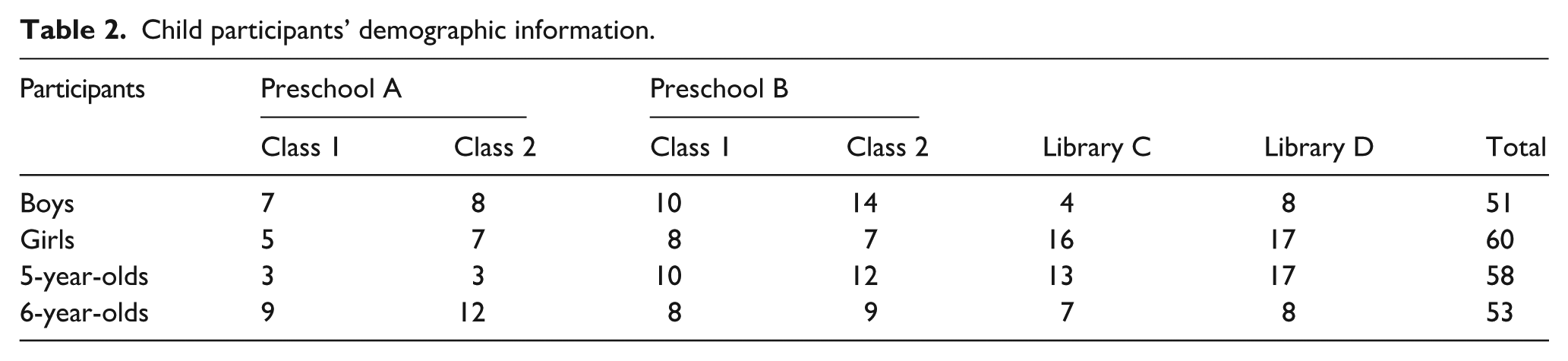
The study employed purposive sampling and relied on voluntary participation. Children were recruited from two public preschools and two public libraries in central Taiwan, with the facilitation of teachers and librarians. The sampled areas consisted of a mixed population in terms of parental education and family income. Child participants were selected based on the following criteria: aged five to six; Chinese as their first language; and no known language impairments or special educational needs. Caregivers of 114 children provided informed assent for participation. Data collected from three children were excluded due to incomplete participation, resulting in a final sample of 111 children (51 boys and 60 girls; 58 five-year-olds and 53 six-year-olds; see Table 2). Each child received a box of crayons as a participation incentive. Ethical approval was obtained from National Cheng Kung University Governance Framework for Human Research Ethics (case number: 107-248), and pseudonyms were used to protect participants’ anonymity.
Child participants’ demographic information.
Materials
Given the emergent reading context for the study, pictorial representations of categories were used as elements for the grid. Gelman and Meyer (2011) argued that using categories, rather than one single category, allows for elicitation of more abstract properties. Accordingly, categories, rather than single figurative representations or schemas, were combined to generate meaningful comparisons and contrasts. Consistent with Namy and Gentner’s (2002) findings, children tend to sort based on perceptual similarity when presented with individual pictures but classify based on taxonomic relatedness when provided with exemplars from two categories. Based on popular interests identified in prior research (DeLoache et al., 2007; Johnson et al., 2004; Krapp, 2002; Renninger et al., 1992), eight categories, along with their images, were selected: live animals; community jobs/roles; dinosaurs; superheroes and robots; buildings; vehicles; Pokémon; and princesses.
Data collection
Triadic elicitation of personal constructs typically involves the identification of the “odd one out,” a process that requires that the respondent already has competent matching and sorting abilities. As these schemes are still developing in early childhood, this study employed a dyadic rather than triadic repertory grid technique to reduce task demands for preschoolers (ages five to six). This approach minimised the number of images for comparison at one time and asked relatively simple questions (e.g. “How are the two pictures different?”). The categorisation task was combined with eliciting children’s rationale for differences, providing richer insights into their understanding for analysis (John and Sujan, 1990). All tasks and questions were piloted with 17 children of similar ages and backgrounds to those in the main study. Based on the pilot findings, additional prompts were developed to support verbal responses (e.g. “How do the two images look different?” and “What does this one [selected image] have that the other one does not?”).
All interviews were conducted in children’s natural environments, such as multifunctional classrooms in preschools and libraries during the term time. Upon arriving at the interview site, each child was greeted and introduced to the principal investigator (the corresponding author). After establishing rapport through a storytelling activity, the principal investigator began the experimental procedure by providing the following instruction: We are talking to children like you to find out what you think about different kinds of things. To do this, we will play a few games. For each game, I will show you pictures and ask you some questions about them. There are no right or wrong answers — we just want to know what you think. Every child’s answers are different, and that’s okay.
Following the briefing, the first task involved element identification. The principal investigator presented one image at a time, in a randomly determined order, and asked the child: “Can you tell me what you see in the picture?”
The second task employed the dyadic repertory grid technique. The principal investigator presented two images at a time and asked: “Can you tell me how these two pictures are different?” and asked the child to explain why. If a child paused for more than 10 seconds without responding, the principal investigator used additional prompts to elicit a response, drawing upon both underlying attributes (e.g. function) and perceptual features. Next, the principal investigator asked the child: “Can you tell me which picture you prefer?” and to explain the reason for their preferences. The principal investigator repeated the same procedure for the remaining three pairs of images, with pairs determined using a combinations calculator. Each child compared four pairs in total, with one image appearing only once. In total, 28 possible pairwise combinations were generated, and each pair was compared approximately 15 times.
Finally, the principal investigator presented all eight images at once and asked the child to identify their “favourite” image and explain why. On average, the full procedure took 8 minutes and 45 seconds to complete.
Data analysis
For the dyadic repertory grid task, children’s responses explaining differences, preferences, and favourites were transcribed verbatim for subsequent analysis. In total, 1700 responses were collected. The researchers initially determined whether each response involved operative schemes. Responses that did not involve schemes—such as those identifying purely figurative differences (e.g. colour, size)—were considered irrelevant to the study’s focus and excluded from analysis. While these figurative differences provide evidence of 1:1 learning of object names and visual features, they offer little evidence in terms of conceptual learning, cognitive development, or accommodation. Piaget referred to such learning as merely empirical, and Vygotsky as reproductive. Further examples included the children’s use of culturally acquired terms such as “pretty,” “fun,” “beautiful,” and “lovely” (often applied in reference to clothing and dresses), which were also considered first-order schematic learning and treated accordingly.
For the remaining responses (n = 1184), each was assigned one or more codes according to the list of schemes identified in prior research (see Table 1). Two researchers independently coded all responses, yielding an interrater agreement of 92%; all discrepancies were resolved through discussion. Descriptive statistics were computed, and representative comments were documented. Chi-square tests were performed to examine gender differences evident in the data.
In future repertory grid fieldwork, it was agreed that eliciting more responses concerning the actions rather than the appearance of the elements could be beneficial. This might be achieved by prompting participants with questions such as what is different about what the elements do or how they act, and which they think would be more fun to play with, and why.
Findings
Emergent readers’ favourite subject categories
The subject categories represented in the visual images presented to the child participants were instrumental, as the primary aim of this study was to identify the underlying schematic constructs applied by the participants. Nevertheless, each category was identified as a favourite by at least one child. Table 3 reports the three most frequently mentioned elements: princesses (43.24%), Pokémon (26.13%), and superheroes and robots (12.61%). Contrary to findings from many previous studies, few children (3.60%) selected live animals to be their favourites. Among the top three elements, girls tended to select princesses (78.69%) as their favourites, whereas boys tended to select Pokémon (40.00%) and superheroes and robots (23.64%).
Frequency of child participants’ favourite elements.
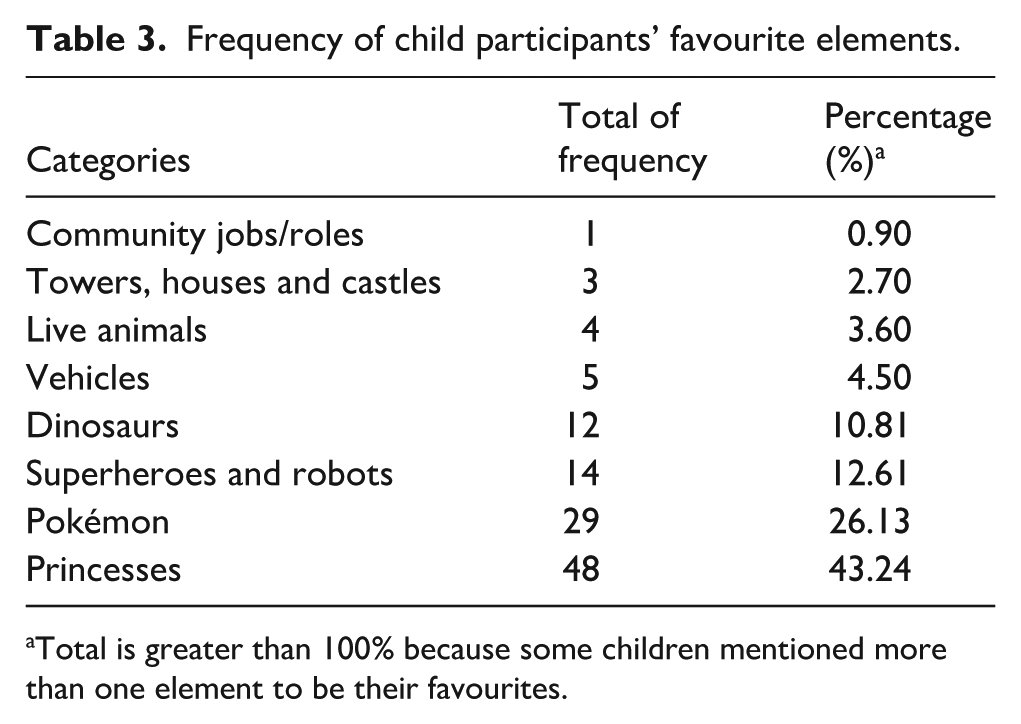
Total is greater than 100% because some children mentioned more than one element to be their favourites.
One 6-year-old girl chose the princesses over vehicles, explaining: “Because I’m a human too, so I like human.” (Response 426B08). In contrast, another girl, when comparing community roles/jobs with vehicles, remarked: “[community roles/jobs] [vehicles] are different. [vehicles] this is a car, [community roles/jobs] this is a human. Because humans have life, [vehicles] cars don’t have life. [I like] the one that don’t have life. Because when you sit in a car, you can see the scenery. [I like] looking at the scenery because it’s beautiful, and the clouds are pretty” (Response 95B12). Both boys and girls referred to the importance of eating and of having legs, which permit walking and running. There were often also references to significant anatomical differences such as wings and the length of tails, ears, and noses. Frequent references were made to whether categories remained still or moved of their own volition, which further corroborate the findings of Mandler and McDonough (1993).
Emergent readers’ schematic constructs for evaluating preferred subjects
Containing/enveloping
References were made to the significance of windows and doors, as well as to clothing, which was often associated with the schemes of containing and enveloping, and occasionally with movement and trajectories. Skirts and dresses worn by princesses elicited frequent mentions (boys: 14, 12.61%; girls: 35, 31.53%), and princesses also evoked many responses that referred to prettiness, beauty, and cuteness (boys: 1, 0.01%, girls: 36, 32.43%). Similarly, Pokémon received responses that referred to prettiness, cuteness, and loveliness (boys: 10, 9.01%; girls: 13, 11.71%). When comparing live animals with princesses, a small number of children expressed concerns about the nudity of live animals, including one girl (0.09%) and three boys (2.70%). For example, a 4-year-old boy stated: “[I like] those with clothes, so others won’t see them naked, as being seen can be embarrassing” (Response 371F07). When comparing community roles/jobs and vehicles, a 5-year-old boy explained: “[I like] those with clothes, because [community roles/jobs] with clothes I can carry things. I can be a policeman. Those without clothes can only move. [community roles/jobs] Wearing clothes can make you feel comfortable. I like human because human have lives. We can do things with lives” (Response 407F16).
Many responses showed a tendency towards comparisons with themselves such as being human, and were often gendered. Boys and girls frequently commented on the gender suitability of wearing skirts, with girls identifying with princesses (22, 19.82%) and boys with community roles/jobs (5, 4.5%) and superheroes and robots (2, 1.80%). One 6-year-old girl articulated her feelings especially clearly: “Well, I usually wear clothes and skirts. I often don’t know what to wear. My favourite one is a longer skirt. [princesses] They are girls, [Pokémon] They are boys. I like girls, because girls are better. Because some of them are good, and some of them are bad. I like their hair, because it’s long, like a princess” (Response 221D07).
Boys often explicitly distanced themselves from princesses. For example, a 4-year-old boy stated: “I like those without skirts, because I’m a boy” (Response 153C11). By contrast, a 4-year-old girl, when comparing live animals with community roles/jobs, reported: “I like both with fur and without fur. I prefer [community roles/jobs] humans [the one without fur], because there are princesses. I prefer humans [community roles/jobs], because they are dressed up, very cute. They dressed up as different characters. Dad always tells me to be a doctor, but I don’t want to, I just want to be a princess” (Response 439F24).
Fighting
References to “bad guys,” crime, self-preservation, violence, and punishment were frequent, particularly among boys. These were coded under the theme “struggle/fighting” (boys: 58, 52.25%; girls: 26, 23.42%). A typical response from a 6-year-old boy illustrates this theme: “[I like] those that can fight bad people because they can defeat bad people” (Response 382F09). Another 5-year-old boy elaborated: “[I like] ones that can turn into cars. Because the ones that can turn into cars have knives to cut dinosaurs—cut their legs off. [superheroes and robots] Optimus Prime. Because if dinosaurs hurt people, Optimus Prime will help people, so I like him. Because he can turn into a car, he is very impressive. His knife is impressive, and his hands can turn into cannons. He can shoot dinosaurs in the neck, and they die. He can kill dinosaurs so the dinosaurs won’t hurt humans” (Response 108B15).
In comparisons between dinosaurs and princesses, one 5-year-old boy reported: “[I like] the one with spikes. They can poke dinosaurs—poke the T. rex in its neck—because I’m afraid it will eat me. [The one with spikes] look cool. [They can] poke other dinosaurs. I like having spikes [. . .] Spikes look cool; they can poke others, poke the T. rex.” (Response 412F17). Another 4-year-old boy reported: “[I like] ones with guns. Because they can blow up/shoot down the police station. [Hit the police]. [squished] which is fun” (Response 167C09). Another 6-year-old boy said: “[I like] the one that can shoot a gun. Because you can control it. I like controlling things. You can rescue people, and when enemies come, you can use the gun to shoot them, and then they suddenly attack, and I take out a knife—my true ability—and they get defeated. True ability is when you use your strength to cut the monster, and then the monster gets defeated” (Response 171C16). Also noteworthy were references to police and doctors not only as helpers, but as figures who fight to save others, reinforcing the theme of heroic struggle and protection.
Trajectories
Child participants frequently referenced dynamic physical actions such as running, flying, kicking, swinging, driving, and the movement of body parts including trunks, legs, and wings. Comparing dinosaurs with vehicles, one 4-year-old emphasised the importance of mobility: “[I like] [dinosaurs] with legs. Because if you don’t have legs, you can’t walk. With legs, you can walk [. . .] Since you can walk, you can run, too. I like running, because running around feels great” (Response 373F07). Comparing live animals with buildings, a 5-year-old boy explained: “[I like] living things, because they are alive and can run and eat. [I like] animals. Because animals can run and grow” (Response 407F16). Another typical example was: “[I like] things that can fly. Because I’ve seen Superman crash into walls. He’s still fine after [crashing into walls]. He has to use his feet first before he can crash with his head. I’ve seen it before” (Response 143C09).
Rotations
The early childhood education literature on action schemes frequently highlights a strong interest—particularly among boys—things that rotate and wheels. This was reflected in child responses, such as when one boy, comparing vehicles with princesses, stated: “[I like] the one with tires. Because it’s very cool, because of its colour [. . .] It [the tire] can run up and down on the rails, so it is very cool. And I hate girls, and I’m not a girl, so I chose the one with tires” (Response 430F21).
Vocalisation and expressions
Child participants also referred to a wide range of vocalisations, including spoken language, songs, and animal sounds such as dogs barking and lions or dinosaurs roaring. One child expressed a clear affective response to the sound of barking: “[I like the one that] barks. Because puppies—they are lovely. The barking one is lovely, the puppy is lovely, I like puppies” (Response 002A01).
Transporting
Children made references to vehicles and animals carrying objects or people, demonstrating the transporting scheme. However, only a few responses provided clear evidence of action schemes such as connecting, disconnecting, or positioning. Other examples where it was more difficult to determine common use or schematic foundations included references to ears and listening, eyes and seeing, friendship, shields, lightening, and electricity—most often associated with Pokémon. There were also a few examples where schemes were clearly being combined in the emergence of more complex operations. For example, references to positioning and sorting encourage children to sequence and put things in order, such as identifying objects as bigger or smaller, or indicating more versus less.
The interviews also revealed some evidence of sustainability awareness among children. Although the following 6-year-old girl was not aware of the climate implications of biogas, her response demonstrated concern for air pollution: “[community roles/jobs] One is a human, [vehicles] one is a vehicle. Humans don’t emit waste gas, and vehicles emit waste gas. [I like] the one that doesn’t [discharge exhaust gas]. This way there will be no air pollution” (Response 207D07). Some children (10, 9.01%) also referenced chimneys in relation to pollution. For example, one 5-year-old boy remarked: “[I like] There is no chimney, so it will not warm up the Earth. Yes, so that humans will be healthy. Pollution. No, if we pollute the Earth, a lot of dirty air from the Earth will enter our bodies and we will catch a cold” (Response 256D16).
Some responses reflected children’s emerging understanding of extinction. For example, one 6-year-old boy explained: “[I like the one from] the Jurassic Era. Because there were many dinosaurs in the Jurassic Era [. . .] Because dinosaurs—now we don’t have them anymore. They are all extinct. Because I have never seen a real moving dinosaur” (Response 211D05). Additionally, the children’s knowledge of electricity and its harmful effects—often mediated through Pokémon—may provide a useful context for early learning about renewable energy.
Gender differences in emergent readers’ application of schemes
In retrospect, gender could have been included as a RQ in this study, although it was not directly aligned with the study’s primary focus on sustainability education. Nevertheless, the data revealed a strong gender influence, necessitating its inclusion as an important analytical dimension. Table 4 presents the eight most frequently cited action schemes identified through the repertory grid analysis.
Frequency of child participants’ references to schemes.
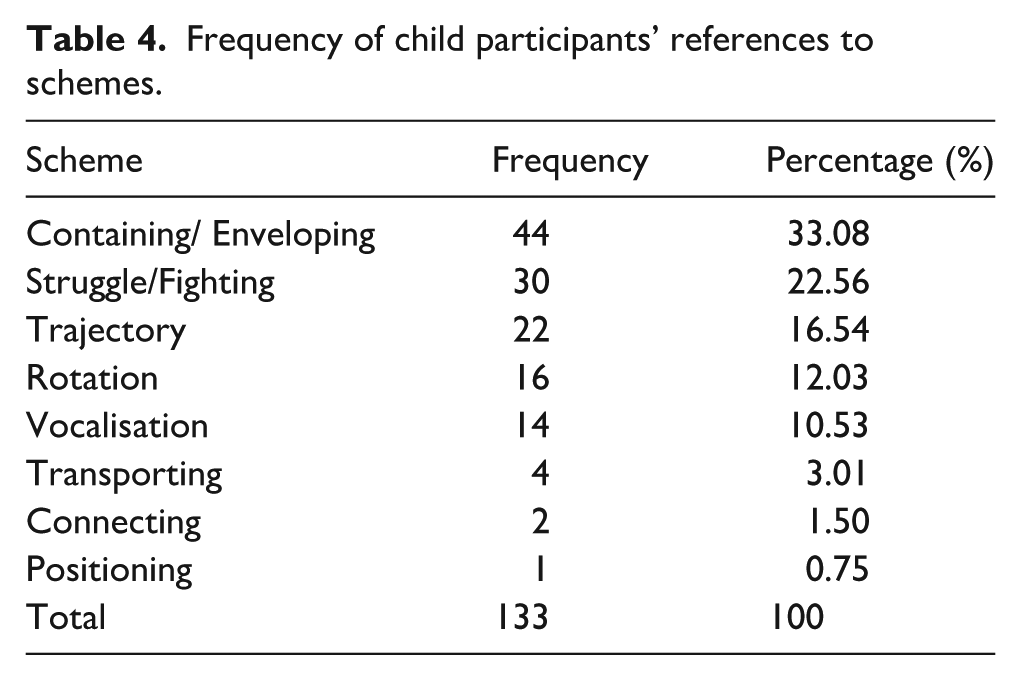
The final dataset consisted of observed frequencies of these eight schemes applied by the child participants, categorised by gender (boys and girls) and age (5 and 6 years old). The initial objective was to assess whether the distribution of schemes was independent of these variables as a group. A Chi-square test of independence was conducted on a three-way contingency table to evaluate potential interactions among scheme, gender, and age. The null hypothesis tested was:
As shown in the second row of Table 5, the test yielded a result of χ2(21) = 22.1021, p = 0.3936, indicating no statistically significant three-way interaction among scheme, gender, and age.
Chi-square test statistics for the association between children’s scheme, gender, and age.
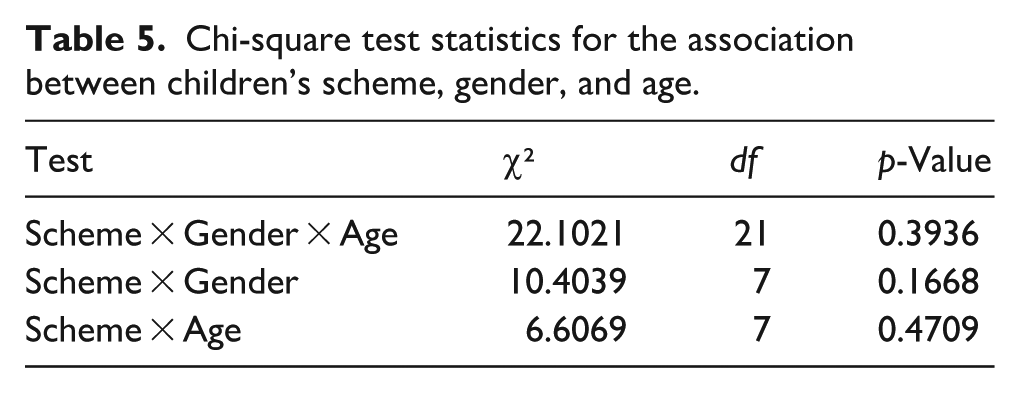
To further explore potential pairwise associations, two separate two-way Chi-square tests were conducted. The first test examined the relationship between scheme and gender, collapsing across age. The second test assessed the relationship between scheme and age, collapsing across gender. Neither test yielded statistically significant results: scheme × gender, χ2(7) = 10.4039, p = 0.1668; scheme × age, χ²(7) = 6.6069, p = 0.4709 (see Table 5).
Given the observed indications of gender bias in specific schemes, per-scheme Chi-square or Fisher’s exact tests were conducted to assess whether individual schemes exhibited gender-based differences in frequency. The null hypothesis tested for each case was:
For each scheme, a 2 × 2 contingency table was constructed comparing the frequency of boys and girls using the focal scheme against those using all other schemes combined. The choice of statistical test was based on expected cell counts: Fisher’s exact test was applied when any expected frequency fell below 5; otherwise, a Chi-square test of independence was employed. This dual approach ensured statistical validity across variable sample sizes.
The results, summarised in Table 6, indicated a statistically significant gender difference in the Containing/Enveloping scheme (p = 0.0376) and a marginally significant gender difference in the Struggle/Fighting scheme (p = 0.0761). No other schemes showed statistically significant gender differences.
Comparison of frequencies for each scheme by boys and girls.
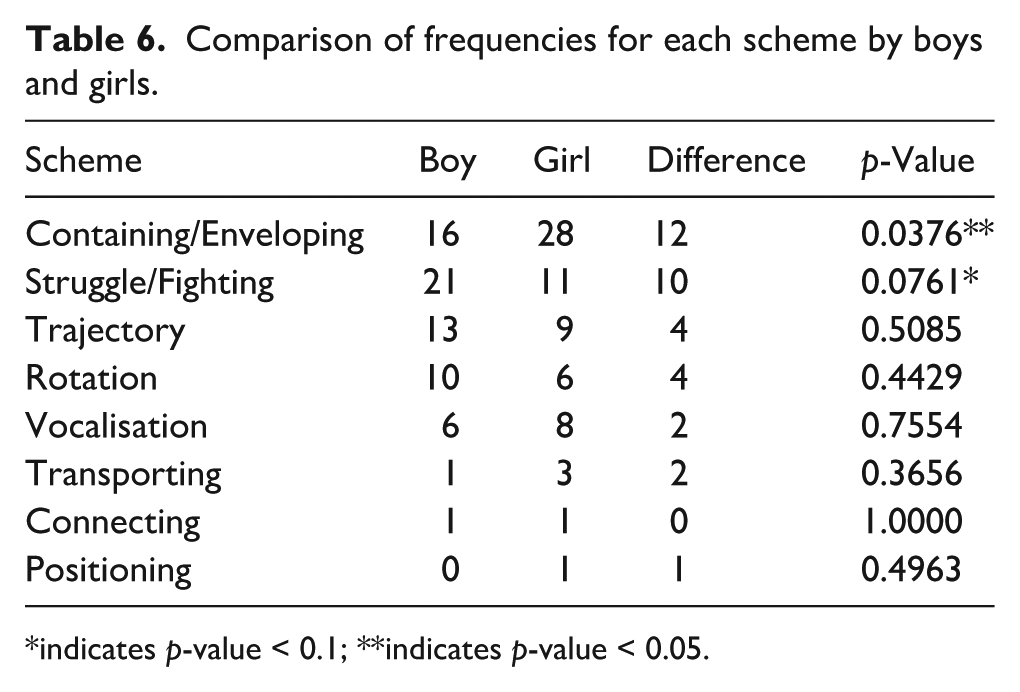
indicates p-value < 0.1; **indicates p-value < 0.05.
To examine age-related differences, the same per-scheme approach was used to compare 5- and 6-year-old participants. The null hypothesis tested for each case was:
Discussion
The present study applied an adaptation of Kelly’s (1955) RGT alongside Piaget’s (1969) later distinction between operative schemes and figurative schema. This distinction, subsequently influential in cognitive science, provides the analytical potential for reconciling Piaget’s later work with contemporary perspectives on embodied cognition, cognitive science, and linguistics (Lakoff and Johnson, 1999). As Lakoff and Johnson (1999) argue, language has culturally developed through embodied experience, which also underpin how children learn and develop in early childhood. Historically, embodied actions and experiences have been metaphorically applied in language, facilitating comprehension of otherwise abstract concepts. This feature of language acquisition arguably simplifies learning: we speak of “grasping” an idea, ambitions that “grow,” or people who are “soft,” and readily understand what it means to “fall” in love or “rise” to an occasion. Such embodied metaphors continue to evolve, as illustrated by more recent expressions like “surfing” the Internet.
However, what is less commonly understood is that the embodied actions are complicit in the process of comprehension and cognition more generally. This becomes clearer when considering how emotional responses in challenging situations often evoke the same physical sensations as being physically “out of one’s depth.” Similarly, the experience of panic or the sensation of “falling” in love is fundamentally embodied, drawing not upon any neural form of visual or linguistic representations, but on somatic memory. In early childhood, play fighting—such as fighting with dinosaurs—provides a context for children to learn about conflict and adversity through embodied play. They are learning to appreciate different roles and perspectives, to develop empathy, and how to control emotions in a safe and controlled environment. Notably, play fighting has been widely recognised as supporting the development of resilience (Hansen Sandseter et al., 2023; Veiga et al., 2025).
Our identification of the most common schemes associated with children’s interest schemas also highlights a persistent challenge: gender bias. This issue is illustrated by an example: a picture storybook on firefighting and climate change, such as The Little Hummingbird (Yahgulanaas and Maathai, 2010), may be perceived as more schematically relevant to boys than to girls. Yet research suggests that children can benefit from fighting play, and their knowledge and understanding of conflict and struggles contribute to the development of resilience. In the development of educational applications, it is therefore essential to remain mindful of Gender Equality, as articulated in the United Nations Sustainable Development Goals. Having identified the scheme as gender biased we can ensure that those texts associated with “struggle/fighting” and with “dressing up” or “containing/enveloping” are coded with secondary, as well as their primary scheme, and ensure through these means that equal gender access is ensured. Picture storybooks also hold potential for actively countering socially and cultural gender stereotypes. For example, the abuse and empowerment of the Cinderella story may be highlighted, and emphasis may be given to superheroes disguising themselves in alternative clothing.
Conclusions
The study has identified a list of schemes that serve as a child-centred taxonomic resource applicable to a range of emergent-reader research contexts. The detailed methodological account is intended to encourage replication and collaboration in developing a robust vocabulary, with extensions to other early childhood information contexts. The identified taxonomy may be applied to the classification of both print and digital materials, with a collection of exemplar sources. Ultimately, this work seeks to inform the design and testing of information technologies that can be used by children’s librarians, early childhood educators, and parents to support children’s learning across diverse indoor and outdoor settings.
The next stage of this research will focus on identifying those schemes that can effectively support schematic learning related to sustainability and examining their presence in children’s resources. A key hypothesis yet to be tested is the extent to which such schematic alignment enhances the learning behaviours identified in UNESCO’s Greening Curriculum Guidance (2024). Potential areas for further exploration include:
Connecting—Food chains and supply chains
Positioning—Food sources and food distribution
Rotation—Wind generation, life cycles, and the water cycle
Trajectories—Growth, timelines, and targets
Transporting—Food distribution and waste collection
By integrating theoretical perspectives on embodied cognition with the use of the RGT, this study demonstrates how children’s natural categorisation processes can inform the organisation of library resources. This carries significant implications for LIS services and professional knowledge, as the findings highlight how schematic categories can guide the design of metadata schemas, browsing interfaces, and book displays that reflect children’s embodied ways of thinking. By aligning classification and display strategies with children’s embodied cognition, children’s librarians can make collections more intuitive and meaningful for emergent readers. Furthermore, these schematic categories provide a valuable framework for introducing sustainability concepts—linking everyday experiences of movement, connection, containment, and transformation to broader environmental, social and cultural, and economic themes. In this way, the categorisation not only advances child-centred information organisation but also contributes to early childhood education for sustainable citizenship within the LIS context.
Footnotes

Funding
The authors disclosed receipt of the following financial support for the research, authorship, and/or publication of this article: Taiwan National Science and Technology Council [113-2410-H-005-025].
Declaration of conflicting interests
The authors declared no potential conflicts of interest with respect to the research, authorship, and/or publication of this article.