







Abstract
This study examines how public librarians in Taiwan navigate the intersection of multicultural collection development and sustainable development within contemporary public library practice. Using a qualitative approach based on semi structured interviews with 12 public librarians, the study analyzes librarians’ professional practices through the lens of Schatzki’s practice theory. The findings show that librarians frame multicultural collection development through epistemic recognition of cultural differences and a sense of professional responsibility, viewing diversity not simply as numerical representation but as the restoration of inclusive public knowledge spaces. Collection development is therefore understood as a dynamic process in which resource allocation is continuously adjusted in response to community demographics and changing information needs. Sustainability is operationalized through multilingual acquisitions, multi format access, and institutional adjustments that lower barriers to information, thereby aligning library practices with SDG 4 (Quality Education) and SDG 10 (Reduced Inequalities). At the same time, librarians employ strategic practices such as anticipatory acquisition, cross sector collaboration, and contextualized curation while navigating structural constraints including limited funding, staffing pressures, procurement regulations, and publishing market limitations. These practices also involve ongoing ethical negotiations concerning cultural representation, freedom of expression, and the balance between equity and efficiency. Based on these findings, the study proposes an Action Cycle Model consisting of six interconnected stages: needs assessment, policy review, professional collaboration, resource integration, promotion and feedback, and subsequent adjustment. The model illustrates how librarians sustain multicultural collections through iterative practices that mediate between professional agency, institutional structures, and community needs, contributing to the broader understanding of sustainable knowledge governance in public libraries.
Keywords
Introduction
In the current era of globalization and intensified cross-border population mobility, libraries have emerged as crucial cultural mediators and social support institutions. Their collection development and information services are increasingly required to address the diverse needs of communities. Within this context, particularly under the trajectory of multicultural societal development, libraries are not only providers of knowledge resources but also bear the responsibility of fostering cultural diversity, advancing social inclusion, and safeguarding intellectual freedom. In professional discussions of librarianship, issues of diversity, equity, and inclusion are widely recognized as important ethical considerations guiding library services and collection development. Accordingly, library practices must be continuously adapted and transformed to reflect evolving understandings of diversity and inclusivity, ensuring that cultural representation and knowledge needs across communities are addressed (Othic, 2019). The construction of multicultural collections therefore represents both a curatorial practice that acknowledges cultural diversity and a concrete contribution to knowledge democratization, cultural equity, and social sustainability.
Taiwan has become increasingly diverse in recent decades due to immigration, international labor mobility, and the presence of Indigenous communities. According to government statistics, Taiwan currently hosts more than 700,000 migrant workers, primarily from Southeast Asian countries such as Indonesia, Vietnam, Thailand, and the Philippines. In addition, there are more than 500,000 new immigrants, many of whom originate from Southeast Asia or mainland China. Taiwan is also home to 16 officially recognized Indigenous groups. These demographic changes have contributed to growing linguistic and cultural diversity, creating new challenges and opportunities for public libraries in developing multilingual and multicultural collections.
The increasing prominence of the United Nations Sustainable Development Goals (SDGs) has further highlighted the need to integrate principles of cultural diversity with sustainable development in library and information science research and practice. Kosciejew (2020) emphasizes that public libraries not only serve as cultural instruments for advancing the SDGs but also function as mobilizable networks of knowledge and community engagement. In Taiwan, public libraries have primarily aligned their services with SDG 1 (No Poverty), SDG 3 (Good Health and Well-Being), SDG 4 (Quality Education), SDG 9 (Industry, Innovation, and Infrastructure), SDG 11 (Sustainable Cities and Communities), and SDG 16 (Peace, Justice, and Strong Institutions; Fan and Ke, 2024). Within this framework, the development of multicultural collections should be viewed as a practical strategy for responding to SDG 4 and SDG 10 (Reduced Inequalities), given its role in expanding equitable access to knowledge and supporting cultural representation in public knowledge institutions.
Nevertheless, challenges remain in the implementation of multilingual and multicultural collection policies. In practice, library collections often continue to privilege national official languages, which may insufficiently address the linguistic and cultural needs of immigrant, migrant worker, and Indigenous communities. Previous studies have observed that multilingual collections in public libraries are frequently uneven in scope, often reflecting dominant language publishing markets rather than the full linguistic diversity of local communities. Moreover, collection development and resource allocation at the branch level are frequently shaped by individual librarians’ language proficiencies and selection preferences, leading to uneven representation of languages and cultural themes (Ly, 2018). To ensure fairness and cultural representativeness, systematic assessment of language distribution and collection comprehensiveness is necessary, alongside periodic strategic adjustments in resource allocation (Nwofor and Ilorah, 2023; Yusuf, 2024).
While prior research on multicultural library services has largely concentrated on language support, cultural appropriateness, and targeted strategies for specific groups (e.g. new immigrants, migrant workers, Indigenous peoples), there has been comparatively little scholarly attention to the role of librarians themselves in mediating and operationalizing the intersection of multiculturalism and sustainable development. This study addresses this gap by adopting a librarian-centered perspective to examine their professional agency, strategies, and reasoning processes in constructing multicultural collections and embedding sustainability principles in their practices.
Specifically, this study pursues the following objectives:
By addressing these objectives, this study contributes to filling a critical gap in the literature, highlighting librarians’ professional agency at the intersection of multicultural knowledge governance and sustainable development, and offering practical implications for the institutionalization of equitable and inclusive library practices.
Literature Review
Multicultural library collections
According to widely discussed professional principles in librarianship, collection development should aim to serve the informational and cultural needs of all members of the community. Within this perspective, multicultural collections are generally understood as library holdings that include works both created by and about diverse cultural and ethnic communities, reflecting multiple perspectives, knowledge traditions, narratives, and lived experiences (American Library Association (ALA), 2019). In this study, the term multicultural collections refers to library resources that represent diverse cultural perspectives, histories, and social experiences. By contrast, multilingual collections refer specifically to materials provided in multiple languages in order to support users whose primary language differs from the dominant language of the host society.
Library professionals hold the responsibility to select, maintain, and promote access to works by diverse authors and creators while addressing the heterogeneous needs, interests, and capacities of their communities. This responsibility involves not only responding to expressed demands but also identifying gaps in existing collections and ensuring that the library’s holdings reflect the diversity of the communities they serve. In this sense, inclusive collection development requires ongoing professional judgment and ethical consideration in balancing representation, accessibility, and community relevance.
As societies grow increasingly diverse, librarians must continuously adapt their practices to changing demographic and cultural contexts. Diversity may encompass dimensions such as age, ethnicity, race, gender, sexual orientation, disability, religion, language proficiency, and migration background (Othic, 2019). In the public library sector, international assessments of multilingual collections have attempted to evaluate both their breadth and depth. Some studies rely on focus groups or user surveys, while others examine collection content, circulation data, or bibliographic analysis. These studies often find that national official languages continue to dominate collections, creating imbalances that privilege mainstream language materials. However, branch-level analyses sometimes reveal more locally responsive patterns, with linguistic distributions that more closely reflect community demographics (Ly, 2018).
The development of multicultural collections therefore requires more than formal policy statements and should be embedded in everyday library practices and collection management strategies. Professional guidelines commonly emphasize several practical approaches, including diversifying resource formats (e.g. print, audiobooks, digital materials), incorporating works from local or independent publishers, critically reviewing cataloging and display practices to avoid stereotyping, aligning multilingual collections with community linguistic structures, and ensuring accessibility through assistive formats. These strategies highlight the importance of integrating inclusivity into routine professional practice rather than treating it as a separate initiative.
Othic (2019) further emphasizes that building meaningful multicultural collections requires careful evaluation of both collection size and quality, as well as a nuanced understanding of community demographics and information needs. In practice, libraries often face financial and structural constraints when developing multilingual and multicultural collections. Under such conditions, librarians must carefully balance the needs of different user groups while also addressing gaps affecting historically underrepresented communities. Rather than privileging one group at the expense of others, effective collection development requires maintaining a fair and responsive balance that reflects the diversity of the entire community.
From this perspective, multicultural collection development is not simply about numerical representation but about ensuring that library collections responsibly reflect the cultural complexity of the communities they serve. Such efforts contribute to more inclusive knowledge environments while supporting equitable access to information across diverse social groups.
Libraries and the Sustainable Development Goals (SDGs)
In 2015, the United Nations adopted the 2030 Agenda for Sustainable Development, introducing 17 Sustainable Development Goals (SDGs) and 169 targets addressing social, economic, and environmental development (United Nations, 2015). These goals aim to promote inclusive and sustainable societies while reducing inequalities across different regions and communities. In the context of this study, sustainability refers not only to the availability of financial resources but also to the long-term institutional integration of multilingual and multicultural services within library practices, including their incorporation into collection policies, strategic planning, and routine service provision.
Libraries have increasingly been recognized as important institutions supporting the SDGs because they provide equitable access to information, educational resources, and community services. Kosciejew (2020) notes that public libraries function as knowledge infrastructures that enable access to information, community learning, and civic participation. In this sense, libraries can contribute to sustainable development by expanding opportunities for education and social inclusion.
International professional organizations such as the International Federation of Library Associations and Institutions (IFLA) have emphasized the role of libraries in advancing access to information and cultural participation within the SDG framework. Bradley (2016) highlights that IFLA’s advocacy during the development of the 2030 Agenda focused on equitable access to information, public access to information and communication technologies, and the preservation of cultural heritage. These priorities position libraries as key actors in promoting inclusive knowledge environments.
Within the context of public library services, multilingual and multicultural collections represent one practical mechanism through which libraries contribute to SDG 4 (Quality Education) and SDG 10 (Reduced Inequalities). By providing access to materials in multiple languages and representing diverse cultural perspectives, libraries can support inclusive learning opportunities while reducing informational barriers faced by linguistically diverse communities.
Librarians’ roles in multicultural and sustainable practices
As frontline professionals, librarians play a crucial role in translating institutional policies and diversity principles into everyday library practices. Their responsibilities include selecting resources, engaging with communities, and ensuring that library collections remain responsive to changing demographic and cultural contexts.
Previous studies have highlighted several challenges librarians face in developing multilingual and multicultural collections. These include limited budgets, uneven language expertise, and constraints in publishing markets that restrict the availability of materials in minority languages (Hill, 2018). Despite these challenges, librarians often act as intermediaries between institutional policies and community needs, using professional judgment to balance representativeness, accessibility, and resource limitations.
Scholars also emphasize that librarians’ work increasingly involves roles beyond traditional collection management. Librarians function as cultural mediators and community connectors who facilitate access to diverse knowledge resources and support inclusive learning environments (Chigwada and Ngulube, 2024). These responsibilities require a combination of professional expertise, cross-cultural communication skills, and collaborative engagement with local communities.
Theoretical framework
This study adopts Schatzki’s (2002) practice theory as its analytical framework to understand how librarians construct and implement multicultural collection practices within institutional and social contexts. Practice theory views social life as constituted through interconnected practices. These practices consist of organized sets of activities that involve shared understandings, rules, material arrangements, and practical knowledge. Rather than treating professional decisions as purely individual choices or as outcomes fully determined by institutional structures, practice theory suggests that actions emerge within socially organized contexts where actors, norms, and material resources interact.
A central concept in Schatzki’s framework is site ontology, which proposes that social phenomena occur within specific sites composed of interconnected practices and material arrangements. In public libraries, these sites include collection policies, cataloging systems, institutional regulations, community demographics, and professional norms that shape librarians’ decision making. Another important concept is bundles of practices, which refers to the interconnected character of multiple practices that together shape social activities. Collection development is therefore not an isolated activity but is closely related to policy interpretation, user engagement, knowledge evaluation, and institutional governance.
Using practice theory allows this study to conceptualize multicultural collection development as a set of situated professional practices rather than a purely technical process. Librarians’ decisions regarding resource selection, language representation, and community engagement can therefore be understood as outcomes of ongoing negotiation among institutional rules, available resources, professional expertise, and community needs. This perspective provides an analytical lens for examining how librarians translate broader normative goals, such as multicultural inclusion and sustainable development, into concrete practices in everyday library work.
Method
Research design
This study employed a qualitative research design, utilizing semi-structured interviews to investigate librarians’ perceptions, strategies, and reasoning processes in the development of multicultural collections and the implementation of sustainable practices. A qualitative approach was chosen to capture the complexity and contextual nuances of librarians’ professional experiences. The semi-structured format ensured consistency in addressing the study’s key themes while allowing flexibility for participants to elaborate on their perspectives and lived experiences.
Research setting and participants
Public libraries in Taiwan operate within a decentralized system primarily administered by local governments at the municipal and county levels. According to national library statistics, Taiwan currently has more than 500 public library branches serving local communities across the island. These libraries are mainly funded through municipal or county government budgets, with additional support from national cultural and educational initiatives. Public libraries provide a wide range of services, including reading promotion programs, community learning activities, and multilingual resources for migrant and immigrant populations. In recent years, increasing cultural and linguistic diversity in Taiwan has led many public libraries to expand their multilingual collections and services in order to better serve migrant workers, new immigrants, and Indigenous communities.
The study focused on public libraries in Taiwan, where issues of multicultural service and sustainability have gained increasing attention in recent years. Participants were librarians with substantial experience in multicultural collection development or who played critical roles in collection-related decision-making and practice. Purposive sampling was employed to ensure diversity in institutional scale and organizational levels, thereby capturing a wide range of professional perspectives. In total, 12 participants from different professional positions and library settings were recruited. The final sample size was determined by the principle of data saturation: once interviews began to yield redundant responses with no new insights, data collection was concluded.
Data collection
Data were collected through semi-structured interviews conducted between June and August 2025. The interview guide was designed around three dimensions: (1) librarians’ understandings of multiculturalism and its application in collection development; (2) experiences and challenges in incorporating sustainable development goals, particularly SDG 4 (Quality Education) and SDG 10 (Reduced Inequalities), into collection practices; and (3) the construction of action models reflected in collection policies and everyday practices. Each interview lasted approximately 60 minutes. With informed consent, all interviews were audio-recorded and transcribed verbatim for analysis.
Data analysis
Thematic analysis was employed to examine the interview data. The process involved iterative reading of transcripts, followed by open coding, axial coding, and the construction of categories. This approach enabled the identification of librarians’ cognitive frameworks and action strategies at the intersection of multiculturalism and sustainability. Constant comparison was applied across transcripts to ensure coherence, while analytic memos were maintained throughout the process to document the researcher’s reflections and enhance analytical rigor and transparency.
Trustworthiness
To ensure the credibility and validity of the findings, three strategies were applied:
Member checking was conducted by inviting selected participants to review preliminary findings to confirm the accuracy of representation.
Triangulation was achieved through the use of supplementary data sources, including policy documents and collection development plans.
Reflexivity was maintained through continuous researcher journaling in order to minimize personal bias.
Research ethics
The study adhered to established ethical standards for qualitative research. Participants were informed of the study’s purpose, procedures, and their right to withdraw at any stage without penalty. Informed consent was obtained prior to interviews, and participants were assured of confidentiality and anonymity. All identifying information was removed during transcription and reporting. Data were securely stored and used solely for academic purposes.
Findings and analysis
Professional frameworks of multiculturalism: epistemic recognition and dynamic equilibrium
The findings indicate that the majority of participants (10 librarians, approximately 83%) identified epistemic recognition and professional responsibility as dual foundations for the development of multicultural collections. In this study, epistemic recognition refers to the acknowledgment of diverse cultural knowledge, languages, and perspectives as legitimate components of the public knowledge domain represented in library collections. The former emphasizes acknowledging the legitimacy of cultural difference, while the latter translates this recognition into concrete practices of collection curation and resource development. As one participant noted, “I am not just collecting books; I am bringing different languages and memories into the public space” (P03). Another participant emphasized, “Diversity is not about distribution; we need to actively fill in the gaps where resources are lacking” (P11). These statements reveal that librarians have moved beyond a “proportional” or “numerical” view of diversity, instead conceptualizing multiculturalism as the representation and restoration of public knowledge spaces. From the perspective of practice theory (Schatzki, 2002), these understandings can be interpreted as part of librarians’ professional practices, in which values, institutional norms, and material arrangements collectively shape how multicultural collections are constructed and maintained.
At the same time, a considerable proportion of participants (eight librarians, approximately 67%) stressed that collection proportions should not be treated as static but rather maintained as a form of dynamic equilibrium responsive to community structures. As one librarian explained, “The same ratio cannot apply to all branches. In areas with large numbers of migrant workers, our Vietnamese and Indonesian collections need to be prioritized” (P07). With immigrant populations becoming increasingly prominent user groups, librarians’ professional practices thus extend beyond reactive responses to needs; they embody an ongoing responsibility to adjust and maintain balance within the ecology of public knowledge.
Interpreting user needs and mediating policies
In the process of collection development, user recommendations were cited by most participants (10 librarians, approximately 83%) as an important indicator of demand. However, these recommendations also carry challenges of selection and balance. Librarians reported that general readers often request highly specialized or personal materials (e.g. medical textbooks), while migrant and immigrant users often recommend resources in their native languages, bilingual learning materials, or literature embedded in cultural contexts. Such diversity of needs compels librarians to mediate between localized reading expectations and global cultural diversity. For instance, one participant recounted a reader’s comment: “Can we also recommend English books? . . . It seems I’ve never seen that kind of recommendation here” (P01), highlighting a potential gap in language diversity within collection building.
To address these heterogeneous demands, librarians relied on policy guidelines and professional judgment to adjust resource allocations while safeguarding the library’s public mission. Nearly half of the participants (six librarians, 50%) also emphasized that library programs play a complementary role in mitigating the risk that temporary or event-driven demands might distort long-term collection balance.
Rather than responding to each request individually, librarians described a strategy of identifying gaps in existing collections and using targeted acquisitions to gradually strengthen underdeveloped areas. In this sense, user feedback was interpreted not only as a direct request for specific materials but also as an indicator of broader collection weaknesses. As one participant explained, “We try to prioritize completing the missing parts of the collection” (P11) This statement reflects a curatorial approach in which librarians interpret user input within a broader professional framework. Instead of simply responding to individual recommendations, they use such feedback to identify structural gaps in the collection and make strategic acquisitions that enhance its overall coherence and representativeness.
Such practices illustrate librarians’ role in mediating between user needs and institutional policy, highlighting the practical challenge of balancing responsiveness to community demands with the long-term sustainability of multicultural collection development. This process reflects what Schatzki (2002) describes as interconnected bundles of practices, where collection development decisions are shaped through the interaction of professional judgment, institutional policies, and community expectations.
Balancing professional stewardship and thematic expansion
Beyond responding to user requests, many participants (nine librarians, approximately 75%) indicated that social advocacy or annual themes also served as key drivers of collection development. For instance, in 2024 the theme of “emotional well-being” was translated into acquisitions covering topics such as emotional education, resilience, and emotional expression, often integrated into program design. As one librarian remarked, “I want these collections to be visible, so I asked the reading promotion instructor to design courses around recognizing emotions, becoming aware of them, labeling them, and calming them” (P04). This illustrates the complementary relationship between collection expansion and educational outreach.
Nevertheless, under pressures of external expectations and internal constraints, librarians consistently demonstrated a logic of professional stewardship. Even when confronted with strong demand-driven pressures, the vast majority (11 librarians, approximately 92%) adhered to collection policies, integrating the principle of “responding to needs while safeguarding professional standards” into their daily practice. This balanced form of professional stewardship not only reinforces the public nature of collections but also prevents short-term trends from overshadowing long-term values. In doing so, librarians assert their role as knowledge gatekeepers, mediating the coexistence of cultural diversity and sustainability within public libraries.
Operationalizing sustainability: SDGs and collection governance
The findings indicate that most participants (10 librarians, approximately 83%) regarded sustainability as a core professional value and operationalized it through localized and institutionalized strategies that translate international agendas into concrete practices of collection governance. For example, the “International Picture Book Center” annually acquires more than 1500 multilingual picture books, serving as an institutional anchor for collection renewal and the maintenance of diversity. This initiative not only strengthens accessibility for both local and migrant readers but also embodies the spirit of glocalization, reflecting librarians’ professional role in mediating between international agendas and local community needs.
SDG 4 (quality education): Accessible learning pathways
Nearly 75% of participants (nine librarians) emphasized that the continual acquisition of multilingual picture books and teaching materials effectively supports bilingual learning and cross-cultural understanding. One librarian explained, “Every year we acquire a large number of foreign-language picture books. These are not just collections, they are educational resources” (P06). In addition, librarians reported integrating multiple formats, such as print, digital, and audio, to lower barriers to use and expand learning pathways, particularly for language learners and visually impaired users (P01). These practices align with SDG 4’s emphasis on inclusive and equitable education, positioning libraries as platforms that combine accessibility with expanded learning opportunities.
SDG 10 (reduced inequalities): Linguistic and institutional justice
In addressing SDG 10, two-thirds of participants (eight librarians, approximately 67%) stressed that collection planning must avoid overreliance on dominant languages and increasingly prioritize Southeast Asian languages (P09). This effort reduces cultural inequality through multilingual resources while ensuring the inclusion of marginalized linguistic groups. Librarians also highlighted the importance of institutional adjustments, such as relaxing borrowing restrictions and shortening interlibrary loan waiting periods, to reduce barriers to information access (P04). Some participants further reported embedding SDG indicators directly into selection lists, thereby facilitating collection audits and promoting cross-departmental collaboration (P06). These dual practices of linguistic justice and institutional justice highlight librarians’ professional role in mediating between cultural equity and informational equity.
Project-based sustainability and institutionalization
All participants (12 librarians, 100%) emphasized that sustainability requires long-term institutionalization rather than short-term projects. Librarians generally agreed that temporary demands arising from events should be integrated into the long-term collection base to avoid fragmented accumulation of resources. As one participant remarked, “We may supplement as needed, but we will not purchase only for a one-off event” (P02). Through regularized acquisition and review mechanisms, event-driven needs are incorporated into systematic governance. This approach ensures that collection development transcends short-term responses and sustains a balance between cultural diversity and long-term sustainability.
Strategic practices, governance challenges, and ethical tensions: From agency to constraint
The findings further reveal that most participants (nine librarians, approximately 75%) demonstrated multi-layered professional agency, actively employing strategic practices to advance multicultural collection development. However, these strategies were simultaneously constrained by structural factors such as limited budgets, staffing shortages, rigid institutional procedures, and publication market barriers. As a result, librarians must continually negotiate and adapt in the process of implementing sustainable governance. Moreover, librarians reported facing multiple ethical tensions, with the central challenge being how to balance user needs with professional standards in everyday decision-making.
Multiple modes of professional strategy
Participants (nine librarians, 75%) reported developing three core strategies in building multicultural collections. First, anticipatory acquisition: to prevent mismatches between collections and community needs, librarians monitored local publishing trends and collaborated with language promotion agencies to proactively supplement multilingual resources, while also encouraging reader participation in recommendation mechanisms. Second, cross-sectoral collaboration: by partnering with social welfare agencies, immigration offices, and Indigenous councils, librarians engaged in resource exchanges and joint curation to acquire specialized materials otherwise difficult to procure. Third, contextualized curation: librarians organized thematic displays, including language learning materials, legal information, and health resources, and supplemented them with multilingual guides to enhance usability. As one participant noted, “circulation rates have clearly increased.” These strategies underscore librarians’ role not as passive responders but as proactive cultural resource curators.
Structural constraints and governance pressures
Nonetheless, participants identified multiple structural constraints. Two-thirds (eight librarians, approximately 67%) pointed to limited budgets and rigid procurement procedures in smaller libraries, which hinder the acquisition of local publications and foreign minority-language works (P02). Staffing shortages and uneven community engagement further necessitated outreach services; as one librarian explained, “Many groups do not actively express their needs, so we have to rely on outreach to discover them” (P09).
The governance challenges reported by participants can be categorized into three types of pressures. First, demand-side pressures: large volumes of user recommendations or complaints often overwhelm librarians’ decision-making. For instance, “A reader once recommended more than 100 titles and even wrote to the mayor’s office” (P10). Over-accommodation risks imbalance, while strict gatekeeping risks being perceived as exclusionary. Second, supply-side pressures: publishing and copyright barriers limit access to minority-language or newly published works (P07), forcing librarians to rely on interlibrary loans, copyright negotiations, or digital alternatives. Third, institutional pressures: cross-professional value conflicts require intensive negotiation between curatorial perspectives that emphasize esthetics and LIS perspectives that emphasize public access. These challenges illustrate how librarians must continually adjust strategies under structural constraints.
Ethical tensions and professional decision-making
In this study, “contextualizing controversial materials” refers to professional practices such as providing explanatory catalog notes, curated displays, or interpretive guidance that help readers understand the historical, cultural, or political context of sensitive materials while preserving intellectual freedom.
Beyond structural limits, librarians also faced four major ethical challenges in sustainable multicultural collection governance. First, the risk of representation: how to avoid reinforcing cultural stereotypes during selection and cataloging. For example, if Indigenous collections primarily depict “poverty” or “assistance,” or if migrant worker resources focus solely on “labor disputes,” such representations may flatten complex identities (P01). Second, the tension between freedom of expression and cultural sensitivity: librarians generally agreed that controversial materials should be retained to preserve informational integrity but must be contextualized with guidance or disclaimers to prevent misinterpretation (P12). Third, the trade-off between equity and efficiency: when faced with niche yet socially significant resources, librarians balanced demand intensity with broader social impact to ensure minority voices were included (P07). Fourth, the negotiation of professional boundaries: librarians often preferred participatory curation with communities to reduce the dominance of unilateral professional interpretation (P03).
From the perspective of Schatzki’s (2002) practice theory, these ethical tensions are not isolated dilemmas but part of the bundles of practices enacted within a particular site. Librarians’ decisions emerge from the interaction of institutional rules, professional norms, available resources, and community expectations, all of which shape how multicultural collections are interpreted and governed in everyday practice. Managing representational risks, contextualizing controversial materials, weighing equity and efficiency, and fostering participatory curation intersect with policies, selection tools, user needs, and institutional norms to form a complex practice network. In this sense, ethical tensions are not merely external constraints but constitutive elements shaping professional judgment and governance. As one participant concluded, “Diversity is not neutral. . . Professionalism means being able to clearly explain why choices are made, as long as they do not cause harm” (P11). This underscores librarians’ professional value in sustainable governance as an ongoing negotiation between agency and constraint, needs and expertise, efficiency, and equity.
Knowledge co-construction and action models: From external expertise to organizational internalization
The findings demonstrate that librarians’ knowledge construction extends beyond personal experience or traditional training, evolving instead through a cycle of professional consultation, cross-sectoral collaboration, and internalization. This process gradually shapes operational action models, enabling librarians to translate external expertise into organizational standards and reinforcing the governance role of public libraries.
Sources of knowledge: Professional consultation
One-third of participants (four librarians, approximately 33%) reported seeking external expertise when faced with professional limitations. For example, in multicultural collection selection, librarians consulted professional associations or scholars to review acquisitions, ensuring resource appropriateness and effectiveness: “We lack expertise in multicultural or ethnic studies, so we ask associations to help with evaluation” (P05). This reflects librarians’ pragmatic approach of supplementing knowledge gaps through expert consultation.
Cross-sectoral collaboration: Complementarity of collections and curation
Over half of participants (10 librarians, approximately 56%) emphasized the importance of cross-sectoral collaboration, particularly the complementary relationship between collection building and exhibition curation. Partnerships with curators, writers, and cultural organizations deepened contextual interpretations of resources and strengthened community connections (P02). Such collaboration not only broadened knowledge sources but also enriched the cultural dimensions of collections.
Professionalized collaboration models
Nearly 60% of participants (seven librarians) described preferring “co-participatory” collaborations with external experts rather than simply receiving advice. Through deliberation and exchange, librarians enhanced their evaluative capacity and developed shared understandings. This collaborative model expanded professional horizons while fostering professional communities, enabling librarians to integrate diverse forms of knowledge into library practice.
Internalization and transformation: Toward organizational standards
External expertise was ultimately institutionalized into decision-making criteria, policies, and procedures. For example, some librarians marked SDG indicators in selection lists to support collection audits and interdepartmental collaboration (P06). These feedback mechanisms ensured that external expertise continued to shape internal practices, creating a cycle of knowledge and action.
The Action Cycle Model: A dynamic mechanism for sustainable collection development
Synthesizing the findings, this study proposes an Action Cycle Model that characterizes librarians’ professional agency at the intersection of multicultural collection development and sustainability. The model emphasizes that librarians are not passive responders to user needs but instead operate through a cyclical process of needs assessment, policy review, professional collaboration, resource integration, outreach and feedback, and readjustment. Within this cycle, librarians continuously mediate between public responsibility and professional expertise, as well as between local needs and global sustainability. This dynamic mechanism demonstrates how public libraries enact knowledge governance through iterative and adaptive practices. See Figure 1.
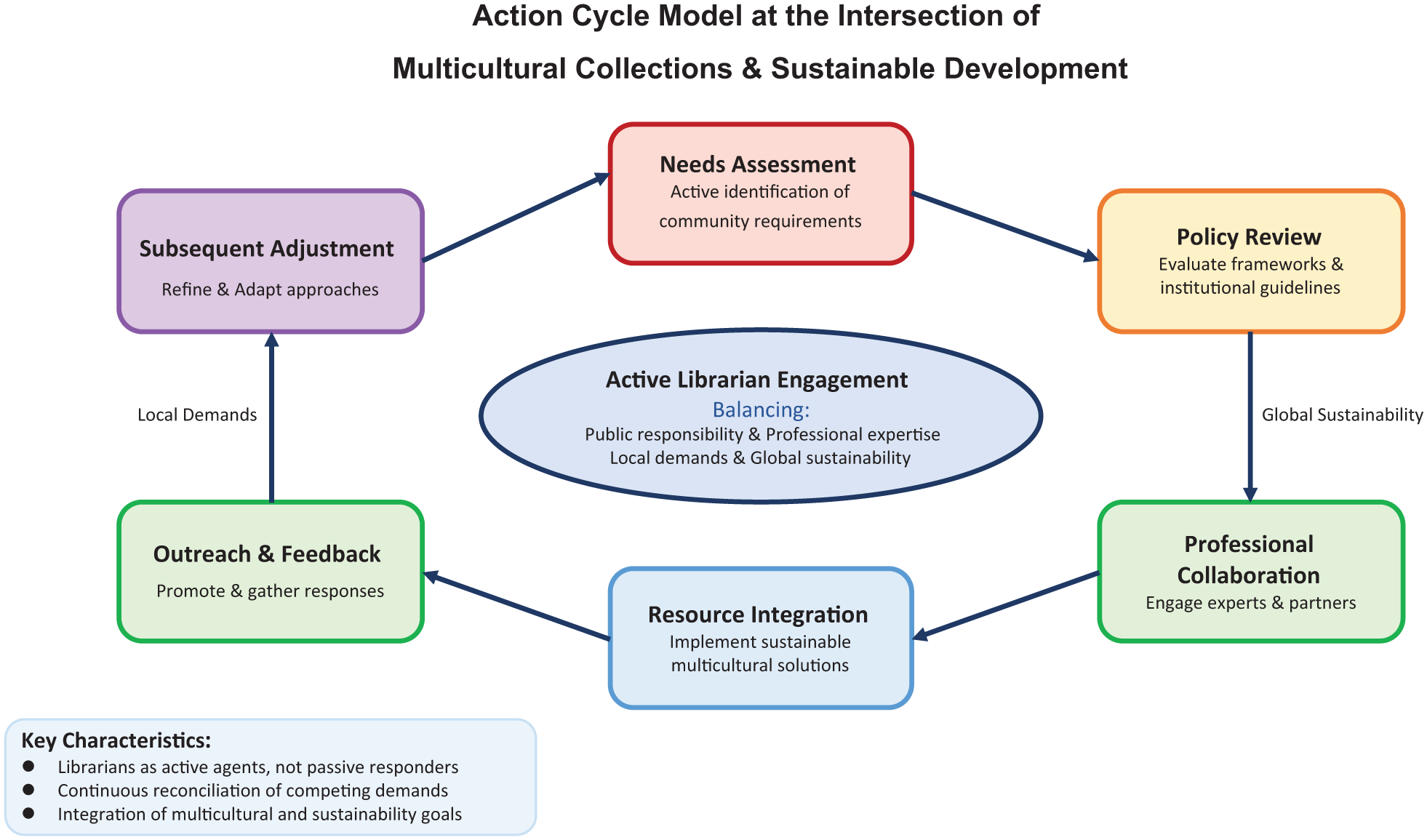
Action Cycle Model.
This process diagram conceptualizes the Action Cycle Model as a continuous loop consisting of six interrelated stages. The dashed central circle highlights librarians’ proactive agency throughout the cycle, distinguishing it from a passive service model. The stages are as follows:
This cyclical process enables librarians to maintain a dynamic balance between responding to external demands and safeguarding professional autonomy. It ensures that multicultural collection development and sustainable practice are not one-off initiatives but continuous processes that simultaneously address the immediate needs of local communities and broader global sustainability objectives. The model acknowledges the complex decision-making environment librarians navigate as they uphold professional standards while remaining attentive to community needs.
The proposed Action Cycle Model offers three key insights for the sustainable development of public libraries. First, regarding publicness, the establishment of institutionalized mechanisms for needs assessment and policy review prevents the monopolization of collection development by specific groups, thereby safeguarding inclusivity and universality in public library services. Second, in terms of accessibility, the integration of multilingual resources, cross-platform dissemination, and contextualized presentation effectively reduces cultural and informational barriers, aligning with SDG 4 (Quality Education) and SDG 10 (Reduced Inequalities). Third, concerning diversity, ongoing professional collaboration and iterative feedback mechanisms enable library collections to dynamically reflect the changing structures and cultural transformations of local communities, embodying the sustainable spirit of “glocalization.”
In sum, the action cycle should not be regarded merely as an operational model but as a framework of knowledge governance. It provides a systematic pathway for policy formulation and practical implementation in the library field, strengthening the institutional capacity of public libraries to balance cultural diversity, professional standards, and sustainable development.
Discussion
Through interviews and analysis of public librarians, this study explored how librarians navigate the intersection of multicultural collection development and sustainable practices by enacting epistemic recognition, professional responsibility, and strategic actions. The findings reveal that librarians typically approach collection decisions by first acknowledging the legitimacy of cultural differences (epistemic recognition) and subsequently translating this value orientation into institutionalized collection practices (professional responsibility). Importantly, such a value framework is not static within policy documents but is continually enacted and reproduced in everyday practices. For example, librarians adjust the allocation of multilingual collections according to the demographic composition of migrant and immigrant residents, thereby creating a mode of “dynamic equilibrium.” This finding echoes Othic’s (2019) assertion that the construction of multicultural collections should not be confined to books but should encompass diverse resource types to ensure representativeness across communities. However, this study further highlights librarians’ agency in negotiating between cultural diversity and publicness, thereby demonstrating the resilience and governance capacity of public libraries under the framework of sustainable development.
The localization of sustainable development goals has become a critical dimension of professional practice. This study shows that librarians not only integrate SDG 4 (Quality Education) and SDG 10 (Reduced Inequalities) into collection policies but also operationalize them through concrete actions such as the acquisition of multilingual picture books, multi-format resource provision, and adjustments to institutional barriers. These findings underscore that sustainability in collection governance is not merely an abstract ideal but is enacted through librarians’ professional judgments and strategic choices in daily services. Moreover, maintaining diversity and equitable accessibility while responding to multilingual and multicultural communities remains a central challenge for both practice and policy planning. As Lee and Choi (2023) argue, public libraries in multilingual communities carry the responsibility of providing sufficient multilingual resources to meet diverse linguistic, cultural, and educational needs. This study contributes by emphasizing librarians’ agency in advancing the sustainability agenda, illustrating how libraries can translate global initiatives into locally embedded practices, and offering concrete implications for policy and practice.
Nonetheless, librarians’ professional agency is simultaneously constrained by structural conditions such as funding, staffing, and publishing circulation. Within these governance challenges, librarians must mediate between user demand, institutional limitations, and cross-professional collaboration, while negotiating multiple ethical tensions. These include avoiding the reproduction of cultural stereotypes, balancing freedom of expression with cultural sensitivity, weighing equity against efficiency, and defining the appropriate scope of professional intervention. The findings demonstrate that librarians’ professional roles are not neutral; rather, they continuously engage in value negotiations through reasoned choices, underscoring the complexity of ethical practice. These results resonate with Hill’s (2018) emphasis on the institutional and resource challenges libraries face in serving linguistically marginalized groups. Yet this study further reveals that even in the absence of multilingual specialists, librarians can advance sustainable multilingual services through alternative strategies such as identifying appropriate vendors, training existing staff, and mobilizing volunteer resources. Moreover, this study complements Hill’s (2018) observation on the importance of collaboration, showing that cross-library knowledge sharing and cooperative networks are indeed essential pathways for achieving service goals in diverse communities. Thus, despite significant challenges, when libraries effectively reach and support linguistically marginalized groups, their contribution to social and cultural inclusion can be profound and enduring.
At the level of knowledge governance, this study demonstrates that librarians’ professional judgments are not derived solely from personal experience but are generated through a cycle of professional consultation, cross-sectoral collaboration, and internalization. External expertise and cross-domain cooperation are translated into internal policies and procedures, thereby forming an institutionalized mode of knowledge governance. On this basis, the study proposes the Action Cycle Model, encompassing needs assessment, policy review, professional collaboration, resource integration, promotion and feedback, and subsequent adjustment. This model illustrates how librarians, situated between agency and structural constraints, sustain the publicness, accessibility, and diversity of collections.
From a theoretical perspective, the study employs Schatzki’s (2002) practice theory, particularly the concept of site ontology, to understand librarians’ professional work. Collection governance is neither solely determined by structures nor by individual actions but emerges within “sites” where librarians’ practices intersect with institutions, tools, and community needs. Likewise, the concept of bundles of practices highlights that librarians’ actions are not isolated but interconnected with collection policies, selection lists, institutional rules, and cross-domain collaborations. Within such a field, librarians’ knowledge judgments, resource selections, compliance with norms, and innovative practices interlink to form specific practice bundles. This theoretical lens enables a deeper understanding of how librarians shape the relationship between collection policies and operational practices, while revealing the broader social implications of cultural diversity and sustainability in the context of public libraries.
Conclusion
Drawing on qualitative interviews and analysis, this study demonstrates how librarians enact professional agency in multicultural collection development and sustainable practices while simultaneously negotiating structural constraints and ethical tensions. The study proposes an Action Cycle Model to capture this dynamic. Four main conclusions can be drawn:
Librarians ground their practices in epistemic recognition and professional responsibility, achieving a dynamic balance between demand-driven and profession-driven orientations, while adjusting collection proportions to reflect cultural diversity.
Librarians have internalized SDG 4 (Quality Education) and SDG 10 (Reduced Inequalities) into institutionalized practices by acquiring multilingual resources, providing multi-format access, and implementing institutional reforms, thereby operationalizing sustainability as a governance model.
Librarians continuously negotiate between agency and constraint, employing strategic actions and ethical judgments to sustain the publicness and professionalism of collections. The proposed Action Cycle Model illustrates how librarians sustain publicness, accessibility, and diversity through a cyclical process of needs assessment, policy review, professional collaboration, resource integration, promotion and feedback, and subsequent adjustment, ultimately framing library governance as an iterative and adaptive process.
The Action Cycle Model carries multiple implications for the sustainable development of public libraries. Institutionalized mechanisms of needs assessment and policy review safeguard inclusivity and universality by preventing monopolization of collections by specific groups. The acquisition of multilingual resources, multi-platform provision, and contextualized displays reduce barriers to information and culture, aligning with the core aims of SDG 4 and SDG 10. Sustained professional collaboration and iterative feedback enable collections to dynamically reflect changing community structures and cultural shifts, thereby embodying the sustainable spirit of glocalization. In other words, the action cycle should be seen not merely as an operational method but as a framework of knowledge governance, offering a systematic pathway for both policy formulation and practical implementation.
Practical Implications
The findings of this study hold several practical implications for both policymakers and library practitioners:
Limitations and future research
This study has several limitations. First, the sample was limited to public libraries in a specific region, which may not capture the full diversity of contexts across different geographic and institutional settings. Second, data collection primarily reflected librarians’ perspectives, with relatively limited representation from library users, policymakers, or other stakeholders. Third, while the proposed Action Cycle Model is grounded in empirical findings, its broader applicability and sustainability remain to be tested across diverse contexts.
Future research could address these limitations in several important ways. First, expanding the sample to include libraries of different scales and across diverse regions would allow for a more comprehensive analysis of contextual variations. Second, incorporating multiple stakeholder perspectives, such as those of users, policymakers, and community partners, would contribute to a more holistic understanding of multicultural collection governance. Finally, cross-library comparative studies, coupled with longitudinal research, could help validate the applicability and durability of the Action Cycle Model while also tracing how librarians’ professional agency evolves over time in response to structural constraints and cultural transformations.
Footnotes

Ethical considerations
This study involved human participants. The research procedures were conducted in accordance with institutional ethical guidelines, and informed consent was obtained from all participants prior to the interviews.
Consent to participate
All participants were informed about the purpose of the study and agreed to participate voluntarily.
Funding
The author received no financial support for the research, authorship, and/or publication of this article.
Declaration of conflicting interests
The author declared no potential conflicts of interest with respect to the research, authorship, and/or publication of this article.
Data availability statement
The data supporting the findings of this study are not publicly available due to the inclusion of interview materials that may contain identifiable information about participants. Data may be made available from the corresponding author upon reasonable request.