







Abstract
This study examines features and proposals on ‘non-users’ in academic libraries reported in LIS literature, and its application at the Metropolitan Technological University Academic Library System, UTEM. In light of the increasing number of higher education students who, do not utilise the information resources and services provided, the purpose of this research is (1) to enhance the development of disciplinary knowledge, and to promote library decision-making regarding ‘non-users’, and (2) to reflect and raise awareness, involvement and commitment among the academic librarian’s community regarding the need for research focused on ‘non-users’. This study is descriptive in scope and uses mixed methodology to examine a population of 1105 undergraduate students identified as ‘non-users’ by the UTEM library system. To obtain quantitative data, a survey was conducted applying stratified probability sampling, with 3.4% margin of error, and 90% of confidence level. To collect qualitative data, matrix of content analysis technique and structured interviews to UTEM librarians, where conducted to gain insights based on their particular expertise and experience. Findings suggest that 60.4% of respondents who do not utilise the library system, are students who self-identify as autonomous, and prefer the use of technological and remote information search tools over the library’s face-to-face service. A 62% of respondents replied that they were not aware of how to use the library. Respondents identified variety of reasons to explain the ‘non-use’ of the library. These include, a lack of knowledge regarding the catalogue utilisation, the hours of the library operation and the availability of needed information resources. Despite awareness of the ‘non-user’ increment among the undergraduate student population, UTEM librarians have recognised a need for user’s involvement strategies to engage them. The discussion highlights a need for non-users focus and reassessment’s methodologies, both strategies applied in ‘non-users’ studies cases for academic libraries.
Introduction
The Metropolitan Technological University, UTEM, as a public educational institution is focused on sustainability, innovation, social responsibility and technological development. The university has an undergraduate student population of approximately 8000, which is distributed across four faculties to cover social sciences; management, business and economics; construction and land management sciences; natural sciences, mathematics and the environment; humanities; and social communication technologies; and Engineering. The Metropolitan Technological University Library System, SIBUTEM, includes four specialised libraries, which are distributed across each campus and located in three local governments, in the Metropolitan Region. The core objective of SIBUTEM is to enable the effective dissemination of information resources, with a view to facilitating access to these resources through a combination of on-site and remote services. The provision of information services is extensive, encompassing on-site borrowing, home borrowing, open shelf access, interlibrary loans, the borrowing of technological devices, access to computers, scanning services in libraries, electronic references, online databases, online catalogues and information literacy programmes, to name but a few. The academic library system categorises library users as regular students, undergraduate students, thesis students or exchange students.
The concept ‘library user’ is traditionally, employed to identify a person who uses in a certain period of time, some information resource or information service from a library. In this sense, Hernández Salazar (2013: 111) argues that, ‘the user becomes the axis around which the knowledge of librarian revolves, and users in library must be conceived not just as an object or an element of the information transference to the library production’ cycle’, but also as an entity that knows. Libraries should therefore undertake users’ studies in order to understand their information needs and behaviour in relation to their information services. The concept ‘non-user’ in contrast, is applied in Library and Information Science, LIS, to identify people who do not make use of the information services of any specific library. Within this context, the mainstream literature on LIS, identifies variety of ‘non-users’ categories associated with the frequency of either using a particular service or visiting a library. In terms of the frequency of use of any information service, the concepts ‘non-users’ or ‘factual non-users’, are identified as those who do not use the library services or those who used to use them, but for some reason, decided not to do so any more. (Consonni, 2010; O’Dell and Preston, 2013). Another category associated with the construct ‘non-user’ is conceptualised as ‘marginal users’, which refers to those who use the library information resources at a sub-optimal or expected level (O’Dell and Preston, 2013; Sridhar, 1994). Similarly, with regard to the concept ‘non-users’ concerning ‘library visits’, Fernández-Ardèvol et al. (2018) describe that they can be classified into two categories: (i) ‘ex-users’, identifying those who visited the library at some point, but not in the past year, and (ii) ‘never-users’, referring those who have never visited the library. From a general perspective, McCarthy (1994) proposes four subgroups for ‘non-users’, identified as (1) influencers or second-hand users, (2) users with no interest in the information services offered by the library, (3) users with their own access to information, and (4) users who demand non-traditional information services. In order to identify the underlying reasons behind the phenomenon of ‘non-users’, Blaylock and Arriola (2021), propose a perspective based on two different dimensions: (i) a dimension associated to personal context, and (ii) a dimension related to institutional context. The authors also describe that some ‘non-users’ consider that the library resources are not essential for their academic success, and therefore, they do not visit or use them.
Conversely, an analysis of the scientific literature when examining for example, the LIS publications indexed in mainstream journals as WoS and Scopus databases, reveals a notable gap or asymmetry between research or studies on ‘users’ and ‘non-users’. In regard to the subject ‘library users’; a total of 3842 articles were retrieved in August 2024. Nevertheless, research referring to ‘non-users’ of libraries, published in indexed journals in the same databases, reached a total of 20 articles, which represents a rate of 0.52% with respect to research on library users. In this context, and focusing on the ‘non-users’ issue to an academic library in Chile, it is pertinent to inquire research questions as what grounds or foundations underlying the existence of ‘non-users’ in the Library System at the Metropolitan Technological university? What is the prevalence of ‘non-users’ of library system at the Metropolitan Technological University by faculty, undergraduate’ programme and enrolment cohort? What features in terms of age, gender and origin distinguish the ‘non-users’ at the Metropolitan Technological University within the 2019–2023? What measures, proposals or strategies put forth the librarians of the Library System at the Metropolitan Technological University to attract ‘non-users’? The variables contained in these research questions originates the research problem which is established as Features and proposals on ‘non-users’ of academic libraries, reported in the mainstream literature and its application to the Library System at the Metropolitan Technological University of Chile. Considering the complexity of the research problem, the scope of the study to be developed is descriptive (Padrón and Camacho, 2000; Tamayo, 1999; Cerda, 1993; Baena, 2017; Bernal, 2010; Cabezas et al., 2018; Hernández et al., 2014; Martínez Ruiz, 2012; Muñoz, 2016; Niño, 2011). Descriptive studies, according to Behar (2008: 17) ‘have the purpose of analysing how a phenomenon and its components are, and how they manifest themselves, because they allow the phenomenon studied to be detailed basically through the measurement of one or more of its attributes’. Consistent with the research problem, the following research hypotheses were established; (i) Research hypothesis,
Literature review
Features on the conceptualisation ‘non-user’ library
A literature review to the concept library ‘non-user’ reveals that such term is traditionally applied to refer o to describe a person who does not actively engage with a library and therefore does not receive the information services or products that libraries provide. The concept ‘Non-User’ is also used in Library and Information Science, LIS, to distinguish people who do not make use of a particular kind of library. In this sense, different researchers establish dissimilar parameters and divergent conceptual approaches to identify what is considered a ‘Non-user’. Such parameters may include, for example, the frequency of use of information services, access or attendance at the library. In general, ‘non-users’ are defined as people affiliated to the library who may potentially require some information service from the library, yet for variety of reasons do not utilise them (Brick, 1999; Borteye et al., 2018; Tedd and Large, 2004). Otherwise, Sridhar (1994: 118) describes a ‘non-user’ of a library as ‘someone who has the right to use library services, but does not do so for a specified period of time’. In the context of education, Foster et al. (2023: 2) propose that ‘a non-user is defined as a student who has never used the library’s book reserve service’. From a temporal perspective, it can be argued that a ‘non-user’ is a person or student who, by right, is a beneficiary of the library, but who does not use the products and services offered by the information unit, over a period of 12 months (Flowers, 1995; Toner, 2008). Similarly, it is possible to describe ‘non-users’ as university students who do not visit, access or borrow from the library during a semester (Blaylock and Arriola, 2021; Del Bosque et al., 2017). Other categories of ‘non-users’ consider a multiplicity of factors including Goodall and Pattern’s (2011: 163) study which states that ‘Non-Users, ‘are students who record -little-use- measured in frequency of five or fewer loans, or five or fewer loans at login to the library e-resource collection, or five or fewer visits to the university library’. Upon de examination of the afore references, it becomes evident that there are at least two discernible elements that contribute to feature the ‘non-users’ concept: (i) the construct ‘Non-User’ refers to a person who should be a user of a specific library and (ii) a specific time period in which the use action should occur, and does not occur. The ontological disparity observed between the examined and referred authors to face a challenge in unifying the conceptualisation. In this regard, Brunskill and Hanneke (2021: 10) consider that ‘there is a significant degree of ambiguity within the discourse surrounding the concept of Non-Users’. From the perspective of the author, this issue has practical implications. The lack of uniformity in the used terminology results in inconsistencies in how the ‘non-users’ are defined across studies. A ‘non-user’ in one study may be classified for example, as a potential user in another. In other words, a need for convergence in the conceptualisation of the construct ‘non-users’.
External conditions that originate ‘non-users’ of libraries
In the field of information science, particularly applied to libraries, independent of this nature or category; it is possible to identify external factors that contribute to the existence of individuals who do not use the library services, which cause or originate the existence of ‘non-users’. In this regard, mainstream literature reports that these reasons are diverse or heterogeneous, and therefore, encompass a range of factors and dimensions. With regard to the external reasons, unrelated to personal motivation, that give rise to ‘non-users’, these are mainly linked to a possible overall lack of knowledge about the library, as well as a lack of knowledge about the resources and services offered by the library. For example, studies have demonstrated that ‘non-users’ are often unaware of the library’s existence or location (Brunskill and Hanneke, 2021; Foster et al., 2023; Hendal, 2020; Mutshewa et al., 2010; O’Dell and Preston, 2013; Turtle, 2005). Another factor is linked to dissemination of misinformation regarding the rights of users to use or access the information services provided by the library (O’Dell and Preston, 2013; Turtle, 2005). Conversely, research results reveal that ‘non-users’ demonstrate a high level of disapproval regarding the availability of library resources, as they perceive a lack of relevant materials to their needs (Consonni, 2010; Flowers, 1995). An additional external factor reason for ‘non-users’ is linked to the accessibility of the library collection. ‘Non-users’ for example, argue that the library collection does not cover the complete bibliography of their degree programme (Consonni, 2010; Karunanayake, 2007; McCarthy, 1994). The literature on ‘non-users’ also describe reasons or factors related to the loan. These include the ‘non-users’ view that the loan service generally represents a prolongation in the time taken to use the service (Frank and Bothmann, 2008; Mutshewa et al., 2010). Additionally, Frank and Bothmann (2008), specify that, ‘non-users’ are either unaware of the necessary procedures or are reluctant to complete the loan form. Additionally, Flowers (1995) uncover in his study a prevailing emotion of discontent or dissatisfaction with library’s regulatory framework, which he deems to be featured by coercive measures that effectively impose restrictions or limitations on the loan service. In their respective studies, Flowers (1995) and Mutshewa et al. (2010) concur that one possible cause or contributing factor is the fact that the library is located distant or far away from the ‘non-users’ home. Similarly, Karunanayake (2007), reports that ‘non-users’ argue that the opening hours of the library do not fit in with their free time, and that it is therefore, not possible for them to be an active user. The lack of ‘non-user’ engagement for this reason is critical, as the location of the library is most often an irreversible issue. This phenomenon should be understood as a growing issue given the emergence and expansion of electronic means of access to information resources on the internet.
Incidence of interests, needs and motivations of ‘non-users’
Reasons associated with an individual’s interest can be identified as fundamental factors contributing to the phenomenon of ‘non-user’ of libraries. It is also possible to distinguish some reasons linked to the interests and/or features of each person as basic factors that give rise to ‘non-users’. The bibliography produced by the Information Sciences on ‘non-users’ reports that the motivations, needs and interests of people may also influence the decision to use or not to use a library. This gives rise to the existence of another facet of interest for the examination and analysis of the non-use of libraries. In this sense, the examined and analysed research, reveals that ‘non-users’ of Library and Information Science, LIS, prefer to seek information autonomously and online rather than through the traditional LIS channels, such as, for example, book lending, reference services, and information seeking (Frank and Bothmann, 2008; Luo and Buer, 2015; O’Dell and Preston, 2013; Sbaffi and Rowley, 2015; Toner, 2008; Turtle, 2005). Moreover, studies on ‘non-users’ report that this phenomenon is associated with the examination of information needs, and the level of interest in libraries. These studies reveal that ‘non-users’ perceive the bibliographic material in libraries as being irrelevant or not pertinent to their work and professional requirements (Mutshewa et al., 2010; Turtle, 2005).
In relation to the motivations underlying the utilisation of a library resources, Sridhar (1994) proposes a categorisation of the process by which a user becomes acquainted with an information source, including a library. This process is reliant upon factors that can be grouped into three categories: (i) the need, (ii) the user and (iii) the library. In defining (i) the need of a user, the author (1994) suggest that this can be understood as an interest in acquiring knowledge, an awareness of lack of knowledge or the existence of uncertainty. In this context, the author describes that factors such as the strength, urgency, certainty and clarity of a need can contribute to the use or non-use of an information service. In category (ii) the author includes three typologies of users: the ‘non-user’, the ‘marginal user’ and the ‘delegated user’. In Sridhar’s (1994) view, the decision to use or non-use an information service is motivated by a number of factors including personal preferences, motivation, initiative, cultural contexts, search experience, and others. Finally, Sridhar (1994) propose that the (iii) source or library is influenced by factors such as accessibility, ease of use and perceived usefulness by the individual. Similarly, Girton (2018) outlines the needs of students when utilising libraries. These needs are related to emotional conditions and can be classified as: (i) relationship, (ii) autonomy and (iii) competence. The author consider that these needs influence the levels of use of a library. If students, for example, perceive the library as an environment where they cannot form relations or connection with others, this perception has a detrimental impact on their predisposition towards the library. Similarly, autonomy is also affected by students’ willingness to engage and asking questions to the library staff. The author suggest that students are reluctant to be seen as incompetent, and this desire inhibits their ability to ask questions to the library staff. Consequently, this attitude negatively affects their autonomy with regard to the use of library resources.
Measures, and proposals to attract non-users
Research on ‘non-users’ published in mainstream journals in general reveals the interest in making transparent and understand the motives and reasons that potential users have for not making use of library services. Furthermore, potential solutions to this problem can be identified and or distinguished. In this context, the attraction of ‘non-users’ to information units has become a subject of interest particularly in light of the advent of social networks and technological progress. From the perspective of user studies, it is recommended that the opinions of ‘non-users’ must be taken into consideration. Additionally, proposals that relate to the application of active reinforcement or direct marketing techniques are suggested. Examples of such techniques and tools include the use of advertising and promotional activities in both traditional media, such as local newspaper or leaflets, and in digital media, including websites, social media and emails targeted at users and non-users (Flowers, 1995; Foster et al., 2023; Frank and Bothmann, 2008; Sbaffi and Rowley, 2015; Shah et al., 2021). Other measures reported in the literature to attract ‘non-users’ include the perspective of librarians, who propose the creation and improvement of services aimed at ‘non-users’. Sbaffi and Rowley (2015) exemplify that, in the case of public libraries in Manchester and Rome, the most frequent activities consist of reading groups, which have had a positive impact on the increase of users. Furthermore, as Houghton et al. (2013) considers, librarians have proposed the development of activities oriented towards culture, leisure, technology, aid and social welfare. In addition, it is suggested that libraries implement and promote workshops and activities related to user education, particularly in the areas of information literacy, IL. These initiatives aim at equipping users with the skills to effectively search for and retrieve information. have the purpose with the purpose of training in the search and retrieval of information. Additionally, encouraging discussion and reflection on the value of information for users (Shah et al., 2021; Toner, 2008) is also proposed as beneficial.
In a different context, authors such as Del Bosque et al. (2017) and McCarthy (1994) recommend that librarians familiarise themselves with the ‘non-users’ motivations for not using the library services, in order to gain a deeper understanding on the factors influencing their decision not to do so. This is with a view to delivering personalised messages promoting the services to each type of audience. Girton (2018) further develops the concept of ‘empathetic marketing’, which entails librarians developing an understanding of, and a sense of empathy towards their users and ‘non-users’, and forming connection with them. This is recommended to mitigate the anxiety that may be experienced by students when using the library services. However, Garoufallou et al. (2013) identify a contrasting viewpoint suggesting that the application of marketing techniques may be less effective without further contextualisation. Conversely, the authors recommend that library marketing should be integrated into the strategic plans and long-term goals of the institution in which the library is embedded. This approach would ensure that this task is organised, evaluated and conducted on a permanent or continuous basis.
Research methodology
In light of the preceding literature review, the formulated research questions, the identified variables and the stated research problem, a mixed methodological approach was decided as the most appropriate for conducting this study. This approach, according to Creswell (2009), allows for the examination of variables within research questions and the research problem from both a quantitative and qualitative perspective, thereby facilitating a holistic analysis. From a positivist perspective, the research problem considers, for example, variables related to the characterisation of the origin, gender, dedication and age range of the ‘non-users’ students of SIBUTEM (Briones, 1996; Creswell, 2009; Ñaupas Paitan et al., 2014). Similarly, the variables related to the description of proposals and actions on ‘non-users’ raised by the librarians that make up the SIBUTEM can be studied and analysed by adopting a qualitative approach, searching for meaning, depth and significance (Batthyány and Cabrera, 2011; Hurtado de Barrera, 1998; Monje, 2011). With regard to the operational considerations and the quantitative dimension of the research problem, the population under study consists of 1105 undergraduate students of the 2019–2023 cohorts who registered zero total loans during their studies at the Metropolitan Technological University of Chile. Considering the qualitative dimension, the research defines the librarians employed by SIBUTEM, during the year 2023, as the unit of analysis or observation (Figure 1).
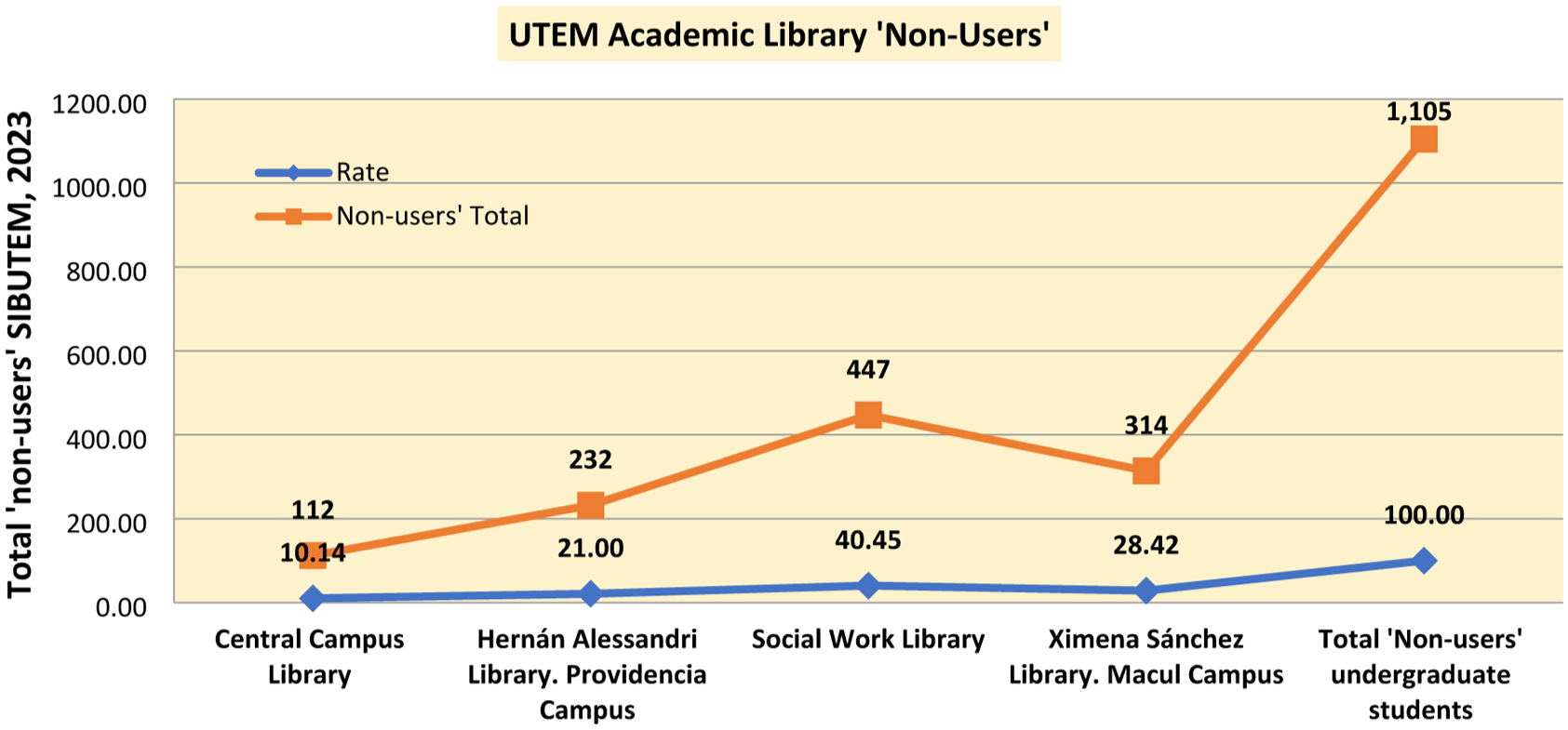
Non-users of the UTEM academic library system.
Data collection process
In order to address the methodological consistency of the study, the development of data collection instruments considered the operationalisation and examination of variables extracted from the research questions. These variables enabled the delineation of three key elements: firstly, the research problem and its associated variables; secondly, the scope of the study; and thirdly, the definition of the study population or observation unit. Consequently, the data collection instruments necessary for the study’s complexity are derived from both quantitative and qualitative methodologies. Applying quantitative methodology, a questionnaire consisting of 15 closed and multiple-choice questions was designed and validated, following the validation model developed by Krippendorff (2004). The questionnaire was administered as a survey to a sample of the ‘non-users’ population which had been selected according to a stratified sampling procedure. The questionnaire was administered to a population of undergraduate students from the 28-degree programmes at the Metropolitan Technological University, identified as ‘non-users’ of the University Library System, SIBUTEM. A link to the online survey was distributed via institutional e-mail to ‘non-users’ students, who had been identified as those who had not registered any loans during the previous 12 months in the SIBUTEM. In order to achieve the response rate defined to ensure the statistical validity of the study results, a follow-up strategy was implemented using e-mail and text messaging. The quantitative data was collected via surveys administered to undergraduate students within the non-user population of SIBUTEM. These data were then processed and analysed using SPSS® software. The statistical analysis comprised the utilisation of descriptive statistics for the examination of the variables characterising non-users. Utilising qualitative methodology, the research developed two data collection instruments: a questionnaire administered as an interview and a content analysis matrix. A seven-question open-ended questionnaire was administered as a semi-structured interview to four SIBUTEM librarians who agreed to participated in the study. The implementation of this data collection technique occurred subsequent to the conclusion of the statistical analysis, as its objective was to facilitate an in-depth examination, interpretation and elucidation of the results obtained concerning the perceived causes of the ‘non-user’ phenomenon, as well as the institutional strategies or proposals designed to attract this user’s population. The content analysis matrix was used to systematically examine and organise the mainstream literature. In the content analysis matrix, the findings of the examined and analysed studies, were categorised into five dimensions, which corresponded to (1) Conceptualisation of ‘non-users’. (2) Taxonomy of ‘non-users’. (3) Conditions that give rise to ‘non-users’. (4) Incidence of interests, needs and motivations of ‘non-users’. (5) Measures, proposals and/or solutions with the purpose of attracting ‘non-users’ to the library. The content analysis matrix consists of 25 rows, corresponding to the total number of mainstreams examined articles. These were selected from the Web of Science and SCOPUS databases, based on the selection criteria for the intentional or non-probabilistic sample, previously identified
Sampling technique
In light of the qualitative dimension under examination, the technique of non-probabilistic, directed or purposive sampling was applied. This type of sampling is not based on the application of statistical procedures, as the unit of analysis is selected according to the researcher’s criteria, either by convenience or availability (Creswell, 2009; Muñoz, 2016; Ñaupas Paitan et al., 2014; Niño, 2011). In this regard, the selection criteria for non-probability sampling, applied to develop the research content analysis technique, are outlined as follows: The first criterion pertain to the type of information source: indexed or mainstream articles were selected, in the referential database Scopus and Web of Science. The second criterion pertains to temporality, namely articles published in the Web of Science and SCOPUS databases and indexed until 2 May 2023. The third criterion for relevance was applied to the selection of mainstream articles retrieved from the Web of Science and SCOPUS databases. This was achieved through the utilisation of a search strategy constructed from the terms ‘non-user’ and its variants ‘non-use’ ‘non-user’ ‘non-users’ and ‘academic library’. The fourth criterion for completeness was achieved through the utilisation of a search strategy that compulsorily included the terms ‘non-use’ and ‘academic library’ in the article title, abstract and keywords of the Web of Science and SCOPUS databases. The fifth criterion refers to type of information source: main stream articles indexed in the Web of Science and SCOPUS databases which complied with the ‘article’ filter. were selected. The six criterion concerns to language: mainstream articles which met the language availability requirement in English or Spanish and indexed in the Web of Science and SCOPUS databases were selected. Similarly, the selection criteria for the non-probabilistic sampling to develop and apply the interview technique to Librarians belonging to the Library System of the Metropolitan Technological University were as follows: Criterion No. 1. In order to ensure the inclusion of a diverse range of perspectives, participants were selected based on their professional training and experience. Specifically, those who held degrees in either Library and Information Science and Records Management. Criterion No. 2 Place of Work: the participants were required to have been employed as librarians at the Metropolitan Technological University, where they had gained experience in their respective roles.
In order to examine the quantitative variables included in the research problem, the study uses stratified probability sampling. Cochran (1971), suggests that a heterogeneous population can be segmented or subdivided into subpopulations or layers, each of which is internally homogeneous. As Cochran (1971: 128) notes, the homogeneity of the strata ‘allows for the accurate estimation of measures derived from a small sample within that stratum’. In practical terms, Cochran (1971), asserts that stratification is applied for administrative reasons, and that that stratified probability sampling is advisable when studying human populations that are segmented into different strata. In this case, a subdivision of faculties located on different campuses is observed at the University. Additionally, Cochran (1971) states that stratified sampling is justified by the necessity to ensure precision in the estimators of the features of the entire population by examining some subdivisions of the population. It is therefore recommended that each subdivision be treated as a population in its own right. As shown in Table 1, the four academic libraries that comprises the UTEM Library system, SIBUTEM correspond to the four strata that group together the students of the 28 undergraduate degrees programmes included in the research:
Non-users distribution by stratum at the UTEM Academic Library System, SIBUTEM.
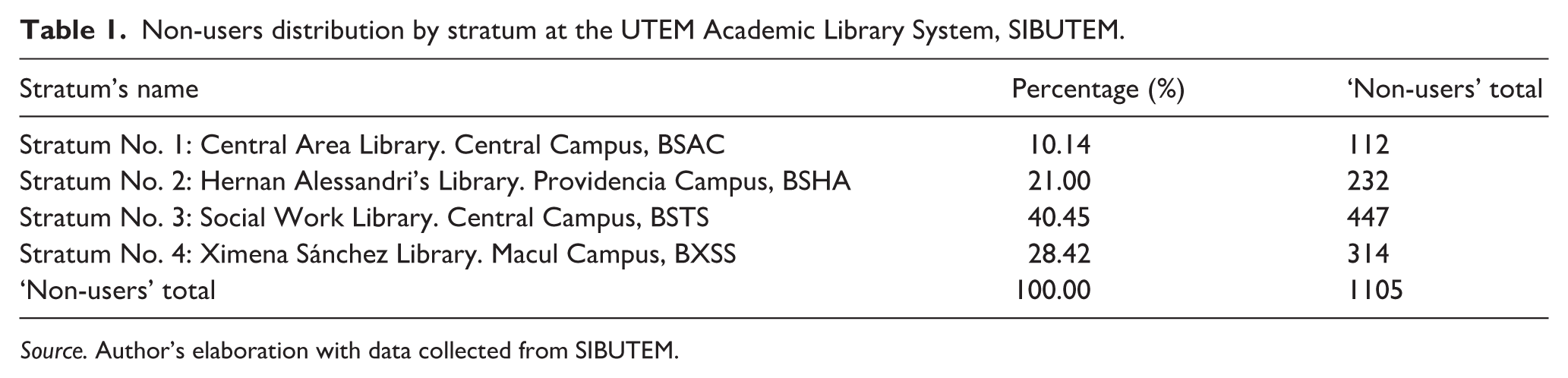
Source. Author’s elaboration with data collected from SIBUTEM.
A total of 1115 undergraduate students were identified as ‘non-users’ within the study population by the Library System, UTEM. The stratum corresponding to the Social Work Library exhibited the highest concentration of ‘non-users’ with a rate of 40.45%. Conversely, the Central Area Library stratum revealed the lowest rate of ‘non-users’ with 10.14%. Accordingly, the following procedure was applied used to organise the stratified probability sampling technique and ascertain the requisite minimum population sizes to ensure the representativeness and statistical validity of the research. The following elements are identified in this statistical procedure:
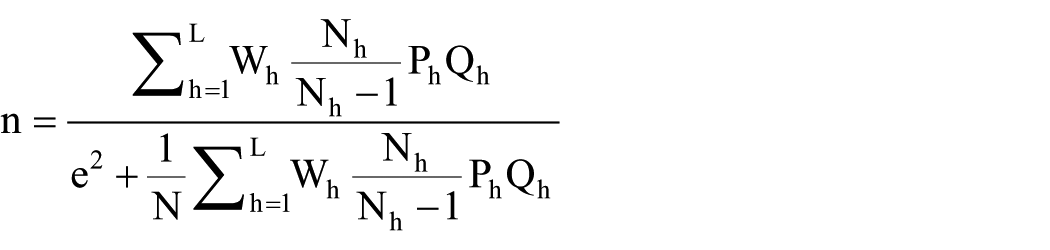
Source: Cochran (1971)
Wh: The weight of stratum h over the total population under study.
Nh: Total number of units in stratum h.
Ph: Probability of obtaining a positive response in stratum h.
Qh: Probability of not obtaining a positive response in stratum h.
e: Acceptable sampling error in the estimation of the indicators.
N: Size of the population.
In light of the adopted population sampling size procedure, and considering the size of the population of ‘non-users’ under study, the research adopted a margin of error of 3.5%, and a confidence level of 95%. In accordance with the established margin of error and the application of the stratified probability sampling technique (Cochran, 1971); (Hernández et al., 2014), the minimum size of the study population by stratum was as follows:
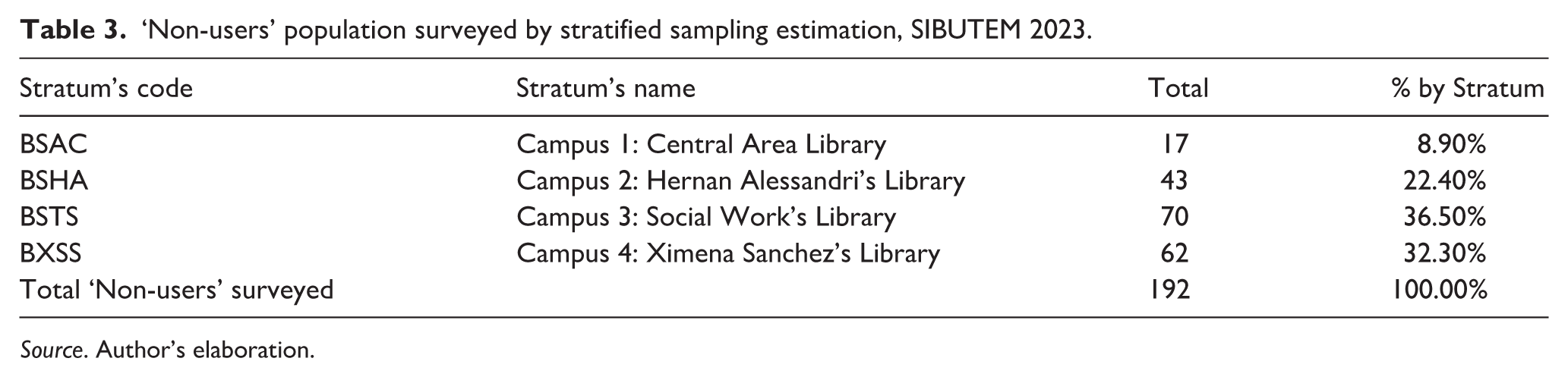
According to the applied statistical procedure, and Table 2 results, for a sampling error of 0.034, a minimum total of 137 ‘non-users’ of the UTEM academic library system, SIBUTEM are required to participate in the study, distributed across the four strata identified by the SIBUTEM. A total of 192 surveys were completed on 23 November 2023, exceeding the minimum required by 40%, as in shown in Table 3.
Minimum sample size by stratum, according to sampling error estimation.
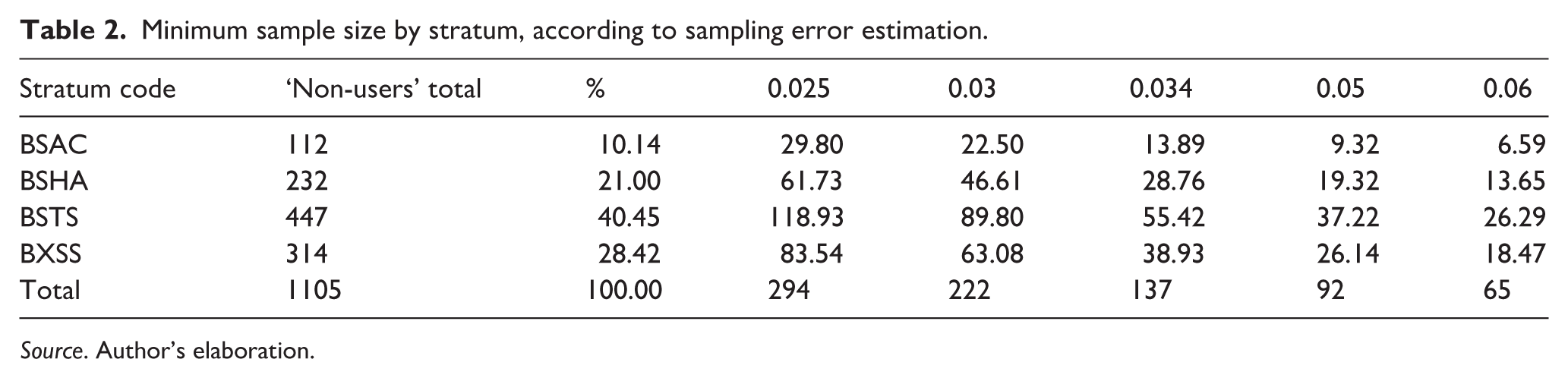
Source. Author’s elaboration.
‘Non-users’ population surveyed by stratified sampling estimation, SIBUTEM 2023.
Source. Author’s elaboration.
Research results
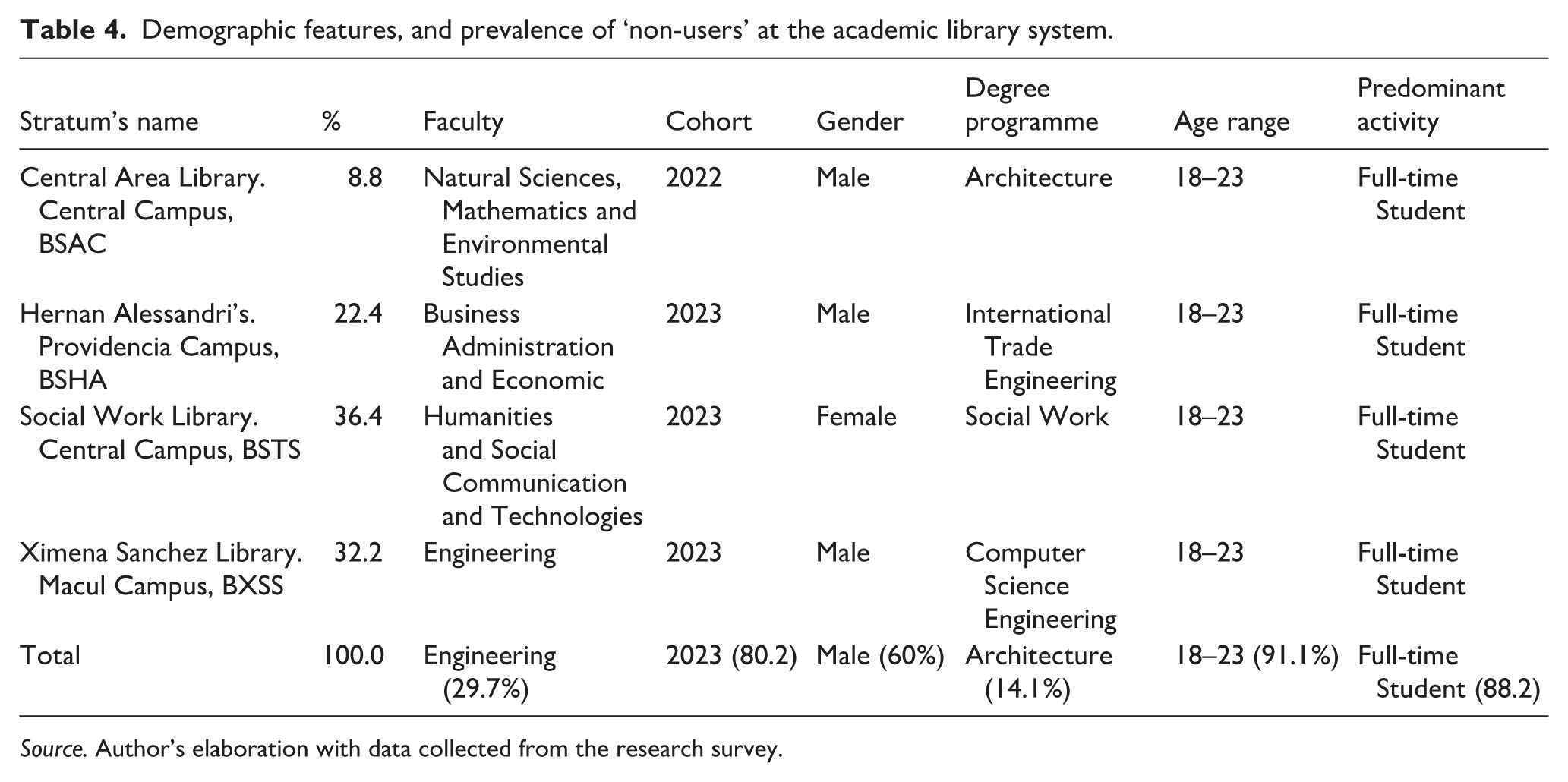
Regarding the description of the ‘non-users’ in terms of gender, origin, dedication and age range, it is concluded that these students are mainly young people, with a male majority in terms of sex, as well as gender identification. The predominant activity is studying, with a significant participation in sports activities. In terms of work, sporadic work is the most frequent, while a smaller number of ‘non-users’ do part-time or full-time work. The prevalence in terms of Faculty, undergraduate programme and admission cohort reveals that the distribution of ‘non-users’ is balanced between Faculties. This finding suggests that the ‘non-users’ phenomenon is not centred on specific academic areas but rather is observed as a cross-cutting phenomenon. As is shown in Table 4, with regard of ‘non-users’ distribution by degree programme, 66.1% of ‘non-users’ are concentrated in seven undergraduate programmes: Architecture, Social Work, Civil Engineering in Computer Science, Computer Science, Visual Communication Design, Computer Science Engineering, Library Science and Documentation and International Trade Engineering. The admission cohorts with the highest rate of ‘non-users’ correspond to the 2022–2023 entry cohorts, equivalent to the first 2 years of the undergraduate programme. This fact provides an indication that the UTEM academic library system can strengthen the dissemination and visibility of their libraries with emphasis on the first year’s entry cohorts. It is also an opportunity to reverse this behaviour, considering that undergraduate degrees have a duration of 5 years.
Demographic features, and prevalence of ‘non-users’ at the academic library system.
Source. Author’s elaboration with data collected from the research survey.
Underlying factors that influence the ‘non-users’ motivation in relation to the utilisation of the UTEM academic library system
Reasons for student’s non-use of the UTEM academic library system, can be divided into two sub-categories. The first concerns (i) personal reasons for not using the library, namely how personal interests and needs negatively affect library use. The second concerns (ii) external reasons to personal motivation, which identify students’ non-use with reasons associated with aspects of library management.
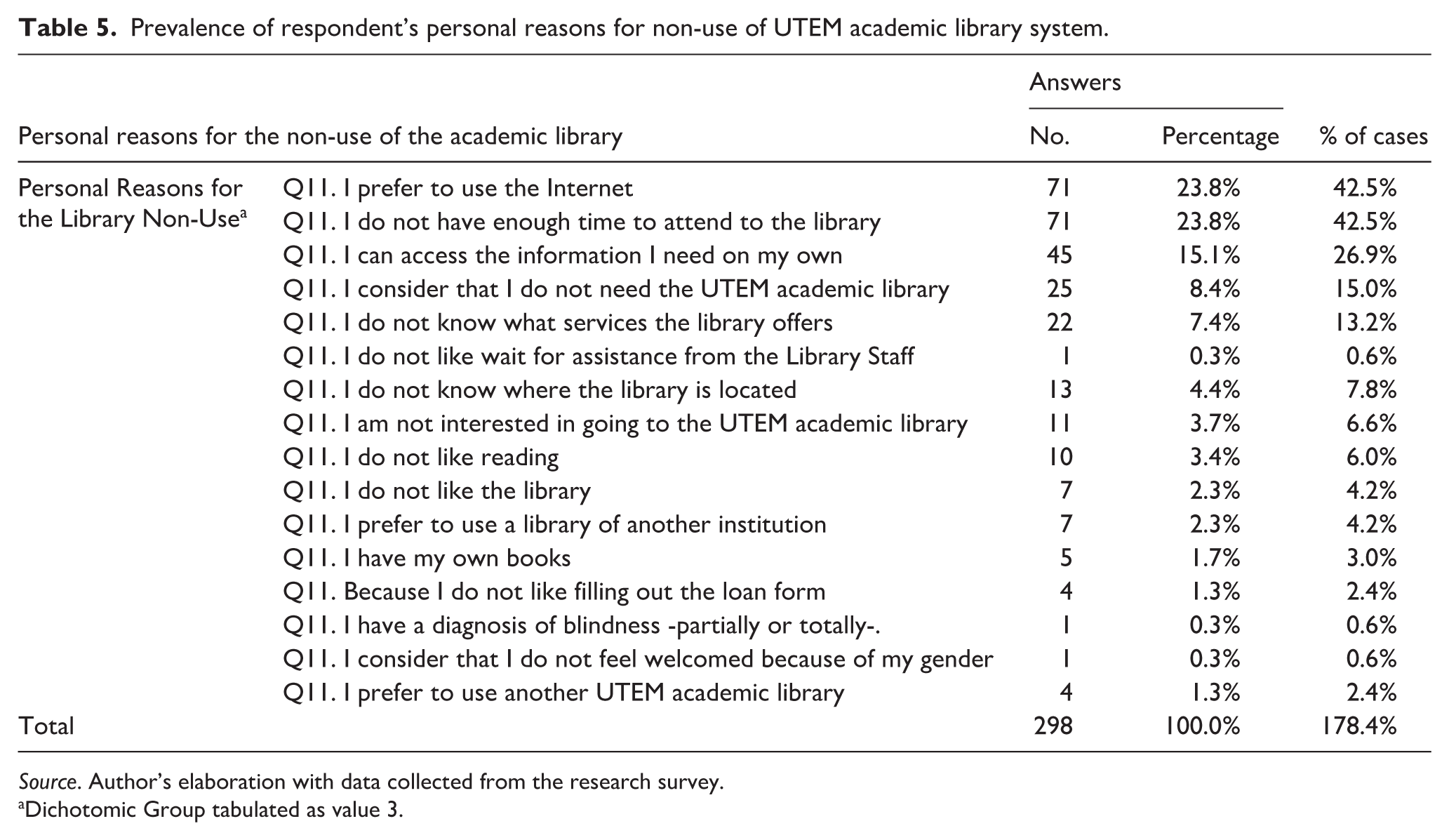
Regarding the underlying causes, foundations or personal factors that originate the existence of ‘non-users’ of the UTEM, academic library system, results revealed that there is not a single factor for which to attribute reasons of causality or occurrence of the phenomenon, but rather, a set of factors that determine the non-use of the information services at the UTEM academic library system. The most frequent cited reasons for ‘non-use’ the examined academic library system include: ‘I don’t have enough time’ −45.5%−, ‘I prefer to use the internet’ −45.5%−, ‘I can access the information I need on my own’ −26.9%−. These three factors, suggests that the same problem reported in the examined mainstream literature on ‘non-users’ is replicated for the Chilean case. ‘Non-users’ are undergraduate students with a high level of autonomy in their relationship with the use of technological tools, accessing them with the belief they do not require the information resources and services provided by an academic library. With regard to personal reasons, for Non-Use of UTEM academic library system, the research results demonstrate that none of the options under evaluation extracted from the literature review, and presented to ‘non-users’, managed to obtain percentage of cases over 50%of respondents’ preferences. The reasons for non-use might refer a potential autonomy in the search for information, among of the ‘non-users’ whereby they opt for the convenience of speed and time saving that technological alternatives offer in comparison to traditional library resources. Additionally, personal reasons for not utilising the library are associated with a lack of awareness about its existence, and the services it offers. This is evidenced by the responses ‘I do not know what services it offers’, ‘I do not know where it is located’ and ‘I do not think I need it’, which achieved 36% of the total cases. Furthermore, positive aspects are evident with regard to factors of integration, diversity and accessibility. This is evidenced by the fact that 0.3% of students respond that they did not use the academic library system because they ‘have a diagnosis of partial or total blindness’, or because they ‘consider that I do not feel welcome because of my gender’, or because they ‘do not like waiting to be attended by a Library Staff. These preferences are consistent with those reported in the literature review, where ‘non-users’ are featured as people with a high level of autonomy in the completion of tasks, and with preference for using their own technological tools over the available information resources and services of an academic library (Frank and Bothmann, 2008; Luo and Buer, 2015; O’Dell and Preston, 2013; Sbaffi and Rowley, 2015; Toner, 2008; Turtle, 2005). This evidence, therefore, may suggest that SIBUTEM ‘non-users’ are undergraduate students who demonstrate a certain level of independence with respect to information access and might consequently, develop and maintain different ways of attaining their information needs compared to other generations (Table 5).
Prevalence of respondent’s personal reasons for non-use of UTEM academic library system.
Source. Author’s elaboration with data collected from the research survey.
Dichotomic Group tabulated as value 3.
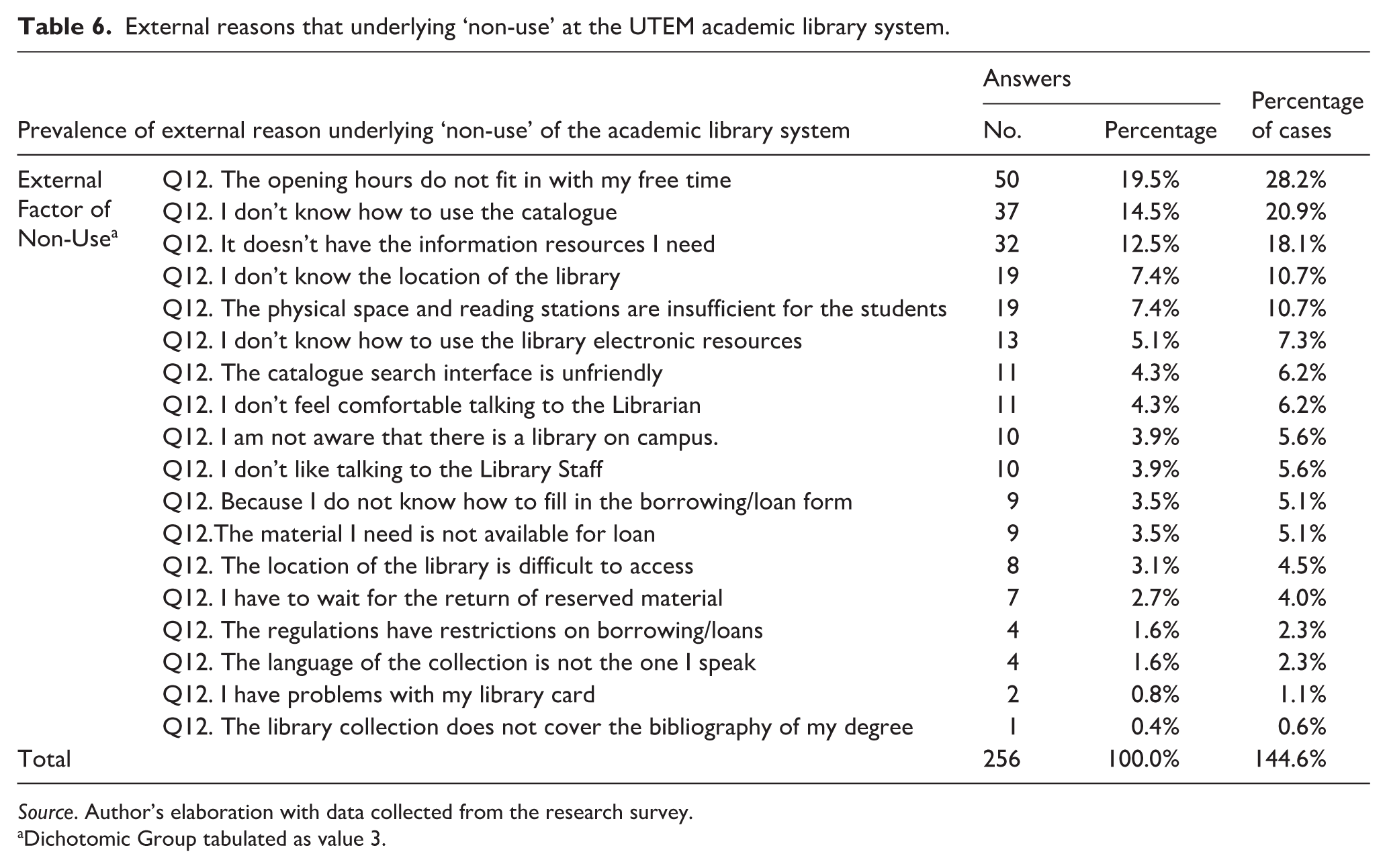
The external factors that contribute to the non-use of the academic library services by undergraduate ‘non-users’ students, can be attributed to a variety of factors that influence this behaviour. Consequently, the prevalence of these responses, are oriented towards library management issues. Similarly, with regard to promotion of the library, responses such as: ‘I do not know that there is a library on campus’ and ‘I do not know the location of the library’ account for 16.3% of the given options. Additionally, 11.8% of the respondents replied that they ‘don’t feel comfortable talking to the librarian’, and they ‘don’t like talking to the people who attend’, which is possibly a problem related to library user services management. Consequently, there are options that refer to a questioning of the library’s policies and/or regulations, since alternatives such as: ‘the material I need is not available for loan’, ‘I have to wait for the return of reserved material’, ‘the regulations have restrictions on lending’, and ‘I have problems with my library card’, which collectively account for 12.5% of the responses. Additionally, 4.5% of respondents selected the option ‘the location of the library is difficult to access’. This would mean that the library’s accessibility is a challenging issue in the library management. It is also important to note that options such as: ‘I do not know how to use the catalogue’, ‘I do not know how to use the electronic resources’, ‘the catalogue search interface is not user-friendly’, and ‘I do not know how to fill in the loan form’ account for 39.5% of the external reasons for non-use the academic library system. These findings highlight a challenge for training of information literacy, IL, to the academic libraries system at UTEM. Finally, options such as: ‘it does not have the material I need’, ‘the physical space and reading stations are insufficient for students’, ‘the language of the collection is not the one I speak’, and ‘the library collection does not cover the bibliography of my degree’, concentrate 31.7% of the percentage of responses, demonstrating an incidence of non-use of the library associated to access and availability of information resources, and bibliographic collections of the UTEM academic library system (Table 6).
External reasons that underlying ‘non-use’ at the UTEM academic library system.
Source. Author’s elaboration with data collected from the research survey.
Dichotomic Group tabulated as value 3.
Academic Library System’s strategies to attract ‘non-users’ undergraduate students at the Metropolitan Technological University of Chile
Regarding the measures that the Metropolitan Technological University Library System has taken with respect to the ‘non-users’ undergraduate students, the provided responses by the SIBUTEM librarians suggest that a variety of initiatives have been implemented with the aim of attracting undergraduate students, who have been defined as ‘non-Users’. These initiatives cover a number of areas including cultural management, information literacy, infrastructure and information dissemination. These initiatives reflect a comprehensive approach to encourage participation and use of the information resources and information services. Nevertheless, 13.7% of undergraduate students are ‘non-users’ of the UTEM academic library system which is a fact that demands attention from academic libraries.
Research hypothesis validation
The Null hypothesis, Ho, is validated, as the prevalence of ‘non-users’ of the UTEM academic library system, SIBUTEM, is not concentrated mainly in the Faculty of Engineering and ‘non-users’ are not considered by librarians in proposals regarding SIBUTEM information services. The concentration or distribution of ‘non-users’ by faculty is similar across faculties, thus precluding the attribution of an absolute majority to the Faculty of Engineering. Conversely, the interviewed librarians specify that they consider ‘non-user’ students in the design of library services, but they did not refer to the development of studies or specific measures to address this issue (Table 7).
Specific measures reported by the SIBUTEM’s librarians.
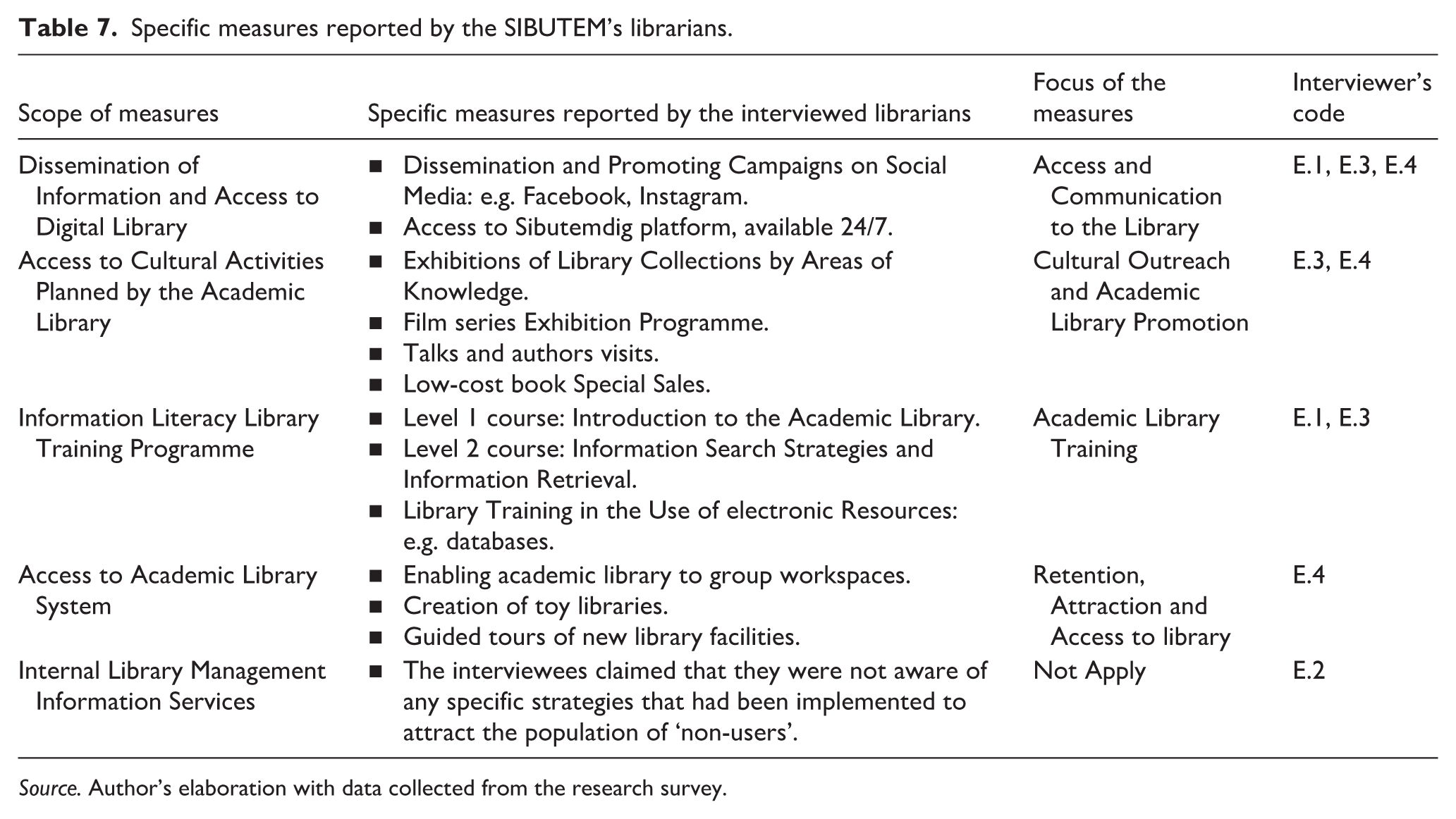
Source. Author’s elaboration with data collected from the research survey.
Conclusions
In addressing the research problem on features and proposals on ‘non-users’ in academic libraries, as reported in mainstream literature, and its application to the case study at The Metropolitan Technological University Library System, it can be concluded that, according to the existing and examined bibliography, there is a gap in the number and level of research for studies on ‘non-users’ that is asymmetrical with regard to the scientific production conducted and devoted to library use and its users for different types of libraries, in the field of the Library and Information Science, LIS.
It is also concluded that, with regard to the profile of ‘non-users’ in the examined case study, they are undergraduate young people students, mostly digital natives, with technological skills and autonomy. It is also concluded that, in contrast to the conventional barriers to physical access to the academic libraries, the fundamental and predominant factor for non-use is the preference for the Internet as primary and principal source of access to information. Despite assertions or statements by ‘non-users’ that their predominant activity is focused to their studies, it is concluded that even when they are aware of the existence of the library system, SIBUTEM, students fulfil their academic requirements predominantly by using resources such as the Internet, ignoring, unseeing and remaining unnoticed about the benefits that the library brings to their studies. This reluctance to utilise the academic library is attributed to personal reasons such as:(i) a lack of time, and (ii) a preference for digital resources which lead undergraduate students to prefer autonomous and individual study methods rather than group study methods, where the academic library is perceived as being at a disadvantage compared to the abundance of electronic resources available on the Internet. Consequently, it can be concluded that these results are consistent with those reported by the examined mainstream literature (Frank and Bothmann, 2008; Luo and Buer, 2015; O’Dell and Preston, 2013; Sbaffi and Rowley, 2015; Toner, 2008; Turtle, 2005). These studies confirm that ‘non-users’ are portrayed or described by a conviction or self-perception of operational self-sufficiency, which leads them to prefer their own technological tools over library services. In conclusion, SIBUTEM ‘non-users’ also respond to this pattern, and have developed ways of using, interacting, and involvement to information that are structurally different from those of previous generations.
From a practical and library management perspective, it can be concluded that there is a gap between the available knowledge about ‘non-users’, and the articulation of such knowledge in the academic library information service policies. This discrepancy between SIBUTEM’s institutional strategies, and the behaviour and information need of ‘non-users’; suggests that the measures stated by the interviewed Librarians; are focused on improving the users in-person experience, such as common spaces or open access to the shelves, and the training of active users who attend the library; rather than implementing strategies to attract ‘non-users’, who prefer to have access to information in virtual environments. In this sense, it is concluded that, although this study is situated in an academic library Chilean context, the results have implications for the management of university libraries. The phenomenon of ‘non-users’, suggest the need to move from a passive library model, which relies on waits for students visiting, to a proactive academic library model. In this regard, it is concluded that academic library policies must be reoriented to intervene in the digital spaces where ‘non-user’ students reside, with the aim of designing and implementing access to information strategies, strategies for information literacy, and empathetic marketing approaches; preferably in the first 2 years of their degree programme. This is due to the fact that the time during which the user’s autonomy consolidation occurs in the early years of the undergraduate studies. Consequently, academic libraries and Librarians face the challenge of not only attracting students to the library building, but also of integrating the information library services into their students’ everyday digital study environment.
Discussion and implications
A comparison of the results of this study on the ‘non-users’ phenomenon in libraries with those reported in the reviewed and examined literature; reveals that the use of technological tools, which provide autonomy and a perception of informational self-sufficiency in undergraduate students, are causal factors for the occurrence of the phenomenon of ‘non-use’ of academic libraries. (O’Dell and Preston, 2013; Sbaffi and Rowley, 2015; Toner, 2008; Turtle, 2005). In the case of SIBUTEM, the finding that the prevalence of non-users is concentrated at 97.4% in the first- and second-year cohorts, with an average age of 22.7 years, could suggest the existence of a pattern of autonomy that coincides with the transformations in information behaviour of younger generations. The practical implications for academic libraries, the directors of these services, and librarians would be twofold. Firstly, there is a necessity to become truly aware of the advance, progression, and growth of the problem of non-use. Secondly, it is essential to consider it a marginal or isolated phenomenon. In order to address the issue, strategies must be developed to Foster et al., (2023) the ‘non-users’ involvement, transforming them into active participants in the academic library services.
In light of the study’s findings, and the examined literature, it is clear that there is a need to discuss on the plethora of guidelines and strategies that have been documented in the mainstream literature for the purpose of attracting ‘non-users’. For academic libraries, library managers, and librarians, the practical implication is to make strategic decisions about which approaches should be evaluated for attracting and engaging ‘non-users’ with the library in terms of cost-benefit and effectiveness. This strategy should be planned as an ongoing process or at very least remain in place for the duration of an undergraduate programme. The examined literature proposes the concept of empathetic marketing in academic libraries as an innovative approach that seeks to gain a deep understanding of the emotions, needs, motivations and difficulties of users and non-users in order to design information services that truly meet their expectations (Del Bosque et al., 2017; Foster et al., 2023; Girton, 2018; Toner, 2008). In this regard, SIBUTEM should implement campaigns segmented by undergraduate programmes, recognising the disciplinary differences and educational stages of each group. Consequently, targeted campaigns should be developed to train undergraduate students, valuing their technical skills and autonomy in searching for information access, but clearly highlighting the specific benefits that the library can offer them to contribute to their academic success. Consequently, the promotion and dissemination of library and information services has been identified and emerges as a key priority or convergent strategy in the results of this study, and the examination of proposals put forward by the examined authors (Flowers, 1995; Foster et al., 2023; Frank and Bothmann, 2008; Toner, 2008). If successful experiences for academic libraries on dissemination among the ‘non-user’ undergraduate student have been reported in the examined literature, the practical implication for academic libraries, library managers and the librarians of SIBUTEM would be to direct efforts towards positioning the library as a key information resource that ‘non-users’ can access both physically and virtually. Consequently, the propagation and advancement of information services promotion, underpinned by the utilisation of the ICT’s basis, constitutes another alternative line of development to the implementation of initiatives and the integration of non-user’s experiences for induction, training in database usage, electronic resources, and digital tools for information retrieval and access.
With regard to the direction of future research on the phenomenon of ‘non-users’, and based on the results of this study it is proposed that two lines of research can be explored in greater depth by academic libraries, the directors of these services and librarians, in order to gain a more profound understanding of ‘non-user’s undergraduate students. The primary research strand concentrates on the development of longitudinal studies for monitoring student’s advancement from the point of their enrolment to ascertain whether those who do not use the library in their initial year subsequently become users at subsequent stages. The second research line focuses on the development of ‘non-users’ studies that consider the implementation of targeted campaigns or strategies with personalised messages aimed at students who do not use or attend the library. The intervention would be planned for a limited period among groups of ‘non-users’ library who did and did not receive the intended strategy, with the aim of subsequently comparing the increase or decrease in the levels of the library information services use, as well as the increase in participation, perception of value and reduction in the number of ‘non-users’ of the library.
Footnotes
Acknowledgements
We would like to express our gratitude to Mr. Carlos Mallea Garrido, Director of the Metropolitan Technological University’s Library System, SIBUTEM and to the General Directorate for Analysis and Institutional Development − DGAI. In addition, our gratitude is extended to the SIBUTEM librarians who consented to participate in the interview, and to the undergraduate students who completed the survey.

Ethical considerations
The research protocol and data collection instruments were reviewed and approved by the Information Management Department Director at the Metropolitan Technological University, UTEM. institutional data on ‘non-user’ undergraduate students was provided by the University’s Library System Director. The Directorate of Institutional Management and Analysis − DGAI-UTEM −, provided collaboration and technical support for the administration of the survey. In consideration of the nature of this study and in accordance with the prevailing institutional guidelines, the relevant administrative authorities have formally sanctioned the research procedure, thereby exempting it from the necessity of undergoing review by an independent ethics committee.
Consent to participate
Written informed consent was obtained from all participants, including both undergraduate students and Librarians from the Metropolitan Technological University’s Library System − SIBUTEM. This process was carried out prior to the starting of data collection process, thereby ensuring voluntary participation and strict adherence and observance to the principles of data confidentiality and anonymity. Furthermore, participants consented to the dissemination of the research results to the SIBUTEM Director, and their subsequent publication.
Funding
The authors received no financial support for the research, authorship, and/or publication of this article.
Declaration of conflicting interests
The authors declared no potential conflicts of interest with respect to the research, authorship, and/or publication of this article.
Data availability statement
The quantitative and qualitative data generated and analysed during this study are not publicly available due to the sensitive nature of the respondent’s data, and the need to protect participant’s confidentiality. Data may be available from the authors upon reasonable request and subject to ethical approval.*