






Abstract
Diversity as it relates to discrimination, race and ethnicity is experiencing challenges in today’s society, and the terms “ally” and “accomplice” are used as part of the broader conversation about how society supports social justice for diversity, equity, and inclusion (DEI). People are comfortable being an ally, supporting marginalized people without getting too involved or experiencing any trouble with their own life or profession, but less comfortable being an accomplice, fighting against injustices even though their life and profession may be at stake. To better understand how librarians and information professionals perceive allies and accomplices, this research study explored the mental models of librarians as it relates to allies and accomplices as part of a larger study that looked at librarian experiences with microaggression, discrimination, racism, and tools/strategies that can help librarians with daily challenges. Using a mixed-methods approach that included a survey and semi-structured interviews conducted via Zoom with participants across the United States and internationally, the study gathered insights from librarians and information professionals about their perceptions and experiences with allies and accomplices. Thematic analysis was used to analyze qualitative data and the major finding was 10 mental models of allies and accomplices. Mental models provide a framework to investigate librarians and information professionals’ understanding of allies and accomplices. The research also highlighted the role of microaggression in the daily life of librarians and information professionals, and the need for tools and strategies to help librarians and information professionals deal with the daily challenges.
Introduction
Diversity—particularly as it relates to discrimination, race, and ethnicity—is facing increasing challenges in today’s society. In a climate where diversity, equity, and inclusion (DEI) initiatives are increasingly contested, high-profile actions have underscored the vulnerability of equity-focused leadership. For example, Carla Hayden, the first Black Librarian of Congress, was fired through a two-sentence email (Peet, 2025), a move widely viewed as emblematic of broader resistance to DEI efforts. Within this context, the terms ally and accomplice have become central to ongoing conversations about how individuals and institutions meaningfully support social justice.
Brown and Ostrove (2013) describe allyship as a process in which individuals from dominant groups engage in ongoing self-reflection and action to challenge systems of privilege, though such efforts may still be constrained by power dynamics and unexamined bias. Gomberg-Muñoz (2018) similarly critiques superficial or performative allyship, arguing that solidarity requires sustained commitment and a willingness to disrupt inequitable structures. While many people are comfortable identifying as allies, offering support to marginalized individuals without becoming deeply involved or risking personal or professional consequences, fewer are willing to act as accomplices, who actively confront injustice even when doing so may place their careers, reputations, or personal safety at risk. At the same time, the term accomplice itself raises concerns due to its association with criminality, potential professional repercussions, and fears of overstepping boundaries within communities one does not belong to. Together, these tensions highlight the complexity of moving from symbolic support to substantive action in advancing equity and resisting systemic inequities.
Librarians are great allies to marginalized people, but in librarianship, the need for accomplices is greater. Marginalized people in these professions need more than allies to fight against the daily injustices, microaggressions and racism that they experience. They need accomplices who are willing to fight with them and be an active partner/co-conspirator in the fight against injustices even if it means a threat to their own livelihood (Jones, 2021). To better understand how librarians and information professionals perceive allies and accomplices, this research study explored the mental models of librarians as it relates to allies and accomplices as part of a larger study that also looked at librarian experiences with microaggression, racism, and tools/strategies that can help librarians with daily challenges. This research study focused on librarians’ mental models of allies and accomplices and was guided by the following research questions (RQ):
What is the perception/mental models of an ally and an accomplice by librarians?
How can librarians shift from being allies to becoming accomplices?
What tools and strategies can librarians use daily to help in the fight against microaggression?
Research into librarians’ mental models of allies and accomplices contributes to the field by providing a better understanding of how librarians perceive and address challenges stemming from inequities, and the tools needed to address those challenges.
Literature review
Librarianship plays a critical role in addressing systemic inequities and advancing diversity, inclusion, and social justice. This literature review examines key concepts shaping this work, including mental models, allyship and accompliceship, microaggressions, and equity. Mental models influence how library professionals design systems and make decisions, while the distinction between allies and accomplices highlights differing levels of engagement in challenging injustice—particularly in a profession historically grounded in neutrality. The literature also examines the impact of microaggressions and underscores libraries’ responsibility to promote equity through inclusive practices, leadership representation, and services for diverse communities.
Mental models
Understanding mental models—cognitive frameworks that influence how individuals perceive and interact with the world—can improve librarianship, decision-making processes in libraries, and library systems. In Kenneth Craik’s The Nature of Explanation (1943), he described the concept of a mental model (“small-scale model”) as an internal representation of the external world. Although there have been multiple definitions of mental models since, Craik’s definition has endured to be a core understanding of a mental model. The actual term, “mental model” was coined by psychologist Philip Johnson-Laird who suggested that people create mental models of a phenomenon that they can use to interact with the world (Johnson-Laird, 1983; Staggers and Norcio, 1993). Donald Norman (1983) introduced mental models to human-Computer Interaction (HCI) to describe a user’s internal representation of an external information system. This led to the use of mental models in user experience and the design of interactive systems. The user’s mental model provides a method for understanding the user’s approach to the interactive system and how best to design a system based on the model. Norman identified six observations about mental models, suggesting that mental models are incomplete, unstable, lack firm boundaries, unscientific, parsimonious, and people have limited ability to run their models (Norman, 1983). These observations have been used to help when defining mental models and what can be expected of a mental model. A recent scoping review by Hu and Twidale (2023) looked at the history of mental models and an overview of the current literature in HCI through the analysis of 70 studies published from 2010 to 2021. The authors found that there were still challenges in the use of the term mental models across the domain due to a lack of consistency in defining the term. According to Hu and Twidale (2023: p. 113), “26 (38%) publications used this term on an intuitive basis without defining it.” Of those that defined the term, some used simple definitions while others provided detailed explanations of the use of the term mental models. Although the focus of the article was on mental models in the HCI domain, the use of the term “mental model” has grown in recent years and multiple variations appear across disciplines and in practice (Hu and Twidale, 2023; Weinberg and McCann, 2019; Young, 2008). There is limited use of mental models in research on librarianship as it relates to the work of librarians, particularly an understanding of librarians’ perspectives of a given concept or phenomenon in librarianship. Much of the research has focused on mental models as it relates to the use of digital information systems (Maceli, 2019; Thomas et al., 2020). However, mental models do not need to be limited to digital information systems but can be used to understand information systems more broadly, general concepts in the world, and how people use those models to make decisions. The library as information system draws on digital and physical systems to support users’ access to information and mental models of libraries can augment the understanding of libraries and librarians (Desmarchelier et al., 2025). There is little research in this area as it relates to librarianship and specifically, an understanding of diversity, equity, and inclusion.
The definition of mental models used in this study draws from the core definition of an internal representation of the external world. Beyond the simple definition, a mental model represents the user’s knowledge, experience, and understanding of a concept and how it is used within a given context in the world. Researchers have elicited mental models using multiple methods, including surveys, interviews, observations, tasks, and drawing (Hu and Twidale, 2023; Naughton and Agosto, 2012). Although mental models can be unstable and incomplete, they provide an understanding and perspective of the world and how the user make decisions about a particular concept.
Because mental models exist inside the mind, it is difficult to know exactly what a person’s mental model is of a given phenomenon. However, mental models research elicits a user’s mental model, creates representations in the world, interrogates those models, and adjusts the models based on new information. By focusing on several aspects of mental models research, there can be a better understanding of a person’s mental model and how it is used to interact with the world and make decisions about systems. For this study, the focus is not on interrogating mental models or adjusting mental models, but rather on eliciting and creating representation of the mental models that people already hold and trying to understand what those representations mean. By creating representation of librarians’ mental models outside the mind, the mental models can provide a cognitive framework to understand how librarians use their models to make decisions and interact with systems and each other. Mental models of allies and accomplices in librarianship provides a framework where librarians’ mental models are identified and represented in the world, which makes it possible to interrogate and change those models according to the context and need of librarianship.
Allies and accomplices in librarianship
The concepts of allyship and accompliceship have significant implications for librarianship, particularly as the profession strives to address systemic inequities and support marginalized librarians and communities. These frameworks highlight different modes of engagement with social justice work: while allyship emphasizes advocacy, solidarity, and education, accompliceship foregrounds direct intervention, accountability, and risk-taking in dismantling systems of oppression. Examining how these concepts have been taken up within library and information science (LIS), scholarship provides a lens through which to evaluate both the possibilities and limitations of equity work in the profession.
Allyship in librarianship
Allyship in LIS is often framed as the work of individuals in positions of relative privilege who support marginalized colleagues and communities. Within library settings, this can manifest as advocating for diversity, equity, and inclusion (DEI) in collections, services, and institutional policies (Cooke, 2017). Allies engage in practices such as self-education, amplifying diverse voices in collections, and creating inclusive spaces for library users (Espinal et al., 2018). Such work can also involve acknowledging privilege, recognizing structural bias, and actively seeking to transform organizational cultures that perpetuate exclusion.
At the same time, allyship in librarianship has been critiqued for uneven implementation and frequent lack of depth. Hussey and DeCurtis (2022) observe that allyship remains inconsistently defined in LIS discourse, ranging from symbolic or performative gestures to more meaningful and sustained commitments to equity. Brook et al. (2015) similarly caution against superficial diversity initiatives that fail to address underlying power structures in libraries. Gomberg-Muñoz (2018) and Powell and Kelly (2017) expand this critique, noting that allyship, when reduced to rhetoric or symbolic action, risks reinforcing the very inequities it seeks to address by allowing privileged actors to “feel good” about minimal engagement without enacting substantive change. These critiques underscore the tension between allyship as a valuable entry point for individuals seeking to engage with equity work and its potential pitfalls when not coupled with sustained, systemic efforts.
Studies in librarianship have explored allyship across multiple dimensions, emphasizing its importance for both individual and systemic change. First, research highlights allyship’s role in supporting librarians of color, encompassing mentorship, sponsorship, and the development of inclusive workplace policies that address barriers to advancement and professional recognition (Hussey and DeCurtis, 2022; Kung et al., 2020; Magurany and Dill, 2022). These efforts provide tangible career support while fostering a sense of belonging and validation within institutions where librarians of color have historically been underrepresented. Second, allyship is examined in the context of community engagement, where librarians leverage their professional authority to advocate for underrepresented patrons, promote equitable access to information, and challenge systemic inequities in library services and programming (Kung et al., 2020). Through these practices, librarians act as facilitators and advocates for social justice in their communities. Third, scholars have investigated institutional strategies for formalizing allyship, including the implementation of DEI initiatives, training programs, and policy reforms that embed supportive practices into organizational culture (Bright, 2022; Cooke, 2017). Such approaches highlight the potential for allyship to move beyond individual acts of solidarity toward sustained structural change, reinforcing the profession’s commitment to equity and inclusion.
Accompliceship in librarianship
In contrast to allyship, accompliceship demands more radical and sustained engagement with systems of oppression. Rooted in activist traditions, accompliceship emphasizes risk-taking, accountability, and the deliberate disruption of inequitable institutional structures. Within librarianship, this approach moves beyond identifying or acknowledging injustice to actively challenging norms, policies, and procedures that perpetuate it. For instance, accomplices may confront bias in hiring and promotion practices, advocate for equitable allocation of resources, or resist organizational procedures that reinforce exclusionary practices (Honma, 2005).
A critical dimension of accompliceship in LIS involves intentionally building support structures for minority librarians. This can include mentoring and sponsoring librarians from underrepresented groups, advocating for equitable tenure and promotion processes, and creating inclusive leadership and committee opportunities. Accomplices may also work to ensure that professional development funds, conference opportunities, and research support are distributed fairly, addressing systemic barriers that limit career advancement. By actively dismantling these barriers, accompliceship fosters a profession where minority librarians can thrive.
Unlike symbolic gestures of support, accompliceship requires concrete action and a willingness to confront discomfort. As Suyemoto et al. (2021) observe, accompliceship is characterized by prioritizing justice over personal comfort, taking responsibility for contributing to harm, and engaging in long-term collective struggle. In LIS, this can mean leveraging positional authority to contest policies and practices that marginalize staff or community members while remaining accountable to those most directly affected (Hudson, 2017). By centering the perspectives, needs, and priorities of marginalized librarians and communities, accompliceship reframes professional responsibility: it shifts the focus from individual advocacy toward structural transformation, challenging the frameworks that produce and sustain inequity within the profession.
Microaggressions
The term “microaggression” was introduced in 1970 by Chester Pierce, a professor at Harvard, to describe subtle and often indirect expressions of racism that were increasingly prevalent (Alabi, 2015; Sue et al., 2007). Torino et al.’s (2018) taxonomy of microaggressions—categorizing them into micro assaults, microinsults, and microinvalidations—serves as a foundational framework for understanding these dynamics. A micro assault is a deliberate verbal, non-verbal, or environmental action aimed at expressing discriminatory or biased sentiments; microinsults are unintentional behaviors or verbal remarks that convey rudeness, insensitivity, or demeaning attitudes toward a person’s racial heritage, gender identity, religion, ability, or sexual orientation; microinvalidations are verbal remarks or behaviors that undermine, dismiss, or exclude the psychological thoughts, feelings, or lived experiences of the targeted group (Sue et al., 2007; Torino et al., 2018).
Microaggressions in LIS often manifest in subtle yet pervasive ways, reflecting biases related to race, gender, professional status, and intersecting identities. For example, librarians of color frequently report being mistaken for custodial staff or having their qualifications questioned, exposing implicit biases about competence and professional roles (Alabi, 2015; Cooke and Sweeney, 2019; Sweeney and Cooke, 2018). Female librarians often encounter stereotypes tied to caregiving roles or are subjected to infantilizing language, such as being called “sweetie” or “honey,” which undermines their professionalism (Bourg, 2018). Early-career librarians and those in paraprofessional roles may face dismissive attitudes or condescension from senior staff, devaluing their contributions and reinforcing hierarchical inequities (Garnar, 2021). Additionally, librarians with multiple marginalized identities, such as women of color or LGBTQ+ individuals, often experience compounded microaggressions that reflect intersecting systems of bias (Cooke and Sweeney, 2019). These dynamics underscore the need for greater awareness, structural change, and proactive efforts to foster equity and inclusion within the LIS field.
The impact of microaggressions on librarians is multifaceted, significantly influencing mental health, job satisfaction, and career advancement. Persistent exposure to microaggressions often leads to stress, burnout, and feelings of alienation, creating an emotional toll that undermines overall well-being (Alabi, 2015). These experiences can also significantly impact careers, undermining professional confidence and limiting access to networking, mentorship, and promotion opportunities (Cooke and Sweeney, 2019). Moreover, when microaggressions go unchecked, they contribute to toxic workplace cultures, hindering efforts to promote diversity, equity, and inclusion within organizations (Garnar, 2021). This highlights the importance of accomplices who actively recognize, interrupt, and respond to microaggressions to foster more supportive and equitable environments within the library and information science field (Cooke and Sánchez, 2019).
Equity
It is important to emphasize the necessity of intentional, systemic efforts to foster equity within the field of librarianship. Recommended strategies include pipeline programs, such as scholarships, internships, and outreach initiatives, which aim to diversify the librarian workforce (Bright, 2022). Additionally, inclusive leadership training is essential, offering development programs that emphasize equity and inclusion for librarians from underrepresented groups (Kang et al., 2025). Policy reforms are also crucial, with an emphasis on implementing equitable hiring practices, transparent promotion criteria, and robust DEI frameworks to address systemic inequities (Brook et al., 2015). Furthermore, strengthening community engagement through partnerships with local organizations can help libraries better understand and meet the needs of diverse populations (Kung et al., 2020).
Despite longstanding efforts to increase diversity, the library profession remains predominantly white and female, with limited representation from underrepresented racial and ethnic groups. In their 2023 article, By any Measure, Hulbert and Kendrick report that the percentage of white librarians remained stable between 2017 and 2022 averaging nearly 86% of the profession (Kendrick and Hulbert, 2023). Scholars identify several factors contributing to this disparity. Pipeline challenges, such as limited recruitment efforts and barriers to entry—including the high cost of obtaining a Master of Library and Information Science (MLIS) degree—disproportionately affect underrepresented groups (Dupree and Boykin, 2021; Poole et al., 2021). Retention issues also play a significant role, as workplace cultures that fail to foster diversity and inclusion often lead to higher turnover rates among librarians from marginalized backgrounds (Alabi, 2015; Cooke and Sánchez, 2019; Dupree and Boykin, 2021). Additionally, implicit biases in hiring practices and professional networks frequently perpetuate homogeneity, disadvantaging candidates from diverse backgrounds (Acadia and Vogt, 2022; Brook et al., 2015; Dupree and Boykin, 2021). Addressing these systemic issues is critical to creating a more equitable and representative library profession.
Gaps in the literature
While LIS literature has advanced understanding of mental models, allyship, accompliceship, microaggressions, and equity, significant gaps remain. Research often focuses on individual behaviors or isolated DEI initiatives, offering limited empirical evidence on long-term impact, institutional change, or intersectional outcomes. Accompliceship, in particular, is underexplored, and few studies examine strategies for embedding equity-oriented practices within library structures or evaluating their effectiveness.
Microaggressions remain pervasive in library environments, highlighting the need for interventions that go beyond interpersonal interactions to address the organizational cultures and policies that enable exclusionary practices. Central to this challenge are mental models—the implicit assumptions and norms that shape decision-making, policy implementation, and professional identity. These cognitive frameworks often hinder equity efforts by reinforcing dominant perspectives and resisting transformative change.
Future scholarship should prioritize the lived experiences of marginalized librarians, critically examine the mental models that sustain inequities, and investigate how allyship and accompliceship can be leveraged to drive systemic change. Advancing the profession’s commitment to diversity, equity, and inclusion requires expanding the conceptual boundaries of allyship, embedding accompliceship in practice, and fostering structural conditions that support meaningful engagement. Such work is essential to cultivating a more just and inclusive vision of librarianship that upholds its foundational values of access, intellectual freedom, and social responsibility.
Methods
Using a mixed methods approach, this research study collected both quantitative and qualitative data. The study was approved and met the criteria for exemption by the Queens College’s Institution Review Board (IRB) on 02/20/2024 in the sentence.]. All participants provided consent to participate in the study. Survey respondents accepted the online consent prior to taking the survey. Interview participants signed and returned the consent document prior to the interview. Data collection included an online user survey and a semi-structured interview.
The inclusion criteria included participants that were 18 years and older, a librarian/information professional, working in any type of library (academic, public, special, etc.) and information organizations.
User survey
The online survey, organized into three sections, covered impressions, demographics, and follow-up questions. Ten questions in the impressions section collected data about participants’ perception and mental models of ally and accomplice. The demographics section collected information on participants’ organization, age range, sex and gender, and race/ethnicity. The final section asked participants if they wanted to be interviewed, and if so, participants provided contact information, which was used to schedule interviews.
Beginning March 13, 2024, the researchers recruited librarians and information professionals using email, social media, and professional networks. Emails and social media communication were sent to the State University of New York Librarians Association, City University of New York Librarians Association, Library Think Tank social media group, we here, social media group, and Black Caucus of American Library Association. Due to few responses to the initial recruitment, a second recruitment email was sent out with an extended timeframe for responses. The researchers decided to keep the survey open throughout the Spring, Summer, and into the Fall 2024 semesters so that interview participants recruited directly at conferences and presentations can take the survey. Participants recruited at conferences agreed to fill out the survey prior to their interview. The survey closed on October 17, 2024.
User interview
The user interviews were semi-structured, which allowed the researchers to ask the same questions of each interview participant but provided flexibility for follow-up questions based on the participants’ responses. This allowed the researchers to get to the core of what participants wanted to express. The researchers recruited interview participants via the survey and direct solicitation. All interview participants took the survey, making them a subset of all survey respondents. By interviewing a subset of the survey respondents, the researchers were able to get more detail regarding the experiences identified in the survey and discussed in the semi-structured interview.
The researchers interviewed 30 participants between March 2024 and October 2024. All interviews were scheduled for 60 minutes and conducted using Zoom, an online communication tool, which allowed participants to be anywhere with an internet connection. Most individual interviews lasted between 30 and 60 minutes depending on the participant, with three exceptions: the shortest interview was 29 minutes, and two longest interviews were 64 minutes. Participants that completed the interviews received a $50 Amazon gift card as a thank you for their time and participation in the study.
The interview included two parts: Part I was a scenario activity about a librarian’s interaction with a patron; and Part II was the semi-structured interview that asked participants about their experiences with allies, accomplices, discrimination, microaggression, and racism. Based on the interview, data collected in Part II helped to generate mental models and the role of microaggression, which includes an understanding of the participants’ experiences with allies, accomplices, and microaggression. The researchers excluded data dealing with other aspects of the research that did not address these issues, such as the scenario in Part I and discrimination and racism in Part II.
Mental models extraction
Extracting mental models requires drawing the user’s model from inside the mind and representing it in the world. The survey and interview elicited participants’ mental models of allies and accomplices, but most importantly it included a “trigger” that activated the participant’s mental model for observation and documentation. Mental models are triggered by an interaction with the world and can be as simple as a word or phrase, question, image, activity, etc. For this study, the trigger included questions that asked participants to describe their perspectives on allies and accomplices in multiple ways.
Please describe your thoughts/ideas when you hear the word “Accomplice.”
Please describe your thoughts/ideas when you hear the word “Ally.”
Do you consider yourself an ally or an accomplice? If either, neither, nor both, then why?
a. Have you experienced where someone was an ally or an accomplice to you? b. If you only could select one or the other, which would you choose?
The trigger activated the mental model of allies and accomplices and participants referred to their perspectives on allies and accomplices throughout the interview. The triggers helped to elicit multiple aspects of the mental model.
Data analysis
Quantitative data from the survey used descriptive statistics for analysis. The qualitative survey data was imported into NVIVO, qualitative data analysis software, for analysis. Data collected from the interview included video and audio recording of the interview. Microsoft Office 365 automatically transcribed the video once uploaded in the system and created a transcript document. The researchers manually processed the transcript document to remove unnecessary line breaks and adjust the transcript timestamp for import into NVIVO. Once imported into NVIVO, the researchers manually checked the transcript and video file to confirm that the timestamps and that the transcribed text matched the recorded video data.
Using thematic analysis (TA), the data were coded and analyzed using open coding methods (Saldaña, 2009; Wildemuth, 2009). The approach used to identify themes in the data and the mental models was reflexive TA (Braun and Clarke, 2006, 2021, 2022). According to Braun and Clarke (2021: p. 341), “Themes in reflexive TA are patterns of shared meaning, united by a central concept or idea.” Extracting mental models requires an iterative process of coding and theme generation. Each qualitative response was coded based on the data and as patterns were identified across the data. This process continued iteratively for all the data dealing with the topic and then the patterns were analyzed to determine if they provided a multi-dimensional view of a particular concept expressed by the participants in the study. Those concepts represented the mental models or view of the world from the participants’ perspectives.
Results
Survey respondents
Demographics
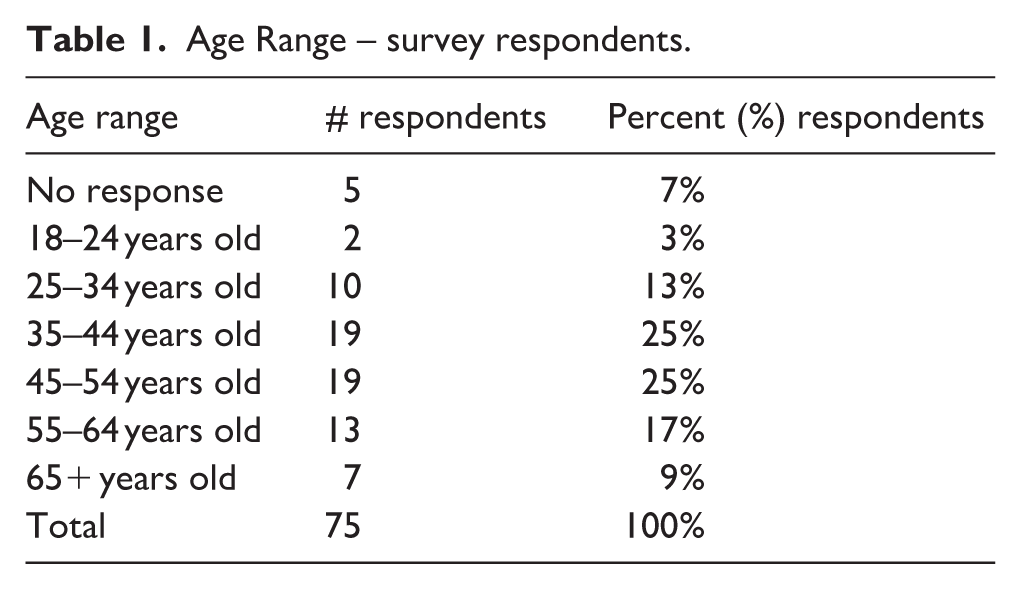
Of the 216 submitted responses, 70 were 100% complete and 5 were mostly (58%) complete, which provided a total of 75 usable survey responses with five being partially complete. The other 141 responses were incomplete (0% or 5%). The survey asked respondents about their demographics, including age range, sex, gender, and race/ethnicity. In terms of age range (see Table 1), 50% of respondents were within the range of 35 and 54 years old. There were only two respondents in the 18–24 years old age range.
Age Range – survey respondents.
For sex and gender, respondents identified their sex and gender in two questions so that they could share their own context regarding their representation in world. For sex, 45 respondents (60%) selected female, 19 (25%) selected male, one (1%) selected intersex, 5 (7%) selected prefer not to say, and 5 (7%) did not respond to the question. For gender, the question was an open text field to allow survey respondents to provide their own words to describe their gender. Twenty-one respondents (28%) did not respond to the question. Of those that responded to the question (72%), the responses varied, including “genderfluid,” “non-binary,” “woman,” “man,” “cisgender,” “polyamorous pansexual,” and a variety of other terms and combinations to describe gender identity. As such the participants in the study represented a diverse group in terms of sex and gender.
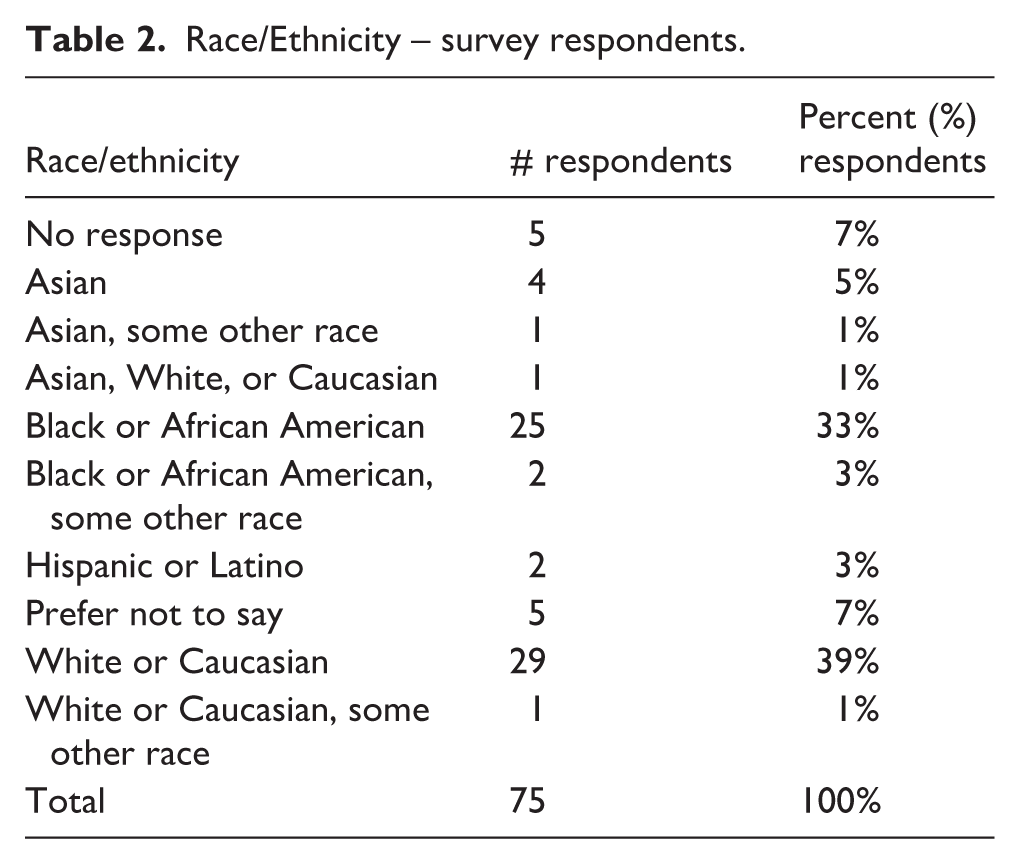
The race/ethnicity question was similar to the United States Census Bureau data question on race and ethnicity (United States Census Bureau, n.d.). Based on the survey, White or Caucasian (39%) and Black or African American (33%) were the top two respondents to the survey (see Table 2). Seven percent of participants did not respond to the question and of those that did respond, 7% selected “Prefer not to say” as a response to the question. Thus, 14% did not provide race/ethnicity information.
Race/Ethnicity – survey respondents.
First Impressions
The first impression is one way to get a quick sense of someone’s mental model of the world and what helps to guide their decision-making. The first two questions of the survey asked respondents about the first three words that come to mind when they hear the word “accomplice” or when they hear the word “ally.” Since these were the first two questions, the survey respondents could base their responses on their own experiences without influence from other questions in the survey. Respondents did not need to have prior experience with the terms “accomplice” or “ally” to respond to the question. Their responses provided a quick view of their immediate reactions and mental model of the terms as they experience it. Based on the answers, a word cloud was developed to show an overall model of respondents first impressions (Figure 1; Table 3)
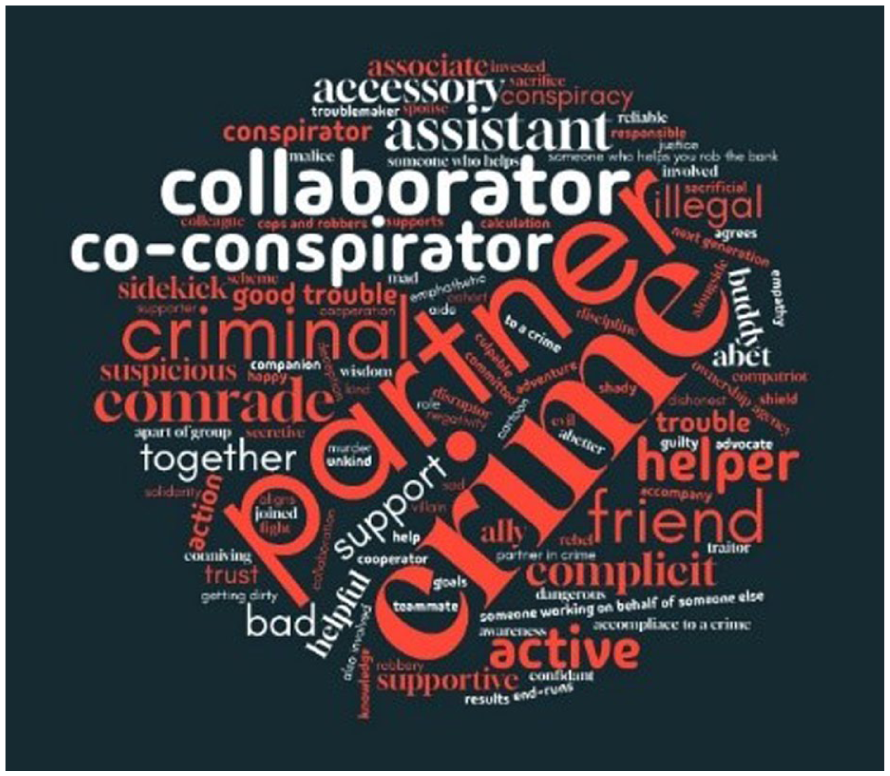
First Impression accomplice word cloud.
First Impression–accomplice top 10-word frequency.
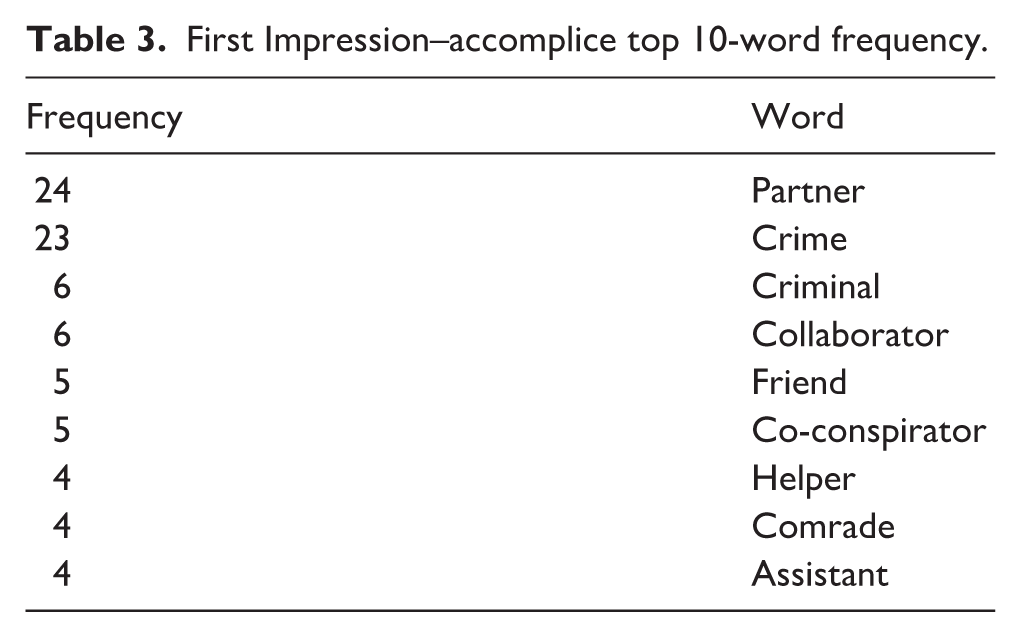
For accomplice, the first impression created a mental model that had a negative connotation having to do with crime and/or criminal activity. Of the words provided to answer the question, “partner,” (24) “crime,” (23) and “criminal” (6) were the top three responses. Although “partner” on its own is not necessarily negative, it was followed by “crime” in terms of the frequency of use, which created an overall first impression focused on “partner” and “crime.”
Other responses to round out the top 10 include “collaborator” (6), “friend” (5), “co-conspirator” (5), “helper” (4), “comrade” (4), “assistant” (4). There were also positive words such as “helpful” (2), “supportive,” (2), but the negative terms outweighed the positive. Even when there was a positive term in the three words from respondents, many times there were also negative terms.
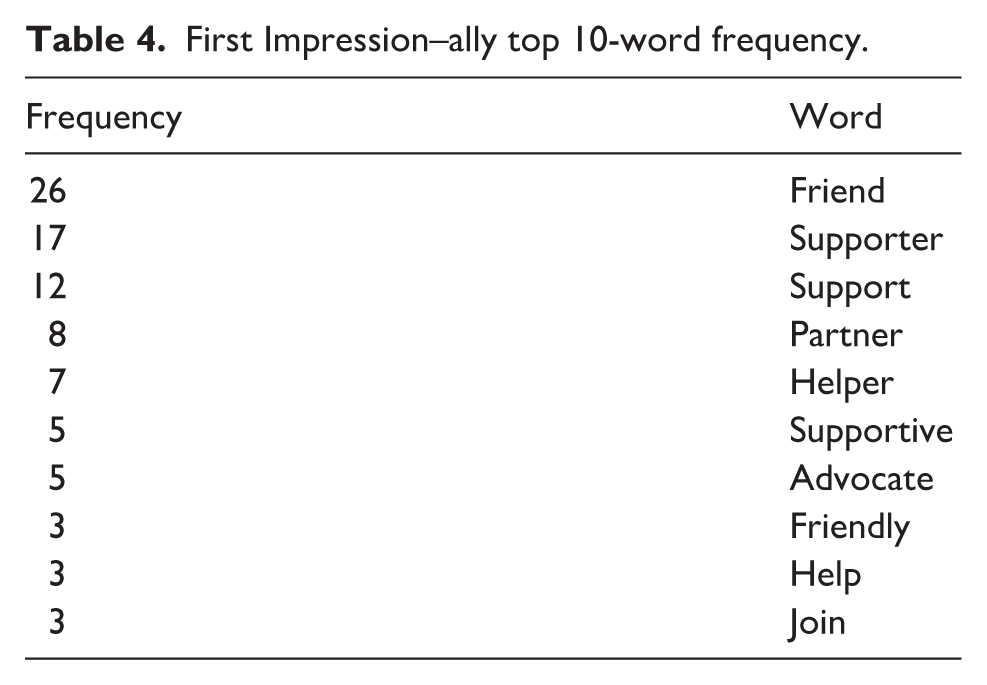
For ally, the first impression created a mental model that had a positive connotation having to do with support. The top five words were “friend” (26), “supporter” (17), “support” (12), “partner” (8), and “helper” (7). The top 10 were positive terms, and the overall impression of ally was positive (Figure 2; Table 4)
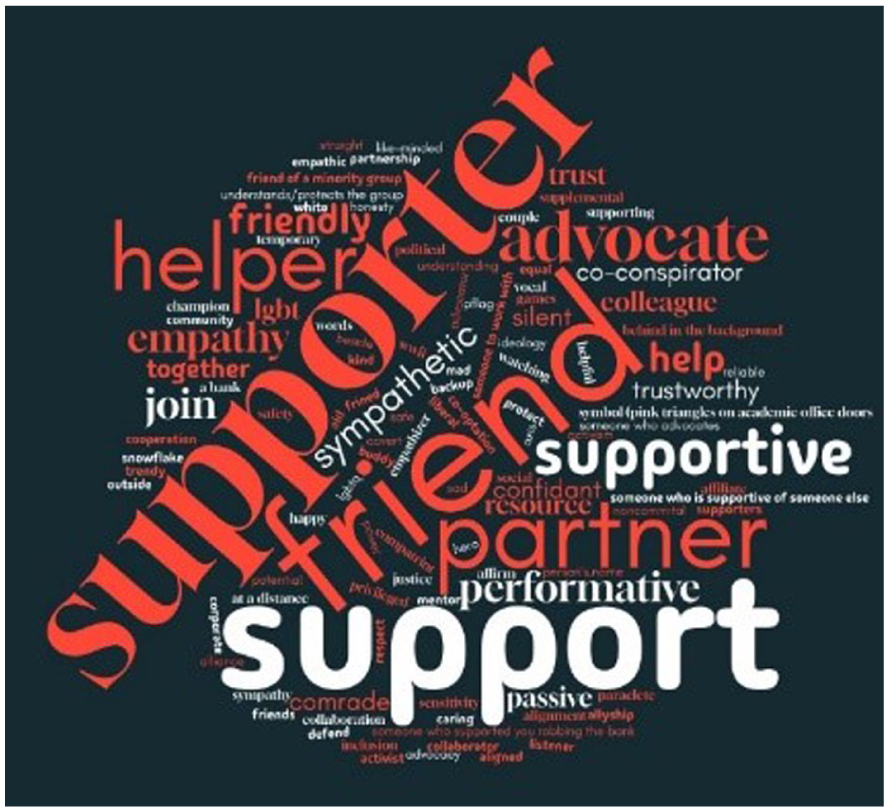
First Impression ally word cloud.
First Impression–ally top 10-word frequency.
Self-identification
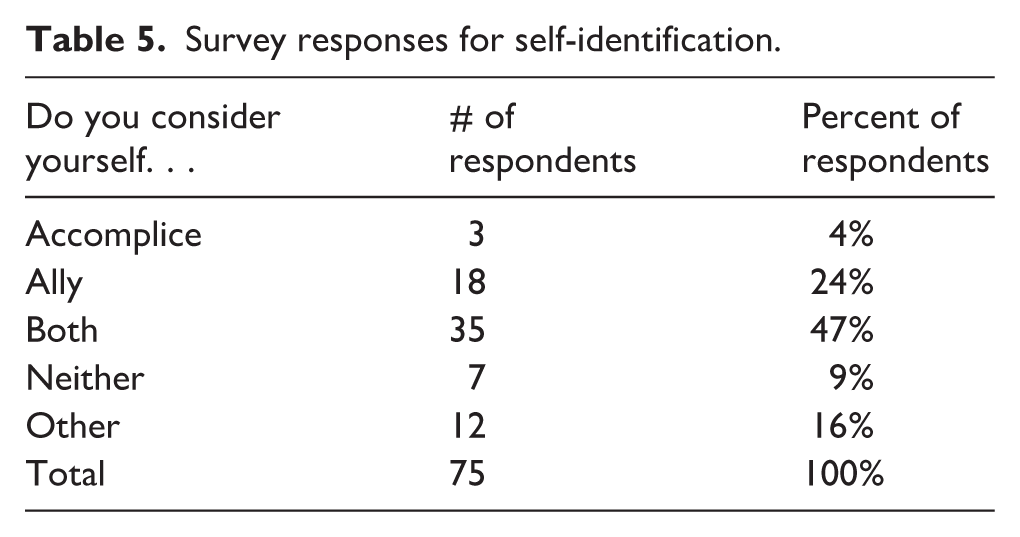
When asked whether they considered themselves an “Accomplice,” “Ally,” “Neither,” “Both,” or “Other,” the majority (47%) of survey respondents selected “Both,” followed by “Ally” (24%), then “Other” (16%), “Neither” (9%), and “Accomplice” (4%). Few respondents (3) selected “Accomplice” as a method of self-identification. Of the respondents that selected “Other,” most suggested that being an accomplice or an ally “really depends on context.” (Table 5)
Survey responses for self-identification.
Microaggression
The survey explicitly asked respondents, “Do you know what is a microaggression?” and could respond with a “Yes” or “No” response. Only 7% (5) of respondents responded “No” while 93% (68) responded “Yes.” This suggests that although most people know what is a microaggression, there are some people that do not and as such, it is important not to assume that everyone knows or understand microaggressions. When asked if they had experienced or witnessed a microaggression in their professions, only one respondent selected that they had never experienced or witnessed a microaggression. All other respondents experienced or witnessed microaggressions ranging from “Sometimes” (41), “About half the time” (7), “Most of the time” (11), and “Always” (13), suggesting that microaggressions were pervasive in their work life.
Interview participants
Demographics
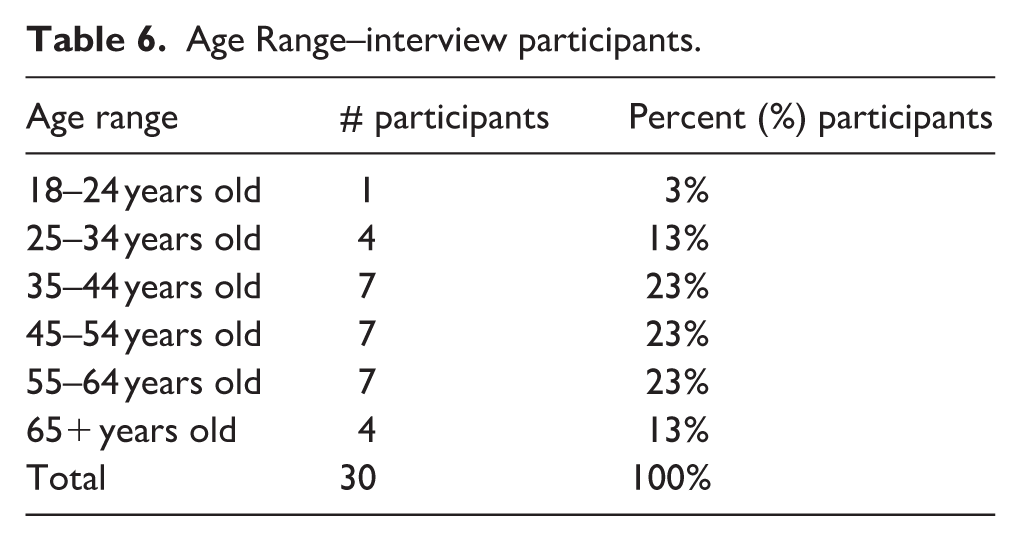
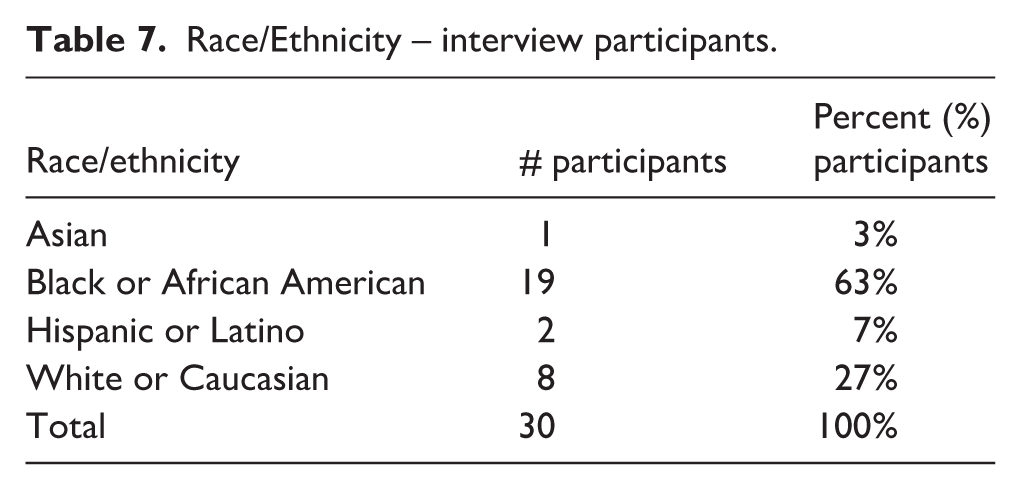
Thirty survey respondents agreed to participate in an interview. Participants were of a similar age range and represented a good distribution of overall participants in the study (see Table 6). There were 19 (63%) female, 10 (33%) male, and one participant preferred not to say (3%). In term of race/ethnicity (see Table 7), participants were Black or African American (63%) followed by White or Caucasian (27%), then Hispanic or Latino (7%) and Asian (3%). This differed from the overall survey results, but Black or African American and White or Caucasian were still the top two racial/ethnic groups.
Age Range–interview participants.
Race/Ethnicity – interview participants.
The demographic information provided a lens to understand the research participants’ context and their model of the world.
Self-identification
Of the interview participants, none selected “Accomplice” in the survey when asked to self-identify in refence to allies and accomplice. However, in the interview, participants were asked the same question and could elaborate more than in the survey. As they described how they defined and experienced allyship and accompliceship, participants clarified their perspective and six participants stated that they were accomplices. This was a noticeable change from the survey to the interview.
Microaggressions
Interview participants were asked what microaggressions mean to them and to describe an example where they witnessed or experienced an act of microaggression. All participants were able to define microaggression in their own words and provide an example of either experiencing or witnessing microaggressions. The definitions were similar and focused on the slights that people experienced each day. As one participant explains, “Microaggression is like small, sometimes subtle, sometimes blatant actions, words or physical actions that you do to harm someone simply because of how they might identify.” Participants provided examples of the types of slights that they experienced. One participant described a simple dialog with a patron, where the patron did not believe she was a librarian.
“A person asked me why did they get rid of all the librarians? So I said, I’m sorry, did you need a specific librarian? It’s like, no, why are there no librarians here? And I said, well, I’m a librarian. And she asked me if I was a professional librarian, which, you know, I’m like, I’m a qualified librarian. What question can I answer for you?”
Multiple Black librarians described similar experiences, where patrons did not believe they were librarians, and as such they had to spend time combating patron’s belief system, a mental model that tells the patron that librarians are white.
Sometimes microaggressions may be off-handed comments or intended as a compliment. For example, “you look really smart for a little brown boy with your glasses,” one participant described hearing a parent say to her child in elementary school. The person saying the sentence thought it was a compliment, but the participant thought it was offensive and had to explain how a sentence like that can harm a young child, particularly since it suggests that without the glasses the child is not smart.
Mental models
The interview data provided the source for identifying and generating mental models based on participants’ description of their experiences with allies and accomplices. Whether participants heard the terms before or not, when it was triggered, the mental models were formed, and they represent participant’s perspective of the world. Through iterative data analysis, 10 mental models were generated based on participants’ responses (see Table 8): three on allies, four on accomplices, one on neither, and two on both. Each model represented a perspective on the topic of allies and accomplices and a view of the external world. The title of each mental model was an overarching theme that was derived from the data.
Mental Models of allies & accomplices.

Mental models of ally
Participants were asked to describe their thoughts/ideas when they heard the word “Ally” and if they considered themselves an ally or an accomplice. Based on the data, there were three mental models of allies:
Distant support
Participants with a mental model of “Distant Support” see an ally as someone that provides support but does not get too involved. They provide support from a distance. Distant Supporters can be a trustworthy partner, but they are generally passive, and their support can be performative.
One participant described it as follows: “So, when you say I’m an ally . . . I’m not really in the same situation you are. I’m not going through the same things you are. I don’t face the same challenges you are, but you can always come to me for support” (ampid021).
Another participant provided a description that encapsulated the mental model and created a visual that anyone can understand.
“With an ally, I think that they might be, you know, on the phone giving me directions or waving from the sidewalk. They may not actually be in the car with me as an ally. You will talk about what is good for me, not necessarily what’s good for all of us” (ampid017).
The visual of someone supporting from a distance (“on the phone,” or “on the sidewalk,”) but not exactly in the situation with you (“not actually in the car”) is a mental model that suggests that you are supported but there is some distance in the relationship and the expectations.
Fair weather friend
Participants with a mental model of “Fair-Weather Friend” see an ally as a friend that is supportive when things are good (the weather is nice), but not when things are not so good (stormy weather). Fair-Weather Friends can be counted on if there is a need to support positive and good things, but when there are challenges and a need to provide stronger support, Fair-Weather Friends will not be there.
“Fair weather friend is a friend who is there for you; a friend when it’s sunny, when the weather is good. But when it’s, you know, cloudy or rainy or snowy or whatever, they’re not there to be there for you” (ampid026).
The weather metaphor provides a visual for this mental model that suggests the change in the weather means a change in the support from this ally.
Good guys
Participants with a mental model of “Good Guys” see an ally as a “white knight” that helps to do something good and positive. They are supportive of goals that they consider good as contextualized by society. “Good Guys” are doing good and want to be recognized for helping.
“But, you know, we saved the word ally for the so-called good guys, you know. So, Ally tends to be people helping on the good side” (ampid004). “I guess, we as a society, we are sort of conditioned to see ally as positive and the word accomplice as negative. And we see them all the time, in TV and writings, etcetera” (ampid020).
The “Good Guys” mental model is not surprising because anyone who has watched movies or television shows, or read stories, understands the concept of the good guys and the bad guys. There is always a good guy doing things to save humanity and a bad guy doing things to harm humanity. These concepts are seen throughout society, and it is not surprising that participants think of an ally as the good guys and an accomplice as the bad guys.
Mental models of accomplice
Participants were asked to describe their thoughts/ideas when they hear the word “Accomplice” and if they considered themselves an ally or an accomplice. Based on the data, the following mental models of Accomplice emerged:
Partner in crime
Participants with a mental model of “Partner in Crime” saw an accomplice as someone that helps with something wrong, negative, and bad. They are the bad guys that are doing things considered criminal. A “Partner in Crime” is there when things are challenging and are willing to suffer the consequences.
“Accomplice to me is someone who is willing to do hard time with you. There is a criminal connotation to accomplice, and to me that’s appropriate because I kind of put that word in the frame of social justice” (ampid026). “So yeah, when I think about accomplice, I immediately think about crime because that’s usually the context. It’s heard in my brain, but even in the midst of an accomplice, that’s somebody who was like there, like present and supportive for, again for criminal activity, but they were there” (ampid018).
Participants visualized criminal activity when describing their perceptions of accomplice. The “Partner in Crime” mental model creates a visual of someone participating in a criminal activity. However, even as participants identified criminal activity, they also suggest that there is a positive perspective where the person is there during the tough times.
Take action
Participants with a mental model of “Take Action” saw an accomplice as someone who helps to do or accomplish something. They are taking an action rather than being passive supporters.
“Accomplice is somebody who is part of the action itself, the participant” (ampid019).
The “Take Action” mental model has an active visual where the accomplice is doing and being a part of the action rather than just supporting on the sideline. As one participant puts it, “Accomplice. You’re in the car with me. Maybe you’re driving at times. Maybe I’m driving. But we’re in it together” (ampid007).
Good trouble
Participants with a mental model of “Good Trouble” saw an accomplice as someone who acts for the greater good even though it may cause trouble. They are doing things that they know may be considered bad, but it is necessary to change the system and the world.
“It’s somebody who’s willing to take one for the team, is someone who may not or be on your team like all the time or obviously, but they’re willing to just kind of take one and stand up for what they believe is right and what and they do it in an intentional way” (ampid023).
One participant provided a librarianship specific example that suggests that the Good Trouble mental model can be applied to a variety of situations: “So, I might be an accomplice in liberating furniture to save the library budget because I know that there’s that furniture graveyard in the basement of another building and I’m done asking for budget money. So I might be, you know, causing good trouble and taking things. And that’s I know I’m an accomplice to that” (ampid005).
The visual that was elicited from this mental model is that the accomplice stands up for what is right even if it causes trouble to the accomplice.
Ride or die
Participants with the mental model of “Ride or Die” saw an accomplice as someone who helps to achieve a goal good or bad and provides support no matter what happens. They are there with you through it all regardless of what happens.
“Someone who’s really on your side and deals with the challenges alongside with you” (ampid029) “So is the person who is going to help you to achieve the goal of good or bad. That person is your person. That person is right there with you hanging in and they’re like we got this together. I’m in with this with you together” (ampid031).
As participants used the phrase “Ride or Die,” the understanding was clear to them, and they explained that the phrase represented a close relationship where there was complete trust in the person; they considered their “Ride or Die” person.
Mental models of neither
When participants were asked about being an ally or accomplice, some participants stated that they were neither. Based on the data, one mental model emerged:
Just do right
Participants with the mental model of “Just Do Right” saw neither an accomplice nor an ally, but rather someone that stood up for what is right regardless of the situation. Based on their understanding of the world, society, and culture, they do things they believe are right without labels.
“I consider myself neither. And some people say that’s radical. I think right is right and wrong is wrong. I’m really big on, like, you know, do the right thing when nobody is watching. So for me, like, my moral code is really like even though if you don’t want to, you still do the right thing even when you have nothing to gain from it, or it may even take from you doing the right thing” (ampid009).
The “Just Do Right” mental model speaks to the perspective that people can have a moral code that puts respect for people first and a commitment to do what is right in any given situation.
Mental models of both
When asked about being an ally or accomplice, some participants stated that they were both, indicating that they may be an ally and an accomplice sometimes. Based on the data, two mental models emerged.
Context matters
For participants with the mental model “Context Matters,” an ally or accomplice depended on the person, situation, day, and context. They recognized that the context mattered as it related to the relationship and whether someone is an ally or accomplice. They pointed out that they can be an accomplice to one person and an ally to another and that can also change depending on the situation and what is happening.
“It’s dependent on what, who the person is that I’m dealing with and what the situation is” (ampid001) “I would say you have to touch a little bit of everything to understand where everything is” (ampid017).
The mental model of “Context Matters” suggests that understanding the context and responding appropriately to that context is critical to being an ally or an accomplice. Understanding the need in the situation at the time helps to determine the role and how to respond.
Ally to accomplice
Participants with the mental model of “Ally to Accomplice,” sees someone as an ally trying to become more of an accomplice. The “Ally to Accomplice” person has a good sense of being an ally while wanting to understand and become an accomplice.
“I do recognize where there are some things that I just don’t understand because I don’t come from that background, and in that regard, the best I can do is be an ally just cause I don’t know how to do more” (ampid007) “Again, accomplice has such a connotation to criminal activity in me that I would like to learn more about the new meaning of it or the more enhanced meaning of the term. So for now, I do consider myself an ally” (ampid008).
The mental model of “Ally to Accomplice” is a journey along a path that goes from one to the other.
Tools & strategies
One of the final questions in the interview asked participants to suggest tools and/or strategies that would help librarians and information professionals deal with daily challenges. Based on participants’ responses to what could help them, four themes were identified that would be a guide for individuals and libraries to craft a solution to help librarians deal with daily challenges.
Discussion
The 10 mental models generated through iterative reflective thematic analysis answer RQ1, which asks about librarians’ perceptions and mental models of allies and accomplices. These mental models provide a framework for identifying and representing internal perceptions in the external world (Craik, 1943). Since mental models exist in the mind, this research focused on extracting and representing the mental models librarians and information professionals hold about allies and accomplices in librarianship. At the beginning of the study, the researchers expected that there would be mental models of ally and accomplice, but the mental models of neither and both were a surprise finding. As participants described their definitions and identified their perceptions, it became clear that it was not a binary (ally or accomplice) relationship, but rather a range of perceptions of how people experienced and viewed ally or accomplice. Although some models seemed similar, participants provided specific examples that differentiate each model.
First impressions are a quick and brief view of a person’s mental model of a concept. When participants provided the first thoughts that come to mind based on the trigger, they were drawing from their mental model of that concept and were actively engaged in using that mental model. Because mental models can be unstable (Norman, 1983), it was important to dig deeper and ask participants to investigate their models and share it with the external world. Asking participants to verbalize their understanding in multiple ways clarified and revealed the mental model.
Mental models of an ally suggest that an ally can be helpful, but as described by participants, they are passive supporters and do not take action when action is needed. Mental models of an accomplice suggest that there is a general negative connotation, but there is a positive as well, and an accomplice will act when needed. Mental models of both and neither suggest that the conversation around ally and accomplice needs to expand from a binary to a continuum that will allow others to participate even if there are no labels or they are unsure of what label to ascribe to themselves. Labels can create a barrier to entry and as such, this research suggests that additional space should be allocated to those who are outside the categorial structure.
In RQ2, the question asked how librarians can shift from being allies to becoming accomplices and the research identified the need for definitions and consistent language to describe what participants experienced and how they responded to daily challenges. The mental model framework offers a way to create a consistent language and definitions for perceptions of ally and accomplice, which will help librarians to articulate their current position and what works or does not work for that position. Mental models give participants a model of their own perception and what it means to have that perception. Understanding their individual models, participants can make changes to move forward at their own pace. Expecting participants to simply move from being an ally to being an accomplice overlooks their current realities and the daily, intentional work required to create change. In addition, participants described their reservations about being an accomplice or taking action (Suyemoto et al., 2021). It is important to meet people where they are and give them the tools to change their own position based on their needs. Thus, to move from an ally to an accomplice, participants first need to externalize their internal model, understand that model, and then intentionally work to change the model. The 10 mental models from this research provides a reference for librarians to understand their individual models and make the changes to move toward being an accomplice.
In RQ3, the question asks what tools and strategies librarians can use to help fight against daily injustices, specifically microaggression. The research showed that most librarians and information professionals experience microaggression daily. Only one participant in the study did not experience or witness an act of microaggression. This suggests that microaggression is a serious issue in the profession, and participants need help in dealing with the challenges of microaggression whether they perpetrate or receive them. According to Sweeney and Cooke (2018), “Microaggressions are challenging to understand, discuss, avoid, and combat, and the effects (both short term and cumulative) of these transactions can manifest in physical and mental ways.” Microaggression can take many forms, but the daily slights that participants experienced had an impact. Whether participants considered themselves allies or accomplices also had an impact on what they did when they witnessed or experienced an act of microaggression. Overall, participants were not sure what to do or how to provide support as needed in the given context. Thus, the research asked participants what they needed to help them with daily challenges and documented the tools and strategies that they suggested. The four themes identified in the research can help librarians and information professionals craft solutions to address daily challenges.
Overall, this research suggests that librarians are searching for ways to address issues and a consistent way to verbalize their perceptions. Mental models provide an approach that librarians can use to understand their own perceptions and how those perceptions are perceived by others. Using that understanding, librarians can develop methods to address the role of allies and accomplices and daily challenges such as microaggressions.
Limitations
There are limitations to the article and study. The article is limited by its focus on a part of the overall study, dealing specifically with librarians’ mental models of allies and accomplices, and microaggression. In addition to what is addressed in this article, the overall study addresses a scenario, discrimination, and racism, which were beyond the scope for this article. The overall study is limited by mental models extraction and representation but does not address interrogating and running the model. A future study can address how librarians use mental models and ways these mental models can be interrogated, particularly after there is an understanding of mental models as it relates to allies and accomplices.
Since completing the research, the world of DEI has changed and there is an ongoing effort to dismantle DEI programs throughout the United States. This study does not address any of these issues, as they were not encountered during the data collection or analysis process.
Conclusion
Diversity, equity, and inclusion remain critical yet contested concepts in today’s political climate, particularly as conversations about race, ethnicity, and discrimination continue to evolve. This study contributes to those conversations by examining how librarians conceptualize and enact the roles of ally and accomplice within their professional contexts. While librarians often see themselves as allies who support marginalized groups, the findings suggest a growing need for accomplices—those willing to take risks and challenge systemic inequities from within their institutions.
This article highlights an important dimension of librarianship: the tension between advocacy and action. The study’s limitations, including its focus on representing mental model rather than interrogating or running models and study’s completion prior to current national efforts to dismantle DEI initiatives, underscore the need for continued research. Future studies might explore how librarians apply and evolve these mental models in practice amid shifting political and institutional landscapes.
Ultimately, understanding the difference between being an ally and an accomplice, and the growing continuum of activism, invites the profession to move beyond performative support toward active, sustained engagement in social justice. For librarians, this means embracing a role not only as information stewards but also as co-conspirators in creating equitable and inclusive spaces for all.
Supplemental Material
sj-docx-1-lis-10.1177_09610006261454000 – Supplemental material for Actions matter: Mental models of allies & accomplices in librarianship
Supplemental material, sj-docx-1-lis-10.1177_09610006261454000 for Actions matter: Mental models of allies & accomplices in librarianship by Robin Naughton and Simone L. Yearwood in Journal of Librarianship and Information Science
Footnotes

Ethical considerations
This study met the criteria for exemption (#2024-0101-QC) by the Queens College, CUNY Institution Review Board (IRB) on 02/20/2024.
Consent to participate
All participants provided consent to participate in the study. For the survey, respondents confirmed their consent before starting the survey. For the interview, participants provided signed consent before the interview.
Funding
The authors disclosed receipt of the following financial support for the research, authorship, and/or publication of this article: The Andrew W. Mellon Foundation funded part of the research through a Diversity Enhancement Research Grant administered by Queens College, CUNY.
Declaration of conflicting interests
The authors declared no potential conflicts of interest with respect to the research, authorship, and/or publication of this article.
Data availability statement
None. Any other identifying information related to the authors and/or their institutions, funders, approval committees, etc., that might compromise anonymity.
Supplemental material
Supplemental material for this article is available online.
Author biographies
References
Supplementary Material
Please find the following supplemental material available below.
For Open Access articles published under a Creative Commons License, all supplemental material carries the same license as the article it is associated with.
For non-Open Access articles published, all supplemental material carries a non-exclusive license, and permission requests for re-use of supplemental material or any part of supplemental material shall be sent directly to the copyright owner as specified in the copyright notice associated with the article.
