






Abstract
Public libraries are increasingly understood not merely as information-service institutions but as community-based infrastructures that support civic life, social connection, digital inclusion and everyday wellbeing. This article offers an integrative review of scholarship on the community roles of public libraries across five major strands: public sphere and democracy, social capital and trust, place and community engagement, digital inclusion and administrative access, and wellbeing, welfare and social integration. The review argues that the literature has moved decisively beyond narrow service-centred conceptions of the public library, yet remains fragmented across thematic domains and often under-specifies the mechanisms through which libraries generate community effects. The article’s central contribution is to reconceptualise the public library as a form of social infrastructure that links informational access, relational encounter, civic participation and low-threshold support. Four recurring mechanisms—accessible infrastructure, relational encounter, mediated capability-building and institutional buffering—are identified as the analytical bridge between institutional presence and community effects. The article concludes by outlining a research agenda that prioritises conceptual clarity, mechanism specification and stronger comparative evidence, and by drawing out practical implications for how public libraries can position themselves within local systems of digital, civic and social support.
Keywords
Introduction
Research on public libraries has moved well beyond traditional concerns with collections, circulation and information provision. A substantial body of scholarship now treats the public library as an institution embedded in community life rather than as a narrowly technical service organisation. In this literature, public libraries appear as democratic spaces, relationship-building settings, community anchors, sites of digital inclusion and low-threshold points of support for everyday social needs (Audunson, 2005; Scott, 2011; Vårheim et al., 2019). This shift matters because it alters the analytical question. The issue is no longer only what libraries provide, but what kind of public institution the library is and how it matters to community life.
This change in emphasis has been driven by several developments. First, the decline of a purely collection-based understanding of library value has encouraged scholars to examine how libraries function as places, programmes and social interfaces. Secondly, digitalisation has made public libraries newly important as sites of access to devices, connectivity and assistance with increasingly online public and private systems (Bertot et al., 2013, 2016). Thirdly, austerity, social fragmentation and rising everyday precarity have increased attention to institutions that remain free, routine and broadly accessible. Public libraries fit this description unusually well. Their community significance is therefore being reconsidered not because their traditional functions disappeared, but because those functions now intersect with wider democratic, social and welfare-facing roles.
Yet this literature remains analytically fragmented. Studies of democracy and the public sphere often develop separately from work on social capital, community engagement, digital inclusion, or health and welfare support. As a result, scholarship has generated a substantial catalogue of functions but less clarity about how those functions fit together conceptually. Recent reviews identify similar problems. Vårheim et al. (2019) show that work on libraries as public sphere institutions is dispersed across multiple research questions and methods, while Sørensen (2021) demonstrates that value research has accumulated unevenly and still leaves important conceptual and methodological gaps. More recent work has also shown that even when democracy is central to the argument, it is not always clearly theorised (Hanell, 2026).
This article addresses that problem through an integrative review of the community roles of public libraries. It asks two questions: how has the literature conceptualised the community role of public libraries, and what broader theoretical account emerges when these lines of research are read together? The article argues that the most productive answer is to understand public libraries as a form of social infrastructure. The concept of social infrastructure, as Klinenberg (2018) defines it, refers to the physical places and organisations that shape how people interact; libraries feature prominently in his account, and subsequent work has applied and extended the concept to institutional settings beyond physical space (Latham and Layton, 2019). This concept is preferable to a simple list of functions because it identifies what otherwise diverse activities share: they organise access, encounter, capability-building and low-threshold support in ways that shape community life. The contribution is therefore threefold. First, the article synthesises a fragmented literature into a clearer analytical map. Secondly, it advances social infrastructure as an integrative framework for understanding public library roles. Thirdly, it develops a research agenda—and practical implications for library practice—that clarify where the literature, and the field, remain conceptually and operationally weak.
The argument unfolds across five substantive strands of scholarship: public libraries as public sphere institutions; public libraries as sites of social capital and trust; public libraries as community places and engagement hubs; public libraries as infrastructures of digital inclusion and administrative access; and public libraries as settings implicated in wellbeing, welfare and social integration. The discussion section then identifies four recurrent mechanisms—accessible infrastructure, relational encounter, mediated capability-building and institutional buffering—that help explain how community effects are generated across these strands.
Review design and analytical scope
This article adopts a state-of-the-art integrative review rather than a PRISMA-style exhaustive systematic review. An integrative review is a form of research synthesis that allows for the inclusion of diverse methodological traditions—experimental, qualitative and conceptual—and enables the reviewer to build new frameworks from existing literature (Torraco, 2016; Whittemore and Knafl, 2005). Although the integrative review method has been most fully developed in nursing, health and applied social sciences (Torraco, 2016; Whittemore and Knafl, 2005), review-based knowledge synthesis is now well established within library and information science itself, as recent mapping and systematic reviews of public library scholarship demonstrate (Blanchard et al., 2026; Sørensen, 2021; Vårheim et al., 2019). The present article extends this tradition by adopting an explicitly integrative—rather than systematic or mapping—approach. Unlike systematic reviews that restrict inclusion to studies meeting pre-specified quality thresholds, integrative reviews are particularly suited to bodies of scholarship that are methodologically heterogeneous and conceptually diffuse—conditions that characterise the literature on public libraries and community. That choice follows from the nature of the research problem. The aim is not only to catalogue findings but also to bring into conversation adjacent bodies of scholarship that have often been treated separately, even though they concern the same underlying question: what role does the public library play in community life? An integrative review is appropriate for that purpose because it allows concept-building across literatures that differ in method, disciplinary emphasis and outcome vocabulary.
The review focuses on peer-reviewed English-language scholarship that explicitly conceptualises public libraries in relation to community life, public engagement, social connectedness, democratic participation, digital access, or support for everyday wellbeing. The literature was identified through iterative searching of Web of Science, Scopus, Library Literature & Information Science Full Text and Google Scholar. Search terms combined variants of ‘public library’ with terms including ‘community’, ‘social capital’, ‘public sphere’, ‘digital inclusion’, ‘wellbeing’, ‘social infrastructure’, ‘democracy’ and ‘place’. Searches were not date-limited, with priority given to scholarship published since 2000, though foundational earlier works were included where directly relevant. Priority is given to foundational studies that shaped subsequent debate, review articles that map the field, and empirical studies that have become representative of particular strands of scholarship. Studies focussed primarily on technical library operations, cataloguing, collections management, or user-interface design were excluded unless they directly addressed the community role of the public library. The result is a purposive but analytically coherent corpus of studies organised around five recurring strands that appear consistently across the literature.
This approach has two implications. First, the article does not claim exhaustive coverage of every publication relevant to public libraries and community. Secondly, the value of the review lies not in count-based comprehensiveness but in interpretive synthesis. The central analytical task is to identify recurring concepts, mechanisms and blind spots that become visible only when these literatures are read together. That also means paying attention to what the field tends to conflate. Several studies use related but not identical terms—community engagement, public sphere, social capital, inclusion, wellbeing, place, value—as if they referred to the same outcome. One of the aims of this review is to disentangle those categories and show how they overlap without collapsing into one another. It is worth acknowledging at this point that the five strands used to organise the review are analytically distinguishable but not empirically separable. Some studies could reasonably be assigned to more than one strand, and the overlaps between, for example, social capital and place-based research, or between digital inclusion and civic participation, are real. These overlaps are flagged where they arise and are revisited in the discussion section.
The five strands that organise the review were generated primarily through a bottom-up, inductive reading of the corpus, with theoretical sensitivity guiding their subsequent refinement—an abductive logic characteristic of integrative review. Initial engagement with the literature revealed recurring thematic clusters—democratic and civic life; social relations and trust; space and belonging; digital access; and health and social support—which were then refined and connected to established theoretical traditions. The strands are therefore neither arbitrary nor purely theory-driven: they reflect patterns that become visible when a broad body of scholarship is read inductively and then theorised.
This integrative scope also distinguishes the present article from the two most prominent recent systematic reviews of public library value. Sørensen (2021) systematically catalogues how ‘value’ has been operationalised across stakeholder-perception studies and identifies methodological gaps in the value-research tradition; Blanchard et al. (2026) synthesise empirical evidence on the impact and value of UK public libraries and group findings into thematic clusters such as reading, digital support and community participation. Both reviews are indispensable, but both remain bounded by the value vocabulary that organises their respective corpora. Neither asks whether the diverse functions catalogued under ‘value’ or ‘impact’ share an underlying institutional logic, and neither steps outside the LIS literature to ask what kind of public institution the library is. The present review takes a different and complementary path: rather than aggregating value claims, it brings five conceptually adjacent literatures into a single analytical conversation and asks what theoretical account of the public library best explains their convergence. The contribution is therefore conceptual rather than evaluative, and it is intended to sit alongside—rather than replicate—the systematic value reviews that already exist.
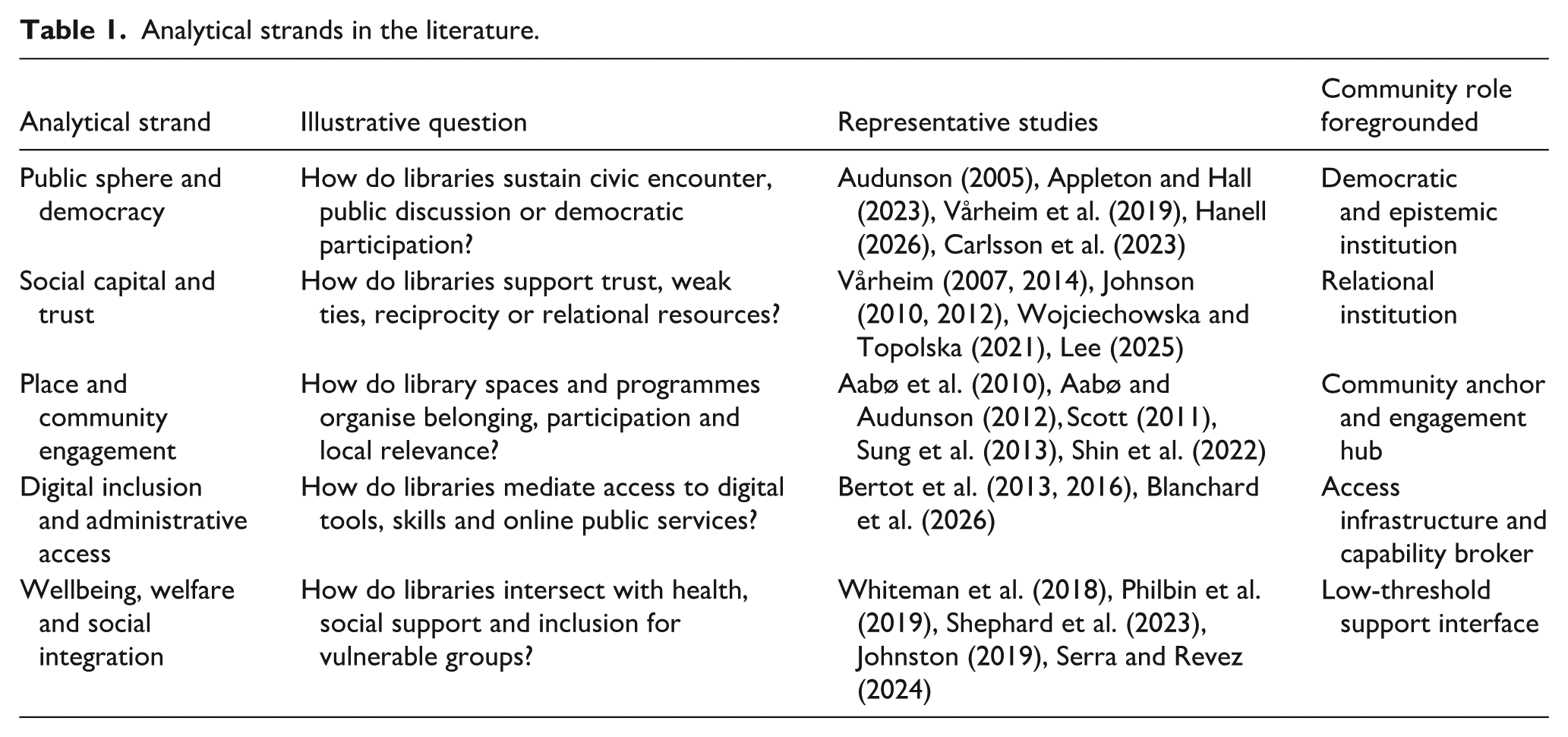
Table 1 summarises the five strands that structure the review, the central question asked in each strand and the main kind of community role foregrounded by that scholarship.
Analytical strands in the literature.
Public libraries as public sphere institutions
The public sphere, as originally theorised by Habermas (1989), denotes the communicative domain situated between private life and state power in which citizens engage in reasoned deliberation about matters of common concern. Subsequent scholars have debated and revised this concept, emphasising its historical exclusions, its tensions with agonistic democratic theories and its partial, contested realisation in everyday institutional settings. One of the most influential lines of scholarship conceptualises the public library as a public sphere institution. Here the library is understood not merely as a place where information is stored or accessed, but as a setting in which citizens encounter difference, access public knowledge and participate in forms of shared civic life. This line of work is significant because it shifts the analytical focus from service outputs to democratic conditions. The value of the library lies not only in what it lends or teaches but in the social and informational environment it helps sustain.
Audunson’s (2005) widely cited account of the public library as a meeting-place remains foundational in this regard. His concept of ‘low-intensive meeting places’ emphasises the democratic importance of routine, low-barrier environments in which diverse people can be present with one another without requiring strong prior ties or formal deliberation. This is an important corrective to over-idealised understandings of the public sphere. It suggests that democratic life is not supported only through explicit debate or formal participation, but also through mundane coexistence, visibility and everyday exposure to difference. In this sense, public libraries contribute to democracy partly by preserving conditions for contact and recognition that more commercial or exclusionary spaces may not provide.
Subsequent work has both broadened and refined this line of argument. Vårheim et al. (2019), in a mapping review of libraries as public sphere institutions, show that the literature encompasses community, institutional practice, funding, service design and knowledge organisation. Their review is especially valuable because it demonstrates that the public sphere literature has not been limited to a single normative claim. Rather, it has developed as a dispersed set of questions about how libraries engage in public life and what kinds of activities count as public-sphere work. Appleton and Hall (2023) further deepen this perspective by showing that the public library’s public-sphere role is bound up with its epistemic function. Drawing on longitudinal focus groups in UK public libraries, they argue that public library space supports person-to-person knowledge exchange in ways that extend beyond formal information provision.
At the same time, the democratic literature is not conceptually settled. Hanell (2026) demonstrates that recent public library scholarship invokes democracy through at least three distinct lenses: Habermasian consensus-oriented views, Mouffean conflict-oriented views and social-capital-oriented approaches. This matters because the mechanisms implied by each view are different. A Habermasian approach emphasises deliberation and rational-critical exchange; an agonistic approach highlights contestation and the visibility of difference; a social-capital approach emphasises trust, participation and relational density. Much of the literature moves among these understandings without stating clearly which democratic effect is being claimed. As a result, ‘democracy’ often functions as an umbrella term rather than a specified analytical category.
It is important to note, however, that not all scholarship treats democracy as an under-specified umbrella term. Carlsson et al. (2023) offer a more precisely theorised account, examining how public libraries can actively support democratic processes through information access, civic education and deliberative programming. Such work demonstrates that it is possible to make analytically specific claims about library contributions to democracy without collapsing into vague celebration of the institution’s civic significance.
The most defensible lesson from this strand is therefore not that libraries are democratic in some general moral sense, but that they can support the preconditions of democratic life through accessible space, public knowledge, routine encounter and civic visibility. That is a more precise claim and one that fits the empirical literature better. It also points towards a broader conceptualisation of the library as social infrastructure: a public institution that helps organise the social and informational conditions within which democratic life becomes possible.
Public libraries as sites of social capital and trust
Social capital refers broadly to the relational resources—trust, norms of reciprocity and networks of association—that enable collective action and social cooperation (Coleman, 1988; Putnam, 2000). Putnam’s formulation, which distinguishes between bonding capital (ties within homogeneous groups) and bridging capital (ties across diverse groups), has been particularly influential in library research. It should be noted, however, that Putnam’s account has attracted substantial criticism: critics argue that it can naturalise social homogeneity, underplay structural inequalities and attribute social problems to deficits of trust rather than to political and economic arrangements (Gelderblom, 2018). LIS applications of social capital theory have not always engaged with these critiques, and future work would benefit from doing so.
A second body of literature frames the public library as a site of social capital formation and trust-building. This strand asks whether and how libraries contribute to relationships, reciprocity, social trust and community connectedness. Its importance lies in moving beyond institutional ideals to the micro-processes of social interaction. Whereas the public sphere literature often focuses on democratic conditions, the social capital literature is more directly concerned with how relations are formed, supported and extended in and through library settings.
Vårheim (2007) provided a crucial starting point by arguing that public libraries should be taken seriously within wider social capital debates. He showed that library scholarship had produced suggestive empirical findings but had rarely connected them to broader theoretical puzzles about how institutions generate social capital. This argument remains important because it resists both naïve celebration and disciplinary isolation. It implies that public libraries matter not simply because they are ‘good things’ in local communities, but because they are instructive cases for understanding how public institutions contribute to trust and social connectedness.
Johnson’s studies are especially important for translating this agenda into empirical work. Johnson (2010) used survey data to examine the relationship between library use and indicators of social capital in a large Midwestern US city. Library users reported higher levels of community involvement and trust than a comparison sample, although the relationship between frequency of use and social capital was not straightforward. The significance of this finding is not that it proves a direct causal effect, but that it cautions against simplistic interpretation. Library use and social capital are related, but the relationship is conditional and mediated rather than automatic.
Johnson (2012) extended this work by examining the informal interactions between library staff and patrons. Based on interviews with staff in neighbourhood branch libraries, the article identifies several mechanisms through which libraries may contribute to social capital: trust-building, referral to resources, social support, reduction of isolation and help in navigating an increasingly digital world. This is one of the strongest pieces of evidence in the field because it connects institutional context to relational process. Libraries are not depicted as abstract containers of social capital but as places where specific kinds of interactions make relational resources more likely.
Vårheim's (2014) later work similarly sharpens the mechanism question by examining how participation in library-based ESL, computer and civics classes affected social trust among first-generation Mexican immigrants. The study suggests that trust in the library, in staff and in other users can develop through repeated programme-based interaction. Again, the point is not that all library participation produces generalised trust, but that under certain conditions library programmes can provide a starting point for trust-building spirals. Read together, this strand suggests that the library’s community role is relationally mediated. Public libraries do not simply contain community; they help constitute it by enabling low-threshold interaction, recognition and support. That makes them analytically distinct from institutions whose primary logic is bureaucratic transaction or market exchange.
It is also worth noting that alongside social capital, cultural capital—as theorised by Bourdieu (1986)—provides a related but distinct analytical resource. Cultural capital encompasses embodied dispositions, institutionalised credentials and cultural objects, and shapes how individuals relate to institutions such as libraries. Recent work has suggested that public library programmes can contribute to cultural capital development and help bridge cultural divides, particularly for immigrant and minority-language communities (Lee, 2025; Wojciechowska and Topolska, 2021). The relationship between library use and cultural capital remains underexplored relative to social capital, and represents an area where future research could productively build.
Public libraries as community places and engagement hubs
A third strand centres on the public library as place. If the social capital literature highlights interaction, the place literature highlights the institutional and spatial conditions that make such interaction possible. Public libraries matter, on this account, because they offer a publicly legitimate, low-cost, non-commercial and routinely accessible environment in which people can remain, meet, learn and participate. This strand is especially relevant to contemporary debates because it links community role not only to programmes or services but to the material and symbolic qualities of library space itself. The place-based tradition has been shaped partly by Oldenburg's (1989, 2001) concept of the ‘third place’. Third places are informal public gathering spots—distinct from home (the first place) and work (the second place)—characterised by accessibility, social levelling and a convivial atmosphere that welcomes habitual, unpressured presence. Oldenburg identified examples such as coffeehouses and barbershops; public libraries share many of these qualities and are frequently cited as third places in both scholarly analysis and policy argument. The third-place concept has influenced library design and programming and continues to inform discussions of how public libraries can sustain community sociability in an era of privatised leisure and declining civic infrastructure. It is worth noting that community engagement—the second theme of this strand—overlaps meaningfully with the social capital literature reviewed above, since both are concerned with relational ties and civic participation. The key distinction is one of emphasis: the place literature foregrounds the spatial and institutional conditions for engagement, while the social capital literature focuses on the relational outcomes.
Aabø et al. (2010) provide a key empirical foundation for this perspective. Their study shows that public libraries function as multiple kinds of meeting place, including a public square, a setting for meeting diverse people, a public sphere, a place for joint activity, a metameeting place and a site for virtual meetings. The significance of these findings lies in their plurality. The library is not one kind of place; it hosts several layers of publicness simultaneously. This helps explain why discussions of public library value often seem diffuse: the same space can support solitary study, weak-tie contact, organised programmes, informal observation and civic participation.
Aabø and Audunson (2012) deepen this argument by showing that the library as place cannot be reduced to service consumption. Their study of how library space is actually used demonstrates that public libraries support social activity, cultural participation, personal development and everyday presence. This is an important corrective to instrumental framings in which the library is judged solely by measurable outputs. The community significance of the library also lies in what it permits people to do and be in a publicly recognised space. In practical terms, this means that space, seating, accessibility, openness and atmosphere are not secondary design issues but part of the institutional substance of public library work.
Research on community engagement broadens this place-based argument by focussing on how libraries create local relevance. Sung et al. (2013), through a qualitative case study, identify seven elements of community engagement, including belonging, commitment, communication, flexibility, genuineness, relevance and sustainability. The importance of this study is that it treats engagement not as a slogan but as a process requiring design, responsiveness and credibility. Community engagement is not achieved merely by calling the library a community space; it must be built through relationships, responsiveness and institutional practices that residents experience as meaningful.
More recent work pushes this logic further by linking public libraries to explicit needs assessment and community-based design. Shin et al. (2022) argue that if libraries are to remain relevant under rapidly changing information conditions, they must assess the needs of users and non-users in relation to services, spaces and expectations. Their emphasis on triangulation and social media data is notable because it translates the idea of a community-based library into an operational research agenda. Scott (2011), from a broader community-building perspective, similarly argues that libraries function as conduits for learning, inclusion, civic engagement, access to resources and local economic vitality. Taken together, this strand positions the public library not as a generic ‘good place’ but as a locally embedded institution whose community role depends on how well space, services and engagement are aligned with the texture of local life.
Public libraries as infrastructures of digital inclusion and administrative access
Digital inclusion refers to equitable access to and meaningful use of digital technologies, encompassing physical access to devices and connectivity, the digital literacy skills needed to use them effectively, and the substantive capability to participate in digital systems in ways that improve life outcomes (Bertot et al., 2016). It is a relational concept: digital inclusion is not achieved by providing access alone but by ensuring that access translates into meaningful participation. This strand overlaps with the public sphere literature insofar as digital access has become a prerequisite for civic and administrative participation; the distinctive contribution of the digital inclusion strand lies in its focus on capability and intermediation rather than on democratic conditions per se. Digitalisation has produced a fourth major strand of scholarship: the public library as a site of digital inclusion and access to online services. This literature is crucial because it shows how older library commitments to equitable access have been reconfigured rather than displaced. The issue is no longer only access to books, reference expertise or cultural materials. It is also access to devices, connectivity, digital skills and the increasingly online administrative systems through which people seek work, benefits, information and public services.
Bertot et al. (2013) argue that public libraries have become central partners in the delivery of e-government services. Their analysis of innovative partnerships among libraries, government agencies and community organisations shows that libraries often serve as frontline intermediaries when public services are delivered online but users lack the resources or skills to navigate them independently. This is analytically important because it places the library within debates usually associated with administrative systems, state capacity and service accessibility. The library is not simply supplementing government from the outside; it is often compensating for the exclusionary effects of digitalised governance.
Bertot et al. (2016) further demonstrate that digital inclusion is not a peripheral activity but central to how many libraries understand their mission. Drawing on the 2013 Digital Inclusion Survey, they show that public libraries prioritise access to public technologies and infrastructure, training, and assistance with community-relevant digital needs such as employment, civic engagement and government services. This strand therefore highlights an important transformation in library work: libraries increasingly act as capability brokers. They do not merely provide infrastructure but help users convert infrastructure into practical agency.
Recent review work confirms that this is not a temporary or narrowly American development. Blanchard et al. (2026), in a systematic review of public libraries in the UK, identify information and digital support as one of the key themes through which public library value is expressed. Their findings are particularly useful because they show how digital roles sit alongside, rather than replace, more traditional library functions. Public libraries support reading and culture while also offering free access to technology, trustworthy information and skills training. This reinforces the argument that the community role of libraries should be understood infrastructurally. Digital inclusion is not simply a service line; it is one of the ways libraries maintain equitable access to the conditions of participation in contemporary society.
At the same time, much of this literature remains better at demonstrating need than at specifying outcomes. More is known about what users seek help with than about how library-mediated digital support affects longer-term civic, administrative or socioeconomic trajectories. Future research would benefit from examining the conditions under which digital assistance changes access to rights, public services or social mobility. Even so, the literature already makes one point unmistakably clear: when public systems are digital by default, the public library becomes a critical institution for administrative inclusion.
Public libraries, wellbeing and social integration
Wellbeing, in its social dimensions, refers to the conditions that enable individuals and communities to thrive, including health, social connection, security and the capacity to participate in civic and community life (Keyes, 1998). Social integration, a related concept—and one of the dimensions of social wellbeing identified by Keyes (1998)—describes the processes through which individuals and groups become active and recognised members of a community or society. A fifth strand extends the community role of public libraries into health, welfare and social integration. This is one of the most significant recent developments in the literature because it shows how libraries intersect with everyday vulnerability even though they are not formally welfare agencies. As more people encounter complex health, housing, immigration and social needs in public settings, the public library has become an important site where unmet need becomes visible and where some form of initial response is often attempted.
Whiteman et al. (2018) offer compelling evidence of this shift. Based on a survey of public library staff in Pennsylvania, they show that staff frequently engage with patrons on employment, nutrition, exercise and social welfare concerns and are often confronted with acute health and social crises. The value of this study lies partly in its candour: it demonstrates both the promise and the strain of this expanded role. Libraries are well positioned to function as public health partners because they are accessible and trusted, yet staff often feel underprepared for the level of social need they encounter.
Philbin et al. (2019) take this argument further by conceptualising public libraries as community-level resources for advancing population health. Their use of a social determinants framework is important because it relocates library research within broader debates on place-based disparities and meso-level institutions. Public libraries matter, on this account, not because they are part of the healthcare system in a narrow sense, but because they are modifiable community institutions that influence access to information, social support, programmes and referral. This framing strengthens the analytical bridge between library studies and wider scholarship on wellbeing, inequity and community infrastructure.
The literature on social work in public libraries also demonstrates how libraries are increasingly implicated in frontline responses to psychosocial need. Shephard et al. (2023), in an international scoping review, show that public libraries have become sites where interprofessional partnerships with social workers are being explored or institutionalised. Their review identifies both facilitators and barriers, which is important because it avoids romanticising the library as a cure-all. Libraries can provide low-threshold support and referral, but they are also stretched institutions whose boundaries, capacities and professional identities are under pressure.
Work on immigrant and refugee inclusion highlights similar dynamics from another angle. Johnston (2019) shows how conversation-based programming can contribute to immigrant integration by fostering learning, relationship-building and expanded social networks. Serra and Revez (2024) demonstrate that public libraries in the Lisbon Metropolitan Area can support the social inclusion of refugees and asylum seekers by addressing information needs and providing welcoming institutional contact. Here again, the library’s role is best understood as interface rather than substitute. It is a place where access, recognition, orientation and connection can be initiated. This strand therefore reinforces a broader conclusion: public libraries increasingly function as low-threshold civic institutions where the boundaries between cultural service, social support and community integration are becoming more porous.
Discussion: from functional diversity to social infrastructure
Read separately, the five strands reviewed above describe a remarkably diverse institution. Public libraries are cast as democratic spaces, trust-generating institutions, meeting places, digital intermediaries and support interfaces. Read together, however, a clearer picture emerges. The community significance of public libraries does not lie in any single function. It lies in their capacity to organise multiple forms of access and support through one publicly accessible institutional setting. This is why the concept of social infrastructure is useful. It does not deny functional diversity; rather, it explains why that diversity is coherent.
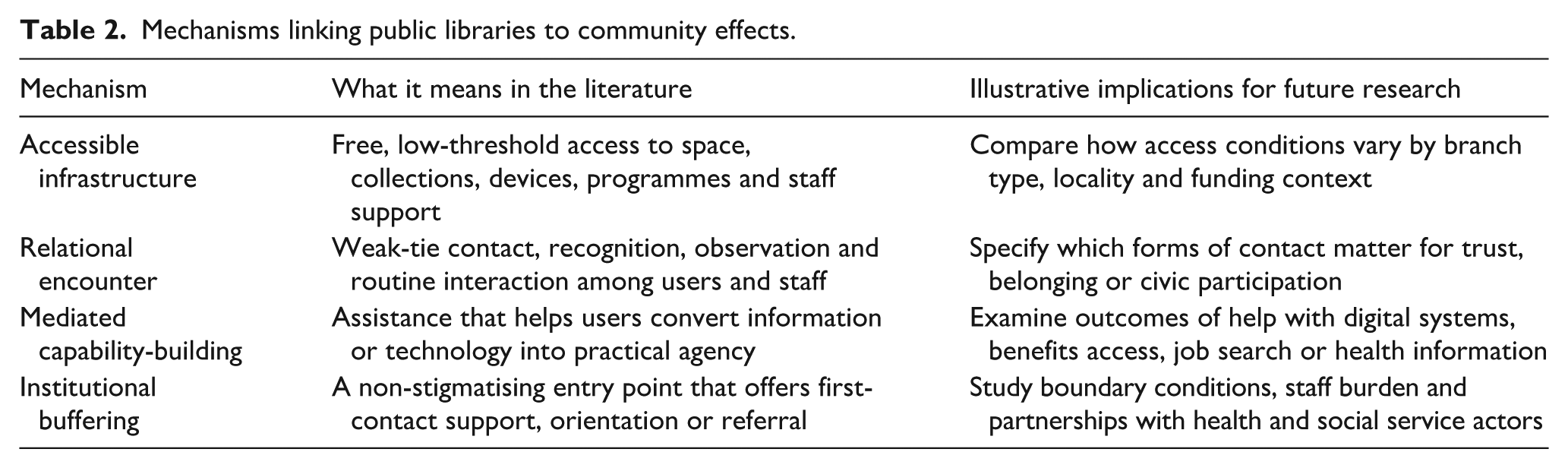
The literature reviewed here suggests four recurring mechanisms through which public libraries operate as social infrastructure. The first is accessible infrastructure. Public libraries provide free, legitimate and routine access to space, resources, devices, collections and programmes. This is foundational because every other effect depends on it (Aabø and Audunson, 2012; Scott, 2011). Without low-threshold access, libraries could not serve as meeting places, digital support centres or democratic environments. The second mechanism is relational encounter. Libraries create opportunities for weak-tie contact, observation, recognition and low-intensity interaction among diverse users and between users and staff (Audunson, 2005; Johnson, 2012; Vårheim, 2014). This mechanism is central to both public sphere and social capital accounts.
The third mechanism is mediated capability-building. Public libraries do not only offer resources; they help people use them. This is clearest in the digital inclusion literature, but it also appears in community engagement, immigrant integration and health-related support. Staff and programmes frequently translate abstract access into practical capability by helping people navigate information, technologies, institutions and local opportunities (Bertot et al., 2013; Johnston, 2019; Serra and Revez, 2024). The fourth mechanism is institutional buffering. Libraries often serve as relatively non-stigmatising, low-threshold entry points through which people facing complexity—whether administrative, digital, health-related or social—can receive initial assistance, referral or simply a safe place to remain (Philbin et al., 2019; Shephard et al., 2023; Whiteman et al., 2018). This does not make the library a welfare agency, but it does make it an important buffer within fragmented local support systems.
These four mechanisms help clarify why the public library should be understood as social infrastructure, in the sense developed by Klinenberg (2018), rather than simply as a set of community services. They also help discipline future claims. The literature sometimes overstates what libraries do by moving too quickly from institutional presence to broad social outcomes such as cohesion, democracy or wellbeing. A mechanism-centred framework offers a more defensible alternative. It suggests that libraries shape community life when specific organisational conditions are in place: accessible and welcoming environments, socially meaningful interaction, capable mediation of information and systems, and pathways to broader forms of support. In other words, public libraries are consequential not by symbolic virtue alone, but by the patterned ways in which they organise access, encounter and assistance.
It is also worth acknowledging explicitly that the five strands reviewed here are analytically distinguishable but not empirically separable. Community engagement overlaps with both the social capital and place-based literatures; digital inclusion intersects with civic participation in ways that connect it to the public sphere tradition; and wellbeing support often requires the relational pathways that also sustain social capital formation. These overlaps are not a weakness of the literature but reflect the fact that public libraries generate effects that are inherently multidimensional. The social infrastructure framework helps manage this complexity by providing a single institutional logic for diverse but interrelated functions.
This synthesis also clarifies the field’s main gaps. First, the literature is still marked by conceptual slippage. Terms such as democracy, inclusion, engagement, value and wellbeing are often used expansively without clear specification of the outcomes or mechanisms implied. Secondly, the evidence base remains uneven. Qualitative case studies and practice-oriented accounts are abundant and valuable, but comparative, longitudinal and mixed-method work remains relatively scarce. Thirdly, the literature is still only partially cumulative. Subfields often speak past each other even when they are describing overlapping institutional processes. Finally, the literature reviewed here reflects a marked geographic skew, drawing predominantly on scholarship from Scandinavia, the United Kingdom and North America. This is not simply an Anglophone limitation but a substantive one: the community roles of public libraries are likely to be shaped by national welfare regimes, funding structures, traditions of civic trust and local demographic contexts. Findings from Nordic social-democratic contexts cannot be assumed to generalise to liberal welfare states, post-socialist settings or low-income countries. Future research should systematically seek evidence from the Global South, East Asia, Southern and Eastern Europe and other under-represented regional traditions.
A stronger next generation of research would therefore do three things. It would specify mechanisms more explicitly; it would distinguish among different kinds of outcomes instead of subsuming them under broad claims of library ‘value’; and it would compare how public libraries operate across different institutional and community settings. Such work would not only strengthen library scholarship itself. It would also make public libraries more visible within broader interdisciplinary discussions of social infrastructure, democratic institutions, digital inequality and local support systems. For library and information science specifically, this reframing offers a way to connect the field’s long-running internal debates about public library value to a wider theoretical vocabulary—social infrastructure—that is increasingly used across sociology, urban studies, public administration and public health. In this sense, the review’s contribution to LIS is not to displace the value tradition but to give it a sharper conceptual anchor and a stronger interdisciplinary footing (Table 2).
Mechanisms linking public libraries to community effects.
Conclusion and practical implications
This article has argued that the literature on the community roles of public libraries is richer than a simple service-based understanding of the institution would suggest. Across five strands of scholarship, public libraries are repeatedly shown to matter as democratic spaces, relational institutions, community places, digital access infrastructures and low-threshold support interfaces. Taken together, these literatures indicate that the public library is best understood as a form of social infrastructure: a public institution that helps organise the conditions of community life through access, encounter, capability-building and support.
That conclusion is analytically stronger than the now common claim that libraries are simply ‘important to communities’. It identifies why they are important and what kinds of mechanisms recur across otherwise disparate literatures. It also clarifies the field’s main challenges. Public library research must move beyond diffuse claims of value and towards sharper concepts, more explicit mechanism statements and stronger comparative evidence. If it does so, scholarship on public libraries will not only better explain the library itself; it will also contribute more substantially to broader conversations about public institutions and the infrastructures that sustain community life.
The practical implications of this synthesis for library practice and policy are equally concrete. First, the social infrastructure framing offers public libraries a defensible language for articulating their value to municipal funders and partners: not as one service among many, but as the institutional layer that makes access, encounter and capability-building possible across other local systems. Secondly, the four-mechanism framework can guide service design and impact evaluation. Rather than measuring only outputs such as visits or loans, libraries can examine how their spaces, programmes and staff support each mechanism—accessibility, relational encounter, capability-building and buffering—and where capacity falls short. Thirdly, the review highlights the importance of formal partnerships with health, social service and digital inclusion actors so that libraries can perform low-threshold entry-point work without absorbing burdens for which they are neither resourced nor mandated. Finally, library workforce planning should take seriously the relational, mediating and frontline-support competencies that the literature consistently surfaces but that traditional professional training does not always foreground.
Footnotes

Ethics considerations
This article is an integrative review of published scholarship and did not involve data collection from human participants. No ethics approval was therefore required.
Funding
The author disclosed receipt of the following financial support for the research, authorship, and/or publication of this article: This work was supported by the Ministry of Education of the Republic of Korea and the National Research Foundation of Korea (NRF-2021S1A5C2A02087244).
Declaration of conflicting interests
The author declared no potential conflicts of interest with respect to the research, authorship, and/or publication of this article.
Data availability statement
This article is an integrative review of existing published literature. No primary data were generated or analysed in the course of this study. All sources cited are identified in the reference list.