






Abstract
Information avoidance has emerged as a critical focus within information behavior research. While existing studies have examined such behavior among pregnant women in diverse cultural settings, the socio-cultural dynamics shaping information avoidance in the Chinese context remain underexplored. Addressing this gap, this study investigates the multilevel, socio-culturally embedded factors that drive information avoidance among Chinese pregnant women. Guided by a grounded theory approach, semi-structured, in-depth interviews were conducted with 12 pregnant or recently postpartum women residing in urban areas of northern China. Interview transcripts were systematically analyzed through open, axial, and selective coding procedures. The analysis identifies three interrelated dimensions as central to information avoidance practices: individual factors, information-related factors, and contextual factors rooted in Chinese familial and cultural systems. The findings reveal that China’s familial collectivism, pregnancy-related taboos, and indigenous knowledge systems uniquely shape and intensify information avoidance behaviors in ways that differ markedly from those documented in Western, individualistic contexts. Based on these insights, the study develops a context-sensitive theoretical model that elucidates culturally specific mechanisms underlying information avoidance and offers evidence-based recommendations for policymakers and healthcare providers to design culturally congruent information interventions for pregnant women in China.
Introduction
Humans are the fundamental element and driving force behind economic and social development. In 2018, the number of births in China decreased to 15.23 million, and the government’s two-child policy did not achieve the expected results. The fertility accumulation effect continued to weaken. With the implementation of the three-child policy, pregnant women have increasingly become the focus of national attention (Ren et al., 2019). During the long process of pregnancy, many pregnant women experience anxiety and tension due to insufficient knowledge of pregnancy, obstacles to role function transformation, and lack of family and social support. These emotions then affect their information behavior, resulting in information avoidance (Yang, 2018). Pregnant women are a typical group that exhibits information avoidance behavior (Savage, 2008). For example, lacking childbirth experience and trusted medical advice leads pregnant women to heightened sensitivity to the pain associated with childbirth. This fear can result in deliberately avoiding certain types of information, such as watching childbirth videos or discussing the pain and potential complications of delivery.
Over the past two decades, feminist perspectives in information science have gained traction, particularly in critiquing gender biases in information systems and examining women’s information behavior (Greenshields and Given, 2022; Urquhart and Yeoman, 2010). Feminist technoscience and related intellectual frameworks have provided critical lenses for advancing research on information practices (Costello and Floegel, 2021). Yet while women’s information-seeking behaviors are increasingly documented, studies on decolonized and minoritized populations remain scarce—let alone rigorous investigations into their information avoidance strategies (Colón-Aguirre and Cooke, 2022). Existing work on female information avoidance overwhelmingly centers on white, educated women, rendering marginalized groups—including Asian and notably Chinese pregnant women—virtually invisible in this discourse.
Critically, information avoidance carries distinct socio-cultural imprints in vulnerable female populations (Cronin et al., 1997; Loudon et al., 2016). In Confucian-heritage China, pregnant women face compounded pressures: the new three-child national policy and the legacy of the historical one-child policy have intensified societal scrutiny of pregnancy, embedding unique cultural stressors (e.g. son preference, workplace penalties for maternity) that shape information practices. Chinese pregnant women develop culturally distinct information avoidance strategies shaped by traditional pregnancy customs (e.g. cultural taboos, fetal peacekeeping, and avoiding “cold” foods, as per Chinese medicine) that differ fundamentally from Western individualistic patterns. Unlike individualistic Western contexts, Chinese pregnant women navigate familial collective decision-making and taboos around sensitive topics, which may trigger avoidance. Therefore, this study focuses on Chinese pregnant women as a distinct group of information users and aims to identify the key factors that shape their information avoidance behavior. This study adopts information avoidance theory (Howell and Shepperd, 2016) to explore the influencing factors of pregnant women’s information avoidance. The research questions addressed in this study are as follows:
By employing grounded theory, this research uncovers the individual, information, and contextual dimensions of the drivers of information avoidance, and analyzes the factors under each dimension. It constructs a theoretical model of the influencing factors of pregnant women’s information avoidance. Based on the qualitative findings, it proposes actionable recommendations for policymakers and healthcare providers to tailor information services.
Literature review
The concept of information avoidance
Information avoidance has its origin in psychology. Freud et al.’s (1984) psychological defense theory discussed the tendency of individuals to suppress uncomfortable thoughts or memories, a process termed “repressed forgetting.” Although this repression is typically unconscious, it inspired later research on how people may consciously regulate their exposure to distressing information. Contemporary studies on information avoidance have extended this idea by focusing on intentional and goal-driven behavior, where individuals actively avoid certain information despite its availability and relevance. Sweeny et al.’s (2010) “Information Avoidance: Who, What, When, and Why” is a landmark in information avoidance research. He defined information avoidance as “any behavior intended to prevent or delay the acquisition of available but potentially unwanted information.” Barbour et al. (2012) posited that information avoidance is a common response to uncertainty, not necessarily detrimental, and is influenced by situational and individual factors.
Neben (2015) regarded information avoidance as a kind of informational behavior that restricts or terminates exposure to, absorption, and use of information relevant to decision-making. His conceptual model conceptualizes information avoidance as a multi-stage process, consisting of three behavioral types: exposure avoidance, absorption avoidance, use avoidance. These behaviors are triggered by defense motivation, which arises when individuals encounter information incongruence—information that conflicts with their existing beliefs or knowledge systems—and experience an anticipated information threat. Golman et al. (2017) focused on proactive information avoidance when information is freely available and accessible, noting that individuals employ various strategies to avoid information. For instance, people might be reluctant to return to a clinic to obtain medical test results, or deliberately ignore such information. In the context of health communication, Miller (1995) defined information avoiders as those who proactively and purposefully take steps to avoid acquiring or being exposed to threatening health information. Building on these perspectives, other researchers, such as Yang and Kahlor (2013), have emphasized the motivational and emotional underpinnings of information avoidance, particularly how affective responses and perceived efficacy influence the decision to avoid or seek information.
Recent research has further refined this concept. Hicks et al. (2025) argue that information avoidance should be viewed as a diverse set of practices aimed at regulating one’s engagement with information. These practices include reducing the intensity of exposure, restricting control over information interaction, or filtering content based on perceived undesirability. Similarly, Foust and Taber (2025) emphasize that information avoidance arises particularly when the information is perceived as personally relevant yet psychologically threatening, thus activating defense mechanisms.
In summary, we define information avoidance as the behavior of ignoring or avoiding accessible and useful information due to negative emotions or self-cognition. In the context of pregnancy, this may include avoiding medical advice, fetal health information, or socio-emotional information (e.g. others’ evaluations of one’s pregnancy) when such information evokes strong negative emotions (e.g. stress, anxiety) or conflicts with self-perception. Information avoidance has three defining features: (1) active avoidance, individuals deliberately, rather than inadvertently, avoid information; (2) utility neutrality, the avoided information may still hold potential value or relevance; (3) subjectivity-driven, avoidance stems from personal perceptions (e.g. emotional distress or cognitive dissonance), rather than objective information characteristics.
Factors influencing information avoidance behavior
Individual factors
Emotional factors
Individuals frequently choose to avoid information to regulate their emotional states. Case et al. (2005) posit that individuals mitigate their fears by rejecting advice perceived as ineffectual or challenging to implement, thereby avoiding information that induces fear. For instance, given that smoking elevates the risk of lung cancer, physicians advise smokers to quit smoking to maintain health. Smokers may then avoid such information to alleviate their fear of potentially developing cancer. Raedt et al. (2013) suggests that death anxiety tends to diminish with age, and thus younger and middle-aged individuals may be more likely to avoid death-related information compared to older people. Beyond anxiety and fear, regret also significantly influences avoiding information. Woolley and Risen (2018) discovered that participants in a dessert experiment chose to forgo advanced knowledge of the cake’s calorie content, as it could affect their enjoyment and induce regret after consumption. Wang et al. (2018) highlight that psychological factors greatly influence health information avoidance among Chinese university students. Some students, unable to confront their internal fears about health issues, avoid visiting hospitals, thereby minimizing their exposure to health information. In digital health contexts, this emotional regulation is further complicated by the paradox of online information abundance: while intended to empower, excessive or alarming health content can heighten distress and trigger avoidance as a means of preserving psychological equilibrium (Soroya et al., 2021).
Yang and Kahlor (2013) conceptualized information avoidance as an outcome of emotional motivations interacting with cognitive evaluations. They found that individuals’ attitudes toward information seeking, emotional affect, information subjective norms, and perceived behavioral control are key drivers of avoidance. Specifically, when emotional responses are negative, individuals are more likely to experience information overload or distress, which then leads to information avoidance. Interestingly, those with positive emotions—such as excitement or hope—sometimes also avoided risk information when they perceived it to be irrelevant to their perceived control. These findings indicate that emotional valence alone does not determine avoidance; rather, it interacts with perceived behavioral control and motivations to shape behavior. Building on this, Foust and Taber (2025) found that “anticipated regret” is a particularly salient emotional factor affecting avoidance. When individuals expect that new information may force them to change behaviors or face unpleasant truths, they may pre-emptively avoid it to protect themselves emotionally. Conversely, Howell and Shepperd (2012) found that self-affirmation techniques—such as writing about personal values—can significantly reduce information avoidance by helping individuals feel more resilient when facing threatening information. They showed that affirmation reduced information avoidance from 55% to just 16%. Notably, empirical research during the COVID-19 pandemic revealed a counterintuitive pattern: negative emotions such as worry were associated with lower levels of information avoidance among German news consumers, suggesting that avoidance is less about escaping distress and more closely tied to negative attitudes toward information seeking or perceived inefficacy in managing information overload (Link, 2021). Given that emotional responses are often shaped by how individuals appraise health threats, it is worth noting that the link between threat perception and information avoidance appears consistently stronger in Western contexts than in Asian societies (Li, 2022).
Cognitive factors
According to cognitive dissonance theory, people usually avoid information that is inconsistent with their perceptions and beliefs to avoid psychological discomfort. Cognitive conflict plays a critical role in avoiding information. In many cases, users avoid information because they tend to look for information that is consistent with their worldview and cognition without recognizing or looking for information that conflicts with it (Gaspar et al., 2016). Case et al. (2016) argues that individuals may ignore or reject information that contradicts their internal states in order to reduce cognitive discomfort.
Golman et al. (2017) found that information users will adopt information if the received information reinforces their views, and conversely, information that conflicts with beliefs causes them to disregard it and question the quality or impartiality of the source. Sweeny and Miller (2012) pointed out that many people also choose to avoid information without being informed because they do not know whether the information is consistent with existing attitudes, beliefs, or decisions. Cognitive barriers can further reinforce information avoidance behavior. Savolainen (2015) argued that low self-efficacy in information seeking can manifest as an internally constructed cognitive barrier, which discourages individuals from accessing potentially dissonant information. Such barriers may amplify the effects of cognitive dissonance by undermining one’s confidence or perceived ability to deal with conflicting messages.
Information factors
Information overload has become a common phenomenon in the Internet age. Information avoidance due to information overload is common and understandable (Bandura, 1977). Most of the information that people are exposed to in their lives and work has a repetitive feature, which makes it easy for them to develop information fatigue, which leads to information avoidance behavior (Guo et al., 2020). Hicks et al. (2025) provide a nuanced view of overload by introducing the dual dimensions of intensity (the speed and volume of information) and granularity (the size or resolution of content). They suggest that users respond to overload by limiting one or both dimensions—such as requesting summaries or selectively blocking dense information. Savolainen (2015) notes that when faced with complex or excessive information, individuals may consciously reduce their cognitive burden by selectively ignoring relevant content, which can constitute a form of information avoidance. Some research demonstrates that information overload tends to exacerbate the generation of adverse emotions in users, resulting in information avoidance behavior (Liu et al., 2019).
Contextual factors
Ramanadhan and Viswanath (2006) posited that patients with lower socioeconomic status actively avoid health information and are less likely to engage in preventive health behavior. McCloud et al. (2017) revealed that individuals with lower socioeconomic status in the United States exhibit avoidance behavior toward graphic health warning labels on cigarette packaging. This is attributed to their perceived lower control over their environment and limited access to cessation resources, thereby diminishing the effectiveness of such warning messages. Jung (2014) suggests that patients burdened with greater debt are more prone to health information avoidance.
Pregnant women’s information avoidance behavior
Pregnancy constitutes a unique context in which personal, informational, and contextual factors intersect to shape information avoidance behavior. Shipp et al. (2004) found that many pregnant women will specifically avoid information related to the sex of the fetus when undergoing examinations. Some even refused to look at the screen during the ultrasound scan for fear of inadvertently seeing the sex of the fetus. This avoidance is more prevalent among women who are older, highly educated, religious, or have planned pregnancies, suggesting that avoidance may reflect value-based and emotional motivations rather than information deficits. Ruthven et al.‘s (2018) results showed that young pregnant women sometimes develop negative emotions such as loss and resentment, which may come from financial situations or concerns about the future of the child, which causes them to actively avoid some information.
As for information from doctors and hospitals, Mckenzie (2001) showed that pregnant women selectively engage with medical information rather than passively accepting or rejecting it. When clinical advice conflicts with personal values—such as when diagnostic testing might force a morally unacceptable decision—women may deliberately avoid that information. Others may skip reading about potential risks, not due to distrust, but to protect their emotional well-being. Empirical studies suggest that when medical advice conflicts with women’s lived pregnancy experiences, trust in professional information sources may be weakened, which contributes to subsequent information avoidance (Browner and Press, 1996; P J McKenzie, 2003b).
Building on McKenzie’s model of everyday life information practice, Yeoman (2010) expanded its application to the context of the menopause transition, highlighting a more complex interaction between women and information sources than previously conceptualized. Although it focuses on the menopause transition, it provides valuable enlightenment into the information behavior that may also occur during pregnancy: pregnant women may exhibit selective avoidance of everyday information— such as unsolicited advice or anecdotal stories—not because it poses health risks, but because it resonates poorly with their emotional states, social circumstances, or lived experiences.
Ghiasi’s (2021) research indicates that pregnant women encounter barriers to information seeking, with the most common being shame or embarrassment when discussing pregnancy-related issues, as well as issues related to low income and low educational attainment. Zou and Han (2017) found that a pregnant woman’s educational level influences information avoidance behavior. Pregnant women with higher education levels actively seek pregnancy-related information, while those with lower educational levels are more prone to information avoidance because of cognitive biases. Adverse living and working environments may further intensify stress levels, thereby increasing the likelihood of information avoidance as a coping strategy.
While these findings provide important insights, current research still faces key limitations. First, most current research is grounded in Western cultural contexts. It pays insufficient attention to the culturally specific factors that shape information behavior among Chinese pregnant women—such as traditional cultural beliefs, family dynamics, and social norms. Second, the majority of studies adopt a unidimensional analytical approach. There is a noticeable lack of integrative research that systematically considers multilevel drivers of information behavior, including individual factors, information-related factors, and contextual factors. Therefore, it is necessary to investigate the underlying mechanisms and influencing factors of information avoidance among Chinese pregnant women through a multilevel lens within a localized cultural context.
Research methods and data collection
Research methods
Ethical approval for the study was obtained from the University where the authors formerly worked. This study adopts the grounded theory approach from the straussian perspective (Glaser and Strauss, 1967), which emphasizes a systematic and structured coding process to develop theory from qualitative data (Jia and Heng, 2020).
In grounded theory research, semi-structured interviews are commonly employed as a primary data collection method, as they allow researchers to follow a predefined interview guide while remaining flexible in adjusting question order, content, and follow-up probes based on participants’ responses. This approach facilitates the in-depth exploration of participants’ lived experiences and subjective meanings while maintaining sufficient structural consistency, making it particularly suitable for exploratory studies and for investigating complex social phenomena that require theory development and refinement.
Accordingly, this study employed a grounded theory method to investigate the influencing factors of information avoidance behavior among pregnant women. Through in-depth interviews with expectant mothers, a bottom-up, iterative analysis of interview transcripts was conducted to derive experiential generalizations and construct a model of the factors influencing information avoidance.
Data collection
The sample of this study consists of married women in China who are pregnant or have recently given birth and are engaged in information avoidance behavior. Prior to each interview, participants were assured of anonymity, informed of the study’s objectives and content, and provided consent for audio recording and transcription. To ensure participants could freely express complex emotions and experiences, all interviews were conducted in Mandarin Chinese. Each interview was audio-recorded in full and subsequently transcribed verbatim into Chinese text for subsequent coding and analysis. The research explored in detail why pregnant women choose information avoidance, the benefits of information avoidance, and how to avoid information, with interviews conducted between June 19 and August 4, 2020. The sample ultimately included 12 married pregnant women as participants, with their ages primarily ranging from 25 to 35 years. All participants resided in urban areas of northern China, and most had similar educational and socioeconomic backgrounds, contributing to the relative homogeneity of the sample. The sample covered the full range of pregnancy stages, including early pregnancy (1–4 months), mid-pregnancy (5–7 months), late pregnancy (8 months until delivery), as well as women with previous childbirth experience. As for family structure, most participants lived either with their husbands or with their parents/in-laws.
Following each interview, the audio recordings were promptly transcribed and returned to the participants for review. Participants were asked to verify the objectivity and accuracy of the transcripts, ensuring alignment with their expressed views. The transcripts were subsequently revised based on participant feedback to maintain the integrity of the original data. The duration of each interview ranged from 30 to 60 minutes, with an average of 45 minutes per interview. After transcription, the interview transcripts were returned to participants for member checking to ensure that the transcripts accurately reflected their intended meanings. This process was particularly important for capturing the emotional nuances expressed by participants.
Qualitative data analysis
Open coding
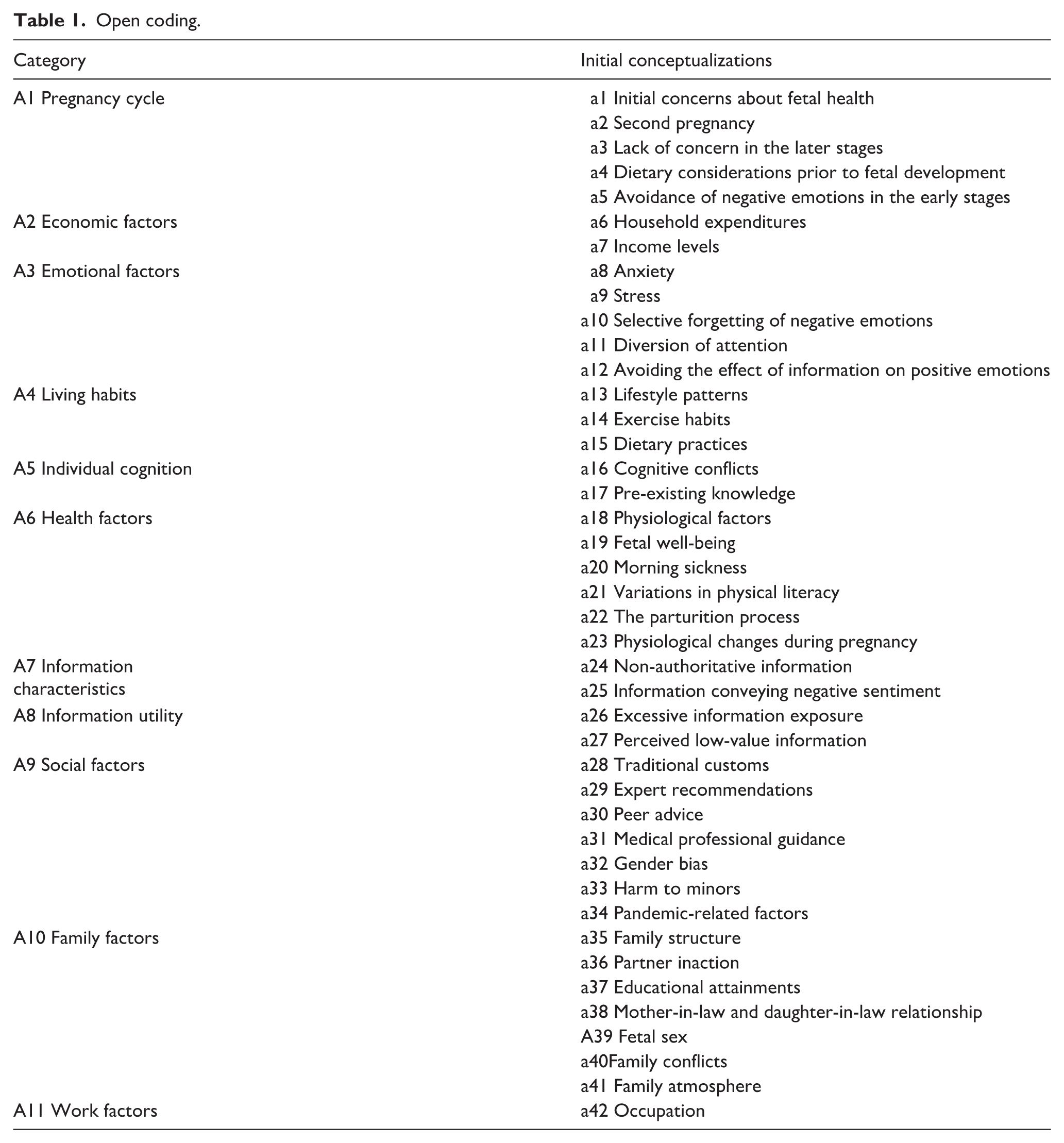
Based on the 12 interview samples, 12 interview files were generated as the primary data source. NVivo was used for coding, resulting in approximately 150 coded segments across the interview transcripts, from which initial concepts were derived. Due to the overlap of initial concepts, the nodes were refined. The initial coding was conducted in Chinese in October 2020, and the translation of the coded data into English was completed in March 2025. The open coding phase focused on identifying and labeling discrete meaning units in the interview data, resulting in the generation of initial codes. Ultimately, 43 initial conceptualizations and 12 categories were formed (as shown in Table 1).
Open coding.
Axial coding
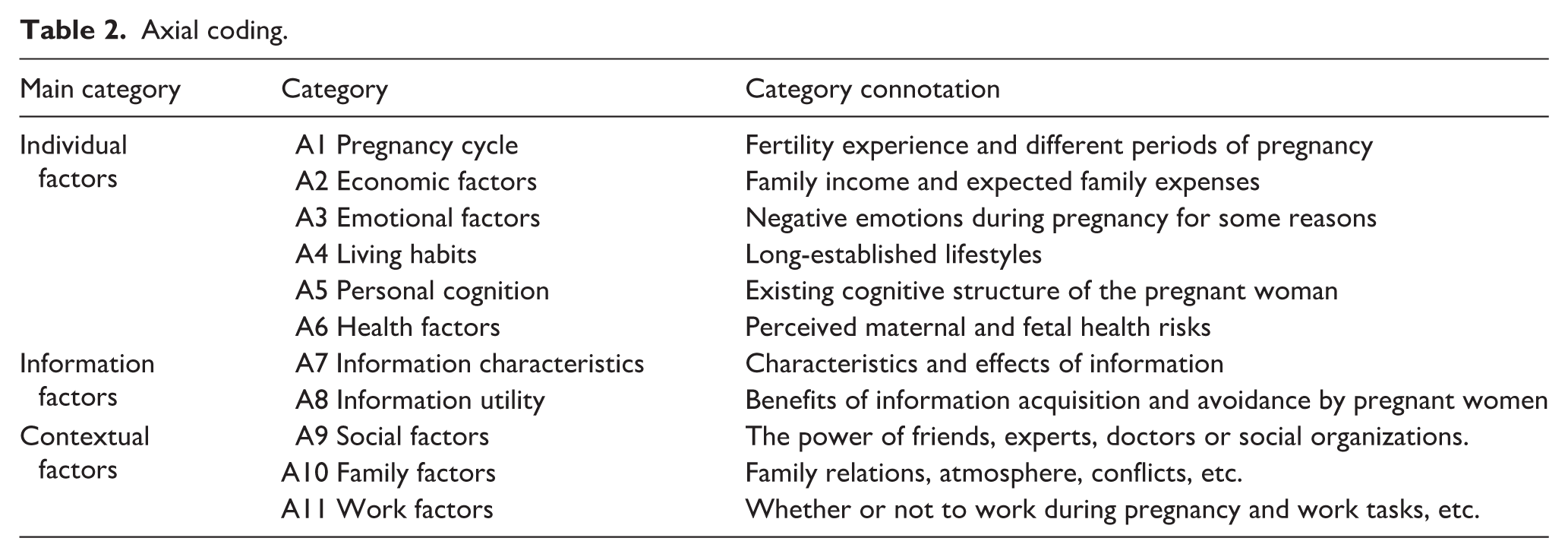
Axial coding is the second-level coding that summarizes and generalizes the initial conceptualizations. It involves exploring and refining the relationships between each initial concept, ultimately leading to the induction of 12 categories and 3 main categories. The axial coding phase grouped related initial codes into higher-level categories based on their shared properties and relationships (as shown in Table 2).
Axial coding.
Selective coding
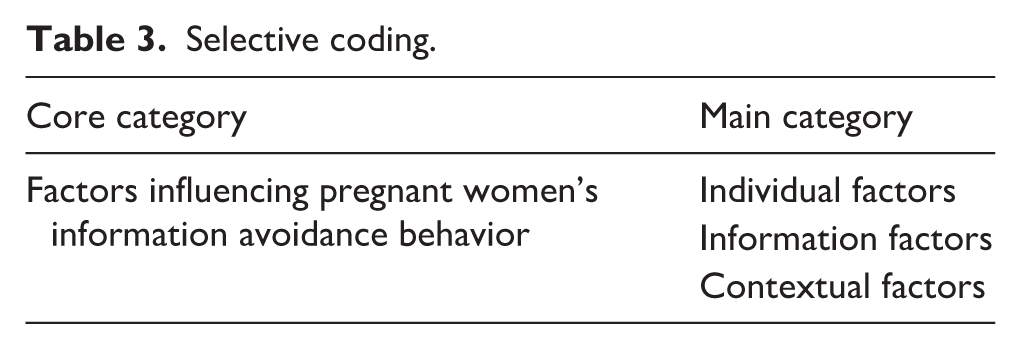
Selective coding, the third stage of the coding paradigm, systematically analyzes initial concepts and categories following the preceding two coding phases. This process integrates the data into broader, overarching core categories, ultimately leading to the development of a conceptual framework. Selective coding integrated the major categories around a central core category, facilitating the construction of an explanatory model for information avoidance behavior among pregnant women. The outcomes of this coding phase are presented in Table 3.
Selective coding.
Theoretical saturation tests
Grounded theory advocates saturation testing after model construction. In order to ensure the validity and objectivity of the research results, 10 samples were randomly selected for coding and analysis prior to model development. In addition, two extra samples were independently coded by peer researchers to assess whether theoretical saturation had been achieved. The analysis showed no new concepts or categories emerging from the final two samples, indicating that theoretical saturation was reached.
Constructing a model of factors influencing information avoidance of pregnant women
The findings of this study indicate that pregnant women’s information avoidance behavior can be categorized into three main groups: individual factors, information factors, and contextual factors. These factors jointly influence the information avoidance choices of pregnant women in China.
Individual factors
Pregnant women’s pregnancy cycles, family situations, and living habits affect their choice to avoid and actual avoidance of information. Individual factors in this study include the seven subcategories of the pregnancy cycle, economic factors, emotional factors, living habits, personal cognition, health factors, and physical factors.
Pregnancy Cycle: Culturally Mediated Temporal Dynamics The pregnancy cycle manifests distinct information avoidance patterns shaped by China’s “Baotai culture” (fetal preservation culture). Multiparous women exhibit experiential normalization—as described by S2, early miscarriage concerns in first pregnancies give way to culturally sanctioned self-monitoring (“quietly staying in bed”), reflecting internalization of “downplaying issues” norms. She said: “When I was pregnant with my first child, any early signs of miscarriage—like bleeding—would make me panic. I'd desperately search for answers. But now, during this pregnancy, when I noticed some bleeding a few days ago, I just stayed calm, rested at home, and it resolved on its own. This time, I didn't overthink it—I simply let it go.” Primiparous women demonstrate stage-dependent vigilance: first-trimester anxiety (consistent with the Chinese tradition of “concealing early pregnancy” transitions to second-trimester openness, mirroring the cultural practice of “announcing Ximai” (a traditional Chinese medicine term for the pulse characteristics observed during pregnancy, i.e., announcing pregnancy after stability). In the first-trimester anxiety stage, there are more kinds of information for them to avoid. However, as the pregnancy progresses into the second stage, they are less concerned about these restrictions. This temporal pattern aligns with the Confucian “going with the flow” philosophy in perinatal care.
Economic Factors: Familial Financial Face-Saving Financial information avoidance operates through the Chinese tradition of “family shame concealment” mechanisms. Some pregnant women, due to low family income, face significant financial pressure during pregnancy. S7’s avoidance of low-income discussions exemplifies collective burden minimization, where women shield their families from financial “loss of face.” She said: “With our household's 6,000 RMB monthly income [≈2025 USD 835] and me being unemployed, I have stopped opening hospital cost statements.” S6’s education cost avoidance reflects the “only-child pressure” phenomenon, where anticipated intergenerational educational investments trigger pre-emptive ignorance—a behavior academia links to urban middle-class “tiger-parenting anxiety.” She complained: “Like most Chinese parents, we have high hopes for our child's education—but it's also a huge financial burden. Just thinking about the costs frustrates me. As my mother-in-law says, 'Out of sight, out of mind'.” Notably, most of the participants we interviewed practiced selective financial avoidance, deliberately overlooking certain expenses to preserve family harmony.
Emotional Factors: Emotional Labor Chinese pregnant women exhibit pronounced information avoidance behaviors when experiencing negative emotions, a phenomenon amplified by sociocultural expectations. The imperative to maintain a radiant complexion of pregnancy (pregnancy bliss)—a culturally valorized sign of auspicious maternal health—compels many to suppress depressive or anxious feelings. This emotional labor manifests in proactive information avoidance, particularly when content threatens to disrupt psychological equilibrium or familial harmony. Participant S8′s coping strategy exemplifies how avoidance functions as cultural emotion work: “When the doctor mentions postpartum risks, I pretend to note them but later avoid the handouts. My mother says good mothers do not dwell on such ill-omened topics - it disturbs the baby's joyful aura.” Over two-thirds of respondents pre-emptively avoided fetal gender-related information to circumvent distress linked to son preference—a strategic evasion of patriarchal discourse. The findings underscore how collectivist norms weaponize emotional suppression, transforming pregnancy into a performance of biopolitical compliance.
Living Habits: Confucian-Postmodern Dissonance. The inertia of living habits during the transition to motherhood reveals a fundamental tension between entrenched cultural scripts and contemporary individualism. Our findings show how pregnant women navigate this dissonance through strategic information avoidance, particularly when confronted with behavioral prescriptions that challenge their pre-pregnancy identities or autonomy. Pregnant women often avoided information that required disruptive lifestyle changes. The case of S1 exemplifies this conflict: “When my husband cites 'Taboo Foods for Expectant Mothers' saying 'a virtuous wife avoids cold foods for fetal health,' I feel controlled. Sometimes I deliberately order spicy crayfish and have cold drink while pretending not to hear him - it is my way of keeping myself sane.” This performative disregard (Zou and Han, 2017) challenges traditional Confucian Dao of wifely compliance while asserting what participants termed “pregnant privilege”—a temporary license for self-indulgence. Urban participants who continued smoking engaged in pre-pregnancy identity preservation, systematically avoiding cessation information. This reflects resistance against the Confucian maternal model for all under Heaven (mother-as-saint) archetype prevalent in collectivist discourses.
Personal Cognition: Rural-Urban Epistemic Divide Personal cognition refers to the cognitive structure of pregnant women. They sometimes choose to avoid information that conflicts with their own existing beliefs or experiences in their working life (Smith et al., 2008). In particular, much of the information avoided during pregnancy tends to be health-related, including advice about diet, medical procedures, or conflicting recommendations from professionals and family members (Hashmi et al., 2024). Health information literacy disparities manifest in tensions between experiential medicine and modern medicine. Rural housewife S2’s elder-preference (“trust older generation’s experience”) exemplifies rural elders’ wisdom epistemology, whereas urban educated S1’s proactive learning aligns with scientific childbirth movements. Rural participant S2’s assertion—“When medical advice conflicts with elders' experience, I trust those who lived through it”—epitomizes the generational knowledge preference prevalent in rural communities. This contrasts sharply with the much lower information avoidance rates of urban, educated women, which are attributable to their enhanced health literacy and greater capacity to reconcile conflicting information through critical evaluation skills.
Health Factors: Cultural Logics of Risk Avoidance. Chinese pregnant women’s health information avoidance is fundamentally shaped by “auspicious health beliefs,” which is a Taoist-Confucian synthesis prioritizing psychological comfort over medical absolutism. It manifests through culturally specific mechanisms of moderation doctrine in medical compliance and delivery room taboos.
Moderation Doctrine in Medical Compliance S2’s rejection of stringent glucose standards (“6.1 is too harsh”) exemplifies golden-mean medicine, where women balance biomedical advice with cultural notions of “avoiding excess.” S2 argued, “The 6.1 standard feels too strict—I check sometimes, but will not obsess. My mom never tracked hers, and we are fine. If it feels wrong, I will skip it.” As documented in traditional Chinese texts, extreme interventions violate fetal harmony principles.
Delivery Room Taboos Avoidance of birth process knowledge (“I skip over it”) reflects deeply embedded “blood-light disaster” superstitions. Women actively curate purified information ecology, censoring depictions of labor pain and congenital disabilities to maintain pregnancy bliss aura—a practice validated by elders’ admonitions to dwell not on inauspicious matters. S2 said: “I actively avoid birth videos—not just from fear, but because dwelling on pain seems to invite misfortune. My aunt says a calm mind ensures an easy delivery, so I focus on positive stories instead.” The avoidance behavior of birth-related content is intensified by “blood-omen cosmology,” manifesting as spatial taboos (avoiding funeral sites/old delivery rooms), actively filtered words like “dystocia” or blood-red infographics, and ritual neutralization (e.g. carrying Taoist “fetal talismans” (antai fu) during ultrasounds to counteract visual “pollution”).
Information factors
The information avoidance practices of Chinese expectant mothers are profoundly shaped by culturally embedded health concepts specific to Chinese society. A marked preference for authoritative sources (information characteristics) emerges, reflecting the Confucian “prudent discernment of knowledge,” while the deliberate avoidance of contradictory or distressing information serves to preserve “mental tranquility.” This tendency intensifies when confronting the deluge of inconsistent guidance on prenatal care and dietary regimens—a phenomenon participants described as paralyzing. S2’s account encapsulates this dynamic: “There was no standard answer, and so many conflicting opinions. The information was too overwhelming, inconsistent, and unreliable, which was the biggest challenge. It often made me frustrated. In the end, I just stopped looking.” Such behavior, reflecting the impacts of information characteristics and information utility, aligns with traditional Chinese medicine’s prioritization of “peace of mind” above exhaustive information engagement, while paralleling Case et al.’s (2016) documented patterns of defensive avoidance in Western contexts.
The culturally sanctioned imperative of “nurturing mental tranquility” reconfigures avoidance from passive withdrawal to active self-preservation, especially when mediating tensions between biomedical protocols and ancestral practices such as postpartum confinement.
Contextual factors
Pregnant women’s information avoidance behavior is deeply embedded in China’s socio-cultural fabric, where traditional childbearing norms intersect with modern realities across three key spheres: society, family, and work.
Social factors Pregnant women’s information avoidance in China reflects the “Cha Xu Ge Ju” (differential mode of association) observed in Chinese social networks, where trust and information behavior follow concentric life circles (Wang et al., 2025). Within this framework, women prioritize advice from insiders in their core life circle (life in the round), such as family doctors and close friends, while actively filtering out peripheral information sources. As S31 noted: “I have not binge-watched childbirth videos online. When discussing this with Teacher Qi, he advised against over-researching and suggested it is better to simply proceed with delivery without overthinking it. I do not want to add unnecessary stress to myself.”
The COVID-19 pandemic intensified this pattern, with pregnant women demonstrating circle-based avoidance—disproportionately rejecting pandemic information from outer life circle while accepting curated updates from personal physicians (core life circle). This behavior aligns with Fei’s classic observation that Chinese social cognition operates through familiarity-based trust rather than abstract information systems.
Family factors of pregnant women mainly include family structure, member relationship, partner, education level of members, gender of the fetus, and family conflicts. Of all contextual influences, family dynamics constitute the most pivotal dimension, wherein interpersonal conflicts exert a profound detrimental effect on maternal psychological well-being. Such discord frequently triggers emotionally-driven information avoidance patterns—often manifesting as seemingly irrational rejection of clinically relevant prenatal guidance—as women prioritize emotional self-preservation over informational engagement.
Among these family factors, family structure, partner relationships, and family conflict exert the most pronounced influence on information avoidance behaviors. A prevalent custom sees maternal or paternal grandmothers moving in with expectant couples following conception, fundamentally altering the household composition from a nuclear dyad to an intergenerational arrangement under the justification of offering superior nurturing and assistance during the gestational period. Within this new living dynamic, traditional cultural values often intensify interpersonal tensions. Specifically, when elders express son-preference idioms rooted in patriarchal norms—such as allusions to continuing the family line, most of the participants reported strategically avoiding gender-related discussions to preserve family harmony. This avoidance behavior serves as a coping strategy against the disruption of the household’s originally harmonious relationships, particularly when prenatal screenings suggest a female fetus, ultimately leading pregnant women to avoid child-gender-related information to maintain domestic equilibrium selectively.
A predominant number of pregnant women reported profound dissatisfaction with their spouses, rooted in partners’ adherence to “the husband as wifely guide”—a Confucian tenet that often manifests as emotional detachment and a lack of practical participation in prenatal care. While husbands typically expressed verbal approval of the pregnancy, their refusal to adapt daily behaviors—such as sharing household responsibilities or attending prenatal consultations—was perceived as a reinforcement of male chauvinism, provoking resentment and intentional disregard of their opinions on health matters. Furthermore, this spousal dynamic often extended to the larger family context, where multiple interviewees reported being at odds with their families during pregnancy. The many demands placed on them by their families—often framed through traditional expectations like family rules—would cause them to avoid pregnancy-related information instinctively as a means of reducing interpersonal conflict and preserving emotional equilibrium.
Work-related decisions during pregnancy—including continued employment versus leave and exposure to specific job risks—are deeply interwoven with traditional Chinese beliefs about “fetal preservation” and maternal responsibility. Many women experience acute tension between the Confucian ideal of “becoming strong as a mother” and the practical demands of their professional roles, which leads to culturally-framed avoidance strategies. Some opt for early leave or resignation, not only due to physical strain but also in response to familial pressures rooted in nurturing the fetus by maintaining calm—a practice believed to prevent “fetal fright.” However, this withdrawal often triggers financial anxiety and future career concerns, ironically heightening stress.
Those who continue working, particularly in high-risk professions such as healthcare, report significantly elevated health-related concerns. As S4, a doctor, noted: “During the pandemic, performing CT scans on COVID-19 patients, I was terrified—but I had to suppress my fear to do my job. I avoided thinking about the risks to my baby just to function professionally.” Consequently, many engage in purposeful information avoidance to mitigate the psychological dissonance arising from competing obligations, filtering out occupational hazard information to balance societal expectations of maternal sacrifice with professional identity.
In this research, the information avoidance behavior of pregnant women was investigated through the grounded theory approach, and the final model of influencing factors was established (as shown in Figure 1), which implies three main categories: individual factors, information factors, and contextual factors. These three main categories have a significant influence on pregnant women’s information avoidance. Importantly, these categories do not operate in isolation; rather, they are collectively structured and permeated by the Chinese sociocultural context, which functions as an overarching condition shaping the meaning and operation of each factor.
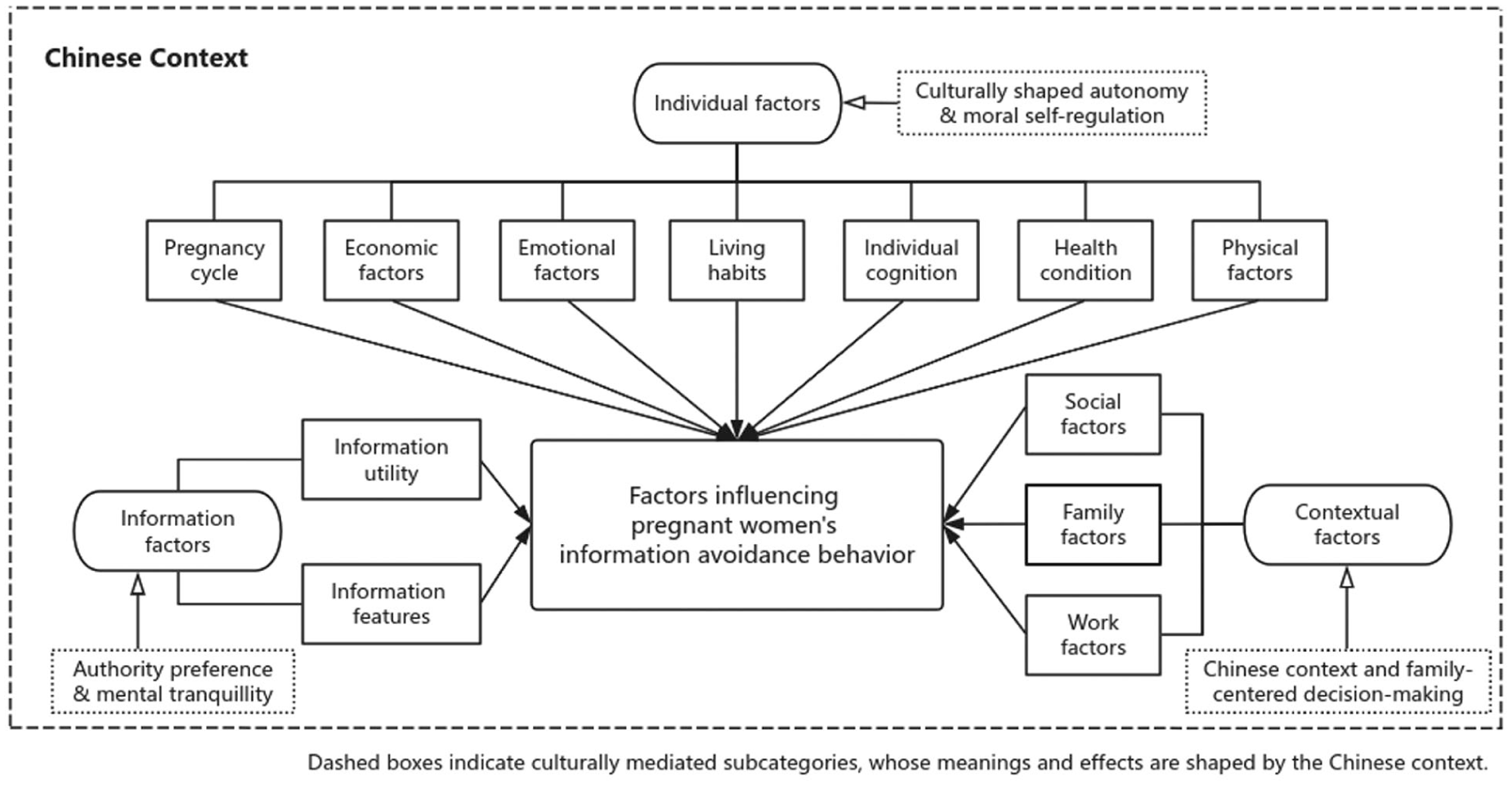
Factors influencing information avoidance behavior of Chinese pregnant women.
Research implications
Pregnant women perspective
Initially, when information may cause psychological discomfort to pregnant women, they can use diversion to avoid negative information and prolong positive emotions (Smith et al., 2025). However, the findings suggest this avoidance is not merely a coping tactic but an active strategy to preserve emotional equilibrium—what participants described as maintaining “mental tranquility” (xin’an) for the sake of fetal well-being. Additionally, after becoming pregnant, women inevitably experience changes in their exercise habits, dietary practices, and daily routines (del Campo Giménez et al., 2024). The forced adjustments to these habits can be a source of distress for many pregnant women. Information that excessively restricts their behavior can make them hesitant to do what they want, leading them to avoid such information in order to prevent negative emotions. Family members should convey relevant information to pregnant women in a gentle manner. However, due to unfamiliarity with current medical guidelines for pregnancy, it is critical for family members to seek reliable sources or consult professionals before offering advice.
Information service platforms perspective
Information services should be more humanized, and website service providers should build a service-oriented system for pregnant women that is applicable, easy to learn, and friendly. This is needed because a systematic review found that online pregnancy-related resources are often fragmented and misaligned with women’s actual information needs across different stages of pregnancy (Lu et al., 2022). Rather than implementing speculative technical solution such as AI-driven content tagging, platforms should prioritize user-controlled boundaries based on actual avoidance patterns observed in qualitative interviews. Information platform interfaces should allow users to opt out of entire categories of content frequently avoided by participants—such as fetal gender disclosure, detailed cost estimates, graphic birth narratives, or discussions of congenital anomalies. To prevent information overload from causing cognitive fatigue in pregnant women, information platforms should limit content distribution to prevent meaningless spam and excessive posting, thereby avoiding the distress caused by a large volume of information being pushed to pregnant women.
Context perspective
Recent qualitative research highlights that throughout pregnancy, family relationships significantly shape women’s capacity to exercise autonomy and negotiate lifestyle choices (Lafont et al., 2025). In the Chinese context, this dynamic is deeply embedded in Confucian-influenced familial ethics, where maternal health is not viewed as an individual concern but as a collective responsibility tied to “family harmony” and intergenerational continuity. In this context, family members of pregnant women should become cultural brokers: translating medical advice into family-acceptable narratives. Interview accounts reveal that such translation is most effective when it frames recommendations using concepts that emerged organically in participants’ discourse—such as “protecting the fetus” (“baotai”) or “maintaining family harmony.” This study shows that while many pregnant women find certain unsettling information online, they are more likely to accept it if it is conveyed by close individuals. Additionally, some traditional Chinese childbirth customs, such as confinement in childbirth (Zuo Yuezi), may not be suitable for every pregnant woman. A nationwide survey in China revealed that many postpartum women adhere to restrictive confinement practices—such as avoiding bathing, outdoor activity, or sun exposure—not based on medical advice but primarily due to recommendations from parents or in-laws (Qin et al., 2020). Existing studies in China have shown that such practices are widely observed but often conflict with modern health recommendations (Chen et al., 2008). Crucially, resistance to scientific guidance frequently stems not from ignorance, but from the prioritization of culturally sanctioned care rituals over individualized clinical advice—a tension rooted in China’s collectivist health ethos. Family members should approach the care of pregnant women based on modern scientific principles of childbirth while respectfully negotiating, rather than dismissing, these cultural logics. Many pregnant women mentioned in conversations that their husbands were not attentive enough during pregnancy, so “husband engagement programs” teaching emotion-sensitive information sharing should be launched. Such programs should emphasize not only increased involvement but also the importance of recognizing when silence or redirection—not additional information—is the appropriate response to expressed anxiety.
Conclusion
Information avoidance represents a significant and growing concern within information behavior research (Hicks et al., 2025). While prior studies have established important baseline understandings of gestational information avoidance—primarily in Western, individualistic settings—they have systematically neglected the profound ways in which China’s unique sociocultural configuration structurally reorganizes the determinants, manifestations, and lived experience of this information behavior. This study employed a grounded theory approach to qualitatively investigate the multilevel influencing factors of information avoidance among Chinese pregnant women—a vulnerable population navigating intersecting pressures from familial, medical, and societal systems under the influence of pervasive cultural norms such as Confucianism, fetal preservation culture (Baotai), ritual taboos, and gender-based expectations.
Our findings delineate 12 distinct impact factors of information avoidance, categorized across individual, informational, and contextual dimensions. These are not isolated influences but interact within a culturally saturated system that amplifies and particularizes avoidance behaviors. Typically, information avoidance operates through culturally mediated temporal dynamics across the pregnancy cycle; financial information avoidance is refracted through the preservation of “familial face”; emotionally triggered avoidance is structured by the cultural imperative to perform “pregnancy bliss”; and biomedical information avoidance is legitimized through doctrines of Taoist-Confucian moderation and mental tranquility. Finally, socially and familially motivated avoidance should be understood within Fei’s framework of Cha Xu Ge Ju (differential mode of association), where information avoidance is contingent on relational proximity, intergenerational authority, and patriarchal structures.
Theoretically, this research extends existing information avoidance models by incorporating culturally embedded constructs. We demonstrate that information avoidance behavior among Chinese pregnant women is not merely a psychological response but a culturally strategic practice. In essence, it is a culturally embedded information practice—deeply rooted in sociocultural structures and collective norms (Savolainen, 2008). These insights necessitate a redesign of public health information services and prenatal communication strategies. To be effective, interventions should move beyond individual patient education and directly engage deeply with family dynamics, cultural health beliefs, and socio-structural constraints.
In sum, this study contributes a nuanced, context-rich theoretical model that categorizes the cultural specificity of information avoidance, offering insights into culturally resonant support practices aimed at safeguarding maternal well-being in an increasingly complex information landscape. While canonical definitions of information practice (Savolainen, 2008) often foreground information seeking and use, our findings posit that information avoidance—due to its deeply socially embedded and culturally legitimized nature—constitutes a strategic form of information practice in its own right. As Hicks et al. (2025) argued, information avoidance should be regarded as a significant practice that moderates the information interaction. In this sense, our research highlights the value of adopting an information practice lens, which helps to illuminate how information activities are not just individually enacted, but collectively structured and reproduced within specific sociometrical contexts (Lloyd and Olsson, 2019; Pamela J. McKenzie, 2003a; Savolainen, 2008).
Data for this study were collected during the COVID-19 pandemic. While the pandemic temporarily strained healthcare resources, China’s rapid control measures and the widespread adoption of online consultations allowed for continued access to healthcare. Although the pandemic likely intensified information avoidance behavior in the short term—due to heightened anxiety and disruptions in the availability of in-person medical consultations—it did not result in a structural change in the factors influencing information avoidance behavior.
The research has some limitations. First, the qualitative interview, though rich in depth, involved a relatively homogeneous sample of urban pregnant women. This limits the generalizability of the findings to more diverse populations. Future studies should employ stratified sampling to include underrepresented groups (e.g. disabled populations, high-risk pregnancies). Secondly, the reliance on self-reported data introduces recall bias. Complementary methods such as observational studies or digital trace analysis could provide more objective behavioral measures. Furthermore, the current model identifies key factors but does not establish their relative weights. Subsequent quantitative research using structural equation modeling could test the proposed relationships and develop a more predictive framework.
Footnotes

Ethical considerations
This study was deemed exempt from ethics approval under the guidelines of the Department of Information Resources Management at Tianjin Normal University. The determination was based on the study involving minimal risk to participants, using only fully anonymized interviews, and collecting no identifiable personal data, thereby ensuring complete anonymity and confidentiality for all participants.
Funding
The authors disclosed receipt of the following financial support for the research, authorship, and/or publication of this article: This research was supported by the National Social Science Fund of China (Key Project: “Health Anxiety and Intervention Strategies among Information-Poor Groups under the Healthy China Strategy”) and Leading Talent Cultivation Grant in Philosophy and Social Sciences Planning of Zhejiang Province "Information Behavior of Online Health-Anxious Populations in the 'Healthy China' Context"
Declaration of conflicting interests
The authors declared no potential conflicts of interest with respect to the research, authorship, and/or publication of this article.
Data availability statement
Anonymized interview data are available from the corresponding author upon reasonable request, subject to ethical and confidentiality considerations.